




Abstract
Since 1976, the U.S. Department of Housing and Urban Development (HUD) has relocated low-income children of color from public housing communities to less racially and economically isolated neighborhoods in an effort to improve their developmental opportunities. This article provides the first comprehensive evaluation summary of seven relocation programs and the reasons why six of them failed to replicate the educational successes of the inaugural Gautreaux program. The author argues that children were not able to convert potentially greater opportunities to learn into educational success after they resettled due to four complications, including an absence of threshold effects in destination neighborhoods, the existence of cultural discontinuities, incompatibilities between HUD and educational policy and between educational institutions, and the uncertain relevance of neighborhoods and schools as sites of educational production.
Keywords
The persistent problem of educational inequality led Congress to address school-related determinants of racial and socioeconomic differences in achievement with the No Child Left Behind Act of 2001. Nearly a decade later, Black-White gaps in NAEP mathematics performances are still between 25 and 28 points, as they have been since 1990, while the Hispanic-White gap stands at 16 (Rampey, Dion, & Donahue, 2009). This reality implies that a significant portion of these test score gaps extend from differences in the social background of children that impinge on learning at a time and place beyond the reach of school accountability policies. Limits in the ability of family socioeconomic differences to account for disparities in learning are also beginning to appear quite consistent within research. For example, after accounting for social class differences, major national longitudinal studies rarely explain more than a half standard deviation unit of the Black-White dissimilarity in mathematics (Brooks-Gunn, Klebanov, Smith, Duncan, & Lee, 2003; Fryer & Levitt, 2005; Magnuson & Duncan, 2006). In short, the schools and relative socioeconomic status (SES) of underrepresented families are not the only social factors responsible for gaps in achievement.
It makes sense that researchers and policymakers would eye suspiciously the composition of children’s neighborhoods as likely contributors to educational inequality because high rates of economic segregation (Massey & Fischer, 2003; Swanstrom, Ryan, & Stigers, 2006), concentrated poverty (Jargowsky, 1997; Kingsley & Pettit, 2003), and urban unemployment (Mincy, 2004) continue to characterize U.S. metropolitan areas. African American and Hispanic children are overrepresented in racially segregated and impoverished inner-city areas (Acevedo-Garcia, McArdle, Osypuk, Lefkowitz, & Krimgold, 2007). Disparities in the spatial concentration of SES mirror those in test-taking (Donahue, Daane, & Jin, 2005; Mead & Sandene, 2007) and educational attainment (Holzman, 2004) between children located in the educationally underserved inner city and higher performing urban fringe. Hence, disrupting the correspondence between location and opportunities to learn with programs that move disadvantaged families to higher resourced neighborhoods may lessen achievement inequality. In this review, I assess the results of programs initiated by the U.S. Department of Housing and Urban Development (HUD) with just this aim.
Our nation’s growing investment in relocation programs—as a way to increase residential and educational opportunity for children—is an additional motivation for this review. Since HUD began moving public housing residents out of segregated high-rise communities through the Gautreaux Assisted Housing Program, the number of such programs has grown, including two large-scale multicity programs. Authorized by Congress in the early 1990s with appropriations that have since then totaled $70 million and $6.7 billion, respectively, the Moving to Opportunity for Fair Housing and Housing Opportunity for People Everywhere (HOPE VI) represent the nation’s largest investment in the idea that residential opportunity can lead to social mobility for lower income families and their children. In light of the aforementioned social problems and these significant policy responses, a comprehensive review of these programs’ impact on the educational performance of children who tend to be African American, Hispanic, and especially poor has great social and policy significance.
Yet another reason why a review of these program outcomes is worthwhile is that there are some questions, often posed by researchers, about how children respond to social change that are best informed by interventions such as these. Researchers seldom get parents’ consent to carry out interventions that significantly alter the environments of children. Studies of school desegregation programs (Armor, 2002; Crain & Mahard, 1978) and school reform initiatives (Carlson, Borman, & Robinson, 2011) have included changes in children’s learning environments and therefore come the closest to the type of evaluation typical of relocation programs. However, without having changed the non-school conditions to which children are exposed, evaluations of desegregation and comprehensive reform programs have not accounted for disparities in the broader geography of opportunity. Relocation programs, in contrast, account for variation among key social background characteristics through a random selection of families, a controlled selection of destination neighborhoods, and, in some cases, the random assignment of families to them thereafter.
Finally, this review is timely in that it is the first to systematically assess the educational results that followed the implementation of seven different programs enacted in 12 different cities. Meta-evaluations of three or more programs have been conducted with other individual-level outcomes in mind, such as health (Acevedo-Garcia et al., 2004, Jackson et al., 2009), safety, employment, and social networks (Goetz & Chapple, 2010; Varady & Walker, 2003), and others have interrogated the theoretical (Briggs, 1997; Sampson, 2008) and methodological (M. P. Johnson, Ladd, & Ludwig, 2002; Sobel, 2006) suppositions of housing mobility programs in general. Meta-evaluations that address education typically consider other social outcomes and consequently do not address it in as much detail as done in this review. Although building on numerous reviews of experimental programs, Briggs (1997), in particular, stands out as a point of departure. In his critical review, Briggs questioned whether relocation programs delivered on their promise to provide opportunity, noting that greater access to low-yielding associations and low-wage jobs in different locales did not constitute better neighborhoods or more opportunity. I extend his line of thinking in this review by identifying the issues that complicated children’s conversion of potentially greater opportunities to learn in destination neighborhoods into better educational outcomes. I begin the review with a description of the review methodology.
Method
Selection of Studies
My process of locating relevant studies began with a keyword search of computerized databases. To identify evaluations of relocation programs, I used the key words mobility, Gautreaux, housing voucher, Moving to Opportunity, relocation, Yonkers, Hope VI, urban, and Section 8. Education, achievement, attainment, schooling, graduation, test-scores, learning, choice, and dropping out were included among the education search keywords. These keywords were entered in the online databases (e.g., Social Science Citation Index) in various combinations. The database search generated 4,236 references.
Selection criteria
I next developed and applied some conditions for the selection of studies. Most selection criteria followed closely from the review’s guiding interests and others emerged as necessary standards of selection during the review of the references and abstracts. After eliminating repeated references (which amounted to a 37% reduction in the number of entries), my research team removed references to dissertations, book reviews, journal commentaries, newsletters, and magazine articles. These initial decisions reduced the rather large number of potential studies to a count conducive to a publication abstract review process. We applied two additional conditions during the abstract review process to eliminate less relevant studies. These conditions required that each evaluation examine a relocation program and have participants of school age. Applying these criteria resulted in a sample of 89 studies.
Snowball selection of studies
From this point, we used the references of the 89 studies to identify others that were not obtained through the computerized database search. This process netted 54 additional studies, most of which were conference/working papers, chapters in edited volumes, agency reports, and briefs. Once located through a Google search, abstracts of these studies were read and cross-referenced with those identified through the database keyword searches. We added these studies to the list of acceptable evaluations if their research contents were not identical to that of an already identified journal article. The application of the database and snowball search criteria was carried out by two individuals to establish intercoder reliability. Any discrepancy in the application of these selection criteria was resolved in conference.
Final selection
The remaining studies were read in their entirety and included in the final sample if they satisfied one additional condition. Studies had to compare the post-move educational experiences of children (a) to their prior educational performance, (b) to children that did not move, or (c) to those that moved to categorically different environments. The final study pool included 27 evaluation studies of seven different programs: Gautreaux Assisted Housing Program, Cincinnati Special Mobility Program, Yonkers Family and Community Project, Minneapolis Special Mobility Program, Gautreaux II, Moving to Opportunity for Fair Housing (MTO), and the Housing Opportunities for People Everywhere (HOPE VI).
HOPE VI differs from the other tenant-based relocation programs in this review because it awards grants to cities—by 2010, 648 of them to 193 cities—to carry out community revitalization efforts (HUD, 2011). Once a community is revitalized, the previous public housing residents have a chance to return. Despite the implication that HOPE VI only temporarily displaces families, I have retained its evaluations in this review for several reasons. First, the overwhelming majority of residents will not return to the redeveloped sites due to the low number of units reserved for public housing residents (Goetz, 2004). Second, most closure and revitalization processes have taken a decade or longer (Pattillo, 2007), which provides more than enough time for a child to develop in a second context. Third, HOPE VI requires housing authorities to offer supportive services to help displaced residents relocate and attain self-sufficiency (Gallagher & Bajaj, 2007). Last, although better temporary housing was not expressly sought for displaced families, HOPE VI targeted only the most structurally deficient high-rise communities for demolition. Thus, most displaced families experienced upwardly mobile moves, often with the benefit of a voucher (Popkin, 2010). The characteristics of these evaluations are summarized in Table 1.
Summary of urban relocation program effects in education

Note. All reports of differences are significant at the .05 level or lower unless noted as interview findings. CTBS = California Test of Basic Skills; MFT = Maryland Functional Test; WJ-R = Woodcock-Johnson Revised.
Analytical Method
The final group of studies was reviewed for consistent themes about the programs’ impact theory, program and evaluation results, and the program characteristics that were proffered to explain those outcomes. In the initial step, I set out to understand each program’s theory, or how it would ideally function to achieve the desired outcomes (Rossi, Lipsey, & Freeman, 2004). Although a program theory may provide a fairly comprehensive view of the program conditions, units of analysis, and social processes that enable learning, evaluation studies are rarely able to assess every aspect of the program theory or other unmentioned mediators of program outcomes. Therefore, the program theory summary does not provide an identical set of constructs with which to assess each program. It does, however, provide a point of contrast for the review of program results and the program developments that may have confounded aspects of the program theory. The synthesis of these program theories is reflected in Figure 1.
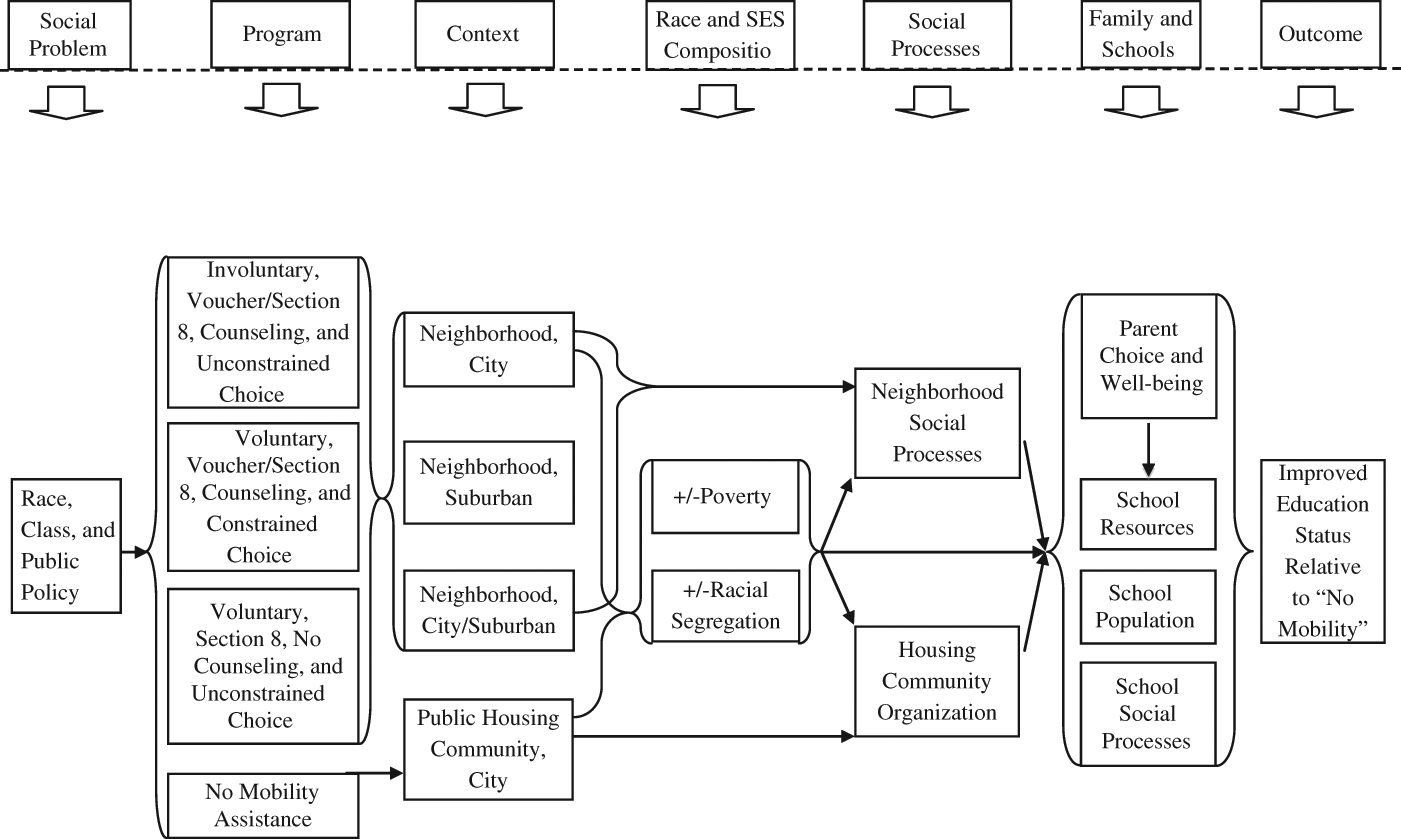
Relocation program theory. SES = socioeconomic status.
In the second step, I explored the program and evaluation designs, family enrollment decisions, educational experiences, and outcomes. It was more appropriate to use the program as the unit of analysis in this section of the review as the constructs examined throughout the evaluations were quite diverse and because doing so provided a more complete picture of each individual program. Table 1 contains summaries of key aspects of the evaluation studies and provided the organization for this process.
In the last step, I considered key program developments that researchers cite as possible reasons for differences between the hypothesized and actual program outcomes. This process revealed four leading complications that prevented children from translating closer proximity to opportunities to learn (OTLs) into educational advancement. Consequently, I argue that to be successful, programs must overcome the educational policy mismatches, challenge of replicating threshold effects, cultural incongruities of endogenous membership, and the uncertainty of how neighborhoods and schools work.
There are, however, some parameters of the review that should be established at its start. First, the small number of relocation programs that HUD has enacted reduces the likelihood that other sampling criteria would yield a substantially different pool of evaluations. Nonetheless, some studies may have become available during the later stages of this work and been unknowingly excluded. A second caution arises from the variability across the programs in design and development. Study differences should play a vital role as we form opinions about relocation programs. Third, as the assessment of these programs is ongoing, other advantages or disadvantages of program participation may be shown in future evaluations and as participants reach adulthood. At that time, a review can be approached with different questions and methods in mind. Future reviews will likely add to, or further qualify, the conclusions that have been reached in this and other reviews.
Program Theory
Race, Class, and Public Policy
Understanding the program theory begins with the identification of the dynamics of race, social class, and public policy that justify a program intervention (Figure 1, Column 1). For starters, the economic status of urban communities of color began a dramatic change for the worse four decades ago. A decline in the number of blue-collar jobs, the suburbanization of job growth, and technological advances undercut the demand for less-skilled labor (Kasarda, 1976), which in turn increased the isolation of urban residents and their unemployment (Wilson, 1987, 1996). Middle-class African Americans were encouraged by these changes to leave the inner city and form more exclusive enclaves on the urban fringe (Pattillo, 1999). Subsequently, the number of neighborhoods with poverty concentrations exceeding 40% doubled from 1970 to 1990 (Jargowsky, 1997) and have remained well above their pre-1970 levels since that time (Kingsley & Pettit, 2003).
Our nation’s racial structure and historical commitment to the ghettoization of African Americans also played an inexcusable role in sustaining urban poverty (Galster & Hill, 1992; Massey & Denton, 1993; Wacquant, 1997). Racial segregation requires African Americans, who continue to be significantly less prosperous than the other major racial/ethnic groups, to live together, creating impoverished neighborhoods whether or not a representative proportion of the Black middle class resides in them. Hyper-segregation remains a reality for the majority of African American and Hispanic children living in the 100 largest metropolitan areas in the United States, where average segregation dissimilarity rates stand at .72 and .56, respectively (Acevedo-Garcia et al., 2007), with a score of 1.00 indicating complete racial isolation.
Racial and social class concentrations purportedly led to a general decline in the social milieu of the inner city, permitting the onset of norms among youths that appeared inconsistent with social mobility. Crane (1991), for example, found high school drop-out rates increase as the neighborhood percentage of higher status residents falls to extremely low levels. Others point out that inner cities have fewer social resources for children, including role models to emulate or adults capable of sponsoring them effectively as they navigate the educational system (O’Connor, 2000). Consequently, youths’ low aspirations may be a response to their frequent observation of less successful adults within areas of concentrated poverty (MacLeod, 1995; Wilson, 1996). This line of thinking also links neighborhood racial isolation to urban educational decline because youths in segregated areas purportedly develop an “oppositional” orientation toward schooling as a way of expressing their rejection of the institutions and values of their White “oppressors” (Massey & Denton, 1993, p. 167). To the extent that these orientations exist, they are only compounded by the lower quality of public schools in disadvantaged communities of color. Urban schools often have less qualified teachers (National Center for Education Statistics, 2006; Wirt et al., 2004), lower average student achievement scores (Donahue et al., 2005; Orr et al., 2003), fewer resources (Bifulco, 2005; Lee & Burkham, 2002), and a higher level of racial and social class concentrations than the neighborhoods in which they are embedded (Saporito & Sohoni, 2007).
The problems of racial and economic isolation were also assisted by the housing and transportation policies of federal, state, and municipal agencies (HUD, 1995). The Federal Housing Authority (FHA), for example, used maps to identify predominantly minority areas as ineligible for community investment and mortgage assistance, which ultimately made it difficult for Black neighborhoods to attract middle-class families (Wilson, 1996). Department of Transportation policies isolated largely minority areas with highway construction projects, while metropolitan transportation systems undercut the economic opportunity of inner-city families by neglecting to provide them access to suburban jobs (Mazmanian & Sabatier, 1989; Wilson, 1996). In addition, HUD supported local decisions to restrict the placement of public housing to marginalized neighborhoods and tenants of color to segregated public housing communities (Polikoff, 2006). HUD subsequently lost or reached settlement on several legal challenges to its placement of public housing and its tenants (Goetz, 2003; Pattillo, 2007). These legal settlements resulted in the initiation of five of the seven programs reviewed in this meta-evaluation and the formulation of their primary aim: to restore public housing recipients’ social and economic opportunity—including children’s opportunity to learn—by relocating them to less racially and economically isolated areas.
Relocation programs were not always initiated in response to litigation, however. Leadership changes in Washington, a growing concern about the economic consequences of urban poverty (HUD, 1995), and the generally favorable assessment of the Gautreaux program led HUD to pursue a large-scale multisite residential mobility program, MTO, and to deconcentrate the poor through the HOPE VI program.
Switching Contexts
Moreover, participants across all seven programs in this review experienced one of thes four programmatic groupings of the core components detailed in the second column of Figure 1. These features include the conditions of residents’ participation (i.e., voluntary, involuntary); whether residents received mobility assistance or not, and of what type (i.e., voucher, Section 8); and the amount of autonomy families had in selecting their destinations.
In the third column of Figure 1, and depending on the intervention program in which children participated, families that relocated switched from a public housing community to a neighborhood context, and often from the inner city to the suburbs. In this figure, public housing communities are thought of as separate from the neighborhood context because research suggests that children in public housing communities have few experiences outside of them (Shlay & Holupka, 1991). Though evidence about the benefits of public housing communities for low-income children’s learning relative to city neighborhoods is mixed (Currie & Yelowitz, 2000; Jacob, 2004), suburban contexts’ relatively fewer public hazards (e.g., traffic, blight, etc.) and lower population density (Chase-Lansdale & Gordon, 1996; Klebanov, Brooks-Gunn, Chase-Lansdale, & Gordon, 1997) might support youths’ cognitive development better than public housing communities and the inner city.
Of perhaps greatest interest to program planners and the courts were the racial and socioeconomic composition of the neighborhoods to which families would be moving (Figure 1, Column 4). In fact, neighborhoods were approved as possible destination sites only if they would constitute a significant reduction in the racial and/or social class isolation of those relocating. Regarding the importance of changes in neighborhood SES, researchers hypothesized that having working- and middle-class neighbors would increase low-income children’s educational achievement through their observation of a greater range of adult roles and learning behaviors in educational settings. Recent work has suggested that having higher income neighbors is one of the neighborhood features most consistently related to education outcomes in observational research (O. Johnson, 2010). If correct, this implies greater educational outcomes for youths that reside near higher income families relative to those living in public housing communities. Although the Gautreaux and Cincinnati programs made relocation contingent on the racial composition of neighborhoods, the close correspondence of neighborhood social class and race makes it hard to switch contexts on the basis of one without also experiencing a change in the other. Though a recent review finds that measures of neighborhood racial integration have both positive and negative associations with the education of African Americans (O. Johnson, 2010), early evaluations of the Gautreaux study heightened the perception that largely White neighborhoods and schools held an educational benefit rarely available in communities of color (J. E. Rosenbaum, 1991, 1995).
Relocation program theories also hypothesize that substantial differences exist in the social quality of the neighborhood and housing community contexts and that those differences would lead to relatively better social outcomes for arriving children (Figure 1, Column 5). Researchers have long argued that the true effects of neighborhoods lie in the geographically bound social processes that impact children’s day-to-day decision making and eventual adaptation to area norms (Ainsworth, 2002; Jencks & Mayer, 1990), including those about schooling and learning (MacLeod, 1995). For example, research has found positive linkages between a neighborhood’s (a) social capital and youths’ classroom engagement and test scores (Caughy & O’Campo, 2006; Darling & Steinberg, 1997), (b) social cohesiveness and adolescents’ perceived school efficacy and grades (Plybon, Edwards, Butler, Belgrave, & Allison, 2003), and (c) average level of peer support and preteens’ grade point averages (Gonzales, Cauce, Friedman, & Mason, 1996).
These neighborhood social attributes purportedly stand in contrast to those of public housing communities, which research has described as being highly organized and resourceful in combating social problems, but also as places of heightened fear (Venkatesh, 2002). The experience of violence, for example, is thought to lessen children’s feelings of safety and reduce adults’ willingness to supervise, report on, or intervene in the behavior of youths. Fear may lead to increases in the delinquency of youths and the school truancy of other children who wish to avoid conflict. Several studies in this area of research relate students’ perception of crime (Nash, 2002), their residency in areas with criminal activity (Madyun & Lee, 2008), personal threats and perceptions of delinquent behavior among their peers (N. Bowen & Bowen, 1999), and their feelings of safety and perception of neighborhood support (G. Bowen, Rose, Powers, & Glennie, 2008; N. Bowen, Bowen, & Ware, 2002) to lower school attendance and grades. For these reasons, the academic performance of children moving to neighborhoods should improve relative to those who remain in public housing communities.
Families and Schools
The program theory also considers the family context (Figure 1, Column 6) as a site where children’s opportunity to learn is negotiated by their parents. First, parents might better support the learning of their children if they were more economically successful and had improved mental health and higher-yielding social networks, among other key adult indicators of well-being. Program theories then hypothesize that children will benefit more from relocation if their parents also benefit. The second and perhaps greatest family feature of consequence to this review relates to the educational placement of children after relocation. All of the programs in this meta-evaluation included no restrictions on parents’ choice of schools for their children to attend. The program theory therefore relies on the inconvenience of remaining enrolled in schools further from a family’s new location and the better reputation of schools in the destination neighborhoods to induce parents to change children’s schools after relocating. In fact, given that open school enrollment policies were in effect at most program sites, children could have been facing long commutes to their school of choice before relocation. If program participants elected them, school transfers could have reduced transportation needs, traveling times, and the associated costs to lower levels than non-movers (J. E. Rosenbaum & Zuberi, 2010). Of course, these decisions would rely on other family-level dynamics, among them an understanding of differences in school quality, the availability of supervisory care for children outside of school, child transportation, and the educational needs and desires of their children.
The final theoretical component most directly related to learning considers the resources, demographic composition, and social processes of the schools. Although disparities in school resources dwindled during the latter quarter of the twentieth century, the per pupil expenditures of suburban school systems continued to exceed those of their city counterparts, amounting to as much as a 16-percentage point advantage for students in predominantly White schools (Bifulco, 2005). African Americans are the least likely of the major racial groups to attend majority White higher resourced schools (Acevedo-Garcia et al., 2007; Orfield & Eaton, 1996). Program participation would assist African American children in escaping elementary schools that rank lower on all 14 indicators of school quality measured by the Early Childhood Longitudinal Study (Lee & Burkham, 2002), among them, teacher qualifications, class size, the presence of gifted and talented programs, average student achievement, and teacher attitudes.
Lastly, the same social processes that represent the productive social machinery of neighborhoods also occur in schools (O. Johnson, 2008a). Consider the importance of children’s social capital to learning, for example. Since family income is positively related to achievement, the addition of higher income peers to the social networks of relocated children is likely to increase their exposure to higher performing children. This would be of greatest benefit in instructional settings where academically diverse peer groupings might enable educational spillovers—less advantaged children’s accumulation of knowledge about academic subjects and the educational system as they experience its transmission to higher income children (for whom it was intended). Spillovers of this sort are the processes that bring about the academic benefits of heterogeneity within instructional groupings (Dreeban & Gamoran, 1986), classrooms (Cooley, 2010), and among college peers (Sacerdote, 2001) for lower performing students.
Program Goals, Proximity, and Opportunities to Learn
The program theory represents how an OTL, secured by moving children to neighborhoods of the kind that have been found positively correlated with learning, can result in many educational advantages for children, relative to those that remained in high-poverty and segregated public housing communities. “Opportunity” in this case reflects the fact that program participation does not guarantee equal educational experiences, because the program theory components (i.e., teacher qualities, peer qualities, etc.) are beyond the direct control of the program functions. These programs instead restrict the residential options of movers to neighborhoods with levels of racial segregation and poverty below a certain percentage to increase children’s resettlement within proximity of those resources. Educational advantages are measured in the program evaluations as test scores, attainment, college going, educational standards, teacher support, curriculum placement, and integrated schools among other educational dimensions listed in Column 5 of Table 1. Although not all outcomes are direct measures of learning, they do reflect learning opportunities, since noncognitive outcomes, such as special education assignment, are certainly related to learning. OTLs are therefore defined in this review as the proximity to educational resources that residential mobility provides. We now turn our attention to the evaluation results and program developments that rely on this program theory.
Results
The Dwindling Promise of Gautreaux
All 27 of the evaluation studies in this review compare the educational experiences of children that have resided in at least two environments and after they have had between 4 months and 20 years to experience a second context. The majority of evaluations are quantitative and either report mean differences between treatment groups (e.g., movers and stayers) or differences between educational measures taken at baseline and some years after children had relocated. Several evaluations are qualitative or mixed-method and, with the use of interview or ethnographic data, provide greater detail about the former and current educational experiences of a smaller group of youths (Briggs, Ferryman, Popkin, & Rendon, 2008; Deluca & Rosenblatt, 2010; J. E. Rosenbaum, Kulieke, & Rubinowitz, 1988; Kaufman & Rosenbaum, 1992; Keels, 2008; Popkin, Harris, & Cunningham, 2002). In Table 1 the evaluations for each program are ordered according to the length of time (or treatment dosage) children have had to experience a second context. The summaries that follow address the (a) program and evaluation designs, (b) family enrollment decisions, (c) educational experiences and outcomes, and (d) other program developments (e.g., parent experiences, family mobility) that contextualize the program results. The summary begins with the Gautreaux program, the earliest and most successful relocation program for which evaluations are available.
Gautreaux Assisted Housing Program
Limited opportunities to settle in less segregated areas led six African American public housing residents to file suit against the Chicago Housing Authority and HUD in 1966. The decision of Gautreaux v. Chicago Housing Authority (1969) resulted in the Gautreaux program, a HUD-sponsored effort that began in 1976 to transition primarily African American families from large public housing dwellings into Section 8 housing within racially integrated neighborhoods (Peroff, Davis, & Jones, 1979). The quasi-experimental program design randomly selected eligible families with children from among those that were interested in relocation and then allowed them some discretion in picking their destination. Program guidelines required that families resettle in suburban areas, though the tight housing market led program developers to allow approximately 20% of eligible families to relocate to parts of the city that were becoming less racially concentrated (DeLuca & Dayton, 2009).
Since its start, the program has been evaluated on at least three occasions, permitting us to view program outcomes at up to 5 years (J. E. Rosenbaum et al., 1988), 12 years (J. E. Rosenbaum, 1991, 1995; Kaufman & Rosenbaum, 1992), and 20 years (Keels, 2008) after children’s families were relocated. Repeated evaluations of program participants place the Gautreaux program in a class of its own in linking educational trajectories to differences in environmental opportunity over the life course. Not only can we observe more immediate impacts such as grades, educational placement, and parents’ perceptions about schools, but also more distal outcomes such as high school completion, postsecondary enrollment, and whether youths were to complete college 2 or 4 years later. With the exception of school grades and perhaps educational placement, Gautreaux outcomes were consistent with its program theory. Children who relocated to the suburbs were disproportionately identified as learning and behaviorally disabled but were nonetheless more likely to stay in school, having a drop-out rate 75% lower than children relocated within the city. Those that relocated to the suburbs also were more likely to take college-track courses and attend 4-year colleges (J. E. Rosenbaum, 1991).
There are several ways that these outcomes could have come about. First, there were school differences that may have benefitted children in the suburbs more than in the city. Suburban schools had higher average reading and ACT scores than city schools (Kaufman & Rosenbaum, 1992), and 88% of suburban movers attended schools with standardized test scores at the national average or above (Briggs et al., 2008). In addition, suburban parents were more likely than city parents to report that schools had higher educational standards, that teachers provided more educational support (J. E. Rosenbaum et al., 1988), and that there was increased peer pressure to go to college (Kaufman & Rosenbaum, 1992). Second, improvements in the lives of mothers and the family economy may have indirectly benefitted their children. Program evaluations reported generally beneficial developments for families, including increased employment and less dependence on public assistance for African American women (Mendenhall, DeLuca, & Duncan, 2006). Third, relocation may have improved the outlook of children in ways that led them to become more invested in education. For example, the parents of children in the suburbs felt that their schools were safer than the ones they left behind and the ones that city children were attending. Suburban children consequently held significantly more positive attitudes toward schooling in comparison to the children of city families, who remained concerned about school safety after relocation (J. E. Rosenbaum et al., 1988).
The findings of the Gautreaux demonstration were routinely cited as proof that neighborhoods mattered and that racially integrated environments were more beneficial for the educational performance of youths. But there was a fourth accounting of these program effects discussed at length within the literature that focused on the participant selection (Goetz & Chapple, 2010) and quasi-experimental designs of the Gautreaux evaluations (O. Johnson, 2010). First, housing mobility programs seldom draw from the entire population of public housing residents. Most voluntary relocation programs require participants to have a good credit rating and favorable rental history. For example, MTO participants underwent a criminal record check (Orr et al., 2003), and participation in the Gautreaux program was limited to families with four children or less (J. E. Rosenbaum, 1991). J. E. Rosenbaum (1991) reported that these criteria eliminated approximately 30% of the public housing residents from eligibility. In his recounting of Gautreaux interest seminars, Polikoff (2006) recalled that program counselors dissuaded families that did not have vehicles from participating in the program since being in the suburbs without owning transportation would be inconvenient. Sampling restrictions such as these bias the treatment group with movers who are more prepared for success, as O. Johnson (2010) observed, in a hypothetical comparison with those that did not move. Second, since the Gautreaux program was a “posttest-only” quasi-experiment (J. E. Rosenbaum et al., 1988, p. 30) without baseline indicators or a control group, we do not know if or how much city children regressed after moving, and in contrast, whether and to what degree differences between them and the suburban movers would have remained significant if their educational performance levels did not change or even paralleled that of non-movers. So we cannot rule out that the mean differences between suburban and city movers were caused by declining outcomes among children that moved to other parts of the city, rather than improvements in the educational performance of children in the suburbs.
Cincinnati Special Mobility Program (SMP)
The Cincinnati SMP emerged in 1984, following the settlement of a 1979 class-action lawsuit brought by five African American residents of housing projects who alleged that the city deliberately created and maintained racially segregated public housing (Hutchins v. Cincinnati, 1984). The Cincinnati SMP randomly selected approximately 700 families for resettlement in urban and suburban locations where the percentage of African Americans was less than 40 (Fischer, 1991). Technically, the Cincinnati SMP included two evaluation groups: families that moved to less racially isolated areas and those that remained in traditional family public housing. Since relocated families were moved to urban and suburban areas, the outcomes of children within these two categories can be contrasted with the outcomes of children that remained in public housing. Baseline information was also collected, permitting pre- and post-move comparisons up to 7 years after relocation. These design features represent a significant advance over the Gautreaux program’s evaluation, and the extensive data that were collected should have been subjected to rigorous analysis. Unfortunately, evaluation results about the Cincinnati SMP appear in only one unpublished report (Fischer, 1991), and the methods used in it are largely descriptive. The evaluation consequently leaves many questions about the program’s educational impact unanswered.
Most noteworthy about the Cincinnati SMP is that the findings contradict those of Gautreaux. First, the percentage of movers to the city and suburbs was reversed in the Cincinnati SMP, with only 23% of moving families choosing to reside in the suburbs. Second, a citywide school desegregation plan was in effect, making school populations more racially and economically integrated. Consequently, changing schools after relocation—as did 75% of all Cincinnati SMP movers—did not result in dramatic reductions in their school’s average racial and poverty concentration. Third, suburban parents reported many difficulties, including less public transportation, an absence of social services geared toward low-income families, fewer child care options, and isolation from extended family and friends that could provide familial support (Fischer, 1991). Perhaps most inconsistent with the Gautreuax findings were the suburban-city differences in school performance and satisfaction. Families that moved to the suburbs were less satisfied with the suburban schools than those that relocated to other parts of the city (Fischer, 1991). Fischer (1991) reported that over a quarter of the suburban children generally did worse in school, after relocation, compared to 10% of the city children.
Yonkers Family and Community Project
The Yonkers project was also initiated in response to a court order in 1985 requiring the city of Yonkers to desegregate its schools and public housing (United States v. Yonkers Board of Education, 1985). The quasi-experimental design of the Yonkers project resulted in public housing families being randomly selected for relocation to eight predominantly White areas with low percentages of poverty. The overwhelming majority of individuals selected to move did so because new housing was constructed for them. References from program participants were used to solicit others still in public housing to form a control group. Forming a post hoc control group is not ideal because approximately 54% of those included in this group had not expressed an interest in moving (Fauth, Leventhal, & Brooks-Gunn, 2007). However, members of the control group were nearly identical to movers on other important characteristics.
Although our literature search produced several evaluation reports about the Yonkers project (Briggs, 1998; Briggs, Darden, & Aidala, 1999; Fauth et al., 2008), only one compared the educational outcomes of movers and children from the public housing community (Fauth et al., 2007). For parents, evaluators found several advantages of relocation, including significantly improved employment, welfare, and physical health outcomes, as well as neighborhoods with lower perceived levels of social disorder and crime (Fauth et al., 2008). Relocation was not the “tide that lifted all boats,” however, in particular, children’s educational outcomes. Seven years after relocation, significant differences in reading and math performance, engagement, and educational self-concept favored the children who remained in public housing. Moving was negatively related to the reading and math performance of children aged 8 to 18. The authors also reported that as movers matured, their school engagement decreased until it was lower than that of the control group for both older and younger children (Fauth et al., 2007). Perhaps a leading reason for the declines in school engagement is that a substantial number of children remained in their original schools after relocation. The city’s open enrollment policy had allowed families their choice of schools before they received the opportunity to move, and the program guidelines did not require parents to revisit those choices.
Moving to Opportunity for Fair Housing
In 1992, Congress authorized HUD to enact MTO in five major cities. In contrast to the racial composition requirements of destination neighborhoods in the Gautreaux and Cincinnati SMP programs, MTO assisted public housing residents to move out of areas with a high percentage of persons living in poverty (40% or more) to areas of low poverty (10% or less). Program participants were randomly selected and assigned to three residential opportunities: a voucher that could be redeemed only in a low poverty environment, Section 8 housing that had no residential restrictions, and reassignment to their current residency in public housing.
Initial evaluations of the MTO program were mixed. The first concern was with the low number of experimental families that obtained leases in the destination neighborhoods, resulting in only 47% of MTO participants relocating (Briggs et al., 2008). Because so many within the treatment group did not relocate, the program’s evaluations frequently report separate estimates for those who intended to relocate but did not (intent-to-treat) and those that did (treatment-on-treated) when making group comparisons. Prohibitive rents played a role in making movers less likely to find leases, especially in higher income areas. This outcome led to a second program complication: Areas that were most accessible to movers had the least effective schools as indicated by average school reading and math pass rates (Ladd & Ludwig, 1997, 2003). Nonetheless, destination schools still had significantly lower free/reduced lunch percentages, greater wealth per pupil, and lower withdrawal rates (Ladd & Ludwig, 2003) among other advantages than the schools serving the housing communities. In the family context, evaluations reported possible improvements in the mental health of voucher recipients but also described voucher mothers’ treatment of their daughters as harsh in comparison to mothers in higher poverty contexts (Leventhal & Brooks-Gunn, 2005). Perhaps most discouraging was that over 80% of relocated families decided to keep their children in their original schools (Briggs et al., 2008). Without enrolling children in new schools, MTO’s treatment was much less comprehensive than its program theory.
Despite these shortcomings, the initial evaluations of educational impacts between 1 and 4 years after relocation yielded some promising news. Relocated children were more likely to receive school tutoring in Los Angeles (Hanratty, McLanahan, & Pettit, 1998), have higher reading and math scores in New York (Leventhal & Brooks-Gunn, 2004) and Baltimore (Ludwig, Ladd, & Duncan, 2001), and complete college in Chicago (E. Rosenbaum & Harris, 2001) than children in the control group. However, at this point in the duration of the program, school completion rates for movers did not differ significantly from those of the control group (E. Rosenbaum & Harris, 2001; Ludwig et al., 2001).
Evaluations of program effects 4 to 10 years after families had been given the opportunity to move produced findings that were surprising and the source of much public debate (Ludwig et al., 2008). The cognitive advantage that was found for children in New York relative to Section 8 recipients two years after relocation disappeared by Year 5 (Leventhal et al., 2005). In addition, the children of the experimental group that successfully relocated had lower grades than those that stayed behind, and the groups did not differ in test performance, school engagement, or time on homework (Leventhal et al., 2005). Three analyses of the pooled data from all five MTO sites produced similar results. Orr et al. (2003) and Sanbonmatsu, Kling, Duncan, and Brooks-Gunn (2006) found no significant effects of relocation four to seven years later on elementary, secondary, and postsecondary educational outcomes. The third of these studies (Kling, Liebman, & Katz, 2007) found effects of relocation that supported the education of females while disadvantaging Black males relative to control group children. However, these authors’ examination of pooled data also yielded no significant benefits of relocation.
Minneapolis Special Mobility Program
Unlike the four voluntary relocation programs already reviewed, the next two programs also evaluated the experiences of children whose families had no choice other than to move. The consent decree in Hollman v. Cisneros, signed in 1995, initiated the Minneapolis SMP. In addition to the tenant-based relocation assistance of the other programs, the Minneapolis SMP also contains elements that reflect HUD’s aim to raze inadequate public housing buildings. Hence, the Minneapolis SMP includes (a) children whose families were involuntarily displaced following the closure of their public housing structures, (b) families that volunteered to relocate with a voucher or Section 8 certificate, and (c) families that continued to reside in public housing in other locations. Housing counselors assisted displaced and voluntary movers to find leases, although the latter group was required to move to less racially and economically isolated areas.
Evaluations of the Minneapolis SMP compare the experiences of voluntary and involuntary movers who relocated to census tracts that were less racially and economically isolated (less than 28.7% minority, 12.2% suburban poverty, and 33.5% urban poverty) to those who received Section 8 housing or moved to another public housing community. In the single comprehensive evaluation with educational outcomes (Goetz, 2002), parents were asked whether they somewhat agreed or totally agreed that their child likes school, does well in school, and gets attention from teachers. No statistically significant differences were found on responses to those questions among voluntary, displaced, Section 8, or public housing treatment groups. However, pre-/post-move comparisons indicated that displaced families reported their children received significantly less attention from teachers after the move. None of the pre-/post-move differences were significant for voluntary movers. The evaluation also considered both school satisfaction and children’s feelings of safety in school for treatment group pre- and post-move, but yielded no improvements on those measures after resettlement.
These null findings are especially disappointing given that Minneapolis SMP participants were more likely than those in other programs (with the Yonkers project possibly being comparable) to experience a greater dosage of the treatment; approximately 80% of relocated families were still in their destination neighborhoods four years after the relocation process began (Goetz, 2002). The participants of other programs, in contrast, often moved to more affordable and consequently less economically and racially integrated neighborhoods after their initial placement. There are a few other explanations worth mentioning.
First, some of the similarity in the findings among voluntary and displaced families may be explained by the emphasis placed on children in this review, since decisions to move are made by parents for children, making most moves for them involuntary in nature. Complicating further the detection of effects between treatment groups is that public housing residents, despite being selected to remain in their original housing, often moved too. Goetz (2002) did not report residential stability rates for the stayed-in-place control group, but evaluations of programs such as MTO show that a substantial number of families assigned to remain in public housing move later on unassisted (Clark, 2008). If being forced to move had a negative effect on children as it seems to have in studies of achievement (Pribesh & Downey, 1999) and high school and college completion (Hagan, MacMillan, & Wheaton, 1996), it might have been stronger in relation to the control group had they stayed put. Third, as the Minneapolis SMP was being implemented, Minneapolis was revising its school enrollment policies to reflect a neighborhood schooling model (Goetz, 2002). If this policy change resulted in more children attending destination schools, the lack of difference in pre-/post-move indicators of school satisfaction and safety would be even more unexpected.
Housing Opportunities for People Everywhere
Although similar to the Minneapolis SMP in having some participants that were forced to relocate, HOPE VI differs in that those affected by closures had fewer mobility restrictions. Vouchers obtained through HOPE VI can be used to secure housing anywhere that meets fair market rent standards, which are set by HUD using an area’s property value and rental cost estimates. HUD assistance receivers can exceed the rent cost standard if they agree to pay the difference out-of-pocket and if that difference does not exceed 30% of their income. Even without restrictions, HOPE VI closures often led affected families to leave public housing communities altogether and join largely African American neighborhoods with lower averages of concentrated poverty and incidences of crime (Popkin, 2010).
To answer questions about what happened to the original residents of closed public housing properties, Congress commissioned two systematic and multicity studies in 1999. One of those studies, the HOPE VI Panel Study, provides two of the three evaluation reports in this review and details the education-related program outcomes of children from five cities (Gallagher & Bajaj, 2007; Popkin, Eiseman, & Cove, 2004). The third evaluation report relies on data from the Chicago Housing Authority (CHA) and Chicago Public Schools to compare the educational outcomes of those that relocated following the closure of their housing development to those that remained in public housing (Jacob, 2004). Taken together, the trends evidenced by evaluations of the HOPE VI program mirror those of the MTO program with promising educational effects at the first follow-up and disappointing findings in subsequent evaluations.
The HOPE VI Panel Study randomly selected participants at the Washington and Chicago sites and included all dislocated participants at the other smaller sites for interviews and surveys in 2001, 2003, and again in 2005 (Popkin, 2010). At follow-up in 2003, 45% of children whose families had relocated had also changed schools (Popkin et al., 2004). The children of voucher recipients were somewhat successful in moving to schools higher in quality and lower in poverty and violence (Popkin et al., 2004) but failed to escape racially and economically segregated schools because these conditions characterized most schools within the districts serving these cities (Popkin, 2006).
Nonetheless, children across all five sites had some success in their new educational environments relative to those remaining in public housing two years after relocation. Children who moved to lower poverty neighborhoods were less likely to be suspended or expelled, had less trouble getting along with teachers, and were less likely of being held back a grade than children living in public housing (Popkin et al., 2004). However, an evaluation of the Chicago site three years after relocation assessed test scores, GPAs, credits, and absences and found no educational improvements relative to control group children in public housing (Jacob, 2004). In fact, Jacob (2004) reported involuntary relocation led to increases in dropping out, most notably for girls. The final HOPE VI Panel Study evaluation revealed no major changes in school engagement for children 4 years after relocation relative to children in public housing (Gallagher & Bajaj, 2007).
Two factors may account for these HOPE VI outcomes. First, without the benefit of similar educational indicators being used across reports, only cautious conclusions can be drawn about the limited durability of program effects over time. Second, a portion of these troubling outcomes may be due to the stresses voucher movers experienced after resettling. Families had difficulties in the private rent market, specifically with paying separate utilities (that previously were included in public housing rents) and buying groceries. Growing health concerns (Popkin, 2010) and feelings of increased isolation (Clampet-Lundquist, 2004) were additional issues cited by parents.
Gautreaux II
Unfortunately the implementation of these programs has not signaled the end of increasing racial segregation—or the appearance of such—through the provision of public housing (Goetz, 2003; Pattillo, 2007). As a result of continued allegations of racial discrimination, CHA agreed to initiate a second Gautreaux residential mobility program in 2001. Families who were current leaseholders in good standing in CHA developments received a voucher to relocate to census tracts with no more than 24% low-income and 30% African American residents. Evaluations of Gautreaux II differ from those of its predecessor in that researchers collected primarily qualitative data throughout the relocation process and provide detailed baseline/post-move differences. These accounts in comparison to evaluations of the original program reveal a more mixed record of accomplishment for Gautreaux II. The findings of three evaluation studies are presented in Table 1.
Gautreaux II was nearly as effective as the first program in relocating children to suburban neighborhoods where they could attend schools with lower percentages of poor students and higher performance averages on assessments (Keels, 2008). Although 95% of them had switched schools, I calculate—using numbers presented by Zuberi (2010, p. 412) and Keels (2008, p. 240)—that over 40% of suburban children attended schools their parents felt were not safer or higher in quality than their former schools. Families that remained in destination neighborhoods for nearly 30 months were no more likely to report that their children were doing better in school than families that had moved from their destination neighborhoods (Boyd et al., 2006).
The evaluation of Gautreaux II is the only one that also considers supplementary and nonformal educational resources such as before- and after-school programs and free breakfast programs (Zuberi, 2010). Baseline and post-move qualitative comparisons suggest that relocation to the suburbs resulted in significant reductions in the availability of nonformal opportunities to learn, children’s participation in them, and their affordability (Zuberi, 2010). These shortcomings were experienced by the majority of children, being most pronounced for those that switched schools and relocated farther away from their original neighborhoods (Zuberi, 2010).
The consequences of there being fewer nonformal OTLs were not limited to the children, however. Fewer OTLs for children within and outside of the destination schools amounted to a loss of time in parents’ schedules that could have been used to secure employment and training and support their own adjustment. Family budgets were also strained when additional child care, transportation, and meal arrangements were required to compensate for these losses (Zuberi, 2010). Therefore, a reduction in the availability of nonformal OTLs not only influenced the educational development of children directly, but also indirectly through its impact on the social organization, parental adjustment, and solvency of their families.
Discussion
The Complications of Conversion
The comprehensive review of evaluations presented here reported the outcomes of seven relocation programs in which low-income youths of color were moved to a neighborhood context where opportunities were expected to increase learning. The theory guiding the development and implementation of these programs suggested that moving children from a public housing community context to a neighborhood that (a) was less racially and economically isolated and (b) had more resources and higher performing schools would serve as a comprehensive intervention. Children’s learning would not only be enhanced by the quality of OTLs in these areas, but also indirectly through improvements in other aspects of their lives, including their own physical safety and the economic and mental well-being of their parents. In contrast, I found that youths relocating to these new environments had a relatively difficult time converting local OTLs into educational advancement.
In all but one program, the educational benefits of relocation relative to families in the city and public housing communities were short-lived. Why did children not experience greater educational improvement after they relocated to more racially diverse and economically integrated areas, areas that administrators presumed would have abundant OTLs? Drawing on statements within the field and the results of this analysis, I present four answers to that question that highlight the (a) importance of replicating threshold effects in subsequent programs, (b) cultural discontinuities of endogenous membership, (c) mismatches of educational policy, and (d) uncertain relevance of neighborhoods.
A complication of thresholds in replication
This analysis revealed a tremendous amount of variation in the program developments that followed relocation, which may explain why the programs that followed Gautreaux fell short of the benchmarks it set. To this point, evaluators of the Gautreaux I program are quick to point out that not all relocation programs were created equal (J. E. Rosenbaum & Zuberi, 2010). In light of the shortcomings of the programs that followed, Gautreaux I has become the Perry Preschool Project of the mobility study era. Subsequent Head Start programs have not been able to replicate the outcomes of the Perry Preschool Project some 50 years after its implementation, partly due to poorly performed evaluations, but primarily because few programs have been able to reproduce its program structure. Some of these programs may have satisfied one condition as well as Gautreaux, but none benefitted from its constellation of relatively ideal programmatic developments.
For example, only the Cincinnati SMP approached Gautreaux’s percentage of children that switched school districts. However, Gautreaux I evaluators report 88% of moving children attended schools that had above average performances on academic assessments, a level that was not replicated by any of the other programs (J. E. Rosenbaum & Zuberi, 2010). Yonkers may have matched or even exceeded Gautreaux’s placement of families in largely White destination neighborhoods because housing units were constructed in such places especially for them. However, low percentages of Yonkers children switched schools, and their schools’ average demographic composition remained largely unchanged after resettlement. In sum, subsequent programs were able to match Gautreaux on only a few of its implementation process outcomes.
The downside of this explanation is that it advances the idea that no improvement in disadvantaged children’s educational outcomes is likely unless substantial changes are made along multiple dimensions of their social lives. Although the level of change required may be intimidating, the claim is supported by the concept of threshold effects. Researchers have theorized (Durlauf, 2001; Granovetter, 1978) and empirically demonstrated (Crane, 1991) that the increasing prevalence or particular distribution of a behavior within a neighborhood increases the likelihood that others in the vicinity will conform. The threshold effect, then, is the point at which the prevalence of a behavior (e.g., college going) within a social group becomes high enough to increase the probability that others will conform. The same reasoning applies to program thresholds. More learning for resettled children may not occur if program participation does not expose children to multiple social and institutional dimensions that meet or exceed adequate thresholds. Unfortunately, research has yet to establish the level a particular program feature would need to achieve in order to enhance children’s learning.
Cultural discontinuities of endogenous membership
Another frequently offered explanation for the unsatisfactory program outcomes is that the process of acculturation—or adjustment to the norms and interpersonal habits of the destination area—was difficult for arriving children. According to the evaluation results, challenges of acculturation fell into two broad categories: one, families’ continued reliance on cultural logics to make sense of new opportunities and two, the cultural discontinuities related to the endogenous constitution of resources in destination neighborhoods and schools. About the first, qualitative evaluations of MTO point out that parents often relied on cultural logic about child behavior and development rather than facts about school quality to inform decisions about which school their child should attend (Deluca & Rosenblatt, 2010; Duncan, 2008). A sort of low-income folklore about how “children will learn if they want to” may explain why so many MTO families kept their children enrolled in lower quality schools after relocation.
Popkin et al. (2002), in contrast, asked MTO families to share their reasons for not sending their children to schools in the destination neighborhoods; they found that the rational sensitivities of reasonably informed mothers often accounted for their decision to have their children attend their original schools, oftentimes after trying out the schools in their new neighborhoods for a period. These parents were also critical of the safety and quality of the destination schools and weighed the benefits of school transfers against the likelihood of their children succeeding academically and adjusting emotionally (Popkin et al., 2002). In sum, abstract program theories of “opportunity” gave way to parents’ more concrete assessment of their children actually benefitting from what these schools offered, sometimes after having experienced educational setbacks in destination schools.
Perhaps more consequential than the cultural logic of parents are the cultural discontinuities that arise when membership in a distinct social group is granted by a third party (i.e., policymakers) while for other members it is attained organically. Program administrators hoped that upon relocation, lower income children would create positive relationships with students and staff, neighborhood children, and local authorities across racial/ethnic and social class cultures. With regard to education, they assumed that the educational behaviors of their new peers would be somewhat contagious and that the higher expectations of performance and level of educational resources intended for higher income children would “spill over” into the lives of low-income children (Durlauf, 2001). These expectations found a reasonable basis in neighborhood effects research, which has explored the possibility of educational upgrading for less advantaged children in economically advantaged settings (Jencks & Mayer, 1990; Lopez-Turley, 2002).
Instead, children of several programs reported having fewer neighborhood friends (Goetz, 2002; Keels, 2008) and no greater access to individuals for social support (Briggs, 1998; Clampet-Lundquist, 2007). Some parents felt isolated: They had fewer conversations with neighbors (Goetz, 2002), were farther away from supporting family and friends (Fischer, 1991), and experienced a decrease (Clampet-Lundquist, 2004) or no beneficial change (Briggs, 1998) in the number of social ties that could lead to employment or better informed school decisions. In school, suspensions and expulsions increased (E. Rosenbaum & Harris, 2001; Ludwig et al., 2001; Popkin et al., 2002), and more frequently than not, arriving children found themselves placed in special education and, concomitantly, removed from the instruction and peers of greatest educational value. These developments prevented the conversion of OTLs into beneficial spillover effects, intimating further that the appropriation of a sociocultural group’s resources may be reserved by and for those who are responsible for their local constitution.
Educational policy mismatches
From an educational science perspective, learning depends and builds on prior learning such that initial human capital deficits slow the accumulation of additional knowledge. Within the context of a relocation program, mismatches arise as the educational preparedness of arriving children falls short of the level of skill required for learning within destination schools. A “skills mismatch” might be a popular way to describe this dilemma, though it may mistakenly place more emphasis on the educational capabilities of children than the more fundamental and foregrounding problems of mismatches within educational policy. For example, educational and HUD dispersal policies were often unaligned, because although there was relatively little variability in guidelines across program sites, there was an immense amount of variability across educational systems. Without having control of the means of educating children, relocation programs relied on educational policy and institutions to carry out their programmatic intent to improve children’s learning. HUD could have entrusted the acquisition of these programmatic goals to school systems without concern had the variability among them not been partly responsible for the inequitable distribution of skills among youths in the first place. School choice dissonances with HUD policy provide another example. If school attendance had been based on neighborhood-school catchment areas, it would have been difficult for children to remain in their original schools after relocation. Educational choice policies—especially in the Yonkers and MTO programs—significantly undermined the intention of these programs to get low-income children into destination schools.
The program evaluations in this review have not only alluded to educational policy–HUD mismatches, but also policy dissonance between and within educational systems. First, a lack of standardization of institutional structures among schools and educational systems is a celebrated hallmark of the U.S. educational system. The varying educational standards (Kaufman & Rosenbaum, 1992), curricula, and schedules (Goetz, 2002; Popkin et al., 2002) reported by parents and evaluators are an outgrowth of localized education. These mismatches make it more difficult for children to adjust after arriving to new schools. Second, and in addition to these between-school differences in formal OTLs, there were mismatches in schools’ supplemental programs or nonformal OTLs (Clampet-Lundquist, 2007; Zuberi, 2010). In some programs, suburban schools were ill equipped to provide the supplemental educational services on which children from the city had come to rely.
Third, children’s greater likelihood of being assigned to special education and repeating a grade suggests the social organization of suburban schools was more diligent in sorting youths into specific educational programs. Educational research has long held that suburban schools are more highly stratified (Jencks & Mayer, 1990) and, consequently, more likely to identify African Americans as learning disabled (Oswald, Coutinho, & Best, 2002), in contrast to largely minority schools, which tend to have a less rigid sorting of children according to academic ability (Sorensen & Hallinan, 1984). Stratification within schools likely led to very different post-move schooling experiences and lessened any potential boost relocation may have had under more ideal destination school circumstances. Ultimately, the endogenous particularities of schools and systems across the geography of opportunity defy the compensatory effect we would like all schools to have for all children, no matter their unique neighborhoods of origin.
The uncertain relevance of neighborhoods
The final explanation for the outcomes of this review regards the relevance of neighborhoods to the life outcomes of children. Some observational studies estimate the maximum amount of educational variation neighborhoods could account for is 10% (Solon, Page, & Duncan, 2000) or even as little as 5% (Leventhal & Brooks-Gunn, 2000). The methodological difficulties associated with the estimation of neighborhood effects in observational research sustained hope that stronger effects may still be possible in experimental evaluations, leading some to call MTO the most explicit test of the importance of broader macroeconomic changes to urban communities (Ludwig et al., 2008). Its unexpected findings have led observers to note the precariousness of social disorganization theory (Jackson et al., 2009) and neighborhood effects research (Clampet-Lundquist & Massey, 2008). To those observations we add the findings of this review, which neither challenge the view that neighborhood effects in education are weak nor support the viewpoint that having higher income neighbors is a vital neighborhood-level determinant of learning (Massey, 2001; O. Johnson, 2008b).
Researchers have also voiced a healthy concern that family selection into neighborhoods might artificially inflate neighborhood estimates. Low neighborhood rents, for example, may attract families with children that are predisposed to a lower level of educational performance rather than cause them to underperform. Evaluations in this review were not entirely able to avoid this question of causality. In fact, despite their use of random selection and, at times, random assignment, the evaluation studies in this review were not able to escape the spurious influences of family choices that resulted in nonequivalent treatment groups. In MTO, for example, several selection issues arose that made it difficult to understand the direction of the potential bias (Katz, Kling, & Liebman, 2001; Snell & Duncan, 2006).
This assertion that a neighborhood is nothing more than the sum of its individuals reminds us that the same has been implied about schools. Coleman (1966) and his colleagues shocked social activists with the estimation of weak differences in outcomes between segregated Black and White schools, implying that racial composition was of little importance. Subsequent studies of school desegregation have produced varied results, failing to dismiss the results of the Coleman report as atypical (Armor, 2002). Other syntheses of educational research have argued that school resources—as measured in research and used by schools—do not matter much (Hanushek, 1997), though this research does not explore differences in the significance of school resources according to race or urban status. Further supporting this line of thinking are the meager percentages of variation in achievement held between schools in educational science; seldom have they eclipsed the proportion explained by within-school factors (see Bryk & Raudenbush, 1988). Hence, the complication of conversion is that under ideal ecological circumstances, neighborhoods and schools offer too little with which to offset the family and individual factors that place low-income children of color at an academic disadvantage. It follows that variation in learning across neighborhoods is an artifact of family dynamics and their selection of neighborhoods, as opposed to the neighborhoods and schools themselves.
But there is an alternative interpretation of these findings that emphasizes the ways in which neighborhoods and schools figure prominently into the lives of children. First, we must acknowledge that neighborhoods and schools share the same ecological organization; that is, they share a common basis for the constitution of their memberships and therefore partner to bring about social relationships, the development and dispersal of resources, and ultimately, learning behaviors and outcomes (O. Johnson, 2011). Using adequate measures of schools in models at the expense of neighborhoods, or vice versa, does not come close to accounting for the variability in educational outcomes that they together determine. Rarely, however, does research contain measures that capture the productive technology of neighborhoods or schools separately and, much less frequently, together. For example, there are very few studies that employ cross-classified random effects modeling to do so (Pong & Hao, 2007; Raudenbush & Bryk, 2002). The same can be said of these program effects, which—due to low school transfer rates—generally do not reflect the joint contributions of new neighborhoods and new schools.
Second, if the effects of neighborhoods and schools lie in the social interactions, norms, and processes in schools and neighborhoods, mean-difference estimates present an even darker box from which to gauge these effects. Qualitative evaluations have illuminated the difficulty experienced by movers in establishing new social relationships. If such relationships are the vital element of social production in education and the substance of which neighborhoods are made, we have no empirical basis on which to say that neighborhoods and schools do not matter, since these relationships often failed to develop for relocated families (Briggs, 1998; Clampet-Lundquist, 2004, 2007; Goetz, 2002; Keels, 2008). In contrast, educational studies have reported some of the largest school effects by assessing the social mechanisms and norms of schools, including the importance of teacher commitment and workplace culture (Rosenholtz, 1991), relational trust among school actors (Bryk & Schnieder, 2002), and the communal social organization of Catholic schools (Bryk, Lee, & Holland, 1993). Future research in this area should investigate what neighborhood and school dynamics support the establishment of social connections for relocated families and children before discounting their relevance.
Third, establishing that selection into neighborhoods accounts for null findings has had its own setbacks. Studies using instrumental variable estimation, a procedure used to produce neighborhood effects estimates that are purged of any spurious correlation with unknown characteristics, have found that ordinary least squares estimates in comparison are not artificially inflated (Duncan, Connell, & Klebanov, 1997; Foster & McLanahan, 1996). Recent studies have used counterfactual modeling to account for families’ selection into neighborhoods; they find that selection effects would have to be unusually strong in order to suggest a biased neighborhood estimate (Harding, 2003) and that having previously lived in a poor neighborhood accounts for as much as a year’s difference in schooling in children’s verbal ability (Sampson, Sharkey, & Raudenbush, 2008). Hence, the results of this review could suggest that neighborhoods are even more powerful than initially thought in that improvements in the OTLs of youths cannot undo the educational consequences of their previous residency in less advantaged neighborhoods. To avoid this grim reality, programs would have to target younger children and provide assistance (e.g., counseling) to families that could help leverage neighborhood resources in the service of their children’s educational development.
Conclusion
In closing, reviews have long been used to lessen ambiguity on pressing social issues and inform policymaking. This review focused on the problematic covariation of residential and achievement inequality and urban relocation programs as a policy remedy. HUD’s approach in comparison to other policies could be viewed as far reaching. It sought not only better school contexts for low income children of color, as has been the case in school desegregation and reform efforts, it also eliminated situations where children would leave good schools and go home to troubled neighborhoods by upgrading their residential status. HUD’s response also included a two-generational strategy where children would not only benefit directly from their new neighborhoods and schools, but also indirectly from the better employment and social opportunities that relocation provided for their parents.
Although few approaches to the problem of geographic inequality in education can claim to be as comprehensive, few seem to rely—to the extent that these programs do—on the decisions of families, the capacity of schools, or the congeniality of strangers to convey a compensatory effect on children’s learning. The findings of this review imply that this hopeful dependence was misplaced. Children who participated in these programs had a difficult time converting OTLs into educational advancement, in part because the programs that followed the Gautreaux demonstration failed to meet its program standards. Children and parents also had a hard time adjusting, due to both HUD policy and educational policy mismatches and cultural dissonances between the movers and local residents. Finally, the social mechanisms of neighborhoods and schools remain elusive. Until more is understood about how these social units function, a determination of whether policy can reverse the effects of having lived in the poorest and most racially isolated areas will remain out of reach.
Although there are several important realities to consider in understanding the outcomes of these programs, their lack of direct influence over aspects of the program theory is of great importance. On this point, Harlem Children’s Zone presents an interesting policy alternative given that it directly introduces change to lower income children’s neighborhoods, families, and schools. Before the relative usefulness of relocation programs can be determined, however, new relocation programs will need to be designed in a way that brings organization and incentives to bear on the features that affect directly the determinants of education.
Footnotes
Author
Odis Johnson, Jr., is currently an assistant professor in African American Studies and a faculty associate at the Maryland Population Research Center at the University of Maryland, 2169 LeFrak Hall, College Park, MD 20742; e-mail: