




Abstract
Involvement in work-related learning seems to be more complex than a simple supply–demand fit. An interplay of several factors can influence this involvement at different stages of the decision-making process of the employee. The aim of this systematic review is to examine which antecedents of work-related learning have been identified in previous research. In total, 56 studies met the criteria for inclusion. In the current study, we describe how work-related learning was measured and what the empirically observed relationship is between learning intention and actual participation in work-related learning. The results show a positive relationship between intention and participation. A learning intention is most related to the attitude, subjective norms, self-efficacy, and career-related variables of the employee. Important predictors of actual participation in work-related learning are firm size, initial level of education and self-efficacy of the employee, support by managers, and opportunities within the organization.
Keywords
Many researchers, human resource development professionals, and policymakers have stressed the importance of work-related learning for employees to keep up with the rapidly growing and changing society and economy, characterized by technological advancement and global competitiveness (e.g., Baert, 2005; Hurtz & Williams, 2009; Kyndt, Dochy, Michielsen, & Moeyaert, 2009; Maurer, Weiss, & Barbeite, 2003). For both organizations and individuals it has become crucial that employees learn continuously throughout their (flexible) careers. The continuous development of employees can enhance an organization’s competitive position, while at the same time this learning contributes to the sustainable employability of individuals (Gijbels, Raemdonck, & Vervecken, 2010). Many learning activities are being set up to realize this continuous development. However, the participation rate is often lower than expected or needed, and those who did not participate in previous learning activities remain more reluctant to participate in the future. It appears that the relationship between the opportunity to participate and the actual participation of employees is less straightforward than a simple supply and demand fit. Prior research has devoted its attention to what influences work-related learning, and it appears that many factors affect the involvement in work-related learning (e.g., Bates, 2001; Cavanaugh & Noe, 1999; Noe & Wilk, 1993). The actual learning process of the employee is the result of a complex decision-making process in which different stages can be identified. In addition, both individual and context-related characteristics can have an influence on the different stages of this process (Baert, 1998).
The purpose of this systematic review study is to identify the antecedents of work-related learning investigated by prior research. First, how work-related learning can be defined is discussed; a holistic approach that includes both on- and off-the-job learning, and formal and informal learning is presented. Subsequently, the decision-making process of the learner is explored. The theory of reasoned action (Fishbein & Ajzen, 1975) is used heuristically and provides a way of explaining this decision-making process. After discussing the methodology adopted by this study, the results are provided. Finally, the main conclusions are presented and future research perspectives are discussed.
Defining Work-Related Learning
Until the 1990s, work-related learning was usually equated with formal learning. Formal learning is structured in terms of learning context, learning support, learning time, and learning objectives. It is typically organized through courses provided by an education or training institution, which can be independent or established within the organization (e.g., corporate university or training department). Thus, formal learning occurs within a context that is specifically designed for learning. Furthermore, the learning process is mainly instructor led and marked by a fixed and limited time frame. Finally, desirable learning outcomes are often specified ahead of time (Eraut, 2000; Malcolm, Hodkinson, & Colley, 2003; Marsick & Watkins, 2001). This formal learning can occur both on and off the job, meaning that learning activities like courses, seminars, or conferences can be held within the organization itself or at a different location.
Formal learning is often contrasted with informal learning (Eraut, 2004; Malcolm et al., 2003; Marsick & Watkins, 2001). Informal learning is characterized by a low degree of planning and organizing in terms of the learning context, learning support, learning time, and learning objectives. Informal learning opportunities are not restricted to intentionally created learning environments but can occur during several on- and off-the-job (work-related) activities. The learning results from engagement and reflection in daily work-related activities in which learning is not the primary goal. Informal learning is undertaken autonomously, either individually or collectively, but without an instructor or trainer. It often happens spontaneously and unconsciously. From the learner’s perspective, it is unintentional, although a basic attitude of “willingness to learn” can benefit learning processes and outcomes. Finally, informal learning outcomes are not defined in advance and are therefore unpredictable (Desimone, 2009; Ellström & Kock, 2011; Hager, 1998; Livingstone, 1999). However, it can be noted that the organization can create favorable conditions that increase the likelihood for informal learning to occur (Baert, De Witte, Govaerts, & Sterck, 2011; Kyndt, Dochy, & Nijs, 2009). Although formal and informal learning are often presented in contrast, both types of learning should not be dichotomized. Formal and informal learning are considered as being part of a continuum of formality ranging from totally unorganized learning as a by-product of working (informal learning), to learning organized within an educational setting (formal learning; Colley, Hodkinson, & Malcolm, 2003). In addition, formal and informal learning can be complementary; both are important components of workplace learning (Slotte, Tynjälä, & Hytönen, 2004).
For this study, work-related learning is defined as the engagement in formal and informal learning activities both on and off the job, whereby employees and groups of employees acquire and/or improve competences (integrated knowledge, skills, and attitudes) that change individuals’ present and future professional achievement (and eventually also their career) and organizational performance (Doyle, Reid, & Young, 2008; Matthews, 1999). This definition supports a coherent and holistic approach to work-related learning and captures the notion that work-related learning does not occur within education and training alone, but rather as a sustainable change aimed at achieving individual and organizational goals (Crouse, Doyle, & Young, 2011; Leslie, Aring, & Brand, 1998; Matthews, 1999).
Toward Participation: The Theory of Reasoned Action
Before employees participate in work-related learning, they have to decide whether or not they will participate (Baert, 1998). Baert, De Rick, and Van Valckenborgh (2006) identify different stages in this decision-making process: This process starts from a generally formulated or felt need that evolves into an educational need, which leads toward an intention to participate in learning and a concrete educational demand, resulting in the actual participation in a learning activity (see Figure 1). At each stage, several factors can influence the decision-making process and hinder or facilitate its continuation.

Decision-making process of the potential learner (Baert et al., 2006).
This conceptualization of the decision-making process is based on the theory of reasoned action of Fishbein and Ajzen (1975; also see Ajzen & Fishbein, 1980). This theory provides a heuristic framework for this systematic review study. It allows us to explain the decision-making process of the individual, shows that intentions play a central role within this process, and illustrates together with the theory of planned behavior (Ajzen, 1991)—an extension of the theory of reasoned action (Ajzen & Fishbein, 1980)—the importance of individual and contextual antecedents. According to the theory of reasoned action, individuals’ behaviors are steered by their intentions that are, in turn, shaped by their perceptions and considerations of various personal, social, and contextual factors (Fishbein & Ajzen, 1975). This theory assumes that deciding to participate in work-related learning is a rational process, in which all advantages, disadvantages, and costs and benefits are considered (Pryor, 1990). However, not all elements that are taken into consideration are therefore purely rational or objective. For example, the beliefs of an employee about the attractiveness of specific learning activities can play an important role in this decision-making process (Baert et al., 2006). In the following sections, this process is described in more detail.
From Educational Need to Educational Participation
The process that leads to educational participation starts with the experience of a need, a discrepancy between the current and desired situation. Baert (1998) detailed this process as the process of the increasing articulation of an educational need. The experienced need can involve several aspects and can manifest itself in various contexts and over time. This “general” need to do and manage things in a different and better way can get an educational dimension (Baert, 1998). If individuals recognize that they lack certain competences or are in need of more advanced levels of competences to be able to satisfy the felt need, that is, to be able to resolve the discrepancy and reach the desired situation, an educational aspect is connected to the “general” need. When this educational aspect is increasingly articulated, an educational need is formed. This means that the person is aware that learning is needed to bridge the experienced discrepancy. It does not necessarily mean that this person is (already) deciding to engage in learning activities.
According to theory of reasoned action (Ajzen & Fishbein, 1980), a learner who has gone through the process of articulating an educational need should develop an intention to learn to satisfy the educational need (Baert et al., 2006). This learning intention takes up a central role in the decision-making process and steers the individual to the formulation of an educational demand, followed by a search for a suitable and concrete educational solution to resolve the experienced discrepancy. This solution may not necessarily be the best or most adequate solution, but a solution that fits the cost–benefit balance in the eyes of the employee. The final step in the process is the actual educational participation. How successful this participation will be and how much transfer will occur depend on a number of factors (e.g., Gegenfurtner, 2011). However, these questions are not within the focus of this article.
Ideally, this process follows the linearity that is presented in Figure 1; however, in practice a nonlinear process with unequally important stages can occur. For example, when the initial solution for the educational need does not meet the requirements, the potential learner might readdress this initially formulated educational need and formulate a different educational demand. Or the information about an educational activity or program offered to the employee can launch the process of becoming aware of an educational need, followed by the articulation of an intention to learn.
In 1991, Ajzen extended the theory of reasoned action and formulated the theory of planned behavior. This theory of planned behavior considers the fact that not all behavior is completely under the volitional control of the individual and illustrates the importance of the contextual dimension in deciding to participate in learning activities. It is not uncommon in organizations that employees cannot fully act on their intention because several contextual influences are urging them to adapt. The context can discourage or encourage the formulation of a learning intention. The theory of planned behavior has been shown useful for predicting participation in organizational training (Fishbein & Stasson, 1990), managers’ voluntary development activities (Maurer & Palmer, 1999), and learning and development activities in general (Maurer et al., 2003).
Exploring Learning Intentions
As mentioned before, the formulation of a learning intention takes up a central role within the decision-making process with respect to an engagement in learning activities. Maurer et al. (2003) found that the intention to participate in learning activities was a robust predictor of actual participation in those learning activities. In addition, a learning intention is considered a proximal determinant of participation in education and training (Fishbein & Ajzen, 1975). Getting employees to commit to an involvement in learning activities is considered a first valuable step toward actual participation (Maurer et al., 2003).
According to Fishbein and Ajzen (1975), a person’s intention to learn is influenced by his or her attitude toward learning and the perception of the subjective social norm (Baert et al., 2006; Kyndt, Govaerts, Dochy, & Baert, 2011). The attitude of an individual is determined by the personal balance of the advantages, disadvantages, costs, and benefits of the educational participation. The subjective social norm is formed through the observation of the norms of significant others and not of all others (Baert et al., 2006). The impact of its influence is also determined by the stronger or weaker tendency of the individual to conform.
Influencing Involvement in Work-Related Learning
The decision-making process of the employee as described above can be influenced at each stage of the process. The current study will—besides the actual participation—also focus on the antecedents of the learning intention because of its central role within the decision-making process of the individual, and because it is considered a first valuable step toward actual participation. The model of Baert et al. (2006) proposes influencing factors on three levels: the individual or micro level, the learning activity or meso level, and the social context and its actors or macro level. At the individual level, individuals’ sociodemographic and psychological features are considered, as well as the characteristics related to their job. On the meso level, all features of the learning activity are recognized together with the prior experiences of employees regarding learning activities. At the macro level or the level of the context, several factors related to the organization and broader context can be distinguished. The structure of these levels is used as a heuristic framework for presenting the results of our literature study. For the clarity of these results and because different research studies investigated different combinations of variables, the separate relationships of the different antecedents with the involvement in work-related learning are discussed. However, one must bear in mind that participation in learning results from an interaction between the individual and the organization (Tynjälä, 2008). In the conclusion and discussion section, we illustrate the possible interrelationships among the variables.
Method
Research Questions
This review aims at offering an overview of the empirical research that investigated the involvement in work-related learning. This study starts with exploring how prior research has measured work-related learning. Subsequently, the relationship between learning intention and actual educational participation is examined. Next, the factors related to the learning intention of employees and the actual participation in learning are explored. In other words, this study focuses on the antecedents of two different stages within the decision-making process (Baert et al., 2006). The research questions are the following:
How is work-related learning measured within prior research?
What is the relationship between learning intention and actual participation in work-related learning?
Which antecedents of the learning intention of employees have been identified?
Which antecedents of the participation of employees in work-related learning have been identified?
Literature Search and Selection
As mentioned before, the current study is a systematic review. The main difference between a systematic review and a theoretical study is the more scientifically transparent and reproducible process of the former one (Cook, Mulrow, & Haynes, 1997). It aims at providing an exhaustive summary of the literature relevant for the research questions at hand. Therefore, a thorough and transparent search of the literature is necessary. For the current literature search various education and business databases were consulted by means of Limo, an electronic search platform. In total six databases were included in the search: Academic Search Elite, Business Source Premier, EconLit, ERIC (CSA), Francis, and Social Sciences Citation Index. The search terms in this study were work-related learning, continuous career development, educational participation, job-related learning, development activities, and learning intention in combination with the terms employees and workers. In total, the search yielded 596 results (see Table 1), of which 396 were unique records.
Nonunique results of literature search
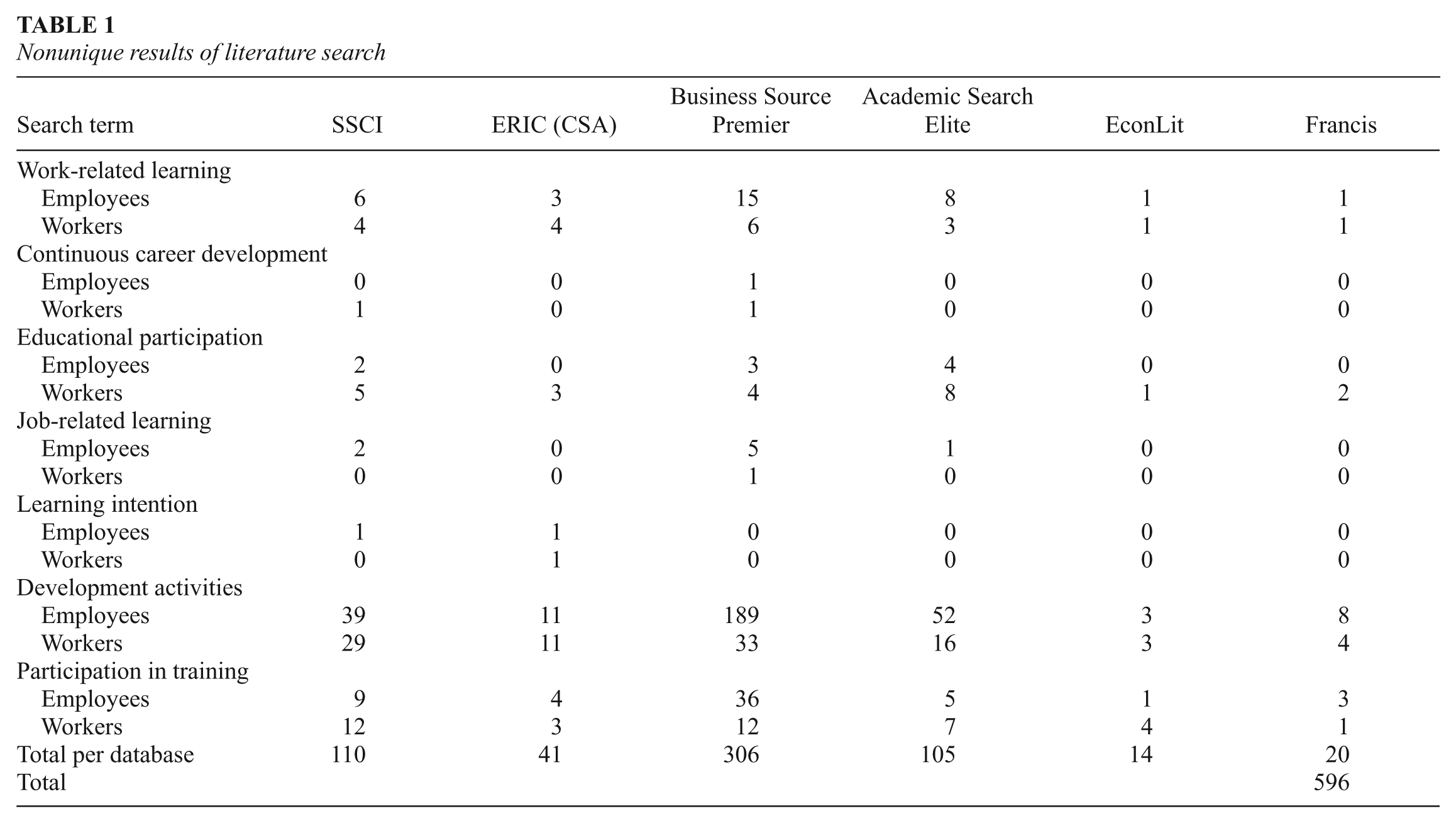
The selection of the literature to answer our research questions was based on several criteria for inclusion. Empirical studies were included in this systematic review if they met all of the following criteria: (a) focused on the participation in work-related learning or the learning intention of participants who were at the time of the research study employed within an organization, (b) published in peer-reviewed journals, (c) published in 1990 or later, and (d) published in English. Studies on the outcomes of work-related learning were not included. A total of 43 studies were retained based on these criteria. In addition, 13 studies were added to this selection by tracing back references included in the retrieved literature. In total, 56 studies formed the basis for answering our research questions.
Analysis of the Studies
After the final selection of these studies based on the criteria for inclusion, each study was analyzed. First, we assessed if the study focused on the actual participation in work-related learning, the learning intention of the employee, or both. Subsequently, it was determined which type of learning was measured based on the measurement instrument used in the primary study. Next, the antecedents that were included in each study were identified and assigned to the appropriate level (micro, meso, or macro). The nature and significance of the relations between the antecedents and the involvement in work-related learning were established within each study. Finally, it was analyzed if the results concerning the relations were consistent or contradictory across the different primary studies. The characteristics of the studies can be found in the appendix (available in the online journal), whereas Table 2 provides an overview of the antecedents organized by level and category.
Alphabetical overview of antecedents for work-related learning per category

Results
Measuring Work-Related Learning
When interpreting the results concerning the antecedents of work-related learning, it is important to understand how work-related learning was conceptualized and measured within the selected primary studies. As mentioned before, work-related learning used to be foremost equated with formal learning; this is also reflected in how work-related learning was measured. More than half of the studies (n = 29) focused solely on the participation in formally organized learning activities (e.g., Albert, Garcia-Serrano, & Hernanz, 2010; Blau et al., 2008; Cavanaugh & Noe, 1999; Green, 1993; Harris, 1999; Leisink & Greenwood, 2007; Leuven & Oosterbeek, 1999; Noe & Wilk, 1993; Sala-Velasco, 2009; Taylor & Urwin, 2001; Thangavelu, Haoming, Cheolsung, Heng, & Wong, 2011). Participants were usually asked to indicate if they had participated in any kind of organized education or training during a specific amount of time (e.g., past year or past 6 months). In contrast, only a small number (n = 3) of studies focused solely on the measurement of informal learning. Cooper and Kurland (2002), for example, focused on employee development activities such as networking and mentoring. However, it needs to be mentioned that mentoring can also be organized in a formal way. Doornbos, Simons, and Denessen (2008) focused solely on informal work-related learning, and Schulz and Roβnagel (2010) measured the learning success in informal learning.
Within the category of studies that included both formal and informal learning activities in their study, two types of studies can be distinguished: studies that actually differentiated between formal and informal learning (n = 4) and measured and analyzed both of them explicitly separately (e.g., Chan & Auster, 2003; Hurtz & Williams, 2009; Mallon & Walton, 2005; Maurer et al., 2003) and studies that did not differentiate (n = 14) and generally questioned the participants about whether or not they undertook several development activities such as attending a course, but also reading a book or discussing issues with colleagues. All these items then formed the basis for a variable measuring work-related learning (e.g., Birdi, Patterson, & Wood, 2007; Gijbels et al., 2010; Ito & Brotheridge, 2005; Maurer, Mitchell, & Barbeite, 2002; Simmering, Colquitt, Noe, & Porter, 2003). A complete overview of what each study focused on in measuring work-related learning can be found in the appendix.
Regarding the research on learning intention, 7 of the 16 research studies focused on the intention to participate in formal learning activities (e.g., Elman & O’Rand, 2002; Greenhalgh & Mavrotas, 1994; Kyndt et al., 2011; Renkema, 2006). The remaining 8 studies took the intention toward both formal and informal learning activities into account but did not differentiate between these intentions in the analyses (e.g., Gaillard & Desmette, 2010; Maurer et al., 2002; Maurer & Tarulli, 1994; Renkema, Schaap, & Van Dellen, 2009). No studies focused solely on the intention to undertake informal learning activities, which is no surprise since informal learning is often considered to be unintentional from the learner’s perspective (Marsick & Watkins, 2001). See Table 3 for an overview of the descriptive information regarding the included studies.
Descriptive information of the included studies

Learning Intention and Participation in Work-Related Learning
The purpose of the second research question was to examine the relationship between the two different stages of the decision-making process as described by the theory of reasoned action (Ajzen & Fishbein, 1980) and applied to learning and education by Baert et al. (2006). Seven research studies that investigated the relationship between a learning intention and actual participation found a positive statistically significant relation (e.g., Bates, 2001; Hurtz & Williams, 2009; Kyndt et al., 2011; Maurer et al., 2003; Zoogah, 2010). The majority of these seven studies (n = 5) focused on the intention to participate in formal learning activities (Bates, 2001; Kyndt et al., 2011; Noe, 1996; Renkema, 2006; Zoogah, 2010), whereas a couple of studies (n = 2) included both formal and informal learning activities when measuring the learning intention of employees (Hurtz & Williams, 2009; Maurer et al., 2003).
A few longitudinal studies (n = 4) showed that a learning intention was positively related with later participation in work-related learning (Hurtz & Williams, 2009; Maurer et al., 2003; Noe, 1996; Zoogah, 2010). The majority (n = 6) confirmed that a learning intention was positively related to prior participation in learning activities (e.g., Bates, 2001; Kyndt et al., 2011; Maurer et al., 2003; Renkema, 2006). These results indicate that the relationship between learning intention and actual participation is reciprocal in nature; prior participation leads toward higher learning intentions, and higher learning intentions relate to more participation in future work-related learning. Only the study of Sanders, Oomens, Blonk, and Hazelzet (2011) found that participation in informal learning did not predict a formal learning intention. In addition, the studies of Pierce and Maurer (2009), Maurer and Tarulli (1994), and Greenhalgh and Mavrotas (1994) did not analyze the relationship between learning intention and actual participation, but considered learning intention as an inherent part of the involvement in work-related learning.
Antecedents of Employees’ Learning Intentions
In total 16 studies investigated antecedents of employees’ learning intentions. Half of the studies (n = 8) focused on the intention to participate in formal learning activities in the (near) future (Bates, 2001; Elman & O’Rand, 2002; Greenhalgh & Mavrotas, 1994; Kyndt et al., 2011; Noe, 1996; Renkema, 2006; Sanders et al., 2011; Zoogah, 2010). The other half (n = 8) questioned whether employees were intending to undertake employee development activities without differentiating between formal and informal activities (Armstrong-Stassen & Schlosser, 2008; Doornbos, Bolhuis, & Denessen, 2004; Gaillard & Desmette, 2010; Hurtz & Williams, 2009; Maurer et al., 2003; Maurer & Tarulli, 1994; Pierce & Maurer, 2009; Renkema et al., 2009). In general, it can be noticed that these studies investigated a lot of different antecedents; as a consequence several antecedents were included in only a single study.
Micro level: Sociodemographic characteristics
The first demographic variable to be highlighted is age. In general, results of the studies (n = 4) show that age is negatively related to a learning intention; this association can be considered small to moderate (Maurer et al., 2003; Renkema et al., 2009). Greenhalgh and Mavrotas (1994) and Sanders et al. (2011) refined this result and showed that middle-aged employees in fact demonstrate the highest learning intentions in comparison with their older and younger colleagues. Sanders et al. (2011) also found that employees older than 56 years have the lowest learning intentions. In addition, three studies did not find a statistically significant relationship (Kyndt et al., 2011; Noe, 1996; Zoogah, 2010).
Regarding gender, Sanders et al. (2011) found that women had higher learning intentions than men. In addition, two studies did not find gender differences (Greenhalgh & Mavrotas, 1994; Zoogah, 2010). Elman and O’Rand (2002) did confirm the result of Sanders et al. (2011) when they connected the willingness to retrain to job insecurity. They found that women are more willing to retrain because they belong to a group that is more at risk of losing its job. In the same research, they also found that employees who are responsible for children (in terms of income) are more likely to retrain (Elman & O’Rand, 2002). The study of Kyndt et al. (2011) did not find any differences between employees with or without children.
Finally, unlike the results on actual participation (see infra), the level of education of the employee is not such a strong predictor of an employee’s learning intention. For example, Zoogah (2010) did not find a statistically significant relationship. Greenhalgh and Mavrotas (1994) found that employees who obtained degree-level qualifications demonstrate a higher learning intention. Elman and O’Rand (2002) showed that employees without a college degree are less likely to engage in future learning activities. Kyndt et al. (2011), whose study focused on low-educated employees, that is, those without a starter’s qualification for higher education, found that those employees without any form of educational degree had the lowest learning intentions; however, the effect size was rather small.
Micro level: Personal characteristics
Above we already discussed that prior participation is a positive predictor of an employee’s learning intention. This prior participation also has an indirect effect on employees’ learning intentions; the experience of this prior participation influences the attitude of the employee toward learning, which in turn is an important predictor of an employee’s intention to participate in future development activities (Hurtz & Williams, 2009). Other research studies also confirmed the influence of an employee’s attitude toward learning (Bates, 2001; Greenhalgh & Mavrotas, 1994; Renkema, 2006; Sanders et al., 2011). The relation between attitude and intention can be described as a moderate to strong relationship (Hurtz & Williams, 2009). Another important variable within the theory of reasoned action (Fishbein & Ajzen, 1975) for the intention of individuals is the subjective norm. A positive relationship between the subjective norm and a learning intention was identified by empirical research (Renkema, 2006; Sanders et al., 2011). The reported beta coefficient indicates that subjective norm is a moderately strong predictor. Sanders et al. (2011) stated that the perceived value attached to employees’ training participation of significant others, such as colleagues, family, and friends, should be considered when trying to increase the motivation to participate in training.
In the theoretical background, the theory of planned behavior and the role of perceived behavioral control in the decision-making process were introduced. A few empirical studies (n = 2) investigated the relationship between perceived behavioral control and learning intention. The study of Sanders et al. (2011) found a moderately strong and positive relationship between perceived behavioral control and learning intention. Zoogah (2010) was unable to confirm this.
Another personal characteristic that is taken up in the research on employees’ learning intentions is self-efficacy. Self-efficacy can be defined as the belief individuals have in their own capacities, in this case the capacity to learn. Four out of five studies investigating the relation between self-efficacy and learning intention found a positive relationship. Kyndt et al. (2011) and Renkema (2006) related self-efficacy to a formal learning intention, whereas Maurer et al. (2003) and Maurer and Tarulli (1994) found a relationship with a learning intention pertaining to formal and informal learning activities. The study of Renkema et al. (2009) was the only study that investigated self-efficacy and did not find a statistically significant relationship. In line with the results on self-efficacy, Maurer et al. (2003) found that if employees perceive themselves to possess the qualities needed for learning in terms of general skills and abilities, they report a higher learning intention.
In total, three studies included career-related variables. Sanders et al. (2011), investigating a formal learning intention, found that career orientation was positively correlated with this learning intention. The more employees are working toward certain career goals in a (more or less) strategic way, the more likely they are to engage in future formal learning activities (Sanders et al., 2011). In addition, Kyndt et al. (2011) found that self-directedness in career processes, which concerns influencing the course of one’s career, is positively related to the intention of an employee to engage in formal learning activities. This relationship can be considered moderately strong. Maurer et al. (2003), who focused on the intention to engage in both formal and informal development activities, investigated the role of career insight, defined as the awareness of strengths and weaknesses and thoughts about career plans.
Finally, Noe (1996) found that career exploration—more specifically if employees had sought information about job areas that interested them—is moderately strong and positively related a learning intention. In sum, it appears that the more conscious an employee is in thinking about his or her career perspectives, the stronger his or her intention to learn will be. In addition, research showed that employees with a higher organizational commitment presented a slightly lower learning intention (Renkema et al., 2009). The indication that employees who are more likely to change to another organization develop a higher learning intention can be explained by the wish to remain employable; however, Renkema et al. (2009) noted that this is not a very important predictor.
The research of Maurer and Tarulli (1994) adds the finding that a higher need for self-improvement relates positively to the intention to engage in development activities including both formal and informal learning activities. The motivation to transfer—that is, the motivation to actually apply on the work floor what has been learned—and previous transfer success also have a positive relationship with learning intention (Bates, 2001). Zoogah’s (2010) study took a different approach in comparison with the other studies. He investigated learning from a disadvantaged perspective and focused on individual relative deprivation. Results showed that when employees recognized that they have been disadvantaged and feel resentment, their formal learning intention is higher (Zoogah, 2010).
Micro level: Job characteristics
Half of the studies investigating an employee’s learning intention (n = 8) considered job-related characteristics when investigating employees’ learning intentions. First, we focus on tenure, a variable highly correlated with age. It is therefore no surprise that the results are in line with the results on age and show a negative relation with learning intention (Kyndt et al., 2011; Renkema et al., 2009). Elman and O’Rand (2002) confirmed that more experienced employees were less willing to retrain. However, two studies did not find statistically significant results (Greenhalgh & Mavrotas, 1994; Zoogah, 2010).
Kyndt et al. (2011) found in their study that the more job autonomy employees perceive—the more freedom they perceive in how they go about their job—the higher their formal learning intention is. Two studies investigating the influence of job involvement on the intention to engage in both formal and informal learning activities found that job involvement is statistically significantly related to a learning intention (Maurer et al., 2003; Maurer & Tarulli, 1994). This means that the more employees consider their work to be central in their life, the higher their learning intention is. Job satisfaction in turn is related moderately positively to a job-related learning intention but negatively to a career-related learning intention (Renkema et al., 2009). Finally, the study of Doornbos et al. (2004) showed that the intentionality of work-related learning varies across work domains. However, it needs to be mentioned that this study solely focused on police work; as a consequence these work domains are very specific and difficult to generalize.
Meso level: Learning activity
The characteristics of the learning activity were also investigated in a small number of studies (n = 6). Aspects of the learning activity that have been investigated are the expected outcomes or benefits. Intrinsic outcomes such as interest and personal value were found to relate positively to employees’ learning intentions (Maurer et al., 2003; Maurer & Tarulli, 1994). The results concerning the extrinsic benefits (e.g., pay or promotion) are less clear: Maurer et al. (2003) identified a negative relationship, whereas Maurer and Tarulli (1994) found a positive relationship. Kyndt et al.’s (2011) results were in line with those of Maurer and Tarulli (1994) and showed that perceived financial benefits relate positively to a learning intention. In general, the effect of expected outcomes seems to be rather limited. Pierce and Maurer (2009) differentiated between individual and organizational benefits. They found that perceived individual benefits related positively to the intention to participate in future learning activities, whereas perceived organizational benefits related negatively to their learning intention. Apparently, the fact that the organization benefits from employees’ participation in learning does not enhance the learning intention of the employee.
Zoogah (2010) investigated employees’ counterfactual beliefs. These are the beliefs an employee has when looking back (often with regret) to a missed learning opportunity. When employees expect better outcomes (in comparison to the current situation) from participating in a learning activity, their learning intention is higher.
In terms of content, the study of Elman and O’Rand (2002) showed that employees were more willing to retrain themselves in technical skills than professional and managerial skills.
Macro level: Organization
The studies investigating the support for learning within the work context in general show that support relates positively to a learning intention; a positive relationship was found for supervisor or management support (Maurer & Tarulli, 1994; Sanders et al., 2011), coworker support (Sanders et al., 2011), and general work support including from supervisors, coworkers, and subordinates (Maurer et al., 2003). Renkema et al. (2009) confirmed this positive relationship for job-related learning intentions, but did not find a statistically significant relationship with career-related learning intentions. Only the study of Pierce and Maurer (2009) contrasted these results with a negative relationship between organizational support and learning intention. Noe (1996) did not confirm the relationship between management support and learning intention.
Other studies included support in a broader concept of learning culture (Bates, 2001) or learning climate (Armstrong-Stassen & Schlosser, 2008). Bates (2001) showed that a continuous learning culture, where learning is considered a key responsibility of all employees, and which values and supports learning and its job application through formal and informal systems, is not correlated to a formal and informal learning intention. Armstrong-Stassen and Schlosser (2008) found that a job development climate characterized by the degree to which jobs are designed to promote learning is positively associated with a similar learning intention. Renkema (2006) did not find a statistically significant correlation between a learning intention and the perceived dialogical learning culture, which combines an appreciation of learning and the possibility of discussing development. Another aspect of the climate within an organization pertains to the stereotyping of employees. The study of Gaillard and Desmette (2010) focused on the effect of negative stereotyping of older employees on their learning intention. In their experimental study they found that older employees who were confronted with negative stereotyping demonstrated lower learning intentions than those who were not. The reported effect size showed that this was a rather strong effect.
Renkema (2006) also conducted an experimental study, in which he investigated if the learning intention differed between employees with and without an individual learning account, which is a combination of a professional development plan and an individual financing mechanism. This study was conducted in the sectors of both technical installation and elderly care. In the technical installation sector, employees with an individual learning account presented higher learning intentions than those without. In the elderly care sector, the individual learning account did not change the results. In addition, it was found that an individual learning account had an equalizing effect between age groups.
Maurer and Tarulli (1994) investigated the influence of a company policy that facilitated participation in learning and development activities. Remarkably, they found that after controlling for other personal and environmental variables, this company policy was negatively related to the learning intention of employees. However, the relationship was rather limited in strength. Similarly, Zoogah (2010) found that unfair procedures in terms of offering training and promotions within organizations increase the learning intentions of employees. This negative relationship between procedural justice and learning intention is explained by the fact that this injustice serves as a wake-up call for employees.
Employees in small firms present lower learning intentions, whereas employees in high technology manufacturing have high learning intentions, probably because the latter industry is confronted with very rapid changes (Greenhalgh & Mavrotas, 1994). Regarding the income of an employee, it can be noticed that employees with higher wages are less likely to retrain (Elman & O’Rand, 2002). Finally, two studies investigating the role of a full-time or part-time contract contradict each other: Kyndt et al. (2011) found that full-time employees have a lower learning intention, whereas Greenhalgh and Mavrotas (1994) found lower learning intentions for part-time employees.
Macro level: Broader context
Similar to the characteristics of the job and learning activity, until now little attention has been given to the broader context of the employees when investigating their learning intention. Elman and O’Rand (2002) investigated the relationship between the likelihood of losing one’s job and the willingness to retrain through formal education. They found that groups of employees (women, non-Whites, and individuals holding multiple jobs) who were more at risk of losing their job were more willing to retrain (Elman & O’Rand, 2002). Sanders et al. (2011) did not find a statistically significant relationship between job insecurity and learning intention.
The results regarding the organization already showed that the support within the organization is an important predictor of a learning intention (e.g., Noe, 1996; Sanders et al., 2011). In addition, Maurer et al. (2003) identified support from outside the workplace (e.g., family and friends) as a modest positive predictor of a learning intention pertaining to formal and informal learning.
Antecedents of Employees’ Participation in Work-Related Learning
Micro level: Sociodemographic characteristics
The majority of the selected research studies (n = 30) devoted attention to the role of sociodemographic variables in the involvement in work-related learning. Regarding gender, research often confirms the idea that female employees have a lower degree of participation in formal vocational education than do men (Albert et al., 2010; Lauber, Taylor, Decker, & Knuth, 2010; Leuven & Oosterbeek, 1999; Oosterbeek, 1996). Harris (1999) and Selmer and Leung (2003) found that women are offered fewer training opportunities, whereas Greenhalgh and Mavrotas (1994) found that when training is longer (i.e., takes up more time), more men than women participate. In general, the research literature is mixed about the effect of gender on participation. Further analysis of the situation nuances these findings and shows that sex-related discrimination decreases (Green, 1993) and that differences are a result of the fact that women, more often than men, are employed in jobs where, in general, vocational education is less common (Oosterbeek, 1996).
The research of Simpson and Stroh (2002), however, contradicts this. They found that in 1995 women participated more in development activities than did men, and they were also able to attribute this to the occupational segregation. Other researchers (n = 3) also found that women participate more in formal career-related continuous learning activities than do men (Rowold & Shilling, 2006; Sala-Velasco, 2009; Thangavelu et al., 2011). Finally, several studies (n = 4) did not find differences between men and women (Garavan, Carberry, O’Malley, & O’Donnel, 2010; Lauber et al., 2010; Tharenou, 2001; Xiao & Tsang, 2004). Tharenou (1997), who conducted his study in the public sector, attributes the lack of difference between the participation of men and women to the regulations regarding gender equality in the public sector. Based on the comparison of age groups, Taylor and Urwin (2001) argued that women have caught up with men and that differences have disappeared over the years.
In addition to the majority of studies (n = 13) that investigated the relation between gender and formal learning, three studies were found that took both formal and informal learning into account when comparing men and women (Booth, 1991; Ito & Brotheridge, 2005; Taris & Feij, 2004). However, they did not differentiate among these types of learning. The results of these studies also present an ambiguous image of the relation between gender and work-related learning. Booth (1991) found that women undertake fewer learning activities, whereas Ito and Brotheridge (2005) obtained higher scores for women and Taris and Feij (2004) ended up with a non–statistically significant relationship.
With regard to marital status, Greenhalgh and Mavrotas (1994) and Thangavelu et al. (2011) found that unmarried individuals take more part in formal learning activities than married persons, whereas Montizaan, Cörvers, and de Grip (2009) found the opposite. Simpson and Stroh (2002) found only an interaction effect of marital status and gender, suggesting that family responsibilities have a continued negative effect on women’s access to formal training in occupations where female representation is not high. However, Harris (1999) found that single men participate less. Others did not find a statistically significant effect of marital status (Forrier & Sels, 2003; Oosterbeek, 1996; Taylor & Urwin, 2001). The study of Booth (1991), which was the only study that included formal and informal learning activities when investigating the relationship with marital status, also did not find a statistically significant result. In conclusion, it can be stated that the results for marital status are inconclusive.
Subsequently, the relationship between having children and involvement in formal work-related learning is discussed. There are four studies that did not find a statistically significant relationship (Greenhalgh & Mavrotas, 1994; Taylor & Urwin, 2001; Tharenou, 1997, 2001). However, Tharenou (1997) did argue that women with (younger) children are less likely to be full-time employed, which reduces the possible impact of this family factor. This explanation stems from the fact that four research studies indeed found that having children results in a lower participation (Booth, 1991; Green, 1993; Harris, 1999; Simpson & Stroh, 2002). Harris (1999) found that especially having children younger than age 4 reduced female participation, whereas having children between 5 and 11 years old reduced male participation. Booth (1991), who took both formal and informal learning into account, also found a negative relationship between having children and work-related learning for women.
There seems to be a general consensus among researchers about the negative relation between age and formal work-related learning (e.g., Greenhalgh & Mavrotas, 1994; Harris, 1999; Taylor & Urwin, 2001; Warr & Birdi, 1998). As employees get older, they participate less in training. However, several nuances have been formulated regarding this relationship, suggesting that the relationship is less direct than it might seem. On one hand, Oosterbeek (1996) put forward that
older workers have a lower probability of working for a firm that offers training opportunities, but given that a worker is employed by a firm that provides training, the worker’s age has no influence on the probability of his/her being selected for a training program. (p. 803)
On the other hand, both Sala-Velasco (2009) and Thangavelu et al. (2011) found that the relation between age and formal participation is positive until a certain point, after which participation declines again. Sala-Velasco (2009) argued for a quadratic relationship, whereas Thangavelu and colleagues (2011) placed the cutoff point at 37 years of age.
In addition, it has been found that the negative relation between age and vocational educational participation is stronger for men than women. A minority of research studies did not find a statistically significant relationship with age (e.g., Blau et al., 2008; Cavanaugh & Noe, 1999). Studies focusing on both formal and informal learning (without differentiating between them) showed similar results. Booth (1991) described a statistically significant negative result. However, a majority of these studies found that age was not statistically significant in the prediction of formal and informal learning (Ito & Brotheridge, 2005; Noe, 1996; Taris & Feij, 2004). Finally, there were two studies that investigated formal and informal learning separately. Schulz and Roβnagel (2010) focused solely on informal learning and found no statistically significant correlations between age and prior participation in informal learning and learning success. They did find that age was positively correlated with learning opportunities at work. In addition, Chan and Auster (2003) investigated the role of subjective age (feeling old) and relative age (feeling old in comparison with colleagues) in a group of librarians. Their results showed that employees who feel older participate less in informal learning activities (Chan & Auster, 2003).
The initially obtained level of education of an individual is another important predictor of participation in learning activities. Research has shown that the level of education is an especially important predictor of participation in formal training (e.g., Greenhalgh & Mavrotas, 1994; Ito & Brotheridge, 2005; Tharenou, 1997): Employees with a higher level of education tend to participate more in such training (e.g., Albert et al., 2010; Green, 1993; Montizaan et al., 2009; Tabassi & Bakar, 2009; Taylor & Urwin, 2001; Warr & Birdi, 1998; Xiao & Tsang, 2004). Tabassi and Bakar (2009) identified a low level of education as a barrier for participation. Thangavelu et al. (2011) also found that higher educated employees participate more in formal work-related learning; however, they argued that low-skilled workers would benefit more from training. Oosterbeek (1996) contributed that a higher education degree increases both the likelihood of working for a firm offering training and the likelihood of receiving training. Two studies, including both formal and informal learning, also found that level of education was positively related to work-related learning (Booth, 1991; Ito & Brotheridge, 2005). Harris (1999) found that the effect of educational level was stronger for men. In contrast, Booth (1991) found that the relationship is stronger for women.
A limited number of studies included the ethnicity of the individuals in their research. Taylor and Urwin (2001) found that ethnic minorities participate less in formal work-related learning. In line with this finding, Harris (1999) found that non-White men in the United Kingdom also participate less. Oosterbeek (1996) conducted a study in the Netherlands that showed that employees with a non-Dutch nationality have a higher likelihood of working for an organization offering training. Leuven and Oosterbeek (1999) confirmed this result in the Netherlands, but found that in Canada, Switzerland, and the United States immigrants participate less in formal training. Simpson and Stroh (2002) found no effect for race, as did Booth (1991), who looked at both formal and informal learning.
The final demographic variable, social class, was investigated only by Garavan et al. (2010). Their results showed that social class was positively related to participation in formal e-learning activities. Higher social classes participate more in work-related e-learning (Garavan et al., 2010).
Micro level: Personal characteristics
The category of personal characteristics contains the most antecedents of work-related learning (see Table 2). We start by discussing the variables that are considered within the theory of reasoned action (Fishbein & Ajzen, 1975) and theory of planned behavior (Ajzen, 1991). Prior research found positive correlations between attitude and participation in formal and informal work-related learning (Hurtz & Williams, 2009; Maurer et al., 2002; Maurer et al., 2003). In addition, Hurtz and Williams (2009) showed in their structural equation model that attitude especially influences participation via the intention, whereas Bates (2001) did not find a statistically significant correlation with participation, but reported a positive relation with intention. The study of Hurtz and Williams (2009) was the only one that also investigated the role of subjective norms. They found that subjective norms related positively to participation. Zoogah (2010) identified the positive relation between perceived behavioral control and participation in formal learning as postulated in the theory of planned behavior (Ajzen, 1991). However, Hurtz and Williams (2009) remarkably found that perceived behavioral control was moderately negatively related to participation. In addition, they found that voluntariness was related negatively to participation (Hurtz & Williams, 2009). They concluded that if employees have a free choice to participate, they are less likely to participate (Hurtz & Williams, 2009).
Although time is assumed to play a central role in the participation of employees in work-related learning, only a few studies (n = 3) investigated time as such (Brown & McCracken, 2009; Chan & Auster, 2003; Warr & Birdi, 1998). These studies do confirm that a lack of time is an important barrier for the participation in formal learning. The research of Warr and Birdi (1998), however, shows that this relationship is mediated by a motivation to learn. Chan and Auster (2003) were also able to confirm the negative relationship for informal learning. Noe and Wilk (1993) included time within their measure of situational constraints and found that these situational constraints lowered the participation in development activities. Garavan et al. (2010) could not confirm this result for formal work-related e-learning.
Subsequently, we discuss several psychological characteristics of the individual. A first important factor that comes to the fore is self-efficacy. Three studies that investigated a combination of formal and informal learning found that self-efficacy is positively related to participation in development activities (Maurer et al., 2002; Maurer et al., 2003; Maurer & Tarulli, 1994). Maurer et al. (2002), however, confirmed this only for off-the-job learning activities and not for on-the-job learning activities. Blau et al. (2008) related self-efficacy to formal organizational development activities but not to professional development activities. The first category of developmental activities focuses on the organization. Through organization-specific initiatives, organizational-relevant skills and knowledge are learned, whereas the latter focuses on development activities pertaining to the occupation; profession-relevant skills are learned through profession-based initiatives (Blau et al., 2008).
Noe and Wilk (1993) confirmed a positive relationship of self-efficacy and a subjective measure of participation in formal learning activities based on the perception of the individual; the relationship was not confirmed for the objective measure retrieved from the human resource information system. Schulz and Roβnagel (2010) differentiated between memory self-efficacy and occupational self-efficacy and found that both correlate positively with learning success in informal learning and opportunities to learn at work. When employees believe in their own memory capacities and capacities to exert their profession, their learning success in informal learning and their opportunities to learn at work will be perceived as higher.
Maurer et al. (2003) also measured the employees’ beliefs in their learning qualities, which is closely related to self-efficacy. They found that this belief was positively correlated with participation in formal and informal development activities; however, no direct relationship was found in the structural equation model. The influence of learning qualities was mediated by the learning intention (Maurer et al., 2003). A general learning confidence was found to be positively associated with participation in formal learning (Warr & Birdi, 1998), whereas anxiety during prior learning activities was unrelated to current participation (Maurer et al., 2003). A perceived decline in memory and mental functioning correlated negatively with participation, but was statistically nonsignificant in the structural model (Maurer et al., 2003). The positive correlation of perceived intelligence was also statistically nonsignificant in the structural model (Maurer et al., 2003). Another related construct that was investigated is the perceived level of competence. Schulz and Roβnagel (2010) found that learning competence predicted learning success in informal learning positively, whereas Doornbos et al. (2008) found that a higher perceived competence was negatively associated with the informal learning strategies learning together and learning from experts. Finally, Maurer et al. (2002) focused on the implicit theory of the employee and found that individuals who believe that ability can be enhanced participate more in learning activities, in comparison to those who believe that ability is fixed.
The next subset of variables that is explored pertains to the level of skills and competences and the need individuals experience to improve these. Both Maurer and Tarulli (1994) and Maurer et al. (2003) found that self-need for improvement was positively associated with participation in formal and informal development activities. Bates (2001) investigated the role of basic skills level and proficiency. Math and reading skills were positive predictors for the objective measure regarding work-related learning (Bates, 2001). However, when employees perceive that their reading skills are below what is required for their job, they are more likely to participate in formal development activities (Bates, 2001). Sala-Velasco (2009) added that experienced deficits in competences such as management and negotiating competences increase the likelihood to be offered formal training, whereas being overeducated for a job decreases this likelihood. Finally, Sala-Velasco (2009) showed that employees who graduated in health sciences had a higher likelihood of receiving formal training.
Besides the capacities of employees and their beliefs concerning these capacities, the motivation of the employee is an important antecedent of work-related learning. Several studies focused on different aspects of motivation. A total of six studies focused on the motivation to learn through formal learning activities (Bates, 2001; Garavan et al., 2010; Noe & Wilk, 1993; Tabassi & Bakar, 2009; Tharenou, 2001; Warr & Birdi, 1998). These studies confirmed the positive relation between motivation to learn (or participate) with actual participation (Bates, 2001; Garavan et al., 2010; Noe & Wilk, 1993; Tharenou, 2001; Warr & Birdi, 1998). Tabassi and Bakar (2009) showed that having no motivation was an important barrier for the participation in formal learning.
Hurtz and Williams (2009) focused on a learning goal orientation. A learning goal orientation represents a general desire to learn new skills and increase competences that are considered important. Their results showed that learning goal orientation is a statistically significant direct predictor of actual participation in formal and informal learning activities. In addition, Schulz and Roβnagel (2010) found that such a learning goal orientation is positively associated with learning success in informal learning, whereas a performance avoidance orientation (concealing a lack of knowledge, skills and abilities) is negatively related to learning success. A self-directed learning orientation is closely related to the notion of a learning goal orientation.
A self-directed learning orientation is a “relative stable tendency to take an active and self-starting approach to work-related learning activities and situations, and to persist in overcoming barriers and setbacks” (Gijbels et al., 2010, p. 243). Such a learning orientation was found to relate positively to developmental behavior (Gijbels et al., 2010; Gijbels, Raemdonck, Vervecken, & Van Herck, 2012). Finally, epistemic beliefs in which learning is considered important and valuable, were also positively related to this learning success (Schulz & Roβnagel, 2010). The above-discussed motivational antecedents show some similarities with the concept of learning intention; however, a learning intention is considered to be more specific (Kyndt et al., 2011). It pertains to an intention to demonstrate a certain behavior, whereas these motivational antecedents describe a more general tendency or belief of the individual. It can be expected that these motivational antecedents would strongly relate to the learning intention of an employee.
In terms of motivation to transfer, two contradicting studies were found. Bates (2001) showed a positive relation between motivation to transfer and participation in formal learning, whereas Noe and Wilk (1993) found a negative relationship. Their results suggest that the more motivated employees are to apply what they learned, the less they perceive these learning activities to be appropriate for their job content. Bates found that expected transfer effort performance is a positive predictor of participation in formal learning. Bates also investigated the expectancy belief regarding the performance outcome, but this was found to be unrelated to participation. Tharenou (2001) confirmed that motivation through expectancy explained participation in training and development. Chan and Auster (2003) confirmed this result for informal learning but not for formal learning.
Research on the relationship between the personality of employees and their participation in work-related learning is scarce. Two studies investigated the role of the personality trait conscientiousness. Conscientiousness is defined as a combination of achievement and dependability (Hurtz & Williams, 2009). Individuals higher in achievement set high standards for themselves, are goal directed, and generally try hard to do good work, whereas individuals high in dependability are reliable, thorough, disciplined, and persistent. Simmering et al. (2003) found that conscientiousness was positively related to participation in formal and informal development activities, especially when employees experience a misfit between the autonomy they experience in their job and the autonomy they need or desire.
Besides the above-described personal and psychological characteristics, several variables related to how individuals go about their careers have been investigated. An overall responsibility for career development did not yield a statistically significant relationship with formal work-related learning (Cavanaugh & Noe, 1999); neither did focusing on career goals (Noe, 1996) or career planning (Rowold & Shilling, 2006). However, the distance to such career goals did yield a positive relationship with formal and informal development behavior. The further employees are removed from their career goals, the more they participate (Noe, 1996). Career strategies such as discussing and planning activities to broaden one’s skills used to reach those career goals were found to relate positively to participation in formal learning (Tharenou, 1997).
However, the results of the research of Noe (1996) did not confirm this. The research of Mallon and Walton (2005) confirmed that developing “saleable” skills or remaining employable was as a desired outcome of learning activities. Career exploration—specifically searching information about job areas of interest—can be considered as a specific career strategy (Rowold & Shilling, 2006). Two studies showed that this career exploration was positively associated with participating in formal learning activities (Noe & Wilk, 1993; Rowold & Shilling, 2006). Noe found only an indirect effect via the learning intention of the employee. The final career-related variable that was investigated is career insight. Career insight pertains to “the extent to which a person has knowledge concerning his or her career-related strengths and weaknesses, specific career goals, career plans and current work situation” (Maurer et al., 2003, p. 714). Two studies found positive correlation between career insight and participation in formal and informal learning activities (Maurer et al., 2003; Maurer & Tarulli, 1994). However, Maurer et al.’s (2003) structural model showed that this relationship was indirect via the learning intention.
In terms of the commitment of employees toward their career or job, two different concept are distinguished: occupational commitment, that is, the commitment to the profession or occupation of the employee, and organizational commitment, which refers to the commitment of the employees toward the organization they are working for (Blau et al., 2008). Four research studies considered occupational commitment. Three of them found a positive relationship between occupational commitment and participation in formal work-related learning (Blau et al., 2008; Cavanaugh & Noe, 1999; Lauber et al., 2010). However, Blau et al. showed that this relationship pertained only to professional development activities and not organizational development activities. Chan and Auster (2003) found a non–statistically significant relation between occupational commitment and both formal and informal learning activities. Two of the above-mentioned studies also considered organizational commitment. Blau et al. related this organizational commitment positively to formal organizational development activities. In contrast, Lauber et al. (2010) found a negative relationship. They explained this relationship through the existence of time constraints.
Pierce and Maurer (2009) took a more holistic approach on organizational commitment; they examined organizational citizenship behavior: “Individual behavior that is discretionary, not directly or explicitly recognized by the formal reward system, and in the aggregate promotes the efficient and effective functioning of the organization” (Pierce & Maurer, 2009, p. 139). This type of behavior was positively related to work-related learning behavior involving both formal and informal activities. Zoogah (2010), on the other hand, found that when individuals recognize that they were disadvantaged by their organization and they resent this, this does not directly affect their participation in formal development activities. However, individual relative deprivation was indirectly related through the learning intention of an employee.
In this final paragraph of this section, we present a few additional research results. Both Harris (1999) and Booth (1991) found that union members participate more in learning activities. Harris added that this effect was less strong in larger organizations. Greenhalgh and Mavrotas (1994) found no relation between formal learning and union membership. Holding a second job increases the participation of women, whereas men’s participation increases when they are looking for (additional) jobs (Harris, 1999). Related to this looking for a job, Booth found that the number of months an employee remains unemployed relates negatively to the participation in development activities. Finally, the study of Montizaan et al. (2009) found that postponing retirement for 1 year increased the participation of older employees, whereas their pension savings did not have any predictive value.
Micro level: Job characteristics
The final category at the micro level pertains to the characteristics of the job. We start with discussing the occupational type and level of the employee. The research concerning the influence of the occupational level of employees shows consistent and relatively strong findings. Employees in higher level occupations (e.g., managers and professionals) participate more in formal learning activities (Albert et al., 2010; Cavanaugh & Noe, 1999; Forrier & Sels, 2003; Green, 1993; Harris, 1999; Noe & Wilk, 1993; Oosterbeek, 1996; Sala-Velasco, 2009; Tharenou, 1997, 2001; Warr & Birdi, 1998; Xiao & Tsang, 2004). Noe (1996) also found that managers participate more than technical and clerical staff when considering both formal and informal learning activities. Taylor and Urwin (2001) found that managers, administrators, professionals, and associate professionals participate more in formal learning activities than do office and personal and protective service employees, whereas Booth (1991) found that manual workers participate less in comparison to nonmanual workers.
The research of Ito and Brotheridge (2005) added that participation in decision making, which is associated with higher occupational levels, contributes to participation in learning activities. Aspirations of employees to become managers were not related to the participation in formal learning activities (Tharenou, 2001). In line with the results at the occupational level, Ito and Brotheridge (2005) found that the more employees managers have under their supervision, the more they participate in formal and informal learning activities. Simmering et al. (2003) were unable to confirm this result regarding the span of control of an employee.
Finally, Greenhalgh and Mavrotas (1994) focused on specific occupations and found that those in occupations such as sales and security participate the least in formal learning. We have already reported that employees in high-technology professions demonstrate a higher learning intention in comparison to other professions; however, it can be noticed that this is not reflected in their actual participation (Greenhalgh & Mavrotas, 1994). In line with their results regarding learning intention, Doornbos et al. (2008) found that different work domains in police services also lead to differences in the participation in informal learning activities.
Blau et al. (2008) investigated the influence of job and occupational satisfaction on the participation in formal learning activities. Job satisfaction pertains to the satisfaction employees derive from their current job and position within the organization, whereas occupational satisfaction refers to the satisfaction employees derive from performing their profession, which could also be performed within another organization. They found that job satisfaction relates to organizational development activities, whereas occupational satisfaction relates positively to professional development activities (Blau et al., 2008). Hurtz and Williams (2009) and Rowold and Shilling (2006) also presented a positive relationship between job involvement and educational participation. The more individuals consider their work to be a central life concern, the more they participate. Two other studies could not confirm this result (Maurer et al., 2003; Maurer & Tarulli, 1994).
In line with the job demands control model of Karasek (1979), a few studies (n = 4) investigated the role of job demands and job control in participation in development activities (Gijbels et al., 2010, 2012; Taris & Feij, 2004). Results show that job demands are positively related to work-related development (Gijbels et al., 2012; Loon & Casimir, 2008). Loon and Casimir (2008) showed that this relation is even stronger when individuals’ need for achievement is high. Gijbels et al. (2010) were unable to confirm this positive relationship. Regarding job control, the study of Gijbels et al. (2012) found a moderate positive relationship with work-related learning.
Taris and Feij (2004) investigated work-related learning at different levels of job demands and job control. Their results showed that the most learning occurs when both job demands and job control are high, whereas both low job demands and job control result in the least amount of learning. The study of Gijbels et al. (2010) showed a statistically nonsignificant relationship between job control and work-related learning behavior. Experiencing a high level of strain was found to have an adverse effect on learning (Taris & Feij, 2004). In addition, Tharenou (2001) focused on job challenge. Although receiving challenging assignments positively predicts the motivation of an employee to learn, it does not predict participation in formal learning activities.
The results regarding the workload of an employee appear to be inconclusive. Doornbos et al. (2008) found that work pressure was positively related to informal learning activities, whereas Lauber et al. (2010) and Murray and Lawry (2011) identified workload as a barrier for participation. Tharenou (2001) concluded that workload barriers do not predict participation in formal learning.
Besides the demand side of the job, other job characteristics were considered. Doornbos et al. (2008) did not find a statistically significant relationship with task variety and task autonomy when investigating different informal learning activities. Ito and Brotheridge (2005) also identified a statistically nonsignificant result for autonomy. In contrast, Simmering et al. (2003) did show that the autonomy a job supplies correlated positively with work-related learning. In addition, they found that especially conscientious employees participate in work-related learning when they feel that their autonomy needs are not satisfied by the autonomy in their job (Simmering et al., 2003).
The research of Cooper and Kurland (2002) concluded that professional isolation had a negative influence on informal learning activities. This result seems to indicate that interaction with others is an important element in the informal learning process of an employee (e.g., Kyndt, Dochy, & Nijs, 2009).
When investigating the differences between employees with different contracts, two differentiations come to the fore: a temporary versus tenured contract and a full-time versus part-time contract. All studies that investigated these differences focused on formal learning. Their results show that employees with a permanent contract participate more than those with a temporary contract (Albert et al., 2010; Forrier & Sels, 2003; Harris, 1999; Leuven & Oosterbeek, 1999; Oosterbeek, 1996). Full-time employees also participate more in comparison with part-time employed individuals (Albert et al., 2010; Greenhalgh & Mavrotas, 1994; Leuven & Oosterbeek, 1999; Sala-Velasco, 2009; Thangavelu et al., 2011; Tharenou, 2001). In terms of working hours, research shows that working longer hours increases the likelihood of participating in formal learning activities (Harris, 1999; Oosterbeek, 1996). Booth (1991) and Green (1993) confirmed this result for female workers. In addition, Harris found that working flexible hours also increased this likelihood, whereas Warr and Birdi (1998) found that working in shifts had a negative relation with development activities. Job insecurity (Blau et al., 2008; Cavanaugh & Noe, 1999), occupational insecurity (Blau et al., 2008), and experienced job loss (Cavanaugh & Noe, 1999) were found to be unrelated to participation in work-related learning.
Although Tabassi and Bakar (2009) state that low income forms a barrier for the participation in formal learning, quantitative research does not seem to confirm this finding. Three studies found that income was not a statistically significant predictor of work-related learning (Green, 1993; Ito & Brotheridge, 2005; Montizaan et al., 2009). Greenhalgh and Mavrotas (1994) stated that employees with a middle income participated more than employees with low or high incomes. Thangavelu et al. (2011) concluded that well-paid employees were more likely to participate.
Finally, the tenure of an employee was examined. Although tenure and age are strongly correlated, the results concerning tenure are less clear-cut. Several studies (n = 5) did not find a statistically significant relation between tenure and work-related learning (Oosterbeek, 1996; Simmering et al., 2003; Thangavelu et al., 2011; Tharenou, 1997, 2001). In total, four studies concluded that tenure was negatively related to learning (Doornbos et al., 2008; Green, 1993; Greenhalgh & Mavrotas, 1994; Ito & Brotheridge, 2005). Albert et al. (2010) confirmed this finding for general training, but found the reverse for specific training. The studies of Garavan et al. (2010), Harris (1999), and Noe and Wilk (1993) showed a positive relationship between tenure and participation in formal learning activities. In general, and in line with the results on the employee’s age, the coefficients are relatively small.
Meso level: Learning activity
The meso level, or the level of the learning activity, is the level that is least investigated by the studies focusing on participation included in this review study. A couple of longitudinal studies (n = 2) investigated if prior participation predicted later participation in development activities. The results show that prior participation in formal learning is a strong predictor of later participation in formal learning (Hurtz & Williams, 2009; Maurer et al., 2003). The reactions and experiences to this prior participation were also investigated. Positive reactions related to more participation in learning activities (Greenhalgh & Mavrotas, 1994; Hurtz & Williams, 2009). Noe and Wilk (1993) did not confirm this relationship. In addition, previous transfer success after a formal training was also a positive predictor of participation in formal learning activities. It looks like participation seems to be part of a vicious or virtuous circle (Greenhalgh & Mavrotas, 1994). The research on informal learning is limited, but prior participation in informal learning does not seem to predict later learning success in informal learning (Schulz & Roβnagel, 2010). However, when employees value informal work-related learning, they participate more in the informal learning activity “learning together.”
Only a few studies (n = 3) focused on the influence on participation of characteristics of the actual learning activity itself. Garavan et al. (2010) investigated the role of the content quality and the learner support, feedback, and recognition that was offered. Their results show that content quality and learner support, feedback, and recognition positively predicted participation in formal work-related e-learning. Leisink and Greenwood (2007) added that it is important that the training is adapted to adult learners in a way that it is relevant for practice (rather than theoretical). They stated that training is not attractive if employees cannot use it. This relevancy for practice was also identified by Murray and Lawry (2011).
The majority of the studies within this level (6 out of 11) focused on the expected benefits and outcomes of participating in learning activities. In general, it can be concluded that expected benefits yielded a positive relationship with participation (Noe & Wilk, 1993; Pierce & Maurer, 2009). Maurer et al. (2003) found that intrinsic benefits had a positive relationship with participation in formal and informal learning activities, whereas extrinsic benefits showed a negative relationship. Mallon and Walton (2005) identified that employees participate because they want to gain skills that will enable them to progress in their career and because it results in a formal qualification and possible career advancement. However, Garavan et al. (2010) showed that participation was negatively related to the likelihood of future increased responsibility. Murray and Lawry (2011) found that participation leads to personal satisfaction and confidence.
Macro level: Organization
At the macro level, two different categories are distinguished. The first category pertains to the characteristics of the organization. The results concerning the relationship between the firm size and work-related learning are consistent. Except for the study of Tharenou (1997), all studies showed that firm size is positively related to participation in formal learning activities (Albert et al., 2010; Greenhalgh & Mavrotas, 1994; Harris, 1999; Montizaan et al., 2009; Oosterbeek, 1996; Sala-Velasco, 2009; Taylor & Urwin, 2001; Tharenou, 2001; Xiao & Tsang, 2004). Booth (1991) confirmed this result for work-related learning including formal and informal learning activities. Green (1993) found this result only for on-the-job learning activities. As mentioned, Harris found that the effect of being a union member was stronger in larger firms. In line with this result, Booth found a positive effect of union coverage within an organization, whereas Leisink and Greenwood (2007) argued that union activities can play an important role in training arrangements for low-skilled employees.
Several research studies (n = 7) investigated if differences existed between organizations in different sectors. Three studies showed that employees in the public sector participate more in formal development activities than do employees in the private sector (Booth, 1991; Harris, 1999; Sala-Velasco, 2009). Birdi et al. (2007) found that employees in the nonprofit sector also participate more in comparison to those in the profit sector. Finally, three studies did not find differences (Green, 1993; Tharenou, 1997, 2001). In addition, other studies (n = 5) focused on differences between different industries. On one hand, several industries were identified in which educational participation was low: agriculture (Oosterbeek, 1996), manufacturing (Greenhalgh & Mavrotas, 1994; Taylor & Urwin, 2001), education (Sala-Velasco, 2009), construction (Oosterbeek, 1996; Taylor & Urwin, 2001), hospitality (Taylor & Urwin, 2001), retail and wholesale (Taylor & Urwin, 2001), and trade (Oosterbeek, 1996).
On the other hand, the medical industry (Oosterbeek, 1996), legal companies (Sala-Velasco, 2009), and nontrade (Greenhalgh & Mavrotas, 1994) and tertiary industries (Xiao & Tsang, 2004) were identified as industries with a high level of educational participation. Rowold and Shilling’s (2006) study investigated the differences between different departments within the same organization. Their results showed that outbound departments (e.g., sales) participated more in career-related continuous learning than did inbound departments (e.g., administration).
An organizational variable that has been investigated by a quite a lot of researchers is organizational support (n = 19). Tharenou (2001) stated that this support was one of the most important predictors of work-related learning. The majority of the studies (n = 14) found that organizational support related positively to participation in development activities (Hurtz & Williams, 2009; Leisink & Greenwood, 2007; Maurer et al., 2003). A similar relation was found for social support (Garavan et al., 2010; Maurer et al., 2002; Noe & Wilk, 1993) and supervisor support (Chan & Auster, 2003; Ito & Brotheridge, 2005; Leisink & Greenwood, 2007; Maurer & Tarulli, 1994; Murray & Lawry, 2011; Noe, 1996; Tharenou, 2001; Warr & Birdi, 1998). Warr and Birdi (1998) also confirmed this positive relationship for support from colleagues; however, Maurer and Tarulli (1994) found a negative relationship regarding this support, whereas social integration with colleagues was statistically nonsignificant (Doornbos et al., 2008). Murray and Lawry (2011) concluded that it was important to have people around. In addition, Pierce and Maurer (2009) also found a negative relationship between organizational support and involvement in work-related learning. Three studies did not find a statistically significant relationship between work-related learning and support (Doornbos et al., 2008; Gijbels et al., 2010; Gijbels et al., 2012). Career encouragement by supervisors and colleagues did result in more participation in formal learning activities (Tharenou, 1997).
Several research studies (n = 5) incorporated organizational support within the broader concept of learning climate or culture. A positive learning climate or culture refers to an organizational climate that values, supports, and appreciates work-related learning. These aspects of an environment were found to relate positively to participation in learning activities (Tharenou, 1997). Brown and McCracken (2009) showed that an unsupportive organizational climate is an important barrier for the participation in formal learning activities. Tabassi and Bakar (2009) stated that a low culture was also experienced as an important barrier. Schulz and Roβnagel (2010) found that a positive training climate related positively to learning success in informal learning. In contrast, Chan and Auster (2003) found that a climate in which it is perceived that information is exchanged with peers and supervisors related negatively to informal learning. However, the authors argued that this unexpected result can probably be explained by the difficulty of measuring informal learning and the fact that not all informal learning is recognized as learning. Within informal learning, feedback plays an important role. Brown and McCracken (2009) defined staff issues as the unwillingness of employees to be receptive to feedback and found that this was an important barrier for work-related learning.
Furthermore, Maurer et al. (2002) did not find a statistically significant relationship between participation in formal learning activities and the degree to which an organization emphasizes investment in learning and development. Maurer and Tarulli (1994), investigating the company orientation toward learning—that is, the degree to which learning is valued and emphasized—also found a statistically nonsignificant relationship. In contrast, a company policy that facilitates participation in learning and development activities was found to be a positive predictor. In addition, a staffing strategy that focuses on recruiting employees from within the organization rather than from the outside and therefore focuses on the internal development of expertise positively predicts participation in work-related learning (Bates, 2001).
Xiao and Tsang (2004) investigated the direction of internal mobility and found that both employees who experienced upward mobility and those who experienced downward mobility participated more in work-related learning than the stable reference group. They stated, “Those with upward mobility have acquired the skills to stay competent on the job; whereas those downward mobility are aware of the necessity to acquire job competence” (Xiao & Tsang, 2004, p. 410). Related to this internal mobility, Zoogah (2010) found that procedural justice—procedures in terms of offering training and promotions within organizations—did not significantly predict participation in development activities.
Different organizations can offer different opportunities for learning to their employees. Research that investigated the role of the perceived opportunities for actual participation in learning activities showed that the availability of learning opportunities is a strong positive predictor of actual participation (Hurtz & Williams, 2009). Maurer et al. (2002) added that the availability of development resources (learning materials and time) related positively to on-the-job learning. Schulz and Roβnagel (2010) found a similar result for informal learning; learning opportunities at work correlated positively with informal learning success. Doornbos et al. (2008) specified that the possibility for collegial feedback was an important variable for participation in various types of informal learning activities. Two studies investigating the role of 360-degree feedback were not able to confirm this result for formal and informal development activities (Maurer et al., 2002; Simmering et al., 2003). Both studies found statistically significant relationships only between development and self-rating or self-feedback; however, Maurer et al. (2002) found a positive relationship, whereas Simmering et al. (2003) found a negative relationship.
Pertaining to the opportunities an employer offers and the willingness of employees to participate, it can be stated that it is remarkable that Noe and Wilk (1993) did not find a statistically significant relationship between a match in employee and firm development needs and participation in work-related learning.
The final organizational characteristic we present is the influence of organizational change. Xiao and Tsang (2004) found that employees who indicated that they were unsure of whether or not they had experienced technological and organizational changes within their organization were less likely to participate than those who did experience these changes. Cavanaugh and Noe (1999) focused on voluntary job change and organizational change in terms of downsizing, restructuring, and mergers. Their results showed that these changes were unrelated to the participation in development activities. Finally, Zoogah (2010) found that when employees were in agreement with the policy change, they participated more in formal learning activities.
Macro Level: Broader context
The broader context is the category that contains the least investigated variables. The first variable in this category pertains to support coming from people outside the workplace. Maurer et al. (2003) and Warr and Birdi (1998) investigated this nonwork support—the support received from friends and family—and found that it was positively associated with participation in formal and informal development activities.
Furthermore, the role of the government was explored. Leisink and Greenwood (2007) showed that the institutional frameworks of countries play a role when it comes to participation in training of low-skilled employees. Tabassi and Bakar (2009) identified an inadequate obligation from the government to participate in formal learning activities and low control by the government of the use of unskilled workers as barriers for participation in formal training. Montizaan et al. (2009) focused on the effects of reform of the pension system, which led to an exogenous change in benefits, on the participation in development activities of older employees. Their research showed that this exogenous change in pension rights affected investments in human capital: Older employees participated more in development activities.
Discussion
The current systematic review focused on the involvement in work-related learning and its antecedents, and the main results can be summarized as follows. The study started from the decision-making process of the potential learner as explained by the theory of reasoned action (Fishbein & Ajzen, 1975). This theory assigns a central role to the learning intention of an employee; therefore not only the antecedents of the actual participation but also the antecedents of an employee’s learning intention were examined. The empirical research studies included in this review showed that a learning intention is indeed related to actual participation in learning activities (e.g., Bates, 2001; Hurtz & Williams, 2009; Maurer et al., 2003). In addition, the empirical research contributes that this relationship is reciprocal in nature. Prior participation enhances the learning intention of the employee, which in turns predicts future participation.
Although many contrasting results were identified for many variables, prior research does provide consistent results for several specific variables. Besides the attitude and subjective norm of the employee, self-efficacy and various career-related variables were found to be important for an employee’s learning intention. Self-efficacy seems to be a prerequisite for employees to develop an intention to learn (e.g., Kyndt et al., 2011; Maurer et al., 2003; Maurer & Tarulli, 1994). Employees need to believe in their own capacity to think about participating in development activities. Furthermore, the results of various career-related variables indicate that when employees are consciously and strategically thinking about their careers, they will be more inclined to undertake learning activities in the future (e.g., Noe, 1996; Sanders et al., 2011). However, this should not be interpreted as an isolated result: For employees to advance in their career, promotional opportunities need to be available within the organization. In addition, a supportive organizational context—which was also identified as an important predictor (e.g., Armstrong-Stassen & Schlosser, 2008; Bates, 2001; Sanders et al., 2011)—can potentially enhance these career-related variables and the employee’s self-efficacy.
The results show that when employees experience that their learning is supported, appreciated, and valued, they will be more inclined to participate in future development activities (e.g., Armstrong-Stassen & Schlosser, 2008; Bates, 2001; Sanders et al., 2011). Regarding the learning activity itself, the majority of the research focused on the expected benefits or outcomes. The results indicate that (expected) intrinsic benefits predicted a learning intention positively, but prior research was inconsistent regarding various extrinsic outcomes (e.g., Maurer et al., 2003; Maurer & Tarulli, 1994). This inconsistency might be explained by the fact that these different primary studies were executed within different organizations (i.e., contexts) and that not every organization provides the same and/or powerful extrinsic rewards for engaging in learning activities.
Regarding the actual participation of employees in learning activities, level of education and self-efficacy come to the fore as important individual characteristics. Research has consistently shown that employees with a higher level of education participate (much) more in both formal and informal learning activities, but especially for formal learning this relationship is strong (e.g., Albert et al., 2010; Greenhalgh & Mavrotas, 1994; Tharenou, 1997). On one hand, these results can be explained on an individual level; low-qualified employees often have negative experiences with education, making them less inclined to participate in learning activities (Illeris, 2006). On the other hand, the study of Oosterbeek (1996) showed that high-qualified employees have a higher likelihood of working for an employer who offers training possibilities. In addition, this effect is sustained: The results showed that prior participation and the experience during this prior participation yielded an important contribution in explaining employees’ participation in formal learning activities. Employees who have participated before, in general, participate more later on (e.g., Hurtz & Williams, 2009; Maurer et al., 2003), especially if this was a positive and successful experience (Greenhalgh & Mavrotas, 1994; Hurtz & Williams, 2009).
However, the limited research on informal learning did not confirm this relationship (e.g., Schulz & Roβnagel, 2010). For self-efficacy the results were in line with the results pertaining to the learning intention of employees and generally showed a positive contribution of self-efficacy to actual participation in work-related learning (e.g., Blau et al., 2008; Maurer et al., 2002). In line with the results for learning intention, it can be argued that the organizational context (such as a positive learning climate, organizational support, and offered opportunities) can interact with the characteristics of the employee and enhance employees’ participation in development activities (e.g., Schulz & Roβnagel, 2010; Tharenou, 1997, 2001).
Furthermore, the size of the firm, a basic characteristic of the organization, seems to play an important role. Research has consistently shown that employees in larger firms participate more (in formal learning) than those in small firms (e.g., Albert et al., 2010; Oosterbeek, 1996; Xiao & Tsang, 2004). However, it can be noticed that the majority of these research studies focused on formal learning. Larger organizations might be in more need to formalize the learning activities because of the complexity of the organization and the product control systems, including the formal registration of learning activities and training. It would be premature to conclude that smaller organizations with more informal systems and control do less or that they compensate for this lack of formal learning with informal learning. Nevertheless, it is observed that participation in formal learning activities stimulates informal learning, and informal learning often leads to participation in more formal learning activities (Leslie et al., 1998; Shipton, Dawson, West, & Patterson, 2002).
This systematic review study reveals that sociodemographic variables have received substantial attention in prior research, probably because of commonsense expectations (e.g., age will have an impact on activity) and because these type of studies usually based their analysis on data collected within large, often nationally organized surveys such as the Labour Force Survey, OSA Labour Supply Survey, and National Household Education Survey. In addition, these variables are easily measured, and as a consequence most of the studies included them in their research. Hence, a lot is known about the differences between different demographic groups, but more than a summary, a critical reflection, is needed because these studies are usually not able to explain these differences as they rarely take the organizational context into account. For example, the results regarding the differences between men and women are not unequivocal; neither are the explanations provided for these differences.
On one hand, both Oosterbeek (1996) and Simpson and Stroh (2002) attributed the differences between men and women to occupational segregation, but remarkably they used the same explanation for opposite results. On the other hand, Taylor and Urwin (2001) argue that the differences between men and women have disappeared over the years. At the same time, researchers found that having children had a negative effect only on the participation of women, indicating that this could also be a potential explanation for the differences between men and women (e.g., Green, 1993; Simpson & Stroh, 2002; Tharenou, 1997). However, several organizational and job-related characteristics might also explain these differences, or the lack thereof. For example, when an individual’s employer provides proper day care or allows for flexible hours, this might resolve the difference between men and women. It seems that a lot of antecedents of work-related learning can be used to explain these sociodemographic differences and that the interaction between the individual and the context should be taken into account.
In contrast to gender, the relationship between age and work-related learning seems to be clear. In general, it can be concluded that older employees participate less in learning activities than do their younger colleagues (e.g., Harris, 1999; Warr & Birdi, 1998). However, here also different explanations are provided. The study of Oosterbeek (1996) showed that older employees have a lower probability of working for a firm that offers training opportunities, whereas Gaillard and Desmette (2010) offer a culture of negative stereotyping of older employees within an organization as a possible explanation. Both of these researchers explain individual differences by means of organizational characteristics. Other researchers have argued that these age differences might be a cohort effect related to the (in general) lower level of education of older employees (Mulenga & Liang, 2008). It can be concluded that although it is relatively easy to include sociodemographic variables in the research on work-related learning, it is far more difficult to explain the identified differences. Therefore, it appears to be important that these variables are not investigated in an isolated manner, but that other individual characteristics and the context are taken into account. In quantitative research, a multilevel approach provides the researcher with the possibility of including individual characteristics and organizational characteristics simultaneously in the analysis. In addition, it is possible to identify the variance at each specific level (Raudenbush & Bryk, 2002). Future research would benefit from adopting this approach.
When reviewing Table 2, it is apparent that the characteristics of the learning activity were less investigated than the individual and organizational characteristics. In our view, this is no surprise, as none of the research studies focused on one specific learning activity, making it difficult to question the participants about characteristics such as the instructional design, the quality of the teaching, and supportive relationships within the group for example. Most of the studies asked in general if employees were planning on participating in a learning activity or if they had participated in a learning activity without specifying this activity. However, the results of the limited number of research studies that did include characteristics of the learning activity seem to indicate that the attention on this meso level construct is warranted. Employees do consider it important that the learning activity is relevant for practice, adapted to adult learners, and of a high quality and that enough support is provided in terms of feedback (Garavan et al., 2010; Leisink & Greenwood, 2007; Murray & Lawry, 2011).
Another observation that deserves attention pertains to how the empirical studies measured work-related learning. As mentioned, the majority focused on formal learning. In earlier studies (e.g., beginning of the 1990s) this can be explained by the lack of attention for informal learning. But for the majority of these studies the focus on formal learning can be attributed to the fact that formal learning is a lot easier to define and identify and, as a consequence, to measure, especially in large-scale quantitative studies. In addition, several studies did include informal learning in their measures, but often in a way that did not differentiate between formal and informal learning (e.g., Birdi et al., 2007; Maurer et al., 2002; Simmering et al., 2003). Although we consider this attention for informal learning a positive development, until now no differences between formal and informal learning in terms of their antecedents could be derived from this type of research. We argue that more attention should be given to possible differences in antecedents between these two types of learning, as the results of the studies that did differentiate between them seem to indicate that different patterns might arise between formal and informal learning (e.g., Chan & Auster, 2003; Schulz & Roβnagel, 2010). In general, it can be noticed that the majority of researchers did not consider the fact that different variables might be important for these different types of learning.
Finally, one can wonder if differences arose between empirical studies that adopted different methodologies. Within the studies selected for this systematic review, three general methodologies can be distinguished: qualitative studies, relatively small quantitative survey studies, and large-scale quantitative survey studies. As we already mentioned, this latter type of study focused on sociodemographic variables the most, resulting in a more descriptive overview of which groups of employees demonstrated higher learning intentions and participation rates. The other two types of studies were more interested in explaining these learning intentions and participation rates. We would have expected that informal learning would have been investigated the most by qualitative research studies; however, looking at the appendix we cannot conclude that this is the case for the studies included in the current systematic review. Because of the limited amount of qualitative studies (n = 5) and the overall differences among all studies, no systematic discrepancies could be identified among the studies based on the applied methodology.
Limitations
The current systematic review faces some limitations. A first limitation pertains to the selection of the primary studies in this review. We focused solely on empirical studies and did not include theoretical studies. As a consequence, only antecedents included in these empirical studies are presented; the potential influence of other important constructs from a theoretical point of view is therefore not discussed in our results section. Second, one of our inclusion criteria was that the studies had to consider the relation of the antecedents with the actual participation in learning activities or learning intention. Accordingly, studies that investigated differences between reasons for participation without including actual participation were not included; neither were studies focusing solely on learning outcomes.
Another limitation of this study refers to the fact that different primary studies measured learning in various ways. Where possible we have tried to make the appropriate distinctions, but nevertheless some of the results presented in this review study are less nuanced in comparison with the primary study itself. Finally, this review study does not escape the traditional limitation of possible publication bias. Because of the difficulty in retrieving unpublished work, this study focused on published studies. However, it can be mentioned that discussion is arising concerning this publication bias. For example, the study by Dalton, Aguinis, Dalton, Bosco, and Pierce (2012) provided empirical evidence that falsifies the assumption that inflation bias occurs because of the fact that statistically nonsignificant results are less likely to be published.
Future Research
This review examined 56 studies in answering its research questions. With only 12 of these studies dated from before 2000, it can be concluded that this is a relatively new field of research. This novelty is also visible in the results of this review study; within 56 studies, 117 possible antecedents were considered. Keeping in mind that several studies primarily focused on sociodemographic variables, it should not be a surprise that the research on work-related learning gives a scattered impression, with many antecedents that included in only a small number of studies or even a single study. Future research should try to build a coherent model rather than including every possible variable that might potentially be related to work-related learning. By providing an overview of the existing research and using our own heuristic framework, this review study has hopes to contribute to the future coherence of this field of study.
Although the current empirical research recognizes informal learning, it does not seem to consider the fact that formal and informal learning might have different antecedents. Future research would benefit from an examination of this issue. Taking both formal and informal learning into account and differentiating between them might not only enable us to identify mutual and distinct antecedents but also allow us to investigate empirically how both forms of learning relate to each other. For example, future research could confirm empirically if formal and informal learning are indeed complementary to each other (e.g., Leslie et al., 1998; Shipton et al., 2002).
It has been argued in the introduction that a need for continuous work-related learning is being experienced as the nature of jobs is constantly changing (e.g., Baert, 2005; Hurtz & Williams, 2009; Maurer et al., 2003). This evolution in the nature of jobs is expected to increase learning intentions of employees, in terms of both numbers of employees and the volume and intensity of learning intentions. Keeping this in mind, it is remarkable that the relationship between learning intention and job characteristics—especially in the knowledge intensive branches of the labor market—has not been investigated by many studies. Future research could investigate if this expectation holds up.
Finally, in line with the study of Garavan et al. (2010), it might be interesting for future research to focus on more specific learning activities rather than a general measure of development activities, to identify which elements of the learning activity (subjects, delivery modes, didactic, guidance, duration, composition of the group, certification, etc.) are taken into account by the employee during his or her decision-making process. The research of Boeren, Nicaise, and Baert (2012), for example, already showed that satisfactory learning experiences relate strongly to the perception of the classroom environment, whereas the work of Hurtz and Williams (2009) shows that positive prior experiences predict the participation of employees in learning activities. It is to be expected that these classroom variables can make a valuable contribution to the research on involvement in work-related learning.
Footnotes
Authors
EVA KYNDT, PhD, educational sciences, is a postdoctoral researcher at the Institute for Education and Information Sciences (University of Antwerp, Belgium) and at the Centre for Research on Professional Learning & Development, and Lifelong Learning, University of Leuven, Dekenstraat 2, Box 3772, 3000 Leuven, Belgium; e-mail:
HERMAN BAERT, PhD, educational sciences, is professor emeritus at the Centre for Research on Professional Learning & Development, and Lifelong Learning, University of Leuven, Belgium. His research interests are HRD and HRD policies, professional development, and workplace learning.
References
Supplementary Material
Please find the following supplemental material available below.
For Open Access articles published under a Creative Commons License, all supplemental material carries the same license as the article it is associated with.
For non-Open Access articles published, all supplemental material carries a non-exclusive license, and permission requests for re-use of supplemental material or any part of supplemental material shall be sent directly to the copyright owner as specified in the copyright notice associated with the article.
