




Abstract
The National Science Foundation–sponsored report Fostering Learning in the Networked World called for “a common, open platform to support communities of developers and learners in ways that enable both to take advantage of advances in the learning sciences.” We review research on science inquiry learning environments (ILEs) to characterize current platforms. We searched databases and 11 major science and technology journals and identified 30 distinct ILEs investigated in articles published from 2008 onwards. We use research-based inquiry principles to analyze ILE features that support learners, teachers, developers, and researchers. We identify ILEs that are taking advantage of learning sciences research, building on the accomplishments of others, and creating the platforms envisioned in the report. We hope that this review will help teachers, designers, and researchers identify platforms they can customize and enhance rather than starting anew if unnecessary. Enhancing existing platforms combines the efforts of many individuals and, thus, strengthens the field.
Keywords
The National Science Foundation (NSF) sponsored report Fostering Learning in a Networked World (Borgman et al., 2008, p. 23) called for “a common, open platform to support communities of developers and learners in ways that enable both to take advantage of advances in the learning sciences.” The authors of the report argued that “the platform architecture must be designed so that it can evolve, especially over the coming decade as computing shifts come into their own” (Borgman et al., 2008, p. 23). We review articles published in 2008 or later to map the landscape of contemporary inquiry learning environments (ILEs); to analyze their impact on science learning gains; to identify opportunities for students, teachers, researchers, and designers; and to seek evidence that the field is developing a cumulative, generative set of open platforms. To capture progress in achieving the goals of the Fostering Learning in a Networked World report, we address the following research questions: (a) What inquiry features characterize contemporary ILEs; (b) what is the impact of ILEs on student learning and do features aligned with research-based design principles contribute; (c) how are teachers supported in implementing contemporary ILEs; and (d) what are emerging platforms for cumulative improvements of ILEs?
Science ILEs support design and delivery of curriculum materials for middle and high school students. ILEs have been referred to by many names including digital teaching platforms (Dede & Richards, 2012), model-based science learning environments (Sun & Looi, 2013), and computer-based learning environments (Roscoe, Segedy, Sulcer, Jeong, & Biswas, 2013). We define ILEs as curriculum delivery systems that provide instruction for one or more science topics, take advantage of technology to represent complex ideas using visualizations and/or ask students to represent their ideas visually, scaffold inquiry, enable embedded assessments, and support registration and logging of progress to monitor student outcomes. For example, an ILE with a climate change unit would support students by using visualizations to illustrate the effect of carbon dioxide in the atmosphere, allow students to explain their ideas about climate change, and log student responses. Teachers could use the logged responses to give guidance and for assessment.
Value of Inquiry Learning
Despite the widespread research on scientific inquiry over the past two decades, a universal definition for scientific inquiry remains elusive (Anderson, 2007; Cuevas, Lee, Hart, & Deaktor, 2005). However, core features of scientific inquiry are evident in various definitions across the literature, including questioning and generating hypotheses, experimenting, designing, and planning, predicting, modeling/visualizing, observing and data collection, analyzing data, interpreting and explaining, developing/evaluating/arguing, reaching conclusions, and communicating findings (Bell, Urhahne, Schanze, & Ploetzner, 2010; Furtak, Seidel, Iverson, & Briggs, 2012; McNeill, Pimentel, & Strauss, 2011; Minner, Levy, & Century, 2010; National Research Council [NRC], 1996, 2000; Osborne, Erduran, & Simon, 2004; Zion & Mendelovici, 2012). For example, in a review of inquiry instruction, Quintana et al. (2004, p. 341) incorporated some of these features into their definition: [inquiry is] “the process of posing questions and investigating them with empirical data, either through direct manipulation of variables via experiments or by constructing comparisons using existing data sets.”
Building on these definitions, the Next Generation Science Standards (NGSS) characterize practices for engineering and science, such as asking questions and defining problems, constructing explanations and solutions, and engaging in evidence-based arguments (NRC, 2011). The NGSS call for instruction that develops students’ ability to use these practices in the context of inquiry activities (Furtak et al., 2012; Quintana et al., 2004). The NGSS identify the focus of inquiry as core disciplinary ideas and cross-cutting concepts including concepts associated with the nature of science (NRC, 2011).
Teachers and researchers need to help students make judicious connections between practices, core ideas, and cross-cutting concepts. A powerful ILE can help them refine inquiry materials using evidence from trials with students (e.g., Edelson, Gordin, & Pea, 1999). For example, a climate-change unit where students design a house with reduced CO2 emissions implemented in an ILE could be tested using embedded assessments that measure the use of the NGSS practices. Instruction could be refined to strengthen the likelihood of learning the practices.
Researchers have called for inquiry methods to strengthen understanding of science concepts and to enhance motivation to learn science. Inquiry can support the development of skills students need in the current workplace such as collaboration, communication, digital literacy, citizenship, problem solving, critical thinking, creativity, and productivity (Dede, 2010; Voogt, Knezek, Cox, Knezek, & Ten Brummelhuis, 2013). Reviews document the impact of inquiry on student learning (Furtak et al., 2012; Minner et al., 2010; Quintana et al., 2004). Inquiry methods may succeed by increasing student motivation in science, guiding students to delve into authentic problems, or providing students with insight into what practicing scientists do (Chinn & Hmelo-Silver, 2002; McCrory Wallace, Kupperman, Krajcik, & Soloway, 2000; Schwarz & White, 2005).
Operationalizing Inquiry
Blanchard et al. (2010) offered a way to categorize inquiry instruction that could help evaluate ILEs. They described teacher-led inquiry that involves verification of a scientific concept, principle, or law with all instructions provided by the teacher (Level 0). Structured inquiry (Level 1) provides students with instructions toward finding answers to a particular problem defined by the teacher. In guided inquiry (Level 2), the teacher gives students a question, but the students must design the experimental procedure and develop their own findings. In open-ended inquiry (Level 3), students must decide the question and the means to solve it, but the teacher may also support the development of the question to be answered. Many ILEs can support Level 0 inquiry by recording student work in a gradebook. Most ILEs support teachers to use Level 1 and 2 inquiry activities and some support aspects of Level 3. We use these categories to analyze the potential of ILEs reviewed in this article.
Design Principles for ILEs
Researchers have synthesized valuable features of ILEs in design principles (Barab & Luehmann, 2003; Bell et al., 2010; Edelson, 2001; Hmelo-Silver, 2006; Kali, 2006; Linn & Hsi, 2000; Quintana et al., 2004; Reiser et al., 2001; van Joolingen, de Jong, & Dimitrakopoulou, 2007). Many early uses of the Web neglected these principles. For example, assignments often called for unguided search to locate the “right” answers online (McCrory Wallace et al., 2000) and websites replicated the textbook rather than taking advantage of visualization technologies (Tuvi & Nachmias, 2001). Use of technology can be improved when supported by an ILE that incorporates these principles.
We reviewed the design principles associated with inquiry learning and extracted four cross-cutting design principles that capture the features that influence student learning and the development of inquiry skills. Researchers generally agree that ILEs guide students to develop inquiry skills by (a) exploring meaningful and authentic scientific contexts such as climate change, thermodynamics, healthy eating, and so on (Barab, Makinster, Moore, & Cunningham, 2001; Krajcik & Blumenfeld, 2006; Linn & Hsi, 2000; Schwarz & White, 2005); (b) using powerful visualizations to illustrate phenomena that are too small (chemical reactions), fast (airbags), or vast (the solar system) for classroom experimentation (Höffler & Leutner, 2007; Kozma, 2003); (c) encouraging collaboration with others (Barab & Luehmann, 2003; Bell, Gess-Newsome, & Luft, 2008; Vygotsky, 1978); and (d) developing autonomous, metacognitive learning practices that involve having students set their own learning goals, distinguish ideas, reflect, and link their ideas into complex arguments (NRC, 1996; Quintana et al., 2004; Slotta & Chi, 2006; Williams, DeBarger, Montgomery, Zhou, & Tate, 2012). We use these four successful design principles for inquiry instruction to analyze features of contemporary ILEs.
Classroom Implementation of Inquiry
Even though the potential of inquiry to positively impact learning is evident, enacting inquiry has met considerable difficulties within school contexts (Anderson & Helms, 2001; Roehrig & Luft, 2004). Students and teachers are unsure of the new roles and responsibilities that inquiry requires (van der Valk & de Jong, 2009) and teachers often lack the experience, content knowledge, and pedagogical strategies to succeed (Crawford, 2007; Kim, Hannafin, & Bryan, 2007). In addition, inquiry teaching often takes more time than transmitting information and may seem unaligned with the face validity of high-stakes assessments (Blanchard et al., 2010; Hodson, 1988; Lewis, 2006; NRC, 2011; Penuel, Fishman, Gallagher, Lopez-Prado, & Korbak, 2009; Singer, Marx, Krajcik, & Clay Chambers, 2000; Stage, Asturias, Cheuk, Daro, & Hampton, 2013).
Fortunately, recent research shows that ILEs offer many new tools and resources for teachers to successfully enact inquiry teaching strategies and are becoming more pervasive in middle and high schools (Webb, 2005). ILEs have the advantage of scaffolding learners and ensuring that students work in their zone of proximal development (ZPD), “the distance between the actual developmental level as determined by independent problem solving and the level of potential development as determined through problem solving under adult guidance, or in collaboration with more capable peers” (Vygotsky, 1978, p. 86). ILEs provide ZPDs for students through technological, content specific, and social scaffolds (Dolonen & Ludvigsen, 2012; Pea, 2004). ILEs can help teachers guide students to explore interactive media such as visualizations (Hickey, Ingram-Goble, & Jameson, 2009; McElhaney & Linn, 2011). ILEs can also provide embedded assessments that help teachers monitor progress (Liu, Horton, Olmanson, & Toprac, 2011; McElhaney & Linn, 2011). Advanced ILEs can log student interactions and help teachers manage inquiry instruction. The logs can reveal patterns of interaction that might be difficult to extract by observation.
For example, balancing teacher, moderator, or online control with opportunities for individual exploration is a challenge for the design of inquiry instruction (Lee et al., 2011; Nicolaidou, Kyza, Terzian, Hadjichambis, & Kafouris, 2011; Raes, Schellens, De Wever, & Vanderhoven, 2012; Reiser et al., 2001). ILEs support teachers and researchers to compare alternative teaching strategies and to use logged data to evaluate the advantages of each (Hill & Hannafin, 2001). Using these tools, teachers could explore the balance between learner control and online scaffolds by assigning distinct guidance to groups of students. For instance, in developing explanations about what causes climate change, some students may simply need a prompt to elaborate on their explanations, whereas other students may be better served through a prompt to critique a sample student explanation in light of their original explanation.
To take advantage of ILEs, teachers benefit from professional development. Research shows that initially teachers focus on logistic issues such as accessing the Internet (Gerard, Varma, Corliss, & Linn, 2011). Once logistics are under control, teachers benefit from professional development that helps them ask inquiry questions and scaffold student interpretation of visualizations of complex phenomena (McElhaney & Linn, 2011). Successful adaptation of ILEs into teachers’ practice requires professional development that supports teachers to customize the ILE and experiment with different teaching strategies to enhance their students’ inquiry (Donnelly, O’Reilly, & McGarr, 2013; Hmelo-Silver, Duncan, & Chinn, 2007). For example, teachers appreciate insights from other teachers who have found ways to take advantage of tools that monitor student progress. They also benefit from opportunities to analyze when online guidance can succeed for their students and when they need to intervene.
Method
To conduct a review of the design and impact of ILEs on student learning, we searched databases and recent journals for all studies of inquiry learning. We selected studies that tested the impact of an ILE to teach precollege students about a science curriculum topic such as thermodynamics, plate tectonics, or photosynthesis. We focused on ILEs that took advantage of the technology by (a) using visualizations or asking students to generate visualizations to enhance representations for learners and (b) including scaffolding to structure the learner experience. We limited our review to ILEs that had embedded assessments to track student progress and supported student registration and logging to record student activities. To identify research on contemporary and active ILEs, we focused on articles published in 2008 or later.
Finding Articles
Databases
We initially searched the EFT (Education Full Text) and ERIC databases consistent with recommendations of Lee et al. (2011) concerning the value of such databases. We used the keywords “Learning Environment,” “Science,” “Online,” and “On-line” and identified in excess of 2,000 articles published over 15 years (1998–2012). We applied the criteria, full text, peer-reviewed, middle school, and high school, and achieved a more manageable number of articles: 282 in EFT and 179 in ERIC. Other keywords were tested in the databases—for example, “Computer,” “Web,” “Internet,” and “Technology”—but they yielded similar results. On reviewing the results from the initial search terms, many articles were excluded because they focused solely on teachers and not students, were not focused on science education, lacked registration systems, or involved only content generation in blogs or wikis. Our final set consisted of 18 relevant articles from 2008 onwards. We then extended the search to journals concerned with science or technology education.
Journals
We identified and searched 11 journals with science or technology foci: Cognition and Instruction, Computers and Education, Education Technology Research and Development (ETRD), Interactive Learning Environments, International Journal of Computer-Supported Collaborative Learning (CSCL), International Journal of Science Education (IJSE), Journal of Research in Science Teaching (JRST), Journal of Science Education and Technology (JSET), Journal of the Learning Sciences (JLS), Learning & Instruction, and Science Education. We identified all articles that possibly included an ILE over five and a half years of these journals (2008–June 2013). This search added 96 articles to the 18 articles found from the database search making 114 articles. Eight of the articles identified involved frameworks, reviews, or meta-analysis that in some way referred to ILEs, leaving 106 articles focused on individual ILEs.
We applied five criteria to the 106 articles: teaching science topic to precollege students, using visualization, enabling scaffolding, including embedded assessments, and supporting registration. These criteria resulted in 76 articles (identified in the References) that represented 30 ILEs. See Table S1 (online only) for keywords used for the ILE criteria and Table S2 (online only) for excluded ILEs (all supplementary materials are available online at http://rer.sagepub.com/supplemental).
Coding for Inquiry and Infrastructural and Implementation Features
To identify the value of the ILEs for supporting inquiry, we developed a rubric and coded each one for inquiry features. We analyzed the ILEs for the four successful elements of inquiry skills development noted from the literature: (a) exploring meaningful and authentic scientific contexts, (b) using powerful visualizations, (c) collaborating with others, and (d) developing autonomous, metacognitive learning practices. Analyzing the ILEs for these features provides a broad overview of how contemporary ILEs align with research from the learning sciences on how students develop inquiry skills. Table S3 (online only) includes the keywords used to help identify inquiry principles in the articles. Some of the keywords overlap, but these keywords were interpreted based on the context in which they were used in the articles (e.g., “draw” in the context of drawing a representation or drawing conclusions). We established interrater reliability using a sample of 10 articles representing 8 ILEs. The first author and another rater agreed 86% of the time. Disagreements were distributed across categories and mostly reflected the need to increase the clarity of definitions (e.g., refining the meaning of “selecting resources”). We used these findings to refine the rubric.
We searched and coded each ILE article for infrastructural features and teacher implementation experience. We recorded the frequency of infrastructural features that ILEs have to directly support teachers’ enactment of inquiry: authoring of content, grading of student work, computer-generated automated guidance/feedback, multiple units, student progress monitoring tools, and flagging of student work. Automated guidance/feedback includes the use of multiple choice responses or sophisticated algorithms for short open responses. The Web-based Inquiry Science Environment (WISE), for example, uses natural language processing to detect the presence of scientific concepts in student responses, thus allowing for targeted guidance (Linn et al., 2014). We coded the duration of studies of the ILE (1 year or less, 2 years or less, or longer than 2 years). We also coded for evidence of iterative refinement based on student learning outcomes and searched for the types of professional development provided to teachers. We used this information to illustrate the level of teacher support for ILE implementation and the refinements made based on teacher use of the ILE.
Computing Effect Sizes
We characterized the impact of the ILEs by computing effect sizes for pre/post and comparison-based design studies (Appendices A and B). Not all articles included data that could be used to compute effect sizes and these are not included in the tables. Appendix A includes the effect sizes of studies with pre/posttest designs that measure learning gains. Appendix B categorizes the weighted effect sizes of comparison studies (Hedge’s g).
Selecting Case Studies
To enrich the quantitative findings from reviewing studies of ILEs, we provide a deeper analysis of four specific ILEs selected based on their distinctive features, the number of inquiry features they include, and their availability with an open source license. We specifically selected all the ILEs that include authoring and could qualify as a platform for accumulating inquiry features. We discuss nQuire, Science Created by You (SCY), STOCHASMOS, and the WISE platforms (see Figure 1).
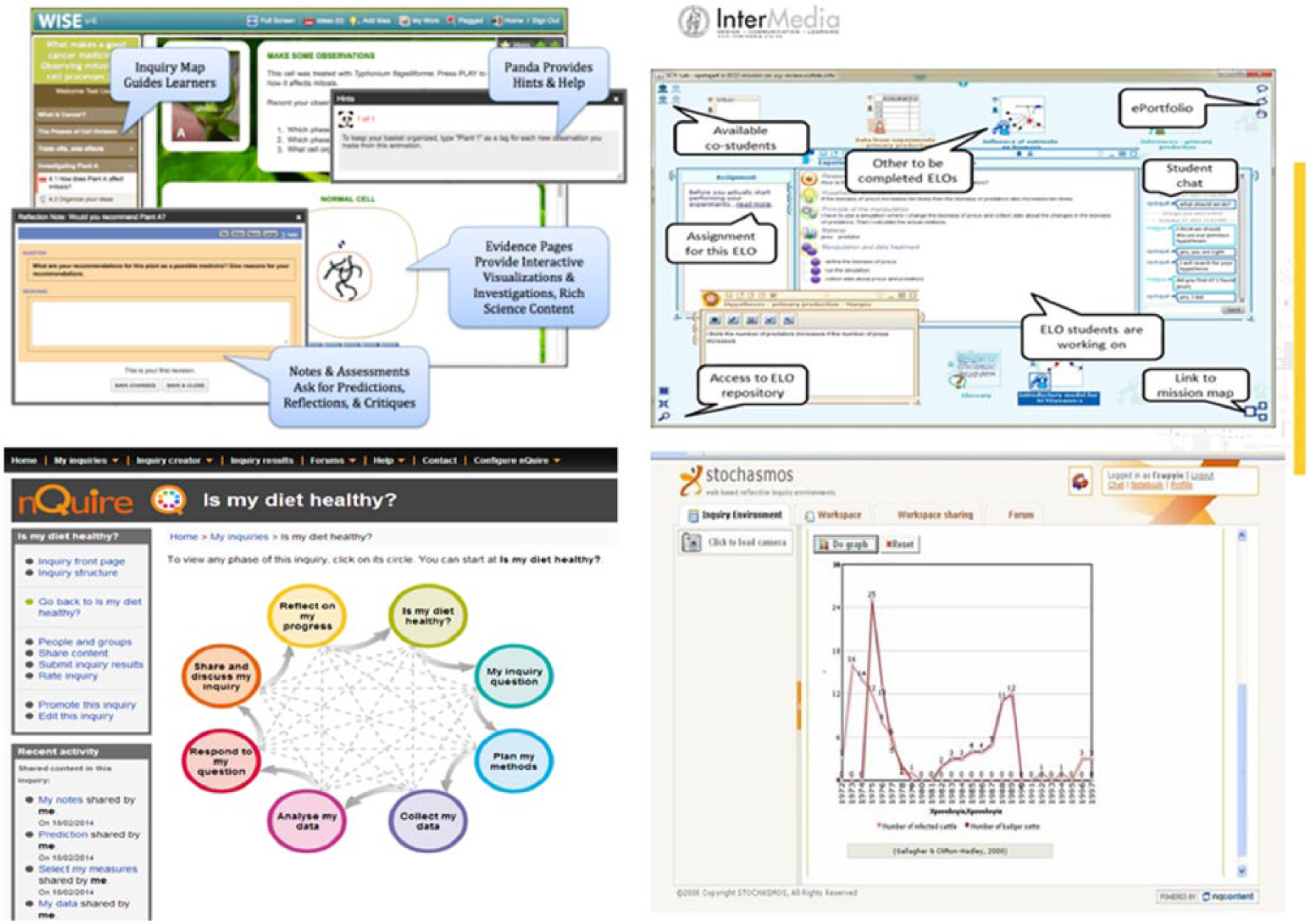
Case study ILEs: WISE (top left), SCY (top right), nQuire (bottom left), and STOCHASMOS (bottom right).
The purpose of nQuire is to guide students’ overall inquiry process both inside and outside the classroom. nQuire focuses on scripted support for learning (Anastopoulou et al., 2011). SCY is focused on the student development of products (emerging learning objects [ELOs]) that are derived from answering socioscientific questions (e.g., how to build a CO2 friendly house; de Jong et al., 2010). STOCHASMOS also supports students in answering a socioscientific problem and encourages students to develop evidence-based arguments through processes of planning, monitoring, and evaluating their investigations (Nicolaidou et al., 2011). WISE focuses on the enhancement of student knowledge integration for a broad range of science concepts and inquiry processes. Students engage in a variety of activities (virtual experiments, graphing, modeling) centered on an overarching, contextually relevant inquiry question (e.g., how to make airbags more effectively to reduce casualties; McElhaney & Linn, 2011). The activities are stepwise, but students are free and often encouraged to review or revisit previous steps (Gerard & Linn, 2013). Thus, the four ILE cases have distinctive features that should offer additional insight into inquiry learning.
Limitations of the Study
As noted already, there are many ways to define an ILE. In attempting to categorize ILEs and what they encompass, we may have omitted environments that others would have included. To ensure transparency, we explicitly define the criteria we use in this study so that others may be able to carry out similar studies or focus on particular aspects of ILEs in more detail. We have included a list of the excluded ILEs in the supplementary materials (Table S2; online only). Most ILE studies were excluded for lacking features of registration, taking advantage of visualization by computer or student, or collecting embedded assessments. A number of ILEs supporting argumentation were excluded, as they did not take advantage of visualization. We included pre/post studies to show the relative magnitude of the effect sizes across categories. There were a limited number of comparison studies within the included articles and as a result, evaluating the impact of ILEs on student learning was restricted.
The parameters we have used for inclusion may not be agreed upon by others. There is also a certain level of interpretation in determining whether an ILE has a specific feature based on descriptions in peer-reviewed journals and on the ILE’s website (if it has one) as reflected in the interrater agreement for a sample of items (86%). Although we did not include unpublished studies, based on the pre/post learning gains, we calculated a fail-safe N (Orwin, 1983) of 33.1 (p < .001); thus, we would need to identify 33 additional studies with a mean effect of essentially zero to reduce the combined effect to statistical nonsignificance.
If a feature was not noted in an article it may be left out in our analysis, but the authors may have noted it in another article not within the journals we searched. Nevertheless, given the large investments being made in ILEs and their promising role in science learning, a review of their features and impacts can contribute to the field. We call on researchers to characterize the features of their ILEs so that others can benefit from their work. The characteristics we have defined for analysis are a starting point toward making such features explicit.
Results
Overall, we identified 30 ILEs that met our criteria (Table 1). These ILEs were developed in 8 countries and studied by researchers in 12 countries (other countries not in the table, but where studies were conducted are Belgium, China, Estonia, and France). Seven of the ILEs serve middle school students (Grades 6–8, 23%), 15 serve high school (Grades 9–12, 50%), and 8 serve grades spanning across both middle and high school (27%). Of the 30 ILEs, 13 (noted with an asterisk in Table 1) are open source and can be used in classrooms (see Table S4, online only, for these websites; some may require a download or request for access).
Inquiry learning environments within the selection criteria
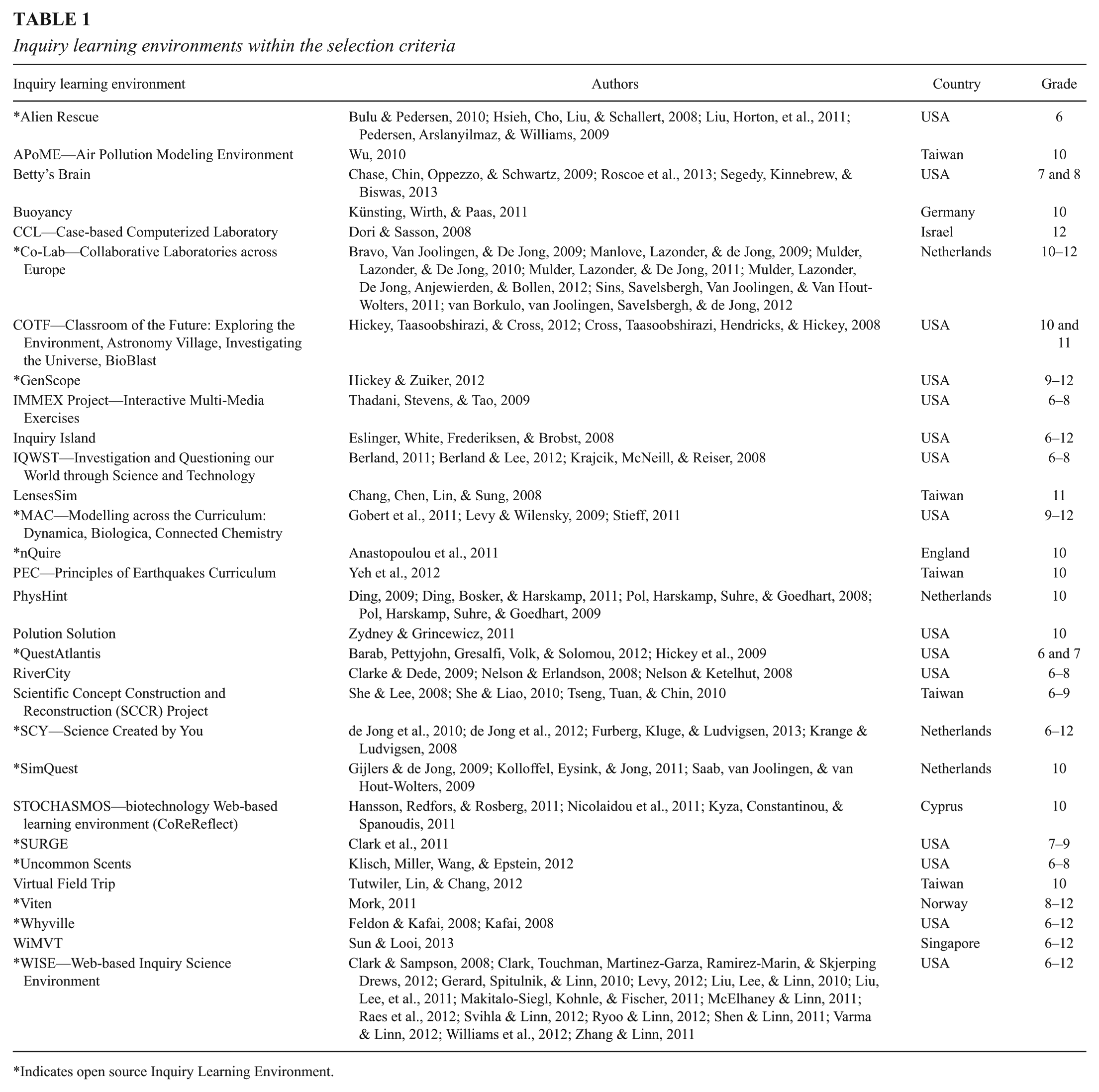
Indicates open source Inquiry Learning Environment.
Inquiry Features
To answer our first research question, we analyze the four inquiry features in the ILEs.
Exploring Meaningful and Authentic Scientific Contexts
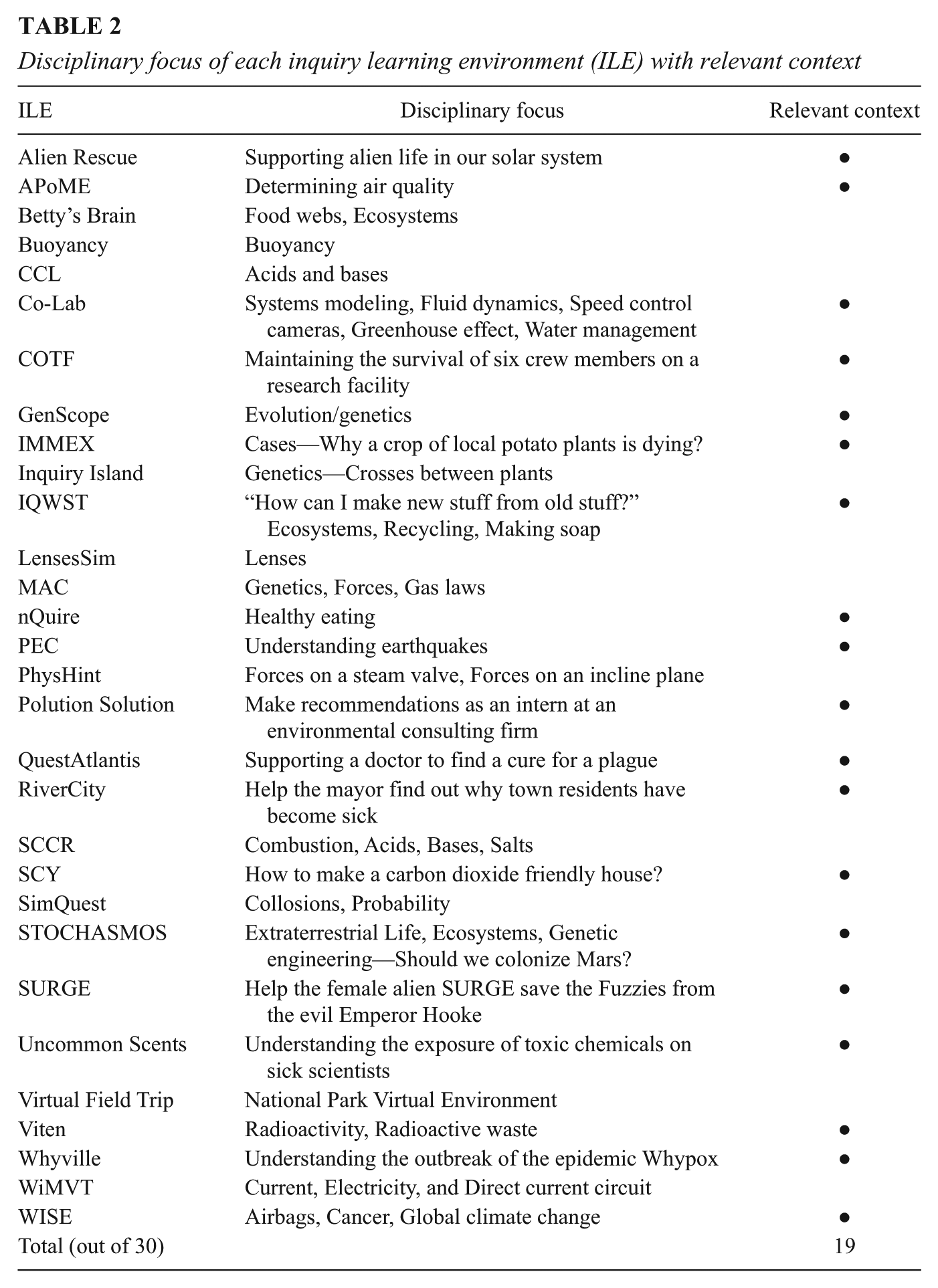
Of 30 ILEs, 19 (63%) featured an authentic context (see Table 2). Even when there are many appropriate, authentic, socioscientific questions or problems (for ecosystems, systems modeling, genetics, inclined planes), they were sometimes omitted or left to the teacher. Research shows that designing effective instruction around an authentic context is difficult because of the complexity of these situations. Most curriculum materials featuring meaningful contexts are designed by partnerships of discipline experts, educational researchers, and teachers, and have undergone several trials and refinements (e.g., Krajcik & Blumenfeld, 2006; Svihla & Linn, 2012). Classroom teachers generally do not have the time and resources to develop meaningful contexts on their own but can personalize a meaningful context for their students.
Disciplinary focus of each inquiry learning environment (ILE) with relevant context
All four cases featured a socioscientific issue and/or an overarching inquiry question. nQuire tasks students with documenting the food they eat and analyzing the implications for healthy eating (Anastopoulou et al., 2011). SCY challenges students to create designs to solve socioscientific challenges such as making a house with low CO2 emissions. STOCHASMOS engages students in using scientific evidence in a debate about a scientific dilemma, for example, considering whether genetically modified plants should be grown in their country. WISE design requirements call for including an overarching inquiry question such as “What impacts your genetic inheritance?” (Williams et al., 2012), “How can global warming be reduced?” (Varma & Linn, 2012), or “What are causes and possible cures for cancer?” (Linn & Eylon, 2011).
There are many calls in science education literature to portray relevant, accessible, and accurate science to students to encourage their interest and motivation in science (Saab et al., 2009). ILEs have the capability of supporting investigations of relevant scientific questions, and our analysis highlights that about two thirds of the ILEs provide meaningful and authentic contexts for students. These ILEs respond to numerous calls for personally meaningful student inquiry. These ILEs show how students can be supported to critically engage in science content while investigating novel and exciting scientific contexts. To succeed, the teacher plays an important role by guiding students to reflect on the role of scientific principles in the science contexts incorporated into the ILEs.
Using Powerful Visualizations
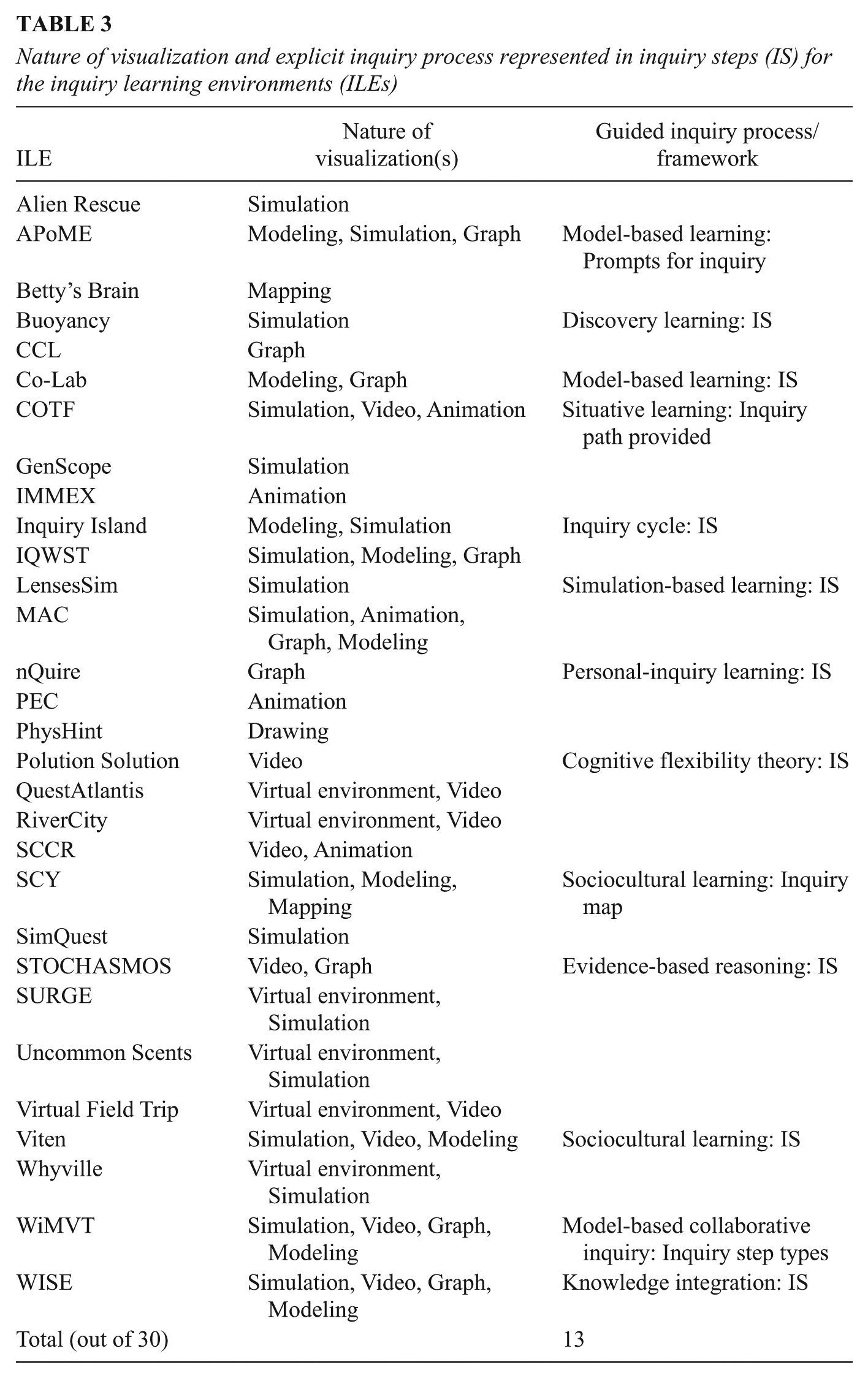
Using powerful visualizations refers to both making scientific concepts more visible through ILEs and making students’ thinking visible. All the ILEs used visualizations to take advantage of technology, consistent with the selection criteria (see Table 3). Overall, 13 of 30 ILEs (43%) guide students to use visualization for inquiry. Many of these ILEs, but not all, support Level 2 inquiry (Blanchard et al., 2010) guiding exploration of the visualization (Table 3). Some ILEs support aspects of Level 3 inquiry, where students must decide the question and the means to solve it.
Nature of visualization and explicit inquiry process represented in inquiry steps (IS) for the inquiry learning environments (ILEs)
The four cases capture the variety of guidance and interactivity available for visualizations. In nQuire, students generate graphs from the data they collect on their nutrient intake and compare outcomes. nQuire guides students in using inquiry processes such as “Decide my inquiry question or hypothesis,” “Plan my methods, equipment, and action,” and “Decide my conclusions” (Anastopoulou et al., 2011). SCY guides students’ visualization in the mission map using tools such as concept mapping, modeling, and simulations. Students can view their “missions” to complete in the mission map (de Jong et al., 2010; de Jong et al., 2012). These tools can be adapted to specific students or to the overall content. In STOCHASMOS, students gather and evaluate the credibility of evidence from sources such as video and graphs. STOCHASMOS provides students with an Inquiry Environment that is organized by tabs to help students choose appropriate inquiry processes (Nicolaidou et al., 2011). WISE uses knowledge integration guidance to engage students in visualizations including simulations, virtual experiments, video, graphing, and modeling for various science topics (McElhaney & Linn, 2011; Ryoo & Linn, 2012). Knowledge integration guidance involves asking students to make predictions; guiding students to use the visualization to add new, normative ideas; engaging students in distinguishing among their predictions and the new ideas in the visualization; and requiring students to reflect on their experiences and construct an argument to explain the topic under study (Liu et al., 2010).
The four cases all make the inquiry process explicit to students. nQuire and STOCHASMOS provide students with specific inquiry steps to help students identify inquiry processes. WISE is similar to nQuire and STOCHASMOS in using inquiry steps, but these steps are determined based on principles of knowledge integration. SCY gives students an inquiry mission map to help them identify the inquiry processes embedded in their designs.
ILEs incorporate varied, powerful visualizations to communicate complex scientific ideas. ILEs typically provide students with visualizations of the scientific concepts, but less than half of the ILEs support students as they select inquiry processes. ILEs use distinct approaches to guide students to consider or select appropriate processes for interacting with the visualizations. For example, when interacting with a climate change visualization, students may investigate the overall process of how global climate change occurs or may specifically analyze what happens to solar radiation when greenhouse gases increase in the earth’s atmosphere. Designers grapple with the tradeoff between providing too much guidance (and making the inquiry seem formulaic) and providing too little guidance (so students either skip the visualization entirely or flounder because they cannot determine how to proceed).
Supporting Collaboration With Others
From the 76 studies in this analysis, 30 involved students working individually (39%), 31 involved students collaborating (41%), and 14 (18%) included aspects of students working individually and collaboratively (See Table S5; online only). Eleven of the 30 ILEs include chat features to support student collaboration. One study compared online chat to face-to-face chat (Sins et al., 2011) and found advantages for engagement in face-to-face chat. Many studies built on prior research to design supports that succeeded in orchestrating student interactions (e.g., Hickey & Zuiker, 2012; Zhang & Linn, 2011).
The cases vary in the forms of collaboration they support. nQuire and SCY have both individual and collaborative elements. In nQuire, students collect their own data, but are also encouraged to share their findings with each other. nQuire notes that there is a fine line between finding personally meaningful inquiry topics for students and the potential for embarrassment, that is, some students felt uncomfortable about discussing their diets with others (Anastopoulou et al., 2011). In SCY, students could do certain tasks both individually or in a group, for example, reflect on their approaches, critique and evaluate each other’s emerging ideas, and discuss other aspects of their designs through the chat features (de Jong et al., 2010; de Jong et al., 2012). Students who revisit each other’s ideas and refine their ideas based on input from others are more likely to gain insights. This pattern, which is found in both science learning and science laboratories, can promote conceptual change (Furberg et al., 2013). For STOCHASMOS and WISE, students work collaboratively. Students working with STOCHASMOS share their ideas in a common workspace and also have to reach agreement with their peers on the credibility of their evidence. Students have difficulty engaging in extended collaboration for long-term investigations (Nicolaidou et al., 2011). In WISE, students work in collaborative groups but the ILE does not specifically guide the collaborative process or allow students to keep track of their own ideas. In some cases, researchers report that students collaborating in WISE spontaneously monitor each other’s progress, thus increasing self-regulation (Raes et al., 2012).
In summary, a key aspect of workplace success, collaboration, is incorporated into more than half of the ILE studies. In many cases, collaboration is dictated by limited computer resources rather than designed to take full advantage of the expertise of the students. Collaboration is most effective when scaffolded. Students benefit from tools and tailored content that facilitates the process of learning from each other. Such guided collaboration has proven valuable and could strengthen most ILEs (Makitalo-Siegl et al., 2011).
Developing Autonomous and Metacognitive Learning Practices
A central goal of inquiry instruction concerns promoting autonomous learning so that students can become lifelong learners. It is useful to distinguish between ILEs that primarily add and distinguish ideas, primarily extend and refine ideas, or do all these things (Bell et al., 2010; Etheredge & Rudnitsky, 2003). We characterize the processes the ILE uses to support student decision making in Table 4. (A description of each inquiry process is found in Table S6, online only.) Scaffolding and assessment tools are defining features of ILEs. ILEs strongly support student autonomy and metacognition for inquiry processes such as making hypotheses/predictions, collecting data, analyzing/interpreting, and drawing conclusions. ILEs provide less support for processes such as making an argument, planning, choosing variables, manipulating variables, presenting, and reflecting. Finally, ILEs give little support for inquiry processes such as selecting resources, drawing, graphing, avatar/role playing, and modeling (Table 4).
Inquiry processes coded for the inquiry learning environments

A number of the ILEs do not scaffold student autonomy and metacognition of important inquiry processes such as planning, argumentation, graphing, and modeling. Scaffolding these inquiry processes can support students in developing important skills necessary for lifelong science learning (and closely align to those used by practicing scientists). Few ILEs give students autonomy in selecting resources or adding variables to investigate. The scaffolding needed to support students in choosing appropriate variables requires further research (Lee, Plass, & Homer, 2006).
All four platforms offer numerous and diverse supports to help students distinguish and refine their ideas: nQuire (12), SCY (13), STOCHASMOS (10), and WISE (14). Each of the ILEs have some missing features such as avatars and role play, graphing, choosing variables, selecting resources, or collecting data. Overall, all the ILEs have inquiry features to support visualizations and many also support student autonomy and metacognition (see Table S7, online only). Only some of the ILEs address the inquiry features of meaningful and relevant science context and collaboration. Fourteen of the 30 ILEs (47%) include features aligned with all four of the inquiry features, including Alien Rescue, Co-lab, and GenScope (Table S7). All the cases address the four inquiry features (nQuire, SCY, STOCHASMOS, WISE). Eight of the 30 ILEs (27%) have three of the inquiry features including APoME, PhysHint, and WiMVT (Table S7). Most of the ILEs support Level 1 or Level 2 inquiry (Blanchard et al., 2010). Some ILEs (e.g., Alien Rescue, nQuire, Whyville) purposefully primarily support aspects of Level 3 inquiry (Blanchard et al., 2010). For these ILEs, teachers have a major responsibility to promote inquiry practices within their classrooms (Pedersen et al., 2009).
Impacts on Student Learning
We address the second research question by reviewing impacts of using the ILEs on student learning. We analyzed all studies that reported data necessary for computing effect sizes (44 out of 76 articles). We look at both pre/post studies and comparison studies. The effect sizes are mostly positive, consistent with reviews of inquiry instruction (e.g., Furtak et al., 2012; Minner et al., 2010; significant effect sizes are bolded in Appendix A). The studies show learning gains in conceptual understanding resulting from inquiry instruction, with an average weighted effect size of 0.87 for pre/post studies. Studies show value of inquiry for a broad range of science topics: air quality, gas laws, kinetic molecular theory, motion, global climate change, and genetics. Three studies (Gerard et al., 2010; Krajcik et al., 2008; Svihla & Linn, 2012) demonstrate the value of iterative refinements for improving outcomes from inquiry instruction. In these studies, the effect sizes increased in the second and/or third year after designers or teachers used evidence from earlier studies to refine instruction.
The comparison studies show mostly favorable results for the interventions (see effect sizes in Appendix B). Features of successful interventions include the value of a teachable agent (students teach a computer agent) for students over having their own avatar, collaboration over individual student work, and dynamic visualizations over nondynamic visualizations. For example, a comparison study on the topic of photosynthesis showed that dynamic visualizations can illustrate dynamic scientific processes that static images struggle to communicate, such as the transformation of carbon dioxide and water in a plant’s chloroplast to form glucose and oxygen (Ryoo & Linn, 2012). A negative effect size was recorded for online chat versus a face-to-face condition probably because students in the face-to-face condition exchanged more comments (Sins et al., 2011).
Each of the comparison studies have also been coded for the four successful inquiry features. The comparison studies mostly focus on using powerful visualizations or developing autonomous students (Appendix B). Thirteen of the 26 comparison studies focus on some aspect of visualization and 9 of the 26 comparison studies have some focus on student autonomy. The average weighted effect size for visualization is 0.59 and for autonomy it is 0.41 based on these studies. For exploring meaningful and authentic science and collaboration, there are two studies each (Appendix B). The average weighted effect size for meaningful and authentic science is 0.32 and for collaboration it is 0.67. Of the four cases, three reported effect sizes that demonstrate value for inquiry learning: nQuire, STOCHASMOS, and WISE (see Appendix A and Appendix B). WISE research also shows that with iterative refinements, effect sizes increase.
Teacher Infrastructural and Implementation Features
The findings have so far explored the inquiry features embedded within ILEs and illustrated positive learning gains for ILE-based interventions. However, a crucial factor that underpins both short-term and long-term success of precollege ILEs is the contribution of the teacher (Furberg et al., 2013; Gerard et al., 2010; Krajcik & Blumenthal, 2006). Teachers benefit from infrastructural supports to implement inquiry. Half of the 30 ILEs have multiple units and one third have grading (see Table S8, online only). Less common infrastructural features across the ILEs are authoring (8), automated guidance/feedback (10), progress monitoring (2), and flagging of student work (4; Table S8). The four cases vary in how many of these six infrastructural features they include: nQuire (2), SCY (5), STOCHASMOS (4), and WISE (6; Table S8). WISE and SCY include all the teacher infrastructural features, except SCY does not have progress monitoring. STOCHASMOS does not include automated feedback or progress monitoring, and nQuire does not incorporate grading, automated feedback, progress monitoring, and flagging student work. The absence of grading and automated feedback in some of the platforms could deter designers from using them for authoring new units.
We found that most research on ILEs depends on implementations conducted by novice users who were using the ILE for the first time (see Table S9, online only). Twenty of the ILEs (66%) had studies that involved implementation for less than 1 year, six ILEs lasted for 2 years, and four ILEs had studies more than 2 years. Eight ILEs showed some aspects of iterative refinement based on student learning outcomes. We grouped the average effect sizes in the pre/post learning gains (Appendix A) based on studies that lasted 1 year or less and studies that lasted longer than 1 year. Studies that lasted 1 year or less had a weighted average effect size of 0.69 (p < .001, 95% CI [0.614, 0.765, fixed; 0.244, 1.128, random]), and studies that lasted over a year had a weighted average effect size of 0.96 (p < .001, 95% CI [0.904, 1.011, fixed; 0.734, 0.982, random]).
Among the case studies, nQuire, SCY, and STOCHASMOS typically involved teachers with less than 1 year experience of using the platform. The nQuire study involved one teacher and it took place over a semester. nQuire held many informal meetings with the teacher where they discussed inquiry in detail (Anastopoulou et al., 2011). In SCY, the teachers collaborated with the research team on the design of the environment, including the content, pedagogy, and planning for design research in the schools (Dolonen & Ludvigsen, 2012). For one STOCHASMOS study, the teacher in the study had 16 years experience, but was teaching an extended ILE investigation for the first time (Kyza et al., 2011). In another study, the teacher had 17 years experience, but had no experience teaching with inquiry methods (Nicolaidou et al., 2011). The many teachers using WISE participated in longitudinal studies occurring over 2 years or more. Most participated in some form of professional development.
In summary, most of the research on ILEs involves testing innovations with teachers new to inquiry. Some studies include trial and refinement over several years. These studies typically involve researchers guiding teachers in the classroom. Follow-up and scaling studies are needed to determine the most effective ways to sustain and improve the use of inquiry materials.
Discussion
Fostering Learning in the Networked World (Borgman et al., 2008) envisions a common and open platform that can readily evolve to encompass emerging technologies such as automated scoring, educational games, new visualizations, and so on. Such technologies can build on and improve existing ILEs and also support the development of new units within ILE platforms (Krajcik et al., 2008; McElhaney & Linn, 2011; Svihla & Linn, 2012). Evidence from the studies in this review show research-based aspects of inquiry help students learn science in ILEs: meaningful and authentic science, powerful visualizations, collaboration, and autonomy/meta-cognition.
The ILEs use a plethora of ways to structure student inquiry including a variety of cycles, steps, and maps. The structuring approaches are often quite precise, making inquiry seem more systematic than it is in scientific labs (Furtak et al., 2012; Windschitl, 2004). More research is needed to determine the progress students make in understanding inquiry practices. Developing a common, flexible, and abstracted approach for structuring inquiry could reinforce the cumulative impact of courses and topics and strengthen student understanding of the scientific practices called for in the Next Generation Science Standards (NRC, 2011).
More research exploring the tradeoff between too much guidance (thus making science appear formulaic) and too little guidance (thus encouraging superficial or mindless explorations) is needed. Students benefit from flexible, abstract frameworks that can be used for both classroom and personal inquiry activities. WISE, for example, uses the knowledge integration pattern in organizing inquiry both within and across units. Students experience multiple ways to make predictions; gather evidence from visualizations, virtual experiments, or hands on experiments; distinguish between predictions and new evidence; and reflect on their experiences by building an argument (Linn & Eylon, 2011).
Based on our study, researchers investigating ILEs can contribute to understanding by conducting more sustained implementations of ILEs. Only 10 of the 30 ILEs had studies that lasted over a year in teacher implementation. This finding is consistent with a review of professional development literature for inquiry teaching, which indicates that successful professional development programs require at least 2 years but that few investigations involve that level of support (Gerard et al., 2011). Given the complex and broad nature of many units delivered by ILEs, short-term studies can place unrealistic expectations on teachers. As was highlighted in the case studies, teachers may need to learn how to use both the technology and inquiry methods. Thus, studies using the 10 ILEs that lasted over a year and focused on iterative refinement showed increased weighted average effect sizes, suggesting the advantage of sustained professional development. However, further short-term and longitudinal studies are needed. This research also shows that iterative refinement based on student and teacher feedback improves both the curriculum and inquiry teaching strategies. Studies with experienced teachers who are familiar with the ILE make it easier to understand the impact of improvements to the curriculum.
The NSF report (Borgman et al., 2008) encourages researchers to consolidate their efforts and build on the work of others rather than reinventing resources that exist. Our study demonstrates progress on developing common platforms in that 16 of the 30 ILEs have multiple curriculum units. However, less than half of the ILEs have two or more infrastructural features such as authoring, grading, or feedback, and only a small handful have progress monitoring or flagging of student work. The small number of technology features in most ILEs is consistent with the significant investment ILE platforms require to develop. We hope that this review will help teachers and researchers new to ILEs identify platforms that they can build on rather than starting anew if unnecessary. In this way, users can focus on strengthening ILEs.
Developing flexible platforms can achieve the vision of the NSF report and, more important, meet the needs of teachers. Teachers seek flexible yet durable materials that can be readily assimilated into their classroom practice (Cuban, 1986). Teachers can see the benefit of investing in learning how to use an ILE if there are multiple units, if units are customizable, and if developers add features that they desire (such as support for tablets and mobile computing).
Teachers desire platforms that support customization of curricula to their own needs. At the same time, researchers are commonly concerned with maintaining the integrity of ILEs (Barab & Luehmann, 2003; Plesch, Kaendler, Rummel, Wiedmann, & Spada, 2013; Squire, MaKinster, Barnett, Luehmann, & Barab, 2003). We found eight ILEs that support customization or authoring for researchers or teachers. For these ILEs, teachers can use evidence from their students’ work to customize units and align instruction with classroom needs (Svihla & Linn, 2012). Researchers and teachers can collaborate to build on evidence from student work and maintain the integrity of inquiry instruction. Teachers need to be equal players in testing and refining units. Researchers need to welcome teachers as partners and take advantage of significant teacher expertise as they refine ILEs to adjust to changing classroom, student, policy, and institutional demands.
In summary, the pre/post and comparison studies demonstrate the impact of ILEs on student learning. Furthermore, these results show that students using ILEs in typical classrooms can gain deep and coherent understanding of science concepts. At the same time, these studies show that better technology integration and more effective professional development is needed to increase the number of students who benefit from these technologies.
Implications for Future Design and Research
Aligning with calls from the Fostering Learning in the Networked World report, researchers and designers of ILEs should seriously consider the extension of rather than recreation of existing, open source, and evidence-based ILE platforms. Researchers should first consider existing open source and evidence-based ILE platforms (see Table S4, online only), such as those that have large userbases (e.g., Questatlantis, Whyville, and WISE). Students, teachers, and researchers benefit when new tools build on familiar platforms and take advantage of tested and useful existing features. Investment in such an approach increases the sustainability of valuable platforms and allows designers to focus on adding their innovations rather than reinventing things that already work. Of course, creative innovations must not be constrained by existing platforms. Balancing innovation and alignment with existing platforms is necessary in allocating resources to support a vibrant, creative research community and strengthen opportunities for student learning.
WISE, for example, in 2014 supported a community of more than 9,000 registered teachers and 76,000 registered students. Collaborators continuously add new features to WISE, for example, the NetLogo project uses WISE for curriculum (Sengupta & Wilensky, 2011). WISE also has over seven instances of its platform in the United States, Taiwan, Argentina, and other countries. The studies in this article by international researchers not directly affiliated with the WISE group attest to the successful use of existing platforms to support new teachers and researchers.
ILE platforms can enable researchers and designers to investigate powerful questions concerning the impact of instruction on students’ cumulative learning in science and increase the validity of their results. Studies can compare representations of science phenomena, ways to track student progress over time, methods for providing personalized and automated guidance to students, new forms of assessments, and ways to provide guidance to teachers. Currently, the studies are thinly spread across many ILEs with varied technology supports. Converging on a unifying platform could ensure that all studies take advantage of established supports and make syntheses of findings more robust.
Studies are needed to broaden the range of inquiry assessments. Many ILEs support multiple-choice questions, but few take advantage of more sophisticated inquiry assessments such as concept mapping, drawings, or essays. ILEs can feature embedded assessments that also serve as learning opportunities (Hickey et al., 2012). Research and development is needed to show how these items can become valid and reliable options for high-stakes assessment. There is also a need for greater research on matching ILEs to student needs and capabilities (Wu, 2010). Within ILEs, offering alternative media elements (video, animations, drawings, online chat, etc.) may allow for customization to student needs (Zydney & Grincewicz, 2011).
Researchers can increase the impact of ILEs by strengthening teacher professional development (Yeh et al., 2012). Researchers and teachers can collaborate to use evidence from classroom learning to improve inquiry scaffolds. Helping teachers develop criteria based on research for designing and evaluating inquiry teaching and learning could lead to productive customizations of units for specific users. Building and sustaining a research program focused on developing criteria for effective inquiry instruction is especially important given the NGSS focus on sustained investigations and cumulative learning. Future studies can test and refine the design principles and features noted in the ILEs we reviewed and connect them to achievement of the NGSS.
Conclusion
In reviewing the characteristics of contemporary ILEs, we identified many highly creative and effective ILEs. ILEs typically enhance student learning, but greater collaboration, cumulative development, and comparison studies on ILEs are critically needed. There is a paucity of research on how ILEs affect student learning over consecutive years. More studies of sustained use of ILEs by teachers could enhance design of curricula as well as inform professional developers. However, a cumulative understanding of design principles that support inquiry is emerging (Kali, 2006; Quintana et al., 2004). We drew on four components of inquiry that were widely supported in the literature: meaningful and authentic science, powerful visualizations, collaboration, and autonomous, metacognitive learners. These four components were evident across many of the ILEs. They would benefit from more precise characterizations to help researchers make informed design and implementation decisions. For example, specific guidelines for designing instruction that promotes student autonomy are needed. Most ILEs align with the suggestions of Quintana and others to provide guidance (either on demand or in the form of questions) but do not help designers resolve the tradeoffs between too much and too little guidance.
The role of the teacher within ILEs needs more attention. Some ILEs leave much of the guidance to the teacher, giving teachers few guidelines (Furberg et al., 2013; Krange & Ludvigsen, 2008). Most ILEs lack supports for teachers that take full advantage of embedded assessments of student work. Professional development research shows that teachers need time to develop skill in implementing inquiry (Gerard et al., 2011). These findings support the idea that teachers can develop effective monitoring and guiding skills when they implement inquiry activities such as those supported by most of the ILEs and refine their practices based on logged student work. As teachers develop these skills, they become prepared to enhance inquiry opportunities across the curriculum.
Footnotes
Appendix
Comparison studies effect sizes for the ILEs
| ILE (author) | Grade | n | Nature of comparison (exp./cont.) | Hedge’s g | Type |
|---|---|---|---|---|---|
| Co-Lab—van Borkulo et al., 2012 | 11 | 74 | Modeling group vs. expository group (n = 38/36) | 0.40 (p = .089) | V |
| MAC—Stieff, 2011 | 10–12 | 431 | Connected Chemistry Curriculum (visualization tools) vs. Lecture-based methods (n = 217/214) | V | |
| PhysHint—Pol et al., 2009 | 10 | 59 | Immediacy of feedback—During/After (DA) vs. control (n = 18/23) | 0.81 (NR) | V |
| Immediacy of feedback—After (A) vs. control (n = 18/23) | |||||
| Questatlantis—Hickey et al., 2009 | 6 | 116 | Virtual environment vs. text-book approach (n = 54/62)—Proximal Test (PT) and Distal Test (DT) | V | |
| 0.89 (DT) (p = .003) | |||||
| Questatlantis—Barab et al., 2012 | 7 | 65 | Game based (GB) vs. story based (SB) (n = 33/32) | V | |
| SCCR—She & Lee, 2008 | 6 | 61 | SCCR intervention in topic of combustion vs. control—Combustion Achievement Test (CAT), Scientific Reasoning Test (SRT), Combustion Dependent Reasoning Test (CDR) (n = 31/30) | V | |
| STOCHASMOS—Kyza et al., 2011 | 6 | 53 | Workspace vs. PowerPoint condition (n = 13/13 groups)—Total explanation | 0.75 (p = .06) | V |
| STOCHASMOS—Nicolaidou et al., 2011 | 11 | 25 | Biotechnology intervention vs. typical curriculum (n = 12/13) | V | |
| WISE—Clark et al., 2012 | 8 | 50 | Spanish-English support vs. English only support (n = 24/26) | 0.54 (p = .065) | V |
| WISE—Ryoo & Linn, 2012 | 7 | 167 | Dynamic vs. static visualization (n = 81/86) | V | |
| WISE—Shen & Linn, 2011 | HS | 79 | Experienced students vs. typical students (n = 38/41) | V | |
| WISE—Svihla & Linn, 2012 | 6 | 186 | Year 1 curriculum (GCC1) vs. Year 2 curriculum (GCC2)—Global climate change (n = 119/67) | V | |
| WISE—Zhang & Linn, 2011 | 8 | 133 | Drawing generation vs. simulation interaction (n = 81/52) | V | |
| Alien Rescue—Bulu & Pedersen, 2010 | 6 | 267 | Scaffolding conditions—Specific vs. general domain (n = 127/140) | Au | |
| Continuous scaffold vs. Faded scaffold (Domain specific, n = 74/66) | |||||
| Continuous scaffold vs. Faded scaffold (Domain general, n = 70/57) | 0.4 (p > .79) | ||||
| Betty’s Brain—Chase et al., 2009 | 8 | 62 | Students with Teachable Agent (TA) vs. Avatar (Av)—TA spend more time learning (n = 31/31) | Au | |
| Co-Lab—Sins et al., 2011 | 11 | 44 | Chat vs. face-to-face communication (n = 11/11) dyads—Number of process episodes | Au | |
| Surface processes | |||||
| Deep processes | 0.19 (p < .72) | ||||
| PhysHint—Pol et al., 2008 | 11–12 | 37 | Problem solving: PhysHint vs. control (n = 11/26) | 0.49 (NR) | Au |
| SimQuest—Gijlers & de Jong, 2009 | 10 | 66 | Shared Proposition Table Scaffold vs. Control (n = 22/22)—Proposition test | Au | |
| Shared Scratchpad Scaffold vs. Control (n = 22/22)—Proposition Test | |||||
| WISE—Lee et al., 2011 | MS and HS | 4,745 | Inquiry vs. typical instruction (n = 2,685/2,060) | Au | |
| WISE—Makitalo-Siegl et al., 2011 | HS | 108 | Help seeking (Dyads)—Low scripted (n = 35) vs. High scripted (n = 19) | Au | |
| Co-Lab—Mulder et al., 2012 | 10 | 91 | Comparison of model progression for different restrictions | Au | |
| Restricted variables (n = 20) vs. control (n = 30) | |||||
| Performance Success—Variables | |||||
| Performance Success—Relations | |||||
| Semirestricted variables (n = 19) vs. control (n = 30) | |||||
| Performance Success—Variables | |||||
| Performance Success—Relations | |||||
| Unrestricted (n = 22) vs. control (n = 30) | |||||
| Performance Success—Variables | |||||
| Performance Success—Relations | |||||
| LensesSim—Chang et al., 2008 | 11 | 384 | Simulation with experiment prompting vs. control (n = 39/39) | Au | |
| Simulation with hypothesis menu vs. control (n = 40/39) | |||||
| Simulation with step guidance vs. control (n = 35/39) | |||||
| Experiment prompting vs. step guidance (n = 78/74) | |||||
| Hypothesis menu vs. step guidance (n = 79/74) | |||||
| nQuire—Anastopoulou et al., 2011 | 10 | 36 | nQuire students vs. control condition (n = 21/15): | Me | |
| Attitudes to scientific inquiry (ASI) | |||||
| Adoption of scientific attitudes (ASA) | 0.44 (ASA) (NR) | ||||
| Leisure interest in science (LIS) | −0.35 (LIS) (NR) | ||||
| Enjoyment of science lessons (ESL) | |||||
| PEC—Yeh et al., 2012 | 10 | 153 | Considering Prior Knowledge vs. not Considering Prior Knowledge (n = 78/75) | Me | |
| Lower cognitive load in learning process (CLLP) | |||||
| Curriculum operation (CO) | |||||
| Total cognitive load (TCL) | |||||
| Science conception learning outcome (SCL) | 0.18 (SCL) (p = .27) | ||||
| Open-response question (OQ) | |||||
| Co-Lab—Manlove et al., 2009 | 10–12 | 42 | Pairs (n = 12) versus individuals (n = 18) | C | |
| Elaborate Laboratory Report Content | |||||
| Better Models | |||||
| SimQuest—Kolloffel et al., 2011 | 9 | 215 | Collaborative dyads (n = 60) vs. individual (n = 95) students’ conceptual understanding | C |

Note. NR = not reported; V = visualization; Au = autonomy; Me = meaningful context; C = collaboration.
Notes
Authors
DERMOT F. DONNELLY is a postdoctoral researcher in the Graduate School of Education at the University of California, Berkeley, 4407 Tolman Hall, Berkeley, CA 94720, USA; e-mail:
MARCIA C. LINN is a professor of cognition and development specializing in education in mathematics, science, and technology in the Graduate School of Education at the University of California, Berkeley, 4407 Tolman Hall, Berkeley, CA 94720, USA; e-mail:
STEN LUDVIGSEN is a professor at the University of Oslo, Oslo, Norway; e-mail:
References
Supplementary Material
Please find the following supplemental material available below.
For Open Access articles published under a Creative Commons License, all supplemental material carries the same license as the article it is associated with.
For non-Open Access articles published, all supplemental material carries a non-exclusive license, and permission requests for re-use of supplemental material or any part of supplemental material shall be sent directly to the copyright owner as specified in the copyright notice associated with the article.
