




Abstract
Sixteen meta-analyses were conducted to examine relations of typically developing bilingual immigrant-background children’s oral language proficiency in their first and second language with the school outcomes of early literacy (k = 41), reading (k = 61), spelling (k = 9), mathematics (k = 9), and academic achievement (k = 9). Moderate to strong within-language relations were found for all school outcomes (.22 < r < .43), and cross-language relations for early literacy and reading (.12 < r < .22). Within-language relations were stronger than cross-language relations (.14 < d < .35). Only 6 out of 96 moderator effects tested were significant. Based on our findings, we propose a task-dependent bidirectional transfer hypothesis: The strength of cross-language transfer depends on the type of language proficiency task and the type of school outcome. Stimulating oral language proficiency in both languages can be a key factor in improving school outcomes of bilingual immigrant background children.
Bilingualism—competence in two languages—is a widespread phenomenon (Edwards, 2004), with the percentage of students that belong to a language minority in the United States expected to increase to 40% in 2030 (Thomas & Collier, 2002). The number of bilingual children with an immigrant background is increasing worldwide. These children often show less favorable school outcomes compared to their monolingual peers (e.g., Aud et al., 2012; Fleischman, Hopstock, Pelczar, & Shelley, 2010), which may be due to disadvantages in proficiency in the language of education. Several studies with bilingual children with an immigrant background have reported positive associations between language proficiency and the school outcomes of early literacy, reading, spelling, mathematics, and general academic achievement in both the first language (L1) and the second language (L2; e.g., Atwill, Blanchard, Christie, Gorin, & Garcia, 2010; Bang, Suárez-Orozco, Pakes, & O’Connor, 2009; Barrett, Barile, Malm, & Weaver, 2012; Hammer, Lawrence, & Miccio, 2007; Raynolds & Uhry, 2010), whereas others failed to find such positive associations (e.g., S. Y. Kim & Chao, 2009; Scarpino, Lawrence, Davison, & Hammer, 2011). The associations between language proficiency and school outcomes can differ depending on whether language proficiency and the school outcome are measured for the same language (within-language relations) or for different languages (cross-language relations). Insight in the strength and direction of these relations can add to the theoretical knowledge base on cross- and within-language relations and inform interventions targeted at improving the school outcomes of bilingual children with an immigrant background.
In the current study, a set of meta-analyses of 86 studies including 23,049 children is performed to test the hypotheses that in bilingual children with an immigrant background, oral language proficiency is positively related to school outcomes within and across both the ethnic and the host language, the effect that moderator variables have on the strength of these relations and the hypotheses that within- or cross-language relations in one language will be comparable in strength to the same relations in the other language, and within-language relations are stronger than cross-language relations.
All over the world, children with an immigrant background grow up bilingually, because their L1 is different from the language of their host country, their L2. Numbers of immigrants are increasing worldwide, mainly due to labor migration as a result of globalized economic activity (United Nations Population Fund, 2006). In the United States, most of the language minority children are Hispanic (Klein, Bugarin, Beltranena, & McArthur, 2004). In recent years, the number and percentage of Hispanic and Asian students in the United States have increased, with Hispanic students now making up 23% of the total school enrollment (Aud et al., 2012). The percentage of language minority students in the United States is expected to increase to 40% in 2030 (Thomas & Collier, 2002). The increasing flow of immigrants is also one of the main factors behind multilingualism in European countries (Tabouret-Keller, 2004). Overall, 12% of the inhabitants of the 27 countries of the European Union are first-generation and 5% second-generation migrants (Eurostat, 2011). These migrants are likely to be language minorities in their host countries. In Canada, 20% speak a language other than English or French, with most of the language minorities speaking an Asian language (Statistics Canada, 2006).
Bilingualism can have certain cognitive advantages. Several studies have shown that bilingual children generally perform better than monolingual children on executive control tasks, working memory, metalinguistic awareness, abstract and symbolic representation skills, and spatial perspective taking (Adesope, Lavin, Thompson, & Ungerleider, 2010; Barac & Bialystok, 2012; Bialystok, 2007; Greenberg, Bellana, & Bialystok, 2013; Poulin-Dubois, Blaye, Coutya, & Bialystok, 2011). The need to switch between two languages is thought to be responsible for these cognitive advantages. Brain areas related to cognitive control are also engaged in L2-related brain activity (Abutalebi, 2008). The advantages can differ dependent on the degree of balanced bilingualism and the age of onset of bilingualism (Bialystok & Barac, 2012; Luk, De Sa, & Bialystok, 2011). The cognitive skills in which bilinguals generally excel might support them in their academic performance (Best, Miller, & Jones, 2009; Yeniad, Malda, Mesman, van IJzendoorn, & Pieper, 2013).
Despite the cognitive advantages of bilingualism, most bilingual children with an immigrant background generally score lower on standardized reading and math assessments (Aud et al., 2012; Entorf & Minoiu, 2005; Fleischman et al., 2010) and are more likely to have repeated a grade or to drop out of high school (Child Trends Data Bank, 2012, 2013). This disadvantage in school achievement can be partly explained by the less favorable socioeconomic status (SES) of many immigrant families. Children from families with a lower SES generally show less favorable school outcomes. Asian American students are an exception, in terms of achievement as well as of SES, because they generally score higher than their monolingual counterparts on standardized assessments and their families’ SES is comparable to that of native families (Chen & Stevenson, 1995; Fleischman et al., 2010). For bilingual children with an immigrant background, the possible cognitive advantages of bilingualism apparently do not outweigh their less favorable position in education compared to their monolingual counterparts.
In addition to differences in academic achievement between bilinguals and monolinguals, there is substantial variation within bilingual groups. Children’s oral language proficiency—their proficiency in speaking and understanding spoken language (in their L1 or L2)—is one of the variables related to these achievement differences. Previous research with bilingual children has shown that oral language proficiency is positively related to the early literacy skills of phonological awareness, letter knowledge, and initial awareness of literacy concepts (e.g., Atwill et al., 2010; Dickinson, McCabe, Clark-Chiarelli, & Wolf, 2004; Hammer & Miccio, 2006) and to reading (e.g., Marx & Stanat, 2012; Melby-Lervag & Lervag, 2011), spelling (e.g., Abu-Rabia & Siegel, 2002; Raynolds & Uhry, 2010), mathematics (e.g., Barrett et al., 2012; Kleemans, Segers, & Verhoeven, 2011), and general academic achievement (e.g., Garnett, 2012; Hoff, 2013). However, some studies found no relation of oral language proficiency with these school outcomes (e.g., Abu-Rabia, 1999; Buriel & Cardoza, 1988; Durgunoğlu, Nagy, & Hancin-Bhatt, 1993; S. Y. Kim & Chao, 2009). Furthermore, there are also studies that found negative effects of L1 proficiency on school outcomes (e.g., Liu, Benner, Lau, & Kim, 2009; Scarpino et al., 2011; Swanson, Rosston, Gerber, & Solari, 2008).
There are several theories explaining cross-language relations, relations between a predictor measured in one language and an outcome measured in the other language. Some of these theories suggest positive and others negative cross-language relations. Insight in which of these theories is applicable in the relation between oral language proficiency and school outcomes can provide useful information on which language to stimulate in order to improve school outcomes. According to the interdependence hypothesis (Cummins, 1979), L1 competence positively relates to L2 competence, because competence in L2 is partly based on competence in L1. In other words, cross-language transfer takes place. More recently, an interdependence continuum (Proctor, August, Snow, & Barr, 2010) has been suggested, in which the strength of the interdependence is hypothesized to be dependent on the resemblance in languages and the type of L1 and L2 skills. This idea of interdependence between languages is confirmed by neuroimaging studies, in which the same neural structures (particularly the left inferior frontal gyrus and superior temporal gyrus) were found to be responsible for both L1 and L2 processing (Abutalebi, 2008; Buchweitz & Prat, 2013).
However, according to the threshold hypothesis (Cummins, 1979), L1 proficiency has to be of a sufficient level for this positive transfer to take place. Neuroimaging studies have also shown that the similarity in brain activation between L1 and L2 was higher for more proficient bilinguals (Buchweitz & Prat, 2013). In addition, the script-dependent hypothesis (Geva & Siegel, 2000; Ryan & Meara, 1991) assumes that the type of errors made in L2 are influenced by L1 and dependent on the degree of similarity between the scripts of the two languages. Furthermore, the relation between oral proficiency in one language and school outcomes in the other language could also take the form of subtractive bilingualism, which refers to learning L2 skills at the expense of L1 skills (Butler & Hakuta, 2004).
Language education policies have frequently changed, in North America as well as in Europe, and it is still the subject of debate whether the ethnic language should be incorporated in education or whether the focus should be on education in and of the host language (Mackey, 2004; Tabouret-Keller, 2004). Insight in the strength and directions of the relation between proficiency in L1 and L2 and school outcomes in both languages can inform future decisions on language policies. A meta-analytic approach is particularly powerful to examine the relations between language proficiency and school outcomes in both L1 and L2 for bilingual children with an immigrant background, and the potential moderators of these relations, because it combines the results of several previous studies and analyzes the causes of divergent outcomes in terms of differences in design of the studies. In addition, meta-analyses in which within- and cross-language relations between oral proficiency and school outcomes are compared can add to the theoretical knowledge base on interdependency between two languages in bilinguals and the generalizability of these findings to different samples of bilingual children with an immigrant background.
Moderators
Divergent findings between studies regarding the relation between language proficiency and school outcomes may result from differences in sample and procedural characteristics, which therefore need to be tested as moderators in the meta-analyses. Relevant sample characteristics that could serve as potential moderators are sample size, SES, immigrant generation, age or grade level, L1 education, whether or not it is a Spanish sample in the United States, and gender; relevant procedural characteristics are the language proficiency measure, the type of language proficiency, language modality, type of school outcome (early literacy, reading, spelling, mathematics, or general academic achievement), the outcome measure, the type of early literacy, reading or spelling that is measured, publication year, and the use of covariates.
Sample size is one of the sample characteristics that can potentially moderate the relation between oral language proficiency and school outcomes. Publication bias is more likely for studies with small sample sizes and effect sizes for published studies with small samples may therefore be inflated (Slavin & Smith, 2008). Overall, we expect stronger relations between language proficiency and school outcomes in studies with smaller sample sizes.
SES is an important variable to consider, because immigrant background families are more likely than native families to have a low SES or live in poverty (Aud et al., 2012), though the magnitude and direction of this SES difference are dependent on their immigration history (Entorf & Minoiu, 2005). There is evidence that part of the difference in school outcomes between bilingual children with an immigrant background and monolingual nonmigrant children—the achievement gap—can be accounted for by SES (Barrett et al., 2012; Glick & Hohmann-Marriott, 2007; Hammer & Miccio, 2006). However, the influence of SES on school performance has been shown to differ strongly between countries (Entorf & Minoiu, 2005), and the achievement gap does not always disappear when SES is controlled for (Marx & Stanat, 2012). Because children from low-SES families are less likely to experience stimulating home environments that enable them to transfer their initial language skills into better school outcomes (Buckingham, Beaman, & Wheldall, 2014), the strength of the relation between language proficiency and school outcomes may differ between SES groups.
Regarding the immigrant generation to which children belong, one might expect that the gaps in academic achievement are smaller for children from later immigrant generations. However, there is an immigrant paradox, referring to the phenomenon that the achievement gaps with monolingual peers widen for later generations. Paradoxical associations between length of residence or immigrant generation and adjustment outcomes have been found in several domains, and SES-related stressors and segregation into low-SES schools and neighborhoods might play a role in that paradox because these SES effects are more pronounced in later generations (Fuligni, 1998; Suárez-Orozco, Rhodes, & Milburn, 2009). First- and second-generation youth are more likely to complete secondary school than their peers from third or later immigrant generations (Glick & White, 2004). Second-generation students are less motivated to work hard for school success than their first-generation peers (Kaufman, 2004). However, ethnic language use and proficiency are generally lower in later immigrant generations, whereas host language use and proficiency are higher (Hakuta & D’Andrea, 1992). This paradoxical pattern of a decrease in achievement on various school outcomes combined with an increase in host language use and proficiency over generations may lead to differences between immigrant generations in the relation between language proficiency and school outcomes.
The potential moderating effect of the age or grade level can be explained by the framework of the simple view of reading (Hoover & Gough, 1990), which suggests that the importance of language proficiency for reading increases in later grades, when the focus of reading instruction moves from word recognition to comprehension. The same might be true for other school outcomes, for which the importance of language proficiency might increase with increasing linguistic complexity of the educational instructions and tasks and the effects might thus be moderated by age or grade level.
The effects of language proficiency on school outcomes might be related to whether or not the child receives some form of L1 education. L2 proficiency has been shown to be positively influenced by monolingual as well as two-way immersion programs, whereas L1 proficiency fares better in a two-way immersion or transitional bilingual program (Barnett, Yarosz, Thomas, Jung, & Blanco, 2007; Slavin, Madden, Calderón, Chamberlain, & Hennessy, 2011).
The host country and ethnic background might also play a moderating role. Most of the studies in which the relation between language proficiency and school outcomes was investigated have been conducted with Hispanic children in the United States, which is not surprising given the (increasing) size of this immigrant background group (Aud et al., 2012; Klein et al., 2004). Findings of these studies cannot be generalized to other bilingual samples in other countries without caution, because countries differ in their immigration policies and history (Entorf & Minoiu, 2005). In addition, Spanish and English are orthographically comparable. In accordance with the script-dependent hypothesis (Geva & Siegel, 2000; Ryan & Meara, 1991), studies with Spanish-English bilinguals might therefore show different outcomes than studies with other L1-L2 combinations that show less resemblance in their orthographies.
Gender differences have been found in oral language proficiency as well as in school outcomes. Girls outperform boys in language skills and academic achievement (Bouchard, Trudeau, Sutton, Boudreault, & Deneault, 2009; Demie, 2001). Also, mothers of girls generally use the ethnic language more in the communication with their child than mothers of boys (Hammer, Lawrence, Rodriguez, Davison, & Miccio, 2011). The relation between language proficiency and school outcomes can also differ for boys and girls. Bilingualism has been found to be advantageous compared to monolingualism for the academic achievement of boys but made no difference for girls (Lutz & Crist, 2009).
Procedural characteristics that are relevant to test as potential moderators in the meta-analyses of the relations between oral language proficiency and school outcomes are the language proficiency measure, the type of language proficiency, language modality, type of school outcome (early literacy, reading, spelling, mathematics, or general academic achievement), the outcome measure, the type of early literacy, reading or spelling that is measured, publication year, and the use of covariates. We expect that the relation between oral language proficiency and school outcomes is stronger for proficiency measures that show larger resemblance to the skill measured in the outcome, and for outcome measures that are more language-related, such as early literacy, reading, and spelling (as opposed to mathematics and general academic achievement). Studies that were published earlier might show different results than more recent studies, for example, because of changes in the immigrant population or in the education system. The use of covariates is included as a moderator to check for differences between studies for which we had raw correlations available and studies for which we did not.
Hypotheses
In sum, bilingual children with an immigrant background show less favorable school outcomes, despite the possible cognitive benefits of bilingualism. Oral proficiency in both L1 and L2 might have an effect on these children’s school outcomes, but the strength and direction of the effects might be different for L1 and L2. In addition, whether these effects are also present across (rather than within) different languages needs further investigation. In this study, we synthesize the available findings on the relation between oral language proficiency and school outcomes of bilingual children with an immigrant background by means of meta-analyses. We aim to test the following hypotheses:
Method
Literature Search
To identify relevant published studies, we searched the electronic databases Web of Science, ERIC, and PsycINFO by using the keywords immigrant, bilingual*, “second language learn*,” “dual language learn*,” multilingual*, “foreign language learn*” combined with “language proficiency,” “language fluency,” “verbal fluency,” “language development,” “language ability,” “language skill*,” lexic*, vocabulary, grammar, syntax, semantics, “language competenc*,” “language acquisition,” “language knowledge,” “language attainment,” “language learning,” “language achievement,” “language score,” “verbal score,” “language performance,” “expressive language,” “receptive language,” “language outcome,” “language grade,” “oral expression,” “language progress,” and with child*, infan*, adolescen*, toddler, preschooler, baby, babies, and youth. To exclude articles concerning children bilingual in sign language and a spoken language, we added NOT “sign OR gesture.” This search was finalized in August 2013. In addition, we checked the reference lists of the collected articles and of relevant review articles (August et al., 2006; Bialystok, 2007; Costigan et al., 2010; Figueredo, 2006; Garnett, 2012; Hammer & Miccio, 2006; Hoff, 2013; Kristen et al., 2010 ; Marx & Stanat, 2012; Schmid, 2001) and a meta-analysis (Melby-Lervag & Lervag, 2011) for relevant published studies.
Studies were included if they reported on the relation between oral language proficiency and any type of school outcome in a sample of bilingual children with an immigrant background. The following inclusion criteria were used: (a) the study was reported in a journal article written in English; (b) the maximum mean age of respondents was 18 years; (c) respondents had an immigrant background (studies with, e.g., adoptees, returnees, or children living in a bilingual area were excluded); (d) respondents were bilingual, and outcome data were available specifically for the bilingual (sub)sample; (e) respondents were developing typically (studies with children with, for example, dyslexia, specific language impairment, or learning disabilities were excluded); and (f) the child’s oral receptive and/or expressive language proficiency in the L1, L2, or both was analyzed as a predictor of one or more school outcomes, or both constructs were measured concurrently.
The risk of error and bias due to inclusion or exclusion of studies (Shelby & Vaske, 2008) was reduced by using several search engines and including all studies that reported a statistic reflecting the relation between language proficiency and school outcomes. To make sure that the inclusion criteria could be interpreted unambiguously, 50 articles were assessed for eligibility by two raters in each phase of the screening process (screening of abstracts and screening of full-texts). In case of disagreement, the coders discussed and reconsidered the criterion to get to a full consensus on the in/or exclusion of these 100 articles (50 abstract screening and 50 full-text screening).
We found 95 studies reported in 98 articles that met our search criteria. However, 9 of these studies (from 10 articles) could not be included in our meta-analysis, because they did not report usable effect size data (see Figure 1). The studies included in the meta-analysis had sample sizes ranging from 19 to 2,843. Eighty-six studies provided a total of 320 correlations for various within- or cross-language relations of several of the school outcomes early literacy skills, reading, spelling, math, and general academic achievement to be used in the meta-analyses. Fourteen studies provided only early literacy outcomes, 27 only reading outcomes, 2 only spelling, 3 only math, and 4 only academic achievement. All other studies provided results on several school outcomes. Overall, 41 studies reported on oral proficiency and early literacy (n = 4,589), 61 on oral proficiency and reading (n = 18,820), 9 on oral proficiency and spelling (n = 1,405), 9 on oral proficiency and math (n = 6,811), and 9 on oral proficiency and general academic achievement (n = 5,094). Table S1 (available in the online journal) provides an overview of all the studies included in the meta-analyses.
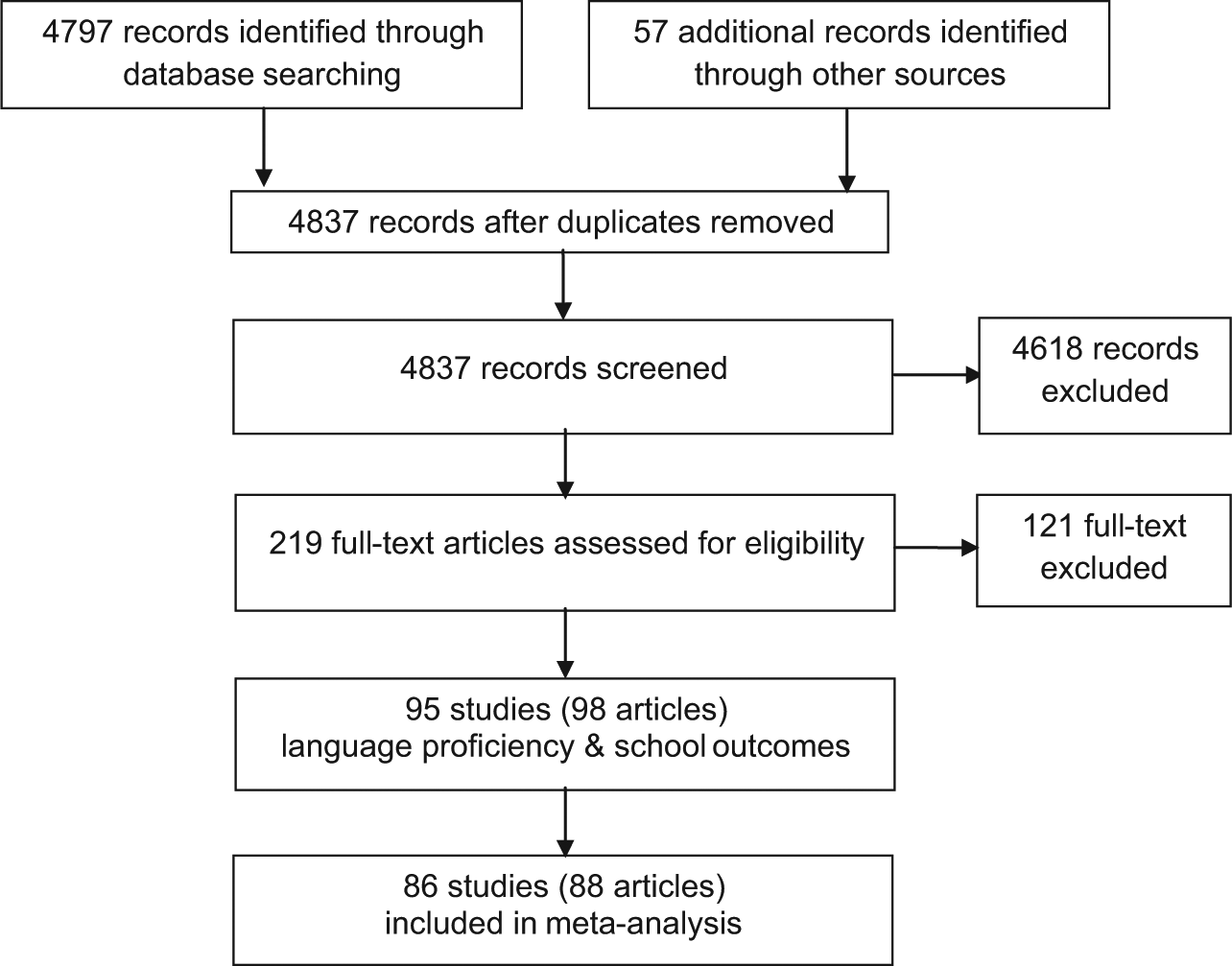
Flow chart of literature search and selection.
Moderators
The so-called apples and oranges problem and the issue of mixing studies that differ in methodological quality (Shelby & Vaske, 2008) were dealt with by coding moderators such as sample size, use of covariates, and measurement of language proficiency, and testing their influence on the meta-analytic results. The coding scheme for characteristics of studies, samples, predictors, and outcomes is presented in Table 1. For each scale, a minimum of 20 studies (23%) were coded by two coders to assess intercoder reliability. Cohen’s kappa was computed for categorical variables, and intraclass correlations for continuous variables. The average agreement was .96 (range .88–1.00) for both the categorical and the continuous variables.
Coding system for studies on language proficiency and school outcomes

Note. SES = socioeconomic status; L1 = first language; L2 = second language.
General measures are measures that used a combination of aspects of the overall construct or were based on a combined effect size of different specific measures of the overall construct.
Two types of moderators were coded: sample and procedural characteristics. Sample moderators included sample size, SES, whether or not the sample consisted of Spanish-English bilinguals in the United States, L1 education, immigrant generation, gender, and age or grade level at the first measurement. Initially, we also coded whether L1 had the same or a different script as L2 or whether a combination of various L1s was present in the sample. However, because the subcategories for this variable were too small, we decided to combine this variable with L2 and the country of origin into one variable indicating whether the study used a Spanish-English bilingual sample in the United States. Procedural moderators included publication year, use of covariates, measurement of language proficiency, type of language proficiency, language modality, type of outcome, measurement of outcome, type of early literacy (if relevant), type of reading (if relevant), type of spelling (if relevant), and cross-/within-language relations. These procedural characteristics were coded separately for each combination of predictor and outcome variables. Outliers of continuous moderator variables were Winsorized to be one higher than the next highest value or one lower than the next lowest value of the particular variable (Dixon, 1960).
Statistical Analyses
Using the program Comprehensive Meta-Analysis (CMA; Borenstein, Rothstein, & Cohen, 2005), a total of 16 meta-analyses were performed for all possible within- and cross-language relations for each of the five school outcomes. In addition, the differences between correlations across and within L1 and L2 were also meta-analyzed for each school outcome. An overview of all these analyses is provided in Figure 2. For each cross- or within-language relation of each school outcome, an effect size (correlation) was computed. For the additional analyses of the differences between correlations, the standardized differences (d) were computed for each school outcome as effect size to compare within- and cross-language relations in one language with the same relations in the other language and to compare within-language relations with cross-language relations.

Overview of meta-analyses.
For studies that reported a nonsignificant finding without providing the exact statistics, a conservative nonsignificant zero effect size was used (Mullen, 1989). For studies that reported several correlations for one cross- or within-language relation between language proficiency and a school outcome, combined effect sizes were computed using comprehensive meta-analysis. We never used multiple findings from the same study within a single analysis, to ensure that the effect sizes were independent of one another. To take the heterogeneity of study outcomes into account, random effect models were used as the mode of analysis for significance tests and moderator analyses (Borenstein, Hedges, & Rothstein, 2007; Shelby & Vaske, 2008). Random effect models allow for random differences between studies because of variations in procedures, measures, or settings, which go beyond sampling errors on the subject level (Lipsey & Wilson, 2001). Q statistics were computed to test the homogeneity of effect sizes (Borenstein et al., 2005). Also, 95% confidence intervals (CIs) were computed for all effect sizes. To test the influence of possible adjustments of the sample for publication bias, the trim and fill method was used (Duval & Tweedie, 2000).
To assess differences between effect sizes for specific subsets grouped by moderators, Q statistics and their p values were computed. Contrasts were only tested when at least two of the subsets consisted of at least four studies (Bakermans-Kranenburg, van IJzendoorn, & Juffer, 2003). Therefore, type of measurement of language proficiency and of school outcomes could not be tested as moderators. Furthermore, for moderators that had a category “unclassifiable,” this category was not included in moderator analyses. As a result, gender could not be tested as a moderator.
Results
Language Proficiency in Relation to Early Literacy and Reading
The results of the meta-analyses for within-language relations between language proficiency and early literacy are presented in Table 2, and the results for cross-language effects in Table 3. Overall, there were moderate within-language correlations for both L1 and L2 between language proficiency and early literacy (.33 < r < .37), which corroborates Hypothesis 1 for this outcome. The cross-language correlations were weaker (.21 < r < .22), though still significant. Hypothesis 2 is thus also confirmed for early literacy. Regarding the moderators listed in Hypothesis 3, type of proficiency was a significant moderator for L1 within-language and L1-L2 cross-language relations, with studies in which vocabulary was used as language proficiency measure showing a stronger correlation than studies in which a general language proficiency measure was used. No other moderator effects were significant.
Meta-analytic results of studies of within-language relations between oral proficiency and early literacy

Note. CI = confidence interval; SES = socioeconomic status; LI = first language; L2 = second language.
Q statistic for total set stands for homogeneity (df [degrees of freedom] = k − 1), Q statistic for moderator for effect of contrasts (df = number of subgroups − 1). bFor moderators that have a category “unclassifiable,” the Q statistic reported in this table does not include the unclassifiable category. cSES and immigrant generation, and use of covariates could not be tested as a moderator for L1 relations, because group sizes were too small. dStudies with a mix of several L1 education methods excluded in analysis of L1 relations. eStudies from Grades 4–8 excluded in analysis of L1 relations and from Grades 9–12 excluded in both analyses. fStudies that used grammar/syntax/morphology as language proficiency indicator excluded. gStudies with letter knowledge as early literacy measure excluded.
p < .05.
p < .01.
Meta-analytic results of studies of cross-language relations between oral proficiency and early literacy

Note. CI = confidence interval; SES = socioeconomic status; LI = first language; L2 = second language. Use of covariates could not be tested as a moderator, because group sizes were too small.
Q statistic for total set stands for homogeneity (df [degrees of freedom] = k − 1), Q statistic for moderator for effect of contrasts (df = number of subgroups − 1). bFor moderators that have a category “unclassifiable,” the Q statistic reported in this table does not include the unclassifiable category. cSES, immigrant generation, and type of early literacy could not be tested as moderators for L2–L1 relations, because group sizes were too small. dStudies with bilingual/transitional programs excluded in analysis of L2–L1 relations. eStudies from Grades 4–8 and Grades 9-12 excluded. fStudies that used grammar/syntax/morphology as language proficiency indicator excluded. gStudies with expressive proficiency measure excluded in analysis of L2–L1 relations. hStudies with early concepts of print as early literacy measure excluded.
p < .05.
p < .01.
The results of the meta-analyses for within-language relations between language proficiency and reading are presented in Table 4, and the results for cross-language effects in Table 5. Overall, there were strong within-language correlations for both L1 and L2 between language proficiency and reading (r = .40), which is a confirmation of Hypothesis 1 for this outcome. The cross-language correlation from L1 to L2 was weaker (r = .12), though still significant, whereas there was no significant effect of L2 proficiency on L1 reading (r = .07), so Hypothesis 2 only partly holds true. Regarding the moderators from Hypothesis 3, L1 education was a significant moderator of the L2 within-language relation between oral proficiency and reading, with a less strong correlation for children in L2 immersion compared to children following separate L1 classes or a bilingual or transitional education program. Also, the within-language correlations between oral proficiency and reading were higher with increasing age, as shown by the significant moderator effect of age or grade level for these relations. For the L1 within-language relation, type of reading was also a significant moderator, with a less strong effect in studies in which (pseudo)word reading was used as reading proficiency measure compared to studies that measured reading comprehension. None of the other moderator effects were significant.
Meta-analytic results of studies of within-language relations between oral proficiency and reading

Note. CI = confidence interval; SES = socioeconomic status; LI = first language; L2 = second language.
Q statistic for total set stands for homogeneity (df [degrees of freedom] = k − 1), Q statistic for moderator for effect of contrasts (df = number of subgroups − 1). bFor moderators that have a category “unclassifiable,” the Q statistic reported in this table does not include the unclassifiable category. cStudies in which language proficiency was measured in Grades 9–12 or for which this age/grade information was missing excluded.
p < .05.
p < .01.
Meta-analytic results of studies of cross-language relations between oral proficiency and reading

Note. CI = confidence interval; SES = socioeconomic status; LI = first language; L2 = second language.
Q statistic for total set stands for homogeneity (df [degrees of freedom] = k −- 1), Q statistic for moderator for effect of contrasts (df = number of subgroups − 1). bFor moderators that have a category “unclassifiable,” the Q statistic reported in this table does not include the unclassifiable category. cStudies from Grades 9–12 or for which age/grade information was missing excluded. dUse of covariates could not be tested as a moderator for L2–L1 relations, because group sizes were too small. eStudies with expressive language proficiency measure excluded in analysis of L2-L1 relations. fStudies with reading comprehension as reading measure excluded in analysis of L2-L1 relations.
p < .05.
p < .01.
In Figure 3, the correlations of oral language proficiency with early literacy and reading and the 95% CIs of these correlations are presented. The outcomes of the trim and fill procedure (Duval & Tweedie, 2000) showed no indication for publication bias, which means that the file drawer problem (Shelby & Vaske, 2008) does not affect our results. Funnel plots are presented in Figure 4.

Correlations and 95% confidence intervals of oral proficiency with early literacy and reading for each combination of languages.

Funnel plots for all meta-analyses of relations between language proficiency and school outcomes.
Language Proficiency in Relation to Other School Outcomes
Within-language relations for the three other school outcomes—spelling, math, and academic achievement—are presented in Table 6 and cross-language relations in Table 7. For all three outcomes, there were significant moderate to strong within-language effects (.22 < r < .43), confirming Hypothesis 1, but no significant cross-language effects (−.08 < r < .21). Hypothesis 2 does thus not hold true for these school outcomes. Except for the comparison between Spanish-English samples from the United States and other samples, which could be tested for L1-L2 relations of academic achievement, moderators could not be tested for spelling, math, and academic achievement, because group sizes were too small. The comparison between Spanish-English samples from the United States and other samples was not a significant moderator of the L1-L2 relation between language proficiency and academic achievement (Q = 3.27, p = .07).
Meta-analytic results of studies of within-language relations between oral proficiency and spelling, math, and academic achievement
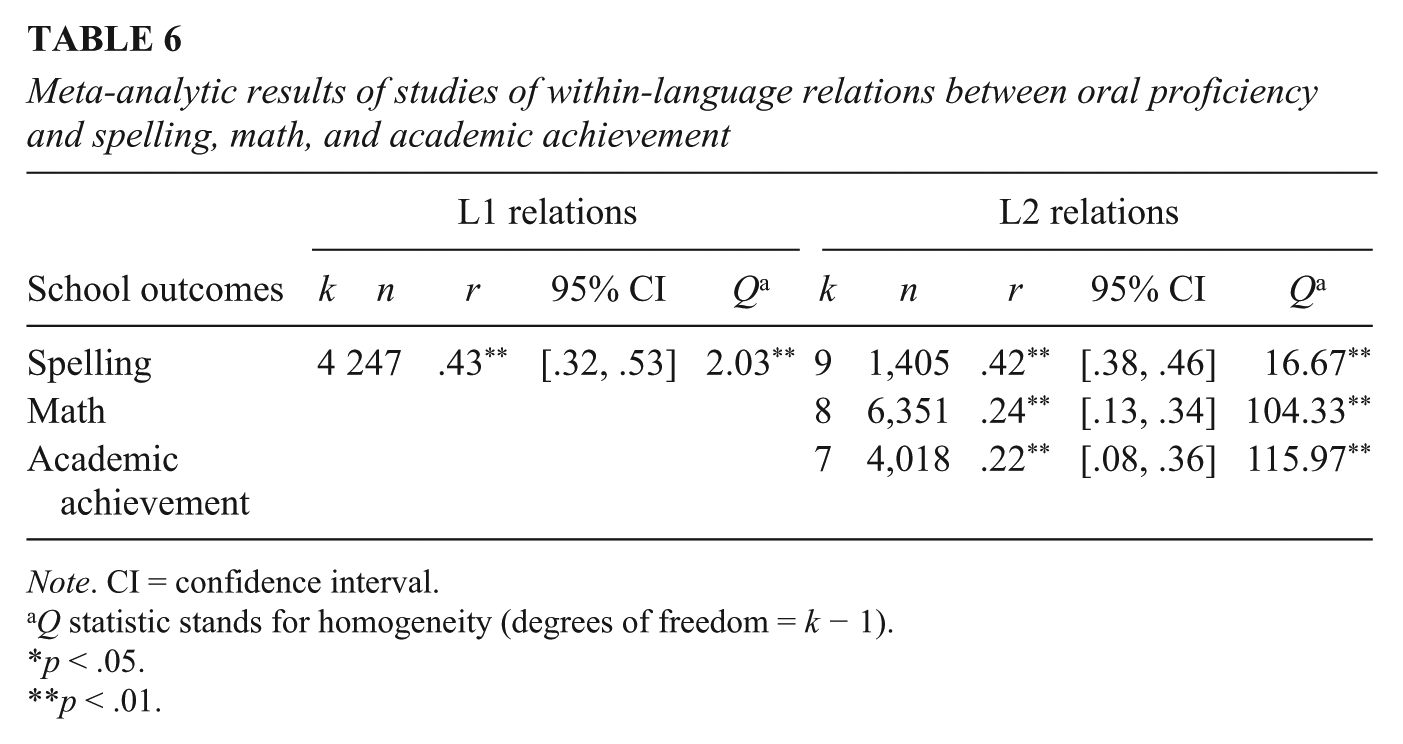
Note. CI = confidence interval.
Q statistic stands for homogeneity (degrees of freedom = k − 1).
p < .05.
p < .01.
Meta-analytic results of studies of cross-language relations between oral proficiency and spelling, math, and academic achievement
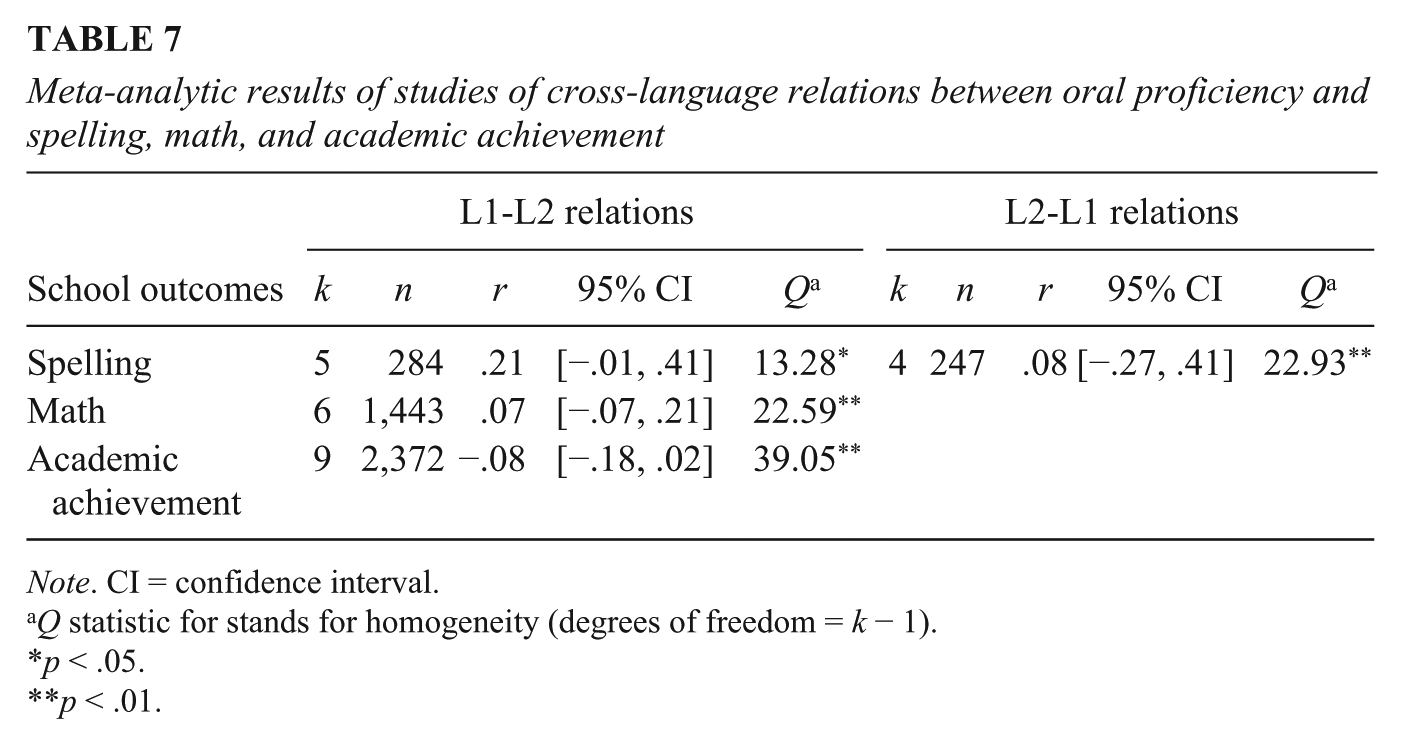
Note. CI = confidence interval.
Q statistic for stands for homogeneity (degrees of freedom = k − 1).
p < .05.
p < .01.
Comparison of Cross- and Within-Language Relations in L1 and L2
The results presented above suggest that effects measured in L1 did not differ substantially from the same effect measured in L2, whereas within-language relations between oral language proficiency and school outcomes were stronger than cross-language relations. The results of meta-analyses of the standardized differences between correlations are presented in Table 8. Regarding within-language relations, only one significant difference between L1 and L2 was found, with a stronger within-language relation between language proficiency and early literacy in L2 than in L1 (d = −.06, p < .05), so Hypothesis 4 is confirmed for all school outcomes except early literacy. There were no significant differences between within-language relations in L1 versus L2 for reading or spelling. Also, no significant differences between cross-language relations in L1 versus L2 were found, which corroborates Hypothesis 5. For the comparison between within- and cross-language effects, all differences that we could test were significant, confirming Hypothesis 6. All effects pointed in the same direction, namely, that within-language relations were stronger than cross-language relations between oral language proficiency and school outcomes. The significant moderators for these effects were consistent with the differences in effects between subgroups reported in Tables 2 to 5.
Meta-analytic results of differences between correlations of language proficiency with school outcomes

Note. CI = confidence interval.
Q statistic for stands for homogeneity (degrees of freedom = k − 1).
p < .05.
p < .01.
Discussion
The results of the current meta-analyses show that within-language relations between the oral language proficiency and the school outcomes of bilingual children with an immigrant background were substantial and significant. In addition, these relations were significantly stronger than cross-language relations between oral proficiency and school outcomes. Within-language relations between oral proficiency and the school outcomes of early literacy, reading, spelling, mathematics, and academic achievement were moderate to strong. For cross-language relations, only weak positive relations were found for L1 oral proficiency with L2 early literacy and L2 reading, and for L2 oral proficiency with L1 early literacy.
Within-Language Relations
The positive within-language relations that we found were in line with our expectations. Oral language proficiency, particularly in the language of education, is important to communicate with the teacher and to understand explanations and instructions in class and is thus likely to support positive school outcomes (Hoff, 2013). The school outcomes in the areas of early literacy, reading, and spelling are strongly language-related. For these outcomes, language proficiency not only does play a role in the understanding of instructions but is also an integral part of the task itself. It is thus not surprising that the relations of oral language proficiency with these outcomes were stronger compared to relations with mathematics and general academic achievement.
The number of studies reporting on L1 within-language relations between oral language proficiency and school outcomes was smaller than the number of studies reporting on L2 within-language relations, which is not surprising given that education in L1 is not always provided. For those studies that reported within-language relations in both languages, the strength of within-language relations did not differ significantly for L1 and L2 in the case of reading and spelling outcomes, whereas for early literacy within-L2 relations were stronger than within-L1 relations.
Cross-Language Relations
The positive cross-language associations between L1 oral proficiency and L2 early literacy and reading found in our meta-analyses are in line with the interdependence hypothesis (Cummins, 1979), which states that competence in L2 is partly based on competence in L1. This would converge with findings from neuroimaging studies that the same brain regions are active in L1 and L2 processing (Abutalebi, 2008; Buchweitz & Prat, 2013). However, cross-language relations were less strong than within-language relations. The threshold hypothesis (Cummins, 1979) states that L1 proficiency has to be of a sufficient level for positive cross-language transfer to take place. However, from the cross-language relations that we found, it cannot be inferred whether this hypothesis holds true. It is possible that the positive cross-language relations we found would have been stronger when only respondents with a certain basic L1 proficiency level had been taken into account or weaker for samples with a more limited L1 proficiency.
To test this hypothesis, we would need studies that include (sub)samples with L1 proficiency above or below a certain threshold. However, only four of the studies in our meta-analyses used a basic L1 proficiency level, dominance in L1 over L2 or L2 over L1, or an equal proficiency in L1 and L2 as a selection criterion (Anthony et al., 2009; Arab-Moghaddam & Sénéchal, 2001; Gholamain & Geva, 1999; Gorman, 2012), and none reported relations between oral language proficiency and school outcomes for different levels of L1 proficiency. In addition to the L1-L2 relations, there was a positive correlation between L2 oral proficiency and L1 early literacy, which means that for this school outcome transfer from one language to the other is bidirectional. This might be explained by the fact that early literacy instruction is likely to take place in L2 and that development of this skill in L2 might trigger the acquisition of corresponding skills in L1 (Meisel, 2004).
As we did not find any significant negative cross-language relations, the subtractive bilingualism hypothesis, which assumes that L2 develops at the expense of L1, was not supported (Butler & Hakuta, 2004). Instead, we propose a task-dependent bidirectional transfer hypothesis stating that in addition to within-language effects of oral language proficiency on school outcomes, cross-language transfer from L1 to L2, and reversed, can take place and that the strength of this transfer depends on the type of oral language proficiency task and the type of school outcome. This hypothesis should be tested further in future research. With regard to the improvement of school outcomes of bilingual children with an immigrant background, this hypothesis suggests that it is important to consider whether stimulation in L1 will be beneficial for a particular school outcome and for which type of stimulation chances of transfer are highest.
Moderator Effects
Only 6 of 96 tested moderator effects were found to be significant. The only significant procedural moderator was the language proficiency measure, showing that the within- and cross-language associations of L1 oral proficiency with early literacy in L1 and L2 were generally stronger for studies that used vocabulary as language proficiency measure compared to studies that used a general proficiency measure. A possible explanation for this moderator effect is that vocabulary and early literacy are more strongly related because they are both measured at the word level, whereas a general proficiency measure also includes measures at the sentence or paragraph levels. Neuroimaging studies have shown that word-level conceptual representations converge across languages, whereas at the sentence or paragraph level grammatical rules and representations need to be appropriately selected for the comprehension and production of a certain target language (Buchweitz & Prat, 2013). Thus, because general oral language proficiency measures also include grammatical aspects whereas early literacy tasks only require word-level skills, general proficiency measures may have less strong within- and cross-language relations with early literacy.
Four significant sample moderator effects were found, including child grade level, type of reading proficiency measure, and participation in L1 language classes or bilingual programs. Within-language relations between oral proficiency and reading were moderated by the grade level or age of the children. Also, the type of reading proficiency measure moderated the relation between L2 proficiency and L2 reading. The relation was stronger when reading comprehension was used as reading proficiency measure compared to (pseudo)word reading. The influence of both of these moderators is in line with the simple view of reading (Hoover & Gough, 1990), which suggests that the importance of language proficiency for reading increases in later grades, when the focus in reading instruction moves from word recognition to comprehension. In other words, oral language proficiency is more important for reading comprehension than for word reading, and this type of reading proficiency is more prominent in later grades.
The relation between L2 proficiency and L2 reading was stronger for samples in which the majority of the respondents took part in L1 language classes outside the regular school program or were enrolled in a bilingual or transitional program, compared to samples in which the majority of respondents were in an L2 immersion program. It may seem counterintuitive that the relation in L2 is less strong when children are educated in L2 only. However, the importance of programs emphasizing language development in both languages is supported by a review of effective reading programs for English language learners (Cheung & Slavin, 2005). Furthermore, reading programs intended for use with English-proficient students are typically adapted and emphasize vocabulary and oral language more when used with English language learners (Cheung & Slavin, 2005). It may thus be that extra attention for language education in general makes children with bilingual educational input profit more. This idea is supported by the trend toward stronger cross-language relations between oral proficiency and reading for subgroups with some form of L1 education, which can be inferred from the correlations coefficients presented in Table 5, which are higher for the subcategories with some form of L1 education than for the L2 immersion category.
None of the other sample or procedural characteristics (sample size, SES, immigrant generation, whether or not it is a Spanish-English sample in the United States, gender, publication year, and use of covariates) showed significant moderator effects. For some of these variables this was contrary to our expectations. Based on the literature on achievement gaps (Barrett et al., 2012; Marx & Stanat, 2012) and the immigrant paradox (Fuligni, 1998; Suárez-Orozco, Rhodes, et al., 2009), we expected the relations to be stronger for samples with a higher SES and from an earlier immigrant generation. Our meta-analytic results, however, did not confirm these expectations and instead show that the relation between oral language proficiency and school outcomes is rather stable across various moderators as it is influenced by only 6 out of 96 sample and procedural characteristics.
Publication Bias
Despite the fact that unpublished articles were not included in our analyses and publication bias seems common in psychological sciences (Ferguson & Heene, 2012), we did not find indications for such bias, according to funnel plot inspection and the trim and fill procedure (Duval & Tweedie, 2000). Most studies included in our meta-analyses of relations between oral language proficiency and school outcomes reported correlations for more than one language or more than one school outcome. In such studies, it is more likely that null findings that otherwise may not have been published and thus would have led to publication bias are now reported in addition to positive relations found for the other language or school outcome. For those studies that compared a bilingual and a monolingual sample (e.g., Burgoyne, Whiteley, & Hutchinson, 2011; Silvén & Rubinov, 2010), such null findings in the bilingual sample are more likely to be reported to show contrasts between bilinguals and monolinguals. Moreover, none of the studies included in our meta-analyses of the differences between within- and cross-language effects reported this difference as a study result, which makes it unlikely to find any publication bias for those findings.
Limitations and Recommendations
Some limitations of the input for the meta-analyses and related recommendations for future research can be noted. First, the numbers of studies that included spelling, math, or academic achievement as an outcome were relatively low. Therefore, some of the within- and cross-language comparisons and most of the moderator effects could not be tested for these outcomes. The significant relations that we found in the meta-analyses of the few studies available point to a positive relation between oral language proficiency and these school outcomes. Future research should study these relations further in different immigrant background samples, so that future meta-analyses on this topic can include more studies and thus draw more firm conclusions and also test moderator effects. Second, many studies did not report details on potentially important moderators, such as SES, the presence or absence of L1 education, and immigrant generation. Thus for these variables, there were fewer studies to include in the moderator analyses, which have hampered the identification of moderator effects. Future studies in this field could include specific information on these sample characteristics. Third, there were only very few studies that examined a combination of an L1 and L2 with the same script, other than Spanish and English. Therefore, L1 (coded as Spanish/other language with same script as L2/other language with different script as L2/combination of various L1s) could not be taken into account as a separate moderator variable. Future studies could focus on bilingual samples with same-script languages other than English and Spanish, so that future meta-analyses could test the effects of resemblance in scripts on the relation between oral language proficiency and school outcomes.
Despite the rigorous methodology of meta-analysis, there are also some potential weaknesses (Shelby & Vaske, 2008). How we dealt with the so-called apples and oranges problem, the issue of mixing studies that differ in methodological quality, heterogeneity of study outcomes, the risk of error and bias due to inclusion or exclusion of studies, and the independency of effect sizes is described in the Method section. As described earlier the file drawer problem does not affect our results, as there were no indications of publication bias. We chose to use the conventional, uncorrected alpha level of 5% for significance testing in order to explore potentially important moderators that should be replicated in future work. With a Bonferroni correction, no moderator effect would have survived the stricter alpha level. We thus managed to show that the effects found may be independent of moderators examined in the current meta-analysis, and at the same time suggest some moderators to be included in future studies.
Implications
The findings of our meta-analyses are relevant to education policies and practices aimed at bilingual children’s academic development. We found that stimulation of both L1 and L2 can be supportive for immigrant background children’s educational achievement, which could contribute to narrowing the achievement gap with native-born children, and that L1 skills do not develop at the expense of L2 skills. Among bilingual children with an immigrant background, children who are more proficient in oral language generally have better school outcomes. These children may also be those who profit most from the cognitive advantages of bilingualism (Adesope et al., 2010) and therefore fare better in school. This means that we should not only try to close the achievement gap between immigrant-background and native-born children but at the same time try to prevent a potential achievement gap within immigrant-background groups, caused by language proficiency differences.
The few moderator effects that were found suggest that the attention for oral language proficiency should be continued throughout children’s school career, because the importance of oral proficiency is higher at higher grade levels with more focus on reading comprehension. Previous studies have shown positive effects of bilingual education programs on L2 proficiency (Barnett et al., 2007; Slavin et al., 2011). Our analyses add to that knowledge by showing that additional education in L1 can also foster the relation between L2 proficiency and school outcomes. In areas with large communities of a certain language minority in North America as well as in Europe, there is indeed a call for incorporating L1 in education (Mackey, 2004; Tabouret-Keller, 2004). For the ongoing debate on language education policies our findings suggest that L1 might be included in education to obtain the best possible school outcomes in L2.
Conclusion
In conclusion, our findings show moderate to strong within-language relations between the oral language proficiency of bilingual children with an immigrant background and their school outcomes, and also some weaker but significant cross-language relations. No negative cross-language relations were found. Thus, the meta-analyses do not provide support for the hypothesis of subtractive bilingualism. Based on our findings, we propose a task-dependent bidirectional transfer hypothesis. In addition to within-language effects of oral language proficiency on school outcomes, cross-language transfer can take place and the strength of this transfer effect depends on the type of oral language proficiency task and the type of school outcome. Stimulating oral language proficiency in both languages can be a key factor in improving the school outcomes of bilingual children with an immigrant background.
Footnotes
Notes
Authors
MARIËLLE J. L. PREVOO is a postdoctoral researcher at the Centre for Child and Family Studies, Leiden University, Wassenaarseweg 52, 2333 AK Leiden, Netherlands; e-mail:
MAIKE MALDA is an assistant professor at the Department of Clinical Child and Adolescent Studies, Leiden University, Wassenaarseweg 52, 2333 AK Leiden, Netherlands; e-mail:
JUDI MESMAN is a professor of parenting and education in the multicultural society at the Centre for Child and Family Studies, Leiden University, Wassenaarseweg 52, 2333 AK Leiden, Netherlands; e-mail:
MARINUS H. VAN IJZENDOORN is a professor at the Centre for Child and Family Studies, Leiden University, Wassenaarseweg 52, 2333 AK Leiden, Netherlands; e-mail:
References
Supplementary Material
Please find the following supplemental material available below.
For Open Access articles published under a Creative Commons License, all supplemental material carries the same license as the article it is associated with.
For non-Open Access articles published, all supplemental material carries a non-exclusive license, and permission requests for re-use of supplemental material or any part of supplemental material shall be sent directly to the copyright owner as specified in the copyright notice associated with the article.
