




Abstract
In this article, we reviewed and interpreted the evidence from 223 rigorous impact evaluations of educational initiatives conducted in 56 low- and middle-income countries. We considered for inclusion in our review all studies in recent syntheses that have reached seemingly conflicting conclusions about which interventions improve educational outcomes. We grouped interventions based on their theory of action. We derived four lessons from the studies we review. First, reducing the costs of going to school and expanding schooling options increase attendance and attainment, but do not consistently increase student achievement. Second, providing information about school quality, developmentally appropriate parenting practices, and the economic returns to schooling affects the actions of parents and the achievement of children and adolescents. Third, more or better resources improve student achievement only if they result in changes in children’s daily experiences at school. Fourth, well-designed incentives increase teacher effort and student achievement from very low levels, but low-skilled teachers need specific guidance to reach minimally acceptable levels of instruction.
Keywords
Over the past two decades, developing countries have become increasingly interested in adopting education policies that are backed by rigorous evidence of effectiveness. This interest in “evidence-based” policies has resulted in a growing number of impact evaluations since the turn of the century (Vivalt, 2015). In recent years, several researchers have attempted to summarize the evidence from these impact evaluations (Conn, 2014; Glewwe, Hanushek, Humpage, & Ravina, 2014; Guerrero, Leon, Zapata, Sugimaru, & Cueto, 2012; Kremer, Brannen, & Glennerster, 2013; Krishnaratne, White, & Carpenter, 2013; Masino & Niño-Zarazúa, 2015; McEwan, 2014). These reviews aim to make sense of the evidence for policy makers, who lack the time (and sometimes, the specialized training) to sift through hundreds of academic papers. They aspire to identify promising interventions as well as to point out puzzles to examine in future research.
These syntheses reach seemingly conflicting conclusions about which educational interventions improve educational outcomes (Evans & Popova, 2015). The disagreements stem, in part, from differences in the substantive and methodological criteria for including studies (e.g., some focus on studies in a geographic region, others on studies with cost-effectiveness data, and yet others on randomized trials). Yet even reviews with similar inclusion criteria consider different sets of studies. Moreover, the different ways in which reviews categorize interventions result in some conflicting conclusions even when they consider the same studies.
We contribute in three ways to the ongoing debate on the lessons from rigorous impact evaluations of educational interventions in developing countries. First, we consider for inclusion in our review all the studies in reviews released in recent years. Thus, we avoid the risk of reaching conclusions about the state of the evidence simply due to an incomplete coverage of existing studies. Second, instead of categorizing interventions according to whether they look similar or have similar names, we group them based on their theory of action. This taxonomy, like all others, has limitations. However, we believe it is helpful in generating hypotheses about why similar interventions have succeeded or failed, and in identifying areas that would benefit from further research. Finally, instead of conducting a meta-analysis, we conduct a narrative review of the evidence. We do so to bring attention to the aspects of the design and implementation of successful educational interventions that are not easily captured in meta-analyses.
We derive four lessons from the studies we review:
Reducing the costs of going to school and expanding schooling options increase attendance and attainment, but do not consistently increase student achievement
Providing information about school quality, developmentally appropriate parenting practices, and the economic returns to schooling affects the actions of parents and the achievement of children and adolescents
More or better resources improve student achievement only if they result in changes in children’s daily experiences at school
Well-designed incentives increase teacher effort and student achievement from very low levels, but low-skilled teachers need specific guidance to reach minimally acceptable levels of instruction
This article is structured as follows. The “Method” section presents our initial criteria for including studies in our review, our strategy for finding studies, our rationale for excluding some studies on closer scrutiny, our classification of the interventions that we discuss, and our standards for reporting the effects of these interventions. The “Results” section discusses the results from our review. The “Discussion” section reviews key lessons, identifies the limitations of existing evidence, and proposes some areas for policy experimentation and impact evaluations.
Method
Inclusion Criteria
We review evaluations of educational interventions in preprimary, primary, and secondary schools that took place in low- or middle-income countries from 2000 to 2015. 1
Outcomes
We review studies that include at least one of the following education-related outcomes: enrollment, attendance, repetition, dropout, retention, or measures of student achievement or cognitive skills. For a subset of studies for which information on cost-effectiveness is available, we summarize the evidence. In doing so, we report the effect of interventions on student participation, student achievement, or teacher attendance for each US$100. Student participation is defined as the school-level average of attendance among enrolled students—typically, based on unannounced visits. To ensure cost-effectiveness estimates are consistent across studies, we rely on the calculations of the Abdul Latif Jameel Poverty Action Lab (J-PAL), which use the methodology described by Dhaliwal, Duflo, Glennerster, and Tulloch (2012). 2
Interventions
We include studies of educational interventions, such as offering computer-assisted learning or altering incentives for teachers. We also include studies of health interventions, such as providing deworming drugs and iron supplements, that include at least one of the educational outcomes mentioned above.
Types of Studies Included
We only include studies that take advantage of exogenous variation in the receipt of the intervention, either by randomly assigning individuals to a treatment or by exploiting quasi-random variation in treatment assignment from natural experiments. Included studies based on natural experiments use differences-in-differences, regression discontinuities, and/or instrumental variables to estimate the causal impacts of interventions. We do not consider studies that attempt to estimate counterfactual outcomes either by employing matching methods or fixed effects for individuals in pre–post comparisons.
Literature Search
We searched for studies in English in peer-reviewed journals, working paper series, and academic conferences. We conducted the final search that we describe below from January to September 2015. Figure 1 offers an overview of the search and review process. 3
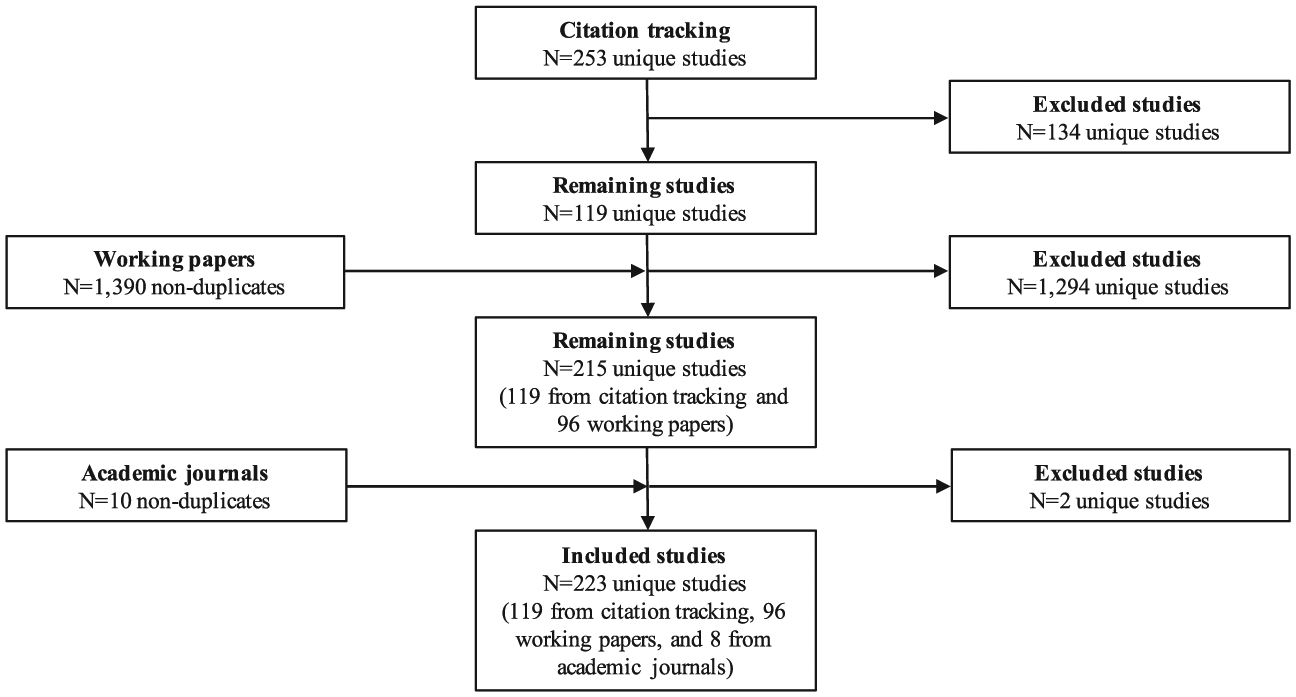
Search and review process.
Citation Tracking
We consulted eight reviews of impact evaluations of educational interventions in developing countries and tracked the citations. These included meta-analyses, narrative, and vote-counting reviews. 4 This search produced 253 studies, of which 119 met our inclusion criteria.
Working Papers
We surveyed the education publications on 16 websites from research centers, professional associations, development banks, think tanks, and development economics conferences. Including this “grey” literature was crucial because this is a rapidly evolving field and we wanted to limit the influence of publication bias. 5 This search produced 1,390 additional studies, of which 96 met our inclusion criteria.
Academic Journals
We searched for academic articles in 18 journals in education, economics, and public policy. 6 This search produced 10 additional studies, 8 of which met our inclusion criteria.
Additional Exclusions
In addition to excluding studies that did not meet our initial inclusion criteria, we excluded some studies for other reasons. We left out studies that do not focus on a specific intervention, policy change, or treatment. We left out three evaluations that only estimate the effect of a bundle of different interventions, because it was not possible to determine the contributions of specific interventions to the reported effect.
We also excluded some studies due to methodological considerations. We left out studies without balancing checks between treatment and control groups at baseline, as well as studies with imbalance between experimental groups at baseline. Finally, we also excluded four studies that we could not access during our literature search. As noted in Figure 1, applying all these criteria yielded 223 unique studies that we include in our review.
Due to space considerations, we cannot discuss all studies that satisfied our inclusion criteria in detail. So after reviewing the evidence pertaining to studies with the same theory of action aimed at addressing the same problem, we describe one that illustrated well the evidence from the relevant group of studies. In cases in which the results are sensitive to a particular detail (e.g., the design of incentive plans to increase teachers’ effort levels), we explain this pattern. We have also produced a version of the article that includes in footnotes all studies that support the argument illustrated by the evidence from each study that we do describe in the article. This extended version also includes in footnotes all studies that introduce minor caveats to our summary of the evidence, and is available from the authors.
Classification Criteria
The authors of reviews of impact evaluations typically develop their own categories to group what they consider to be similar interventions. Authors of meta-analyses fit category-specific meta-regression models and determine the average treatment effect of each category. The assumption in these analyses is that if the authors have enough evaluations of interventions that are similar enough, they can determine whether a category of interventions works.
In this article, we use a different approach. We group studies according to how they are trying to solve a specific problem. As shown in Figure 2, we start with the aim school systems seek to achieve: getting children to enroll in school and learn. Then, we categorize interventions according to whether they are trying to do this by increasing demand for education (left side) or by improving the supply of education (right side). Next, we develop subcategories of demand and supply interventions. Some interventions aim to increase demand for education by (a) reducing the costs of attending school, (b) preparing children to learn at school, (c) making schooling pay, or (d) improving access to better schools. Other interventions try to improve the supply of education by (a) increasing the quantity or quality of resources, (b) addressing students’ individual learning needs, (c) increasing teacher and/or principal effort, or (d) tackling teachers’ capacity.
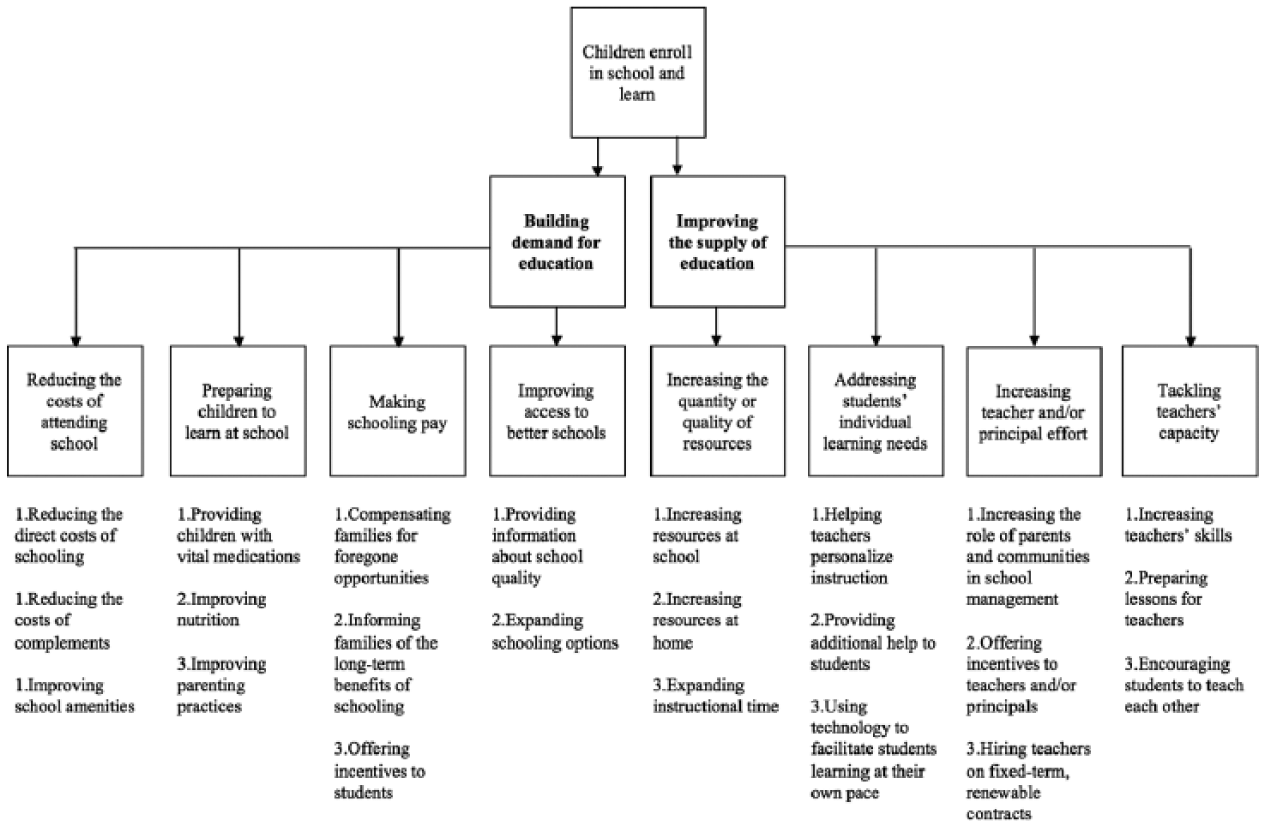
Classification criteria.
Finally, we list strategies used to increase demand and improve supply. These strategies are not exhaustive; they simply group the educational interventions that have been evaluated thus far. Admittedly, this categorization is based on our own interpretation of the (often explicit, but sometimes implicit) theory of action underlying each of the interventions in the impact evaluations we review. We believe, however, that our categories provide an intuitive way to organize the interventions. Moreover, these categories are less consequential than those used in meta-analyses. The reason is that instead of using the categories to estimate the average effect of groups of similar interventions, we discuss individual interventions in some detail. If we chose our categories differently, where we discuss each intervention would change, but what we write about each intervention would not change.
Reporting Effects
We report the effect of educational interventions using the metrics employed by the authors of the impact evaluations. We do this for two reasons. First, using the original scales in reporting the effects of programs on disparate educational outcomes facilitates communication. Second, many studies do not include the necessary information to calculate effect sizes. Instead of excluding these studies, we try to contextualize the effects of all interventions by reporting the target population and impact time frame.
We focus on the average effects of interventions, rather than on subgroup effects, due to space considerations. We only make two exceptions: We report heterogeneous effects when they provide insights about the mechanism through which the intervention is making a difference or when heterogeneous effects are the sole focus of a study. We also focus on the effects of the offer (not the receipt) of interventions because they are the more relevant parameters for policy makers, who cannot control whether individuals take up the interventions for which they are eligible. Whenever this is not possible, we clarify that we are reporting the effect of receiving the intervention.
Results
Building Demand for Education
Reducing the Costs of Attending School
One reason children and youth may not go to school is because the cost of doing so is too high. Several interventions have tried to address this problem by (a) reducing the direct costs of schooling, (b) reducing the costs of complements to schooling, or (c) improving school amenities.
Reducing the direct costs of schooling
The traditional way in which school systems have reduced the direct costs of schooling has been to lower or eliminate user fees. These policies have increased enrollments in primary school. Barrera-Osorio, Linden, and Urquiola (2007) evaluated the impact of an initiative in Bogotá, Colombia, that reduced school fees for low-income families in 2004. They found that the program increased the enrollment of primary school children in the poorest households by 3% and the enrollment of children in the next-poorest households by 6%.
In countries where many children are not attending school, the sudden influx of students from low-income families prompted by user fee eliminations can put a strain on the public school system. Lucas and Mbiti (2012) examined the impact of fee elimination in primary education in Kenya in 2003. The policy increased the number of students who completed primary school. However, it led to a small reduction in the achievement of students on track to graduate. It also prompted parents from wealthier families to switch their children to private schools (see also, Bold, Kimenyi, Mwabu, & Sandefur, 2011).
Another popular approach to reducing the direct costs of schooling is to build new schools closer to the homes of potential students. These initiatives have increased enrollments by reducing the time children spend commuting to school. Duflo (2001) evaluated the impact of a large primary school construction program in Indonesia between 1974 and 1978. Each primary school constructed per 1,000 children led to an average increase of 0.12 to 0.19 years of schooling (depending on how the effect was estimated).
Two types of school construction have also led to improvements in student achievement: village-based schools and preschools. Burde and Linden (2013) found that the construction of village-based schools (i.e., schools serving only children in the neighboring area) in Ghor, Afghanistan, in 2007 not only increased girls’ enrollment in schools by 52 percentage points, it also improved their math and language test scores by 0.65 standard deviations (SDs). In fact, for each US$100, the program yielded a 2.11 SD effect on student achievement. Similarly, Berlinski, Galiani, and Gertler (2009) found that construction of preprimary schools in Argentina between 1993 and 1999 improved the third-grade Spanish and math test scores of beneficiaries by 0.23 SDs.
A promising alternative for reducing commuting costs is providing students with a means of transportation to school. Muralidharan and Prakash (2013) found that a program in Bihar, India, that offered girls in secondary school bicycles to travel to school increased their enrollment by 30% and reduced the gender gap in enrollment by 40%. In fact, the initiative was more cost-effective in increasing school attendance than cash transfers for families (reviewed below).
Reducing the costs of complements
Another strategy to increase school enrollments is to lower the costs of complements to schooling. Such interventions have had positive impacts on students who take advantage of these cost reductions. Evans, Kremer, and Ngatia (2009) found that primary school students who received free uniforms in Busia, Kenya, in 2002 were 44% more likely to attend school and they performed 0.25 SDs better on math, English, and Kiswahili tests after 1 year. For each US$100, the program yielded a 0.71-year increase in student participation. Unfortunately, the authors do not report the effect of the offer of free uniforms on student achievement.
Complementary inputs are more likely to have a positive impact when there are few or no transaction costs to obtaining them. Ma et al. (2014) found that offering free eyeglasses to fourth and fifth graders at school in Gansu, China, in 2012 improved their math test scores by 0.11 SDs. Yet offering vouchers for free eyeglasses that families could redeem at the local county hospital had no such effect.
Covering the costs of complements to schooling can be budget neutral in terms of the cost per student if the number of students per classroom is allowed to increase. Kremer, Moulin, and Namunyu (2003) assessed the impact of an initiative in Busia and Teso, Kenya, in 1995 that covered the costs of textbooks, classroom constructions, and school uniforms. The program led to a sharp reduction in dropout rates and an influx of new students into participating schools. The authors found no evidence that the higher student–teacher ratios reduced the achievement of already enrolled students.
Improving school amenities
Yet another approach to increasing enrollments is to improve amenities in schools. Perhaps the most common initiative is to provide free meals at school. Although some initiatives aim specifically at improving the nutrition of children (we discuss those below), others are conceived as “food-for-education” programs. These initiatives have a mixed tracked record. For example, Vermeersch and Kremer (2004) found that free breakfasts in preschools in Busia and Teso, Kenya, in 2000 increased student attendance by 30%. The program improved students’ scores on oral and written tests only in schools with experienced teachers. Afridi (2011), however, found that a school meals program in Madhya Pradesh, India, in 2003 had no impact on the attendance and enrollment of primary school students on average.
Another way of improving school amenities is to build school latrines. Adukia (2014) found that a large school-latrine–construction initiative in India in 2003 increased enrollment in Grades 1 through 5 by 12% and that of students in Grades 6 through 8 by 8%. At younger ages, girls and boys benefited from either unisex or sex-specific latrine constructions; at older ages, however, girls only benefited from sex-specific latrines. In contrast, Oster and Thornton (2011) found that providing free sanitary products to girls in Grades 7 and 8 in Chitwan, Nepal, had no impact on their absenteeism rates. Together, these studies suggest that providing safe, private spaces for pubescent girls is a more effective way of curbing menstruation-related absences than improving sanitation technology.
Building schools with “girl-friendly” facilities consistently increases enrollments, but it does not always result in improved student achievement. Kazianga, Levy, Linden, and Sloan (2013) found that constructing primary schools equipped with sex-specific latrines, canteens, take-home rations, and textbooks in Burkina Faso in 2005 increased enrollments by 19 percentage points and math and French test scores by 0.41 SDs after 2 and a half years. Yet Dumitrescu, Levy, Orfield, and Sloan (2011) found that a similar initiative in Niger in 2008 increased enrollment by 4.3 percentage points, but had no impact on student attendance or French and math test scores.
Preparing Children to Learn at School
Another reason why children may not go to school is that they are not well prepared (e.g., cognitively or physically). Some interventions have sought to (a) provide children with vital medications, (b) improve their nutrition, or (c) improve parental practices.
Providing children with vital medications
Offering children medications against preventable diseases is a cost-effective way to increase enrollment and attendance; however, its impact on student achievement is mixed. Some interventions have provided deworming drugs. For example, Miguel and Kremer (2004) found that a mass treatment of intestinal helminths (e.g., hookworm, roundworm, whipworm, and schistosomiasis) in primary schools in Busia, Kenya, in 1998 reduced student absenteeism by one quarter. By reducing the prevalence of the helminths, the program also reduced the absenteeism of untreated children in treated schools, as well as that of children in neighboring schools. The program was highly cost-effective: for each US$100, it yielded 13.9 additional years of student participation. However, the program did not improve the English, math, and science test scores of third through eighth graders. Yet Grigorenko et al. (2006) assessed a similar initiative in Bagamoyo and Kibaha, Tanzania, in 1997 and found that the offer of access to deworming drugs improved the performance of children in Grades 2 to 5 on a battery of cognitive tests, with impacts ranging from 0.18 to 0.36 SDs.
Other interventions have provided treatment for malaria, which is a major cause of child morbidity in many low-income countries. These initiatives have not improved student achievement. For example, Brooker and Halliday (2015) found that an intermittent screening and treatment program for malaria for students in Grades 1 through 5 in Kwale and Msambweni, Kenya, in 2010 had no impact on literacy or numeracy. Effects on cognitive skills do not emerge later in life either. Jukes et al. (2006) tracked the beneficiaries of a malaria prevention treatment in Farafenni, Gambia, after 14 to 16 years and found no effects on memory, attention, reasoning, knowledge, or language, even though the intervention resulted in an increase of 0.52 years of schooling.
Improving nutrition
There are essentially two approaches to improving the nutrition of students from low-income families: providing them with nutrients that they often lack in their diet or offering them free school meals. A number of interventions have provided children with basic nutrients. Iron supplements have generally succeeded in improving students’ cognitive skills. For example, Baumgartner et al. (2012) compared the effects of providing iron and fatty acid supplements to primary school children in KwaZulu-Natal, South Africa, in 2009 and found that only iron supplements improved the number of words children could recall.
Other nutrients have increased school participation, but not student achievement. For example, Hamazaki et al. (2008) found that fatty acids provision in Lampung, Indonesia, made fourth through sixth graders 0.4 times more likely to attend school. Yet Osendarp et al. (2007) found that providing micronutrients (iron, zinc, folate, and vitamins), fatty acids, or both had no impact on the verbal skills, memory, general intelligence, or attention of primary school students in Jakarta, Indonesia, in 2003.
Combining deworming drugs with micronutrients has improved school participation, but it has not always improved children’s cognitive skills. Bobonis, Miguel, and Puri-Sharma (2006) found that delivering iron supplements and deworming drugs to preschool students in Delhi, India, in 2001 reduced student absenteeism by one fifth. For each US$100, it increased student participation by 2.7 years. Jinabhai et al. (2001) assessed the impact of providing deworming drugs, iron, and/or vitamin A to primary school children in KwaZulu-Natal, South Africa, in 1995. They found that deworming drugs, by themselves and jointly with vitamin A and/or iron fortification, had impacts of similar magnitude on auditory and intellectual functions, memory, and math achievement. Yet Solon et al. (2003) found that combining micronutrients with deworming drugs had no impact on the verbal, nonverbal, and quantitative abilities of primary school children in Batangas, the Philippines, in 1998.
The evidence on the effects of free school meals on student achievement varies widely. Part of that variation stems from the type of food the intervention provides. Whaley et al. (2003) compared three school feeding programs for first graders in Embu, Kenya, in 1998: a vegetable stew that was complemented with meat, another one that was served with milk, and a third one with additional oil equivalent to the energy provided in the meat and milk versions. Children who were offered the stew with meat outperformed all other groups in their ability to organize perceptual detail, reason by analogy, and draw comparisons. Children assigned to the meat- and oil-based stews outperformed their control group peers in arithmetic skills.
Improving parenting practices
Many different initiatives have tried to help parents support their children. Interventions that improve parent–child interactions have had positive impacts on childhood cognitive outcomes, by themselves and when combined with other treatments. Attanasio et al. (2014) found that weekly home visits from community members to show mothers that activities they could do with their children aged 12 to 24 months improved children’s cognitive skills by 0.26 SDs and their receptive language by 0.22 SDs. Moreover, the educational and cognitive effects of these interventions persist over time. For example, Walker, Chang, Powell, and Grantham-McGregor (2005) assessed the long-term effects of a similar home visitation program that targeted the mothers of children aged 9 to 24 months in Kingston, Jamaica, from 1986 to 1989. They found that students assigned to the intervention had higher IQ, better vocabulary, and better verbal and reading skills 17 to 18 years after the intervention.
Helping parents to support their children’s learning is more difficult once children are older. Banerji, Berry, and Shotland (2014) compared adult literacy classes for mothers of children aged 5 to 8, training for mothers to enhance their children’s learning at home, and a combination of both treatments in Bihar and Rajasthan, India. These programs improved math scores only modestly—0.04, 0.05, and 0.07 SDs, respectively—and only the third treatment had an effect (0.05 SDs) on language scores.
Most efforts to improve parental practices that have been rigorously evaluated require considerable commitment from parents over a sustained period of time. An approach that has received relatively little attention in developing countries is nudging parents to adopt better practices via text messages. Mo, Luo, et al. (2014) found that weekly text messages to parents in Ningxia, China improved students’ math achievement when accompanied by monthly quiz questions to assess parents’ understanding of the messages. Text messages by themselves had no such effect.
Making Schooling Pay
Low-income families may not send their children to school because the cost of foregoing the alternative (e.g., employing children at home or in the labor market) seems too high. Some interventions have tried to (a) compensate families for foregone opportunities, (b) inform them of the long-term benefits of schooling, or (c) offer incentives to students.
Compensating families for foregone opportunities
The most common approach to compensating low-income parents for the opportunity cost of schooling is to offer them cash if they enroll their children in school. Many versions of these “conditional cash transfers” or CCTs (sometimes labeled as scholarships) have been rigorously evaluated in a wide variety of contexts. Nearly every CCT that has been evaluated has increased student enrollment. Yet the magnitude of this impact has depended on the characteristics of the beneficiaries. CCTs have had especially large impacts on the enrollment of students transitioning between levels of schooling (e.g., from primary to lower secondary school; Schultz, 2004), children of age to be in grades with especially low enrollment rates (Maluccio & Flores, 2005), and students from the poorest families (Galiani & McEwan, 2013).
The magnitude of the impact of cash transfers has also depended on several features of program design. Treatment exposure makes a difference. Behrman, Parker, and Todd (2009) found that children who were exposed for a longer time to CCTs in Mexico from 1997 to 2003 experienced greater impacts on educational attainment. The schooling outcomes on which cash transfers are made conditional also matter. For example, Barrera-Osorio, Bertrand, Linden, and Perez-Calle (2011) compared the effects of three CCTs in Bogotá, Colombia, in 2005. One version transferred money to low-income parents if their child was enrolled in school and attended 80% of the days of each month. The second made a third of the transfer conditional on the child enrolling in the next grade. The third not only provided a smaller monthly transfer but also provided a lump sum transfer when the child graduated from high school. All versions increased school attendance, but the second one also increased grade promotion by 4 percentage points, and the third increased tertiary enrollment by 48.9 percentage points.
One fear about CCTs is that they might reduce the school enrollment of noneligible siblings of recipients. The limited available evidence indicates that this rarely occurs. For example, Ferreira, Filmer, and Schady (2009) found that CCTs in Cambodia in which eligibility varied substantially among siblings made recipients 20 percentage points more likely to be enrolled in school without affecting the enrollment of ineligible siblings.
Families’ perceptions of the conditionality of cash transfers matters. For example, Schady and Araujo (2008) found that CCTs in Ecuador in 2003 improved enrollment in primary and secondary school by 3.7 percentage points even when the enrollment requirement was never enforced. Benhassine, Devoto, Duflo, Dupas, and Pouliquen (2013) found that labeled cash transfers (i.e., not conditional on school attendance, but labeled as an education support program) in Morocco in 2008 had roughly the same impact on attendance (about 7.3 percentage points) as CCTs. However, conditionality may serve as a commitment device in the medium term. Baird, McIntosh, and Ozler (2011) found that although unconditional cash transfers targeting adolescent girls in Malawi in 2008 reduced dropout after 2 years, the impact was only 43% as large as that of otherwise comparable CCTs. The authors found that the CCTs produced a 0.06 SD impact on English test scores for each US$100.
Only one type of CCTs has improved student achievement: merit scholarships. For example, Kremer, Miguel, and Thornton (2009) assessed a program in Busia and Teso, Kenya, that awarded a scholarship for 2 years to girls in Grade 6 with the top scores on district exams of English, geography/history, mathematics, science, and Swahili. The program improved the average test scores of girls in schools assigned to the program by 0.19 SDs across the five subjects. In Busia, where the program was most successful, it produced 0.27 additional years of student participation, a 1.37 SD increase in test scores, and 50 more days of teacher attendance for each US$100.
There is mixed evidence on whether the impact of CCTs on children’s developmental outcomes depends on the size of the cash transfers. Fernald, Gertler, and Neufeld (2008) found that doubling the size of a cash transfer in Mexico in 1998 improved children’s cognitive development and receptive language. Yet Macours, Schady, and Vakis (2012) compared two CCTs of different amounts in Nicaragua in 2005 and found that children in families assigned to receive the larger transfers did not have better development outcomes than those assigned to receive the smaller transfers.
Informing families of the long-term benefits of schooling
Some low-income parents do not enroll their children in school because they underestimate the economic returns to education. Informing low-income families about the economic returns to schooling has increased both attainment and achievement. For example, Jensen (2010) found that providing boys in eighth grade in the Dominican Republic in 2001 with information about the wages of adults with different levels of education resulted in an average increase of 0.20 to 0.35 more years of completed schooling. For each US$100, the program yielded 3.1 additional years of student participation.
What and how information is delivered matters. Nguyen (2009) found that asking teachers to convey to parents and their children the economic returns to schooling in Madagascar in 2007 improved student attendance by 3.5 percentage points and test scores in math, French, and Malagasy by 0.20 SDs. For each US$100, this program yielded a 118.34 SD effect on test scores and 20.7 years of student participation. However, asking a “role model” of poor background to share his/her educational experience and achievements had an impact on poor children’s test scores, but asking a role model of rich background had no effect.
Providing information about economic returns has had unintended consequences in some settings. Loyalka et al. (2013) found that asking teachers in Hebei and Shaanxi, China, to deliver a lesson to their seventh graders about the economic returns to schooling and the availability and cost of high schools had no effect on dropout rates, math achievement, or students’ plans to go to high school. However, combining this lesson with three additional lessons about China’s economy, and strategies for identifying career interests and navigating China’s education system resulted in a 2-percentage point increase in the student dropout rate and reduced math achievement by 0.14 SDs. The authors speculated that providing information about the relatively high wages for unskilled labor may have dissuaded students from going to high school.
Offering incentives to students
Many students have a hard time seeing how behaving or doing well in school will pay off. One policy response has been to offer students incentives to perform better in school. Interventions that reward students for obtaining a minimum score on an exam have generally not succeeded in raising student achievement. For example, Angrist and Lavy (2009) found that offering cash to students for passing the national high school exit exam in Israel in 2000 had no effect on the average passing rates of students. Interventions that reward students for their scores (i.e., so that students’ rewards are proportional to their performance) have fared better. For example, Sharma (2010) found that offering cash to eighth graders in Nepal in 2009 based on their average grades in nine compulsory subjects improved their average aggregate scores by 0.09 SDs.
The design of incentives matters. For example, Li, Han, Zhang, and Rozelle (2014) found that providing cash rewards to the parents of primary school students in Beijing, China, that made the greatest improvement in school grades had no impact on students’ test scores. Yet offering an additional reward to a high-achieving student for serving as a peer tutor improved math and reading test scores by 0.14 SDs. They also found that calling parents to explain the intervention to them (in addition to the cash incentives and peer tutoring) improved math and reading achievement by 0.2 SDs.
Cash incentives for students based on measures of academic performance may elicit dysfunctional responses. Behrman, Parker, Todd, and Wolpin (2015) found that providing Mexican high school students with cash incentives for reaching minimum scores on a math exam led between 8.4% and 14.9% of students to cheat in the first year of the experiment, and the percentage increased in each of the next 2 years.
Improving Access to Better Schools
Even if parents understand the potential value of schooling, they may choose not to enroll their children if they perceive the quality of their local schools to be too low to yield benefits. To address this problem, several interventions have tried to (a) provide families with information about the quality of available schools or (b) expand schooling options for these families.
Providing information about school quality
Some argue that providing parents with information about the performance of schools can help them make better decisions about where to send their children to school, and demand improvements in their schools. The modest amount of evidence bearing on this hypothesis is encouraging. Andrabi, Das, and Khwaja (2009) provided parents (and schools) in Punjab, Pakistan, in 2004 with a report card that displayed the test scores of their own children and the average scores of students in all schools in each village. As a result, children’s test scores in English, math, and Urdu improved by an average of 0.11 SDs. The gain persisted for 2 years after the intervention. Much of this improvement was driven by a 0.31 SD increase in the test scores of students’ enrolled in private schools. However, student test scores in public schools also improved, albeit only by 0.10 SDs. These findings suggest that information spurs competition among private schools and also enables parents to demand changes in public schools.
Expanding schooling options
A number of interventions have tried to make private schools more accessible to children from low-income families. In some countries, all public school students are eligible to receive vouchers. These are known as universal voucher systems. In other countries, only low-income families are eligible. These are known as targeted voucher systems. In some contexts, targeted vouchers have had positive short- and medium-term impacts. For example, Angrist, Bettinger, Bloom, King, and Kremer (2002) found that a voucher program in Colombia in 1991 had no impact on enrollment in secondary school, but it increased the attainment of students assigned to vouchers by 0.10 years of schooling and their test scores on math, reading, and writing by 0.20 SDs after 3 years. Angrist, Bettinger, and Kremer (2006) found that the voucher offer increased the probability that youths from low-income families graduated from secondary school by 6 to 7 percentage points, and it improved their performance on college entrance exams.
These findings are encouraging. However, it is possible that the initiative influenced the achievement of students other than those who used vouchers to switch to private schools. One plausible mechanism is that public school students who switched to private schools may have reduced peer group quality both in the public schools they left and in the private schools to which they moved. Muralidharan and Sundararaman (2015) designed an experiment in Andhra Pradesh, India, in 2008 to address both these concerns. First, they invited students attending public schools in a number of villages to apply for vouchers to attend private schools (we call these students “voucher applicants”). Then, they randomly selected some of those villages to be those in which some applicants would be awarded vouchers for private schooling (we call these villages “voucher villages”). In voucher villages, a random subset of voucher applicants was awarded vouchers. This two-stage lottery allowed the authors to examine the impact of the vouchers on lottery winners as well as the potential spillover effects of the program on nonapplicants in public schools and on students who were already in private schools at the start of the experiment.
Muralidharan and Sundararaman (2015) assessed the skills of students in participating villages 2 and 4 years after the start of the experiment. They found that voucher winners in voucher villages performed about the same in Telugu and math as voucher applicants in nonvoucher villages. However, after 4 years, students in the first group performed 0.12 SDs better in English and 0.55 SDs better in Hindi (a subject taught only at private schools) than students in the second group. Importantly, this improvement did not occur at the expense of nonapplicants or lottery losers in public schools, or of nonapplicants who already attended private schools. Since the cost of schooling in the private schools was considerably less than the cost of public schooling (because teacher salaries were much lower), the authors contend that this voucher system was a cost-efficient way to improve the schooling of children from low-income families.
An alternative approach to vouchers is to offer per-student subsidies to private schools that serve low-income students without charging tuition or fees. In Pakistan, the only developing country where these initiatives have been rigorously evaluated, they have had promising results. For example, Barrera-Osorio et al. (2013) found that per-student subsidies to private primary schools in Sindh, Pakistan, in 2009 increased enrollment by 30 percentage points and language and math test scores by 0.67 SDs.
However, the success of per-student subsidies may depend on the level of capacity to set up and maintain private schools. Alderman, Kim, and Orazem (2003) compared two programs in Baluchistan, Pakistan, that invited local associations in urban and rural areas to set up their own private schools and paid them per girl enrolled. The program in urban areas increased girls’ enrollment, but the one in rural areas did not. The authors speculated that this was because urban areas had more out-of-school children not served by public schools, a better local pool of teachers, and more adults with the knowledge needed to manage private schools successfully.
Improving the Supply of Education
Increasing the Quantity or Quality of Resources
Children from low-income families typically live in homes and attend schools with few educational resources. Many interventions have (a) increased resources at school, (b) increased resources at students’ homes, or (c) expanded instructional time.
Increasing resources at school
A number of interventions have provided schools with teaching inputs, such as textbooks, libraries, or flipcharts. These inputs have not improved student achievement for two reasons: Sometimes, they are not used, and other times, they are used but they do not markedly alter children’s daily experiences at school. The case of textbooks illustrates the first reason. Glewwe, Kremer, and Moulin (2009) found that providing free official textbooks in English, math, and science to students in Grades 3 through 8 in Busia and Teso, Kenya, in 1995 had no impact on English, math, or science test scores on average. The authors explained that most students could not read the books because they were written in English, the third language of most students.
The case of flipcharts illustrates the second reason additional resources did not produce greater student achievement. Glewwe, Kremer, Moulin, and Zitzewitz (2004) found that providing flipcharts to primary schools in Busia and Teso, Kenya, in 1998 (charts for science, health, and math; a teacher’s guide for science; and a map for geography) had no impact on eighth-grade test scores. This occurred even though 98% of teachers knew that their school had received flipcharts, 91% said they had used them, and 92% reported that they were useful. A likely explanation is that teachers lacked the knowledge of how to use these resources to improve instruction and thereby to change students’ experiences in school.
This problem also emerges in recent initiatives that provide schools with desktop computers or laptops. Barrera-Osorio and Linden (2009) found that installing refurbished computers in public schools and encouraging teachers to use them to teach reading in Colombia in 2002 had no impact on students’ Spanish or math test scores. A plausible reason was that teachers of core subjects did not integrate them into their classroom instruction. Cristia, Ibarrarán, Cueto, Santiago, and Severín (2012) found the same pattern of results from an initiative that provided free laptops with 39 educational applications and 200 e-books to students in rural regions of Peru.
An alternative to providing schools with specific inputs, which they may not know how to use, is to offer funds that schools may use to purchase whatever inputs they feel they need. Interestingly, however, Das et al. (2013) found that school grants in Andhra Pradesh, India, and Zambia had a positive impact on student outcomes when they were unexpected, but had no impact when they were expected. In India, school grants that were announced late in the school year improved language and math scores by 0.08 and 0.09 SDs, respectively, but had no impact in the following year, when they were expected. In Zambia, well-publicized grants in 2001 had no impact on student achievement, but discretionary district-level funding, which is harder to predict, improved English and math test scores by 0.10 SDs. A clue to the explanation for this puzzling pattern is that in both settings parents responded to grants that were anticipated by reducing their own expenditures on education. Thus, these increases in public funds did not markedly increase the total resources devoted to children’s education.
Increasing resources at home
Many children in developing countries lack basic educational resources at home. To stimulate their learning at school, several interventions have provided children with resources they can take home—typically, desktop computers or laptops. These initiatives have not improved student achievement. For example, Malamud and Pop-Eleches (2011) found that low-income students aged 7 to 19 years in Romania who were offered vouchers to purchase personal computers in 2004 performed worse in math, English, and Romanian by 0.25, 0.33, and 0.30 SDs, respectively, although they increased their computer skills and performed better on a test of intelligence. The apparent explanation is that students offered a voucher reported spending more time playing computer games and less time reading and doing homework.
Expanding instructional time
In many low-income countries, the average student attends schools for only half the day (about 4 hours). In response to concerns that this may not provide enough time for children to master critical skills, many developing countries have lengthened their school days. Typically, they have accompanied this with an increase in material resources. Studies of these combined initiatives typically find that they produced small improvements in student achievement.
To our knowledge, there is only one study of the consequences of simply increasing instructional time. Orkin (2013) found that lengthening the school day from 4 to 6 hours in Ethiopia in 2005 resulted in first through third graders being 2.17 to 2.74 times more likely to be proficient in math and 3.51 to 4.18 times more likely to be proficient in writing, but had no impact on their writing proficiency.
Addressing Students’ Individual Learning Needs
Teachers in many low- and middle-income countries struggle to meet the individual learning needs of heterogeneous student populations. Several interventions have tried to (a) help teachers personalize instruction, (b) provide additional help to struggling students, or (c) use technology to facilitate students learning at their own pace.
Helping teachers personalize instruction
A common strategy to enable teachers to cater to students’ individual needs is to reduce the number of students per classroom. A number of countries have done this, often by imposing a maximum class size rule. Evaluating the impact of these rules, however, has been difficult because responses by principals, teachers, and parents reveal differences between the characteristics of students in small and larger classes. These responses render invalid the common strategy of estimating the impact of class size by comparing the performances of students in classrooms just below and just above the maximum class size. The best available evidence is that class size reductions in developing countries are effective only when initial class sizes are very large, the reductions radically change the number of students in the classroom, and students are tracked by their initial achievement.
Duflo, Dupas, and Kremer (2011) compared two interventions in Western Province, Kenya, in 2005. One offered funds to primary schools to split their first-grade class into two sections and hire a teacher on a contractual basis to teach the extra section. The second did the same, but also required schools to assign students to classes based on their prior achievement. On average, class size reductions lowered the average number of students per class from 91 to 44 students in nontracking schools and from 89 to 42 students in tracking schools. After 18 months, math and literacy test scores were 0.14 SDs higher in tracking than in nontracking schools. In fact, the combination of smaller classes and tracking raised the scores of students of all initial achievement levels. This intervention yielded a 34.56 SD effect for each US$100 when the authors accounted for the baseline characteristics of the treatment and control groups.
Tracking students across schools has had different consequences than tracking them to different classes within schools. In some developing countries, students are assigned to secondary schools based on their performance at the end of primary school. For example, Pop-Eleches and Urquiola (2013) found that a rule in Romania that allows students to choose their secondary school based on their performance on a nationwide exam improved the performance of students right above a predetermined cutoff by 0.02 to 0.10 SDs. This policy, however, also had unintended consequences. Teachers with higher certification credentials gravitated to better-ranked schools. Parents reduced their effort (e.g., helping students with their homework) when their children were admitted to a better school. And finally, children who were admitted to a better school by a small margin perceived themselves as weak and marginalized.
Another approach to helping teachers personalize instruction is to give them feedback on their students’ achievement. Existing evidence suggests that simply providing teachers with diagnostics is not effective. For example, Muralidharan and Sundararaman (2010) found that providing teachers in Grades 1 through 5 in Andhra Pradesh, India, in 2005 with the results of diagnostic tests increased teacher effort, but did not improve the achievement of their students. Feedback for teachers only improves student achievement when it is accompanied by initiatives that build teachers’ capacity or make their jobs more manageable. For example, Duflo, Berry, Mukerji, and Shotland (2015) found that simply replacing high-stakes exams with more frequent evaluation of students by teachers had no impact on the achievement of students in Grades 1 through 8 in Haryana, India, in 2012. Yet assessing students’ skills at the start of the year and setting aside a portion of the school day to group and teach students according to their ability level improved the achievement of students in Grades 1 through 5 in oral and written Hindi by 0.15 and 0.14 SDs, respectively.
Providing additional help to students
Another way to address students’ needs is to offer additional support to low-achieving students. Banerjee, Cole, Duflo, and Linden (2007) assessed the effect of hiring young female high school graduates in Mumbai, India, in 2001 to take low-achieving students in Grades 3 and 4 out of class for 2 hours during the school day and provide them with remedial instruction using a highly structured curriculum. The program increased math and language test scores by 0.14 SDs after the first year and by 0.28 SDs after the second year. For every US$100, the program yielded a 3.05 SD effect after the first year.
Some interventions provide students with a mix of academic and nonacademic support. These programs have been difficult to implement. For example, Cabezas, Cuesta, and Gallego (2011) assessed a 3-month program in Gran Santiago and Bío Bío, Chile, in which fourth graders met 15 times with college volunteers who read them age-appropriate texts. On average, the program did not improve the cognitive skills of the students. One reason may be that volunteer turnover was high in Gran Santiago.
Using technology to facilitate students learning at their own pace
Instead of asking teachers to cater to students’ individual needs, some initiatives have experimented with computer-assisted learning (CAL). These are (typically, game-based) computer programs that include exercises focusing on basic skills required by the official curricula. These programs have generally improved student achievement. For example, Banerjee et al. (2007) assessed a program that provided children in Grade 4 with 2 hours of shared computer time per week (1 hour during class time and 1 hour either before or after school) to interact with game-based CAL software focused on the basic competencies of the official math curriculum in Gujarat, India, in 2002. The program improved math achievement by 0.35 SDs after 1 year and 0.47 SDs after 2 years. For every US$100, the program yielded a 1.54 SD effect after 2 years.
These programs are most effective when they are a complement to rather than a substitute for conventional classroom instruction. Linden (2008) compared two versions of the CAL program discussed above in Gujarat, India, in 2004: an out-of-school time version, which took place either before or after school, and a pullout program, which took place for 2 hours during school. The first version improved students’ math test scores by 0.28 SDs. The second version, however, reduced achievement by 0.57 SDs from what it would have been in the absence of the program. In other settings, these programs have been found effective when implemented during time allotted to computer class. For example, Mo, Zhang, et al. (2014) assessed use of game-based CAL software for math in Shaanxi, China, in 2011. The initiative entailed two 40-minute instructor-supervised sessions per week, in which two students shared one computer. Participation was compulsory and instructors took attendance regularly. The program improved the math test scores of third and fifth graders by 0.16 SDs.
These programs can be combined with provision of laptops, which by themselves have had no impact on student achievement. Mo et al. (2013) assessed a program in Beijing, China, in 2011 that provided third-grade migrant students with free laptops on which three tutoring programs were installed: a commercial, game-based, math CAL program, a similar program for Chinese, and a math CAL program devised by the research team jointly with experts. The researchers trained students and their parents to interact with the computer, so that parents could supervise children at home. The program improved students’ computer skills by 0.33 SDs and math test scores by 0.17 SDs.
Increasing Teacher and/or Principal Effort
In some developing countries, teachers are often absent from school; when they are in school, they are not always teaching or preparing classes; and when they are teaching, they devote too much time to noninstructional tasks. In response to these problems, a number of interventions have (a) increased the role of parents and communities in school management, (b) offered incentives to teachers and principals, and (c) hired teachers on fixed-term, renewable contracts.
Increasing the role of parents and communities in school management
Many interventions have tried to involve parents and community members in monitoring teacher and principal performance and managing schools. The rationale behind most of these initiatives is twofold. First, parents and communities have a clear incentive to make schools work. Second, parents and communities may also understand the needs of their schools better than national or regional authorities. The least intrusive of these interventions provide information to communities about opportunities to get involved. Evaluations indicate that more information does not consistently translate into greater involvement. For example, Banerjee, Banerji, Duflo, Glennerster, and Khemani (2010) found that providing information to communities in Uttar Pradesh, India, in 2005 about the existence of village education councils, their membership, resources, and roles did not increase the involvement of parents, local authorities, and teachers in public schools, and did not reduce student and teacher absenteeism. Combining this information with training for community members about how to administer a testing tool for children had similar results.
Similar interventions have affected intermediate outcomes, but have had only small and isolated effects on student achievement. Pandey, Goyal, and Sundararaman (2009) assessed the impact of providing information to communities on their oversight roles in schools and education services in Karnataka, Madhya Pradesh, and Uttar Pradesh, India, in 2006. The intervention increased teacher attendance by 7 percentage points in Uttar Pradesh, but on average it had no effect in Madhya Pradesh. It had no effect on teacher activity (i.e., whether the teacher was teaching) in Uttar Pradesh, but it increased teacher activity in Madhya Pradesh by 9 percentage points. The intervention produced small improvements (from 0.03 to 0.08 SDs) only on some subtests of math and reading for some grades, and did not do so consistently across sites.
A more intrusive approach is to provide schools with monetary grants that community members play a role in administering. The effect of these interventions has depended on the preexisting level of community capacity. For example, Beasley and Huillery (2015) found that providing monetary grants to primary schools in Tahoua and Zinder, Niger, in 2007 increased parental participation and student enrollment in the early grades. However, teacher absenteeism increased, and there was no impact on student achievement. The authors concluded that parents lacked the authority and capacity to use the additional funds to improve school quality.
School grants seem to be most effective when they are combined with interventions that build the capacity of communities. For example, Pradhan et al. (2014) compared the impact of seven variations of a school grants program in Indonesia in 2007: grants by themselves; grants combined with training on planning, budgeting, and management; grants combined with guidelines for school committee elections and roles; grants combined with joint planning meetings between school committees and village councils; and combinations of the last three variations. They found that grants combined with joint planning meetings improved language test scores by 0.17 SDs. For each US$100, this intervention yielded a 34.62 SD effect. When the grants were also combined with guidelines for school committee elections, they improved language test scores by 0.23 SDs. For each US$100, this intervention yielded a 13.34 SD effect. On average, no intervention improved math achievement.
Offering incentives to teachers and/or principals
The evidence from impact evaluations of initiatives that provide additional compensation to educators indicates that it is not the size, but the structure of compensation that matters. Even small pay increases can improve teacher effort and student achievement when made conditional on desired and attainable outcomes. There were very few evaluations of unconditional pay increases that met our inclusion criteria. One that did was conducted by de Ree, Muralidharan, Pradhan, and Rogers (2015). They assessed the impact of permanently doubling the base pay of teachers in 120 randomly selected primary and junior secondary public schools in Indonesia in 2009. They found that, after 2 and 3 years, the doubling in pay led to no improvements in teacher effort or student learning outcomes.
There are two types of conditional pay increases that have been rigorously evaluated: those that reward teachers for additional effort and those that reward them for improving the performance of their students on standardized tests. Several interventions have offered cash or in-kind rewards to teachers for regular attendance. The results indicate that these programs work only when monitoring is systematic and nondiscretional. Duflo, Hanna, and Ryan (2012) assessed a program in Rajasthan, India, in 2003 that provided teachers in nonformal education centers with tamper-proof cameras, required that they took pictures of themselves and their students in school every day, and offered them bonuses based on the number of days they attended. The program reduced teacher absenteeism by 21 percentage points and improved students’ math and Hindi test scores by 0.17 SDs after 30 months. For every US$100, the intervention yielded a 2.27 SD improvement in student achievement and 45 days of additional teacher attendance.
Teacher incentive programs that rely on principals or parents to monitor attendance and distribute incentives have not been successful. For example, Chen, Glewwe, Kremer, and Moulin (2001) assessed a program that provided teacher training, classroom materials, and incentives for teacher attendance to preschools in Busia and Teso, Kenya, in 1997. Principals had to track teacher attendance and distribute the bonuses. Funds not paid as bonuses could be used for other school-related purposes. Principals typically paid the entire bonus to teachers regardless of attendance. The program had no impact on teacher attendance or students’ test scores.
Several interventions have offered teachers cash incentives for improving the performance of their students on standardized tests. Some of these programs have increased student achievement. For example, Muralidharan and Sundararaman (2011) compared two teacher incentive programs in Andhra Pradesh, India, in 2005. One provided a group bonus that was distributed to all teachers in a school, based on the average improvement of all students in that school on tests of math and language; a second provided an individual bonus to each teacher that was based on the average improvement of his or her students on standardized tests. After 1 year, both programs performed equally well: the group bonus and individual bonuses improved test scores in math and Telugu by 0.14 and 0.16 SDs, respectively. Yet after 2 years, the individual bonus performed better, increasing test scores by 0.28 SDs compared with an increase of 0.15 SDs for the group bonus.
In some cases, incentive programs have elicited dysfunctional responses. For example, Glewwe, Ilias, and Kremer (2010) assessed a program in Busia and Teso, Kenya, in 1997 that offered teachers of Grades 4 through 8 in-kind prizes (e.g., suits, plates, and bed linens) based on the average performance and improvement of students on government exams of multiple subjects (English, math, science/agriculture, Swahili, geography, arts/music, and business). The program improved the achievement of students on the tests linked to the incentives by 0.14 SDs after 2 years. For each US$100, the intervention yielded a 4.54 SD improvement. Yet it did not improve students’ scores on tests of the same subjects that were not linked to the incentives. This pattern suggests that teachers focused on drilling students on the types of items included on the tests that affected bonuses and that this did not produce meaningful increases in students’ skills.
Some of these programs include provisions to discourage dysfunctional responses, but these provisions generate their own responses. For example, Barrera-Osorio and Raju (2015) compared three teacher-incentive programs in Punjab, Pakistan, in 2010: one that rewarded teachers based on their school’s average gain on fifth-grade assessments of math, science, and Urdu; a similar one that rewarded principals based on the same metric; and another that rewarded both teachers and principals based on this measure. To prevent schools from discouraging low-achieving students from enrolling or taking the tests, the formula used to allocate the incentives also considered gains in schools’ enrollment in Grades 1 to 5 and the test-taking participation rate in Grade 5. After 3 years, the program had no impact on test scores, but it increased enrollment by 4.6% and test-taking participation rates by 3.4%. These findings suggest that, when faced with incentives for multiple outcomes, some of which are difficult to attain, teachers and principals respond by trying to influence the outcomes that they can affect most easily.
Hiring teachers on fixed-term, renewable contracts
In many developing nations, it is very difficult to dismiss public school teachers for low effort or performance. This has led some countries to try to reduce class sizes by hiring additional teachers on fixed-term, renewable contracts. These “contract teachers” are often not professionally trained and are paid much lower salaries than civil service teachers. In the short term, these initiatives have resulted in high effort among contract teachers and higher student achievement. For example, Muralidharan and Sundararaman (2013) found that contract teachers in primary schools in Andhra Pradesh, India, in 2005 were much less likely than regular teachers to be absent from school (18% vs. 27%). After 2 years, students in schools with an extra contract teacher performed 0.16 and 0.15 SDs better in assessments of math and language, respectively.
Yet hiring contract teachers may also lead to some undesirable responses. For example, Duflo, Dupas, and Kremer (2015) assessed the impact of an initiative that divided Grade 1 classes in Western Province, Kenya, in 2005 and hired contract teachers to teach the extra class. They found that first graders assigned to civil service teachers did not improve their achievement in math and literacy, even though the reform reduced the number of students per class from 82 to 42 on average. This was at least partly due to civil service teachers reducing their effort: After the reform, they were less likely to be found in their classes teaching. In contrast, first graders assigned to contract teachers performed 0.24 SDs better in math and literacy. In fact, replacing civil servants with contract teachers both increased student achievement and lowered costs.
In the settings where pay for performance or contract teachers have shown positive impacts, student learning outcomes, student achievement, and teacher attendance were extremely low. In such contexts, well-designed incentives that reward outcomes that teachers can directly affect by increasing their effort (e.g., less absence or more “time-on-task”) may produce gains that are “low hanging fruit.” However, once this low-hanging fruit has been picked, further student learning improvements may be constrained by the low skills of teachers in many developing countries. In these cases, it is necessary to build the capacity of existing teachers.
Tackling Teachers’ Capacity
Classifying interventions aimed at increasing teachers’ effectiveness is difficult because there are often common elements across categories. However, the following categories capture much of the variation: (a) increasing teachers’ skills, (b) preparing lessons for teachers, and/or (c) encouraging students to teach each other.
Increasing teachers’ skills
The traditional approach to improving teacher capacity is to provide in-service training (also called professional development). Developing countries often spend large sums of money on these programs, but few have been rigorously evaluated. Implementing professional development programs well is difficult. For example, Yoshikawa et al. (2015) assessed a professional development program for pre-K and kindergarten teachers in Santiago, Chile, in 2008 that combined workshops and in-classroom coaching on oral language and literacy development, socioemotional development, and coordination of early childhood development with health services. The quality of implementation of the professional development varied widely. This was at least part of the reason that the initiative had no impact on child outcomes. However, even training programs that have been implemented faithfully have not consistently improved student achievement. For example, Zhang, Lai, Pang, Yi, and Rozelle (2013) found that an intensive, 3-week in-service teacher training program for English teachers in Beijing, China, in 2009 had no impact on students’ scores on assessments of English.
Not all professional development efforts have been ineffective, however. Abeberese, Kumler, and Linden (2014) assessed a month-long reading marathon in Tarlac, the Philippines, in 2009, which trained teachers to incorporate reading into their curriculum, provided reading materials appropriate for the age of their students, and encouraged children to read as many books as possible during a 31-day period. This program increased the number of books students read and improved the reading test scores of fourth graders by 0.13 SDs. In fact, for each US$100, the program yielded a 1.18 SD effect. These effects persisted: After three months, students assigned to the reading marathon performed 0.06 SDs better in reading.
Preparing lessons for teachers
Low-income countries where teacher capacity is very low have experimented with scaffolding (i.e., providing teachers with very specific instructions about how to deliver each of a set of lessons). These programs have improved student achievement. Lucas, McEwan, Ngware, and Oketch (2014) assessed the impact of a program that guides teachers through a highly structured five-step process for developing children’s literacy skills, and is accompanied by resources and mentoring. This initiative improved the scores of students in Grades 1 and 2 on an assessment of oral literacy in Kenya by 0.08 SDs and the scores of students in the same grades on assessments of written and oral literacy in Uganda by 0.2 and 0.18 SDs, respectively. It did not improve numeracy in either setting.
In some cases, teachers are given prerecorded or scripted lessons. For example, Naslund-Hadley, Parker, and Hernandez-Agramonte (2014) found that a program in Cordillera, Paraguay, in 2011 that integrated a 30- to 40-minute prerecorded audio in Spanish and Guaraní into math lessons, complemented with additional resources and teacher-led activities, improved the math achievement of preschool students by 0.15 SDs. Tailoring the scaffolding approach to students’ skill levels matters. For example, He, Linden, and MacLeod (2008) compared two approaches for teaching English in Maharashtra, India, in 2005: flashcards for teacher-led drills and a machine that let students learn at their own pace. Both approaches improved the English test scores of students in Grades 1 through 5: the first one by 0.34 SDs and the second one by 0.55 SDs. Both also improved students’ math test scores: the first one by 0.25 SDs and the second one by 0.39 SDs. However, low-achieving students benefited more from the teacher-directed method, whereas high-achieving students benefited more from the method that allowed them to learn at their own pace.
The setting in which these preprepared lessons are delivered also matters. For example, He, Linden, and MacLeod (2009) assessed a program in Mumbai, India, in 2006 to teach children aged 4 to 5 years to read. The program combined storybooks, flashcards, and charts with a library with age-appropriate texts. The program was implemented in three different settings: public preschools, public primary schools, and preschool classes outside of school created specifically for this program. The versions of the program in public preschools and primary schools produced more robust gains in students’ reading skills. In public schools, the program was most effective when it took place outside the hours of the regular school day.
Encouraging students to teach each other
Several interventions have attempted to compensate for low teacher capacity by encouraging peer-to-peer learning. These programs have worked best in secondary school, when students are most independent of the teacher. For example, Wachanga and Mwangi (2004) found that a 5-week intervention in which secondary school chemistry students in Nakuru, Kenya, performed experiments and then discussed the results with their peers improved students’ performance in chemistry.
These programs have worked less well in lower grades, where the teacher needs to play a more active role as facilitator. For example, Berlinski and Busso (2013) assessed the impact of an approach to teaching seventh-grade geometry in Costa Rica in 2011 that required students to formulate and explain hypotheses, teachers to explain the material, and students to practice together. The program included a teachers’ manual and a students’ workbook with exercises. The authors evaluated four versions of the program: one that only implemented the new program, one in which the teacher had an interactive whiteboard, one in which student pairs shared a laptop for 2 hours per week, and one in which each student had his or her own computer. All four versions of the program resulted in lower student achievement in seventh-grade geometry than in regular classes without the program or the additional materials.
Discussion
In this concluding section, we summarize the evidence that led us to the four substantive lessons listed in the introduction to the article. We also suggest guidelines for describing evidence from program evaluations. Some of the lessons from the 223 recent rigorous impact evaluations we reviewed concern increasing demand for more and better education. Reducing the cost of attending school, by lowering the direct costs of schooling, reducing the costs of complements, or improving school amenities, has generally increased children’s enrollment and attendance in school. Yet more time in school has not consistently resulted into higher achievement. Preparing children to learn at school by providing medications or improving nutrition has typically increased children’s participation in school, but it has rarely improved student achievement. Initiatives aimed at influencing parental practices have been more effective in improving the developmental and academic skills of children during their first few years of life.
Making schooling pay by compensating parents for the opportunity cost of sending their children to school has increased children’s time in school. However, except for merit scholarships, it has not resulted in higher student achievement. Informing families of the long-term benefits of schooling has increased schooling and achievement, but only when students (and their parents) see it in their own interest to stay in school and learn more. Offering incentives to students to perform better in school has improved student achievement, but in some cases, it has elicited dysfunctional responses. Improving access to better schools by providing information about school quality and expanding schooling options has improved student achievement in some settings, but not others. We need to learn more about the roles of design and contextual factors in explaining this pattern.
Our review yields some useful lessons for improving the supply of education. Increasing the quantity or quality of resources, at home or at school, has had at best modest impacts on student achievement. The same is true for initiatives that have expanded the length of the school day. One potential explanation is that these reforms have typically offered “more of the same”; they have rarely changed children’s daily experiences. There is mounting evidence that addressing students’ individual learning needs, by helping teachers personalize instruction, providing additional help to struggling students, or letting students learn at their own pace, increases student achievement. Perhaps equally important, these strategies are often most effective in increasing the skills of low-achieving students and do so without harming their high-ability peers.
Increasing teacher and/or principal effort by involving parents and communities in school management has not been effective in enhancing student outcomes—especially, in settings where preexisting capacity is low. Offering incentives to principals and/or teachers has improved student achievement. However, it has proven difficult to design incentive systems that do not elicit dysfunctional responses. Hiring teachers on fixed-term, renewable contracts has increased student achievement in the short run, but taking this policy to scale and maintaining it over time presents many challenges. Professional development aimed at increasing teachers’ knowledge of substance and pedagogy has not increased student achievement. Preprepared lessons for teachers have improved student achievement in settings of low teacher capacity. Encouraging older students to teach each other shows promise.
Our review offers some guidelines for discussing the evidence. First, the details of design and implementation of educational interventions matter (Pritchett & Sandefur, 2013). A corollary of this lesson is that blanket statements about the effectiveness of particular interventions, such as vouchers or computers, are neither accurate nor helpful. Second, the average effects of interventions typically mask considerable heterogeneity across groups. It is critical to understand the effects of an intervention for specific groups because they sometimes drive average effects and because these impacts shed light on whether an intervention will work with a different population.
Third, the consequences of any school improvement strategy are likely to depend on the circumstances in the particular setting. In settings where many children are out of school, it may make sense to focus on demand-side interventions. However, in countries where most children are going to school and learning is low, improving instruction is crucial. Similarly, in settings where teacher capacity is very low, making their job easier—for example, by tracking students by ability or preparing lessons for teachers—may produce incremental improvements. In countries where teachers have moderate capacity but low effort, aligning the incentives of students, parents, and teachers may make more sense, provided that there are mechanisms to discourage, identify, and correct dysfunctional responses.
Finally, most of what we know about these interventions concerns short-term outcomes for students. In the United States, a number of interventions have had only short-lived impacts on test scores, but large effects on important adult outcomes (Chetty et al., 2011; Kemple & Willner, 2008; Ludwig & Miller, 2007). Examining longer term consequences of promising interventions in developing countries is an important goal for future research.
Footnotes
Appendix A
Appendix C
Appendix D
Appendix E
Notes
Authors
ALEJANDRO J. GANIMIAN is an education postdoctoral fellow at J-PAL South Asia (Institute for Financial Management and Research, AADI Lower Ground Floor, 2 Balbir Saxena Marg, Hauz Khas, New Delhi, 110 016, India; e-mail:
RICHARD J. MURNANE, an economist, is the Thompson Research Professor at the Harvard Graduate School of Education (Gutman 406B, Cambridge, MA, 02138; e-mail:
References
Supplementary Material
Please find the following supplemental material available below.
For Open Access articles published under a Creative Commons License, all supplemental material carries the same license as the article it is associated with.
For non-Open Access articles published, all supplemental material carries a non-exclusive license, and permission requests for re-use of supplemental material or any part of supplemental material shall be sent directly to the copyright owner as specified in the copyright notice associated with the article.
