




Abstract
This article presents a critical review of the recent literature on undocumented students in higher education, placing it in the context of recent anti-immigrant sentiment and policy revisions. The 81 reviewed studies reveal that undocumented students confront significant financial barriers, shoulder unique psychological and social burdens tied to their legal status, and lack access to forms of social capital that facilitate postsecondary success. At the same time, they bring a host of assets to college campuses—including civic engagement and resilience—that are underutilized. Although their experiences are dependent on ethnoracial group and geographic context, these differences have not been sufficiently studied. Likewise, researchers have not adequately explored the impact of institutional, state, and federal programs designed to help undocumented students. In sum, the recent literature sheds some light on the experiences of undocumented postsecondary students, but further research should yield a more nuanced picture and better address their needs.
The 2016 presidential election, President Donald Trump’s ongoing efforts to repeal Deferred Action for Childhood Arrivals (DACA), and recent federal court rulings have returned debates regarding undocumented immigrants to the fore of political and public discourse. In November of 2008, Gallup found that only 2% of Americans believed that immigration was the biggest problem facing America—ranking it the ninth most important problem (Jones, 2008). By March of 2017, however, 12% of people polled by Gallup stated that “immigration and illegal aliens” were the most important problem facing the nation—ranking it the second most important problem (Swift, 2017). In the public eye, immigration has become more important despite the fact that the number of undocumented immigrants in the United States—roughly 11.3 million—has remained largely unchanged since 2009 (Passel, 2015). 1
One of the central facets in the current immigration debate surrounds undocumented children brought here by their parents, part of the 1.5 generation (Rumbaut, 2004). Members of the 1.5 generation, while technically part of the first generation to immigrate to the United States, often arrive as infants or young children (prior to age 12), spend their youth in American schools, and tend to identify as American (Abrego, 2011; Cebulko, 2013; Gonzales, 2016; Rumbaut, 2004). In many ways, 1.5-generation immigrants tend to share more traits with their second-generation peers than with first-generation immigrants (Abrego, 2011; Gonzales & Chavez, 2012; Rumbaut, 2004).
Current public and political rhetoric surrounding undocumented 1.5-generation students is febrile. As such, it is important to document the research that explores their experiences in higher education to begin to get a broader understanding of their triumphs, the barriers they face, and what can be done to help them in their pursuit of postsecondary degrees. This review will focus on that scholarship and examine the experiences of undocumented 1.5-generation students in all phases of higher education. It aims to add to the scholarship by surveying the general research landscape concerning undocumented students in higher education; investigating the impact of federal-, state-, and institutional-level policies; and critically examining extant literature to push future scholarship to better serve this student population.
More than three decades ago, the majority opinion in the Plyler v. Doe (1982) Supreme Court case ruled that undocumented students have the right to attend to K–12 schools as U.S. citizens (Abrego & Gonzales, 2010; Gonzales, 2016; Gonzales, Heredia, & Negrón-Gonzales, 2015). Despite some efforts to circumvent this ruling (American Immigration Council [AIC], 2016), schools across the United States have admitted undocumented students for the past 35 years. As a result, 1.5-generation students are frequently acculturated in the K–12 system and tend to believe in so-called American values like meritocracy and that hard work will help them achieve upward mobility (Abrego, 2006; Cebulko, 2014; Garcia & Tierney, 2011; Gonzales et al., 2015; Gurrola, Ayón, & Salas, 2013). Moreover, students from the 1.5 generation grow up with few recollections of their countries of origin and no real options if they are forced to return (Abrego, 2011; Abrego & Gonzales, 2010). Frequently, they do not learn about their undocumented status until they apply for college (Abrego, 2011; Garcia & Tierney, 2011; Gonzales, 2016; Gonzales & Chavez, 2012; Negrón-Gonzales, 2013; Suárez-Orozco, Yoshikawa, Teranishi, & Suárez-Orozco, 2011). Once they learn about their status they find themselves stuck in what Suárez-Orozco et al. (2011) called “interminable liminality,” as they have no straightforward path to citizenship and no means for assimilation, despite being acculturated in U.S. schools and identifying as American.
Suárez-Orozco et al. (2011) defined liminality as “the transitional moment between spheres of belonging when social actors no longer belong to the group they are leaving behind and do not yet fully belong in their new social sphere” (p. 444). Undocumented students reside in this state of “ambiguous belonging,” which increases as they grow older (Suárez-Orozco et al., 2011, p. 444). Despite their deep roots in the United States and shared American values, these students are never allowed to fully belong to U.S. society—they are simultaneously included and excluded (Abrego, 2008; Cebulko, 2014; Gonzales, 2007; Gurrola et al., 2013; Suárez-Orozco et al., 2011). A common refrain of Latinas/os in the undocumented 1.5 generation is that they are “Ni de aqui, ni de alla—Neither from here nor from there” (Gurrola et al., 2013, p. 504). Despite this liminality and a multitude of barriers, however, these students continue to graduate from U.S. high schools and aspire to higher education.
Each year in the United States, 65,000 undocumented students graduate from high school (Passel, 2006). However, only 5% to 10% of them make the transition to higher education (Gonzales, 2007, 2016). Those who do are more likely to enroll in community colleges (Abrego, 2008; S. M. Flores, 2010b; S. M. Flores & Horn, 2009) and less likely to enroll full-time or graduate than citizens (Conger & Chellman, 2013; Gonzales, 2016). This population confronts a host of unique economic, legal, and social obstacles to accessing and persisting in higher education that their citizen peers do not (Cervantes, Minero, & Brito, 2015; Crisp, Taggart, & Nora, 2015; W. Pérez, Cortés, Ramos, & Coronado, 2010; Teranishi, Suárez-Orozco, & Suárez-Orozco, 2015).
The Plyler ruling fell short in that it did not address the needs of undocumented students after they leave compulsory K–12 education (Gonzales, 2016; Gonzales et al., 2015). Since that ruling, various laws (detailed below) have been created to forbid undocumented students from receiving federal and state financial aid. Laws have been passed in various states to ameliorate the financial burden, but many have not done enough to help them persist in higher education: The cost remains steep, campus climates are not welcoming, and support systems for these students are not robust (Conger & Chellman, 2013; Kaushal, 2008; Muñoz & Maldonado, 2012).
Beyond finances, undocumented students in higher education struggle with the constant fear of deportation and a multiplicity of psychological and social barriers on college campuses. Moreover, law cannot be separated from other social forces such as culture, identity, and everyday life. In other words, the notion of “illegality” permeates undocumented students’ identities and lives (Abrego, 2008; Muñoz, 2016; Suárez-Orozco et al., 2011). The effects of undocumented status are uniformly negative, harming development from the beginning of life through young adulthood (Suárez-Orozco et al., 2011). Although nothing short of legal status will extirpate all these problems, attending college and getting a degree can have a palliative effect, as it can strengthen social networks and increase hope for future opportunities (Muñoz, 2016; W. Pérez, Cortés, et al., 2010). Thus, outside of creating a path to citizenship, increasing the number of undocumented 1.5-generation students enrolled in higher education and helping them succeed should be a top priority for legislators and institutions of higher education. It benefits not only the students, but society as a whole (Muñoz, 2013).
In general, however, there is a lack of research on undocumented students in the United States (Diaz-Strong, Gómez, Luna-Duarte, & Meiners, 2011). Moreover, there is scant research exploring the experiences of non-Latina/o undocumented students (Cebulko, 2014). Some scholars have conducted research in this area (e.g., Buenavista, 2016; Cebulko, 2013, 2014; Cebulko & Silver, 2016; Chan, 2010), but more work is desperately needed. This dearth of knowledge is partially due to the fact that gathering data on undocumented students can be difficult and unreliable because of the nature of their status and fears about revealing it (Suárez-Orozco et al., 2011). As such, it is important to critically review the extant research in order to paint a clearer picture of the general experiences of undocumented students in higher education and to identify opportunities to address existing gaps in scholarship.
Overview of Relevant Laws
Laws and the notion of legal status are the foundation of discourse surrounding undocumented students. Over the past 40 years, federal legislation and court cases have attempted to determine what rights or benefits should be afforded or denied to undocumented peoples. This section details legislation and court cases that are vital to understanding undocumented students and their pursuit of education.
The 1982 Plyler v. Doe Ruling
In 1975, Texas passed legislation that would allow local school districts to deny undocumented students the right to public education. Sixteen undocumented students from the Tyler Independent School District filed a class action lawsuit after the district attempted to enforce this legislation and the case was ultimately decided by the U.S. Supreme Court in Plyler v. Doe (1982; AIC, 2016; Lopez, 2004). In a 5–4 ruling, the court argued that undocumented students are entitled to equal protection under the 14th Amendment, which means they should have unfettered access to K–12 education (Gonzales, 2016; Olivas, 2004). Chief Justice Brennan wrote in the ruling that education plays a pivotal role in the life of a child and of the nation, and that denying K–12 education would create a “lifetime of hardship” and a permanent “underclass” of individuals (Abrego & Gonzales, 2010, p. 149).
There have been attempts at the state and local levels to circumvent the ruling and deny undocumented students access to K–12 public schools (AIC, 2016). Despite these efforts, the federal government has worked to uphold the decision. For example, the U.S. Department of Education and Department of Justice penned “Dear Colleague” letters to school administrators in May 2011 and May 2014 to remind them that they must allow all students access to schools, regardless of immigration status (AIC, 2016; Lhamon, Rosenfelt, & Samuels, 2014).
The Personal Responsibility and Work Opportunity Reconciliation Act of 1996
In an attempt to follow through on his campaign promise to end “welfare as we know it,” President Bill Clinton signed the Personal Responsibility and Work Opportunity Reconciliation Act (PRWORA) in 1996 (Dyck & Hussey, 2008). Its purpose was to reform the welfare system, but it also denied federal benefits to undocumented immigrants. It stated that any immigrant who was not here lawfully would not be entitled to any federal public benefit including retirement, welfare, health, disability, public or assisted housing, postsecondary education, food assistance, unemployment, or any other similar benefit (Frum, 2007). Moreover, it explicitly forbids undocumented students from receiving federal loans or funding for higher education, putting it out of financial reach for many undocumented students. However, the law does not prohibit and has not prevented states from passing legislation, such as the California Dream Act in 2011, to give financial aid to undocumented students (Rincón, 2008).
The Illegal Immigrant Reform and Immigrant Responsibility Act of 1996
In the 1980s and 1990s, the number of undocumented immigrants in the United States increased dramatically, as did the desire in Washington to curb the flow of these immigrants entering the country (Gonzales, 2016). Concomitant with this influx was a growth in anti-immigration legislation at the federal, state, and local levels (Rincón, 2008). These measures culminated in the Illegal Immigrant Reform and Immigrant Responsibility Act (IIRIRA; 1996). Rincón (2008) asserted that IIRIRA was an attack on immigrants—documented and undocumented—stoked by fear, resentment, and xenophobia toward “illegal aliens” (p. 60). Aimed at curtailing so-called incentives for the undocumented to seek social services, this bill dramatically altered the benefits available to undocumented students (Olivas, 2004; Rincón, 2008). With regard to higher education, Section 505 of IIRIRA states that undocumented citizens will not be eligible for postsecondary in-state tuition in the United States unless all citizens or nationals receive the same benefit, whether or not they reside within that state (Olivas, 2004).
In-state resident tuition (ISRT), which is much lower than out-of-state tuition, makes college more accessible for many individuals. As a result, prohibiting undocumented students from receiving it greatly inhibits their access to higher education (Mehta & Ali, 2003). As I discuss in more detail below, some states have pursued various legal interpretations of IIRIRA and many have interpreted it in such a way that allows undocumented students to receive ISRT (Olivas, 2004). Since 2001, legislation to repeal Section 505 has been introduced in the Senate and the House in virtually every session of Congress (Barron, 2011).
In-State Resident Tuition Policies, State Aid, and Institutional Policies
ISRT policies allow undocumented students to pay in-state tuition rates as opposed to out-of-state or international rates, which some states require (Abrego, 2008). In 2001, HB1403 in Texas was the first policy to grant undocumented students ISRT, followed in 2002 by California’s AB540 (Abrego, 2006, 2008; S. M. Flores, 2010a, 2010b). In fact, between 2001 and 2016, 20 states passed legislation or Board of Regents policies that offer ISRT policies for undocumented students—16 by state legislation and 4 via state university systems (Mendoza, 2015; National Conference of State Legislatures [NCSL], 2015; Thangasamy & Horan, 2016). 2 Six states—California, Washington, New Mexico, Minnesota, Oregon, and Texas—offer state loans and financing to undocumented students (NCSL, 2015; Thangasamy & Horan, 2016).
While ISRT policies allow undocumented students to pay in-state rates, many of these bills do not give undocumented students access to state or federal financial aid (Abrego, 2006, 2008). And it is important to note that during this same era four states explicitly barred undocumented students from receiving ISRT, two prohibited undocumented students from enrolling at public universities, and others enacted restrictive policies that hinder access to ISRT for undocumented students (Mendoza, 2015; NCSL, 2015). 3
The Dream Act of 2001 and Beyond
The Development, Relief, and Education for Alien Minors (DREAM) Act was brought in front of Congress for a vote for the first time in 2001 with bipartisan support, but it did not pass (Barron, 2011). The bill would have offered undocumented students who met the requirements temporary residency for 6 years, during which time they would need to obtain at least an associate degree or complete 2 years of military service (Diaz-Strong et al., 2011). To qualify, students would need to have arrived in the United States before age 16 and have lived in the country continuously for 5 years, be of good moral character, and pass a criminal background check (Diaz-Strong & Meiners, 2007). Those meeting all requirements after 6 years would be offered permanent residency and have a path to citizenship (Diaz-Strong et al., 2011).
Modified versions of the bill and other legislation with similar aims were reintroduced between 2001 and 2010 but to no avail (Barron, 2011; Gonzales, 2016). The general outline and objectives of the DREAM Act have remained constant through each iteration, but over the years, as partisan rancor increased, it lost Republican support (Barron, 2011). In 2010, a new version of the DREAM Act was introduced to Congress. In an effort to shore up flagging Republican support, the bill’s authors created a more conservative version that would, for example, increase criteria for disqualification and lower the age cap (Barron, 2011). Despite these efforts and passing the House with bipartisan support, the bill could not get a filibuster-proof majority in the Senate and it failed to pass (Cebulko, 2013; Gonzales, 2016). In 2012, with prospects for the DREAM Act stalled, President Obama decided to act, creating DACA (Cebulko, 2013).
Deferred Action for Childhood Arrivals in 2012
On June 15, 2012, President Obama signed DACA, an executive order employing many of the same guidelines and provisions of the 2010 DREAM Act. DACA temporarily deferred deportation from the United States for undocumented students and granted them 2-year renewable work permits and temporary social security numbers (Cervantes et al., 2015; Gonzales & Bautista-Chavez, 2014; Z. J. Pérez, 2014; Teranishi et al., 2015). To be eligible, students were required to meet a host of requirements similar to those listed in the DREAM Act (see Z. J. Pérez, 2014). In 2014, Obama expanded DACA to incorporate an estimated 30,000 more people into the program and extended the 2-year deferment to 3 years (Z. J. Pérez, 2014).
DACA was repealed by the Trump administration in September 2017 and it was set to expire in March 2018. However, in early 2018, federal judges in California, New York, and Washington, D.C., ruled against the administration’s repeal, leaving the law’s future uncertain. At the time of writing, Congress has not passed DACA or a similar bill, and hope that bipartisan legislation will be signed into law to protect DACA recipients, referred to as Dreamers, seems slim at best. Regardless of the outcome, the anti-immigrant sentiment that has led to this point will continue to negatively affect the lives of undocumented immigrants.
Method
This review includes literature published between 2001 and 2016, as there has been progress—albeit uneven across states—for undocumented students regarding access, enrollment, and persistence in college during this time period (Abrego, 2008; S. M. Flores, 2010a, 2010b; S. M. Flores & Chapa, 2008; S. M. Flores & Horn, 2009). As noted above, in 2001, Texas became the first state to pass a law (HB1403) permitting undocumented students to be eligible for in-state resident tuition. Since then, institutional policies and state-level laws have been passed to improve undocumented students’ access to and persistence in higher education.
Although the time period included in this review was, overall, one of ostensible progress and increased inclusion for undocumented students in higher education, progress has been uneven, with some states passing regressive policies that hinder access for undocumented students (Cebulko & Silver, 2016; Muñoz, Espino, & Antrop-González, 2014). These include some repressive laws that criminalize undocumented students—including SB710 in Arizona and HB56 in Alabama—and potentially impede their advancement to higher education (Buenavista, 2016). Some university systems also passed policies—like Policy 413 passed by the Georgia Board of Regents—barring undocumented students from certain schools (Muñoz et al., 2014). Moreover, some progressive state laws have been undermined by federal laws and policies that negatively impact their access, their ability to persist, and the future of the students and their families (Gonzales, 2016; Rincón, 2008). And with the election of President Trump in 2016 and anti-immigrant sentiment simmering, the future of undocumented students’ access to higher education—as well as their legal standing—has become less certain. Indeed, the political progress and setbacks for undocumented students during this time period are unique; given the vitriol and capriciousness of the current political climate and the uncertain future these students face, it is important to capture their experiences.
Search Strategy, Inclusion/Exclusion Criteria, and Data Extraction
In the fall of 2016, I began systematically searching two major databases in the fields of education and social science—ERIC and Web of Science—using comparable search protocols. I also conducted a search using the same protocols in Google Scholar to find any articles not identified in the previous searches. I started the search by using different iterations of the following terms: “undocumented immigrants,” “undocumented students,” “1.5 generation” 4 “higher education,” “community college,” “graduate school,” “career path,” and “in-state tuition.” Concurrently, I used the reference lists from identified studies to find other relevant articles.
The initial search yielded 965 articles and 4 books. After the search, I checked all studies for duplicates, which were removed, leaving 136 articles. Based on the abstracts, I then selected articles that examined the experiences of undocumented students. I excluded literature that was not in English, was explicitly about the K–12 experiences of undocumented students with no reference to the higher education transition or experience, was solely related to students’ experiences or activities outside of the school setting, was focused on someone other than students (e.g., parents), was a discussion of the laws or policies regarding undocumented immigrants without discussing their impact on students, or was focused on immigrants but not those who are undocumented. Dissertations, editorials, presentations, literature reviews, conference papers, and student theses were excluded as well. Four policy reports were included because they were empirical studies that drew on established research methods and shed unique light on the experiences of undocumented students in higher education.
After applying these criteria, I was left with 73 articles, 4 policy reports, and 4 books, for a total of 81 sources. These include qualitative, quantitative, and mixed-methods research studies. Though it did not use empirical methods, Sanchez and So’s (2015) essay that describes the creation of a venerated program at UC Berkeley for undocumented students was included because it contributes unique and vital insights not found in studies that used empirical methods.
I created an Excel database and coded the data to capture author(s) and year, research question(s)/purpose, state or location, sample, methods, data sources, and themes. (See Supplemental Table in the online version of the journal.) I then conducted full readings of the 81 pieces that fit the inclusion criteria to examine their findings as well as theoretical and methodological strengths and weaknesses. As I read the literature, I created a list of salient themes and subthemes germane to undocumented students and the pursuit of higher education. In the following sections, I discuss my results, critique the existing literature, and offer insights for future research.
Results
Of the 81 pieces included in the review, over two thirds (68%; n = 55) used qualitative methods, 23% (n = 19) used quantitative methods, and almost 9% (n = 7) used mixed-methods. Over two thirds (70%; n = 57) focused solely on Latina/o undocumented students. 5 Very few (4%; n = 3) focused solely on non-Latina/o undocumented students, over one fifth (21%; n = 17) included a mixed ethnoracial sample of undocumented students, and four (5%) did not state the ethnoracial groups in the sample. California was the sole location of two fifths (n = 32) of the studies, 23% (n = 19) were multistate studies, 9% (n = 7) did not name a specific state, 6% (n = 5) were conducted in Texas, 6% (n = 5) were conducted in New York, and the remaining studies were conducted in other states. 6
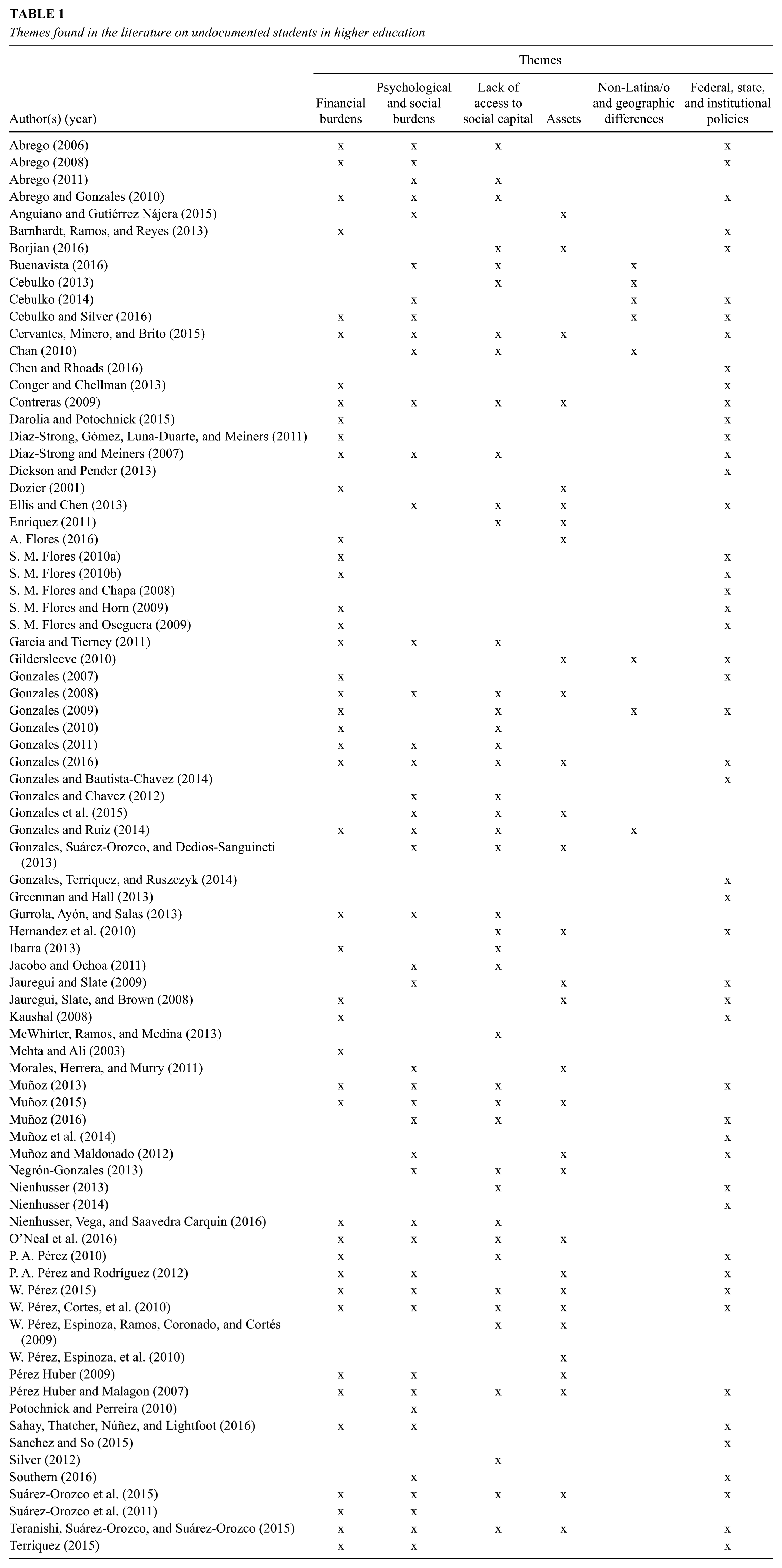
This literature makes clear that undocumented students share manifold experiences in their transitions from high school to higher education, in higher education, and in their transitions to the workforce or postgraduate work. Moreover, they face burdens beyond what their documented peers face (Crisp et al., 2015). Specifically, six major themes were illuminated by the literature, some of which are shared by all undocumented students: (a) they face financial burdens that documented students do not, (b) they are confronted by a bevy of unique psychological and social burdens and are rarely given tools to address them, (c) they are not given access to vital social capital, and (d) they bring a host of assets to college campuses, but these are undervalued and underutilized. Furthermore, while there are shared experiences, it is important to note that (e) non-Latina/o undocumented students and undocumented students from different geographic contexts have different experiences, and (f) although state legislatures and institutions of higher education are taking positive steps to increase access and persistence for undocumented students, they are not doing enough. Table 1 lists all 81 of the sources I included in the review and shows which themes were present in each. In the sections that follow, I examine each of these themes, discuss concerns with current research, and finish with ideas for future studies.
Themes found in the literature on undocumented students in higher education
Financial Barriers Are Inimical to Undocumented Students’ Pursuit of Higher Education
Financial concerns are the greatest obstacle facing undocumented students as they transition to and persist in higher education. Indeed, 27 of the 81 sources in this review found that many do not pursue 2- or 4-year higher education because of the cost, and the majority cannot endure without financial assistance (e.g., Abrego, 2008; Cebulko & Silver, 2016; Contreras, 2009; Suárez-Orozco et al., 2015). On graduation from high school, undocumented students are often in the difficult position of choosing between continuing school or working to help support their families, and many choose the latter (Gonzales, 2016; Gurrola et al., 2013; McWhirter, Ramos, & Medina, 2013; Pérez Huber & Malagon, 2007). The vast majority of undocumented students who choose to pursue higher education start at 2-year institutions, and even then the financial burden can be too heavy to bear (Abrego, 2008; S. M. Flores, 2010a; S. M. Flores & Horn, 2009; S. M. Flores & Oseguera, 2009; Suárez-Orozco et al., 2011).
Many students in the United States face similar financial constraints to undocumented students—roughly 70% of all college students utilize some form of financial aid (Gonzales, 2016)—but documented students typically have access to federal and state grants, loans, and scholarships that undocumented students generally do not (Abrego, 2006, 2008; Nienhusser et al., 2016). PRWORA (1996) and IIRIRA (1996) were drafted to prohibit undocumented students from receiving federal and state financial aid or ISRT. As a result, many states and institutions force undocumented students to pay out-of-state tuition, which is significantly higher than in-state tuition, thereby prohibiting many from accessing college (Mehta & Ali, 2003).
Applying for scholarships and other funding as an undocumented student is not always straightforward or clear. Laws vary from state to state, policies vary from institution to institution, and frequently they can be bureaucratic nightmares (Barnhardt, Ramos, & Reyes, 2013; A. Flores, 2016; Ibarra, 2013; Sahay, Thatcher, Núñez, & Lightfoot, 2016). There are not many scholarships available to undocumented students, and the ones that are available are highly competitive and frequently do not cover the full cost of college (Diaz-Strong et al., 2011). Furthermore, high school staff and college admissions staff often lack correct information about the process of applying for financial aid for undocumented students (Barnhardt et al., 2013; Gonzales, 2008, 2011, 2016; Ibarra, 2013; P. A. Pérez & Rodríguez, 2012; Nienhusser et al., 2016). Beyond a lack of information, anxiety about disclosing their status may prevent undocumented students from applying for scholarships (W. Pérez, Cortés, et al., 2010). Students who do qualify for scholarships may have them taken away when they cannot produce a social security number (Diaz-Strong & Meiners, 2007; Gonzales, 2016). Complicating matters further, nonprofit advocacy groups and scholarship providers lack consistency and transparency in their services for and engagement with undocumented students (A. Flores, 2016; Teranishi et al., 2015).
Even when highly qualified undocumented students are admitted to selective universities, they often do not attend due to financial constraints (Abrego & Gonzales, 2010; Ibarra, 2013). Undocumented students cannot legally work in the United States unless they are protected under DACA; as a result, they generally work in low-wage jobs and must work long hours or multiple jobs to support themselves and their families (Contreras, 2009; Garcia & Tierney, 2011; Gonzales, 2016; Pérez Huber & Malagon, 2007; Terriquez, 2015). As noted in 12 of the studies in this review, if they do enroll in college, financial burdens continue to affect their persistence, as many are forced to balance school and work, often in menial jobs off campus (e.g., Dozier, 2001; Gonzales, 2016; W. Pérez, 2015; Teranishi et al., 2015). Families may also bear the financial burden, particularly as they strive to provide as much financial support as they can (Abrego & Gonzales, 2010; Diaz-Strong & Meiners, 2007).
Financial struggles cause many undocumented students to enroll part-time or to “stop out” of school, and as a result, they frequently do not finish on time (Abrego & Gonzales, 2010; Conger & Chellman, 2013; Contreras, 2009; Diaz-Strong et al., 2011; Gonzales, 2016; Gonzales & Ruiz, 2014; Suárez-Orozco et al., 2015; Teranishi et al., 2015; Terriquez, 2015). Indeed, undocumented students are significantly more likely to stop out than documented peers with similar characteristics (Terriquez, 2015). In sum, financial burdens are frequently too great for undocumented students to enroll or finish college on time, if at all (Conger & Chellman, 2013).
Undocumented Students Face a Host of Unique Psychological and Social Burdens
Roberto Gonzales (2011, 2016) noted that, for U.S. citizens, the transition from adolescence to adulthood is associated with new rights and responsibilities. For example, at the age of 18, citizens gain the right to vote, can enlist in the military, and can serve on a jury. However, Gonzales (2016) deftly asserted, “[f]or undocumented youth, the transition to adulthood is accompanied by a transition to illegality” [italics in original] (p. 11).
The Plyler ruling gave 1.5-generation undocumented students in the United States a place to belong and develop during childhood (Gonzales, 2016) and, often, to postpone the negative impacts associated with being undocumented (Gonzales & Ruiz, 2014). However, it did not erase their “illegality” or offer them political parity during the transition into adulthood (Gonzales, 2016; Gonzales et al., 2015). Indeed, many students are not aware of their undocumented status until they approach certain rites of passage—getting a driver’s license, getting a job, applying to college—that require a social security number (Gonzales, 2016; Jacobo & Ochoa, 2011). This “transition to illegality” is frequently replete with psychological and social burdens that weigh heavily on undocumented students, especially those with aspirations to pursue higher education.
The Transition to Illegality and Conflicting Identities
As undocumented students transition into adulthood and learn about their status, “seemingly overnight, once-fuzzy cultural barriers become impenetrable” (Gonzales, Suárez-Orozco, & Dedios-Sanguineti, 2013, p. 9). As they enter adolescence, they are in contact with more institutions and are forced to confront the social limitations of their status (Gonzales, 2016; Gonzales et al., 2013; Gonzales et al., 2015; Jacobo & Ochoa, 2011). They begin to question the narratives and identities they had formed about themselves and reassess future plans (Gonzales et al., 2013; Jacobo & Ochoa, 2011). The realization of their legal status and the challenges that surround it frequently have deleterious effects on their mental health and well-being (Gonzales et al., 2013; Gonzales & Chavez, 2012; Gurrola et al., 2013; Suárez-Orozco et al., 2011). Newfound feelings of liminality and uncertainty about the future arise and can take a heavy toll on socioemotional growth (Suárez-Orozco et al., 2011).
In 17 of the 81 studies reviewed, students expressed feelings of intense shock, fear, stigma, grief, anxiety, shame, embarrassment, confusion, stress, depression, confusion, and frustration on learning about their status (e.g., Abrego, 2008; Buenavista, 2016; Morales et al., 2011; Muñoz, 2015). Gonzales et al. (2013) and Gonzales and Chavez (2012) posited that this realization is often damaging to students’ identity, self-efficacy, and purpose in life. Furthermore, some struggle to find a coherent sense of self, as the term “illegal” becomes a core part of their identity, shaping the way they view and define themselves personally, emotionally, and intellectually. Gonzales et al. (2013) also concluded that learning about status leads undocumented students to more risky behavior, use of drugs and alcohol, and less self-care. It also makes students afraid to form meaningful and trusting relationships, severing vital social networks and leading to experiences of isolation and discrimination.
The plethora of psychological and identity concerns negatively affects many undocumented students’ paths to higher education. Many feel a level of dissonance between the messages they received during their K–12 years about the United States as a land of opportunity and the structural barriers that their status imposes on them as they attempt to transition to higher education (Cebulko, 2014; Gonzales, 2016; Morales et al., 2011). Fears of being outed frequently limit interactions with teachers and peers, leading to lower motivation for pursuing higher education (Cebulko, 2014; Diaz-Strong & Meiners, 2007; Gonzales, 2011, 2016). Moreover, the newfound awareness of undocumented status brings feelings of hypervigilance regarding their status and whom they can trust (Buenavista, 2016).
Beyond the stresses of dealing with their understanding of themselves as undocumented students, frequently these feelings have an impact on their relationships with their families. Some experience tension when they try to reconcile conflicting narratives about their parents—one that portrays their parents as “illegal” or “lawbreakers” and another that portrays them as the good citizens they grew up with (Negrón-Gonzales, 2013). Additionally, some students understand why their parents waited to tell them about their status, while others express anger and mistrust (Gonzales, 2016).
As students learn about and come to terms with their legal status, they are confronted with a conflicted identity and a host of mental health issues that they frequently must deal with on their own. Any sense of belonging they may have felt is undermined by the knowledge that the authorities are actively seeking to deport them and their family (Suárez-Orozco et al., 2011). Any assumed link between educational attainment and material and psychological outcomes is broken and they frequently lose motivation to pursue higher education (Abrego, 2006; Diaz-Strong & Meiners, 2007; Garcia & Tierney, 2011; Gonzales, 2011; O’Neal et al., 2016). The sense of hopelessness, along with the bevy of psychological, social, and emotional concerns, is potentially devastating and demoralizing. A future of college and prosperous career opportunities becomes filled with uncertainty and fear.
Acute Fear
Seventeen studies in this review found that undocumented students in higher education live in constant fear of disclosing their status, deportation (of themselves or loved ones), and being ostracized and stigmatized (e.g., Abrego, 2011; Cervantes et al., 2015; Jacobo & Ochoa, 2011; Terriquez, 2015). Fear of deportation is so central that it can permeate nearly every aspect of their lives and lead to a general sense of mistrust of peers and school officials (Buenavista, 2016; Contreras, 2009; Negrón-Gonzales, 2013; W. Pérez, Cortés, et al., 2010). It can manifest itself in paranoia and leave students feeling like they need to constantly look over their shoulders (Buenavista, 2016). It is also frequently coupled with feelings of insecurity, a lack of sense of belonging, and pressure not to be discovered (Abrego, 2011; Anguiano & Gutiérrez Nájera, 2015; Contreras, 2009; Jacobo & Ochoa, 2011; W. Pérez, Cortés, et al., 2010; Pérez Huber & Malagon, 2007).
Students may go to great lengths to conceal their status from peers as well as from administration and faculty. For example, researchers have found that students create alternative background stories about themselves, talk in code, adopt other stigmatized identities, avoid conversations, and isolate themselves in order to maintain secrecy about their status—all of which can have deleterious psychological effects (Abrego, 2008, 2011; Buenavista, 2016; Cebulko, 2014; Chan, 2010; Gonzales, 2016; Muñoz, 2013, 2015). Students in several studies stated that they had few relationships where they trusted the other person enough to disclose or discuss their fears and anxiety over their status (Buenavista, 2016; Cebulko, 2014; Chan, 2010; Contreras, 2009; Jauregui & Slate, 2009; O’Neal et al., 2016). Moreover, when students did reveal their status to a person who was unsupportive, it made them more guarded and secretive and less trusting of others in the future (Muñoz, 2015, 2016).
Muñoz (2016) conducted a study of college students who disclosed their status and found that they experienced a “fluidity of fear” (p. 723), meaning that the fear was not constant, but fluctuated over time. She found that more information about the immigration system and strong social networks empowered undocumented students and diminished their fears. Participants in her study often relayed information they learned back to their families and communities, which further diminished their fears. Muñoz (2016) also found that when students disclosed their status they empowered others in their situation and then often become agents of knowledge for those students. She posited that disclosing can allow students to reclaim their identity and humanity.
Interestingly, for participants in Muñoz’s (2016) study, relational closeness was not a factor for disclosure, which was more likely to take place when students felt like the person they were disclosing to was a gatekeeper, with information or knowledge about an opportunity or resource. Negrón-Gonzales (2013) drew similar conclusions. She asserted that disclosing gives students access to a community of other undocumented students who help each other process their feelings. This leads students to become more politically active and engaged, which in turn helps erode fear and shame. That said, there are still insufficient emotional and psychological supports for undocumented students in higher education.
Lack of Emotional and Psychological Well-Being
For many undocumented students, overall emotional and psychological well-being is a major obstacle to academic persistence and social engagement (Jacobo & Ochoa, 2011; Teranishi et al., 2015; Terriquez, 2015). They often experience high levels of shame and powerlessness (Abrego, 2011; Cervantes et al., 2015; Diaz-Strong & Meiners, 2007; Ellis & Chen, 2013; Garcia & Tierney, 2011; Muñoz, 2013; Negrón-Gonzales, 2013; W. Pérez, Cortés, et al., 2010; Suárez-Orozco et al., 2015). Moreover, 10 studies in the review found that students often felt a sense of stigma and embarrassment about their status and that they tended to internalize those feelings (e.g., Chan, 2010; Ellis & Chen, 2013; Muñoz & Maldonado, 2012; Teranishi et al., 2015). Many reported high levels of stress that they often hid from others, including their families, as they did not want to add to the burdens their parents were facing (Cervantes et al., 2015; Diaz-Strong et al., 2011; Diaz-Strong & Meiners, 2007; Muñoz, 2013; O’Neal et al., 2016; W. Pérez, 2015; Terriquez, 2015).
W. Pérez, Cortés, et al. (2010) also noted that being raised in the United States and lacking documentation can leave students feeling humiliated and helpless as they feel like they are perceived as outsiders and inferior to their documented peers. While social and school support can palliate these negative effects, undocumented students frequently do not feel as though they have someone on campus they can trust and talk to openly (Buenavista, 2016; Chan, 2010; O’Neal et al., 2016; Potochnick & Perreira, 2010). These intense feelings of shame, stigma, stress, and humiliation can manifest in the form of acute anxiety or depression.
Anxiety and depression occur among undocumented students at higher rates than samples of documented students (O’Neal et al., 2016; Potochnick & Perreira, 2010; Suárez-Orozco et al., 2015; Terriquez, 2015). This anxiety is rooted in fears of deportation and the possibility of separation from family members (Cervantes et al., 2015; Negrón-Gonzales, 2013; Potochnick & Perreira, 2010). Students often know at least one person from their family or neighborhood who has been deported, which can amplify anxiety and can lead to depression (Buenavista, 2016; Gonzales & Chavez, 2012). Potochnick and Perreira (2010) found that experiencing discrimination was strongly associated with the risk of depression in undocumented students. O’Neal et al. (2016) found that undocumented students with high levels of depression had lower grade point averages than their citizen counterparts suffering from depression. Furthermore, many counselors and mental health workers on campus are unfamiliar with the issues undocumented students face, and so these students do not feel like they can talk to them about their depression and often feel forced to address it on their own (Muñoz, 2015).
Problematic Campus Climate
A positive campus climate is an important factor for undocumented students to persist in higher education. In a large survey of undocumented students, Suárez-Orozco et al. (2015) found that climate was second only to affordability in terms of importance in selecting a college. Unfortunately, 10 of the 81 studies in the review asserted that college campuses are not always welcoming places for undocumented students and many of them reported instances of discrimination as well as feeling isolated, unsupported, and intimidated (e.g., Cebulko, 2014; Nienhusser et al., 2016; Pérez Huber, 2009; Suárez-Orozco et al., 2015). Simple tasks like getting a student identification card can become frightening when people ask for social security numbers (Muñoz, 2013; Muñoz & Maldonado, 2012). This can lead to a lack of sense of belonging that can persist as students feel their institutions do not meet their needs (Contreras, 2009; Muñoz & Maldonado, 2012; Pérez Huber & Malagon, 2007).
While students reported overt discrimination in some studies (Cervantes et al., 2015; Gonzales & Ruiz, 2014; Pérez Huber & Malagon, 2007; Suárez-Orozco et al., 2015; Teranishi et al., 2015), more frequently discrimination on college campuses revealed itself in nativist racism—“a form of racism that is specifically directed at immigrants who are racially identified as Latina/o” (Pérez Huber & Malagon, 2007, p. 856; see also Pérez Huber, 2009). It is derived from the notion that Whites are “native” and all non-Whites are foreigners. Pérez Huber and Malagon (2007) found that this type of campus climate engenders feelings of fear, intimidation, and invisibility in undocumented students. Their participants expressed fear of being viewed as criminal because they could not reveal who they actually are. 7
Other studies have had similar results: College campuses elicit anxiety in undocumented students (Muñoz, 2013; Terriquez, 2015), students feel that staff and faculty are not sensitive to their needs (Buenavista, 2016; Chan, 2010; Contreras, 2009; Nienhusser et al., 2016), they are made to feel like outsiders (Buenavista, 2016; Gonzales, 2008, 2016; Muñoz & Maldonado, 2012; Negrón-Gonzales, 2013), they feel silenced in classrooms when discussing immigration (Muñoz, 2013; Muñoz & Maldonado, 2012), and they feel unsupported by administration or peers (Buenavista, 2016; Gonzales, 2008, 2016; Nienhusser et al., 2016). Compounding these issues, undocumented students frequently encounter difficulties with faculty, administration, and staff who are misinformed about state and national policies (Abrego & Gonzales, 2010; Buenavista, 2016; Contreras, 2009; Gonzales, 2016; Muñoz, 2016; O’Neal et al., 2016). Contreras (2009) found that the campus agents with the most relevant information were staff in school diversity offices.
Institutional support is crucial for helping undocumented students foster networks and resources to address their needs (Garcia & Tierney, 2011; Nienhusser, 2014; P. A. Pérez & Rodríguez, 2012; Southern, 2016). A vibrant community that supports the unique needs of undocumented students and validates their experiences can help contribute to their success (Barnhardt et al., 2013; Gonzales, 2016; Gonzales et al., 2015; Southern, 2016). Positive experiences with people on campus can help undocumented students better navigate the school and its bureaucracies, and in turn counter the negativity they may face (Contreras, 2009; Nienhusser, 2014; P. A. Pérez & Rodríguez, 2012). Student organizations, diversity/multicultural offices, undocumented student centers, and the like can help students create supportive networks and contribute to their success and persistence (Contreras, 2009; Gonzales, 2016; Muñoz & Maldonado, 2012; Pérez Huber & Malagon, 2007; Suárez-Orozco et al., 2015). Moreover, faculty and staff can help undocumented students create positive counternarratives, find meaningful roles, and regain a level of control in their lives (Gonzales et al., 2013).
Undocumented Students Lack Access to Vital Social Capital
Inherent in the notion of social capital is the idea that investing in relationships and social networks will yield benefits that would not otherwise be present (Bourdieu, 1986; Coleman, 1990; Lin, 2001). In the case of students, social capital can take the form of relations with peers, teachers, faculty, administrators, mentors, and parents that produce valuable resources to help students succeed in school and transition to higher education. While social capital is crucial for all students, it is paramount for undocumented students, as they need support and specific resources to help navigate unique barriers to higher education (Cebulko, 2013; Garcia & Tierney, 2011; Muñoz, 2015; P. A. Pérez, 2010; Pérez Huber & Malagon, 2007; Silver, 2012). Their ability to seek out and trust gatekeepers and agents in academic settings is vital to gaining access to social capital, and with it vital resources and information (Gonzales, 2010; Muñoz, 2015).
The Transition to Higher Education
Frequently, undocumented students lack strong social networks and social capital in secondary school contexts (Cebulko, 2013; Garcia & Tierney, 2011; Gonzales, 2009). Many are the first in their families to attend college and do not have guidance from family members on the process (Gonzales, 2016; McWhirter et al., 2013). They ultimately depend on their high schools to adequately prepare them for the transition (Diaz-Strong & Meiners, 2007; Gonzales, 2010, 2016; Muñoz, 2015; Nienhusser, 2013). Twelve studies in this review found that positive relationships, strong networks, and guidance from caring adults are perhaps some of the most important factors (e.g., Abrego & Gonzales, 2010; Hernandez et al., 2010; Ibarra, 2013; Nienhusser, 2013; Silver, 2012).
Frequently, undocumented students go to inner-city or rural high schools that are segregated and/or poorly funded; these schools provide fewer networks and fewer resources to prepare them for the transition to higher education (Abrego, 2006; Garcia & Tierney, 2011; Gonzales et al., 2015; Gonzales & Ruiz, 2014). Moreover, schools and colleges frequently do not actively work to facilitate college access for undocumented students (Gonzales, 2016; Gonzales & Ruiz, 2014; Ibarra, 2013; Nienhusser et al., 2016). Undocumented students who lack caring and positive relationships in schools often do not receive the guidance and information they need and may eventually drop out before graduating (Cebulko, 2013; Gonzales, 2011, 2016).
Undocumented students are rarely viewed as college-going by high school staff and, as a result, are not given essential college and financial aid information (Gonzales, 2010, 2016; Nienhusser et al., 2016). Gonzales (2010) adroitly explored this problem and found that educational advancement of undocumented students is shaped, in part, by their place in the school hierarchy. He found that undocumented students who were positively tracked in advanced placement and honors classes had access to stronger networks and social capital compared to their negatively tracked peers. Moreover, they had access to relevant information about applying to college and were able to form trusting bonds with teachers, counselors, and other school staff that helped them obtain the resources necessary to access college (Gonzales, 2010, 2016; Gonzales et al., 2015; Ibarra, 2013). Negatively tracked undocumented students, on the other hand, often felt isolated and alone and did not have the same access to information or services (Enriquez, 2011; Gonzales, 2010, 2016; Gonzales et al., 2015). W. Pérez, Espinoza, Ramos, Coronado, and Cortés (2009) likewise suggested that undocumented students who were recognized as gifted participated in more extracurricular activities, volunteered more and, as a result, had higher levels of academic success—endeavors that helped augment their social capital and get them to college.
As discussed, many undocumented students struggle to form trusting relationships at school, as they are embarrassed or scared to disclose their status or to have it unintentionally disclosed by friends or school staff (Abrego, 2011; Buenavista, 2016; Cebulko, 2013; Cervantes et al., 2015; Gonzales, 2010; Pérez Huber & Malagon, 2007). As such, they may struggle to increase social capital and access key information (Chan, 2010). Even if undocumented students are able to disclose to a caring adult, many school agents do not know how to properly advise them on applying and transitioning to higher education (Enriquez, 2011; Gonzales, 2008, 2016; Ibarra, 2013; Nienhusser et al., 2016). As a result, undocumented students frequently utilize undocumented peers and student organizations to find information specific to their needs (Enriquez, 2011; Gonzales, 2016; P. A. Pérez, 2010; Pérez Huber & Malagon, 2007).
Eleven studies reported undocumented students having negative experiences with teachers and other school agents and found school to be a place of marginalization and discrimination (e.g., Diaz-Strong & Meiners, 2007; Enriquez, 2011; Gonzales, 2010; Gonzales et al., 2015; Gurrola et al., 2013). That said, research makes manifestly clear that social capital, social networks, and social support from student organizations, peers, school agents, and family members are critical for helping undocumented students transition to higher education and persist (Abrego & Gonzales, 2010; Cervantes et al., 2015; Diaz-Strong & Meiners, 2007; Muñoz, 2015; W. Pérez, 2015; W. Pérez et al., 2009; Pérez Huber & Malagon, 2007; Silver, 2012). There is, however, a lack of symmetry between the social capital that undocumented students need to transition to higher education and the social capital they receive. This continues as students make the transition to higher education.
Social Capital on Campus
Frequently, 1.5-generation undocumented students have few opportunities to establish and grow networks on college campuses because of their legal status and exclusion from institutional supports (Garcia & Tierney, 2011; Negrón-Gonzales, 2013). As in high school, on college campuses they tend to feel like they do not have anyone they can trust and, as a result, feel isolated and have fewer meaningful relationships (Contreras, 2009; Garcia & Tierney, 2011; Gonzales et al., 2013; O’Neal et al., 2016; Suárez-Orozco et al., 2015; Teranishi et al., 2015). Those who are able to foster positive and supportive relationships with campus faculty and staff do benefit from those connections (Abrego & Gonzales, 2010; Contreras, 2009; Garcia & Tierney, 2011; Gonzales et al., 2013; Suárez-Orozco et al., 2015; Teranishi et al., 2015).
Increased positive relationships with faculty and student affairs staff can foster a sense of ease in students, provide motivation and support, and make them more apt to seek out information that is relevant to them (Contreras, 2009; Gonzales et al., 2013; W. Pérez, Cortés, et al., 2010). Moreover, college instructors can be vital in fostering a sense of belonging among documented students and act as “validating agents” (Rendon as cited in W. Pérez, Cortés, et al., 2010, p. 42). But faculty and staff may by generally unaware of how best to mentor and advise undocumented students (Garcia & Tierney, 2011). These students therefore frequently turn to peer groups and student organizations on campus to foster social capital and obtain resources and information they need (Gonzales, 2016).
Peer support is crucial for helping undocumented students to persist (Borjian, 2016; Gonzales, 2016; W. Pérez, Cortés, et al., 2010; Pérez Huber & Malagon, 2007; Suárez-Orozco et al., 2015). Bonding with other students can foster a sense of belonging, bolster cultural and personal empowerment, improve motivation, and increase access to vital resources (Gonzales, 2008; Gonzales et al., 2013; Muñoz, 2016; W. Pérez, Cortés, et al., 2010; Pérez Huber & Malagon, 2007; Suárez-Orozco et al., 2015). Undocumented students often rely heavily on peer networks to acquire information about resources, classes, job opportunities, and community activities (Contreras, 2009). Student organizations are also crucial for disseminating information and forming networks (Pérez Huber & Malagon, 2007). They can provide space for undocumented students to form a shared identity with others in similar circumstances and provide them opportunities for civic engagement and activism (Gonzales et al., 2013; Muñoz, 2015).
Two of the biggest obstacles to creating social capital for undocumented students are transportation and long work hours (Gonzales, 2011, 2016; Gonzales & Chavez, 2012; Hernandez et al., 2010; Suárez-Orozco et al., 2015). Many states do not allow undocumented students to obtain driver’s licenses—although some allow DACA students to do so (Teranishi et al., 2015)—and many undocumented students select colleges that are near their homes and only require a bus ride with no transfer fare (Cervantes et al., 2015; P. A. Pérez, 2010). A lack of a driver’s license frequently means spending hours on public transportation, which cuts down time on campus for important things like attending required classes, seeing a professor, joining group meetings or activities, or creating vital networks (Abrego & Gonzales, 2010; Garcia & Tierney, 2011; Gonzales, 2016; Hernandez et al., 2010; Jacobo & Ochoa, 2011). Moreover, these obstacles can hamper their ability—at both the undergraduate and graduate levels—to get internships, teacher assistantships, research assistantships, or on-campus jobs that can further their academic and career goals (Abrego, 2006; Ellis & Chen, 2013; Garcia & Tierney, 2011; Gonzales, 2016; Muñoz, 2013; W. Pérez, 2015; Pérez Huber & Malagon, 2007). They are also detrimental to students’ attempts to build social capital and their sense of belonging on campus, which can be inimical to their persistence (Contreras, 2009; Gonzales, 2016; W. Pérez, Cortés, et al., 2010; Pérez Huber & Malagon, 2007; Suárez-Orozco et al., 2015). Undocumented students’ lack of access to social capital can lead them to feel like they are undervalued. This feeling can be exacerbated because institutions of higher education frequently do not recognize the multitude of assets that undocumented students bring to campus.
Undocumented Students Have Manifold Assets That Are Underutilized and Undervalued
Despite the multiplicity of barriers faced by undocumented students in higher education, many of their stories are ones of motivation, commitment, and perseverance—not failure (Contreras, 2009; Dozier, 2001; Gonzales, 2016). In fact, some assert that the difficulties and hardships they have faced in their journey to higher education have made them more resilient and better able to address problems that they encounter (Ellis & Chen, 2013). These students bring an arsenal of assets to college—an arsenal that can be leveraged to improve the campus and the experiences of undocumented students on it. However, these assets are under-researched, undervalued, and underutilized.
Civic Engagement
Thirteen studies in this review asserted that a large proportion of undocumented students tend to be very engaged in American civic life, which can take the form of social service, volunteering, community work, or activism (e.g., Anguiano & Gutiérrez Nájera, 2015; Ellis & Chen, 2013; W. Pérez, 2015). Sometimes feelings of otherness draw students to civic engagement and activism because it makes them feel more a part of American society (Negrón-Gonzales, 2013; W. Pérez, Cortés, et al., 2010). Furthermore, civic engagement tends to motivate undocumented students to excel academically (Muñoz, 2015; W. Pérez, Espinoza, et al., 2010; Suárez-Orozco et al., 2015). Frequently, this engagement and activism takes place in the community, where students reach out to and mentor youth in similar situations (Contreras, 2009; Gonzales, 2008; Suárez-Orozco et al., 2015). Several studies noted that undocumented students are frequently involved in high school leadership and extracurricular activities and actively seek similar opportunities in higher education (Gonzales, 2016; Hernandez et al., 2010; W. Pérez, Espinoza, et al., 2010).
Interestingly, W. Pérez, Espinoza, et al. (2010) found that female undocumented students and those with higher GPAs reported “higher levels of civic engagement, social service, and tutoring activities” (p. 258). Moreover, the authors posited that undocumented students—male and female—will most likely assume leadership positions in their communities and remain civically engaged throughout their lives. High levels of civic engagement belie the stereotype of the undocumented student as a lawbreaker hiding in the shadows, and this empowers students to actively counter similar narratives and cope with the barriers that they face (Gonzales, 2008; Pérez, Espinoza, et al., 2010).
Gonzales (2008) studied undocumented student activists who put themselves in harm’s way and risked being outed and deported to publicly protest and advocate for their rights. Activism and the courage associated with it are assets that undocumented students bring to campus with them and ones that should be—but rarely are—leveraged by university officials to improve the campus and the experiences of other undocumented students. These high levels of civic engagement should lead university, state, and federal legislators to reevaluate and reconceptualize what it means to be a citizen in a more inclusive way that values civic engagement and participation in society (Perry, 2006). In such a reconceptualization, many undocumented students would meet the criteria of citizenship in ways that people who are citizens by birth do not.
Giving Back to the Community
Several researchers found that undocumented students are not only determined to succeed academically but also to give back to their families and communities (Cervantes et al., 2015; Contreras, 2009; Gonzales, 2008; W. Pérez, 2015; Suárez-Orozco et al., 2015). They serve as hope for other undocumented students who want to go to college, and often mentor them to help them achieve their goals (Gonzales, 2008; Hernandez et al., 2010; W. Pérez, 2015). Morales et al. (2011) noted that undocumented students feel a strong desire to fight for the rights of the people in their communities and for other undocumented people. This sense of responsibility serves as motivation to succeed in school and provides students with tools to persevere (Anguiano & Gutiérrez Nájera, 2015; O’Neal et al., 2016). And, beyond their own communities, undocumented students exhibit a sense of commitment to effect change in the United States (Morales et al., 2011; W. Pérez, 2015). This can increase the social capital of people in their communities and extend resources to others in their situation.
Motivation, Desire, and Ganas
To overcome the manifold barriers that undocumented students face and to persist in higher education, studies have found that they must exhibit a tremendous amount of motivation and desire to succeed—or ganas (Contreras, 2009; Jauregui & Slate, 2009; W. Pérez, 2015; Pérez Huber & Malagon, 2007). Moreover, they frequently use their feelings of limitation, otherness, and disempowerment to fuel this motivation (Anguiano & Gutiérrez Nájera, 2015; Borjian, 2016; Cervantes et al., 2015; A. Flores, 2016; Negrón-Gonzales, 2013; O’Neal et al., 2016; W. Pérez, 2015). Some students may feel they are lucky or privileged to attend higher education, which serves as further motivation (Anguiano & Gutiérrez Nájera, 2015). Seven studies found that undocumented students are motivated by the sacrifices made by their families to help them reach their goals (Anguiano & Gutiérrez Nájera, 2015; Cervantes et al., 2015; Hernandez et al., 2010; Jauregui & Slate, 2009; Morales et al., 2011; W. Pérez, Cortés, et al., 2010; Pérez Huber & Malagon, 2007).
In a similar vein, O’Neal et al. (2016) found that many undocumented students display grit, which they defined as “passion and perseverance towards long-term goals” (Duckworth et al., as cited in O’Neal et al., 2016, p. 449). They posited that grit helps students navigate the difficult bureaucracies and barriers they face in higher education, and it is augmented by the desire to make their families proud. It should be noted, however, that while grit is an intuitively appealing predictor of academic success, a recent meta-analysis found it has, at best, a weak relationship to academic success (Credé, Tynan, & Harms, 2017). Moreover, the concept is problematic because it can be used to blame the victims of oppression and poverty. Specifically, the notion that grit is all someone needs to pull himself or herself out of poverty and oppression oversimplifies complex structural obstacles. Despite controversies and concerns about the construct of grit, it is clear that high levels of motivation help undocumented students to succeed academically, and this motivation should be recognized and fostered by university staff and faculty.
Resilience
Resilience is defined here as the ability to persist and achieve positive outcomes in the face of significant adversity (Luthar, Cicchetti, & Becker, 2000). Numerous studies have revealed that undocumented students in higher education show tremendous amounts of resilience—not only in making it from high school to higher education but also in persevering and succeeding academically despite the many barriers that they encounter (Borjian, 2016; Cervantes et al., 2015; Ellis & Chen, 2013; Gonzales et al., 2013; Morales et al., 2011; W. Pérez, 2015; Suárez-Orozco et al., 2015; Teranishi et al., 2015). The motivation to succeed academically, coupled with familial support, helps to buoy resilience in many students (Ellis & Chen, 2013; Morales et al., 2011; P. A. Pérez & Rodríguez, 2012; W. Pérez, 2015; W. Pérez et al., 2009; Pérez Huber, 2009).
Another source of resilience is undocumented students’ general optimism and ability to creatively navigate situations and obstacles (Ellis & Chen, 2013; Hernandez et al., 2010; Morales et al., 2011). Not surprisingly, resilience can be bolstered by high levels of social capital and strong networks (Enriquez, 2011; W. Pérez et al., 2009; Pérez Huber, 2009). Ellis and Chen (2013) noted that students find strength in dual identities from their home and host cultures, and resiliency is enhanced as they overcome struggles in their path. Furthermore, strong problem-solving skills as well as a strong sense of purpose can facilitate resilience (Morales et al., 2011). Finally, students find resilience in their desire to challenge stereotypes and obstacles associated with their status, and they often develop internal narratives about the importance of overcoming these barriers (Cervantes et al., 2015; Morales et al., 2011; W. Pérez, 2015). Resilience and creativity to navigate the higher education system can strengthen the higher education community.
Various Forms of Capital
Undocumented students—who are often first-generation college students—are frequently portrayed as lacking the dominant cultural capital and implicit knowledge necessary to succeed in higher education (Collier & Morgan, 2008; Pérez Huber, 2009). This is problematic, as it comes from a deficit model, which sees students as lacking capital as opposed to valuing and utilizing the capital they do have (Yosso, 2005). Pérez Huber (2009) documented the different forms of capital possessed by Mexicana undocumented college students using Yosso’s (2005) concept of community cultural wealth. She asserted that undocumented students utilize seven forms of capital—aspirational, familial, linguistic, social, navigational, resistance, and spiritual—to navigate institutional barriers, give back to their communities, strengthen their emotional and psychological well-being, and work toward social justice. The assets that undocumented students bring are manifold, but they are rarely harnessed by faculty or staff.
Non-Latina/o and Rural Undocumented Students Face Distinct Obstacles
This review has so far focused largely on the shared experiences of all undocumented students. It is also important to note that there are distinct differences in these experiences created by ethnoracial and geographical differences. I discuss these differences in this section.
Ethnoracial Differences
The vast majority of literature exploring the experiences of undocumented students is focused on Latina/o students (Cebulko, 2014). Latina/o populations make up the clear majority of undocumented students in the United States, but there are significant numbers of non-Latina/o undocumented students (Passel, 2015). For example, roughly 12% of the undocumented population are Asian immigrants (Buenavista, 2016); in California, undocumented Asian students make up a significant proportion of the undocumented population (Gonzales, 2009). Relatively little is known about non-Latina/o undocumented students and how they experience the pursuit of higher education (Buenavista, 2016; Cebulko, 2013, 2014). There is recent growth in this research, however, and this nascent work is integral as we begin to parse the nuances of the specific needs of undocumented students.
Non-Latina/o undocumented students often describe themselves as invisible or hidden, as they do not fit the picture of the archetypal undocumented student (Buenavista, 2016; Chan, 2010; Gonzales, 2009). Moreover, undocumented status is typically seen as a Latina/o problem (Chan, 2010). Chan (2010) noted that this invisibility is a double-edged sword: Non-Latina/o undocumented students can live in the United States without the threat of being profiled as undocumented, but they often feel isolated as a result. Moreover, Chan noted, these students are often not offered information about how they can pursue higher education. The “model minority myth”—the false notion that Asian Americans have achieved success due to their cultural work ethic—conceals the very real problems that Asian undocumented students face, as well as the diversity of experiences among different ethnic groups (Buenavista, 2016; Gonzales, 2009). Furthermore, this myth, when combined with undocumented status, can force undocumented Asian students into silence (Poon et al., 2016). Institutions of higher education should explore ways to recognize and serve non-Latina/o undocumented students, as they are frequently excluded.
Buenavista (2016) noted that non-Latina/o undocumented students sometimes understand their undocumented status as different from that of undocumented Latinas/os. She noted that many Asian undocumented students experience “undocumented status acquisition” (p. 10), meaning they come to the United States with their families via a visa, and when they overstay that visa they become undocumented. Some use this notion to differentiate themselves from Latina/o undocumented students to stave off negative portrayals and to substantiate feelings of acceptance (Buenavista, 2016). In general, undocumented students have a host of shared experiences, but different ethnoracial groups experience being undocumented in some fundamentally different ways. Further research is needed to explore these differences and to better learn how institutions of higher education can better serve all undocumented students.
Rural Versus Urban Students
Aside from ethnoracial differences, there is also sharp divide in experiences of undocumented students in rural and urban schools. In their study of the experiences of undocumented students in rural high schools, Gonzales and Ruiz (2014) asserted that most scholarship has focused on urban students and this has obscured variations across different geographic contexts. They averred that while many experiences between rural undocumented students and their urban counterparts are similar, rural students confront a “unique constellation of rural disadvantage” [italics in original] (p. 196).
Much of the literature cited above argues that 1.5-generation students can find a sense of belonging and shared values in the K–12 experience. This was not the case for the rural undocumented participants in Gonzales and Ruiz’s (2014) study, where many felt they were on the periphery of the community and school. They faced overt hostility and discrimination from peers, teachers, and school staff. Some students—especially those who enrolled in higher education—had caring mentors at their schools, but they were in the minority. Furthermore, Gonzales and Ruiz found that these rural schools lacked rigorous courses like advanced placement, tutoring and college readiness programs, and adequate extracurricular opportunities. This may hinder all rural students, but it compounds the obstacles shouldered by undocumented students.
Beyond the school context, rural students are typically exposed to agricultural work and immigration enforcement early in their lives (Gildersleeve, 2010; Gonzales & Ruiz, 2014). These experiences, combined with early awareness of their status, negatively affect how they view their future and aspirations for higher education. In one of the few studies that has touched on the struggles of rural undocumented students, S. M. Flores (2010a) echoed Gonzales and Ruiz (2014). She found that in states with inclusive ISRT policies, urban undocumented students were more likely to enroll in higher education than their rural peers. Ultimately, more research that examines the experiences of undocumented students in different geographical contexts is needed to understand the variety of unique and shared experiences.
Government and Institutions Are Taking Some Positive Steps, but It Is Not Enough
Federal-, state-, and institutional-level policies have attempted to address the issues detailed in the sections above, with varying degrees of success. At the state and institutional levels, policies have allayed some of the financial burdens undocumented students confront; institutional policies have helped address some issues regarding social capital and psychological burdens. But few institutions have begun to utilize the assets of undocumented students or address the specific needs of different groups of undocumented students. And, at the federal level, DACA had some success. As I discuss next, however, its repeal and the subsequent court cases leave the future of federal law for 1.5-generation students in the balance.
The Impact of DACA
Congress’s unsuccessful attempts to pass the DREAM Act have left the country without a uniform federal law regarding undocumented students of the 1.5 generation, and this has had a negative impact on college access and persistence. President Obama’s DACA sought to fill the gap in federal law, and scholars have noted that—prior to the recent push to end the program—it has had numerous positive effects on undocumented students. Several studies have indicated that DACA increased the number of opportunities available to undocumented students, allowing them access to new jobs, higher earnings, internships, bank accounts, credit cards, driver’s licenses, health care, and, in some states, improved financing for college (Gonzales & Bautista-Chavez, 2014; Gonzales, Terriquez, & Ruszczyk, 2014; Teranishi et al., 2015). For many students, DACA provided a respite from fears and anxieties of deportation, a stronger sense of security, and a greater sense of belonging in society (Cervantes et al., 2015; Gonzales et al., 2014; Teranishi et al., 2015).
Teranishi et al. (2015), at the UndocuScholars Project at UCLA, conducted one of the most recent and comprehensive surveys of undocumented students. They found that, in comparison to other undocumented students, DACA recipients participated more in campus life and felt reduced stigma as well as a greater sense of belonging on campus and in society. They also noted that DACA recipients had more stable living conditions and accessible transportation, and that they were twice as likely as non-DACA students to obtain internships. In Teranishi et al.’s (2015) survey, 86% reported that DACA had a positive effect on their lives and education.
Though DACA has clearly improved lives and opportunities for undocumented students, it has many shortcomings. For example, in a study looking at its effects in states with different stances toward undocumented immigrants, Cebulko and Silver (2016) found that state laws could enhance or hinder its impact. Specifically, state laws in Massachusetts enhanced students’ abilities to utilize DACA, while those in North Carolina dramatically hindered or negated its impact. Thus, states with anti-immigrant laws could hamper or eliminate chances for undocumented students to attend college, even if they were DACA recipients.
Overall, although it has offered some good support, DACA has not been enough to create inclusive contexts for all undocumented students, as implementation has not been consistent in all states (Cebulko & Silver, 2016; Sahay et al., 2016; Teranishi et al., 2015). Moreover, it has not addressed the issue of federal or state financial aid for undocumented students and, as discussed earlier, costs can still prevent undocumented students from accessing higher education or force them to stop out (Cebulko & Silver, 2016; Gonzales & Bautista-Chavez, 2014; Gonzales et al., 2014; Sahay et al., 2016; Terriquez, 2015).
Another disconcerting problem with DACA is the preponderance of eligible young people who did not apply (Gonzales, 2016). As of 2016, about 1.7 million youth were eligible, and roughly 728,000 (43%) applied and were granted DACA status (Hipsman, Gómez-Aguiñaga, & Capps, 2016). Importantly, Gonzales and Bautista-Chavez (2014) and Gonzales et al. (2014) found that the benefits of DACA have frequently gone to undocumented students with higher levels of education and socioeconomic status. Explanations for why some did not apply are not completely settled, but research points to older DACA-eligible youth not being aware of the law or not having the resources to take advantage of it, as well as barriers such as financial constraints that have prohibited undocumented youth from applying to school and thus discouraged them from applying for DACA (Gonzales, 2016). Relevant here is the finding from Gonzales and Bautista-Chaves (2014) that community organizations were integral in helping undocumented students access and complete DACA paperwork and applications.
While it has improved access and persistence in higher education for undocumented students, DACA was never a permanent or complete solution. Some scholars have asserted that “DACA is, at best, a second-class status” for recipients (Gonzales et al., 2014, p. 16). Nevertheless, while not a complete solution, DACA was an important inclusionary step for 1.5-generation undocumented students. Its termination will negatively impact hundreds of thousands who have benefitted from it.
State-Level ISRT Policies
As noted above, many states have ISRT policies for undocumented students. Laws like PRWORA and IIRIRA have generally been interpreted as prohibiting such policies (Manuel, 2014). However, courts have found that neither law bars students from receiving ISRT if they complete a certain number of years of high school in the state—it is read as barring ISRT based on residency only and not on other factors (Olivas, 2004). Similar to DACA, ISRT policies have been a positive step forward, but not a complete solution.
Ten studies have shown that ISRT policies can increase enrollment of undocumented students in higher education (e.g., S. M. Flores, 2010a, 2010b; S. M. Flores & Chapa, 2008; S. M. Flores & Oseguera, 2009, Jauregui et al., 2008). A study by S. M. Flores and Horn (2009) also revealed that Latina/o undocumented students living in states with ISRT policies are as likely to persist in higher education as their Latina/o citizen and legal resident peers. Dickson and Pender (2013) noted that this was especially true for institutions with large Latina/o populations. Kaushal (2008) found that ISRT policies are associated with an overall increase in college enrollment and educational attainment for undocumented students. It should be noted, however, that Greenman and Hall (2013) found no significant relationship between ISRT policies and enrollment, though the authors noted that their data did not allow them to understand the nuances of the influence of the policy.
Abrego (2008) found that ISRT policies can have a positive impact on students’ psychological well-being. She interviewed students in California and found that AB540, the state’s ISRT policy, allayed the stigma many students felt. Her participants had internalized their undocumented status as part of their identity and otherness, but the law gave them a new, more positive way to identify themselves. They felt safer and more confident about disclosing their status and applying to college, as they felt the label gave them a legitimate place in higher education. Interestingly, Contreras (2009) found that the ISRT policy in Washington (HB1079) did not have the same effects. Contreras attributed this to the fact that the state had a “smaller proportional critical mass of undocumented students on college campuses” than California did (p. 619). Just as Cebulko and Silver (2016) demonstrated that state context can affect the implementation of DACA, these two studies demonstrate how state contexts can impact the effect of ISRT laws on undocumented students.
ISRT policies for undocumented students seem to increase enrollment; however, more 1.5-generation students are enrolling part time or in community colleges, showing that finances are still a potentially large barrier (Darolia & Potochnick, 2015). Several studies have also pointed out that while ISRT policies may increase enrollment, they do not do enough to help students persist and complete their degrees (Conger & Chellman, 2013; Darolia & Potochnick, 2015; Gonzales, 2009; Greenman & Hall, 2013). Regardless of state policies, the absence of an all-encompassing federal policy will continue to limit undocumented enrollment and persistence in higher education (Greenman & Hall, 2013).
Institutional Interventions and Policies
Beyond state-level policies, institutions of higher education can also play a significant role in increasing access and persistence among undocumented students. Many institutions have a “don’t ask, don’t tell” policy about undocumented students and lack explicit policies regarding these students and their access to higher education (Teranishi et al., 2015, p. 14). The vast majority of the articles I reviewed suggested institutional interventions aimed at improving access and support for undocumented students. This subsection details these recommendations, which aim to increase access and persistence, improve the well-being of undocumented students on campus, and help the prospects of those who graduate.
Improved access
Colleges and universities should work in conjunction with high schools to improve college transitions for undocumented youth, in particular by making a concerted effort to increase their social capital (Abrego & Gonzales, 2010). Mentoring programs would allow undocumented students to connect with mentors in schools, communities, or local universities in order to receive information and resources (Abrego & Gonzales, 2010; Nienhusser, 2013). Moreover, administrators and faculty can cultivate relationships with key individuals in the community and with high school personnel who work with undocumented students to help disseminate information to students (Muñoz & Maldonado, 2012). Scholars suggest that universities expand outreach to feeder high schools and undocumented communities so that parents know what resources are available (Cervantes et al., 2015; Diaz-Strong et al., 2011; Nienhusser, 2013; W. Pérez, Cortés, et al., 2010; Southern, 2016). Moreover, admissions and financial aid offices should reduce ambiguity and explicitly and publicly state that undocumented students are eligible for admission as well as train staff to help students navigate the application process (Barnhardt et al., 2013; Nienhusser, 2013; Suárez-Orozco et al., 2015).
Increased faculty, staff, and administrative awareness
Numerous studies in this review contend that higher education faculty, staff, and administrators can be effective agents to support and motivate undocumented students to persist, feel like they belong, and succeed (Barnhardt et al., 2013; Gildersleeve, 2010; Nienhusser, 2014; P. A. Pérez & Rodríguez, 2012; W. Pérez, Cortés, et al., 2010; Southern, 2016; Suárez-Orozco et al., 2015). Fourteen articles averred that these key stakeholders should receive trainings or workshops on the laws, policies, needs, concerns, and issues relevant to undocumented students and how they can best address them (e.g., Borjian, 2016; Chen & Rhoads, 2016; Sanchez & So, 2015; Southern, 2016; Suárez-Orozco et al., 2015), and universities should create taskforces to increase staff and faculty knowledge (Contreras, 2009; Muñoz & Maldonado, 2012; Pérez Huber & Malagon, 2007). Moreover, faculty must anticipate undocumented students and their unique challenges so that they can better support them and cultivate trusting relationships (Suárez-Orozco et al., 2015; Teranishi et al., 2015).
Undocumented allies on campus
Faculty, staff, and peers can play a significant role as “undocu-allies” in advancing and addressing the needs of undocumented students on higher education campuses (Cervantes et al., 2015; Chen & Rhoads, 2016; Muñoz, 2015; Southern, 2016; Suárez-Orozco et al., 2015). Faculty can showcase their support for undocumented students with a “freedom to disclose” statement on course syllabi and by working to foster trusting relationships with students (Cervantes et al., 2015). Faculty can also partner with student groups to support undocumented students.
Institutional programs or centers can also serve as allies to undocumented students. Sanchez and So’s (2015) essay describes the work of the Undocumented Student Program (USP) at the University of California, Berkeley, which serves as a model program for other UC campuses. It has two full-time staff members who are responsible for ensuring every undocumented student is identified as AB540 (receiving ISRT per the California law) and that those who self-identify as undocumented receive direct communication and support, from admission to graduation. USP also provides services such as book lending, emergency loan assistance, workshops on relevant issues for undocumented students, and free legal support. USP employees research the institution and help negotiate innovative solutions to the barriers undocumented students face on campus. For example, they create nontraditional allies by changing the minds of people who generally are opposed to undocumented students, which can, in turn, improve the campus climate and support systems.
Improved campus climate, networks, and support systems
The literature makes clear that colleges and universities should make a concerted effort to create a campus climate that is welcoming, transparent, and supportive of undocumented students, providing them with the necessary resources to acclimate and succeed (Barnhardt et al., 2013; Diaz-Strong et al., 2011; Hernandez et al., 2010; Muñoz et al., 2014; Muñoz & Maldonado, 2012; Nienhusser, 2014; Southern, 2016). Freshman seminars and orientations should center on social justice issues and multiple dimensions of oppression—including legal status (Muñoz & Maldonado, 2012). The university should publicly and unequivocally show support for undocumented students on campus to increase sense of belonging and make clear efforts to support them (Suárez-Orozco et al., 2015; Teranishi et al., 2015). Additionally, they can be vehicles to spread accurate information about undocumented students in an effort to disabuse the student body and the public of negative stereotypes and misinformation (Muñoz, 2013).
Several articles in the review argued that universities should create and fund centers for undocumented students to provide them a safe space to find resources and services (Chen & Rhoads, 2016; Suárez-Orozco et al., 2015; Teranishi et al., 2015). Institutional organizations and student groups that support undocumented students should collaborate with other organizations on campus and the community to grow support networks for undocumented students (Conger & Chellman, 2013; Diaz-Strong & Meiners, 2007; Muñoz, 2016). Campuses must work to engender more awareness regarding mental health for undocumented students and should supply legal, counseling, and mental health support that is attuned to their specific needs (Cervantes et al., 2015; Ellis & Chen, 2013; Muñoz, 2013, 2015; W. Pérez, Cortés, et al., 2010; Suárez-Orozco et al., 2015; Teranishi et al., 2015). Ultimately, in order to ensure that more undocumented students flourish on university campuses, there needs to be a dialogue about how to improve admissions, outreach, financial aid, transition programs, support services, retention programs, and efforts to help with graduate school or careers (Teranishi et al., 2015).
Discussion
It is imperative that scholars build on the extant corpus of literature to shed light on ways to increase access and improve retention of undocumented students in higher education. With this goal in mind, this review identified key themes in the literature that begin to illuminate the shared experiences of undocumented students and their pursuit of higher education. This analysis also identified strengths and weaknesses in the existing research. Many of the studies are methodologically strong and provide a rich understanding of the experiences of a multiplicity of groups of undocumented students, but some concerns should be addressed in future research.
To start, many of the studies did not adequately differentiate between the experiences of different ethnoracial groups. Almost all were focused exclusively on Latina/o undocumented students, and even the 17 studies that utilized diverse samples generally included extremely small samples of non-Latina/o students (an exception is Teranishi et al., 2015). Furthermore, these 17 studies rarely, if ever, examined the differences between ethnoracial groups. The lack of diversity is understandable to an extent, as Latinas/os make up the vast majority of undocumented students in the United States, but East and Southeast Asian ethnoracial groups account for over 1.5 million undocumented residents (Passel, 2015). Moreover, they make up an extremely large proportion of undocumented students in higher education, especially in California.
Only three studies solely addressed the experiences of non-Latina/o undocumented students (Barnhardt et al., 2013; Buenavista, 2016; Chan, 2010). This imbalance seems to validate and perpetuate the invisibility of non-Latina/o undocumented students described by Buenavista (2016) and Chan (2010). The almost exclusive examination of Latina/o undocumented populations in the literature perpetuates the harmful social construction of Latinas/os as the undocumented, “deviant” other (Schneider & Ingram, 1993, p. 336; see also Chavez, 2013). Scholars are not immune to social constructions, and these constructions can shape their goals and the direction of their research (Schneider & Ingram, 1993). Researchers should continue to examine the experiences of the largest undocumented population in the United States and also cast a wider net so that conceptions of Latinas/os as the archetypal undocumented student can begin to shift, and a broader more nuanced picture of undocumented students can emerge.
Many studies have focused on undocumented Latina/o students from multiple countries. Authors noted that their samples included participants from El Salvador, Guatemala, Mexico, Honduras, Columbia, and other Central and Latin American countries. However, with few exceptions (e.g., Cebulko & Silver, 2016), they did not attempt to parse the different experiences of these communities. The consistent grouping together of Latina/o national and ethnic groups belies the variety of experiences of individuals in these various groups. Moreover, the grouping of Latinas/os in research can perpetuate the problematic notion that they are a homogenous group (Chavez, 2013).
There is clearly value to understanding the shared experiences of Latina/o undocumented students, but there is also untapped knowledge to be gained by understanding the various experiences of specific Latina/o ethnoracial groups. Additionally, there is much to be gained by exploring the variation within these ethnoracial groups. There is a host of indigenous undocumented students from Central and Latin America, and their experiences and needs are not addressed in the literature. Simply categorizing them as Mexican or Guatemalan does not adequately capture the complexities of their experiences—more research needs to be done that explores their experiences in order to better address their needs.
Finally, few articles in this review (e.g., Muñoz, 2015) explored the intersectionality of undocumented status with race, gender, religion, or sexual identity. Some articles touched on the intersectionality of socioeconomic status and undocumented status, but they did not interrogate the subject with much depth. Understanding the intersectionality of these students is imperative in confronting the simplistic binary of undocumented or documented (Chavez, 2013).
Many of the policies and practices being proposed or implemented at the institutional level are intuitively good, but there is a dearth of research that empirically tests their efficacy. While there is a fair amount of literature on the efficacy of state-level ISRT policies—much of it pointing to positive results—more work needs to be done to understand their impact for undocumented students outside of the Latina/o population and what can be done to improve them. Moreover, future research should explore the implications for policy and practice of the assets that undocumented students bring to institutions of higher education so that they can find policies that utilize these strengths. There is also a dearth of research examining the impact of state laws allowing undocumented students to receive financial aid. In this same vein, more data need to be collected exploring how many undocumented students stop out or drop out of higher education. Several studies discussed the phenomenon, but none noted the numbers nationwide or even statewide.
The vast majority of literature exploring the experiences of undocumented students is focused on states with the largest populations of undocumented students: California, New York, and Texas (Cebulko, 2014). Less is known about the experiences of undocumented populations in other states and how they experience the pursuit of higher education (Cebulko, 2013, 2014). Some scholars (e.g., Cebulko, 2014; S. M. Flores & Oseguera, 2009; Muñoz et al., 2014) have begun to investigate how different state policies and contexts affect the experiences of undocumented students and how people are fighting unjust state laws barring undocumented students from higher education. Beyond these efforts, little scholarship has shed light on states that have remained “neutral” by not implementing ISRT policies or those that have implemented oppressive anti-undocumented student policies. In sum, future research needs to explore a wider array of state contexts.
Another issue in the literature is that fewer than half of the studies included a theoretical framework, and in some ways, this limits the utility of the findings and stalls the advancement of the field (Crisp et al., 2015). This could be attributed to a lack of theoretical models explaining the experience of undocumented students. For example, Gonzales et al. (2013) acknowledged a lack of conceptual or theoretical models on healthy identity formation for undocumented youth. Similarly, I found a general lack of theories that seek to understand the unique experiences of undocumented students. Liminality, critical race theory, LatCrit, Bronfenbrenner’s ecological theory, and social capital theory were common, but none—save liminality—are specific to undocumented students pursuing higher education. Suárez-Orozco et al. (2011, 2015) have begun to create strong frameworks that should be built on; future research should develop stronger theoretical and conceptual frameworks to explore the paths of undocumented students aspiring to higher education.
Conclusion
This review aimed to explore themes in the experiences of undocumented students pursuing higher education and to provide a critical examination of the recent literature to investigate pathways for future research. Studies published between 2001 and 2016 highlight several common themes: extreme financial barriers, psychological and social burdens, lack of access to social capital, and a host of assets that are underutilized. Moreover, limited research has begun to highlight the differences between various groups of undocumented students. Finally, the literature highlights some positive steps in state legislation and at institutions of higher learning but also shows a failure at the federal level, which severely hinders attempts at increasing access and improving retention at the state and institutional levels.
There are clearly difficulties with conducting research with undocumented students in the current political climate. Many of the researchers in this review facilitated a level of trust between themselves and their participants. The current actions and rhetoric of the Trump administration may make it harder for researchers to garner that trust, as undocumented students may be less likely to talk openly about their status. Furthermore, the repeal of DACA and the rampant anti-immigrant sentiment in communities and on campuses will make it more difficult for researchers to collect large-scale survey data. At a time of capricious policy and open hostility to the undocumented community, it is now more important than ever to conduct research that shapes policies that will improve the access, safety, and persistence of undocumented students on campuses across the country.
Supplemental Material
DS_10.3102_0034654318783018 – Supplemental material for Undocumented Students in Higher Education: A Review of the Literature, 2001 to 2016
Supplemental material, DS_10.3102_0034654318783018 for Undocumented Students in Higher Education: A Review of the Literature, 2001 to 2016 by Peter Bjorklund in Review of Educational Research
Footnotes
Notes
Author
PETER BJORKLUND JR. is a PhD student in the Department of Education Studies at the University of California, San Diego, 9500 Gilman Drive, La Jolla, CA 92093; email:
References
Supplementary Material
Please find the following supplemental material available below.
For Open Access articles published under a Creative Commons License, all supplemental material carries the same license as the article it is associated with.
For non-Open Access articles published, all supplemental material carries a non-exclusive license, and permission requests for re-use of supplemental material or any part of supplemental material shall be sent directly to the copyright owner as specified in the copyright notice associated with the article.
