




Abstract
This meta-analysis examined the effects of family-school interventions on children’s social-behavioral competence and mental health. One hundred and seventeen group design studies yielding 592 effect sizes constituted the current sample. Random effects models were estimated when calculating each pooled effect size estimate, and mixed effects models were calculated for each moderator analysis. The analyses yielded significant effects of family-school interventions on children’s social-behavioral competence and mental health (
Keywords
Responsibility for children’s learning and development is shared by many. As a lifelong resource, families represent the first essential system within which children develop secure attachments, establish routines, and access opportunities for nurturance and early stimulation. Schools provide the context for children to acquire information, interact in diverse social situations, and solve academic and interpersonal problems. Together, families and schools form the foundations on which children build academic, language, social-behavioral, and a host of other life skills.
From an ecological theoretical perspective, children’s learning and development are influenced by sources occurring within and across multiple systems; each system is embedded in and interacts with the other systems (Bronfenbrenner, 1977). Microsystems such as classroom and home settings are the most proximal to the child and exert an immediate impact on development. Interactions, experiences, and relationships across microsystems, such as the interface between families and schools, represent the mesosystem. At broader ecological levels are the exosystem (influences that occur in settings within which children do not interact but that affect their development) and macrosystem (the broad cultural and political influences within which children and their various environments exist). Direct (the home and school microsystems) and relational (the home-with-school mesosystem) influences are the foundation of family-school interventions, the focus of our current study. We define family-school interventions as those aimed at (a) promoting the participation of significant caregivers (e.g., parents, grandparents, stepparents, foster parents) in the educational process of their children (Fishel & Ramirez, 2005) or (b) creating partnerships wherein families and professionals cooperate, coordinate, and collaborate to enhance opportunities and success for students (Christenson & Sheridan, 2001).
Family-school interventions often target a variety of academic (e.g., achievement, motivation) and social-emotional (e.g., social competence, mental health) outcomes. Previous efforts to synthesize the family-school intervention research focused on academic outcomes (cf. Castro et al., 2015; Fan & Chen, 2001; Hill & Tyson, 2009; Jeynes, 2003, 2005; Patall, Cooper, & Robinson, 2008; Wilder, 2014). Furthermore, some meta-analyses have successfully identified the conditions under which family-school interventions operate best (i.e., moderators) and the core components of interventions that contribute to student outcomes such as enhanced academic progress (Hill & Tyson, 2009). However, there is no research investigating moderators and core elements of effective family-school interventions contributing to social-emotional outcomes across preschool to high school samples. Using meta-analytic methods to synthesize and summarize the extant literature, the purpose of the current study is to reveal the effects of family-school interventions on broad social-emotional (i.e., social-behavioral and mental health) outcomes. The impacts of child age, ethnicity, and geographic locale are investigated as potential moderators of intervention effects. Finally, core components of family-school interventions that relate to significant social-emotional outcomes are investigated.
Summary of the Family-School Intervention Literature
A number of terms (e.g., parent involvement, family participation, parent engagement, home-school collaboration, family-school partnership) describe the family-school interface. Although they denote different emphases and represent unique conceptual and practical elements, they are often used interchangeably. Parent involvement interventions emphasize the participation of significant caregivers (e.g., parents, grandparents, stepparents, foster parents) in the educational process of their children to promote academic and social well-being (Fishel & Ramirez, 2005). They are typically designed by school personnel, structured to meet school-based educational goals, and accepted or rejected by parents. Family-school partnerships are approaches wherein families and professionals cooperate, coordinate, and collaborate in establishing meaningful roles and practices to enhance opportunities and experiences for children (Christenson & Sheridan, 2001).
Decades of research supports the finding that children experience better academic and social outcomes when there is support provided by families and schools. The positive effects of parental involvement are evident across diverse samples, various academic skills and subjects, and differing intervention approaches. For example, the impact of parental involvement on academic achievement has been demonstrated for minority students in urban areas (Jeynes, 2003, 2005), as well as for boys and girls (Jeynes, 2005). Parental promotion of reading and writing has been found to be significantly related to the development of children’s vocabulary, listening comprehension, and early literacy skills (Marulis & Neuman, 2010; Sénéchal & LeFevre, 2002; Sénéchal & Young, 2008), and parental involvement in mathematics education improved mathematic achievement scores among students in elementary and secondary schools (Sheldon & Epstein, 2005). Home literacy practices, such as shared storybook reading and taking children to the library, have also been found to promote oral language development and literacy achievement (Dixon et al., 2012). Additionally, past meta-analyses have highlighted the importance of parent involvement in supporting inclusive education practices (Waitoller & Artiles, 2013) and improving student engagement (Lawson & Lawson, 2013).
Collaborative approaches characteristic of family-school partnership programs have also demonstrated positive outcomes for children. For example, Barry and Santarelli (2000) found that tantrums across both home and school settings decreased with the use of joint strategies (i.e., cross-setting token economy system; home-school notes). A parent-teacher collaborative team intervention yielded increased social interaction with peers, student-initiated interactions, student engagement in classroom activities, and academic skills for three students with disabilities (Mortier, Hunt, Desimpel, & Van Hove, 2009). Adolescent Transition Program and Family Check-Up (Connell, Dishion, Yasui, & Kavanagh, 2007), a responsive model that shapes family-school partnerships based on individual decisions, was shown to effect and maintain over time decreased problem behaviors among adolescents at risk for delinquent behaviors in comparison with a randomized matched control group.
Although much prior meta-analytic research suggests that the engagement of parents is associated with a host of positive academic outcomes for a diversity of learners (e.g., Hill & Tyson, 2009; Jeynes, 2003, 2005; Nye, Turner, & Schwartz, 2006; Wilder, 2014), variability in the effects of parent engagement is also noted across studies. Some large-scale reviews have documented minimal to no impact of family engagement on academic achievement (Mattingly, Prislin, McKenzie, Rodriguez, & Kayzar, 2002), student grades (Fan & Chen, 2001), and academic outcomes for students with disabilities (White et al., 1992) or at risk for reading and language impairments (Mol, Bus, & deJong, 2009), leading some researchers to question the link between parental engagement and children’s academic adjustment (i.e., Robinson & Harris, 2014). However, others have suggested that some of this variability in effects may be accounted for by the differing analytic approaches and measures used across studies (Holloway & Park, 2014). Moreover, the degree to which the relation between parental engagement and children’s social-emotional functioning varies across studies remains unclear.
Family-School Interventions and Social-Emotional Functioning
Whereas several meta-analyses have explored the effects of family-school interventions on students’ academic performance, there are currently no similar studies that collectively summarize the effects of family-school interventions on social-emotional and mental health outcomes. Social-behavioral competencies such as interpersonal skills (e.g., prosocial skills, peer relationships), self-regulation (e.g., compliance), and externalizing behaviors (e.g., aggression, conduct problems) represent classes of behaviors that affect learning in direct and indirect ways. Children’s mental health, as evidenced by intrapersonal characteristics such as internalizing concerns (e.g., anxiety), self-esteem (e.g., feeling of efficacy), and emotion regulation (e.g., coping skills), is gaining increased attention as a significant influence on a range of experiences and outcomes.
Behavioral and emotional difficulties are among the most widespread and chronic problems faced in childhood (Pastor, Reuben, & Duran, 2012) that impair children’s functioning across the key settings in which they develop (i.e., home, school; Achenbach, McConaughy, & Howell, 1987). Children with behavioral and social-emotional challenges are at risk for several negative outcomes later in life (Bradshaw, Schaeffer, Petras, & Ialongo, 2010). They are likely to experience school dropout (Kokko, Tremblay, Lacourse, Nagin, & Vitaro, 2006), delinquent activity (Fergusson, Horwood, & Ridder, 2005), and mental health problems in adulthood (Reef, Diamantopoulou, van Meurs, Verhulst, & van der Ende, 2011).
The gap in understanding how family-school interventions can support students’ social-emotional and behavioral skills development is problematic given the significant relationship between social-behavioral deficits and a host of significant problems across the life span. Comprehensive, integrative research revealing the effects of family-school interventions on children’s social-emotional functioning is sorely needed.
Uncovering the Conditions of Efficacy
Efforts to determine the child and community characteristics that contribute to family-school intervention effects are necessary. Efforts at determining what works in the field need to consider “for whom” and “in what context” effects can be expected. Consistent with ecological theory, a number of potential characteristics at the child, family, and community levels may influence the uptake and efficacy of family-school interventions. Revealing the conditions under which family-school interventions are most effective will lead to refined efforts at increasing their efficacy for variable samples in diverse settings.
Children at different developmental periods require and may derive differential benefit from interventions targeting social-behavioral functioning; thus, the impact of family-school interventions may depend on the grade level of the child (i.e., early childhood; elementary, middle, or high school). For example, previous research on family-school interventions in middle and high schools has shown consistently that parent expectations, aspirations, and style are significantly related to academic achievement (Hill & Tyson, 2009; Shute, Hansen, Underwood, & Razzouk, 2011; Singh et al., 1995). To date, studies have not considered child age or development as a potential moderator of the effects of family-school interventions. Determining whether family-school interventions relate to positive outcomes at specific periods of development has important practical implications that may direct future intervention work in this area.
Family ethnicity is distinctively related to parent involvement and student performance. Families of children from different cultures espouse unique beliefs about educational roles and responsibilities, perspectives on parenting, and expectations for children’s performance. Thus, the moderating effect of race/ethnicity may provide nuanced information about the effects of family-school interventions for diverse samples. Studies with African American, European American, Latino/a, and Asian samples reported unique associations between parenting behaviors and student achievement (Jeynes, 2003). Student academic performance and social skills have been found to differ across ethnic groups as parents become involved (Hill & Craft, 2003). No previous reviews have explored family variables that moderate the effects of family-school interventions on social-emotional outcomes; thus, family ethnicity is an important variable to investigate in the present study.
Schools within distinctive geographic locales (i.e., urban, rural) experience vastly different contexts that may interact with family-school interventions in unique ways. Like most intervention research, the majority of family-school intervention studies have been conducted in urban settings (e.g., Chicago Child-Parent Centers; Reynolds, 2000). Relatively little is known about the effect of community locale (e.g., rural, urban) on family-school intervention outcomes. Diverse community characteristics such as geographic isolation, low population size and density, limited access to opportunities and resources, and dual relationships present unique realities for rural schools (Arnold, Newman, Gaddy, & Dean, 2005; Howley & Howley, 2004). A rapidly changing student and family demographic base and high teacher turnover are among the factors most likely to influence the formation, implementation, sustainability, and effects of certain forms of school-family interventions in rural settings.
Detailing the Core Components of Effective Family-School Interventions
A number of practices and approaches are subsumed under the umbrella of family-school interventions. The complexity associated with family-school interventions creates challenges in both practice and research settings. Family-school interventions often have several components implemented across one or more settings by different treatment agents, with a general lack of consensus on what causes or contributes to specific outcomes associated with a family-school intervention. Uncovering the core elements that contribute to a family-school intervention’s effects will yield highly relevant information that can inform future research and practice.
One oft-touted aspect of family-school interventions concerns the quality of the relationship between parents and teachers. Relational elements that characterize positive connections between families and schools include parent-teacher interactions such as mutual support and decision making, shared expectations for student performance, trust, openness and respect, and sensitivity. Collaborative activities such as co-creating educational or behavioral goals, sharing the responsibility for implementing action plans, and utilizing intentional methods to monitor students’ performance are increasingly common (cf. Sheridan, Knoche, Edwards, Bovaird, & Kupzyk, 2010; Sheridan & Kratochwill, 2008; Sheridan, Witte, Holmes, & Coutts, 2017; Sheridan, Witte, Holmes, & Hu, 2017). Likewise, structural elements—direct and tangible actions such as implementing learning supports at home (e.g., help with homework, behavioral strategies) and participating in events at school (e.g., parents’ volunteer roles)—represent potential components of family-school interventions.
There is a dearth of research that attempts to reveal the components of family-school interventions that produce positive effects. That is, the “operative elements” or “active ingredients” of family-school interventions (i.e., those components that are responsible for producing outcomes at the student, parent, and teacher levels) have not been empirically determined (Sheridan, Rispoli, & Holmes, 2014). Such information is necessary to direct efficient and effective intervention efforts that are likely to produce the desired treatment effects (Damschroder & Hagedorn, 2011).
Study Purpose
The purpose of the present study was to determine the effects of family-school interventions on children’s social-emotional functioning (i.e., social-behavioral competence, mental health). Furthermore, we were interested in determining whether child and community characteristics influenced the effects. Finally, determining the intervention components that were related to significant positive effects was a research interest. A large, comprehensive meta-analysis was conducted to address these issues. Three questions guided this research:
What are the effects of family-school interventions on children’s social-emotional functioning (i.e., social-behavioral competence, mental health)?
To what degree do characteristics of the child (i.e., grade level, race/ethnicity) and community (i.e., urban/rural locale) moderate the effects of family-school interventions on children’s social-emotional functioning?
What components of family-school interventions are the most effective at improving children’s social-emotional functioning?
Methods
Compilation of the current meta-analytic database took place in three steps: (1) literature search, (2) study identification, and (3) study coding.
Literature Search
Three central approaches were used in our literature search: reference databases, hand searches of journals, and cited references. Parental involvement and family-school partnership research spans several substantive areas, including education, psychology, and sociology. As such, multiple databases were searched in an effort to yield literature from each of these fields. Parameters were specified that included keywords for each electronic database, in addition to narrowing searches to studies reported in English and conducted between 2001 and 2014. Specifically, the following databases were searched: PsycINFO, Education Resources Information Center (ERIC), Sociological Abstracts, and Dissertation & Theses Abstracts. Several keyword combinations were used (e.g., Parent* with Involvement, School*, Education, Teacher*, Homework, and Engagement). Our time frame coincided generally with the passage of the No Child Left Behind Act, which requires that all schools receiving Title I funds ensure effective involvement of parents and support a partnership among the school, the parents, and the community to improve student academic achievement.
As a secondary strategy, key journals in education (i.e., Journal of School Psychology, School Psychology Quarterly, Early Childhood Research Quarterly, School Community Journal, Journal of Educational Psychology, Early Education and Development), psychology (i.e., Developmental Psychology, Journal of Child and Family Studies, Child Development), and sociology (i.e., Sociology of Education) published between 2001 and 2014 were hand searched by trained research assistants.
Third, cited reference searches were conducted by exploring citations within prior meta-analyses/review articles (e.g., Fan & Chen, 2001), along with forward citation searching of particularly relevant articles yielded from the reference databases and hand searches. Furthermore, to minimize potential publication bias (Begg & Berlin, 1988), Dissertation & Thesis Abstracts was searched for unpublished studies; unpublished studies identified in the Education Resources Information Center were also considered.
Identification of Studies
The literature search yielded 19,183 journal articles, book chapters, and dissertations/theses (i.e., 18,442 identified through reference databases and 741 additional records identified through journal hand searches, reviews of prior meta-analyses, and forward citation searching). Figure 1 details the search and screening procedures. Each abstract was reviewed by trained research assistants to determine whether the full manuscript should be retrieved based on its relevance (i.e., if it describes a study investigating parent involvement or a family-school partnership intervention for students from preschool to Grade 12, with academic, behavioral, or social-emotional outcomes suggested). Twenty percent of the studies were reviewed by more than one research assistant. The research assistants met biweekly to discuss discrepancies until a consensus was reached.
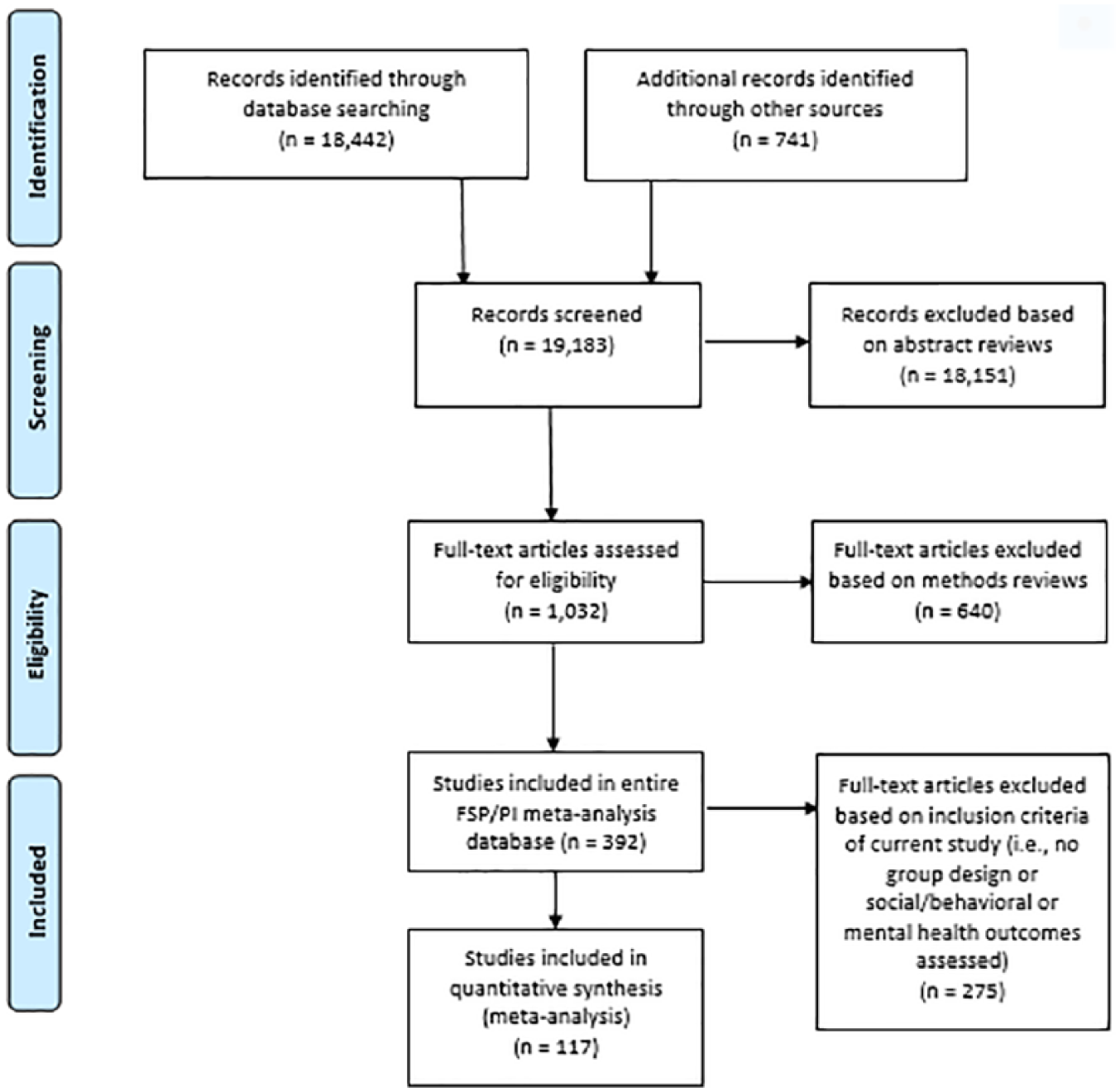
Flowchart of the search and screening process.
A total of 715 abstracts were retained, and their methods sections were reviewed to determine their fit, based on five criteria. Failure to meet any of the following criteria resulted in exclusion from the meta-analysis:
The study presented the results of an intervention focused on parental involvement (i.e., the participation of significant caregivers, including parents, grandparents, stepparents, foster parents, etc.) in the educational process of their children to promote their academic and social well-being (Fishel & Ramirez, 2005) or family-school partnerships (i.e., child-focused approaches wherein families and professionals cooperate, coordinate, and collaborate to enhance opportunities and success for children and adolescents across social, emotional, behavioral, and academic domains; Christenson & Sheridan, 2001). Studies focused on family therapy or parent training that took place outside the school setting were excluded.
The study involved students from preschool through Grade 12.
The study presented outcomes (i.e., it measured the effects of parent involvement or family-school partnership interventions on children’s academic [learning], behavioral, or social-emotional functioning).
The study presented the results of a parent involvement or family-school partnership intervention that was implemented to improve student performance. The parent involvement or family-school partnership intervention occurred within the context of a naturalistic setting (not a laboratory or contrived assessment task).
The study used any of the following research designs:
a. An experimental or quasi-experimental design that compared groups receiving one or more parent involvement or family-school partnership interventions with one or more control groups, with both pretest and posttest measures on at least one qualifying outcome variable. b. A pre-/posttest design with measures on at least one relevant outcome using the same participants, including one- and multiple-group designs involving parent involvement and/or family-school partnership interventions (Wilson, Lipsey, & Derzon, 2003).
We included studies of all school-age children (i.e., preschool to 12th grade) and excluded studies of college-age students or children who were too young to receive formal education. Our rationale for including all school-age children was based on previous research demonstrating the effects of family-school engagement across early-childhood and elementary, middle, and high school educational contexts. Furthermore, we excluded studies solely focused on parent training interventions in the home (e.g., parent management training focused on decreasing disruptive child behaviors) and included studies of family-school interventions focused on (a) promoting parental/caregiver practices to support children’s academic functioning and/or (b) collaborative efforts between families and schools to influence child development. Our rationale for excluding studies solely focused on parent behavior management at home was based on our definition of family-school engagement interventions, which required interventions to have some emphasis on children’s educational processes or school contexts. In addition, we included studies quantifiably assessing child and adolescent social-emotional competence (e.g., behavioral regulation, peer relations) and/or mental health outcomes (e.g., self-esteem/self-worth, emotion regulation), in which effect sizes could be derived, and we excluded studies solely focused on academic outcomes. By focusing only on social-behavioral competence and mental health outcomes, the present study is extending beyond previous family-school engagement meta-analyses that have explored primarily children’s academic functioning.
In all, 392 family-school intervention studies were included in the final sample. Of these, 117 provided outcome data for children’s social-emotional outcomes (i.e., social-behavioral competence, mental health) and constituted the sample for the present study. As a point of comparison, other related meta-analyses investigating parent involvement have yielded far fewer studies (i.e., Hill & Tyson, 2009, included 50 studies, and Jeynes, 2003, included 20).
Study Coding
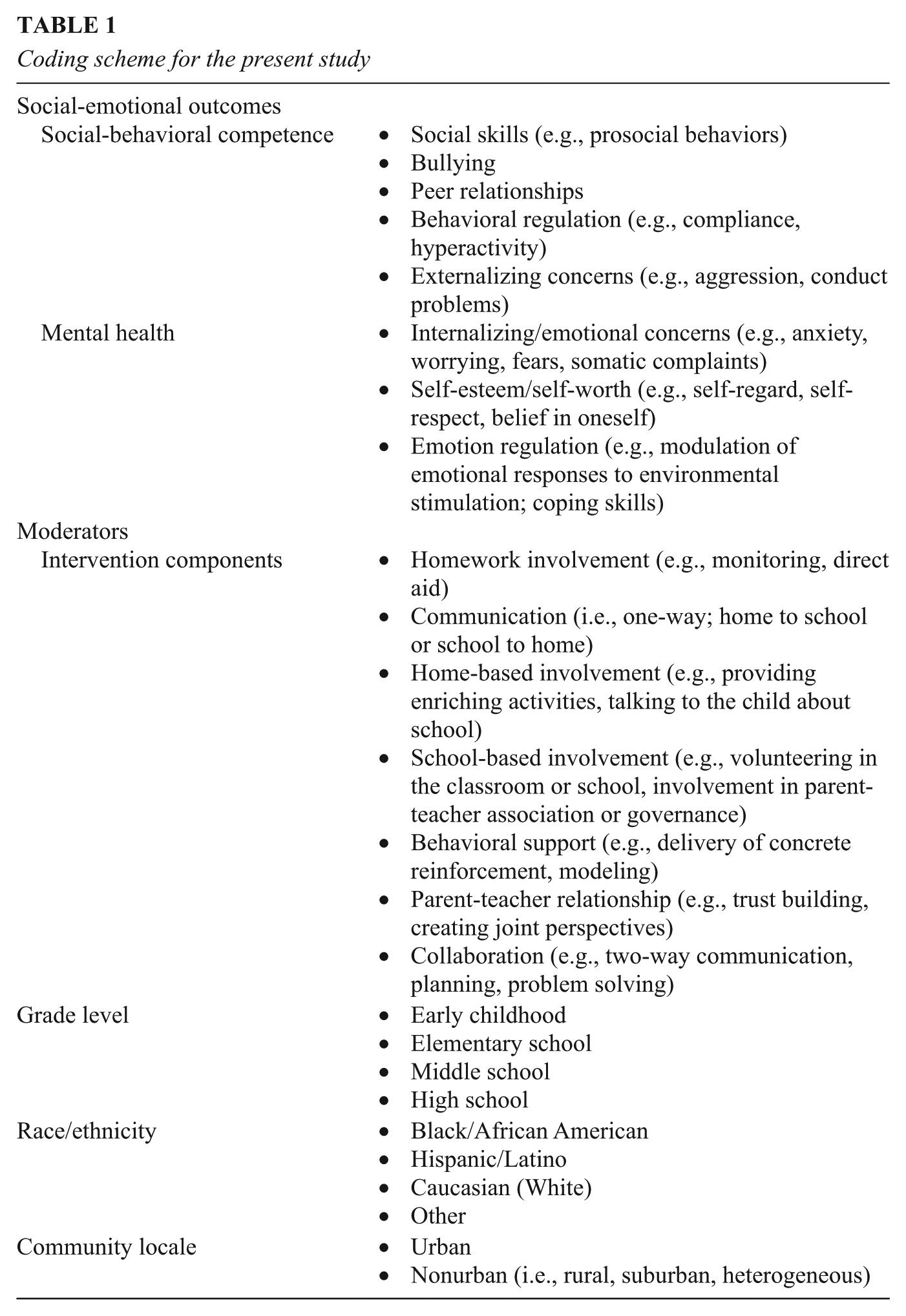
Research assistants with expertise in the area of family-school interventions were trained as coders to extract information pertinent to answering the research questions. The coders met weekly to discuss disagreements and reach a consensus; 15% of the sample was coded by two or more coders. Studies were coded for intervention components (e.g., homework involvement, communication, parent-teacher relationship), social-behavioral competence outcomes (e.g., behavioral regulation, peer relations, externalizing concerns), mental health outcomes (e.g., self-esteem/self-worth, emotion regulation), and sample and setting characteristics (see Table 1 for the coding scheme used in the present study).
Coding scheme for the present study
Interrater reliability across coders was analyzed using Fleiss’s (1971) generalized kappa given its computational utility across number of raters and coded variables. In this study, coding information was gathered using three to six coders across 27 weeks of coding. The Fleiss generalized kappa was 0.610, indicating moderate agreement (Viera & Garrett, 2005). Disagreements most often occurred regarding coding intervention components and outcomes, as our codebook included a range of subcategories within broader categories. The inclusion of subcategories sometimes required the coders to make fine-grained differentiations between similar constructs (e.g., differentiating social skills from peer relationship), which other researchers have also noted to be a common source of coding disagreement (e.g., Campbell, Quincy, Osserman, & Pedersen, 2013; Krippendorff, 2008). These differentiations were especially difficult when studies did not provide definitional clarity, thus leaving some interpretation to the study coders. As per standard practice, each coding difference was discussed by the coders and the project supervisor until a final, consensus-based code was selected.
Data Analysis
We used Hedges’s (1981) bias-corrected standardized mean difference effect size,
In addition to estimating the overall pooled effect size,
For the child race/ethnicity moderator analyses, we used the percentage of the sample in each primary study characterized as Black/African American, Hispanic/Latino/a, Caucasian (White), or Other (as a reference group). Regarding the community locale moderator, two categories were coded (1 = Urban and 0 = Other, defined as suburban, rural, or heterogeneous). 1 Because most of the studies reported information for one or more moderators but typically not all three, we estimated the meta-regression models by testing each moderator individually. In each of these analyses, the moderator variable was grand mean centered, resulting in intercept parameter estimates that could be interpreted as the average effect sizes for a sample with the mean value for the relevant moderator.
We also calculated pooled effect sizes for each of the two outcome types for each type of family-school intervention component, including homework, communication, school-based involvement, home-based involvement, behavioral support, parent-teacher relationship, and collaboration. Because we hypothesized that the intervention components would contribute positively to student outcomes, we used one-tailed tests to determine the statistical significance of the effects. This decision was made because using two-tailed hypothesis tests would only test for effects, including both positive and negative results as “effects.” Thus, we matched the direction of our test statistic (one-tailed positive) with our one-tailed, positive effect hypothesis. This maintains the Type I error rate for the hypothesis of interest (a positive effect). Selection of a one-tailed hypothesis test decreases power if the true effect is null or negative and increases power for the test of our one-tailed hypothesis of interest.
Last, some interventions included the use of multiple components. Thus, there were overlaps in the effect sizes used when we calculated the pooled effect for each component.
Results
Overview of the Studies and General Outcomes
A complete overview of the characteristics of each study included in the current meta-analysis is provided in Supplemental Table S1 (in the online version of this journal). A total of 117 studies were included in our final sample. Of these 117 studies, 36 (30%) assessed mental health outcomes, 114 (97%) assessed social-behavioral competence outcomes, and 32 (27%) assessed both mental health and social-behavioral competence outcomes. The overwhelming majority of the studies (93%) were empirical journal articles. Seven studies (6%) were dissertations/theses, and one study (<1%) came from a book chapter. Approximately 45% of the studies did not report information on community locale. Of the studies reporting community locale, the majority (70%) were conducted in urban settings, followed by 18% in heterogeneous settings, 7% in rural settings, and 5% in suburban settings. Sample sizes included a broad range of child participants (i.e., 12–4,578), with an average of 322.81 per study and a median of 92. Of the studies reporting child grade, approximately 46% included early-childhood populations; 50% included elementary school, 15% included middle school, and 7% included high school populations. Regarding child race/ethnicity, approximately 44% of the studies did not provide sufficient information to be coded. To provide an estimate of child race/ethnicity from the studies reporting sufficient information, the percentages of each race/ethnicity variable were averaged across studies as follows: White (62%), African American (35%), Hispanic/Latino (22%), Asian American (8%), and Native American/Pacific Islander (2%).
The studies included a range of family-school intervention components and social-behavioral competence and mental health outcomes. Regarding family-school intervention components, behavioral support occurred the most frequently (68% of the studies), followed by home-based involvement (35%), collaboration (32%), communication (24%), parent-teacher relationship (15%), school-based involvement (6%), and homework involvement (4%). The mental health outcomes assessed included the following: self-esteem/self-worth (14%), internalizing/emotional concerns (21%), and emotion regulation (6%). Specific social-behavioral competence outcomes assessed included the following: externalizing concerns (39%), social skills (37%), attention regulation (17%), behavior regulation (24%), and peer relations (9%).
Our primary study purpose was to reveal the effects of family-school interventions on children’s social-emotional outcomes. Two types of outcomes were of interest: social-behavioral competence and mental health. For children’s social-behavioral competence outcomes, a total of 511 effect sizes were reported from 114 studies. The pooled random effects estimate of the effect of family-school interventions was statistically significant, with a value of 0.33 (t[105] = 7.07, p < .05). Thus, for this sample of studies, family-school interventions appear to have a significant, positive effect on children’s social-behavioral competence (e.g., prosocial skills, peer relationships, self-regulation, externalizing problems).
For mental health outcomes, there were 81 effect sizes reported in 36 primary studies. The resulting pooled random effects effect size estimate was statistically significant (
Pooled effect size by outcome

Note. n = number of effect size estimates; k = number of studies;
p < .05.
Impact of Child and Community Characteristics
To examine if the effects of family-school interventions on social-emotional functioning for children were moderated by child and community characteristics, mixed-effects meta-regression analyses were conducted for each outcome and moderator (see Table 3). The first moderator of interest was age, wherein we asked whether the effects of family-school interventions on children’s social-behavioral competence and mental health outcomes may depend on the age of the child. Our results suggested that intervention outcomes were not dependent on age for either social-behavioral competence (b = .03, t[26.1] = 0.34, p > .05) or mental health outcomes (b = .06, t[8.7] = 0.75, p > .05). Thus, for this sample of 117 studies, family-school interventions were equally effective for children across early childhood, elementary school, middle school, and high school.
Moderator analyses by outcome and moderator
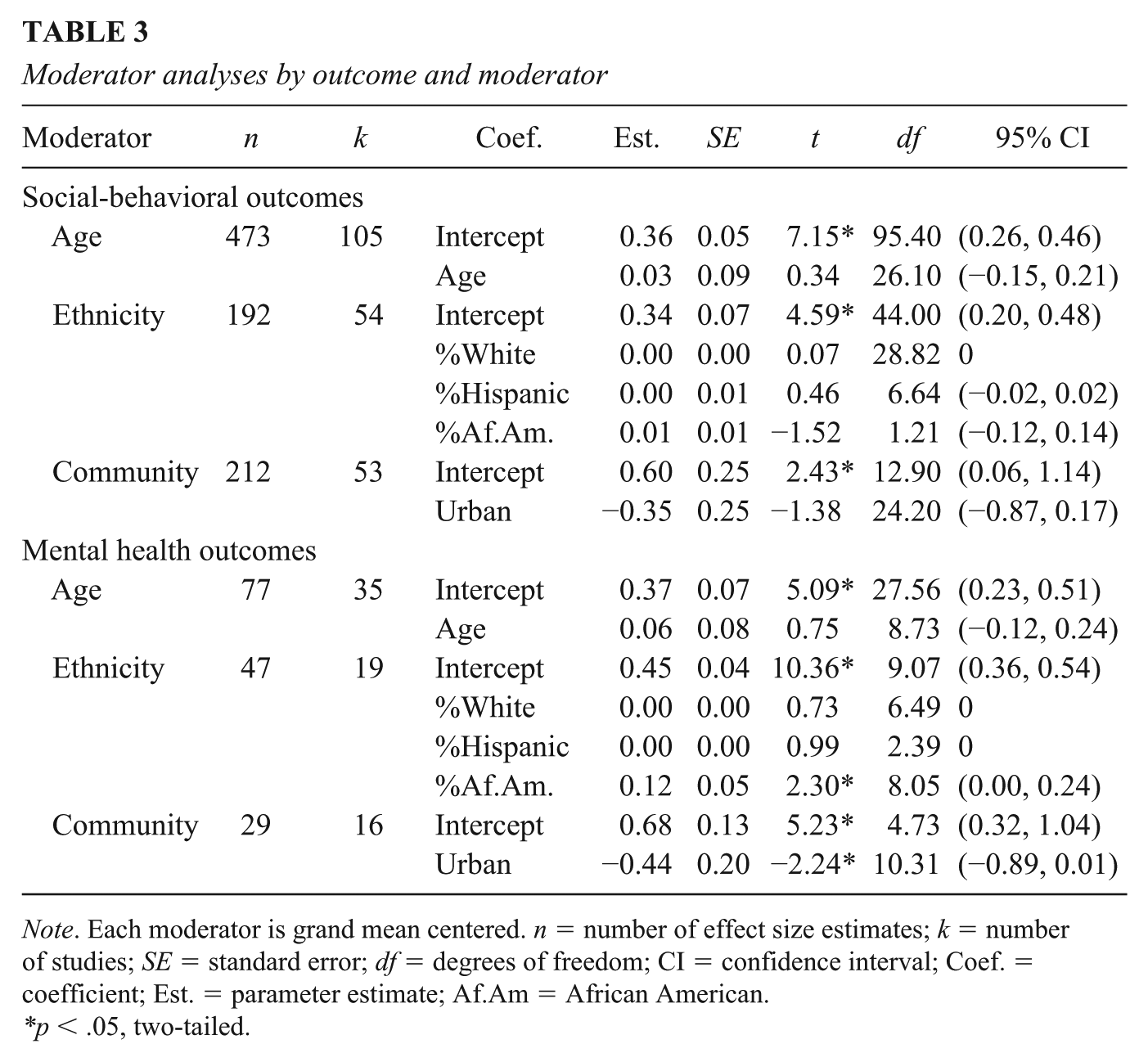
Note. Each moderator is grand mean centered. n = number of effect size estimates; k = number of studies; SE = standard error; df = degrees of freedom; CI = confidence interval; Coef. = coefficient; Est. = parameter estimate; Af.Am = African American.
p < .05, two-tailed.
A second moderator variable of interest was community locale, or the geographic location where the family-school intervention took place. Mixed results were revealed across the types of social-emotional outcomes. Whereas the community variable had no significant impact on family-school interventions’ effects on children’s social-behavioral competence (b = −.35, t[24.2] = −1.38, p > .05), community locale significantly moderated the effects of family-school interventions on children’s mental health (b = −.44, t[10.3] = −2.24, p < .05). Smaller effect sizes were found in urban settings compared with nonurban (rural, suburban, town) locales.
Finally, the degree to which the effects of family-school interventions were moderated by child ethnicity was explored. The effects of family-school interventions on child mental health were moderated by the percentage of the sample who identified as African American (b = .12, t[8.1] = 2.30, p < .05), such that the higher the proportion of African American children in the sample, the larger the effect sizes. The effects of family-school interventions on social-behavioral outcomes did not differ significantly as a function of child race/ethnicity (see Table 3).
Components Analysis
To better understand the relevant intervention components that relate to the effectiveness of family-school interventions, we calculated pooled treatment effects for each family-school partnership intervention component and for each outcome (see Table 4). Note that some interventions entailed combinations of components, and this means that some effect sizes were used to obtain more than one component’s pooled effect. When the adjusted degrees of freedom for the t-test statistic was lower than 4, we used a more stringent alpha level (α = .01 rather than .05) to better control the Type I error rate (Tanner-Smith et al., 2016). Because our hypothesis was directional (i.e., we expected that the intervention components included in family-school intervention studies would contribute positively to student outcomes), we used one-tailed tests when assessing statistical significance.
Pooled effect size by outcome and intervention component
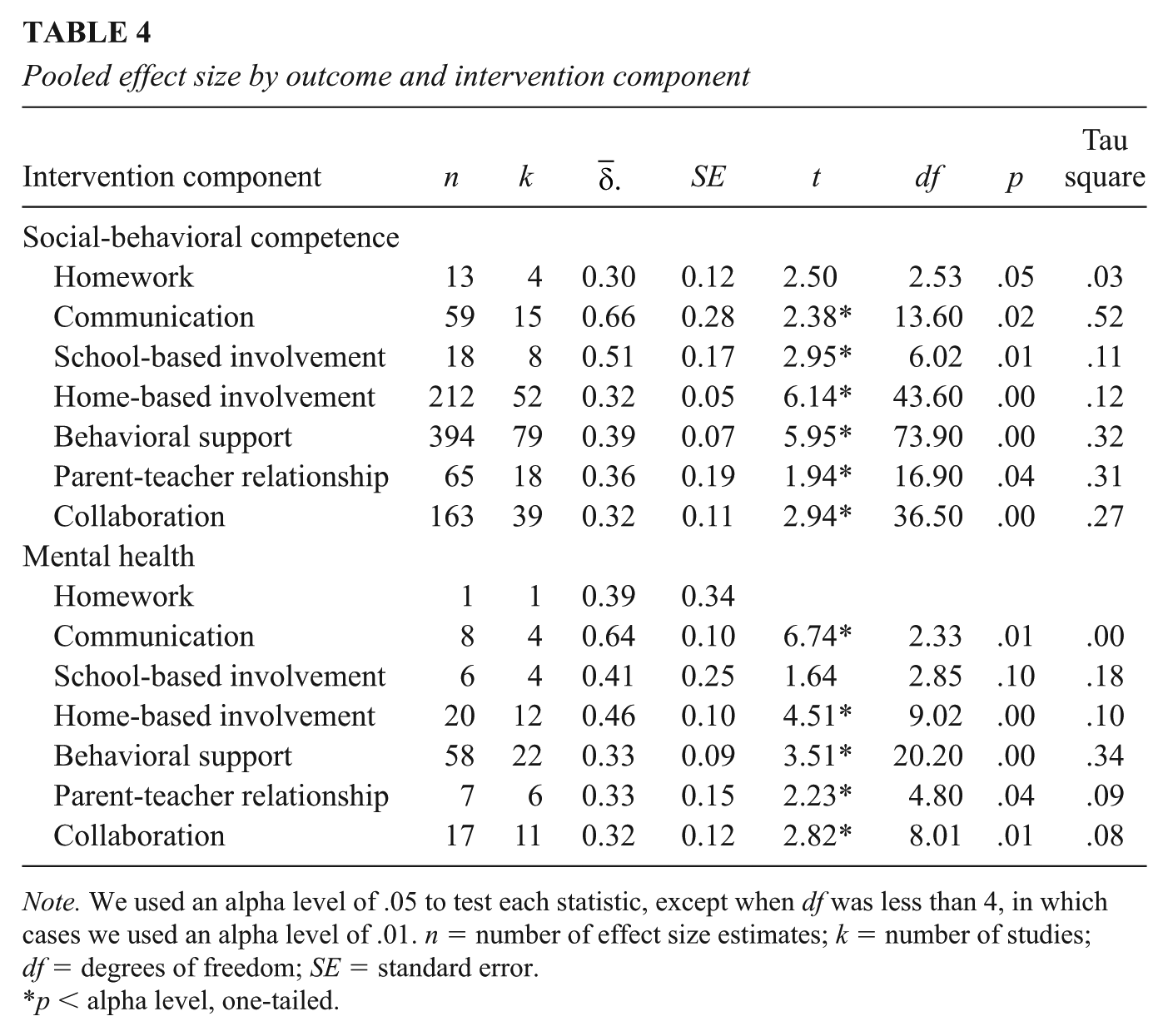
Note. We used an alpha level of .05 to test each statistic, except when df was less than 4, in which cases we used an alpha level of .01. n = number of effect size estimates; k = number of studies;df = degrees of freedom; SE = standard error.
p < alpha level, one-tailed.
The results of the components analysis are given in Table 4. There is great consistency among the components and their relationships to students’ social-behavioral competencies and mental health. Specifically, communication, home-based involvement, behavioral support, parent-teacher relationship, and collaboration were each significantly related to both social-behavioral competence and mental health outcomes. Contrarily, homework support was not significantly related to either of these classes of outcomes. School-based involvement was significantly related to social-behavioral competence only.
Discussion
This study represents perhaps the largest meta-analysis to date in the area of family-school interventions and their effects on children’s development. Whereas other family-school meta-analyses have focused on academic outcomes (e.g., Fan & Chen, 2001; Patall et al., 2008), this study is novel in its attention to social-behavioral outcomes. With a total sample size of 117 intervention studies and 592 effect sizes constituting our database, we are confident that this meta-analysis is comprehensive and representative of research in this area. Furthermore, the thorough selection process, systematic coding procedures, and rigorous analytic approach support our findings as reliable and conclusive.
Taken as a whole, the results of this study indicate that family-school interventions enhance children’s social-behavioral competence and mental health. These affective and adaptive skill sets are requisite for a host of important life outcomes, including school completion and positive interpersonal relationships. Children’s displays of competent forms of social behavior (e.g., engaging in prosocial behaviors, refraining from disruptive and antisocial forms of behavior) are positively related to peer acceptance, achievement motivation, and academic success (Wentzel, 2009). Social-behavioral skills enable young students to interact prosocially in social settings, engage adaptively in academic environments, and respond appropriately to teacher instruction; thus, they are widely considered precursors to achievement (DiPerna & Elliott, 2002; Kwon, Kim, & Sheridan, 2012). Furthermore, mental health disorders are the most common health issues faced by our nation’s school-age children; close to one in five children suffer from a mental health or learning disorder, and 80% of chronic mental disorders begin in childhood (Child Mind Institute, 2016). Interventions that involve the myriad adults responsible for children’s positive development (i.e., parents and educators), provide comprehensive support across socializing environments (i.e., home and school), and target social-behavioral and mental health outcomes are efficacious for bolstering children’s long-term competencies.
Understanding Nuanced Effects: For Whom and in What Contexts Are Family-School Interventions Effective?
As in most research dealing with field-based problems, context matters when it comes to determining the efficacy of family-school interventions. In the present study we explored characteristics of the child (age, race/ethnicity) and community (urban/nonurban locale) to begin to understand the conditions that may influence interventions’ effects. Our findings were mixed. First, addressing the need to discern how interventions may work differently for children at various developmental levels (Hill, 2016), we assessed the degree to which a child’s age might moderate the effects of family-school interventions. Discussions in the literature consistently posit that it is increasingly difficult for parents to demonstrate active involvement as their children get older. But although it might be expected that family-school interventions may be differentially relevant or effective for addressing social-behavioral competencies or mental health across developmental periods (e.g., early childhood, adolescence), that was not the case in our large sample of studies. That is, family-school interventions were effective whether a study’s sample was composed of children in preschool, elementary school, or high school. We chose to include studies that defined family-school intervention using both traditional methods for involving parents (e.g., school-to-home communication, school-based conferences, homework support) as well as distinctive approaches for engaging with parents in their child’s learning (e.g., problem solving, setting goals, discussing aspirations), recognizing that some studies found these latter approaches effective for parents of adolescents (Hill, 2016). Although our findings are encouraging at a global level, beyond an examination of the components that were part of intervention programs for students of various ages (see Supplemental Table S1 in the online version of the journal), little is known about the specific intervention components that contributed to positive outcomes for children of distinct ages within our sample and how their features may have influenced outcomes.
Contrary to the general finding of no difference based on children’s age, our analyses revealed that the effect of family-school interventions on children’s mental health was moderated by race/ethnicity, such that the effects were larger for African American students. Disagreements and lack of trust are disproportionately experienced by ethnic minority families, including African Americans (Hill, 2011); some suggest that this is due to certain practices that isolate and alienate families who lack access to traditional means of communication and engagement (Doucet, 2011). Our findings demonstrating significant family-school intervention effects to enhance mental health outcomes for African American students are very encouraging. Coupled with information on intervention components that are significantly related to mental health outcomes (i.e., home-based practices; behavioral supports; and communication, collaboration, and relationships between home and school), our results begin to uncover important methods that may be beneficial for African American families. More research is needed to discern with greater precision family-school practices that are uniquely efficacious for diverse families.
A third context variable investigated in this study is community locale and its influence on family-school intervention effects in the social-behavioral and mental health realms. Research is beginning to isolate differences in experiences and outcomes for children’s learning and behavior as a function of growing up in rural or urban settings, and we sought to reveal whether influences more distal to the child and the immediate home-school environment (i.e., community locale) determine the efficacy of family-school interventions. Our finding that mental health effects were smaller in urban settings relative to nonurban (e.g., rural) is not surprising; the increased social capital gained when families and schools jointly provide support to students may be more pronounced when fewer services are available, as is the case in rural communities. By definition, rural schools and communities are isolated, and access to specialized mental health services and providers is limited relative to urban settings (Holmes, Witte, & Sheridan, 2017). Thus, creating novel opportunities to improve and increase access to services (i.e., through joint family and school supports) represents a method for decreasing the barriers of isolation and limited resources notable in many rural communities.
Unpacking the Components of Effective Interventions
A challenge in the family-school intervention literature is ambiguity or lack of specificity about the construct itself (Sheridan, Holmes, Smith, & Moen, 2016). That is, much of the research has explored the efficacy of family involvement, partnership, or a similar term without operationalizing what the intervention entailed. Often interventions are implemented and tested as a package composed of numerous elements or components. This study sought to reveal the various components that represent family-school interventions and begin the process of empirically deriving the operative features of partnership interventions.
As a first step in determining the active ingredients of family-school interventions responsible for social-behavioral competence and mental health outcomes, we generated effect sizes for seven individual components of interventions described in the literature. The results of the components analysis support the metamodel of family-school intervention proposed by Kim and Sheridan (2015), which highlights the critical role of both relational and structural features in effective family-school interventions. Specifically, some elements appeared universal in supporting children’s social-behavioral skills and mental health; that is, they were significant elements of family-school interventions for all of the social-behavioral and mental health outcomes assessed. The elements that are generally instrumental in driving outcomes represent both interpersonal, relational processes (i.e., communication, collaboration, parent-teacher relationship) and tangible, structural elements (i.e., home-based involvement, behavioral supports). Relational elements invite parents to contribute in meaningful, relevant ways aligned with their values and perspectives; structural components provide tools and techniques for parents regarding what they can do to support their child’s behavioral development.
Relationally, efforts to increase home-school interactions and improve parent-teacher relationships minimize borders and enhance continuities for students (Phelan, Davidson, & Yu, 1998). Communication and collaboration represent opportunities for information sharing and joint responsibility (collaborative planning and problem solving) for student outcomes. It should be noted that for both social-behavioral competencies and mental health outcomes, communication (school to home or home to school) yielded the highest effect sizes (.66 and .64, respectively) relative to the other components, highlighting the significance of meaningful information sharing between home and school (e.g., through home-school notes, email, or text correspondence) for children’s positive social and mental health functioning. Unfortunately, little else is known about the communication interventions used by researchers and whether they differentially affect student outcomes. Unpacking this construct more fully would help elucidate the role of the unique communication strategies represented in family-school interventions. An independent study of communication as a complex and multidimensional construct would provide clarity on what works and allow for more prescriptive practice recommendations.
Structurally, home-based involvement and behavioral supports yielded significant effects on social-behavioral and mental health outcomes. Whereas home-based learning environments (e.g., family literacy activities) have been shown to be effective at improving academic outcomes (e.g., Kim & Quinn, 2013; van Steensel, McElvany, Kurvers, & Herppich, 2011), this is the first study to demonstrate systematically the broad benefits of home-based involvement for children’s social-emotional outcomes. In this vein, home-based involvement includes methods for bolstering parenting practices within the home to support children’s social competencies and mental health. Similarly, the use of efficacious behavioral supports and strategies (e.g., positive reinforcement, modeling prosocial behaviors) delivered at home and school promotes consistent, cumulative opportunities for developing social-behavioral competencies and mental wellness.
Other elements yielded mixed results (i.e., they appeared significant in supporting some but not all outcomes); others did not appear to be related to any outcomes. Specifically, school-based involvement (e.g., volunteering in classrooms or on school boards) had a significant effect on social-behavioral competence but not mental health. Parents’ participation in school-driven functions (i.e., working in ways to help achieve functional goals at school, e.g., meeting classroom or organizational needs) influenced a smaller set of outcomes but not those associated with mental health challenges. Parental involvement with homework was not significantly related to any social-behavioral or mental health outcomes. Although previous meta-analyses have suggested benefits for academic achievement (Cooper, Robinson, & Patall, 2006), such was not the case when considering social-emotional outcomes. Homework participation—presumably an academically dense task—may be unrelated to outcomes in domains other than academic achievement.
Study Implications
As previously noted, this meta-analysis is the first of its kind to assess the impact of family-school interventions on children’s social-emotional outcomes (social-behavioral competence and mental health). Because of the comprehensive and systematic nature of this meta-analysis, we believe that our findings present an accurate overview of the family-school intervention literature. Thus, our results may have potential implications for families and schools. Overall, our findings support efforts by families and schools, both uniquely and together, and showcase family-school interventions as an effective means of fostering and improving children’s social-emotional and behavioral competencies. Beyond simply demonstrating the positive social-emotional benefits of family-school interventions, our results reveal the importance of both relational (i.e., communication, collaboration, parent-teacher relationship) and structural (i.e., home-based involvement, behavioral support) components. These components can be complementary to previously established interventions and could be foundational to the development of new family-school interventions.
Within schools, our findings can make important contributions at the schoolwide, classroom, and individual levels. For example, schools can create greater opportunities for two-way communication and collaboration by offering meetings in which families are allowed to visit their children’s schools and agree on strategies to support children across home and school. At the individual level, teachers and parents may come together to collaboratively plan and problem solve for a child with behavioral and/or social-emotional concerns. Strategies that promote home-based involvement and articulate tactics supporting prosocial behaviors across home and school can be derived in the context of collaborative problem-solving meetings.
Although family-school interventions are key at various school levels, many school personnel are unprepared and lack the skills necessary for successful collaboration (Epstein & Sanders, 2006; Weiss, Lopez, Kreider, & Chatman-Nelson, 2014). When trained in family engagement, teachers are likely to have improved practices, knowledge, and attitudes toward working and collaborating with families (Smith & Sheridan, in press). Thus, future teacher education courses, in-services, and training programs can incorporate effective family-school communication and collaboration strategies as revealed in the current study.
For families, our results indicate that parents’ home-based involvement and behavioral support practices have meaningful impacts on children’s social-emotional outcomes. It is important for parents to recognize this and be aware of and engage in specific practices that can improve children’s outcomes across home and school. Furthermore, the results can be used to improve the efficiency and efficacy of parent support programs. Specifically, programs might provide parents with basic behavioral skills (e.g., positive reinforcement), emphasize the importance of home-based involvement, and outline activities parents can do to collaborate with their child’s teachers.
Our results have implications for family-school interventions as they are implemented across developmental stages. Although family-school practices tend to decline as children get older (Hill & Tyson, 2009; Singh et al., 1995), our findings highlight the continuous and consistent benefits of family-school interventions across child development. The majority of family-school programming and policies have been shaped by elementary schools. Moving forward, more efforts may be made to extend family-school interventions to middle and high schools. These intentional actions seem particularly fruitful in improving the mental health outcomes of African American students and are encouraging given the dearth of studies finding effective methods for creating connections with families from diverse backgrounds. Finally, developing and implementing family-school interventions in nonurban schools to promote positive mental health outcomes are warranted. The importance of this finding cannot be overstated; rural schools are typically described as tight-knit and community oriented but lacking in specialized resources to support the increasing mental health needs therein. Our finding uncovering the significance of family-school interventions for improving mental health outcomes in nonurban relative to urban settings capitalizes on the strengths of rural communities in an area in dire need of support.
It is important to note that the practical meaning of the findings in this meta-analysis is bound by the normative standard associated with each outcome. The positive effect sizes denoted in relationship to social-behavioral outcomes and intervention components reflect the average effects of interventions across an average set of conditions. As in any study, significance (denoted by p values and effect sizes) does not equate to clinical or practical significance. It is not possible to know how individual participants in the intervention studies actually fared as a function of their involvement. For example, although treatment group participants generally made statistically significant improvements relative to a control group, whether those improvements resulted in meaningful changes in social-emotional functioning (e.g., removal of skill deficits or depressive symptoms) is not known. Readers are encouraged to use caution when drawing broad conclusions about the current findings.
Limitations and Future Research
Despite the important findings and implications of the present study, certain limitations are noteworthy. First, although this study revealed some elements that contribute to social-behavioral and mental health outcomes, it represents just a first step in determining the active ingredients of family-school interventions (Damschroder & Hagedorn, 2011). This research explored the contributions of various intervention components. Very rarely, however, are family-school interventions comprised one component in isolation. Additional research is needed to determine how (in what combination or form) the elements work together (or provide unique support) to produce the desired social-behavioral and mental health outcomes. Such research would facilitate a greater understanding of the critical features of family-school partnerships and empirically inform the implementation of unique and contextualized family-school interventions.
This study revealed certain components and context variables defining efficacious family-school interventions. However, we were unable to explore the specific mechanisms by which family-school interventions mediate children’s social-behavioral competencies and mental health outcomes. Cheung and Pomerantz (2012) found that parents’ involvement was related to adolescents’ achievement through its effect on adolescents’ motivation and engagement. In randomized controlled intervention studies, Sheridan and colleagues (Sheridan et al., 2012; Sheridan, Witte, Holmes, & Coutts, 2017; Sheridan, Witte, Holmes, & Hu, 2017) reported that the quality of the parent-teacher relationship mediated the effect of a family-school partnership intervention on students’ social-behavioral outcomes. However, there are likely unmeasured constructs additionally playing a role in the pathway between family-school interventions and student outcomes; meta-analyses of large-scale longitudinal studies may be useful in exploring the effects of a range of variables simultaneously.
In practice, family-school interventions often take place in the context of broader school structures and programs that may influence their uptake, implementation, and outcomes. For example, some family-school interventions in our sample may be occurring in the context of systemwide (universal) practices to support positive behavior or academic success; these are likely executed in a generalized way in schools with the infrastructure to support them. Other studies in our meta-analysis may have explored family-school interventions implemented in a targeted way to address unique issues associated with individual students meeting certain enrollment criteria or demonstrating specific challenges. These variations may influence family engagement, student outcomes, and a host of other factors of interest. Our coding framework did not include systemic variables such as schoolwide policies and practices. Future meta-analyses may explore these and other systemic issues to uncover their impact on the outcomes of programs and program components.
Finally, this meta-analysis included studies using group designs only. A number of studies utilizing experimental and quasi-experimental small-N designs have examined the efficacy of family-school interventions on student functioning, but they are not included here. In addition, the rigor and quality of the group designs included in the present study have not been taken into account, which may have influenced the collective meta-analytic findings. Another important limitation has to do with our decision to test multiple simple meta-regression models when assessing each moderator variable’s influence on an intervention’s effect. Unfortunately, the available code that facilitates implementation of RVE uses listwise deletion for handling missing moderator values. Given the extent and pattern of the missing moderator variables’ values, if we had used listwise deletion, analyses of the resulting meta-analytic database would have had substantially less power. However, estimating a set of simple meta-regression models ignores the relationships among the single moderators in each model and thus does not allow assessment of the unique contributions of moderators to the explanation of treatment effects. Thus, we compromised and erred on the side of using RVE for handling within-study dependence in the effect sizes owing to its optimally performing robust standard errors rather than reduce our power. Future methodological research is needed to provide improved methods for handling missing moderator variables for testing meta-regression models with within-study dependence.
Future meta-analytic work is needed to synthesize the effects of family-school interventions conducted at the single-case level, also accounting for the quality of the study design.
Conclusions
The purpose of this study was to systematically analyze the impact of family-school interventions on children’s social-emotional functioning (i.e., social-behavioral competence and mental health). After the abstracts and method sections of studies were reviewed by trained research assistants, 117 family-school intervention group-design studies yielding 592 effect sizes were retained for our final sample. The studies were coded by our research assistants for intervention components (e.g., homework involvement, behavioral support, communication, collaboration), child outcomes (i.e., social-behavioral competence and mental health), child grade level, child race/ethnicity, and community locale. The results revealed that family-school interventions had a significant positive impact on children’s social-behavioral competence and mental health. Key family-school intervention components representing both relational processes and structural practices were identified. The results of the component analyses may be used to inform family-school interventions, school personnel training, and parent practices. The effects were not moderated by grade, indicating that family-school interventions improved children’s social-emotional competencies regardless of age. Intervention effects were found to be more effective for improving mental health outcomes among African American students (in comparison with other races/ethnicities) and students in nonurban (rural/suburban) locales (in comparison with urban areas). Several study limitations were noted and should be considered when interpreting the study results. Additional research is needed to determine how (in what combination or form) family-school interventions work together (or provide unique support) to produce the desired social-behavioral competencies and mental health outcomes. Furthermore, future meta-analytic work is needed to synthesize the effects of family-school interventions conducted at the single-case level, taking into account the quality of the study design more broadly.
Supplemental Material
DS_10.3102_0034654318825437 – Supplemental material for A Meta-Analysis of Family-School Interventions and Children’s Social-Emotional Functioning: Moderators and Components of Efficacy
Supplemental material, DS_10.3102_0034654318825437 for A Meta-Analysis of Family-School Interventions and Children’s Social-Emotional Functioning: Moderators and Components of Efficacy by Susan M. Sheridan, Tyler E. Smith, Elizabeth Moorman Kim, S. Natasha Beretvas and Sunyoung Park in Review of Educational Research
Footnotes
Notes

Authors
References
Supplementary Material
Please find the following supplemental material available below.
For Open Access articles published under a Creative Commons License, all supplemental material carries the same license as the article it is associated with.
For non-Open Access articles published, all supplemental material carries a non-exclusive license, and permission requests for re-use of supplemental material or any part of supplemental material shall be sent directly to the copyright owner as specified in the copyright notice associated with the article.
