



Abstract
Considerable research has examined the positive educational experiences of students of color assigned to teachers of the same race or ethnicity. Underlying this research is the belief that the cultural fit between students and teachers has the potential to improve a child’s academic and nonacademic performance in school. This comprehensive review examines the extent to which Black and Latino/a students (1) receive more favorable ratings of classroom behavior and academic performance, (2) score higher on standardized tests, and (3) have more positive behavioral outcomes when assigned to a teacher of the same race/ethnicity. Assignment to a same-race teacher is associated with more favorable teacher ratings, although the relationship differs by school level. There is fairly strong evidence that Black students score higher on achievement tests when assigned to a Black teacher. Less consistent evidence is found for Latino/a students.
Keywords
For schools to narrow racial and ethnic opportunity and achievement gaps, policies and practices must be found that benefit children from traditionally underserved racial and ethnic groups. One such practice that has received considerable attention over the past two decades is the assignment of students to a teacher of the same race or ethnicity (Dee, 2004; Ladson-Billings, 1994; Milner, 2006). The potential for student–teacher racial/ethnic matching to improve students’ opportunities to learn and reduce achievement disparities is rooted in the critical role that teachers play in their students’ cognitive and behavioral development (Blazer & Kraft, 2017; Borghans, Duckworth, Heckman, & ter Weel, 2008; Jackson, 2018; Kraft, 2019; Rockoff, 2004). For instance, drawing on experimental data from the Measures of Effective Teaching project, Kraft (2019) shows that teachers have both an impact on standardized tests and competencies such as growth mind-set, perseverance, and effort in class. For students from traditionally underserved racial and ethnic groups, assignment to a teacher of the same race or ethnicity may further improve students’ opportunities to learn (Milner, 2011). With a same-race teacher, a student may experience higher expectations, a more supportive relationship, culturally relevant instruction, or role-modeling, all of which can improve their academic and nonacademic performance in school (Irvine, 1989; Ladson-Billings, 1994; Luke, 2017; Milner, 2011).
Possible benefits of student–teacher racial/ethnic matching stand out given that Black and Latino/a students are assigned to teachers of the same racial or ethnic identity at low rates. Data from the 2013 National Assessment of Educational Progress show that 91% of White fourth-grade students were taught by a White teacher, while only 23% of Black students were taught by a Black teacher and 20% of Latino/a students were taught by a Latino/a teacher (Yarnell & Bohrnstedt, 2018). At the same time, Latino/a and Black teachers are concentrated in schools where at least three fourths of students identify as racial or ethnic minorities (Yarnell & Bohrnstedt, 2018). A consequence of the racial segregation of teachers is that many Black and Latino/a students are never taught by a teacher of the same race or ethnicity. Longitudinal data from North Carolina show that 56% of Black elementary school students were never assigned to a Black teacher (Gershenson, Hart, Lindsay, & Papageorge, 2017).
While these descriptive differences are stark, they are important for this study insofar as they point to a school environment whereby teachers are tasked with the instruction of an increasingly diverse student body (Warikoo & Carter, 2009). As teachers’ expectations about appropriate classroom behavior are informed by their own class-based values and beliefs (i.e., cultural capital; Lareau & Weininger, 2003), these beliefs can shape their perceptions of student behaviors in the classroom. For Black and Latino/a students who face entrenched marginalization and discrimination in schools, assignment to a teacher of another race/ethnicity can result in being perceived as more disruptive in class, a greater chance of being referred to the front office, and a greater chance of receiving exclusionary discipline for the same offenses (Okonofua, Walton, & Eberhardt, 2016; Skiba et al., 2011; Tenenbaum & Ruck, 2007; Wright, Gottfried, & Le, 2017).
Given teachers’ evaluative role over students, teacher racial bias has been of long-term interest to educational researchers. Decades of research show that, on average, all teachers have more negative perceptions of underserved racial and ethnic minorities than White students (Alexander, Entwisle, & Thompson, 1987; Ferguson, 2003; Tenenbaum & Ruck, 2007; Tyson, 2002), perceptions that are linked to the inequitable allocation of classroom and school resources (Ferguson, 2003; Tenenbaum & Ruck, 2007). Compared to Black and Latino/a students, teachers hold more positive expectations of White students, direct more positive speech toward them, and are less likely to make negative referrals (Farkas, 2003; Ready & Wright, 2011; Tenenbaum & Ruck, 2007). While this research clearly shows that the average teacher has more negative perceptions of Black and Latino/a students than White students, it leaves open the question of the ways in which students of color would differentially benefit when assigned to a teacher of their own race or ethnicity. In other words, if racial bias resulted from the underlying prejudices due to racial or ethnic differences between students and their predominantly White teachers, would a teacher of the same racial or ethnic identity as the student have more positive perceptions of the student’s classroom behavior and academic performance?
The purpose of this review is to critically synthesize research on the topic of student–teacher racial/ethnic matching and examine the influence that assignment to a teacher of the same race/ethnicity has on teachers’ ratings of students and a variety of student outcomes. This literature has two main gaps addressed by this review. First, a sizable research base has explored the potential benefits of assignment to a teacher of the same race/ethnicity but has not adequately teased apart racial and ethnic differences, as well as the ways in which gender identity, school level, and region may moderate this relationship. Second, the research to date has given little indication of the specific mechanisms driving the observed effects of a student having a teacher of the same race/ethnicity. Most important, the question remains unresolved of the extent to which the benefits of assignment to a same-race teacher are driven by teachers’ more culturally appropriate interactions with students and families or improved performance of students that results from having a teacher with a shared race or ethnicity (or a combination of the two).
This review is guided by the following question: To what extent is Black and Latino/a students’ assignment to a teacher of the same race/ethnicity associated with improved teacher ratings, increased student achievement, or more positive behavioral outcomes (disciplinary action, gifted and talented assignment, attendance, and school dropout)? This review focuses on Black and Latino/a students, given the disproportionate number of disciplinary referrals and achievement disparities for these groups (Reardon, Cimpian, & Weathers, 2015; Skiba et al., 2011). The review is composed of quantitative studies examining the benefits of students’ assignment to a teacher of the same race or ethnicity. Such an approach requires addressing the question raised most explicitly by Luke (2017), in a recent commentary in the American Educational Research Journal. In a historical context where scholars of color have long recognized the success teachers of color have with students of their own racial or ethnic identity (e.g., Cizek, 1995; King, 1993; Milner, 2006; Walker, 2000), this review synthesizes the quantitative research on this topic and provides a direction for future research.
Before turning to this study’s outline, it is important to discuss the terminology used in this review. First, when student and teacher race and ethnicity are discussed, it is recognized that these are socially constructed categories. An element of students’ socialization within schools, as well as their racial and ethnic identity formation more generally, relates to their teachers’ racial and ethnic identities (DeCuir-Gunby, 2009). An assumption is made that evidence of more positive educational outcomes for students assigned to a co-racial or co-ethnic teacher is attributable to the ways in which students’ and teachers’ racial and ethnic identities interact within the classroom setting in a way that can stave off marginalization and discrimination and promote achievement (Cowen & Garcia, 2008). Yet it is important to emphasize that the quantitative studies in this review focus on average benefits for students with a co-racial or co-ethnic teacher, overlooking any within-group differences (Warikoo & Carter, 2009).
Second, a multitude of terms have been used in the literature to refer to the assignment of students to a teacher of the same race or ethnicity, including co-racial or co-ethnic students and teachers, cultural synchrony, isomorphism, student–teacher racial/ethnic matching, pairing, race-congruence, and symmetry (Blake et al., 2016; Cherng & Halpin, 2016; Takei & Shouse, 2008). Other studies have focused on the mismatch between a student and teachers’ racial/ethnic identity (Dee, 2005; Gershenson, Holt, & Papageorge, 2016; McGrady & Reynolds, 2013), thereby looking at the potentially unfavorable classroom conditions students of color face when assigned to a teacher of another race/ethnicity. While this review includes studies that include both approaches, following Blake et al. (2016), the term student–teacher racial/ethnic matching is used when talking about the benefits to students of having a teacher of the same race or ethnicity. To refer to students and teachers of the same race or ethnicity, the terms same-race and same-ethnicity or co-racial and co-ethnic are used.
The rest of this article is organized as follows. A conceptual framework detailing the mechanisms by which student–teacher matching is expected to benefit students is presented. The process by which studies were identified for this review is then explained. The results are separated into studies that examine the impact of student–teacher matching on (1) teacher ratings of student behavior, (2) teacher ratings of student academic performance, (3) student achievement, and (4) other behavioral outcomes. The conclusion discusses the implications of this review and makes recommendations for future research on this topic.
Conceptual Framework
The central unresolved question in the literature on student–teacher racial/ethnic matching is the degree to which any benefits in student outcomes result from changes in the attitudes or behavior of the co-racial/co-ethnic teacher or student (Ferguson, 2003). When students’ academic or behavioral improvements are attributed to the teacher, the predominant explanation is the potential for a shared cultural understanding between the teacher and the student or the student’s family (Irvine, 1989; Milner, 2006; Quiocho & Rios, 2000). The basis for a shared cultural understanding is that students and teachers may possess cultural values that derive from a particular racial or ethnic community. Importantly, just because a student and teacher identify with the same racial or ethnic group, they do not inherently hold corresponding beliefs or values. For a shared cultural understanding to improve student outcomes, Gay (2000) writes that “knowledge and use of the cultural heritages, experiences, and perspectives of ethnic groups” (p. 205) must alter teachers’ perceptions of their co-racial or co-ethnic students, lead to the adoption of culturally relevant pedagogy, or improve student– and parent–teacher relationships. The students themselves could also be particularly responsive when assigned to a teacher of the same race or ethnicity. That is, regardless of improved pedagogy or relationships from the co-racial or co-ethnic teacher, a student may feel more engaged with the teacher, adjusting their effort, attitudes, or behavior (Grissom, Kern, & Rodriguez, 2015). A teacher’s influence extends outside the classroom when they have an organizational influence by advocating for changes to school policies or practices in a way that improves the learning opportunities for students of the same race or ethnicity. These three mechanisms related to student–teacher racial ethnic matching—shared cultural understanding, student responsiveness, and organizational influence—and their hypothesized relationship with various student outcomes are described in turn.
Shared Cultural Understanding
Students have the potential to benefit from assignment to a teacher of their own race to the extent to which students and teachers share similar beliefs about what it means to identify with a particular racial or ethnic group, and these beliefs are translated into higher expectations for student learning, improved teaching, and stronger relationships with students (Gay, 2000). As was noted above, shared racial or ethnic group membership does not necessitate that students and teachers will hold corresponding beliefs or values. This issue is particularly salient for Latino/a students and teachers, where differences in nationality or immigrant generation can hinder the formation of a shared cultural understanding. Sociohistorical patterns can also shape the ways in which students and teachers develop a shared cultural understanding. The history of racism and discrimination in the southern United States may result in similar conceptions about what it means to identify as Black, thereby improving the efficacy of student–teacher racial matching on student outcomes compared to other regions in the county.
Teachers’ perceptions of their students have long been considered an important precursor to a range of educational opportunities, including assignment to school services (e.g., special education and gifted programs), higher ability grouping, and grade promotion (Ford, 1998; Ready & Wright, 2011). When a student and teacher share cultural values rooted in their racial or ethnic group, there is the possibility that the teacher will offer a more fair appraisal of the students’ classroom behavior or academic performance than teachers lacking this shared cultural understanding (Weinstein, Tomlinson-Clarke, & Curran, 2004). As a result, classroom opportunities to learn become available to the student, and they may also be more likely to receive other school services. It is important to emphasize that these hypothesized benefits are in contrast to Black and Latino/a students’ normative classroom experience that is often defined by White teachers’ conscious and unconscious racial stereotyping of classroom behavior (Gregory & Mosely, 2004). As an example, Okonofua and Eberhardt (2015) show that teachers’ negative racial stereotypes of Black students resulted in elevated disciplinary infractions as opposed to White students, even when the student behaves similarly. These findings suggest that assignment to a teacher of the same race or ethnicity may be associated with less negative perceptions of misbehavior in the classroom, perceptions that might be linked to reduced office referrals for Black and Latino/a students. While teacher perceptions can influence a range of behavioral and academic outcomes, the strongest evidence for this component of a shared cultural understanding would come from evidence of an association between student–teacher racial/ethnic matching and teachers’ subjective ratings of students’ classroom behavior or academic ability.
Teachers’ cultural understanding of students can extend to their instructional decisions. While any teacher has the potential to adopt culturally relevant pedagogy (Aronson & Laughter, 2016; Young, 2010), teachers of color often have a greater awareness of the “cultural referents” that can assist in teaching knowledge, skills, and attitudes (Ladson-Billings, 1994, p. 18). With a greater understanding of the social and cultural backgrounds of their students, teachers of color can make connections between students’ identities and course material. This cultural understanding can shape all instructional decisions for which a teacher oversees, including the relevance of the curriculum and the evaluation of students. Awareness of student knowledge could lead a teacher to develop a diverse array of performance-based assessments that address the complexity of student learning, alongside standardized assessments (Lee, 1998). With unbiased beliefs about a child, a teacher may more effectively cater instruction to these students, differentially benefitting them in the process. Notably, this approach does not imply teacher partiality, this is, favoritism toward one group of students over another but rather an inclusive instructional approach. The improved connectedness with students requires valuing each child’s importance and working to develop commonalities (Ladson-Billings, 1994, 1995).
Alternatively, a teacher may demonstrate partiality, whereby their behavior offers a direct benefit to students of their own race (Grissom et al., 2015; Lim, 2006). Examples of partiality include time spent in (and out) of the classroom with certain students, who is called on to respond to questions, and who is praised. There is debate in the literature regarding the appropriateness of teacher partiality, depending on the degree to which scholars approach partiality as an issue of equality or equity. Political scientists have approached this topic from the lens of bureaucratic representation, that is, the notion that governmental services are delivered more fairly when the demographic composition of employees matches that of the client population (Lim, 2006). Even if preferential treatment regarding the allocation of school resources is meant to equalize prior discrimination faced by students, political scientists have raised questions about teacher bias and neutrality directed toward other students (Grissom et al., 2015). In contrast, a critical race perspective emphasizes the fundamental role that co-racial or co-ethnic teachers can play in countering the structural racism faced by Black and Latino/a students. Teacher partiality may be necessary to counter the history of racialization and racism in efforts to equalize student opportunities and outcomes (Kohli, Pizzaro, & Nevárez, 2017). As culturally relevant pedagogy or partiality are hypothesized to have the most immediate impact on students’ academic success, the strongest evidence for this mechanism would be a strong relationship between student–teacher racial/ethnic matching and student achievement, as opposed to subjective teacher ratings or other behavioral outcomes.
Shared values between students and teachers may also facilitate the formation of supportive student–teacher relationships (Decker, Dona, & Christenson, 2007; Hamre & Pianta, 2006). Students of color are less likely than White students to report the presence of supportive relationships in schools (Saft & Pianta, 2001). For instance, Crosnoe, Johnson, and Elder (2004) show that Black male students felt less teacher bonding once the percentage of White teachers in a school increased. Saft and Pianta (2001) find teachers to report more positive relationships with students when of the same race/ethnicity. Results from recent meta-analyses indicate that more supportive student–teacher relationships are correlated with academic outcomes as well as greater attachment to school (Cornelius-White, 2007; Roorda, Koomen, Spilt, & Oort, 2011). Supportive teacher–student relationships could also buffer students from exclusionary school discipline or other school practices such as grade retention or referral to special education (Decker et al., 2007). While there is a hypothesized relationship between student–teacher relationships and academic and social outcomes, evidence of the presence of this mechanism would be supported by students’ demonstration of more prosocial behaviors, fewer classroom disruptions, and, ultimately, fewer disciplinary referrals.
Student assignment to a teacher of their own race or ethnicity may also lead to improved relationships with parents/guardians. Increased parental involvement has the potential to improve communication between the parent and school staff and even influence the child’s receipt of other important school services, including screening for special education or the school’s gifted program (Abrams & Gibbs, 2002; Harackiewicz, Rozek, Hulleman, & Hyde, 2012; Lareau & Horvat, 1999). Previous research suggests that the lack of shared cultural understanding between school staff that tend to be predominantly White and more racially and ethnically diverse families creates sharp disparities in terms of attending school events and volunteering at school between Black, Latino/a, and White families (Noel, Stark, & Redford, 2016). Among children within the same classroom, parent–teacher racial/ethnic mismatch is associated with significantly lower probability the teacher has contact with the parent or the parent attends conferences (Vinopal, 2018). The most salient evidence for this component of shared cultural understanding would be if student–teacher racial/ethnic matching has the largest influence in areas in which parents have an outsized influence, such as screening for gifted services or attendance.
Student Responsiveness
Students can positively respond to a teacher of the same race/ethnicity in a number of ways. First, students can internalize high expectations communicated by a teacher of the same race/ethnicity, modifying their own expectations and behaviors in efforts to reach the expectations set by the teacher (Brophy & Good, 1970; Clewell & Villegas, 1998; Ferguson, 2003). This occurrence is often characterized as the positive effect that role modeling has on students’ improved engagement in their education. In Cherng and Halpin’s (2016) analysis of data from the Measures of Effective Teaching study, Black students reported feeling more motivated, feeling more engaged with course material, and having a stronger relationship when assigned to a Black teacher compared to a White teacher.
Second, a child may identify with their racial or ethnic group in more positive ways when taught by a teacher of the same race/ethnicity, making the student less susceptible to stereotype threat (Steele & Aronson, 1995). Stereotype threat is the theory that students from nondominant groups face stresses linked to the identification with negative stereotypes related to their race/ethnicity (Steele, 1997; Steele & Aronson, 1995). When activated, the stress associated with fulfilling negative group stereotypes can cripple students’ classroom performance (Steele & Aronson, 1995; Walton & Spencer, 2009). Such stresses can also lead students to disengage from educational environments or even develop an oppositional outlook (Ogbu, 2003; Steele, 1997). Being in a classroom with a teacher of the same race may deter this adverse psychological process in two ways. Students may not face the same self-evaluative pressures as they would be less concerned with being judged as conforming to negative group stereotypes. The presence of a same-race teacher who has overcome racial barriers might also lead a student to discount negative group stereotypes and even adopt a self-affirming attitude.
Third, students may feel more comfortable reaching out to teachers whom they feel better understand them or their learning needs, possibly as a result of a shared cultural values and beliefs (Kozlowski, 2015). This help-seeking behavior could allow the teacher to more effectively support students’ learning needs. Notably, the recursive nature of co-racial or co-ethnic student–teacher interactions has made it difficult to identify the different ways in which teachers or students are driving the benefits of demographic matching.
One way to resolve this tension is to describe the instances in which the effect of student–teacher racial/ethnic matching differs across school levels. Research on racial identity development points to sharp divides in elementary and middle school students’ awareness of racial or ethnic categories and responsiveness to racism and discrimination. Even though children are aware of racial or ethnic categories by preschool, young children are less susceptible to negative group stereotypes as secondary school students (Ambady, Shih, Kim, & Pittinsky, 2001). When Black and Latino/a elementary school students face negative racialized perceptions from their teachers, they may be less likely to internalize these attitudes in a way that influences their performance. Consequently, evidence of a large effect of student–teacher matching in elementary school likely results from teacher behaviors that stem from a shared cultural understanding as opposed to student responsiveness.
Somewhat conflicting factors shape Black and Latino/a secondary school students’ responsiveness to a same-race teacher, resulting in a somewhat ambiguous relationship. A developmental perspective suggests that same-race teachers have the potential to serve as valuable role models for Black and Latino/a secondary school students given the heightened exploration and identification with a racial or ethnic identity (DeCuir-Gunby, 2009; Pahl & Way, 2006; Quintana, 2007). Zirkel (2002) argues that adolescents’ identity development is critical in the identification of extrafamilial role models, with co-racial or co-ethnic role models being of particularly importance to Black and Latino/a students’ educational aspirations. By encouraging group identification, student–teacher racial/ethnic matching may also encourage Black and Latino/a students to resist discrimination faced in other areas of their life (Pahl & Way, 2006). Yet the importance of role modeling is likely tempered by weakened student–teacher relationships and high levels of disengagement often experienced by Black and Latino/a students in middle and high school (Benner & Graham, 2009; Fredricks, Parr, Amemiya, Wang, & Brauer, 2019), possibly limiting the degree to which secondary students with same-race teachers adopt pro-academic behaviors.
Changes in the role of student–teacher and parent–teacher relationships throughout a child’s formal schooling might further elevate the role for co-racial or co-ethnic teachers in elementary school, where such relationships tend to be much stronger than in secondary school (Decker et al., 2007; Lynch & Cicchetti, 1997; McQuiggan & Megra, 2017). When assignment to a co-racial or co-ethnic teacher in elementary school facilitates improved student–teacher relationships, it could be particularly valuable for behavioral outcomes, such as reduced disciplinary referrals. If student–teacher racial/ethnic matching in elementary school is also linked with stronger parent–teacher relationships, the influence may extend into additional domains in which parents have an outsized influence, such as attendance or screening for gifted services. In short, stronger evidence of an effect of student–teacher racial/ethnic matching in elementary rather secondary schools would suggest that teachers’ behavior toward students—whether enacted by higher expectations for student learning, the delivery of culturally relevant pedagogy, or improved student–teacher or parent–teacher relationships—would be more influential than student responsiveness.
Organizational Influence
The previously described mechanisms outline direct benefits to students that stem from the assignment to a teacher of the same race or ethnicity as the student. The presence of teachers of the same race might improve student outcomes through changes in school policies or the behavior of other teachers in the school. Milner (2006) describes how Black teachers “often advocate for Black students in spaces where others misunderstand their life experiences, worldviews, and realities” (p. 101). Such advocacy has the potential to change other teachers’ beliefs about students of color or even press to change school policies that disadvantage nondominant groups of students. Changes could include pressuring the instructional staff to adopt restorative justice approaches to school discipline (Weinstein et al., 2004; Welsh & Little, 2018), implementing culturally sensitive curriculum (Ladson-Billings, 2004), or participating in implicit bias training (Warikoo, Sinclair, Fei, & Jacoby-Senghor, 2016). This organizational influence may also be quite passive, in that the presence of Black and Latino/a teachers alters White teachers’ beliefs about their students’ academic capabilities. This influence may also be contingent on a “critical mass” of co-racial or co-ethnic teachers. Grissom, Rodriguez, and Kern (2017) show that a much larger share of Black and Latino/a students participate in their school’s gifted program when at least 20% of the teachers identify with the same racial or ethnic group.
Despite this conceptual basis, there is little evidence indicating the extent to which this organizational influence actually occurs. The few studies that have compared teachers’ direct classroom-level influence with their indirect organizational influence have generally found that the direct influence teachers have on their students overshadows these indirect influences (Nicholson-Crotty, Grissom, Nicholson-Crotty, & Redding, 2016; Vinopal, 2018; Yarnell & Bohrnstedt, 2018). Other work shows that teachers’ beliefs about instruction and instructional practices transfer within groups of teachers, although this research has not specifically shown how teachers’ race or ethnicity moderates this relationship (Sun, Loeb, & Grissom, 2017; Sun, Penuel, Frank, Gallagher, & Youngs, 2013). In addition, a growing research base describes how personal and organizational pressures placed on teachers of color can take a psychological toll (Amos, 2016; Jay, 2009; Pizarro & Kohli, 2018; Quiocho & Rios, 2000). Witnessing racism within the school, feeling ostracized for voicing antiracist beliefs, being expected (or compelled) to support students outside the school day, and requirements to adopt standardized curriculum or pedagogies introduce psychological burden and stress for teachers of color.
Method
Literature Search Strategy
The goal of this review is to understand the relationship between student–teacher racial/ethnic matching and teacher ratings of students and student academic and behavioral outcomes. The following inclusion criteria was used to identify articles for review: (1) published between 1995 and August 2018, (2) available in full text, (3) published in English, (4) published in a peer-reviewed journal or working papers or reports from the grey literature, (5) located in the United States, (6) K–12 setting, and (7) used quantitative data. The review begins in 1995 as it was the year in which Ehrenberg, Goldhaber, and Brewer (1995) published the first study to use matched student–teacher data to examine the individual benefits students face when assigned to a teacher of the same race/ethnicity.
A variety of terms were used to identify studies that have examined this topic. The following terms were combined with a Boolean AND: “racial match,” “ethnic match,” “ethnoracial match,” “demographic match,” “race match,” “race congruence,” “racial congruence,” “cultural synchrony,” “racial interaction,” “racially symmetrical,” “representative bureaucracy,” “bureaucratic representation,” “racial mismatch,” “ethnic mismatch,” “ethnoracial mismatch,” “demographic mismatch,” and “race mismatch.” Additional terms included “same race teacher,” “own race teacher,” “teacher like me,” “student-teacher matching,” “teacher-child ethnic match,” and “teacher-child racial match.” These search terms were entered into four databases: Education Resources Information Center, EbscoHost’s Education Source, ProQuest’s Education Database, and Google Scholar.
Evaluating Study Quality
Studies were screened to ensure that the review was limited to articles pertinent to this study’s research question. In most cases, the title and abstract were reviewed, although there were instances in which the full text of the articles was also examined. Studies were excluded under the following conditions: (1) the dependent variable was not measured at the student level, (2) subjective ratings of students were conducted by someone other than the classroom teacher, (3) student–teacher racial/ethnic matching was not measured at the individual level, or (4) the study did not comply with American Educational Research Association’s standards for reporting social science evidence. This inclusion criteria separates the current study from Driessen’s (2015) review of student–teacher racial/ethnic matching, which included fewer studies, many of which used school-level data. Importantly, by focusing on student-level outcomes, the studies in the current review are able to control for student characteristics that are correlated with both teacher assignment and future academic outcomes.
Figure 1 describes the phases of the search process, the number of articles that were excluded in each phase, and the reasons for exclusion. Five studies were excluded that were not conducted in a K–12 setting (e.g., Saft & Pianta, 2001). Six studies were excluded that did not have a relevant dependent variable. The primary reason for excluding this set of studies was that subjective ratings were made by the student rather than the teacher (e.g., Cherng & Halpin, 2016; Crosnoe et al., 2004). Forty-two studies were excluded that did not explicitly measure student–teacher racial/ethnic matching at the individual level. The predominant reasons for excluding this set of studies was that teacher or student race/ethnicity was aggregated to the school level (e.g., Ehrenberg & Brewer, 1995; Pitts, 2007) or studies looked at teacher perceptions or student outcomes by race, but did not focus explicitly on student–teacher racial/ethnic matching (e.g., Cooc, 2017; Minor, 2014). A separate decision rule was followed for studies that examined student discipline, as only one study of student discipline measured student–teacher racial/ethnic matching at the individual level. For this outcome, studies were included that measured teacher racial composition at the school or grade level, as long as the dependent variable (e.g., office referrals, exclusionary discipline) was measured at the student level. In total, 35 studies were identified through this process. Driessen’s (2015) review, from which this study builds, included two studies that met the inclusion and exclusion criteria but were not identified through the literature search (Clotfelter, Ladd, & Vigdor, 2007, 2010). For comprehensiveness, these studies are included in the review, for a total of 37 studies.
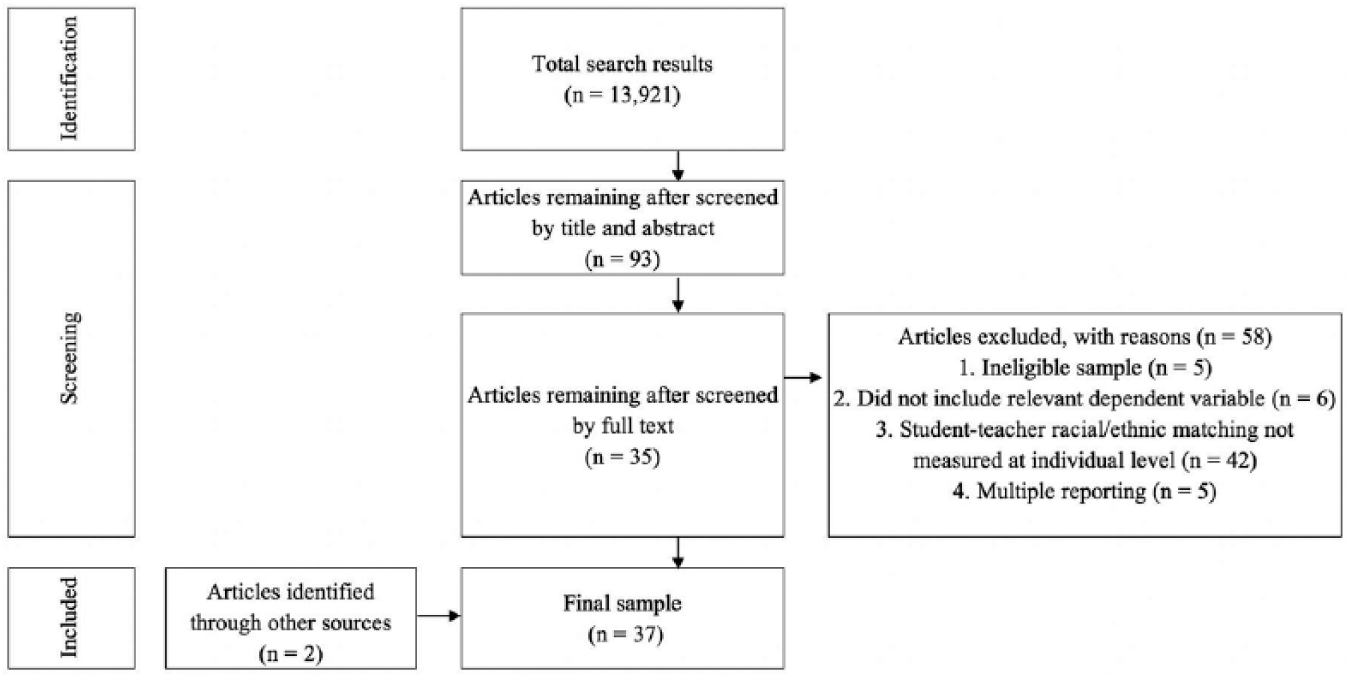
Study selection process for systematic review.
Interpretation and Synthesis
Key features of each study were recorded, including the sample, outcomes, research methodology, and results. Studies were synthesized across the four main outcomes examined in this review: (1) teacher ratings of student behavior, (2) teacher ratings of student academic performance, (3) student test scores, and (4) and other behavioral outcomes. This approach allowed for identification of instances of consistent and discrepant evidence across studies. When synthesizing evidence of the effect of student–teacher racial/ethnic matching on student outcomes, Black and Latino/a students are the focus of the study given the disproportionate number of disciplinary referrals and achievement disparities for these groups and less available evidence for other racial/ethnic groups. Although the studies in this review define Latino/a (or Hispanic) identity broadly, it is important to emphasize that such categorization overlooks important heterogeneity in academic achievement depending on Latino/a students’ national origin and generational status (Reardon et al., 2015).
Supplemental Table A1 (in the online version of the journal) provides a brief summary of the studies examined in this review. Studies are listed chronologically, separated by these four main outcomes. Studies are listed more than once if they examined outcomes across these general categories. In addition to identifying the main effect of student–teacher racial/ethnic matching, the conceptual framework guided the review of the literature to the extent that any of the reviewed studies could speak to the mechanisms driving any observed effects. For instance, when reviewing the effect of student–teacher racial/ethnic matching on student achievement, differences for Black and Latino/a students are considered, as well as any evidence of a moderating relationship with gender identity, school level, and region.
Results
Teacher Ratings of Students
The predominant outcome in studies of student–teacher racial/ethnic matching has been subjective teacher ratings of students’ classroom behavior or academic performance. Teachers’ ratings of their students are most relevant in this review to the extent to which they provide evidence that student–teacher racial/ethnic matching is associated with more positive perceptions of Black and Latino/a students. In the following sections, the review reports how teacher ratings of Black and Latino/a students’ classroom behavior and academic performance differ by racial/ethnic matching. Table 1 summarizes the findings of teacher ratings of student classroom behavior. Table 2 summarizes the findings of teacher ratings of student academic ability.
Overview of studies examining the relationship between student–teacher race/ethnicity matching on teacher ratings of student classroom behavior
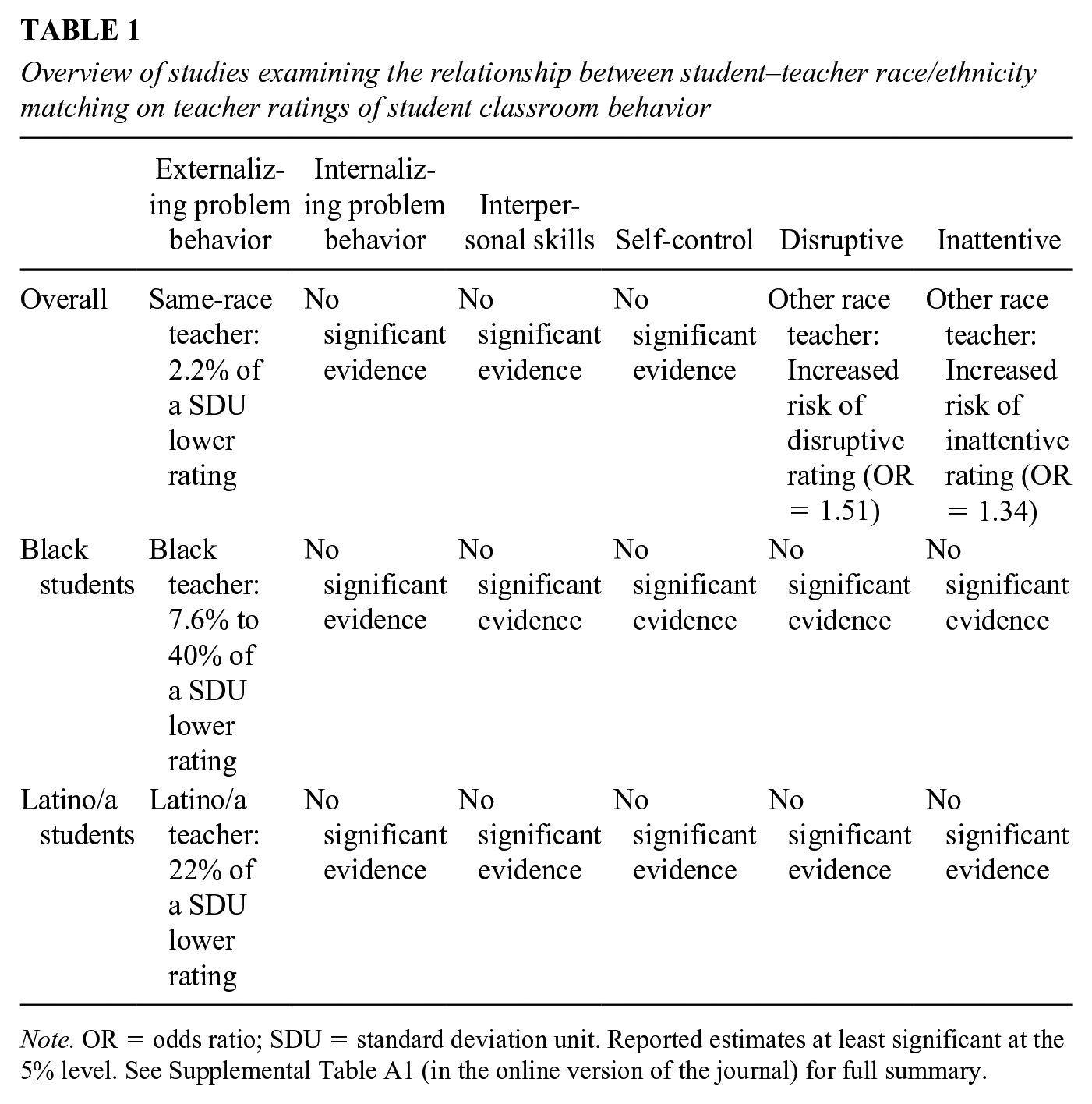
Note. OR = odds ratio; SDU = standard deviation unit. Reported estimates at least significant at the 5% level. See Supplemental Table A1 (in the online version of the journal) for full summary.
Overview of studies examining the relationship between student–teacher race/ethnicity matching on teacher ratings of student academic performance
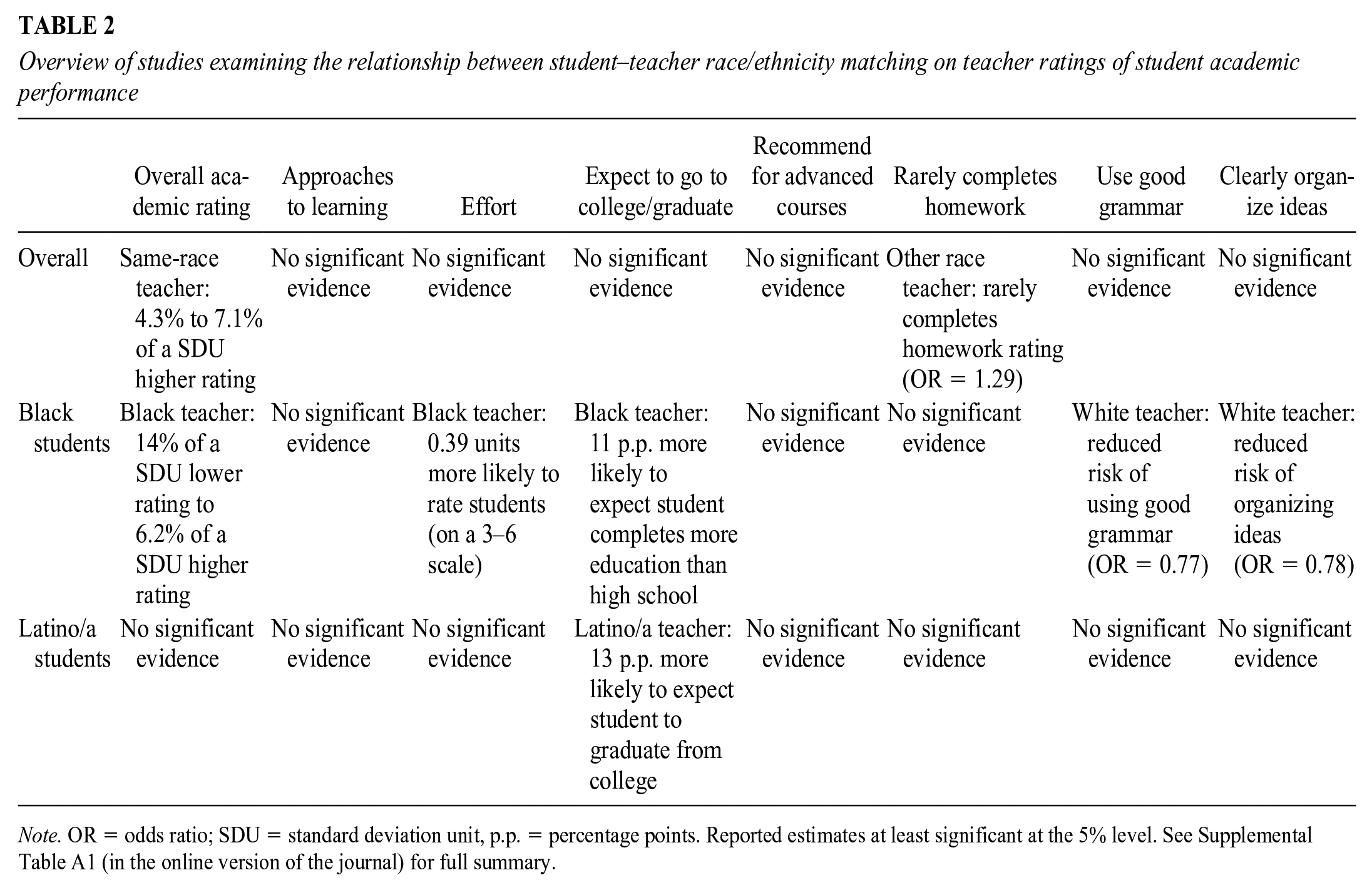
Note. OR = odds ratio; SDU = standard deviation unit, p.p. = percentage points. Reported estimates at least significant at the 5% level. See Supplemental Table A1 (in the online version of the journal) for full summary.
Black Students
Teacher ratings of student behavior
Black teachers generally describe Black students as being less likely to disrupt class or externalize problem behaviors compared to when Black students are rated by a teacher of another race. This finding is generally consistent for elementary and secondary students. Four studies analyzed social and behavioral outcomes using Educational Childhood Longitudinal Study (ECLS-K; ECLS-K:2011) data, including teacher ratings of students’ externalizing behaviors, internalizing behaviors, interpersonal skills, and self-control. Black students’ externalizing problem behaviors are the only measure that consistently differs depending on the match between student and teacher race/ethnicity. In kindergarten, both Downey and Pribesh (2004) and Wright et al. (2017) show that descriptive reports of more frequent disruption by Black students than White students virtually disappear when Black students are assigned to a Black teacher. Bates and Glick (2013) extend this analysis, examining teacher reports of externalizing behaviors through fifth grade. For Black students, being assigned to a Black teacher is associated with a 0.08 standard deviation decrease in negative ratings of externalized problem behaviors, which accounts for half of the difference between Black and White students.
Studies of eighth-grade students sampled as part of the Educational Longitudinal Study of 1988 (NELS:88) generally find that the behavior of Black students is described more favorably when assigned to a Black teacher (and more negatively when assigned to a teacher of another race/ethnicity), although there are exceptions (Takei & Shouse, 2008). Examining Black and Latino/a students, Dee (2005) shows that assignment to a teacher of another race/ethnicity is associated with increased odds of being described as frequently disruptive and inattentive. A notable feature of Dee’s study is the use of student fixed effects to compare how separate teachers rate the same student’s behavior, ruling out fixed, but unobserved student characteristics that may confound the relationship between student–teacher racial matching and teacher behavioral ratings.
Teacher ratings of student academic ability
Researchers have found more consistent evidence of higher ratings of Black students’ academic performance by Black teachers in secondary schools compared to elementary schools. Using data from NELS:88, Black male teachers rated Black male students higher in reading and science and Black female students higher in mathematics and science, compared to White male teachers, when controlling for students’ prior performance (Ehrenberg et al., 1995). When examining a more general factor of pro-academic behaviors, Oates’s (2003) findings are similar, namely, that White teachers rate Black students less favorably than White students. Additionally, Downey and Pribesh (2004) find that, compared to White teachers, Black teachers describe Black students as putting in more effort in their English classes.
With the Educational Longitudinal Study of 2002 (ELS:2002), McGrady and Reynolds (2013) find White teachers rated 10th-grade Black students as less likely to use good grammar and clearly organize ideas than White students. Gershenson et al. (2016) and Fox (2016) both analyze teachers’ expectations for their 10th-grade students’ educational outcomes, including graduating from high school and earning a 4-year degree (or higher). Gershenson et al. find a 12 percentage point difference between Black and non-Black teachers expectation that the student would graduate from high school. Fox (2016) finds Black teachers are 11 percentage points more likely to expect Black students to complete more education than high school than White students with White teachers. While this main outcome is generally consistent across these two studies, differences in how the authors define the comparison group are consequential in terms of teacher expectations for earning a 4-year degree or higher. Estimates in Fox’s (2016) analysis are compared to White students with White teachers, whereas the comparison group in Gershenson and colleagues’ analysis is to each racial/ethnic group when they were not assigned an “other race” teacher. Gershenson and coauthors find non-Black teachers are 9 percentage points less likely to expect Black students to earn or 4-year degree (or higher). In Fox’s study, when Black students are assigned to a Black teacher, teachers expect that they are 6.5 percentage points less likely to graduate from college than White students assigned to White teachers, a difference that is not statistically significant.
In elementary schools, the strongest evidence of teacher ratings of academic ability comes from Ouazad’s (2014) analysis of kindergarten through fifth-grade students in the ECLS-K data. Using both student and teacher fixed effects to identify the effect of being assigned to a same-race teacher, Ouazad (2014) finds that White teachers rate Black students 11% of a standard deviation lower in literacy than Black teachers and 6% of standard deviation lower in mathematics (but not significant at conventional levels). In supplementary analysis, the author provides strong evidence that the observed differences in teacher ratings are due to differences in teacher perceptions of students, as opposed to student responsiveness or more culturally responsive pedagogy on behalf of the teacher. Ouazad (2014) examines the ways in which teachers rated various competencies in the beginning weeks of the school year. The author finds no difference in the ways that same-race teachers rated more objective domains such as reading and writing. Yet, more abstract questions such as the use of complex sentence structure, interpretation of stories read to the child, familiarity with letters, and the use of rhyming words were all rated higher by same-race teachers.
Null findings
For Black students, assignment to a Black teacher is linked with higher ratings of externalized problem behaviors and, in secondary schools, academic ability. Despite these consistent findings, there was no significant evidence for a range of other behavioral and academic outcomes. No empirical evidence was found for teacher ratings of internalized problem behaviors, interpersonal skills, self-control (Wright et al., 2017), and disruptiveness (Downey & Pribesh, 2004). In terms of academic ratings, Downey and Pribesh (2004), Fryer and Levitt (2004), Ready and Wright (2011), and Wright et al. (2017) find no evidence of a benefit of racial/ethnic matching for Black kindergarten students in terms of the approaches to learning or academic rating scale in literacy or mathematics. Fox (2016) shows no evidence of a relationship between assignment to a Black teacher and an increased likelihood of being recommended for advanced courses. Other studies that look at more general factors related to academic and social skills also had null findings (Jennings & DiPrete, 2010; Pigott & Cowen, 2000).
Latino Students
Teacher ratings of student behavior
The primary evidence of Latino/a teachers’ ratings of Latino/a students’ classroom behavior comes from Wright et al.’s (2017) study of kindergarteners in the ECLS-K:2011. Latino/a teachers report that Latino/a students display fewer externalized problem behaviors in class than when they are assigned to a teacher of another race/ethnicity. As was described above, Dee (2005) showed that assignment to a teacher of another race/ethnicity is associated with increased odds of being described as frequently disruptive and inattentive, but the results were not separated for Black and Latino/a students.
Teacher ratings of student academic ability
The evidence base for Latino/a teacher ratings of Latino/a students’ academic ability is similarly weak. Among elementary school students, Ouazad (2014) reports that White teachers rate Latino/a students 15% of a standard deviation lower in literacy than Latino/a teachers and 17% of standard deviation lower in mathematics. For high school students, Fox (2016) shows that, compared to White students with White teachers, Latino/a teachers are 13 percentage points more likely to expect Latino/a students to graduate from college.
Null findings
In addition to the small evidence base of a relationship between Latino/a student–teacher matching and teacher behavioral or academic ratings, there are also a number of insignificant results. In terms of classroom behavior, null findings were reported for teacher ratings of internalized problem behaviors, interpersonal skills, self-control (Wright et al., 2017), externalizing problem behaviors (Bates & Glick, 2013), and disruptiveness (McGrady & Reynolds, 2013). For academic ability, null findings include working hard for grades, using good grammar, clearly organizing ideas (McGrady & Reynolds, 2013), expectations that the student will graduate from high school, recommendations for advanced courses (Fox, 2016). Similar to Black students, Jennings and DiPrete (2010) find no evidence that Latino/a teachers rate Latino/a students higher on their general factors related to academic and social skills. As noted above, it is possible that the Latino/a students’ and teachers’ diverse histories and cultures may limit their ability to develop a shared cultural understanding, thereby limiting the influence of Latino/a student–teacher matching on teacher ratings of students.
Summary
Overall, the reviewed evidence on teacher evaluations of student behavior indicates that the measure of externalized problem behaviors is the primary domain that consistently differs depending on the race of the teacher. Black and Latino/a students are rated as being less frequently disruptive in class when assigned to a Black or Latino/a teacher, respectively, although the evidence base is strongest for Black students with Black teachers. Evidence also indicates that Black and Latino/a students’ academic abilities are rated more positively when assigned to a teacher of the same race/ethnicity (and less positively when assigned to a teacher of another race/ethnicity). Although this pattern is found in both elementary and high schools, the evidence is more consistent in the higher grades.
These findings point to the importance of student–teacher racial/ethnic matching in leading to improved teacher perceptions of students, an important outcome of a shared cultural understanding between students and teachers. Evidence from kindergarten and early in the school year further underscore how assignment to a same-race teacher can lead to improved teacher perceptions of students’ classroom behavior and academic ability. That being said, studies of high school teachers’ expectations for future academic attainment suggest that student responsiveness could also be a factor for high school students (Fox, 2016; Gershenson et al., 2016). Same-race teachers may have systematically higher expectations for the academic attainment of co-racial students but students also seem to have internalized such high expectations communicated by a teacher of the same race/ethnicity, modifying their own behaviors in efforts to reach the expectations set by the teacher, thereby further improving their teacher’s perceptions of their academic potential.
Student Achievement
Most studies that look at the effect of student–teacher race/ethnicity matching on student achievement look specifically at student–teacher racial dyads (e.g., Black students with Black teachers). That being said, the few studies that look at the overall relationship of having a teacher of the same race/ethnicity indicate a small, positive effect. In an analysis of over eight million student observations from Florida, Egalite, Kisida, and Winters (2015) find an overall effect of racial/ethnic matching of 0.002 standard deviations in reading and 0.008 standard deviations in mathematics, with much larger effects in elementary than middle school. Clotfelter et al. (2007) show evidence of slightly larger effects (in elementary school), with effects ranging from 0.007 to 0.020 in reading and 0.017 and 0.029 in mathematics. Dee’s (2004) reanalysis of data on over 23,000 elementary school students from the Tennessee Student Teacher Achievement Ratio (TN STAR) experiment shows that students gained 3.6 percentile points in mathematics when assigned to a teacher of their race/ethnicity. Reading scores increased by 2.9 points. Two studies examining district or state administrative data from a single school year find no overall evidence of a relationship between student–teacher racial/ethnic matching (Howsen & Trawick, 2007; Huang & Moon, 2009). As shown in the next subsections, however, results are distinct for Black and Latino/a students, with much stronger findings of benefits to achievement for Black students.
Black Students
There is evidence that Black students score higher on achievement tests when assigned to a Black teacher, although there are notable exceptions to this pattern, particularly in analysis of nationally representative student surveys. Figure 2 presents the standardized coefficients from studies that have disaggregated student achievement results for Black students. To obtain estimates displayed in the table, the author conducted several calculations in effort to report standardized coefficients, including (1) calculating standard errors from reported t-statistics, (2) standardizing percentile scores, and (3) calculating a weighted average for Black male and female students. It is worth emphasizing that several studies discussed below are not reported in this figure as the original authors report unstandardized test scores. Still, Figure 2 shows a range of positive, null, and negative estimates of the relationship between Black student–teacher matching and student achievement, many of which are estimated with little precision. That being said, there is more evidence of a positive, significant effect, particularly in reading.

Forest plot of the studies examining the relationship between Black student–teacher matching on student achievement.
Dee (2004) finds that Black students’ mathematics scores increased by an average of 3 to 5 percentile points when assigned to a Black teacher and reading scores increased by 3 to 6 percentile points. Quasi-experimental studies of district and state databases generally replicate this finding, although the magnitude of this relationship varies. Egalite et al. (2015) show that for Black students assigned to Black teachers, reading scores increased by 0.004 standard deviations and 0.019 standard deviations in mathematics. In a large urban district in Texas, Hanushek, Kain, O’Brien, and Rivkin (2005) find a 0.105 standard deviation effect on mathematics achievement for Black students assigned to Black teachers. The exception to this pattern is Buddin and Zamarro’s studies (2009a, 2009b, 2009c) from Los Angeles. Although Black students assigned to Black teachers generally have higher test scores, the authors find no evidence of test score gains, and even find Black high school students assigned to Black mathematics teachers scored 0.03 standard deviations lower.
Studies of nationally representative data offer less conclusive evidence of the benefits of race matching on Black students’ test scores. In their analysis of NELS:88, Ehrenberg et al. (1995) find limited evidence of a relationship between the race (and gender) of 10th-grade students and their teachers. The only observed test gains occurred for Black male students assigned to Black male teachers in history. In Fryer and Levitt’s (2004) and Jennings and DiPrete’s (2010) studies of test score gains for kindergarten and first-grade students in the ECLS-K, both sets of authors find no evidence that Black students have greater gains in mathematics or reading when assigned to a Black teacher. In a later analysis of ECLS-K, Easton-Brooks, Lewis, and Zhang (2009) and Eddy and Easton-Brooks (2011) use growth curve modeling to show that Black students with at least one Black teacher made larger test score gains than students without Black teachers (0.64 and 1.75 on a 100-point scale, in mathematics and reading, respectively).
The lack of significant evidence from many nationally representative studies, may be attributable, in part, to the comparatively smaller sample sizes. Yarnell and Bohrnstedt (2018) use multilevel structural equation modeling to of 165,410 students who participated in the 2013 National Assessment of Educational Progress. Although the study examines student achievement levels in reading—as opposed to student gains in the aforementioned analyses of administrative data—assignment to a Black teacher is associated with higher achievement levels for Black students. Black male students’ reading achievement was 6.23 points higher than Black male students not taught by a Black teacher. Black female students’ reading achievement was 4.80 points higher than Black female students not taught by a Black teacher. Given that the Black–White achievement gap is 23.8 points in this study, these differences account for a 20% to 25% reduction in this achievement gap for Black female and male students, respectively. Although promising, the evidence that Black students’ assignment to Black teachers improves average test scores is not definitive. As discussed below in greater detail, there is also evidence that the benefits of assignment to a Black teacher are moderated by school level and region.
Latino/a Students
There is less overall evidence of an effect of Latino/a student–teacher matching on student achievement, and the existing evidence is mixed. Figure 3 presents the coefficients from the studies that have disaggregated student achievement results for Latino/a students. The only positive effects of ethnic matching for Latino/a students are found in Los Angeles (Buddin & Zamarro, 2009b, 2009c). Here, the authors observe small but positive effects in middle school mathematics and high school reading and mathematics test score gains but null findings in middle school reading and elementary school reading and mathematics. Hanushek et al. (2005) show evidence of a 0.084 standard deviation effect on mathematics achievement, although this estimate is sensitive to model specification. Similarly, Jennings and DiPrete (2010) find a marginally significant effect of ethnic matching for Latino/a students in mathematics (0.29 standard deviations). Egalite et al. (2015) find a negative effect for Latino/a students assigned to Latino/a teachers in both reading and mathematics (−0.010 and −0.008 standard deviations, respectively). In summary, although there is some evidence that Latino/a students benefit with a Latino/a teacher, the evidence is not conclusive.
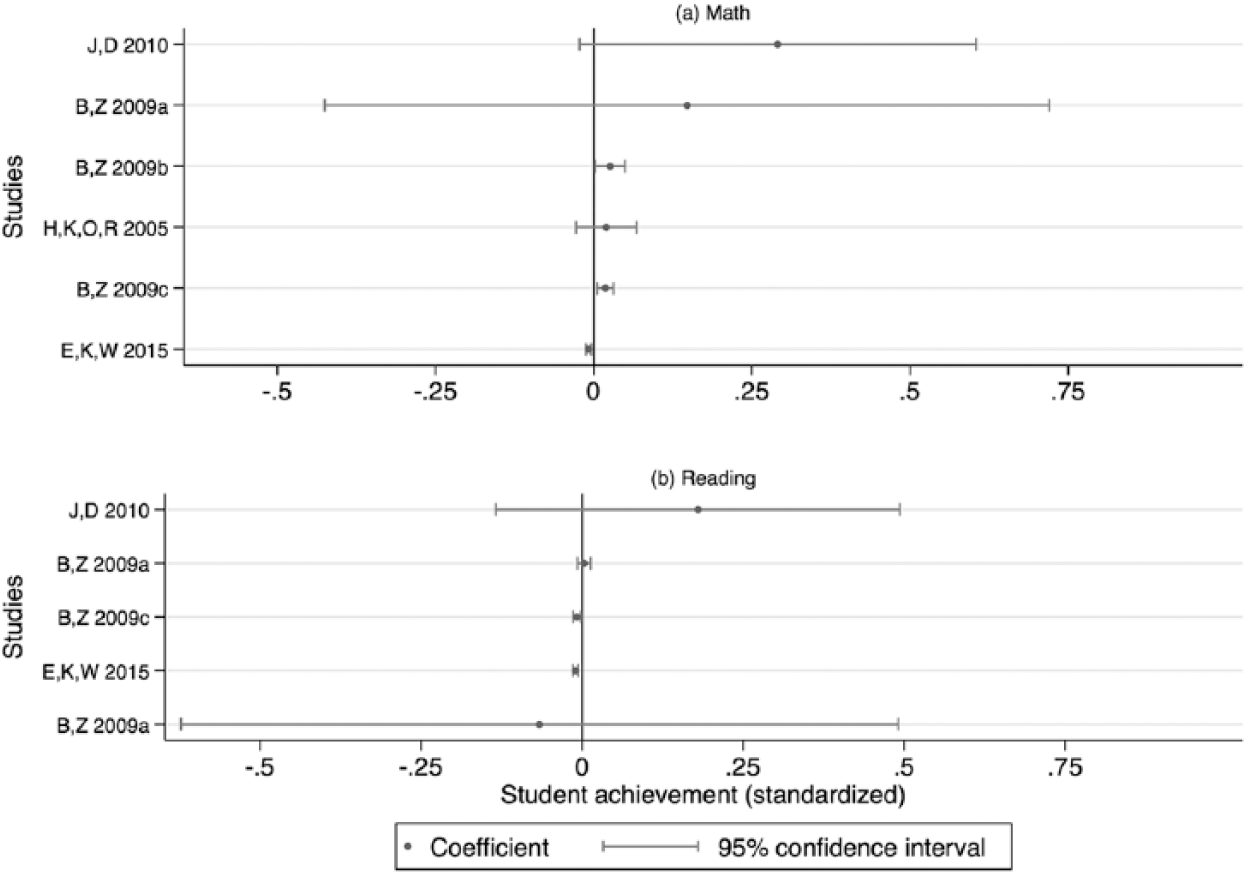
Forest plot of the studies examining the relationship between Latino/a student–teacher matching on student achievement.
Moderating Effects on Student Achievement
Next, this review considers the extent to which student–teacher racial/ethnic matching is moderated by gender, school level, and region. While no consistent differences are found in the extent to which student–teacher matching differs for by gender identity, test score gains are larger for students in elementary schools (as opposed to secondary schools) and possibly in states in the southern United States. Although several studies test for differences by racial and gender identity (Dee, 2004; Eddy & Easton-Brooks, 2011; Ehrenberg et al., 1995; Hanushek et al., 2005; Yarnell & Bohrnstedt, 2018), there is little consistent evidence to support this hypothesis. For instance, Yarnell and Bohrnstedt (2018) found Black male students to have higher reading test scores when assigned to a Black teacher than Black female students assigned to a Black teacher, although the differences were not statistically significant. That being said, there is reason to believe that the benefits would be accentuated for matching race/ethnicity and gender among students and teachers, a proposition that has not been systematically examined in the literature.
In terms of school level, the effect of student–teacher matching seems to be slightly stronger in elementary schools. Buddin and Zamarro (2009a, 2009b, 2009c) find either negative or null effects for the Black student–teacher interaction in middle and high schools, with evidence of a relationship in elementary schools in mathematics but not reading. A similar pattern emerges in North Carolina (Clotfelter et al., 2007, 2010). More recently, Egalite et al. (2015) find an overall effect of student–teacher race match to be 0.004 in elementary school reading and a precisely estimated null finding in middle and high schools. For math, the effect in elementary schools was 0.014 versus 0.002 in middle and high schools. Even within elementary schools, Penney’s (2017) reexamination of the TN STAR indicates that the effects of having a Black teacher for Black students are concentrated in early elementary school. In kindergarten, assignment to a Black teacher is associated with improved test performance in mathematics, reading, and word recognition. It is only for mathematics that this effect continues into first and second grades, with no evidence that having a Black teacher only in third-grade benefits students.
Regional differences are one plausible explanation for the lack of consistent evidence of a relationship between student–teacher racial/ethnic matching and student achievement in studies of national data sets compared to studies using administrative data. The most consistent evidence of an effect of student–teacher matching for Black students comes from southern states, including Tennessee (Dee, 2004), North Carolina (Clotfelter et al., 2007, 2010), Florida (Egalite et al., 2015), and Texas (Hanushek et al., 2005). Unobserved contextual factors may explain these differences. A history of racism and discrimination may have influenced a shared group identity differently for African Americans living in the southern United States than elsewhere in the county. Alternatively, within the context of resegregation of southern schools (Reardon, Grewal, Kalogrides, & Greenberg, 2012), school context may moderate the relationship between student–teacher interactions and student achievement. In other words, students in increasingly segregated southern schools may not only be more likely to be assigned to a same-race teacher but also benefit more. Alternatively, this evidence may simply be attributable to the greater availability of administrative data in these states and researchers would find a similar pattern elsewhere.
Summary
The reviewed studies suggest that assignment to a Black teacher is linked with improved achievement for Black students. Yet there are notable studies using survey or administrative data that find no evidence of improved test performance (Buddin & Zamarro, 2009a, 2009b, 2009c; Ehrenberg et al., 1995; Fryer & Levitt, 2004; Jennings & DiPrete, 2010). As student responsiveness is hypothesized to be more influential in secondary schools compared to elementary schools, that the influence of student–teacher racial/ethnic matching was strongest in elementary schools suggests that Black teachers play a critical role in creating a culturally relevant instructional climate where Black students can thrive academically. Regional variation in the observed effect of student–teacher racial/ethnic matching and the lack of overall evidence for Latino students points to the presence of unobserved factors shaping the formation of shared cultural understanding in ways consequential for student achievement.
Additional Behavioral Outcomes
Researchers have drawn on survey and administrative data to examine possible benefits of assignment to a same race/ethnicity teacher on other student outcomes, including disciplinary referrals and exclusionary discipline, assignment to a school’s gifted and talented program, attendance, and dropout. With the exception of five reviewed studies on school discipline, there are fewer studies examining these outcomes offering less definitive evidence of student–teacher racial/ethnic matching than the studies of teacher ratings of students or student achievement. That being said, the general pattern across these studies is that Black students face less exclusionary discipline, are more likely to be assigned to a gifted and talented program, attend school slightly more frequently, and are less likely to drop out of school, although this overarching pattern is generally contingent on the use of quasi-experimental research designs. It should be noted that Latino/a students have generally not been a focus in these studies, although there have also been null findings in terms of gifted assignment (Grissom & Redding, 2016).
Student Discipline
Unlike the studies reviewed to this point that have centered on matched student–teacher data, studies of disciplinary referrals and discipline rarely have data on the teacher(s) involved in the referral process. In order to understand how the teacher racial/ethnic composition at the school or grade level may curtail exclusionary disciplinary practices (in-school suspension, out-of-school suspension, and expulsion), the inclusion criteria is relaxed to include studies that examine teacher race/ethnicity at broader organizational levels, as long as the disciplinary action is measured at the student level.
Overall, the five reviewed studies provide somewhat mixed evidence for the hypothesis that increased teacher representation can reduce the use of exclusionary disciplinary practices. Three of the five studies have either null or even negative findings. Yet, as was the case with other outcomes reviewed thus far, results are somewhat contingent on the use of estimation strategies that account for the nonrandom sorting of students and teachers. One study examining disciplinary referrals in an unnamed rural district in Georgia found Black teachers to be more likely than White teachers to refer a Black child to the front office (Jordan & Anil, 2009). Sullivan, Klingbeil, and Van Norman (2013) study student suspensions in an unnamed urban school district in Wisconsin and find no evidence of a relationship between the percentage of White teachers and a student’s risk of being suspended and the direction of the odds ratio is opposite of what is to be expected if improved teacher representation is linked to the reduced use of exclusionary disciplinary practices within a school. Blake et al. (2016) study the relationship between the teacher–student racial/ethnic congruence and exclusionary discipline (i.e., being suspended or expelled). Black and Latino/a students had a lower probability of facing exclusionary discipline in their school as greater racial/ethnic congruence between students and teachers was achieved. Unfortunately, the authors’ measure precludes them from separating their results by student and teacher race/ethnicity. Furthermore, these studies do little to account for potential biases linked to the fact that Black and Latino/a students are more likely to attend schools where the use of exclusionary discipline is more prevalent.
Two studies using administrative data from North Carolina begin to address the issue nonrandom sorting of students and teachers. Kinsler (2011) focuses on the prevalence of racial disparities in disciplinary referrals and the role that Black elementary school teachers may play in reducing referrals for Black students. Overall, Kinsler finds that that racial disparities can be explained by cross-school variation. In addition, he finds no evidence of differences in the risk of referral when Black students are assigned to White versus a Black teachers.
An explanation for this finding comes from Lindsay and Hart’s (2017) more extensive examination of the exclusionary disciplinary practices faced by students in public schools in North Carolina. They extend Kinsler’s analysis with a larger sample and a research design that not only accounts for teacher and student sorting across schools but unobserved student characteristics linked to how a child is disciplined within a school. The independent variable in their study is the percentage of Black teachers in a particular grade in a particular year. The dependent variable is whether the student faced any exclusionary discipline. Lindsay and Hart’s research design consists of both a school-grade fixed effect and a student fixed effect. Before conditioning on a student fixed effect, the authors show evidence consistent with some of the other studies on this topic of a positive relationship between the percentage of Black teachers and the probability that Black students face exclusionary discipline. Yet, after including a student fixed effect in their model, the results indicate that an increased share of Black teachers in a grade is linked with a reduced risk of a student facing exclusionary disciplinary practices. For a Black student in a grade with all Black teachers, the probability that they face exclusionary discipline decreases by 2 percentage points. Underscoring the important influence of greater exposure to Black teachers, Lindsay and Hart find the largest effects for defiance-related incidents such as insubordination or disorderly conduct, arguably the most subjective domains under teachers’ purview.
In summary, the studies on the relationship between the teacher race/ethnicity in a grade or school show somewhat limited evidence of a relationship between the racial/ethnic makeup of the teachers in a school and office referrals or exclusionary disciplinary practices. Yet, small sample sizes, data limitations in the measurement of disciplinary infractions, and associational research designs limit the inference that can be drawn from a number of these studies. It is noteworthy that the one study to find consistent evidence aligned with the benefits of racial congruence in curtailing exclusionary disciplinary policies for Black students—Lindsay and Hart (2017)—addressed these issues. That being said, as described in the conclusion, there are still areas for future work to better understand the ways in which students of color are unfairly disciplined within public schools. Importantly, no evidence reviewed directly addresses the issue of whether or not Latino/a students are less likely to receive office referrals or face exclusionary discipline when attending a school with more Latino/a teachers.
Other Behavioral Outcomes
This section on additional behavioral outcomes concludes with a brief consideration of three studies that have considered gifted and talented assignment, student attendance, and school dropout. Grissom and Redding (2016) draw on ECLS-K data to examine assignment to gifted and talented programs in elementary schools. The authors show that White students are assigned to gifted and talented programs at more than twice the rate of Black students, even when conditioning on student and school-level controls, including test scores. Yet, for Black students, assignment to a Black teacher is associated with a virtually identical probability of assignment as White students, when holding other variables in the model at their mean. No corresponding evidence is found for Latino/a students and teachers.
Holt and Gershenson (2017) examine both the number of absences in a school year as well as the likelihood of chronic absenteeism, using administrative data on elementary school students from North Carolina. The authors use a two-way fixed effect to account for unobserved student or classroom level factors that would bias the observed relationship between having a teacher of another race/ethnicity and attendance. Students attend roughly half a day less school (throughout the whole school year), when assigned to a teacher of another race/ethnicity. The authors do not separate their results by student race/ethnicity.
Gershenson et al.’s (2017) study provides the sole evidence of long-term benefits for Black students when assigned to a Black teacher. The authors follow five cohorts of third-grade students through high school graduation. In the authors’ main analysis, they adopt an instrumental variables approach to examine the relationship between the number of Black teachers to which a Black student is assigned in Grades 3 through 5 on their risk of dropping out of high school. Assignment to at least one Black teacher predicts a 4 percentage point decrease in the risk of dropping out of high school, an effect that is driven almost entirely by Black male students. The authors supplement this analysis with a reanalysis of the TN STAR data, where they replicate the magnitude and direction of their main findings.
Discussion
Despite ongoing calls to diversify the teacher workforce, over 80% of teachers identify as White, a consequence not only of individuals’ occupational preferences but a history of policies designed to minimize the number of teachers of color (Carter Andrews et al., 2019; Ingersoll & Merrill, 2017). For the purposes of this review, such a historical trend is concerning given that many students of color never sit in a classroom with a teacher of the same racial or ethnic identity as themselves. As a result, any benefits ascribed to assignment to a co-racial or co-ethnic teacher are in reference to any harms perpetuated toward Black and Latino/a students when in a classroom taught by a teacher of another race or ethnicity (e.g., racial prejudice, exclusionary classroom practices, etc.).
Overview of Findings
The reviewed evidence on teacher ratings of students’ classroom behavior indicates that externalized problem behaviors are the only behavioral rating that are consistently rated differently depending on the race of the teacher. That is, Black and Latino/a students are perceived by their co-racial or co-ethnic teachers as fighting, being disruptive and being argumentative less frequently than when assigned to a teacher of a different race/ethnicity. These differences were substantive. Black and Latino/a students’ assignment to a teacher of the same race or ethnicity narrowed negative ratings of externalized problem behaviors between roughly half and the complete difference with White students (Bates & Glick, 2013; Downey & Pribesh, 2004; Wright et al., 2017). As these behaviors are precursors to office referrals and other disciplinary action (Irwin, Davidson, & Hall-Sanchez, 2013), this evidence points to one clear way in which Black and Latino/a students benefit from assignment to a teacher of the same race/ethnicity. Black and Latino/a students also tend to receive more favorable ratings of their academic ability when assigned to a co-racial or co-ethnic teacher, although this evidence is generally stronger in middle and high schools than elementary schools.
In terms of student achievement, the reviewed studies suggest that assignment to a Black teacher is linked with improved achievement for Black students. These improvements have a nonnegligible influence on the Black–White achievement gap. Yarnell and Bohrnstedt’s (2018) study finds that assignment to a Black teacher is associated with 20% to 25% reduction in the Black–White achievement gap. Yet there are notable studies using survey or administrative data that find no evidence of improved test performance (Buddin & Zamarro, 2009a, 2009b, 2009c; Ehrenberg et al., 1995; Fryer & Levitt, 2004; Jennings & DiPrete, 2010). The reviewed evidence suggests that the possible benefits of Black students’ assignment to a Black teacher are sensitive to contextual factors, given that the largest effects are observed in elementary schools and in studies conducted in the southern United States. Black students are also more likely to benefit from assignment to Black teacher in terms of a reduced risk of exclusionary discipline, an increased likelihood of being assigned to a gifted and talented program, improved attendance, and a decreased risk of dropping out of school.
Evidence of a benefit of Latino/a student–teacher matching on behavioral outcomes is inconclusive, with no overall evidence of whether or not Latino/a students’ behavior changes as a result of assignment to a Latino/a teacher. It is worth emphasizing, this conclusion results not only from consistently null findings but the lack of attention to Latino/a students assigned to Latino/a teachers in a number of studies. The primary explanation put forward to explain this finding is that differences in nationality or immigrant generation between Latino/a students and teachers limits their ability to develop a shared cultural understanding (Egalite et al., 2015).
The reviewed studies also shed light on the ways in which the development of a shared cultural understanding between students and teachers or student responsiveness to a same-race teacher improves student outcomes. Two key pieces of evidence point to teachers’ critical role in developing and acting on a shared cultural understanding. First, evidence from kindergarten and early in the school year underscore how assignment to a same-race teacher leads improved teacher perceptions of students’ classroom behavior and academic ability. Second, as student responsiveness is hypothesized to be more influential in secondary schools compared to elementary schools, that the influence of student–teacher racial/ethnic matching on student test scores was strongest in elementary schools suggests that Black teachers play a critical role in creating a culturally relevant instructional climate where Black students can thrive academically. At the same time, studies of high school teachers’ expectations for future academic attainment and students’ persistence in high school suggests that student responsiveness to also be an important factor (Fox, 2016; Gershenson et al., 2016; Gershenson et al., 2017). Joshi, Doan, and Springer (2018) come to similar conclusion by examining how students differentially benefit from assignment to a same-race teacher, depending on the measured quality of the teacher.
Directions for Future Research
First, future research can continue to reconcile the different mechanisms driving the effect of racial/ethnic matching. Research on student–-teacher gender matching suggests additional approaches to identifying the relative influence of these mechanisms. Paredes (2014) considers the degree to which female students differentially benefit from assignment to a female teacher in gender-segregated classrooms. Paredes reasons that the effect of teacher impartiality would be mitigated in a class with all female students, with any resulting effect being driven by positive student responses to a teacher role model of the same gender. This design feature could be extended for students enrolled in racially segregated classrooms. Sansone (2017) finds that female students’ self-confidence in ninth-grade mathematics or science subsides when controlling for teacher beliefs and classroom behaviors. More important, female students’ self-confidence is substantially lower when a female teacher believes boys perform better in mathematics and science, underscoring the importance of directly measuring how teachers’ biased beliefs shape students’ self-concept and achievement. Future studies on student–teacher racial/ethnic matching could integrate teacher beliefs into regression models as important, policy-relevant moderators.
Second, the mechanisms by which assignment to a same-race teacher are, at face value, consistent for Black and Latino/a students. As a result, the lack of consistent evidence of a benefit of assignment to Latino/a teachers for Latino/a students outside of perceptual measures suggests other factors are likely at play and should be a focus of future research. To the extent to which differences in Latino/a students’ and teachers’ diverse histories and cultures limit their ability to develop a shared cultural understanding, more careful research is likely needed that focuses on country of national origin. Another avenue for ongoing research is to better understand how discriminatory experiences in schools differentially shape the racial/ethnic identity development of Black and Latino/a students (DeCuir-Gunby, 2009; Pahl & Way, 2006; Quintana, 2007). Research on racial/ethnic development indicates that exposure to discrimination can spur reflection on identity and increase perception of later bias, possibly shifting how a student acts in the classroom. Longitudinal studies of children and adolescents’ racial/ethnic identify development could integrate not only student-reported data on experiences of classroom discrimination but teachers’ beliefs about the students’ classroom behavior and academic performance, as well as their racial/ethnic identity.
Third, with the exception of Gershenson et al.’s (2017) study of the effect of Black students’ assignment to a Black elementary school teacher on high school graduation, there has been no examination of the long-term benefits of student–teacher race/ethnicity matching. The importance of this research is underscored by two recent studies showing benefits of gender-specific exposure for children and youth. Bottia, Stearns, Mickelson, Moller, and Valentino (2015) find that the proportion of female high school mathematics and science teachers to be associated with an increased likelihood that a female student declares and graduates with a STEM (science, technology, engineering, and mathematics) degree. Bell, Chetty, Jaravel, Petkova, and Van Reenen (2017) show that women who grow up around a greater share of female inventors from certain technological classes are more likely to become inventors in similar domains. Given teachers influence on students’ aspirations (Fox, 2016), educational researchers are uniquely positioned to examine this important question of the long-run effects of assignment to a same-race teacher.
Fourth, of the outcomes examined in this study, the evidence base is weakest for student behavioral outcomes. Two outcomes that have hypothesized relationship with the race/ethnicity of teachers that have not been examined are grade retention and special education assignment, particularly for categories such as emotional disturbance or an intellectual disability. In addition, stronger evidence is needed for school discipline. Although researchers have long recognized that school discipline is a complex, multistage process involving multiple school stakeholders, few studies have collected data on both the referring teacher, school administrator, and disciplinary action (Skiba et al., 2011). To understand how the racial and ethnic identity of students, teachers, and administrators all interact to exacerbate (or ameliorate) the exclusionary discipline faced by Black and Latino/a students, future research needs to leverage much richer data than what have been used to date. For instance, in one school, the low rate of school exclusion could be attributable to the low rates in which the primarily Black teacher workforce refers Black students to the front office. In another school, Black students are frequently referred to the front office but face little exclusionary discipline because the Black assistant principal overseeing school discipline favors a graduated discipline system with less severe infractions. In short, even in instances when a student is not assigned to a teacher of their own race or ethnicity, other school staff may serve an important compensatory role.
Fifth, the possibility for a compensatory role among other school staff points to the contextual factors that are at play in shaping how student–teacher racial/ethnic matching influences teacher perceptions of students and various student outcomes. Yarnell and Bohrnstedt’s (2018) recent work points the direction for ongoing research on the ways in which the racial/ethnic composition of classrooms and schools moderates the benefits of racial/ethnic student–teacher matching. Importantly, current research does not demonstrate the extent to which assignment to a same-race teacher differs systematically across teacher characteristics and school contexts. Future research could examine how Black and Latino/a teachers’ education and experience moderate the effect of student–teacher racial/ethnic matching. In terms of school context, the mechanisms driving the effect of student–teacher matching are arguably quite distinct for a Black student who attends a racially segregated school with numerous Black teachers compared to a Black student in a racially diverse school who is assigned to one Black teacher throughout their entire schooling. As students and teachers are not equally distributed across schools (Hansen & Quintero, 2018; Sun, 2018), understanding the school conditions in which students benefit the most from a racially or ethnically similar teacher is important, as it can inform administrator’s decisions about how to consider student and teacher race/ethnicity in assignment decisions. Furthermore, this research could also enhance our understanding of the ways in which the classroom environment becomes racialized under different conditions.
Sixth, while the sociocultural environment of a school likely moderates the effect of student–teacher race/ethnicity matching, the most relevant contextual factors are unmeasured in federal surveys and state administrative databases. For instance, Salerno and Reynolds (2017) develop a “place conscious” conceptual model to point to the importance of school ethnic enclaves. Their study points to ways in which “culturally flexible” teachers (who do not necessarily identify as Latino/a) use various instructional resources to support the academic success of minoritized students in a predominantly White school. As another example, student–teacher relationships are of paramount importance in the delivery of cultural relevant pedagogy, role modeling, and relationships with parents, among other factors (Decker et al., 2007; Hamre & Pianta, 2006). Cohen and Steele (2002) argue that improved student–teacher relationships have the potential to improve educators’ cultural understanding of their students, thereby refuting negative stereotypes that could undermine the fair treatment of Black and Latino/a students. Improved relationships may also lead students to be more trusting of the educational system and more likely to invest in their educational success (Okonofua et al., 2016). Although the quality of student–teacher relationships is likely a key mediating factor in the effect of student–teacher matching, it remains unmeasured in the studies examined in this review.
Seventh, the value of student–teacher relationships may extend across racial and ethnic lines. Positive, racially sensitive relationships may improve teachers’ cultural understanding of students in a way that allows them to uphold high expectations for all students’ learning and adopt equitable classroom practices that demonstrates this orientation. While research has documented the ways in which White teachers can thrive with non-White students (see Goldenberg, 2014, for a review), results from this review indicate that, on average, Black and Latino/a students continue to face more negative perceptions of their externalized classroom behavior and academic performance, differences that are consequential for academic and school outcomes, particularly for Black students. Research that continues to examine the ways in which White teachers can support Black and Latino/a students is critical, given that the overwhelming majority of teachers identify as White (Goldenberg, 2014). Quantitative researchers could add to this literature by examining the conditions under which White teachers lead to systematic improvements of children from traditionally underserved racial/ethnic groups. In addition, while this review has focused on the benefits of co-racial and co-ethnic teachers, future research could also probe the ways in which White students benefit from assignment to non-White teachers, including in terms of less-measured outcomes (e.g., racial sensitivity, implicit bias).
Finally, in addition to examining how Black and Latino/a students benefit from assignment to a teacher of the same racial or ethnic identity, future research could continue to examine the psychological burden and stress placed on Black and Latino/a teachers, including how these factors shape burnout and turnover.
Policy Implications
The policy recommendations that emerge from the literature on student–teacher racial/ethnic matching include recruiting a more racially and ethnically diverse teacher workforce, preparing White teachers to work in racially diverse classrooms, either through preservice or in-service training, and retaining teachers of color (Achinstein, Ogawa, Sexton, & Freitas, 2010). In terms of preparation, programs can work to differentially select more equity-oriented teachers, regardless of racial or ethnic identity. While traditional preparation programs will likely play a critical role in recruiting and preparing teachers to engage with more racially and ethnically diverse students (Ladson-Billings, 2004, 2005; Milner, 2011), alternative certification programs aimed at recruiting more diverse teachers also show promise (Gist, 2017; Redding & Baker, 2019). Recent research indicates that “Grow Your Own” programs provide an important pathway into teaching for school and community members, many of whom come from traditionally underserved racial and ethnic groups (Gist, Bianco, & Lynn, 2019).
Evidence that teachers of color are more segregated than students in some states suggests that policies that promote the more even distribution of teachers of color across schools may also prove beneficial for students (Hansen & Quintero, 2018). In response, teacher education programs might become more intentional about the schools in which they place prospective teachers, given that where prospective teachers conduct their student teaching is linked with the location and demographic characteristics of the school in which they begin their career, particularly for underserved racial/ethnic minorities (Krieg, Theobald, & Goldhaber, 2016).
In terms of training, one practical area to emerge from this review relates to the racial/ethnic disparities in how teachers rate externalized problem behaviors among Black and Latino/a versus White students. Since singling out such behaviors often precludes office referrals, policies should focus on teacher perceptions and biases, a point Welsh and Little (2018) arrive at in their review of school discipline policies. Policies and programs that aid teachers in developing a shared cultural understanding between students and teachers have the potential to shape Black and Latino/a students’ success in other academic and behavioral domains.
Supplemental Material
DS_10.3102_0034654319853545 – Supplemental material for A Teacher Like Me: A Review of the Effect of Student–Teacher Racial/Ethnic Matching on Teacher Perceptions of Students and Student Academic and Behavioral Outcomes
Supplemental material, DS_10.3102_0034654319853545 for A Teacher Like Me: A Review of the Effect of Student–Teacher Racial/Ethnic Matching on Teacher Perceptions of Students and Student Academic and Behavioral Outcomes by Christopher Redding in Review of Educational Research
Footnotes
Notes
Author
CHRISTOPHER REDDING is assistant professor in the School of Human Development and Organizational Studies in Education, College of Education, University of Florida, Gainesville, FL; email:
References
Supplementary Material
Please find the following supplemental material available below.
For Open Access articles published under a Creative Commons License, all supplemental material carries the same license as the article it is associated with.
For non-Open Access articles published, all supplemental material carries a non-exclusive license, and permission requests for re-use of supplemental material or any part of supplemental material shall be sent directly to the copyright owner as specified in the copyright notice associated with the article.
