



Abstract
Hispanic-Serving Institutions (HSIs) are colleges and universities that enroll at least 25% Latinx students. Despite being recognized by the federal government since 1992, HSIs lack a historical mission to serve Latinxs. As such the idea of “servingness” has become an elusive concept. An abundance of literature centering HSIs has been published, yet there continues to be a debate about what it means to serve students. We conducted a systematic review of 148 journal articles and book chapters to better understand how researchers conceptualize the idea of servingness at HSIs. We identified four major themes used by researchers to conceptualize servingness: (1) outcomes, (2) experiences, (3) internal organizational dimensions, and (4) external influences. We also found that researchers are often unintentional in their efforts to conceptualize what it means to be an HSI. We offer a multidimensional conceptual framework of servingness to be used in research, policy, and practice.
Keywords
Hispanic-Serving Institutions (HSIs) are nonprofit, degree-granting postsecondary institutions in the United States that are federally designated as such by enrolling at least 25% Latinx 1 undergraduate students. They first gained federal recognition in 1992 after a long political battle (Valdez, 2015). Twenty-five years later, in fall 2017, there were 523 colleges and universities qualified for the HSI designation (Excelencia in Education, 2019). This designation was the result of considerable advocacy in earlier decades, with organizations such as the Mexican American Legal Defense and Education Fund and National Council of La Raza testifying before Congress in the 1970s and 1980s, stressing the need for increased funding for colleges and universities enrolling the largest percentage of Latinxs (Valdez, 2015). But beyond the 25% Latinx (and 50% low-income) enrollment criteria solidified with the reauthorization of the Higher Education Act of 1992, the federal government has not specified what the “serving” in HSIs actually means. Accordingly, the HSI designation has functioned as a federal construct, with no guide for implementing strategies or infrastructures to serve and support Latinx students (Santiago, 2006), leaving open the question, “What does it mean to serve Latinx students?”
The purpose of this article is to conceptualize what “servingness” means in relation to HSIs and Latinx students. But before delving further into questions about what it means to serve students at HSIs, or what we call, “servingness,” it is critical to first situate our exploration of HSIs within the larger context of postsecondary institutions, and other minority-serving institutions (MSIs), in the United States and across the globe. Since the founding of its first higher education institution nearly 400 years ago, the U.S. postsecondary system has expanded to include the largest and most diverse types of institutions in the world (Thelin, 2013; Trow, 1970). One movement toward this expansion has involved the establishment of institutions to serve populations that have historically been denied access or restricted from pursuing a postsecondary education, including MSIs. MSIs in the United States now number over 700, and at 523 and growing, HSIs comprise the largest group of these institutions (see National Academy of Sciences, Engineering and Math [NASEM], 2018, for a description of MSIs in the United States). In contrast to other MSIs that are defined by a mission to serve their respective populations, such as historically Black colleges and universities (HBCUs) and tribal colleges and universities (TCUs), HSIs are defined only by an enrollment threshold of Latinx and low-income students, rather than an explicit mission to serve them (NASEM, 2018; Núñez, Hurtado, & Calderón Galdeano, 2015).
Despite the growth in number and types of institutions, the U.S. postsecondary system remains extremely stratified. The most selective institutions, that graduate the highest percentage of students, enroll predominantly white 2 and socioeconomically advantaged students, while racially minoritized students, especially Black, Latinx, and Native American students, as well as low-income populations, remain concentrated in less selective institutions, such as comprehensive institutions and community colleges, with lower graduation rates than the most selective institutions (Carnevale & Strohl, 2013). Against this postsecondary landscape, the vast majority of HSIs enroll predominantly Latinx and low-income students. Moreover, HSIs enroll larger numbers of Black and Native American students than the HBCUs and TCUs whose historical mission it is to target those specific populations (Cuellar, 2019; Núñez et al., 2015). Understanding servingness at HSIs, therefore, has implications for decreasing inequities for racially and economically minoritized groups.
Although research on MSIs has focused on institutions in the United States, many institutions around the world are also designed to address the needs of students from historically marginalized groups in their own contexts. Broadening the conceptualization of MSIs to encompass a global perspective, as MSIs exist on every continent in the world except for Antarctica, is therefore essential. In addition to those of racially and ethnically minoritized populations, global MSIs address the needs of Indigenous, linguistic, and religious minority populations (Hallmark & Gasman, 2018). Although research on international MSIs is limited, these institutions provide important access to postsecondary education in their respective regional and national contexts, and therefore merit further scholarship (Hallmark & Gasman, 2018). Notably, HSIs are quite diverse, encompassing nearly every type of institution, from 2-year to 4-year, rural to urban, public to private, and small to large (Núñez, Crisp, & Elizondo, 2016). Therefore, conceptualizing what servingness means within HSIs’ diverse institutional contexts could also provide insights for scholars seeking to understand servingness in various kinds of global MSIs. The purpose of this systematic review of literature, therefore, was to advance a multidimensional conceptual framework of servingness that can be applied in multiple contexts.
Conceptual Framework to Understand HSIs and Servingness
Early research centering HSIs did not address the idea of servingness, but it predicted the essential role HSIs would play in decreasing educational inequities, described their history as grounded in the Civil Rights Movement and connected to political advocacy and lobbying, and stressed their role in providing Latinx students with access to college (Laden, 2001, 2004; Olivas, 1982; Solórzano, 1995). More recent research has shown that HSIs are underresourced (de los Santos & Cuamea, 2010; Ortega, Nellum, Frye, Kamimura, & Vidal-Rodriguez, 2015), yet they lack the institutional capacity for advancement activities related to fundraising, government relations, and sponsored programs (Mulnix, Bowden, & López, 2002, 2004). With the growth in research centering HSIs, a debate has emerged in the literature about what it means to serve Latinx students within the context of HSIs.
For example, some scholars have argued that HSIs must produce equitable outcomes for Latinxs (Contreras, Malcolm, & Bensimon, 2008). In fact, Garcia (2017a) found that administrators, faculty, and staff at one HSI made strong claims about this outcome, stating that their ideal HSI identity is connected to equitable graduation and persistence rates for Latinxs. Researchers have provided evidence of this outcome, showing that HSIs produce equitable educational outcomes for minoritized students when compared with non-HSIs, after controlling for characteristic such as institutional control, size, and selectivity (Rodríguez & Calderón Galdeano, 2015). Yet there is also research that shows that Latinx students who attend HSIs have an increased racial and ethnic identity salience (Garcia, Patrón, Ramirez, & Hudson, 2018; Guardia & Evans, 2008) and enhanced nonacademic outcomes such as academic self-concept (Cuellar, 2014, 2015). Garcia (2017b) outlined numerous accounts in the research in which both academic and nonacademic outcomes have been considered as indicators of servingness.
In addition to academic and nonacademic outcomes, scholars have argued that the organizational culture is an essential element for serving students at HSIs. Franco and Hernández (2018) highlighted the importance of using campus climate measures to assess servingness in HSIs. This argument has been further stressed by researchers who state that HSIs must provide culturally sustaining practices that promote equitable outcomes (Malcom-Piqueux & Bensimon, 2015), including culturally relevant curricula and advising practices (Garcia & Okhidoi, 2015). Elements of the organizational culture and campus climate may include the compositional diversity of the faculty (Contreras, 2017) and graduate student population, which is blatantly white when compared with the undergraduate population (Garcia & Guzman-Alvarez, 2019), while some claim that all faculty and institutional leaders must become agents of change who work toward equitable outcomes and experiences of all students at HSIs (Malcom-Piqueux & Bensimon, 2015; Garcia, 2019).
Drawing on both institutional theory and theories of organizational culture, and bringing together the literature that suggests that both outcomes and culture are essential to an HSI organizational identity, Garcia (2017a) proposed the Typology of HSI Organizational Identities (see Figure 1). With the typology, Garcia (2017a) advanced the idea that servingness should be analyzed at the organizational, rather than the individual level. Grounded in a constructivist perspective, Garcia (2017a) asked organizational members at one HSI to discuss “who we are” as an organization, and specifically “who we are as a Latinx-serving” organization. This approach drew on the experiences and knowledge of the people within an HSI and allowed them to shape the HSI organizational identity. In asking organizational members what it meant to be an HSI, Garcia (2017a) found that members mostly described two dimensions, including outcomes (i.e., graduation, post-baccalaureate job placement) and culture (i.e., positive campus climate for Latinxs, programs and services for Latinxs), as indicators of a Latinx-serving identity. As we undertook this literature review, we used Garcia’s (2017a) typology as a departure point to classify how researchers framed servingness, particularly along the two dimensions proposed in the model: outcomes and culture. An objective of this literature review was to discover other ways to operationalize servingness, while also fleshing out the constructs of outcomes and culture.
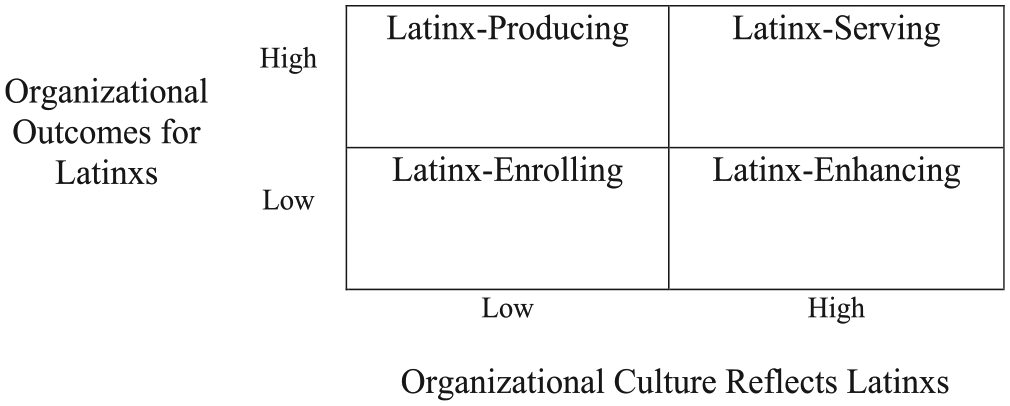
Typology of Hispanic-Serving Institution organizational identities.
While Garcia centered her typology on the organizational level, Núñez et al. (2016) published one of the only articles that accounted for the entire population of HSIs, advancing an essential population-level typology of HSIs. With this typology, Núñez et al. (2016) conceptualized HSI institutional diversity across 2- and 4-year sectors, public and private sectors, and regions of the United States, particularly highlighting Puerto Rican HSIs, which have essentially been ignored in HSI research. They found significant differences in institutional resources among HSIs, and HSIs with lower institutional resources tended also to have lower graduation rates. This research, cited in policy documents such as National Science Foundation’s (NSF; 2017) biannual report on the statistics on women and minorities’ participation in sciences, has provided policy makers and researchers with a sense of the niches that different HSIs fill within the broader system of U.S. higher education. Yet it also highlighted the extreme diversity among HSIs, which complicates the ability to generalize the concept of servingness.
Beyond the debate in the literature about outcomes versus culture, and the extreme institutional diversity among HSIs, there is also extreme diversity within HSIs, with students encompassing considerable racial/ethnic, linguistic, and class identities (Cuellar, 2019; Núñez, Hoover, Pickett, Stuart-Carruthers, & Vázquez, 2013). HSIs are also more likely to enroll less academically prepared students and students who prefer to stay closer to home for college (Cuellar, 2019; Núñez & Bowers, 2011). Collectively, these factors indicate that students who enroll in HSIs have encountered more structural oppression than those who do not enroll in HSIs (Garcia, 2018). That such diverse students might require more and different kinds of support, coupled with the fact that HSIs themselves are so diverse in terms of sector, type, and mission (Núñez et al., 2016), makes defining and operationalizing servingness a complex endeavor.
The complexities and tensions in the literature about what it means to serve Latinx and other minoritized students at HSIs, along with the growing critical mass of these institutions, motivated us to conduct this systematic review of literature in order to better understand how servingness at HSIs has been conceptualized in research. In conducting this review, we are advancing a multidimensional conceptual framework for understanding servingness in HSIs by examining how scholars implicitly and explicitly define servingness in their research, both in the research design (e.g., the questions they ask, the sample they use, the variables they include, the phenomena they focus on), and the empirical findings from the research. This allowed us to conceptualize what servingness means by categorizing and classifying empirical research. Moreover, it allowed us to think about servingness in more complicated ways than simply basing this organizational identity on student-level outcomes and experiences, which Garcia (2015) heavily critiqued, arguing that analyses of HSIs and their servingness must be organizational in nature. The multidimensional conceptual framework for understanding servingness in HSIs necessarily incorporates both student-/individual-level and organizational aspects.
Interrogating Assumptions Underlying the Framing of Servingness
It is also critical to interrogate unintended negative consequences of the way researchers frame servingness, particularly for institutional accountability purposes (Núñez & Rodríguez, 2018). For example, HSIs have been criticized for having lower graduation rates than other institutions, with little regard for the fact that HSIs often function with fewer resources than other institutions to provide education for low-income and students of color that may need extra support in order to be successful (Espinosa, Turk, & Taylor, 2017). In fact, to counter narratives that HSIs fail at producing critical academic outcomes, rigorous empirical research has recently shown that after controlling for characteristics such as institutional control, size, and selectivity, HSIs have similar graduation rates as non-HSIs (Flores & Park, 2015; Rodríguez & Calderón Galdeano, 2015).
Early research with HSIs tended to frame these institutions in an overly simplistic, binary fashion, as either Hispanic-serving (i.e., authentically “serving” Hispanic students) or Hispanic-enrolling (i.e., enrolling a lot of Hispanic students in name only; Núñez et al., 2015). More recent empirical research, however, has illustrated that HSIs’ organizational culture can be more nuanced, where personnel at these institutions conceptualize and enact a range of ways to serve Latinx students (e.g., Garcia, 2016a, 2017a). Although both positive or negative framings of HSIs and their ability to serve Latinx students may be unintentional, the way that researchers approach their research with HSIs matters, as framing has the ability to influence practice and policy concerning HSIs at the local, state, and national level. In fact, the way HSIs are framed in research can have consequences as severe as adversely affecting public funds that HSIs receive (Núñez & Rodríguez, 2018).
With this systematic review of literature, we analyzed how researchers have framed the limitations and contributions of HSIs, drawing from the theoretical base on (anti)deficit framing. Valencia (1997) highlighted the problematic nature of equity research, which often implicitly or explicitly suggests that low-income students and students of color struggle in the educational system because of cognitive, cultural, and motivational deficiencies, as well as shortcomings in students’ families and cultures. By focusing the analysis on students, systematic factors such as school segregation and inequitable funding models escape liability for their role in creating inequities in educational outcomes (Valencia, 1997). When research is framed through a deficit lens, minoritized students are blamed for their own educational failures, while policies are enacted to fix the students, rather than addressing the sociohistorical nature of oppression within the educational system (Valencia, 1997). As a result of this deficit framing, pathologizing practices, policies, and pedagogies are used to reinforce colonialism, subjugation, and the inferiority of minoritized students (Shields, Bishop, & Mazawi, 2005). Although a number of scholars have debunked deficit framing in recent times, contemporary scholarship continues to reify the notion that minoritized students are deficient (Valencia & Solórzano, 1997). In order to disrupt this, scholars must actively frame their research from an assets-based view, starting with the design of the study and the research questions.
Following this line of thinking, the limited, binary framing of HSIs as solely “enrolling” or “serving” (Núñez et al., 2015) is deficit in nature, not taking into account the diversity of HSIs (Núñez et al., 2016) and more complex and nuanced realities faced by HSIs, including a lack of resources and funding (Ortega et al., 2015). Moreover, research often decontextualizes the external political, economic, and social environments within which HSIs operate. Together, these tendencies in the framing of research with HSIs can perpetuate a deficit narrative about these institutions. Higher education research has been dominated by inquiry about the most selective institutions, rather than on institutions that provide access to students of color and low-income students (Deil-Amen, 2015). Therefore, racially minoritized institutions like HSIs have often been positioned as lesser than the most selective institutions (i.e., white institutions; Garcia, 2019), rather than having their everyday “on the ground” practices examined, free of the imposition of the dominant reference point of highly selective institutions (Deil-Amen, 2015; Núñez, 2017a). It is important to recognize the assets and innovations that are developed within these institutions (Conrad & Gasman, 2015), rather than employing inappropriate comparison groups that do not take into account other institutional characteristics such as racial/ethnic composition, selectivity, and resources (Rodríguez & Calderón Galdeano, 2015). That said, conducting research that uncritically advocates for or celebrates HSIs does not serve the best interests of Latinx students either (Núñez, 2017b). Instead, it is the responsibility of researchers to conduct rigorous studies that produce critical knowledge about these institutions and the people within them (Núñez, 2017b).
With this systematic review of literature, we applied Garcia’s (2017a, 2017b) framework of serving by incorporating concepts and measures of culture and outcomes as a heuristic to examine and classify how researchers framed inquiry about HSIs and servingness. We also examined the extent to which research has employed a deficit lens to explore notions of servingness. In using these frameworks, we approached this endeavor as both conceptual (how has servingness been conceptualized?) and methodological (how has research been framed?). With this review, we tried to highlight the purpose, identity, and meaning that researchers have attached to the HSI federal designation, in order to conceptualize servingness while also noting the ways in which HSIs have been situated more broadly in higher education research (e.g., implicitly or explicitly compared with non-HSIs). In doing so, we advance a multidimensional conceptual framework for understanding servingness that can be used in research, practice, and policy.
Method
We conducted a systematic review of the literature to identify research that was relevant to addressing our two research questions: (1) How do researchers explicitly or implicitly conceptualize servingness at HSIs? (2) How do researchers explicitly or implicitly frame the limitations and contributions of HSIs? Specifically, we followed the methods outlined by Petticrew and Roberts (2006) that involve a multistep process for conducting a systematic review. Systematic reviews differ from traditional literature reviews because they involve the use of quality criteria to select appropriate evidence, assess validity, and synthesize compelling evidence on a given topic (Collins & Fauser, 2005). This method serves as a way to reduce the bias that can occur in traditional literature reviews that do not apply a scientific approach to reviewing and summarizing past work (Petticrew & Roberts, 2006). Because we were interested in exploring narrowed research questions about HSIs and their ability to serve students, identifying and reviewing the quality of research with HSIs, and synthesizing the reliable evidence in order to conceptualize a multidimensional, conceptual framework of servingness, a systematic review was appropriate for our study (Cooper, 2010).
Databases and Search Parameters
We searched the ERIC (EBSCO) database using the terms “Hispanic-Serving Institution” and “Hispanic-Serving Institutions.” The search identified a total of 293 publications that included academic journals (n = 169), ERIC documents and dissertations (n = 102), education reports (n = 6), and magazines (n = 16). Using the same keyword searches, we also manually searched the Journal of Hispanic Higher Education (JHHE) because the journal publishes work that is specific to Latinx college students and HSIs. We cross-checked our search of peer-reviewed journal publications by looking at several other databases including Academic Search Complete, EconLit, JSTOR, PsycINFO (ProQuest), ScienceDirect, Web of Science, and Wiley Online Library. Searching these additional databases and JHHE produced 14 academic journal articles that were not duplicative of the previous articles found when searching the EBSCO Host. Examples of the journal sources that were identified in our initial search are provided in Figure 2. Of note, JHHE was the source of a total of 51 publications that were identified in our initial search. Finally, we added book chapters from four books, three of which are specifically about HSIs and one which is about MSIs more broadly (n = 39). Collectively, our search yielded a total of 346 publications.
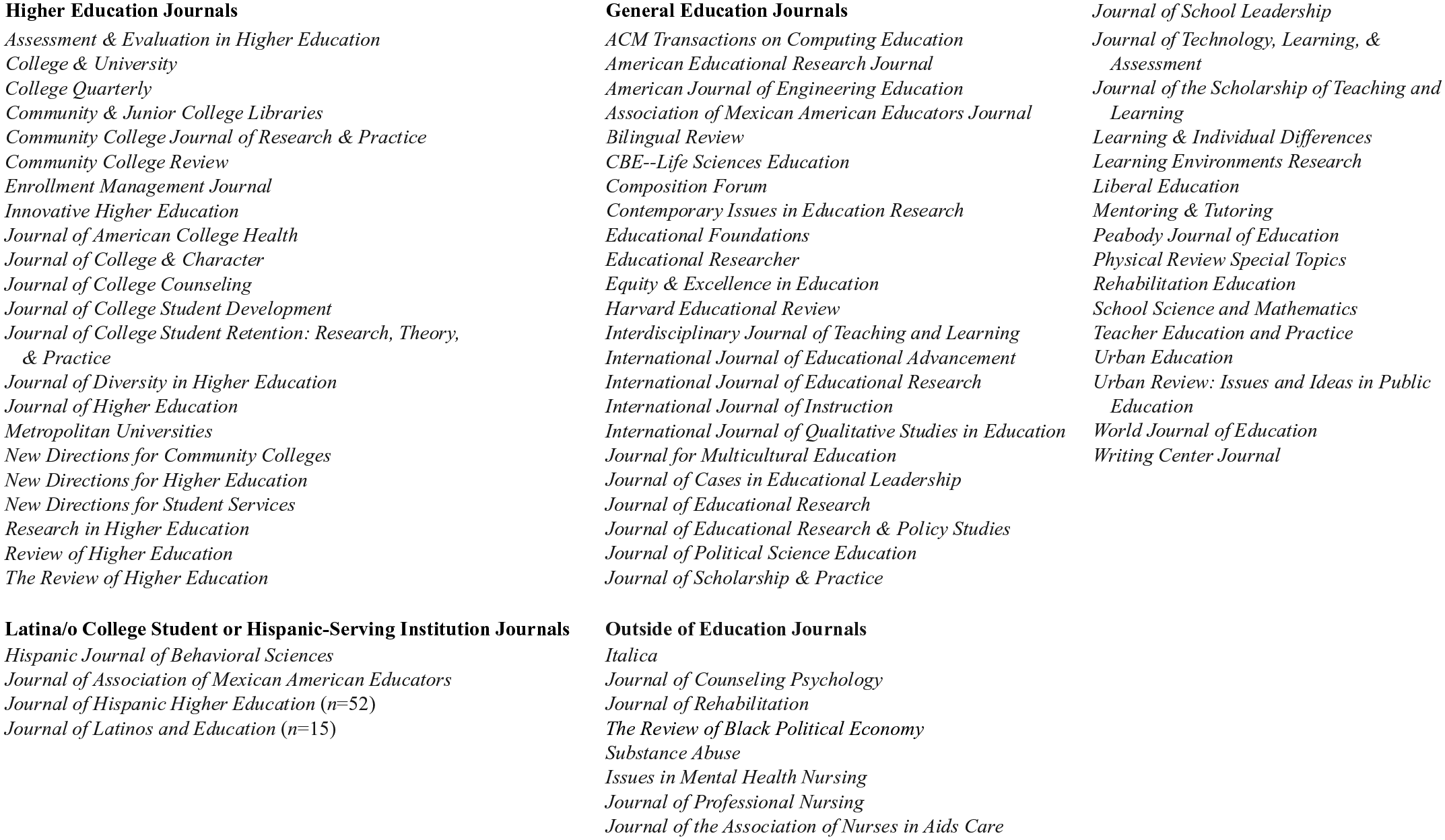
Journals identified in the initial search.
Selection and Screening Process
The publications derived from this initial search were included in a systematic review and judged against an inclusion/exclusion criterion. Studies were included in the initial list if there was an implicit or explicit link to HSIs, including studies that explicitly explored concepts and phenomena with HSIs and those focused on other concepts and phenomena, but conducted at HSIs. This included studies that were not necessarily about higher education phenomena. For example, we included a study that had “HSI” in the title and sampled Latinx students enrolled at an HSI but was focused on health outcomes. Studies that were focused on understanding MSIs were also included in the initial selection if they explicitly addresses HSIs, even if periphery. Studies conducted at HSIs, but that were focused on students from non-Latinx backgrounds, were also considered.
Although we wanted to be as inclusive as possible in order to avoid the loss of potential sources of information, we ultimately decided to exclude ERIC documents and dissertations, education reports, and magazines (n = 124). We excluded dissertations since some had been transformed into multiple journal articles, and we did not want duplication. We also excluded education reports, policy briefs, and magazines, as the range and quality was too large to account for in a systematic way. Moreover, they had not been through an objective peer-review process.
Applying the initial inclusion/exclusion criteria reduced the sample of publications to be systematically reviewed to 222, including 183 journal articles and 39 book chapters. The selected studies represented different research designs including quantitative, qualitative, policy, historical, and conceptual approaches, among others. No limit was placed on the characteristics of the HSIs included; therefore, studies that focused on HSIs across institutional types (e.g., public, private, 2-year, 4-year, etc.) were included. In order to classify each of the 222 publications for analysis, we created a shared spreadsheet that captured and organized the following: (1) whether or not the HSI context was considered in the design and implementation of the study; (2) whether or not deficit framing was used in the analysis or findings; (3) the unit of analysis; (4) whether or not the study was empirical; and (5) the institutional characteristics of the HSI(s). We used this shared spreadsheet to review selected articles for quality criteria, to establish trustworthiness, to develop a list of codes that captured the distinct ways researchers conceptualized servingness, and to code the final set of publications included.
Quality Criteria
The 222 publications that were selected from the initial inclusion/exclusion procedure were systematically assessed for quality. The standard of each study’s quality was assessed using criterion measures (Caldwell, Henshaw, & Taylor, 2005; Petticrew & Roberts, 2006), represented by a series of questions. These questions were created by the authors to help them identify and assess the scientific quality of each publication (see Table 1). The data from these questions were added to the shared spreadsheet in order to help the authors organize the information obtained while assessing whether each study met the quality criteria. We responded to each criterion measure question using a 0- to 1-point scale, with 0 = no and 1 = yes.
Quality criteria
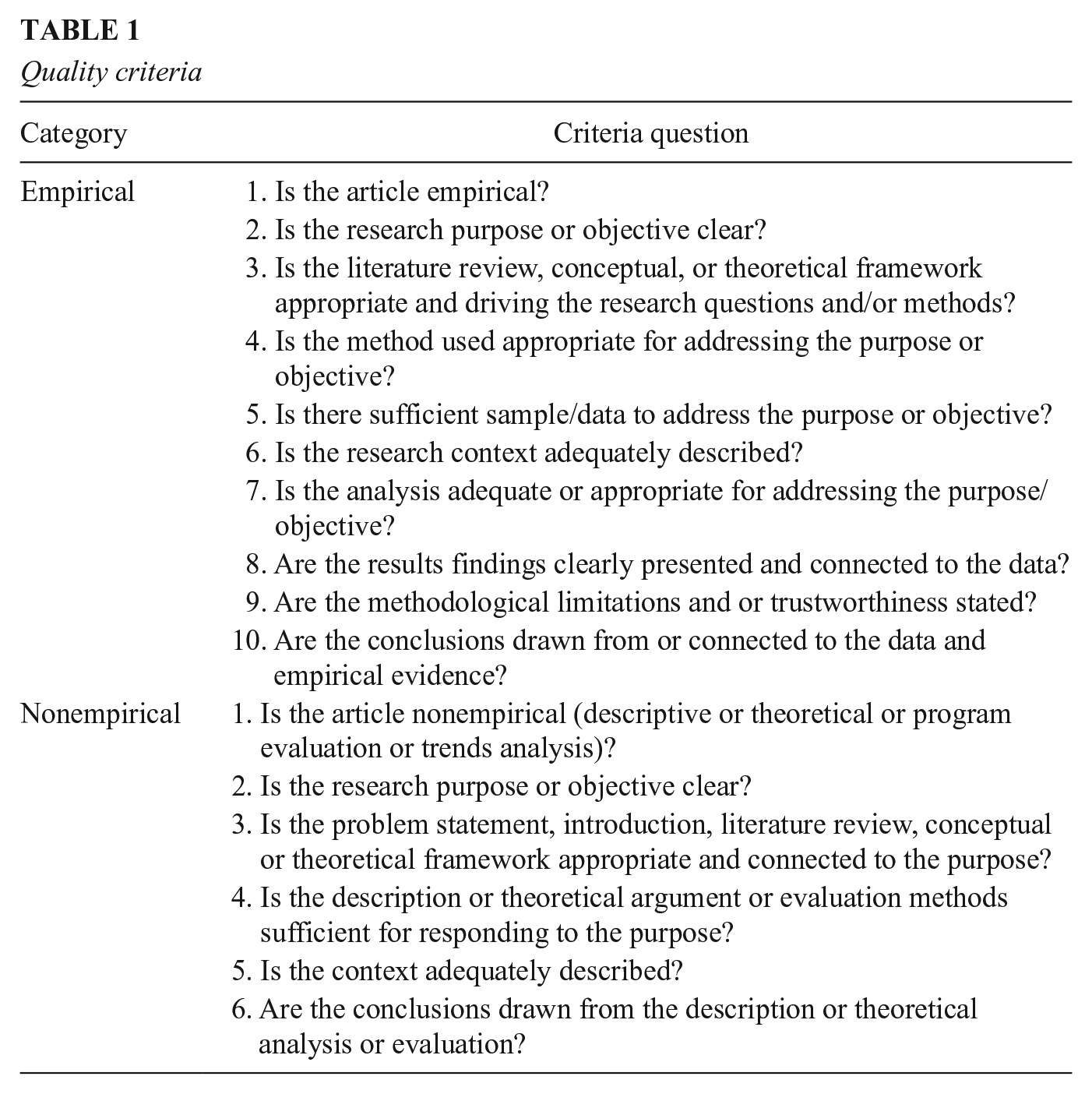
Our selection of studies was further based on two different criterion scales—empirical and nonempirical publications. We purposefully created these two criterion scales because the articles that we labeled as nonempirical did not fit well into the first set of criterion measures we created. For example, one measure of quality was the use of a guiding theoretical or conceptual framework, yet we found that nonempirical publication did not usually include a theoretical or conceptual framework. We also assessed methods and analyses used, which were not always clear in nonempirical publications. As such, we developed a second set of questions and criterion scale that was better designed to assess the quality of nonempirical work. Once the scales were developed, each study was grouped according to whether they were identified as empirical or nonempirical. We then reviewed studies using the appropriate criterion scale. Empirical studies, or those that employed scientific methods and included data collection and analyses, were evaluated along 10 criterion measures and were included in the final database for analysis if the total score was equal to or greater than 6. Studies that were nonempirical, descriptive, or theoretical in nature were evaluated along 6 criterion measures and must have achieved a score a 4 or higher to be included in the final database for analysis.
Studies that did not meet quality criteria (i.e., below 6 for empirical studies or below 4 for nonempirical studies) were excluded from the final review. Empirical studies were often excluded for not meeting quality criteria because they had a misalignment between the title (“Effectively Serving AB540 Undocumented Students at an HSI”), the purpose (to explore the experiences of undocumented students), the research questions (no clear research questions listed), the conceptual framework (barriers and obstacles, resilience), the methods (mixed, surveys, interviews, and focus groups), and the unit of analysis (faculty and staff). Nonempirical studies that were excluded based on quality often were misaligned in many ways as well, such as title (“Hispanic College Students Library Experience”) and purpose (to examine academic libraries move toward electronic library materials). After completing this quality check procedure, 74 publications were determined to be below quality and therefore removed. This left a final total of 148 publications, which included 109 journal articles (empirical and nonempirical) and 39 book chapters (empirical and nonempirical), that met our quality criteria and were included in our systematic review. Figure 3 shows the entire search and screening process.
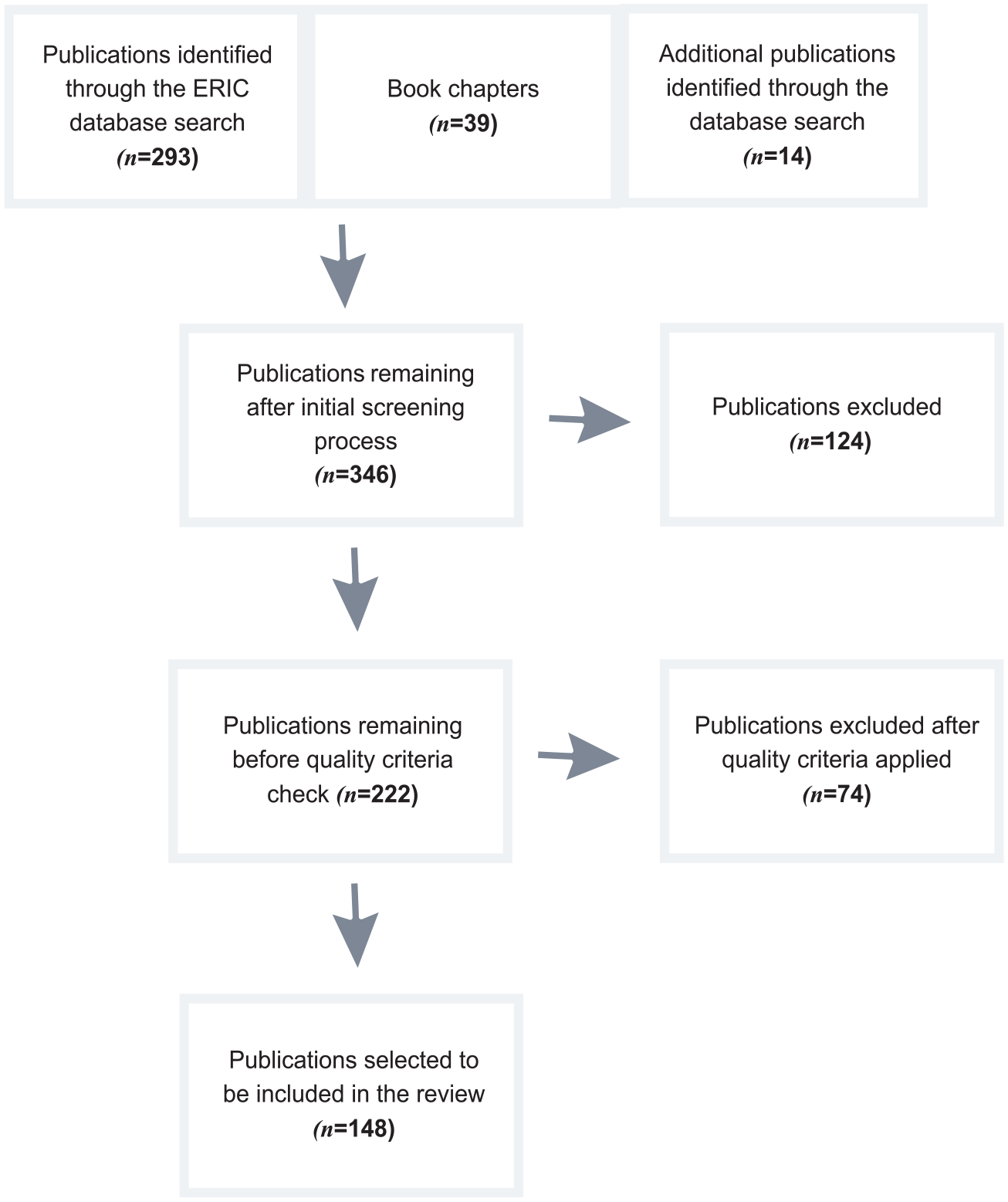
Search and screening process results.
Coding and Intercoder Reliability
Using the 148 publications deemed acceptable quality, next we developed a coding structure to be used in our analysis. Each author read, reviewed, and developed initial codes for 20 randomly selected studies independently. Studies that were published by one of the authors were assigned to be reviewed by another author that did not work on the publication. Each author used the shared spreadsheet to develop initial codes and noted any questions that emerged when reading and reviewing each publication. After the first round of evaluations were completed, we met to discuss the codes that were emerging. During this meeting, we developed a list of 11 codes, discussed the meaning of each code, developed initial definitions of each code, and assessed the codes’ relevance to the research questions. Using the list of 11 codes and their definitions, we then independently coded the same 20 articles. We added an additional eight articles to this phase in an effort to ensure coding consistency and validity. Once coding was completed, we met a second time to discuss the usefulness of the codes and our understanding of the codes.
Through this systematic process of developing codes, we sought to ensure trustworthiness and minimize article selection bias between authors (DeCuir-Gunby, Marshall, & McCulloch, 2011). In addition to discussing codes during these meetings, we also discussed each of the other categories in the spreadsheet, including whether or not we felt the study framed HSIs as deficit, and if the researchers had considered the HSI context. We continued to interrogate each article while challenging our own assumptions about quality and usefulness of each article in conceptualizing servingness, and about what we believed was deficit framing. When discrepancies occurred, either about code definitions or about our assumptions as researchers, we discussed the issues until an agreement was reached by all the authors. This entire process was done to ensure trustworthiness, reliability, and consistency between the authors before coding the remaining articles and moving to analysis.
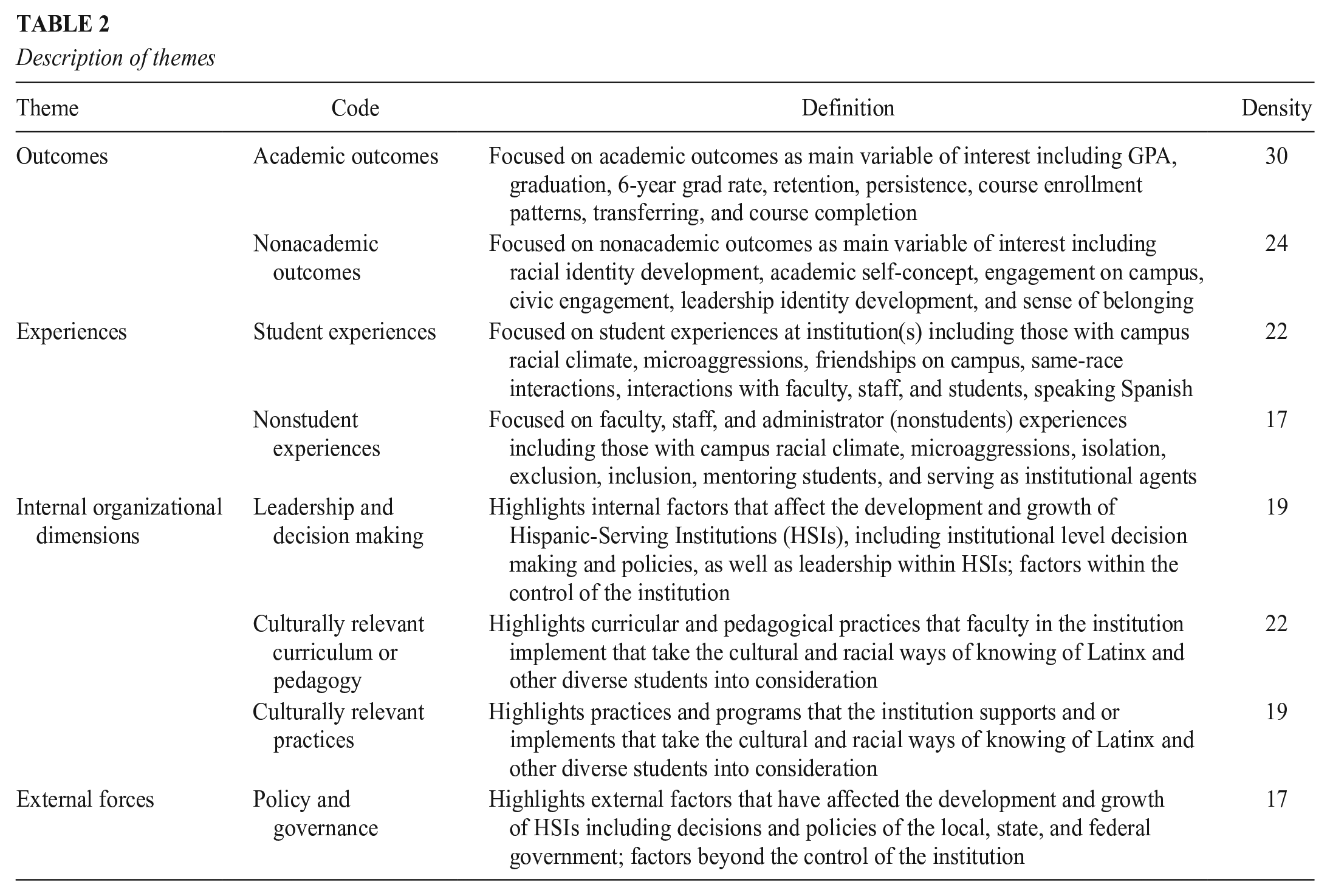
Through this process, we simultaneously developed a coding framework to be used for analysis. The framework included the following 11 codes: (1) academic outcomes, (2) nonacademic outcomes, (3) student experiences, (4) faculty and staff experiences, (5) external policy and governance, (6) internal leadership and decision making, (7) culturally relevant practices, (8) culturally relevant curriculum and/or pedagogy, (9) history and overview, (10) access, and (11) other. We also identified four initial themes, collapsing the 11 codes into these themes, which further expounded our investigation of how researchers had conceptualized servingness: (1) outcomes, (2) experiences, (3) internal organizational dimensions, and (4) external forces (see Table 2 for themes, codes, and definitions).
Description of themes
Data Analysis
In the next phase of analysis, the remaining studies of the 148 (n = 120) were randomly assigned to the authors and coded independently using the coding framework, bringing the total sample size used in the analysis to n = 148. Understanding how serving was conceptualized by other researchers involved a process of examining each study’s research design, framing of the research questions, data sources, analysis approach, and interpretation of findings. During the data analysis process, we considered the rigor of the research and whether there was strength in the evidence and interpretations made about HSIs. Specifically, we examined whether the research design was focused on understanding HSIs, as organizations or as a population, or the influence of HSIs. This included assessing whether the study drew from research on HSIs and effectively articulated a conceptualized framework to understand the organizational context and variation. We felt this was particularly important among studies that grouped HSIs as a whole despite there being contextual variation in their samples (e.g., 2-year vs. 4-year, public vs. private, rural vs. urban). For quantitative studies, we scrutinized whether appropriate variables were selected that could accurately be used to understand servingness. Among qualitative studies, we paid particular attention to the data collection and whether it detailed and accounted for the context of the HSI(s). Last, in inspecting the units of analysis, data sources, and sample sizes in each study, we determined whether a study overstepped a broader generalization about HSIs. In other words, we examined whether the results found in a study that sampled one HSI used these findings to make generalizations about all HSIs.
Results
Our systematic reviewed revealed four broad themes used by researchers to conceptualize servingness at HSIs, including outcomes, experiences, internal organizational dimensions, and external influences. In this section, we provide a summary of each of the four main themes and discuss how these themes indicated servingness in the studies reviewed. The articles used are exemplary representations of the themes, yet we caution the reader that many articles are representative of more than one theme, meaning there is overlap in the themes (they are not mutually exclusive). We tried our best to use examples where the highlighted theme is dominant. We also discuss the framing HSI research, highlighting limitations and contributions.
Outcomes
Outcomes were a common way that authors conceptualized HSI servingness, whether implicitly described as measures of servingness or not (n = 54). Outcomes included both academic and nonacademic variables, and were largely student-centered, meaning researchers made meaning of servingness based on student-level outcomes.
Academic Outcomes
A total of 30 articles described academic outcomes such as GPA, 6-year graduation, retention, course enrollment, course completion, and transferring. Yet within the 30 articles, there was a lack of consistency in the findings and the conclusions made by researchers about how well HSIs were serving Latinxs with regard to academic outcomes. Some researchers concluded that HSIs were serving Latinx students in STEM majors well (Camacho & Lord, 2011; Crisp, Nora, & Taggart, 2009). For example, using logistical regression analyses, Crisp et al. (2009) quantitatively revealed that Latinx students at one large doctoral granting HSI were 1.37 times as likely to declare a STEM major than white students. Other scholars stressed that HSIs were adequately enrolling students in all majors, but found evidence of inequitable baccalaureate outcomes for Latinxs attending HSIs (Contreras et al., 2008). Using structural equation modeling, Garcia (2013) showed that the percentage of Latinx students enrolled at HSIs and non-HSIs did not predict graduation rates for Latinxs, while Hagedorn, Chi, Cepeda, and McLain (2007) used ordinal regression analyses to show that the representation of both Latinx faculty and students at nine community colleges in California did positively and significantly influence GPA and course completion rates, albeit moderately.
After controlling for student characteristics and institutional capacity using propensity score matching techniques, Flores and Park (2015) concluded that attending an HSI in Texas did not have a negative or positive effect on college completion rates for Latinxs. One way to think about this is that HSIs are not necessarily serving Latinx students any better or worse than non-HSIs. Rodríguez and Calderón Galdeano (2015) came to similar conclusions using the same institutional matching technique, with both sets of authors noting that their findings countered the dominant narrative that HSIs were underperforming, or not serving Latinx students well. In all of these cases, the authors suggested that servingness was defined by academic outcomes. Beyond academic outcomes, scholars have also hypothesized that post-baccalaureate enrollment (Garcia, 2017a) and labor market outcomes were important indicators of servingness (Park, Flores, & Ryan, 2018), yet to a much lesser extent and with less empirical evidence.
Nonacademic Outcomes
A total of 24 articles indicated that nonacademic outcomes were measures of servingness, including outcomes such as academic self-concept, civic engagement, social agency, racial/ethnic identity salience, and leadership development. Using data from the Cooperative Institutional Research Program and hierarchical regression analyses, Cuellar (2014) found that Latinx students who attended HSIs had a greater increase in academic self-concept over 4 years than those who attended non-HSIs, yet they did not show a significant increase in social agency and commitment to social action (Cuellar, 2015). Although she concluded that HSIs served students well by enhancing self-perceptions of their academic ability and potential, she claimed that the lack of a statistical difference on the social agency variable simply meant that HSIs were serving students equally well as non-HSIs when it came to empowering them to take action around social issues. Through focus groups interviews with 11 self-identified Latina women student leaders, Onorato and Droogsma Musoba (2015) discovered that Latinas attending one HSI in the Southeast had greater opportunities to hold leadership positions in mainstream organizations, rather than ethnic-based organizations, which gave them more opportunities to enhance their leadership skills. Through qualitative focus groups, Guardia and Evans (2008) and Garcia et al. (2018) concluded that the HSI context provided Latino men with curricular and cocurricular opportunities that enhanced their racial/ethnic identity development.
Experiences
A second way that authors conceptualized servingness was by exploring and describing experiences that people have at HSIs (n = 39). Experiences included those of both students and nonstudents (faculty, staff, administrators), suggesting that there is more to servingness than what happens to students. Instead, the experiences of all members within the organization shape servingness. Examples of experiences examined in the research included interactions with same-race peers, the presence of Spanish-speaking faculty, staff, and students, and perceptions of the campus climate at HSIs.
Student Experiences
Of the 39 articles and chapters that we coded as “experiences,” 22 focused on student experiences. Using qualitative interviews with students at one HSI in the Southwest, Arana, Castañeda-Sound, Blanchard, and Aguilar (2011) found that students who persisted said that having supportive faculty and staff who understood racial identity politics was an essential factor in their undergraduate experience. Students have also said that having a recognizable Latinx cultural heritage on campus, a critical mass of Latinxs on campus, and culturally validating experiences positively enhanced their experience at an HSI (Arana et al., 2011; Garcia, 2016a; Guardia & Evans, 2008; Rendón, Nora, & Kanagala, 2015). Moreover, some researchers concluded that having the ability to speak Spanish with peers, faculty, and staff was a comforting experience for Latinxs who attended HSIs (Guardia & Evans, 2008; Sebanc, Hernandez, & Alvarado, 2009). Sebanc et al. (2009) interviewed 46 English–Spanish bilingual students attending one HSI and found that they viewed their friendships with other bilingual friends as more positive as a result of understanding, connections, and cultural identifications, yet these feelings varied somewhat by immigration status and Spanish fluency.
Some students in Sebanc et al.’s (2009) study also said that they felt discriminated against on campus when they spoke Spanish or English with an accent, suggesting the climate on campus for bilingualism is complex. Rendón et al. (2015) described similar tensions with language that Latinx students felt at one HSI in Texas. Using a mixed-methods approach, Cuellar and Johnson-Ahorlu (2016) also showed the complexities in perceptions that students of color at one HSI community college had of the campus climate. Quantitatively, they found that Asian American students were more likely than white and Latinx students to report discrimination and bias on a survey, yet qualitatively through a series of focus groups, Latinx students reported instances of perceived discrimination at higher rates that Asian American and white students, stating that they sometimes felt supported on campus but sometimes felt they were discriminated against based on their race, ethnicity, and/or language (Cuellar & Johnson-Ahorlu, 2016). Desai and Abeita (2017) used field notes and one-on-one interview data with one Diné (Navajo) student at an HSI to reveal her experiences with microaggressions, noting egregious institutionalized microaggressions she encountered “via the university seal, the commodification and exploitation of Native are/cultural objects, and finally the presence of racist and stereotypical murals and artwork displayed in prominent places on campus” (p. 282).
Nonstudent Experiences
Another 17 cases focused on nonstudent experiences, highlighting the voices of faculty, staff, and administrators. Like Cuellar and Johnson-Ahorlu (2016), Garcia (2016b) concluded that the campus climate at one HSI in the Southwest was similarly complicated for student affairs staff. Using a narrative approach, Garcia (2016b) reported on the experiences of three student affairs staff members, showing how one participant felt her office was a counterspace for both students and staff of color, while another felt alone as the only professional of color in her office on the same campus. A group of nine Latina faculty members and one white faculty member at an HSI used a dialogical epistemological research approach to reveal how they created their own community, called Research for the Educational Advancement of Latin@s (REAL), as a way to support and mentor each other in their bids toward tenure (Ek, Quijada Cerecer, Alanis, & Rodriguez, 2010). Although working at an HSI allowed them to teach and mentor a large percentage of Latinx undergraduates, they recognized that they were still being evaluated and judged based on dominant Eurocentric male ideologies. Yet being at this HSI gave them access to like-minded Latinas, which allowed them to strengthen their research skills and empowered them to challenge racism and sexism at the institution (Ek et al., 2010). These and other studies that focused on both student and nonstudent experiences at HSIs suggested that servingness can be determined by the experiences that people have within these environments, yet highlighted the tensions inherent in serving minoritized groups.
Internal Organizational Dimensions
The third way that researchers conceptualized servingness was by addressing internal dimensions in the organization (HSI) that had been altered in order to respond to the needs of Latinxs on campus (n = 60). Internal organizational dimensions included institutional policies and decision making as well as curricula, programs, and practices at the institution. We considered these elements within the control of the institution, and therefore essential for understanding, as these dimensions can be altered, as needed, to better serve Latinxs. We broke the publications that centered their analysis on internal organizational dimensions into three subthemes: leadership and decision making, culturally relevant pedagogy and curriculum, and culturally relevant programs.
Leadership and Decision Making
First, leadership and decision making includes practices and policies that nonstudents enact and that may influence servingness. We coded 18 cases as such. One practice that scholars have noted as important for HSI leaders to address is the mission of the institution. In analyzing the mission statements of 10 four-year HSIs, however, Contreras et al. (2008) documented that none had indicated that they had a mission to serve Latinx students, despite the fact that all mentioned diversity, multiculturalism, and/or access as core values. Yet Flores and Park (2015) and Garcia (2016a) noted in their studies that beyond the stated mission, when HSI leaders applied for the HSI designation and made the decision to pursue competitive federal grants, they voluntarily committed to addressing educational equity gaps for Latinx and other minoritized students at their institutions. Torres and Zerquera (2012) proposed a “readiness” scale that leaders at HSIs could use to assess their readiness to serve. The scale suggested that leaders should develop an institutional mission for serving Latinxs, an institutional plan for diversity, marketing strategies for enrollment, a commitment to the local community, a Latinx-inclusive website, and programs and services for Latinx students. Each of these elements can be considered internal decisions that institutional leaders must make in order to address their level of servingness.
The literature shows, however, that leaders at HSIs face a number of decision-making challenges. Importantly, HSI leaders struggle to recruit, train, and retain part-time and full-time faculty that can effectively teach minoritized students (de los Santos & Cuamea, 2010; Murphy, 2013). Using descriptive data from sources such as Integrated Postsecondary Educational Data System, scholars have highlighted huge gaps in faculty, staff, and administrators of color at HSIs (Gonzales, 2015; Santos & Acevedo-Gil, 2013). Others have used empirical evidence to show how faculty and administrators of color became institutional agents who actively worked to disrupt systems of oppression that were preventing Latinx students from succeeding (Espinoza & Espinoza, 2012; Garcia & Ramirez, 2018), while legitimizing and mobilizing the funds of knowledge that Latinx students brought to the institution (Gonzales, 2015). As such, researchers have argued that HSI leaders must determine the best ways to recruit faculty, staff, and administrators of color who can influence servingness.
Culturally Relevant Pedagogy and Curriculum
Second, we defined culturally relevant curriculum and pedagogy as those that took into consideration the racial and cultural ways of knowing and learning of students from minoritized backgrounds. Like leadership and decision making, curriculum and pedagogy are within the purview and control of the institution, and particularly the faculty teaching at HSIs. Yet Cole (2011) found that only about 3% of the curriculum at HSIs was ethnocentric, meaning it strictly considered the perspectives and culture of one ethnic group (e.g., Latinxs, African Americans, Native Americans). This finding was not surprising, as this reality is indicative of the settler colonialism embedded within the structures of postsecondary institutions since their founding (Patel, 2016; Wilder, 2013). This reality has not escaped HSIs, yet researchers have argued for more culturally relevant curricula. In our sample, there were 22 articles and chapters highlighting culturally relevant curricula or pedagogical practices at HSIs. We noted that most of these articles were focused on one classroom at one HSI, meaning that these articles are not generalizable to all HSIs.
The availability of culturally relevant curriculum may be a sign of servingness at HSIs, particularly when the curriculum is ethnocentric, historic, embedded within the normative structures of the institution, and part of the learning goals of the institution (Garcia & Okhidoi, 2015). Garcia and Okhidoi (2015) used interviews, document analysis, and observations at one HSI in the Southwest to understand how the university institutionalized its Chicana/o Studies program by offering Chicana/o courses across the curriculum and allowing students to take these courses as part of their core curriculum requirements. Sanchez, Ramirez, and Hernandez (2013) documented their personal experience with a 3-year intentional course redesign process at their HSI in California, as part of their commitment to become more Latinx-serving. Faculty on campus helped identify high enrollment classes with high failure rates, and considered these as part of the course redesign before settling on a biology sequence, charging a team of biology professors with the redesign, which eventually resulted in higher pass rates in these courses (Sanchez et al., 2013). The article highlighted the intentionality that must be enacted at HSIs to become better at serving minoritized students through the curricular structures.
Several articles specifically addressed culturally relevant pedagogy that faculty at HSIs use as a means of engaging minoritized students and centering racial and cultural epistemologies. Through a case study inclusive of interviews, focus groups, document analysis, and observations, Garcia (2016a) found that faculty at one HSI in the Southwest talked about connecting with students on a cultural level and seeing them as cocreators of knowledge, while students at the same institution described how essential these pedagogical practices were as it made them want to learn from these faculty members. Using an autoethnographic approach, Murakami-Ramalho, Núñez, and Cuero (2010) explored how their mixed-race identities affected their ability to advocate for Latinx students at one HSI in Texas. They found that they used their identities to connect with students, teach for social justice, and form resistance capital while teaching. Through this research they learned that they needed to see themselves as racialized and gendered people in order to successfully implement culturally relevant pedagogical practices intended to engage students from a variety of minoritized backgrounds.
Beyond these single cases, Kiasatpour and Lasley (2008) used the 2006 Survey of Texas Political Science Instructors to compare how political science faculty teaching at HSIs, “national universities,” and “other” colleges and universities incorporated pedagogical practices that have been shown to engage minoritized populations, including service-learning opportunities and teaching strategies such as group activities and free writing. In comparing mean scores, they found that political science faculty at HSIs did incorporate these techniques at statistically higher levels than those at national and other institutions (Kiasatpour & Lasley, 2008). Similarly, analysis of a national sample of higher education institutions found that faculty at HSIs were more likely to use student-centered pedagogies like collaborative learning and journaling, in comparison with faculty at other institutions (Hurtado & Ruiz Alvarado, 2015).
Culturally Relevant Programs
Finally, some authors have focused on culturally relevant programs at HSIs, suggesting that these types of programs are a sign of servingness. We coded 19 cases that highlighted culturally relevant programs. Garcia and Okhidoi (2015) used case study data, including interviews, documents, and observations, to provide evidence of how one HSI in the Southwest scaled up and embedded the Educational Opportunity Program (EOP), which has historically served low-income, first-generation students of color, within the structures of the institution. They documented how the institution established one central EOP office and multiple satellite offices in all of the academic colleges, each with a director and a full-time staff of advisors to work with all students. This model was unique, as grant-funded programs such as EOP are often on the margins of an institution, yet this HSI recognized the importance of EOP in its ability to serve minoritized students, intentionally investing resources into this program (Garcia & Okhidoi, 2015). Natividad (2015) theoretically argued that programs at HSIs should help students develop collective knowledge and language that enhances their cultural identity, providing descriptive evidence (including pictures) of how the Nepantla Program at one HSI used symbolism, imagery, and messages to promote college-going among Latinxs. Finally, E. Martinez and Gonzales (2015) conducted a descriptive analysis of programs that bridged academic and student affairs at six HSIs, showing how these programs were effective in supporting Latinxs by recognizing the assets these students bring to campus. The internal organizational dimensions discussed in each of these articles and chapters remind administrators, faculty, and staff at HSIs that they must be intentional in their efforts to serve Latinx students.
External Influences
The fourth and final theme is external influences, such as state and federal legislation. Although authors did not necessarily write about policies and external forces as indicators of servingness, these influences may affect an institution’s ability to effectively serve minoritized students. Also, policy and governance are often beyond the control of the institution, yet institutions respond to the external environment, seek legitimacy, and act in ways that conform with institutionalized ways of knowing as determined by the field (DiMaggio & Powell, 1983; Gonzales, 2013), so it is important to regularly monitor these forces. In our search, the fewest number of articles and book chapters discussed external influences (n = 17).
Some literature focused on the federal legislation that led to the establishment of HSIs; however, most of it was historical, with a majority describing how HSIs became HSIs. In a thorough historical depiction of legislative actions leading to the 1992 decision that recognized HSIs, Valdez (2015) highlighted the advocacy work of the Hispanic Higher Education Coalition and the Hispanic Association of Colleges and Universities (HACU). He argued that Hispanic Higher Education Coalition, which included high-profile Latinx groups such as the Mexican American Legal Defense and Education Fund and the National Council of La Raza, and HACU were pivotal in advocating for the HSI designation during legislative hearings throughout the late 1970s and 1980s. Like previous historical analyses published by MacDonald, Botti, and Clark (2007) and Olivas (1982), Valdez stressed that the recognition of HSIs at the federal level was the result of self-determination and long-term advocacy efforts by Latinx community and educational leaders who sought out allies and resources that would help institutions enrolling the largest percentage of Latinxs better serve them.
Other publications have highlighted external forces that shape servingness. HACU, for example, has remained a constant advocate for Latinx college students in general, and the primary champion for HSIs, lobbying for greater political and economic support for these institutions (Calderón Galdeano, Flores, & Moder, 2012). Calderón Galdeano et al. (2012) published a descriptive article, stressing HACU’s essential role in increasing appropriations to HSIs under Title III and Title V, as well as lobbying for funding from agencies such as the U.S. Department of Agriculture, the Department of Housing and Urban Development, and the Department of Defense. In fact, the federal investment in HSIs increased annually from 1996 to 2004; however, it has since remained steady, at about $92 to $94 million each year, despite the fact that the number of HSIs has increased dramatically each year, and will continue to increase (Ortega et al., 2015).
Ortega et al. (2015) used data from the Delta Cost Project to analyze revenue trends for HSIs, raising concerns about these trends. For example, they showed that public 2-year and 4-year HSIs relied heavily on state, local, and federal grants and appropriations, are limited in their ability to increase tuition as a source of revenue, and are absorbing the declining investment in higher education from their states (Ortega et al., 2015). Even more concerning, research has shown that leaders at HSIs were ill-equipped to enhance their institutional advancement efforts (Mulnix et al., 2002, 2004; Ortega et al., 2015). Using survey data collected from 80 HSI leaders, Mulnix et al. (2004) found that 30% of the HSIs in their sample did not have offices that regularly monitored federal grant opportunities and 35% did not have staff that regularly interfaced with local, state, and private foundations.
Some researchers have considered the influence of state-level policies on the emergence of HSIs. M. Martinez (2015) analyzed state-level policy in Nevada, showing the political process undertaken as the state sought to embrace the emerging HSI status of Nevada’s public institutions. In response to declining financial support for higher education in the state, key stakeholders, such as state legislative representatives, the Latin Chamber of Commerce, and campus Offices of Diversity, explored the definition and implications of being HSIs (M. Martinez, 2015). Yet even with state-level support for HSIs, Martinez showed that there were still tensions present, such as those presented by a simultaneous push for a college completion agenda and pushback from academic deans who had concerns about their ability to hire faculty of color to match the changing student demographics (M. Martinez, 2015). Using an historical analysis, Doran (2015) documented similar tensions in Texas, as the University of Texas, San Antonio, made decisions that increased the enrollment of students of color, such as opening a downtown campus closer to the population, while simultaneously pushing for Tier 1 status, which in many ways negated their efforts to be broad access. These case studies highlighted clearly how external forces, such as state-level policies and decisions, may help or hinder an institution’s ability to serve racially minoritized students.
Flores and Morfin (2008) used descriptive enrollment data to analyze changes in the enrollment of students from various racial/ethnic backgrounds into less selective institutions (which are most likely to be HSIs) in California and Texas, since both states had policies banning affirmative action in admissions. They found limited evidence that the bans on affirmative action had led to an increase in the enrollment of Latinxs in less selective institutions (Flores & Morfin, 2008). More important, they found that Black, Asian, and white students have shown a greater overall increase in enrollment into these less selective institutions than Latinxs (Flores & Morfin, 2008). Núñez and Bowers (2011) came to similar conclusions, empirically showing an increase in the enrollment of racially minoritized students at HSIs (e.g., Black, Asian American, Native Americans), suggesting that external policies may have been the reason. Torres and Zerquera (2012) used U.S. Census data to identify “potential” HSIs in states with increasing numbers of Latinxs in the population, noting the importance of recognizing how changing demographics in the external environment must lead to changes internal to the institution. In general, the literature that focuses on external influences, such as legislation and policies, show that these forces indirectly affect institutions’ ability to serve Latinx students.
Framing HSIs in Research
Through our methodological analysis, we discovered two important considerations when exploring how researchers explicitly or implicitly frame the limitations and contributions of HSIs: (1) unit of analysis and (2) intentionality in considering the HSI context in research design and approach.
Framing of HSIs Based on Unit of Analysis
We identified several studies where the unit of analysis was not the HSI, as an organization or a population. Instead, the unit of analysis was students (n = 36), faculty (n = 13), or programs/interventions that were located at an HSI (n = 17). Because the unit of analyses in these studies were not the HSI, as an organization or population, findings from these studies demonstrated factors or experiences with the population being studied, and not necessarily the HSI. For example, a study by Maestas, Vaquera, and Muñoz Zehr (2007) was focused on understanding students’ sense of belonging on an HSI campus. The authors in this study used secondary data from the Diverse Democracy Project, which asked students about their experiences and perceptions of a number of topics that were associated with their sense of belonging. Although data collected revealed students’ experiences with the campus, the questions were not specific to the HSI context, and in fact, the institution was the only HSI included in the data set. Although we included studies that had the individual as the unit of analysis in our conception of the way researchers made sense of servingness at HSIs, we caution readers to evaluate authors’ interpretations of findings about HSIs, noting when the HSI, as an organization, was not the unit of analysis. We suggest that individual experiences be considered as indicators of serving, without making claims about the HSI as an organization.
HSI Context Considered in Design and Approach
We thoroughly analyzed whether researchers explicitly considered the HSI context in their studies, meaning one of the main purposes of their research was to theorize what it meant to serve Latinx students and/or be an HSI, and/or the focus was to better understand the complexities of HSIs. In these studies, the authors’ research questions were focused on understanding HSIs and their research was guided by HSI literature. For example, Núñez et al. (2016) asked the guiding question, “How can we characterize the institutional diversity among HSIs?” (p. 57) as they developed their study. Another example is when Fosnacht and Nailos (2016) asked the research question, “Are HSIs especially effective in promoting student engagement for Latinas/os?” (p. 191).
In one such study, Núñez and Bowers (2011) used nationally representative data to quantitatively examine what factors were associated with a student choosing to enroll at an HSI. To conceptualize their model, they drew on literature that was specific to HSIs as well as an organizational model that identified environmental predictors associated with their outcome of interest. The authors incorporated variables into their conceptualized model that were found to have a relationship with a student choosing to enroll at an HSI. Because the research questions and design accounted for organizational variation, the authors were able to make claims about the HSI and its relationship with student outcomes. We coded 69 cases as “explicit” and primarily drew on these publications as we answered both research questions.
Alternatively, we found that in 42 instances, the HSI context was not explicitly addressed throughout the study, from the purpose, research questions, and methods to the discussion and conclusions made. In these instances, being an HSI was simply an institutional characteristic used to describe the setting of the research, much like higher education researchers describe institutions as public or private, large or small, or research or comprehensive universities when they are describing the institutional sample in their methods sections. In these 42 instances, the use of the term, “HSI” was often only in the title of the article, the abstract, and/or the methods section, but rarely considered as a finding or important point of discussion. For example, researchers might indicate that, “the survey was administered at one HSI in the Southwest” but nothing more.
In between these two extremes (explicit and not considered), we also found that some articles minimally considered the HSI context (n = 25). In these cases, the authors mentioned HSI status beyond the title, abstract, and/or methods section, yet often lacked explicit claims about HSIs and servingness. For example, Cervantes (2015) stated, “I reflect on my students’ final performative project in my undergraduate Latino Cultural Expressions class at a Hispanic-Serving Institution” (p. 69), and then proceeded to describe the context in detail, including the racial breakdown of the institution at the surrounding community. In the article, he made strong claims about his use of “culturally sustaining pedagogy” in his class, providing examples as evidence, but never connected his own racial/ethnic identity to that of the institution and/or his students, which may have been a much stronger case for how the racialized identity of HSIs are connected to racialized identities of those within the institution (Garcia & Dwyer, 2018; Garcia, 2019), and most important, how essential faculty are to defining servingness within HSIs. For the 67 cases in which the HSI context was not considered or minimally considered, it was difficult to determine the conceptualization of servingness and the framing; therefore, we did not draw as heavily on these 67 to answer either research question.
We also found that in 13 instances, authors actually concluded that the core phenomenon they were examining was influenced by the HSI context. By this we mean that the authors did not intend to talk about HSIs as a core concept or to define servingness; however, the HSI context was such a powerful influence that it emerged as significant. For example, in looking at the trends in equity for women faculty and administrators at 2-year colleges, Opp and Poplin Gosseti (2002a, 2002b) found that being an HSI was a significant positive predictor of representation of both women of color faculty and administrators at these institutions. From these articles, it can be concluded that although faculty of color and administrators of color are still not represented at comparable rates to students of color in HSIs (Gonzales, 2015; Santos & Acevedo-Gil, 2013), 2-year HSIs are actually better than 4-year HSIs at hiring women faculty and administrators of color, which could be essential to serving Latinx students. We also drew from these 13 cases as we answered the stated research questions.
Deficit Framing
Of the 69 cases in which the HSI context was explicitly considered, we coded 10 as “deficit framing,” which we defined as researchers framing HSIs in a way that portrayed them as less effective than non-HSIs, sometimes making claims that HSIs are not actually serving Latinx students or arguing that they are simply “Hispanic-enrolling” (used by authors in a negative way, minimizing the fact that providing access to Latinxs is an important endeavor for postsecondary institutions). In one example, authors claimed that Latinx students might perform better at non-HSIs with higher transfer and graduation rates and more opportunities. This language reifies the normative standards of postsecondary institutions, and fails to recognize that the data used to make these types of claims are often flawed. Espinosa et al. (2017) found that using National Student Clearinghouse data provided a more positive outlook on HSIs, as it follows students through their educational journey, including transfer patterns, compared with federal data that only follows first-time, full-time enrollment, which is not the norm for students enrolled in HSIs. Although researchers should certainly be critical of HSIs, as HSIs have a significant amount of work to do in order to become fully functional spaces of inclusion and liberation (Garcia, 2018; Núñez, 2017b), scholars must be careful to recognize limitations in data and methods used, and be intentional in considering the complexities of sociohistorical contexts.
In some instances when HSIs were framed as deficit, the methods were rigorous and the findings substantiated, yet conclusions were made about HSI cultures and contexts without properly accounting for organizational variables in the research design. Hubbard and Stage (2009), for example, stated, “We found only a few differences between Hispanic Serving Institutions and those with fewer Latino students suggesting further evidence that HSIs do not have institutional missions that directly serve the needs of the Latino population” (p. 285). They went on to say, “These institutions demonstrate few differences with PWIs” (p. 285). Although it is true that HSIs do not have an historical mission for serving Latinxs, and the authors made valid comments about differences between HSIs, HBCUs, and PWIs, the authors’ overall claims were made to support their findings about differences in faculty attitudes, perceptions, and preferences, with little evidence of a connection between historical mission and faculty attitudes. Moreover, their study did not include measures of historical mission, so this connection was anecdotal, at best. The concern is that readers automatically make the assumption, whether the authors state it or not, that HSIs are not actually serving Latinx students because they really are white institutions. As evidenced by the four themes we found with regard to servingness, the concept is much more complex than a few variables measuring faculty attitudes, perceptions, and preferences can alone reveal.
Nelson Laird, Bridges, Morelon-Quainoo, Williams, and Holmes (2007) made similar comparisons between HSIs, PWIs, and HBCUs using regression analyses and data from the National Survey of Student Engagement, stating that because Latinxs were engaged at HSIs in similar rates as they are at PWIs, HSIs, “We suggest that HSIs are in the midst of a shift from having white-oriented institutional cultures to cultures inclusive of Hispanic student and their educational needs” (p. 51). Again this suggestion is valid, and although this may be the case, their analysis was at the student level, meaning they accounted for student perceptions of the environment, yet their claims about the “white-oriented culture” were at the organizational level. The authors did not include indicators of culture in their statistical models, such as those institutional organizational variables we discussed as indicators of servingness (e.g., curriculum, pedagogical approaches, support programs). Again, readers may take this conclusion as valid, without being critical of the fact that this claim was beyond the scope of the research design.
In other instances where we coded articles as deficit, the authors made generalizing claims about HSIs based on limited evidence. For example, Contreras et al. (2008), following a review of the mission statements of 10 HSIs, found that none of the 10 made reference to the institution’s mission to serve Latinx students. They went on the state that the HSI identity is a “manufactured identity that is highly variable” (p. 74), which is certainly true; in fact, it is an identity manufactured by the federal government (Santiago, 2012). After a more thorough review of these 10 institutions’ website, the authors stated, “Based on the website search we were not able to discern a Latina/o agenda across the Hispanic-serving institutions assessed” (p. 78). Yet this claim is based on a review of 10 mission statements/institutional websites, despite the fact that there are nearly 500 HSIs in the United States. Moreover, it assumes that mission statements and websites are key indicator of servingness. Again, our thorough review of the literature shows that servingness is more complicated than can be revealed in a mission statement or website.
Discussion
To date, research with HSIs has described their founding and evolution, stressed their importance in providing access to numerous minoritized groups in postsecondary education (i.e., students of color, low-income students, immigrant students), shown the diversity of outcomes and experiences that occur in these institutions, and exemplified the practices that are working to serve students in HSIs. Early HSI research was descriptive in nature, often lacking solid empirical evidence and rigorous methods, and with little recognition of the institutional diversity among HSIs. Foundational research was also student centered, and lacked recognition of organizational elements needed to serve students and the external forces acting on these institutions. Consistent with our decision to use it as a guiding heuristic, Garcia’s (2017a) Typology of HSI Organizational Identities emerged as the only theoretical framework in peer-reviewed literature to offer more holistic guidance in understanding servingness that incorporated both organizational culture and outcomes. Here, we extend Garcia’s (2017a) two-dimensional framework, with the results of this systematic review leading us to contend that servingness is multidimensional in nature, even beyond outcomes and culture.
Multidimensional Conceptual Framework of Servingness in HSIs
Evidence from our research review shows that servingness in HSIs cannot be reduced to one (or even two) factor(s). Rather, it manifests in multiple ways and should be conceptualized along multiple dimensions. Based on the findings from the literature review, we added the consideration of systemic, political, and historic forces to the consideration of individual and organizational forces, in order to advance a multidimensional conceptual framework of servingness in HSIs that is grounded in extant research to date (see Figure 4). It is informed by a comprehensive analysis of how researchers to date have framed servingness based on the main phenomena they analyzed. In other words, we came to understand how servingness has been understood in research based on the variables and elements observed, outcomes and experiences explored, and overall findings of current research centering HSIs. Outcomes and experiences tend to address the individuals (both students and other personnel, including faculty, staff, and administrators) as the units of analysis. External influences on serving are more distal, shaping the capacity for HSIs to develop structures for serving Latinx students. Thus, structures for serving and external influences on serving, in contrast to outcomes and experiences, are likely to focus on organizations as units of analysis.

Multidimensional conceptual framework of servingness in HSIs.
Indicators of Serving
Individual dimensions include outcomes and experiences of both students and nonstudents, which we call “indicators of servingness.” In research design, these are most commonly known as dependent variables, or core phenomena researchers explore. Importantly, indicators of serving are measurable, either by surveys, interviews, or focus groups. Indicators of serving have also been used to measure the impact or quality of attending an HSI. In the framework, we broke outcomes into academic and nonacademic outcomes. Some of the most common student-level academic outcomes examined in the research we reviewed included GPA, course completion rates, 6-year graduation rates, transfer rates, STEM degree completion rates, post-baccalaureate enrollment, and labor market outcomes. Nonacademic outcomes were not as common, but included academic self-efficacy, social agency, racial identity, and leadership identity. Although not included in our initial search, more recent articles that were published outside of our time parameters propose that critical consciousness, social justice orientation, civic engagement, and graduate school aspirations are also important nonacademic outcomes to consider, so we added them to our framework (Cuellar, Segundo, & Muñoz, 2017; Garcia, 2018, Garcia & Cuellar, 2018). In the framework, both types of outcomes happen as a result of time spent within the structures of HSIs, and are affected by experiences, structural elements, and external forces. They also influence each other (as indicated by the double-sided arrow).
In the research literature, experiences constitute how people in HSIs—primarily students, but also, faculty, staff, and administrators—encounter the organizational environment in these institutions. Although the outcomes examined in the literature were primarily addressed at the student level, literature on experiences also included perspectives of faculty, staff, and administrators. To become truly transformative spaces of serving, HSIs must consider the experiences of all people within the organization, particularly as faculty, staff, and administrators at HSIs can ultimately influence the experiences and outcomes of students (Espinoza & Espinoza, 2012; Garcia & Ramirez, 2018; Murakami-Ramalho et al., 2010). We divided these experiences into validating experiences (positive) and racialized (negative). We chose to call these “racialized,” because it is important to name these experiences as connected to larger systems of oppression (i.e., white supremacy), and connected to the racialized identities of the Latinx students, and other racially minoritized students, within HSIs. The notion of validating experiences was based on Rendon’s (1994) concept of validation, meaning academic or social recognition or affirmation of the backgrounds of diverse students and personnel, such that these individuals can feel more seen, heard, and supported in these particular educational settings. These kinds of experiences included interactions with same-race/same-ethnicity peers, faculty, and staff, cultural validation, the ability to speak Spanish on campus, and mentoring and support. Racialized experiences, on the other hand, included encounters with racism, discrimination, harassment, and microaggressions. In the framework, experiences, like outcomes, are the results of what happens within the structures of HSIs. Moreover, they are measurable, often by way of surveys, interviews, or focus groups.
Structures for Serving
Beyond the measurable indicators of servingness, research shows that organizational structures for serving must be considered, as they shape HSIs’ capacity to address the needs of Latinx students. Within the literature, organizational structures for serving included the decisions that leaders make with regard to serving, including developing mission and values for serving; implementing strategic and diversity plans for serving; changing hiring practices in order to increase the compositional diversity of faculty, staff, and students; engaging with the surrounding Latinx community; and investing in institutional advancement activities. Also, it is important to stress that applying for and implementing HSI grants shows a commitment to serving Latinx students (Flores & Park, 2015; Garcia, 2016a). Curricula, pedagogy, and support programs that are culturally relevant, sustaining, enhancing, and grounded in the ways of knowing of Latinxs are also critical to the structures for serving in HSIs. Also falling outside of our search parameters, but worth mentioning and including in the framework, are organizational elements proposed by Garcia (2018) including incentive structures, engagement with the Latinx community, and external boundary management. Structures for serving, unlike outcomes and experiences, are not necessarily measurable in traditional ways, but they are tangible and can be observed. As such, those looking to understand structures must utilize appropriate approaches, such as case studies, observations, ethnographies, inventories, and document analyses of items like strategic plans or meeting notes of gatherings attended by various stakeholders.
External Influences on Serving
Beyond the structures, the research also highlights the importance of situating the capacity to serve Latinx students within broader historical, political, and social contexts, or what we have called external influences. This includes a consideration of federal, state, and local legislation, as well as the decisions of state governing boards, advocacy groups, and community leaders. Most important, the literature that focused on the history and development of the HSI designation showed the importance of grassroots advocacy. In other words, the HSI designation did not come about because of the federal government’s desire to better serve Latinxs, but instead as a result of long-term political advocacy. Advocacy groups such as HACU have a tremendous amount of influence on the external environment, and are actively lobbying for more funding for HSIs. Doran (2015) and M. Martinez (2015) also showed how crucial state and local legislation is on the ability for colleges and universities to serve. Although no studies to date have explored institutional governing boards or alumni at HSIs, we added them to the framework, as general higher education research stresses the importance of these stakeholders (Association of Governing Boards of Colleges and Universities, 2010; Birnbaum, 1988; Cabrera, 2011; Garcia, 2018; Kezar, 2006). We encourage future research in this area.
A final element we added to the framework, which is visually depicted at the most external layer, is the system of white supremacy. This inclusion is influenced by recent work that addresses and calls out the systems of oppression, including settler colonialism and white supremacy, that are regularly influencing HSIs as racially minoritized institutions (Garcia, 2018, 2019; Vargas, 2018). Moreover, it considers the fact that recent research shows that HSI grant seekers are framing grant proposals and interventions through a race-neutral lens (Vargas & Villa-Palomino, 2019). We encourage future research to consider the influence of white supremacy, which cuts across and influences each element of the framework. Notably, external influences are best understood through historical analyses, policy analyses, critical analyses, and case studies.
Implications for Research, Practice, and Policy
The importance of this multidimensional conceptual framework for understanding servingness in HSIs is that it illustrates the complexity of what it means for an institution to be or become an HSI, to embrace or enact an HSI organizational identity, and to come to serve Latinxs in HSIs. Importantly, the framework operationalizes a broader array of contexts and variables that can and must be used to define servingness in HSIs. Moreover, we found that there is an extant body of literature that centers HSIs that can and should be used by scholars, practitioners, and policy makers taking on the task of conceptualizing servingness. The foundational HSI research must be used in research and practice, and should influence future policy directions and decisions.
For researchers, the multidimensional conceptual framework for understanding servingness provides a way to conceptualize, develop, and implement studies with and for HSIs and the people within them. It provides a systematic way to structure and isolate the variables researchers are seeking to explore, while providing language about the complexities of servingness and the limitations of defining servingness by one element. As scholars develop studies about servingness, we encourage them to consider as many variables in the framework as possible, rather than reifying servingness to a single dimension.
With this study, we also caution researchers from making claims about HSIs and servingness, without fully accounting for the assumptions underlying the framing, limitations, and contributions of the study. For example, interpretations made about individuals (often students) as units of analysis should address what variables or qualities have or have not been examined in the data, such as organizational structures for serving or external influences on the capacity to serve. Researchers should explicitly recognize and state in methodological limitations sections the full range of variables or qualities that are missing from their analyses, and be careful in making broad claims about servingness in their discussion and implications sections. Subsequently, they should incorporate and speak to findings from extant literature about these missing or exogenous variables and qualities when interpreting their results. Utilizing the multidimensional conceptual framework of servingness in research is critical, as it will enhance methodological rigor of the research centering HSIs. Incorporating various elements of the framework into research will more fully contextualize the limitations and contributions of HSIs.
In practice, the multidimensional conceptual framework can help administrators, faculty, and staff in HSIs better understand how to transform their institutions in order to better serve Latinx students. This makes the framework essential, as the question about how to serve Latinx students is one of the most pressing questions in HSIs, with organizations such as the Alliance for HSI Educators hosting annual conferences specifically for practitioners seeking guidance and advice about best practices and approaches for serving students. The framework helps practitioners within HSIs understand the complexities of servingness; yet it provides a practical guide for understanding the various elements to consider. First, they may want to isolate key outcomes and experiences that they can measure, and determine how they will use those as indicators of serving on their campus, recognizing that not all HSIs should want their students to have the same experiences and outcomes. These variables will necessarily vary by mission, purpose, and institutional type (Garcia, 2018; Núñez et al., 2016). Then administrators, faculty, and staff may want to observe the structures in place that are influencing the desired outcomes and experiences, either positively or negatively. They may also conduct a SWOT analysis or ask key stakeholders to complete an inventory to help them identify these structures. Based on what they find, they may then hone in on some of the most commonly cited variables for better serving Latinxs, including curricula, pedagogy, services, and support structures.
The framework provides key policy advocacy groups such as HACU, Excelencia in Education, American Council on Education, The Education Trust, and the Campaign for College Opportunity with a more holistic understanding of servingness that can inform the evaluation of the “performance” of these institutions. Specifically, the framework more clearly operationalizes servingness, making explicit the meaning of servingness, which will help advocacy groups and policy makers better understand how to evaluate HSIs’ contributions to important societal outcomes such as economic mobility (Espinosa, Kelchen, & Taylor, 2018; NASEM, 2018) and STEM workforce development (NASEM, 2018). Moreover, the framework can help multiple audiences understand the extent of generalizability of research to all HSIs. We urge legislators and advocacy groups to consider the complexities of servingness as they evaluate HSIs. These groups must also see their role in defining and conceptualizing servingness within the framework, as external influences on serving, asking them to consider the best approaches for positively influencing and motivating those within the structures to better serve Latinx in HSIs.
HSIs play a critical role in the nation’s economic and scientific development (NASEM, 2018; NSF, 2017). Thus, the framework can also inform legislators’ and state, local, and federal agencies’ efforts to construct policies to address the needs of HSIs and, in turn, support these stakeholders to engage more thoughtfully and deeply with institutions that are critical to the development of regional and national workforces. For example, federal agencies that are interested in the advancement of science, such as NSF and NIH, can identify indicators from the framework that are salient to national goals of cultivating the science workforce. They can then employ associated indicators or dimensions to guide the development of new or existing program areas to support HSIs or to craft requests for grant proposals. State legislators, for example, might use the framework to guide their understanding of local HSIs’ contributions to local workforce development, and allocate resources to invest in the economic growth that could result from strengthening local HSIs’ capacities to train future employees in their respective regions.
The recent NASEM’s (2018) report on MSIs’ and HSIs’ contributions to the science workforce in the United States highlighted “intentionality” as a key feature that enables MSIs to cultivate talent in STEM among marginalized groups that in the past have had limited, if any, chances to pursue higher education. In addition to the directions described above, the framework for HSIs outlined here might also provide a departure point for scholars of national and global MSIs to better operationalize dimensions and indicators of intentionality in these kinds of institutions, as they seek to identify how diverse MSIs can best serve groups that historically have been underserved and outright discriminated against by higher education institutions and systems. Moving forward, it is critical to situate such analyses appropriately in salient local, state, federal, national, or global contexts (Hallmark & Gasman, 2018).
Conclusion
Our systematic analysis allowed us to advance a multidimensional, conceptual framework for understanding servingness in HSIs that can be used in research, practice, and policy. Overall, researchers have conceptualized servingness at HSIs through (1) academic and nonacademic outcomes, (2) experiences, (3) organizational dimensions, and (4) external forces. Because HSIs have been highlighted in the American Educational Research Journal centennial issue as institutions that can enhance the degree attainment of Latinx students and as important in the next 100 years of education research (Garcia, 2017a; Núñez, 2017a) understanding how researchers conceptualize servingness is an essential question to consider. Given this importance, findings from our systematic review of the literature advances an existing understanding of HSIs and demonstrates the responsibility that researchers have in shaping the narrative of HSIs. Researchers seeking to do this work must approach it from an antideficit, equity-based, liberatory approach. Considering all of the dimensions of this framework to not only design but also to interpret and contextualize research on HSIs, can enable scholars, practitioners, and policy makers to employ a more assets-based approach in examining the capacities and contributions of HSIs to actualizing a variety of positive individual and societal outcomes.
Footnotes

Notes
Authors
GINA A. GARCIA is associate professor in the Department of Administrative and Policy Studies at the University of Pittsburgh, 4200 Fifth Ave, Pittsburgh, PA 15260; email:
ANNE-MARIE NÚÑEZ is professor of Higher Education and Student Affairs Program in the Department of Educational Studies, Ohio State University, 29 W. Woodruff Ave., Columbus, OH 43210; email:
VANESSA A. SANSONE is assistant professor of higher education in the Department of Educational Leadership and Policy Studies at The University of Texas at San Antonio, 501 César E. Chávez Boulevard, San Antonio, TX 78207; email: