



Abstract
The literature on first-generation college students largely focuses on the challenges and barriers they may experience in college. Yet, we do not have a clear understanding of who these students are as learners. To address this gap, this systematic review examines how scholars study and conceptualize first-generation college students as learners. We found the majority of the literature we reviewed conceptualized them as learners based on their academic performance and the influence of cultures on their learning. These two conceptualizations positioned first-generation college students against normative ways of learning, and in doing so promulgate an assimilation approach in higher education. We found a smaller body of literature that conceptualized first-generation college students as learners whose lived experiences, when connected to academic content, can contribute to their academic learning, advancement of disciplines, self-growth, and community development. We use this alternative view to provide recommendations for studying and working with first-generation college students.
Keywords
First-generation college students comprise a sizeable one third of the U.S. college-going student body; yet, only 56% earn a baccalaureate degree within 6 years compared with 74% of students with a parent who graduated from college (Forrest Cataldi et al., 2018). Educational research on this population has focused on the personal challenges and systemic barriers they confront as they access, navigate, and persist in college (e.g., Chen, 2005; The Pell Institute, 2016). For example, scholars have noted that first-generation college students are statistically more likely to be low-income, nonnative English speakers, and have racially minoritized 1 identities, all of which can correlate with negative outcomes for academic performance and degree completion (Bui, 2002; Redford & Hoyer, 2017). While research on these challenges is important for understanding first-generation college students, it leaves us knowing little about who they are as academic learners.
Higher education scholars, teachers, and practitioners have a responsibility to understand these students as learners given that a central purpose of higher education is learning. We posit that failing to understand these students as learners may lead scholars, teachers, and practitioners to overlook important ways to support them in their academic pursuits. Furthermore, we believe that understanding first-generation college students as academic learners is an equity issue because while they are a heterogeneous population, a significant portion of this group is composed of students who are racially minoritized (Rodini et al., 2018). Research shows that the whiteness deeply embedded in higher education institutions significantly disadvantages racially minoritized students (Bensimon, 2018). Therefore, studying first-generation college students as academic learners moves us beyond issues of access to parity in educational experiences and outcomes for minoritized students in higher education (Dowd & Bensimon, 2015).
By academic learners, we mean students engaged in sociocultural processes involved in disciplinary knowledge acquisition, production, and application. Our view of academic learning is largely shaped by a sociocultural and critical learning sciences approach (Esmonde & Booker, 2017) whereby “context [is] inseparable from cognition” (Esmonde, 2017, p. 6); therefore, academic learning is understood as situated within a particular sociohistorical context and shaped by sociocultural identities and practices (e.g., Esmonde, 2017; Nasir & Hand, 2006). We recognize that teaching and learning are not neutral acts (Freire, 1970/2005; R. Gutiérrez, 2013), and a sociocultural and critical approach to this work allows us to stay attuned to how power at micro- and macro-levels shapes learning conditions and, ultimately, learning itself (Esmonde, 2017; Lee, 2017). This approach allows the contexts of first-generation college students’ lives to be taken into consideration in their learning, which is a particularly helpful strategy for working with students who have multiple and intersecting identities that are marginalized in higher education.
Informed by this approach, we provide a systematic review on how a limited body of scholarship studies and conceptualizes first-generation college students as academic learners. It is our hope that insights gained from this review could be helpful to researchers, teachers, and practitioners working to study and support these students’ academic experiences. Thus, we aimed to address the following research questions: (a) What methodologies have been used to study first-generation college students as academic learners? (b) What theoretical frameworks have been applied to study this topic? (c) What does the existing literature on first-generation college students tell us about them as academic learners?
To provide context, we begin with a brief overview of broader issues affecting first-generation college students; then, we describe the methods used in this review. Next, we discuss the methods and theories employed in the reviewed studies, and the three ways first-generation college students were conceptualized as academic learners in the literature. In our discussion, we explain how the first two bodies of literature we reviewed are imbued with normative ways of learning that can cultivate an assimilation approach in higher education. In the third body of literature, scholars conceptualized first-generation college students as learners whose lived experiences, when connected to academic content, can contribute to their academic learning, advancement of disciplines, self-growth, and community development. We end with recommendations for researchers on methods and frameworks used to study first-generation college students, and for practitioners and teachers to improve academic learning and support.
Background
In this overview, we explain how scholars typically define first-generation college students. We then provide some background on three topics relevant to first-generation college students: (a) access, (b) transition, and (c) retention and graduation. The literature we included here is not part of our systematic review but is important context.
First-Generation College Students Definition
Higher education scholars, teachers, and practitioners do not use one definition of first-generation college students. Definitions range from being narrow, “students whose parents do not have any postsecondary experience” (Redford & Hoyer, 2017, p. 2), to being broader, “students whose parents have not received a bachelor’s degree” (U.S. Department of Education, 2016, p. 1). In 1998, policymakers amended the Higher Education Act (1965/1998) definition to include students from single-parent homes; however, most traditional definitions do not take into account various family structures. It is also typically not clear whether “parent should apply only to biological parents or be broadened to include stepparents, foster parents, and adoptive parents” (Toutkoushian et al., 2018, pp. 2–3, emphasis in original). Toutkoushian et al. (2018) found in a sample of 7,300 students that the number considered first-generation ranged from 22% to 77% based on the researcher’s definition.
The definition researchers use matters because it can inform who gets served or overlooked in research, policies, and practices (Toutkoushian et al., 2018). Although first-generation college students are a heterogeneous population (Rodini et al., 2018), the term often gets used, particularly by policymakers, as a more palatable proxy for affirmative action because more first-generation college students identify as racially minoritized and/or have low-income backgrounds than continuing-generation college students (Sharpe, 2017). Yet, when the term gets used as a proxy for educational equity, it can potentially shadow important differences that many are unwilling to directly address, such as racial equity (Bensimon, 2018). It is important as a field to understand and critique the definition of first-generation college students because not doing so can leave us with research that scholars cannot link together, or policies and practices that potentially overlook complexities within this population. For the purposes of this review, we did not establish a priori definition of first-generation college students but rather noted how articles in our review defined (or did not define) the term.
Access
Much of the literature on first-generation college students focuses on the influence of school, family, and peers on their access to higher education. For instance, access to Advanced Placement (AP) courses has a statistically positive correlation with postsecondary enrollment (Chapman et al., 2016). Yet, Forrest Cataldi et al. (2018) found that among 2003–2004 U.S. high school graduates, only 18% of first-generation students took high-level math or earned AP credit, compared with 44% of students who had at least one parent with a baccalaureate degree. Also, research shows that positive relationships with counselors and teachers (Hudley et al., 2009), supportive peer groups (Marciano, 2016), and high parental expectations (Bui & Rush, 2016) can have important mediating effects for first-generation college students in terms of college attendance.
Transition
Some first-generation college students experience academic and social challenges as they transition into higher education because they may not be familiar with institutional norms and practices and do not have the personal networks to ask for guidance (Pascarella et al., 2004). This difficult adjustment compounds especially when their first-generation status intersects with other marginalized identities, such as race, socioeconomic status, gender, and age (Ward et al., 2012). Racially minoritized first-generation college students can often be uncertain about the average level of academic challenge in courses, which can lead to feelings of uncertainty and stress about whether they belong in college (Godsoe, 2018). Being the first to attend college can also potentially strain relations with family, creating a sense of conflicting identities that may contribute to “emotionally taxing” feelings of being an imposter or traitor (Burns, 2013, p. 21) or “family achievement guilt” that can lead to depressive symptoms and lower self-esteem (Covarrubias et al., 2015, p. 2031).
Retention and Graduation
Once first-generation college students gain access to higher education, they have a 71% higher risk of attrition (Ishitani, 2003) and lower graduation rates than students with college-educated parents (Forrest Cataldi et al., 2018). For example, among students who started college during the 2003–2004 school year, 33% of those who identified as first-generation college students left their respective college or university 3 years later without a degree, compared with 14% of students whose parents had a bachelor’s degree (Forrest Cataldi et al., 2018). First-generation college students may also struggle to achieve traditional measures of academic success, such as high grade point averages (Chen, 2005; Redford & Hoyer, 2017). However, a small body of literature on first-generation college students shows they can have resiliency and self-efficacy in their academic studies (Reyes, 2012) and are capable of academic success (Evans, 2013).
These broader issues shaping first-generation college students’ experiences in higher education help provide some context on this student population. Yet, this literature also limits the field’s understanding of first-generation college students because it largely focuses on structural barriers and personal characteristics that negatively affect their persistence and graduation. While it is important to understand these barriers and their detrimental impact on first-generation college students, this literature does not offer much insight into who these students are as academic learners nor the assets they can bring to and use in their learning. Without such insight, higher education scholars, teachers, and practitioners may overlook important ways to support these students as learners.
Positionality
To offer additional context, we share our positionality in relation to this research. We both identify as first-generation college graduates and now first-generation academic scholars. I, Jillian Ives, was raised in a working-class, rural town. As a white 2 woman I had the privilege to hide my first-generation and socioeconomic status when I encountered people in college who assumed I had the social capital to be successful. When I finally had a professor who recognized and validated my background, it helped me see how my first-generation identity enhanced my ability to learn the subject matter. I found this experience powerful, as my previous college experiences created distance between myself and my family.
I, Milagros Castillo-Montoya, experienced my pursuit of academic studies as a first-generation Puerto Rican woman to be exciting and painful. Schooling provided me with amazing opportunities. Yet, it was also painful because with the exception of Spanish classes and my Puerto Rican and Caribbean Studies courses, I mostly did not see myself, my people, my culture, my language reflected in what I read, studied, and theorized from. Taking classes in my native tongue and about my own culture gave me something to grow from and confidence in what I bring to my work because I come from a legacy of people who are resilient, loving, and community-oriented.
While our experiences differ given our respective social identities, we both share a common view that lived experiences matter and are valuable sources of knowledge that can be leveraged to scaffold academic learning. As such, our positionalities as first-generation college graduates and now scholars informed our desire to inquire into how first-generation college students are understood as academic learners. While we viewed this positionality as an asset for this study, we followed a systematic literature review method that offers transparency and enhances trustworthiness of this research.
Method
Systematic reviews aim to make sense of large quantities of information by identifying salient themes and gaps in existing knowledge (Littell et al., 2008). In order to systematically review the literature on first-generation college students, we used Petticrew and Roberts’ (2006) method of review for the social sciences, which includes developing research questions, selecting search terms and databases, formulating inclusion and exclusion criterion to refine the search, assessing study quality, and extracting data from the articles to answer the research questions. We followed these steps, but modified the assessment of study quality to allow for “a wider set of sources of knowledge” (Petticrew & Roberts, 2006, p. 127). We wanted to include nonempirical articles written by instructors that we viewed as making an important contribution to helping us understand first-generation students as academic learners. Therefore, we chose to assess study quality by using peer review as a criterion for inclusion. Since as a field we do not have a universal scoring method for heterogeneous data outside of the positivist paradigm (Hawker et al., 2002), we agreed that review by peers in the field offered one way to evaluate quality. We recognize the peer review process is not bias-free; thus, it has its own limitations as a quality check (Stanley, 2007).
Search Criteria
We developed the following inclusion and exclusion criteria based on our research questions: (a) first-generation college students in U.S. higher education institutions as the topic and/or subject of study; (b) relevant to academic learning, by which we mean the processes students are involved in as part of academic knowledge acquisition, production, and application; (c) available to us in full-text; and (d) published between 2008 and 2018 to capture the increase in college enrollment that resulted from the 2008 financial crisis (Dunbar et al., 2011). We honed in on articles focused on learning processes relative to academic contexts and excluded articles focused on the social, emotional, or psychosocial aspects of the transition to college. An example of an article that met the inclusion criteria is Smith and Lucena (2016), who examined how first-generation students were able to “draw on the funds of knowledge they acquired growing up in poor families . . . [to] establish a sense of belonging in engineering” (p. 1). This article met our inclusion criteria because the students were scaffolding their lived experiences for knowledge acquisition. Stebleton et al. (2014) provide an example of an excluded article, as they explored first-generation college students’ use of mental health services and mental health status, finding “greater levels of depression/stress” (p. 6). While mental health has important implications for academic learning, we focused our inclusion criteria on knowledge acquisition, production, or application as described above; thus, this article did not meet the criteria.
Search Procedure
In performing the search, we used three educational research databases: ERIC, PsychInfo, and Academic Search Premier, and combinations of the following search terms: “first-generation college students,” “academic achievement,” “academic success,” “academic learning,” “academic performance,” “learning,” and “learners.” The initial search resulted in 1,552 articles. Throughout the screening process, we identified additional articles through the snowball method, meaning we examined the references of included articles for any citations that did not appear in our database searches. Snowball methods are frequently used in systematic reviews to identify important sources that would have otherwise been missed if only using the database search results (Greenhalgh & Peacock, 2005). After removing duplicates across databases and including the additional three articles we identified later in the process through the snowball method, we had a total of 473 articles for screening.
We conducted two rounds of screening, first applying the inclusion and exclusion criteria to titles and abstracts and then to the full text of the remaining articles. In the first round, we excluded a total of 398 articles, of which 37 (9%) focused on institutions outside of the United States, 71 (18%) focused on students outside of higher education, and 290 (73%) focused on nonacademic learning contexts. This left us with 75 articles to review by full text. In the second round of screening, we excluded 16 articles, of which 10 (62.5%) did not actually focus on first-generation college students, four (25%) that did not focus on academic learning contexts, and two (12.5%) that had no relevant findings for first-generation college students. We arrived at 59 articles (see Figure 1 for a diagram of the selection process) to include in the review. We acknowledge that no systematic review is exhaustive, nor should it be, as the purpose of a review is to critically synthesize ideas and methods in the field. As such, research may exist within these parameters we set that did not, for one reason or another, end up in our review. Despite this, we have identified a body of literature to serve the purpose of a review.

Preferred Reporting Items for Systematic Reviews and Meta-Analyses (PRISMA) diagram of selection process (first-generation college students abbreviated as FGCS).
Our next step was to extract relevant information from the 59 articles to form an information database, including the following:
General information: author(s), study title, year of publication, journal, general topic
Research design: research problem(s), research question(s) or hypothesis, conceptual or theoretical framework(s), research methodology and methods, population or participants
Findings: summary of overall results or findings, as well as findings relevant to first-generation college students as academic learners
Table 1 provides an overview of the characteristics of the 59 articles. See Table S1 (in the online version of the journal) for a full list of the studies and extracted information.
Characteristics of included studies a
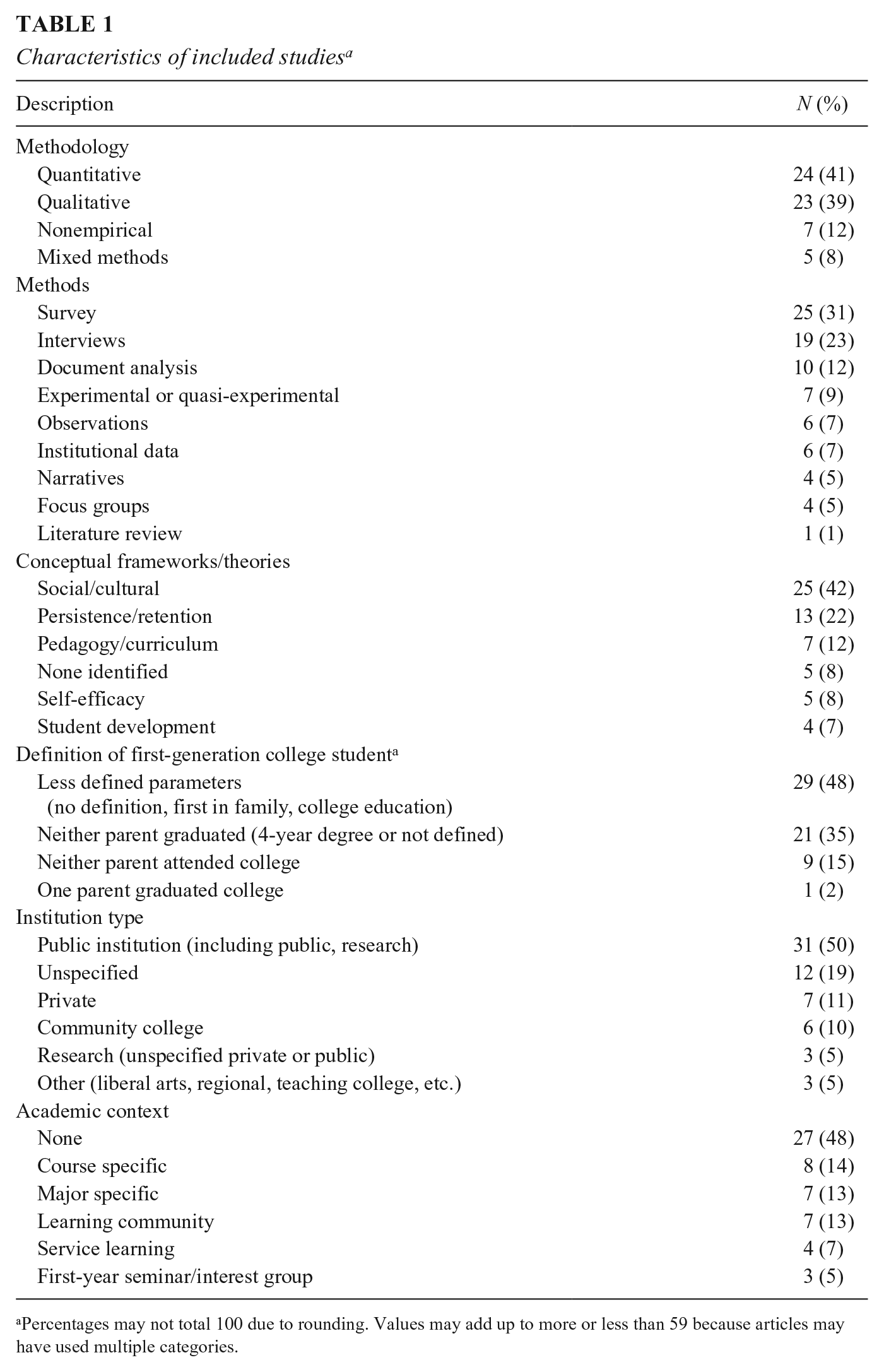
Percentages may not total 100 due to rounding. Values may add up to more or less than 59 because articles may have used multiple categories.
Data Analysis
We conducted a thematic synthesis to analyze the articles (Thomas et al., 2012) and to inductively identify common assumptions, theories, methods, and findings (Suri & Clarke, 2009). This approach synthesizes literature that is cross-disciplinary and varied, and is “systematically grounded in the studies it contains,” meaning the themes emerge from the primary studies as analysis unfolds rather than being predetermined by a conceptual framework (Thomas et al., 2012, p. 193). We began by inductively coding the findings, discussion, and implications sections of each article. After independently coding and writing analytic memos about the same articles, we met to discuss our thoughts and emerging themes. We discussed any disagreement in codes to address intercoder reliability and created a codebook that included definitions and examples from the data for each code. For example, we coded text that discussed first-generation college students having lower traditional success measures, such as GPA or SAT, as “lower academic achievement.” After we established the codebook, one researcher used it to code the findings, discussions, and implications sections of all 59 articles in NVivo. We then conducted second-cycle coding to look for categories and themes across codes to develop our findings (Saldaña, 2016).
Results
In presenting the results, we address our first and second research questions concerning the methodologies and theoretical frameworks used to study first-generation college students. We then address the third research question on what the reviewed literature tells us about first-generation college students as academic learners.
Methodologies Used in the Literature Reviewed
We categorized the studies we reviewed by methodology (see Table 1) used to study first-generation college students. The majority used either quantitative (41%) or qualitative (39%) methodologies, and the remaining studies were nonempirical (12%) or used mixed methods (8%). As for methods in the studies we reviewed, surveys (31%) were most prevalent. The surveys were not typically original instruments but rather large state or national surveys. For example, Kim and Sax (2009) used data from the University of California Undergraduate Experience Survey, which is a longitudinal statewide survey of students in the University of California system. They used the data to explore patterns of faculty–student interactions among different subgroups, first-generation status being one of those variables. Also using large data sets, Atherton (2014) pulled data for one institution from 1999 to 2009 from the Cooperative Institutional Research Program (CIRP) first-year survey, which is an instrument designed by the Higher Education Research Institute and administered at hundreds of colleges across the United States. Atherton (2014) used the data to explore whether first-generation college student status influenced objective and subjective self-rating measures of academic preparedness. The next most common methods across all studies were interviews (23%) and document analysis (12%).
We also identified patterns in data sampling (see Table 1). Of the analyzed studies, almost half (48%) did not include a specific definition or parameters for first-generation college students. We included in this group broad definitions, such as students whose parents did not have “a college education” (e.g., Castillo-Montoya, 2017, Wilson & Kittleson, 2013) or were the “first in their family to attend college” (e.g., Jackson et al., 2016; Smith & Lucena, 2016). These definitions are broad because a college education could include anything from taking any courses or earning a degree, and first-in-family could include siblings or extended family. Of the studies that included more specific definitions, most defined first-generation students as neither parent having graduated from college (35%), in which two studies included guardians, or neither parent attending college (15%). Of the 59 studies, almost half (42%) used samples containing both first-generation and continuing-generation college students. First-generation students are also a heterogeneous group, and the majority of studies (95%) looked at or noted other social identities within the first-generation college student population, often as independent variables. In Table S1 (in the online version of the journal), we note specific subgroup identities when it was an explicit focus in the article, or the main identity that the researchers focused on.
Patterns in research site selection included a predominance of certain institutional types. Table 1 shows that, among studies we reviewed, 71% examined 4-year institutions, 10% focused exclusively on community college students, and the remaining 19% did not specify an institutional type. Five of the studies noted that the research site was a minority serving institution, four of which were specifically a Hispanic serving institution. Six studies noted the research site was a predominantly White institution (PWI). The remaining articles did not note demographic characteristics of the institution, which leaves it unclear whether the majority of the research is happening at PWIs but are not being noted as such and, even more, why PWI status would be normalized if this is the case. Almost half of the articles (48%) did not indicate a specific academic context for the study, while the others focused on a specific academic course (14%), students in a specific major (13%), or were divided among learning communities, service learning courses, and first-year courses (25%).
A closer analysis of the methodologies used to study first-generation college students as academic learners led us to three main points. First, the prevalent instruments that researchers used were large data sets from state or national surveys, not designed with first-generation college students and their experiences in mind. While such data sets are important for research, the questions are designed to capture the experience of the largest group of students. This can limit the knowledge scholars generate to understand and conceptualize first-generation college students as academic learners in their own right. For example, in a systematic review of Latinx academic success outcomes, Crisp et al. (2015) found that studies relying on national data sets used ethnocentric definitions of variables that did not align with Latinx cultural experiences.
Second, the instruments are tools to compare first-generation and continuing-generation college students from the onset of the studies. Of the 59 studies, almost half (42%) used samples containing both first-generation and continuing-generation college students. For instance, Atherton’s (2014) purpose in using the CIRP survey was to compare subjective and objective preparedness of continuing- and first-generation college students, with the hypothesis that first-generation students are less prepared in both categories. Also using the CIRP survey, Elliott (2014) compared the academic adjustment and self-efficacy of both first- and continuing-generation college students. While using comparison groups can generate valuable knowledge, when research compares a subpopulation of students to a control population of ostensibly “average” students whose lived experiences may greatly differ, it limits understanding of the subpopulation. Therefore, prior to any analysis, the data are already marked with underlying beliefs and values that successful college students should think and behave in particular, normative ways, as comparison was embedded in the purpose of the studies that used those instruments.
The third point is that a lack of diversity in sampling limits our understanding of first-generation college students as academic learners. Most studies took place at one institution type, namely 4-year institutions, even though the majority of first-generation college students are enrolled in community colleges (Bui, 2002; Redford & Hoyer, 2017). This insight is important because this means that what the field knows about first-generation college students as academic learners is mostly from a limited perspective. Thus, what higher education scholars, teachers, and practitioners do know may not actually reflect the realities of the majority of first-generation college students. This is not to say that there is not value in learning about their experiences in 4-year colleges; we believe there is. However, the field needs to critically reflect on whether this approach reflects how some institutional contexts are valued over others and how this limited view constrains our understanding of these students. Also related to sampling, our analysis shows that existing research has not examined first-generation college students’ learning within a variety of academic settings (i.e., disciplines or courses). That is, when scholars focus on first-generation college students as academic learners, they are often not anchoring their research within the contexts where that learning is taking place (courses, disciplines, learning communities, etc.) and in relationship with what it is that they are learning, namely, the subject matter.
Theories Used in the Literature Reviewed
While many studies used multiple frameworks or were not explicit about their framing, we grouped them by the theories or constructs primarily guiding their scholarly work. As shown in Table 1, social and cultural frameworks were the most (42%) prevalent in the studies we reviewed, which focused on the interactions between society and culture that affect individuals. We organized the studies with this type of framing into four subcategories: psychosocial, social/cultural capital, sociocultural learning, and sociohistorical contexts.
Eleven of the articles in the social and cultural frameworks group used psychosocial theories, which focus on how culture shapes people’s beliefs and ways of making meaning, and how these influenced first-generation college students’ approach and experiences in academic learning. All of the articles in this category showed how students’ cultural expectations and beliefs are at odds with higher education. A few attributed this dissonance to institutions centering and normalizing white, upper and middle-class, and patriarchal cultural expectations (Stephens et al., 2014; Wilson & Kittleson, 2013). The focus of these studies was on alleviating dissonance by changing how students perceive or experience the culture of the academy or their disciplines (e.g., through reflections and difference-education). For instance, Harackiewicz et al. (2014) integrated stereotype threat models with cultural mismatch theory to test a values affirmation intervention in a double-blind randomized experiment. They found first-generation college students experienced a cultural mismatch and had lower levels of perceived belonging, but that their belonging concerns were reduced through the intervention, which was a writing exercise on values in a biology course. Therefore, the focus was on the strategies that students need to develop or could use to navigate the academic environment.
Six articles in the social and cultural frameworks group used social or cultural capital as the main theory, the majority of which drew on Bourdieu (1986). Three articles focused on social capital, two focused on cultural capital, and one used social networks. Three of these articles integrated inclusion and engagement literature from higher education, typically drawing on Tinto (1993). Based on the prevalence of Bourdieu’s theory within the 11 articles in this group, we see his theory having a major influence on how the field views first-generation college students as mainly lacking important resources because the academy places high value on dominant cultural and social norms and practices. For example, Soria and Stebleton (2012) combine literature on engagement and social capital to compare first-generation and continuing-generation college students’ academic engagement at one institution by using data from a national survey. They found that first-generation college students exhibited patterns of lower academic engagement, and they noted, “Drawing back to our conceptual frame, it is believed that first-generation students’ lower social capital results in their decreased academic engagement” (Soria & Stebleton, 2012, pp. 680–681).
The remaining articles in the social and cultural theories group include sociocultural learning and sociohistorical contexts. Five articles focused on sociocultural learning—how people learn from drawing on and receiving validation about their sociocultural identities, experiences, and knowledge. These articles showed how first-generation students’ prior knowledge and funds of knowledge—valuable ways of knowing, skills, and practices accumulated through household knowledge and lived experiences (González et al., 2005; Kiyama & Rios-Aguillar, 2018)—can be useful for learning or advancing their disciplines or the academy. For example, using testimonio, Castillo-Montoya and Torres-Guzmán (2012) illustrated how the authors drew on their funds of knowledge, pedagogies of the home, and cultural intuition to navigate and thrive in the academy as first-generation college students and scholars, as well as advance their disciplines given their bilingual and bicultural knowledge.
Three articles used a sociohistorical context framework to acknowledge the sociocultural conflict that students may experience when their own cultural perceptions clash with institutional culture. They focused on the institutions and agents changing cultural norms and expectations to better support students. For instance, Stephens et al. (2012) used cultural mismatch theory, but also emphasized “the extent to which students experience a match or mismatch depends . . . on the larger university cultural context” (p. 1181).
The second most frequently used framing in these studies (22%) was persistence and retention theories. Many (54%) studies in this group used Tinto’s (1993) theories on student retention and integration to focus on factors that support or hinder first-generation students’ academic integration. Thus, these studies mostly focused on the characteristics and behaviors of first-generation college students that hinder persistence and engagement. A few scholars in this group did critique and add other theories to align more closely with minoritized students’ experiences, but most studies did not take that approach. From this group of studies, we learn some of the challenges first-generation college students face in integrating academically and socially, as conceptualized largely by Tinto, and some of the supports institutions can offer to alleviate these challenges. For example, Longwell-Grice and Longwell-Grice (2008) used Tinto’s theories on retention in a multiple case study of four first-generation, working-class, white male first-semester college students, all of whom left after the first semester. They highlighted the importance of faculty interaction for retention, as the participants feared interacting with faculty and did not experience faculty support.
The next largest framing category was pedagogical/curriculum (12%). The studies that took a more critical approach in their pedagogical/curriculum framework, such as drawing on critical pedagogy, expanded their analysis beyond interactions in the classroom to make a larger critique of educational and social systems and highlight how students and teachers can change those systems. For instance, in her case study of TRIO students in a learning community course at a Research 1 institution, Jehangir (2010) used multicultural curriculum and critical pedagogy to illustrate how the framework can bring “students’ narratives, stories, and lived experiences into academic spaces . . . creating space and place for historically marginalized students” (pp. 535, 537). The studies that used a framework without a critical approach, such as looking at course-structure interventions, focused on what individual students could do to enhance their academic learning. For example, in a pilot study, Lipp and Jones (2010/2011) examined the impact of journaling and scaffolding by instructors and peer tutors in a history course for 20 bilingual Southeast Asian and Latinx first-year, first-generation college students. Although they found the intervention contributed to improved learning outcomes, they found it was insufficient to help the students overcome reading comprehension and motivational challenges.
The second-to-last category of articles used self-efficacy to frame their studies (8%). Four of the five studies in the self-efficacy category drew from Bandura’s (1997) work, and one study drew on academic self-concept. What we learn from the majority of these studies is that first-generation college students struggle to achieve traditional measures of academic success despite high self-efficacy. For example, Vuong et al. (2010) examined the impact of students’ self-efficacy on academic success in a survey of 1,291 second-year students at five California campuses. They found that continuing-generation college students outperformed first-generation college students in terms of GPA, but the two groups were similar in their self-efficacy. Other studies found that self-efficacy is instrumental to academic performance, as the more you believe in yourself, the better you perform (Craft DeFreitas & Rinn, 2013; Elliott, 2014; Majer, 2009). These results indicate that self-efficacy is a construct that may need further examination in relation to first-generation college students.
The last group of studies used student development theories to frame their studies (7%). What we learn from these studies is how first-generation college students develop within an academic context. For example, Wang (2014) used transition theory to study the student–teacher interactions of 30 first-generation college students and found that a “lack of experience” with college meant students pursued relationships with teachers that “empowered them to believe that they could take ownership or control for their learning and overcome the challenges of being a [first-generation college] student” (p. 77). All four studies in this group used theories developed from college students with dominant identities. When first-generation college students’ development was framed with these theories, the studies inevitably found some kind of dissonance between the developmental experiences of first- and continuing-generation students, with the first-generation students as the ones who persistently fell short.
Two of the four studies in this group problematized the whiteness of student development theory and used supplementary theories based on historically marginalized students. For example, in their study interviewing 24 TRIO students 3 to 4 years after taking a learning community course, Jehangir et al. (2011) drew on self-authorship but also included work that expanded upon that theory “with attention to the experience of historically marginalized students” (p. 57). The articles that included student development theories based on marginalized students made larger critiques of higher education culture and pointed to ways first-generation college students have agency in their development. The remaining five studies did not use a framework (eight percent).
Overall, our analysis of the theories being used to study first-generation college students as academic learners led us to three main points. First, as we illustrate above, some theorists are dominating the field, namely, Bourdieu (1986), Tinto (1993), and Bandura (1997). The overreliance on a few theories means that higher education scholars are largely framing, understanding, studying, and analyzing first-generation college students from a limited number of theories. Furthermore, those theories originate mainly from dominant and privileged identity groups (both in sample and by theorists)—a point we elaborate on below. This overreliance on a few theories is understandable given that the norm in the academy is to cite seminal works, even at the cost of underciting relevant scholarship by racially minoritized scholars (Bensimon, 2007; Harris & Patton, 2019; Patton & Njoku, 2019). Second, when some of these prevalently used theories are used, scholars do not necessarily maintain the focus on power. For instance, researchers who use Bourdieu’s (1986) notions of social and cultural capital often neglect issues of power and domination in access to such capital (Dika & Singh, 2002), although Bourdieu’s work was a critique of how education systems privilege (reward) what middle- and upper-class students (and their families) possessed. Several scholars have noted that many researchers have applied his work to higher education in the United States in a way that sustains a deficit view of the students by emphasizing the resources students lack that shape inequitable educational outcomes (Davies & Rizk, 2018; Sablan & Tierney, 2014; Winkle-Wagner, 2010).
If scholars do not draw on Bourdieu’s focus on organizational structures that reproduce inequality, then their research on first-generation college students will lead to findings that show these students as less than when compared to the capital valued, expected, and rewarded in higher education. The consequence is that scholars will miss the opportunity to point out the problems within the structures of learning (as opposed to the students). We saw this in some of the studies noted above where the focus was on changing the student and helping them navigate within the existing academic environment rather than problematizing and changing the normative culture that leads to students’ dissonance in the first place. Therefore, scholars can use Bourdieu’s theory (intentionally or not) in ways that emphasize what first-generation college students are missing and needing to successfully integrate into higher education, rather than critiquing the system and its culture.
The third point we arrived at based on our analysis of this literature is that these few theories dominating the field have largely not been developed with first-generation or other minoritized college students in mind. Since the emergence of Tinto’s model on student retention and engagement, higher education scholars often research minoritized students using dominant theories that proceed to view minoritized students as “similar, if not identical, to those of majority students” (Rendón et al., 2000, p. 130). Bensimon (2007) similarly points out this “lack of variability” in conceptualizing student success for minoritized students is evidenced by the “underutilization of racially conscious constructs introduced by minority scholars” (p. 449). In the literature we reviewed, we did not see many emerging theories with first-generation college students’ voices and experiences as central or even primary in the theorizing. Outside of our review, Yosso (2005) is an example of a theorist who draws on Bourdieu’s work to develop her own theory—community cultural wealth—that centralizes the way minoritized students develop capital from their own communities.
First-Generation College Students as Academic Learners
In the extant literature, scholars have conceptualized first-generation college students as academic learners in three ways, based on (a) their academic performance, (b) the influence of cultures on learning, and (c) the contributions of lived experiences to academic learning, advancing disciplines, and extending learning outside of the classroom.
Academic Performance
Thirty articles (51%) focused on first-generation college students as learners by examining their academic performance. The articles vary in terms of relating academic performance to the following: (a) performance measures, (b) academic self-concept, (c) faculty–student interactions, or (d) academic resources.
Performance measures
First-generation college students are often conceptualized as learners who are less prepared to enter college than their continuing-generation peers, typically as evidenced by test scores and GPA (Atherton, 2014; Elliott, 2014; Horowitz, 2017; Vuong et al., 2010). While this lack of preparation is sometimes blamed on K–12 school preparation, it is also seen as a consequence of first-generation college students’ backgrounds. For example, Hao (2011) discussed hearing the director of a program for first-generation college students say that “many do not have foundational reading and writing skills, which could prevent them from enrolling in classes with other students” (p. 93). In sum, these studies show that faculty and staff tend to position first-generation college students as entering college already academically behind their continuing-generation peers.
Other articles focused on the influence of faculty on first-generation college students’ academic performance. McMurray and Sorrells (2009) examined how faculty can connect academic content to first-generation college students’ lives by using examples to help them see themselves using that content as a professional in their future career. Other studies showed how the achievement gap between privileged students and disadvantaged students, including first-generation college students, is reduced when faculty engage in more inclusive and culturally relevant teaching practices (Gillian-Daniel & Kraemer, 2015; Schmid et al., 2016). Schademan and Thompson (2016) found that faculty who viewed college readiness as developing over time, rather than having a fixed view of readiness, experienced less frustration and served as cultural agents for low-income first-generation college students. In sum, this group of articles positioned the responsibility of academic performance on faculty; however, they did so in a way that positions first-generation college students as less prepared and in need of intervention.
Academic self-concept
Academic self-concept is an important cognitive resource for first-generation college students (Majer, 2009) and can have a significant impact on GPA (Craft DeFreitas & Rinn, 2013). Several studies using multi-institution surveys found that first-generation college students had lower academic preparedness but higher academic self-concept (Atherton, 2014; Elliott, 2014), or lower academic performance but similar self-efficacy (Vuong et al., 2010), compared with continuing-generation college students. In other words, first-generation college students experienced incongruence between how they perceived their academic abilities and how prepared they actually were based or their performance. Atherton (2014) conceptualized this dissonance as representative of first-generation college students not realizing that their lower academic preparation “might affect their academic outcomes” (p. 828). In their survey based on Tinto’s (1993) persistence model, Dika and D’Amico (2016) also found that early academic performance was a significant predictor of first-generation college students’ persistence in STEM (science, technology, engineering, and mathematics). In sum, first-generation college students’ early academic performance is important for persistence, but their perceptions of their own abilities can be at odds with their actual academic performance.
Faculty–student interactions
A strong relationship exists between positive faculty–student interactions and positive outcomes for first-generation college students. For example, in a mixed methods study of 43 first-generation college students in service learning courses, McKay and Estrella (2008) found the quality of interactions with faculty accounted for a substantial amount of the variability in the academic and social integration variables measured in the survey. Similarly, Glass et al. (2017) found a significant and positive relationship between out-of-class faculty interactions and co-curricular engagement for first-generation college students in their quantitative study on 1,463 first- and continuing-generation international students studying in the United States.
First-generation college students tend to desire and expect to have relationships with faculty (Trammell & Aldrich, 2016; Wang, 2014); yet, many of them still have fewer interactions with faculty than their continuing-generation peers (Kim & Sax, 2009; Soria & Stebleton, 2012; Yee, 2016). Furthermore, most of the studies in this group (64%) found that first-generation college students tend not to be academically engaged. For example, in a multiple case study of working-class, male, first-generation college students, Longwell-Grice and Longwell-Grice (2008) found that participants did not interact with faculty because they feared being found out to be incompetent, reflecting their “insecure image of self-as-college-student” (p. 415). Studies in this group also pointed to mediating factors in building relationships with faculty that have a disproportionate effect for first-generation college students, such as the negative effect of large classes (Beattie & Thiele, 2016) and the positive effect of learning communities (Maltby et al., 2016; Wirt & Jaeger, 2014). In sum, although first-generation college students are academically engaged by faculty interactions, they are less likely to experience quality interactions with them than their continuing-generation peers.
Academic resources
Other studies examined ways in which first-generation college students use resources for academic assistance. These studies show that first-generation college students tend not to seek assistance when in academic peril (Yee, 2016), speak with faculty or peers for help (Hicks & Wood, 2016), or seek tutoring resources (Lipp & Jones, 2010/2011). They tend, instead, to turn to online sources before turning to people in their network for help (Tsai, 2012). Olson (2017) found that racially minoritized first-generation students attempted fewer homework strategies and showed less perseverance when faced with difficult class assignments compared with their continuing-generation majority peers. Yee (2016), in a 2-year ethnography, linked similar findings to first-generation college students’ backgrounds: Like middle class students, first-generation students believed that . . . they would have to be more responsible for themselves. However, unlike middle class students who interpreted that responsibility as reaching out to seek help, first-generation students interpreted the responsibility as being on their own to succeed. (p. 845)
While recognizing the need to be independent in college, first-generation college students interpreted the rules of the game differently than their continuing-generation peers. Some studies attributed this difference to a lack of cultural and social capital (Atherton, 2014; Beattie & Thiele, 2016; Soria & Stebleton, 2012; Yee, 2016).
Other studies pointed to the same connection between academic resources and performance but focused on interventions or ways of teaching students to effectively use resources. Faulkner and Burdenski (2011) found that teaching low-income, first-generation college students how to better identify and act on their needs helped increase their academic self-efficacy and success in developmental mathematics. Nosaka and Novak (2014) noted the benefit of learning community programs on first-generation college students’ academic and social integration, resulting in statistically higher retention rates than students outside of the program. And, Morales (2014) suggested that faculty can build students’ self-efficacy through realistic appraisals of their strengths and weaknesses and encouraging them to seek help. In sum, first-generation college students’ academic performance can be hindered by their interpretation of what it means to use academic resources. Studies in this group of the literature indicated that specific interventions can help these students expand their understanding and use of available resources to support their academic success.
Taken together, our review of the 59 articles led us to identify that 30 of them (51%) conceptualized first-generation college students as learners based on their academic performance—meaning, how well they perform on traditional measures compared with their peers through normative assumptions about success. Within these articles, we also saw other commonalities across theories and methodologies. For instance, all of the articles that used Bourdieu’s (1986) social and cultural capital and Bandura’s (1997) self-efficacy theories were in this group of articles focused on academic performance. Some of these theories were derived from dominant-identity students, and others have been applied to U.S. higher education in ways that leave out power constructs that were part of the original theory. Without additional interrogation or more critical theories derived from marginalized student populations, these concepts set studies up from the onset to compare first-generation college students to the normalized view of a college student in higher education. As noted earlier, this juxtaposition inevitably leads to a deficit framing and understanding of first-generation college students. For instance, as noted in studies mentioned above, first-generation college students are seen as not academically engaged as opposed to the aspects of the learning environment failing to adequately support them. They are also positioned as responsible for initiating interaction with faculty instead of placing that responsibility on faculty.
Studies in this group were also heavily based on quantitative methodologies (53%) and contained the majority of the nonempirical studies (five of the seven). As we indicated in the theory section, these methodologies did not allow for first-generation college students’ voices and experiences to emerge in a way that highlights the value they bring to their learning because they rely on instruments designed with a normalized view of college students.
Influence of Cultures on Learning
Fourteen articles (24%) focused on the influence of various cultures on the academic learning of first-generation college students. A subset of articles in this group examined the influence of students’ culture on their own learning, and another subset examined the influence of the institutional culture and how it interacted with students’ culture. Across these articles, we saw culture, as a concept, reflect K. D. Gutiérrez and Rogoff’s (2003) view of cultural ways of learning that emerge from “proclivities of people with certain histories of engagement” with educational institutions, rather than individual traits, which can lead to overgeneralizing and essentializing notions of cultural learning (p. 19). In this group of articles, first-generation college students are conceptualized as academic learners who are (a) prosocial, (b) interdependent, and/or (c) experience dissonance with the culture of the academy.
Prosocial academic learners
The literature in this group of reviewed articles emphasized that first-generation college students are prosocial academic learners—meaning students who want to learn in community, and want their learning to be connected to and beneficial for their home communities. Studies in this group found that first-generation college students value being geographically close to home and are drawn to majors with a communal focus (Allen et al., 2015; Harackiewicz et al., 2016; Tibbetts, Harackiewicz, Priniski, et al., 2016). In a survey of incoming students regarding their motivations for attending college, first-generation college students tended to select more interdependent motives (e.g., “help my family out after I’m done with college”) and fewer independent motives (e.g., “explore new interests”) than continuing-generation students (Stephens et al., 2012, p. 1188). In the literature we reviewed, prosocial learning was particularly important to Latinx students (Nuñez, 2011; Trevino & Craft DeFreitas, 2014). For example, in her study of Latina community college students, Chavez (2015) found that peer and faculty support created a sense of community in which the students wanted to mentor younger Latina peers.
Interdependent learners
In addition to wanting to stay connected with their community, the literature in this group showed that many first-generation college students may take an interdependent approach to academic learning. That is, many first-generation college students prefer to learn and benefit from learning with others (Eddy & Hogan, 2014; Pelco et al., 2014; Stephens et al., 2012; Tibbetts, Harackiewicz, Canning, et al., 2016). Eddy and Hogan (2014) found that increasing course structure in biology (e.g., adding guided-reading questions, in-class group activities) helped increase the reported sense of classroom community and reduced the gap in final grades between first-generation and continuing-generation students. In their study of a service-learning course, Pelco et al. (2014) attributed the significant difference in self-reported academic and professional growth for racially minoritized first-generation college students to the interdependent nature of service-learning modeling the cultural background of the students.
Cultural dissonance
The literature indicated that, unlike the preferred interdependent learning approach of many first-generation college students, the culture of the academy emphasizes and expects independence. In their survey of college administrators, Stephens et al. (2012) found that “universities focused more on independent cultural norms than interdependent cultural norms . . . overall, the American system of higher education reflects and promotes the middle-class cultural norms of independence” (p. 1186). Wilson and Kittleson (2013) and Smith and Lucena (2016) both focused on low-income first-generation college students in STEM, which also has a culture that emphasizes independence. They described the STEM classroom environment as validating middle-class norms and invalidating the first-generation college students’ knowledge and experiences. For example, the classes fostered a competitive instead of cooperative environment and expected students to prioritize time to study over family responsibilities (Wilson & Kittleson, 2013).
Independent norms manifest in other classroom expectations as well, for example, that all students speak up in class discussions despite the fact this may conflict with the cultural preferences of some racially minoritized students (White, 2011). As discussed in the previous finding, some studies use class participation or interaction with faculty as a measure of academic engagement (Kim & Sax, 2009; Soria & Stebleton, 2012). The problem with measuring academic engagement through participation is that it neglects the underlying power embedded in assumptions about what academic participation ought to look and sound like (White, 2001). In academic spaces, first-generation college students may feel their own ways of talking and participating may not align with the normative academic discourse. This lack of congruency may sway these students from actively participating in class or seeking out conversations with faculty outside of class (White, 2011). Failure to participate in these expected, independent ways may lead faculty to mistakenly interpret the behavior as “disrespect for the teacher or the class, disinterest in the subject matter, or apathy in general” (White, 2011, p. 250).
The disjuncture between the independent culture of the academy and the interdependent, communal preferences of many first-generation college students can lead many of these students to experience cultural dissonance. In an experimental study, Stephens et al. (2012) found that when orientation materials emphasized college culture as independent, continuing-generation students performed better on a subsequent verbal academic task than their first-generation college peers. Conversely, when the orientation materials presented college culture as interdependent, the performance gap on the verbal academic task disappeared. Stephens et al. (2014) similarly found in a randomized control trial that when college seniors told entering first-year students stories about the value of diverse backgrounds and the ability of people from different backgrounds to succeed, the gap between first-generation and continuing-generation college students’ first-year grades decreased by 63% in the intervention group.
In sum, our review of the 14 articles (24%) in this group focused on the influence of cultures on the academic learning of first-generation college students. Most of the 14 studies used quantitative methodologies (57%), and they represented a majority of the studies that had psychosocial theories (9 of the 11 articles; 82%). The psychosocial group mostly focused on interventions of cultural meaning making, which included quasi-experimental designs. Therefore, these studies artificially altered how students perceived the culture of the discipline or academy to understand the interventions that could support their academic success, not on interventions that can address the systemic causes of the cultural dissonance.
Contributions of Lived Experience
Fifteen articles (25%) positioned first-generation college students as having valuable lived experiences that when connected to subject matter can (a) enhance academic learning, (b) advance ways of knowing and doing in their disciplines, and (c) support extensions of academic learning, such as self-growth and community development. The articles in this group also expand the notion of academic learning beyond traditional measures such as GPA and test scores.
Academic learning
The literature that connected subject matter to first-generation college students’ lived experiences showed that such connections facilitate these students’ academic learning. For instance, Bass and Halverson (2012) found first-generation college students in their study valued being able to examine and draw on their own lives in their learning of subject-matter concepts in a first-year interest group course. Castillo-Montoya (2017) found racially and ethnically diverse first-generation college students had ways of thinking and knowing that faculty helped unpack as valuable prior knowledge that could enhance subject-matter learning. Similarly, Jehangir (2010) pointed to the importance of validating low-income, diverse, first-generation college students’ cultural knowledge and cultural wealth in academic spaces to support deeper learning. Slate et al. (2009) also pointed to first-generation college students valuing instruction that built upon their prior knowledge and life experiences. All of these articles show that instructors who recognize first-generation college students as already having valuable experiences that relate to subject-matter concepts use multiple strategies, such as class discussion and writing reflections, to surface that knowledge and expand upon it to deepen knowledge of the academic concepts.
Advancement of disciplines
When subject matter is connected to first-generation college students’ lives, they are potentially positioned to help advance ways of knowing and doing in academia, and more specifically, their disciplines. Jehangir (2009) discussed the valuable knowledge that diverse first-generation college students bring to academia, and how this contribution is only possible when first-generation college students take the material and use it in their lives. This learning approach builds a bridge between the classroom and students’ lived experiences, thus enabling students “not only to enter the academy but also to bring the lessons and experiences of their home worlds into their academic space . . . [and] taking what they have learned and translating it into action . . . social change in context of their identity and community” (Jehangir, 2009, pp. 43–44).
Smith and Lucena’s (2016) study of low-income first-generation college students in engineering provides another example of this learning approach. They found that students developed ways to validate their class-specific backgrounds on their own, and even sought out ways to incorporate their insights into their discipline. The students “wished to change the way engineers consider . . . the experiences and knowledges of people who work with their hands for a living” (Smith & Lucena, 2016, p. 23). Similarly, Castillo-Montoya and Torres-Guzmán (2012) discussed ways they drew on their cultural knowledge as Puerto Rican female students and scholars to advance how they thought about and engaged with their scholarly work. These articles indicate that even when instructors or practitioners do not make space for first-generation college students to integrate their cultural knowledge and lived experiences, some will identify ways to do it for themselves. This allows the discipline to benefit from first-generation college students’ backgrounds and knowledge.
Extensions of academic learning
When first-generation college students’ lives are integrated into academic learning, their learning can also promote self-growth and community development. For first-generation college students who are historically and currently marginalized, integrating their cultures and lived experiences into the classroom can lead to self-authorship—making decisions and navigating the world based on one’s internal beliefs, values, and sense of self (Jehangir et al., 2011; Jehangir et al., 2012). Scholars in this group of literature drew on expanded conceptions of self-authorship specifically for racially minoritized students.
Developing self-authorship can help first-generation students combat the marginalization and isolation they experience in higher education (Jehangir et al., 2011). For instance, Nuñez (2011) found that when Chicano first-generation college students learned more about their heritage through Chicano studies courses, their confidence increased and they were better able to handle racism and isolation on campus. Similarly, Castillo-Montoya and Reyes (2018) found Latinx students in a Latino cultural center service-learning course “indicated that learning about the academic content enriched their understanding of sociocultural identities as well as their critical consciousness” (p. 13). In sum, these authors conceptualized first-generation college students as being able to critically reflect on their personal experiences when they saw their lives in the academic content, and thus enhance and, at times, transform how they saw themselves and their identities.
Researchers also conceptualized first-generation college students as learners who could contribute to their communities and society by learning how to critically analyze social structures. These articles discussed first-generation college students as wanting to give back to their communities, as mentioned in a previous section (e.g., Allen et al., 2015), but further noted that racially minoritized students who learned to critique social structures felt more empowered to make a difference through service learning (Castillo-Montoya & Reyes, 2018; Conley & Hamlin, 2009; Yeh, 2010). Yeh (2010) explained that “working with disenfranchised communities and learning about the systems that affect them . . . was simultaneously liberatory and empowering, because it gave many of them the tools to critique the structural inequalities within that very same culture” (p. 59).
Other scholars noted that racially and ethnically diverse first-generation college students also felt empowered to contribute to their communities based on what they learned from their social science and humanities courses (Castillo-Montoya, 2017; Morales, 2012; Rodriguez & Buczinsky, 2013). For instance, Jehangir (2009) similarly found that as racially minoritized first-generation college students advanced their critical consciousness, they were more motivated to challenge oppression and serve communities with which they identified. In sum, giving first-generation college students the tools they need to critique social structures empowers them to positively influence their communities. And as shown above, many first-generation college students tend to be prosocial learners, thus seeking to learn in community and to give back to their communities while engaging in academic learning.
Taken together, this third group positions first-generation college students as having valuable lived experiences that when connected to subject matter can (a) enhance academic learning, (b) advance ways of knowing and doing in their respective disciplines, and (c) support extensions of academic learning. This group contained the majority of the studies that used qualitative methods (52%). While this approach is useful for deep and contextual understanding of the participants’ experiences, the localized nature of qualitative research limits our understanding of how this type of learning is happening in other places and more broadly in the field of education. This group also used the majority of pedagogical and sociocultural learning theories (57% and 80%, respectively). The articles that used a pedagogical framing within this group took a critical approach, for example, challenging the political neutrality of education through social justice and critical pedagogy. The sociocultural learning theories also centered first-generation college students’ voices by using more qualitative methods and highlighted the strengths and values the students brought to their learning through, for example, their funds of knowledge. We note that the majority of the articles in this section (73%) focused on specific racial and ethnic identities within first-generation college students rather than using race or ethnicity as an independent variable as was the case with the studies we grouped as focused on academic performance or the influence of culture (13% and 21%, respectively).
Discussion
In the previous section, we discussed how the literature we reviewed positions first-generation college students as academic learners in three ways, based on (a) their academic performance, (b) the influence of cultures on learning, and (c) the contributions of their lived experiences for their academic learning, advancement of disciplines, and extensions of learning. The first two groups of literature differ in focus but are undergirded with the assumption that the successful college student thinks and behaves in normative ways. In what follows, we discuss how this assumption supports an assimilationist approach to higher education, and we explain why this approach is a problem if the field of higher education wants to support and honor first-generation college students as academic learners. We then discuss how the third group of literature supports an alternative way to conceptualize first-generation college students as academic learners without pursuing an assimilation approach.
Assimilationist Approach: The Normative View in Higher Education
In the first group of articles (51%), first-generation college students are positioned as learners in terms of their academic performance, typically by comparing their academic performance to that of their continuing-generation peers. These scholarly works point to first-generation college students as having lower performance and engagement, unrealistic academic self-concept, fewer interactions with faculty, and an unwillingness or inability to seek out academic resources—approaching first-generation students from a deficit perspective.
This conceptualization explicitly or implicitly centers an assimilationist approach, by which we mean an orientation that expects adoption or internalization of norms in the field in order to be successful. We draw on Antony (2002) to establish this point given his argument about the congruence and assimilation orientation of psychosocial and sociological theories of career choice as well as socialization theories. He problematizes that these theories begin with a normative assumption that the new student needs to internalize the disciplinary norms and be congruent with the values of the field in order to be successful in any given field. Similarly, we see a pattern in this body of literature that frames first-generation college students as the ones who need remediation by comparing their backgrounds, preferences, and outcomes with those of their continuing-generation peers who are viewed as the “norm” in higher education. In doing so, this scholarly body contributes, intentionally or not, to an academic culture that normalizes those assumptions that position first-generation college students as lacking the skills or characteristics needed to be successful in college.
The second group of articles (24%) positions first-generation college students in terms of how cultural contexts mediate learning as opposed to focusing on an individual cognitive perspective in thinking about learning. At first glance, these articles appear to be more asset-focused because they highlight the prosocial and interdependent preferences of many first-generation college students. This group of articles also focuses on how these students may experience dissonance when their preferred ways of learning come into conflict with expectations that reflect dominant and privileged ways of learning valued in higher education, namely, white patriarchal norms.
Acknowledging the cultural dissonance first-generation college students may face in adjusting to college is valuable. Socializing first-generation college students into the normative culture of higher education and their discipline is important for academic success (Ladson-Billings, 1995), and some programs do this through mentoring or instruction rather than putting the responsibility entirely on the student to figure out on their own. However, in this approach, socialization most often takes a one-directional approach, asking the student to take on the disciplinary or professional values and norms at the cost of their own, which can be especially problematic for racially minoritized students (Antony, 2002; Winkle-Wagner & McCoy, 2016).
When the studies in this second group asked how to lessen that dissonance and help first-generation college students gain access to the culture of the academy, they still tended to operate with an assimilationist approach in that they assumed the student should unilaterally adapt and change. In these studies, the researchers conceptualized successful students as navigating an independent culture, and the authors rarely problematized this aspect of the academy’s culture. In doing so, higher education scholars further normalize these expectations of the dominant culture more broadly into the academy’s culture and in doing so, intentionally or not, call for first-generation college students to assimilate. Nasir and Hand (2006) critiqued research focused on differences in cultural practices, as it often does not adequately address issues of power and “the political nature of culture” (p. 463). The individualized strategy of changing students to fit into the system obscures institutionalized patterns of inequity (Dowd & Bensimon, 2015) and, indeed, higher education scholars’ and practitioners’ role in reproducing them.
Writing about the field of mathematics, R. Gutiérrez (2012) explains why this strategy is both patronizing and harmful. She indicates that framing “equity from a deficit perspective” is asking how to “get more people of differing walks of life” into the field “so that they can reap the social and economic benefits” (p. 30). But when researchers and educators look at equity from an asset perspective, they ask how these students’ “participation will somehow change the nature” of the discipline for the better (p. 30). Here Gutiérrez positions academic learning as a give and take process where students can not only gain academic acquisition but also produce and apply knowledge. Yet, the approach taken in this second group leaves us with the view that if a student fails it is because they did not adapt appropriately, not that the structures or culture of the academy needs to adapt to better serve them, which would be a more equity-based approach (Dowd & Bensimon, 2015).
Concepts and frameworks can also provide lenses through which researchers take an assimilationist approach. Many of the studies in this review used frameworks developed from normalized white, traditional-aged college students, for example, Tinto’s (1993) and Bourdieu’s (1986) seminal works. While these conceptual frameworks have contributed greatly to the field, scholars have critiqued the application of theories based on studies of white college students to marginalized groups (e.g., Crisp et al., 2015; Tierney, 1999). Citing Tinto (1993) specifically, Tierney (1999) argues, Tinto’s notion is that college initiates must undergo a form of cultural suicide, whereby they make a clean break from the communities and cultures in which they were raised and integrate and assimilate into the dominant culture of the colleges they attend . . . [to] be successful. Conversely, if they fail to assimilate, they will fail at college. (p. 82)
Similarly, scholars have critiqued and expanded the application of Bourdieu’s social and cultural capital to nondominant students. The literature overwhelmingly uses static conceptions of cultural capital, which fail to consider the dynamic nature of culture and thus constrains the recognition of marginalized groups’ nondominant forms of capital (Sablan & Tierney, 2014). While many have challenged the application of Tinto and Bourdieu to nondominant groups, others have offered new frameworks that center nondominant students.
In this sense, a major insight from our analysis is that when higher education scholars use frameworks and theories that encourage assimilation of marginalized students, their findings will follow suit. Studying first-generation college students only by what they are not—whether that be their peers or how they do not fit into the dominant culture—frames the field’s understanding in problematic ways. Putting the onus on first-generation college students to change, higher education scholars, teachers, and practitioners are asking them to assimilate to the dominant ways of thinking, being, and doing in academia; and even more, they normalize this ask. Thus, if higher education scholars want to study first-generation college students in ways that position them as having agency and power to contribute to their learning and remain connected to their communities, it would be helpful to rethink research designs, frameworks, and tools.
Alternative View of First-Generation College Students as Academic Learners
The third group of reviewed articles (25%) positions first-generation college students as learners whose lived experiences, when connected to academic content, can contribute to their academic learning, advancement of disciplines, self-growth, and community development. This group of articles shows first-generation college students can learn the academy’s and their disciplines’ normative expectations while not sacrificing their own values. Others highlighted how first-generation college students drew on their unique knowledge to facilitate their success and to change the cultures they encountered in and outside the academy, including their disciplines and communities (e.g., Smith & Lucena, 2016).
Concepts and frameworks can also provide lenses through which researchers can offer an alternative view to learning. Specifically for Tinto and Bourdieu, some scholars have applied their theories in alternative ways to their research on first-generation college students. Scholars that challenged Tinto’s application to nondominant students (e.g., Crisp et al., 2015) have offered new frameworks that center nondominant students’ cultural norms, such as family connection as a resource for persistence (Guiffrida, 2006). Other scholars point to a subset of contemporary researchers who have taken Bourdieu’s theories in a new direction in order to respond to criticisms of cultural capital being deficit-oriented (Davies & Rizk, 2018; Sablan & Tierney, 2014). Davies and Rizk (2018) call this stream of research the “Collins tradition” after Randall Collins, who offered an alternative view of cultural capital as “a resource that facilitates interaction in any group, not just those with elevated statuses, as per Bourdieu’s usage” (p. 340). Sablan and Tierney (2014) note that researchers who have an alternative view of cultural capital “portray cultural capital as a concept embedded in social institutions and interactions as opposed to discrete characteristics or behavior” possessed by individuals (pp. 170–171). The researchers in this stream often supplement Bourdieu’s theories with frameworks focused on funds of knowledge (e.g., Kiyama, 2010) or modify the theories (e.g., community cultural wealth; Yosso, 2005) to centralize the lived experiences of minoritized students.
Interconnected and Multidirectional Learning as a Path Forward
What we learn from this third group of literature is that first-generation college students can be academic learners who interconnect their lived experiences with academic learning and in doing so are better able to examine social structures, themselves, and others (Castillo-Montoya, 2018; Freire, 1970/2005) and then apply this learning outward, in a new direction, to advance their disciplines and inform their communities and lives. This alternative view of first-generation college students expands the notion of “academic learning” from the first group of articles, which focused mostly on traditional measures of academic achievement, to a view of first-generation college students as learners who can interconnect and be multidirectional in their learning. That is, students connecting their lived experiences to subject matter and then this new learning back to their lives, is a form of academic performance that we posit displays interconnected and multidirectional learning (Castillo-Montoya & Ives, forthcoming).
As evidenced by our review, this form of academic learning may not yet be normalized in higher education. In fact, this conceptualization of first-generation college students as academic learners counters the banking model of education, where learning is seen as one-directional—the teacher brings the knowledge into the classroom and it is directed toward the students (Freire, 1970/2005). Yet, the third group of literature positions first-generation college students as learners whose backgrounds have value for learning rather than deficits. Insights from this literature can inform how the field defines first-generation college students as learners and the multiple pathways their learning can take. This view is important because it disrupts normative assumptions about learning and counters the thriving assimilationist approach in the field’s study of first-generation college students as learners. It offers us an alternative and more equitable view of who these students are and who they are capable of being if we supported them holistically in their pursuit to learn by creating more equitable academic environments. Such a view, which moves us beyond the structural barriers and personal characteristics approach prevalent in this literature, pushes us as a field to see that the separation we create for students between college and their lives is not only dehumanizing but also counterproductive to learning and therefore our aims as a learning institution. In this sense, this third group brings hope and humanization to our conceptualization of first-generation college students as academic learners.
Implications
Our findings suggest that, as a field, higher education has a very limited picture of who first-generation college students are as learners in academia. It is a picture mainly oriented around deficit—what first-generation college students are not, or what they do not possess (e.g., academic preparation, capital). There is, however, a promising subgroup of literature that conceptualizes first-generation college students as learners whose lived experiences can enhance their academic learning, contribute to their personal growth and development, and help them improve their communities and disciplines. This view of first-generation college students supports conceptualization of them as learners who can interconnect their lives and the subject matter and engage in multidirectional learning. From these findings, we highlight implications for researchers, practitioners, and instructors.
For research, we recommend that scholars carefully consider their methods and theoretical frameworks in studying first-generation college students. We found that higher education scholars tend to use instruments and procedures that were not designed for first-generation college students in mind—either using national surveys or comparing first-generation and continuing-generation college students through other methods. We suggest designing instruments or protocols with these students’ strengths and backgrounds in mind, and thereby not compare them to an “average” student, placing them in a deficit position from the onset. We realize this goes against normative research practices. Comparative research is valuable, but we urge researchers to consider additional methods for zooming into the specific population of interest beyond comparing them to the normalized group. We suggest that researchers who want to use surveys conduct pilot studies or cognitive interviews to test their close-ended question constructs and integrate opportunities for students to answer open-ended questions in their own words. Also, scholars have suggested reforms and new ways to conceptualize constructs, such as student engagement, in national surveys to reduce racial bias (e.g., Dowd et al., 2011).
As for theoretical or conceptual frameworks, we suggest scholars be explicit about how they are framing their work. We recognize that theories and frameworks evolve over time and, therefore, do not recommend researchers stop using certain theories. Instead, we encourage researchers to reflect on and identify the origin of a theory, the effect of its application to a nondominant group of students, and how supplementary theories might modify or update a framework. We also encourage researchers to seek out theories developed for the populations they are aiming to better understand. For instance, of the 59 studies we reviewed, only one used intersectionality as a theoretical framework to problematize “researchers’ tendency to consider a social category . . . to be homogeneous, when in fact members of that category vary substantially on other dimensions” (Harackiewicz et al., 2016, p. 748).
The lack of researchers using intersectionality to study first-generation college students is problematic in at least two ways. First, intersectionality, grounded in critical race theory and Black feminist theory, recognizes the power structures inherent in shaping the experiences of students with intersecting oppressed identities (Collins, 2000; Crenshaw, 1989). This type of analysis, which interconnects the macro-level issues with micro-level experiences, is complex and could shed light on first-generation college students as academic learners in a way our field has not sufficiently explored. Second, given many first-generation college students are also racially minoritized (Redford & Hoyer, 2017), it behooves the field to move beyond theories developed with white students in mind and to include theories that explore experiences of racially minoritized students. With that said, researchers must take great care to understand the lineage of intersectionality scholarship prior to using it (Harris & Patton, 2019).
As a field, we also need to better understand differences in first-generation college student subgroups. Most studies sampled from a diverse group of first-generation college students, illustrating the heterogeneity of the population. However, many used the multiple social identities as dummy variables, which limits scholars ability to compare experiences across identities within first-generation college students (Warikoo & Carter, 2009). Thus, as a field, we will continue to think of first-generation college students as a monolithic group, when in fact they have great variation in identities and experiences. Rodini et al. (2018) also point to the intersections that are lacking in the literature, such as first-generation status among students of Asian or Native American descent. 3
We also recommend researchers carefully consider their participant sampling procedures. Many of the studies in our review (48%) did not give specific parameters when defining first-generation college students or their participant sample. Toutkoushian et al. (2018) recommends researchers include multiple alternatives for parental education, along with definitions of who should be considered a parent for students to select from. Furthermore, we recommend moving away from traditional definitions that use heteronormative and hegemonic notions of a two-parent household and recognize alternative family structures. We encourage researchers to be specific about the sample used in reporting as well, including details of students’ selections to allow for comparisons across studies. For example, only two of the reviewed studies included a chart of participant information listing the highest level of education obtained by parents or guardians.
Variation in research sites is also needed in studying first-generation college students as academic learners. A limited number of studies examine 2-year institutions (Rodini et al., 2018); yet, first-generation college students are statistically more likely to start at a community college than a 4-year institution (Bui, 2002; Redford & Hoyer, 2017). Studies in our review were also limited in academic classrooms. Higher education scholars, teachers, and practitioners need to understand first-generation college students’ discipline-specific experiences if they are to support their subject-matter learning. We know from existing research that in order to study learners, we must also consider what it is they are learning (Neumann, 2014). “Talking about learning is vague and insubstantial when we do not know what it is that is being learned . . . to decline to specify what is learned may be as obfuscating as to decline to specify who is learning” (Neumann, 2005, p. 66). As such, we urge scholars studying first-generation academic learners to consider, if not centralize, what and how it is that students are learning. This includes making connections between the knowledge students have given their lived experiences and the subject matter they are learning (Castillo-Montoya, 2019; Delima, 2019), as well as interrogating the disciplinary norms, and thinking critically about the subject matter (R. Gutiérrez, 2013; Nasir & Hand, 2006).
We also offer recommendations for practitioners in considering how to best support first-generation college students. Practitioners can examine the definition of first-generation college students used in their campus programs and policies. How clear is the definition, how broad or narrow is it, and is it considerate of alternative family structures? Toutkoushian et al. (2018) recommend thinking about the purpose of the program or policy in picking a definition to determine how broad or narrow a swath of the population you want to capture or serve. We also encourage practitioners to frame their programs for first-generation college students in a way that emphasizes strengths and assets rather than helping “at risk” students. Validating and affirming students’ home cultures, while teaching them how to navigate the academy, can encourage bicultural competence and pride in their first-generation student status (Delgado Bernal, 2006).
For teachers who want to support and empower first-generation college students as academic learners who can interconnect their lives and subject matter and engage in multidirectional learning, we recommend the following. First-generation college students benefit from academic experiences that center communal and prosocial goals (e.g., Harackiewicz et al., 2014), create classroom community with instructors and peers (e.g., Schademan & Thompson, 2016; Wirt & Jaeger, 2014), draw on their lived experiences (e.g., Bass & Halverson, 2012; Castillo-Montoya, 2017), and provide them with explicit tools for navigating the academy and academic resources (e.g., Faulkner & Burdenski, 2011; Yee, 2016). Simultaneously teaching first-generation college students about mainstream academic culture, while valuing their own cultures, empowers them to be more fully themselves in their academic success (e.g., Jehangir, 2009; Morales, 2012). Furthermore, creating a learning environment where students can produce and apply their knowledge to benefit themselves, their communities, and the discipline has the potential to change the culture of the academy that marginalizes them in the first place.
Conclusion
We conducted a systematic literature review of a limited number of studies that explored who first-generation college students are as academic learners with the aim of examining the methodologies and theoretical frameworks that have been used to study first-generation college students, and how the existing literature conceptualizes them as academic learners. We found researchers employed limited types of instruments and procedures to study first-generation college students and relied heavily on a few seminal frameworks theorized from dominant students. Despite the contributions of the existing scholarship, we explain how the majority of the literature we reviewed was imbued with normative assumptions, which contributes to an assimilationist culture within higher education. We highlighted, however, an alternative view of first-generation college students as learners whose lived experiences, when connected to academic content, can contribute to their academic learning, advancement of disciplines, self-growth, and community development. We refer to this view as an interconnected and multi-directional approach to learning.
Supplemental Material
Supplementary_File_for_Review_Table_S1 – Supplemental material for First-Generation College Students as Academic Learners: A Systematic Review
Supplemental material, Supplementary_File_for_Review_Table_S1 for First-Generation College Students as Academic Learners: A Systematic Review by Jillian Ives and Milagros Castillo-Montoya in Review of Educational Research
Footnotes

Notes
Authors
JILLIAN IVES is a doctoral student in the Department of Educational Leadership, University of Connecticut, 249 Glenbrook Road, Unit 3093, Storrs, CT 06269-3093, USA; e-mail:
MILAGROS CASTILLO-MONTOYA is an assistant professor of higher education and student affairs in the Department of Educational Leadership, University of Connecticut, 249 Glenbrook Road, Unit 3093, Storrs, CT 06269-3093, USA; e-mail:
References
Supplementary Material
Please find the following supplemental material available below.
For Open Access articles published under a Creative Commons License, all supplemental material carries the same license as the article it is associated with.
For non-Open Access articles published, all supplemental material carries a non-exclusive license, and permission requests for re-use of supplemental material or any part of supplemental material shall be sent directly to the copyright owner as specified in the copyright notice associated with the article.
