




Abstract
Kimberlé Crenshaw’s scholarship on Black women has been the springboard for numerous education studies in which researchers use intersectionality as a theoretical framework; however, few have considered the possibilities of intersectionality as a methodological tool. In this literature synthesis, the authors (a) examined studies about Black women in higher education that had been published in the past 30 years to understand how those scholars applied intersectionality across Crenshaw’s three dimensions (i.e., structural, political, and representational) and (b) advanced a set of four strategies, arguably providing a guide for engaging “intersectionality methodology,” what the authors coin as “IM.” Implications for higher education research and social science research broadly are also presented.
Kimberlé Crenshaw (1989, 1991) introduced intersectionality as an analytic concept to address the complex latent power relations that shape the lives of women of color, and Black women in particular. Crenshaw’s scholarship on Black women has been the springboard for numerous education studies in which researchers use intersectionality as a conceptual framework; however, few have considered the possibilities of intersectionality as a methodological tool. MacKinnon (2013) offered the first glimpse with intersectionality as method. Although MacKinnon articulated the critical value of intersectionality, she did not necessarily articulate intersectionality as method. From a social science research perspective, we argue that MacKinnon offered an explicit explanation of the methodological underpinnings of intersectionality, rather than a specific method or set of data collection techniques (e.g., surveys, interviews, or observations) one would use in social science research. Drawing a distinction between method and methodology in intersectionality research is extremely pertinent especially for conducting research about Black women. Intersectionality is a Black feminist epistemology with the power to unearth, create, and/or disrupt methodological arguments, dilemmas, and paradigms that are the basis of social science inquiry and critical theorizing (Bhattacharya, 2017; Collins, 2019; Crenshaw 1989, 1991). Simply stated, “Epistemology shapes discourse itself-namely who gets to tell intersectionality’s story- and methodology determines what counts as a plausible story” (Collins, 2019, p. 123). We provide an overview of MacKinnon’s intersectionality as method below.
MacKinnon (2013) posited intersectionality as method provides a more comprehensive explanation for the convergence of dominating forces by illuminating specific details that are often overlooked, are missed, or have fallen through the cracks in typical analyses. In this way, intersectionality is corrective in nature. Second, intersectionality as method explicitly names systems of domination as well as the outcomes and structural realities resulting from their convergence. In other words, intersectionality pays close attention to racism, sexism, and classism as they simultaneously operate but specifically names White male supremacy 1 as the driving force behind categorizations of subordination and the persistence of hierarchies that allow some groups to advance as others lose traction. Third, intersectionality as method refuses the use of single-axis or one-dimensional frames for understanding inequities. Instead, intersectionality insists on a more complex analysis that draws attention to the “social hierarchy [that] creates the experiences that produce the categories that intersect” (MacKinnon, 2013, p. 1024).
Finally, MacKinnon (2013) argued that intersectionality as method brings the gravity of intersectional subordination into full view, in a way that forces the trivial and mundane to actually bear weight. For example, through an intersectional lens, the Flint water crisis cannot simply be viewed as a series of poor decisions made by state and local leaders but instead has to be seen as an act of genocide against a community of people (primarily people of color, low income, etc.) whose lives intricately depend on having safe water. Similarly, the slow governmental response to Hurricane Katrina, through an intersectional lens, can no longer be viewed as a failure in emergency management systems. Intersectionality forces recognition of a clear politics of disposability, in which the lives, health, and well-being of Black and Brown people were overwhelmingly disregarded by a system of leaders and decision makers (primarily White men).
The present study picks up where MacKinnon’s (2013) work left off, providing scholars with a nuanced methodological approach for taking up intersectionality in their study of Black women in education research, and social science research broadly. To that end, we drew upon Crenshaw’s (1989, 1991) earliest intersectionality work, where she introduced a three-dimensional (i.e., structural, political, and representational) intersectionality framework that explains how Black women experience intersectional erasure daily, to review empirical studies about Black women in higher education that had been published in the past 30 years (n = 680 studies). Our literature analysis was guided by the following research question:
How has Crenshaw’s (1989, 1991) three-dimensional intersectionality framework been applied by scholars who published empirical studies about Black women in higher education in the past 30 years?
Our literature synthesis revealed that scholars of 23 studies engaged Crenshaw’s (1989, 1991) intersectionality framework in their study of Black women in higher education. Yet they seldom used the term intersectionality to describe their research. Perhaps most important, our analysis further revealed that these scholars tended to employ four strategies in their application of intersectionality, ultimately guiding decisions they appeared to make regarding study design, methods and analysis, which we coined as intersectionality methodology (IM).
In the balance of this article, we discuss the origin and evolution of intersectionality, which includes an overview of Crenshaw’s influence, specifically her three-dimensional intersectionality framework that grounds our literature synthesis (Crenshaw, 1989, 1991). Then, we delineate the methods for this critical literature analysis, after which we present our findings. Our article concludes with implications of our study’s findings for higher education research and practice, and social science research broadly.
Intersectionality: Origins and Evolution
Kimberlé Crenshaw is overwhelmingly credited with coining the term intersectionality in higher education spaces during the late 1980s and early 1990s (Collins & Bilge, 2016). However, Black women’s lived experience with intersectional subordination did not begin with the coining of the term; intersectionality has a long history (Collins & Bilge, 2016).
Intersectionality is rooted in the legacy of Black feminism, which contends that the experiences of Black women and girls illuminate a particular understanding of their position in relation to sexism, class oppression, racism, and other systems of domination. Late 18th- and early 19th-century Black women, such as Sojourner Truth and Ida B. Wells, are exemplars of thought leaders engaged in praxis and inquiry of intersectional oppression. Born a slave and unable to read or write, Sojourner Truth fought slavery and advocated for women’s rights. Early in the Civil War, she worked with abolitionists William Lloyd Garrison and Fredrick Douglass, and those connections provided opportunities to give public speeches (Michals, 2015). Her most famous speech, “Ain’t I a Woman?!” was delivered in December of 1851 at a women’s convention in Akron, Ohio. The discourse in this speech challenged prevailing notions of racial and gender inferiority and inequality, which demonstrated her refusal to see Black women’s dehumanizing treatment simply through race or gender: That man over there says that women need to be helped into carriages, and lifted over ditches, to have the best place everywhere. Nobody ever helps me into carriages, or over mud-puddles, or gives me any best place! And ain’t I a woman? Look at me! Look at my arm! I have ploughed and planted, and gathered into barns, and no man could head me! And ain’t I a woman? I could work as much and eat as much as a man—when I could get it—and bear the lash as well! And ain’t I a woman? I have borne thirteen children, and seen most all sold off to slavery, and when I cried out with my mother’s grief, none but Jesus heard me! And ain’t I a woman?
Sojourner Truth used her platform to shine a light on the intersectional subordination, that is, the race-class-gender oppression shaping the lives of Black women (Crenshaw, 1991). One of the consequences of chattel slavery was the intentional removal of Black men from their homes, wives, and children, leaving most Black women in an involuntary position to provide and protect themselves and their children from state-sanctioned rape and race-based violence perpetrated by White slave owners (C. M. Holmes, 2016). Consequently, many Black women adopted a sense of manly strength traditionally stereotypical of heterosexual men to fight against sexual violence. At the same time, Truth shed light on the fact that she was also very much feminine based on the social construction of motherhood. These complexities demonstrate that society did not view Truth as a woman because she was not considered feminine enough to be supported in similar ways as White women.
Sojourner Truth also critiqued the abolitionist movement in her “Ain’t I a Woman?!” speech for its sole focus on Black men: That little man in black there, he says women can’t have as much rights as men, ‘cause Christ wasn’t a woman! Where did your Christ come from? Where did your Christ come from? From God and a woman! Man had nothing to do with Him.
Her remarks drew attention to the identity politics that made Black women invisible in both the women’s suffrage and abolitionist movements (Collins, 2000).
Ida B. Wells, a prominent journalist, activist, and researcher, was 21 years old when Sojourner Truth died, and her work emphasized intersectionality as praxis and inquiry (Collins & Bilge, 2016). An article Wells (1909) wrote in The Evening Times discussed the race and gender discrimination in what she described as hypocrisy in lynching laws. Wells critiqued John Temple Graves, who defended the lynching laws by citing a need for a White mob to protect White women of the south from rape by Black people. Wells was engaging in contemporary theorizing about intersectionality when she demonstrated how Christianity and structural racism were used to justify the lynching of 3,284 Black women, children, and men in the United States in the previous 25 years (Collins, 2019).
The Black feminist legacy continued with contemporaries, such as Audre Lorde, Angela Davis, and the Combahee River Collective, 2 whose writings and activism produced intersectionality scholarship such as Women, Race and Class (Davis, 1983), Sister Outsider: Book of Essays and Speeches (Lorde, 1984), and the Combahee Statement (Taylor, 2017). Not only did these scholarly writings address Black women’s intersectional experiences through race, class, and gender, but Lorde and the Combahee River Collective also specifically addressed how heteronormative constructions of Black womanhood undermine their well-being. Critic, social theorist, and feminist, bell hooks (1981) further elaborated in her first major work, Ain’t I a Woman? Black Women and Feminism, offering a critique of White-supremacist-capitalist-patriarchy. She explained how classism, racism, and sexism, buttressed by the civil and women’s rights movements, converged to attribute Black women the lowest status of any group in the United States.
With Black feminism, Black women had developed a complex understanding of their societal status that remained rooted in Black feminist ideologies, which helped them to (a) challenge and resist intersectional oppression and (b) name the systems of power (e.g., patriarchy, sexism, racism, and classism) largely responsible for the struggles they faced (Collins, 2000).
Crenshaw’s Influence
Crenshaw engaged the Black feminist tradition in her 1989 article Demarginalizing the Intersections of Race and Sex, which decidedly centered Black women in her characterization of intersectionality. She also highlighted the divisions and “discursive traditions that made up critical legal studies (CLS) in the 1980s” (Crenshaw, 2011, p. 224), in critique of the failed promises of U.S. anti-discrimination laws. Specifically, Crenshaw pointed out that critical legal studies was a contentious site, liberal feminists were aligned with dominance feminists, neo-Marxists struggled against liberal anti-racists, liberal anti-racists had tensions with radical Black nationalists, and radical Black nationalists took issue with queer and feminist anti-racists. Crenshaw’s (1989) early intersectionality work placed a focus on Black women and emerged “at a specific historical juncture in the U.S., one, in which, the parallel legal projects of race and gender discrimination law were undergoing critical theorization within liberal and left formations” (Crenshaw, 2011, p. 225).
In her watershed article, Mapping the Margins, Crenshaw (1991) actually coined the term intersectionality. She used the concept to articulate how the use of single-axis analysis for understanding the lives of Black women, and women of color contributes to their intersectional erasure. In the article, Crenshaw critiqued how battery and rape are interpreted under the law to show that women of color, and Black women in particular, experience discrimination because of the interlocking systems of oppression pressing down on their lives. In doing so, Crenshaw characterized intersectionality using three dimensions.
Structural Intersectionality
Crenshaw (1991) argued that structural intersectionality emphasizes multiple forms of structural oppression (e.g., racism, classism, and sexism) situating and shaping the lives of Black women. All of the ruling relations between the arrangements of Black women’s lives are distinct from those of White women and Black men. Structural intersectionality draws attention to the fact that despite the distinctions, Black women’s lives are confined to lenses that privilege the experiences of White women and Black men (Crenshaw, 1991). The failure to account for Black women’s unique experiences because they share the same race as Black men and the same gender as White women reveals how “power works in diffuse and differentiated ways through the creation and deployment of overlapping identity categories” (Cho et al., 2013, p. 797). In higher education, for example, sexual assault violence is primarily structured around White women’s experiences, resulting in the erasure of Black women and other women of color who experience such victimizations at the intersection of minoritized statuses of race and gender (Harris & Linder, 2017).
It is unfathomable to imagine Black women as victims of campus sexual assault because current sexual violence is almost always situated on fraternity row (read: White male aggressors); yet, for Black women, such instances of assault are often due to intimate partner violence. Moreover, White women are privileged in that they can at least be viewed as victims, whereas Black women are blamed for the violence they endure (Patton & Njoku, 2019). In sum, structural intersectionality calls attention to hidden forms of domination that operate in specific contexts to enforce structural power on Black women. More often than not, Black women’s experiences are subsumed under the recognizable categories within structures where Black men and White women are the normalized default (Crenshaw, 1991).
Political Intersectionality
Crenshaw’s (1991) articulation of intersectionality in the lives of Black women was also concerned with resisting systemic forces (the structures) that shape the differential life chances of marginalized groups to reshape modes of resistance beyond single-axis approaches (Cho et al., 2013). Given their race and gender, Black women operate within two minoritized identities that are forced to compete in politicized contexts, ensuring they remain disempowered and voiceless in ways not experienced by White women or Black men (Crenshaw, 1991). Political agendas for racial justice typically center Black men, while political agendas for gender justice often center White women. However, neither agenda is sufficient for grappling with the needs of Black women, given that racial justice agendas rarely complicate issues of gender and gender justice agendas rarely complicate issues of race (Crenshaw, 1991).
As a result, Black women’s subordination is further reinforced and compounded, often leading to their erasure from either political agenda. Crenshaw (1991) also explained that while identity politics within racial and gender justice political agendas can be a source of strength and communal solidarity wherein Black women advocate for women’s rights or Black people’s rights, they are also limited because intragroup differences are either conflated or ignored. In other words, it would be false to assume that all Black women have the same allegiances or worldviews regarding what it means to be a Black woman. A case example is the 2008 Democratic Primary, in which Illinois Senator Barack Obama and New York Senator Hillary Clinton campaigned for their party’s presidential nomination. During the race, Black women’s political allegiances were torn between the possibilities of having the first Black president and the first woman president, yet neither campaign directly spoke to the experiences of Black women as a major constituent group, nor could one assume which allegiances Black women held. What was clear in the public discourse, however, was the assumption that Obama’s identity as a Black man and Clinton’s identity as a White woman made them equally capable of representing Black women (Peltier, 2007).
Representational Intersectionality
Representational intersectionality refers to how Black women’s lives are situated in public discourses, oftentimes in ways that are detrimental and stereotypical (Crenshaw, 1991). Representational intersectionality exposes how controlling images such as Sapphire, Mammy, Jezebel, and Superwoman reinforce racist and sexist stereotypes of Black women as loud, angry, violent, hypersexual, and superhuman (Epstein et al., 2017; Harris-Perry, 2011; Patton & Haynes, 2018). These images and historical depictions can materialize in real-life consequences for Black women. For example, some research has called into question “othermothering” (Collins, 2000) practices at historically Black colleges and universities (HBCUs; Hirt et al., 2008; Mawhinney, 2011) in large part because of the image of “self-sacrificing.” Othermothering is a construct conceptualized to better understand the ethic of care in Black communities that grew out of a “survival mechanism during slavery when children and biological parents were separated at auction and ‘fictive kin’ would take on mothering responsibilities for the orphaned children” (Mawhinney, 2011, p. 215). Collins (2000) discussed how this notion of othermothering is taken up by Black teachers and educators, and Hirt et al. (2008) examined the permeation of othermothering specifically at HBCUs.
In her personal narrative as a Black woman faculty member at an HBCU, Mawhinney (2011) illuminated the complexity of representational intersectionality when she discussed the myriad ways she sacrificed her time, energy, and even personal finances to ensure her Black students were cared for and supported. It could be argued that not only do we see the representation of the Mammy in this case, but Mawhinney also implicated the Black institution for fostering othermothering, which ultimately proved detrimental for this Black woman faculty member. The institutional priorities, she contends, placed its responsibilities to faculty and students second to other needs. In the end, this Black woman chose to leave the HBCU for a predominantly White institution. Interestingly enough, the othermothering continued for her because, again, she felt the few Black students that were there needed support. Thus, this case demonstrates one way in which Black women in faculty positions are coerced into perpetuating representational images.
Kimberlé Crenshaw’s three-dimensional intersectionality framework supports researchers, activists, and policymakers in the complex examination of the micro and macro power dynamics shaping Black women’s lives. Intersectionality has become a popularized concept in higher education and other fields of study, such as sociology, psychology, and women and gender studies. Societies, Review of Research in Education, Women and Therapy, and Family Relations: Interdisciplinary Journal of Applied Family Science are just a few examples of interdisciplinary journals that have had special issues focused on intersectionality. Crenshaw’s scholarship has also become globally relevant with social movements and human rights organizations (Collins & Bilge, 2016). Intersectionality’s popularity both in and outside of the academy will continue to inform the study of Black women in higher education and social science research broadly. We present the research design of the present study in the next section.
Method
Our literature analysis was guided by the following research question:
How has Crenshaw’s intersectionality been applied across its three dimensions (i.e., structural, political, and representational) by scholars who published empirical studies about Black women in higher education in the past 30 years?
We used a combination of search terms (e.g., “Black women” and “higher education” or “college” or “university”) to initiate a broad electronic database search (e.g., EBSCO and PsycINFO) for empirical studies about Black women 3 in higher education published between 1986 and 2016. Since our study aim was to provide scholars with a nuanced methodological approach for taking up intersectionality in their study of Black women in education research, and social science research broadly, we made the decision to limit our search to research published in peer-reviewed journals to help us isolate empirical studies, 4 and located 680 articles overall. These studies contribute to larger discourses about Black women in higher education, but collectively, little is known about Black women as they relate to the study of intersectionality. Our positionalities are interwoven throughout this study in a manner that “frames [the] social and professional relationships in the research field and also governs the tone of the research” (Sanghera & Thapar-Björkert, 2008, p. 553).
Positionality
We identify as cis women scholars, who individually are Black, Black American, African American, and Black Caribbean. Furthermore, our individual minoritized class, ability, and immigrant statuses position us not only to examine but also to embody Crenshaw’s intersectionality across its three dimensions. Our positionality is equally not only how we identify but also how others identify us: oppressed and oppressor, insider and outsider, personal and political. Thus, our engagement in this study reflects our willful determination to do what Professor Regina Austin (1989) referred to as “write us” research and also engage the Black feminist tradition of centering the perspectives of Black women in our teaching, like our scholarship.
Procedures and Analysis
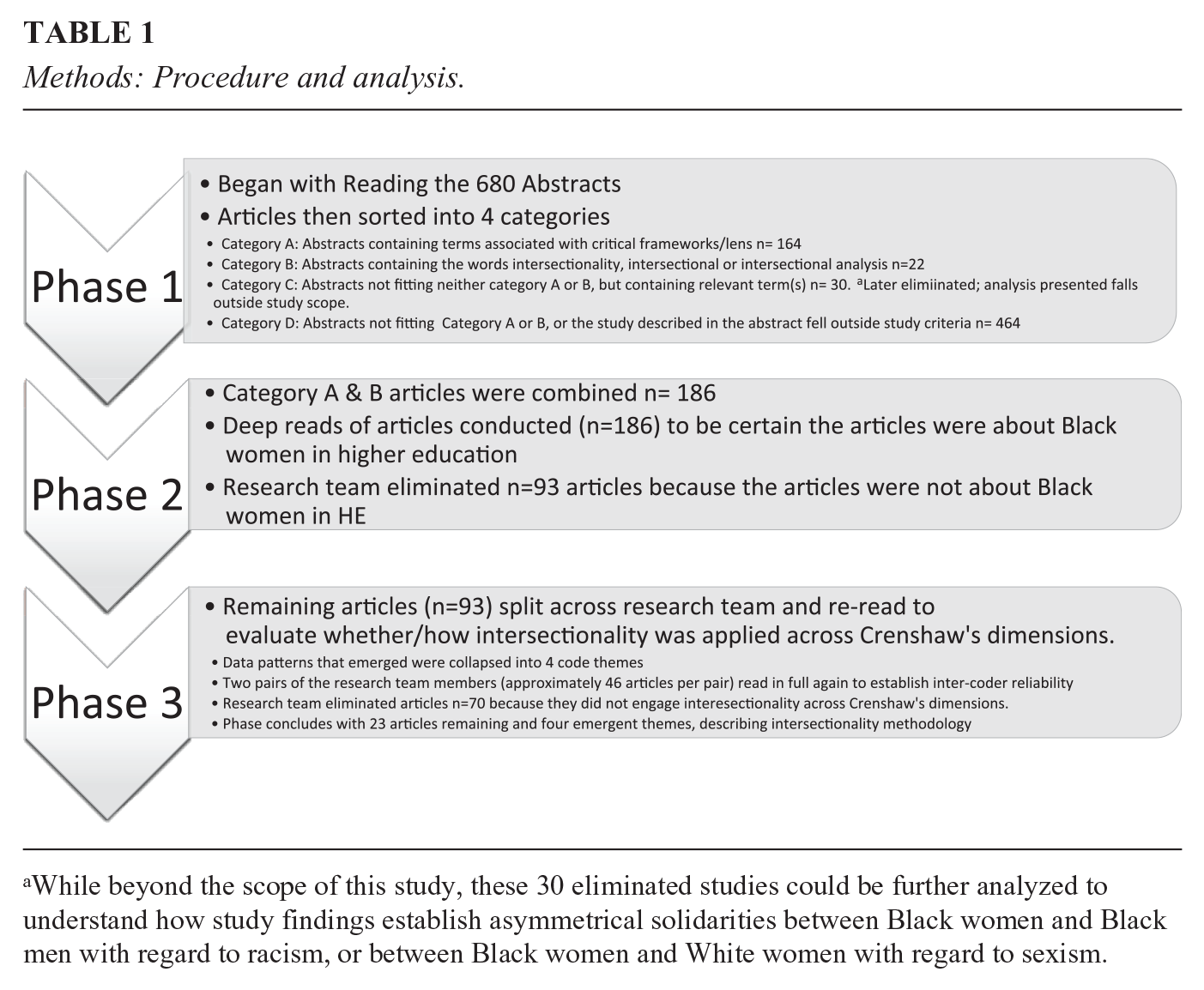
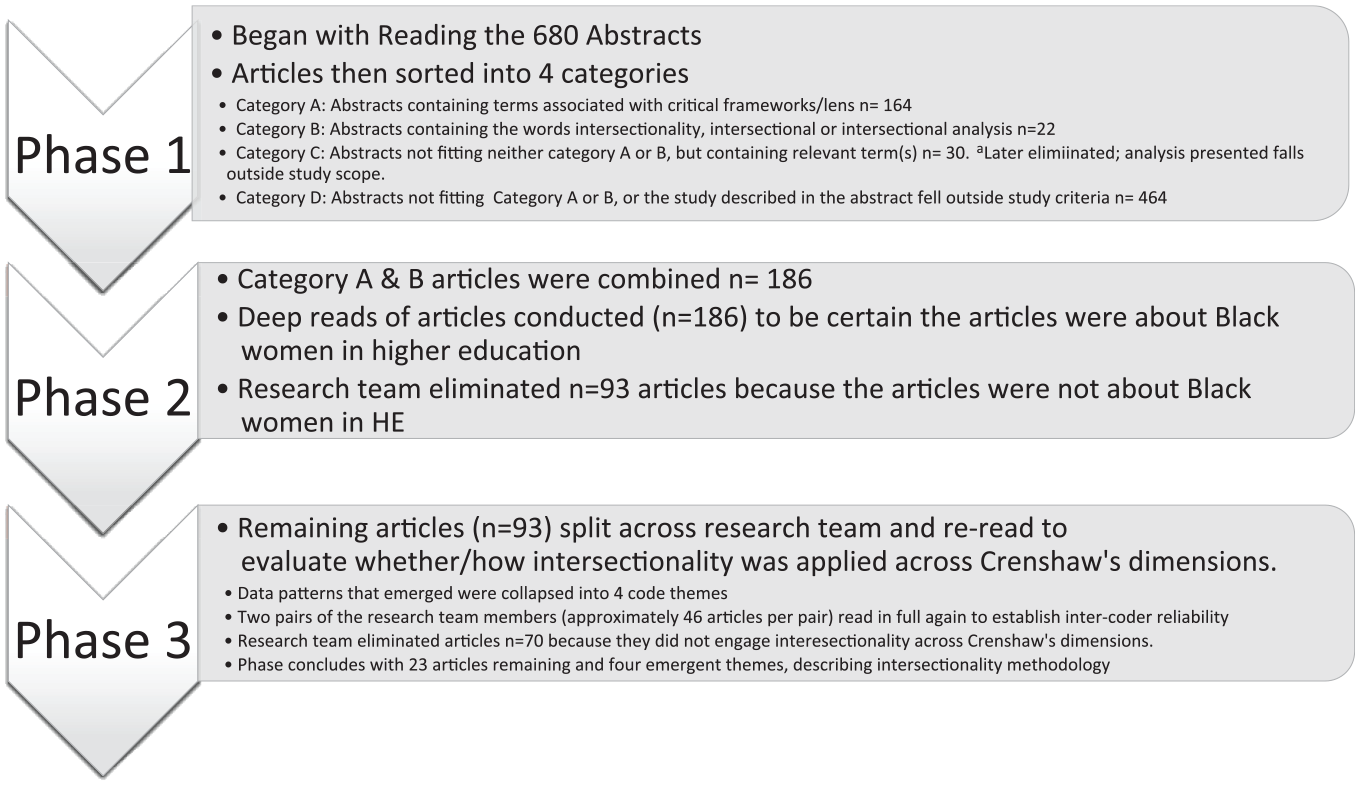
Our coding procedures occurred in three phases (see Table 1). In Phase 1, we read each of the 680 abstracts and sorted the articles into three separate categories with differing inclusionary and exclusionary bounds (Saldaña, 2016). Articles assigned to Category A (n = 164) had to have at least one of the following terms in the abstract: critical race feminism, critical race theory, Black feminist thought (BFT), Black feminist theory, endarkened feminist epistemology, oppression, racism (and/or racial injustice/justice), sexism, racist, sexist, invisibility and/or invisible, narrative, White supremacy, disposability and/or disposable, interiority or inferior, gendered, racialized, racialized sexism, womanism/womanist, or Black feminism. The keywords chosen are concepts associated with Crenshaw’s conceptualization of the intersectional subordination that Black women experience and theoretical constructs critical scholars have used in their research on gendered racism and race-based oppression broadly. Articles assigned to Category B (n = 22) had at least one of the following terms in the abstract: intersectionality, intersectional approaches, and/or intersectionality research. Articles assigned to Category C (n = 30) did not have any of the terms in Categories A or B in the abstract, but the abstract contained terms that appeared relevant. For example, Carter-Sowell and Zimmerman’s (2015) article presenting findings about stigma among women of color was placed in Category C initially, because the phrases/words “strong Black woman schema,” “prejudice,” and “double-consciousness” appeared in its abstract. However, the research team later determined that the analysis presented in this article engaged in single-axis analyses along the lines of race or gender. While beyond the scope of this study, these 30 studies could be further analyzed to understand how study findings establish asymmetrical solidarities between Black women and Black men with regard to racism, or between Black women and White women with regard to sexism (see Table 1).
Methods: Procedure and analysis
While beyond the scope of this study, these 30 eliminated studies could be further analyzed to understand how study findings establish asymmetrical solidarities between Black women and Black men with regard to racism, or between Black women and White women with regard to sexism.
Finally, Category D codes (n = 464) were assigned to articles that were eliminated for one or both of the following reasons: The abstract did not contain any of the terms in Category A or B, or the study described in the abstract fell outside of the criteria for our study (see Table 1). For example, Abrams et al.’s (2016) article presenting study findings that compared gender role beliefs of African American and Vietnamese American women was eliminated because the abstract did not contain any of the required terms in Category A or B, and its abstract reported that the mean ages among African American women and Asian American women in the study were 44 years old and 42 years old, respectively, which led the research team to believe the study did not foreground the experiences of Black women or their experiences in higher education. An electronic code book (see Table 2) was created that detailed sample citations and corresponding abstract by its respective code category (i.e., A-D).
Sampling of code book detailing inclusionary/exclusionary bounds

Phase 2 of our analysis began with combining articles in Categories A and B (n = 186). Those articles were then divided among the members of the research team (see Table 1). Individually, each member of the research team conducted full reads of the articles they were assigned to be certain an empirical study about Black women in higher education was presented therein. If the research team member determined that an assigned article did not present an empirical study about Black women in higher education, the article was eliminated and no further analysis was conducted. For example, an article presenting a study about Black women and obesity was initially coded in Category B because the term intersectional appeared in its abstract but was later eliminated after a full article read. The research team determined that while Black undergraduate women were in the participant sample, the intent of the research was not to contextualize Black women’s experiences in higher education. The research team concluded Phase 2 of the analysis with the elimination of 93 of the 186 remaining articles (across Categories A and B) because we discovered that empirical studies about Black women in the context of higher education were not presented therein.
In Phase 3 (see Table 1), the remaining 93 articles were divided among the members of the research team. Each research team member was tasked with reading their assigned article and noting, in our electronic code book (see Table 2), whether and how the researchers engaged intersectionality across each of Crenshaw’s (1991) dimensions. The research team then convened to discuss patterns that had emerged in our analysis. We were able to collapse the patterns we observed in the data into four emergent themes. Then the 93 articles were split across two pairs of the research team members (approximately 46 articles per pair) and read in full again to establish intercoder reliability (MacPhail et al., 2016) or agreement in emergent themes. Seventy of the remaining 93 articles were ultimately eliminated, largely because the research team agreed that (a) intersectionality was not addressed in the study or (b) the article presented a nontraditional study, with no clear methods, findings, or implications (which happened far less often). By the end of our analysis, we determined that only 23 studies were published by scholars who engaged Crenshaw’s conceptualization of intersectionality in their research. Four distinct themes emerged in our analysis, shedding light on the way(s) that scholars applied intersectionality across its three dimensions in their study of Black women in higher education. We outline those findings in the next section (see Table 3).
Intersectionality methodology features and study methods of the 23 studies in data corpus
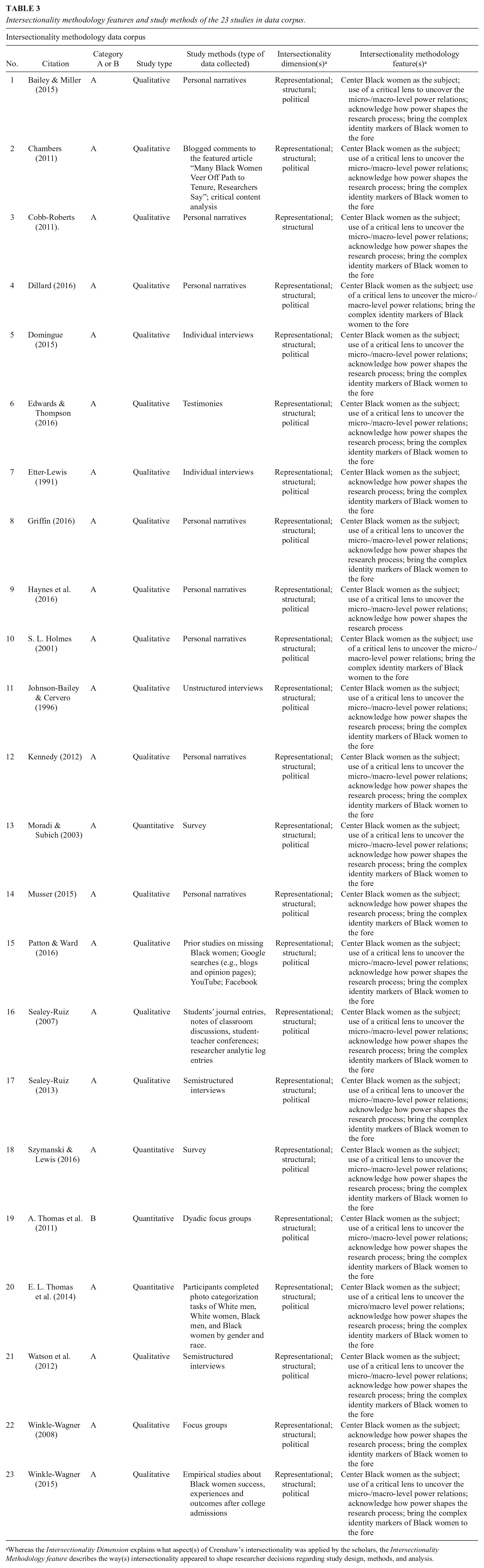
Whereas the Intersectionality Dimension explains what aspect(s) of Crenshaw’s intersectionality was applied by the scholars, the Intersectionality Methodology feature describes the way(s) intersectionality appeared to shape researcher decisions regarding study design, methods, and analysis.
Limitations
While our study’s findings make several contributions to the study of intersectionality in higher education research and social science research broadly, some limitations do exist. The primary limitation is linked to how our data set was generated. This is not a comprehensive review of all literature on Black women and intersectionality. We limited our data search to empirical studies about Black women in higher education published in peer-reviewed journals exclusively. The search parameters and exclusionary bounds invoked during our data collection/analysis process meant that some relevant source material published in books, periodicals, or law review journals or in outlets without peer review would inevitably be excluded, including some of our own. While beyond the scope of this study, limiting our data set to empirical studies published in peer-reviewed journals shed a great deal of light not only on some of the research methods that aid in the intersectional study of Black women’s experiences but also on where the limited (intersectionality) research about Black women has been published over the past 30 years.
A second and related limitation has to do with bounding our data set to a particular time frame. Our data collection began in 2017, which explains why we limited our analysis to research published in the past 30 years. However, in the last few years, important research about Black women and intersectionality has been published that upon further review may have met the threshold for inclusion in this study. Research about the experiences of Black women is extremely limited. We are especially excited about the (higher) education research published recently, and forthcoming, which presents the lived experiences of Black women in complex and dynamic ways. The final limitation has to do with the generalizability of our findings. In operationalizing IM, it would be logical for readers to question whether IM could be applied in studies about other populations. Intersectionality, according to Crenshaw (1989, 1991), explains how multiple interlocking systems of oppression shape the experiences of Black women and other similarly minoritized populations. Thus, our findings do not suggest that IM could be applied to a study of just any population. Conceivably, IM will continue to evolve as more scholars study Black women and similarly minoritized groups’ intersectionality (e.g., Latinas, queer Black men, or Black Muslim women). We are hopeful that our collective understanding of the power and contribution of intersectionality research will change how future scholars are trained and create shifts in higher education, and society as a whole.
Findings
Intersectionality Methodology
With the intent to provide scholars with a nuanced methodological approach for taking up intersectionality in their study of Black women in education research, and social science research broadly, our literature synthesis examines how Crenshaw’s intersectionality had been applied across its three dimensions (i.e., structural, political, and representational) by scholars who published empirical studies about Black women in higher education between 1986 and 2016. In those 30 years, we determined 680 studies were published about Black women in higher education. However, only 23 empirical studies were published by scholars who engaged intersectionality in their research across Crenshaw’s three dimensions. Moreover, these particular scholars tended to employ four strategies in their application of intersectionality, which we introduce here as IM. In presenting our findings, we use the intersectionality dimension (i.e., structural, political, and representational) to explain what aspect(s) of Crenshaw’s intersectionality was applied by the scholars and the IM feature to describe the way(s) intersectionality appeared to shape researcher-decisions regarding study design, methods and analysis.
Feature 1: Centralize Black Women as the Subject
All the scholars in our narrowed sample of 23 studies addressed representational and structural intersectionality by centralizing Black women as the subject, namely, as knowledge sources and producers. Scholars who centered Black women as sources of knowledge, such as S. L. Holmes (2001) and Sealey-Ruiz (2007, 2013), addressed representational intersectionality by treating Black women’s voices as legitimate and not taking said knowledge for granted. To illustrate, in her oral history project, Etter-Lewis (1991) wrote, “[A]s an African American woman and researcher, I felt I had a unique privilege in reconstructing an overlooked aspect of African-American and women’s history and culture” (p. 155). The Etter-Lewis study focused on the sociolinguistic construction of authority among second-generation African American women collegians, whose parents attended college at the turn of the century. She stated, “The women I interviewed became my role models [emphasis added]. . . . I was simultaneously a researcher and a student [emphasis added] learning personal lessons from my subjects’ life stories” (p. 155). At other times, scholars such as Dillard (2016) made a point to bring visibility to the often-obscured contributions of Black women that take place on the meso (e.g., institutional/community) and macro (e.g., profession/academe) levels. Dillard’s (2016) auto-ethnography illuminated her own experience to theorize Black women’s leadership, stating, “The declarations of love and sovereignty that Black women make, as we suffer under the weight of racism and sexism [in higher education], can expand our collective understanding of how all lives matter” (p. 31).
Centering Black women as knowledge sources also seems to have helped these scholars combat structural intersectionality. As sources of knowledge, Black women could not be treated as props, precluding scholars from using their study findings to explain (or theorize about) the lived experiences of another population in higher education. When Black women function as props, they often mimic an “experimental group” in a study, while being compared to a “controlled group,” such as White women when exploring gender, or Black men when exploring race (see Stojek & Fischer, 2013, a study we eliminated).
Alternatively, scholars who centered Black women as the subject by situating them as knowledge producers often employed methodological techniques intended to address representational and structural intersectionality by: (a) presenting “powerful alternatives” to stereotypical representations of Black womanhood (Sealey-Ruiz, 2013, p. 6) and (b) exposing how Black women experience multiple intersectional forms of oppression. For instance, Bailey and Miller (2015) used narrative inquiry to critique their experiences navigating the academy as Black queer women faculty: Our unique experience as faculty has been under theorized, even by us, and necessitates specific strategies that would not be addressed by a focus on Black women who are assumed to be straight or queer women who are assumed to be White. (p. 169)
Several scholars in this narrowed sample followed suit, drawing upon methodological approaches that allowed them to serve simultaneously as participant-researcher and source-knowledge-producer. For instance, Haynes et al. (2016), Cobb-Roberts (2011), and Griffin (2016) used collaborative auto-ethnography and counterstorytelling to create oppositional discourses to the ones that often leave Black women feeling “inadequate and expendable, or otherwise invisible” (Haynes et al., 2016, p. 381). Researchers intent on taking up intersectionality often used collaborative auto-ethnography and counterstorytelling to illuminate how Black women, in particular, can experience intersectional erasure (Cho et al., 2013, p. 791) and therefore do not show up in data, when traditional methodological approaches that privilege whiteness, maleness, and heteronormativity are relied upon. Those scholars in our narrowed sample of 23 who centered Black women as knowledge producers in their research appeared to embrace methodological approaches that positioned them to do research with Black women rather than on Black women. Our analysis began to suggest that researcher proximity has great bearing on intersectionality research. This has strong implications for intersectionality research, which we revisit in the section on power in the research process. Our analysis further revealed how centering Black women as knowledge sources and producers illustrates intersectionality research’s corrective nature.
Extreme Invisibility and Scholarly Neglect
Centralizing Black women as the subject involved scholars tackling structural intersectionality to address the extreme invisibility and scholarly neglect that Black women experience in higher education literature. Taking up intersectionality allowed the scholars in our narrowed sample of 23 to isolate the identity politics, and thus, the intersectional oppression, that Black men and White women seldom confront. For instance, Moradi and Subich (2003) used path analysis to examine concomitant links between Black women’s perceptions of racist and sexist encounters and their experiences with psychological distress. Moradi and Subich used their research to demonstrate how (a) racism, (b) sexism, and (c) psychological stress have been studied separately, creating disparate bodies of literature that do not account for Black women’s unique experiences. Szymanski and Lewis (2016) were also interested in psychological distress among Black women. They studied Black women’s experiences with gendered racism, an intersectional form of subordination, to understand their coping strategies. Like Moradi and Subich, Szymanski and Lewis asserted that little research exists about the physical and psychological wellness of Black women because racism and sexism is a rarely studied intersectionality in quantitative studies about mental health. These scholars further posited that the extreme invisibility and scholarly neglect that Black women tend to experience also contributes to the lack of accessibility to models that accurately measure identity development among them. For instance, A. Thomas et al. (2011) used scholarship on BFT and intersectionality to measure “gendered racial identity” and explain social identity development among African American girls and women. A. Thomas et al. explained that gendered racial identity for young Black women involves the recognition of their race and gender identities. They asserted that existing gender or racial models are inadequate to explore the experiences of Black women and girls because they do not account for intragroup differences. “In order to understand the experience and identity development of African American girls and women, it is important to understand the intersection of racial and gender identity, or gendered racial identity as an aspect of social identity” (A. Thomas et al., 2011, p. 531).
Scholars also used qualitative methods and BFT to address the “effects of prolonged invisibility” on Black women and girls. Haynes et al. (2016) found that prolonged exposure to master narratives in U.S. classrooms that render Black women and girls invisible can teach Black women and girls to adopt deficit perspectives of themselves as learners and scholars. According to hooks (1981), master narratives that treat Black women’s bodies as inanimate and disposable were constructed in slavery and are ingrained in the American consciousness. The studies by Haynes et al. (2016) and A. Thomas et al. (2011) illuminated a pattern in the data with regard to scholars using critical lenses, like BFT, to address issues of intersectionality in their studies, a point we further expound upon in our section on using critical/intersectional lenses.
Research Problem Placed in Sociopolitical Context
Centering Black women as the subject helped scholars in our narrowed sample to address representational intersectionality and place the research problem under study in its appropriate sociopolitical context. Edwards and Thompson (2016, pp. 39–40), for example, critiqued the extant literature on ally work, arguing that much of the literature situates “over privileged individuals” as saviors who engage sacrificially in the dismantling of hegemonic structures that benefit them and exploit the labor of Black women faculty in the academy. To be clear, centering Black women as the subject enabled these scholars to examine institutional norms, traditions, and policies that perpetuate and/or circumvent the marginalization of Black women. In her qualitative study about college reentry, Sealey-Ruiz’s (2013) focus on the experiences of Black mothers debunked harmful stereotypes that cast Black women as the “welfare mother/welfare queen.” She found that Black mothers associated pursuing higher education with their maternal instincts. Sealey-Ruiz used her study findings to dismantle racist, gendered, and classist tropes imposed upon Black women as matriarchs, a controlling image of Black womanhood that portrays them more consumed with their children’s happiness than with their own.
Domingue (2015), Cobb-Roberts (2011), and Chambers (2011) addressed representational intersectionality in their research and illustrated how gendered racism is enacted at an institutional level. For example, Cobb-Roberts revisited articles she had written and published before tenure about her teaching. She recounted a time when lived experiences as a queer Black woman were compared to Oprah Winfrey by a White male student, who was attempting to convince his classmates that significant progress had been made in education toward social equality. Cobb-Roberts noted the student’s comment made her aware that her race and gender were on full display but in ways that frequently tokenize Black women and minimize their contributions. Patton and Haynes (2018) posited that Oprah Winfrey, particularly her labor, is often subjected to mammification by White others, who celebrate her accomplishments and treat her as a model minority.
Feature 2: Use of a Critical Lens to Uncover the Micro-/Macro-Level Power Relations
While research questions and designs varied, the authors of 20 of the articles in our narrowed sample of 23 used a combination of critical yet intersectional lenses (i.e., theories or frameworks) to evaluate the structural and representational intersectionality that reinforces the race, sex, gender, and class domination (Crenshaw, 1991) shaping Black women’s experiences in higher education. Our analysis further indicates most of the lenses utilized have roots in Black feminist scholarship—see, for example, how Szymanski and Lewis (2016) and Sealey-Ruiz (2007) used intersectionality and culturally relevant curriculum, respectively.
Black Feminist Thought
Black feminist thought was applied most often (n = 8). Scholars who used BFT drew on the scholarship of Collins (1989) and hooks (1981). BFT asserts that Black women’s social location, as racialized and gendered Others, makes them “outsiders within” a social world that privileges White, masculinist, cis- and heterosexist, and middle-class ways of knowing. For instance, Johnson-Bailey and Cervero (1996) argued BFT is an extension of the Black feminist movement; thus, it is an epistemology that posits the experiential knowledge of Black women is legitimate. BFT asserts that racism and sexism negatively affect Black women’s lives, especially those who are among the poor and working class (Johnson-Bailey & Cervero, 1996). Griffin’s (2016) application of BFT helped her to denote how Black women faculty, who are not only bisexual but also first-generation college students, experience tenure and promotion. Bailey and Miller (2015) coupled Black feminist epistemology with Freire’s (2005) critical pedagogy to show how they struggle, as queer Black women faculty, to navigate racist and homophobic interactions with students and faculty colleagues.
We turn to scholarship by Smyth (2004) to demonstrate that critical/intersectional lenses are tools scholars utilize in conducting intersectionality research. According to Smyth, a critical/intersectional lens “forms part of the agenda for negotiation to be scrutinized and tested, reviewed and reformed as a result of investigation (Smyth, 2004, para. 4).” Smyth argued that theoretical/conceptual frameworks should be used in education research to provide a structure from which to organize research content.
Kennedy (2012) used hooks’s (1994) scholarship on emancipatory teaching and Collins’s (2002) BFT to frame her analysis. Kennedy’s autoethnographic study explored Black women’s experiences at HBCUs. In her analysis, Kennedy compared her HBCU experience with her mother’s, and with that of other HBCU alumni published by Black women professors. Her analysis illustrates how discourses about gender become subsumed by those on race to bring visibility to the ways Black women resist racialized gender oppression at HBCUs.
Smyth (2004) also argued that researchers should use theoretical/conceptual frameworks to help their readers locate their research questions. In that regard, Watson et al. (2012) asked and answered the following research question: How do Black women experience sexual objectification within multiple systems of oppression? The application by Watson et al. of BFT and objectification theory helped them address representational and structural intersectionality. Specifically, Watson et al. used their study findings to illustrate how racist and sexually demonizing stereotypes of Black women are used to justify the sexual objectification of Black women’s bodies and to blame them for the sexual violence they encounter. Sealey-Ruiz’s (2013) use of BFT and critical race theory enabled the Black women in her study “to tell their stories in their own words” (p. 4). Sealey-Ruiz used her study findings to address representational intersectionality and illustrated how Black reentry women not only persist academically but also maintain positive self-images in hostile campus learning environments that project racist and sexist stereotypes of Black womanhood.
Endarkened Feminist Epistemology
Smyth (2004) also stressed that theoretical/conceptual frameworks ought to help researchers make judgments about their data. Dillard’s (2016) use of endarkened feminist epistemology further demonstrated this. Dillard made endarkening the focus of her analysis to draw attention to structural intersectionality, specifically the silent suffering and violence that she, and other Black women academic leaders, experience at predominantly White institutions. In this way, Dillard (2000) used narrative inquiry to “dig up” (p. 679) the unearthed stories of survival of Black women who lead.
Womanist Theology and Critical Race Feminism
These scholars’ use of critical/intersectional lenses proved to be a research tool that inspired methodological innovations, underscoring the contributions of intersectionality research. For example, Edwards and Thompson’s (2016) use of womanist theology inspired their creation of an approach to qualitative research they called Scholarly Rearing: Methodological Deliverance. According to Edwards and Thompson, womanist theology attends to structural intersectionality by taking up “faith, religious practice, scholarship, resistance, justice, and Black womanhood integratively” (p. 43). Scholarly Rearing is a spirit-filled methodology that challenges researchers to place less emphasis on “speaking to a disciplinary audience—one that is disinclined to appreciate a Black feminized spiritual perspective—and more concerned with the survival of the oppressed” (Edwards & Thompson, 2016, p. 44).
Patton and Ward (2016) applied critical race feminism in their examination of the disposability politics surrounding missing Black undergraduate women, and presented a new qualitative approach: critical race feminist methodology (CRFM). Patton and Ward’s CRFM addressed representational and structural intersectionality in three ways. First, CRFM helped Patton and Ward to focus on missing women at the intersection of race, gender, and class within postsecondary contexts. Second, CRFM supported their use of unconventional methods (e.g., reputable websites, newspapers, as well as social media platforms such as blogs, Facebook, and YouTube) for identifying data and information about Black women that is missing from literature and missing in society. Third and perhaps most important, CRFM helped Patton and Ward to move beyond theorizing, to create a new qualitative approach that recognizes Black women’s humanity as an integral part of the research process.
Feature 3: Address How Power Shapes the Research Process
Scholars in our narrowed sample politicized the research process to dismantle research traditions that reproduce whiteness (Harding, 1991), encourage single-axis analyses, and contribute to epistemic erasure of Black women. Edwards and Thompson (2016) argued that Scholarly Rearing helped them to “decenter the sterile (soulless) . . . eurocentrist notions of logic and rationality for communal knowledges and workings of faithful Black women” (p. 40). Politicizing the research process also appeared to support these scholars in their decision to introduce the perspectives of Black women on their article’s first page, rather than filtering their experiences through a race or gender only discourse. For example, S. L. Holmes (2001) articulated her interest in the experiences of Black women faculty because she encountered so few like her in her doctoral studies. We also noted that scholars addressed political intersectionality in the research process by probing “who is made vulnerable by the research, understanding that the researchers should be the most vulnerable” (Fine, 2006, p. 88). These types of power analyses place emphasis on researcher reflexivity (or researcher positionality) and researcher proximity (e.g., approaches to trustworthiness/reliability).
Researcher Reflexivity
By taking a reflexive stance, these scholars critiqued their positionality or examined the “biological wisdom and blinders” they brought into the research process (Fine, 2006, p. 90). Chambers (2011) addressed her positionality head on, arguing that her lived experiences as a tenure track, Black woman faculty member made it impossible for her to be neutral but not for her to present findings that were confirmable and dependable in her study of departure among Black women academics. Similarly, Sealey-Ruiz (2013) acknowledged that being stereotyped as a Black woman and a mother were issues she had to “deal with in various contexts” of her own life (p. 8). As such, her interests in talking with Black mothers revolved around a desire to discover new ways to resist the structural intersectionality Black women contend with in American society. Scholars who addressed how power shaped their research process addressed political intersectionality not only by refusing to engage in single-axis analyses but also by concerning themselves with mitigating power’s adverse effects.
In this way, scholars took different steps to validate or establish credibility of their findings: triangulating their data with member checks (e.g., Kennedy, 2012; Sealey-Ruiz, 2007), documenting researcher presuppositions and biases (e.g., Musser, 2015; Watson et al., 2012), and peer debriefing with colleagues to help alert them to aspects of the research that were taken for granted (e.g., Moradi & Subich, 2003). For example, Johnson-Bailey understood that her use of BFT required her to address her positionality in her 1996 narrative study with Cervero that explored the reentry experiences of Black college women. Thus, as a prerequisite, she constructed a personal narrative using her responses to the interview questions she prepared for participants. Her narrative became an essential component to the study’s design, making the narrative process between her and the study’s participants reciprocal. Johnson-Bailey asserted that the clear differences between her story and her participants’ stories are the “analytic litmus test” establishing the integrity of her findings (Johnson-Bailey & Cervero, 1996).
Researcher Proximity
Addressing how power shaped the research process also involved White scholars politicizing the research process by asking themselves, “Who-am-I-to-do-this-work?” (Fine, 2006, p. 90). For example, Moradi and Subich (2003) acknowledged that whiteness would influence how White members of their research team would interpret their data in a study about Black women’s experiences. In addition to comprising a research team of scholars of color and White scholars, Moradi and Subich attempted to further decenter whiteness by drawing upon the personal contacts of the lead author, an African American, to (a) maximize participation, (b) reduce potential data contamination related to possible suspicion and anxiety of study participants toward White researchers, and (c) eliminate the potential effects of White data collectors’ intentional or unintentional racism” (pp. 458–459).
Winkle-Wagner (2008, 2015) provides another example of White scholars’ grappling with research proximity and the role of power in the research process. In her 2015 article, Winkle-Wagner wrote, I was interested in what the literature implied about power in research processes, and how this can shape what is known about groups of people (Black women in this case). I attempted to connect this literature to larger issues related to Black women. It is through Black feminist thought that I came to the idea of [B]lack women being narrowed down to fit mainstream and dominant notions of being, and this initiated my approach . . . . Together, these theoretical ideas provided a background on which I rooted my thinking about the literature. (p. 177)
She later expressed, “Quantitative research on Black women should include multi-level or advanced statistical modeling to account for the levels of experience of Black female students and to allow for the intersections of race, class, and gender” (Winkle-Wagner, 2015, p. 192). Moradi and Subich (2003), quantitative researchers, heeded Winkle-Wagner’s advice.
Apart from Winkle-Wagner and Moradi and Subich, we did not observe other White scholars (e.g., Szymanski & Lewis, 2016; Watson et al., 2012) address the ways that their whiteness shaped the research process, which heightened our reservation about White scholars engaging in research about Black women. Political intersectionality insists that researchers name resistance strategies they employ to disrupt the ways that power shapes the research process. We argue this is especially important for White scholars who study Black women, and other racially minoritized populations. Fine (2006) asserted that it is only “once the fog of unacknowledged subjectivities has cleared” that researchers can conduct (intersectionality) research that “presents counter-hegemonic perspectives and stand-points that challenge dominant views—even as these dominant views may be narrated by some of [society’s] most oppressed people” (pp. 90–91).
Feature 4: Bring the Complex Identity Markers of Black Women to the Fore
The scholars in our narrowed sample of 23 presented analyses in their study of Black women in higher education that captured the fullness of their humanity. We observed that their examinations addressed structural-political-representational intersectionality, seemingly to illustrate that Black women’s lives cannot be fully understood by studying one dimension of identity alone. We noted three ways that helped these scholars to bring the complex identity markers of Black women to the foreground in their analyses.
Avoid the Lowest Common Denominator
Presenting Black women in the fullness of their humanity often involved these scholars taking up intersectionality to resist the tendency, as Winkle-Wagner (2008) asserted, to distill Black women’s experiences down to one common denominator: race or gender, to political intersectionality. E. L. Thomas et al.’s (2014) study on social nonprototypicality of Black women addressed political intersectionality to underscore how single-axis, identity politics contribute to Black women’s erasure. Their findings indicated that Black women are literally invisible because they are slow to be recognized (by White and Black people) as Black, or as women. Described as a “predictive social consequence,” E. L. Thomas et al. contended that their experiment explains why (and how) Black women’s faces are less likely to be remembered, their contributions go unrecognized or attributed to others, and they are not held to the gender stereotypes associated with White womanhood because they are seen as less female. Scholars also used their findings to address political intersectionality to highlight how single-axis analyses contribute to an undertheorizing of Black women’s developmental experiences. Musser (2015) examined her own experiences on the academic job market to illuminate how Black queer women faculty can feel simultaneously too visible because of their blackness, and invisible because they do not express their gender and sexuality in ways that reinforce racist and sexually demonizing stereotypes. Musser underscored how Black queer women can struggle to navigate two or more systems of oppression with competing political agendas: While women’s studies have historically been friendly to LGBTQ individuals, I wondered if my presentation as a normatively feminine woman rendered me invisible as queer and in this way not necessarily less qualified to teach sexuality studies, but less “useful” as a community member who could not be counted on to necessarily perform the labor of mentoring LGBTQ students or being a visible ally. (p. 4)
Black Womanhood Wholly Constructed
By presenting Black women in the fullness of their humanity, these scholars used their findings to address representational intersectionality in their construction of Black womanhood as personal, deliberate, intellectual, and virtuous, gender characteristics most often reserved for White women and White or Black men in academic and public discourse. For example, Edwards and Thompson (2016) described how their intersecting identities as Black Christian women academics helped them to “deliberately enact religiospiritual resistance” in an institutional framework that cast Black women in the image of “institutional housekeepers’’ (p. 41). Similarly, Sealey-Ruiz’s (2013) analysis of personal stories from Black reentry women achieved the participants’ and researchers’ intent to represent Black women as triumphant, well-positioned for academic achievement instead of stereotypical victims to undermine their accomplishments. Sealey-Ruiz’s critical construction of Black motherhood recognized Black women’s contributions to the Black family, and refuted racist and sexist tropes of Black women as the matriarch, welfare queen, and mammy.
There is also Etter-Lewis (1991), who unearthed counternarratives about Black womanhood in her sociolinguistic analysis of the life histories and personal narratives of college-educated Black women who had held professional positions once occupied by men or White people between 1920 and 1940. Her analysis included a participant narrative, where a participant named J. T. refers to herself in the first person. Etter-Lewis kept J. T.’s narrative intact, seemingly to emphasize that J. T. is a Black woman who sees herself as shero of her own life story, a counternarative to prevailing representations of Black women as “the help” (Harris-Perry, 2011) that persist today. Finally, Bailey and Miller’s (2015) analysis of their experiences in academe underscored how gender-queer faculty can encounter “passive homophobia” in their interactions not only with White faculty and students but also with other Black women faculty (p. 183). Their analysis revealed that the passive homophobia Bailey encountered was a manifestation of power dynamics of race-sexuality-gender that permitted some straight Black women faculty to decouple her queerness from her Black womanhood, thus, requiring queer Black women faculty, like her, not to act on their sexuality in order to be part of the group.
Intersectional Interventions
By insisting that the complex experiences of Black women cannot be explained by one identity marker alone, these scholars illuminate the need for “intersectional interventions” (Patton & Njoku, 2019). However, very few specific examples are outlined in the research. Scholars who raised the issue asserted that institutions must be designed with Black women in mind and/or with their input to actually address structural-political-representational intersectionality. For instance, Edwards and Thompson (2016) and Sealey-Ruiz (2013) asserted that in order to design appropriate support structures for Black women, institutional leaders need to possess “a nuanced understanding of these women’s daily existence” on campus (Sealey-Ruiz, 2013, p. 22). E. L. Thomas et al. (2014) discovered Black women and girls, when asked, can articulate how race and gender shape their lives. Scholars like E. L. Thomas et al., Edwards and Thompson, and Sealey-Ruiz urge higher education institutions to share in the burden of undoing institutional norms and practices that reinforce racist and sexist oppression, in favor of campus environments that embrace Afrocentric values and foster self-determination and resistance among Black women.
Szymanski and Lewis (2016) presented “sista-circles” or Black women therapy groups as an intersectional intervention, citing such institutional supports can help Black women cope with the trauma associated with everyday encounters with gendered racism. Bailey and Miller (2015) also referenced the transformative power of connection and prompted institutional leaders to financially support queer women of color students and faculty, in ways that do not tokenize, organize, or use these networks as evidence of campus diversity. Still, there is an acknowledgment among these scholars (e.g., Chambers, 2011; Cobb-Roberts, 2011; Griffin, 2016; S. L. Holmes, 2001; Johnson-Bailey & Cervero, 1996; Musser, 2015) that the work of challenging intersectional subordination (i.e., the racist-sexist-ableist-classist-homophobic oppression endemic to higher education, and society alike) is part of a daily struggle for Black women inside and outside of the classroom, who are “simultaneously working to liberate” themselves (Bailey & Miller, 2015, p. 185).
Discussion
Our findings suggest that IM has four features that illuminate how both (a) the three dimensions of intersectionality can be applied in the study of Black women and (b) researcher decisions regarding study design, methods, and analysis are made as a result. In all 23 studies, the scholars centered Black women as the subject, involving them in the research process as knowledge sources and/or knowledge producers. The decision to center Black women in the research seemingly enabled these scholars to address the structural intersectionality that persists through scholarly neglect when, for example, education research problems are not placed in their appropriate sociopolitical context. All but three of the 23 studies were conducted by scholars who used a critical/intersectional lens, such as BFT, in their analyses. Their efforts demonstrate how intersectional analyses can not only exist in quantitative and qualitative research but also generate methodological innovations. Scholars involved in all 23 studies engaged the final two features but not at the same levels: addressing how power shapes the research process, and bringing complex identity markers to the fore. Our analysis suggests that scholars who appeared concerned with power’s adverse effects on Black women’s lives tended to address how power shaped their research process, thus setting IM apart from any other form of education research, and social science research broadly. Furthermore, our findings indicated that researcher reflexivity and researcher proximity are key considerations in evaluating how power shapes the structure of the research process for scholars who apply IM, whether they are quantitative or qualitative. For example, would a quantitative scholar conducting research about Black women be inclined to acknowledge and address how power shapes the research process, like those in our sample, if they were not applying IM? In this way, IM prompts researchers to consider how identity politics are compounded and maintained at the onset and throughout the research process. Finally, using IM, these scholars appeared better able to present analyses that represent Black women in the fullness of their humanity, bringing to the fore their complex identity markers that cannot be explained by one identity dimension alone. IM ostensibly rejects both (a) research approaches that examine Black women’s experiences from the lowest common denominator and (b) study findings that insist Black women are a monolithic group.
Implications for Research and Practice
Less often in our analysis did we observe scholars presenting intersectional interventions that would support and advance Black women’s liberation in higher education. Our analysis suggests that intersectional interventions in higher education are needed because not all Black women (or Black people or women of color, for that matter) experience oppression in exactly the same way. IM presents researchers with the opportunity and ability to generate data-driven intersectional interventions that are transdisciplinary, effective, and focused on the needs of Black women. Research collaborations and learning environments that create “counterspaces” designed not only to center the lived experience of Black women but also to create the conditions for them to be knowledge sources and producers are prime examples of intersectional interventions. This may take the shape of a research project where the research team composed of Black women faculty and Black undergraduate women, utilizing an intersectional lens to examine campus violence targeting Black undergraduate women. Other examples include the new transinstitutional Community Lab for the Intersectional Study of Black Women and Girls in Society at Vanderbilt University. The Community Lab engages IM by drawing on the intellectual resources in sociology, law, STEM, education, African American and Diaspora Studies, religious studies, divinity, and health to create a transdisciplinary research hub for the creation of intersectional interventions that expand pathways of success for Black women and girls in P–20 and beyond. In this way, IM provides scholars a guide to take up intersectionality in research about Black women at the onset of a study, beginning with the research problem to the research design and through to the intersectional interventions for research, policy, and practice.
Only 23 of the 680 studies published about Black women in higher education were published by researchers who engaged IM. Consequently, the limited and extant research published about Black women in higher education ultimately recentered whiteness, contributing to the scholarly neglect Black women experience in the literature and the intersectional erasure they experience in higher education and society broadly. Our analysis also has implications for who engages IM. As noted earlier, some of the studies in our data corpus were conducted by White scholars, some of whom grappled with their positionality. We realize that not every scholar will acknowledge their identities and positionalities in research, but we highly encourage this process for those interested in using IM. Another implication of our study deals with publication venue. We were also struck by where the 23 intersectionality studies about Black women in higher education were published. The overwhelming majority of publication venues (14 of 23) were published in venues specifically devoted to issues related to research on Black women’s gender- or sex-related education. The remaining nine appeared in journals with a broader focus. We contend that a more vigorous analysis is needed in future research that evaluates how scholars who engage in intersectionality research experience the publication process. This type of examination could reveal a great deal about where research on Black women and/or intersectionality shows up. Moreover, this line of inquiry could have significant influence for education research and the preparation and training of future researchers via graduate preparation and training. A study about these scholars’ publication experiences could illuminate how editorial board members, journal reviewers, and graduate faculty may inadvertently become culpable in the epistemic erasure of Black women in higher education, academe, and society, as well as the un/doing of intersectionality (Bilge, 2013, 2014; Harris & Patton, 2019).
Conclusion
This literature synthesis examined how Crenshaw’s intersectionality had been applied across its three dimensions (i.e., structural, political, and representational) by scholars who published empirical studies about Black women in higher education between 1986 and 2016. Our focus on Crenshaw’s three-dimensional framework in our analysis helps to name (and these scholars to address the) structural, political, and representational forms of intersectional subordination that shapes Black women’s everyday lives in (and outside of) higher education. In those 30 years, 680 studies were published about Black women in higher education, but only 23 were published by scholars who engaged intersectionality in their research across Crenshaw’s three dimensions. Our analysis further revealed that these particular scholars tended to employ four strategies in their application of intersectionality, which we coined as Intersectionality Methodology. In this regard, we expanded on McKinnon’s thinking to denote the difference between intersectionality as method and what we are coining as intersectionality methodology. We argue drawing this distinction is important, especially as it pertains to the study of Black women because, as our analysis makes clear, intersectionality methodology provides future scholars with a guide for conducting research about Black women.
Footnotes

Notes
Authors
CHAYLA HAYNES is an assistant professor higher education in the Department of Educational Administration and Human Resource Development at Texas A&M University, 543 Harrington Office Building, 4226 TAMU, College Station, TX 77845-3424; email:
NICOLE M. JOSEPH is an assistant professor of mathematics and science education in the Department of Teaching and Learning at Vanderbilt University, 230 Appleton Place, Nashville, TN 37240-0002; email:
LORI D. PATTON is chair of the Department of Educational Studies in the College of Education and Human Ecology and Professor of Higher Education and Student Affairs at The Ohio State University, 121 Ramseyer Hall, 29 W. Woodruff Avenue, Columbus, OH 43210; email:
SARAN STEWART is an associate professor and the program director of Higher Education and Student Affairs in the Neag School of Education at the University of Connecticut, 249 Glenbrook Road, Unit 3064, Charles B. Gentry Building, Storrs, CT 06269-3064; email:
EVETTE L. ALLEN is the executive director of Multicultural Affairs & Inclusive Excellence at Arkansas State University, PO Box 1018, Room 3003, Jonesboro, AR 72467; email: