




Abstract
This systematic literature review maps an emerging subfield in educational research : international scholarships for students from the Global South. To untangle the multiple and sometimes competing rationales for scholarship programs, this study identified and reviewed 105 peer-reviewed articles and book chapters published from years 2010 to 2019. From the findings, six primary and distinguishable program rationales emerge: scholarships to develop skills development and human capital, to enhance diplomatic relations, to promote social change, to spur sustainable development, to internationalize universities, and to increase students’ access to higher education. In the analysis, complements and contradictions among the rationales are explored, thereby emphasizing the importance of clarifying programs’ goals and designs. The goal of this review is to highlight variances, opportunities, and omissions within the literature to inform scholars, administrators, and policymakers in the field of international higher education.
Keywords
Prior to the COVID-19 global pandemic, university students who traveled overseas to pursue education were a significant and growing population. According to the UNESCO Institute for Statistics ([UIS], n.d.-a), over five million students pursued international education in 2017. Over a million of these students pursued higher education in the United States, with approximately 20% receiving scholarship funding (Institute of International Education, n.d.). Concurrently, research related to international students is flourishing with quality insights in the fields of international education (Dolby & Rahman, 2008), internationalization of higher education (Buckner & Stein, 2020), and global student mobility trends (UIS, n.d.-a).
The inclusion of scholarship programs in the United Nations (2015) Sustainable Development Goals (SDGs) brought the topic of international higher education and student mobility to newfound levels of international prominence. Within the SDGs, education is featured prominently, both as a goal itself and as a mechanism to reach other goals—with international scholarships as one of the educational tools identified. Specifically, SDG Target 4.b reads: By 2020, substantially expand globally the number of scholarships available to developing countries, in particular least developed countries, small island developing States and African countries, for enrolment in higher education, including vocational training and information and communications technology, technical, engineering and scientific programmes, in developed countries and other developing countries.
More than 150 countries have signed on to the SDGs, and by extension, a commitment to increase the number of international scholarships, propelling these programs into the limelight. However, we have little empirical knowledge about whether and how scholarships lead to sustainable development in “least developed countries” and raise questions as whether all scholarships are intended to lead to development goals.
The research on international scholarships programs has yet to be collected and systematically reviewed. Part of our limited knowledge is likely due to the dispersed nature of peer-reviewed research on scholarship programs: research is found across multiple areas of education (adult education, higher education, vocational education, and comparative education, to name a few), as well as diplomacy studies and international affairs, sociology, history, economics, management, medicine, and regional studies. Additionally, there is a lack of consensus on the definition of international scholarships, with Campbell and Mawer (2019) noting, “Scholarships have been typically identified by example rather than definition” (p. 169). As part of this article, we propose a new definition of these programs.
Furthermore, it is commonplace to lump all scholarship programs together, assuming that they share similar attributes, goals, and outcomes. Toward this point, Wilson (2015) argued that over time, prominent British scholarships converge on one goal, creating sympathetic “opinion leaders,” building better relations between the students’ home countries and the United Kingdom. More recently, Boeren (2018) noted that most scholarships combine multiple objectives, which “may lead to a conflict of interests in some respects, but in most cases a balance is found” (p. 44). Unresolved, this conflation of programs, goals, and anticipated outcomes can lead to ambiguous models and inadequate evaluations as well as diffuse programming driven by unclear expectations.
Beyond this, the mixing and conflating of various rationales for scholarships can place multiple pressures or unintended burdens on students who participate in these programs. As multiple program goals and undergirding theories of change are incorporated in programs, students can be caught between competing and unrealistic expectations, leading to challenging decisions about remaining abroad at the completion of their programs or leading to skepticism about program aims and their roles within these schemes. In support of these claims, Campbell and Mawer (2019) observed that competing program goals and theoretical framings may even bring about perverse effects, such as a scholarship winner determining that the best way to promote economic development is to live abroad and send remittances, even as this removes their option of working to build organizational capacity or campaigning for social change at home. By addressing assumptions that all scholarships seek similar outcomes, this article aims to examine how multiple goals may contradict each other, undermining their effectiveness and sometimes trapping students in the middle of competing goals.
To gain greater insight into international scholarship programs for students in the Global South, we reviewed literature related to international scholarships published between 2010 and 2019. We define Global South as a collection of countries in Latin America, Asia, Africa, Oceania, and elsewhere that hold the majority of the world population yet are usually politically or culturally marginalized from Europe and North America (Dados & Connell, 2012). Global South countries are typically identified as low- and middle-income by the World Bank (2019) or may be labeled as “developing,” a term used in the SDGs (United Nations, 2015). We systematically reviewed the underlying goals of these programs and identified six major rationales common in the research: (a) skills and knowledge acquisition for human capital development; (b) diplomatic aims, relations with former colonies, or solidarity; (c) social change or social justice in the home country; (d) international or sustainable development and as humanitarian aid; (e) internationalization of universities; and (f) providing access to higher education. In our discussion, we examine ways that these rationales contradict and complement each other, toward clarity of the diverse nature of these initiatives. By collecting, reviewing, and organizing the literature around international higher education scholarships for individuals from the Global South, the article aims to offer researchers and policymakers a useful review of the literature on international scholarships.
Background
International scholarships have increased in number, type, and complexity of design over time, as “scholarships and the networks they create are now a vast, global phenomenon” (Tournès & Scott-Smith, 2018, p. 19). They have also grown to a considerable cost: According to the UIS (n.d.-b), governments pledged more than US$630 million in the form of official development assistance (ODA) for international scholarships in 2016. The recipients of these scholarships vary significantly, as does their destination, field of study, and degree earned. Trends in programs also shift: currently international organizations are promoting scholarships for refugees (United Nations Educational, Scientific and Cultural Organization [UNESCO], 2019), with the DAFI (Albert Einstein German Academic Refugee Initiative) scholarship program nearly doubling the number of scholarships from 2015 to 2016, and Syrians receiving 38% of all awards (United Nations High Commissioner for Refugees, 2017).
Scholarship funders are also diverse, including international organizations, governments, private foundations, universities, corporations, and individuals—and sometimes a mix working in partnership. Although there is no comprehensive database of international higher education scholarships, Perna et al. (2014) found that 183 governments sponsored international scholarships. Large foundations are also major sponsors. The Mastercard Foundation has set aside over $850 million for scholarships starting in 2012 (Cosentino et al., 2019) and the Open Society Foundations has funded over 15,000 grantees (Brogden, 2018). In addition, the level of individual support varies, including schemes which range from those which provide small grants for books or transport to “top up” other funding to full-ride support at expensive higher education institutions in the Global North.
Given this variety in programs, international scholarships are difficult to pinpoint, as there are multiple definitions in use and few tools to collect unified data across global programs (Bhandari, 2017). To further complicate matters, a significant portion of the research on international scholarships focuses on students traveling between Global North countries, as they are the majority of mobile students (UIS, n.d.-a). There is still a gap in understanding programs and outcomes for students in the least developed countries.
To address these challenges, the following guidelines for defining international scholarship programs are proposed. This definition is developed and refined from several other scholars’ proposed definitions or conceptualizations of international scholarship programs (see Bhandari, 2017; Campbell & Mawer, 2019; UNESCO, 2019) and extended to provide more detail than is typically allotted. International scholarships are defined by the following criteria:
Recipients must be studying at the higher education level outside their home countries, defined as the nation where the student has citizenship or legal domicile. Likewise, there must be a mobility component, so that the individual is crossing borders in conjunction with the educational experience (although, in the case of refugee students, not necessarily at the same time as their studies).
Recipients must be working toward a degree at an accredited institution of higher education. Moreover, recipients must be enrolled in classes or working with an academic advisor, as opposed to a scheme where students are enrolled in only seminars or can access only the library or campus facilities, as is the case in some visiting scholar programs.
The scholarship awards must be part of a program; thus, there is more than one scholarship offered with the same purpose, recipients are selected by uniform criteria, and the program is managed by a centralized administration. Moreover, the scholarship must have been openly advertised, with a competitive process to select the recipients.
The award must cover the majority (over 50%) of the study, travel, and other expenses associated with international study. This reflects the assumption that the scholarship is a major support for the individual to pursue education abroad.
For the purposes of this article, the focus is on scholarships for “developing countries, in particular least developed countries, small developing states and African countries,” the population targeted by SDG Target 4.b. Although an incomplete measure of national development, the World Bank’s (2019) low- and middle-income countries designation is used as the benchmark to identify developing countries.
To further examine the outcomes of international scholarships, this article attempts to answer the following research question: What are the main goals and associated outcomes of international higher education scholarship programs available for students in the Global South?
Method
To answer the question above, this article used the method of systematic literature review, which summarizes current knowledge on a specific topic by selecting papers that meet set criteria (Oxman, 1994). This method was selected because our main goal was to understand how peer-reviewed literature illuminates the role of scholarships in sustainable development, in line with Petticrew and Roberts’s (2006) claims that systematic literature reviews “provide guidance” and “convenient summaries” (p. xiii) to researchers, practitioners, and policymakers. In this section, we will explain our motivation and perspective on this topic, discuss our approach and selection criteria, explain our analysis, and address methodological limitations.
Researchers’ Motivation and Perspective
When the SDGs were announced in 2015, one of us (Anne) began to explore how international scholarships are used as a tool for sustainable development as promoted in Target 4.b. This motivation spurred many conversations with researchers and practitioners, considerable reading on this topic, and the design of this project. Emelye joined the project in 2018 as a graduate research assistant, and through numerous conversations—both internally and with external experts—this project was refined.
Our research team has extensive experience in the field of international exchanges and scholarships. Anne has worked in the field of international scholarships for over 15 years as a researcher, evaluator, program manager, and consultant. She has also taught courses on international scholarships, as well as designed programs and curricula for scholarship grantees. Emelye lived and studied internationally for most of her life and currently works in the field of higher education and international education exchange. In addition, Anne and Emelye, along with other scholars in the field, maintained the Scholarship Program Research Network bibliography of international and national scholarship research.
The researchers’ motivation to complete this project is due to their sincere curiosity to understand the complex nature of scholarship programs and their multiple goals—both envisioned and realized—including toward environmental sustainability. Both authors consider themselves international education scholar-practitioners with a concern for human rights, social justice, and environmentalism, and both believe that international educational exchange builds a better world. The team recognizes the knowledge on international scholarships is imperfect and incomplete; at the same time, the team believes that the time is right to advance knowledge toward improved policy and research and that academic literature can inform leaders and change society broadly.
Selection Criteria and Approach
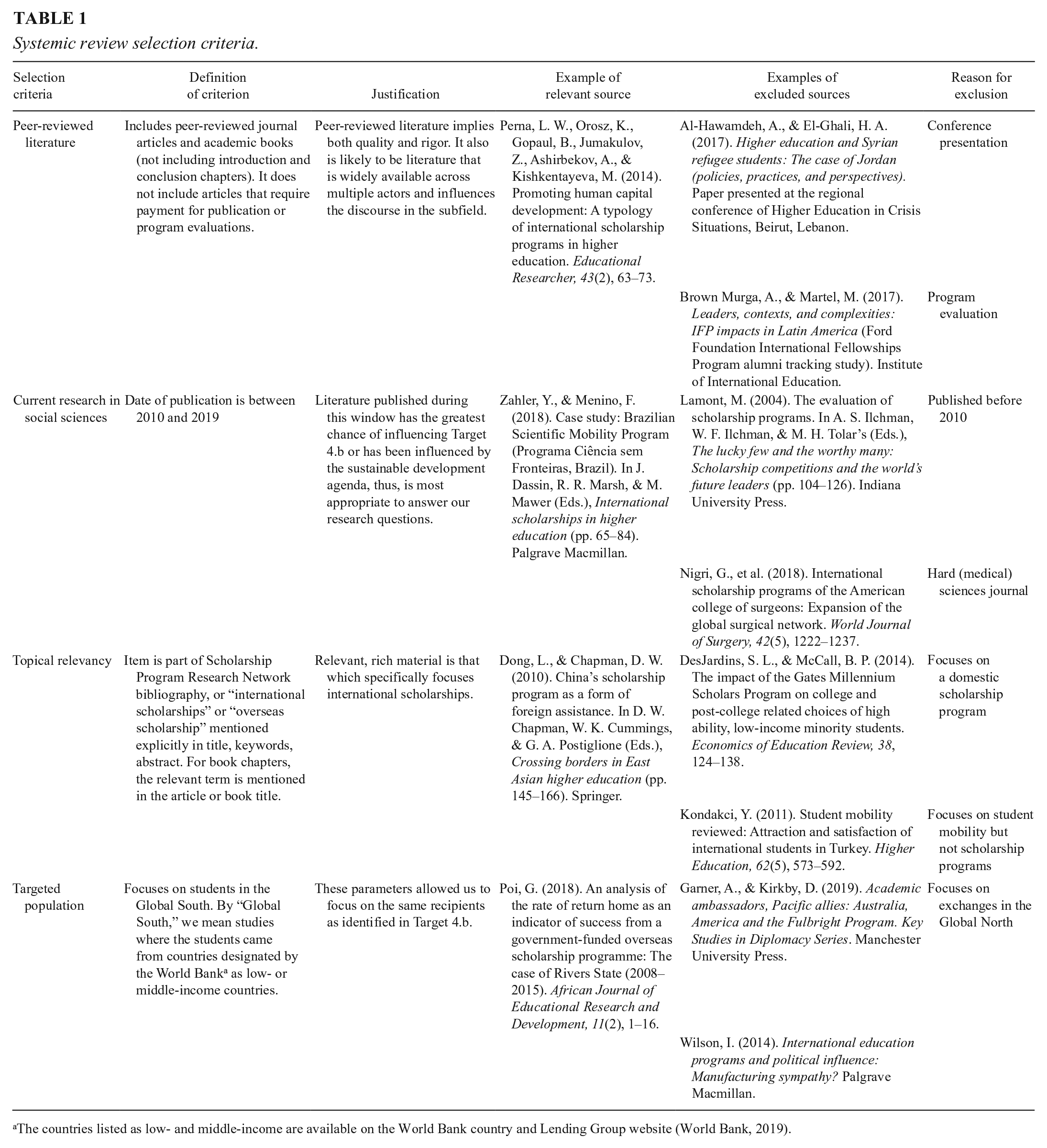
To be included in our literature review, the piece had to meet the following criteria:
Reviewed by peers: In this article, peer review is defined as research which presumes rigor and wide access. This literature is published in academic books and peer-reviewed journals, and where authors are not required to pay a fee to submit their work. Peer-reviewed literature is in contrast to program reports and evaluations that are not made public or may be specific to a program’s singular aims. In reviewing academic books, we did not include introduction or conclusion chapters, as this material often duplicates the content of chapters included in the review.
Published in the years from 2010 to 2019 in a social science journal or academic book: Our assumption is that literature published during this window has the greatest chance of influencing the SDGs. We excluded information about medical training fellowships found in medical or hard sciences journals, as our study focuses on themes more likely emphasized within social science research.
Focused on international scholarships: We defined this phrase in two ways. First, literature in the Scholarship Program Research Network bibliography 1 was included. Second, if the article was found on Google Scholar or ERIC (Education Resources Information Center), it must use the term “international scholarship” or “overseas scholarship” in the title, among the keywords, or in the abstract of the article. For book chapters, we looked for these terms in either the book or chapter title.
Targeted on scholarships for students in the Global South: By “Global South,” we mean studies where some or all of the students came from countries designated by the World Bank as low- or middle-income countries (World Bank, 2019). These parameters also allowed the review to focus on the same recipients as identified in SDG Target 4.b.
These criteria are outlined in Table 1, along with examples of pieces that did and did not qualify based on these criteria.
Systemic review selection criteria
The countries listed as low- and middle-income are available on the World Bank country and Lending Group website (World Bank, 2019).
To identify relevant literature, we used three sources: (a) a bibliography of approximately 300 items maintained by the Scholarship Program Research Network, (b) Google Scholar, and (c) ERIC. The Scholarship Program Research Network is a group of more than 100 scholars and practitioners of scholarship programs, who contribute materials to an open source bibliography. To complement this bibliography and find additional literature, we conducted searches using Google Scholar and ERIC. 2 In our Google Scholar search, we set a custom range for publications dated 2010 to 2019 and searched for the terms “international scholarships” and “overseas scholarships” separately. We included a review of the first 300 articles in each category. In our ERIC search, we selected only “peer reviewed” literature, published between 2010 and 2019. From these three sources, we compared all sources according to our selection criteria. Approximately 450 items were reviewed by the research team, with 105 items meeting the selection criteria and included in this research.
It is worth mentioning that not all of the articles and book chapters considered in this analysis are cited in this article; this choice was based on the word count limitations. However, all sources used in the analysis are included in Appendix A, an online reference list, available in the online version of this journal. Additionally, there was not adequate space to include the main findings of each source or to validate or summarize reported impact, as is common in a meta-analysis (Petticrew & Roberts, 2006). Instead, the aim of this article is to identify and untangle the main goals and associated outcomes of international scholarships for students in the Global South.
Analysis
Once relevant literature was identified, our team evaluated each of the 105 articles or book chapters, noting: (a) year of publication, (b) participants’ home country or region, (c) participants’ host country, (d) time period studied, (e) primary rationale or theory of change and how it was described, (f) intended or determined outcomes of scholarship program, (g) critiques to scholarships mentioned, if any, and (h) any notion of sustainability used in the article, if any. Information for all fields was entered into a Google Sheet, as both citations and summary comments. (A streamlined version of this table is included online as Appendix B, available in the online version of this journal.)
In this article, we use the word rationale to mean the concept that logically connects a program to its intended outcome. As Martel (2018) wrote, these types of connections are important to examine in order to “see a variety of complex relationships between the student that pursues an international scholarship and his or her spheres of influence: the home and host institutions, peers, and the home and host community” (p. 283) as well as to accurately measure the influence of scholarship programs. Many papers indicated several rationales or theories of change, so we included the most prominent in category “e” and also noted others that were mentioned. On the other hand, some items failed to describe an explicit program goal, rationale, or theory of change. In these cases, we inferred the rationale based on proxies such as the programs’ intended outcomes in category “f” or the program description.
After the first round of data entry, we used inductive thematic analysis (Creswell, 2009; Miles & Huberman, 1994) to determine the major rationales as represented in the literature. After this, six categories were identified which represented the major rationales. The entries in the Google Sheet were edited, marking each source with one of the six categories, or using “other”; in several cases, the paper was reread and additional text was added to the Google Sheet. For the purposes of this work, we determined that major rationales were those which were featured prominently in five or more sources.
After the data was edited and cleaned, the second layer of analysis was conducted to consider each rationale subgroup (e.g., all literature that had been labeled as “human capital or skills development”). This included reading some articles several times to reconsider initial impressions and categorizations, as well as notice alignments with other papers and emerging themes. The summary of each subgroup is presented as the results for this article. In a similar fashion, critiques of scholarships were summarized by subgroup. Any notions of sustainability—in program models, anticipated outcomes, or perceived impact—were also recorded.
Methodological Limitations
There are several limitations to this article. First, this review includes only English language sources, those peer-reviewed in journals or academic books, and those that do not require scholars to pay a fee when submitting their manuscript. Certainly these choices influenced the findings and omit quality work in other languages and that which is high quality but not published, such as conference presentations, program reports, and evaluations. The assumption here is that research found in peer-reviewed journal articles and scholarly books is viewed as having quality and rigor and is influential in developing policies and guiding future research. Expansion on these findings to include other scholars and sources across languages and modes will build deeper understanding of this subfield.
Second, this article does not explore how scholarships are often embedded in larger international agendas, such as part of China’s Forum on China-Africa Cooperation (FOCAC; Niu & Liu, 2016) or through European government initiatives intended to strengthen institutions and research networks (Boeren, 2018). This choice was made as the goal is to consider stand-alone scholarship programs as the unit of observation. At the same time, this narrows the understanding of these complex programs, as many of program outcomes attributed to scholarships are likely the result of multiple initiatives.
Third, in identifying predominant rationales in each article, this article’s estimation of the main rationale may be different than that of the program designer, administrator, or evaluator. This is not surprising, as many of the rationales, theories, or motivations are not explicit or are conflated. It also may be that the research team had to infer the primary rationale or theory of change based not on a specific program’s description but on other characteristics of the article, such as the literature in which the study was situated or the papers’ findings (e.g., how the alumni contributed to social change activities). In putting forth the findings from this systematic review, the research team hopes to disencumber future researchers from similar challenges.
Fourth, it is worth noting that there is a potential skew of the literature available for this study, as some countries or programs receive outsized attention. This is likely due to multiple factors, including the size and scale of the programs and certain funders’ and administrators’ focus on evaluation, knowledge sharing, and publications. For example, the Ford Foundation International Fellowships Program (IFP) is disproportionately represented among the literature, likely due to several robust research initiatives, including funding an IFP Archive with over 4,300 files (Columbia University Libraries, n.d.). Additionally, the review’s focus on countries of the Global South omitted literature that may have illuminated additional trends or key points. For example, there are several insightful studies on the King Abdullah Scholarship Program, which were not included because Saudi Arabia does not qualify as low- or middle-income by the World Bank. By not including this literature, important topics—such as scholarships for improved Middle Eastern and U.S. relations in a post–9/11 context (see Hilal & Denman, 2013)—are not captured in this review. Ultimately, the focus on certain programs and countries, and the omission of others, has shaped the findings in this article: we both recognize and accept this limitation to our findings.
Results
The thematic analysis of international scholarship literature discerned six primary and distinguishable rationales for international scholarships for students from the Global South. The most common rationales are the following:
Skills and knowledge acquisition for human capital development
Diplomatic aims, relations with former colonies, or solidarity
Social change or social justice in the home country
International or sustainable development and as humanitarian aid
Internationalization of universities
Providing access to higher education
Each rationale is explored below, presented in order based on the number of articles which stated these rationales as the primary or dominant outcome, although this order is not intended to reflect the actual number of programs with these various rationales.
Before continuing, it is important to emphasize that most of the papers reviewed mentioned several rationales or intended outcomes, and oftentimes noted a belief that one set of outcomes (e.g., skills development) led to others (e.g., social change outcomes). Some papers referred to outcomes by level, and a common framework is to examine the micro (individual), meso (institutional), and macro (societal) levels (see Mawer, 2018). This categorization is also applied in the summary of the six rationales below.
Skills and Knowledge Acquisition for Human Capital Development
The first major rationale in international scholarship programs is based on the theory of human capital development, or the idea that skills and knowledge can be acquired through overseas education and brought home to advance the individual (micro-level), their workplace and their community (meso-level), and ultimately their country or region (macro-level). The long-range outcome is that these skills will contribute to innovation, quality, and development in the participants’ home countries, contributing to the knowledge economy and leading to net economic growth. This perspective is rooted in human capital theory, whose proponents show, often in quantitative terms, how the financial investment in education reaps economic dividends once the education is applied through employment (Sweetland, 1996). As Marsh and Oyelere (2018) wrote, “[t]ertiary educated emigrants and international students and alumni are the primary conduits of human capital transfer” (p. 209) in technology-driven developed and emerging economies.
Central to this rationale is the belief that newly-acquired knowledge and skills are portable and that overseas education is worth the investment. Individuals learn in a foreign context and then apply that education through employment in their home country. Programs with these aims are often funded by private corporations or governments. Perna et al. (2014) noted that foreign degrees are “a form of human capital import” (p. 64) and proposed a typology of four types of government-funded scholarship programs aimed at promoting human capital development. While they did not focus exclusively on low-income countries, the researchers did emphasize that policymakers and administrators should acknowledge and adjust for “the regional and national context when examining the availability, characteristics, and effects of programs” (p. 71), including employment opportunities. One way that programs ensure that the talent returns home is through binding agreements, where participants agree to the scholarship and a postscholarship employment commitment at the outset (Campbell, 2018).
As a main goal of global development is increased gross domestic product, tying scholarship programs to economic gains appears logical. In Africa, Kajunju (2018) noted, scholarships address “the critical need to educate and compete in a globalized knowledge economy” (p. 348) among other outcomes. China is another example, with scholarship programs both being a historical strategy to import innovation and technology toward China’s “self-strengthening ambition” (Zha & Wang, 2018, p. 235) and for the Chinese government to export science, technology, and innovation to other countries, such as Tanzania, for economic development (Makundi et al., 2017).
Of particular interest in the literature is human capital import in the science, technology, engineering, and medicine (STEM) fields, with the ultimate goal of nation building. Continuing with the example of Chinese scholarships, several authors pointed out that individuals educated in the STEM fields were recruited back home with promise of world-class laboratories, salary supplements, and financial support for their housing and children’s education (Zha & Wang, 2018). Shen (2018) wrote that Chinese doctoral students “leverage the superior faculty resources and research facilities overseas” (p. 224) to bring knowledge back home for economic development. While much of the research focuses on STEM fields, Chalid (2014) has noted that scholarships also develop important “soft skills” and intercultural competency.
The literature also points to scholarships building capacity in higher education. Mansukhani (2018) argued that scholarships “could be very fruitful” for India, “especially if tied to investments in Indian higher education institutions” (p. 363). Moreover, Brogden (2018) wrote about one of the Open Society Foundations’ scholarships which aims to “expose faculty to current pedagogy, academic networks, and the latest research resources in order to enhance their capacity to teach innovatively at their institutions” (p. 135). Ahmad et al. (2016) noted that the Human Capacity Development Program sponsored by the Kurdish Regional Government of Iraq aimed to bolster higher education institutions in the region, especially following the Saddam Hussein regime when international exchanges were restricted.
At the core of this rationale is the presupposition that individuals will “apply” their new degree when they return, hence these programs often measure success in terms of employment. Kalisman (2015) provided an example of how graduates of American University in Beirut applied their knowledge, stating that graduates played key roles in the formation of school systems, the composition of textbooks used throughout the Arabic speaking world, and the promotion of various political ideologies, particularly a broad notion of pan-Arabism. An AUB degree guaranteed employability in the Arabic speaking world, allowing graduates to move freely from one Mandate to another and to rise through the ranks of each government’s bureaucracy. (p. 609)
Likewise, Azhgaliyeva et al. (2017) argued that graduates of the Kazakhstan government’s Bolashak International Scholarship reported a high employment rate (above 95%) but very few of these alumni are employed as entrepreneurs despite a significant desire to start a business, questioning whether international scholarships promote this kind of innovation and new ideas from abroad. For many human capital import programs, a binding contract is part of the scholarship agreement so that individuals are required to return home and work for the sponsor, or in the sponsor’s interests, to repay the cost of the degree (Perna, Orosz, & Jumakulov, 2015).
The majority of studies on international scholarship programs that are rooted in a skills development rationale or human capital theory focus on the program design, employment outcomes, and policy recommendations on how to boost these goals. One example comes from Perna, Orosz, Jumakulov, et al. (2015) who showed that “individuals will likely only choose to participate in an international student mobility program if they perceive the benefits to exceed the costs” (p. 184) underscoring human capital theory’s attention to economics and also prompting program administrators and policymakers to understand the perceived costs in order to accomplish nation-building goals. Perna, Orosz, and Jumakulov (2015) suggested that certain programmatic aspects—such as requiring recipients to return to work for the government or pay back their scholarships—could be effective ways to build human capital in the home country, noting that “maximizing benefits to individuals, employers, and society is important to policy and practice in many nations” (p. 95), although Campbell (2018) raised concerns about limiting individual agency.
Finally, some scholars write about choosing a group of scholars to learn together as part of a human resources plan (Rotem et al., 2010), building a “critical mass” of talent to change the culture within an organization (Kent, 2018). In the literature, this notion of a critical mass of scholarship holders is most commonly linked with university departments and governments. Boeren (2018) noted that building a critical mass of scholars educated overseas has been a technique, along with other forms of funding, to build academic departments at targeted universities. In the case of scholarships influencing the Indonesian government, Purdey (2015) showed how alumni among the 18,000 graduates of the Australian government program have formed “the Australian mafia”—indicating a close-knit employment network—and are pursuing changes across the government. However, Mawer (2017) pointed out that measuring any catalytic effect of an alumni critical mass has been difficult and additional research on these effects, and the durability of the changes introduced in the home country, is warranted.
Two critiques of scholarships feature prominently among this subset focusing on skills and knowledge acquisition for human capital development. The first is the question of brain drain—if students do not return to apply these skills, is the investment in their education lost? Several scholars highlighted the inherent tension of scholarships providing individuals with specific skills needed in the Global South and then graduates taking their skills elsewhere. This tension becomes apparent when overseas education cannot be applied at home due to a weak economy, different economic system, or poor infrastructure (Abeuova & Muratbekova-Touron, 2019; Dassin et al., 2014b); when there is a global demand for certain skills, like health care, but few well-paid posts available in the home country (Marsh & Oyelere, 2018); when governments or employers do not recognize foreign degrees (Campbell, 2020); or when changes in national administrations render binding agreements invalid (Campbell, 2017). Other authors noted that alumni often pursue careers in international sectors in their own countries.
In a review of the brain drain literature, Marsh and Oyelere (2018) pointed out that migration decisions are complex, with graduates often considering “push and pull factors”—a common framing among student mobility scholars. They also note that sending remittances does not compensate for loss of talent and oftentimes the smallest countries are the biggest “losers” in the competition for the world’s talent. In a specific example, Tessema et al. (2012) investigated why graduates of an Eritrean scholarship program did not return home during the Eritrean–Ethiopian War, finding “the high level of brain drain occurring after 1998 can be attributed to the deterioration” (p. 256) in economic and political factors, working conditions, peace and stability, and lack of attractive human resources practices.
Increasingly, the polarized conception of alumni being either in the home country or abroad has been challenged in the literature. Recent research indicates that the “home” and “overseas” categories are not so distinct or permanent, with ways of contributing from abroad and individual trajectories changing over time. In a recent paper, Abeuova and Muratbekova-Touron (2019) argued that requiring people to return and holding collateral does not quell a desire to emigrate following education abroad, as the “majority of the respondents, regardless of their career success, showed a strong intention to leave the country and join the nomads group to explore international opportunities” (p. 10). Their findings also spoke to a desire of graduates to move in and out of the home country, which Campbell (2020) called “cyclical mobility.” Marsh and Oyelere (2018) argued that additional attention should be given to engaging diaspora and transnational communities in stimulating development.
The second common critique in skills development for human capital development is the question of appropriateness of overseas education. In other words, are students gaining an education that is useful to the needs and context of their home country? Hickling-Hudson (2012) raised this point in emphasizing that Jamaican doctors who studied in medicine, dentistry, and engineering in Cuba—a context similar to their own—felt their education had specially trained them to be “a certain kind of professional, one who is oriented toward finding out the needs of people or of industries in a particular field, and gearing his or her career toward meeting those needs” (p. 117). Moreover, embedded in this point is the question of whether all overseas education is equally good. Rotem et al. (2010) summarized these points in a review of certain fellowships supported by the United Nations in writing that “there is a great variability in the design and implementation of fellowship programs in terms of duration, mode of training, recipient instruction resources and capacity and other variables” (p. 3), raising questions about selecting educational programs with an individual’s home country employment context in mind. Calls for additional research into what makes overseas education appropriate—even transformative—for scholarship students has been raised by Baxter (2018), among others.
Diplomatic Aims, Relationships With Former Colonies, or Solidarity
The second major rationale is connected to the idea of educational exchange as a way to strengthen bilateral relations, with scholarships as a tool to foster connections, trust, and familiarity between student-citizens of two countries. The logic here is that future national leaders are identified and sent abroad to establish relationships, gain cultural knowledge, and develop sympathy for the hosting country (micro-level impacts). The intended goal is that when they return and rise to positions of power, they will be able to influence their constituents and also advance bilateral relationships to build economic trade, reduce hostilities or war, maintain alliances, or spread ideologies (at the macro-level). Laying out the theory of change of how international exchange contributes to diplomatic gains, Wilson (2015) argued that scholarship programs ultimately intend to create opinion-leaders (credited to Scott-Smith, 2008), whereby a scholarship “benefits their countries by generating alumni who are well informed about and well disposed toward the country in which they studied” (p. 131). Wilson also wrote that when evaluating programs based in diplomacy, program administrators “often point to alumni who have gone on to attain influential positions” and that politicians may “periodically raise concerns that [alumni] are not influencing effectively enough” (p. 131).
These scholarships are often funded by governments, who employ “soft power” when hosting students from abroad. As part of reaching diplomacy aims, graduates are expected to maintain relationships with those in the host country, including with their university hosts and academic mentors. For example, Abimbola et al. (2016) noted the importance that alumni of Australian programs in Uganda, Mozambique, and Kenya placed on keeping relations with their academic supervisors after graduation.
Depending on the nature of the relations between countries, these bilateral relationships can strengthen preexisting ones (e.g., between the imperial power and its former colonies), can forge emerging partnerships, or can show solidarity among a network of countries or populations, such as during the Cold War. Johnson (2018) recently argued that overseas scholarships sponsored by the U.S. government mirror its foreign policy, starting with a brief liberal international phase following World War II and marked by the development of the Fulbright Program. The next stage was the Cold War, when scholarships were part of the “global struggle for allies and for hearts and minds” (p. 174). Following the collapse of the Soviet Union, educational exchange was used as a way to reorient bilateral relations, although Johnson argues this period ended abruptly on September 11, 2001, with a greater focus on education for security, intelligence, and development as part of the War on Terror. Much historical research on scholarship programs focuses on how government-sponsored scholarships reflected a specific foreign diplomacy at the time. Examples include programs to reinforce colonial powers (Pietsch, 2011), those that reflected the prominence of the Soviet Union (Hessler, 2018), and initiatives to continue to provide support for the Commonwealth (Byrne, 2018; Kirkland, 2018).
Of this literature focusing on students in the Global South, two specific subsets are particularly rich: scholarships for democracy building and for supporting socialist solidarity. The Cold War has been called “a golden age of scholarship programs” (Tournès & Scott-Smith, 2018, p. 15) to extend education to individuals with similar values and worldview and to build either prosocialist and prodemocracy networks. One good source is Loerke’s (2018) work that outlines how “the US government was quick to exploit both diplomatic and development opportunities created by the fall of the Berlin Wall in 1989” (p. 195) leading to large-scale programs such as the Edmund S. Muskie and Freedom Support Act Graduate Fellowship Program for students in the former Soviet Union.
On the other side, several studies examine the ways that scholarships were used to increase solidarity among global socialist-minded populations. For example, Hessler (2018) noted that for the students on scholarship in the USSR, higher education toward a degree was as important as vospitanie, defined as “a mix of character education, ideology, and civics” (p. 203).
In writing about scholarships in modern-day Czech Republic, Němečková et al. (2014) hypothesized that the original purpose of the government scholarship was as an “instrument used to play its role in strengthening political and security relations with particular countries within the socialist block”; however, today the program is “an instrument of the Czech development cooperation programme” (p. 84). Recently, China has included the term “solidarity” as part of FOCAC; as Niu and Liu (2016) wrote, FOCAC is “a continuity of the philosophy of solidarity, morality, and reciprocity in China’s South-South cooperation with African educational development” (p. 269) with scholarships intended “to facilitate diverse cooperation between China and Africa” (pp. 288–289).
More recently, government-sponsored educational exchange appears to be taking up values of national security. Atkinson’s (2018) work showed how the U.S. military exchanges allow foreign officers to be educated at the U.S. National Defense University, U.S. Army Schools, and U.S. Navy Schools leading to an extension of U.S. soft power and military “interoperability”, specifically noting that education exchange has allowed the U.S. to gain access to operating bases in the Middle East (Atkinson, 2015).
While the idea of building bilateral relations is mostly perceived as a positive outcome in the literature, some scholars raise the question about whether these scholarships are being used inappropriately to influence future leaders to align with political ideologies. For example, in a paper examining scholarships given to Tanzanian students in the 1960s to study in China and the USSR, Williams (2017) found that students were encouraged to read about revolutionary struggle, participate in “mock warfare,” and generate debate about the “meaning of education in a liberation struggle” (p. 135). Others (Hessler, 2018; Kalisman, 2015) pointed to early programs that would monitor student behavior while on scholarship, with host university staff intervening if students did not seem aligned with sponsors’ values.
Social Change and Social Justice in the Home Country
The third major rationale is that scholarship programs bring about social change and social justice in the students’ home countries. The logic in this rationale is that students will be exposed to different cultures, policies, and perspectives while abroad, thereby acquiring and bringing home more progressive values (micro-level) and advocating for the rights of marginalized or ostracized populations or other social change at home (macro-level). Prominent themes include individuals’ contributions to others’ wellbeing, often known as “give back,” “ripple effect,” or “social remittances.” Examples in the literature include teaching and training, volunteering, leading, policymaking, and mentoring, all within the country of origin.
These programs are most often funded by private foundations or philanthropists which aim to promote minority rights and advance specific social issues. In line with the literature reviewed, social change can be defined as shifts in how individuals—regardless of wealth, ethnicity, (dis)ability, gender, or other potentially limiting factors—are perceived and treated in society. Social change is often linked to social justice, which emphasizes fair and equitable treatment of citizens, protection of human rights, access to quality services, and full integration in society. It is important to note that social change and social justice are complex terms, heavily dependent on context. Scholars agree that social change requires partnerships, exchanges of ideas, and coordinated action from many individuals that perceptively shift opinion, behavior, and values (Della Porta & Diani, 2006) to support activists and build coalitions—in some cases with scholarship grantees at the center of these networks (Dassin & Navarrete, 2018).
Dassin et al. (2018) suggested “numerous ‘pathways’ by which international scholarship programs and award recipients break down barriers and foster positive change” (p. 5) including through personal action, networks, and influence. Programs targeting social change outcomes often focus on specific types (e.g., disability rights) and in countries where these specific issues are salient (Loerke, 2018). As an example, Africa (2014) argues that international scholarships have aligned with other social justice initiatives in South African universities. Moreover, in a study of scholarship program alumni associations, Campbell and Baxter (2019) found that the social change activities pursued by alumni responded to national context, with a scholarship alumni association in Mongolia focusing on youth participation and volunteering and an alumni association in Georgia advocating for human rights through social work. However, across the three countries examined in the study, alumni noted a “desire to influence national policy” after recognizing “larger, systemic challenges to be addressed through advocacy efforts on a national level” (Campbell & Baxter, 2019, p. 169).
Success in this subcategory of literature is often measured by the social change that has occurred in terms of the issue or the context. Three studies that focused on the Ford Foundation IFP scholarship highlight this well. Kusakabe (2014) showed how scholarship graduates of the Asian Institute of Technology in Thailand have worked to create an international network to promote gender equity in international development efforts in China and the Philippines. In Cambodia, international scholarships were credited with encouraging women to become professors in the male-dominated Cambodian academy (Maxwell et al., 2015). In a recent quantitative study, Waluyo et al. (2019) found that IFP scholarship alumni had skills to change paths and respond to challenges as they emerged, which was related to their work to influence social change in 22 countries.
In this literature, social change may also be recognized as features of a program that change to become more equitable or inclusive. For example, Aldersey et al. (2019) explored how a university partnership, facilitated by the Mastercard Scholars Program, was addressing the challenge of disability in Ethiopia, where an estimated 17 million may be affected by disability. This partnership between the University of Gondar in Ethiopia and Queen’s University in Canada has “an overall goal of creating a disability-inclusive campus and regional rehabilitation hub” (Aldersey et al., 2019, p. 2) at the University of Gondar. In contrast, sometimes scholarship programs are viewed as not demonstrating the social change values they espouse. Grinbergs and Jones (2013) raised this question in looking at the Erasmus Mundus MA/Mgr in Special Education Needs scholarship suggesting that the program’s goals to advance inclusive policy and practice in education was not fully demonstrated in selecting the cohort of grantees.
It is worth noting that promotion of social change also brings forth questions of importing cultural norms and values from other countries, especially in relation to perpetuating gender, disability, and sexual rights. In one example, Campbell (2018) noted that following a scholarship, a student returned to his home country that was hostile to gay rights and was “unable, due to personal safety concerns, to follow the plan that he had crafted during his studies (supported by his scholarship funder) to publicly advocate for sexual minority rights” (p. 173). Campbell and Lavallee (2019) shifted focus from measuring the changes brought by scholarships to the ways that alumni work together to define and promote social change in Ghana, especially around issues of disability rights; their findings show that a scholarship alumni association took up many characteristics of a community of practice, an organizational learning approach (Wenger, 1998). Notably, additional research about the values scholarship alumni bring from abroad is needed, especially in research targeting low- and middle-income countries.
As a final point in this section, several scholars noted a gap in research exploring how individuals gain access to social change values and concepts. On the one hand, it might be perceived that simply living in another culture brings about awareness of different types of social norms, values, and policies; on the other, it appears that focused study or experiences, such as volunteering, provide key models or lessons in activating social change. In this aspect Baxter (2018) points out that “international study is understood to play a pivotal role in developing technical skills, leadership competencies, and capabilities for public service” (p. 107) yet “research that illuminates the effectiveness of different learning activities and environments” is a “black box” of understanding how learning abroad occurs (p. 123). Baxter (2018) conceded that most scholarships assume that education is relevant, that skills are transferable from university to home, and that learning is guaranteed. Continuing, she wrote, “the assumption that international study inevitably contributes to the competencies associated with leading social change is challenged by research on study abroad and service-learning that indicate exposure alone does not guarantee gains in related skills and proficiencies” (Baxter, 2018, p. 119). Moreover, Dassin and Navarrete (2018) call into question how “individual agency and collective benefits” connect, advocating for examining individuals as members of networks (p. 306). Further study in the relationship between overseas higher education and social change at home is warranted.
International or Sustainable Development and as Humanitarian Aid
The fourth major rationale is international scholarships for international or sustainable development outcomes. 3 The rationale is based on an assumption that a country is deemed in need of improvement in certain areas (e.g., public sector management) and that education can bring in skills from overseas that will help the country develop in economic and sustainable ways (macro-level impacts). In these programs, the goal is to benefit a targeted country or community over the individual, and as evidence, these scholarships may be viewed as one tool among several to reach a technical assistance goal that aligns with national overseas aid priorities (see Franken et al., 2016; Nordtveit, 2011). Reflecting these priorities, these scholarships are often in specific fields in which capacity or reform is needed for national development. Funding for these scholarships often comes from ODA or from other pots of government or international organization money designated for international or humanitarian aid. As an example, the OECD measures the gross disbursements of total net ODA for scholarships by country to track the world’s progress toward SDG Target 4.b (UIS, n.d.-b).
From a policy perspective, the impact of scholarships as international aid is often estimated in terms of whether the funding is well-spent. For example, Bonilla and Kwak (2015) attempted to measure the effectiveness of nine governments’ donor support to Guatemala, and Dong and Chapman (2010) argued that the Chinese Government Scholarship Program has “been an effective mechanism of ODA” (pp. 163–164). More often, scholarships funded as part of ODA are critiqued for the investment made in a single person when the same amount could support educational systems that benefit many. For example, UNESCO recently raised the question of whether scholarships are worthwhile given that following a scholarship “students do not always return. Aid could instead support students or universities in the region” (2019, p. 105). Like the literature related to skills and knowledge development for human capital transfer, brain drain is also a significant critique in literature in this subgroup of scholarships as aid for international or sustainable development.
In addition, scholarships seeking sustainable or international development are often critiqued because a significant part of the aid money is spent in the donor countries, going toward tuition and associated living costs. In one example, Koda and Yuki (2013) raised the question of whether Japanese aid spent on overseas scholarships—with funding thereby going to universities in the host countries—is as beneficial as funding twinning programs, where students do not move but receive international credentials; they found that Malaysian employers did not seem to discriminate against those who had received an international credential but had remained in Malaysia to earn it. Fiddian-Qasmiyeh (2011) pointed out that one of the goals of educational aid for refugees is to reduce dependency on aid, but that the results of a study on Algerian Sahrawi refugees who studied in Cuba showed that scholarship graduates left the community, sending remittances from abroad, and “ultimately reshaping and reinforcing, rather than reducing, the Sahrawi refugee camps’ dependence upon Western aid providers” (p. 433).
Building on this point, several authors argued that scholarships can be used to replicate power imbalances or extend the notions of capitalism or other Global North values to Global South populations. Fiddian-Qasmiyeh (2015) suggested that student mobility privileges countries in the Global North and international organizations over Southern knowledge and South–South cooperation educational migration, prioritizing “certain models of education, and certain student(s’) bodies, to the detriment of Others” (p. 1). In addition, Purdey (2015) noted that scholarships often reproduce a country’s elite, writing, “Today the Australia Awards program in Indonesia is a highly elitist program which, for the greater part, rewards those who are already in privileged leadership positions” (p. 119). These arguments show how international aid may extend Global North values and perpetuate divisions—a distinct counterpoint to intercultural learning and transformative experiences touted by many international education programs.
To dig into the notion of scholarships for sustainable development, Campbell and Mawer (2019) recently asserted that linking scholarship programs and sustainable development outcomes is undertheorized and that “failing to comprehend the theoretical frames that undergird scholarship programs creates an opportunity for diverse (and sometimes perverse) outcomes that may not serve the world’s compact for a sustainable future” (p. 167). To link international student mobility and sustainable development, they argued for a human capabilities approach, which is based on the notion that individual “freedom” is achieved when one can plan their life goals, with the intention of achieving or doing something worthwhile to the individual (Sen, 2000), with education expanding one’s range of options. They also argued for increased access to quality higher education in order to address emerging and shifting global problems, advocating for further support for alumni who currently work to address global challenges in governments, international organizations, and humanitarian agencies. Finally, they called for more scholarships “to tackle these wicked problems facing the globe” calling for “sophisticated education, new forms of experts, and dynamic partnerships across disciplines and nations” (p. 180).
The implications of literature in this subgroup is focused mostly on policy recommendations and calls for improved program evaluation. The literature also raises questions about the viability of individual recipients to actually achieve broad development aims, highlighting the importance of contextual factors, power, and complexity involved in policy change. For instance, Campbell (2017) noted that the home country government played a significant role in whether alumni wanted to work in government positions or toward development goals in general. Notably, almost none of the research in this section looks at the relationship between scholarships and the natural environment, instead focusing on the economic, social, or political attributes of sustainable development.
Internationalization of Universities
The fifth major rationale is that international scholarships influence higher education systems by bringing underrepresented perspectives to diversify and enrich university campuses in host countries (meso-level impacts). The assumption is that a diverse student body, representing a variety of nations, will bring different experiences, knowledge, and perspectives to the university. Higher education internationalization in itself is a significant body of literature, and student mobility is often cited as a key component (Buckner & Stein, 2020). With the primary benefactors being universities, higher education consortia, and governments, findings from this subcategory suggest that individuals are selected for the program based on their underrepresented perspective or citizenship. Funders for scholarships that achieve internationalization aims are various, and typically include funding or tuition remission provided by the host or home universities. In some university plans, scholarships are specifically mentioned as tools for internationalization (Moreira Nery, 2017).
The majority of the research which adheres to this rationale looks at how diverse populations of international students influence their host universities. One course of action is through scholarship students influencing faculty and peers. Small (2014) notes that scholarship students at the University of Hawai’i at Mānoa influenced the university by educating and enriching others by sharing their diversity, cultural background and knowledge base, and international expertise; informing and inspiring others through offering alternative perspectives, real-life experiences, insightful stories, reality testing, and creative problem-solving; contributing to the creation and success of novel learning environments; serving as agents of policy change at the university; and engaging in volunteering community service. (p. 148)
Similarly, Fisher (2014) noted that through hosting Ford Foundation IFP students, their institution adopted changes that extended beyond the scholarship students’ time on campus. For example, the university adopted curriculum to “counter discrimination and marginalization and to contribute to the building of leadership capacity in disadvantaged communities” (p. 197) as well as developing partnerships among faculty and the scholars, leading to the development of field schools and new courses. However, Fisher noted that these changes were not taken up easily, highlighting an initial mismatch between faculty perceptions, campus programming, and student academic preparation in language, critical thought, and academic writing.
Another way that international scholarship students have influenced their host institutions is by driving a need to make more equitable policies. Devés and Mora-Curriao (2014) noted that scholarship students at the University of Chile helped the administration increase its recruitment, support, and engagement with marginalized populations, leading to the implementation of an equity and inclusion policy. Albrecht (2014) wrote that through hosting scholarship program students, the International Student and Scholar Services at the University of Texas at Austin changed their approach to student advocacy and working with students with disabilities.
In addition, scholarships can be used as a tool for building international networks and transmitting international experiences back to the home university. One of the most significant efforts in this category is the Programa Ciencia sem Fronteiras, the Brazilian Government’s Scientific Mobility Program (GSMP), which was designed to send over 100,000 Brazilians abroad and is “emblematic of a new era in the internationalization of Brazilian higher education” (Zahler & Menino, 2018, p. 65). Zahler and Menino (2018) wrote that through Brazilian student mobility, GSMP had “the potential to cause a deep impact on the Brazilian higher education system” (p. 74) as scholarship grantees contributed to how Brazilian higher education is perceived internationally, and some participants chose to pursue graduate degrees in Brazil, enriching their home country’s classrooms, labs, and international partnerships. However, Moreira Nery (2017) argued that there is significant discordance between the ways that Brazilian institutions were engaging in internationalization and the government’s strategy and administration of GSMP. For example, applicants lacked English or other foreign language skills, resulting in a huge proportion of GSMP students seeking placement at Portuguese universities. After the first year, administrators rerouted many applicants and over 8,000 students were required to take foreign language courses before studying in another country.
In addition, much of the research related to campus internationalization focuses on the benefits to the host universities, instead of on the education received. Nevertheless, several scholars noted weaknesses or inadequacies in the host universities or in the participant experience, uncovering different levels of engagement by host universities, gaps in program planning, and inadequate funding. The issues are quite diverse across the literature, with such examples as mixing of Chinese and English languages for Tanzanian students (Makundi et al., 2017) and limited phone and internet use in Cuban higher education (Pérez, 2012).
Two particular cases are worth examining a bit closer. Africa (2014) discussed how South African universities’ goals for transformation aligned well with the Ford Foundation’s mandate in the IFP. However, despite new curricular offerings and numerous efforts to enhance infrastructure, the reality showed that IFP host universities in South Africa had difficulties accommodating students with disabilities and older students, or to provide adequate academic advising and university facilities. In another case, Urban et al. (2010) noted that scholarships for Dominican students to study in the United States were so all-encompassing and academically demanding that the students felt overwhelmed, preventing them from continuing in the program.
On a related note is the concern that scholarship host universities may be slow to change and interested in replicating Anglo-American values and ways of knowing—especially to impose these on a student from the Global South. Pásztor (2015) raised the question of whether some universities have actually “entered a new era of ‘widening participation’” or whether they continue to act “as transmitters of privileges” (p. 833), replicating Global North and white values. These points are suitable counterarguments to the logic of elite Global North universities as suitable venues for all scholarship participants.
In closing this section, it is important to emphasize that international students’ influence on host or home universities should not be assumed, as each campus and context is different—as is each student and their experiences. Baxter (2019) made this point in a study of Rwandan scholarship students studying at two U.S. campuses, which illuminated how students maintain ongoing relationships between home and host communities and form transnational identities. These relationships influenced the way students were active on their host campuses, noting that some had limited engagement due to multiple expectations placed on them.
Providing Access to Higher Education
The sixth and final rationale found in the literature positions scholarships as a way to provide access to cross-border higher education. This rationale begins with the idea of education as a human right, especially as related to notions of equality of opportunity (micro-level outcomes). Programs in this subset challenge the notion that access to higher education should not be limited by one’s location or circumstance—especially if academic programs, seats, or quality learning is not available at the universities in a student’s home country. Therefore, the goal is to provide more overseas educational opportunities for more diverse populations, with success measured by the number of individuals who can enroll. This goal extends beyond the individual’s benefit; it can also be viewed in terms of populations, aiming to change the composition of students pursuing international education, especially at elite global universities. International scholarships that provide access—such as those provided by the Roma Education Fund, for example—are often funded by private foundations, governments, and private philanthropists, especially those who are members of the same or a similar community.
A common way that scholarships provide access is through removing economic barriers to education. As Dassin et al. (2014a) wrote, international higher education is also a “highly restricted universe” and “access is further circumscribed not only by financial factors but also by students’ socio-economic background” (p. 16). Redzwan (2017) noted that a scholarship provided by the government of Namibia was founded “primarily to assist talented children from underprivileged families [to] acquire university education” in South Africa (p. 289). In a quantitative review of the Mastercard Scholars Program, Cosentino et al. (2019) indicated that their work found providing scholarships “is an effective way to improve access to university studies among vulnerable, disadvantaged, and underserved youth” (p. 7), especially in the case of higher levels of study (full degrees instead of certificate programs) and to international higher education.
International scholarships that aim to increase access to higher education are also an approach used for marginalized groups that are underrepresented in higher education, such as students with disabilities; students from minority ethnic groups; female, homosexual, or other sexual minorities; or economically disadvantaged students. This also includes students who do not have a universally recognized nation-state in which to study or have been forced to relocate from their traditional homelands, such as Roma, refugees, or indigenous peoples. In these studies, the focus is often on program design, including determining characteristics that identify an individual as a member of a group that is marginalized and in need of support (Musa-Oito, 2018), and the process by which they are identified and matched with host institutions that can support these populations, including providing preacademic training (Small et al., 2014; Zahler & Bertin, 2014). The focus is on removing barriers and helping to increase the numbers and types of individuals who can access higher education. In this subgroup, there is little research on the student experience or long-term outcomes of these programs, and currently there is a dearth of research on scholarships for refugee populations.
Discussion
This review of literature aims to aid the understanding of international higher education by mapping rationales for international scholarships for students from the Global South. The need for this review arose from the recognition that academic literature about international scholarships has yet to be collected and organized, compromising our understanding of how international scholarships can lead to various distinct outcomes. At the same time, many programs and initiatives are being conflated in the literature and practice.
The review intentionally excluded international scholarships for students specifically from Global North countries, as much of the research on student mobility and scholarships has been focused on the Global North, with lessons being applied to overseas contexts. In this review, the goal was to highlight knowledge related to international scholarships for students in the Global South, both to complement existing knowledge with additional cases from low- and middle-income countries and to deepen our knowledge about this specific subset of programs.
Specifically, this article organizes the literature by prevailing rationales for scholarships, untangling the six primary and distinguishable categories of outcomes present across the articles and book chapters included in this review: (a) skills and knowledge acquisition for human capital development; (b) diplomatic aims, relations with former colonies, or solidarity; (c) social change or social justice in the home country; (d) international or sustainable development and as humanitarian aid; (e) internationalization of universities; and (f) providing access to higher education. In the discussion below, three points are delineated. First, the importance of mapping this subfield is addressed. Second, common contradictions and complements among the various rationales are described and explored. Finally, the discussion ends with a consideration of risks associated with conflating scholarship programs’ goals.
Importance of Mapping a Subfield and Identifying Distinct Rationales
The subfield of international scholarship programs is growing, and the literature is considerably varied and interdisciplinary. The bulk of this research resides within a broad range of education literature, yet much of it also exists in various other fields in the humanities and social sciences. By reviewing studies across disciplines, this article proposes a structure for better understanding and organizing this growing subfield, highlighting both common critiques to international scholarship programs and opportunities for future research. In addition, many of the authors cited in this article have noted that scholarship programs are complex or that there is no unified definition of these programs. To address this problem, we proposed a definition of scholarships for students in the Global South.
As was uncovered in the analysis, some programs are not explicit in their expected outcomes, or mix multiple rationales or theories of change. While confusion over program models and aims may appear harmless, blending various goals can lead to muddled knowledge, inability to apply extant research to policy and practice, and ill-defined research agendas. For example, it is unreasonable to assume that all government-funded scholarships are designed to reach the SDGs when many predominantly aim for skills development outcomes. The goal of this article is to disentangle these rationales and identify the literature that allows deeper insight into the diversity of programs, their undergirding values and theories of change, and expected results.
It is worth remembering that this review highlighted only the six most common rationales among peer-reviewed articles and book chapters published in English. Certainly there are other goals and rationales not mentioned here. For example, Del Sordi (2018) claimed that the Bolashak program in Kazakhstan is “a multidimensional tool, promoting development and channelling authoritarian rule” of the Kazakh government, suggesting that “the programme itself [is] in support of its strategies of legitimation” (p. 216). The notion of scholarships perpetuating a regime’s authoritarian power was not common enough among the literature to be explored in this article, along with other rationales not dominant in the literature reviewed, such as faith-based scholarships.
Despite these shortcomings, it is the right time to map the subfield and enrich thinking of how international scholarships for students in the Global South, especially as the field of international higher education is likely heavily influenced by the COVID-19 pandemic and will change accordingly. As scholarship programs consider the future of student mobility, it is worth examining the theories of changes and rationales for programs. This point will be further explored below.
Contradictions and Complements Among the Rationales
In addition to identifying the predominant rationale for each of the articles and chapters, secondary or additional rationales were recorded. There were three pairs of rationales that were often referred to in the same source, outlined briefly below. While most scholars noted friction or tension among competing goals, there were also a few notes of complementarity. These pairs signal opportunities for further examination of alignment and contradiction within programming models and evaluations.
Scholarships as International Aid and for Bilateral Diplomacy
Scholars highlighted that many scholarships were both identified as providing international or sustainable development aid to a country, while working in tandem to improve bilateral relations or enhance their soft power diplomacy. This mimics a common critique in international aid, as Amazan et al. (2016) noted that aid is never neutral, with scholarships being one tool that contributes to “the flows of knowledge and capital between developed and underdeveloped countries” (p. 48) to maintain the status quo.
Examples of this critique are numerous. For example, China’s provision of scholarships in Africa is seen both as aid for individual students and as improving China’s “mutually beneficial” economic cooperation in targeted, resource-rich countries (Nordtveit, 2011). Maikinda and Turner (2013) questioned whether “the growth of Australia’s scholarship program in Africa has been driven by Australia’s national interests” (p. 40), including as positioning for membership on the UN Security Council, over African development goals.
Scholarships for Human Capital Development and for Improved Bilateral Relations
Scholars highlighted that many scholarships both addressed skills and knowledge development for human capital while also aiming to improve bilateral relations. These two rationales often fit together in that skills development is perceived as an individual gain (micro-level) while binational relations were seen not as person-to-person diplomacy but as bilateral relations (macro-level).
The main point on which these two rationales confound each other is that programs appeared to be seeking greater collaboration between two countries through educational exchange, yet the outcomes point to the host country recruiting the best participants or home country challenges limiting the alumni to work in government. Several scholars explored these barriers, with examples seen in Moldova (Campbell, 2020), Mongolia (Enkhtur, 2019), and Eritrea (Tessema et al., 2012), among others.
Well-trained scholarship alumni were also able to find better employment options in a third country—thereby circumventing the goal to build bilateral relations between home and host countries altogether. As an example, Fiddian-Qasmiyeh (2011) pointed to the case of a Cuban scholarship program that provided scholarships to Sahrawi refugees living in camps in Algeria, with Cuba aiming to show solidarity with this group and build self-sufficiency through the development of skills. However, findings from this study show that many of the trained graduates looked for better-paying employment outside of the community, either in Europe or with international organizations. As was mentioned earlier in the section on skills and knowledge for human capital development, this concern of whether education abroad is appropriate for the home country context is very relevant in terms of programs aiming to enhance and develop bilateral relations.
Scholarships for Social Change and for Providing Access
The last two themes that often appeared together in the literature were scholarships for social change and for providing access to higher education. This idea is embodied in the model of the Ford Foundation’s IFP program (see Dassin et al., 2014b; Musa-Oito, 2018) where grantees were selected from among marginalized populations in the 22 target countries (providing access on a micro-level) while also expecting that the grantees would return to create national social change (macro-level outcomes). While national social change is difficult to measure, there are several scholars who point to the attempt of IFP alumni to engage in this work (Campbell & Lavallee, 2019; Kusakabe, 2014; Waluyo et al., 2019). That being said, there are also recognized barriers for marginalized people to acquire positions of leadership and drive widescale social change in their countries—despite their overseas education—especially when fighting against the status quo.
Risks of Conflation and Opportunities for Additional Research
As noted above, intermixing among the different rationales or theories of change—both those noted in the section above and other combinations—has led to conflation and confusion among scholarship models. While at first glance this conflation of rationales may appear to be an inconvenience, there is risk in assuming all programs have the same goals, similar design elements, or indistinguishable outcomes. As is seen in this review, not all sponsored students were given a scholarship to engage in the work of diplomacy or social change—and certainly not all programs aim to contribute to sustainable development.
First, separating out the rationales leads to improved program design and evaluation. Greater insight into program’s rationales, values, and theories of change fundamentally leads to better scholarship program design and administration of programs and to improved refinement and evaluation of existing efforts (Martel, 2018; Mawer, 2017). For example, scholarships for Syrian refugees to attend Jordanian universities—thereby providing access to education—likely has different selection criteria, student support strategies, and evaluation metrics than one focused on the human capital development of Kenyans in the computer science fields by providing scholarships to study in the United States. Not only does clarification of these rationales help improve programs and their evaluation, it also may reduce the tendency among programs to collect easily gathered data instead of appropriate indicators for stated goals. Ayoubi and Massoud (2011) raised this point in questioning why a European Union–funded TEMPUS program aiming to increase internationalization of Syrian universities primarily measured greater promotion of Syrian and European cooperation in line with diplomacy goals. Improved evaluation enhances the work of scholars, evaluators, and policymakers.
Ultimately, the main risk in conflating rationales is that it puts unnecessary pressure on the scholarship students who receive and respond to different sets of expectations; these can come from funders, host universities, students’ partners and families, peer networks, and from themselves. Some are explicit, such as a bonded agreement to return home and work in government, while others are implicit, like messages received from the home community to seek additional education abroad and send remittances home. As Schröder (2014) noted, conflicts in program design and expectations may be more likely found in government-sponsored rather than privately funded programs, as many government scholarships are not carefully conceived, have a strategic focus unaligned with objectives, and tend not to be particularly responsive or adaptive.
One study provides detail into the student experience of those facing multiple expectations. In research of 34 Rwandan government scholarship recipients studying in the United States, Baxter (2019) found that students expressed three major sets of competing expectations during their scholarships: (a) between the messaging of program sponsors who sought to advance economic change in Rwanda and host university staff who emphasized leadership, critical thinking, and social change, (b) between family members who encouraged students to seek economic opportunities abroad and program sponsors who advocated for return, and (c) between the imagined life in the United States and the lived reality of a demanding academic program. Baxter (2019) wrote, Students described anxiety and a fear of failure when considering the multiple expectations placed on them by program administrators, family, and others. Their struggle to navigate these tensions was especially heightened as they approached graduation and were faced with major decisions. [ . . . ] these were the challenges that students were less comfortable sharing openly, which further exacerbated individual struggles. (p. 112)
In addition, universities often host students from multiple scholarship programs, so clarifying different goals and bringing attention to multiple tensions and student identities also points to the importance of differentiating program rationales and expectations placed on these individuals.
In considering these rationales, student agency is an important factor. Agency is defined as how an individual makes choices and weighs their interests and desires against the opportunities available at the time; the theory recognizes that these options change as an individual develops and grows, reflects on their situation, and creates new relationships (Bandura, 2001). Along with others, Baxter (2019) noted the importance of acknowledging and understanding scholarship students’ agency in how they navigate their academic experiences, with whom they seek advice and share their experiences, and how they select their postscholarship pathways. Understanding not just the tensions placed on scholarship recipients, but the ways individuals navigate these tensions—both during and after the program—provides greater insight into design, evaluation, and outcomes, as well as providing terrain for rich qualitative research.
There is ample opportunity for additional research in the emerging subfield of international scholarships, in both the range of questions posed and the appropriate research methods to address these. Numerous scholars included in this review pointed to gaps in extant literature, including basing program decisions on empirical findings instead of on impressions (Kirkland, 2018); better understanding if an individual’s accomplishments are attributed to the scholarship experience (Mawer, 2017); and overcoming the challenges of low quality data and focus on short-term outcomes (Němečková et al., 2014). Multiple authors have called for greater research on postscholarship transitions, including securing employment, navigating cultural transitions, and the extent to which graduates apply their new skills (see Loerke, 2018). Additionally, this research team advocates for further research in other contexts and for other populations—especially for refugees, students with disabilities, sexual minorities, and toward environmental protection goals—across and beyond the rationales presented here.
Conclusion
As the world recovers from COVID-19, it is likely that the demand for higher education will rebound, as will international student mobility. Correspondingly, the number of and types of international scholarships will almost certainly also grow. Better understanding of the subfield of international scholarships literature, as well as the nuances and tensions within, is paramount to both educational research and those who fund, design, and administer these programs.
In closing, it is worth highlighting that part of this project was to identify notions of sustainability—how scholarships were contributing to long-lasting change in either program models or outcomes. This search began with our area of interest—the idea of environmental sustainability specifically. After our review, we came up empty-handed: we found that research on the ways that scholarships contribute to the environmental impact is almost entirely missing from the literature (one exception is Campbell & Mawer, 2019). There are very few sources exploring or showing the link between international scholarships and respecting environmental limits, or indicating that programs have a responsibility to do so. It is concerning that the academic literature has yet to weigh in on this issue, especially as the SDGs—a major international agreement—promotes scholarships to bring about sustainable development. In our view, academic research has an important role to play in building better international scholarship programs and preserving the health of our planet for future generations.
Supplemental Material
Appendix_A_All_Studies_included_in_the_review – Supplemental material for A Systematic Review of International Higher Education Scholarships for Students From the Global South
Supplemental material, Appendix_A_All_Studies_included_in_the_review for A Systematic Review of International Higher Education Scholarships for Students From the Global South by Anne C. Campbell and Emelye Neff in Review of Educational Research
Supplemental Material
Appendix_B-Table_2_Included_studies_-_V2 – Supplemental material for A Systematic Review of International Higher Education Scholarships for Students From the Global South
Supplemental material, Appendix_B-Table_2_Included_studies_-_V2 for A Systematic Review of International Higher Education Scholarships for Students From the Global South by Anne C. Campbell and Emelye Neff in Review of Educational Research
Footnotes

Notes
Authors
ANNE C. CAMPBELL, PhD, is an associate professor at the Middlebury Institute of International Studies, 460 Pierce Street, Monterey, CA 93940, USA; email:
EMELYE NEFF, MA, is an international education professional working to advance intercultural communication and experiential learning in higher education institutions and study abroad organizations. She currently works as an academic advisor at the University of California, Santa Cruz supporting graduate students in the BaskinSchool of Engineering. She is a returned Peace Corps volunteer and identifies as a third culture kid (or global nomad) having spent most of her life living and studying outside of the United States. She holds a bachelor of arts in international studies and geography from the University of Denver and master of arts in international education management from the Middlebury Institute of International Studies, 460 Pierce Street, Monterey, CA 93940, USA; email:
References
Supplementary Material
Please find the following supplemental material available below.
For Open Access articles published under a Creative Commons License, all supplemental material carries the same license as the article it is associated with.
For non-Open Access articles published, all supplemental material carries a non-exclusive license, and permission requests for re-use of supplemental material or any part of supplemental material shall be sent directly to the copyright owner as specified in the copyright notice associated with the article.
