




Abstract
Teacher working conditions (TWCs) are, in many ways, student learning conditions. Furthermore, they have also been linked to teacher retention. These connections make TWCs important to understand; yet there is no accepted construct definition delineating and defining what TWCs are. Through a systematic review and narrative synthesis of literature from the United States, I define TWCs and organize the topics that emerged from the literature into a catalog of TWCs. After defining what TWCs are, I employ findings from the narrative synthesis to discuss what TWCs are not. Additionally, I document sources of variation in operationalizing TWCs as well as areas of homogeneity in how researchers study TWCs. I find that researchers agree on the underlying concept of TWCs, vary widely in how they decompose the concept, and overwhelmingly use survey methods to study TWCs. Last, I offer three suggestions to consider in future research.
Teacher working conditions (TWCs) are, in many ways, student learning conditions when considering the school environment (Hirsch & Emerick, 2006, 2007). Furthermore, they have been linked to teacher retention (Johnson et al., 2012; Rivkin et al., 2005); as working conditions improve, the rate of teacher turnover decreases (Boyd et al., 2011; Ingersoll & May, 2011; Johnson et al., 2012; Kraft et al., 2016; Podolsky et al., 2016). In one study, Kraft et al. (2016) examined a set of working conditions at middle schools in New York City and found that a one standard deviation increase in TWCs at the 50th percentile in the distribution of measured working conditions is associated with a 25% reduction in the likelihood of teacher turnover. These associations are not surprising given the evidence that TWCs are associated with teacher stress (Grayson & Alvarez, 2007; Pearson & Moomaw, 2005), teacher exhaustion, personal accomplishment (Pearson & Moomaw, 2005; Skaalvik & Skaalvik, 2009), and overall job satisfaction (Basak & Ghosh, 2011; Liu & Ramsey, 2008).
Yet, currently, there is no common definition of what constitutes a “teacher working condition.” Furthermore, Berry et al. (2008) noted that there is no list, system, or framework for detailing the components of TWCs. The only guidance on defining TWCs I found was from Johnson (2006), whose research on TWCs dates back decades, including the extensive work of Johnson (1990). Johnson (2006) provided a figure that listed broad categories of what TWCs are and a short description of each category. The author then reviewed the literature on each of the categories as they relate to teacher retention. However, only one of the 81 articles in this study’s sample applied this guidance (i.e., Ladd, 2011), though several cited the article (i.e., Boyd et al., 2011; Fall & Billingsley, 2011; Ni, 2012; Torres, 2016). The guidance provided may not have been applied because the article was not published in a peer-reviewed journal or by an education research institute but by the National Education Association, which may cause researchers hesitation in adopting the framework. Furthermore, though Johnson’s credentials are not in question, the article did not delineate how the categories were derived, which may also contribute to researchers’ hesitancy to adopt them. Additionally, defining TWCs was not the main thrust of the article; rather, it was to relate, review, and provide guidance on the most salient factors in teacher retention. The definition seemed to function as a means to organize the article, rather than as an authoritative point of guidance. This may be another reason the definition is not in common use. Last, some researchers may not see the value in adhering to a common definition of TWCs, preferring to derive their own.
I argue that there is a need for a common understanding and practice when studying TWCs. With every researcher, or even every study, defining TWCs differently, how can a cohesive knowledge around TWCs emerge? I show that the lack of alignment in understanding TWCs has permitted topics to be designated as TWCs, which are fundamentally apart from them. Furthermore, I show that these misalignments have hindered our understanding of TWCs and done a disservice to some of the most vulnerable populations education researchers study: underserved students. Additionally, without a clear understanding of what TWCs are, policymakers and school leaders cannot develop targeted or actionable policies concerning TWCs. The lack of a common definition of TWCs has introduced confusion among researchers, policymakers, school leaders, teachers’ unions, and teachers when discussing solutions for improving TWCs. The variation in language around TWCs is a barrier to unambiguous communication, partnership building, and solution finding.
To my knowledge, this study was the first to addresses this issue. I did so by using systematic narrative synthesis methods to configure a research-based, construct definition of TWCs. The definition has two parts: a narrative definition and a catalog of topics. I also described the variation in how TWCs were defined and the sources researchers used in operationalizing TWCs. I found that researchers were in general agreement regarding their concept of TWCs, regarding them as “elements in a teacher’s school environment that affect teaching.” However, I found wide variation in the topics and measures that researchers used to operationalize TWCs. From this variety, I translated across studies to configure 12 categories of TWCs: Leadership & Teacher Empowerment; Students; Faculty; District, State, & National Actors; Parents & Community; General & Instructional Resources; Orientation-Climate; Professional Development; Time; School Features; Facilities; and Safety. The list credibly tends toward an exhaustive cataloging of what TWCs are in the U.S. context and provides a basis on which to examine what TWCs are in contexts outside the United States.
An additional value of this study lies in the description and analysis of how TWCs are studied. Though the topics measured by researchers varied widely, there was homogeneity in the methods they employed to gather data, depending almost exclusively on survey methods. Furthermore, the survey items employed by researchers were overwhelmingly items that measure teacher perception, which describe TWCs but are not directive, meaning they do not indicate actions that can be taken to remedy described working conditions. Thus, this study documents what TWCs are and how they are studied, which exposes some of the strengths and weaknesses in current practice.
Background on TWCs
The literature on teacher retention includes studies that link specific working conditions to teacher retention patterns. Improvements in the following working conditions are associated with decreased teacher turnover: new teacher induction (Guarino et al., 2006; Johnson et al., 2005; Kang & Berliner, 2012); collegiality (Allensworth et al., 2009); workload (Brill & McCartney, 2008; Luekens et al., 2004); school culture (Baker-Doyle, 2010; Guarino et al., 2006; Johnson et al., 2005; Simon & Johnson, 2015); school climate (Johnson et al., 2005); resources (Borman & Dowling, 2008; Guarino et al., 2006; Ingersoll et al., 2014; Johnson et al., 2005); facilities (Boyd et al., 2011; Johnson et al., 2005; Podolsky et al., 2016); content-focused professional development (Ingersoll & May, 2012); teacher autonomy and teacher influence (Allensworth et al., 2009; Ingersoll et al., 2014; Marinell & Coca, 2013; Podolsky et al., 2016); leadership (Boyd et al., 2011; Kraft et al., 2016; Ladd, 2011); administrative communication (Johnson et al., 2005; Podolsky et al., 2016); instructional leadership (Allensworth et al., 2009; Marinell & Coca, 2013; Simon & Johnson, 2015); school management (Marinell & Coca, 2013; Simon & Johnson, 2015); and the principal’s support role (Boyd et al., 2011; Brown & Wynn, 2009; Ingersoll & May, 2011; Shen et al., 2012; Waddell, 2010). The host of TWCs associated with teacher retention motivates the need for a better understanding of what TWCs are and how to study them.
Attention to the connection between TWCs and student outcomes is more recent. Studies that have investigated TWCs and student outcomes agree that TWCs are a significant factor (Bascia & Rottmann, 2011; Dobbie & Fryer, 2013; Johnson et al., 2012; Kraft et al., 2016; Ladd, 2009), though the literature, to date, has focused on student achievement. Jackson and Brugemann (2009) provided evidence that teachers’, especially new teachers’, student achievement scores increased in the presence of colleagues with high value-added scores. In the same year, Ladd (2009) found that constructs from the North Carolina Teacher Working Conditions Survey (NC TWCS) explained almost 15% and 12% of the variation in test scores in math and reading, respectively. Bascia and Rottmann (2011) conducted a mixed-methods study of Ontario classrooms that included interviews, classroom observations, and surveys. They stated, “Teachers consistently described teaching conditions and students’ opportunities to learn in mutually reinforcing ways. Parents’ reported perspectives and our own observations corroborated these connections” (p. 796). Dobbie and Fryer (2013) employed qualitative research to develop a set of working conditions regarding school effectiveness. They found that a one standard deviation increase in an index of their set of TWCs variables was associated with a 0.053 and 0.039 standard deviation increase in math and reading gains, respectively. Johnson et al. (2012) had similar findings, though they employed a broader set of TWCs and found larger effects: 0.15 standard deviation increase in math and 0.20 standard deviation increase in reading linked with a one standard deviation improvement in TWCs. Furthermore, these authors provided evidence that schools with worse TWCs, which then showed improvement, had stronger gains in student achievement than in previous years. Conversely, schools with higher measures of TWCs had stronger gains in student achievement relative to schools with moderate and low measures of TWCs. Kraft and Papay (2014), who also employed data from the NC TWCS, illustrated that improvements in TWCs were associated with the rapidity of novice teacher gains in teaching effectiveness. They found that teachers in schools that had high measures of TWCs experienced more rapid improvement in teaching quality. Last, Kraft et al.’s (2016) findings corroborated the findings of earlier studies, concluding, in their study, that the quality of TWCs existed on a continuum. Where a school measured on that continuum determined how TWCs affected student achievement.
These relationships make TWCs important to understand. Yet, the research on TWCs is not cohesive (Berry et al., 2008) and contains competing operationalization of the concept. For example, Furgeson et al. (2006) operationalized TWCs as the levels of student achievement, student income, and crime that characterized the school environment; whereas, Boyd et al. (2011) approached TWCs using very different categories: teacher influence, administration, staff relations, student behavior, facilities, and safety. No categories across these studies had any topical overlap, yet these two studies are not anomalies in the literature. They exemplify the lack of agreement among researchers about how to define TWCs and the categories that make them up. The lack of agreement in defining and parameterizing TWCs lends to the disorganization of the literature and impedes progress in understanding them.
Research Questions
The research questions addressed in this study are the following:
I approached answering these questions with systematic narrative synthesis methods and descriptive analysis. From peer-reviewed journal articles and reports on TWCs from the US, I developed a construct definition of TWCs, using what I termed “researcher concepts” of TWCs. I examined two elements of researcher concepts: (a) narrative definitions of TWCs and (b) TWCs concept decomposition, meaning the various ways that researchers “broke down” the concept of TWCs into smaller topics and measures. To address Research Question 2, I analyzed rationales for narrative definitions provided, examined researcher sources of data when studying TWCs, and types of measures employed.
Method
Research Approach
My aim in conducting the narrative synthesis was to use the studies of TWCs as cases to compare across, providing the data to configure researcher concepts of TWCs into a cohesive construct definition. Gough et al. (2012) described the process: Configuring data involves some form of interpretive conceptual analysis and is thus particularly associated with reviews where: (i) the concepts are the data for analysis. . . . Good examples are . . . thematic analysis (Thomas & Harden, 2008), where a range of concepts from primary studies is interpreted and configured to create higher order or meta-concepts. (p. 52)
The study’s configurative approach entailed that no single study’s definition or conceptualization of TWCs was prioritized as the “correct” definition that refuted other definitions (Noblit & Hare, 1988). By sourcing from an exhaustive set of peer-reviewed literature on TWCs in the United States, I translated across researcher concepts of TWCs to identify themes among these concepts, which fall broadly into categories and subcategories of TWCs.
In a departure from common synthesis methods, the current synthesis did not investigate the findings of the studies but instead the elements present in each study’s concept of TWCs. Therefore, the studies’ concepts of TWCs were under scrutiny rather than their research methods.
Analytic Procedures
In designing the narrative synthesis, I followed Gough et al.’s (2012) three-phase procedure, outlined in Figure 1. As a single author, I employed two strategies to reduce bias in sample selection. I delineated clear inclusion criteria and developed and adhered to a rubric to determine the relevance of articles to this study’s research questions.
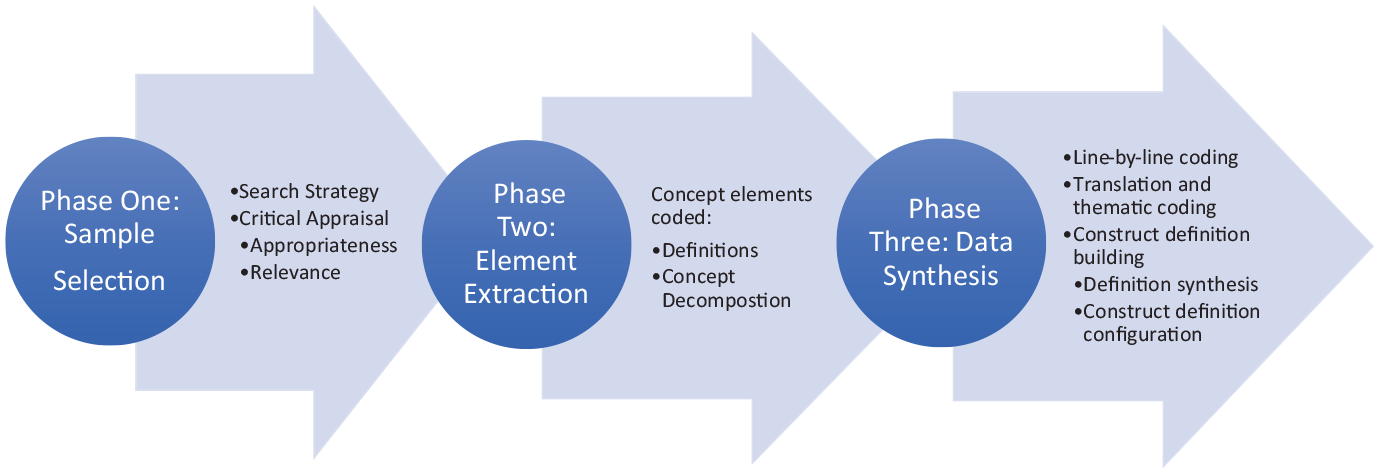
Process for narrative synthesis of researcher concepts of teacher working conditions.
Phase 1: Sample Selection
In this phase, I created the database of studies from which I conducted the synthesis.
Search strategy
I used two sources for obtaining academic articles on the topic of TWCs: online databases and reference list searches of articles. I searched the following online databases: Education Resources Information Center, PsychInfo, ProQuest, Education Full Text, and Academic Search Premier. All article abstracts and titles were searched using the following search term: “teach* AND work* AND condition*,” with no limitation to the field of study or discipline (e.g., policy vs. mathematics education). Next, I utilized database thesauruses to match keyword search terms to databases.
There is evidence that TWCs before the landmark education legislation No Child Left Behind, enacted in 2002, may differ from the context teachers experienced after the legislation (Dee et al., 2013; Nichols & Berliner, 2008). Therefore, I used search engine qualifiers to bound the search to studies published in or after 2002.
The processes of compiling, screening, and excluding were documented in the workflow map in Figure 2. The results from term and keyword searches from all search engines, totaling 7,326 records, were imported into software developed for systematic review, EPPI-Reviewer 4. From these records, I removed 3,368 articles that were not about TWCs or considered only a small subset or single topic related to TWCs, rather than a study of TWCs as a whole concept. For example, Absar (2016) was excluded because the study focused on organizational commitment and job satisfaction and did not include a focus on TWCs.
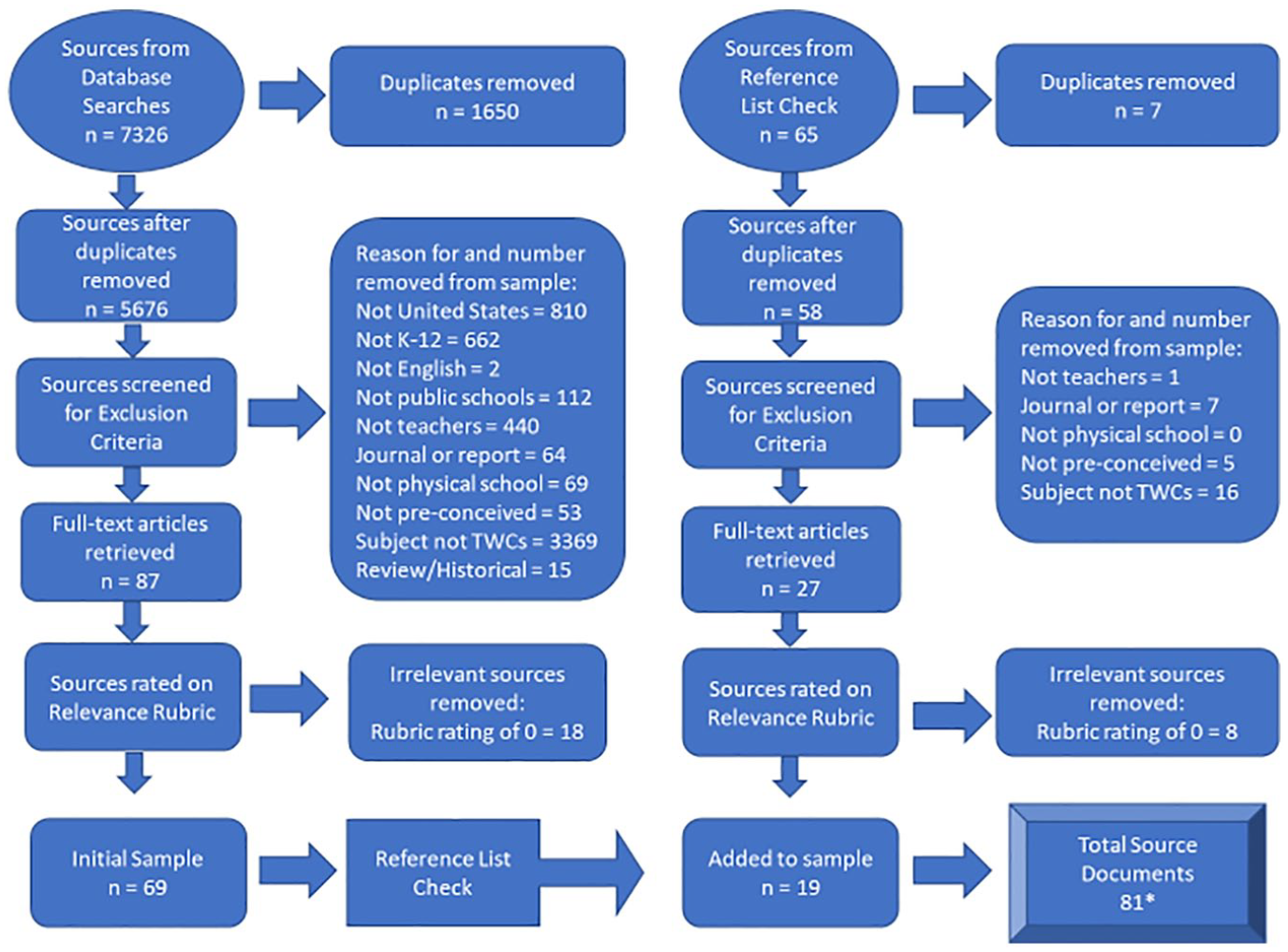
Workflow map of teacher working conditions document sample selection.
Critical appraisal
Next, I adapted Gough et al.’s (2012) weight of evidenceframework to determine: (a) soundness of studies; (b) appropriateness of studies; and (c) relevance of the study focus to the review. The first step, soundness of studies, is a review of the sampled studies’ research methods. The current synthesis did not rely on study findings; thus, I did not critically appraise study methods.
Appropriateness of studies (inclusion criteria)
My search had eight inclusion criteria. First, I only included studies that focused on the working conditions of teachers, as opposed to principals or students. I removed a total of 440 articles on this criterion, including Friesen (2015), who focused on the learning context of students.
Second, I only kept articles studying TWCs in the United States. To my knowledge, this was the first study of its kind on TWCs, so I bounded the study to a country that could provide the depth and breadth of research necessary to produce a credible construct definition of TWCs for that country. 1 An example of a study omitted due to setting is Forte and Flores (2014), which was omitted because the setting for this study was Portugal.
Third, fourth, and fifth, I excluded 2, 662, and 112 records due to criteria related to the language of publication without translation (English), the level of schooling (K–12), and the funding for schooling (public), respectively. As examples, I excluded Acker and Dillabough (2007) because the setting of the study was the university and Dorman (2003) because the study’s setting was in private schools.
Sixth, following quality assurance criteria applied by researchers conducting reviews of the literature in recent academic journals (see Muenks & Miele, 2017; Welsh, 2017), I kept in the sample only research articles published in peer-reviewed journals, omitting 64 articles based on this criterion. Seventh, I omitted 69 studies of virtual public schools or online contexts from the sample, as the working conditions in these schools are likely different than physical schools (Muirhead, 2000). As examples, I excluded Edwards (2003) because it was an opinion editorial, rather than a research article, and Fassetta et al. (2017) because the focus of the article was the context surrounding online teacher training.
Last, the research questions of this synthesis inquired after researchers’ concepts of TWCs. Inductively derived concepts of TWCs are more representative of participant conceptions of TWCs, which are not within the scope of this synthesis. Therefore, I included only articles that contained a pre-conceived (a priori) articulation of TWCs, effectively excluding most qualitative research. Applying this criterion, I removed 52 articles from the sample, including du Plessis and Sunde (2017), who derived their concept of TWCs from participants. Resulting from the article search and exclusion process, a total of 87 articles remained in the sample for relevance analysis.
Relevance of studies
Next, to systematically gauge the relevance of articles to this review’s question (Petticrew & Roberts, 2005), I developed a rubric to examine whether each article contained at least one of two elements of a researcher’s concept of TWCs: (a) a narrative definition of TWCs or (b) some description of the topics, variables, measures, or labels used to break down the concept of TWCs. A detailed description of the rubric is available upon request. After applying the rubric, I omitted 18 articles that were not relevant to the synthesis.
Search strategy redux: Reference list check
Next, I checked the reference lists of all 63 articles, looking broadly for titles that appeared to investigate TWCs. I identified an additional 58 articles to check through this process. After applying inclusion and relevance criteria to these articles, I added 19 of these articles to the sample, resulting in a final sample of 81 articles. However, I added three additional articles, which provided narrative definitions of TWCs but had previously been omitted due to inclusion criteria, to the narrative definition analysis, because the sample of studies that provided a narrative definition was small (originally, six articles). These three articles were only included in the narrative definition analysis.
Phase 2: Element Extraction
Using NVivo Qualitative Software, I hand-coded the full text of each article in the sample. For definitions, I coded narrative descriptions of how the authors defined TWCs. For concept decomposition, I coded (a) labels and sublabels applied to topics of TWCs, (b) narrative descriptions of the labels and sublabels, and (c) available in 69 of 81 articles, survey items used to measure the labels and sublabels.
Phase 3: Data Synthesis
Data synthesis methods were informed by Thomas and Harden (2008) and Gough et al. (2012). To reduce bias during analysis, I adhered to well-known, qualitative, analytic procedures. Figure 3 outlines the process of synthesis in three steps: (a) line-by-line coding, (b) translation and thematic coding, and (c) construct definition configuration.

Process for synthesis of researcher concepts of teacher working conditions.
The measures researchers presented in their studies have often been psychometrically tested for validity and reliability to measure a particular construct. I decomposed these sets of measures to be able to qualitatively identify the breadth of topics addressed in the literature, regardless of the construct the researcher was measuring. To do this, I translated across studies and thematically analyzed the resulting groups. Translation is the process of comparing what is similar in a data set and interpreting why there are differences (Noblit & Hare, 1988). Thomas and Harden (2008) described the process of thematic analysis as “taking concepts from one study and recognising the same concepts in another study, though they may not be expressed using identical words” (p. 47). In addition to translation, I employed axial coding from grounded theory, where codes were both inductively and deductively associated (Corbin et al., 2014). From this process, I synthesized a narrative definition and configured 12 categories of TWCs.
A major undertaking of this study was to define what TWCs are, which entailed demarcating what they are not. During the last step of the synthesis, I vetted each category that emerged from the synthesis against the synthesized definition of TWCs. I omitted categories that did not align, bringing the two elements of the construct definition, the narrative definition and catalog, into alignment.
Descriptive and variation analyses
Last, I explored the results numerically. I calculated descriptive statistics of the number of measures that addressed each category. Next, I tabulated the number of times each author included a topic or measure of each category with a heat map overlay that systematically shaded cells with higher counts darker and cells with lower counts lighter. Last, I tallied the source for each researcher’s concept of TWCs and the methods by which they collected data to inform their research, including the types of measures employed.
Results
Overall, I found that there was no standard practice for studying TWCs and very little guidance on what TWCs are. However, by synthesizing across sample articles, I found that researchers that provided a narrative definition of TWCs were in general conceptual agreement about what TWCs are. Next, I found that TWCs can be understood as a list of categories and smaller components of those categories. Furthermore, despite the conceptual agreement in narrative definitions of TWCs, there was significant variation in the ways that researchers decomposed the concept of TWCs to study it, including the ways they labeled and measured it. This was evident in the variation and breadth of categories addressed in sample articles. Last, though the topics measured by researchers varied widely, there were commonalities in the types of sources to which researchers turned to find measures and the methods they employed to gather data.
A Narrative Definition of TWCs
Table 1 identifies text from the nine authors, where they provided narrative definitions of TWCs. Overall, the authors agreed conceptually on what TWCs are. Six authors used language connoting that TWCs are those elements related to a teacher’s ability to do their job, the remaining three articles did not state anything that disagreed with this sentiment. This majority definition makes conceptual sense, given that the “work” in TWCs is teaching; thus, the conditions in the school environment that affect teaching are TWCs. The substance of the article texts disagreed in only one instance, around pecuniary considerations, with one article (i.e., Shen et al., 2012) including it in their definition. I address disagreement among researchers below.
Narrative definitions and key elements of teacher working conditions from sample articles
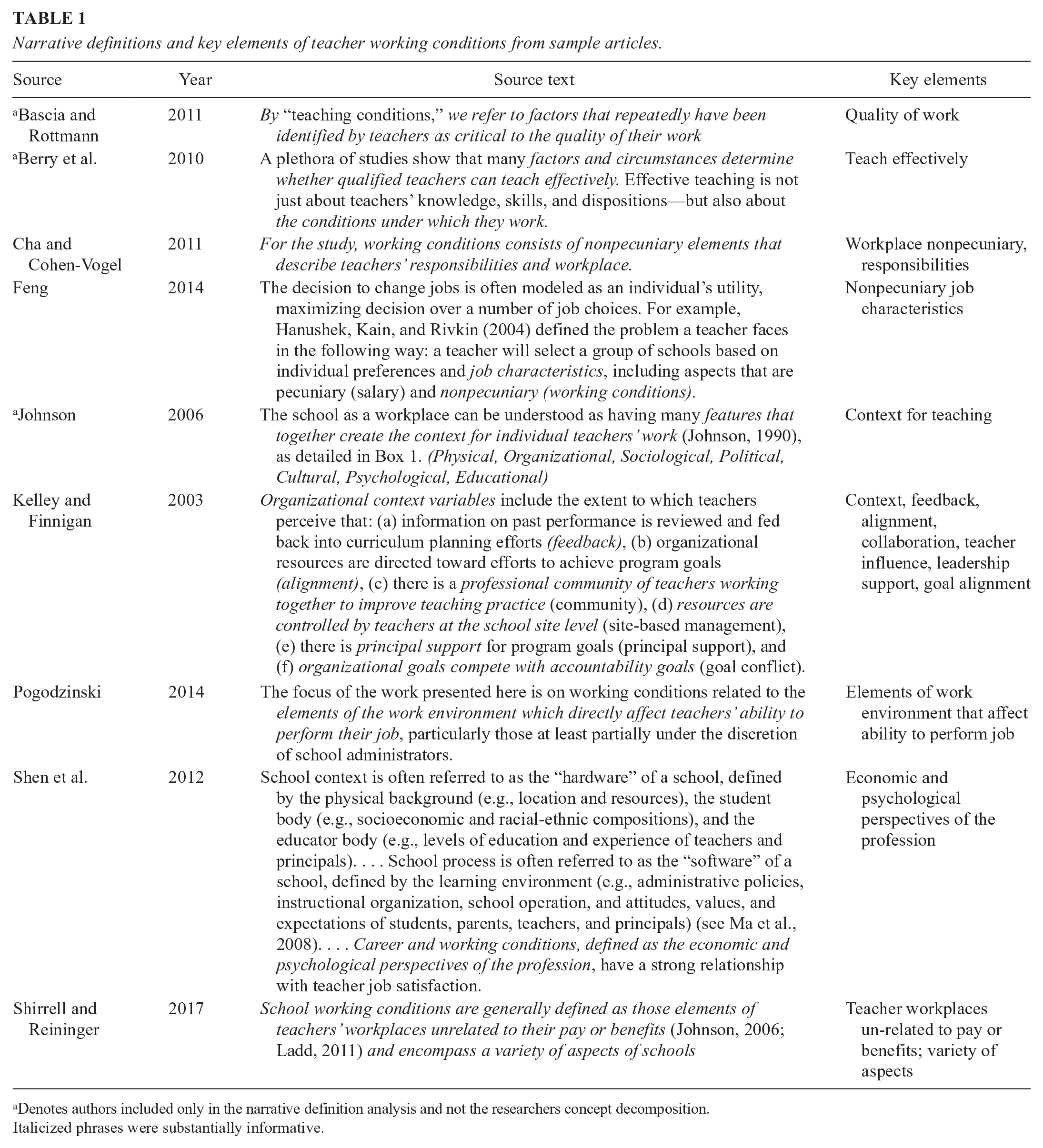
Denotes authors included only in the narrative definition analysis and not the researchers concept decomposition. Italicized phrases were substantially informative.
The concept cited above provides an idea of what TWCs are. However, because only concepts or words present in all six articles were included, the result is a rather general statement. Therefore, I synthesized across the nine articles, pulling language from them, to clarify that TWCs are confined to the workplace, affect teaching, and are nonpecuniary. The synthesized definition reads: TWCs are the nonpecuniary elements of the workplace that affect teaching. Two elements of the definition delineate what TWCs are by placing them geographically in the workplace and proximally to teaching. If researchers apply this definition consistently, the literature on TWCs will become more cohesive.
A Catalog of TWCs
In the following paragraphs, I explain the categories, components, and subcomponents that make up the TWCs catalog, which emerged from the systematic narrative synthesis. As with any catalog, the organization of categories and subcategories should conceptually fit, but there is inherent subjectivity in how it is organized. In Table 2, I organized each category and any subcategories, describing each as they were employed in this sample.
Definitions of TWCs catalog categories, components, and subcomponents
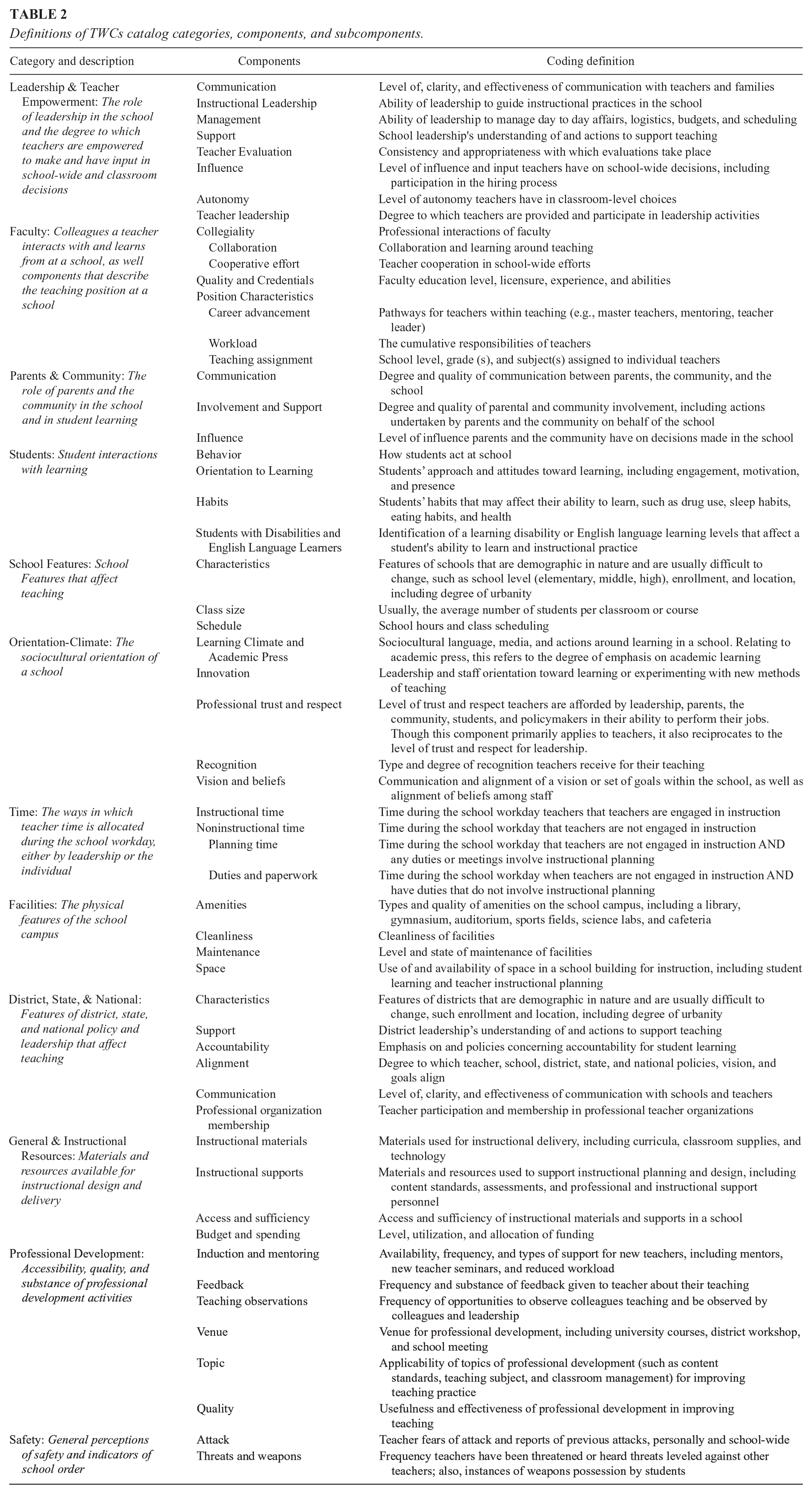
The categories fall into two broad meta-categories of Actors and Constructs. The Actors meta-category includes items that involved the persons with whom teachers interact and those who contribute to the creation of conditions for teaching. The second meta-category, Constructs, is characterized by items that measured both tangible and intangible things, rather than people, that affect teaching in the workplace. When studying TWCs in future research, these distinctions may help clarify the target of the study and subsequent implications.
Actors
The first category under Actors is Leadership & Teacher Empowerment. Though these two topics appeared separately on surveys, the literature on TWCs often merged measures of Leadership and Teacher Empowerment after factor analysis, due to their collinearity (Ladd, 2009, 2011). This is likely because Teacher Empowerment is a measure of power distribution in the school, and school leadership, specifically principals, are the seat of power in schools (Fullan, 2010). Items that measured Teacher Empowerment, then, were measures of how principals chose to distribute power in the school. Yet, the measures, labels, and descriptions in the sample articles that addressed Teacher Empowerment focused on the discretion afforded to teachers. It would be useful for some items to also focus on the actors, principals, and the decisions they make that affect teacher empowerment. The results from such a measure would direct stakeholders more clearly regarding how to improve teacher empowerment.
The measures and labels of four subcategories of Leadership & Teacher Empowerment were directly related to Leadership: Communication; Instructional Leadership; Management; and Support. However, rather than referring specifically to Leadership, several measures of Communication, Instructional Leadership, Management, and Support used language that generalized to the “school” or used passive voice.
For example, Ladd (2009) employed this survey item, from the NC TWCS, “The school leadership communicates clear expectations to students and parents.” The item specified school leadership as the communicator, which directs interpretation. Compare this item to Johnson et al. (2012), who used this item from the Teaching, Empowering, Leading, and Learning Survey (TELL) to measure Communication, “Clear expectations are communicated to students and families.” The use of passive voice forces inference as to who communicates clear expectations to students and families, thus interpretation of this item is less clear. It may be that the writers of this item were after a broader sense of communicating expectations than leadership, including any actors that might do so (e.g., district communications department, district leaders, colleagues). In this instance, considering that teachers are the most numerous respondents to these surveys, a negative response may suggest that the school in general, including colleagues, did not communicate expectations well to students and parents. The vagueness in wording widens the opening for later interpretation as to what action can or should be taken in response to the results.
The second group of subcategories is related to Teacher Empowerment: Teacher Evaluation; Teacher Influence; Teacher Autonomy; and Teacher Leadership. Both Teacher Influence and Teacher Autonomy refer to items that measured the decision-making input teachers have, but the two subcomponents were distinguished by whether the decision making had school-wide or classroom-level effects, respectively. For example, the six measures in sample articles that referenced the school’s teacher hiring process, a process beyond an individual teacher’s classroom, were paired with questions about teacher influence in the school.
The Students category is composed of four subcategories: Behavior; Habits; Orientation to Learning; and Students with Disabilities and English Language Learners (SWD and ELL). Each of these subcategories represents items that measured characteristics of students that affect the conditions under which teachers must teach. Both, SWDs and ELLs, should be welcomed in classrooms and are contributors to classroom learning. However, these groups represent unique challenges for teachers. SWDs have been identified as those who need additional assistance and/or modifications to learn best. Thus, the presence of SWDs in the classroom changes the conditions under which teachers meet the needs of all students and comply with Individualized Education Plans. Similarly, ELLs require additional support to learn, especially in classrooms where only English is spoken, changing the teaching conditions for teachers of these students.
The impact these students’ needs have on teaching can be significantly mediated by the support services and support personnel available in schools. Thus, this category also represents items that measured the set of resources available to teachers to meet the learning needs of students with formally identified needs.
The Faculty category describes items that measured the characteristics of colleagues that teachers work among, as well as the characteristics of their teaching position. The Collegiality subcategory is divided into two components: Collaboration and Cooperative Effort. Collaboration encompasses items that measured collegial learning and sharing for instructional planning and improvement, whereas Cooperative Effort refers to items that measured school-wide or collective efforts, such as schoolwide enforcement of student behavior codes. The District, State, & National Actors category is a broad category that includes any items or labels that referred to the ways that districts, states, and federal actors interacted with schools, including the policies handed down from these actors.
The majority of measures and labels of the Parents & Community category specified one or the other, parents or community. However, though the actors were distinguished, the topics of the measures were largely in alignment. Most measures of Parents & Community had the objective of measuring these subcategories: Communication; Involvement and Support; and Influence. Communication refers to items that measured the frequency and substance of communication between parents and teachers, as well as between parents and leadership. Involvement and Support measures most often did not describe the types of involvement or support inquired after and instead asked about the degree to which parents and the community are supportive or have the opportunity to be involved in the school or influence school decision-making. For example, Houchens et al. (2017) used an item that read, “Parents/guardians are influential decision makers in this school.” The item did not specify a decision in which parents/guardians might be involved. To provide clearer guidance, an item from this category might ask respondents to indicate which decisions, from a provided list, parents have input.
Constructs
Within the Constructs meta-category, the measures of school Orientation-Climate present in the sample literature are characterized by five subcategories: Innovation; Learning Climate and Academic Press; Professional Trust and Respect; Recognition; and Vision and Beliefs. Innovation speaks to items that measured a school’s or faculty’s openness to and drive for new ideas and methods. Learning Climate and Academic Press refers to items that targeted the measure of a school or faculty’s orientation toward students and student learning. Though Academic Press could conceptually be subsumed as part of the Learning Climate, I distinguished Academic Press, by including it as part of the title of this subcategory, due to its prominence in the literature (i.e., Dobbie & Fryer, 2013; Ladd, 2009) and the number of measures that referred to Academic Press, specifically, versus Learning Climate, generally.
The Professional Trust and Respect subcategory captures items that measured the orientation of leadership, parents, the community, and other teachers toward the teaching profession and the subsequent treatment of individual teachers as professionals. Closely related, though measured distinctly in the sample literature, Recognition represents items that measured the level or instance of recognition teachers receive for their work. Last, Vision and Beliefs represent items that measured a school-wide understanding of, alignment with, and communication of a vision or set of goals for the school.
Professional Development includes items that measured new teacher induction and mentoring; formal professional development sessions, including their quality and usefulness; and opportunities to observe and be observed teaching.
The Time category refers to measures of how teachers’ time is allocated in schools and is divided into two subcategories: Instructional Time and Noninstructional Time. Noninstructional Time is broken further into two subcategories: Planning Time and Duties and Paperwork. Planning Time refers to items that measured the time teachers have available during the school day for planning instruction, whether with colleagues or individually. Duties and Paperwork represent the items that measured tasks not related to instructional planning, consisting of items that addressed the number of duties, the amount of paperwork teachers reported, and the degree to which these tasks interfered with teaching.
The School Features category is organized by the degree of modifiability of the feature in the school environment. Characteristics of schools are items that measured those features of schools that are generally not policy malleable, such as the level of school enrolment and urbanity. Though Class Size was often labeled as a school characteristic in sample articles, it is more policy malleable than other characteristics of schools and was measured distinctly 30 times in the sample literature. Due to these characteristics, Class Size is listed separately from Characteristics of Schools in the catalog.
The Facilities category is the most homogenous in terms of language, meaning that measures across sample articles referenced Facilities subcategories using the same terms or asked about facilities, in general. The most populous of these was facility Cleanliness, with 10 measures that addressed this topic. Following Cleanliness was facility Maintenance, with seven measures on this topic. Amenities refers to items that measured the existence of, or access to, and quality of school amenities, such as libraries, science labs, play equipment, and auditoriums. The last component of the Facilities category captures items that measured the sufficiency and use of school Space.
The last category, Safety, straddles two extremes: the most general and most specific of the TWCs categories. Seventeen measures of school Safety asked generally about the level of safety in the school. In contrast, the remaining Safety items asked about specific student behaviors related to safety, such as student physical attacks, vandalism, weapon possession, and verbal abuse, which specificity was not otherwise found in TWCs categories.
What TWCs Are Not
The narrative definition provided above states that TWCs are elements of the workplace that affect teaching. Defining TWCs provides the information necessary to demarcate what they are not. From the review and synthesis of the literature, two categories and one subcategory of Students were sometimes included as TWCs, which do not conceptually fit the definition agreed on by the majority of authors providing narrative definitions. The two categories are Psychological States and Pecuniary Considerations, and the subcategory is Student Demographics. In this section, I explain why these categories should not be studied as TWCs and why researchers may have included them in their studies. In all cases, at least one reason researchers may have included one, or all, of these categories is because there is no commonly accepted guidance on what TWCs are and are not. In this discussion, I highlight the research that has begun to disentangle these topics from TWCs, especially student demographics, and to provide the information and rationale for future research to consider these categories distinctly from TWCs.
Psychological States
Psychological States of individual teachers, such as satisfaction, burnout, resilience, and self-efficacy, were included as TWCs in 24 articles in this sample (30%). I argue against Psychological States as TWCs because, regarding working conditions, they are reactions to working conditions in the school environment, rather than working conditions themselves (Bascia & Rottmann, 2011; Cha & Cohen-Vogel, 2011). A teacher’s sense of satisfaction in teaching or level of burnout are conditions that develop in reaction to and after interacting with TWCs and other elements of the teaching profession, whereas TWCs are independent of the internal psychological states of individual teachers. However, an individual teacher’s work and effectiveness may be affected by their colleagues’ externalizing of psychological states as they are projected into the workplace. Examples of these instances are evident in constructs such as collegiality (Shah, 2012) and collective efficacy (Goddard et al., 2000).
It is the conflation of cause and response that may entice researchers to measure psychological responses as TWCs. A significant number of measures on TWCs surveys asked about a teacher’s satisfaction with a working condition. It may be that “satisfaction with” eventually translated to a type of working condition itself. Yet, if a psychological reaction, such as satisfaction, and the mechanisms causing it, such as workload or resources, are conflated, the mechanisms become more difficult to identify and thereby that much more difficult to address. Both, Bascia and Rottmann (2011) and Cha and Cohen-Vogel (2011) employed logic models to articulate their research approaches. In both cases, the authors represented TWCs as a cause of Psychological States in the flow of cause and effect. Their examples suggest how logic models can be a tool to disentangle TWCs from reactions to them.
Pecuniary Considerations
Only one article of the nine that stated a narrative definition of TWCs, Shen et al. (2012), asserted that the category of items that measured Pecuniary Considerations are part of TWCs. Five articles overtly disagreed, each specifying that TWCs are distinct from pay and benefits (Cha & Cohen-Vogel, 2011; Feng, 2014; Johnson, 2006; Ladd, 2011; Shirrell & Reininger, 2017). Feng (2014) distinguished salary from working conditions by categorizing salary as pecuniary and working conditions as nonpecuniary. Furthermore, Johnson (2006), Ladd (2011), and Shirrell and Reininger (2017) all asserted that “[a]lthough teachers’ pay and benefits have considerable influence on their career decisions, these economic conditions are generally considered distinct from working conditions . . . ” (Johnson, 2006, p. 2).
Though these authors did not directly present a rationale for excluding pecuniary considerations, I assert that there is a misalignment in the concept of TWCs with pecuniary considerations. When referring to pecuniary considerations, Johnson (2006) made a distinction between working conditions and economic conditions, which hints at the source of the misalignment. If teacher pay is considered a TWC, then teacher pay must affect an individual’s ability to teach, one of the two main criteria for being a TWC. Yet, the argument for such a connection must include several mediators, which list likely includes working conditions. A raise in teacher salary may be called for, relieve economic stresses, signal value in education, attract higher quality teacher candidates, and help retain teachers in the profession, but it is not a TWC because it does not affect a teacher’s ability to teach.
Johnson (2006) provided a clue as to why 22 articles (27%) in this study included salary and benefits as a TWC, while others stated that it is general practice to not include them. Johnson explained that economic conditions affect teacher retention, which is also strongly associated with TWCs. Thus, the two topics, pecuniary considerations and TWCs, are both of interest when studying the causes of teacher retention. Their continued appearance together may have eroded some of the conceptual distinction between them.
A second reason, perhaps, that pecuniary considerations sometimes were included as a TWC, rather than its own set of conditions, may lie in the context in which salary and benefits are often discussed (or not discussed) in the United States. Though the U.S. economy thrives on individual economic success, it is still considered somewhat a cultural faux pas to discuss money or to be openly concerned with making money. Nevertheless, low salaries are a perennially discussed issue for teachers, placing this profession in an uncomfortable position.
An additional factor may be that teaching is sometimes referred to as a calling or service. For example, teachers are differentiated in their employment status, with student teachers often referred to as “preservice” teachers and employed teachers referred to as “in-service.” These terms carry, for some, the supposition that the teaching profession is entered to contribute to social and children’s well-being, rather than as a means to make a living. The American sensitivity to monetary discussions paired with the view that teaching is a service or calling to work with children can make it culturally unpopular to voice concerns about pay for teachers. Therefore, it is plausible that researchers cast Pecuniary Considerations as one of many considerations of TWCs so as not to single teachers out for accusations of being concerned with money.
It is important to keep these conceptually different mechanisms for teacher retention separate, to provide better guidance for policymakers and education stakeholders concerning the most impactful levers that show promise to recruit and retain teachers. Because pecuniary considerations are important (not just to teachers but to most everyone) and affect teacher retention in different ways than TWCs, they should be given distinct consideration and not allowed to fade into the complexity of TWCs.
Student Demographics
Last, Student Demographics, which represents items that measured student race and socioeconomic status (SES), emerged as a subcategory of the Student category. I assert that neither, student race nor SES, is a TWC. Furthermore, the usage of Student Demographics to proxy for TWCs is not useful in developing a better understanding of TWCs, and most important, it may be harmful to students.
Of the 81 articles in the analysis of concepts of TWCs, 16 (20%) included measures of student SES and/or race as part of their decomposition of TWCs. Some articles stated that they used race and student SES as proxies for TWCs (see Hanushek & Rivkin, 2007), making either a correlative argument to do so or not including an explanation for their decision. Other authors made direct arguments for including race and SES as measures of TWCs. For example, Ladd (2011) justified including race and SES as measures of TWCs by stating that “high proportions of racial minorities or low-income students makes it difficult for schools to retain teachers” (p. 236).
Race and SES are correlated with elements of schooling, such as funding levels and home resources, that affect teaching (Horng, 2009). However, such correlations represent only blunt proxies for TWCs and do not provide substantive direction for policy or improvements. Furthermore, when researchers examine student demographics and working conditions, they find that what drives teachers’ choices more than student demographics are the poor working conditions found shamefully disproportionately among schools attended by students of color and students in poverty (Boyd et al., 2011; Horng, 2009; Johnson et al., 2012). Thus, in the least, student race and SES are too blunt as proxies for TWCs to be useful for improving policy or school practice. More urgently, the harm in allowing student race and SES to proxy for TWCs is that it misrepresents teachers’ experiences with minority and low-SES students. The focus, blame, and stigma are laid on under-served students, rather than the unmeasured, underlying conditions under which they must learn, teachers struggle to teach, and teachers sometimes leave.
Variation and Overlap in the Study of TWCs
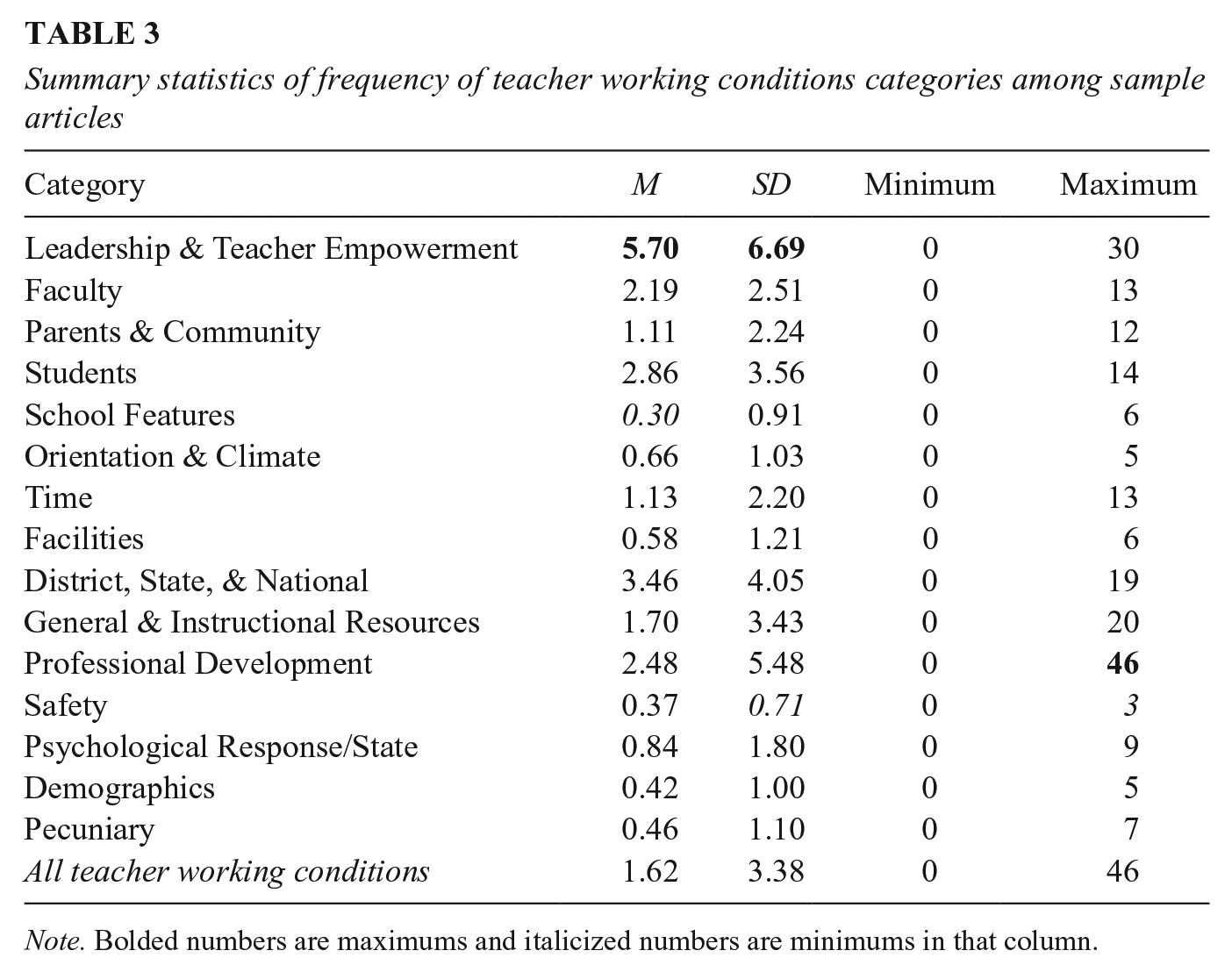
In this section, I describe the variation in researcher decompositions of TWCs using descriptive statistics and tabulation. I included those categories that were omitted from the catalog, those that did not fit the definition of a TWC (Student Demographics, Pecuniary Considerations, and Psychological States), in these calculations because the inclusion of all measures and labels of TWCs that appeared in the sample articles provides a more accurate representation of the overall variation in researcher decompositions of TWCs. Table 3 lists descriptive statistics of the number of measures that addressed each category.
Summary statistics of frequency of teacher working conditions categories among sample articles
Note. Bolded numbers are maximums and italicized numbers are minimums in that column.
These numbers suggest the relative stability of categories in the sample literature. The categories with the highest means are those that appear in the sample literature most often. As expected from studies anchored in the research literature, as one reviewer pointed out, these categories are also those found most prominently in the literature as factors in teacher retention and student learning (Boyd et al., 2011; Kraft et al., 2016; Ladd, 2011; Podolsky et al., 2016; Simon & Johnson, 2015). Yet, the column of zeros under Minimum for TWCs Categories indicates that no category was represented in all articles. This suggests that researchers, singly, each conceive of TWCs as a narrower concept; yet when considered together, the concept expands. Furthermore, the concept is bounded, even among all researchers, since the measures fall into 12 categories, none of which is labeled “Miscellaneous.”
Leadership & Teacher Empowerment was, by far, the most populous category, with an average of 5.7 measures per sample article. Leadership & Teacher Empowerment also had the most variation in the number of measures per article, indicated by the relatively large standard deviation (6.69). A total of 20 sample articles included between 10 and 30 measures of this category. Yet, 22 sample articles either did not include measures of Leadership & Teacher Empowerment or included measures but did not define Leadership & Teacher Empowerment as a TWC, considering this category separately.
Professional Development had the highest maximum, with 46 items on the NC TWCs dedicated to its measure. The least varied and lowest maximum category was Safety, with a mean of 0.37 measures per sample article. The relatively small standard deviation (0.71) of Safety supports that this pattern held for the sample. The last row entry, All TWCs, shows that on average, sample articles included 17.88 measures or labels of TWCs. However, the standard deviation (15.73) indicates that there was wide variation in this number, with a minimum of a single measure to represent TWCs (see Ronfeldt, 2012) and a maximum of 65 measures (see Ladd, 2011).
Visualizing Variation
In Table 4, I present a heat map of the total number of measures per category by article. The articles were ordered by frequency of measures from highest to lowest. For example, the first entry is Ladd (2011), who included 30 measures of Leadership & Teacher Empowerment in this study, the most measures of any category that an article in the sample employed. Sample articles that included several measures of one category tended to include more measures of any other categories that the article included. As the cells become lighter, traveling vertically down the table, they trend lighter across all categories in the article. Thus, researchers in this sample tended to evenly spread the number of measures for each category.
Heat map of counts of the number of measures per category by article

Note. Darker tds represent higher frequencies.
Sources of Variation and Homogeneity in Defining and Studying TWCs
In this section, I examine patterns in researchers’ definitions and operationalization of TWCs, both narratively and in how TWCs were measured.
Sources of narrative definitions
Of the nine sample articles that included a narrative definition, four included information on why they defined TWCs as they did. Each of the four authors’ rationales leaned on the extant literature in some fashion. Bascia and Rottmann (2011) and Berry (2010) both stated that their concepts stemmed from the identification of factors from the literature that determine whether teachers can teach effectively. Johnson (2006) referenced prior work on TWCs, Johnson (1990), which is an in-depth chronicling of the context of teaching from the perspective of teachers, as the basis for their definition. Last, Shirrell and Reininger (2017) cited Johnson (2006) and Ladd (2011) but only to support the part of their definition where they asserted that pay and benefits are not working conditions. Each of these authors referenced prior literature for guidance on how to define TWCs. However, only 9 authors of 83 provided a narrative definition of TWCs, and only four of these provided information as to the derivation of their definition. These findings support the earlier assertion that no commonly accepted source defines TWCs and that researchers are looking for one.
Sources of measures of TWCs
Researchers make hundreds of decisions while designing and conducting a single study. One decision they must make is the type of data to use in the study of their topic. As delineated in the description of sample selection, to examine researcher, rather than participant, concepts of TWCs, the sample for this study was restricted to preconceived researcher concepts. In practice, this means that the sample consists of quantitative studies, where researchers develop their own concept, rather than identifying concepts of participants. In this section, I examined the types of data the researchers in this sample used to study TWCs and from where their measures were derived.
In this sample, every study, except two, employed survey methods to gather information about TWCs. The first exception, Ondrich et al. (2008), accessed a particularly rich set of administrative data. However, it is not clear from the description of their data whether their administrative data set included survey items. The second exception, Ronfeldt (2012), proxied teacher retention rates for TWCs. In the majority of studies, surveys were the only method for gathering information about TWCs. Some exceptions included Dobbie and Fryer (2013), who also interviewed participants and analyzed videotaped teaching sessions, and Marinell and Coca (2013), who, in addition to survey analysis, conducted in-depth case studies to inform their understanding of TWCs.
It is intuitive as to why researchers chose surveys of teachers as the primary method for gathering data on TWCs. Teachers are the target audience who experience the working conditions under study and are invaluable in studying the topic. Thus, it is reasonable for researchers to want to access information from teachers to study TWCs, and surveys are an obvious method for gaining such access. However, as with any single method, survey research has known limitations, such as response bias, and so other quantitative methods should be employed to complement and augment the understanding that has been gleaned thus far from an imbalanced use of survey methods.
Survey item sources
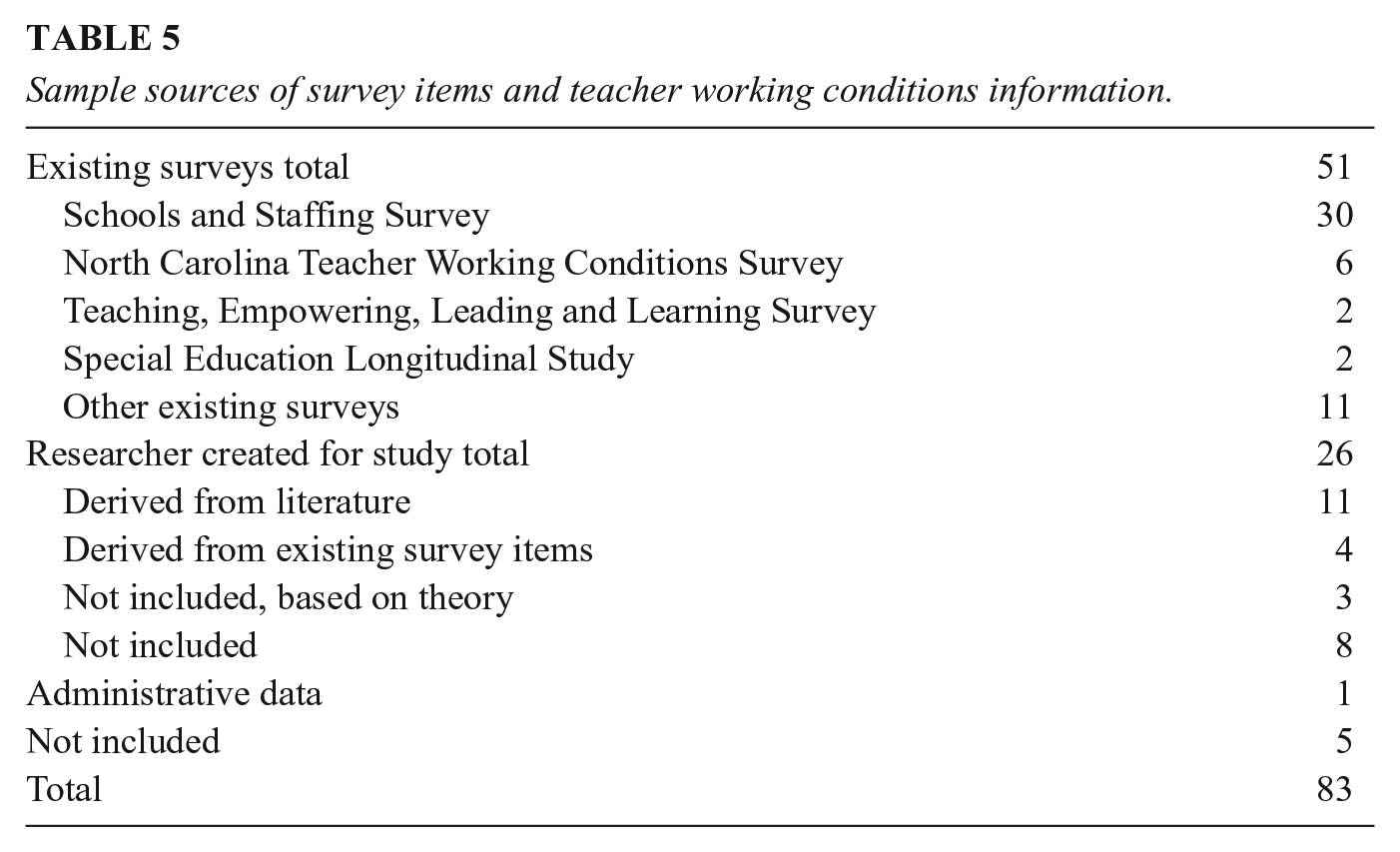
In Table 5, I show that over half of researchers took advantage of existing surveys for their research. Not surprisingly, the nationally representative and psychometrically tested Schools and Staffing Survey (SASS) was the most popular survey researchers used to study TWCs, with 30 studies employing items from this survey. The 2011–2012 SASS had a section dedicated to TWCs and a separate section measuring “School Climate and Teacher Attitudes.” The second most popular survey, though far less utilized compared with the SASS, was the NC TWCS. This survey is attractive as a tool because it was dedicated solely to the measure of TWCs, measuring a wider range of topics than the SASS. Furthermore, it has been administered to teachers in North Carolina biennially since 2002 and consistently boasts high response rates (Ladd, 2011).
Sample sources of survey items and teacher working conditions information
However, Ladd (2011) suggested some important gaps the NC TWCS had regarding the topics covered, including not addressing available curricula, teaching assignments, and services available to students. My comparison of the topics covered on the 2018 NC TWCS to the catalog presented in this study agrees with Ladd’s (2011) assessment that the survey had some important gaps. Attesting to the comprehensiveness of the work in this study, the TWCs catalog includes all three topics, listed above, that Ladd (2011) noted were missing, as well as three additional topics that the 2018 NC TWCS did not address: workload (considered separately from time spent working), communication of leadership, and instructional materials.
Other surveys include the TELL Survey and the Special Education Longitudinal Study, which were employed in two studies each. Developed by the New Teacher Center, the TELL is similar to the NC TWCS in that it was developed to measure TWCs, though it has not been available for as long as the NC TWCS. It is not surprising that the Special Education Longitudinal Study is used in only two studies, given the specific population for whom the survey was designed. The remaining studies that employed existing surveys all used different, locally administered instruments.
A second set of researchers created instruments to study TWCs. Among these 26 authors, 11 reported that they derived their survey items from the literature. Four researchers built their survey by collecting items from other surveys. Three authors did not include explicit explanations of how their survey items were formulated; however, they stated that their surveys were constructed with guidance from theory. The theories reported were the contextual theory of modifiability (Moon et al., 2003), the theory of planned behavior (Kersaint et al., 2007), and the job characteristics model (Bozeman et al., 2013). Both, Kersaint et al. (2007) and Bozeman et al. (2013) framed TWCs within their respective theories in efforts to explain the role TWCs play in teacher retention whereas, Moon et al. (2003) had a broader goal of identifying malleable mechanisms for school improvement, one among them being TWCs. In the remaining eight articles, the source of survey items was not explicitly stated in the description of the instrument.
Overall, the use of theory was sparse in the sample with only 13 of 81 articles mentioning or framing their understanding of TWCs within theory. However, the three articles that utilized theory to build their surveys (see Bozeman et al., 2013; Kersaint et al., 2007; and Moon et al., 2017) provide helpful examples regarding the use of theory in studying TWCs. For example, Kersaint et al. (2007) explained that the theory of planned behavior has three tenets: (a) attitude toward behavior, (b) subjective norm toward behavior, and (c) perceived behavioral control. They then targeted their survey items to each of these tenets: For attitude toward the behavior, participants in the sample were asked about the advantages and disadvantages associated with a return to teaching within the next 3 years. For subjective norm toward the behavior, the questions asked for the identification of any individuals or groups who might approve or disapprove of a return to teaching in the next 3 years. For perceived behavioral control, the participants were asked to describe the factors that would make it easy or difficult to return to teaching in the next 3 years. (p. 778)
TWCs entered the model most notably when the authors addressed the first and last tenets of the theory. Thus, theory directed these authors toward topics that should be addressed to answer their research question.
Teacher perception items
Ladd (2009) noted that the majority of the NC TWCS survey was composed of questions regarding teachers’ perceptions. My survey of the items on the instrument found that at least 67 percent of the 183 items on the 2018 NC TWCS elicited teacher perceptions. I found an even starker preference for teacher perception items in the articles in this study, which overwhelmingly used items that measure teacher perceptions of their working conditions. Of the 69 articles in this study that provided the specific measures of TWCs they used (as opposed to only the labels or topics), 50 (72%) employed teacher perception items for 90% or more of their measures, with the majority using teacher perception items for all of their measures. Teacher perceptions of TWCs are imperative to developing an understanding of why teachers stay or leave a school. However, paralleling overreliance on survey methods, the literature in this sample overrelied on this one item type.
By connecting the rationales of authors who provided narrative definitions with the analysis of survey item measures, some major patterns emerged. In the absence of an accepted definition of TWCs, most researchers did not attempt to narratively define it. Of 81 articles in this study, only 9 included a narrative definition of TWCs. Yet, those who did looked to the literature for guidance. The majority, who did not include a narrative definition, instead, turned to surveys and sets of items as proxy definitions. However, these surveys were developed relying substantially on teacher perception items.
Discussion
As the TWCs catalog illustrates, this construct is wide-ranging and contains overlapping and interacting topics, making the study of TWCs difficult. Yet, issues concerning the study of TWCs discussed in this study do not appear to be foundational differences in understanding, which might be challenging to bring into alignment. Instead, I found that researchers in the United States had similar underlying concepts; however, they took wide departures when operationalizing TWCs. This may be due to several reasons, but a strong contributing factor was the source from which researchers drew survey items, especially whether they used an existing survey or developed their own. A second source of variation, and the impetus for the current study, was the lack of guidance on what TWCs are. The definition and catalog contributed from this work may provide guidance to the field in thinking about the wide range of elements that make up TWCs and, just as important, what TWCs are not. The definition demarcates TWCs from other features of schooling, such as salary and discipline. Rather than a black box of schooling, where effective schools can seemingly only be understood in terms of the race and wealth of their students, the study of TWCs can meaningfully describe the multifaceted contexts in which schools decline, coast, and thrive. In this section, I discuss what these findings tell us and suggest three areas of action to consider for moving the study of TWCs forward.
First, to create a cohesive literature on TWCs that builds on past research and progresses toward policy-relevant findings, researchers must better understand the parameters of what they are studying. They must articulate and defend their concepts and operationalization of TWCs. Since there is evidence of general agreement in the way that researchers conceptualize TWCs, researchers should capitalize on this agreement by operationalizing TWCs in a way that aligns with the concept of TWCs generally understood in the literature. This concept of TWCs conveys that TWCs are elements of the workplace that affect teaching. Careful consideration of this concept led to the conclusion that the concept of TWCs does not align with the psychological states of individual teachers, pecuniary considerations, or student demographics. I encourage researchers to articulate their underlying concept of TWCs and then align the way they operationalize TWCs with that concept. I submit this study as a tool to step forward in this direction.
Next, the researchers in this study’s sample employed the literature to focus on the TWCs categories and subcategories that most affect the topic under study, whether the topic was teacher retention, student learning, or another topic associated with TWCs. I encourage researchers to go one step further. I urge researchers to dig deeper, to identify, within these impactful TWCs topics, the actions, processes, and practices that school leaders and policymakers can adopt for school improvement and then develop valid measures of them. The qualitative literature on TWCs is thick with specificity. Work by Brown and Wynn (2009), Fullan (2010), Johnson and Birkeland (2003), and Simon and Johnson (2015) are a few examples of research that can be surveyed to identify high-impact and specific conditions, processes, characteristics, and practices that need to be measured.
Theory is also available to guide researchers in this effort. There is benefit for researchers of TWCs to ground their studies in theory, especially for those developing their own surveys. The relative lack of theory in the literature in this sample may be the result of a lack of guidance on what TWCs are and how one might go about studying them. With a lack of clarity on what TWCs are, researchers understandably might have difficulty framing them within a theory. However, I cited three authors (Bozeman et al., 2013; Kersaint et al., 2007; and Moon et al., 2017) who applied theory, not just in guiding their research approach, but in the construction of their surveys as well. Theory may direct researchers to areas of TWCs that are not as well studied and provide a framework for interpreting findings. The authors cited in this study utilized theory to narrow their focus within the wide range of TWCs to those topics most likely to return useful answers to their research questions.
Last, I encourage researchers to use the specific TWCs practices and processes that they identify as impactful to engineer data gathering that is directive, meaning it informs school leaders and policymakers as to how to improve or what to change. On this front, there is a substantial amount of work to be done. The current method for studying TWCs relies on surveying teachers about their perceptions of TWCs. Surveys will continue to be used and teacher perceptions should continue to be sought, but the predominance of surveys and teacher perceptions needs to be brought into balance with other data gathering methods and item types. Ladd (2009) suggested, over a decade ago, that observational data could be gathered to complement teacher perceptions. A second idea is to ask teachers how they might measure TWCs if they were to be observers in their schools. What would they look for? If developed into a protocol, an observational assessment could be as useful for the study of TWCs as the Classroom Assessment and Scoring System is for teaching practices.
One likely reason for the predominance of teacher perception items is their prevalence on existing surveys and the ease of writing perception items. However, a reason not to overrely on educator perceptions is that they differ by the position of the participant. Hirsch and Emerick (2007) found persistent disagreement between the perceptions of teachers and principals. They concluded that this lack of agreement exposes a serious hindrance to prioritizing TWCs as a policy initiative. Furthermore, teacher perception items are difficult to interpret across schools because there are no baseline expectations, meaning what is “sufficient” or “satisfactory” varies from participant to participant. These inconsistencies may make policymakers hesitant to depend on findings from research when the findings hinge almost entirely on teacher perceptions.
Furthermore, teacher perception items are often not specific or directive. As an illustration, consider this measure of teacher collaboration from the 2011–2012 SASS, which I suggest is a teacher perception item. The item asked teachers to agree or disagree with this statement, using Likert-type responses: “I make a conscious effort to coordinate the content of my courses with that of other teachers.” Even if the results of this question unequivocally support that teachers do or do not make an effort to coordinate content, the results are not specific enough to be directive for improvement or policy action. It does not provide school leaders with direction concerning what they can do if they want to increase collaboration or content alignment. Should they ask teachers to be more conscious of their efforts?
Suppose researchers noted a few specific practices of effective schools regarding collaboration, including that they allow time for collaboration both across grades in the same content area and within grades. Given this context, compare the SASS item above with these questions, which are examples of directive questions: How often do you collaborate with: teachers in the same grade as you? teachers teaching the same content as you? How much time do you typically spend collaborating in a week? Results indicating deficits in these areas carry with them an implied action for remedy. Researchers could model typologies of effective schools to estimate what constitutes “enough” collaboration time in a range of contexts and results could then be employed to inform evidence-based, school improvement targets.
Future research would benefit from expanding the lens through which TWCs are studied beyond the U.S. context. Comparing the findings of this study with patterns and methods employed outside the United States may identify a larger variety of methods and measures for studying TWCs. It may be that the dependence of researchers on survey methods and teacher perception items is an American phenomenon and much could be learned from examining literature outside of the United States. It may also be that the same patterns hold, which could expose broad challenges in the study of TWCs.
Researchers, especially qualitative researchers (Elsbree, 1939; Goodlad, 1984; Lortie, 1975; Johnson, 1990), have long reported that TWCs are important, but we have not yet cultivated an effective method for studying them in a way that optimizes the research on TWCs for school improvement. As often as possible, items measuring TWCs should be written in such a way that they imply the action necessary to improve an outcome in the school. Measures of TWCs then become informative snapshots that can be compared across schools, and the underlying conditions, which contribute heavily to student and teacher outcomes, can be targeted for improvement.
Supplemental Material
sj-docx-1-rer-10.3102_0034654320985611 – Supplemental material for Configuring a Construct Definition of Teacher Working Conditions in the United States: A Systematic Narrative Review of Researcher Concepts
Supplemental material, sj-docx-1-rer-10.3102_0034654320985611 for Configuring a Construct Definition of Teacher Working Conditions in the United States: A Systematic Narrative Review of Researcher Concepts by Becca C. Merrill in Review of Educational Research
Footnotes
Notes
Author
BECCA C. MERRILL graduated with her doctorate from the School of Education at the University of North Carolina at Chapel Hill and became an advisor and researcher at Education Northwest, a research nonprofit organization in Portland, Oregon. Her interests include the teacher labor market and early learning systems. She enjoys quantitative, qualitative, and mixed methodologies.
References
Supplementary Material
Please find the following supplemental material available below.
For Open Access articles published under a Creative Commons License, all supplemental material carries the same license as the article it is associated with.
For non-Open Access articles published, all supplemental material carries a non-exclusive license, and permission requests for re-use of supplemental material or any part of supplemental material shall be sent directly to the copyright owner as specified in the copyright notice associated with the article.
