




Abstract
The authors present a systematic review of elementary school universal school-based (USB) social and emotional learning (SEL) interventions from 2008 through 2020 for two groups of minoritized students in education research and practice: students with disabilities and/or minoritized racial identities. Completed in accordance with the Preferred Reporting Items for Systematic Reviews and Meta-Analyses standards, in this review the authors identified 269 studies for inclusion, which reflected 107 USB SEL interventions. Eleven studies explicitly excluded students with disabilities. Studies varied widely in how disability and racial identity were categorized within and across studies and provided limited evidence of effectiveness through the use of subgroup analyses to support meaningful assessment of how students with disabilities and racially minoritized elementary school age students are benefiting from USB SEL interventions. The authors discuss the limitations of findings, education research best practices, and the minimum reporting standards necessary to ensure ability and racially minoritized youth representation in future USB SEL research.
The past two decades have been met with a surge of interest and investment in universal school-based (USB) social and emotional learning (SEL) to support the whole child, and all students, to thrive (Aspen Institute, 2019; Cipriano et al., 2021b; Collaborative for Academic, Social, and Emotional Learning, 2020; Durlak et al., 2011). Concurrently, the promotion of social and behavioral outcomes is now nationally recognized as a primary goal of education in the United States alongside academic achievement (Dusenbury et al., 2019; Every Student Succeeds Act, 2015). There is considerable momentum to implement USB SEL to transform a pathway to educational equity for minoritized youth (Aspen Institute, 2018; Farrington, 2020; Jagers et al., 2019), particularly toward the end of dismantling structural racism and the use of exclusionary practices 1 (Duchesneau, 2018; Mahoney et al., 2020; Williams & Jagers, 2022). Making matters most urgent, despite the presumed promise of USB SEL for all students (Aspen Institute, 2019, Collaborative for Academic, Social, and Emotional Learning, 2020; Mahoney et al., 2020), there remains open questions as to whether evidence-based SEL is in fact effective or even accessible to ability-minoritized and racially minoritized students (Cipriano & Rappolt-Schlichtmann, 2021; Gregory & Fergus, 2017; Hoffman, 2009; Mahfouz & Anthony-Stevens, 2020).
On the whole, minoritized students—including those historically marginalized by race, ethnicity, and ability (Artiles et al., 2016; Annamma et al., 2018; Cruz et al., 2021)—have not shared equitably in benefits stemming from educational interventions, best practices, or improvements to educational policy (Artiles et al., 2016; Annamma et al., 2018; Ladson-Billings, 2021; Leonardo, 2009). Once more, in some cases the deficit orientation of these interventions, practices, and policies have been considered to contribute to the inequitable, inaccessible, and punitive educational practices affecting minoritized youth (Cipriano et al., 2021a; Annamma et al., 2018; Bal & Trainor, 2016; Duchesneau, 2018). Although scholars have cautioned against the potential for SEL interventions to be race-evasive, failing to consider power, privilege, and cultural differences, or overlooking the role of individual beliefs and structural inequities in their design and implementation (Aspen Institute, 2018; Cipriano et al., 2021b; Duchesneau, 2018; Gregory & Fergus, 2017; Hoffman, 2009; Mahfouz & Anthony-Stevens, 2020; Osher et al., 2014), recent media commentary politicizing SEL and misconstruing it as or adjacent to the enaction of critical race theory in U.S. schools has drawn public criticism. But what do we know about the experiences of marginalized youth in USB SEL programs and approaches? To dismantle structural inequities and better understand the relationship between educational intervention effects and outcomes for specific groups of students with differing backgrounds, identities, and needs, we must unpack how minoritized students are reflected in the evidence base. Toward this end, in the present article we present a systematic review of elementary school USB SEL interventions for two groups of minoritized students in education research and practice: students with disabilities (SWDs) and/or minoritized racial identities. We begin with definitions of key constructs, next discuss the significance of disability and race at school, and close with the urgency to unpack student disability and race representation in USB SEL.
Operational Definitions
Here we offer operational definitions for USB SEL, student disability status, and student racial identity to anchor our review. USB SEL refers to intervention programs that are delivered systemically to all students in a class, school, or district to support the development of intra- and interpersonal skills that promote physical and psychological health. SEL includes fostering emotional intelligence, behavior regulation, and identity formation, the skills necessary for establishing and maintaining supportive relationships and making empathic and equitable decisions in the best interest of the entire school community (Collaborative for Academic, Social, and Emotional Learning, 2020; Cipriano et al., 2021b). Lack of consensus remains regarding the parameters of SEL (Aspen Institute, 2019; Cipriano et al., 2021b; Berg et al., 2017; Elias & Yuan, 2020; Jones et al., 2017). For example, the Collaborative for Academic, Social, and Emotional Learning’s (CASEL) five SEL competencies (self-awareness, self-management, social awareness, relationship skills, and responsible decision making; see Collaborative for Academic, Social, and Emotional Learning, 2020) are widely regarded as the standard (Lawson et al., 2019), and yet upward of 136 SEL frameworks have been identified (Grant et al., 2017), comprising more than 700 SEL-related competencies (Jones et al., 2017) that could represent critical content of USB SEL interventions (see Cipriano et al., 2021b). Universal programs are defined as those delivered to all students in a given school or grade, not exclusively those learners with identified needs or risk factors for social and emotional support (Greenberg et al., 2003; Rivers et al., 2013), and are often implemented as Tier 1 in a multitiered system of support (Rosen, 2021). All students in a school, grade, or classroom could receive a universal SEL intervention in their classrooms, and although SEL could be delivered by a pushed-in provider (such as a school counselor or specialist; see Jones et al., 2017, for review), universal programs are intended to promote skill building for all students, and not be delivered in targeted sessions.
SWDs include those who qualify for special education under the Every Student Succeeds Act (2015) and have individualized education plans (IEPs). It also includes other students with a formal disability diagnosis and students with 504 plans. SWD identifiers can include those who are sensorially or perceptually diverse, including students who are blind or have low vision, are deaf or hard of hearing, or have sensory processing challenges. SWDs also include those with specific learning disabilities such as dyslexia, or attention issues such as attention-deficit/hyperactivity disorder, as well as social processing differences such as autism or emotional and behavioral disorders (U.S. Department of Education, 2018). Identified SWDs collectively make up an estimated 14% to 18% of the student population (National Center for Education Statistics, 2021). With the goal of keeping students in the least restrictive environments as much as possible (U.S. Department of Education, 2018), most students receiving special education services are included in general education classes for at least 80% of the school day and learn in classrooms in which USB SEL interventions are implemented (Cipriano & Rappolt-Schlichtmann, 2021).
In the present review, student race is defined as a social construct without biological meaning: a classification system defined by physical differences between people and often used for the purpose of maintaining a power hierarchy among groups to perpetuate systems of privilege, most specifically between people of color and those who are white (Lanham & Liu, 2019; Smedley & Smedley, 2005). In contrast, student ethnicity is defined as a socially constructed characterization of people predicated on having a shared culture related to common ancestry and shared history (Suyemoto et al., 2020). Ethnic groups and ethnicity are not fixed, bounded categories; they are malleable, open to change, and usually self-defined (Barth, 1998). The meanings of race and ethnicity as social constructions are built and sustained at a multitude of ecological levels and are relevant to lived experience in ways that have consequential psychological, interpersonal, and material impact for individuals, groups, and communities (Suyemoto et al., 2020). We examine race and ethnicity as a combined construct in the present research study as a result of the precedence for how race and ethnicity are presented in education research (Codiroli McMaster et al., 2018; Dixon et al., 2021).
We use the term minoritized throughout this article to refer to the experience by which a person or group suffers subordinate social status in relationship to a dominate group or its members (including by race, ethnicity, or ability) resulting in systematic exclusion from access to social resources or are otherwise disadvantaged in relationship to a dominant group.
The Implications of Student Disability and Race at School
The narrative of students with learning differences within the context of U.S. public education is one of profound intersectionality: Race, class, gender, ethnicity, and disability interact to create overlapping and interdependent systems of disadvantage with negative consequences for students’ long-term health and wellness, as well as academic, social, and economic outcomes (Annamma et al., 2018; Artiles et al., 2016; Crenshaw, 1991; Cruz et al., 2021). Disproportionate representation in special education is a well-documented and complex issue in education research (see Morgan et al., 2015; National Center for Learning Disabilities, 2020; Skiba et al., 2016). Students of color and English language learners with disabilities are simultaneously less likely to receive services when warranted, more likely to spend time in restrictive rather than general education environments, and more likely to experience harsh discipline (Artiles et al., 2016; Cruz et al., 2021; Cruz & Rodl, 2018; National Center for Learning Disabilities, 2020). In comparison with their white peers, students of color and those who have experienced poverty are more likely to be identified as having disabilities at school (specifically emotional and behavioral disorders and specific learning disabilities; National Center for Learning Disabilities, 2020; Skiba et al., 2016). In comparison, rates of identification vary for English language learners by state, sometimes resulting in overidentification and other times underidentification (Morgan et al., 2015; Skiba et al., 2016; U.S. Department of Education, 2015). Within this context and despite an overall decline in the use of punitive discipline in U.S. schools over the past decade, Black students and SWDs are currently more likely to receive out-of-school suspensions without educational supports (U.S. Department of Education Office for Civil Rights, 2014). Nearly one in four boys and one in five girls with disabilities who also belong to minoritized racial groups (including Black, Native Hawaiian, Pacific Islander, American Indian, Alaskan Native, and multiracial) have received out-of-school suspensions, compared with only 6% of the general population. And in 2019, Black SWDs lost upward of 77 more days of instruction per 100 students enrolled than white SWDs, according to the U.S. Commission on Civil Rights (U.S. Department of Education Office for Civil Rights, 2019). Missed class time alongside exclusionary practices is associated with increased likelihood of students’ being retained, dropping out, or entering the juvenile justice system (U.S. Office for Civil Rights, 2019).
Making these trends even more concerning, the effects of chronic absenteeism and a lack of classroom integration can be detrimental to student achievement (Eklund et al., 2022) and high-quality instruction and support are effective alternatives to suspensions and classroom removals (Hamre et al., 2013). These outcomes matter in the long term as well. Approximately half of all individuals with disabilities are not employed, and those with college degrees have the highest rate of employment (Horowitz et al., 2017; Lipscomb et al., 2017). Unfortunately, SWDs attend college at half the rate of their peers and are less likely to graduate (Horowitz et al., 2017). At the same time, college enrollment rates for Black (37%) and Hispanic (36%) young adults (ages 18–24 years) trail that of their white peers (42%; Hussar et al., 2020). Moreover, Black and Hispanic or Latino/a youth are less likely to be employed than their white peers, and those who do have jobs earn lower wages than their peers (Spievack & Sick, 2019). Given these disparities, alongside the possibility and promise of USB SEL to support student development (Aspen Institute, 2019; Cipriano et al., 2021b; Durlak et al., 2011), it is critical to discern if USB SEL is benefiting ability-minoritized and racially minoritized youth.
Disability and Race Representation in USB SEL Research
Student disability and race representation in USB SEL is an urgent area of inquiry (Cipriano and Rappolt-Schlichtmann, 2021c; Rowe & Trickett, 2018). In 2018, Rowe and Trickett’s review of students reflected in Durlak et al.’s (2011) seminal meta-analysis of USB SEL programs investigated how often and in what manner demographic characteristics are reported, described the frequency and results of moderation and/or subgroup analyses on the basis of diversity demographics, and evaluated if articles addressed diversity in discussions of program efficacy and generalizability. Importantly, the literature presented in Durlak et al.’s article reflects the body of evidence in the field through January 1, 2008. Their (Rowe and Trickett’s) review showed that student diversity characteristics were inconsistently reported across articles, with most studies not testing for moderating effects and those that did reporting inconsistent effects across student characteristics. For example, in the literature prior to 2008, student disability status was rarely reported and, when so, was used as a screener to exclude a sample from study. Relatedly, regarding race and ethnicity, almost half the studies prior to 2008 used the label other, minority, or multiethnic. Despite the statistical precedence to create large enough categories for moderation analyses (Baron & Kenny, 1986; Cohen et al., 2014; Sharma et al., 1981), these classifications overgeneralize and betray within-group heterogeneity, diminishing our ability to understand who is benefiting from the SEL intervention.
Although these findings are profound, they are based on a literature that is out of date, reflecting the state of the evidence available for USB SEL only through 2008. Most recently, Daley and McCarthy (2021) completed a systematic review of student disability representation in middle and high school USB SEL interventions exclusively and found that of the 166 articles that met their inclusion criteria, 19 studies explicitly mentioned including SWDs, and only 5 included analyses in which SWDs were a subgroup. Once more, minimal and inconsistent characterizations of disability status in the evidence base was found to significantly limit the ability to understand how USB SEL intervention effects may be moderated by student characteristics, cautioning against the generalizability of the reviewed USB SEL programs benefits for adolescents with disabilities (Daley & McCarthy, 2021).
To reconcile the absence of evidence and build an empirical foundation for the study of ability and racially-marginalized learners within the evidence for USB SEL, the present review is organized around three guiding questions: Are SWDs represented in the evidence for USB SEL interventions for elementary school age students (Question 1), and if so, how (Question 1a)? Are student racial and ethnic identities represented in the evidence for USB SEL interventions for elementary school age students (Question 2), and if so, how (Question 2a)? Are SWDs from minoritized racial identities represented in the evidence for USB SEL interventions for elementary school age students (Question 3)?
Method
This systematic review follows the contemporary Preferred Reporting Items for Systematic Reviews and Meta-Analyses (Page et al., 2021), and the Reporting Standards for Research in Psychology (APA Publications and Communications Board Working Group on Journal Article Reporting Standards, 2008). In this section we outline the data collection methods used in the following subsections: inclusion criteria, search strategy, data screening and extraction, and risk for bias. See our prespecified, peer-reviewed protocol to strengthen transparency through preregistration (Pigott & Polanin, 2020).
Inclusion and Exclusion Criteria
We included studies of USB SEL interventions in the United States published and unpublished in English from January 1, 2008, through September 1, 2020. We used 2008 as the start date to capture all studies available since the SEL field’s seminal review paper (see Durlak et al., 2011). We defined USB SEL interventions in this study as interventions for students that are provided during school hours and within the school setting that target the development of social and emotional skills among all students in the classroom or school. Social, emotional, behavioral, and academic outcomes include those subsumed in CASEL’s five SEL competencies as well as immediate and long-term indicators of student well-being, including prosociality, academic performance, educational attainment, employment status, motivation, engagement, conduct, and emotional distress. We included a comprehensive list of study designs to optimize capturing the broadest range possible of studies for inclusion: randomized controlled trials, controlled (nonrandomized) trials or cluster trials, interrupted time series, controlled before-after studies, prospective and retrospective comparative cohort studies, case-control or nested case-control studies, cross-sectional studies, case series, and case reports. We included studies examining the elementary school student population, which we identified as students in kindergarten through fifth grade. However, we included students in sixth grade in cases in which elementary school was operationalized to extend beyond fifth grade. We also included studies addressing additional student populations if data for other grade levels (i.e., middle school) were reported separately.
Search Strategy
Relevant studies were identified through electronic searches of bibliographic databases. A systematic literature search was developed through an analysis of the Medical Subject Headings of known key articles provided by the research team (mesh.yale.edu). Scoping searches were done in each database. An iterative process was used to translate and refine the searches, and to maximize sensitivity, the formal search used controlled vocabulary terms and synonymous free-text words to capture the concepts of “SEL programs” and “elementary school.” The search strategy was peer reviewed by a second librarian using the Peer Review of Electronic Search Strategies Checklist (McGowan et al., 2015; Supplemental Table 1).
A comprehensive search of multiple databases was then performed by an experienced university librarian of APA PsycInfo (Ovid), Dissertations & Theses Global (ProQuest), MEDLINE (Ovid), and Education Resources Information Center (ProQuest). The database searches were limited to articles available in English in 2008 and beyond. In addition, we hand-searched the journal Contemporary Educational Psychology for articles that may not yet have been included in the databases.
To mitigate risk for publication bias, we followed the recommendations outlined by Higgins and Green (2011) and manually searched for unpublished studies through several methods. These included (a) searching the American Educational Research Association’s database, (b) putting out a call for unpublished studies on the American Educational Research Association Social Emotional Learning Special Interest Group list serve, and (c) searching three prominent repositories of unpublished and published papers of SEL interventions: CASEL’s (2013) guide Effective Social and Emotional Learning Programs: Preschool and Elementary School Edition, CASEL’s (2015) updated list of interventions to the 2013 report, and the RAND report Social and Emotional Learning Interventions Under the Every Student Succeeds Act (Grant et al., 2017). These steps did not yield any additional articles beyond the initial electronic search (n = 9,676) and gray literature review (n = 5,419).
Search results (n = 15,095) were pooled in EndNote (www.endnote.com) to remove duplicates (n = 4,077), and then the final set of articles was uploaded (n = 11,018) to Covidence (www.covidence.org) for screening. Articles were double-screened in two phases by four of the authors: first title and abstracts and then full text. Articles were screened for inclusion on the basis of the inclusion criteria detailed above. If there was not sufficient detail in the title and abstract to determine inclusion or exclusion, the article was assessed against the inclusion criteria in the full-text stage of screening. Once abstract and title screening was complete, the review team transitioned to full-text review of eligible articles (n = 384). To ensure reliability on study exclusion at this phase, all articles were independently reviewed by two of the authors, and any conflicts were resolved through discussion. Authors reached “almost perfect” interrater reliability for both stages of screening (0.93%–1% for title and abstract, and 0.81%–0.98% agreement for full text; McHugh, 2012), resulting in 236 articles screened for inclusion.
Finally, three authors conducted ancestral searches of the references lists of the 236 studies that met eligibility for inclusion. Authors carried out forward searches of the 236 studies (searches for articles that had cited these studies that could meet criteria for inclusion in the present review) using both Web of Science and Google Scholar search tools. Through both backward and forward hand searching, a potential 58 studies were identified for review. After removing duplicates and double screening, 33 studies met the criteria for inclusion and went to the data extraction phase, bringing our analytic total to 269 studies (see Figure 1).

Preferred Reporting Items for Systematic Reviews and Meta-Analyses diagram of included studies. SEL = social and emotional learning.
Analysis Procedures
Four study authors reviewed the included articles (n = 269) using a detailed instruction manual (Supplemental File 2) developed by the first three authors that guided the specific tailoring of an online data abstraction program (Covidence) to code all studies independently. We extracted relevant information from the articles to form our data set:
General information, including author(s), study title, year of publication, publication type (peer reviewed, dissertation, conference abstract, report, or unpublished manuscript), journal, and name of USB SEL intervention (Table 1).
Characteristics of included studies (n = 269)
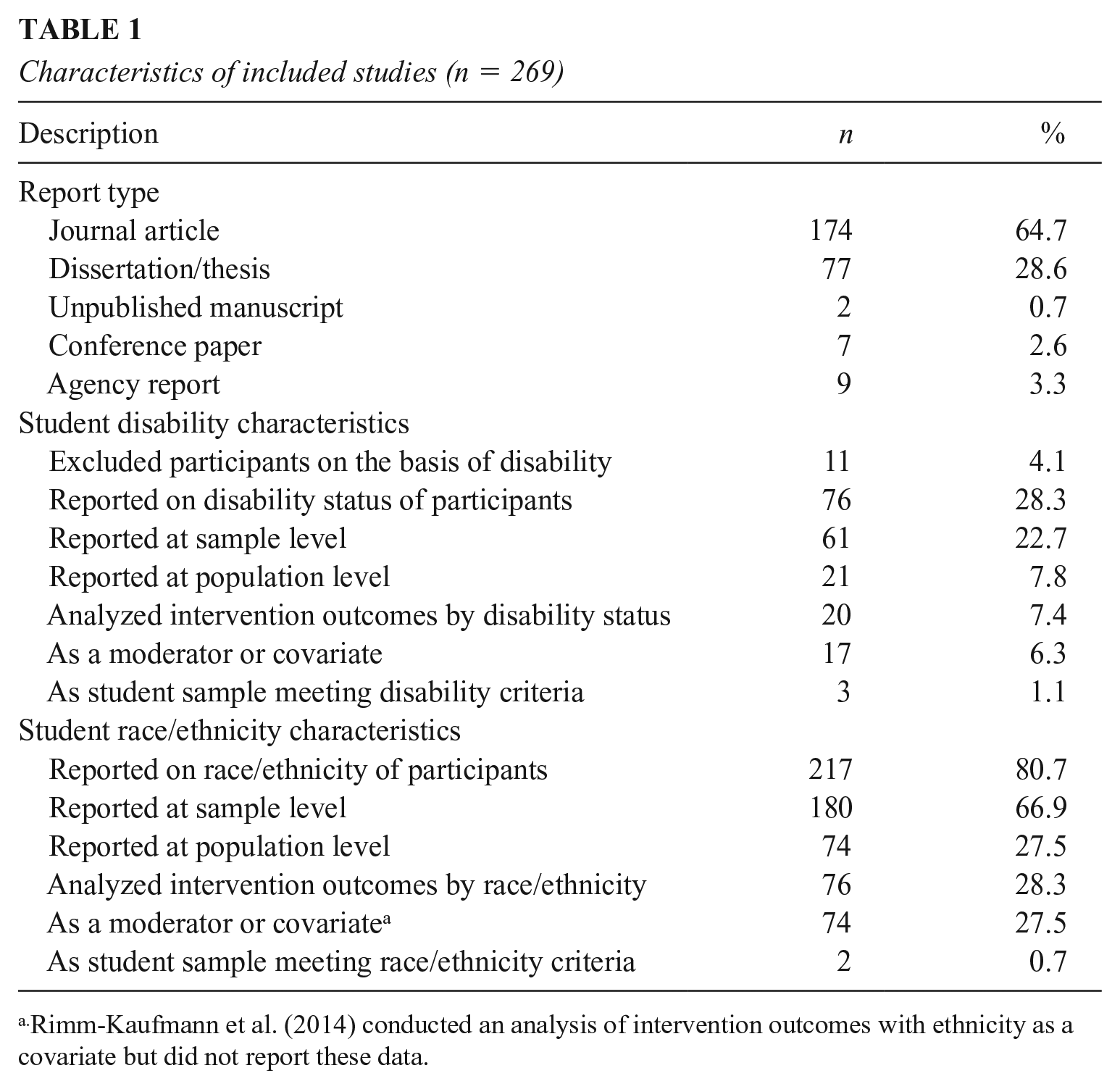
Rimm-Kaufmann et al. (2014) conducted an analysis of intervention outcomes with ethnicity as a covariate but did not report these data.
Student disability characteristics, including if study participants were excluded on the basis of disability status, if disability status of participants was reported, and if so, how (Table 2).
Descriptive details of how disability and race were reported in included studies(n = 269)
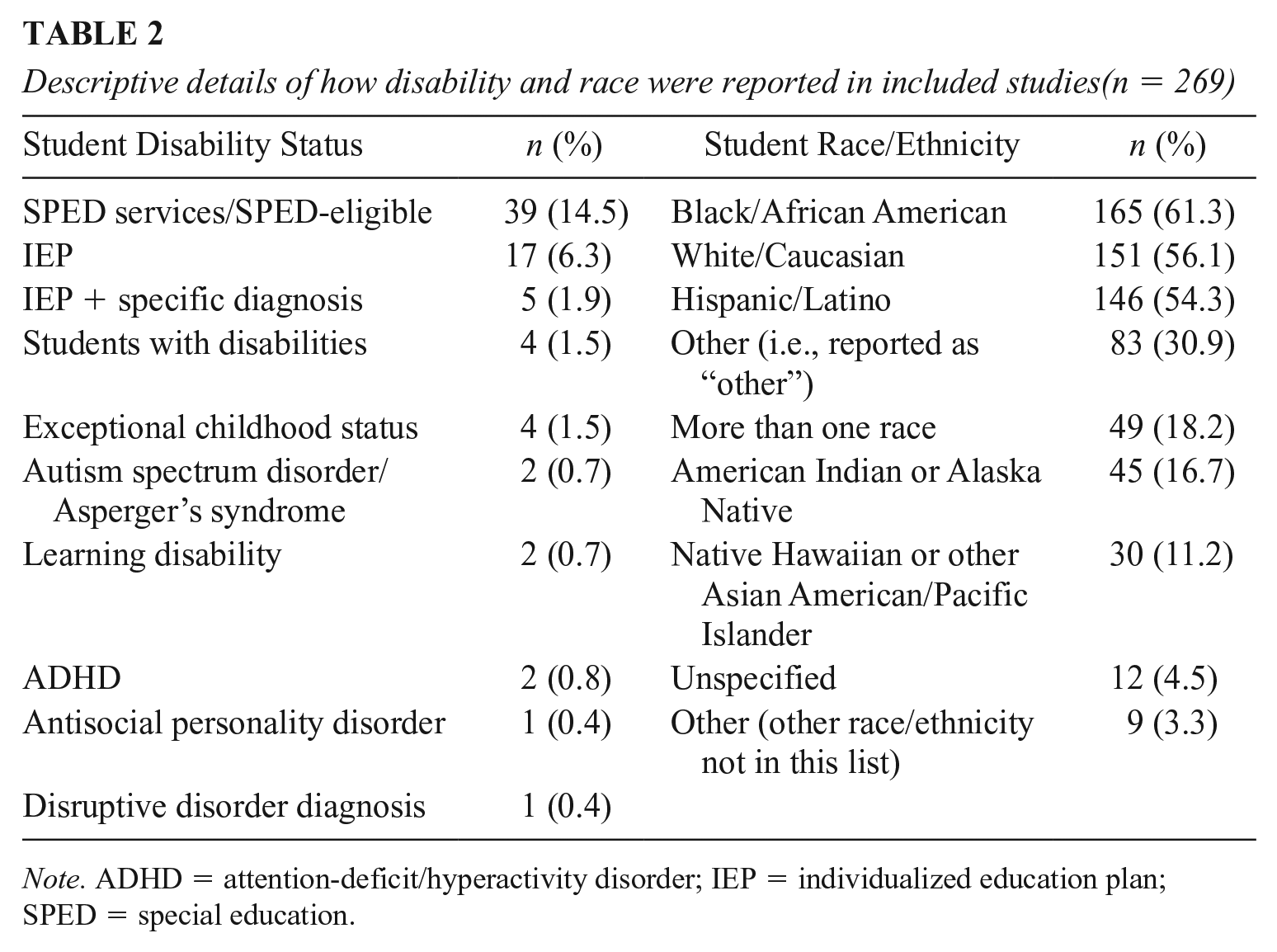
Note. ADHD = attention-deficit/hyperactivity disorder; IEP = individualized education plan; SPED = special education.
Student race/ethnicity characteristics, including if data on the race of participants were reported, and if so, how (coded as American Indian or Alaska Native, Asian American/Pacific Islander, Asian, Black or African American, Hispanic/Latino[a], Native Hawaiian, white/Caucasian or non-Hispanic, more than one race, unspecified, other [i.e., reported as other] and other [i.e., another race reported not included in this list]; Table 2).
Level of Minoritized Identity Representation
We coded student representation at two levels: population and sample. Population-level student disability and race representation includes the presentation of descriptive data at the regional, state, county, district, or school level. Examples of population level descriptive data include demographic characteristics such as disability status (e.g., students who receive special education services, those with IEPs) presented as a proportion of students within the school district. This differs from sample-level student disability and race representations, which include the presentation of descriptive data for the sample of study: those participating in the SEL intervention and/or the control group (see Supplemental File 2).
Analytic Representation of Minoritized Identities
We coded the representation of students in study results into two categories: sample (e.g., sample was homogenous, and results were presented only for students identified as a certain race/ethnicity or disability status) or variable (analyzed as a moderator or covariate on intervention outcomes). Studies reporting only results for students meeting the criteria of representing specific demographic characteristics, such as those with IEPs or who belong to a certain racial/ethnic minority group, were coded as “sample.” Moderating variables influence the level, direction, or presence of a relationship between independent and dependent variables, whereas covariates are moderating variables that are controlled for or held constant in a study so as not to influence statistical results (Baron & Kenny, 1986; Cohen et al., 2014). For example, categorical variables such as race/ethnicity and disability status are common moderators that may be included or controlled for as covariates in statistical models to inform for whom and under what circumstances a relationship will hold.
All studies were double-coded to provide an estimate of reliability. To ensure consistency across reviewers, we conducted calibration exercises before review and weekly throughout full-text coding, which lasted 6 weeks, and discrepancies were resolved through discussion.
Results
We begin with the general characteristics of studies in our sample and then address the representation of SWDs and race in the evidence for USB SEL interventions.
General Characteristics of Included Studies
Characteristics of the 269 studies included in this review are summarized in Table 1. Our search for studies focused on the period between and inclusive to 2008 and 2020. The 269 studies included in this review represent studies from each year within this 13-year range: 2008 (8.2%), 2009 (4.8%), 2010 (7.8%), 2011 (6.3%), 2012 (5.6%), 2013 (8.5%), 2014 (10.8%), 2015 (10.4%), 2016 (8.6%), 2017 (6.3%), 2018 (9.7%), 2019 (6.3%), and 2020 (6.7%). Our review yielded 174 peer-reviewed journal articles, 77 dissertations or theses, 9 agency reports, 7 conference papers, and 2 unpublished manuscripts. Of the 174 peer-reviewed journal articles, 73 different journals were represented, with Prevention Science being the most frequently appearing journal (n = 14). See Supplemental Table 3 for a full list of journals reflected in this review.
Studies reflect 107 USB SEL interventions. Seventy SEL interventions were represented only once, and 18 SEL interventions accounted for 60% of the 269 articles reviewed, including, in order of greatest frequency, the Good Behavior Game (n = 28 [10.4%]); Second Step (n = 15 [5.6%]); Positive Action (n = 14 [5.2%]); CW-FIT (n = 13 [4.8%]); Promoting Alternative Thinking Strategies (PATHS) (n = 11 [4%]); INSIGHTS (n = 9 [3.3%]); Responsive Classroom (n = 8 [3%]); Incredible Years (n = 7 [2.6%]); Mindfulness 2 (n = 7 [2.6%]); 4Rs, RULER, Steps to Respect, and Merrell’s Strong Kids (n = 6 each [2.2%]); and Tools for Getting Along, Strong Start, Playworks, Making Choices, and Leader in Me (n = 5 each [1.9%]). All of these 18 SEL interventions are recognized by CASEL and are manualized, with the exception of Mindfulness, which is a framework. See Supplemental Table 2 for full distribution of SEL interventions represented in this review.
Disability and Race Representation in USB SEL Elementary School Research
Student Disability Status
Of the 269 studies that were included in the present review, 11 studies (4.1%) explicitly mentioned excluding students on the basis of disability status. Seventy-six studies (28.3%) reported data on student disability status, with 61 (22.7%) reporting these data at the sample level and 21 studies (7.8%) reporting these data at the population level. The majority of studies reported by special education status (n = 39) or whether the student had an IEP (n = 17). Researchers reviewed the varying disability designations reported and collapsed these into 10 categories on the basis of responses that were the same or similar (e.g., “special education eligible,” “eligible for special education services,” received special education services; see Table 2). Twenty studies (7.4% of the full sample) considered disability status when reporting study results or analyzed intervention outcomes by disability status. Put another way, 7.4% of studies looked at how the SEL intervention outcomes differed for SWDs or specifically focused on intervention effects for SWDs. Of these studies reporting on SEL intervention effects and student disability status, 11 were published in peer-reviewed journals, 8 were dissertations, and 1 was a report. Furthermore, nearly half of these 20 studies represent one of three SEL programs: Social Skills Improvement System Classwide Intervention Program (SSIS-CIP) (n = 4), Incredible Years (n = 3), and Second Step (n = 2). Of these 20 studies, 17 looked at disability status as a moderator or covariate (6.3%), and 3 presented data only on students who met the criteria of having an IEP, specific diagnosis, or qualifying for services (1.1%; Fairclough, 2016; Kieta, 2011; Orton, 2011).
Student Race/Ethnicity
Two hundred seventeen studies (80.7%) reported data on student race or ethnicity, with 180 (66.9%) reporting these data at the sample level and 74 (27.5%) reporting at the population level. The majority of studies reported data for Black/African American students (165 studies), white/Caucasian students (151 studies), and Hispanic/Latino students (146 studies). Almost a third of the studies (83 studies [30.9%]) in the present review reported student race and ethnicity as “other.” From the 269 studies in the full sample, 76 studies (28.3%) reported results on a homogenous racial/ethnic group of students or analyzed intervention outcomes by race/ethnicity. Of these 76 studies, 74 analyzed race/ethnicity as a moderating variable or controlled for race/ethnicity as a covariate (27.5%), and 2 studies reported results on a homogenous racial/ethnic student sample (0.7%) (e.g., African American students [Barnes et al., 2016] and Hispanic students [Bottini, 2017]).
Evidence for USB SEL Interventions at the Intersection of Disability and Race
Our review yielded one study that analyzed the effects of a USB SEL intervention at the intersection of student disability and race (Osher et al., 2014). The 2014 study, published in the Journal of Applied Research on Children, examines the Cleveland Metropolitan School District’s 4-year implementation of the PATHS USB SEL intervention as part of a districtwide effort to promote safe conditions for learning for students at risk. In this study, the use of exclusionary disciplinary practices was an outcome, and the authors found that school-level disciplinary incidents decreased in schools that reported “medium” or “high” implementation of PATHS (35.9%), as well as among those schools that used student support teams (49.1%) and planning centers (51.4%). Furthermore, student perceptions of safety increased more in schools where these three interventions (PATHS, student support teams, and planning centers) were rated higher in their implementation quality. Alongside these main effects, the researchers reported disparities in rates of exclusionary discipline across racial and ethnic groups with disabilities, as well as differences between male and female students. As the severity of school disciplinary response increased (in this case, from in-school suspension, to only out-of-school suspension, to more than one out-of-school suspension, to expulsion), so did the representation of Black and Latino students. Findings suggest the greatest disparities for Black female SWDs, followed by Black male SWDs, Latina SWDs, and Latino SWDs. Furthermore, among Black SWDs, the risk for more extreme disciplinary practice for male students was still greater than the risk for female students, and this finding was mostly consistent for Black SWDs and all Latino students.
Discussion
USB SEL has the potential to support all students to access their education and develop the interpersonal and self-regulation skills to thrive in learning and life (Cipriano et al., 2021b; Durlak et al., 2011; Jagers et al., 2019). To dismantle structural inequities and better understand the relationship between educational intervention effects and outcomes for specific groups of students with differing backgrounds, identities, and needs, we must unpack if all students are being inclusively and equitably served by USB SEL.
Within U.S. public schools, the Individuals With Disabilities Education Act (U.S. Department of Education, 2018) protects the rights of youth with disabilities ages 3 to 21 years to a free and appropriate public education in the least restrictive environment possible. The intent of the law is to ensure that youth with disabilities are not only identified and evaluated, but can also access the curriculum and make progress, while providing safeguards that involve parents in decision making and consent to provide services. Similarly, Title IV of the Civil Rights Act of 1964 prevents discrimination in public education on the basis of race, color, religion, sex, or national origin. Additionally, the Equal Educational Opportunities Act of 1974 was an extension of the Civil Rights Act that further prohibits discrimination against faculty members, staff members, and students and further requires school districts to actively overcome these barriers to students’ equal participation.
Despite such protections, inequities persist. The research literature describes significant disparities for ability minoritized and racially minoritized students in academic, social, and emotional outcomes with negative implications for their well-being as students move through life. For example, students who are racially and/or ability minoritized report higher rates of anxiety, feelings of stigmatization, social isolation, depression, low self-esteem, and evidence academic disengagement, including low motivation for in-school learning, as well as higher rates of skipping school and dropping out (Daley & Rappolt-Schlichtmann, 2018; Harper, 2017)
Research demonstrates that SWDs experience significantly more negative affect, depressed mood, somatic complaints, anxiety, and stress in school than their nondisabled peers (Feurer, 2004; Lackaye & Margalit, 2006; Wiener & Tardif, 2004), and in addition, many SWDs experience peer rejection and difficulty with intra- and interpersonal skills, including emotion regulation and social relationships (Al-Yagon, 2013; Rivara & Menestrel, 2016; Rose et al., 2016). Although there are many complex layers of uncertainty and bias embedded in how and why we see differences in social and emotional skills and outcomes for ability and racially minoritized students across the research literature (from how students are represented or not, the assessments being used and the biases they perpetuate, the conditions surrounding implementation and the context for the intervention, and more), what is clear is that the school environment can be stress inducing and exacerbate unhelpful social and emotional conditions for students (Daley & Rappolt-Schlichtmann, 2018; Petrone & Stanton, 2021). Given the significant overlap between ability and racially minoritized students’ emotional needs and the goals of SEL programs and approaches (Cipriano et al., 2021b; Collaborative for Academic, Social, and Emotional Learning, 2020), and toward the end of supporting trauma-reducing educational experiences for minoritized students (Petrone & Stanton, 2021), there is potential for outsized benefits that can only be realized when supportive emotional conditions are created for all students.
Yet our review found that we know little about the experiences or outcomes of minoritized youth in USB SEL interventions. Since 2008, just over one quarter (28.3%) of USB SEL studies reflect racially minoritized youth in analyses, and only 7.4% (n = 20) reflect SWDs. Drawing conclusions from these studies is difficult in part because the SEL programs and interventions vary. The 20 studies that represented SEL outcomes for SWDs reflected 14 USB SEL interventions, while the 76 studies that represented SEL outcomes for students by racial group reflected 36 USB SEL interventions. Looking at each resulting body of evidence, since 2008, only 9 USB SEL interventions (across 30 studies) have been studied to understand and provide outcome data for SWDs and among diverse racial/ethnic groups across their respective evidence base (City Connects, Good Behavior Game, Incredible Years, Inner Explorer, PATHS, Playworks, Second Step, Student Success Skills, and SSIS-CIP; Supplemental Table 2), with the outcomes they provide data for varying widely across academic, social, and emotional indicators (see Supplemental Table 5), and with only one study looking at the effects of a USB SEL intervention for students at the intersection of disability and race (PATHS; Osher et al., 2014). Importantly, Osher et al.’s (2014) findings speak directly to the need for meaningful subgroup analyses and comparison within studies of USB SEL intervention effectiveness; alongside finding an inverse relationship between school-level disciplinary incidents and quality implementation, the authors also reported the disproportionate representation of Black SWDs across both genders receiving exclusionary disciplinary placements where SEL implementation was reported to be lower quality.
Notably absent from this literature is the lack of meaningful subgroup analysis among disability status and race and ethnicity, as well as consistency in how students are grouped with respect to disability or race. Studies overwhelmingly (n = 14) categorize SWDs under generic umbrella terms, including IEP status (DiPerna et al., 2018; Gomez Varon, 2020), special education (Bakosh, 2013; Bradshaw et al., 2009; DiPerna et al., 2015, 2016, 2018; Fairclough, 2016; Gandhi et al., 2018; Hetrick, 2018; Leos-Urbel & Sanchez, 2015; Malatino, 2011; Reinke et al., 2018; Wiedermann et al., 2020) or having disabilities in general (Osher et al., 2014; see Table 2). Three studies examined disabilities more narrowly by breaking down disability status: by severity (mild, moderate, severe; Meyer & Ostrosky, 2016); emotional, behavioral, and learning disorder (Murray et al., 2018); and having a “mental/physical disability” and “emotional behavioral disability” (Neace & Muñoz, 2012). Furthermore, only three studies specifically referenced students by their disability type or diagnosis, which included having attention-deficit/hyperactivity disorder, specific learning disabilities, physical disabilities, or autism (Jack, 2009; Orton, 2011). The current literature predominantly groups students of all disability types under overarching categories, ultimately undermining the contextualized nature and experience of having a specific disability within USB SEL.
By largely focusing on disability status as a general variable, the field overlooks the variability of potential SEL outcomes among students of differing disability types as well as students of different diagnoses within a single disability category (e.g., learning disabilities). This methodological approach undermines the fact that students with different disability types and different diagnoses within a single disability group may have varying inherent characteristics (internalizing and externalizing behaviors, social skills, cognitive functioning, reading skills, etc.) that affect how students participate in, interact with, and benefit from a range of USB SEL programming (Cipriano et al., 2021a; Cipriano & Rappolt-Schlichtmann, 2021)). For example, Hetrick (2018) noted that when implementing the Strong Kids program, teachers reported students with developmental disabilities experienced challenges using the program’s associated electronic testing instrument but were able to successfully overcome this barrier to access by using a paper version that the SEL curricula offered in the program manual. Thus, the impact of a specific USB SEL intervention, for example, for students with developmental disabilities may be different than for students with dyslexia for varying reasons which may include, but are not limited to, individual characteristics, accommodations and resources provided during the program, and who is facilitating the intervention (Cipriano et al., 2021b). Given the wide range of disability types and diagnoses present within classrooms, there is little understanding of how students of varying disability types are represented within USB SEL programs, how they are affected by USB SEL programs, and whether these interventions are programmatically capable of being implemented to a diverse student body with varying intellectual, physical, emotional, learning, and developmental needs across numerous disability types and diagnoses of learners expected to benefit from universal educational interventions.
Although our review identified a small subset of studies that reflect racially or ability minoritized youth in their analyses, it remains impossible to tease apart what is working or not for whom and under what conditions within USB SEL interventions without full and equitable representation. In the absence of meaningful subgroup analyses as the norm, rather than the exception, our field cannot know with confidence what works (or what does not work) for students and can result in the implementation of ineffective, inflexible SEL interventions that perpetuate inequities for students who are multiply marginalized.
Not Best Practice: We Must Do Better
An unintended result of our review is the compilation of examples of how not to represent minoritized youth in USB SEL research. Although our findings are of a very specific set of interventions (USB SEL) for a targeted age group (elementary school aged) that is geographically bound (United States only), we share these practices in summary form here with the hope that if they are observed in other aspects of the research literature they can be mitigated. Regarding inclusion, our review found that SWDs were explicitly excluded from 11 studies, or 4% of the interventions in our sample. This finding indicates a decrease in the volume of intervention studies that fully excluded SWDs (Rowe & Trickett, 2018), a positive shift in research practice. However, only a limited number of studies (n = 20 [7.4%]) examined how SEL intervention outcomes benefited SWDs. Thus, although fewer studies intentionally excluded SWDs, results still do not include all students in the analysis of results by subgroup, masking the diversity of the sample and potentially meaningful variation in outcomes.
Researchers may be unaware that SWDs are present in the classrooms in which they are working (Cipriano et al., 2015; Horowitz et al., 2017). Some disabilities, including the one in five students in the United States with learning disabilities, are often invisible to outside observers (Horowitz et al., 2017), as well as students who have visual or hearing impairments but who are not fully blind or deaf. In addition, administrative data at the school level is challenging to obtain, an arduous task around which it is difficult to secure researcher-administrator partnership. Challenges and barriers to such data collection are exacerbated by institutional review board policies and requirements for anonymized human participants (Domenech Rodríguez et al., 2017), including student records of disability diagnosis or IEP status, which are protected through privacies granted under the Health Insurance Portability and Accountability Act of 1996 and the Family Educational Rights and Privacy Act of 1974.
This information is often inaccessible without documented permission granted by parents or guardians waiving privacies to obtain this information on individual student participants (Domenech Rodríguez et al., 2017). SWDs may be less likely to have caregivers who comply with signing parental consent forms (Harrell et al., 2000; Horowitz et al., 2002), and/or be less likely to have students provide assent for fear that identifiable data may be exposed or mishandled (Horowitz et al., 2002). Furthermore, once access to school records is obtained, the data can be difficult to code. Student designations in administrative records for IEP or 504 purposes focus on areas of need, struggle, and challenge, often without reference to specific diagnoses, and SWDs who are not struggling in school will not have IEPs, so these records will be incomplete descriptors of classroom composition. For these reasons researchers sometimes do independent identification and testing as a part of their research plan, but this approach is costly and time consuming. Finally, researchers may be underprepared to do analyses that include student subgroups of small numbers, such as those of students with low-incidence disabilities (e.g., visual or hearing impairment, significant cognitive impairment), or to design research (assessments, procedures, etc.) that is inclusive to SWDs.
Regarding the assignment of race, we found inconsistent and concerning labeling practices for student race and ethnicity, practices that education research as a field is grappling with and working to reform so as to define a new, more equitable and inclusive best practice (Freire, 2018; Ladson-Billings, 2021; Shores et al., 2020). For example, some of the studies in this review reported on subgroup analyses in which teachers assigned students to racial categories. Categories included white or non-white; percentage minority (with no indication of what race or ethnicity comprised the proportion of students); and Black, white, or other. It is possible that such practices would ensue as a result of data privacy limitations such as students’ not reporting in studies as part of human participant protections (Horowitz et al., 2002; White, 2020). These practices are problematic: Observer-reported race accuracy is poor compared with self-report as observation reports of race lead to biased estimates (Sohn et al., 2006).
With narrow racial and ethnic labels, limited involvement of youth in self-description and identification, and the regular use of “other” as an acceptable category, the presentation of diverse cultural backgrounds and identities that learners contribute to their environment are substantially silenced. “Othering” is an especially egregious practice whereby all who fall outside of stated identifiers are aggregated into a constructed category large enough for quantitative analysis. This review revealed that more than one third of studies used “other” as an indicator of student racial identity in their analyses. “Othering” in education research promotes generalization that results in diminishing, and essentially erasing, learner identities from classrooms, schools, and studies.
Our review indicates some improvement around these practices. For example, whereas more than half of studies prior to 2008 used “other” as a category for student race (Rowe & Trickett, 2018), only about a third since 2008 do so. However, this positive trend is fighting entrenched precedence supporting the use of preexisting, researcher- and educator-defined categories for student racial identities in education research (Bal & Trainor, 2016; Flay et al., 2005; Hoffmann, 2009; Ladson-Billings, 2021). What makes this even more problematic is that knowing someone’s race is just a starting point or a proxy for understanding deeper experiences such as cultural beliefs, marginalization, privilege, and opportunity. We should be studying race and ethnicity at these deeper levels, but we have yet to even scratch the surface in the current research. Without careful attention and intention to grow in self- and social awareness as researchers, we will not meet the needs of our nation’s increasingly diverse schools and classrooms, leaving student identities silenced, masked, and nonexistent in the research literature. Furthermore, with limited to no knowledge of who constitutes “other” in any given study, there is no clarity for whom or under what conditions the results apply.
Is Something Better Than Nothing?
Effective January 2020, the Society for Research in Child Development (2020) enacted a new sociocultural policy calling for the explicit consideration of the generalizability of findings and the need to represent in the abstract, and methods or discussion section, “the theoretically relevant characteristics of the particular sample studied, for example, but not limited to: race/ethnicity . . . and all other context variables that are relevant.” We are cautiously optimistic that this new policy will promote positive change. However, we are left wondering what constitutes theoretically relevant characteristics for research on USB SEL interventions? Is any school or classroom so homogeneous that disability, race, and ethnicity would ever be irrelevant to the successful implementation and study of USB SEL interventions? Human beings vary, and as such, researchers must intentionally, systematically, and consistently attend to student variability in research design and analysis if we ever hope to equitably and inclusively reflect the experiences and outcomes of marginalized youth in the knowledge base.
In the absence of evidence, we may, however unintentionally, perpetuate racism and ableism 3 within USB SEL. Educational researchers are, in part, products of their training and experiences. We are situated within universities and not-for-profit organizations with long-standing precedents for methodology that reflect the policies of our employers, publishers, funders, and fieldwide accepted best practices. Although racism and ableism are most often defined within school communities as social prejudice or discrimination directed against a person or people on the basis of membership to a particular group, it is important to recognize that racism and ableism also involve one group having the power to systematically discriminate through the institutional policies and practices of the society. We come to this work as researchers and educational practitioners, with identities that are minoritized and marginalized within academia, and we recognize that we sit in a position of power as those who define the parameters within which youth are seen within the evidence base and, thus, reflected within what is defined as “best practice” from the literature.
Limitations
The exclusive focus on USB SEL interventions serving elementary school students in the United States since 2008 is a limitation of this review. Although the parameters we set around the search scope are helpful at elucidating targeted findings, these parameters limit the generalizability of findings to USB SEL interventions conducted with elementary or other school-aged children outside of the United States (Organisation for Economic Co-operation and Development, 2017). Second, although we adopted a comprehensive definition of what constitutes a USB SEL intervention to structure our inclusion criteria, the field is not without disagreement as to what constitutes SEL (Aspen Institute, 2019; Berg et al., 2017; Elias & Yuan, 2020), and for this reason it is possible that our review is not exhaustive. Furthermore, important data regarding the varied types of SEL interventions, how they are delivered, the outcomes they support for youth, and which youth benefit and how, would be enriched by qualitative review (see Cipriano et al., 2021b; Elias & Yuan, 2020; McKown, 2019; Osher et al., 2016; Rivas-Drake et al., 2020; Rivas-Drake & Umaña-Taylor, 2019; Rosario-Ramos et al., 2021). We direct the field to Wilson and Anagnostopoulos’s (2021) methodological guidance article on conducting a qualitative review to elevate the importance of rigorous review of qualitative USB SEL studies to support the most complete representation in the evidence available for USB SEL. Given the rich data emerging over the past 5 years in particular when attending to critical areas of growth in programming to support ethnic and racial identity development among diverse youth through USB SEL and the transformative SEL framing (Jagers et al., 2019; Rivas-Drake et al., 2020; Rivas-Drake & Umaña-Taylor, 2019; Rosario-Ramos et al., 2021), qualitative research should be examined to enhance future work in the field. Last, a fundamental limitation of this review is that we only analyzed ability minoritized and racially minoritized representation within USB SEL in our sample. To fully attend to the breadth of intersectional student identity representation in USB SEL interventions, and in educational research, follow-up analyses should extract and examine how students who are gender, linguistically, economically, and sexuality minoritized are represented in the evidence base and effects should be meta-analyzed at these intersections (Codiroli McMaster et al., 2018; King et al., 2018).
Conclusion and a Call to Action
Seventeen years ago, Flay et al. (2005) released a call to action in Prevention Science on behalf of the Society for Prevention Science Standards Committee. The call sought to establish standards for identifying effective prevention programs and policies including guidance around the definition of sample and population characteristics: Researchers should describe their sample in terms of the age distribution, developmental stage, sex, race/ethnicity, socioeconomic characteristics (which may include social class, educational attainment or a proxy, and/or income or poverty status), marital status, and any other known risk characteristics relevant to the program or policy being tested. (pp. 159)
Further noted was a desirable standard that researchers provide a subgroup analysis that demonstrates efficacy for a subgroup within the sample on the basis of indicators such as gender, ethnicity/race, and risk level.
Prior to 2008, 70% of the studies of USB SEL interventions did not meet this minimum reporting standard for gender, race/ethnicity, or socioeconomic status, and 15% of studies did not report sample demographics at all (see Rowe & Trickett, 2018, for a discussion). As of 2020, more than a third of the studies in our sample of USB SEL in elementary school failed to meet the minimum reporting standard for race and ethnicity and there is still no minimum reporting standard for disability, and Prevention Science, the same journal in which the minimum reporting standard was called for in 2005, emerged as the most frequently represented journal in our review (see Supplemental Table 3). Limitations in the data available and difficulties in collecting the necessary data to support drawing meaningful conclusions for subgroups of students does not mean that because we did not, we should not, or we cannot.
We conclude by offering SEL-informed recommendations for improving best practices in reporting on the effects of USB SEL interventions. We suggest that researchers begin with a radical recognition of who is reflected in their studies and why that may be the case. We implore educational researchers to examine their scholarship closely and consider the following: Did I collect the data I needed in a way that reflects the population of youth affected by the intervention under study? Did I report on results related to all of the data I collected and if not, why not? Can I conduct additional analyses that illuminate the experiences and outcomes of racially and ability minoritized youth (albeit underpowered)? Do my results support the conclusions of my published research, or have I in some way misrepresented what conclusions can be made about subgroups of students who participated in the intervention? Can I submit an update to my work that more equitably and inclusively reflects the experiences and outcomes of minoritized youth?
Next, engage in a process of building critical self- and social awareness. Embrace a growth mind-set and engage in effortful perspective taking with colleagues and research partners to better understand how you might actively grow your capacity to do research that is more inclusive and equitable. Consider the following: Have I explicitly acknowledged that minoritized youth often embody multiply marginalized identities? Do I have the training to know what data I should be collecting and how to represent students fully in my work? Do I have knowledge of the categories of disabilities which qualify students for special education supports and the full range of racial and ethnic identities represented in my research sites? Do I know how to conduct single-case, person-centered designs, qualitative or meaningful small-sample quantitative analyses, or could I seek new partners who can bring complementary methodological competencies? Did I choose to exclude or omit marginalized students from my studies in how I collected, aggregated, or analyzed intervention effects? Why did I make these decisions and what decisions can I make differently next time? What have I learned from my self-reflection?
Last, educational researchers can promote data-driven decision making that is rooted in empathy and fueled by a desire to increase representation and evolve best practice in education research. Consider how sociocultural guidelines such as those offered by Child Development and Prevention Science can support field transformation. Question whether measurement decisions and demographic representations are thoroughly and appropriately instructed in education research training programs. Consider whether institutions can support the next generation of education researchers in evolving to meet the changing demographics of our nation’s school communities. Similar to the evolution of the Diagnostic and Statistical Manual of Mental Disorders with respect to classifications for persons with disabilities (American Psychiatric Association, 2013) and the shift in education research toward the use of Latinx (Romero & Umaña-Taylor, 2018) and BIPOC (Black, indigenous, and people of color; Senteio et al., 2021), leaving space for growth and evolution is critical in supporting complete contemporary representation.
In sum, the research literature for USB SEL is limited in its representation of ability minoritized and racially minoritized students, documenting the overgeneralizations and categorizations common to current USB SEL research practice. In the words of Geneva Gay (2020), “You can’t teach what and who you don’t know” (p. 1). Our current research literature leaves the field in an ongoing state of unknowing about the experiences and outcomes of racially and ability minoritized youth in USB SEL. We encourage intervention scientists to meet the needs of an evolution of education research to require educational interventions to acknowledge, represent, and reflect the rich heterogeneity of learners in classrooms and schools nationwide to support truly representative and generalizable recommendations hereafter.
Supplemental Material
sj-pdf-1-rer-10.3102_00346543221094079 – Supplemental material for A Systematic Review of Student Disability and Race Representation in Universal School-Based Social and Emotional Learning Interventions for Elementary School Students
Supplemental material, sj-pdf-1-rer-10.3102_00346543221094079 for A Systematic Review of Student Disability and Race Representation in Universal School-Based Social and Emotional Learning Interventions for Elementary School Students by Christina Cipriano, Lauren H. Naples, Abigail Eveleigh, Amanda Cook, Melissa Funaro, Colleen Cassidy, Michael F. McCarthy and Gabrielle Rappolt-Schlichtmann in Review of Educational Research
Footnotes
Acknowledgements
We wish to thank Dr. Joseph Durlak for his mentorship; Dr. Tia N. Barnes; the National Center for Learning Disabilities community, especially Dr. Sheldon Horowitz, Meghan Whittaker, and Lindsay Kubatsky; the Collaborative for Academic, Social, and Emotional Learning community, especially Dr. Alaina Boyle, and the Yale Center for Emotional Intelligence Community, especially Elizabeth Kilgallon, Kaveri Sehgal, and Miranda Wood for their support and feedback throughout this study. This research was funded by the OAK Foundation (OCAY-19-407 & OFIL-22-040).

Notes
Authors
CHRISTINA CIPRIANO (she/her) is an assistant professor at the Yale Child Study Center and Director of Research at the Yale Center for Emotional Intelligence, Yale University School of Medicine, 350 George Street New Haven, CT 06511; e-mail
LAUREN H. NAPLES is a postdoctoral associate at the Yale Child Study Center in the Yale Center for Emotional Intelligence, Yale University School of Medicine, 350 George Street New Haven, CT 06511; e-mail
ABIGAIL EVELEIGH is a former post graduate associate at the Yale Center for Emotional Intelligence, and currently is an assistant research scientist and lab manager at the LEARN Lab at New York University, 726 Broadway, New York, NY 10003; e-mail
AMANDA COOK is a research assistant at EdTogether, 65 Commonwealth Avenue, Boston, MA 02116; e-mail
MELISSA FUNARO is a clinical research and education librarian at the Harvey Cushing/John Hay Whitney Medical Library, Yale University, 333 Cedar Street, New Haven, CT 06520-8014; e-mail:
COLLEEN CASSIDY is a former post graduate associate at the Yale Center for Emotional Intelligence, and currently is a qualitative research associate in the Education Policy Initiative at Carolina at the University of North Carolina at Chapel Hill, 308 West Rosemary Street, Chapel Hill, NC, 27516; e-mail:
MICHAEL F. M
GABRIELLE RAPPOLT-SCHLICHTMANN is executive director and chief scientist at EdTogether, Inc., and an adjunct lecturer at the Harvard Graduate School of Education, 65 Commonwealth Avenue, Boston, MA 02116; e-mail:
References
Supplementary Material
Please find the following supplemental material available below.
For Open Access articles published under a Creative Commons License, all supplemental material carries the same license as the article it is associated with.
For non-Open Access articles published, all supplemental material carries a non-exclusive license, and permission requests for re-use of supplemental material or any part of supplemental material shall be sent directly to the copyright owner as specified in the copyright notice associated with the article.
