



Abstract
This study used a meta-analytic structural equation modeling approach to build extended versions of the simple view of reading (SVR) model in second and foreign language (SFL) learning contexts (i.e., SVR-SFL). Based on the correlation coefficients derived from primary studies, we replicated and integrated two previous extended meta-analytic SVR models, that is, Quinn and Wagner’s (2018) model with an English-speaking population with a cognitive factor and Peng et al.’s (2021) model with Chinese-speaking readers with metalinguistic skills. A total of 180 independent samples (N = 36,235) obtained from 152 empirical studies in SFL contexts were included in our meta-analytic structural equation model. The results revealed that the collected data successfully replicated H. Lee et al.’s (2022) SVR model in SL contexts (SV2R) in terms of overall model fit and moderation effects; in addition, the results confirmed that the data fit well with the extended SVR-SFL models.
Keywords
The simple view of reading (SVR; Gough & Tunmer, 1986; Hoover & Gough, 1990) has stood the test of time as a theoretical model of reading. As its name indicates, its strength lies in its simplistic nature, with its major tenet being that two components—(word) decoding skills and language comprehension abilities—can effectively account for one’s reading comprehension level (e.g., Hjetland et al., 2018; Kershaw & Schatschneider, 2012; Lonigan et al., 2018). These two components have generally been operationalized as skills related to the identification of words in texts and ability to understand spoken language and have been proposed as useful indicators for the diagnosis of students with reading difficulties. This framework has generated a large number of primary studies, not only in the first language (L1) (e.g., Aouad & Savage, 2009; Catts et al., 2006; see also Florit & Cain, 2011, for a meta-analysis of SVR in L1 readers of different alphabetic orthographies), but also in the second language (SL; the target language is the primary language of communication in the current context or country) (e.g., Beattie, 2018; Hoover & Gough, 1990) as well as in foreign language contexts (FL; the target language is not the primary language of communication in the current context or country) (e.g., Sparks, 2015; Sparks & Patton, 2016).
Subsequent reading research, while acknowledging its appeal, has criticized SVR on several theoretical and empirical grounds. For example, the SVR framework does not consider the role of text features (Francis et al., 2018) and the nature of reading comprehension assessments (Cutting & Scarborough, 2006). It has also been suggested that SVR focuses predominantly on a superficial level of text comprehension, rather than on the types of comprehension that readers would actually encounter in classrooms (Snow, 2018). In view of such criticisms, there is growing awareness that SVR may be limited in accounting for the complex nature of reading (e.g., Apel, 2022; Nation, 2019; Snow, 2018).
Some of the previous research on SVR has further highlighted a need to extend and expand the framework by suggesting additional components for inclusion in the model (Catts, 2018). Two suggested components are cognitive factors and metalinguistic skills, which have been considered to have some impact on reading comprehension in the previous literature (e.g., Apel, 2022; Cain, Oakhill, & Bryant, 2004; Cain, Oakhill, & Lemmon, 2004; Oakhill et al., 2005; Oakhill & Cain, 2012). Some recent meta-analytic research (Peng et al., 2021; Quinn & Wagner, 2018) has examined whether these components could add to the prediction of the original SVR framework, using a statistical approach known as meta-analytic structural equation modeling (MASEM; Jak & Cheung, 2020). Specifically, Quinn and Wagner’s (2018) MASEM research included studies on English L1 readers (N = 1,205,581) and cognitive factors as an additional component, as cognition-related variables, such as working memory and inference making, have been found to influence reading comprehension in the previous literature. Peng et al. (2021) included studies on Chinese L1 readers (N = 35,261), adding metalinguistic skills as the third major component in view of the accumulated evidence that metalinguistic skills significantly predict Chinese decoding performance. It should be noted that, Quinn and Wagner’s (2018) and Peng et al.’s (2021) models were an expanded operationalization of the SVR model proposed by Gough and Tunmer (1986) and, hence, provide more complex views of reading.
Given the SVR’s appeal yet acknowledging its limitations, the present study aimed to extend the meta-analytic efforts of previous MASEM studies (Peng et al., 2021; Quinn & Wagner, 2018) by considering studies conducted in SL and FL contexts. Specifically, the purpose of the present study was threefold. First, we aimed to extend H. Lee et al.’s (2022) MASEM study, which was the first attempt to validate an SVR model exclusively on SL reading (N = 10,526). Although H. Lee et al.’s (2022) contribution to SL reading as the first MASEM study of reading comprehension in a second language should be acknowledged, it should also be pointed out that the study was limited in that it did not include FL studies in its dataset. We aimed to overcome such a limitation by considering both SL and FL (henceforth referred to as SFL) studies, which would constitute a more comprehensive approach to examining whether the basic proposition of the SVR holds true in the context of reading comprehension in a second language. Second, consistent with the abovementioned studies, we aimed to examine the extent to which a number of identified moderators, such as age, SFL proficiency, and the L1–SFL relationship, would affect the relationships between SFL reading comprehension and its two key components. In addition to these previously identified moderators, we included the learning context in order to examine whether there is any difference between SL and FL contexts in SFL reading comprehension by virtue of having an array of studies conducted in these two contexts. We predicted that the findings related to these moderators would provide evidence-based pedagogical implications for SFL reading instruction. Finally, we aimed to investigate three expanded models inspired by the SVR: (a) Quinn and Wagner’s (2018) model with a cognitive factor, (b) Peng et al.’s (2021) model with metalinguistic components (as the antecedents of decoding skills), and (c) a model combining (a) and (b). A more comprehensive model would contribute to better understanding of SFL reading against the theoretical foundations laid in the SVR and relevant literature. These three models were built to test expanded and more complex views of SFL reading than what the original SVR model purports to explain.
Previous MASEM Models Inspired by SVR
In this section, we review previous MASEM models of SVR (H. Lee et al., 2022; Peng et al., 2021; Quinn & Wagner, 2018), against which our dataset based on the results of SFL reading studies is fitted.
Quinn and Wagner’s (2018) model including cognitive factor
Based on 155 reading studies with English-language readers, Quinn and Wagner (2018) examined whether their data could be fitted to the expanded version of the SVR model. They revised the original SVR model and added the cognitive factor, pointing out that the original model did not include cognition-related variables such as background knowledge, working memory, and reasoning and inference skills, all of which can support monitoring comprehension (Oakhill et al., 2005; Oakhill & Cain, 2012), drawing/generating inferences (Tompkins et al., 2013), and interpolating missing information (Cain, Oakhill, & Bryant, 2004; Cain, Oakhill, & Lemmon, 2004) in the process of reading comprehension. Their model explained about 57% of the variation in reading comprehension. Nevertheless, the cognitive factor did not contribute significantly to the variance beyond the two key components (see Figure 1).
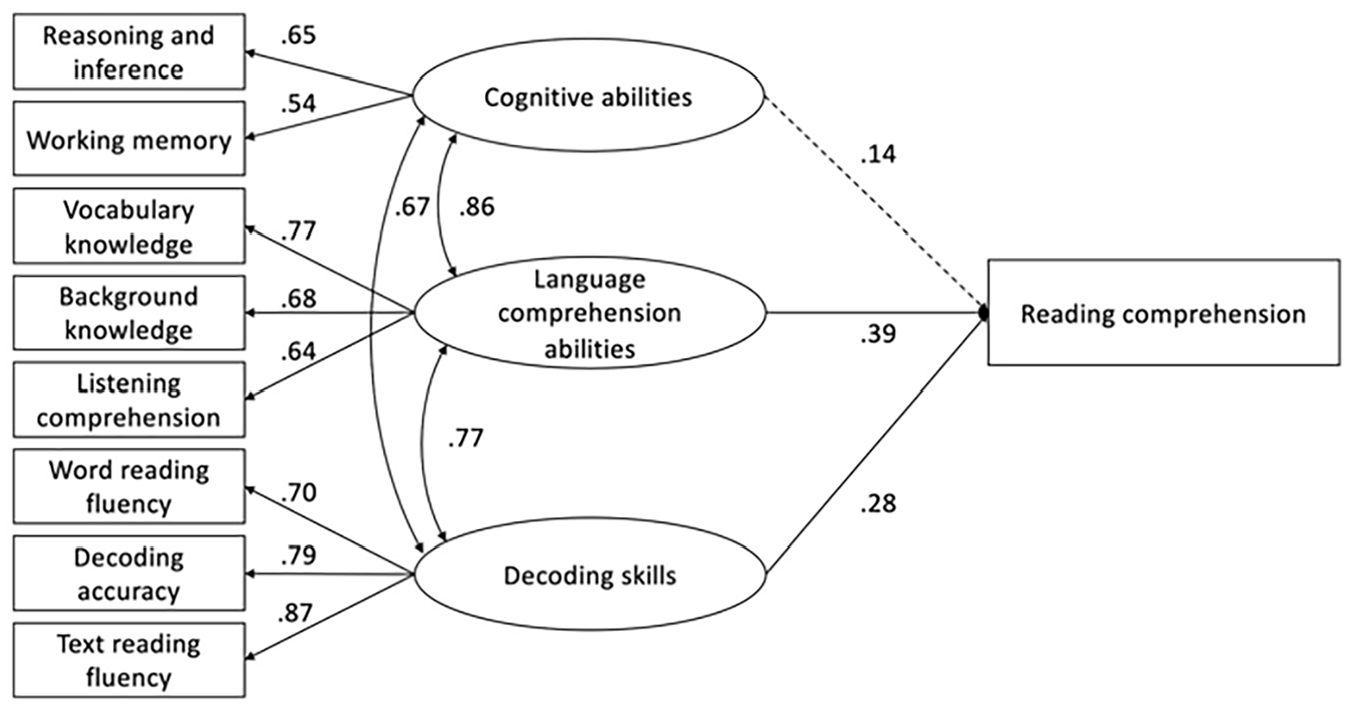
Quinn and Wagner’s (2018) simple view of reading with cognitive factor.
The role of the components of the cognitive factor in reading has also been examined in the SFL reading literature. For example, working memory has been found to be a correlate of SFL reading, as noted in previous studies (e.g., Alptekin & Erçetin, 2009, 2010; Walter, 2004; see Shin, 2020, for meta-analytic results of the relationship between SFL reading and working memory), although readers’ performance levels or different types of working memory tasks may influence such a relationship (e.g., Shahnazari-Dorcheh & Adams, 2014), or working memory may interact with background knowledge in influencing SFL reading (Shin et al., 2019). Another component, reasoning and inference, has also been linked to SFL reading comprehension (e.g., Nikolov & Csapó, 2018; Tabatabaee-Yazdi & Baghaei, 2018). However, the original SVR assumes that the effects of these variables can be subsumed in the language comprehension component.
Although the components of the cognitive factor are correlates of SFL reading comprehension, the question of whether the cognitive factor could make an independent contribution to SFL reading beyond the two key components has remained unanswered. We aim to answer this question with our Model 2 (i.e., Model 2: SVR-SFL Model Variant 1).
Peng et al.’s (2021) model including metalinguistic skills
Continuing the MASEM efforts of Quinn and Wagner (2018), Peng et al. (2021) highlighted the need to validate SVR in nonalphabetic languages and to extend the original model by examining the role of components other than decoding skills and language comprehension abilities. To this end, they collected and analyzed reading studies with Chinese-speaking populations and added metalinguistic skills as a third component in their model. Peng et al. suggested that since metalinguistic skills refer to learners’ awareness of the linguistic components of language (Welling, 2010), such as phonological awareness, morphological awareness, and orthographic awareness (Coltheart et al., 2001), these components may contribute to the development of learners’ “mental framework for analyzing language structure separately from language meaning” (Chaney, 1992, p. 485). Overall, the results are consistent with those of Quinn and Wagner that both decoding skills and language comprehension abilities were significant predictors that together accounted for over 50% of the variance in reading comprehension (see Figure 2). In addition, the metalinguistic skills component was found to be a significant predictor of decoding skills, but had no direct effect on reading comprehension.
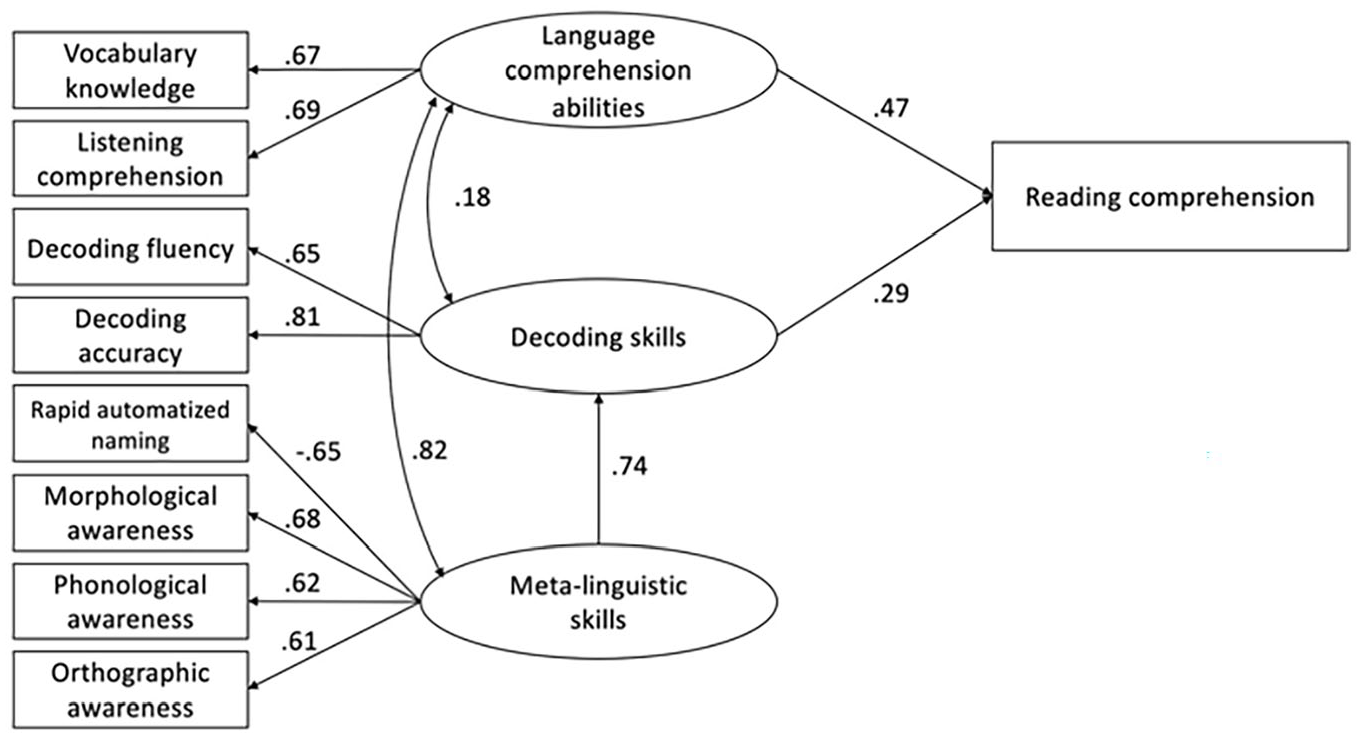
Peng et al.’s (2021) simple view of reading with metalinguistic skills.
However, it remains unexplored whether a component consisting of metalinguistic skills could contribute significantly to SFL reading beyond the components originally proposed in the SVR—we address this inquiry with Model 3 (i.e., SVR-SFL Model Variant 2). For example, Jeon and Yamashita’s (2014, 2022) meta-analysis of the relationships between SFL reading comprehension and a number of metalinguistic skills found a medium and positive correlation between reading comprehension and these variables. However, it should also be noted that such relationships may be better explained by other correlates of reading, such as morphological awareness mediated by the development of SFL vocabulary knowledge (Goodwin et al., 2013), readers’ proficiency levels (e.g., orthographic knowledge in Kato, 2009), or orthographic transparency of language (e.g., Grabe, 2009). It is noteworthy that Jeon and Yamashita’s (2014, 2022) results are based on a univariate meta-analysis approach (e.g., focused on calculating effect sizes, as the only one dependent variable [i.e., univariate analysis], based on reciprocal correlations between each pair of variables of interest) that did not account for complex relationships between the components identified (e.g., focused on structural relationships among multiple variables [i.e., multivariate analysis]; Cook et al., 2002).
Lee et al.’s SV2R
Inspired by the previous MASEM studies on reading in L1 contexts (Peng et al., 2021; Quinn & Wagner, 2018), H. Lee et al. (2022) proposed a simple view of second language reading (SV2R) model with 81 samples from 67 SL studies and found that learners’ SL reading comprehension is a product of their SL language comprehension abilities and SL decoding skills. The former component was measured by SL listening comprehension, SL grammar knowledge, and SL vocabulary knowledge. In contrast, the latter component was measured by SL decoding accuracy, SL decoding fluency, and SL decoding efficiency. In line with the findings from other SVR models, the results indicated that learners’ SL language comprehension abilities (β = .55) made a larger contribution to their SL reading comprehension than their SL decoding skills (β = .33). This difference was statistically significant, χ2(1) = 4.44, p = .04 (see Figure 3).
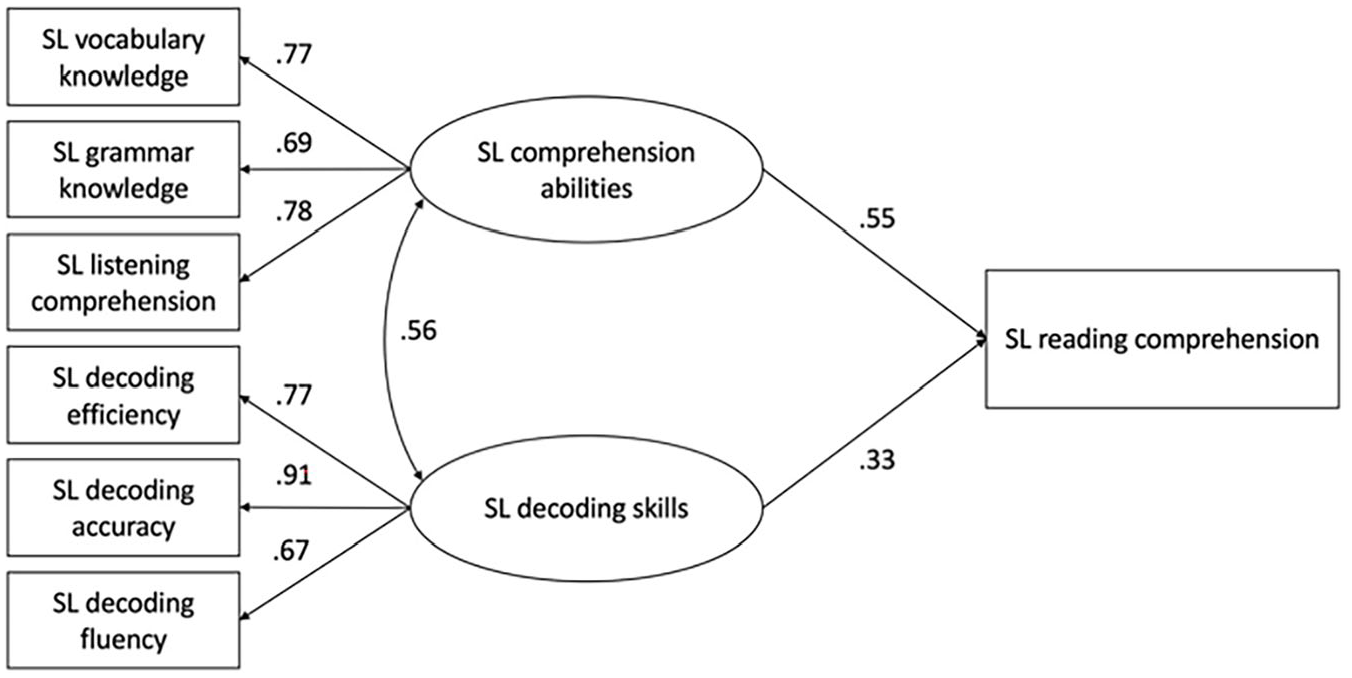
Lee et al.’s (2022) simple view of reading in second language contexts (SV2R).
Although the study by H. Lee et al. (2022) represents an important multivariate meta-analytic addition to SL reading science and has successfully tested the applicability of the SVR model in SL contexts, two issues remain unexplored. First, as noted earlier, H. Lee et al. did not include primary studies of reading in FL contexts (e.g., Sparks, 2015; Sparks & Patton, 2016; Sparks et al., 2012), which arguably differ in some respects from SL contexts. Including studies in FL contexts would not only increase sample size and, thus, statistical power, but also allow us to examine the moderating effect of the learning context (i.e., FL or SL), if any. Second, because a substantial amount of variance is not accounted for in SV2R, it is worthwhile to examine the role of additional components examined in Quinn and Wagner (2018) and Peng et al. (2021) (i.e., cognitive factor and metalinguistic skills component) in SFL reading comprehension.
Potential Moderators in SVR Model for SFL Reading Comprehension
In the present study, we examined the effects of four moderator variables on the relationships between reading comprehension and two key components. The first moderator, “learning context,” was identified based on contextual differences between SL and FL learning the SFL literature, and the rest of the moderator variables were identified based on previous MASEM studies on SVR (H. Lee et al., 2022; Peng et al., 2021; Quinn & Wagner, 2018).
Learning context
In the SFL literature, the contexts SL and FL are often described as “the target language environment” and “outside the target language environment,” respectively (Håkansson & Norrby, 2010, pp. 628–629). On the one hand, it is commonly argued that learners in the SL context are exposed to a much greater proportion of target language input and, thus, enhance language learning. On the other hand, in some FL contexts, labor market pressures for future careers may increase motivation to acquire the target language (Dewaele, 2009). Still, the SL context is generally considered to facilitate the development of the target language better than its FL context in view of the aforementioned input factor (Yang, 2016). As mentioned earlier, H. Lee et al. (2022) did not consider primary studies conducted in FL learning contexts when creating their SV2R model in order to focus exclusively on the SL context. They also suggested that future MASEM efforts should include FL studies to expand understanding of SV2R. In response to this call, we investigated whether the different learning contexts (i.e., SL vs. FL) influence the direction and strength of relationships among the components of the SV2R model, which would yield contextual pedagogical implications.
Age (grade)
Among the identified moderators, age (or grade in some studies) is the only one included in all three previous MASEM studies (H. Lee et al., 2022; Peng et al., 2021; Quinn & Wagner, 2018). Although the studies varied in their categorization (or cutoff) of age (or grade level), the results were consistent with respect to this moderator: The role of decoding skills decreases in older cohorts. For example, in Quinn and Wagner’s (2018) study of English readers, decoding skills contributed less to reading comprehension skills in the older cohort (i.e., Grade 6 and above). In the MASEM study by Peng et al. (2021) with Chinese-speaking populations, the component related to decoding skills was even found to be nonsignificant from Grade 2 onward. This tendency seems to result from the changing status of decoding skills, which become automatic and efficient as a function of age (Catts, 2018; Francis et al., 2005), as proposed in the original SVR framework (Gough & Tunmer, 1986). Using this moderator, we examine whether the age of SFL learners would affect the strength of the relationships between the components of the SVR.
SFL proficiency
Learners’ SFL proficiency has been suggested as a moderator that may correlate to some extent with age or grade level (H. Lee et al., 2022) and influence the relationships between the components of the SVR. Although SFL proficiency has not been an important variable in SFL reading science (but see Pae, 2018; Sparks et al., 2012, for examples that have directly addressed the role of this variable), it may serve as an important moderator within the SVR framework for SFL reading, as H. Lee et al. (2022) found that learners’ decoding skills from SL exerted a greater effect on novice learners than on learners with higher SFL proficiency (see Grabe, 2009, for a similar prediction). Therefore, we identified this variable, along with age, as a potential moderator related to learner factor.
L1–SFL relationship
To examine the moderating effect of the L1–SL relationship, H. Lee et al. (2022) adopted Beaufils and Tomin’s (2020) genetic proximity calculator to categorize L1–SL relations into two values: related versus not related. The results indicated that the L1–SL relationship did not have a significant impact on the relationships between the components in the SV2R model. Thus, H. Lee et al. (2022) postulated that “L1-L2 difference may exert effects only on sub-components, such as L2 language comprehension abilities and L2 decoding skills, but these effects do not extend beyond this level” (p. 600). Although moderation effects have not been observed in previous meta-analytic studies, we examined the effect of this moderator in our analysis because the present study includes both SL and FL studies, which include more diverse combinations of different languages.
Present Study and Research Questions
In the present study, we adopted a MASEM approach to build an extended model of the SVR in SFL contexts (SVR-SFL, hereafter) by using previously proposed SVR variants, including Quinn and Wagner’s (2018) model with a cognitive factor (N = 1,205,581) and Peng et al.’s (2021) model with a component related to metalinguistic skills (N = 35,261) (see Figure 4). The following research questions guided the present study.
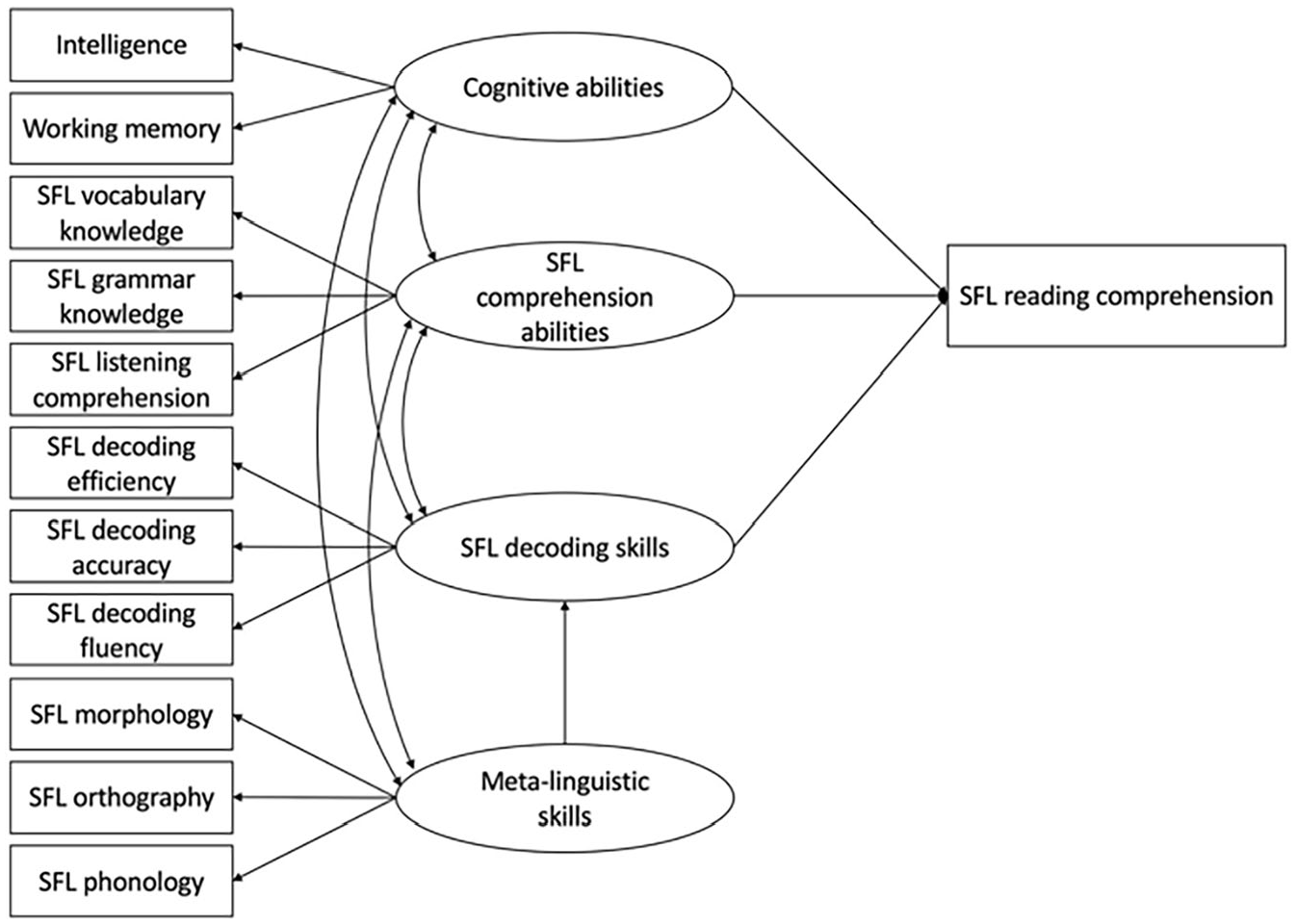
A hypothesized extended simple view of second language reading.
Research Question 1. What are the meta-analytic correlations between SFL reading comprehension and its two primary predictors (i.e., SFL comprehension abilities and SFL decoding skills), in the context of the SVR model?
Research Question 2. Does SVR with a cognitive factor component apply to SFL reading comprehension?
Research Question 3. Does SVR with a metalinguistic skills component apply to SFL reading comprehension?
Research Question 4. Does SVR with both the cognitive factor and metalinguistic skills components apply to SFL reading comprehension?
Method
Literature Search
As the first step of a regular meta-analysis (e.g., H. Lee et al., 2019; H. Lee, Chung, et al., 2020), we conducted a literature search to identify relevant empirical studies and collected the raw correlation coefficients between variables of interest to build MASEM models. For the database and journal search, the set of keywords was designed to include key parameters, such as (a) reading comprehension (i.e., second language reading or foreign language reading), (b) oral language comprehension abilities and decoding skills (i.e., listening, language comprehension, vocabulary, grammar, decoding, accuracy, or fluency, (c) metalinguistic skills (i.e., phonology, orthography, or morphology), and (d) cognitive factor (i.e., working memory or intelligence). In this way, any previous reading studies either in SL or FL contexts, including one or more variables of interest in their analyses, could be identified. For the sake of accuracy, the database searches were exclusively focused on articles’ title and abstract fields.
For the databases, Web of Science, SCOPUS, and ProQuest were accessed. Additionally, we searched related academic journals with high impact factors in the field of education, such as Educational Research Review, Journal of Educational Psychology, Review of Educational Research, and Scientific Studies of Reading; and those in the field of linguistics, such as Annual Review of Applied Linguistics, Language Learning, Language Teaching Research, Studies in Second Language Acquisition, and TESOL Quarterly. Furthermore, prominent second and foreign language learning journals were searched, such as Foreign Language Annals, International Journal of Bilingual Education and Bilingualism, International Journal of Bilingualism, Journal of Research in Reading, Reading and Writing, ReCALL, and Modern Language Journal. To verify the lists of included primary studies, we also referred to previous meta-analyzes on this topic, such as Jeon and Yamashita (2014, 2022), H. Lee et al. (2022), Melby-Lervåg and Lervåg (2011), and Zhang and Zhang (2022).
The authors of the present study conducted the entire literature search together (see Figure 5 for the flowchart of the literature search), and any discrepancies were resolved through a series of discussions. During the initial search, a total of 294 primary studies were identified after duplicates were removed. Subsequently, the titles and abstracts of these studies were reviewed, and 185 studies remained in the pool. Their PDF files were collected and thoroughly reviewed to determine whether they met our four inclusion criteria, namely, that studies had to (a) be written in English and published by June 30, 2022; (b) be conducted in SL or FL contexts; (c) report raw correlation coefficients between variables related to SFL comprehension abilities, SFL decoding skills, cognitive factor, SFL metalinguistic skills, and/or SFL reading comprehension; and (d) report separate data for SFL samples when including both monolingual and SFL learners.

Search and exclusion process.
In total, 152 studies (including all primary studies [k = 67] previously reviewed in H. Lee et al., 2022) were selected for the meta-analysis, with 33 studies excluded for the following reasons. First, there were no raw correlation coefficients between our variables of interest (k = 26; e.g., Chiappe and Siegel, 1999, investigated how the relationship between phonological awareness and reading acquisition would differ across different populations but did not report correlation coefficients between variables; Bruck and Genesee, 1995, looked at the role of phonological awareness in young SL learners without reviewing its relationships with other variables). Second, the study was neither an SL nor an FL investigation (k = 6; e.g., L1 literacy studies with monolingual populations). Third, the study had no separate data for an SFL sample (k = 1; e.g., Proctor et al. [2009] had a total of 4,667 students with 33.2% of SL learners but the reported correlation coefficients were based on the total sample). The remaining 152 studies were reviewed to determine whether any contained multiple samples that should be treated as independent samples. We identified a total of 180 independent samples (N = 36,235). For the list of included studies, refer to the supplemental material in the online version of the journal.
Dataset Construction
Building Pooled Correlation Matrix
To select target variables for our pooled correlation matrix, we reviewed the correlation matrixes used in Quinn and Wagner’s (2018) and Peng et al.’s (2021) SVR models, as well as H. Lee et al.’s (2022) SV2R model. Therefore, a total of 12 variables were considered as our target variables for the pooled correlation matrix. Among them, (a) SFL reading comprehension was identified as the most important dependent variable. According to H. Lee et al.’s (2022) SV2R model, (b) SFL listening comprehension, (c) SFL grammar knowledge, and (d) SFL vocabulary knowledge were considered for computing a latent variable for SFL comprehension abilities. Another three variables, (e) SFL decoding accuracy, (f) SFL decoding fluency, and (g) SFL decoding efficiency, were considered for computing a latent variable for SFL decoding skills. In light of Quinn and Wagner (2018), (h) working memory and (i) intelligence were considered to constitute the cognitive factor. Finally, based on Peng et al. (2021), (j) SFL phonological awareness, (k) SFL morphological awareness, and (l) SFL orthographic awareness were considered to constitute the metalinguistic skills. The definitions of the identified target variables and examples of their instruments are presented in Table 1.
Definitions of 12 target variables and examples of their instruments
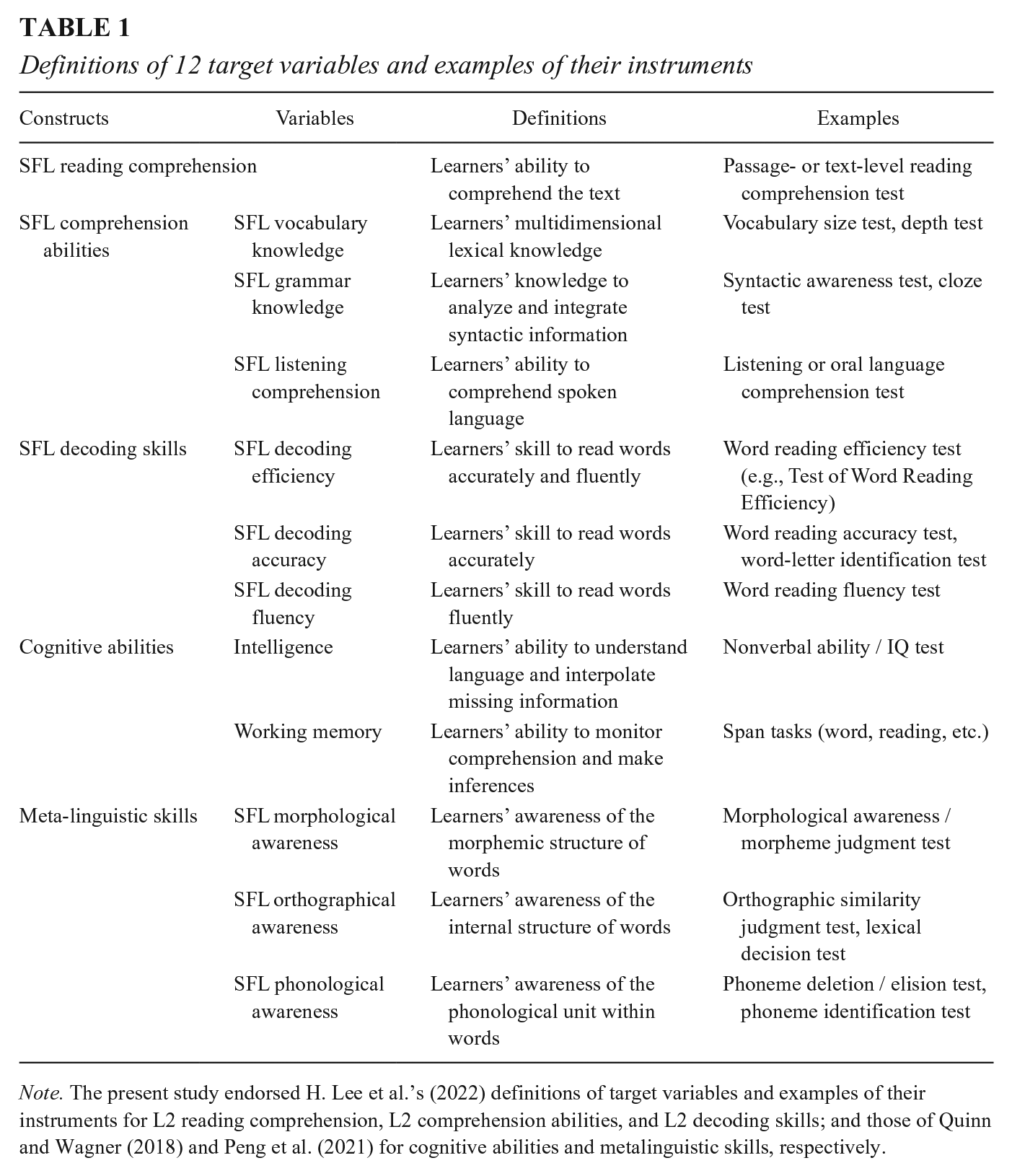
Note. The present study endorsed H. Lee et al.’s (2022) definitions of target variables and examples of their instruments for L2 reading comprehension, L2 comprehension abilities, and L2 decoding skills; and those of Quinn and Wagner (2018) and Peng et al. (2021) for cognitive abilities and metalinguistic skills, respectively.
With these 12 variables as our variables of interest, we reviewed 180 independent samples to transcribe the raw correlation coefficients and create the dataset. As in previous MASEM studies (e.g., H. Lee et al., 2022; Peng et al., 2021), in cases where multiple correlations were reported for the same pair of variables (e.g., when multiple assessments were used to measure the same construct), we calculated average correlation coefficients to ensure independence of the data. The authors of the present study also went through this step together, and any discrepancies were resolved through discussion. Table 2 shows the number of correlation coefficients collected between the variables of interest and the sample sizes for each pair of variables. When collecting data for these variables from different empirical studies, it was natural to observe some variations in terms of how researchers measured these target variables. Although there could be concern that different reading comprehension assessments may require differential demands on its predictors (Cutting & Scarborough, 2006), we did not further distinguish different measurements for each variable given the focus of the meta-analysis, which was to integrate findings from different studies on the same topic.
Numbers and sample sizes of collected correlation coefficients between target variables
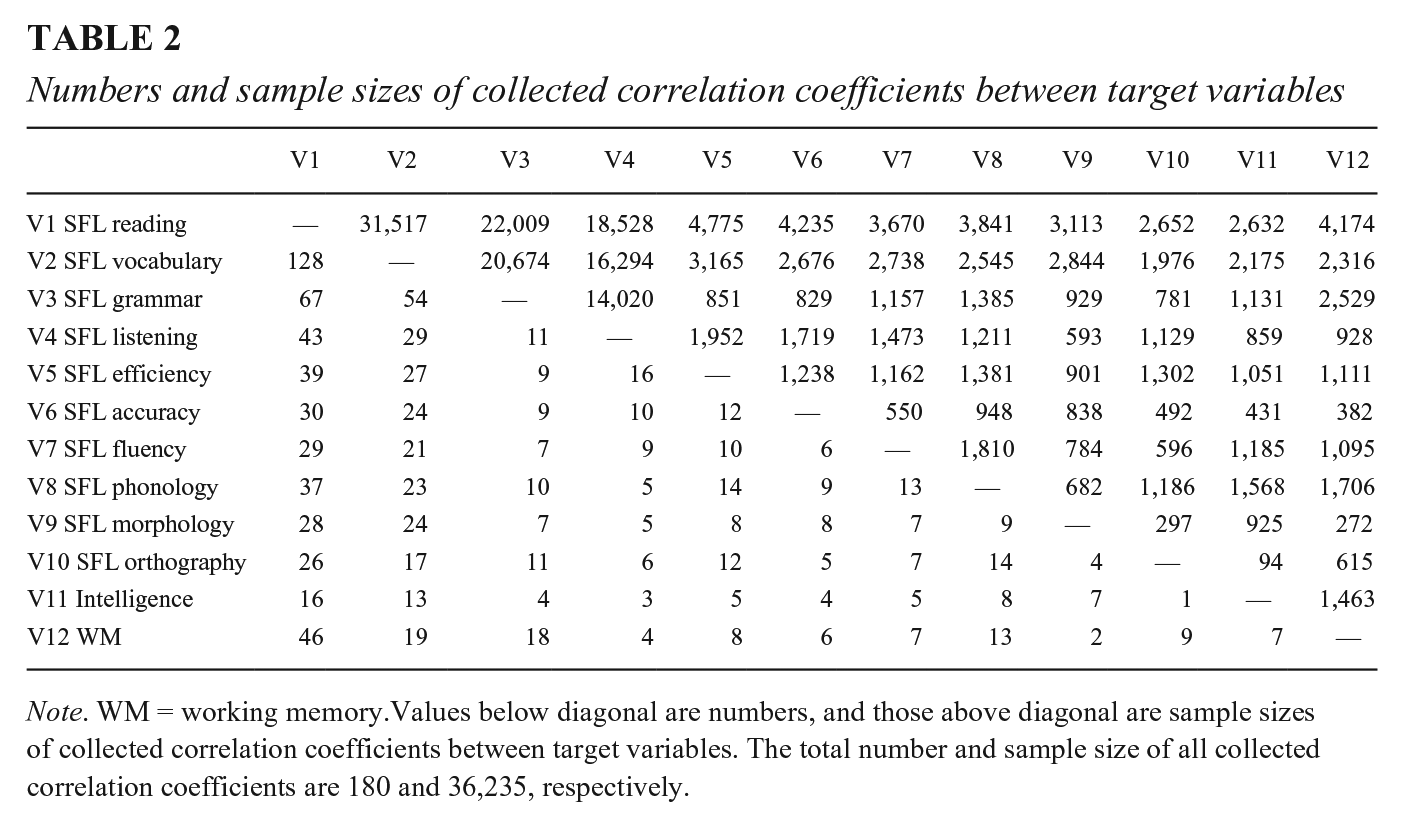
Note. WM = working memory.Values below diagonal are numbers, and those above diagonal are sample sizes of collected correlation coefficients between target variables. The total number and sample size of all collected correlation coefficients are 180 and 36,235, respectively.
Coding Moderator Variables
In the SV2R model of H. Lee et al. (2022), three moderators were examined, namely, the two learner factors of learner age and learner SFL proficiency, and the L1–SFL relationship. Learner factors were found to have significant moderating effects on the relationship between SFL reading comprehension and its two key components (i.e., SFL comprehension abilities and SFL decoding skills). In the present meta-analysis, we adopted these three moderators and their definitions from previous meta-analytic efforts, such as H. Lee et al. (2022) and Jeon and Yamashita (2014, 2022), so that (a) learner age was coded as child (≤ sixth grade or age of 11–12 years, e.g., kindergarteners, elementary school students) versus adolescent/adult (> sixth grade or age of 12–13 years, e.g., secondary school students, adults); (b) learner SFL proficiency was coded as basic (≤ 1 academic year [= two semesters] of SFL learning when not reported, e.g., low proficient learners [reported by researchers according to standardized test results, such as TOEFL (Test of English as a Foreign Language), IELTS (International English Language Testing System), and so on, foreign language learners who just began their first or second semester, SL learners who recently immigrated [less than a year]) versus beyond basic (> 1 academic year of SFL learning when not reported, e.g., intermediate and advanced proficient learners [reported by researchers according to standardized test results, such as TOEFL, IELTS, etc.], foreign language learners who completed at least a year of language study, immigrant SL learners who stayed longer than a year); and (c) the relationship between L1 and SFL was coded as related (a discernible relationship) or unrelated (no discernible relationship) based on the genetic proximity calculated by Beaufils and Tomin (2020) (see Ardasheva et al., 2017, for a different approach to examining the moderating effects of language typology). In addition, because the current meta-analysis included both SL and FL contexts, we included an additional moderator related to (d) learning contexts (i.e., coded as SL vs. FL).
Given that a two-stage structural equation modeling (TSSEM; Cheung & Chan, 2005) allows only a subgroup analysis with no more than two subgroups when testing moderation effects (Jak & Cheung, 2018), we were compelled to dichotomize our moderator variables to conduct subgroup analyses when using the TSSEM approach at the cost of statistical power and throwing away previous information (Jak & Cheung, 2020). Furthermore, when the necessary information was not specifically reported, such as learners’ age and SFL proficiency levels, we followed previous coding definitions and results (see Jeon & Yamashita, 2014, 2022; H. Lee et al., 2022, who used “Children vs. Adolescents/Adults” for the age moderator and “Basic vs. Beyond Basic” for the proficiency moderator) to ensure consistency for the cumulative meta-analytic efforts.
Data Analysis
We conducted a TSSEM, one of the most widely employed MASEM approaches. As its name indicates, TSSEM consists of two stages. (a) In Stage 1, a pooled correlation matrix is built by averaging the correlation coefficients collected from all the primary studies included in the meta-analysis considering different degrees of precision of each target correlation between variables (based on the number and size of the contributing primary studies). (b) In Stage 2, an SEM model is fitted to investigate the relationships between the variables based on the pooled correlation matrix built in the previous stage, again taking into account the precision of the Stage 1 estimates (Jak, 2015). To this end, we employed “metaSEM” R package Version 1.2.5.1 (provided by Cheung, 2015), employing R Version 4.2.0. To assess model fit, we checked the five most widely used indexes according to previous guidelines (e.g., Kline, 2005; Mueller & Hancock, 2019) and examples (e.g., Jin & Lee, 2022; H. Lee, Warschauer, et al., 2020; H. Lee et al., 2022). These are (a) chi-square (χ2) test (either p > .05 or χ2 to df ratio ≤ 5); (b) root mean square error of approximation (RMSEA; < .08); (c) root mean square residual (SRMR; < .08); (d) comparative fit index (CFI; > .90); and (e) Tucker–Lewis index (TLI; > .95).
To answer the research questions, we created a total of four MASEM models. First, we created a base model SVR-SFL (i.e., Model 1) that included SFL reading comprehension along with two latent variables for the two key components, namely, SFL comprehension abilities consisting of SFL listening comprehension, SFL vocabulary knowledge, and SFL grammar knowledge; and SFL decoding skills consisting of SFL decoding accuracy, SFL decoding fluency, and SFL decoding efficiency. Second, we then added a latent variable for the cognitive factor consisting of working memory and intelligence as a third component to the baseline model SVR-SFL according to Quinn and Wagner (2018). Third, we created another SVR-SFL variant model by adding a latent variable for metalinguistic skills consisting of three variables: SFL morphological, phonological, and orthographic awareness as a precursor for SFL decoding skills based on Peng et al. (2021). Finally, we created an extended SVR-SFL model by including both the cognitive factor and metalinguistic skills component in the SVR-SFL base model.
The constructed dataset had missing data, because none of the samples contained all 12 variables of our interest (see Table 2). Based on the assumption that there are no specific reasons for researchers not to include certain variables in their studies, we suspected that the missing data had occurred by chance and justified the use of the full information maximum likelihood (FIML) estimation method (Jak & Cheung, 2020) to address missing correlation coefficients when constructing the pooled correlation matrix (see H. Lee et al., 2022; Peng et al., 2021, for a similar approach). By using the full information of the available data (Wothke, 2000), the FIML approach allows direct estimation of a statistic and standard error from the data, which are known to be relatively unbiased compared to other approaches (Cham et al., 2017).
Regarding the identified moderator variables, it was found that a baseline SVR-SFL model (i.e., Model 1) was the only one that had sufficient numbers of correlation coefficients for the moderator analysis. Because we used subgroup analysis, which is the only option to check moderation effects in TSSEM (Jak & Cheung, 2018), each subgroup by moderator values should not contain zeros in the numbers of correlation coefficients between any pairs of variables. In other words, there should be at least one occasion of correlation coefficients for every pair of variables. For the variants of SVR-SFL (i.e., Models 2 and 3) and the extended version (i.e., Model 4), we were unable to perform moderator analyzes because their subgroups had zero numbers of correlation coefficients between some pairs of variables.
Results
Baseline SVR-SFL Model (Model 1)
Model evaluation
Based on the correlation coefficients between the seven target variables, we first created a pooled correlation matrix (Table 3) to support a baseline model SVR-SFL (Model 1; Figure 6) that included SFL reading comprehension along with two latent variables (i.e., key components), such as SFL comprehension abilities comprising SFL listening comprehension, SFL vocabulary knowledge, and SFL grammar knowledge; and SFL decoding skills comprising SFL decoding accuracy, SFL decoding fluency, and SFL decoding efficiency, following H. Lee et al.’s (2022) model.
Pooled correlation matrix for Model 1: Baseline SVR-SFL model

Note. All correlations (below diagonal) are statistically significant, p < .05. Values above diagonal are numbers (percentages) of included correlation coefficients between target variables. The total number of the included samples is 158.

Model 1: Baseline SVR-SFL model. The number and sample size of the included samples are 158 and 34,943, respectively. The model fit indices confirmed that the dataset successfully fitted the suggested MASEM model: (a) χ2(12) = 20.40, p = .06; (b) CFI = .99; (c) TLI = .99; (d) RMSEA < .001; (e) SRMR = .04. The result of path coefficient comparison indicated a significant difference between .58 (L2 comprehension abilities → L2 reading comprehension) and .27 (L2 decoding skills → L2 reading comprehension): χ2(1) = 13.23, p < .001. R2 = .60.
Table 3 represents the pooled correlation matrix for Model 1: Baseline SVR-SFL Model for SL and FL among the seven variables based on 158 samples with 34,943 participants. A total of 21 pooled correlation coefficients ranged from .20 to .63, with all correlations being statistically significant (ps < .05). Based on the pooled correlation matrix, we built Model 1 (R2 = .60), as shown in Figure 6. The model fit indexes confirmed an overall acceptable model fit: χ2(12) = 20.40, p = .06; CFI = .99; TLI = .99; RMSEA < .001; and SRMR = .04. Furthermore, the model’s two latent variables had significant (ps < .05) and strong factor loadings (βs > .60). Lastly, we found that the two latent variables had statistically significant path coefficients to SFL reading comprehension (.58 for SFL comprehension abilities → SFL reading comprehension, and .27 for SFL decoding skills → SFL reading comprehension). The follow-up likelihood ratio (LR) test between these two path coefficients revealed that SFL comprehension abilities had a significantly larger contribution to SFL reading comprehension than SFL decoding skills (χ2(1) = 13.23, p < .001).
Moderator Analysis for the Baseline SVR-SFL Model
Four moderator variables (i.e., learning context, age, SFL proficiency, and L1–SFL relationship) were examined for their moderation effects on the relationships between SFL reading comprehension and its two key components in the baseline model SVR-SFL (i.e., Model 1). As mentioned in the data analysis section, a subgroup analysis was chosen for this approach. That is, each moderator analysis was conducted by dividing the dataset into two subgroups according to the values of the moderator variables and comparing these two subgroups using an LR test. Table 4 shows the general and specific results of the moderator analyzes. Overall, it was found that learning contexts, χ2(2) = 4.95, p = .08, and the L1–SFL relationship, χ2(2) = 1.84, p = .40, showed nonsignificant effects; whereas age, χ2(2) = 7.97, p = .02, and SFL proficiency, χ2(2) = 9.20, p < .001, had statistically significant moderation effects.
Results of moderator analysis for four moderating variables

Note. LANG = SFL comprehension abilities; DECOD = SFL decoding skills; RC = SFL reading comprehension; ns = nonsignificant; N/A = not applicable.
p < .05, **p < .001.
Regarding learners’ age, SFL comprehension abilities played a larger role for adolescent/adult learners (β = .67) than young learners (β = .55), though this difference was not statistically significant (z = −1.73, p = .08). In contrast, SFL decoding skills played a larger role for young learners (β = .31) than adolescent/adult learners (β = .12), and this difference was statistically significant (z = 2.56, p = .01). Similarly, with respect to learners’ SFL proficiency, the results indicated that SFL comprehension abilities played a larger role for learners who passed basic level (β = .65) than basic learners (β = .45), and this difference was statistically significant (z = −2.87, p < .001). Conversely, SFL decoding skills played a larger role for basic learners (β = .39) than learners beyond basic level (β = .18), and this difference was statistically significant (z = 2.86, p < .001).
Overall, the results for Research Question 1 revealed that both SFL comprehension abilities and SFL decoding skills were significant and positive factors, and that age and SFL proficiency influenced the relative strength of the contribution that these factors made to SFL reading comprehension.
Model 2: SVR-SFL Model Variant 1 (model with cognitive factor)
To investigate whether or not the collected dataset fit statistically with the variants of the SVR model—such as Quinn and Wagner’s (2018) SVR with a cognitive factor and Peng et al.’s (2021) SVR with metalinguistic skills components—in SFL learning contexts, we examined the model fit of Models 2 and 3, following Research Questions 2 and 3.
For Model 2, we built a pooled correlation matrix between nine variables—adding two cognition-related variables, such as intelligence and working memory, to the original seven variables for the baseline SVR-SFL model. These variables were then used to form a latent variable for the cognitive factor, which was added to the baseline model as another component of SFL reading comprehension along with the original two components. Table 5 represents the pooled correlation matrix for Model 2: SVR-SFL Model Variant 1 modeled after Quinn and Wagner (2018), which was based on 177 samples with 36,100 participants. A total of 36 pooled correlation coefficients ranged from .17 to .63, with all correlations being statistically significant (ps < .05). Based on the pooled correlation matrix, we built Model 2 (R2 = .60), as shown in Figure 7.
Pooled correlation matrix for Model 2: SVR-SFL Model Variant 1 (modeled after Quinn & Wagner, 2018)
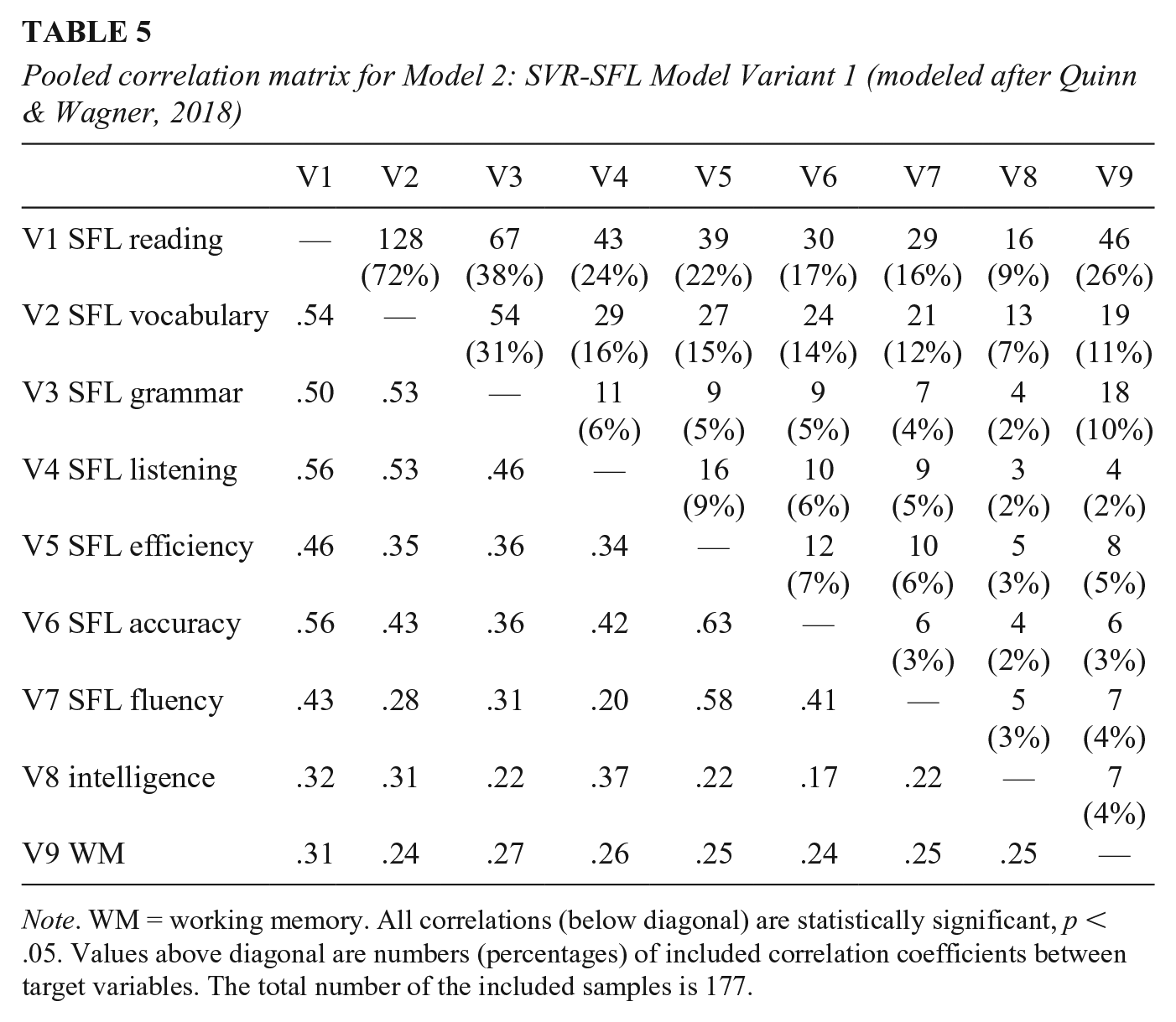
Note. WM = working memory. All correlations (below diagonal) are statistically significant, p < .05. Values above diagonal are numbers (percentages) of included correlation coefficients between target variables. The total number of the included samples is 177.
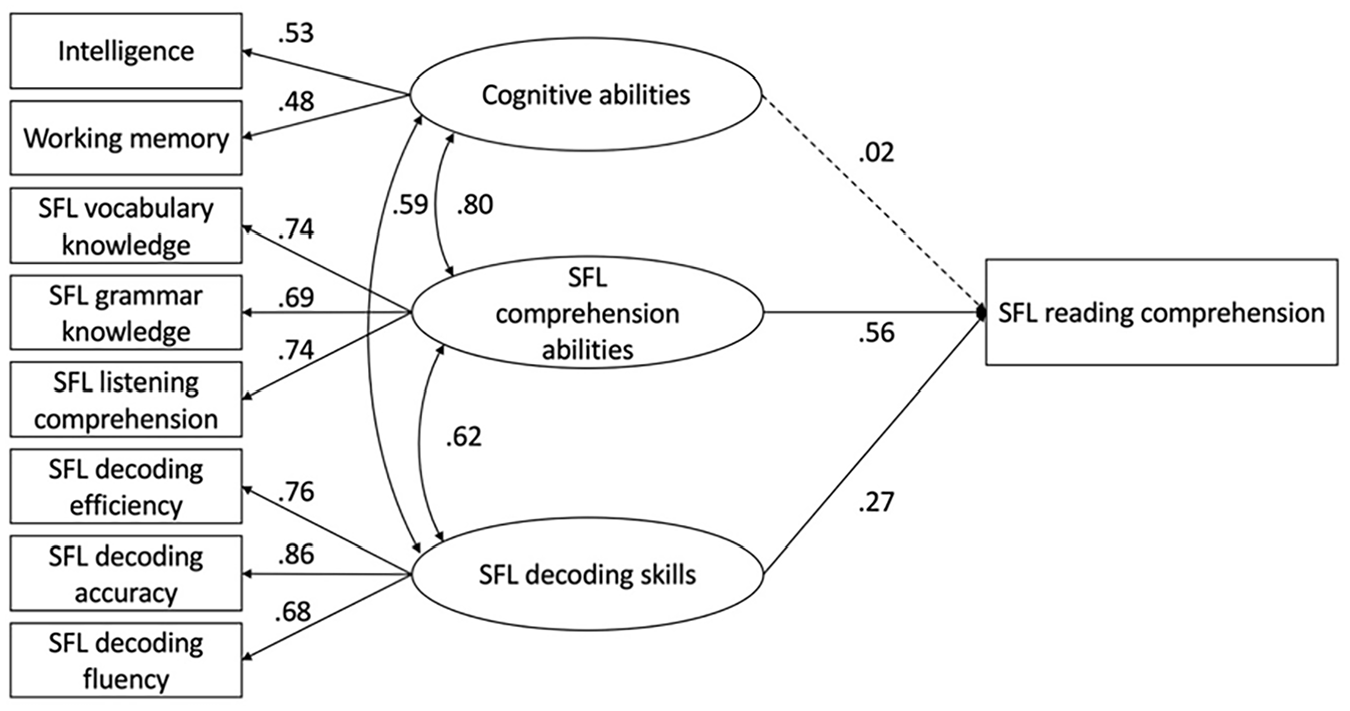
Model 2: SVR-SFL Model Variant 1 (modeled after Quinn & Wagner, 2018). The number and sample size of the included samples are 177 and 36,100, respectively. The model fit indices confirmed that the dataset successfully fitted the suggested MASEM model: (a) χ2(22) = 31.55, p = .09; (b) CFI = .99; (c) TLI = .99; (d) RMSEA < .001; (e) SRMR = .04. The result of path coefficient comparison indicated a significant difference between .56 (L2 comprehension abilities → L2 reading comprehension) and .27 (L2 decoding skills → L2 reading comprehension): χ2(1) = 13.53, p < .001. R2 = .60.
The model fit indexes confirmed an overall acceptable model fit: χ2(22) = 31.55, p = .09; CFI = .99; TLI = .99; RMSEA < .001; and SRMR = .04. Furthermore, the model’s two latent variables for the SFL comprehension abilities and SFL decoding skills had significant (ps < .05) and strong factor loadings (βs > .60), and the latent variable for the cognitive factor had significant (ps < .05) and acceptable factor loadings (βs > .40). Lastly, we found that the two latent variables for SFL comprehension abilities and SFL decoding skills had statistically significant path coefficients to SFL reading comprehension (.56 for SFL comprehension abilities → SFL reading comprehension, and .27 for SFL decoding skills → SFL reading comprehension), whereas the latent variable for the cognitive factor did not show a statistically significant path coefficient to SFL reading comprehension (β = .02, SE = .15, p = .90). The follow-up LR test between the two path coefficients with statistical significance revealed that SFL comprehension abilities had a significantly larger contribution to SFL reading comprehension than SFL decoding skills, χ2(1) = 13.53, p < .001.
To summarize, the results for Research Question 2 revealed that the overall model fit for Model 2 (inspired by Quinn and Wagner’s model) was excellent, with both SFL comprehension abilities and SFL decoding skills being significant and positive factors. However, the cognitive factor was found to be a nonsignificant predictor in the model.
Model 3: SVR-SFL Model Variant 2 (the model with metalinguistic skills component)
For Model 3, we created a pooled correlation matrix between 10 variables by adding 3 metalinguistic variables (i.e., morphological, orthographic, and phonological awareness) to the original set of 7 variables for the baseline model SVR-SFL. These variables were used to form a latent variable for the metalinguistic skills component, which was added to the baseline SVR-SFL model as an antecedent variable predicting SFL decoding skills directly, and SFL reading comprehension indirectly via SFL decoding skills. Table 6 represents the pooled correlation matrix for Model 3: SVR-SFL Model Variant 2 modeled after Peng et al. (2021), which was based on 163 samples with 35,261 participants. A total of 45 pooled correlation coefficients ranged from .20 to .63, with all correlations being statistically significant (ps < .05). Based on the pooled correlation matrix, we built Model 3 (R2 = .58), as shown in Figure 8.
Pooled correlation matrix for Model 3: SVR-SFL Model Variant 2 (modeled after Peng et al., 2021)

Note. All correlations (below diagonal) are statistically significant, p < .05. Values above diagonal are numbers (percentages) of included correlation coefficients between target variables. The total number of the included samples is 163.
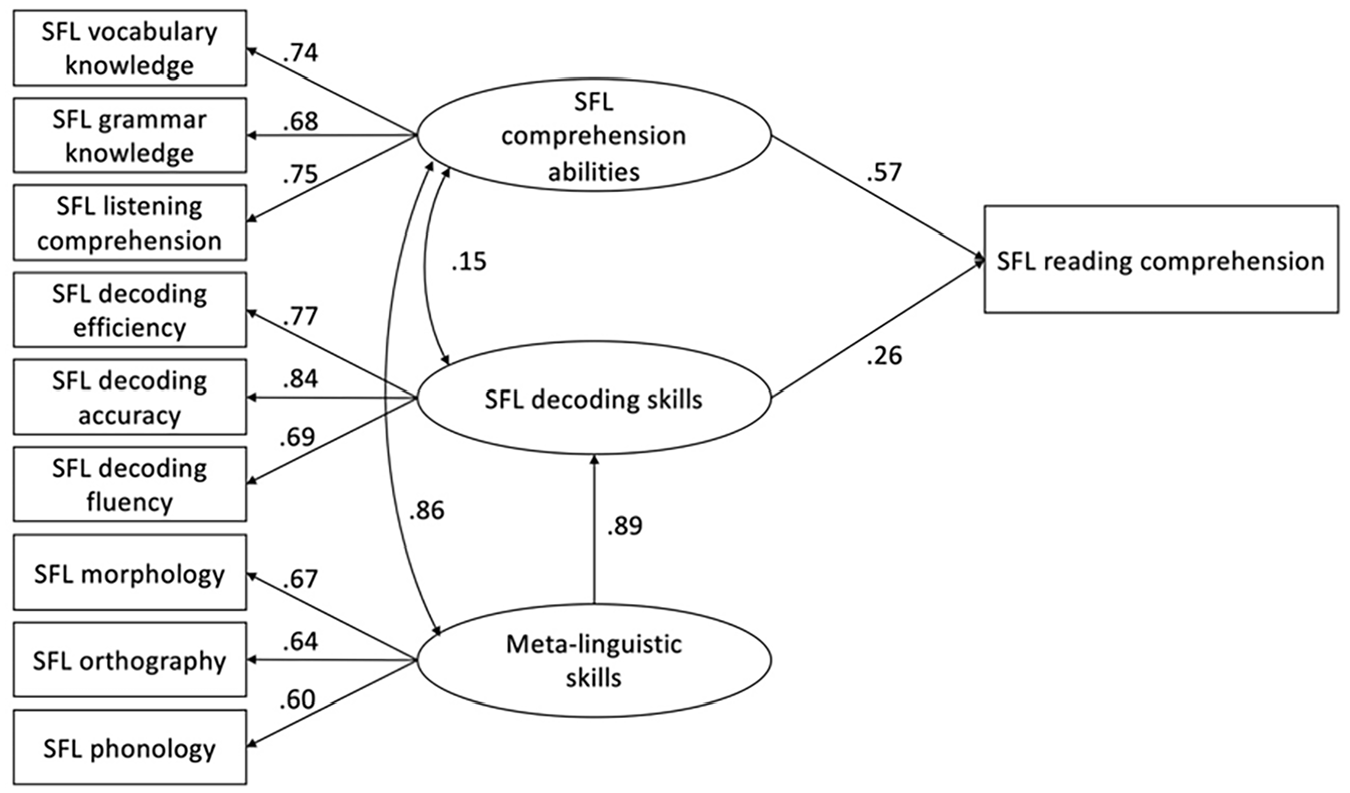
Model 3: SVR-SFL Model Variant 2 (modeled after Peng et al., 2021). The number and sample size of the included samples are 163 and 35,261, respectively. The model fit indices confirmed that the dataset successfully fitted the suggested MASEM model: (a) χ2(31) = 55.95, p < .001; (b) CFI = .99; (c) TLI = .99; (d) RMSEA < .001; (e) SRMR = .05. The result of path coefficient comparison indicated a significant difference between .57 (L2 comprehension abilities → L2 reading comprehension) and .26 (L2 decoding skills → L2 reading comprehension): χ2(1) = 15.46, p < .001. R2 = .58.
The model fit indexes confirmed an overall acceptable model fit: χ2(31) = 55.95, p < .001; CFI = .99; TLI = .99; RMSEA < .001; and SRMR = .05. Furthermore, the model’s three latent variables for the SFL comprehension abilities, SFL decoding skills, and metalinguistic skills had significant (ps < .05) and strong factor loadings (βs ≥ .60). Lastly, we found that the two latent variables for SFL comprehension abilities and SFL decoding skills had statistically significant path coefficients to SFL reading comprehension (.57 for SFL comprehension abilities → SFL reading comprehension, and .26 for SFL decoding skills → SFL reading comprehension), and the latent variable for the metalinguistic skills showed a statistically significant path coefficient to SFL decoding skills (β = .89). According to our follow-up LR test between the two path coefficients to SFL reading comprehension, we found that SFL comprehension abilities had a significantly larger contribution to SFL reading comprehension than SFL decoding skills, χ2(1) = 15.46, p < .001.
To summarize, the results for Research Question 3 revealed that the overall model fit for Model 3 (inspired by Peng et al.’s [2021] model) was excellent, with both SFL comprehension abilities and SFL decoding skills being significant and positive factors. In addition, the component related to metalinguistic skills was found to be a significant predictor for SFL decoding skills.
Model 4: An extended SVR-SFL model
For Model 4, we created a pooled correlation matrix of 12 variables by adding 2 cognition-related variables, namely, intelligence and working memory, and 3 metalinguistic variables, namely, morphological, orthographic, and phonological awareness, to the original set of 7 variables for the baseline model SVR-SFL. Of the five additional variables, the first two variables were then used to form a latent variable for the cognitive factor. They were added to the base model SVR-SFL as an additional component to SFL reading comprehension along with the original two key components. The last three variables were used to form a latent variable for the metalinguistic skills component, which was added to the baseline SVR-SFL model as an antecedent variable immediately contributing to SFL decoding skills. Table 7 represents the pooled correlation matrix for Model 4: An Extended SVR-SFL Model (by merging Models 2 and 3), which was based on 180 samples with 36,235 participants. A total of 66 pooled correlation coefficients ranged from .17 to .63, with all correlations being statistically significant (ps < .05). Based on the pooled correlation matrix, we built Model 4 (R2 = .62), as shown in Figure 9.
Pooled correlation matrix for Model 4: An extended SVR-SFL model (by integrating Models 1, 2, and 3)
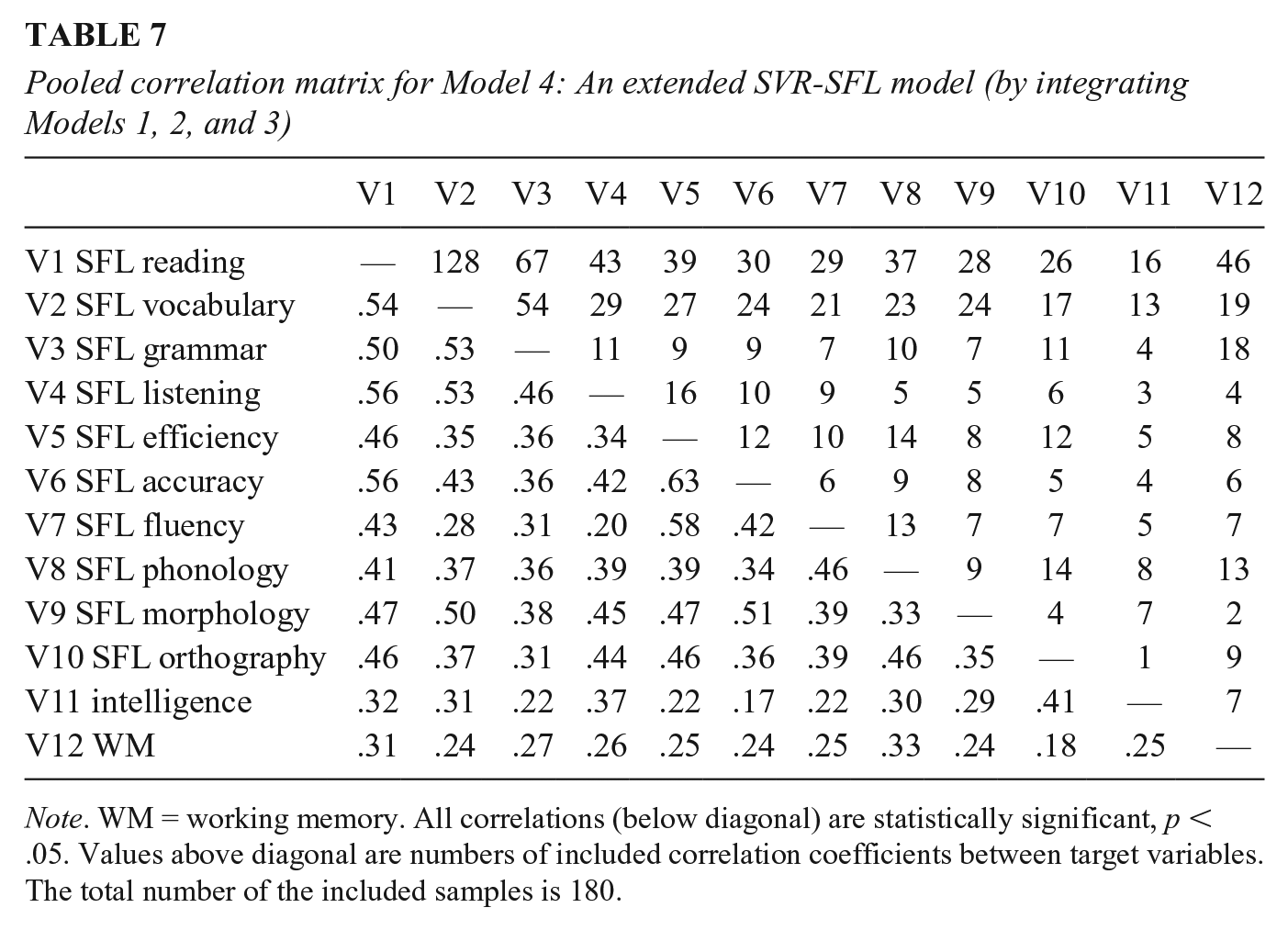
Note. WM = working memory. All correlations (below diagonal) are statistically significant, p < .05. Values above diagonal are numbers of included correlation coefficients between target variables. The total number of the included samples is 180.
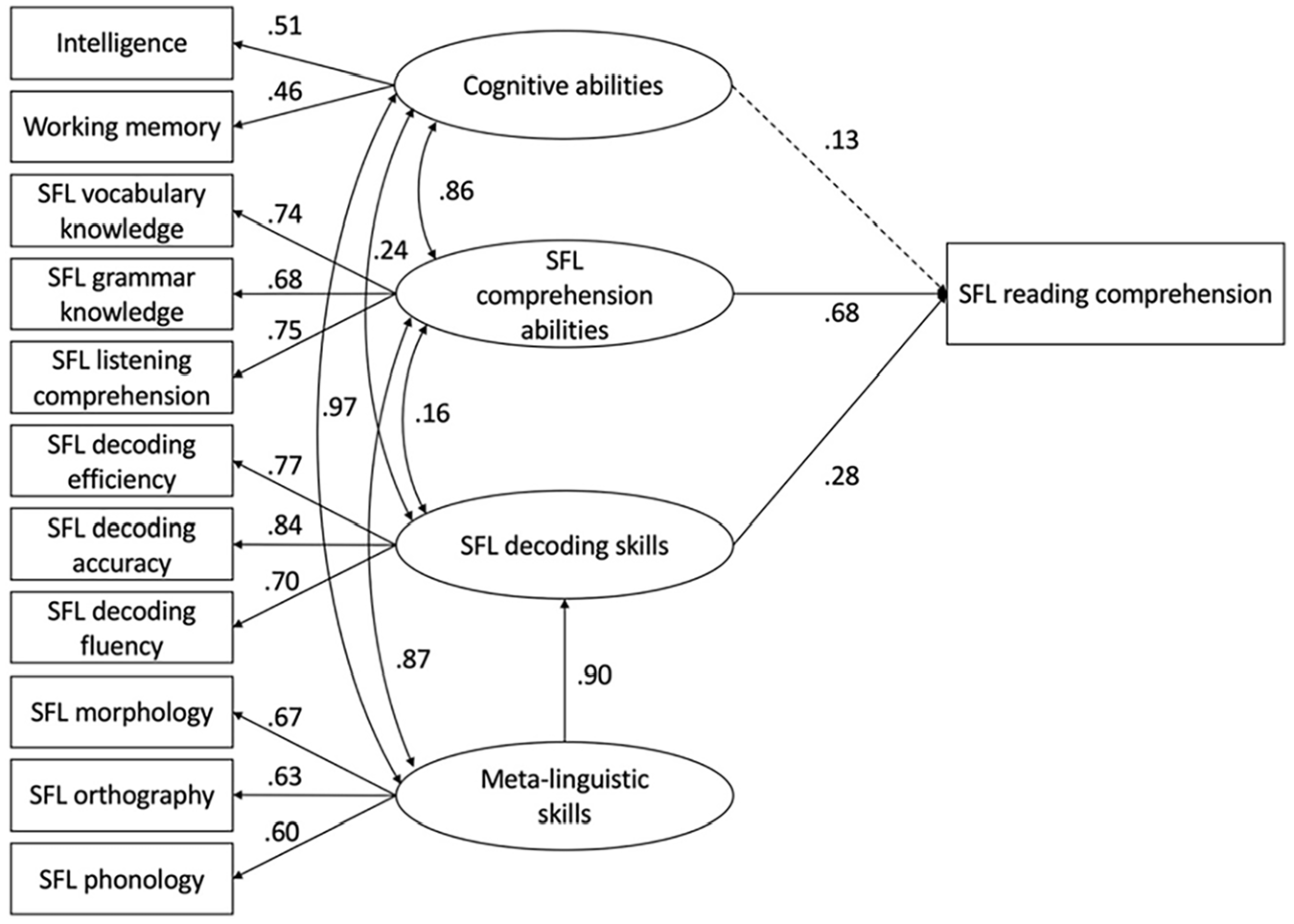
Model 4: An extended SVR-SFL model (by integrating Models 1, 2, and 3). The number and sample size of the included samples are 180 and 36,235, respectively. The model fit indices confirmed that the dataset successfully fitted the suggested MASEM model: (a) χ2(46) = 77.83, p < .001; (b) CFI = .99; (c) TLI = .99; (d) RMSEA < .001; (e) SRMR = .05. The result of path coefficient comparison indicated a significant difference between .68 (L2 comprehension abilities → L2 reading comprehension) and .28 (L2 decoding skills → L2 reading comprehension): χ2(1) = 16.47, p < .001. R2 = .62.
The model fit indexes confirmed an overall acceptable model fit: χ2(46) = 77.83, p < .001; CFI = .99; TLI = .99; RMSEA < .001; and SRMR = .05. Furthermore, the model’s three latent variables for the SFL comprehension abilities, SFL decoding skills, and metalinguistic skills had significant (ps < .05) and strong factor loadings (βs > .60); whereas the latent variable for the cognitive factor had significant (ps < .05) and acceptable factor loadings (βs > .40). Lastly, we found that the two latent variables for SFL comprehension abilities and SFL decoding skills had statistically significant path coefficients to SFL reading comprehension (.68 for SFL comprehension abilities → SFL reading comprehension, and .28 for SFL decoding skills → SFL reading comprehension), while the latent variable for the cognitive factor showed a statistically nonsignificant path coefficient to SFL reading comprehension (β = .13, SE = .24, p = .57), similar to the result related to Model 2. The latent variable for the metalinguistic skills showed a statistically significant path coefficient to SFL decoding skills (β = .90). The follow-up LR test between the two path coefficients with statistical significance to SFL reading comprehension revealed that SFL comprehension abilities had a significantly larger contribution to SFL reading comprehension than SFL decoding skills, χ2(1) = 16.47, p < .001.
Overall, the results for Research Question 4 largely mirrored those of Research Questions 2 and 3, revealing that SFL comprehension abilities and SFL decoding skills were significant and positive factors for SFL reading comprehension and that the component related to metalinguistic skills was a significant predictor for SFL decoding skills, whereas the cognitive factor was found to be a nonsignificant predictor.
Discussion
In this study, we collected previous empirical reading studies conducted in SFL contexts to investigate an SVR-SFL model by adopting a MASEM approach. Our approach is different to that of the SV2R model of H. Lee et al. (2022), which focused exclusively on the SL context, in that the current meta-analysis study additionally included studies from FL contexts as well. The findings of the present study with regard to the significance of two key components provide strong empirical support for the applicability of the original SVR model (Gough & Tunmer, 1986) to SFL contexts and is generally consistent with previous MASEM studies of SVR with L1 readers (Peng et al., 2021; Quinn & Wagner, 2018) and SL contexts (H. Lee et al., 2022). A majority—albeit not all—of the SFL studies included in this MASEM study were not theoretically grounded in the SVR (e.g., Hoover & Gough, 1990; Sparks, 2015; Sparks & Patton, 2016), but examined the components or subcomponents included in the SVR framework. In this regard, the theoretical contribution of the present study lies in its compilation of an array of the extant SL and FL reading studies, and its confirmation that the primary tenet of the SVR holds true in SFL contexts.
Variants of SVR in SFL Contexts
After confirming the validity of the baseline SVR-SFL, the Quinn and Wagner (2018) model was fitted to our data with the cognitive factor (i.e., Model 2). The cognitive factor turned out not to be a significant component of SFL reading comprehension. This finding appears to be rather unexpected, in view of the previous findings indicating the role of such a factor in SFL reading (e.g., Alptekin & Erçetin, 2009, 2010; Nikolov & Csapó, 2018; Tabatabaee-Yazdi & Baghaei, 2018). One possible explanation comes from Quinn and Wagner (2018), who noted that “the SVR posits that constructs such as reasoning and inference and working memory [as cognition-related variables] should load on the linguistic comprehension factor” (p. 1964). In other words, beyond comprehension abilities and decoding skills, its contribution may be limited. Thus, this finding has advanced our understanding of the rather limited role the cognitive factor in SFL reading comprehension plays when the more dominant components (i.e., SFL decoding skills and language comprehension skills) are considered together.
The metalinguistic skills component included based on the model of Peng et al. (2021) proved to be a significant predictor in our model. Although the correlational relationships between these variables or surrogate variables and SFL reading comprehension have already been presented in the meta-analyzes of Jeon and Yamashita (2014, 2022), the present MASEM study advances their finding, proposing that metalinguistic skills consisting of these variables may serve as significant antecedents of decoding skills, exerting an indirect effect on SFL reading comprehension and offering an important implication for SFL reading instruction (see the subsection on pedagogical implications below).
Finally, the results of our third and last extended model including both (a) the cognitive factor and (b) metalinguistic skills were largely consistent with those of Models 2 and 3 and seem to confirm “the parsimonious structure of SVR for reading comprehension” (Peng et al., 2021, p. 23) by suggesting that comprehension abilities and decoding skills are key constructs for SFL reading comprehension. Overall, the extended model SVR-SFL is not only an extension of H. Lee et al.’s (2022) model by incorporating studies conducted in both SL and FL contexts, but it also contributes to our understanding of SFL reading comprehension by adding additional components to the previous version of the model.
Having tested the applicability of the proposition of the SVR in SFL contexts, the next step of SVR-inspired SFL reading research would be to address the controversies surrounding the original SVR in the SFL contexts. For example, it is expected that SVR-inspired SFL reading research would benefit from the systematic investigation into the roles of text-related variables, such as text genre and topic familiarity (e.g., Alderson, 2000; Behtary & Davaribina, 2013; Horiba & Fukaya, 2015; S. K. Lee, 2007) or assessment types (e.g., Brantmeier, 2005; Shin, 2020), in the extent to which the key components influence SFL reading comprehension. These variables, although they may play a significant role in SFL reading comprehension, have not been addressed sufficiently, at least under the basic tenet of the SVR or its extended versions.
The Role of the Identified Moderators in the Relative Importance of Each Component in SFL Reading
Using the baseline SVR-SFL model, we further investigated whether the identified moderator variables influence the relative strength of the contribution that SFL comprehension abilities and SFL decoding skills make to SFL reading comprehension.
The L1–SFL relationship and context were not found to be significant moderators. Regarding this, it is possible that the L1–SFL relationship and context exert some influence on the relationships between SFL comprehension abilities or SFL decoding skills and their constituents (H. Lee et al., 2022). For example, the effects of the L1-SFL relationship may be much more salient in simpler reading processes (i.e., decoding) than in more complex ones. Similarly, the qualitative difference between the SL and FL environments may be selective in some subcomponents of SFL comprehension abilities or decoding skills. For example, Sparks et al. (2017) found that secondary Spanish students in the United States could decode FL words to some extent, but had very poor oral language and reading comprehension skills because of their limited FL vocabulary knowledge at the beginning of their learning. This may be due to a lack of exposure to the target language vocabulary in an FL context. Thus, these results do not necessarily downplay the role of the aforementioned moderators in SFL reading. Rather, they reinforce the validity of our previously discussed proposition that the relationships between decoding skills, language comprehension abilities, and reading comprehension generally hold constant regardless of the L1 and SL/FL pairing studied or the target learning context.
Regarding age and proficiency, which are generally correlated in most contexts of SL and FL (H. Lee et al., 2022), the results showed that SFL decoding skills made a significantly greater contribution to SFL reading comprehension for younger and lower-proficiency learners than for older and higher-proficiency learners. This finding is consistent with the results of previous MASEM studies of SVR in L1 contexts (i.e., before Grade 2 in the Chinese L1 SVR model [Peng et al., 2021]; before Grade 6 in the English L1 SVR model [Quinn & Wagner, 2018]) and provides strong empirical support for the applicability of the original SVR model in SFL contexts. Although the suggested grade or proficiency level above which decoding skills play a less important role in reading comprehension may vary across previous meta-analyzes or MASEM studies (e.g., García & Cain, 2014; H. Lee et al., 2022; Peng et al., 2021; Quinn & Wagner, 2018), it appears that the decoding component becomes more automatic as a function of readers’ grade or proficiency level (Catts, 2018), with comprehension abilities becoming a dominant factor at later stages (e.g., García & Cain, 2014; Language and Reading Research Consortium, 2015).
The significant contribution of comprehension abilities in SFL reading can best be construed by examining its subcomponents, which are strong correlates of SFL reading comprehension in large-scale meta-analyses (higher than r = .7 in Jeon & Yamashita, 2014, 2022). For example, SFL listening comprehension, which “represents the linguistic processes used for the comprehension of oral language at the word level and the level of connected discourse and text” (Sparks, 2021, p. 508), may contribute to SFL reading by enabling readers to comprehend the meaning of the text at all stages of reading. The role of SFL vocabulary knowledge, another subcomponent, should also be highlighted in light of the previous research on the close relationship between the percentage of known words and reading comprehension (e.g., Schmitt et al., 2011) as well as the result of an SVR-based SFL study (Sparks & Patton, 2016), which points to the unique contribution that SFL vocabulary makes to SFL reading.
Pedagogical Implications
The proponents of the original SVR model (Gough & Tunmer, 1986) suggests that readers could be classified according to the levels of their decoding skills and language comprehension abilities. Considering the finding that the original SVR could be well fitted to our dataset, such classification could also be adapted to identify the reading problems of SFL readers (Sparks, 2021; Sparks et al., 2018). For example, first, those with a dyslexic profile should be given explicit instruction in decoding skills (National Reading Panel, 2000; Rose, 2006). Second, for higher-proficiency learners who are more or less proficient in decoding words, instruction should be more focused on improving students’ language comprehension abilities, in particular focusing on oral language (Spencer & Wagner, 2018), as the original model suggested. Instructional efforts in this regard may include extensive listening focused on exposure to the target language to improve learners’ fluency in listening (Chang & Millett, 2014) and direct instruction in a wide range of vocabulary learning strategies that learners can use to independently expand their vocabulary in the target language (Schmitt, 1997). It should be noted that such an emphasis on language comprehension abilities for higher-proficiency SFL readers does not indicate that decoding should be the sole focus for lower-proficiency ones. Indeed, as the L1 literature has recommended this type of instruction for earlier readers (Snow, 2018), lower-level SFL readers may also benefit from early instruction geared toward enhancing language comprehension abilities in terms of the development of their SFL reading comprehension, with SFL vocabulary knowledge being a particularly important component (Sparks, 2021). Third, along with the importance of decoding instruction at the early stages of reading, the development of language comprehension skills, especially oral language skills, is critical for early readers of target languages in which spelling is highly morphologically structured (e.g., English), as the rule-governed phoneme-grapheme links established through decoding (phonics) instruction may not be applicable for some vocabulary. In such cases, oral language skills may enable them to handle such vocabulary and self-correct their code-based reading when it does not work. Given the importance of developing oral language skills, learners in the FL context may further benefit from targeted instruction that provides a large amount of (oral) language input, as they would generally lack such input when outside the classroom.
Another important pedagogical implication could be drawn from the findings related to the SVR-SFL variants. Our finding points to a need to include specific instruction on metalinguistic skills in SFL contexts. In other words, although reading problems at earlier stages of reading have been largely attributed to deficits in decoding skills (e.g., Shankweiler et al., 1999), our model, which is inspired by Peng et al.’s (2021) model with Chinese readers, suggests that reading problems may also be related, at least in part, to low levels of metalinguistic skills. Given this finding, metalinguistic skills could be integrated into SFL reading instruction along with (or before) decoding instruction for at-risk and weak SFL readers. For the development of such skills, instructors may include classroom activities explicitly oriented toward requiring SFL readers to think about the structures of the target SFL. It is expected that the above pedagogical implications could be further deepened and strengthened by research on the role of lexical quality in reading (Perfetti, 2007), which points to the important role of subcomponents or proximal abilities of metalinguistic skills as part of vocabulary knowledge in reading comprehension (see Verhoeven et al., 2019, for an example in this line of research). It should also be noted that while some metalinguistic skills (e.g., rhyming) can be developed predominantly through oral language input, others (e.g., morphological and syntactic awareness) are strongly dependent on L1 reading competence, according to a recent finding (Sparks et al., 2019). Thus, SFL learners may also benefit from targeted instruction to develop their L1 reading competence.
Limitations
There are some limitations of the present study. First, despite our efforts to identify as many SVR studies as possible in SL and FL contexts, we may have overlooked some empirical studies, especially gray literature. Second, we were unable to perform moderator analysis for SVR-SFL Variants 1 and 2 and the extended SVR-SFL model for the reasons stated in the Method section, such that there was a significant range in the number of samples contributing correlations between different pairs of variables (i.e., missing data). However, we believe that the overall results would remain consistent in terms of the influences of the identified moderators in extended versions of the SVR model, considering their similar model fit indexes as well as the almost identical amounts of variance explained (R2) (although we cannot statistically compare Models 1 to 4, as they were nonnested models based on different pooled correlation matrixes). Third, it remains unexplored how affective variables such as anxiety and motivation would influence the development or dropout of the subcomponents identified in the study. Although such affective variables have not been the main subject of inquiry in SVR-based studies (but see Alderson et al., 2016, for one such example), they may merit some scholarly attention as a mechanism to explain reading problems not identified via the SVR model (Sparks, 2021). Fourth, in light of complex systems thinking (Larsen-Freeman & Cameron, 2008) and some recent evidence (e.g., Cai & Kunnan, 2020), the dichotomous coding related to the target moderators may seem rather crude to allow one to obtain findings reflecting SFL learners’ actual development or fluctuation in reading. Fifth, we observed some amount of the unaccounted variance in our models. Future reading research may also consider alternative models of reading, such as the direct and inferential mediation model (Cromley & Azevedo, 2007; Cromley et al., 2010) and the reading systems framework (Perfetti & Stafura, 2014) as their theoretical framework, to examine whether they are a better suit for SFL reading comprehension.
Despite these limitations, we believe that the present MASEM study significantly advances our knowledge of SFL reading. We hope that future primary studies of SFL reading and relevant meta-analytic efforts will navigate through these limitations and further contribute to SVR-based reading science.
Supplemental Material
sj-docx-1-rer-10.3102_00346543231186605 – Supplemental material for Extending the Simple View of Reading in Second and Foreign Language Learning: A Meta-Analytic Structural Equation Modeling Approach
Supplemental material, sj-docx-1-rer-10.3102_00346543231186605 for Extending the Simple View of Reading in Second and Foreign Language Learning: A Meta-Analytic Structural Equation Modeling Approach by Hansol Lee and Jang Ho Lee in Review of Educational Research
Footnotes

Note
The authors thank the editors and reviewers for their valuable time in providing feedback on earlier versions of this article. This work was supported by the Ministry of Education of the Republic of Korea and the National Research Foundation of Korea (NRF-2020S1A5A2A01040173).
Authors
HANSOL LEE is a professor at Korea Military Academy, 574 Hwarang-ro, Nowon-gu, Seoul, Republic of Korea; e-mail:
JANG HO LEE is a professor at Chung-Ang University, 84 Heukseok-ro, Dongjak-gu, Seoul, Republic of Korea; e-mail:
References
Supplementary Material
Please find the following supplemental material available below.
For Open Access articles published under a Creative Commons License, all supplemental material carries the same license as the article it is associated with.
For non-Open Access articles published, all supplemental material carries a non-exclusive license, and permission requests for re-use of supplemental material or any part of supplemental material shall be sent directly to the copyright owner as specified in the copyright notice associated with the article.
