



Abstract
Teacher burnout is assumed to impair the cognitive, motivational, and social functioning of teachers, thereby hindering their professional behavior. Although this is a rapidly growing field of research, a systematic research synthesis is still lacking. Therefore, we meta-analytically summarized primary studies on the work-related correlates of teacher burnout symptoms in terms of absenteeism, the quality of teacher–student interactions (i.e., emotional support, classroom management, and instructional support), and student motivation and achievement. Meta-analyses of 86 studies demonstrated negative associations between teacher burnout symptoms and teacher–student interactions, and student motivation and achievement, whereas absenteeism was positively related to burnout. Meta-regressions showed that the negative associations between teacher burnout, teacher–student interactions, and student motivation varied significantly depending on the rater perspective (i.e., teacher self-report vs external reports). Building on the meta-analytic findings, we propose directions for future research and highlight practical implications for intervention programs.
Keywords
Introduction
Recent research has identified teaching as a profession that has a high level of work-related stress and a considerable risk of burnout (Garcia-Carmona et al., 2019; Johnson et al., 2005; Redín & Erro-Garcés, 2020). On average, between 28 and 40% of teachers suffer from burnout symptoms (Garcia-Carmona et al., 2019). Burnout, which is characterized by feelings of emotional exhaustion, depersonalization, and reduced personal accomplishment, is related to teachers’ mental and physical health (Madigan et al., 2023; Maslach et al., 2001). Moreover, theoretical models from different lines of research have suggested numerous negative associations with teacher absenteeism, the quality of teacher–student interactions, and students’ educational development (Fredrickson, 2001; Hobfoll, 1989; Lazarus & Folkman, 1984; Maslach & Leiter, 1999). These variables are of great relevance. For instance, absenteeism constitutes a major problem for schools because this phenomenon aggravates teacher shortages and impedes the quality of teacher–student interactions, which are vital for students’ cognitive and social-emotional development (Hamre & Pianta, 2005; Kunter et al., 2013; Organisation for Economic Co-operation and Development [OECD], 2005; Tymms et al., 2018).
By now, an extensive number of studies have tested the role that teacher burnout plays in the professional performance of teachers. Previous systematic reviews have indicated a negative association between teacher burnout and productivity, emotional support and care for others (Sabagh et al., 2018), and students’ affective-motivational, behavioral, and academic development (Aloe et al., 2014; Madigan & Kim, 2021a). However, to date, no meta-analysis has comprehensively subsumed the multiple theoretical consequences of teacher burnout such as absenteeism, the quality of learning environments (i.e., teacher–student interactions), and students’ educational development (i.e., motivation and achievement).
The Concept of Burnout
Burnout is defined as a work-related syndrome with three symptoms, namely, emotional exhaustion, depersonalization, and reduced personal accomplishment (Maslach et al., 2001; World Health Organization [WHO], 2021). The key symptom, emotional exhaustion, describes feelings of emotional fatigue, a depletion of individual resources, and overexertion; it forms the individual stress component of burnout and is most frequently investigated as the core symptom of burnout (Maslach et al., 2001). However, burnout encompasses more than a lack of sufficient energy (Maslach et al., 2018; Schaufeli et al., 2020). The second symptom, depersonalization, is defined as a callous, aloof, or indifferent attitude and behavior toward recipients on the job and reflects the interpersonal dimension of burnout because it represents an emotional withdrawal from recipients (Demerouti et al., 2001). In the context of the teaching profession, depersonalization is typically investigated as a detached attitude toward students (Maslach et al., 2018). The third symptom, reduced personal accomplishment, refers to the feeling of incompetence, reduced efficacy, and insufficient ability to succeed in the job (Maslach & Leiter, 1999; Maslach et al., 2001). Although burnout is closely related to work-related depression and substantially overlaps with depressive symptomatology (Bianchi & Schonfeld, 2025), it often has been conceptualized as a distinct psychological syndrome in previous research comprising emotional exhaustion, depersonalization, and reduced personal accomplishment. These three symptoms, which are illustrated on the left-hand side of the heuristic working model in Figure 1, also have been identified in empirical work testing the structure of burnout (Aboagye et al., 2018; Byrne, 1994) and were adopted in the ICD-11 (11th revision of the International classification of diseases; WHO, 2021). In line with this, other definitions also emphasize the multidimensionality of the burnout syndrome but additionally incorporate physical and cognitive symptoms of exhaustion (Demerouti et al., 2001; Schaufeli et al., 2020).
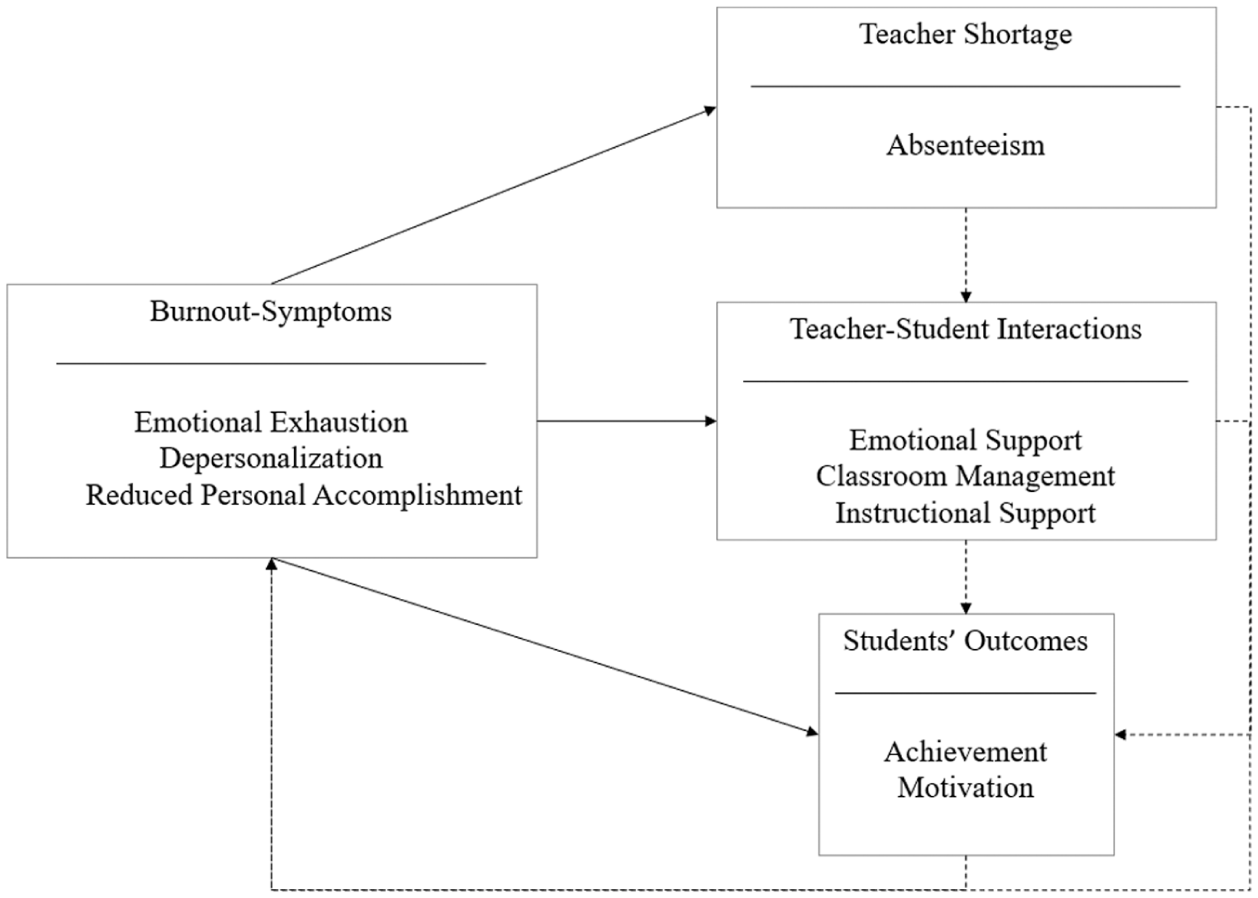
Heuristic working model.
Although burnout is classified as the presence of all three of these symptoms in the ICD-11 (WHO, 2021), it is important to consider the different severities of emotional exhaustion, depersonalization, and reduced personal accomplishment (Maslach et al., 2001; Nadon et al., 2022). Current research has drawn on the underlying assumption that individuals can experience different patterns of the three burnout symptoms, which may develop differently over time (Herman et al., 2018; Mäkikangas & Kinnunen, 2016).
Furthermore, research on antecedents of burnout has suggested differential associations, with emotional exhaustion being most strongly related to general indicators of high job demands (e.g., time pressure) and depersonalization resulting more from social stressors, such as highly demanding interactions and value dissonance (Byrne, 1994; Skaalvik & Skaalvik, 2017; van Droogenbroeck et al., 2014). In contrast, reduced personal accomplishment seems to be most strongly related to self-efficacy (Brouwers & Tomic, 2000). Accordingly, differential associations with theoretically postulated consequences of the individual burnout symptoms are also feasible. Therefore, our meta-analyses considered all three burnout symptoms differentially.
Theoretical Consequences of Teacher Burnout: Constructs and Theoretical Models
Various theoretical approaches have provided explanations for how burnout may influence workplace behavior through different psychological pathways; these can be motivational, social, cognitive, or physical (Fredrickson, 2001; Hobfoll, 1989; Lazarus & Folkman, 1984; Maslach & Leiter, 1999). Numerous studies have documented these relations with individual behavior in terms of reduced professional performance and high rates of absenteeism across different occupational fields (Bakker & Costa, 2014; Salvagioni et al., 2017; Taris, 2006). In light of this, examining the strength of the association between burnout and professional consequences among teachers is especially important. In the following, we first define what we mean by the professional consequences. Subsequently, we elaborate on the theoretically and empirically suggested associations between burnout and each theoretical consequence for the teaching profession (see Figure 1).
Teacher Absenteeism
Previous research has suggested that burnout (as a chronic stress reaction) is inherently related to physiologic processes (Lazarus, 2006; Madigan et al., 2023; Maslach et al., 2001). For instance, burnout symptoms are associated with health problems such as cardiovascular diseases, eating disorders, and gastrointestinal diseases (Toppinen-Tanner et al., 2009). Moreover, other physical symptoms such as headaches, sleeping problems, and physical fatigue are frequently discussed in the context of burnout (Madigan et al., 2023; Schaufeli et al., 2020). Hence, the physical and psychological stress experience is likely to result in increased sick leave and absenteeism due to exhaustion and depleted resources.
Teacher–Student Interactions
The central task of teachers is to establish effective learning environments by engaging in supportive teacher–student interactions that enhance student motivation and promote student learning (Bardach & Klassen, 2020; Kim et al., 2019; Zee & Koomen, 2016). Established conceptual frameworks describing the classroom processes that contribute to student learning and motivation suggest three dimensions of teacher–student interactions, namely emotional support, classroom management, and instructional support (Hamre et al., 2013; Kunter & Voss, 2013; Praetorius et al., 2018). Emotional support describes the facilitation of a positive learning environment and respectful interactions, which result from teachers’ sensitivity to the academic, social, and emotional difficulties of students as well as their consideration of students’ needs and ideas (Strati et al., 2017). Effective classroom management represents teachers’ ability to proactively manage student misbehavior, to deal appropriately with classroom disruptions, and to maximize instructional learning time through well-established classroom rules and routines (Clunies-Ross et al., 2008). Effective classroom management behavior is reflected in students following directions rather than displaying aggression or defiance (Clunies-Ross et al., 2008). Instructional support subsumes teachers’ strategies to promote students’ interest, active engagement, and content understanding; the quality of feedback; and the provision of cognitively challenging tasks and classroom discussions (Hamre et al., 2013).
In their model of the consequences of teacher burnout, Maslach and Leiter (1999) proposed that burnout is reflected in the behavior of the teacher. According to the motivational processes described in the conservation of resources theory (Hobfoll, 1989), teachers experiencing burnout should invest less time and effort in lesson planning and social interactions in class as these teachers attempt to avoid a further loss of resources (Hobfoll, 1989; Maslach & Leiter, 1999). Likewise, burnout impairs social interactions; this is reflected in more reserved and critical interactions with students and less empathy for and more neglect of students’ needs (Lazarus & Folkman, 1984; Maslach et al., 2001; Trauernicht et al., 2021) due to insufficient resources to care for others. Regarding cognitive processes, the broaden-and-build theory (Fredrickson, 2001) presumes that negative emotional states, such as emotional exhaustion, harm cognitive functioning because negative thoughts occupy the capacity of the working memory. Accordingly, teachers experiencing burnout are likely to give lessons that are less cognitively activating, and they may be less flexible in responding to students’ questions. Furthermore, they are likely less effective at classroom management and problem solving when unexpected events occur or when multiple requirements collide (Ortner, 2012; Seiz et al., 2015).
Student Motivation and Achievement
According to the theory of self-determination (Ryan & Deci, 2020), student motivation exists on a continuum, ranging from autonomous (i.e., intrinsic) to controlled (e.g., extrinsic), and depends on the satisfaction of three basic psychological needs, namely autonomy, competence, and relatedness (Bureau et al., 2022; Ryan & Deci, 2020). Complementary to this theoretical perspective, the expectancy-value theory (Wigfield & Eccles, 2000) suggests that both students’ beliefs about their own abilities, including self-efficacy and self-concept, and their task values, encompassing intrinsic interest, perceived utility, and external motives such as incentives and punishment avoidance, determine students’ behavioral engagement in learning activities.
Student achievement comprises performance in different subjects that indicate whether specific learning objectives have been accomplished (Steinmayr et al., 2015). Learning objectives include the acquisition of specific knowledge and competence, the understanding of content that is specified in the respective curricula (e.g., numeracy, literacy, and historical facts), and the development of meta-cognitive skills (e.g., planning, monitoring, drawing inferences, and elaborating). In this study, we focused on the conceptualization of student achievement through grades and test scores. Although grades are regarded as ecologically valid indicators of student achievement that represent more of a cumulative assessment of students’ general performance, they may be biased by the class average achievement as a frame of reference or by teachers’ perceptions (Kriegbaum et al., 2018; Steinmayr et al., 2015). In contrast, standardized test scores are considered to be more objective measures of student knowledge or academic skills (Kriegbaum et al., 2018; Steinmayr et al., 2015).
Different mechanisms have been proposed that account for the relationship between teacher burnout and student development. First, the above-mentioned work suggests that a reduced quality of teacher–student interactions accounts for the negative relationship between teacher burnout (in particular depersonalization) and both student motivation and student achievement (e.g., Benita et al., 2018; Jennings & Greenberg, 2009; Kunter et al., 2013; Maslach & Leiter, 1999; Vandenbroucke et al., 2018; for a comprehensive overview of the theoretical assumptions, see also Klusmann et al., 2021). Second, student achievement could be affected by teacher burnout through teacher absenteeism. If a teacher is frequently absent due to sick leave as a result of emotional exhaustion (Salvagioni et al., 2017), students do not have an effective learning environment or the opportunity to engage in learning activities. Third, a direct link between teacher burnout and student motivation is also feasible because students directly perceive teacher burnout symptoms (Evers et al., 2004). This might be especially evident for teacher emotional exhaustion, which might lead students to adopt the overwrought mood of their teacher, thereby impairing their cognitive-motivational attitudes and behavior. This is often discussed as a contagion effect (Bakker & Schaufeli, 2000; Oberle & Schonert-Reichl, 2016).
Beyond these assumptions, the constructs under consideration are likely mutually interrelated. For example, low student motivation and disruptive behavior might impede teacher–student interactions and further promote the development of teacher burnout symptoms (Aloe et al., 2014; Jennings & Greenberg, 2009; de Ruiter et al., 2020). Because of the multiplicity of plausible mechanisms, we refer to teacher absenteeism, teacher–student interactions, and student motivation and achievement as correlates for the remainder of this article. With this, we want to emphasize that even though the meta-analyses focused on hypothesized consequences of burnout, they do not convey causal relationships.
This Study
With this study, we aimed to provide a systematic review of central, theoretically derived consequences of teacher burnout and examine the research questions of whether teacher burnout relates to teacher absenteeism, effective learning environments (i.e., indicated by classroom management, emotional support, instructional support, and general teacher–student interactions), and student motivation and learning. With this comprehensive approach, we go beyond previous research syntheses (Aloe et al., 2014; Madigan & Kim, 2021a, 2021b; Madigan et al., 2023; Salvagioni et al., 2017) and significantly add to the literature in several respects. First, we intended to synthesize empirical findings on a comprehensive set of potential theoretically postulated consequences of burnout at different levels of manifestation. This allowed us to examine (a) whether burnout manifests not only in cognitive withdrawal (i.e., turnover intentions; Madigan & Kim, 2021b) but also in actual absenteeism due to sick leave, (b) whether previous meta-analytic findings on classroom management (Aloe et al., 2014) also hold true based on an updated literature search and for the two other key dimensions of teacher–student interactions (i.e., emotional and instructional support), and (c) whether the association with student motivation and achievement can be verified meta-analytically based on an updated literature search beyond systematic reviews of existing research (Madigan & Kim, 2021a). Importantly, although prior reviews have examined selected consequences of teacher burnout, the existing evidence remains fragmented across isolated outcomes, timeframes, and methodologic approaches. This fragmentation limits theoretical integration and hampers the development of evidence-based interventions that require a coherent understanding of how burnout manifests across different professional correlates. By integrating this broad set of correlates within a single research synthesis, our study provides a coherent and methodologically consistent framework that clarifies the relevance of teacher burnout symptoms for different aspects of professional functioning. Second, we considered all three burnout symptoms separately so as to examine potential effects differentially (Maslach et al., 2001), which is essential for theory support and the design of targeted interventions. Third, our meta-analyses are the first to investigate the potential influence of common-method bias by investigating the rater perspective (i.e., teacher self-report vs student report/classroom observation) as a moderator in meta-regression analyses. Importantly, this approach allows us to examine whether correlates of burnout are detectable solely through self-reports or also manifest in externally observable behavior, consistent with Maslach and Leiter’s (1999) original conceptualization of burnout. Finally, we systematically reviewed longitudinal studies to examine whether cross-sectional effect sizes are also evident across different time spans. To date, no such comprehensive overview of the associations between teacher burnout and professional correlates exists. Taken together, this synthesis not only consolidates the existing evidence but also identifies critical gaps in the literature and provides a theoretically and empirically informed agenda for future research and intervention development.
With regard to the different theoretical perspectives, which suggest that teacher burnout is associated with motivational, social, cognitive, and physical impairments that influence individual behavior, concrete assumptions can be derived. First, we hypothesized that all three symptoms of teacher burnout, namely emotional exhaustion, depersonalization, and reduced personal accomplishment, are positively related to absenteeism, with emotional exhaustion probably showing the strongest associations due to its theoretical conceptualization as the stress dimension of burnout and inherent relationship to physiologic processes (Lazarus, 2006; Maslach et al., 2001). Second, we hypothesized a negative relationship between burnout symptoms and the quality of teacher–student interactions, which we expected to be especially evident in both depersonalization and reduced personal accomplishment (Maslach & Leiter, 1999; van Droogenbroeck et al., 2014; Zee & Koomen, 2016). Depersonalization is conceptualized as the interpersonal dimension of burnout, which is reflected in disinterested, detached, and hostile behavior toward students (Maslach & Leiter, 1999). Reduced personal accomplishment describes a person’s perceived lack of ability to complete job tasks effectively (Maslach & Leiter, 1999), which might be especially evident in the quality of classroom management and instructional support because these dimensions of teacher–student interactions seem to be particularly dependent on teacher competence in the implementation of specific methods and strategies (Kunter et al., 2013). Third, we hypothesized that there is a negative association between burnout symptoms and student motivation and achievement. We presumed that the negative association between teacher burnout and the quality of teacher–student interactions would translate into a negative association with student motivation and achievement because these student variables largely depend on the quality of teacher–student interactions (Kunter et al., 2013). Because we expected to find the strongest relationship for both depersonalization and reduced personal accomplishment with teacher–student interactions (Benita et al., 2018; Maslach & Leiter, 1999), a closer association of these two burnout symptoms with student motivation and achievement also appeared likely. However, against the background of absenteeism due to sick leave and the contagion effect described earlier, a relationship with emotional exhaustion could also be expected (Oberle & Schonert-Reichl, 2016; Salvagioni et al., 2017).
In addition to analyzing the association between burnout and professional correlates among teachers, we considered study and sample characteristics that might account for potential heterogeneity in effect sizes across studies. We controlled for the following sample characteristics to explore whether the observed effect sizes could be generalized across different samples (i.e., whether the findings were consistent across samples with different characteristics): teacher gender, years of teaching experience, and grade level. These characteristics were discussed to account for different experiences of burnout (Ballantyne & Retell, 2019; Huberman, 1989; Purvanova & Muros, 2010).
Regarding the methodologic characteristics of the studies, we investigated whether effect sizes varied as a function of publication year, type of publication, and teacher self-reports. The sole reliance on self-reported questionnaires poses a substantial risk of common-method bias (Podsakoff et al., 2012), thereby inflating observed correlations, which leads to an overestimation of the relationships.
Finally, we also examined longitudinal research on the consequences of teacher burnout. Longitudinal studies are sometimes considered to be especially informative about how differences in burnout symptoms might be linked with subsequent changes in teacher and student outcomes. However, longitudinal effect sizes are difficult to compare because they are influenced by the individual time lag between the repeated measurements and by the frequent inclusion of baseline levels in the analysis of change (e.g., prediction of the students’ end-of-year grade by teacher burnout at the beginning of the school year while controlling for the students’ baseline performance). For this reason, we expected that correlations from longitudinal studies would tend to be smaller than cross-sectional associations.
Method
Literature Search
To identify relevant studies on the relationship between teacher burnout and its professional correlates, a systematic literature search was carried out in November 2020 and updated in October 2021 and April 2025 using several strategies, which are illustrated in Figure 2. We combined an electronic database search (i.e., PsycINFO, Web of Science, and OpenGrey) with additional manual search strategies to identify both published and unpublished work on teacher burnout. Because we were only interested in teachers currently teaching at preschools, elementary schools, and secondary schools, we further narrowed the search to these types of schools. The exact search terms and the respective search strategies that were employed in the different databases are described in detail in the Online Supplement (Supplementary Table S1) in the online version of the journal.
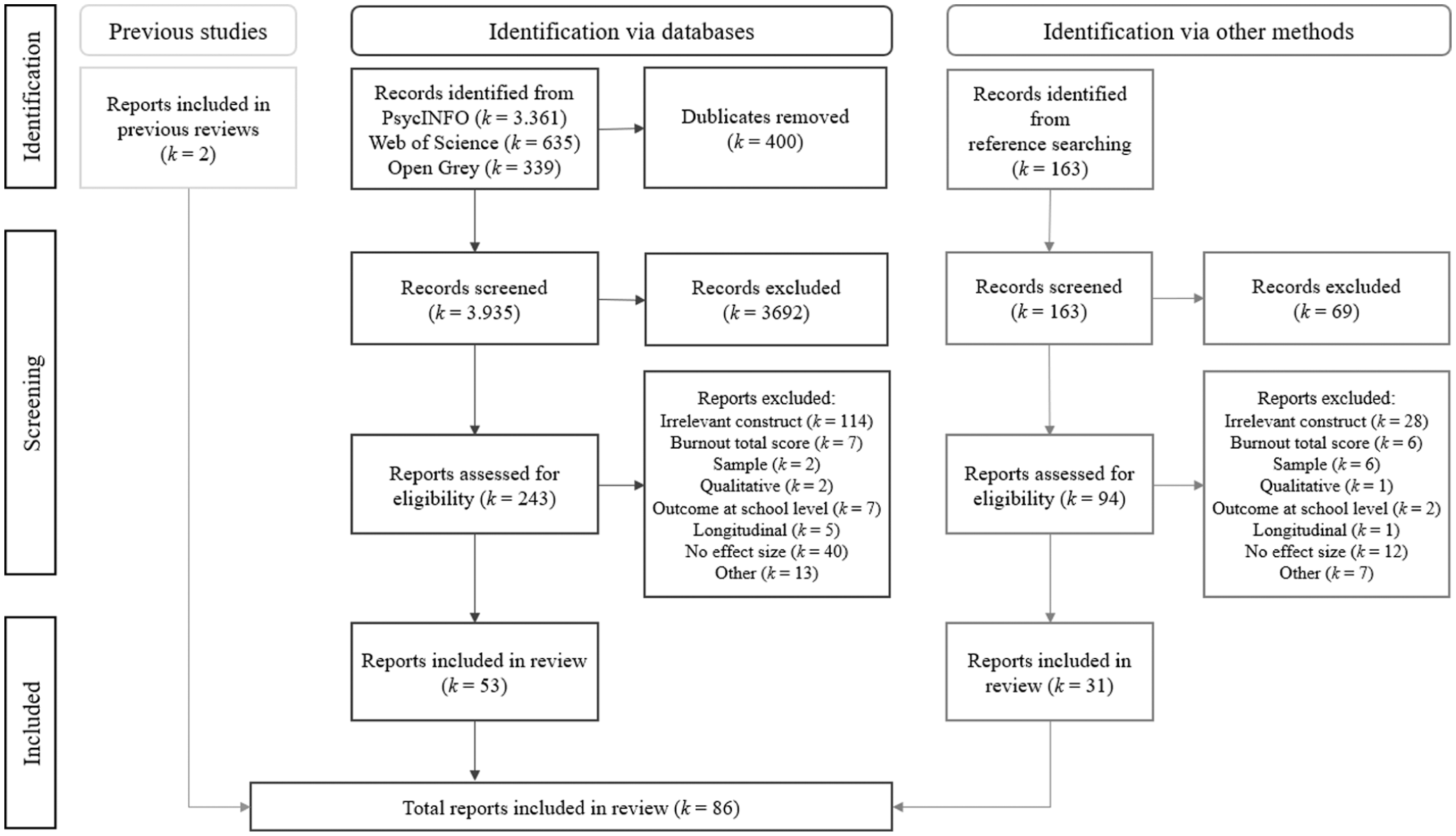
PRISMA (Preferred Reporting Items for Systematic Reviews and Meta Analyses) flow diagram for the literature search process.
To generate a comprehensive literature search, we only combined the thesaurus search terms for teacher with the thesaurus terms for burnout in PsycINFO, leaving the correlate of interest out in the first step. This search identified 3,361 results. For the electronic search using Web of Science, we confined the search and included the correlate of interest. This resulted in 635 additional records after removing duplicates. To search specifically for unpublished work, theses, and dissertations, we conducted an additional search in OpenGrey, which revealed 339 additional records.
In the second step, we conducted both a backward search based on the reference lists of the identified studies and a citation search. To make sure that we had not missed any relevant studies, we reviewed previous meta-analyses that either comprised some of our variables or concerned similar relationships observed in mixed occupational groups. A further 165 records were identified with these additional strategies.
Inclusion and Exclusion Criteria
Records identified by the aforementioned search strategies were first screened by title and abstract, followed by a full-text coding of eligible studies. The prescreening was conducted by the first and second authors, with the support of three student research assistants, and was based on the following criteria. We included studies for the subsequent full-text coding that (a) assessed teacher burnout; (b) reported on professional correlates in terms of absenteeism, teacher–student interactions, and student motivation and achievement; (c) investigated a sample of teachers currently teaching at pre-, elementary, and secondary schools; (4) provided quantitative data; and (5) were written in a language with a Latin alphabet. This resulted in a decision to either include studies that met (coded as 1) or excluded studies that did not meet all the inclusion criteria (coded as 0). Before prescreening, all coders completed a training session based on the coding manual. Intercoder agreement regarding the decision to include or exclude records for the subsequent full-text coding was established based on the double coding of 35% of the identified records (k = 1,377) with κ = .90. On the basis of the elucidated criteria and as illustrated in the PRISMA flow diagram (Page et al., 2021; Pigott & Polanin, 2020) in Figure 2, a total of 3,761 records were excluded after screening the titles and abstracts, leaving 339 studies for further coding. In the second coding step, we decided to exclude or include studies in the systematic review based on the following refined criteria.
Criteria Regarding Teacher Burnout
We excluded studies that reported only a total burnout score (e.g., Høigaard et al., 2012), with the exception of studies that applied instruments that conceptually allowed a differentiation between individual burnout symptoms. This concerned studies that applied the Maslach Burnout Inventory (k = 5; Maslach et al., 2018) but also the Tedium Scale (k = 3; Pines & Kafry, 1978), the Cherniss Burnout Scale (k = 2; Burke & Deszca, 1986), the Burnout Clinical Subtype Questionnaire (k = 3; Montero-Marín & García-Campayo, 2010), the Copenhagen Burnout Inventory (k = 1; Kristensen et al., 2005), the Shirom–Melamed Burnout Measure (k = 1; Shirom & Melamed, 2006), and the Oldenburg Burnout Inventory (k = 1; Demerouti et al., 2001). Of the 16 authors contacted to request the correlations for individual burnout symptoms, eight responded and provided the requested coefficients.
Criteria Regarding the Professional Correlates
Supplementary Table S4 in the online version of the journal provides a detailed summary of the definitions and operationalization of constructs included as correlates of teacher burnout. To focus on teacher–student interactions, we excluded measures that captured teacher self-appraisals, such as scales on teacher self-efficacy or teacher educational beliefs (e.g., Tschannen-Moran & Hoy, 2001). These scales closely align with reduced personal accomplishment and therefore would lead to a conceptual overlap. We retained studies measuring the absence of disciplinary problems, which was often used as an indicator of effective classroom management. Additionally, we kept studies that combined items reflecting emotional support, classroom management, and instructional support into one scale coded as general teacher–student interactions. Studies that assessed correlates at the school level (e.g., Huk et al., 2019) generally were excluded because these measures do not allow for a precise identification of the effects at the individual teacher level. Regarding both the burnout symptoms and the correlates, we excluded studies if an explicit classification of the observed construct was not possible because the studies did not provide a transparent description of the operationalization, nor did other literature that used the respective scales (e.g., Chattopadhyay & Bhattacharya, 2002).
Criteria Regarding Teacher Sample
Studies that surveyed only principals, preservice teachers, student teachers, or administrative school staff were excluded from the meta-analysis, as were studies that investigated teachers who were currently not working as a teacher due to sick leave, retirement, or other reasons. We decided to exclude university teachers because the higher educational context is not directly comparable with general school contexts, which likely reduces the comparability of the samples and increases heterogeneity between studies. For the same reason, we excluded samples that only comprised special education teachers because these teachers, in many countries, work in special education schools, in which they are often confronted with smaller classes, different tasks focusing more on social-emotional work with students (e.g., supporting students with special needs or supporting colleagues through team-teaching), and differ in their perception of their workload manageability compared with general school teachers (Bettini et al., 2017; Zigmond & Kloo, 2017). Studies with mixed samples were included if the sample comprised >50% general pre-K, elementary, or secondary school teachers. Consequently, special education teachers working at general school contexts were included in the meta-analytic sample.
Criteria Regarding Data Analyses
We included studies that reported statistics for mean differences because it was possible to convert these coefficients into correlations (Thalheimer & Cook, 2002), with the exception of one study that did not report sufficient information to enable us to convert effect sizes (Pillay et al., 2005). However, we did not code effect sizes from multiple regression analyses or structural equation models because these analyses typically controlled for covariates, which differ greatly between studies. Longitudinal studies were excluded from the meta-analysis for the same reason, but we still included them in the systematic review if they reported bivariate correlations between burnout symptoms at a prior time point and at least one of the correlates considered at a subsequent measurement point.
If the study did not report relevant effect sizes for the relationships of interest, we accessed the primary data available to calculate the respective correlation coefficients (Aelterman et al., 2019; Arens & Morin, 2016), or we requested the required correlations from the authors. For this purpose, we contacted 52 authors. Fourteen responded to our request, and seven were able to provide the required coefficients.
Other Reasons for Exclusion
Studies that were based on an intervention that affected the burnout symptoms or the correlates were not included in the systematic review if the measurement occurred after treatment. Interventions, for example, targeting the facilitation of high-quality teacher–student interactions might bias the association between teacher burnout and the correlates considered. To ensure that correlations were not influenced by intervention effects, effect sizes were taken exclusively from baseline assessments or control groups for intervention studies. Accordingly, we contacted the respective authors to request the correlations either for the control group or at the baseline before the implementation of any intervention. Of the 12 authors we contacted for this reason, eight answered, and four were able to provide the requested information.
Using these criteria, 253 records were excluded after full-text coding. Consequently, 86 studies were included in the meta-analyses. A list of the studies included is available in Supplementary Tables S2 and S3 in the online version of the journal. Based on double coding of 153 studies (45% of reports assessed for eligibility), coders reached agreement on inclusion or exclusion in 84% of cases. All disagreements were resolved through discussion. Figure 2 summarizes the specific reasons that studies were excluded.
Coding
The first and second authors conducted the full-text coding and extracted the following information from primary studies. First, we retrieved the main study characteristics (e.g., the names of the authors, the publication year, and the type of publication). Second, regarding the sample characteristics, we recorded the sample size, the percentage of female teachers, the mean teaching experience, the grade level taught (i.e., elementary, secondary, or mixed), the school type (i.e., private, public, or mixed), and the country. Third, we captured the following information for teacher burnout: the burnout symptom examined, the instrument used, and the reliability. Regarding the correlates, we coded the investigated construct, the reliability, and information on whether teacher self-reports, student reports, observational measures, or standardized tests were applied. Finally, we retrieved the effect size and coded the following additional information: the level of significance and information on whether manifest or latent correlations were retrieved.
The agreement between coders was assessed by double coding 50% (n = 43) of the 86 studies included. The first author re-coded studies previously coded by the second author, and a trained student research assistant re-coded studies originally coded by the first author. Regarding the categorization of burnout symptoms, the interrater reliability was κ = .88, and regarding the classification of the correlates into the associated coding categories, the interrater reliability was κ = .80. In addition to the double coding, studies for which uncertainties arose during the coding process or for which the coding decisions were not entirely clear were discussed by the research team to ensure that no study was incorrectly coded. The data are published open access at PsychArchive (https://doi.org/10.23668/psycharchives.21918).
Data Processing
We conducted several preliminary steps before aggregating the effect sizes meta-analytically. First, we converted effect sizes other than correlation coefficients (Borenstein et al., 2009; Thalheimer & Cook, 2002). Second, we re-coded effect sizes for the sake of interpretability so that negative correlations reflected findings where higher levels of burnout were associated with less favorable professional correlates. This was necessary because primary studies differed with regard to whether they reported the effect sizes for positively or negatively scored constructs (e.g., personal accomplishment vs reduced personal accomplishment; student misbehavior vs lack of student misbehavior).
Third, although most studies reported manifest effect sizes, four studies reported only latent correlations. To increase the comparability of the effect sizes, we estimated the uncorrected correlation for these four studies, following the formula of Hunter and Schmidt (2004, p. 96). Finally, we considered the following three types of dependencies that emerged in the data of the primary studies: (a) dependent subsamples examining the same relationship, (b) multiple effect sizes for the same association due to the use of multiple subscales of the respective construct, and (c) self-reports and other reports of the observed construct being used within one sample. Ignoring the dependency of multiple effect sizes would entail the risk of a biased estimation of the summary effect in the sense of an overestimation of the precision of the mean relationship if the dependent effect sizes were positively correlated (Borenstein et al., 2009; Hunter & Schmidt, 2004; Rodgers & Pustejovsky, 2019). To address the problem of dependent samples, we did not include multiple reports of the same relationship that were based on a dependent sample. Therefore, we retained the respective effect sizes from the most comprehensive study and excluded dependent subsamples. To account for dependent effect sizes due to the use of multiple subscales, we aggregated the correlation coefficients that referred to the same construct into a single correlation for the (composite) construct by using the procedures recommended by Hunter and Schmidt (2004, pp. 435–439). Likewise, we computed the reliability of the composite correlation using the Spearman–Brown formula (Hunter & Schmidt, 2004, p. 438). This approach retains as much information as possible and avoids the dependence on effect sizes caused by the use of multiple subscales in the same sample (Borenstein et al., 2009). Because we aimed to investigate potential differences in effect sizes arising from rater perspective, self-reports and other reports were not combined. This applied to four studies. Although the error in the aggregated effect sizes is reasonably small if the number of effect sizes that are based on the same sample is minor compared with the total number of effect sizes included in the synthesis (Hunter & Schmidt, 2004), we applied robust variance estimation to address the dependencies in sampling errors within these studies (Hedges et al., 2010).
Analyses
To investigate the research question, we conducted a univariate meta-analysis for each combination of the three burnout symptoms and the correlates. Against the background of the expected variability in the true effect sizes between studies in addition to heterogeneity caused by sampling error, we specified random-effects models throughout (Borenstein et al., 2009; Raudenbush, 2009). To this end, we used the Hunter–Schmidt estimator for the between-study variance in all models and analyzed the untransformed correlation coefficients weighted by sample size using the R package metafor (Field, 2001; Viechtbauer, 2010). We performed robust variance estimation to consider the dependencies caused by multiple effect sizes within studies that were based on self-reports and other reports (Hedges et al., 2010). Additionally, we conducted psychometric meta-analyses with the R package psychmeta to further adjust the results for the attenuation in effect sizes caused by measurement error (Dahlke & Wiernik, 2021). For this purpose, we corrected the correlations for measurement error by means of artifact distribution to obtain more precise estimates of the effect sizes (Borenstein et al., 2009; Hunter & Schmidt, 2004). Detailed results for the psychometric meta-analyses are reported in Supplementary Table S5 in the online version of the journal, which resulted in effect sizes that followed roughly the same pattern but tended to be larger in magnitude. We did not conduct a meta-analysis for associations with fewer than five primary studies (Higgins et al., 2009), but we did systematically review the respective studies.
The total amount of heterogeneity was estimated based on τ2. Additionally, we considered the Q test for heterogeneity and I2 for the proportion of variance between studies. To investigate the amount of heterogeneity in the effect sizes that could be attributed to study and sample characteristics, we estimated meta-regression models with the following moderators: publication year, type of publication, teacher gender, years of teaching experience, grade level (i.e., elementary, secondary, or mixed), and the operationalization of the correlates (i.e., self-reports or other). Categorical moderators were dummy coded for these analyses. Additional subgroup analyses were conducted to further explore the differences between teacher self-reports and external reports for teacher–student interactions.
Meta-analyses are susceptible to publication bias, which can lead to distorted estimates of the average effect size (Borenstein et al., 2009; Carter et al., 2019). For this reason, we investigated publication bias both visually, using funnel plots, and statistically, using Egger’s tests and by reporting precision-adjusted effect-size estimates (Egger et al., 1997). For an overview of a similar methodologic approach, see Wartenberg et al. (2023).
Results
Study Characteristics
The 86 studies reported results for 90 independent samples, representing a total sample size of 38,457 teachers. The studies included were published between 1986 and 2025. However, most studies were conducted after 2015 (66%), indicating a significant increase in research on the correlates of teacher burnout in the past 10 years. Of the 86 studies included, 80 represented published journal articles, whereas six studies referred to unpublished work, including dissertations (k = 5) and one master’s thesis. Most of the studies included were cross-sectional, with only 23 studies being longitudinal, of which 15 represented intervention studies. Regarding the country of origin, 26 of the studies investigated U.S. samples, 17 were conducted in Germany, six in Norway, five in the Netherlands, and four in Belgium. The remaining studies included other European countries, Ghana, Israel, Canada, China, Taiwan, and the Philippines. The sample size ranged from five to 4,567 teachers. On average, 74.72% of participants per sample were female teachers (SD = 19.13), with an overall mean teaching experience of 14.19 years (SD = 4.98) across samples.
Most of the samples included measures of emotional exhaustion (k = 86), confirming the tendency in research to investigate emotional exhaustion as the central symptom of burnout. Nevertheless, 37 samples reported results for depersonalization and reduced personal accomplishment, respectively. Almost all studies included applied the Maslach Burnout Inventory (Maslach et al., 2018). Only 10 studies adopted other instruments, including, among others, the Emotional Exhaustion Subscale of the Friedman Burnout Scale (Friedman & Farber, 1992), the Tedium Scale (Pines & Kafry, 1978), and the Burnout Clinical Subtype Questionnaire (Montero-Marín & García-Campayo, 2010).
Overall Effects for the Relationship Between Teacher Burnout Symptoms and Professional Correlates
In this section we describe the meta-analytic findings on the relationship between the three burnout symptoms and the respective correlates. In line with Cohen’s (1988) recommendations, we interpreted correlation coefficients ≥.10 as small, ≥.30 as moderate, and ≥.50 as large. Subsequently, we supplemented the meta-analytic findings with those of a systematic review of the primary study results from which a calculation of overall effect sizes was not possible. This concerns effect sizes where fewer than five studies were available, providing an insufficient empirical basis for meta-analytic methods (Higgins et al., 2009). The overall effect sizes for the remaining correlations are reported in Table 1, together with information about the sample size and heterogeneity and the effect sizes that were adjusted for measurement error. Forest plots illustrating the effects and the 95% confidence intervals for each study are depicted in Supplementary Figures S1–S17 in the online version of the journal.
Association Between Teachers’ Burnout and Professional Correlates
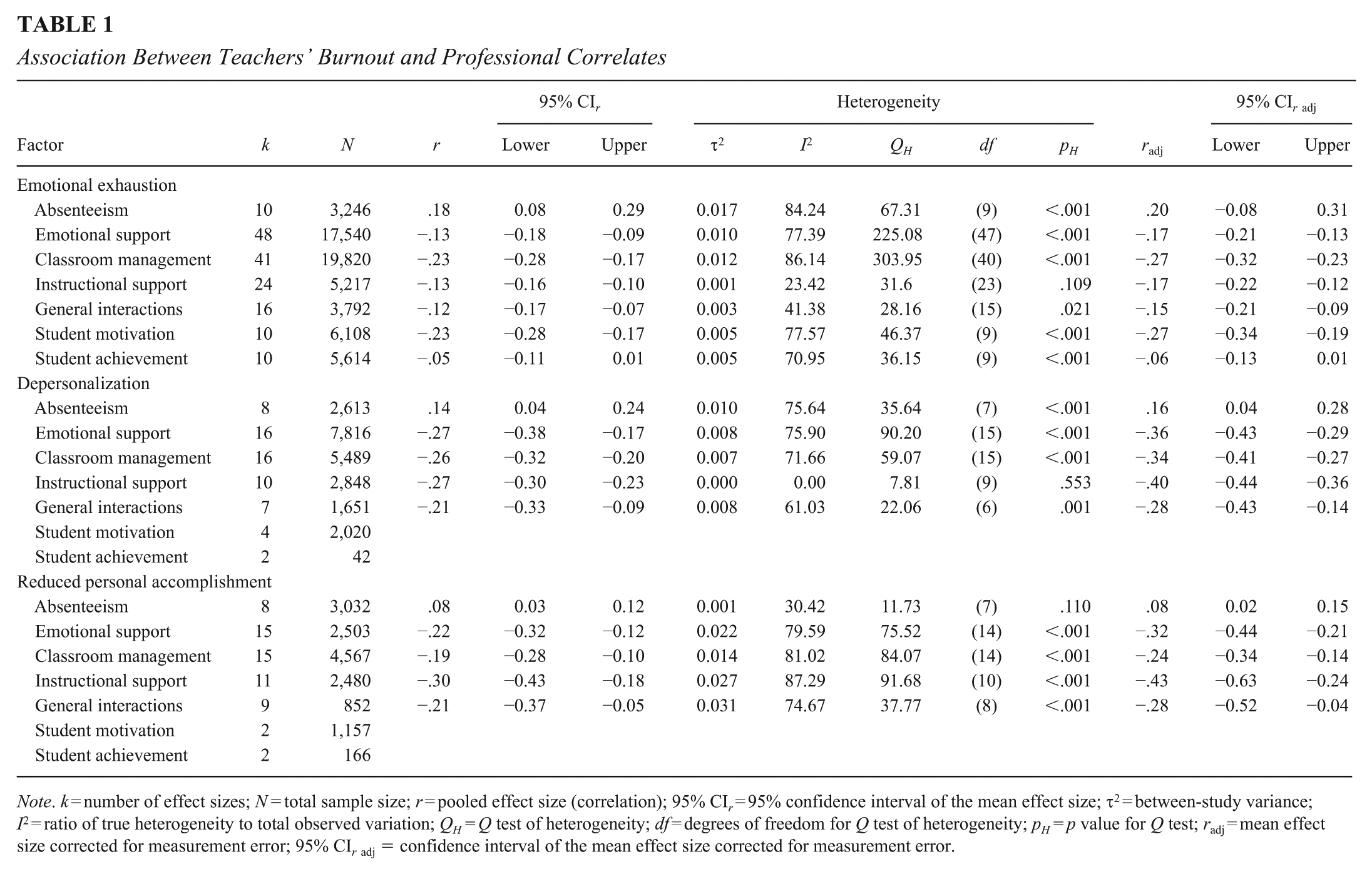
Note. k = number of effect sizes; N = total sample size; r = pooled effect size (correlation); 95% CI r = 95% confidence interval of the mean effect size; τ2 = between-study variance; I2 = ratio of true heterogeneity to total observed variation; QH = Q test of heterogeneity; df = degrees of freedom for Q test of heterogeneity; pH = p value for Q test; radj = mean effect size corrected for measurement error; 95% CI r adj = confidence interval of the mean effect size corrected for measurement error.
Teacher Absenteeism
Ten studies investigated the relationship between emotional exhaustion and absenteeism, with a small effect size of r = .18 (95% CI r = 0.08–0.29), indicating that teachers with higher levels of emotional exhaustion were more frequently absent from work. Seven of these 10 studies found a significant positive association between emotional exhaustion and both the teacher self-rated number of days absent (e.g., Ebert et al., 2014; van Dick & Wagner, 2001) and the objective assessment of days absent obtained from administrative records (e.g., Bartoli, 2002; Moriana & Herruzo, 2006). Eight studies examined depersonalization in the context of absenteeism, most of which showed nonsignificant small positive correlations between depersonalization and absenteeism (r = .14; 95% CI r = 0.04–0.24). Eight studies also examined reduced personal accomplishment in the context of absenteeism, with an overall effect size near zero (r = .08; 95% CI r = 0.03–0.12), yielding a small significant association between reduced personal accomplishment and the amount of time spent absent from work. Consequently, the findings indicate that teachers experiencing higher levels of emotional exhaustion and depersonalization and reduced personal accomplishment are more likely to be absent from work.
Teacher–Student Interactions
Emotional Support
Regarding the relationship between teacher burnout and emotional support for students, we found significant negative correlations for all three burnout symptoms. On the basis of 48 effect sizes, we found a small correlation of r = −.13 (95% CI r = −0.18 to −0.09), indicating a negative association between teacher emotional exhaustion and the quality of emotional support, as measured by teacher self-reports (k = 26), student reports (k = 11), or classroom observations (k = 711). Considering depersonalization, 16 studies investigated the association with emotional support, resulting in a small effect size of r = −.27 (95% CI r = −0.38 to −0.17). Thus, teachers experiencing depersonalization seemed to provide less emotional support, according to teacher (k = 13), student (k = 1), and observer ratings (k = 2). Finally, 15 studies examined reduced personal accomplishment in conjunction with emotional support, yielding a small correlation of r = −.22 (95% CI r = −0.33 to −0.10). In summary, we found small to moderate negative relationships, implying that teachers experiencing burnout are less supportive of students’ individual needs and are less effective at establishing caring, respectful, and collaborative interactions.
Classroom Management
We found small negative correlations between emotional exhaustion (r = −.23; 95% CI r = −0.28 to −0.17), depersonalization (r = −.26; 95% CI r = −0.32 to −0.20), reduced personal accomplishment (r = −.19; 95% CIr = −0.28 to −0.10), and the quality of classroom management. These results suggest that teachers experiencing burnout tend to be less effective at implementing behavioral routines, class rules, and proactive strategies and are more likely to respond to student misbehavior with punitive and controlling strategies, according to teachers (k = 26), students (k = 4), and external observers (k = 11).
Instructional Support
For the relationship between burnout and instructional support, the meta-analyses also revealed significant negative effect sizes for all three burnout symptoms. Combining 24 effect sizes from 23 independent samples resulted in a small negative correlation between emotional exhaustion and instructional support (r = −.13; 95% CI r = −0.16 to −0.10). With regard to depersonalization, 10 studies reported effect sizes from 12 independent samples, yielding a small negative correlation of r = −.27 (95% CI r = −0.30 to −0.23) with teachers’ instructional support. Based on 11 effect sizes, a moderate association was found between teachers’ reduced personal accomplishment and instructional support (r = −.30; 95% CI r = −0.43 to −0.18). Summarizing these results, teachers experiencing burnout symptoms seem to be less successful regarding the facilitation of cognitive activation and higher-order thinking and the implementation of good instructional practices. These relationships were evident for teacher self-reports (k = 10) as well as for student (k = 3) and external observer ratings (k = 12) of instructional support.
General Interactions
Sixteen studies investigated general teacher–student interactions that comprised unspecific interactional processes or a combination of different interactional dimensions (e.g., as measured by the Student–Teacher Relationship Scale; Pianta, 2001). For this reason, no clear assignment to one of the three dimensions outlined earlier was possible. We found negative associations between emotional exhaustion (r = −.12; 95% CI r = −0.17 to −0.07), depersonalization (r = −.21; 95% CI r = −0.33 to −0.09), reduced personal accomplishment (r = −.21; 95% CI r = −0.37 to −0.05), and the quality of general teacher–student interactions, as captured either by teacher self-reports (k = 9) or classroom observations (k = 6). These results indicated that teachers experiencing emotional exhaustion, depersonalization, and reduced personal accomplishment are generally less effective at establishing positive teacher–student interactions.
Student Motivation and Achievement
Motivation
Ten studies considered student motivation in the context of teacher emotional exhaustion, resulting in a small overall effect size of r = −.23 (95% CI r = −0.28 to −0.17). This finding suggests that students whose teachers are emotionally exhausted are, on the one hand, less motivated according to their teachers (k = 5) and to external observers (k = 1), and on the other hand, these students experience less satisfaction of their basic psychological needs as well as lower self-reported motivation and interest (k = 4). Four studies also considered depersonalization, and two studies reported effect sizes for reduced personal accomplishment, suggesting significant small to moderate negative correlations with student motivation in terms of teacher perceptions of student motivation and student self-reports of autonomous motivation for learning (e.g., Skaalvik & Skaalvik, 2017; Soenens et al., 2012). One exception was the study by Flook et al. (2013), which did not find a significant relationship between teacher burnout and student engagement in class, as rated by external observers. However, the sample of this study was very small, with only 12 teachers participating in classroom observations.
Achievement
Eleven studies reported on the relationship between teacher burnout and the achievement of their students. Ten independent samples assessed emotional exhaustion, yielding an overall effect size near zero (r = −.05; 95% CI r = −0.11–0.01). Only three studies examined the association between depersonalization, reduced personal accomplishment, and student achievement. In this context, most studies did not find significant effects. Gastaldi et al. (2014) did not find a significant association between depersonalization and reduced personal accomplishment and the number of high- (rDEP = −.12; rRPA = −.17) and low-achieving students in class (rDEP = .16; rRPA = .16), as assessed by the teacher. The same applied for the association between reduced personal accomplishment and student reading (r = .00) and mathematics achievement (r = .00) on standardized tests (Wolf, 2018). Only one study found a moderate negative association (r = −.33) between depersonalization and student mean grades, as specified by the teacher (Valmassoi, 2020). However, this result should be interpreted with caution because only five teachers participated in the study. In summary, the results did not provide evidence for a significant association between teacher burnout and student achievement.
Heterogeneity and Meta-Regression
As Table 1 illustrates, there was substantial heterogeneity between studies, which indicated that the true effects varied between studies. Considering τ2, the greatest total amount of variability among the true effects was observed for emotional support (τ2 = 0.022), instructional support (τ2 = 0.027), and general interactions (τ2 = 0.031) in the context of reduced personal accomplishment. Additionally, for most relationships, I2 indicated that a moderate to large proportion of the total variability (I2 = 41.38–87.29) was based on the true variance of effect sizes between studies (Higgins & Thompson, 2002). There were exceptions for the following three relationships. There was no significant heterogeneity in effect sizes between studies regarding the association between emotional exhaustion and instructional support (Q = 31.60; p = .109), between depersonalization and instructional support (Q = 7.81; p = .553), or between reduced personal accomplishment and absenteeism (Q = 11.73; p = .110). We explored several study and sample characteristics to identify factors that contribute to effect-size heterogeneity and moderate the relationships between teacher burnout and professional correlates. In the following subsections, we describe the results for one study characteristic that proved to be a significant moderator for several relationships, namely the rater perspective (Table 2). The remaining study and sample characteristics that we analyzed are listed in Supplementary Table S6 in the online version of the journal. In general, the findings from the meta-regression should be interpreted cautiously given that some analyses relied on a limited number of effect sizes.
Results from Meta-Regression Analysis Examining Rater Perspective as a Moderator
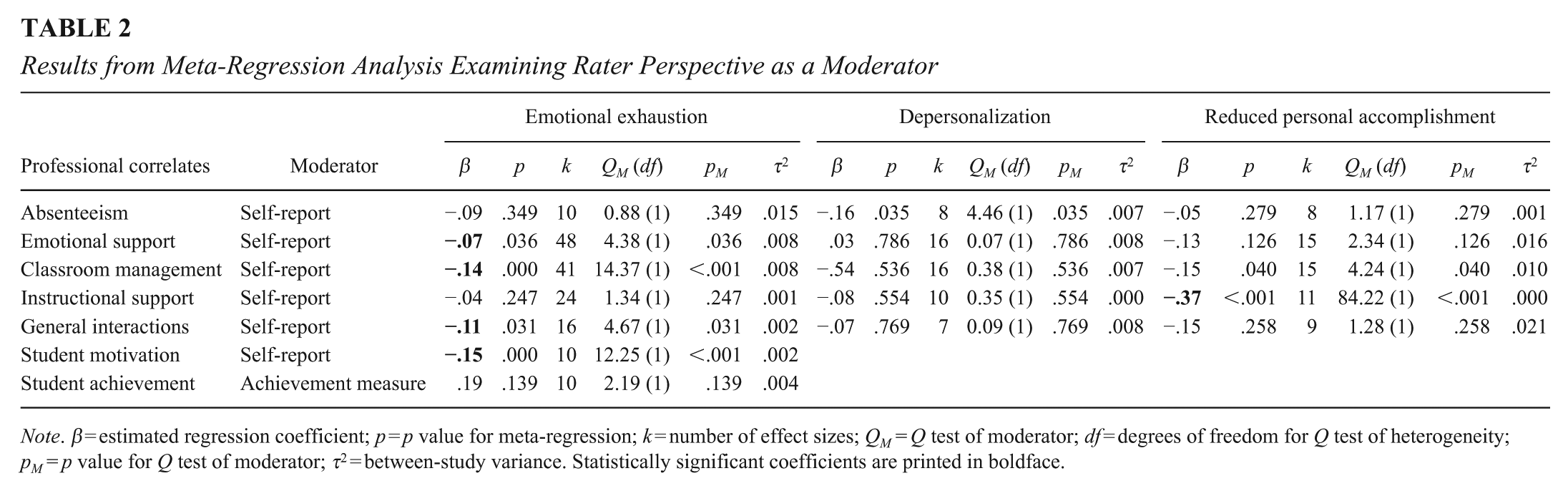
Note. β = estimated regression coefficient; p = p value for meta-regression; k = number of effect sizes; QM = Q test of moderator; df = degrees of freedom for Q test of heterogeneity; pM = p value for Q test of moderator; τ2 = between-study variance. Statistically significant coefficients are printed in boldface.
Regarding the use of teacher self-reports to measure the correlate of interest, meta-regressions revealed that an assessment of teacher emotional support (β = −.07; p = .036) and classroom management (β = −.14; p = .000) via self-reports was related to higher negative correlations with teacher emotional exhaustion (r ES = −.16; 95% CI ES = −0.24 to −0.08; rCM = −.26; (%% CI CM = −0.31 to −0.21). The same was true for the relationship between emotional exhaustion and student motivation (β = −.15; p = .003), which was stronger for teacher self-reports (rSM = −.26; 95% CI SM = −0.31 to −0.21). The effect also was evident when emotional support (rES = −.08; 95% CIES = −0.12 to −0.03), classroom management (rCM = −.10; 95% CICM = −0.15 to −0.05), and student motivation (rSM = −.12; 95% CISM = −0.16 to −0.07) were reported by others, although the relationships were smaller. This was not true for the relationship between reduced personal accomplishment and instructional support (β = −.35; p < .001), which was not significant for external reports (rIS = −.03; 95% CI IS = −0.11–0.04), whereas teacher self-reports of instructional support (rIS = −.41; 95% CI IS = −0.45 to −0.37) revealed significantly larger effect sizes. We did not find any significant differences in the effect sizes for the other relationships between burnout symptoms and types of teacher–student interactions depending on the rater perspective, although, overall, the correlations tended to be smaller for external reports. For a detailed presentation of the subgroup analyses and the separate effect sizes for self-reports and other reports, see Supplementary Figures S21–S31 in the online version of the journal. Considering student achievement, there was no difference in the size of the relationship between teacher emotional exhaustion and student achievement depending on whether standardized tests or teacher evaluations were used to assess student achievement (β = .19; p = .139).
Longitudinal Associations Between Teacher Burnout and Professional Correlates
Of the 31 longitudinal studies that we identified in the literature search, 13 were intervention studies. Of these intervention studies, only eight reported longitudinal effect sizes for the control group or controlled for possible intervention effects. Most of the remaining longitudinal studies did not focus on the consequences of burnout. As a result, either no longitudinal correlation was reported (e.g., Taxer et al., 2019) or burnout was recorded as an outcome at a later measurement point (e.g., Dicke et al., 2014). However, 11 studies indicated longitudinal correlations between burnout dimensions at a prior measurement point and at least one professional outcome at the subsequent measurement point. The vast amount of longitudinal studies investigated dimensions of teacher–student interactions. Supplementary Table S7 in the online version of the journal provides an additional overview of the 20 studies that reported effect sizes for the longitudinal association. Overall, 13 studies implemented two measurement points with a mean time interval of 223.82 days (SD = 140.61; range = 122–933), two studies involved three measurement points with a mean time interval of 91.5 days (SD = 28.5; range = 63–120), and one study implemented four survey dates with 4 months between the first three measurement points and a fourth measurement point after 7 years.
Taking a closer look at the 10 studies that explicitly investigated the consequences of teacher burnout, a mixed picture emerges. For instance, Ansari et al. (2020) examined the relationship between teacher emotional exhaustion at the beginning of the school year and the quality of teacher–student interactions throughout the year in a sample of 117 preschool teachers. Their findings showed a significant negative association between emotional exhaustion and the quality of emotional support, classroom management, and instructional support. In line with this, Benita et al. (2018) also reported that teachers who had experienced higher burnout (i.e., depersonalization) early in the school year saw more classroom disturbances at the end of the school year, a perception shared by their students. Seiz et al. (2015) studied 205 secondary school teachers and found that higher pedagogic/psychological knowledge improved classroom management only when teachers had low emotional exhaustion, enabling them to apply their knowledge effectively.
Although these studies suggest a longitudinal relationship, they did not account for prior instructional quality and do not allow any conclusions to be drawn about the extent to which teacher burnout explains changes in the consequences considered. However, Shen et al. (2015) found that teacher emotional exhaustion at the beginning of the school year was associated with a reduction in ninth and tenth grade students’ perceptions of teacher emotional support and their autonomous motivation by the end of the first school term, based on a sample of 33 teachers and 1,452 students. In line with this, Elzie and Downer (2025) described a positive association between teacher emotional exhaustion (N = 101) at the beginning of the school year and observed student disruptive behavior at the end of the term when controlling for teacher levels of depersonalization and personal accomplishment. This indicates that exhausted teachers are likely to exhibit less effective classroom management strategies over the course of one school term. Hoglund et al. (2015) further demonstrated that teacher emotional exhaustion at the beginning of the second school term was related to less growth in elementary students’ literacy skills throughout that term, as rated by teachers. However, using multilevel growth models with 65 high-needs elementary teachers, they found no significant links between burnout and emotional or instructional support, but unexpectedly, burnout was positively associated with classroom management over time (Hoglund et al., 2015). Similarly, Sandilos et al. (2020) and Doyle et al. (2022) did not find significant associations between teacher emotional exhaustion at the beginning of the school year and changes in the quality of teacher–student interactions (i.e., emotional support, classroom management, and instructional support) by the end of the year when controlling for the effects of professional development training. These findings are confirmed by cross-lagged panel models, which found no significant association between teacher level of emotional exhaustion and personal accomplishment and later teacher–student interactions, whereas teachers’ perceived closeness and conflict with their students predicted changes in the experience of teacher burnout across one school year when controlling for intervention effects (Alamos et al., 2022). Similarly, following a sample of 1,141 Croatian secondary school teachers across 1 school year, Burić et al. (2024) found that student levels of behavioral and emotional engagement and disaffection were more predictive of teachers’ experience of emotional exhaustion than vice versa in a four-wave cross-lagged panel model.
In summary, there is little longitudinal evidence to verify the cross-sectional associations between teacher burnout symptoms and the professional correlates that we considered. The few longitudinal studies that have investigated them, however, suggest longitudinal correlations that partly appear to confirm the effects found for absenteeism, emotional support, classroom management, and student motivation but not for instructional support and student achievement, for which the reported correlations tended to be smaller.
Publication Bias
A visual inspection of the funnel plots (see Supplementary Figures S18–S20 in the online version of the journal) revealed possible publication bias for some relationships because the distributions were not completely symmetric (Sterne et al., 2005). Based on this visual inspection, it appeared that studies with smaller samples sometimes yielded predominantly smaller or larger correlations than studies with larger samples. Additionally, we analyzed possible publication bias by conducting Egger’s regression test for funnel plot asymmetry and computing precision-adjusted effect sizes (Egger et al., 1997; Stanley & Doucouliagos, 2014). The results (Table 3) indicated no evidence of publication bias.
Results of Egger’s Test for Symmetry of Funnel Plots
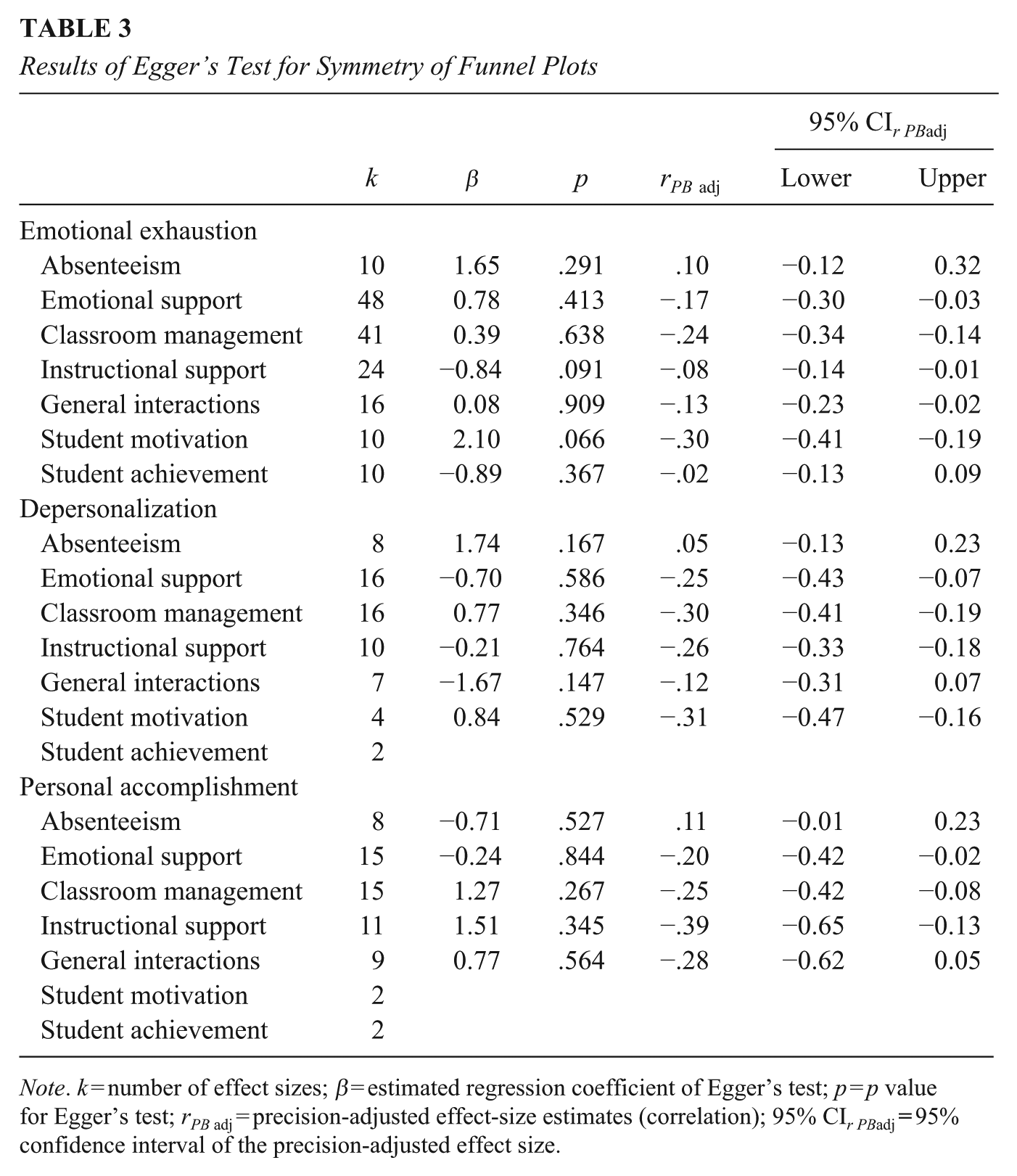
Note. k = number of effect sizes; β = estimated regression coefficient of Egger’s test; p = p value for Egger’s test; rPB adj = precision-adjusted effect-size estimates (correlation); 95% CI
r PB
adj
Discussion
Teachers belong to a professional group that has a considerable risk of burnout on the one hand and a great responsibility for student development on the other hand (Garcia-Carmona et al., 2019; Johnson et al., 2005; Redín & Erro-Garcés, 2020). For this reason, a systematic review summarizing the empirical evidence on theoretically postulated consequences of teacher burnout is essential to gain a comprehensive understanding of the role that teacher burnout plays for their professional performance. Therefore, the objectives of these meta-analyses were to integrate findings on teacher burnout for a variety of correlates at different levels of manifestation (i.e., teacher absenteeism, teacher–student interactions, and student motivation and achievement) and to determine the magnitude of the associations observed both cross-sectionally and longitudinally.
Magnitude and Meaning of Teacher Burnout
Our meta-analyses broadly support the idea that teacher burnout symptoms are associated with higher absenteeism, a lower quality of teacher–student interactions, and reduced student motivation and achievement. These results are in line with other research syntheses focusing on teacher samples, which reported comparable results for the association between burnout, turnover intentions, student misbehavior (as a specific indicator of classroom management), and student educational development, although turnover intentions seem to be more strongly related to teacher burnout than to absenteeism (Aloe et al., 2014; Madigan & Kim, 2021a, 2021b). Interestingly, meta-analyses in other occupational groups have found effect sizes for absenteeism and general job performance that were comparable but smaller than ours (Sabagh et al., 2018; Salvagioni et al., 2017).
In this respect, the findings suggest that depersonalization and reduced personal accomplishment, in general, may be no less detrimental than emotional exhaustion. This is in line with research on the prevalence of burnout symptoms, which has illustrated that depersonalization and reduced personal accomplishment are no less significant and occur even more frequently than emotional exhaustion in some teacher samples (Garcia-Carmona et al., 2019). Consistent with substantive theory (Maslach & Leiter, 1999), our results suggest on a descriptive level that emotional exhaustion (as the stress-related symptom of burnout) is most strongly related to absenteeism. By contrast, the role that emotional exhaustion plays in teacher–student interactions appears to be less important. For depersonalization and reduced personal accomplishment, our results seem indicative of a stronger relationship with emotional support, classroom management, and instructional support. These findings support the idea that emotional exhaustion tends to be more decisive for the individual, whereas depersonalization (as the social dimension of burnout) and reduced personal accomplishment (as the self-evaluation dimension) tend to be particularly detrimental to the quality of teacher–student interactions and teaching processes (Maslach & Leiter, 1999).
Primary studies that investigated the association between teacher burnout symptoms and student motivation or achievement are scarce, and they provide conflicting results, as seen in our meta-analyses. Although the results of the few studies that considered student motivation and achievement suggest that students are less intrinsically motivated, engaged, and interested if their teachers experience burnout, evidence regarding student achievement is inconclusive, and our meta-analyses did not find any evidence for a significant association with teacher emotional exhaustion. Nonetheless, it might be too early to dismiss the idea that teacher burnout is associated with student achievement. Three studies that were methodologically especially sophisticated (i.e., they had large samples and used standardized tests to measure student achievement) found significant, albeit small, correlations with teacher emotional exhaustion (Arens & Morin, 2016; Klusmann & Richter, 2014; Klusmann et al., 2016). Because other constructs, especially individual student characteristics such as intelligence, prior knowledge, and conscientiousness (Grasby et al., 2020; Levpušček et al., 2013), determine achievement to a large extent, thereby reducing the potential of teacher characteristics to influence student achievement (Bardach & Klassen, 2021), the smaller effect sizes that we found are not surprising.
Are the Correlates of Teacher Burnout Only a Matter of Negative Self-Views?
In our meta-regression analyses, one methodologic moderator of particular interest was the operationalization of the correlates via teacher self-report versus via other sources. Considering this moderator was particularly important in light of the possible inflation of the effect sizes attributable to common-method bias (Podsakoff et al., 2012). For instance, according to Maslach et al. (2001), burnout is associated with a more critical view of one’s own behavior and the environment, which is reflected in the symptoms of reduced personal accomplishment and depersonalization. This probably affects teacher assessments of interactional processes and student motivation and achievement, resulting in shared variance due to teacher burnout rather than to true relationships. Additionally, the current emotional state of teachers could affect their memory and reporting of experiences and information (Tourangeau, 2000), such as the frequency of the burnout symptoms experienced during the last school year, the number of days absent, or the occurrence of negative teacher–student interactions.
Our meta-regression analyses revealed that the relationships varied significantly depending on the method used to operationalize teacher–student interactions and student motivation (i.e., teacher self-report vs. student rating or classroom observation), with larger effect sizes found for teacher self-reports of the respective correlates. However, except for the relationship between reduced personal accomplishment and instructional support, overall, the correlations were robust. The fact that studies that used student reports or classroom observations to measure teacher emotional support, classroom management, instructional support, or student motivation also found significant negative associations with teacher burnout symptoms indicates that the associations found are not only based on the negative self-views of teachers. Future research should complement teacher self-reports more frequently with different operationalization methods, such as student reports, classroom observations, and behavioral and physiologic indicators (e.g., eye tracking, facial expression, heart rate, and skin conductance) in more comprehensive samples.
Which Role Does Teacher Burnout Play Compared with Other Teacher Characteristics?
To better understand the relevance of teacher burnout for professional correlates and to evaluate the magnitude of the observed effect sizes, other teacher characteristics that are frequently discussed as being relevant for the professional performance of teachers should be considered. For example, previous meta-analytic findings on the relationship between teacher personality and effectiveness regarding teaching and promoting student learning demonstrated statistically significant associations (Kim et al., 2019). However, most of the correlations were smaller than the effect sizes found in our meta-analyses. The same was true for previous findings regarding the professional knowledge of teachers (D’Agostino & Powers, 2009). Likewise, the intelligence and verbal abilities of teachers appeared unrelated to both the quality of teacher–student interactions and student educational development (Aloe & Becker, 2009; Bardach & Klassen, 2020). In contrast, the effect sizes for teacher self-efficacy found in previous meta-analyses were comparable to the relationships obtained in our study (Zee & Koomen, 2016), as were the effect sizes found for teacher job satisfaction (Wartenberg et al., 2023). In summary, although only small to moderate correlations were found for teacher burnout in our meta-analyses, previous research has shown that other teacher characteristics did not show larger effects either. Therefore, burnout, among other teacher characteristics, seems to play an important role in teacher absenteeism, the quality of teacher–student interactions, and student development.
At the same time, it is important to situate these findings within a broader conceptual debate on the conceptualization of burnout (e.g., Bianchi et al., 2019). Bianchi and Schonfeld (2025) argued that burnout overlaps substantially with depressive symptomatology and may be best understood as a work-related depressive condition rather than a distinct psychological syndrome. From this perspective, the patterns we observed could reflect more general work-related experiences of depressive symptoms rather than burnout-specific mechanisms (McLean & Connor, 2015). For instance, a general depressive mood might underly the three symptoms, which may be particularly reflected in the appraisal of one’s personal accomplishment. Within this broader debate, there also have been further developments that aimed at refining the conceptualization of burnout as a distinct syndrome. For instance, building on Maslach’s work, Schaufeli et al. (2020), proposed a revised conceptualization that places particular emphasis on emotional and physical exhaustion as core symptoms of burnout. Nonetheless, the empirical literature synthesized largely operationalized burnout according to the framework proposed by Maslach et al. (2018), which allows for differentiated examination of symptom-specific associations. Our findings, particularly the differences observed across the three burnout symptoms and across professional correlates, suggest that this multidimensional conceptualization remains informative for understanding teacher functioning because burnout symptoms, while representing separable constructs, still exhibit strong and consistent associations.
Taken together, our results highlight that burnout is a meaningful teacher characteristic, with consistent associations across multiple professional correlates. Importantly, these associations are not solely a matter of negative self-perceptions, because correlations remained significant even when measured via external raters (i.e., student or classroom observations). Moreover, the meta-analytic effect sizes observed for burnout compare favorably with those of other well-studied teacher characteristics, indicating that burnout represents a unique and practically relevant source of variance in teacher behavior and student outcomes.
Limitations
This study aimed to provide a comprehensive summary of previous findings on teacher burnout. However, some limitations still need to be considered. First, restricting database search strategies (e.g., in PsycINFO) to specific teacher samples increases the risk of missing relevant studies. We sought to mitigate this risk through an extensive supplementary search, including backward and forward citation tracking. This targeted approach was adopted to keep the number of database records manageable. In future research, the challenge of very large numbers of search results also could be addressed by combining a more targeted database search with a broader, machine-assisted search strategy (Campos et al., 2024).
Relatedly, the decision to differentially investigate the three burnout symptoms led to the exclusion of some studies that applied instruments other than the Maslach Burnout Inventory (Maslach et al., 2018) because those studies only reported results for a total burnout score. Although the fact that most studies used the Maslach Burnout Inventory (Maslach et al., 2018) increased the comparability of the effect sizes, including studies that used other instruments could have contributed to a broader understanding of the correlates of teacher burnout.
Second, although the inclusion of various correlates of burnout at different levels of manifestation represents another major strength of our meta-analyses, it may reduce the comparability of studies due to different operationalization methods at the same time. The included operationalization methods differed not only in the source of the reports but also in the type of reporting measure used. Absenteeism was mostly measured by retrospective teacher self-reports, with substantial variation in the periods referenced and the structure of the response options. Considering teacher–student interactions, some studies asked for the specific actions of the teacher (e.g., providing individual support for students), whereas others used student behavior as an indicator of teacher–student interactions (e.g., classroom disturbances). For instance, the dimension of classroom management included both teacher strategies to prevent or address student misbehavior and student discipline behavior. For student motivation (e.g., autonomous motivation, interest, basic needs satisfaction, and engagement), we included different related constructs due to the paucity of primary studies that considered these variables. The same was true for student achievement, for which we combined grades and standardized test scores. In contrast to standardized test scores, grades represent a rather subjective measure based on teacher judgment that encompasses more than the mere achievement of students (e.g., also their general behavior in class). Accordingly, it is not conclusively clear whether all studies included in the meta-analyses measured the same underlying construct.
Third, the studies included in the meta-analyses varied not only in terms of their underlying conceptualization but also in terms of the approach they used to address the multilevel data structure regarding student reports of teacher–student interactions, student motivation, and student achievement; most studies estimated classroom-level correlations on the basis of the manifest means of student-level responses, whereas some studies used the latent representations of the classroom-level constructs. The literature on aggregating multilevel data shows that the two approaches can yield different estimates of classroom-level effects depending on the number of students per classroom, the intraclass correlations of the variables, and the existence and size of contextual effects (Lüdtke et al., 2008). Unfortunately, we were not able to further align the effect sizes, but instead we had to use the correlations provided by the primary studies. Likewise, certain studies considered the school level in their analyses and investigated the relationship between teacher burnout and the professional correlates at the school level. However, because we were specifically interested in this relationship at the teacher level, we excluded the few studies that reported results at the school level.
Fourth, although the decision to exclude special education teachers from the analyses enabled us to provide well-informed conclusions about the population of general education teachers, it prevented us from differentiated statements about the consequences of burnout within the important group of special education teachers, which is confronted with specific challenges and which is particularly at risk of experiencing burnout (Bettini et al., 2017; Brunsting et al., 2022). It would have been interesting to consider teacher orientation (i.e., general vs. special education) as a moderator for the size of the associations (for a comprehensive research synthesis on the correlates of special education teacher burnout, see Brunsting et al., 2026; Park & Shin, 2020). Unfortunately, the sample of studies including only special education teachers was too small to systematically investigate heterogeneity depending on teacher orientation using meta-regression analyses (e.g., Brunsting et al., 2026). Additionally, meta-analyses only provide very limited options for investigating potential (study-level) sources of heterogeneity. For example, meta-regression would allow one to infer the extent to which studies with higher proportions of special education teachers tend to yield higher or lower values of certain correlation coefficients. However, these associations are at the study level, and they would not be informative about whether special education teachers (as individuals) are more or less prone to burnout-related outcomes. A more focused design, such as individual-participant-data meta-analysis, would be an approach to answer this question.
Finally, we exclusively considered cross-sectional correlations in the meta-analyses. Including longitudinal studies significantly reduces the comparability across studies and impedes the interpretation of effect sizes, because some longitudinal studies control for different characteristics at baseline, whereas cross-sectional studies do not. Additionally, the length of the intervals between measurement points varies greatly across studies. However, with nonexperimental cross-sectional data, a causal interpretation is not possible. Because we exclusively considered these kinds of data, the results of our meta-analyses should not be interpreted in terms of causal associations. A reciprocal relationship is also conceivable, in particular for teacher–student interactions and for student motivation and achievement. For example, established theoretical models and recent research have discussed low student motivation, engagement, and performance and disruptive student behavior as stressors that might impede teacher–student interactions and further promote the development of teacher burnout symptoms (Aloe et al., 2014; Jennings & Greenberg, 2009; de Ruiter et al., 2020). Moreover, results from intervention studies also have suggested a reciprocal relationship between teacher burnout and teacher–student interactions. Interventions that aimed to reduce teacher burnout found positive effects for the quality of teacher–student interactions (Roeser et al., 2022), whereas interventions that focused on the improvement of interactional processes showed a positive effect for teacher burnout (Dicke et al., 2015). However, the longitudinal studies reviewed in our research synthesis offer initial insights into the ongoing relationship between teacher burnout and professional consequences, showing effects across various timeframes. Although smaller, they partly appear to confirm reciprocal associations with emotional support, classroom management, and student motivation.
Implications for Future Research
In general, previous research focused predominantly on the symptom of emotional exhaustion, reflecting the tendency to consider it as the central burnout symptom. However, the results of our meta-analyses illustrate the importance of considering all three burnout symptoms in future research to better understand their differential effects (Maslach & Leiter, 1999). In particular, depersonalization and reduced accomplishment should not be ignored because these symptoms seem to be at least as detrimental as emotional exhaustion. In addition, it could be interesting to investigate the interplay between the three burnout symptoms. For instance, prior research has indicated that the appraisal of one’s own abilities as sufficient to meet demands can mitigate negative consequences for students (Herman et al., 2018). This suggests that experiencing personal accomplishment could possibly buffer the experience of other burnout symptoms. To gain a deeper understanding of the interplay among the three burnout symptoms, adopting a person-centered approach would be particularly valuable (Howard & Hoffman, 2018).
Although the dimensional perspective on burnout provides important insights into its structure and consequences, the broader conceptual debate about its distinction from depressive symptoms remains unresolved (Bianchi & Schonfeld, 2025). Rather than reflecting two clearly separable phenomena, burnout and depressive symptoms may partly represent manifestations of a shared underlying factor related to general health impairment. Advancing this debate will require research syntheses that jointly consider burnout and depressive symptoms, ideally supported by more accurate diagnostic tools and valid cut-off values for burnout, as proposed by Schaufeli et al. (2020).
In contrast to the abundant literature on teacher–student interactions, research on how teacher burnout relates to student cognitive-motivational development is scarce, making it difficult to draw reliable conclusions. Although the primary studies included in our meta-analyses partially suggested a negative link between teacher burnout and student motivation and achievement, more research is imperative on these associations. In our review, we focused on student motivation and achievement because these variables represent relevant educational outcomes that have been studied most frequently. However, investigating the association between teacher burnout and other student characteristics, such as affective experiences or social-emotional competencies, also would be worth considering. For instance, close relationships in particular have been assumed when the same construct is considered on the teacher and student levels (Bardach & Klassen, 2021). Thus, looking at the emotional exhaustion of teachers and student emotions (e.g., enjoyment and anxiety) might be promising. Likewise, a negative association between teacher depersonalization and student social-emotional competencies and prosocial behavior is conceivable (Hoglund et al., 2015). Students might adopt the cynical and detached behavior of their teachers because teachers function as role models (Oberle & Schonert-Reichl, 2016).
Building on the univariate associations investigated in our meta-analyses, a model-based meta-analysis could be a promising approach to further investigate the correlates of teacher burnout (Becker & Aloe, 2019; Cheung & Chan, 2005). For instance, such an analysis would make it possible to investigate the potential mechanisms that underlie the relationships between teacher burnout, teacher–student interactions, and student motivation and achievement that are postulated by established theoretical models (Jennings & Greenberg, 2009; Maslach et al., 2001). Similarly, model-based meta-analyses would make it possible to investigate more complex associations and to consider moderating variables such as contextual factors.
To obtain a better understanding of the contextual conditions under which the relationships between teacher burnout, teacher–student interactions, and student motivation and achievement are particularly close, future research should consider two avenues. First, it would be interesting to examine other contextual variables that might explain the variation in the relationships between studies. In particular, the socioeconomic, migration, and ethnic backgrounds of students seem to be relevant in several respects. Generally, teachers are more important to students who have less favorable demographic and socioeconomic backgrounds (Hamre & Pianta, 2005; Klusmann et al., 2016). Consequently, there may be a closer relationship between teacher burnout, the quality of teacher–student interactions, and student motivation and achievement in these contexts (Klusmann et al., 2016). It is plausible that, especially for students at risk of school failure (Sirin, 2005), there is a crucial difference in whether their teachers who are experiencing burnout teach them in a minor subject or in multiple core subjects or are their class teacher.
Second, it would be interesting to consider further contextual factors, such as the school climate, school leadership, social support, and societal recognition, because these factors might help to explain variability in effect sizes across different school contexts (Dutta & Sahney, 2016; Schulze-Hagenest et al., 2026; Zheng et al., 2017). Among others, challenging working conditions, societal recognition, and unrealistic expectations, the classroom composition and a shared history of relationships between teachers and their students both inside and outside the classroom seem relevant characteristics that might influence the size of the relationship between the experiences of burnout, absenteeism, and teacher–student interactions among teachers and student motivation and achievement (e.g., Aldrup et al., 2018; Schulze-Hagenest et al., 2026; van Droogenbroeck et al., 2014). In line with this, research also should investigate the context specificity of burnout and consider the school level in the multilevel structure. So far, only a few studies have investigated the correlates of teacher burnout at the school level. Those studies found only little variation in the levels of burnout between schools among teachers, with the quality of cooperation being particularly important (e.g., Klusmann et al., 2008; Schulze-Hagenest et al., 2026; Zheng et al., 2017). However, initial evidence exists that highlights the importance of school leadership not only for teacher burnout and teacher attrition but also for student development (Zheng et al., 2017).
Finally, future research should focus more on longitudinal or experimental studies. Longitudinal studies appear especially promising to uncover potentially reciprocal relationships and to provide insights regarding the stability and variability of burnout symptoms depending on contextual factors. For instance, a vicious cycle in which a low-achieving, disengaged group of students, high levels of teacher burnout, and ineffective, less supportive teacher–student interactions reinforce each other might be especially pronounced in school contexts with little collegial support or a negative school climate. This knowledge could be particularly important in identifying the most promising target variables for interventions, that is, those that are mutable and relevant. However, our research synthesis points out that extensive longitudinal designs to investigate the consequences of teacher burnout are scarce. Ideally, longitudinal studies should comprise multiple measurement time points within 1 school year (for an example of such a study, see Burić et al., 2024) because teachers changing classes from one school year to the next could impair the interpretability of the results. In addition to longitudinal studies, experiments represent an important avenue for future research. For example, Jennings et al. (2013) conducted a randomized, controlled trial to assess the effectiveness of a mindfulness-based professional-development program. Implementing a similar design would make it possible to test whether a reduction in teacher burnout due to an intervention program represents the mediating mechanism with which the quality of teacher–student interactions can be increased.
Practical Implications
Although causality cannot be determined with certainty from our analyses, it is important to provide teachers with the necessary resources and competencies to prevent a vicious cycle (i.e., teacher burnout, teaching processes, and student experiences and behavior) from developing or to break it at an early stage. Teacher experiences of burnout seem to change more strongly in response to internal and external stressors, whereas other teacher characteristics remain relatively stable (Voss et al., 2023). Accordingly, interventions to prevent or mitigate burnout should be prioritized, particularly in light of the increasing demands placed on teachers. For instance, the research synthesis of Iancu et al. (2018) on the effectiveness of different intervention programs suggested that building knowledge and competencies on how to cope with stress and strengthening resources are generally effective in reducing emotional exhaustion and enhancing personal accomplishment. Regarding the reduction of depersonalization, however, established interventions seem to be less effective (Iancu et al., 2018). This is especially disadvantageous in light of the fact that depersonalization is negatively related to social interactions in particular and poses a threat to the individuals involved in those interactions (i.e., students). Accordingly, it is imperative to focus on the development and implementation of effective interventions that specifically address depersonalization.
In addition to specific interventions, prevention programs also should be generally offered to teachers. Improving the school climate and the work environment should be an integral part of burnout-prevention efforts because intervention approaches that target individual experience can only be effective if the environment is supportive with regard to the newly learned experiences (Walton & Yeager, 2020). In this sense, a school climate in which teachers are supported in their individual needs, demands, and personal development might prevent the occurrence of burnout because it might provide the basis for teachers to develop empowering skills and characteristics. For instance, self-efficacy, social-emotional competencies, and basic need satisfaction, as well as support from colleagues and supervisors, represent important factors to help teachers deal with job demands and high workloads and to protect teachers from experiencing burnout (Aldrup et al., 2017; Aloe et al., 2014; Jennings et al., 2017).
Conclusion
These meta-analyses summarize the multiple negative correlates of teacher burnout and provide empirical evidence to support the commonly postulated assumption that teacher burnout is associated with higher absenteeism, less supportive teacher–student interactions, and reduced student motivation. Although the results do not provide evidence that burnout is related to student achievement, it would be worthwhile to explore this relationship in further studies with larger samples and objective measures because some primary studies have already provided promising evidence. Overall, the results of our meta-analyses emphasize the significant role that teacher burnout plays in determining effective learning environments and facilitating absenteeism, with depersonalization and reduced personal accomplishment being no less detrimental than emotional exhaustion. This further illustrates the importance of considering all three burnout symptoms. Moreover, it emphasizes the importance of providing sufficient resources for teachers and establishing effective intervention programs to reduce the risk of teacher burnout not only in terms of emotional exhaustion but also, and in particular, in terms of depersonalization and reduced personal accomplishment. It is therefore essential to consider the psychosocial experiences of both teachers and students in the school context not only in future research but also in educational policy decisions.
Supplemental Material
sj-pdf-1-rer-10.3102_00346543261455273 – Supplemental material for How Strongly Is Teachers’ Burnout Related to Teacher Absenteeism, Teacher–Student Interactions, and Student Motivation and Achievement: A Meta-Analysis and Systematic Review
Supplemental material, sj-pdf-1-rer-10.3102_00346543261455273 for How Strongly Is Teachers’ Burnout Related to Teacher Absenteeism, Teacher–Student Interactions, and Student Motivation and Achievement: A Meta-Analysis and Systematic Review by Gyde Wartenberg, Karen Aldrup, Simon Grund and Uta Klusmann in Review of Educational Research
Footnotes
Acknowledgements
We would like to thank the student assistants for their helpful support and the English language editing team for their thorough proofreading and language revision.
Declaration of Conflicting Interests
The authors declared no potential conflicts of interest with respect to the research, authorship, and/or publication of this article.
Funding
The authors received no financial support for the research, authorship, and/or publication of this article.

Authors
References
Supplementary Material
Please find the following supplemental material available below.
For Open Access articles published under a Creative Commons License, all supplemental material carries the same license as the article it is associated with.
For non-Open Access articles published, all supplemental material carries a non-exclusive license, and permission requests for re-use of supplemental material or any part of supplemental material shall be sent directly to the copyright owner as specified in the copyright notice associated with the article.
