



Abstract
In this chapter, I use figure hiding as a metaphor representing the processes of exclusion and suppression that critical mathematics education (CME) seeks to address. Figure hiding renders identities and modes of thought in mathematics education and mathematics education research invisible. CME has a commitment to addressing figure hiding by making visible what has been obscured and bringing to the center what has been marginalized. While the tentacles of CME research address different analytical domains, much of this work can be connected to the social isms that plague our world (e.g., sexism, racism, heterosexism, colonialism, capitalism, ableism, militarism, nationalism, religious sectarianism). However, the trend in CME research is to address these isms in silos, which does not reflect the compounded forms of oppression that many experience. I review CME studies that employ intersectionality as a way of analyzing the complexities of oppression. Intersectionality’s limited use in CME research has been for identity-based analyses. I offer intersectional analysis as a strategy to extend intersectionality’s power beyond identity toward more systemic analyses.
It is a rare occasion when Hollywood and mathematics education converge. It happened in late 2016 as the Hollywood publicity machine prepared for Hidden Figures (Gigliotti et al., 2016), a film adaptation of Margot Lee Shetterley’s 2016 book. The film depicts the stories of Mary Jackson, Katherine Johnson, and Dorothy Vaughan, Black women mathematicians who worked for NASA (National Aeronautics and Space Administration) and played key roles in support of John Glenn’s 1962 orbit of the Earth. The film has prompted a surge in public discourse about girls and women in science, technology, engineering, and mathematics (STEM), as corporations and media have used the movie as a launching point to discuss broadening participation in STEM. Hidden Figures is part of a recent surge of efforts to amend the dominant historical record to include the unlikely and unsung contributors to developments in mathematics and science. This idea of hidden figures is central to much of the work of critical mathematics education (CME) research.
CME is neither a discrete domain of research nor a distinct political agenda. Rather, it represents a position that mathematics education can be used as a tool both to uncover and to prevent injustice (Alrø, Ravn, & Valero, 2010). If there were a unifying idea behind manifestations of CME, it would be that mathematics is a social, political, cultural, and economic product that “may provoke both exclusion and suppression” (Skovsmose, 2012, p. 343). Therefore, rather than having a shared sense of meaning, it can be said that CME has a shared sense of purpose. CME research takes on multiple characters, but all of them address, in some way, ideas of exclusion and suppression that render some invisible.
I offer figure hiding as a metaphor representing this invisibility. Often the hidden figures with which CME is concerned are everyday people who have been marginalized within or excluded from mathematics education (e.g., Henningsen, 2008; Heyd-Metzuyanim & Graven, 2016). Some CME researchers are concerned with how mathematics education hides identities (e.g., de Freitas, 2004; Gholson, 2016); some examine cultural forms of mathematics as hidden figures within academic mathematics discourse (e.g., D’Ambrosio, 1985; Greer & Mukhopadhyay, 2012); some consider how the politics of mathematics education requires certain modes of thought and exclude—or hide—others (e.g., Gutiérrez, 2008; Kollosche, 2014). Some examine specific practices, policies, and pedagogies (e.g., Gutstein, 2006; Larnell, 2016). Others use different theories and methodologies to urge the community toward a full rethinking of the enterprise of mathematics education (e.g., Stinson & Bullock, 2012; Thunder & Berry, 2016). Regardless of focus, CME has a commitment to addressing figure hiding by making visible what has been obscure and bringing to the center what has been marginalized.
While these tentacles of CME research address different analytical domains, much of this work can be connected to the social isms that plague our world (e.g., sexism, racism, heterosexism, colonialism, capitalism, ableism, militarism, nationalism, religious sectarianism, or extremism). Unfortunately, in the absence of a unifying sense of CME’s commitments (Skovsmose, 2012), researchers operate most often in silos attached to these isms. While it is useful to focus on the singular analytical frame, isolating oneself within that frame can be dangerous as it limits the flow of ideas and limits what is visible. There is a distinct divide, for example, between Marxist CME research and race- or gender-based CME research. This separation is not unique to CME; there is a long-standing critique that Marxism ignores race and gender and that, likewise, race- and gender-based research do not acknowledge class (Hartmann, 1979; Leonardo, 2004). Race and gender scholars accuse Marxist scholars of reducing all inequalities to struggles against capital. It is also not new within social science to consider these isms together. However, mathematics education is emerging as a field prone to consider these isms (and others) separately, if at all.
This shift in the field of mathematics education is important because the siloed sensibility does not align with the way that most people experience these isms as sociopolitical forces. Attending to certain forms of domination while marginalizing others creates a false representation of how oppression works that reinstantiates some of the very divisions targeted for change. The response to oppression cannot be any less complex than oppression itself. Absent modes of analysis that confront this messiness head-on, there is a lingering question of how practices in CME reinscribe the distinctions and divisions that qualify some and disqualify others, thus undermining CME’s goals of inclusion and justice. I envision intersectional analysis as a mechanism to address this issue. In this chapter, I review extant CME research that employs intersectionality and consider the possibilities that intersectional analysis offers for these and future studies in CME. The guiding questions for the review are the following: How has intersectionality been applied in CME research? What methodological potential does intersectional analysis bring to CME research?
Critical Mathematics Education Research
I envision CME research as encompassing two distinct, yet potentially related, modes of thought. First, there is critical research in mathematics education that applies critical theories to questions in mathematics education. This form of CME maintains an internal focus “concerned primarily with how mathematics is learned and taught” (Greer & Skovsmose, 2012, p. 3). Specifically, researchers in this manifestation concern themselves with how people who have been marginalized participate in mathematics education and how that participation can be improved. This internally focused approach uses critical theories to examine how figures are hidden within the structure of mathematics education (e.g., representation in mathematics courses).
The second mode of thought in CME focuses on the political nature of mathematics education and on the connection between mathematics education and critical education (Ernest, 2010; Skovsmose, 1985). The rise of critical education and Freirean thought catalyzed a movement within mathematics education research with an external focus on “how mathematics education might be stratifying, determining, and justifying inclusions and exclusions” (Skovsmose, 2014, p. 139). Freire declared that education is political and that the classroom should be politically engaged. Incorporating ideas from critical education into mathematics education shifted the focus from internal to external, “concerned with the embeddedness of mathematics education and mathematics within historical, cultural, social, and political contexts, and the implications and ramifications thereof” (Greer & Skovsmose, 2012, p. 3). For Fasheh (2012), the concern is with mathematics’ ability to “contribute to protecting life or destroying it” (p. 93). In other words, this way of thinking about CME focuses externally on how mathematics education operates in the world. In this mode of thought, for example, hidden figures include the non-Eurocentric cultures and communities whose mathematics are not granted legitimacy within academic mathematics discourse (Joseph, 1987).
An important aspect of CME’s “attempt to reconcile school mathematics as a site of political power, ethical contestation, and moral outrage” is a commitment to “confront[ing] the problems of access and opportunity according to skin color, gender, and class” (de Freitas, 2008, p. 48). Therefore, the internal and external approaches to CME are connected. These two ways of thinking reveal that CME is not the property of a group of researchers; rather, it is an orientation toward mathematics education research that “[criticizes] existing bodies of knowledge, theories, methodologies, and classroom practices, especially in relation to social inequality” (Collins & Bilge, 2016, p. 31). Therefore, while some may identify as CME researchers, the CME designation can be assigned to any work oriented in this way.
Mathematics education relies on the assumption that mathematics is devoid of ideological commitments and “bereft of ethical principles that might fuel moral outrage” (de Freitas, 2008, p. 47). CME, in its external focus, has a role in challenging these assumptions. One example of CME’s critique of mathematics’ assumptions is the idea of mathematics identity. Martin (2000) conceptualizes mathematics identity as a socially constructed identity akin to race, gender, or ability. Martin’s mathematics identity is composed of four dimensions: “(a) [students’] ability to perform in mathematical contexts, (b) the instrumental importance of mathematical knowledge, (c) constraints and opportunities in mathematical contexts, and (d) the resulting motivations and strategies used to obtain mathematics knowledge” (p. 19). Research in mathematics identity is a way for CME to address the epistemic figure hiding implicit in perceptions of mathematics as a mode of thought that operates outside of social or political influence. If mathematics identity is constructed, then there exists an opportunity for it to be reconstructed, which opens different possibilities for analysis.
Solomon, Radovic, and Black (2015; also see Solomon, 2012) challenge the assumptions about mathematics’ political neutrality by investigating how women who are successful in mathematics negotiated their participation and gender performances in the masculinized world of mathematics. This is a comment on mathematics as a discursive structure. The authors argue that Roz, the subject of this study, experiences a “contradiction between doing mathematics and enacting femininity.”
Here, we can see that Roz views the other women as having resolved the contradiction between being female and being a mathematician by taking on masculine characteristics in order to fit into the world of mathematics, she has chosen to be different—to enact a different kind of mathematical identity, which retains simultaneously a strong and visible femininity (signalled by the use of the cultural tools of skirt and heels) alongside the mathematics. (p. 63)
Roz sees her feminine and mathematician identities as incommensurable. She chooses to perform traditional femininity through her dress as an act of resistance to the figure hiding of mathematics’ masculine sensibility. This account speaks further to the exclusionary norms of mathematics.
Ernest (2010) proposes that those interested in CME should “question the state of mathematics education as a field of study” (p. 3). Skovsmose (2011) adds that CME, like any other critical project, should be characterized by a profound sense of uncertainty. In this review, I take up Ernest’s proposal with the tentativeness that Skovsmose advises, asking, “What is the present state of the ideas, theories, research and publications in [mathematics education] and what should [or could] it be?” (Ernest, 2010, p. 3). However, as a perspective on mathematics education, CME is not itself exempt from critique (Ernest, 2010; Skovsmose, 2011). In this spirit of critique, I consider how intersectionality has been used in CME research and the potential that intersectionality offers CME to think differently about how forms of oppression operate within and through mathematics education.
Intersectionality and Intersectional Analysis
Legal scholar Kimberlé Crenshaw (1989, 1991, 2013) brought the term intersectionality into academe, and Black feminist scholars in the United States such as Zandria F. Robinson (2016), Brittney Cooper (2015), and Patricia Hill Collins (Collins, 1990/2009, 2015; Collins & Bilge, 2016) and abroad such as Nira Yuval-Davis (2006) have advanced this work to the point where it has become a significant concept in broader feminist scholarship (Davis, 2008). Crenshaw (1989) saw that the justice concerns of Black women were often subsumed in antiracist and feminist politics for Black people or women, broadly considered. However, a Black woman’s experience is neither a Black experience nor a woman’s experience, so “this single-axis framework erases Black women in the conceptualization, identification and remediation of race and sex discrimination by limiting inquiry to the experiences of otherwise-privileged members of the group” (Crenshaw, 1989, p. 140). Elsewhere she explains, Racism as experienced by people of color who are of a particular gender—male—tends to determine the parameters of antiracist strategies, just as sexism is experienced by women who are of a particular race—white—tends to ground the women’s movement. The problem is not simply that both discourses fail women of color by not acknowledging the “additional” issue of race or of patriarchy but that the discourses are often inadequate even to the discrete tasks of articulating the full dimensions of racism and sexism. Because women of color experience racism in ways not always the same as those experienced by men of color and sexism in ways not always parallel to experiences of white women, antiracism and feminism are limited, even on their own terms. (Crenshaw, 1991, p. 1252)
Here, Crenshaw points to the limits of both feminist and antiracist approaches as they relate to women of color. Each of these analytical axes, taken separately, hides the woman-of-color figure who experiences race different from men of color and gender different from White women.
Crenshaw (1989) proposes intersectionality to acknowledge “those who are multiply-burdened” (p. 140) by different modes of oppression—or different isms. The idea of multiple burdens speaks to intersectionality’s key concern that racism, sexism, and other forms of oppression, when considered in parallel, appear additive, but those who experience these oppressions in combination endure multiplicative effects (Choo & Ferree, 2010; Crenshaw, 1989; Robinson, 2016; Yuval-Davis, 2006). Collins (1990/2009) uses the term matrix of domination to refer to the “overall social organization within which intersecting oppressions originate, develop, and are contained” and the “historically specific organization of power in which social groups are embedded” (p. 246). The matrix of domination addresses how oppression is organized through social institutions such as government, health care, and (mathematics) education. Intersectionality creates the possibility for researchers to investigate oppression within a matrix of domination.
In recent years, intersectionality has garnered increased attention in academic and public circles as those who have been oppressed seek to articulate the multiple layers of subjugation that correspond to different identities. Intersectionality embraces a more postmodern approach to identity politics that particularizes the intersections of identity categories (Crenshaw, 1991). For example, a person who identifies as a queer Black woman experiences oppression in the name of racism, sexism, and heterosexism based on her racial, gender, and sexual identity, respectively. Intersectionality acknowledges that there is energy required to address each of these identities and that a person must sometimes make difficult decisions when those identity politics conflict.
Intersectionality’s presence and proliferation in academic spaces represents a form of grassroots theorizing. A Black woman (Crenshaw) used her scholarly position as a vehicle to represent the practices and embodied knowledges that, historically, have characterized the lived experiences of her women-of-color foremothers who must simultaneously navigate the complexities of gender, race, language, and other identity politics (Collins & Bilge, 2016). Although the terminology is recent, there is a long history of intersectional analysis by both women-of-color scholars and lay scholars. Crenshaw’s work rests on the shoulders of women like Sojourner Truth, Anna Julia Cooper, Gloria Anzaldúa, Ida B. Wells-Barnett, Paula Gunn Allen, The Combahee River Collective, and countless other known and unknown women who have shaped the consciousness of women of color through the verbal and written articulation of their lived experiences (Gines, 2011). Like Crenshaw, Cooper (2015) identifies her mother’s and grandmother’s teachings as more than just simple life lessons: Because of Black feminism, I understand the theorizing that my mother and grandmother taught me to do as being critical and crucial to my survival as a Black woman of Southern [United States], semi-rural, working-class origins now navigating a middle class, urban, academic life. (p. 10, emphasis in original)
The theorizing that Cooper’s mother and grandmother taught her—and that my mother and grandmothers taught me—is not considered “appropriate” or “rigorous” enough for academic discourse based on academe’s tendency toward figure hiding through elitist and exclusionary practices of legitimizing knowledge (Gines, 2011). Naming these articulations as Crenshaw did is a form of scholarly legitimization that makes them “more compatible with academic norms of discovery, authorship, and ownership” (Collins & Bilge, 2016, p. 80).
One significant characteristic of intersectionality is its commitment to praxis (Cho, Crenshaw, & McCall, 2013; Collins & Bilge, 2016). 1 The women of color who have embraced intersectionality as both an intellectual and practical approach to the world throughout history have not had the luxury of separating their intellectual work from their efforts to survive the matrix of domination (Cooper, 2015). Therefore, the women who have advanced intersectionality within academe have retained praxis as a significant part of that conceptualization. Given this legacy, it is not enough to think through the multiple ways in which oppression weighs on various identities, but it is the scholar’s responsibility to use her or his power to do something in response. This focus on praxis also validates the knowledges that lay scholars who do not share our academic credentials bring to this work and promotes collaboration within and outside of academe.
It is also noteworthy that, although intersectionality is best known and most often articulated as a means of considering domination, oppression is not necessarily its focus. Rather, intersectionality considers the operations and intersections of social structures (which often are oppressive).
It is worth emphasizing that intersectionality is not the opposite of privilege or advantage: it is possible to be intersectionally advantaged or privileged as well as intersectionally marginalized, dominated or oppressed. . . . The idea of intersectionality also points out that social structures not only disadvantage particular groups (as the language of burdens [or oppression] suggests); they also privilege certain groups, again, in ways unique to particular gender-race-class groupings. Every person is marked by multiple social structures. So the idea of intersectionality criticizes, improves on, and moves beyond the language of double or triple burdens as well as the concept of “dual systems.” (Weldon, 2008, pp. 196, 197, emphasis in original)
In this excerpt, Weldon dispels a myth that intersectionality is only a way to comment on oppression by raising the idea that intersectional advantage and disadvantage are not mutually exclusive. For example, while an able-bodied Latinx girl and a Latinx girl with a physical disability may experience similar racial and gender oppression, the able-bodied girl has relative privilege related to ability. Intersectionality allows the researcher to examine how these two girls would experience situations differently based on this relative privilege. There is also an opportunity to use intersectionality to examine how these girls’ experiences reflect the interaction of systems characterized by racism, sexism, and ableism. For example, discourses of health and physical fitness in schools may disparage foods that Latinx families eat or can access, which is an example of racism within these discourses. Additionally, proposing walking as a way to promote health at no cost marginalizes the child who is unable to walk freely. This point underscores the messiness of intersectional analyses and the need to continue to think deeply about how intersectional analyses can capture these nuances.
Models for Intersectional Analysis
Collins and Bilge (2016) propose a distinction between intersectionality and intersectional analysis to capitalize on the theory’s potential beyond identity. Once understood only as a theory of identity, intersectionality has taken on broader meaning over time, and intersectional analysis has become a way to engage intersectionality in critical inquiry. Intersectional analysis represents a move in critical ism-focused scholarship “from parallelism to simultaneity and multiplicity” (Robinson, 2016, p. 491). As “oppressions must work together to produce injustice” (Collins, 1990/2009, p. 21), intersectional analyses interrogate both the individual modes of oppression and the entanglements that the matrix of domination produces. Weldon (2008) articulates intersectional analysis’ potential beyond intersectionality’s identity focus: “It refers to a form of relationship between social structures, specifically one in which social structure combine to create social categories to which certain experiences and forms of oppression are unique” (pp. 195–196). Scholars have taken this shift from identity-focused to structural thinking as an opportunity to create analytical frameworks that encourage broader thinking about intersectionality.
Crenshaw (1991) establishes three forms of intersectionality: structural intersectionality, representational intersectionality, and political intersectionality. Choo and Ferree (2010) provide a similar three-part framework—group-centered approach, process-centered approach, and institution-centered approach. These ways of thinking about intersectional analysis make apparent the broad potential that this theory offers for reading the world. They each investigate figure hiding in different ways, taking an “intersectionality-only” or “intersectionality-plus” approach (Weldon, 2008). Weldon (2008) adopts the mathematical vocabulary of matrices to explain the difference: Drawing on the idea of a “matrix of domination,” I suggest that the concept of intersectionality directs our analytical attention to the possibility that there are effects or experiences that are unique to each cell, not shared by other groups in the same “row” or “column.” The intersectionality-only approach demands that we focus on each cell individually, eschewing a broader analysis of each social structure . . . the intersectionality-plus approach admits that there might be “row and/or column” effects as well as cell-specific effects or experiences. (p. 217)
The intersectionality-only approach considers the domains represented in the matrix of domination (e.g., race, gender, ability) as elements that combine equally to create a cell-specific form of subjection. Like Collins and Bilge’s (2016) intersectionality, this model assumes a unity among intersectional identities that occupy the same cell (e.g., Native American women). The intersectionality-plus approach—like Collins and Bilge’s intersectional analysis—resists this unification by acknowledging that different isms (i.e., different rows or columns) operate in different ways in different contexts. Said differently, the relevance of social structures varies across sociopolitical and sociohistorical contexts. Therefore, the intersectionality-plus model is “more elastic” and “it travels better” (Weldon, 2008, p. 218).
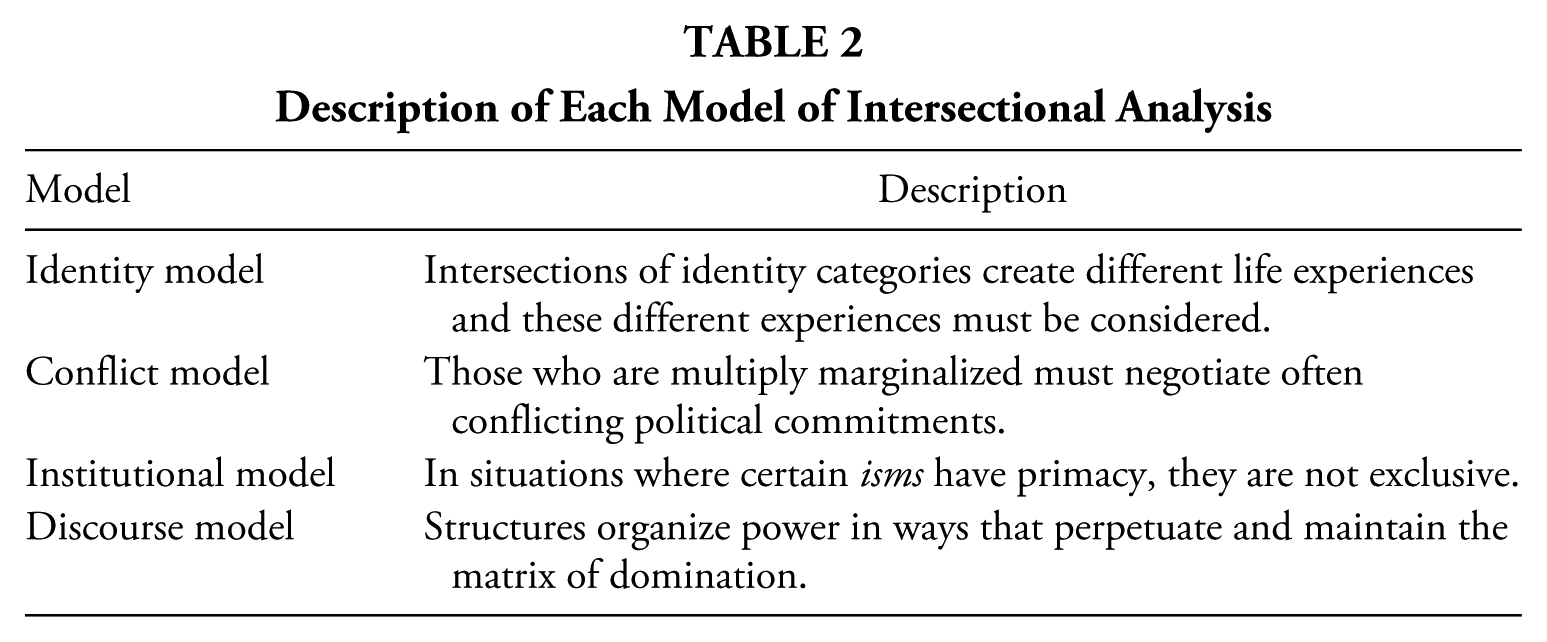
Choo and Ferree’s (2010) typology maps, in part, onto Crenshaw’s (1991). This mapping creates the analytical framework that I use for the review of literature later in this chapter. At the risk of introducing undue complexity, I created a new set of names for the four approaches to intersectional analysis (i.e., identity, conflict, institutional, and discourse models). These names reflect more clearly the focus of each model (e.g., “identity model” reflects structural intersectionality and the group-centered approach’s focus on identity). Table 1 shows the four models of intersectional analysis that I propose and the elements from Crenshaw and Choo and Ferree that each represents. The table also indicates which of Weldon’s (2008) approaches corresponds with each model. The conflict and institutional models map onto only Crenshaw and Choo and Ferree, respectively. Below, I describe each of these models.
Framework for Four Models of Intersectional Analysis Based on Crenshaw (1991) and Choo and Ferree (2010)

Identity Model
Structural intersectionality (Crenshaw, 1991) and the group-centered approach (Choo & Ferree, 2010) constitute the identity model. This intersection-only model addresses how intersections of identity categories create different life experiences. One’s location within the matrix of domination affects the ways that they experience all aspects of life. The identity model is the most familiar appropriation of intersectionality as it is concerned with “giving voice to the oppressed” (Choo & Ferree, 2010, p. 130) by explicitly acknowledging the complexity of identities—or the different cells in the matrix of domination. This approach to intersectionality relies on the idea that figure hiding occurs when analytical focus is on only one dimension of identity (i.e., one row or one column) or when identities are considered as composite rather than compounded. In these situations, those who are multiply marginalized can be excluded, at worst, or included with limited understanding, at best.
Domestic violence is an issue that transcends race, gender, and class, but strategies to support people who experience domestic violence often do not take experiences of the multiply marginalized into account (Crenshaw, 1991). For example, women who do not speak English have limited access to domestic violence support services. When materials advertising support resources are in English and shelters do not have translation services, how do these women get support? They are hidden figures. Failure to consider language in designing domestic violence support services creates a situation that may appear supportive to women but leaves one group without recourse. An identity model approach to intersectionality requires domestic violence service providers to consider how identities in different cells of the matrix of domination experience their services and adjust accordingly.
Conflict Model
The conflict model is an intersectionality-plus approach that encompasses Crenshaw’s (1991) political intersectionality. Crenshaw concentrates on women of color whose experiences align with at least two dimensions of oppression based on race and gender. Political intersectionality acknowledges that these women must distribute their political energy among different agendas that may conflict because each is designed based on those who have privilege within that category. Antiracist and feminist projects center on race and gender, respectively. In the interest of furthering justice for women, feminist projects can perpetuate racism because they center on White women. Likewise, antiracist efforts can perpetuate patriarchy while working for racial justice by centering on men. Figure hiding occurs in these blind spots. The woman-of-color figure is hidden as she negotiates an interest in justice based on both race and gender. Aligning with feminist politics means enduring racial subjugation, while aligning with antiracist politics means turning a blind eye toward misogyny. In either case, the woman of color cannot trust these efforts to represent her fully.
Crenshaw (1991) uses rape as an issue that exemplifies the conflict model. When a woman accuses a man of rape, her race largely determines what follows. If the woman is White and the man is Black, the accused will likely be presumed guilty and treated harshly. In the case where a Black woman accuses a White man, there will not likely be a resumption of guilt and any prosecution. This differential response to an interracial rape accusation creates a dual sense of injustice. Black men accused of raping White women are less likely to receive due process, so advocacy related to these men focuses on the idea that there is a long-standing practice of punishing them for rape without substantiation. Similarly, there is a long-standing precedent of White men raping Black women with impunity and of using narratives of Black women’s sexual promiscuity to negate sexual assault claims. Policies that support victims’ rights and the aggressive prosecution of sexual assault do so in the interest of “all women” with White women as the icon of a rape victim. Antiracist advocates oppose strong sexual assault laws because of the disproportionate effect on Black men. In this case, Black women victims “fall into the void between concerns about women’s issues and concerns about racism” (p. 1282).
Institutional Model
Choo and Ferree’s (2010) institution-centered approach constitutes the institutional model. This intersectionality-plus model applies intersectional thinking to institutions. Often, we connect certain isms with certain institutions (Choo & Ferree, 2010; Weldon, 2008). Class or capitalism are often central to discussion of economic institutions such as the World Bank, the mortgage industry, or the labor market. The idea of the economy relies on economic theory. Therefore, economic theory (e.g., capitalism) will likely be central, and class will appear to be the only element of oppression at issue in economic discussions. In this case, it is not possible to take an intersectionality-only approach because it is not possible to consider all modes of power equally when there is a sense of primacy of class. Thus, the focus on class hides how other isms operate through economic institutions. The institution-centered approach to intersectional analysis permits isms to have primacy within institutions but not exclusivity. Figure hiding occurs in this case when the central concern eclipses any other systems that may be in operation. Choo and Ferree (2010) argue that the institution-centered approach to intersectionality forces us to view systems as complex structures: The account of intersectionality as a complex system sees gender and race are fundamentally embedded in, working through, and determining the organization of ownership, profit, and commodification of labor, for example, by fixing which types of work and types of people enter the market at all. (p. 135)
The authors argue that issues of labor are issues of class, race, and gender, so it is not enough to lump labor issues under a label of capitalism or class without attending to how capitalism “uses race and gender to support itself” (p. 135).
Another ready example of the institutional model is the family. When discussing family, the analysis is more commonly related to gender or sexism (Choo & Ferree, 2010). The example of family presents a more reasonable possibility that the primary focus on gender could eventually shift from its place of primacy as the sociohistorical constructs of family and marriage face political challenge. However, the dominant Western discourse of the family remains gendered and heteronormative. Considering sexuality in conversations about the family reveals the inequities in policies that do not allow for families formed outside of state-sanctioned means. Same-sex partnerships, even if legally recognized, face increased scrutiny or outright discrimination in adoption proceedings. Adding an intersectional analysis based on heterosexism to the gender-primary domain of the family reveals complexity in family discourse that is not plain.
Discourse Model
Representational intersectionality (Crenshaw, 1991) is an intersectionality-plus approach related to the production of cultural images and how racial and gender metanarratives shape these images and perpetuate the marginalization of women of color. Similarly, Choo and Ferree’s (2010) process-centered approach takes a wide-angle perspective on how structures organize power. These two approaches contribute to the discourse model and are about hidden systems. Here, figure hiding is the myopic focus on one ism at the exclusion of others in a way that limits the scope of analysis. Figure hiding can also occur in a failure to acknowledge the dynamic nature of systems—“racialization rather than races, economic exploitation rather than classes, gendering and gender performance rather than genders” (p. 134).
One can consider reactions to the Black Lives Matter (BLM) movement in the United States as an example of the discourse model of intersectional analysis. BLM formed in direct response to a discourse that repeatedly articulates through actions that Black lives have no value. As BLM has emerged as a political force, the response from the mainstream political structure has placed BLM in the crosshairs of militarism and terrorism. Public officials have deployed tanks, riot gear, and extreme police force in response to BLM protests. Narratives in the media frame those who exclaim “Black lives matter!” as domestic terrorists without acknowledging the racial terror that prompts the protests. By enacting discourses of militarism and terrorism, the political establishment creates a discursive image of BLM activists as threats to the public peace, thus reinforcing the matrix of domination (Hooker, 2016; Taylor, 2016).
Review Method
I selected the sample of literature for this analysis through two initial searches using the terms intersectionality mathematics education and intersectionality math education in Google Scholar. These searches yielded 742 unique results. From the results, I pulled only the peer-reviewed journal articles and eliminated articles that were clearly not mathematics education research based on the title, abstract, and/or keywords (e.g., STEM education studies, studies in mathematics addressing intersectional algebras), leaving 39 articles. These articles were all published between 2008 and 2016. After reading each article, I put it into one of three categories: mention (for articles in which the authors used the words “intersectional” or “intersectionality” in passing; 20 articles), recommendation (for articles in which the authors recommend intersectionality as a limitation of their work or as a means to expand the analysis but do not conduct an intersectional analysis; 11 articles), application (for articles in which the authors use intersectionality as the central analytical framework; 5 articles), and conceptual (for conceptual articles and reviews; 3 articles). The articles in this review come from the application category. I chose to focus on empirical articles that use intersectionality as a core part of their theoretical framework to best address the following research questions: How has intersectionality been applied in CME research? What methodological potential does intersectional analysis bring to CME research?
To address the first research question, I turned to Bowleg’s (2008) recommendations for intersectionality research based on her experience researching Black lesbians. Bowleg argues that intersectionality research requires effort beyond traditional qualitative narrative analysis and proposes two additional phases to honor the complexity of intersectionality. First, researchers who use intersectionality must commit to a transdisciplinary approach to research that allows them to understand the broader sociohistorical discourses that are at work. They must take up a broad scope of analysis that requires a sophisticated sociohistorical understanding. The second additional phase of analysis that Bowleg suggests entails the explicit examination of tensions with respect to the intersections of identities. In this phase, the researcher should pay attention to how tension and contradiction manifest in their analysis and spend time interrogating those spaces. In this review, I looked for evidence of Bowleg’s recommendations by asking the following questions: Does the author address broader sociohistorical discourses? Does the author engage the tensions inherent in the intersections of identities?
For the first and second research questions, I use the framework that I created based on Crenshaw (1991) and Choo and Ferree’s (2010) typologies of intersectionality (Table 1). In Table 2, I describe each element of this framework based on the comparison detailed in the previous section. In the next section, I describe each of the five studies and its findings. Then, I use Bowleg’s two criteria and the intersectionality models from Table 2 to analyze how intersectionality is applied in the study. Finally, I return to the intersectionality models to propose a way that the researchers could approach the study differently through another model. For the sake of space, I choose one model on which to base an alternative framing that demonstrates additional methodological potential for intersectional analysis (i.e., Research Question 2).
Description of Each Model of Intersectional Analysis
Intersectionality in Mathematics Education Research
There are few mathematics education researchers who employ intersectionality as a theoretical framework. However, it is common for mathematics education researchers to recommend intersectionality as a potential means to further their analyses of race or gender. Damarin and Erchick (2010) call on intersectionality’s most common use in race–gender analysis to assert that “attention to the intersection of clearly defined constructs, including gender” is required to address issue of equity in mathematics for girls and women (p. 312). Although it is most common for intersectionality to surface in gender- and race-related studies in mathematics education, some mathematics education researchers suggest this theory for analysis related to other identities. Lambert (2015), for example, argues that intersectionality is useful for considering how disability intersects with race. Scholars such as Berry (2008) and McGee (2015) position intersectionality as a way of thinking about how mathematics identity operates with racial identity. For those mathematics education researchers who center on intersectionality in their work, there are varying modes of engagement. The five studies that emerged from the review as applications of intersectionality theory represent the present scope of intersectionality research in mathematics education.
Esmonde, Brodie, Dookie, and Takeuchi (2009)
Esmonde et al. (2009) investigated how students’ identities affect their cooperative group work in an urban secondary mathematics classroom. Operating from the premise that “who students are influences what and how they learn together” (p. 19, emphasis in original), Esmonde and colleagues focus on students’ articulations of their own identities and how they matter in the mathematics classroom. The authors take up intersectionality as an approach to acknowledge the multiplicity of identity and use sociocultural learning theories to understand these identities in practice. They also used critical race theory (CRT) to analyze race, stereotype threat to analyze how identity impacts individual performance, and expectation states theory 2 to understand how identities operate in group work. However, they employed intersectionality to acknowledge a limiting assumption in expectation states theory. While expectation states theory treats identities as additive, the authors assert that “multiple status characteristics can qualitatively influence one another” (p. 23). To capture identities in practice, Esmonde and colleagues analyzed the classroom as a single case, but to ensure that they acknowledged the particularities of student identity, they conducted a second level of analysis with each student. The researchers coded student interviews for explicit and implicit references to identities such as race, gender, and grade level.
In their presentation of results, Esmonde et al. (2009) outline two phases of analysis. In the first phase, they used the whole class as the unit of analysis and coded the data for themes related to group work. In the second analytical phase, they chose a sample of students to analyze individually. This student-level approach allowed the authors to look more deeply into participants’ comments to see how their identities affected their experiences of group work. They observed that students engaged in group work according to the identities that they claimed and that they made decisions about their classmates based on identities that they imposed on them. For example, the boys assumed leadership positions more frequently than girls. In interracial groups of boys, White boys led more than boys of color. Likewise, White girls led in interracial groups of girls. However, in heterogeneous gender groups of the same race, girls did not lead. The authors also observed that identity affects the benefits of group work for students. Although teachers use cooperative learning as a means of support for students who struggle, the authors noted that a White student did not slow the pace to support a Black girl in the group who needed help.
I classify this study in the identity model of intersectional analysis because Esmonde et al.’s (2009) multiphase analysis highlights both the implicit and the explicit effects of identities on cooperative group work in secondary mathematics. They address intersectionality as a concept that characterizes the student participants’ identities and reveals the limitations of an established theory. A limitation of the study with respect to intersectionality is that the authors do not present theories of gender, socioeconomic status, urbanism, or other social categories represented in the participants’ identities, which limits the analysis with respect to Bowleg’s (2008) recommendation for incorporating transdisciplinary literatures. This also limits the potential for an intersectional analysis of the identities themselves. In their data reporting, Esmonde and colleagues acknowledge intersectional identities by referring to participants in multiple-identity terms (e.g., White girl, Latinx boy), but they largely report results in terms of single dimensions of identity (e.g., race, gender, grade level) and combined identity categories (e.g., students of color). Although they allude to shifting privilege for some students (i.e., the White girl who would lead only in groups with students of color), they do not dig into the tensions of intersectional identities as Bowleg recommends, nor do they consider what issues like the inability to assume a leadership role mean for students at the bottom of the intersectional hierarchy (i.e., girls of color).
By engaging in two analytical phases, Esmonde et al. (2009) address the figure hiding that occurs when mathematics education researchers do not look deeper into the data for less obvious social meanings. However, the study also perpetuates figure hiding in that the discussion of differential experiences and opportunities in group work is done only at the level of identity; the discursive structure of mathematics education that creates and maintains these differences remains hidden. The discourse model of intersectional analysis offers another way to consider Esmonde et al.’s (2009) study results at this discursive level. The exclusion that they noted relative to leadership responsibilities and benefits of group work occurs within the mathematics classroom, a space that has been identified as masculinized (Solomon et al., 2015) and as an institutional space of whiteness (Martin, 2011). Therefore, the experiences of these students are not idiosyncratic; they are the result of the way in which mathematics education has organized itself through patriarchy and White supremacy.
Riegle-Crumb and Humphries (2012)
Riegle-Crumb and Humphries (2012) explore how tracking in high school mathematics courses creates different contexts in which students experience stereotypes. The authors argue that mathematics teachers are gatekeepers for students’ mathematics trajectories. They perform a quantitative analysis on national course-taking data from high school transcripts in the Education Longitudinal Study of 2012. They were looking for evidence of teacher bias in course assignment based on gender and race using White males as the comparison group. Riegle-Crumb and Humphries use intersectionality to move beyond prior studies that address gender and race separately. The study’s findings suggest that after taking achievement differences into account, “teachers do not perceive male and female minority students as having lower math ability than their white male peers” (p. 312). In fact, the data show that teachers have more confidence in Black female students in advanced classes than White male students because of the figure hiding that they have overcome to get there.
Riegle-Crumb and Humphries (2012) ground their use of intersectionality in general feminist literature instead of the core literature from Black feminism (apart from one citation of Patricia Hill Collins). This observation introduces an important issue relative to intersectional analysis. Cho et al. (2013) argue that intersectional analysis is bigger than a particular genealogy and that a work is intersectional based on “its adoption of an intersectional way of thinking about the problem of sameness and difference and its relation to power” (p. 795). Although the absence of Black women in citations does not undermine the application of intersectionality in this study, it does signal a form of figure hiding. As mentioned in earlier sections, intersectionality is a recent instantiation of a long-standing epistemic practice among women of color who remain nameless and without credit. Crenshaw (1989, 1991) named intersectionality as a direct response to marginalization of Black women from mainstream feminism. Neglecting to credit Black women in discussions of intersectionality connotes a similar dysconscious marginalization.
The identity model is the most appropriate representation of Riegle-Crumb and Humphries’ (2012) study. Their intent was to move beyond separate analyses of mathematics course-taking based on race or gender to consider these factors together. The study did not take up the broader sociohistorical discourses that affect course-taking decisions. Student test data were a contributing factor to the disparities that the authors address, and they did account for it in the analysis. However, they do not engage with how students experience the “long structure of testing and prerequisites extending back to middle and elementary school” (p. 295) in racialized and gendered ways that limit their possibilities in high school. The nature of this large-scale study did not lend itself to the depth of analysis related to the intersectional tensions that Bowleg recommends.
Riegle-Crumb and Humphries’ (2012) study demonstrates the potential power for a national-level intersectional analysis in the discourse model. Looking at students longitudinally can help show how race/gender patterns in mathematics emerge, shift, and are maintained over time. It would also be valuable to include data such as socioeconomic status, parent education, food access, and teacher experience to see how these factors contribute to racial and gender disparities in mathematics achievement.
Gholson and Martin (2014)
In their study of a group of Black girls in third grade, Gholson and Martin (2014) used intersectionality “to highlight the constructed nature of studying age, race, and gender” (p. 19). They argue that childhood, itself, is an identity marker, so research about Black girls requires that the researcher consider these girls not only as Black and female but also as children who are “forming and maintaining complicated, history-rich interpersonal relationships with each other” (p. 19). With this analysis, Gholson and Martin’s goals were not only to investigate Black girls’ positions within Collins’s (1990/2009) matrix of domination but to go a step further and “acknowledge Black girlhood as a context for nurturance, support, and competence” (Gholson & Martin, 2014, p. 20).
Gholson and Martin (2014) focus the analysis on two Black girl students—Shawna and Mia—and characterize their experiences and relationships in the mathematics classroom as moving between social network positions as “bullies, smart girls, mean girls, and Black girls” (p. 24). Both Shawna and Mia were coded as bullies. Shawna got into physical altercations with peers, and her larger stature encouraged this classification from her peers. Mia’s peers described her as verbally aggressive. However, both girls’ mathematical competence earned them labels as smart girls. Shawna expressed a self-confidence in mathematics that did not translate to her social life where she was isolated. Mia, on the other hand, was a key part of a social group that included other girls who were mathematically successful. The authors coded Mia’s group of popular girls as mean girls because they used their social power to maintain exclusion even in the mathematics class. The Black girls label related to the girls’ self-identification as Black or African American. Shawna described her racial identification with certainty, while Mia’s understanding of race allows for a broader sense of what blackness is. In spite of their identification as Black, both girls expressed a desire to fit into more Eurocentric ideas of beauty. Mia’s proximity to these standards—her lighter skin, long hair, and thinner body—afforded her privilege from others that Shawna did not experience due to her darker skin, shorter hair, and heavier body.
With respect to Bowleg’s (2008) recommendations for intersectionality research, Gholson and Martin’s (2014) emic approach creates a narrative of the hidden Black-girl-child figure that counters dominant sociohistorical narratives of children as nonagentic or Black girls as invisible “‘background noise’ in a larger view of urban life that prioritizes men and boys” (Morris, 2016, p. 18). Putting Black girlhood in a positive light helps reframe perceptions of Black girls as defiant, loud, and more mature than their age indicates (Morris, 2016). The authors also outline an analytical process that confronts the tensions and complexities inherent in the intersectional analysis of three identity categories (i.e., Black, girl, and child). Their large corpus of data combined with the extended ethnographic engagement in the classroom—multiple times per week for the school year—promoted a rich, multilayered analysis. 3 By engaging in analytical separation (Gholson & Martin, 2014), they could analyze the data through single-identity lenses and bring those analyses together to negotiate the conflicts among them.
Gholson and Martin’s (2014) study largely falls within the identity model of intersectional analysis as its greatest contribution is to explore the complexity of the Black-girl-child identity category. They also entertain the conflict and discourse models through their analysis of differentiated intraracial privilege. To extend the analysis into the discourse model, the authors could zoom in on the issues of colorism raised in the Shawna and Mia’s identification as Black girls. Martin (2011) argues that mathematics education is White institutional space, and Stinson (2013) further charges that mathematics is governed by a “white male math myth.” Under these conditions, the Black-girl-child is invisible at the bottom of the racial and gender hierarchies of mathematics (Gholson, 2016). Colorism assigns privilege to people of color based on their physical proximity to whiteness. Further intersectional analysis can explore how this proximity to whiteness affects students’ mathematics experiences.
Zavala (2014)
In her study of Latinx high school students’ accounts of learning mathematics, Zavala (2014) argues that prior analyses of Latinx students in mathematics education research have focused on linguistic identity with little attention to racialized identity, noting that “the issues of race and language terms to be compartmentalized in the literature: an either-or (race or language) approach rather than a both-and (both race and language) approach” (p. 56). Therefore, Latinx students are hidden as figures with both racialized and linguistic identities. The author argues that this omission renders the picture of Latinx students’ experiences in mathematics incomplete. Zavala draws on literature that highlights how race and language separately affect mathematics identity and uses Latino critical race theory (LatCrit) to navigate the “multiple constructs specific to the experiences of Latinas/or in the United States, such as language, culture, ethnicity, immigration status, phenotype, and sexuality” (p. 62). In addition to a theoretical framework, LatCrit also provided Zavala with a methodological approach to narrative analysis, testimonio. The narratives came from individual and focus group interviews.
Zavala (2014) presents three sets of findings: the utility of mathematics, the role of race, and the role of language. She argues that the participants envisioned mathematics as important for their long-term goals. The participants had a color-blind perspective on what creates mathematical success: individual motivation. The author reports that the immigrant students used meritocratic language, “charging those who did not finish [high school in Mexico] with not wanting it enough” (p. 68). The participants who were born in the United States expressed a connection between their racial and mathematical identities, particularly as it relates to dehumanizing stereotypes of Latinx as illegal or violent. With respect to the role of language, Zavala spotlights Julieta, an emergent bilingual immigrant Latina. Instruction in Spanish was critical to Julieta’s success in mathematics. She pointed to the privilege that English-speaking students have in mathematics classes to have ready access to the curriculum materials and the ability to communicate with the teacher. Julieta perceived English-speaking students to be squandering these advantages that she wished she had. Her strategy to address this disadvantage was to do mathematics in Spanish and to partner with another student who could also do the work in Spanish. Zavala attributes Julieta’s agency in the classroom to “the intersectionality of multiple layers of [her] identity . . . , how she liked mathematics, how she connected mathematics to a broader sense of self, her linguistic identity, as well as her initiative” (p. 77).
While Zavala (2014) does not explicitly cite intersectionality literature from Black feminist theory, she engages intersectionality as a core tenet of both CRT and LatCrit. 4 She uses the language in addressing identity as intersectional and honors this idea in her theoretical and methodological choices. Using LatCrit required that Zavala address identity intersections, but she acknowledges that presenting the analysis in written form limited her to a more discrete presentation that may make it appear that these identities “do not subsume, overlap, or influence each other” (p. 65). The traditionally linear approach to academic writing can limit opportunities for the researcher to fully explore the conflicts that Bowleg (2008) urges researchers to confront. However, Zavala does address the complexities of racial and linguistic identities separately in detail. She also suggests that further research is needed to address how larger discourses about immigration and stereotypes of Latinx youth as illegal or violent affect mathematics learning, but she does not step into these issues as Bowleg would require.
While Zavala’s (2014) study falls squarely within the identity model of intersectional analysis due to its focus on combined identities, Julieta’s case represents a step toward the conflict model. Julieta was negotiating a solid mathematical identity with her identities as an immigrant, a girl, and an emergent bilingual. She developed a detailed strategy for success that included initiating a friendship that support her to do mathematics in Spanish and to have access to the capital that English-speaking students held in the classroom. By stepping fully into the conflict model of intersectional analysis, Zavala could bring attention to the demand for hidden work that U.S. school mathematics places on students who negotiate isms such as those Julieta faced. It would also be pertinent to the conflict model to expand on the intersectional privilege that Julieta assigned to her English-dominant Latinx classmates and any conflicts that she experienced between her identity as a Latina and her immigrant or linguistic identities.
Leyva (2016)
Leyva (2016) uses intersectionality grounded in Black feminist theory as the central theoretical framework in his analysis of Latinx college women’s mathematics experiences as STEM majors. He argues, “Research that focuses on a single dimension of identity, however, risks homogenizing group experiences and overlooking within-group differences for negotiating discourses in mathematics and society at large” (p. 81). To capture these different dimensions of the participants’ identities, Leyva included poststructural theory as part of his theoretical framework. He presented the findings by constructing a case for each participant based on data gathered from individual and focus group interviews and written mathematical autobiographies. The counterstories focused on Lauren and Tracy’s intersectional experiences as Latinx women from both an interpersonal and an institutional perspective.
In the cross-case analysis of Lauren and Tracey’s counterstories, Leyva (2016) focused on four discourses: “(a) mathematics ability is innate, (b) women and Latin@s are not good at mathematics, (c) Latin@ women are underrepresented in STEM, and (d) Latin@ women become young mothers and wives instead of college students” (p. 109). When Lauren and Tracey faced challenges to their confidence in their natural mathematics ability, they learned that mathematics is a discipline whose racialized and gendered nature cannot be mitigated by talent alone. The racial and gender identification with their teachers caused them to name pedagogy and teacher–student relationship as critical to supporting women and Latinx students in mathematics. Lauren and Tracey were aware that, as Latinx women, they were part of an underrepresented group. They each valued the encouragement that came from peers, teachers, and family. They also saw themselves as role models to younger family and community members. Tracey used her connection to other Latinx college women to navigate cultural expectations to marry and have children instead of going to college.
In this study, intersectionality directs the analysis in that Leyva (2016) analyzes the data for both its text (i.e., explicit evidence of participants negotiating intersectional identities) and for its subtext (i.e., implicit evidence of participants negotiating intersectional identities). This consideration of subtext connects to Bowleg’s (2008) call for intersectional analysts to use sociohistorical consciousness to see more in the data than what is immediately evident. Leyva (2016) presents detailed case studies of the two focal participants, which allows for a more nuanced understanding of their experiences and honors their complex identities. In these cases, the reader gets a sense of how the participants negotiate their identities within mathematics and the inherent tensions in the process. Although Leyva cites Bowleg in support of his choice to focus on subtext, there are few moments where he takes the transdisciplinary step to analyze the cases through broader sociohistorical realities that Bowleg identifies as an essential phase of intersectionality research. One such moment is when he discusses the participants’ pursuit of a mathematics-intensive major as an act of resistance against dominant cultural narratives that Latinx women are destined to be little more than wives and mothers. Leyva describes this sense of family commitment as familismo “or sense of loyalty and responsibility to the Latin@ family unit” (p. 113). This discourse has the potential to be both limiting and empowering as it “played a critical role in [the participants’] motivations to excel in mathematics while negotiating STEM higher education with family expectations” (p. 113). While the participants described feeling limited by familismo, it also fueled their sense of resistance to create new possibilities for the family through education.
I classify Leyva’s (2016) study as following the identity model by focusing on the racial and gender intersections of Lauren and Tracey’s identities. However, Leyva also connects these identity intersections to larger sociocultural discourses about mathematics, women, Latinx students, and Latinx women, which moves toward the discourse model. The institutional model of intersectional analysis provides additional analytical opportunity in this study through the idea of familismo, which hides the figure of the Latinx child who does not want to follow its cultural norms. As outlined earlier, the family is a discourse determined largely by gender. Familismo dictates male and female roles in the family, but these roles can also be mediated by other issues such as class, immigration status, and ethnicity. Exploring these added intersections may illuminate why, for example, Lauren’s family was willing to support her to defy cultural norms about young Latinx women while Tracey had to rely on a group of peers to “not fall victim to discourses that steer them away from applying their mathematics ability and interest” (p. 113).
Conclusion
Extant CME research has taken up the identity model and made some steps toward broader applications of intersectional analysis, but there is a power in the theory that is yet untapped. The four categories of intersectional analysis that I have presented represent opportunities to address figure hiding in CME by complexifying and enriching research into the social and political aspects of mathematics education. Limiting the use of intersectionality in CME research to the identity model forfeits the opportunities that intersectional analysis makes possible related to ideological and institutional analysis. Failing to employ the full power of intersectionality also limits CME’s potential for praxis toward justice. According to Rawls (1971), justice is the first virtue of any social institution and “laws and institutions . . . must be reformed or abolished if they are unjust” (p. 3). I envision CME’s role within mathematics education writ large as pushing justice to the center of conversations about all parts of the “network of mathematics education practices” (Valero, 2010, p. 374).
In this review, I have proposed intersectional analysis as a methodology for those who engage in either internally or externally focused CME research to address the complexities of social and political realities and to identify ways that current approaches to research unintentionally participate in figure hiding. If CME researchers take on Rawls’ (1971) charge to place justice as the first virtue and to dismantle or reform any social institution that is unjust, they also agree to assume all risk associated with this commitment. Given that CME consistently operates on the fringes of the mathematics education research landscape, this risk is not unfamiliar. Embracing intersectional analysis as a way of thinking about CME has the potential to work against figure hiding by breaking down analytical silos.
Embracing intersectional analysis also has the potential to encourage a sense of community and cohesion among CME scholars because turning an intersectional analytic eye on CME cannot be done in isolation. It is not possible for any one scholar or any one ism group to fully interrogate the matrix of domination; there are always things that one cannot see or commitments under which one cannot not operate. Therefore, the pursuit of justice through inquiry is a necessarily collaborative and strategic partnership in which scholars come together across ism groups with the intention of pooling their intellectual resources in the service of justice. These collaborative justice communities can gather around identities (e.g., the mathematics education of trans youth), issues (e.g., Islamophobia and mathematics education), places (e.g., mathematics education in rural China), or spaces (e.g., urban mathematics education). A justice community has one aim: to move toward justice by directly confronting the multiplicative effects of injustice and oppression.
Intersectional justice communities encourage a different form of accountability. As scholars, we are most often accountable to the theories we use, the participants and institutions we study, to our colleagues via blind review, and the discipline to which we belong. When different scholarly interests come together holding a common value, there is a different form of accountability. Each ism group becomes accountable to the others and, more important, to justice itself. While this situation makes us each vulnerable, that vulnerability creates the opportunity for less figure hiding, more critical self-reflection, stronger interpersonal relationships, and more effective coalitions. It is in this space that, I believe, the critical scholar’s justice mandate can be fulfilled.
