




Abstract
This chapter provides a critical and synthesizing review of the literature on issues related to preparing teachers for diverse learners from historical and theoretical standpoints, reviewing more than 50 years of calls for teacher education reform and efforts to prepare White teachers and teachers of color for racial, ethnic, and linguistic diversity in schools and communities. It finds that the limited success of such efforts is the result of policy changes that overemphasize recruitment and underemphasize retention, and calls for restructuring teacher education programs and research that focuses on critical reflection and generativity that can lead to transformative practices in the classroom. The authors argue for a (re)new(ed) emphasis on community-based teacher preparation grounded in critical reflection and generativity, which facilitates and promotes transformative teacher education that prepares teachers to teach diverse student populations.
The American public education system from its inception in the late 19th century to the present day has struggled with fundamental contradictions in its structures, practices, and functions in society. For example, there has long been a basic contradiction between the democratic impulses of many of the American founders (Dewey, in particular) and the use of the schools to support the racial, gender, and language hierarchies integral to U.S. society. More recently, use of field placement for the final stages of teacher education was intended to improve real-world training for preservice teachers, but this quickly raised awareness among teacher educators that student teachers could learn negative attitudes and behaviors from their mentor teachers. Furthermore, throughout the 20th century the desire for an extended, apprenticeship-based training system for teachers has foundered on the need for more teachers than such a system could possibly produce, prompting shortcuts in teacher education that once again reinforced inequity. The American public education system has also struggled because, while more and more has been demanded from teachers, they continue to be paid far less than other fields requiring a college degree. As a result, there is a chronic shortage of qualified teachers, especially in science and math and in schools that require teachers with the skills, dispositions, and knowledge needed to teach diverse student populations.
In 1969, B. Othanial Smith published Teachers for the Real World, the outcome of 2 years of work by the Steering Committee and Task Force of the National Institute for Advanced Study in Teaching Disadvantaged Youth. The report suggested that teacher education programs failed to provide adequate preparation for teachers to effectively teach “disadvantaged youth”: Racial, class, and ethnic bias can be found in every aspect of current teacher preparation programs. The selection processes militate against the poor and minority. The program content reflects current prejudices; the methods of instruction coincide with learning styles of the dominant group. Subtle inequities are reinforced in institutions of higher learning. (p. 3)
Noting 50 years of efforts to improve teaching and teacher education, including a study of his own (Smith, 1980), Smith nevertheless called for radical reforms in teacher education programs regarding their approach to teaching about diversity and equity, warning, however, that unless there is scrupulous self-appraisal, unless every aspect of teacher training is carefully reviewed, the changes initiated in teacher preparation as a result of the current crises will be, like so many changes which have gone before, “merely differences which make no difference.” (Smith, 1969, p. 3)
Since the 1969 Smith report, many reforms have been proposed for teacher education programs. Yet it would appear that—as he warned—success in teaching for diversity and equity remains as elusive now as it was 50 years ago. For that reason, it seems appropriate that we revisit the topic of changing teacher preparation practices to teach diverse learners in K–12 schools.
Review Method
This chapter investigates the question “How is change in teaching practices and teacher education programs designed to prepare teachers to teach diverse learners conceptualized, facilitated and transformed?” through a critical and synthesizing review of the research literature. We set the context by reviewing 27 national studies of (or calls for the reform of) teacher education from 1929 to 2016. A thematic analysis of this literature provided a sense of the large movements in teacher education reform, which then guided our survey of research on preparing teachers for diverse classrooms to focus on approaches from multicultural education, critical race theory, and community-based teacher preparation. The second phase of the survey used systematic keyword searches of the ERIC database, including teacher education and Whiteness, teacher education and critical race theory, teacher education and multicultural teacher education programs, and so on, producing 10,500 hits. Focusing on teacher preparation shrank this list to 2,000 items; we then examined the texts for empirical studies on preparing White students to handle diversity versus recruiting, preparing, and retaining teachers of color, yielding 50 core studies. Having conducted this review, we then turn to the threads connecting the limited success of these approaches: the need to base research on actual teaching and learning practices in classrooms, the need to encourage critical reflection for transformative learning to be systematically applied throughout teacher education practice, and the need to expose teachers and teacher education programs to generative theory, which has the power to stimulate and support real change in teachers’ practices. We conclude by offering a framework for developing promising practices that combines critical reflection and generativity in a model that can bring about real transformation in individual teachers and teacher education programs.
Defining Student Diversity
A review of literature on teacher education reform shows that the 1969 Smith Report is one of the earliest acknowledgments of student diversity, although he does not use the word diversity. Smith spoke of disadvantaged youth, a term that moved from a sociological association with poverty to encompass other kinds of disadvantage in the 1960s. In Smith’s formulation, disadvantaged youth (1) are denied choice in careers; (2) lack any semblance of political power and are even denied an opportunity to learn how democratic decision making takes place; (3) are stigmatized as culturally disadvantaged, excluded from the broader cultural activities, and have their own culture denigrated; and (4) are denied inter- and intrapersonal competence, segregated from the larger society, and labeled as socially or emotionally disturbed if they protest against the inequity of the situation (pp. 3–4). Smith’s definition avoids specifying groups that could be labeled disadvantaged, choosing instead to focus on the social costs they face by being so labeled. More recent notions of diversity tend to focus on the ways in which groups diverge from a norm that, by and large, itself remains undefined—indeed, the norm has largely become defined by repeatedly adding ways in which students diverge from it. Nevertheless, the overlap of “disadvantaged” with more recent notions of diversity is clear.
Most attempts to define diversity in education are also lists. For example, Zeichner (1996) lists social class, ethnicity, race, and language and Banks and Banks (2010) list gender, social class, ethnic, racial, or cultural characteristics. The National Council for Accreditation of Teacher Education (NCATE; 2008) defines “diversity” as “differences among groups of people and individuals based on ethnicity, race, socioeconomic status, gender, exceptionalities, language, religion, sexual orientation, and geographical area,” and the InTASC Teaching Standards that many teacher education programs have adopted states that “all learners bring to their learning varying experiences, abilities, talents, and prior learning, as well as language, culture, and family and community values” (Council of Chief State School Officers, 2013). Note that although members of all the groups listed by the various definitions are probably subject to the social costs Smith (1969) identified as “disadvantaged,” by focusing on how students diverge from the undefined norm, the lists erase the fundamental social inequities that affect some groups more intensively than others. In other words, if all differences participate in “diversity,” then they become “differences which make no difference” (p. 3).
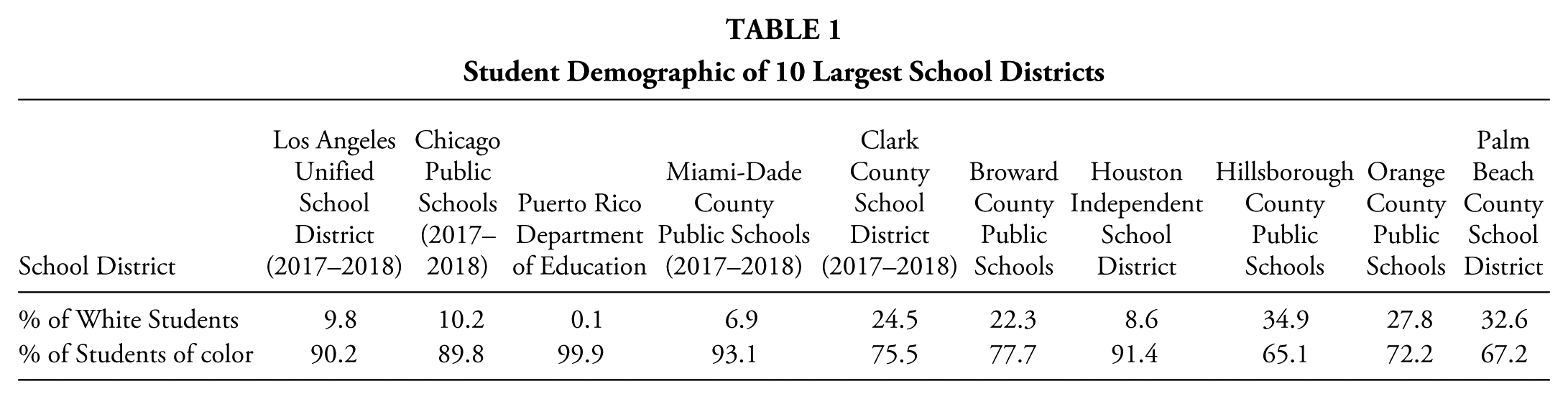
With the conceptual weakness of “diversity,” it is no surprise that teacher education programs are quick to use the term diversity but “share no unified definition of what an educator prepared for diversity actually looks like, how such an educator should get prepared, or how his or her preparation could best be assessed” (Pollock, Deckman, Mira, & Shalaby, 2010, p. 212). We agree with Zeichner (1996) that an adequate definition of diversity must be broad and inclusive, but at the same time it must be effective for the purpose at hand, be it teacher preparation or research. For that reason, we choose to look more to the social costs identified by Smith—marginalization, denigration, segregation, and denial of competence—in choosing the kind of diversity to examine. For purposes of this chapter, we focus on racial, ethnic, and linguistic diversity for the following reasons: First, the racial and ethnic diversity in K–12 schools has increased dramatically in the last decades. In 1972, only 22% of the school population were students of color; as of 2014–2015, White students are now a minority in K–12 public schools, with no single racial or ethnic group in the majority (Institute of Education Sciences, 2016, Table 7, p. 48). In 5 of the 10 largest school districts, students of color comprise more than 90% of the total school enrollment (see Table 1). Yet the teacher corps and the teacher education professoriate remain overwhelmingly White; the resulting “cultural divide” between teachers and teacher educators on one side, and students and communities on the other, “undermines efforts to prepare interculturally competent teachers” (Zeichner, 2003, p. 493).
Student Demographic of 10 Largest School Districts
Second, the number of students who are English language learners or speakers of nonstandard variants of English is significant and growing. For example, California’s residents speak roughly 200 officially recognized languages; nearly 45% use languages other than English in their homes. Black African immigrants represent one of the fastest growing segments of the U.S. immigrant population, increasing by about 200% during the 1980s and 1990s and by 100% during the 2000s (Capps, McCabe, & Fix, 2012); moreover, California has the fifth largest Black population in the country and is home to about 900,000 African Americans under the age of 25. Some 22 years after the Oakland Unified School District sparked fierce debate by declaring Ebonics a distinct language, native-born Black students remain the most misunderstood, misidentified, and underserved population of English language learners.
Third, these three forms of diversity are more consistently studied in the literature. For example, apart from a handful of calls for the inclusion of religion in cultural relevant education (Aronson, Amatullah, & Laughter, 2016; Kimani & Laster, 1999), research on religious diversity is overwhelmingly done outside the United States; empirical research is rare, and it tends to focus on teacher and student beliefs. Diversity in gender and sexual orientation (often handled in tandem) is more significant, yet, as debates over intersectionality have revealed, has complicated interactions with race and ethnicity that scholars rarely attempt to tackle.
Finally, we take seriously the concerns articulated by Gutiérrez and Rogoff (2003), González (2005), Ladson-Billings (2009), Milner (2009, 2014, 2017), Howard (2013), and others that the overuse of “cultural” diversity, and especially the way in which it has replaced race at the center of multicultural education, means that culture has “lost much of its utility as a way to describe the diversity within society” (González, 2005, p. 36). Research indicates that prospective teachers in particular tend to avoid recognizing that race and ethnicity are important aspects of diversity and instead use socially safer terms such as culture (Ladson-Billings, 2009; Howard, 2013). Howard (2013) specifically cautions against “reductive notions of culture” that essentialize minority groups with stereotypical assumptions (p. 2001), while Milner (2017) argues that race needs to be recentered and reemphasized in the fight to support students of color with what they rightfully and highly deserve.
With this focus of diversity on race, ethnicity, and language, we now explore how teacher education programs have tried to prepare teachers for diverse students. We begin with a survey of teacher education reform in general, and with respect to diversity, and then discuss existing approaches to preparing teachers to teach diverse students.
Calls for Reform in Teacher Education
A review of approximately 30 calls for action in reforming teacher education from the first third of the 20th century to the present day (Table 2) indicates that they can be periodized into five phases, each adding new concerns to those of the previous phase:
1929–1945: Developing teachers’ classroom skills and civic responsibility
1946–1968: Professionalizing teaching through clinical training and licensure
1969–1982: Intensifying professionalization, growing awareness of student diversity
1983–1996: Sense of crisis in U.S. education, need for diverse teacher corps
1997–present: Development of alternatives to “traditional” teacher education and concern about U.S. “competitiveness” in international assessments (Program for International Assessment [PISA])
Teacher Education Reform Reports
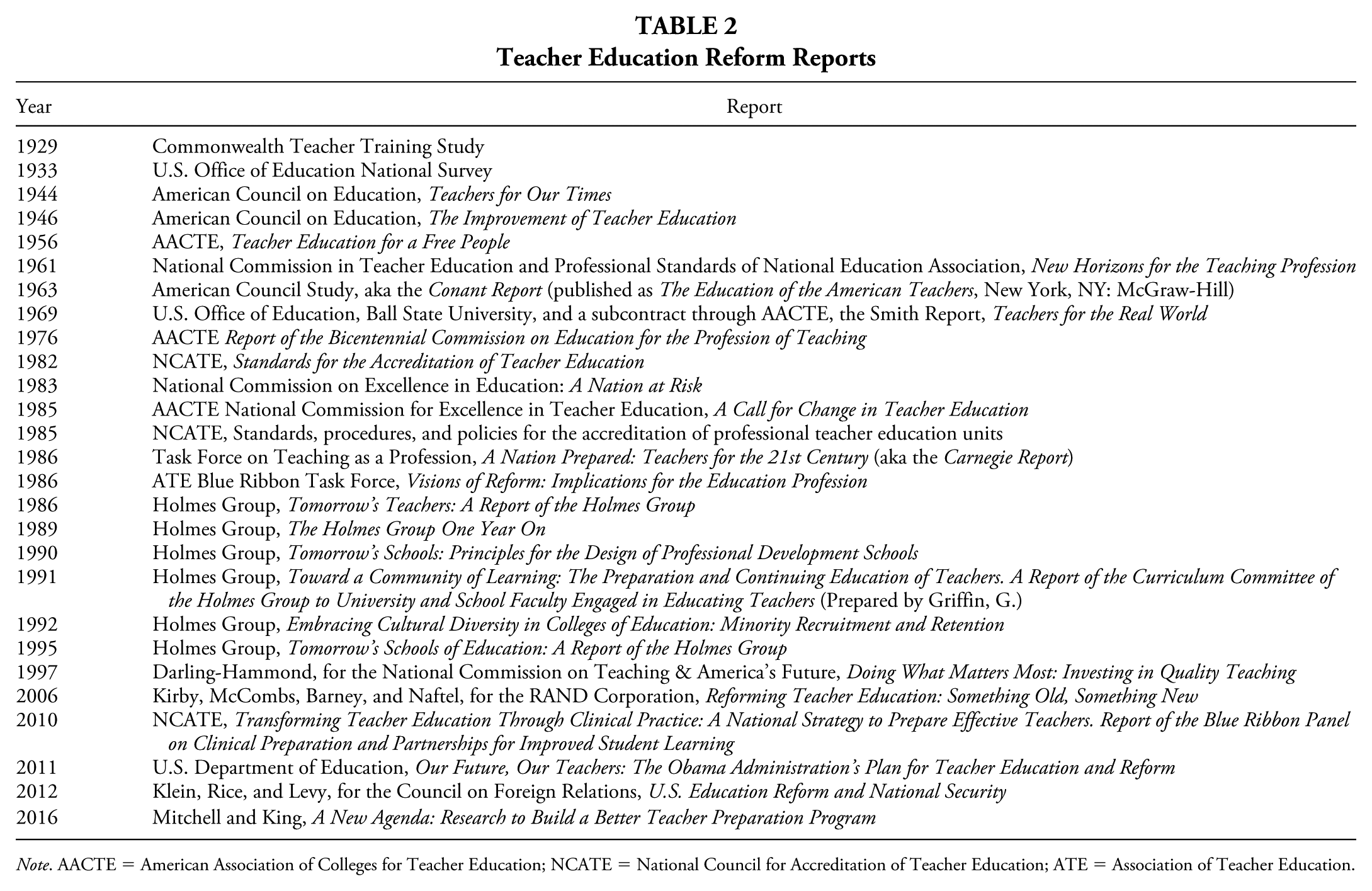
Note. AACTE = American Association of Colleges for Teacher Education; NCATE = National Council for Accreditation of Teacher Education; ATE = Association of Teacher Education.
The first phase, bookmarked by the Great Crash and the end of World War II (WWII), featured three major reports, the Commonwealth Teacher Training Study (Charters et al., 1929), the U.S. Office of Education National Survey (1939), and the American Council on Education’s report, Teachers for Our Times (1947). This trio of reports form a logical sequence, with the first constituting a functional analysis of teachers’ classroom practices across the country, the second calling for a national focus on improving teachers’ competence in classroom skills, and the third arguing for the civic responsibility of teachers in a democratic society. Although this period evinces an awareness of the need for effective teachers at both the classroom and community levels, there is no clear push for changes to teacher training in order to satisfy this need.
The second phase, beginning just after the end of WWII in 1946 and ending at the height of the Vietnam War in 1968, represents a major push toward the professionalization of teacher training, licensing, and assessment. In a series of studies and reports, organizations such as the American Council on Education (American Council on Education Commission on Teacher Education, 1946; Conant, 1963/2001), the American Association of Colleges for Teacher Education (AACTE; Cottrell & Cooper, 1956), and the National Education Association (Lindsey, 1961) developed detailed suggestions for teacher education, laying the foundation for what is now sometimes described as “traditional” teacher education. All the reports agreed on the need for teachers to be trained as undergraduate students at universities with some combination of liberal arts and education coursework, and to get preservice clinical experience under the joint supervision of university-based teacher educators and mentor teachers in the schools. Although the groups did not agree on where responsibility for licensure should lie, all agreed that the requirements for licensure should be decided by universities and be based on research into teaching and learning. Little attention was paid in this period to the social, economic, and political ferment in the larger U.S. society—there is no reflection in policy recommendations, for example, of the fight to eliminate Jim Crow in the south or of the growing race-based inequalities in the north. Even the titles of the reports—The Improvement of Teacher Education (American Council on Education Commission on Teacher Education, 1946), New Horizons for the Teaching Profession (Lindsey, 1961), The Education of American Teachers (Conant, 1963/2001)—reflect the managerial attitude prevalent in this phase.
The next phase continues this managerial attitude through such events as the 1976 Bicentennial Commission on Education for the Profession of Teaching (an AACTE project) and the publication of the first standards for teacher education by the NCATE in 1982. However, as the title of the 1969 report by the AACTE, Teachers for the Real World (Smith, 1969), suggests, the tumultuous changes that had been taking place outside schools of education were beginning to percolate into policy. Indeed, that report appears to be the earliest attempt to address the diversity of the student body, expending considerable space to speaking of “disadvantaged youth” as similar only in their marginalization, but “as different from one another as the children of other elements of the population” (p. 13).
The fourth phase corresponds to a period of major crisis and upheaval in education, heralded by the publication of A Nation at Risk in 1983. This report, although not directly concerned with teacher education, laid out in stark terms an apparent crisis in K–12 student achievement as measured by performance on SAT exams, in comparison to historical scores as well as international ones. Although strongly criticized on methodological and ideological grounds, the sense of crisis engendered by the report as well as a subset of the nearly 40 policy recommendations (notably, the use of standardized testing of student learning) have become permanent features of the U.S. education landscape. Subsequent to A Nation at Risk (National Commission on Education, 1983), further reports on education in general and teacher education in particular became a nearly annual event. Major landmarks include the 1985 AACTE report A Call for Change in Teacher Education (National Commission for Excellence in Teacher Education, 1985) and two competing reports in 1986, one by a group of politicians and businesspeople assembled by the Carnegie Forum on Education and the Economy (A Nation Prepared: Teachers for the 21st Century) and the other by the Holmes Group of education school deans (Tomorrow’s Teachers). All the groups continued the emphasis on professionalization in their report, but the Holmes Group is distinguished for continuing to issue reports into the early 1990s and for launching and intensifying efforts to diversify the teacher workforce as a means of addressing both the growing diversity of the student body and the issues with achievement identified by A Nation at Risk. In particular, the Holmes Group required its member institutions to work on “recruiting minority students and faculty” and reporting the results, beginning with their 1989 report The Holmes Group: One Year On, through their calls for professional development schools (1990) and teacher learning communities (1991), culminating with a report entirely focused on the issue in 1992, Embracing Cultural Diversity in Colleges of Education: Minority Recruitment and Retention (Blankenship, 1992). Interestingly, although there have been many critiques of both the Carnegie and Holmes approaches to professionalizing teacher education (Caldwell, 1986; Cockrell, Mitchell, Middleton, & Campbell, 1999; Darling-Hammond, 1986; Fullan, Galluzzo, & Morris, 1998; Gottlieb & Cornbleth, 1989; Hawley, 1986; Johnson, 1987, 1990; to name just a few), rarely has the focus on teachers and teacher educators of color found in the Holmes Group’s efforts merited comment.
Finally, the current phase, which begins with Darling-Hammond’s 1998 Doing What Matters Most: Investing in Quality Teaching, builds on the proposals for professionalizing teachers that developed in the previous phases but replaces much of the concern about diversity and equity evidenced in the Holmes Group reports with a focus on national competitiveness. Recall that A Nation at Risk raised the issue of national competitiveness with an international comparison of SAT scores and K–12 curricula; in the late 20th and early 21st centuries this was intensified with the creation and application of international standardized testing, particularly those of the PISA. This has ushered in a strong neoliberal emphasis to the policy suggestions, including a focus on the economic value of schooling as opposed to knowledge or community engagement, and a move toward privatizing both K–12 education and teacher preparation. Thus, although some of the same organizations that had been issuing reports for years continued to re-present older prescriptions for teacher education, such as NCATE’s (2010) Transforming Teacher Education Through Clinical Practice, new players from the private sector and the national security disciplines weighed in as well: Kirby, McCombs, Barney, and Naftel (2006), for the RAND Corporation; Klein, Rice, and Levy (2012), for the Council on Foreign Relations; and Mitchell and King (2016), for Bellwether Education Partners, a 501(c)(3) organization founded by venture capitalists and charter school operators including representatives from EdVentures, Inc., and Teach for America.
In sum, reports and calls for action in reforming teacher education through most of the 20th century and into the 21st only begin to recognize student diversity with the 1969 Smith report, and teacher diversity only with the Holmes Group reports from 1986 to 1992. None of the calls for action have elevated the needs of students of color or teachers of color to the level of other issues deemed “crises,” such as the drop in SAT scores decried in A Nation at Risk or the fears of economic competition driving later PISA comparisons. Moreover, because they employ a managerial mind-set, even the reports of the Holmes Group fail to fully diagnose the barriers facing the recruitment, retention, and success of students and teachers of color, providing little advice beyond promoting adequate funding and mentoring of teachers of color. Finally, all the reports since the end of WWII have advocated clinical practice as an important element of teacher preparation. However, there appears to be no recognition of the possibility that clinical practice could reinforce negative aspects of school and society, in spite of research suggesting just that as early as the original Harvard-Lexington summer program (Goldhammer, 1966).
Changes in Teacher Education Practice
It is clear from the literature and policy reports that teacher education programs need to change future teachers’ teaching practice to better support diverse learners. Teacher education programs have indeed responded to this demand and have implemented different approaches to address the issues of teaching diverse students. In general, these approaches fall into two categories: (1) preparing White prospective teachers to teach diverse students and (2) recruiting and preparing prospective teachers of color to teach diverse students. Below we provide a review of the practices and outcomes of these two types of teacher education practice.
Preparing White Teachers for Diverse Students
In the years since A Nation at Risk, three major approaches to preparing White teachers for diverse students have been developed: multicultural education, critical race theory, and community-based learning.
Multicultural Education and Critical Race Theory
Two approaches to teacher education emphasizing social justice have taken shape over the past 50 years, both of which are employed by teacher educators and researchers. The older of the two, multicultural education, grows out of a desire to have schools fully reflect the pluralism of post-WWII society, particularly in the aftermath of the civil rights movements of the 1950s and 1960s. Some years later, scholars and teacher educators such as Gloria Ladson-Billings applied the ideas of critical race theory to education in general, and teacher education in particular. In subsequent years critical race theory has greatly influenced multicultural education, so we treat the two together.
Although the roots of multicultural education go back farther, it is generally considered to have taken shape in the 1970s, simultaneously in the United States, the United Kingdom, and Australia (Banks, 1974; Bullivant, 1972; Gay, 1977; Grant, 1975). There are several major surveys of multicultural education in the literature beginning as early as 1976 (Gibson, 1976) but none that specifically address research from the standpoint of diversity and efficacy in both classroom and teacher education programs. Sleeter and Grant (1987) observed that these early surveys, organized by a combination of target population, long-term goals, and assumptions about cultural differences, “failed to distinguish between related but different approaches” (p. 422). Therefore, they typologized 127 articles and books on multicultural education in terms of approaches to pedagogy but did not address research or teacher education. Some 15 years later, Bennett (2001) assayed an even broader survey of works on multicultural education using the concept of literary genre to develop four clusters of “genres of research” covering curriculum revision and reform, equity pedagogy, multicultural competence, and societal equity (p. 174). However, Bennett’s survey is not limited to research and includes materials such as K–12 textbooks, curriculum reform proposals, and works that are broadly descriptive but not based in systematic research.
The broad literature reviews by Sleeter and Grant (1987) and Bennett (2001) are certainly highly valuable to educators and researchers, but neither provides a pathway for transformation of either classroom teaching or teacher preparation. They do demonstrate the enormous scope of research and pedagogy associated with multicultural education, and that in itself points to definitional problems in the approach. In spite of the use of the word “culture,” in the beginning multicultural education was more closely linked with notions of race, ethnicity, and linguistic diversity and had a somewhat contentious relationship with the identity politics of gender, sexual orientation, and disability. As early as 1974, Banks warned against the expansion of multicultural education away beyond race and ethnicity, arguing that race and ethnicity are so fundamental to American inequity that they must be addressed first, and that bringing in other ways people identify in groups would harm the causes of both sides. A year later, Grant identified a tension between the goals of multicultural education and competency-based teacher education, warning that viewing multicultural education as a set of skills transmissible through professional development would not address the primary goal: eliminating race-based inequities built into the American school system (Grant, 1975).
Critical race theory, by contrast, prioritizes the experience of minority communities of color over that of White teachers, even in the branches of critical race theory that are specifically concerned with the concepts and mechanisms of Whiteness (e.g., critical Whiteness theory). From the standpoint of critical race theory, educational institutions and practices function to perpetuate White supremacy, so the goal of teacher education should be to enable teachers to recognize, acknowledge, and change those institutions and practices. Critical race theory is more visible in research on teacher education than in teacher education programs themselves, typically used as a framework for interpretation and analysis of programs and participants. Nevertheless, it has now deeply affected the stated goals of multicultural teacher education programs, even if it has not produced a unique set of methods for teacher educators.
Notwithstanding early warnings by Banks and Grant, and repetitions over the years, including, most recently, Milner (2017), the two issues they identified have largely defined multicultural education in both practice and research. Originally envisioned as a set of approaches to change school culture, especially the relationship between a school and its surrounding community, it has become a standard pedagogical subject in a large number of teacher education programs, focusing on educating the large White majority of preservice teachers rather than increasing the ranks of teachers of color. As a result, both the majority of teacher education programs and the majority of research on multicultural teacher education focus on the efficacy of teaching White teachers to teach “students of diversity”—to change the mind-set of White preservice and in-service teachers through some combination of self-reflection and exposure to students of color. How to accomplish this has remained unclear; Banks has long advocated teaching “multiple dimensions” of multicultural education in his influential textbook (Banks, 1995), whereas Sleeter recently argued for targeting specific resistant practices of White preservice teachers, focusing their learning about multicultural education on understanding interest convergence, color blindness, and experiential knowledge—concepts drawn from critical race theory (Sleeter, 2017).
Regardless of the specific conception of multicultural education, recent examples of coursework in the literature still emphasize self-reflection and/or exposure to students of color. For example, Davis (2009) used “critical consultation” between White preservice teachers and students of color in their placements to encourage the preservice teachers to discard their habitual deficit thinking, Souto-Manning (2011) built a course using theatrical role-playing methods to raise the awareness of racism among White preservice teachers, and Matias and Mackey (2016) constructed a course focused on self-reflection to try to accomplish the same ends. Several scholars advocate autobiography or other narrative inquiry methods to encourage self-reflection around multicultural issues (Fits Fulmer, 2012; Rieger, 2015). The consistent reportage of a single course focused on multicultural education underscores the observation by Grant and Koskela (1986), Zeichner (1993), and others that multicultural teacher education tends to be handled with a single course (or inservice workshop) rather than being integrated into the curriculum. Given the centrality of self-reflection and exposure to students of color to these multicultural teacher education programs, it is reasonable to predict that this “one-shot approach” (Zeichner, 1993) would have limited effectiveness—and, indeed, several scholars (Amos, 2010; Evans-Winters & Hoff, 2011; Philip & Benin, 2014) suggest that, far from infusing White teachers with a sense of social justice, isolating multicultural content from the rest of the curriculum reinforces their unexamined assumptions about race and ethnicity.
Parallel to the multicultural education courses in teacher education programs, research since the 1990s on the efficacy of such courses has focused on assessing changes in White teachers’ attitudes toward students of color (e.g., Deering & Stanutz, 1995; Gomez, 1994; Goodwin, 1994). This research almost exclusively relies on the self-reports of White teachers, with researchers interpreting statements made by teachers in surveys, interviews, and professional portfolios. Researchers tend to employ a critical framework for analysis, usually critical race theory or critical Whiteness theory, typically in the context of self-study with small-scale, qualitative case study methods, to determine how well White preservice or in-service teachers have “learned” multicultural education. Horton and Scott (2004) employed Freire’s generative themes to examine the responses of four White preservice teachers to a multicultural education program, locating each participant in one of the stages of racial identity development suggested by Helms (1990). They found that far from encouraging notions of pluralism, short-term multicultural education courses may stimulate more rigid notions of White identity. Amos (2010), working with a framework of critical Whiteness theory, observed similar behavior, and went so far as to title his article “They Don’t Want to Get it!” using a quote from one of the preservice teachers of color about their White classmates to summarize the problem: White preservice teachers dominate discussion in multicultural education classes, in part because the structures of teacher education encourage such dominance (Rieger, 2015).
In sum, it appears that consciousness raising through dedicated coursework and exposure to students of color has not produced the transformation of White teachers that early multicultural education theorists once envisioned. Moreover, even when White teachers claim transformation, their actual classroom behavior has not been examined.
Community-Based Learning in Teacher Preparation
Another, more recent approach to preparing teachers for diverse students draws from ideas of community-based learning in an effort to address the tension and distrust between teachers and parents (Graue, 2005; Graue & Brown, 2003). As Graue (2005) observes, “There are significant discrepancies in perceptions between school people and parents about school efforts and family involvement in education” (p. 158), which are further exacerbated by racial and cultural differences between poor parents of color and the largely White middle-class teacher corps (Bryk & Schneider, 2002; Meier, 2002; Noguera, 2001; Tschannen-Moran, 2004).
Zeichner, Bowman, Guillen, and Napolitan (2016) suggest that addressing these problems requires that teachers know about the communities in which their students grow, develop respectful and trusting relations with students’ families and other adults in their communities, and make use of this knowledge and these relationships to support their students’ learning. Murrell (2000) calls this type of teacher a “community teacher” who develops the contextualized knowledge of culture, community, and identity of children and their families as the core of their teaching practice. Community teachers possess the “multicultural competence” they need for accomplished practice in the communities they teach. Community teachers are individuals who typically live and work in the same under resourced urban neighborhoods and communities where students from diverse backgrounds live and go to school. (p. 340)
Because of the relatively recent nature of this approach, there is only limited research on preparing future teachers to work with families and communities (Cochran-Smith & Villegas, 2017; Graue, 2005; Zeichner et al., 2016). Nevertheless, the research that exists suggests that it is a promising approach.
Zeichner et al. (2016) conducted a review of the history of interaction between schools, families, and communities, finding that the idea that teachers should interact with families and communities goes back to the progressive era but that the rationales for developing the relationships vary dramatically, from racist attempts to sanction and correct parental child-rearing strategies to collaborative attempts to build humane educational spaces. Over the past two decades, education researchers and policymakers have attempted to require working with family and community in teacher education programs through performance standards—for example, InTASC Model Standard 10 states that teachers should “take responsibility . . . to collaborate with learners, families, colleagues, other school professionals, and community members to ensure learner growth, and to advance the profession” (Council of Chief State School Officers, 2013). However, researchers have found that the epistemologies and purposes behind these approaches vary dramatically (Evans, 2013; Zeichner et al., 2016). Zeichner et al. (2016) provide a three-tiered typology of teacher-family-community relations within teacher education (involvement, engagement, and solidarity) to distinguish the epistemological groundings, the educational purposes, and the implementation requirements of these approaches. Teacher-family-community involvement is school-centric with an ultimate goal of increasing academic performance, focusing on “school staff to share their knowledge and expertise with families and community providers” (Zeichner et al., 2016, p. 278). Involvement is the most common approach when teacher education programs address the topic at all (Evans, 2013).
The second type, teacher-family-community engagement, acknowledges the knowledge and experience or “community funds of knowledge” (Moll, Amanti, Neff, & González, 1992) to help teachers better understand and serve their students. Techniques of engagement include home visits (Schlessman, 2012; Vesely, Brown, & Mehta, 2017), community walks organized by families and community leaders (Henderson & Whipple, 2013), and listening sessions (Zeichner et al., 2016). Research shows positive learning outcomes from prospective teachers, such as increasing awareness of personal biases and prejudices, increasing understanding of cultural diversity, recognizing strengths and assets of diverse families and communities, and developing confidence and skills to approach and communicate with families and community members (Vesely et al., 2017).
The third type, teacher-family-community solidarity, indicates sustained engagement among teachers, families, community activists, and teacher unions in the joint struggle over pedagogical content and assessment for educational equity for all children. Approaches include setting up community panels with parents and community leaders as panelists (Zeichner et al., 2016), engaging community members as mentors for prospective teachers (Guillen & Zeichner, 2018; Zeichner, et al., 2016), and community and teacher educators co-constructing teacher education programs (Fickel, Abbiss, Brown, & Astall, 2018; Zeichner et al., 2016). These approaches represent a more democratic and transformative framework of teacher education, decentering the power of teacher educators and the traditional curriculum in preparing teachers.
As Sleeter and Soriano (2012) warn, there are perils in transcending the barriers between schools and communities, but at the same time there is great promise in building a relationship of solidarity between schools and marginalized communities, including dispelling “negative myths about diverse populations in particular contexts” and building relationships based on communication, respect, and mutuality (p. 3). Building solidarity between schools and communities is by no means easy work, but it is, as Dobbie and Richards-Schuster (2008) observe, “perhaps the most crucial yet under-theorized process in organizing people for social change” (p. 318). Nevertheless, restructuring teacher education from the standpoint of community-based learning is predicated on the belief “in the educability of all students, thus providing students from different social backgrounds, with diverse levels of ability and behavioral dispositions, opportunities to learn together to live together” (Lopez, Montecinos, Rodriguiz, Calderon, & Contreras, 2012, p. 23). As such, it holds out the hope of fulfilling the promise of multicultural education and critical race theory in education of educating all children equitably.
Recruiting, Preparing, and Retaining Teachers of Color to Teach Diverse Learners
Considering the recruitment, preparation, and retention of teachers of color is a different approach that seeks to change the makeup of the teacher corps, and not accept the overwhelming Whiteness of education as natural. Villegas and Irvine (2010) identified three research-based rationales for increasing the supply of teachers of color: (1) Teachers of color serve as role models for all students, (2) teachers of color can improve the academic outcomes and school experiences of students of color, and (3) more teachers of color are needed to reduce the acute shortage of educators for high-needs urban schools. In addition, our society benefits when all students, regardless of their background, grow up seeing diverse adults in positions of authority (King, 2016). King’s (2016) point is an important one: All students need the opportunity to experience a multiethnic teaching force in order to unlearn racist stereotypes they might have internalized in other settings (Villegas & Irvine, 2010). Research proves that teachers of color in the K–12 workforce benefit all students, inspiring students of color to work toward success and helping White students eliminate bias against people of color (Sleeter, 2001). Furthermore, Villegas and Irvine (2010) found that teachers of color have more favorable views of students of color, including more positive perceptions regarding their academic potential, and there is evidence that students of color view schools as more welcoming and perform better on a variety of academic outcomes if they are taught by teachers of color who are likely to have “inside knowledge” (Ingersoll & May, 2011) due to similar life experiences and cultural backgrounds (Villegas & Irvine, 2010). Thus, it is important to have a diverse population of teachers to meet the needs of all students.
Recruitment
As discussed above, the current teaching force, although becoming slightly more diverse, still remains about 82% White (U.S. Department of Education, Policy and Program Services Department, Office of Planning, Evaluation and Policy Development, 2016). Due to the documented benefits of diversifying the teacher force, teacher education programs and policymakers have called for recruiting and retaining more teachers of color since the mid-1980s (see the review of calls for teacher education reform above; also see Ingersoll & May, 2011, 2016; Irvine, 1988; Villegas, Strom, & Lucas, 2012). Villegas et al. (2012) summarized four specific recruitment strategies pushed by the Education Commission of the States (1990) to recruit more teachers of color: (1) early recruitment and college entrance support programs targeting promising pre-college students, (2) partnerships between 2- and 4-year colleges to facilitate the transition of community college students into 4-year colleges, (3) career ladder programs for paraprofessionals, and (4) final incentives such as scholarships, forgivable loans, and signing bonuses. Literature indicates that teacher education programs have adopted all of these strategies in the past two decades to recruit prospective teachers of color (see Gist, 2014; Schultz, Gillette, & Hill, 2011; Toshalis, 2012; Valenzuela, 2017; Villegas & Davis, 2007). In addition, teacher education programs also have made efforts to recruit undergraduates of color at their institutions with undeclared majors, but this approach is not considered very effective because the number of students of color who matriculate directly at 4-year colleges is limited (Villegas & Davis, 2007).
Retention
The 1992 Holmes Group report Embracing Cultural Diversity in Colleges of Education: Minority Recruitment and Retention Project called for a complete strategy from recruitment through training to mentorship of in-service teachers of color to support diversification of the administrative population as well as the teacher corps. However, while much attention has been given to recruitment of prospective teachers of color, less research demonstrates what teacher education programs have done to retain them. Practices for retaining students of color in teacher education programs have primarily focused on providing academic support in the form of additional instructional assistance through tutoring, learning communities, and exam preparation workshops as well as social support through developing cohorts of students of color, sponsoring cultural events, and providing forms of counseling and advisement (Gist, 2014). In addition to these approaches, some urban teacher residency programs adopt a mentorship approach to provide both academic and social and emotional support to prospective teachers of color (Berry et al., 2008). Currently, there are approximately 50 residency programs nationwide that use mentorship approaches (Carver-Thomas, 2018).
Preparation
Compared to the efforts to recruit and retain prospective teachers of color, less empirical research has been reported on the preparation of prospective teachers of color to teach diverse students (Gist, 2017; Gist, Flores, & Claeys, 2014; Rogers-Ard, Knaus, Epstein, & Mayfield, 2013; Sleeter, Neal, & Kumashiro, 2014; Villegas & Davis, 2008). The curriculum, instructional strategies, and fieldwork in most teacher education programs that emphasize the preparation of middle-class, White teachers (Cochran-Smith et al., 2015) take little consideration of the diversity of prospective teachers (Gist, 2014; 2017; Kohli, 2019), nor have they focused much attention on the specific needs of prospective teachers of color in learning to teach diverse students in K–12 classrooms (Brown, 2014). Two examples come from Brown’s (2014) review of literature on preparing preservice teachers of color: Quiocho & Rios, 2000 found that preservice teachers of color often feel that their education programs are not preparing them to teach “effectively, both students from diverse backgrounds and across multiple school contexts,” while Téllez (1999) finds that teacher education programs fail to engage the knowledge prospective teachers of color possess as well as fail to prepare them to teach all students. Our own review of the literature shows that research on prospective teachers of color primarily focuses on two areas: (1) experiences of prospective teachers of color in teacher education programs and (2) how teacher educators support prospective teachers to develop awareness of their identity, their cultural and linguistic assets, and/or their bias and limitations.
The first area focuses on the cultural and social isolation (Ladson-Billings, 2001; Schultz, Gillette, & Hill, 2008), institutional racism (Gay, 2005; Irizarry, 2007; Villegas & Davis, 2008; Woodson & Pabon, 2016), and ideological and curricular challenges (Milner, 2008; Philip, 2010) that prospective teachers of color experience in teacher education programs. Ladson-Billings (2001) documented the experience of a prospective teacher of color who considered dropping out of her program due to a lack of diversity in the program, remaining only after two other prospective teachers of color joined the program and they were able to work together to support each other. Irizarry (2007) and Kohli (2014) both documented how prospective teachers of color endured institutional racism such as overtly racist comments or actions and racial hierarchies. Similarly, Kohli (2019) studied 11 women teachers of color about their teacher preparation experiences, finding that they believed their teacher preparation programs not only marginalized them in their preparation but also continued to negatively affect their careers as they entered the field with limited tools to resist racialized structures. Gist (2017) explored the program and pedagogical experiences of teacher candidates of color, finding that prospective teachers experience a lack of culturally and linguistically responsive learning in their teacher education programs. Similarly, Philip (2013) documented the experience of a prospective teacher of color who entered the teacher education program with a strong commitment to equity and social justice but found that the strengths gained through college student activism were overlooked and that the teacher education program failed to help her understand the nuances, strengths, and limitations of her activist stances within the context of classroom teaching and institutional change within schools.
The second area of research on prospective teachers of color focuses primarily on how teacher educators facilitate and support prospective teachers of color in developing a deeper understanding of who they are, where they are situated in the society, what assets they have, or what biases they bring through approaches such as critical reflection and collaborative dialog (Clark & Flores, 2001; DePalma, 2008; Kohli, 2012, 2014; Téllez, 1999). Villegas and Davis (2008) argued that teacher educators need to create a safe space conducive to critical dialogue in the preparation of prospective teachers of color. Similarly, Clark and Flores (2001) focused on how providing pedagogical approaches can support the ethnic identity development of Latinx teacher candidates to increase efficacious beliefs in their ability to enact culturally responsive pedagogy. Multiple studies (DePalma, 2008; Evans-Winters & Hoff, 2011; Horton & Scott, 2004; Matias & Mackey, 2016) indicate that the habits of privilege on the part of White preservice teachers and the general structures and assumptions of Whiteness in teacher education programs combine to amplify the voices of White students and silence those of students of color, even in multicultural education courses intended to accomplish the opposite. Kohli (2014), as well, found that prospective teachers of color felt that critical dialogue on internalized racism within teacher preparation was essential to developing pedagogy that challenged racial inequality. These approaches provide valuable pedagogical guidance for teacher educators regarding how to recognize and cultivate the cultural and linguistic strengths of prospective teachers of color.
In summary, research on the implications of prospective teachers’ race and/or ethnicity has focused primarily on recruiting and retaining prospective teachers of color in teacher education programs. Little attention is given to the preparation of prospective teachers of color, and even less is given to how prospective teachers of color carry out the teaching tasks of teaching diverse learners. The practice of recruiting more students of color to teacher education programs, to a certain extent, helps diversify the K–12 teaching force. However, the practice of diversifying the prospective teachers pool through recruitment without further changes to teacher education curriculum, pedagogy, and instruction is problematic for three reasons.
First is the problem of interest convergence. Although Milner’s (2006) research shows that exposure to peers of color dramatically improves the ability of White prospective teachers to empathize with students of color and implement culturally responsive teaching, he has also repeatedly observed that race has rarely had a central place in American teacher education (Milner, 2003, 2017; Milner & Laughter, 2015). Brown (2014) concurs, saying, While the call for recruiting more teachers of color is well founded, they exist in and help to maintain a system of interest convergence wherein teacher education programs can boast about efforts to bring in more teacher candidates of color while simultaneously not transforming the kinds of normative culture, knowledge, and experiences that are valued, maintained, and offered to these individuals. (pp. 339–340)
Second is the problem of the misconceived effect of cultural-match. Although literature on prospective teachers of color suggests that their cultural awareness and personal experiences are assets for teaching all students, especially students of color (Jackson & Knight-Manuel, 2019; Villegas & Davis, 2008), prospective teachers of color need preparation in order to teach diverse students effectively (Achinstein & Aguirre, 2008; Achinstein & Ogawa, 2011; Mabokela & Madsen, 2007). Zeichner (1996) argues that even when teachers and students share a significant part of their cultural background, teacher educators cannot assume that teachers can easily translate cultural knowledge into culturally relevant pedagogy (Montecinos, 1995). Similarly, Gay (2000) asserted, “Similar ethnicity between students and teachers may be potentially beneficial, but it is not a guarantee of pedagogical effectiveness” (p. 205). Moreover, research shows that teachers of color, if not critically assessing their assumptions and practices, have the potential to pathologize students of color, reinforcing deficit thinking (Achinstein & Aguirre, 2008; Jackson & Knight-Manuel, 2019) and internalizing racism due to socialization in a White culture and oppressive schooling system (Kohli, 2014). Teacher educators should not assume that prospective teachers of color are immediately ready to tap their knowledge and experiences in teaching diverse students; rather, as Jackson and Knight-Manuel (2019) suggest, teacher education programs need to create spaces purposefully for prospective teachers of color to critically examine their own sociopolitical consciousness. While Sleeter and Milner (2011) are careful not to assert that diversifying the teaching force is a panacea for increasing student achievement and student learning opportunities, they do propose that the research on the value of diversifying the teaching force is too compelling to ignore the potential benefits for students of color and for all students.
Third is the problem of Whiteness in teacher education. Prospective teachers of color need support to navigate the racialized teacher education programs; teacher education programs should also build curriculum and field experience on prospective teachers of color’s cultural capital (Yosso, 2005) or funds of knowledge (Moll et al., 1992). Furthermore, educational funding inequities at all levels disproportionately affect students of color, including teacher education students, exposing them to substandard educational experiences at every point in their K–16 schooling (Lau, Dandy, & Hoffman, 2007). This, in turn, makes success more difficult and attrition more likely (Ahmad & Boser, 2014). In addition, once students of color become teacher education candidates, their programs are often predominantly White (Ladson-Billings, 2005) with curriculum, pedagogy, methods, and field experiences constructed to prepare White teachers, and thus fail to provide the types of social, cultural, emotional, and academic support that students of color need to successfully complete the program (Gist, 2014; Sleeter & Thao, 2007). Prospective teachers of color then encounter marginalization and discrimination in teacher education programs similar to their experiences in the K–12 system (Burant, 1999; Parker & Hood, 1995; Sleeter, 2001).
Summary of Changes in Teacher Education Practices
In sum, our review above on changing teacher education practices to produce teachers able to teach diverse students effectively shows that primary changes brought about generally focus on the areas of prospective teachers’ beliefs, attitudes, and understandings; however, there are fewer studies that investigate how those changes bring about changes in classroom practice (Anderson & Stillman, 2013; Cochran-Smith et al., 2015). By practice, we mean “teacher candidates learning how to do the actual tasks of teaching” (Cochran-Smith et al., 2015, p. 117). However, much research that claims to study how teacher preparation influences prospective teachers’ professional practice does not investigate their actions in classroom contexts because practice is considered “teacher candidates being engaged as reflective and inquiring professionals” (Cochran-Smith et al., 2015, p. 117). This type of research has primarily engaged prospective teachers in talking about, analyzing, or reflecting on their teaching, and thus research data on practice are primarily based on prospective teachers’ reflections, self-reports, surveys, and interviews. Based on a thorough review of research on the preparation of teachers for urban and high-needs contexts, Anderson and Stillman (2013) find a disproportionate emphasis on belief and attitude change among prospective teachers with relatively little evidence for the development or change in actual teaching practice. They also find a tendency toward reductive views of culture and context. Cochran-Smith et al. (2015) provide similar findings in their extensive review of teacher education research, arguing, “We need more research that goes beyond assuming that changing teacher candidates’ beliefs necessarily leads to different behaviors and actions in their classrooms” (p. 117).
Thus we need to know more about what changes preservice teachers actually implement in their day-to-day teaching practices in order to be able to assess the impact of teacher education programs on their teaching practices. As Hong (2012) argues, a radical shift is needed from reported values and beliefs to “transformative practice” (p. 30). Research grounded in observations of classroom teaching indicates that in spite of required training on multicultural education, differentiated instruction, and teaching for social justice, most White preservice and in-service teachers do not actually internalize these approaches or the philosophy underlying them. Rather, they are adept at performing a shallow approximation when given incentives and the opportunity to construct a carefully bounded example—but otherwise most teachers operate comfortably within the unconsidered privilege structure of the White majority (Thomas & Liu, 2012; Liu, 2015, 2017). According to Mezirow (1990, 2000), attitudes and assumptions are important and subject to critical reflection; however, no matter how critical the reflection sounds or how great the apparent change in attitude, real change happens only with the transformation in actions—which we are referring to as “critical reflection for transformative learning.” This belief is based on our review of the literature, which confirms that most teacher education research does not provide guidance on shifting our focus from apparent attitude changes to actual change in teachers’ practices. The next section reviews the research on critical reflection to facilitate transformative learning and the model of generative change as a framework that actually accounts for a process that facilitates change in teachers’ classroom practices. We further propose that critical reflection and generativity be integrated throughout community-based teacher education programs to fill the existing gap as promising practices that transform teaching and teacher education for the benefit of diverse students.
Changing Teaching Practices Through Transformative Teacher Education for Diverse Students
Recognition of the fundamental problems in the educational system, and by extension in the teacher education system, has grown in the past 50 years, heralded by the 1969 Smith report and truly launched by the 1983 Nation at Risk report. Part of that recognition has involved critiques of U.S. educational institutions for failing to set and meet standards of “rigor.” As a result, standards-based approaches have continued to have a loud voice in the debates, leading to teacher education reform proposals that emphasize training teachers to follow the standards. For example, Hollins (2011) proposes reforming teacher education by focusing a conventional teacher education program (combining academic coursework with short- and medium-term field experiences) explicitly on InTASC and NCATE standards in order to enable teachers to develop constructivist curricula within the framework of the standards.
Two recent articles lay out more radical arguments for the construction and potential correction of the problems with teacher education in the United States: Zeichner’s (2003) “The Adequacies and Inadequacies of Three Current Strategies to Recruit, Prepare, and Retain the Best Teachers for All Students” (hereafter referred to as “Adequacies”) and Kretchmar and Zeichner’s (2016) “Teacher Prep 3.0: A Vision for Teacher Education to Impact Social Transformation” (hereafter referred to as “Teacher Prep 3.0”). These two review-essays take slightly different approaches in examining trends in U.S. teacher education reform, but both build toward Kretchmar and Zeichner’s vision of the next generation in teacher education programs, Teacher Prep 3.0. Beginning from “an understanding that education reform alone is insufficient to address the significant challenges of poverty” (Kretchmar & Zeichner, 2016, p. 427), the authors argue that the key to successfully addressing these issues is neither defending the current system through technical modification (“Teacher Prep 1.0”) nor replacing it with privatized credentialing (“Teacher Prep 2.0”) but in linking education reform to broader movements for social justice in the context of the specific communities of which the schools are a part. In other words, Teacher Prep 3.0 should be controlled neither by university teacher education faculty nor by wealthy entrepreneurs and their enabling politicians but rather by the communities that the schools are intended to serve—creating “community teachers.” This might be done through developing grow-your-own-teacher programs, by bringing community members into the student teaching and evaluation process, or by moving teacher education classes completely out into the community. Thus, regardless of the specific approach, the result is clearly community-based teaching.
When read against 50 years of education reform and efforts to prepare teachers for racially, ethnically, and linguistically diverse learners, Kretchmar and Zeichner’s (2016) Teacher Prep 3.0 presents both promise and challenge. The promise—developing educational and social equity in tandem—is clear; the challenge is how to fulfill that promise. In the previous pages we laid out the case that the limited success of previous attempts is a direct result of two problems: (1) a failure to base both teacher preparation and research on teacher preparation in classroom actions, not just in coursework and reflective, self-reported statements, and (2) a failure to focus efforts for transformation both on the level of the individual teacher and at a broader institutional and community level. The first problem results in preservice teachers talking the talk but not walking the walk; the second problem leaves even successful individuals isolated in an unresponsive institution as well as insulated from the communities that nurture their students. In the final pages of this chapter we present a framework that serves as an example of a model that addresses the problems highlighted above and that successfully accomplishes the vision of Teacher Prep 3.0—through the synthesis of critical reflection for transformative learning at work on every level of the model of generative change that is imbedded within a framework of community-based teaching.
Critical Reflection for Transformative Learning
Critical reflection is a hermeneutic approach to individual learning going back at least to Donald Schön (1983) and Zeichner and Liston (1996), if not John Dewey (1933), and is typically considered to involve repeated reexamination of one’s assumptions about knowledge and understanding, particularly those that are socially, politically, or culturally based. For example, drawing from the philosophical work on reflection by van Manen (1977), as well as Liston and Zeichner’s (1991) social reconstructionist approach, Dinkelman (1999) defines critical reflection as follows: Deliberation about wider social, historical, political, and cultural contexts of education, and deliberation about relationships between educational practice and the construction of a more equitable, [just], and democratic society. (p. 332)
Or, as he puts in more succinctly later, “deliberation on the moral and ethical dimensions of education practice” (Dinkelman, 2000, p. 195). Similarly, Larrivee (2000) combines critical inquiry and self-reflection to define critical reflection as involving “examination of personal and professional belief systems, as well as the deliberate consideration of the ethical implications and impact of practices” (p. 294). What is clearly missing, as Cochran-Smith et al. (2015) critiqued, is a focus on how teachers carry out instructional practice based on reflection: They all seem to suggest a cognitive process as the solution to improved teaching, rather than using that reflection as the basis for change in the classroom.
Other scholars, however, do take the step from thinking to action. For example, Brookfield (1995) argues that “reflection in and of itself is not enough; it must always be linked to how the world can be changed” (p. 217), a position that resonates with Mezirow’s (1990) idea that critical reflection is necessary for changing both how teachers teach and learners learn—what he terms transformative learning: “Reflective discourse and its resulting insights alone do not make for transformative learning. Acting upon these emancipatory insights, a praxis is also necessary” (p. 354). Drawing on thinkers from Dewey to Mezirow, Liu (2015) links the practice of critical reflection with the goal of transformative action for social justice, defining critical reflection as a process of constantly analyzing, questioning, and critiquing established assumptions of oneself, schools, and the society about teaching and learning, and the social and political implications of schooling, and implementing changes to previous actions that have been supported by those established assumptions for the purpose of supporting student learning and a better schooling and more [just] society for all children. (pp. 144–145)
Liu (2015) then takes this definition and develops a full hermeneutic approach to critical reflection for transformative learning based on Brookfield’s (1995) work, including a cycle of six steps of assumption analysis, contextual awareness, imaginative speculation, reflective skepticism, reflection-based action, and reflection on reflection-based action. Figure 1 provides a visual representation of the hermeneutic cycle of critical reflection for transformative learning.
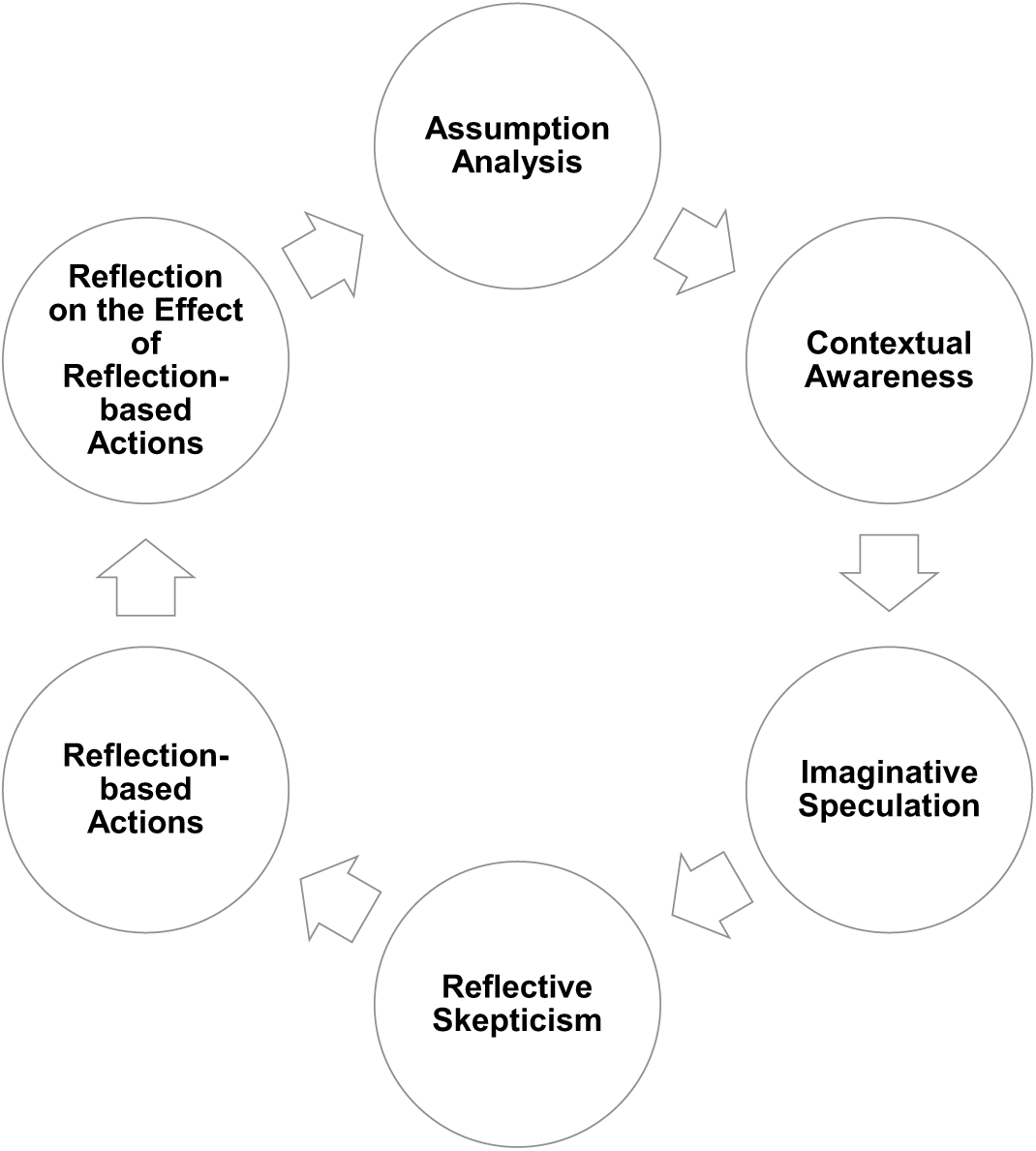
The Hermeneutic Cycle of Critical Reflection for Transformative Learning
Key to this model is the systematic movement from rethinking basic assumptions to taking action to transform learning by both teacher and students. We argue that critical reflection for transformative learning in individual teachers’ classrooms has the potential to further transform practice in the larger teacher education community for social and educational equity as envisioned by Kretchmar and Zeichner’s (2016) Teacher Prep 3.0 for three reasons.
First, it provides clear guidance for teacher educators to guide prospective teachers in a process of intellectual work starting with analyzing and critiquing prior assumptions about diverse learners, especially those grounded on longstanding, taken-for-granted deficit models, recognizing that those assumptions are socially constructed in specific historical and cultural contexts, then actively searching for alternatives to the ways in which diverse learners are failed by our current educational systems. These steps form the basis for prospective teachers to call into question the current assumptions and institutional structures that have guided current practices of teaching diverse students. At this point, teacher educators do not stop their work—they continue to guide prospective teachers to implement alternative actions in their teaching, and further analyze the effect of the reflection-based actions on student learning, upon which they may make further decisions on whether the reflection-based actions better support diverse students, triggering another cycle of critical reflection for transformative learning.
Second, Liu’s (2015) stages of critical reflection for transformative learning, when adopted by classroom teachers, can help them develop into transformative intellectuals who “develop a discourse that unites the language of critique with the language of possibility, so that social educators recognize they can make changes” (Giroux, 1988, p. 128). As transformative intellectuals, teachers can take an active role in reshaping curriculum and pedagogy for diverse learners through their own research-based actions, and by working with the larger community on the basis of shared knowledge as well as a shared commitment to social and educational equity. One problem in the work of preparing reflective teachers is the focus of facilitating reflection by individual prospective teachers with little attention to collaborative reflection among the community of prospective teachers, teacher educators, mentor teachers, and community members (Zeichner & Liu, 2010). We argue that integrating critical reflection in Teacher Prep 3.0 will enable university-based teacher education programs, schools, and the local community to work together on a more democratic basis to prepare the next generation of teachers—as the former prospective teachers become in-service teachers, they work with the community to further implement Teacher Prep 3.0.
Third, Liu’s model of critical reflection for transformative learning provides a valuable framework for research on the content of and procedures for prospective teachers’ reflection on teaching diverse students (see, e.g., Liu, 2017). It further provides a critical lens to guide teacher educators to conduct research on the real actions of prospective teachers in their teaching—whether or not their reflection brings about transformative actions in teaching diverse students. A focus on how prospective teachers actually teach diverse students has been long missing in teacher education research on preparing teachers to teach diverse students, much of which stops at collecting and analyzing prospective teacher’s self-reported data such as written reflections (Anderson & Stillman, 2013; Cochran-Smith et al., 2015). Research based on classroom actions as well as written reflections can help teacher education researchers gain a better understanding of how to improve their own support for prospective teachers to achieve transformative learning. For example, teacher educators can foster prospective teachers’ critical reflection by prompting them to engage in dialog within the teacher education community in Teacher Prep 3.0, to explore their assumptions more deeply, to situate an educational problem in the larger social-political context, and to ground their discussion in specific examples of their teaching practices in the classroom through approaches such as classroom observations and video-recorded lessons. Therefore, the framework, on one hand, points out the importance of focusing on prospective teachers’ teaching practices and, on the other, guides teacher educators to analyze prospective teachers’ actions to determine whether or not they are transformative in terms of teaching diverse learners.
Generative Theory as a Framework for Transformative Practice and the Preparation of Teachers for Diversity
Critical reflection can effect changes at the classroom level, but what about the larger institutional changes that are also necessary? Here we turn to generativity for an answer. Generativity is the generation of new or novel behavior in problem solving (Epstein, 1996), a complex psychosocial construct that describes how an individual responds to societal demands, inner desires, conscious concerns, beliefs, and commitments. The concept was meant to include productivity and creativity in accomplishing things that make the world a better place; it has also been described as a concern for one’s legacy that leads to concrete goals and, most important for our considerations, to transformative actions. The notion of generativity dates back to noted psychoanalyst Erik Erikson (1963), who first used the term in his theory of the stages of psychosocial development. From its very beginning, the term has denoted a concern for guiding the next generation. Building on the work of Erikson, de St. Aubin and McAdams (1995) provided a conceptual and methodological framework for the scientific study of generativity in the context of a life span theory of personality development. Generative actions—including the behaviors of creating, maintaining, and offering to others—reciprocally influence subsequent generative commitments.
It has been noted that today’s teachers are required to enter classrooms that neither they nor their teacher educators have ever seen or taught in before. These culturally and linguistically complex classrooms are diverse, posing challenges that teachers have not been fully prepared to meet. Teacher education programs can address these unmet needs by producing teachers able to generate new behaviors in the form of pedagogical problem solving. According to Erikson (1963), generativity theory provides a formal, empirically based theory of ongoing behavior in novel environments that can be used to engineer creative action. Research by Epstein (1996) on generative theory suggests that the generative mechanisms that underlie creativity are universal—but these mechanisms are not used by many classroom teachers because teacher education programs tend to promote uniformity and discourage the expression of novel or unusual ideas (Ball, 2006). Students who do not conform are seen as troublemakers. In kindergarten, virtually all children are creative; however, very few children express much creativity in school by the end of the first grade. This is not because of some sudden change in the brain’s functioning. Rather, it is due entirely to the school’s demand that children be taught to conform and that children’s creativity be discouraged. The expression of creativity depends on a set of competencies that underlie successful performance, but these competencies are rarely taught in schools or teacher education programs. In general, our society views creativity as the nearly exclusive property of the privileged or the antisocial. However, generativity theory provides a powerful framework to understand the creative process, supporting the notion that, with appropriate training, almost anyone can display a high degree of creative action (Epstein, 1996).
In 2001, Franke, Carpenter, Levi, and Fennema reported a study on “teachers’ generative change” as a consequence of their involvement in professional development, documenting how teachers who participated in a professional development program on understanding the development of students’ mathematical thinking continued to implement the principles of the program four years after it ended. Twenty-two teachers participated in follow-up interviews and classroom observations; all of them maintained some use of children’s thinking, and 10 continued learning about children’s thinking.
The theme running throughout the literature on generativity over the past 70 years is conceiving of generativity as a formal, predictive theory of creative behavior or activity on the part of individuals. Building on this research, Ball (2009) proposed that theories of generativity provide an excellent framework to explain the process by which teachers engage in transformative change that can make a difference in the classroom lives of diverse student populations. Given the reality that almost 40% of teachers entering the classrooms report that they do not feel adequately prepared for the challenges that await them, we need to look to generative theories to guide teacher education in their transformation of program practices. Building on the work of Erickson (1963), Epstein (1996), and Franke et al. (2001), and influenced by Bandura’s (1977, 1997) self-efficacy theories, Ball (2009) combined generative theory and teacher efficacy in a model designed to prepare teachers who believe in their potential ability to affect positive change in the lives of their students and who also think in generative ways to incorporate creative transformative action in their classroom practices in order to meet the needs of 21st-century students. A teacher’s sense of efficacy is critical to his or her effectiveness in bringing transformative action into the classroom. By design, the teachers in Ball’s courses engaged with new perspectives, new ideas, new theories, and new voices through assigned readings, discussions and critical reflective writing, and required interactions with diverse learners to facilitate metacognitive awareness, ideological becoming, and internalization. The outcome was teachers entering the classroom having increased their sense of metacognitive awakening, agency, advocacy, and efficacy in their culturally and linguistically diverse classrooms through these professional development experiences.
Based on longitudinal research spanning national boundaries, Ball (2009) proposed a model based on research grounded in theories of generativity and conducted in teacher professional development programs. Based on the analysis of teachers’ written critical reflections, classroom observations, and discourse analysis of classroom interactions and interview data collected over a decade in the United States and South Africa, the data support the development of a model of generative change explaining how professional development can be internalized by teachers, subsequently serving as a heuristic to help them change their individual programs of instruction. Drawing on that data, the four stages in the model of generative change were designed to stimulate, facilitate, and support real change in teachers’ practices as teachers embraced generative thinking in their journeys toward becoming effective teachers of diverse student populations. Building on the work of Vygotsky (1962), Bakhtin (1991), and Bandura (1977, 1997), the four stages facilitating teachers’ development of a change-oriented mindset include metacognitive awareness, a sense of agency, a sense of advocacy, and the development of a personal voice concerning the education of diverse students. Ball (2009) documents teachers’ development of generative knowledge and illustrates how teachers drew on that knowledge in thinking about students and teaching to support transformative action and creative changes in classroom practices to meet the needs of historically marginalized students.
Ball (2009) argues that in order to effectively teach in culturally diverse classrooms, teachers must learn how to be reflective, introspective, critical, and generative in their thinking. For example, teachers can increase their metacognitive awareness, agency, and efficacy by engaging in Liu’s (2015) stages of critical reflection throughout their development via the model of generative change. Ball defines generativity as the teachers’ ability to continually add to their knowledge and understanding by reflecting on and connecting their personal and professional knowledge with the knowledge that they gain from their students and the students’ community, which results in actions that include the production of knowledge and classroom practices that are creative and useful in meeting the needs of their students. See Figure 2.

Model of Generative Change: The Processes Through Which Teachers Develop Voice, Generativity, and Efficacy in Their Development Toward Transformative Change
This research emphasizes the importance of preparing teachers to learn from their students and community in order to teach diverse students effectively, and to become action-oriented generative thinkers in their classrooms through pedagogical problem-solving behaviors, creativity, and a sense of efficacy. This is accomplished as teachers progress through a carefully designed program that facilitates their development of metacognitive awareness, agency, advocacy, and personal voice concerning the education of diverse students (see Ball, 2006, 2009). Ball found that, as teacher educators model critical reflection and generativity for prospective teachers throughout the teacher education program, changes in teachers’ practices occur. In addition, she found that as prospective teachers are exposed to the work of scholars like Henry Giroux (1988), they begin to consider how they can develop into transformative intellectuals as they critically reflect on the “need to develop a discourse that unites the language of critique with the language of possibility, so that social educators recognize they can make changes” (p. 196). As generative thinking transformative intellectuals, teachers can take an active role in reshaping curriculum and pedagogy for diverse learners through their own research-based actions, and work with the larger community on the basis of shared knowledge as well as a shared commitment to social and educational equity. This development enables the school and community to work together with teachers and teacher educators on a more collaborative basis to prepare the next generation of teachers. Thus, the model of generative change serves as a framework that facilitates and accounts for the process of transformation and changing teachers’ practices. In her 2012 American Educational Research Association Presidential Address, Ball discussed how teachers, teacher educators, and education researchers can take what we know from research and put it to effective use in designing policy and classroom practice. The essay challenged researchers to individually and collectively move away from “research designed as mere demonstrations of knowledge toward generative research that has the power to close the knowing–doing gap in education—research that is designed to inform others, influence others’ thinking, and inspire others to action” (Ball, 2012, p. 283).
Conclusion
This chapter investigates the question “How is change in teaching practices and teacher education programs designed to prepare teachers to teach diverse learners conceptualized, facilitated, and transformed?” Through a critical and synthesizing review of the research literature, we have taken an interdisciplinary approach to a review of the literature related to issues of diversity and diversifying the teaching force. We have documented the calls for reform of teacher education from 1929 to the present, especially with respect to teaching diverse learners, and existing research on teacher education practices in preparing teachers for diverse classrooms, focusing on approaches from multicultural education, critical race theory, and community-based teacher preparation. We then considered research on the need to base research on teaching and learning in real classroom practice, the need to encourage critical reflection for transformative learning to be systematically applied throughout teacher education practice, and the need for critical reflection and generativity, which—when combined in systematic ways within the context of a community-based teacher education program—can support and facilitate real change in teachers’ practices and promote transformative teacher education that prepares teachers to teach diverse student populations. Finally, based on this review, we have proposed an example of a model that combines critical reflection and generativity that can be used as a framework to bring about real transformation in teaching and teacher education for both individual teachers and the teacher education community.