



Abstract
The concept of “thriving” in educational policy refers to a loosely defined mix of academic, socioemotional, and civic outcomes associated with youth well-being. In this chapter, we analyze three focus areas in K–12 education—social emotional learning, 21st-century skills, and digital citizenship—and conclude that they are currently built on an individualistic neoliberal paradigm of learning and success. We argue that this paradigm is incommensurate with the personal, social, and civic flourishing necessary to sustain equitable multiracial democratic futures and offer instead an alternative collective logic of thriving. Our critical metasynthesis of the emergent field of social-design-based experimentation offers design principles educators can use to reorganize collective learning environments to support expansive youth thriving in schools and society.
“Failure to thrive” is a medical diagnosis given to infants and children who experience inhibited physical growth related to established expectations. Treatment is dependent on determination of the causes, usually ascribed to some combination of individual health and broader environmental factors. For instance, a Johns Hopkins Medicine website differentiates between a malnourished child who is suffering from an isolated gastrointestinal condition and one experiencing “economic problems that affect nutrition, living conditions and parental attitudes” (Johns Hopkins University, 2023). Although the complex interplay between individual and environment has long been understood, public health advocates are increasingly expanding the scale at which we understand the environment and its causal relationships with individual consequences. One case is a 2021 UNICEF report that introduced a Children’s Climate Risk Index to establish clear pathways from health hazards, such as malnutrition, to the global climate crisis. From this perspective, intermediary social communities, such as families or neighborhoods, cannot be evaluated or treated without attention to the broader systemic social stressors they face.
We can draw parallels here between public health and public education. Whereas “thriving” in medical literature is defined as largely a physical phenomenon, “thriving” in education scholarship refers to a mix of academic, socioemotional, and civic outcomes often measured through indicators such as test scores, graduation and postsecondary matriculation rates, and voting. As in medicine, a wide variety of data points are brought to bear in policy discourse to diagnose inhibited achievement or growth among specific subsets of students—what can be termed an “educational failure to thrive.” When environmental etiologies for these challenges are considered, they are often located at the peer, family, or community level. Yet shifting our analytic lens to the systemic and existential threats facing young learners and families within social, historical, and cultural context can encourage us to consider questions that delve deeper and reconsider the very metrics used to define success. Such questions include: What does it mean to thrive in 21st-century society? How and to what extent can youth thrive amid persistent socioeconomic inequity, climate disaster, and white supremacist violence? How can learning be organized, implemented, and measured in ways that take this structural environment into account—and better yet, seek to mitigate and transform it?
In this chapter, we argue that current approaches taken in public education to conceptualize, organize, and assess student learning and development are incommensurate with the types of personal, social, emotional, and civic flourishing that are necessary to sustain a multiracial democracy through the systemic challenges facing current and future generations. We analyze how normative understandings of thriving being offered in response by most schools today rely on an individualistic paradigm of youth well-being that defines success as inclusion and participation within the neoliberal marketplace and existing civic institutions.
We argue that this paradigm—rooted in narrow conceptualizations of learning and human development—does not robustly address broader social ecologies, thereby fostering the perpetuation and replication of structural roadblocks to equity across national and international contexts alike. The current approach is inadequate for supporting young people to tackle the social challenges they face and exacerbates inequities that adversely impact youth from historically minoritized communities in public life. Thriving conceived as an individual accomplishment fails to account for the dynamic sociocultural relationships, identities, and processes fundamental to human development and ignores the systemic oppression at the core of current and historical social arrangements (Osher et al., 2020).
We offer in its place a remediation of the concept of thriving grounded in collective logics of well-being. This remediation attends to the multidimensionality of learning and seeks to transform and reimagine the goal of learning at the systems level by designing educational environments with equity at the center. This paradigm of collective thriving demands new approaches to both scholarly inquiry and the design of learning environments focusing on the collective co-construction of justice-oriented civic futures. We examine collective thriving in the context of newer approaches to participatory design-based approaches to inquiry. In particular, our review situates social-design-based experimentation as a methodology and praxis that is uniquely situated to move the field forward.
Our chapter begins by expanding on a critical ecological definition of collective thriving informed by the histories of global justice movements—one that we argue is urgently needed to inform education research, policy, and practice. We then analyze three current focus areas in K–12 education that we believe could play pivotal roles in enacting such an expansive vision—yet in their current forms embody individual logics of thriving through their conceptualization, implementation, and desired outcomes for learning. These focus areas include social emotional learning (SEL), digital citizenship, and 21st-century skills. This analysis is followed by an articulation of social-design-based experimentation as a methodological embodiment of systems-level theories of learning that has the potential to precipitate the needed shift from individual to collective educational approaches. Our critical synthesis of scholarship in this burgeoning field reorients understandings of academic, civic, and social life and offers design principles to reorganize how young people can learn and thrive in school and society.
Until Everybody Is Free: Thriving, Equity, and Learning
The concept of thriving elicits many nature-related metaphors because of its connotations of vigorous growth, flourishing, and generativity. The normative understanding of this metaphor likens flowers to people, whose thriving becomes evident through their individual development, usually in economic terms (dictionary definitions often include the word “prosper”; Magnussen et al, 2021). Plants cannot grow without soil, food, water—all of which are likened to the social and environmental conditions that enable individual human beings to thrive. The definition of thriving that we utilize in this chapter disrupts the directionality implied in this metaphor by shifting the focus from the individual to the collective. This attention to the importance of community is certainly not new within social and behavioral sciences; however, we seek here to further undermine the logic that even in these fields eventually and inevitably returns to the individual as the locus of evaluation and measurement in education and beyond.
Our concept of thriving is instead driven by the lessons of social movement organizing, specifically, the understandings of solidarity summarized in Maya Angelou’s often repeated refrain, “The truth is, no one of us can be free until everybody is free” (CNN, 2013). Abolitionist theorizing suggests that from an existential perspective, none of us are thriving as we consider the continued surge in worldwide white supremacist ideologies, the climate disasters that humans have wrought upon the natural world, and the worsening structural inequities stratifying public life (Gilmore, 2022; Kelley, 2003). The hoarding of resources among the privileged is not only a temporary forestalling of the collective ecological catastrophe that marginalized communities already endure but also a deadening of spirit that degrades our shared humanity (Davis et al., 2022). Thus, thriving is positioned as an aspirational concept envisioning a shared future in which the needs of all communities—and particularly those most impacted by oppressive ideologies and systems—are met (Escobar, 2020; Kaba, 2021).
For this reason, we situate structural equity at the heart of what it means to thrive—not equity of individual outcomes within or in spite of inequitably structured organizations such as schools but, rather, equity in the design and intention of collective social endeavor. For us, equity cannot be defined as more success for racially and other socially minoritized communities within the public institutions that exist today but, rather, as the creation of a society built intentionally to support the personal, social, and civic flourishing of a diverse multiracial democracy (Dixon & Anderson, 2018). Such large-scale creation, although a daunting undertaking, begins with small-scale reconsiderations of what growth and relationality mean in shared space; Freire (1970) counted among the steps to collective liberation the cultivation of “true generosity”—a continuous process to unlearn oppressive forms of interaction and allegiance to irredeemable narratives of success.
Such unlearning in turn implies the need for different understandings of learning that can guide education in formal and informal environments. Behavioral and cognitive models of learning focused on processing of information at the individual level are insufficient for this work. In their articulation of the integrated RISE 1 learning framework, Nasir, Lee, and colleagues (2021) instead argued that learning is fundamentally cultural; individual cognition cannot be understood separately from the social ecologies in which it takes place. Furthermore, these ecologies—encompassing home, school, and community contexts—cannot be treated as neat discrete entities but, rather, must be understood as “tangled roots” (Packer, 2010). This conceptualization of learning is key to helping us understand the roots of structural inequity in society and potential mechanisms for mitigating it. For instance, when confronted with evidence of racial disparities in learning outcomes, an integrated approach to learning moves us away from a discussion of individual or narrow community factors toward analysis of the interplay of broader systems contributing to these outcomes, thus revealing a new set of levers for change.
The response of educational systems to the COVID-19 pandemic represents an instructive natural case study in both the halting emergence of potential collective understandings of thriving and the reentrenchment of individual logics.
One Step Forward, Two Steps Back: Ebb and Flow in Conceptions of Educational Thriving
The school shutdowns that occurred at the onset of the COVID-19 pandemic jolted many caregivers and policymakers into reevaluating their assumptions about the nature and practice of learning in schools (Nasir, Bang, & Yoshikawa, 2021). Although there has long been tacit recognition among the public that learning involves much more than simple inputs and outputs of disciplinary content—and that schools are sites of social and civic as well as academic development—the profound disruptions that the pandemic caused to everyday life brought this realization home (quite literally) with a new sense of urgency. Social media lit up with parents expressing amazed gratitude for the complex work of their children’s teachers as thought pieces proliferated declaring that schooling would never be the same postpandemic. Educators, inspired by Arundati Roy’s (2020) argument that the crisis could serve as a “portal” to more just futures, vowed to focus on the holistic and equitable thriving of young people and communities.
This moment in time presented an authentic rationale for the field of education to reconsider the theories undergirding the structure and organization of learning in public schools and the extent to which they served the aims of equity. Think pieces proliferated that asked provocative questions about the purpose and practice of schooling. For instance, are the needs of historically minoritized students better served when multiple (digital and analog) modalities of schooling are offered instead of the one-size-fits-all classroom model? Should schools be hubs of community wellness and connection rather than conduits of academic content (Ladson-Billings, 2021; Patel, 2022)? Obviously, the potential answers to these questions resisted easy binaries and ushered in complex considerations about how and whether education systems could shift, but the conversation was more expansive than many educators had experienced for decades.
Yet as schools reopened and students returned to classrooms, the expressed commitments to equity and thriving manifested themselves among policymakers and district leadership not through a deep reorganization of collective learning ecosystems but through a doubling down on existing school structures and a focus on addressing deficits at the individual and subgroup levels (Kuhfeld et al., 2022). Alarms were raised about “learning loss” as economists sought to quantify the exact relationship between months of quarantine and units of academic content and determine exactly how far behind various groups of students were in reaching established achievement targets (Betebenner & Wenning, 2021). The United States’s education funding act, American Rescue Plan (ARP), came attached to explicit calls for fostering equity. In practice, states have applied ARP funding to priorities focused on remediating deficits in academics and mental health (e.g., tutoring and SEL curriculum) and shoring up foundational resources that had long suffered from lack of investment (e.g., building renovations, teacher/staff hiring; U.S. Department of Education, 2022). Rather than walking through the portal toward a dramatic transformation of schooling, the institutional leadership largely chose to turn back to existing structures, even as educators and communities struggled to keep the conversation going (Price-Dennis et al., 2022).
These choices assume that current schooling systems are sound and that educational equity will be achieved when more young people are given supports to succeed within those systems. We identify as the correlating societal assumption that current civic and economic structures are sound and that social equity will be achieved when more communities have increased access to opportunity to participate within them. Of course, this situation cannot be attributed directly or solely to narrow conceptualizations of learning; a variety of political forces contribute to the perpetuation of the structures we see around us today. But it is nonetheless crucial to interrogate how we understand learning and its relationship to equity as a key step in the struggle toward the transformation of social futures. As Nasir, Lee, et al. (2021) reminded us, “we cannot create schools with more equitable learning outcomes without learning theory that supports us in understanding why existing approaches to teaching and learning are not working to move toward equity” (p. 557).
We take up this call in the next section of this chapter by applying the RISE learning principles to analysis of three educational interventions that have gained prominence in public schools in response to the COVID-19 pandemic and that have the potential to speak to purposes of teaching and learning oriented toward collective social outcomes. We detail how these interventions embody normative approaches to learning in the name of equity—thus precluding the type of individual, social, and civic transformation they seek—as a prelude to offering alternative envisionings of each.
Potential Levers to Shift Conceptions of Thriving in Public Education
Long before the onset of the COVID-19 pandemic—indeed, for much of the history of public schooling—educators have enacted policies aimed at goals that transcend narrow conceptions of disciplinary content and demonstrate interest in broader social and civic outcomes (e.g., free lunch programs, community schools). Drawing on our collective ecological definition of thriving, which demands attention to interconnectedness, mutuality, and future envisioning, we have identified three current areas of policy discourse that have received renewed attention amid the pandemic and in their expressed intentions demonstrate attentiveness to these concepts. These areas, which have each risen to prominence in global education contexts, demonstrate attention outward to relationships among young people and between young people and the wider society. They include:
Social emotional learning: Students learn about developmental competencies such as self-awareness, relationship management, decision-making, and social awareness (Jagers et al., 2019).
21st-century skills: Students learn academic competencies (e.g., problem-solving, critical thinking, project-based learning) oriented toward college and career readiness for a globalized economy (National Research Council, 2012).
Digital citizenship: Students learn to understand how to engage with digital civic discourse through practicing responsible online etiquette, identifying misinformation, and engaging with school-sanctioned web platforms (Garcia et al., 2021).
These focus areas are in the complex position of seeking to embody expansive sociocultural goals for learning within a K–12 educational context grounded in cognitive metrics and immersed in cultures of hierarchical control featuring few degrees of freedom for teachers and students (Gutiérrez, 2018). We sought to interrogate the rationales and approaches to learning and equity that are characterizing reforms in these areas to illuminate inherent tensions and contradictions that highlight the need for new intervention models.
Social Emotional Learning
Stated Rationale
Although the placement of counselors, social workers, and other psychological support staff in schools has long demonstrated the embeddedness of academic learning within broader structures of (and concerns about) social and emotional development among young people, the concept of a distinct focus on “social emotional learning” (SEL) emerged in the 1990s in response to the rise of literature around emotional intelligence and renewed interest in “whole child” holistic learning models (Comer, 2004; Goleman, 1995). The Collaborative for Academic, Social, and Emotional Learning (CASEL), the leading SEL advocacy organization, encapsulated the overarching vision of what it called a “movement” with the question: “What if education fully supported the social, emotional, and academic development of all children?” (CASEL, n.d.).
Since then, a proliferation of standards, curriculum and other instructional resources have flooded the public education landscape; 27 states have adopted K–12 SEL competencies, and at least 86 formal SEL programs compete for district adoption (CASEL, n.d.). CASEL has also offered key guidelines for international implementation. Despite the seemingly straightforward nature of CASEL’s guiding question, SEL has suffered from a lack of coherence. As a 2009 scan of the field determined,
There is a fair degree of ambiguity and conceptual confusion, as the term is often used as an umbrella for many kinds of programs, including school-based prevention programs drawing from public health, mental health, and juvenile justice perspectives, as well as programs in conflict resolution and moral or character education. (Hoffman, 2009, p. 535)
Even considering this ambiguity, the calls for SEL have only increased, given that the return from pandemic school lockdowns exposed the accompanying mental health effects of the ongoing physical health crisis. The National Education Association, the largest labor union in the United States, argued even as the lockdowns began that SEL should be prioritized in schools (T. Walker, 2020), and districts have reported spending substantial portions of their federal relief funding on SEL support (Hess, 2022).
The essential idea that learning is a social and emotional endeavor fits conceptually into an integrated cultural learning theory of learning; however, the operationalization of learning and the logic of equity within SEL exposes contradictions that demonstrate the difficulties facing reforms built to fit within rather than transform existing educational and social systems.
Approach to Learning
Due to the aforementioned ambiguity in what counts as SEL programming, it is impossible to make blanket claims about a single learning approach that characterizes the field. Nonetheless, the inherent design of SEL and its orientation toward schooling structures raise questions. First, SEL is designed to offer learning about social and emotional identity and agency in the form of curricula featuring explicit lessons and activities created to nestle within the routines and organization of the school day. SEL is sometimes ascribed to its own time period within the school day (e.g., homeroom or advisory) and other times inserted into the time dedicated to subjects such as English language arts or math; in either case, however, the discrete lesson plans offered in many curricular packages encourage separation between “soft” SEL time and “hard” disciplinary time. This choice upholds the arbitrary boundaries between areas of learning set up by the Carnegie credit unit system developed in 1906 that organizes time in schools into discrete “periods”—a structure that runs counter to the fundamental interdisciplinary nature of learning. Furthermore, it telegraphs the logic that learning an academic subject like English language arts is a qualitatively different and separate activity than learning about SEL competencies like empathy—a logic that runs counter to the holistic approach to learning touted by its proponents.
The status of SEL as a schooled subject makes it subject to the accountability systems that structure public schooling, which express themselves through a focus on measurable outputs that are legible with those systems and a centering of the individual as the locus of achievement (or deficit) rather than ecologies of learning (Eklund et al., 2018). To be adopted in districts, programs must prove that they are “evidence-based,” which CASEL (n.d.) defines as “scientifically evaluated and shown to produce positive student outcomes.” Against the historical backdrop of an educational evaluation apparatus that privileges behaviorist and cognitive forms of measurement, the SEL skills and competencies that programs research fall into these learning models. In their review of 33 prominent SEL programs, Jones and colleagues (2021) summarized the cognitive, social, and emotional skills that comprise the focus of most programs:
self-regulation, executive functioning, and critical thinking skills that enable children and youth to take in and interpret information and manage their thoughts, feelings, and behavior toward the attainment of a goal; the ability to identify, understand, and manage their own emotions and to relate to the emotions of others through empathy and perspective-taking; and the skills and behaviors required to build and maintain healthy relationships, resolve conflicts, and work and play well with others. (p. 15)
Although these competencies are indeed critical to learning, their conceptualization within these programs treats them as atomized skills that can be demonstrated and assessed at the individual level abstracted from the environments that impact their articulation and realization. Furthermore, the learning that SEL proponents design these programs to elicit is oriented toward achievement on standardized measures and the forms of emotional regulation considered necessary for “appropriate” behavior within current classroom designs—both of which speak to a particular vision of equity that we argue is antithetical to the pursuit of collective thriving.
Conceptualization of Equity
As in much normative school-based curriculum, the tacit theory of change with regard to racial equity in SEL is one that moves outward from the personal to the interpersonal to the structural. The underlying logic expressed by the disciplinary design is that young people who understand their own social and emotional health are better equipped to engage in positive ways with the people and environments around them, which in turn can make those environments more equitable and conducive to thriving over time (Cohen, 2006). The relationships between learning, the individual, and the environment, although connected, are conceptualized as linear and distinct rather than suffused throughout social and cultural experience. Thus, SEL discourse has over time responded to evidence of racial disparities in school and society through calls for reform that focus on either ameliorating perceived deficits or differences among marginalized students themselves or attempting surface changes to learning environments that leave the bedrock structures largely unchanged.
The already racialized discourse around “at-risk” youth behaviors that catalyzed the initial emergence of SEL fostered the narrative that “problematic” behaviors were a result of inadequate emotional socialization or control. This discourse positioned many youth of color and low-income youth in deficit terms and conceptualized equity as an increase in access to the SEL learning opportunities that they needed (Stearns, 2016). Yet educational psychologists quickly critiqued the universalist assumptions defining “appropriate” presentations of emotion as privileging White, middle-class scripts (Barnes, 2019). As a result, literature in SEL began shifting its language around equity to involve recognizing and valuing different cultural ways of learning. This adaptation continues to perceive culture as an overlay to learning—an element to be adapted to rather than a constitutive element of the fundamental learning ecology.
More recently, Jagers and colleagues (2019) introduced “transformative SEL,” which marked a shift toward a more rigorous consideration of the environment within which young people are developing social and emotional skills; as they defined it, transformative SEL is geared toward “address[ing] issues such as power, privilege, prejudice, discrimination, social justice, empowerment, and self-determination” as part of efforts to mitigate “the interrelated legacies of racialized cultural oppression in the United States and globally” (p. 163). This iteration focuses on identity and agency within existing social contexts and advocates participatory instructional approaches in which teachers and youth learn from each other and seek to address injustice utilizing practices such as project-based learning or youth participatory action research.
Although this latest iteration of SEL holds promise in moving in theory toward the sort of integrated understanding of learning that animates this chapter, it remains to be seen the extent to which it will treat culture as an overlay to learning or as inherent to it as it seeks to pursue incremental change within existing systems. Some of this wobbling is evident in CASEL’s treatment of transformative SEL as one option that schools and communities can select to pursue based on their preferences, alongside “personally responsible” and “participatory” versions. Such design again leaves open the suggestion that equity—and culture—are supplementary to core learning processes. In so doing, the structural design of learning environments—and of societies—remain in place while individuals are the subject of remediation.
21st-Century Skills
Stated Rationale
Despite writing this chapter several years into the third decade of the 21st century, the term “21st-century skills” is still being used in education to convey a message about preparing youth for futuristic labor efforts and problem-solving in an increasingly globalized and digitally mediated world. Influenced by national and global policy organizations, such as Partnership for 21st Century Skills (2016), the goals of 21st-century learning have been to modernize public schooling opportunities in order to center critical thinking, collaboration, and innovation. These are not new aspects of what is covered in schools, but the auspices of a gleaming new century make decades-old claims for new forms of learning shine. These shifts in forms of learning and the tools through which they occur are tied to market forces. Within the United States, such framing focuses on an existential threat to the nation’s global dominance, as U.S. Secretary of Education Miguel Cardona (2022) demonstrated when he tweeted, “Every student should have access to an education that aligns with industry demands and evolves to meet the demands of tomorrow’s global workforce.”
This emphasis on labor demands reflects a constant eye on innovation for the sake of global competitiveness at the heart of 21st-century skills frameworks. Despite the focus on youth intellectual growth and economic opportunity, much of the rationale for 21st-century learning comes from a concern with global risk and American exceptionalism; it is a legacy of coloniality framed through the lens of race and gender that ties the forms of 21st-century learning to past forms of schooling that harm and overlook the needs of diverse student populations (de los Ríos et al., 2019).
From prognostications of falling behind global competition in canonical reports like A Nation at Risk (National Commission on Excellence in Education, 1983) to critical explorations for designing social futures (e.g., New London Group, 1996), 21st-century skills connote new technologies that might unlock previously untapped potential in students. As the dot-com boom and bust of the mid-1990s shifted toward an increasingly connected and wireless world in the 2000s, young people were viewed as a malleable workforce that might shoulder the demands for creativity, collaboration, and problem-solving. Strikingly, these values reflect the same forms of “democratic” schooling Dewey (1916) and others advocated for more than a century in our past.
Also echoing the past, we have faced a once-in-a-century crisis with the onset of the COVID-19 global pandemic. With an increasing need to diversify the instructional models of teaching and schooling in light of health risks, 21st-century skills and schooling increasingly turned to digital remedies to social and health concerns.
Approach to Learning
Because 21st-century learning approaches frequently emphasize digital tools, multimodal composition, and “connected” opportunities within global contexts of labor and social participation, the pedagogical underpinnings here focus on tool-based protocols for learning. Twenty-first-century skills are often invoked alongside web 2.0 technologies like social media, blogs, and democratized forms of media production. This reflects a technocratic foundation to how 21st-century skills are operationalized and understood in classrooms. Although the skills involved in 21st-century learning are not necessarily dependent on digital tools, the majority of classroom-based 21st-century interventions rely on digital technologies as the primary focus for classroom learning (Mirra & Garcia, 2021).
Adjacent to the emphasis on technocratic learning implementations, aspects of student-driven inquiry and problem-solving have been part of the allure of current 21st-century pedagogy. For instance, project-based learning (PBL) has emerged as a primary driver for 21st-century updating of classroom instruction (Baines et al., 2021; Grossman et al., 2021). PBL takes a cognitive approach without sufficient attention to cultural factors. Although it calls itself “21st-century learning,” it reinforces a general minimization of the historicized nature of learning; the same aspects of student-driven education that are hailed from this approach have been called for as “progressive” education for more than a century. An approach to 21st-century learning looks quite similar to reform called for throughout the 20th century.
Conceptualization of Equity
Although the covers of practitioner-facing books advocating for 21st-century skills might feature the faces of myriad “diverse” young people smiling in deep engagement with computers and, ostensibly, with a community of networked learners, 21st-century skills pay little heed to the systemic demands of equity-driven education. Instead, an emphasis on global competitiveness drives the demand for these skills. For example, in a widely covered call for educational reform, President Obama was temporarily dubbed the “Coder in Chief” because he was the first U.S. president to program a computer, writing a bit of running code in Javascript “to show that anybody can try computer science, and learning the basics is the best way to prepare for any career today, and that the basics are relevant to any career in the 21st century” (Code.org, 2014). This emphasis on rudimentary programming skills illuminates the interwoven nature of technology and industry workforce demands driving how individual digital labor gets cloaked as innovative learning opportunities. Such a focus on economic imperatives for learning that fit into capitalist global order serves to maintain structures of inequity. Furthermore, 21st-century skills emphasize access as a key aspect of equity. As Obama’s post exemplifies, anyone could code if given the right tools and time was devoted to this task in learning environments.
Digital Citizenship
Stated Rationale
Like “social emotional learning” and “21st-century skills,” “digital citizenship” is something of a catch-all term that encompasses myriad social, instructional, and civic practices funneled through the lens of contemporary technologies and their affordances. Broadly, recognizing that the line between individuals’ everyday “offline” activities and the lives they lead in online and virtual environments is ever blurrier, “digital citizenship” functions as a label for supporting the kinds of civic educational opportunities offered through an increasingly “connected” and “participatory” set of online opportunities (e.g., Ito et al., 2013; Jenkins, 2006). If young people are engaging in online forms of socialization, this approach reasons that the social and civic models of learning must move online as well. This model finds itself treading two discrete pathways: a focus on allowing individuals to safely interact, share, and consume information in online spaces and, separately, a focus on guiding individuals to engage in meaningful forms of civic participation and engagement. Both of these models, as explored below, typically refuse to meaningfully interrogate the forms of civic learning audiences, spaces, communities, and platforms shaping these interactions today (Mirra & Garcia, 2017). Importantly, because the digital domain seems accessible from nearly every young person’s fingertips, digital citizenship is, inherently, global citizenship. And yet, such assumptions ignore the inequitable distribution of broadband, digital tools, and unfiltered online access. The digital is a domain that affords citizenship to those young people that are able to afford it.
Similar to the call that “skills” must be updated to meet the demands of a recently turned century, the appending of “digital” to “citizenship” evokes the ways schooling and society emphasize technological shifts in social interactions. Digital citizenship is at once a pedagogical call for supporting students’ online social interactions and sociopolitical development (Middaugh, 2019) and a host of interrelated skills related to media literacy (e.g. Garcia et al., 2015), online reasoning (Hobbs & Jenson, 2009), and responses to safety and protectionism (Common Sense Education, n.d.).
Approach to Learning
As outlined in Garcia et al. (2021), the three domains through which digital citizenship is typically approached focus on safety, information analysis, and—less frequently—youth civic engagement (p. 326). All of these foci can take, as rationale, the myriad disparities in civic learning opportunities that shape current forms of instruction (e.g., Kahne & Middaugh, 2008). Safety, for example, might focus on issues of racial harassment or bullying targeting LGBTQ+ communities. However, such approaches are frequently focused on providing protection from online harm, rooting out misinformation, or offering safe avenues for sharing perspectives in closed off corners of the Internet. As a field, digital citizenship does not take up critical scrutiny of the root causes of the existing gaps in civic learning or in feelings of resentment and apathy stoked by colorblind approaches to civics (e.g., Watts & Flanagan, 2007).
When citizenship is conceptualized apolitically in terms of being civil/nice online, that is willfully seeking to skirt the ways that learning and relationships exist within cultural and sociopolitical organization—skirting these issues allows for perpetuation of systems of inequality. Similarly, when conceptualized as sorting through misinformation/disinformation as a purely cognitive activity, it is ignoring this context.
Conceptualization of Equity
To understand the equity conceptualizations of digital citizenship, one need simply look at the ways equity is (or is not) framed in current citizenship instruction. That is, this focus takes the same principles of valuing youth participation in familiar forms of civic participation (e.g., voting, consuming credible media sources, etc.) and takes a just-add-Internet approach. Online fact checking, writing blog posts and op-eds, engaging in civic debate with others are familiar forms of civic learning augmented by digital tools but not necessarily transforming the role of U.S. citizenship and civic instruction for taking on robust forms of equity and transformation. Civic online reasoning and efforts to honor youth voice as they learn to become part of civic communities must begin from understanding the forces of oppression that seek to keep the current inequitable status quo in place.
The piecemeal approaches to individual thriving represented by SEL, 21st-century skills, and digital citizenship offer surface-level solutions to issues of U.S. inequity deeply rooted in this nation’s history. Such notions of thriving are limited to interventions at the individual level that do not adequately work to unravel tightly knotted works of inequality. In the remainder of this chapter, we explore a different approach. The focus on social-design-based experimentation and the forms of scholarship emerging from this tradition build toward broader visions of thriving.
Social-Design-Based Experimentation: A Bridge Toward Reimagining Thriving
As elucidated above, reforms focused on social emotional learning, 21st-century skills, and digital citizenship are seeking to reconcile positions on learning and equity that we argue are intrinsically incommensurate. On one hand, they seek to situate K–12 education as a site of collective social thriving by weaving threads of interpersonal empathy, global connection, and civic dialogue into the tapestry of disciplinary academic learning. On the other hand, they continue to approach learning in forms that are legible to currently existing educational and social structures and conceptualize equity in terms of incremental changes to those structures that increase inclusion and access for historically minoritized communities. The model of change makes halting progress but continues to fall back into positioning individual thriving—as defined by metrics established by schools, economic markets, and civic institutions—as the core from which wider systemic change will follow.
We suggest that seeking to reform narrowly conceived individual and interpersonal learning ecologies while leaving the broader structural ecologies intact will continue to perpetuate inequity precisely because those structures (and learning approaches) were fundamentally designed to stratify amid historical and continuing legacies of racial oppression. Reiterating the premise that individual thriving involves expansive learning that merges behavioral, cognitive, and cultural elements—and thus that it can be fully realized only within broader contexts of collective thriving—we argue that educators must recast their efforts to directly address those contexts.
Such recasting involves a major paradigm shift “that demand[s] radical shifts in our views of learning and in our perceptions of youth from nondominant communities so that they can become agents of newly imagined futures” (Gutiérrez, 2016, p. 187). We offer Gutiérrez’s (2016) framework of social-design-based experiments (SDBEs) as a promising bridge forward. Drawing on cultural historical activity theory, democratizing forms of inquiry, and a resilience thinking framework (B. H. Walker & Salt, 2006), design principles of social-design-based experimentation include (a) attention to history and historicity in relation to resilience, sustainability, and equity; (b) focus on remediating activity, that is, a focus on reorganizing the functional system rather than individuals; (c) dynamic understandings of culture with an understanding that cultural and other forms of diversity are key resources for sustainability; and (d) a persistent emphasis on equity (Gutiérrez et al., 2020).
Social design methodology combines traditions of design-based research (Design-Based Research Collective, 2003), formative experiments (Engeström, 2008), and equity-oriented forms of inquiry to develop an approach that seeks to transform social institutions and their practices through mutual relations of exchange with constituent people as valued stakeholders and partners. This perspective shifts the process of social transformation from changing people through a narrow focus on biological or cognitive determinants of learning to a focus on changing systems of activity in which participants can become designers of their own futures (Lee et al., 2020).
We suggest that SDBEs can function as a bridge in education research and practice because they manifest epistemological commitments to integrated, critical, and equity-focused learning frameworks while offering methodological pathways to systems-level change. They thus seek to move toward a collective logic of thriving to counter individualistic thinking—a set of symbolic yet pragmatic principles and actions that can make alternative futures one interaction at a time. As we explore in our review, SDBEs explore similar commitments as SEL, 21st-century skills, and digital citizenship; but because of their different approach to learning and equity, they push the field in new directions.
Methods: A Metasynthesis of the Developing Empirical Base for SDBEs
Although the practices and theories that inform SDBEs have always existed within communities, conceptual articulations of Gutiérrez’s (2016) particular iteration of the framework have only begun to appear in academic publications within the past several years. In turn, publications that seek to document and analyze the application of SDBE to empirical inquiries in the field of education are just beginning to emerge. We seek here to engage in a scan of this developing body of empirical work to tease out key moves that designers of learning environments can glean from the research. It is important to note our positionality in this work; as researchers who ourselves engage in the collaborative development and analysis of SDBEs as theorized by Gutiérrez and whose scholarship examines the concepts of SEL, 21st-century skills, and digital citizenship, we are uniquely invested in evaluating the affordances and limitations of SDBEs related to these focus areas.
Nuanced but theoretically important distinctions exist between SDBEs and other forms of design experiments and social design research writ large, including (a) a focus on privileging the knowledges of historically minoritized communities and (b) a commitment to stepping outside of the norms of existing social institutions in the organization of the design process. Considering the multiple interpretations of the terms “social,” “design,” and “experiment” in scholarly research and the relatively small body of current SDBE empirical studies and our own experiences in this burgeoning field, we structure this review as a metasynthesis. Metasyntheses “offer an appropriate balance between an objective framework, a rigorously scientific approach to data analysis and the necessary contribution of the researcher’s subjectivity in the construction of the final work” (Lachal et al., 2017). Our study synthesizes findings from recent SDBE scholarship by tracing how the projects detailed in the included studies leverage interdisciplinary learning theories, design learning environments, represent consequential learning, and conceptualize the social, civic, and academic elements of collective equity.
The parameters for our literature search include studies published from 2010 to press time (January 2023) in peer-reviewed academic journals that examine the utilization of SDBE study designs in formal and informal educational contexts. We use 2010 as the starting point for the review for both conceptual and pragmatic reasons; this marks the publication year of one of the first peer-reviewed explications of SDBEs (Gutiérrez & Vossoughi, 2010), and this terminology did not begin to appear in journal articles until well after this publication (all articles in the review were published in 2013 or later). Although K–12 education is our primary focus, we decided to include studies in the review from higher education and teacher education contexts because of both the small size of the current research base and a desire to conceptualize learning across the life span beyond grade-level boundaries.
We conducted the search for literature across three databases—ERIC, EBSCOhost, and Google Scholar. We entered multiple variations of the term “social design based experiment” in an initial search to gather and cross-check an initial corpus of articles. When we bounded the terms in quotes, the search returned small article counts (e.g., “social design experiment”: n = 11; “social design based experiment”: n = 4; “social design research”: n = 3; “social design”: n = 51), whereas open searches without quotes for social design based experiments returned much larger counts (n = 301) because of the aforementioned conceptual variation associated with those terms. We reduced the corpus by engaging in one individual and one collective round of analysis of the abstract, methods, and references of each article to ensure that all included pieces utilized Gutiérrez’s (2016) approach to SDBE. When we found that an author or author team wrote multiple articles focused on a single empirical study, we included only one of those articles (we applied this metric to exclude two articles that we [authors] wrote together) into search engines to scan full texts according to the stated parameters. Once we read all of the full texts and applied our parameters, we developed a corpus of 17 articles. Based on these multiple rounds of analysis, we included 17 articles in this review (see Table 1).
Reviewed Articles
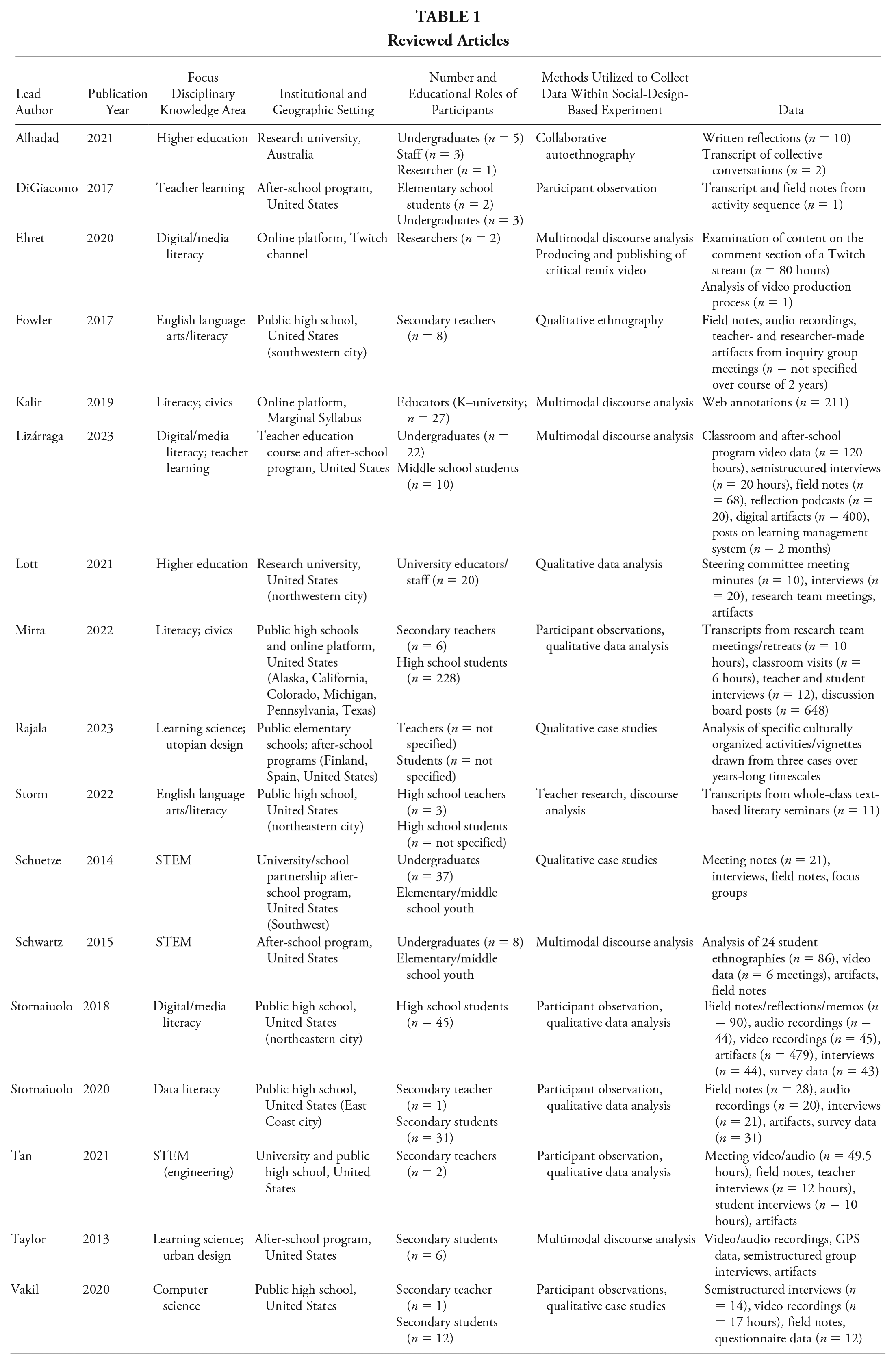
During our first round of coding, we documented basic information about the studies described in the articles, including focus participants, disciplinary knowledge base, setting, and data collection procedures. Our second round of coding was structured around the approaches toward learning and conceptualizations of equity expressed that are fundamental to the conceptualization of SDBEs. We created codes that corresponded to three commitments: (a) a focus on ecologies of learning rather than individuals; (b) a characterization of study participants as historical actors exerting agency between past experiences, present actions, and possible futures; and (c) a commitment to a simultaneous, mutually reinforcing collaborative praxis of learning and social justice. The third round of coding identified instances in which the studies explicitly or implicitly referenced learning related to the three focus areas of SEL, 21st-century skills, and digital citizenship. The fourth and final round of coding sought to identify particular design principles based on SDBE commitments that could be drawn from the processes that the participants engaged in across the focus studies to inform future interventions aimed at collective thriving within structurally equitable learning environments. The following section details the themes that emerged from our analysis.
Design Principles for Collective Thriving
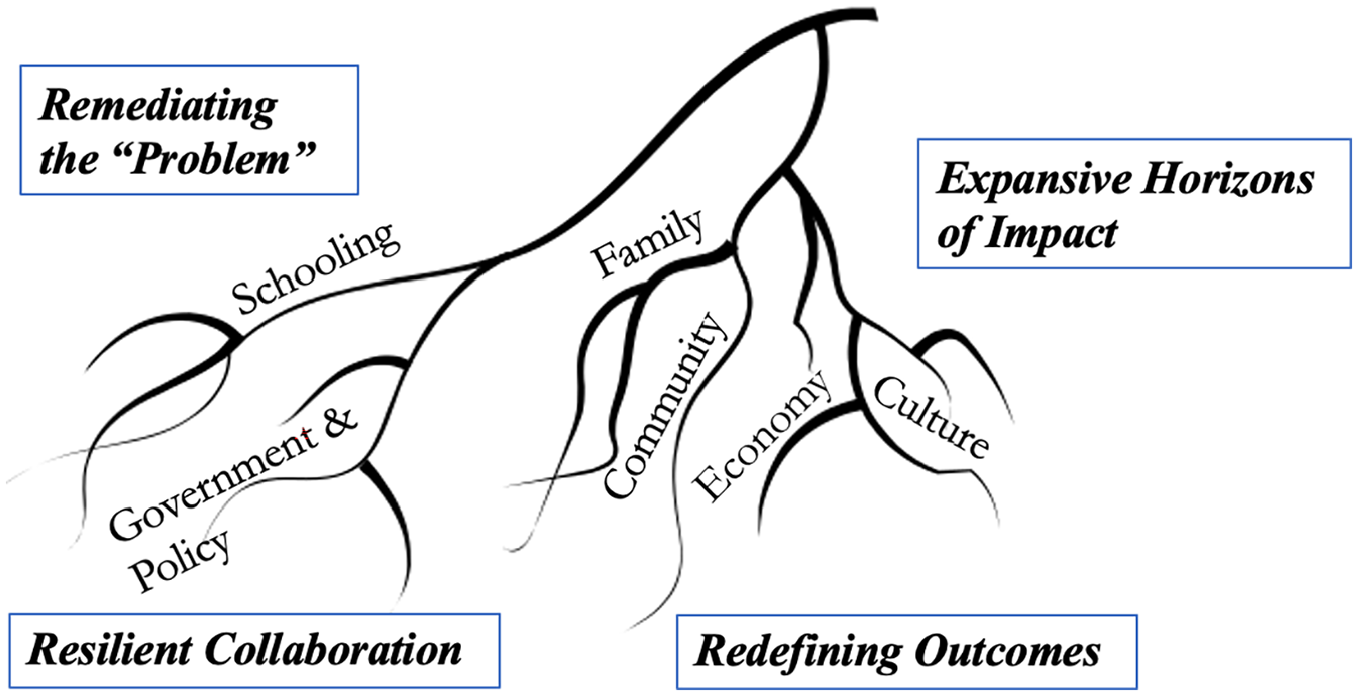
The four design principles that emerged from these cycles of coding point to how methodologies like SDBEs can help the field move beyond singular notions of thriving writ large—and specifically point toward more complex articulations of schooled conceptions of SEL, 21st-century skills, and digital citizenship. The studies also make clear that rather than the neat concentric circles of ecological understandings of systems and domains (e.g., Bronfenbrenner, 2005), the social world elides neat organization. Rather, the “tangled roots” (Packer, 2010) of community, setting, and sociopolitical identities help shape and reshape how social design principles emerge and shift from one study to another (see Figure 1). The principles that follow are a part of the weaving that braids together past inequities, present designs, and future-focused change. They are not a part of the rooted structure of contemporary life but, rather, the nourishment—the soil, the water, the sunlight—that helps sprout new possibilities.
Tangled Roots
Remediating the “Problem”
Across the reviewed literature, we found that researchers made intentional efforts to first introduce readers to a normative “problem” that has been identified in educational policy and practice and then reframe that challenge to shift the locus of analysis from individuals or intermediary activity systems toward overarching structures perpetuating inequity. This move to remediate the problem leverages the SDBE theoretical commitment to focusing on ecologies rather than individuals and applies it in ways that can support K–12 leaders in transforming their approach to similar problems of practice.
Vakil’s (2020) analysis of an SDBE that sought to reimagine curriculum and instruction in high school computer science education exemplifies this remediation while probing the complexities behind 21st-century skills discourse. Vakil began the article by recounting the experience of an African American software engineer who decided to leave his job at Twitter. He used this story to introduce a series of problems that have been identified through dominant discourse in the computer science community; these include a lack of racial diversity at technology companies and the reported climate of racism and sexism in the technology sector writ large (pp. 87–88). Yet rather than responding to these challenges through a targeted focus on the individual (e.g., exploring how to increase representation of people of color in 21st-century technology jobs) or even the activity system of the workplace (e.g., exploring how to foster more inclusive company cultures), Vakil turned the analytical lens to the discipline of computer science itself and the ways that knowledge disciplines reflect and extend societal oppression, arguing that “engineering and computing disciplines [are seen] as embodying values antithetical to justice and human rights concerns” and that the “values present in dominant representations of science” epistemically contribute to the exclusion of the voices, histories, and experiences of people of color (p. 89).
This analytical shift, which may at first appear subtle or semantic, represents a consequential move because how a problem is named dictates the approaches that will be used to address it. If the study is built around the normative challenge of increasing representation within a field that does not interrogate the ways that its knowledge foundations drive out the very communities it is ostensibly seeking to include, the outcomes will represent incremental (and likely fleeting) improvements on a shaky foundation—trapped in the same broader ecology that was discussed earlier across our three focus areas. Vakil’s (2020) study, by contrast, seeks to explore and address the deeper structural problem of how that foundation can be addressed. This starting point seeds the development of a different set of questions, study designs, findings, and implications.
Stornaiuolo and Nichols (2018) engaged in similar efforts to reframe educational challenges related to digital citizenship in an SDBE focused on the role of makerspaces in seeding civic identity and engagement among high school students. The authors set the stage by noting the surging interest across the education policy sphere in the maker movement, which involves building and remixing through the use of physical and digital tools; they also noted that this interest fits into 21st-century learning discourse that seeks to transform struggling schools through initiatives aimed at “innovation, design-thinking, and entrepreneurship” (p 2). Rather than going on to simply explore the integration of maker curriculum and instruction in schools from this paradigm, however, the authors delved into the foundational contradiction between the practices and accountability structures of public schools and the values of the maker movement. As they noted, “it is necessary to note the disconnect between this framing of failure and that of the larger educational infrastructure which continues to be evaluated—and to evaluate—based on a binary scale on which failure is contrasted with success” (p. 6).
Again, this reframing shifts the direction of the ensuing inquiry to delve into the tensions and possibilities of design work that seeks to transform the underlying structures of schooling rather than efforts to overlay well-intentioned practices onto foundations that are at cross-purposes to the fostering of equity. Such remediation of the problem influences the nature of the study approach, which in turn leads to the next design principle to emerge from our analysis.
Resilient Collaboration
The concept of resilience, much like the concept of thriving, is often discussed at the individual level in educational and public health literature—measures seek to determine if young people possess dispositions indicative of resilience in the face of personal or social challenges. As noted earlier, this framing corresponds to some SEL paradigms that seek to accommodate rather than transform learning structures that perpetuate inequity. Gutiérrez (2016) reimagined resilience in her theorizing of SDBEs, in which “mind in action is privileged rather than mind as simply bounded in the individual” (p. 188). This articulation speaks to another pattern noted across our literature review, which is the application of study designs that involve multiple stakeholders engaged in collaboration to create something beyond the bounds of normative educational artifacts. Collaboration and creation within SDBEs are not simply pragmatic choices but intentional nods toward the nature of interactions that foster sustainable and equitable futures.
As Table 1 shows, a majority of the studies (n = 11) involved interactions between participants from different positions within the educational ecosystem, specifically, young people engaging in the research alongside adults. Taylor and Hall (2013) explained that the choice to involve youth as participants is not symbolic but, rather, a carefully cultivated and intentional design decision aimed at critiquing structures that marginalize or erase their perspectives and recentering them as agentic historical actors; in designing their SDBE about counter-mapping public spaces, they noted that “youth are typically not viewed as participatory ‘stakeholders’ in processes of urban development” (p. 66). This orientation toward youth as codesigners shares the commitments of schooled SEL programming but manifests those commitments in the service of authentic and student-directed goals.
Participation in these studies is not conceptualized as simply reacting to or reflecting on an intervention but as taking an active role in the development of the inquiry and the organization of the experimental learning setting. All of the studies leveraged the “D” in SDBEs by describing the study construction as involving design work, design process, or design cycles—language that captures the focus on process and specifically the importance of flexibility, iteration, and change as integral features to enacting equity in educational environments. Schwartz et al. (2015) described the enactment of iteration through the concept of joint problem articulation, which they described as “a process in which a shared understanding of the presented problem and the goal of the activity develops toward shared practice” (p. 95). They integrated joint problem articulation into their SDBE, an after-school space in which prospective teachers engaged in organic activity, dialogue, and STEM learning with middle school youth, with the intention to “distribute agency and expertise to the teacher and students” (p. 95). Distributing knowledge and activity to develop creative responses to a collaboratively defined problem manifests respect for stakeholders and sustainable, resilient design that embodies the pursuit of greater equity in education.
The nature of what was created through the resilient design work across the reviewed studies showcases artifacts that on the surface appear to be legible to existing educational institutions (e.g., curriculum) but upon deeper analysis subvert the norms of those forms in order to speak to the values of reimagined equitable learning settings. For the studies that sought to work within classrooms and create units or lessons that negotiated the constraints of school mandates, they remixed the content to support youth to address equity concerns in their schools and have choice in their learning (Storm et al., 2022; Vakil, 2020), introduced new value orientations to disciplinary learning (Tan et al., 2021), supported youth to see themselves in empowered relation to the content (Stornaiuolo, 2020), and supported teachers to view themselves as knowledge designers rather than mere transmitters of content (Fowler-Amato & Warrington, 2017).
In addition to (or alongside of) rethinking curriculum, many of the studies sought to create products outside of the traditional scope of school-based materials. For instance, several SDBEs focused primarily on the analysis of dialogue among youth (Mirra & Garcia, 2022), between young people and adults (DiGiacomo & Gutiérrez, 2017; Lizárraga, 2023; Schuetze et al., 2014; Schwartz et al., 2015; Stornaiuolo & Nichols, 2018; Taylor & Hall, 2013), and among adults (Alhadad et al., 2021; Ehret & Čiklovan, 2020; Fowler-Amato & Warrington, 2017; Kalir & Garcia, 2019) as the participants engaged in joint activity to make things. Here, the analysis leverages informal learning as a pathway toward uncovering the inequitable assumptions and insights that inform formal learning structures so that more just formulations can be created. The creative approach and practices of SDBEs represent inputs that in turn produce outputs that differ from those traditionally measured in education research; these alternative expressions of outcome comprise the next design principle.
Redefining Outcomes
Just as SDBEs seek to remediate the structure and value orientations of educational learning environments, so too do they seek to interrogate the nature and purpose of desired learning outcomes in these settings. This is both a theoretical and pragmatic commitment; applying the evaluation and assessment indicators utilized by traditional reform efforts in SEL, 21st-century skills, and digital citizenship is inadequate to capture the types of consequential learning sought by these projects, and the empirical base as of now consists of largely small-scale descriptive studies focused on qualitative impacts at the community level. Rather than seeking to capture data demonstrating that youth and adults can achieve according to metrics of inequitable institutions, the studies in this review focused on microgenetic changes in participation that occurred when new and equitable structures were put in place.
Changes in participation represent changes in identity; the studies that included youth participants framed their findings around how youth came to see themselves in new ways in relation to disciplinary knowledge, adults, and civic society. In describing the data literacy projects that students created based on their community research, Stornaiuolo (2020) detailed the effects on their ability to “challenge mainstream, deficitizing, or racialized beliefs about themselves and their communities by re-writing dominant narratives from their perspectives” (p. 100). Lizárraga (2023) analyzed the role of digital fabrication practices in supporting youth to set goalposts for their learning that exceed those imposed by academic institutions, describing how participants “assembled ideational and material tools to craft objects of learning activity that went beyond those established by teachers and schooling” (p. 28).
Similarly, Storm and colleagues (2022) analyzed how youth engagement with popular fandoms in an English language arts class offered them the space to “navigate, remix, contest and potentially transform interpretive communities as they co-construct their own hybrid interpretive spaces, challeng[ing] a conception of literary literacy that privileges only the practices of literary scholars” (pp. 4–5). In these cases, youth engagement in design processes provided opportunities for social emotional agency within not only academic communities but the civic world as well. Vakil (2020) also emphasized that “being engaged in the practice of socially relevant technological design mediated the development and centrality of students’ political identities” (p. 97).
The studies simultaneously documented adult processes of learning to construct educational environments that support consequential youth identity outcomes. Engaging in design work aided them in adjusting their perception of youth abilities; Fowler-Amato and Warrington (2017) noted that as they expanded their perceptions of what counted as disciplinary curriculum, they “strengthened their identities as designers of curriculum, instruction, and assessment and transformed their classroom communities through antideficit English education” (p. 370). Schwartz et al. (2015) emphasized particular questioning practices that teachers developed by engaging with youth in after-school spaces that “focused children’s attention on particular features of design, while also querying children to put forth their own ideas and objectives for specific tasks” (p. 110).
In addition to deconstructing hierarchies between adults and youth, the studies also explored how the structure and praxis of SDBEs honored the often marginalized perspectives and knowledge repertoires of historically minoritized communities. Lott et al. (2021) analyzed how privileging the contributions of staff of color within an SDBE aimed at supporting men of color in higher education guided the project team toward previously unearthed solutions; as they explained, “positioning staff of color as racial equity experts, policy designers, and practitioners allowed them to think about their professional and lived experiences in ways that could lead to responses that would look vastly different from traditional approaches” (p. 29). Although these findings are not oriented toward the broader societal indicators of equity (e.g., economic, social, and civic parity), they demonstrate equitable learning processes that serve as the springboard toward promising futures. This focus on broad timescales of impact represents the final design principle.
Expansive Horizons of Impact
Perhaps the most disruptive and conceptually promising contribution that the SDBE literature makes to the current educational reform landscape is its insistence on the fundamental transformation of schools and other social institutions as a necessary element in the development of a racially equitable society in which all young people can thrive. The previous design principles have demonstrated that the ways researchers and practitioners frame problems, develop approaches to inquiry, and conceptualize desired outcomes can provide the building blocks toward such transformation—rather than remaining ensnared in the logics of structurally inequitable systems. The final design principle that emerges from our review represents the culmination of this building process as the articles demand for interventions that both materially improve the conditions of young people’s lives in the world as it currently exists and embrace a wider horizon of impact that envisions and works toward a more just society.
Consistently, the language of change in these articles speaks beyond normatively measurable forms of impact. The findings and implications articulate entire structures and worlds built through the fomentation of lasting partnership and action in SDBEs (Rajala et al., 2023). From sustaining a “more compassionate and productive public sphere” (Mirra & Garcia, 2022, p. 376) to seeing “how engineering itself could build a better world” (Tan et al., 2021, p. 388), the aspirational statements of impact in these studies do not stop at the individual level or at the doors of a school. Rather, SDBEs find impact through disciplinary K–12 learning that seeks to rewrite the narratives and rules of everyday living.
Such scripting, however, is not at the sacrifice of the demands of the present moment. Paired with these speculative enunciations of future thriving, these studies often attest directly to the impact made on those actors most directly implicated and called on in education research, teachers and students. A student in Vakil’s (2020) study, through experiencing learning that honored her civic identity, found a pathway toward succeeding in today’s discipline of computer science and imagining a more equitable discipline of computer science for tomorrow: “Lupe seemed to be entering a space of expanded possibility where her political identity and her CS identity could not just coexist, but even become intertwined with one another in a productive fashion” (p. 107). Taylor and Hall (2013) also demonstrated how youth in a community counter-mapping project leveraged disciplinary knowledge to create concrete change in their neighborhood—in the form of a bike route through their city—while also fostering their agency to imagine what their neighborhood could look like tomorrow: “They engaged with geospatial information and technology to imagine how their neighborhoods could change in the future” (p. 66).
SDBEs utilize the language of imagination but do not live in the realm of fantasy; rather, they situate the individual design choices that inform teaching and learning in K–12 environments today with steps forward (or backward) in the instantiation of a more equitable society. And they offer practical moves that researchers, educators, and policymakers can make in perspective, relationship, process, and goal setting that can bring that future world into being each day. This is the work of world building; Lott and colleagues (2021) explored how initiatives to retain men of color in higher education can push beyond neoliberal frames and toward a critical civic vision by centering the perspectives of staff of color. As they noted, “Because their issues relating to racism and oppression tend to be at the margins, centering their voices and actions to interrupt the work of oppression provides a liberating way of approaching theorizing” (p. 27). Bringing the margins to the center fosters the development of new publics within SDBEs as participants come to see themselves as “part of a shared world, with responsibilities to act in public ways to impact others around them and to participate with others whom they had never met or, in some cases, imagined” (Stornaiuolo & Nichols, 2018, p. 26).
Collectively, these principles offer a roadmap toward that shared world—a theoretical and methodological foundation for the design of educational interventions that foster collective rather than individual logics of thriving.
Promise and Provocations for the Field: SDBEs and Pragmatic Speculation
The review of SDBE literature in this chapter offers a logic of thriving that differs from the one that currently structures major educational reform efforts in K–12 education. The normative model envisions millions of individual children learning emotional, academic, and civic skills that correspond to the reward structures of social, school, and democratic life in an effort to make those structures incrementally more inclusive of racially minoritized communities. Our scan of the fields of social emotional learning, 21st-century skills, and digital citizenship has sought to critique such logic, arguing that continuing to work within existing structures creates a frustrating feedback loop within which halting steps toward equity are blunted by the foundations of the institutions built to stratify and maintain existing power relationships. This logic is built on the premise that true thriving cannot occur without healthy ecosystems that, echoing Maya Angelou again, honor the worth and experiences of everybody within them. We suggest that social-design-based experimentation offers a pathway toward an alternative logic of collective thriving within which educational settings can become laboratories for the creation of new institutional structures of learning, being, and doing in relation to each other.
Although SDBEs seed a pathway, we argue that there is much yet to explore, within these experiments and across education research and practice communities, about what it looks like to continue to walk these paths toward the systemic transformation they envision. The scholars, educators, and youth engaged in this work must consider what the next steps of this design work will entail in order to engage a wider range of stakeholders and translate the crucial small-scale changes in participation into broader changes in policies and school structures. As Table 1 demonstrates, the developing research base currently utilizes a relatively small number of data collection approaches and analyzes small data sets. Although SDBEs are intrinsically speculative in their eye to the future (Garcia & Mirra, 2023), we maintain that as they develop, they need to articulate for educators a pragmatic pathway forward toward that equitable future step-by-step amid current imperfect contexts.
The pragmatic speculation for which we advocate implies more explicit and continual recognition of the tangled roots of Figure 1 within wider and wider social ecologies. The questions proliferate: What are the mechanisms through which SDBE design processes could (or should?) interface with normative structural design processes? How are shared orientations toward equity extrapolated out to larger and more ideologically diverse communities? How can new systems be seeded with the responsiveness and flexibility to avoid the rigidity that stifles mutuality and shifting goals? What kinds of measurable outcomes are most urgent for communities currently experiencing structural oppression—and how do those map onto scholarly research agendas?
Our field is still grasping for answers to these questions, and SDBEs point us in a potential promising direction rather than settling the conversation. Like members of an orchestra fixated closely on the immediate printed notes of music before them and to the grandiose gestures of a distal conductor, education researchers and practitioners must work in concert toward the desires of cultural-historical social uplift while still meeting the pragmatic needs dictated by systems of narrowed forms of progress and growth. In this way, a speculative approach to education research must move beyond the fixed horizons of the everyday. As the design principles suggest, these horizons have been overly fixated on individual notions of growth, fixed understanding of researcher/participant relationships, and singular goals for measuring progress. Adding to these principles, SDBEs, too, give us vocabulary to challenge where, how, and what counts as impact when it comes to education research. Now we must use it.
Often, when it comes to a study’s findings, a grant justification, and myriad other forms of scholarly accountability within the academy, we are called on to speak to our works’ impact and scale. To this end, a pragmatic speculation is one that does not simply work within the systems as they are but also one that helps challenge what scale and impact mean (and what they could mean) within these systems. Yes, a systemic intervention that significantly boosts a literacy score by a percentage point is a form of impact. But so too is an intervention that fundamentally affirms the beliefs and confidence of an individual. The “systems” of change might be the respiratory, nervous, and cardiovascular systems of young people whose dreams we nourish in the tangled roots of social change. Our scale is both a global and future-focused one and a scale of the individual in the immediate, present moment.
Footnotes

Notes
Authors
NICOLE MIRRA is an associate professor in the Graduate School of Education at Rutgers, The State University of New Jersey. Her research utilizes participatory design methods in classroom, community, and digital spaces to collaboratively create civic learning environments with youth and educators that disrupt discourses and structures of racial injustice and creatively compose liberatory social futures. She previously taught secondary literacy and debate at public high schools in Brooklyn, New York, and Los Angeles, California.
ANTERO GARCIA is an associate professor in the Graduate School of Education at Stanford University. His research explores the possibilities of speculative imagination and healing in educational research. He previously taught high school English at a public high school in South Central Los Angeles.