




Abstract
This article examines the micropolitics of implementing New York City’s Schoolwide Performance Bonus Program and school governance bodies (Compensation Committees) that determined distribution of school-level rewards among personnel. Drawing on a two-year, mixed-methods study, the author finds that although most participants surveyed described a democratic process, case data suggest that principals sometimes overtly and covertly exercised power to shape decisions. The author finds that egalitarian norms, macro-political pressures, the tendency to suppress conflict, and policy design explain why most committees developed equal-share distribution plans even though a significant proportion of members favored some differentiation. The article illuminates the challenges of engaging stakeholders in incentive program design and affirms the value of combining political and sociological perspectives to understand education policy implementation.
In recent years, pay-for-performance programs and policies have received substantial support as a strategy for improving public schools. Targeting individual or groups of educators, these programs tie compensation to performance on the job as a means of incentivizing educators to work and improve instruction, as well as attracting and retaining high-quality staff.
Though controversial, current programs have gained considerable political and financial backing, including increased federal funding and endorsements from Presidents Bush and Obama and Secretary of Education Arne Duncan. For example, the Teacher Incentive Fund (TIF), started in 2006 under President Bush, supports performance-based teacher and principal compensation systems in high-needs schools around the country and has grown substantially in size (in 2006, $99 million was appropriated; in 2010, TIF was funded at $439 million). The Obama Administration’s Race to the Top initiative also supports the spread of this reform by citing as one of its “state reform conditions criteria” that states and their districts use rigorous evaluations to “inform decisions regarding compensating, promoting, and retaining teachers and principals, including by providing opportunities for highly effective teachers and principals … to obtain additional compensation and be given additional responsibilities” (U.S. Department of Education [USDOE], 2009, p. 9).
To date, most of the attention in the field has focused on the effects of pay-for-performance programs on student achievement (for a review, see Podgursky & Springer, 2007). Research on New York City’s Schoolwide Performance Bonus Program (SPBP) is no exception. In the past year, several teams of researchers have examined the effects of this school-based incentive program on achievement (Fryer, 2011; Goodman & Turner, 2011; Marsh et al., 2011).
What has been overlooked in much of this research, however, is the local implementation and decision-making processes surrounding pay-for-performance criteria. As state and district governments continue to experiment with merit pay programs, details of the implementation of such programs will become increasingly important. One of the most pressing implementation issues of performance pay systems will be how to best distribute incentive payments to teachers within a school while maintaining buy-in from teaching and nonteaching personnel.
New York City’s SPBP provides an example of one district’s approach to addressing this implementation challenge. SPBP was a voluntary program jointly sponsored by the New York City Department of Education (NYCDOE) and United Federation of Teachers (UFT) and implemented in about 200 high-needs schools (grades K-12) from 2007-2008 through 2009-2010. If a participating school met its annual performance target, it could receive school-level bonus awards equal to $3,000 per full-time UFT-represented staff member working at the school (including teachers, support staff, and counselors). The program required participating schools to establish a four-person governance body, or Compensation Committee (CC), to determine how to distribute the school-level reward among personnel within their school. Program leaders believed that involving educators in the decision-making process around bonus distribution would increase buy-in for the policy and its outcomes.
Drawing on a 2-year, mixed-methods study of schools participating in SPBP, the following article explores the implementation of the CCs. 1 I examine the actions and eventual distribution plans of these site-level committees through the lens of micropolitical theory (e.g., Blase, 1991; Malen, 2006). Micropolitical theory posits that actors use formal and informal power to either achieve their desired goals or protect their interests, and that policy adoption and implementation result from political interactions and negotiations. Recent elaborations of the theory add that contextual forces play an important role in mediating the “play of power” (Malen & Cochran, 2008, p. 149). This theoretical framework helps to make sense of how site-based policy-setting bodies determined the allocation of bonus funds within SPBP schools. Through this lens I address the following research questions: How was the CC process implemented in schools? What explains the final distribution plans committees adopted?
The answers to these questions contribute to policy, practice, and theory in important ways. The findings provide deeper understanding of the implementation of school-based performance pay programs. Given the significant interest and investment in alternative compensation and personnel policies, it behooves policymakers and local leaders to better understand the political challenges that arise during implementation in schools and ways to structure these processes to ensure success. The study offers particularly useful insights into the realities of engaging stakeholders (often reward recipients) in program design—a common practice among pay-for-performance programs nationally. Guidance from New York City’s experience about the issues that might arise when having conversations about incentive pay and distributing incentives within schools could benefit not only districts and schools participating in or considering the adoption of pay-for-performance programs but also leaders seeking to change an array of deep-rooted personnel policies and practices more generally. The research also affirms the value of understanding local policy implementation through a micropolitical lens.
In the remainder of this article, I first provide a description of SPBP. Next I ground the inquiry in micropolitical theory, followed by a description of the broader study methods. I then present answers to the research questions, including a description of how the various facets of the CC process unfolded across schools and an explanation of the patterns observed. I conclude with a set of broader implications for policy, practice, and future research.
I. Background on NYC SPBP
Building on Mayor Bloomberg and Chancellor Klein’s Children First reforms started in 2002 and implemented for the first time in the 2007-2008 school year, the SPBP was a joint program of NYCDOE and UFT to explore the utility of an alternative compensation plan as a means for improving student outcomes. Unlike other individual-based compensation programs, the unit of accountability under SPBP is the group of educators within a school. The theory of action behind SPBP was that an incentive pay system would motivate educators to change their practices to those that better improve student achievement and that the chance to earn a bonus on the basis of school performance could enhance collaboration, which would also lead to better outcomes. Some SPBP leaders also held that rewarding staff differentiated awards on the basis their individual performances could provide extra incentives to motivate change. This last mechanism of change would come about under the CC, which decided how to distribute school bonuses among staff.
SPBP was a voluntary program implemented in high-needs elementary, middle, K-8, and high schools. For schools participating in SPBP, NYCDOE set annual performance targets based on its Progress Reports, the main accountability tool measuring student performance (growth on standardized tests and relative performance compared to other schools) and the school environment in all schools in the district. Participating schools that met or exceeded 100% of their target received school-level bonus awards equal to $3,000 per full-time UFT-represented staff member working at the school. If their school received the full SPBP bonus, principals automatically received $7,000 and assistant principals $3,500.
In 2007-2008, 427 high-needs schools were identified and about half were randomly selected for the opportunity to participate in SPBP in this first year. Fifty-five percent of school staff needed to agree to participate and 205 schools participated in the program in the first year, 198 schools remained in the second year, and 196 in the third and final year. 2
Each year, in late fall, schools selected by lottery were asked to vote to participate. In the spring, the DOE and UFT provided participating schools with informational training and then asked them to form CCs to develop and submit a distribution plan to the NYCDOE by late spring, prior to the end of the school year and the announcement of state test results. In the fall/winter of the next school year, Progress Report grades and bonus awards were announced.
The program distributed more than $50 million in bonuses in its 3 years. In the first year, 62% of participating schools received more than $20 million in bonuses; in the second, 84% schools eligible earned more than $30 million in awards. In Year 3, due to the state’s raising of its proficiency thresholds, only 13% of the schools earned bonuses totaling only $4.2 million. The district formally discontinued the program in July 2011, based in part on our study’s findings that it did not improve student achievement.
The design and implementation of New York City’s SPBP are relevant nationally for several reasons. First, many design elements are similar to those of other pay-for-performance programs. Like SPBP, all of the first round of federal TIF sites surveyed in one study report basing rewards at least in part on student performance, and almost all use fixed performance contracts (as opposed to an all-or-nothing rank order design) and reward employees for overall school performance (Heyburn, Lewis, & Ritter, 2010). However, most TIF sites also combine collective with individual incentives, so slightly less than 90% tie rewards to individual performance and only 7% used school-based incentives exclusively. Other non-TIF incentive programs also include collective rewards of some sort (e.g., teacher team incentives in Round Rock, Texas) or a hybrid of individual- and school-level rewards (e.g., national Teacher Advancement Program, Denver’s Professional Compensation System, and Houston’s ASPIRE program) (Springer & Balch, 2009). And while some programs, like SPBP, explicitly require educator participation in the design of incentive plans (e.g., the statewide incentive programs in Texas, the national TIF program), 3 many involved committees of educators in the initial design process (e.g., Austin, Denver, Houston, districts in Minnesota). In fact, some of these district committees are structured much like school CCs, such as Denver’s design team that included two members appointed by the teachers’ union and two by the superintendent (Gratz, 2005).
Furthermore, stakeholder involvement in incentive program design is widely recognized as good practice. Research indicates that educator participation in designing an incentive system can promote perceived fairness and acceptability (Milanowski, 2003) and is a common characteristic of high-quality programs (Eckert, 2010). Building on these studies and the history of compensation reform, the federally funded Center for Educator Compensation Reform advises states and districts that “engaging stakeholders in the design and implementation of a compensation plan is critical to its success” (Max & Koppich, 2009, p. 1). Despite this call for engagement, there is a dearth of empirical research on how this plays out in practice.
II. Grounding the Inquiry: Micropolitical Theory as a Conceptual Framework
Micropolitical theory suggests that behavior, processes, and structures within schools are political phenomena and that power greatly affects policy adoption and implementation (Ball, 1987; Blase, 1991, 2005; Blase & Blase, 1997; Iannaccone, 1991; Malen, 2006; Malen & Cochran, 2008; Wirt & Kirst, 2005). Power can be exercised formally, for example, by using one’s position of authority to get others to do something they would not otherwise do (Dahl, 1957). It can also be exercised more informally or covertly through the mobilization of bias (e.g., by preventing issues from surfacing) (Bachrach & Baratz, 1962) and intentional or unintentional manipulation (Lukes, 1974). According to Blase (1991):
Micropolitics refers to the use of formal and informal power by individuals and groups to achieve their goals in organizations. In large part, political actions result from perceived differences between individuals and groups, coupled with the motivation to use power to influence and/or protect. (p. 11)
Some suggest that at the core of these power struggles within schools are different “logics of action” or belief systems (Bacharach & Mundell, 1993). For example, a dispute over curriculum may represent a deeper conflict between teachers who espouse a logic of professional autonomy and district administrators who embrace a logic of bureaucratic accountability.
Micropolitical theory is particularly appropriate for understanding bonus decision-making for several reasons. Unlike other theories, such as rational systems or classical organizational theory (e.g., Simon, 1979) that assume individuals make decisions based on what will advance organizational or policy goals, micropolitical theory recognizes that not all behavior is motivated by the pursuit of achieving collective goals and that self-interest and power may play an important role in explaining behavior. Past research in education indicates that individual goals do not always match collective goals, that actors are not always presented with complete information, and that school governance is inherently political (e.g., Malen & Ogawa, 1988). As such, micropolitical theory draws useful attention to the expectations, experiences, and behaviors of individuals—including strategies they use to exert power and influence—as a way to understand policy adoption and implementation (Flessa, 2009; Wirt & Kirst, 2005). The conceptual framework depicted in Figure 1 (adapted from Malen, 2006) suggests that the interaction of the policy, actors, and context can help explain actions taken within committee meetings and the ultimate distribution plans adopted. The framework calls for an examination of five core domains:
The policy itself, particularly the premises and values it embodies and the extent to which they align with actors’ interests, preferences, and resources. As examined later, in the case of SPBP, the overarching policy embraced a mixed set of values and specified several design features (elections, balance of representatives, consensus) to guide the committee process.
The actors involved, including their interests, preferences, and resources. In general, the theory predicts that “actors seek to promote and protect their vested material and ideological interests” and to advance their preferences or conceptions of the “public good” (Malen, 2006, p. 87). The resources actors bring to the table allocate power in this process and include formal position within the organization, as well as social, cultural, and intellectual capital. In the case of SPBP, the actors included committee members (administrators and other staff represented by the UFT) as well as non-CC-members in the school.
The decision-making arena, in which actors interact with the policy and with each other and employ strategies to exert influence. In this case, CC meetings are the formal arena in which to examine these interactions and strategies.
The contextual conditions shaping these processes. These sociocultural and institutional values, norms, and culture “mediate the power, preferences, and incentives of the players and shape the adoption and implementation of education policies” (Malen, 2006, p. 89).
The policy outcomes, which in this case are the distribution plans adopted by CCs, ranging from equal shares for all staff to differentiation based on performance, role, or other criteria.
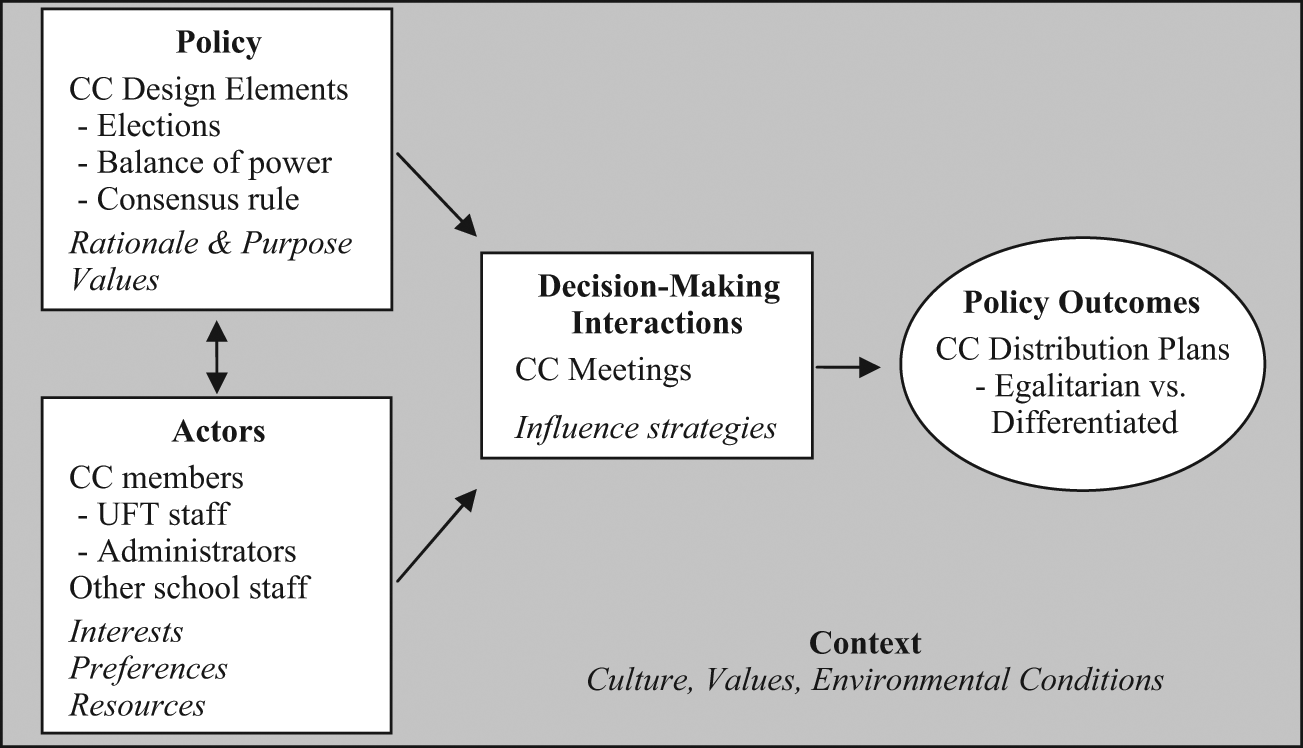
Conceptual Framework of the Micropolitics of CC Implementation
In the remainder of the article, I use this framework to describe how schools implemented the CC process and to explain why they generally adopted one type of distribution plan.
III. Data and Methods
This article draws on data collected in a 2-year study of high-needs K-12 schools that were randomly assigned to SPBP treatment and control status. Multiple data sources inform the analyses presented herein, including surveys, case studies, interviews, and administrative data.
A. Surveys
In Spring 2010, Web-based surveys were administered to a stratified random sample of teachers in tested and nontested grades and subjects in 195 schools participating in the program (we excluded one special education school due to its unique student population). In Spring 2010, we also surveyed all CC members in all participating schools. We administered the CC survey in person at NYCDOE- and UFT-sponsored meetings for all CC members and then online to individuals who did not attend or fill out the surveys at meetings.
We received at least one teacher response from all schools surveyed. Overall, we received responses from 817 teachers, representing 60% of sampled teachers. 4 We obtained responses from at least one CC member in 191 of the 196 participating schools and overall, obtained a responses rate of 72%. 5 The survey instruments drew on the broader study’s conceptual framework and measured attitudes and preferences, program understanding and awareness, perceptions about program implementation and effects, practices, and school context.
B. Case Study Visits
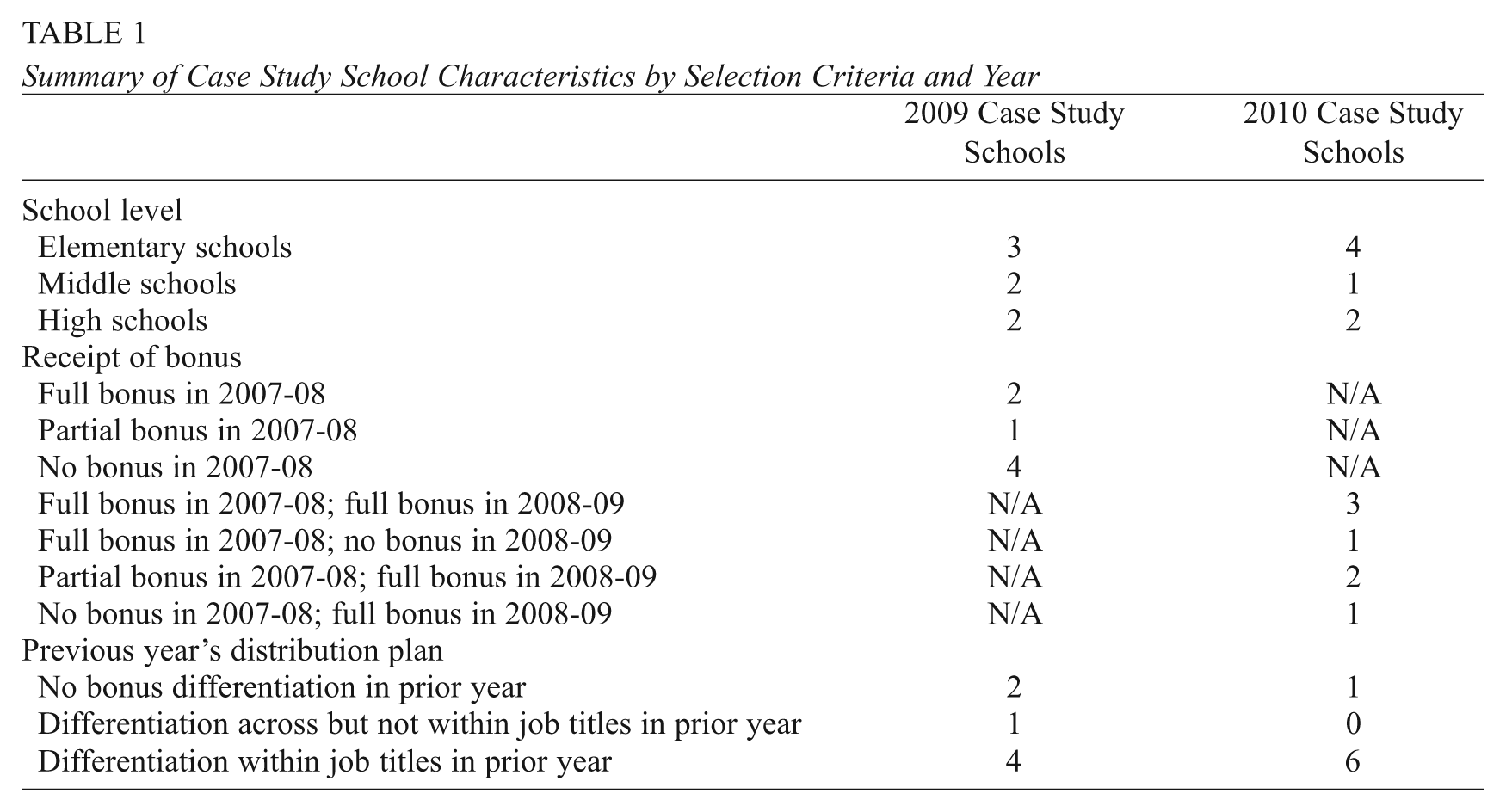
To gain a more in-depth understanding of staff experiences with the program, researchers visited seven case study schools in Spring 2009 and seven different schools in Spring 2010. We chose schools to represent variation in school and student characteristics (school level; borough; enrollment, achievement, and demographics) and experiences with SPBP (whether the school received a bonus and how the CC allocated the bonus). To understand how and why CCs differentiated bonuses among staff, one of our sampling criteria was the degree of differentiation between educators who would have received bonuses in their plans, with oversampling of schools that differentiated substantially. Table 1 summarizes the case study sample according to the main sampling criteria. In the next section, I discuss how this sampling structure may affect the generalizability of the results. In each school, we requested to interview the principal, the UFT chapter leader, the principal’s designee to the CC, the two UFT-elected CC members, and other non-CC staff. Over the 2 years, we conducted a total of 131 interviews with 24 school administrators, 72 classroom teachers, 12 instructional specialists, 11 clinical and student support staff, 7 secretaries, and 5 paraprofessionals.
Summary of Case Study School Characteristics by Selection Criteria and Year
C. Leader Interviews, Documents, and Administrative Data
Documents and interviews with funders and NYCDOE and UFT leaders (17 total) provided information about SPBP design and theory of action. To understand how school CCs planned to distribute bonus awards among staff should they have won the bonus (all schools were required to develop such plans before the end of each school year), we collected information reported to NYCDOE by CCs in the spring. The data included the dollar amount of money to be awarded to each UFT staff member and the members’ position title. We also obtained results of a 2010 NYCDOE four-question survey all CCs filled out describing factors used to determine the distribution of awards.
D. Analysis
The answers to the research questions are based on analyses of survey responses, case study and administrative data, and documents. Teacher and CC member survey responses were analyzed in a similar manner. For CC survey responses, I compared responses of respondents from different role groups (i.e., administrators versus UFT-represented committee members). As a general rule, throughout the article, I explicitly discuss only statistically significant differences (at p < .05). Case study and leader interview notes and documents were coded along the dimensions of the micropolitical conceptual framework (e.g., actors, influence strategies, context) and analyzed by individual school and across schools. Administrative data were analyzed to identify patterns in the proposed distribution plans. Ultimately, I examined the results of all of these analyses to identify cross-school findings and themes.
E. Study Limitations
Due to limited resources, I was not able to survey all teachers or other school staff. As such, the survey data are not representative of all teachers or nonteaching staff in the schools. Opinions from a broader group of teachers and nonteachers come from the case studies and in some cases the CC surveys. Another limitation of these analyses is that I was unable to directly observe CC meetings, and thus, all descriptions of the CC process rely on self-reported interview and survey accounts of these events. To enhance the internal validity and accuracy of findings regarding the CCs I have tried to triangulate data from multiple sources, comparing interview data to documents and surveys whenever possible.
IV. The Micropolitics of Implementing CCs
In this section, I analyze school-level implementation of the CC process, using the core domains of the micropolitical framework to describe the policy, the actors, their interactions in the decision-making process, and their ultimate policy decisions.
A. The Policy: The Centrality of the CC
The CC was a pivotal design feature of SPBP and was intended to serve three purposes: building buy-in, bridging competing values, and ensuring democratic decisions. These purposes are important for understanding later how CCs operated in schools and the plans they developed.
First, the CCs were a purposeful strategy to build support for the overall bonus policy. Implicit in the CC design was a belief that involving educators in developing distribution plans would increase support for the policy. UFT leaders believed the committee created credibility in schools by allowing them to say to their members, “This is really up to you on a school level.”
Second, the CCs enabled the broader policy to simultaneously embrace two sets of values important to the two partner organizations, NYCDOE and UFT. The idea of the CC came from the private sector and was described by some leaders as a “conceptual breakthrough” that allowed for all bonus distribution decisions to be school based. During the initial development of SPBP, the decision to include CCs was instrumental in advancing district-union negotiations. Despite agreeing on the ultimate purpose of the policy, NYCDOE and UFT differed about which specific compensation-related strategies might offer the best prospects for increasing student achievement. NYCDOE favored an incentive-pay system that would reward individual teachers for their students’ test score gains (which some may describe as values of meritocracy and competition). UFT, while open to changing teacher compensation practices, opposed the kind of individual merit pay that “put teachers in competition within a school” and, instead, believed the key to lifting student performance lay in a system that tied financial bonuses to cooperation among teachers and between teachers and the principal (values of collaboration).
In developing SPBP, NYCDOE was mindful of the union’s political challenges. Said one NYCDOE chief architect of the policy, “My goal was to find a way to . . . push for some kind of [pay] differential while having a . . . recognition of some of the political challenges that the union would have in moving in that direction.” Using schools as the unit of analysis to promote collaboration and the CCs as the vehicle for decision-making provided that solution. Thus, schools wanting to distribute equal shares or seeking to differentiate among staff—based on individual performance or other criteria, except seniority, such as time spent in the school or job title—were empowered to do so through the CC.
Finally, the CCs were designed to ensure a democratic process for distributing bonus shares within schools. Although best understood as quasi-democratic due to the selection of two members via appointment, the CC was meant to be a representative body. In each school, the committee would consist of the principal, a principal-designee, and two members elected by UFT-represented staff. Many leaders indicated a desire for CCs to prevent individual stakeholders from driving decisions. Citing the importance of participants having equal voice and no one “side” controlling the process, leaders designed the CCs to have an even number of members and to include two UFT members balanced by the principal and principal-designee.
The requirement for CCs to decide via consensus not majority was another attempt to ensure that members collaborated around an outcome best suited to the school community and that no one individual dominated. “The design of this [the CC] was that if they couldn’t agree on a distribution, nobody got a nickel,” explained one NYCDOE official, “and therefore, they had to reach some kind of agreement.” Another NYCDOE colleague concurred: “In effect, the representatives of the UFT and administration all had veto power. The idea there was to really set up a system where collaboration would be a necessary element.”
B. Political Actors
CC members were the actors most directly involved in implementing the bonus distribution policy. Who were they? What were their preferences for distributing bonuses, overall interests, and resources they brought to the table? I examine these questions next.
Balance of Power on CCs
Overall, there was a lack of party between administrators and UFT staff serving on the CCs. About 60% of all 2010 CC members were UFT-represented staff and 41% were administrators. The reason why the breakdown was not 50-50 as some anticipated lies in the different choices principals made in appointing their designees. As illustrated in Table 2, although in most schools the principal appointed another administrator (e.g., assistant principal), in some schools, the principal appointed a UFT-represented staff member (e.g., a teacher, an assistant principal classified as a teacher). Also, although about half of the UFT members on the CCs reported being elected by their UFT-represented colleagues, as intended by SPBP, almost the same proportion arrived on the committee via nondemocratic means of appointment, volunteering, or assumed membership (see Table 2).
CC Members, Percentages by Role, and Method of Becoming a Member (2009-10)

NOTE: UFT = United Federation of Teachers.
Competing Preferences and Interests
In general, administrats were more likely than UFT to embrace the values of differentiation and meritocracy—values that align with one set of values embedded in the SPBP and with the belief that linking pay to individual performance will result in better outcomes. Nevertheless, divisions emerged within these broader interest groups, suggesting a more complex picture of the multiple and often competing dispositions and values that entered into the CC process from the outset. While some defended particular interests, others were more willing to forgo personal gain to promote community-wide interests. I examine these two sets of competing interests below.
Egalitarianism versus differentiation
On average, CC members voiced a preference for an equal bonus distribution plan. On surveys, 72% of UFT CC members and 50% of administrators on the CC reported that they believed all UFT members should receive an equal share of the bonus because all staff make important contributions to school success. As one teacher CC member reported on the open-ended portion of the survey, “everyone works hard together and succeeds or fails together and should share in the reward equally.” Case study respondents echoed these sentiments. “We didn’t want anyone to feel excluded,” explained one UFT committee member. “We feel everyone works really hard here, from the secretary to the paraprofessionals. Everyone’s position was equally valued at the school.”
Nevertheless, administrators were much more inclined to support differentiated bonus awards than their UFT counterparts (Table 3). For example, more than three-fourths of administrators agreed that teachers with an unsatisfactory evaluation rating (U-rating) should receive a smaller bonus compared to slightly more than one-third of UFT members. In addition, one half or more of CC adminis-trators agreed that staff with “exceptional performance” and staff who provide direct academic instruction should receive a larger bonus share (see Table 3). 6
Percentage of CC Members Agreeing or Strongly Agreeing to Statements About a Differentiated Distribution Plan (2009-2010)
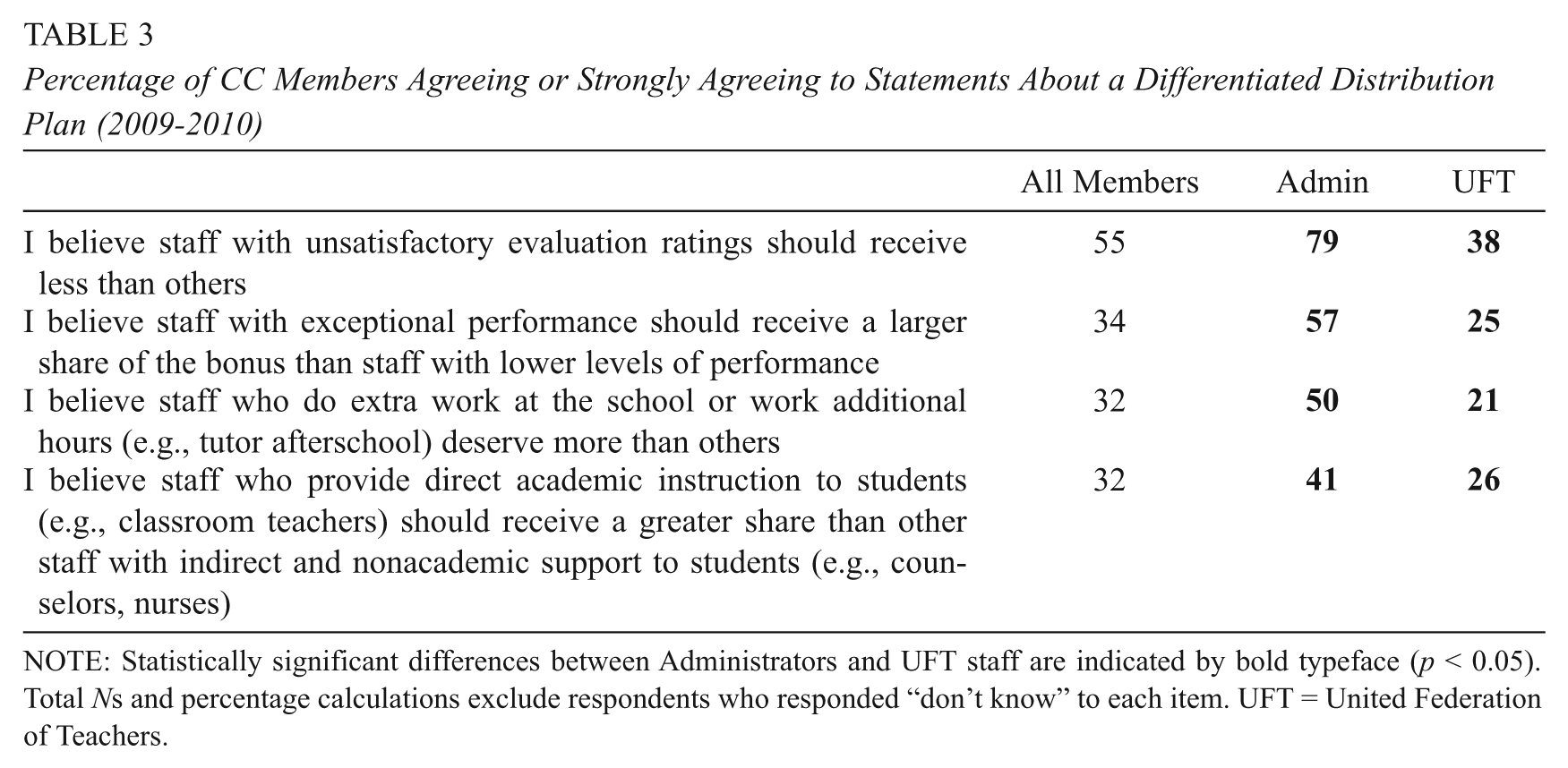
NOTE: Statistically significant differences between Administrators and UFT staff are indicated by bold typeface (p < 0.05). Total Ns and percentage calculations exclude respondents who responded “don’t know” to each item. UFT = United Federation of Teachers.
Common versus particular
CC members also varied greatly in the way they framed their interests and orientation to the process. Many approached their role as defending particular interests. These views did not fall along strict UFT-administrative lines but instead revealed more fine-grained divisions within interests groups, such as teachers versus nonteachers and upper grade or tested grade teachers versus lower or untested grade teachers. The defense of particular interests was especially salient in five case study schools. In the second and third year of the program, for instance, some individuals sought a position on the CC to correct for past CC decisions with which they disagreed. For example, one special education teacher sought the nomination to be sure that special education teachers, paraprofessionals, and coaches were not left out or awarded smaller shares than classroom teachers, as they had been the prior year.
In contrast, throughout our visits, we spoke to many CC members who were willing to forgo added personal gain to represent all staff, or “common” interests, when deciding the bonus distribution. For example, one non-homeroom-teacher raised the idea of compensating homeroom teachers more than others because “there are a lot of things that homeroom teachers do that makes them deserve the bonus. They are the backbone of the school.”
CC Member Resources
Administrators entered the process with formal authority and status as managers that one might expect to represent a source of power in the decision-making process. And as described later, several case study principals seized upon this resource to influence the final CC outcomes. In contrast, other staff came to the table with valuable skills and social capital that proved to be influential in the process. For example, several CC members recognized that the ability to speak forcefully and convincingly was an important resource for deliberations. UFT-represented staff in one school, for instance, had not anticipated the power dynamics that played out in the first year and reported learning the importance of electing individuals to serve on the CC who could “stand up” to the administration and make their voices heard. Finally, professional ties and experience appeared to be another valuable resource. For example, in addition to persuasive speaking skills, one teacher’s past leadership in the private sector, professional credentials, and experience working under an individual incentive program appeared to be instrumental in persuading CC colleagues to adopt a differentiated bonus plan.
Other Actors
While the focus so far has been on CC members, it is important to note that other staff within schools played a role in the bonus distribution process. First, staff elected and appointed CC members who they felt would represent them and their interests. And in general, these individuals expressed egalitarian preferences very similar to those of the UFT members serving on committees. For example, almost two-thirds of teachers surveyed indicated a preference for distributing equal shares of the bonus to all school staff. Also, as I will discuss later, the responses of non-committee school staff to distribution plans adopted, particularly differentiated plans, often shaped CC deliberations and decisions in subsequent years.
B. The Decision-Making Process: Political Interactions and Influence Strategies
How did these actors interact with each other and the policy to make decisions within CC meetings? To what extent were the decisions school based, as intended, and not the result of individual actors? According to surveys, most CC members—UFT staff and administrators alike—felt that decision-making was fair, collegial, and inclusive. In fact, 89% of CC members reported that it was easy for their committee to achieve consensus, as required by the policy. In the 3 years of the program, only one school, not in our case study sample, had to drop out of the program because the CC could not reach consensus on their bonus distribution plan. (Later, it became known that the school met 100% of their performance target and would have received more than $320,000 if the CC had agreed upon the distribution scheme.) Similarly, more than 88% of CC members reported that their opinions and ideas were valued by co-members and that members had an equal say in determining the final distribution plan. Furthermore, very few (14%) reported that some CC members dominated discussions.
Although the case study data confirm these broad findings from surveys, they also reveal that committees took distinct paths to arrive at their decisions and that not all groups did so based on mutual agreement or free of politics. The cases also reveal that actors employed a range of influence strategies, most notably using data to exert influence over decisions.
Dominant Interaction Patterns
Overall, I observed four broad types of interactions across schools over time. The first three fall within the intended “democratic” process envisioned by SPBP leaders. The fourth category represents a process in which principal power played a significant role in determining the CC’s final decision. When reading these descriptions, it is important to keep in mind that I purposefully selected case study schools that had decided on differentiated distribution plans in the past year, which as I describe later tends not to be the norm across SPBP schools. Thus, I am not claiming these cases are representative of all SPBP CCs, but are instead illustrative of the ways in which decision-making played out, particularly in schools that attempted to go against the grain of egalitarian distributions.
Mutual agreement from the outset
Consistent with survey data, some case study CC members reported arriving at their decision easily, quickly, and with little to no discussion or disagreement. The majority of these CCs tended to be ones that developed an egalitarian plan and often agreed that they would distribute shares evenly prior to voting to participate in the program. “We all agreed from the moment [we started],” explained one principal. “We said, ‘Well, we should keep as it’s been for the past years. It’s worked out well, everyone was pleased.’ There was no debate.” In other schools, CCs moved to easy consensus in response to a negative reaction to the prior year’s CC distribution plan. Responding to the staff’s discontent with the prior year’s differentiated distribution plan, one school’s CC vowed not to repeat the same plan and quickly adopted a more egalitarian plan. The principal reported endorsing the plan in the hopes of “calming things down” at the school.
Negotiation and compromise
In some schools, CC members described a process of “give and take,” in which participants debated different options and ultimately one or more members compromised on their position to reach an agreement. These individuals described agreeing to a final decision even if they were not entirely in favor of it in “the spirit of working together” and because failing to do so “means no one gets anything.” Administrators and UFT-represented staff on one middle school committee cited several instances of conceding on certain points about which they felt strongly in order to reach consensus and not lose out on the opportunity to earn the bonus funds. “No one got exactly what they wanted,” explained one UFT CC member. “I was happy, because they [administration] gave in too.” In other schools, CC members frequently described defending one position and then “giving in” because they were “outnumbered”—such as a teacher in one school who opposed the idea of awarding tested-grade teachers larger shares but ceded when the other three members strongly endorsed the idea.
Deliberative exchange
In a few cases, we heard reports of more deliberative exchanges, in which individuals were not agreeing to disagree, but instead changing their opinion in the course of hearing others’ arguments. After lengthy discussions, these CC members came to a mutual understanding of what would be best for the school as a whole. In one elementary school, all CC members interviewed described the process as one in which “everybody had the opportunity to voice their opinion” and “participated equally” and where “everything was open for conversation.” The principal reported rescinding his proposal to allocate more money to classroom teachers in response to teacher arguments: “They heard my point about the teachers but they brought up that in doing that … you would certainly alienate some of the staff who are supporting them, like the paras and the secretaries.”
In one middle school, a teacher on the committee suggested an innovative plan to create an “incentive pool” of the bonus fund of which teachers could earn a share by demonstrating “above and beyond” effort as documented by a checklist of activities. After explaining to other CC members his experience with a similar program in the private sector and the benefits he observed, the CC embraced the idea. This teacher and others explained that the principal (no longer at the school at the time of our visit) held a very different philosophical view of how to use the bonus but, after several meetings, was persuaded to support the incentive plan. In this instance, an idea with wide appeal triumphed over the potential power of the administrator.
Decisions driven by principal power
In a few case study schools, the assumption that balance between administrator- and UFT-selected members and the consensus rule would result in an “even playing field” was not necessarily realized. These dynamics played out in both overt and covert ways. For example, in three case study schools, in a clear assertion of formal power, principals were reported to have the final say on all decisions and most participants recognized very clear patterns of principal control. In one of these cases, UFT CC members reported feeling that they were pushed into decisions with which they were not entirely comfortable by a principal with “an agenda.” A CC member reported:
We thought we were kind of strong-armed. … The administrator came in with a game plan and we didn’t. So it’s like the kids say, “Too bad for us.” We should have had our plan, something in mind that we wanted to do and stood up for it, but we didn’t. … I guess I wasn’t as strong as I thought I was. Because when I took the position [on the CC], and they voted me in, I thought I would be able to stand up, but I wasn’t, I was kind of like, ‘She’s an administrator and we’ll kind of go with how she felt.’ And we shouldn’t have.
In another school, the principal led the charge for a highly differentiated plan based on individual performance. One CC member explained, “We all stayed within our boundaries. … We heeded each other’s input and we listened to it and so did the principal, but we felt that he had the final say.” In this same school, the principal also asserted formal power prior to meetings. In violation of SPBP rules, he appointed all CC members, of which two were not at the school in past years when CCs adopted egalitarian plans and may have been more open to changing course. One could view the principal’s actions as a deliberate move to control the agenda by assembling a group of like-minded individuals willing to support his preferred plan.
Influence Strategies
CC members and some non-CC members within case study schools employed many strategies to influence decisions. Principals were the most visible actors using these strategies, particularly in committees character-ized by nondemocratic, principal-driven decision-making. Some of the more overt strategies described above include moves to control CC membership and to dominate conversation through forceful speech and unyielding resolve. Yet influence strategies were not always as overt and sometimes emerged in committees described by participants as deliberative or involving mutual engagement and compromise. These strategies were also not unique to administrators and often seized upon by UFT members. Most notably, data became a key vehicle for strategic action. A few examples illustrate this point.
Strategic use of privileged data
The use of privileged data represented a covert strategy employed by a few principals. For example, in one school, UFT CC members reported feeling uncomfortable with the principal’s idea of giving U-rated teachers (teachers receiving unsatisfactory ratings) no share of the bonus pool but agreed to do so because they were led to believe it would only affect a few individuals. Later, when submitting the final distribution plan to NYCDOE, they discovered that a substantial number of individuals received U-ratings and thus no bonus share. These UFT CC members were disturbed by the outcome and admitted they would have “fought harder” against the decision to award $0 had they known the exact number of U-rated teachers. This asymmetry of information clearly privileged the principal in the decision-making process. Interestingly, in this school, many CC members described the meetings as quite deliberative and felt they had equal opportunity to share their views. Yet the subtle influence of the principal and his strategic use of data to advance his interests calls into question the democratic and consensual nature of the final decision.
Strategic use of nonprivileged data
The strategic use of data was not, however, limited to principals. In 4 of the 14 case study schools, UFT members surveyed the school staff on their distribution preferences. Although some described the survey as a way to “take a read of the building” to inform their decisions, others cited a more tactical rationale. Rather than allowing the elected or appointed CC members to represent their interests and act on their best judgment, these UFT members—some were on the CC, others were noncommittee UFT leaders—used these data to hold CC members accountable for enacting a distribution plan aligned with majority interests. In some cases, CC members were explicitly expected to adhere to these survey results, making it difficult for members with minority viewpoints to exert influence in the process.
In other cases, CC members used data to build staff buy-in, possibly reducing other CC members’ reluctance to adopt a differentiated plan. For example, responding to staff discontent with the prior year’s differentiated bonus payout that relied on criteria widely viewed as subjective and nontransparent, one committee allowed all staff to vote on the distribution plan prior to approval. This CC also solicited nominations from staff on individuals they felt went “above and beyond” and deserved a greater bonus share—providing greater legitimacy to the final differentiation decision and reducing potential staff backlash. Knowing that all staff had input into the decision, CC members were in essence provided political coverage for making the controversial decision to award more money to certain staff.
C. The Policy Outcomes and Consequences
Although some NYCDOE leaders had hoped CCs would differentiate bonus awards based on individual performance, in the end, the majority of committees developed nearly equal-share distribution plans in all 3 years. Administrative data indicate that across all 196 schools that participated in SPBP in 2010, 82% of all staff were slated to receive the most common or modal award for their school (and even greater equality existed in the earlier years of the program). In 2010, the modal award across all staff in a school ranged from $2,294 to $4,500 with a mean of $3,068. In 32% of schools, the modal or most common award was $3,000, and in 91% of schools, it was within $500 of $3,000. Also, all of the participating schools across all years chose to disseminate bonus money to both teachers and noninstructional staff.
Nevertheless, most CCs did not develop completely egalitarian plans. In 2010, only 14 schools (7%) gave the exact same award amount to every individual. The differentiation in the remaining schools, however, was limited to a small percentage of the staff and the factors used for differentiating tended to be unrelated to individual performance. Next, I examine criteria used for differentiating bonuses and tensions that resulted from adopting differentiated plans.
Criteria for Differentiation
There were two types of differentiation of awards: excluding a staff member from the award pool (i.e., slating him/her to receive no award) and differentiating among members who shared in the award pool. According to NYCDOE surveys, 76 schools reported at least some staff would be slated to receive no award. By far the most common factor used as the basis for this determination was whether or not an individual completed the full year at the school. Twenty-four percent of the 76 schools reported slating U-rated staff to receive no award and 14% slated those with part-time assignments (e.g., split between multiple schools) to receive no award. Only one school reported using demonstrated low quality on the basis of student performance as a factor for not providing an award to staff.
As for differentiating awards among staff slated to receive a share of the bonus (Table 4), working full-time or part-time or working full year or part year were by far the most common determining factors. About one-sixth of schools used individuals’ attendance as a criteria for differentiating bonus distribution. Less than 10% to 15% of schools reported relying on evaluation of staff performance or job titles to differentiate, and even fewer relied on type of assignment. Just over 10% of schools reported factoring in seniority, which the formal SPBP explicitly prohibited. Only 7% of schools reported using U-rating to determine awards, and performance based on value-added or other student achievement was reported as a factor by just 4% and 3% of CCs, respectively (see Table 4).
Percentage of All Schools Reporting Using Criterion to Differentiate Bonus Shares
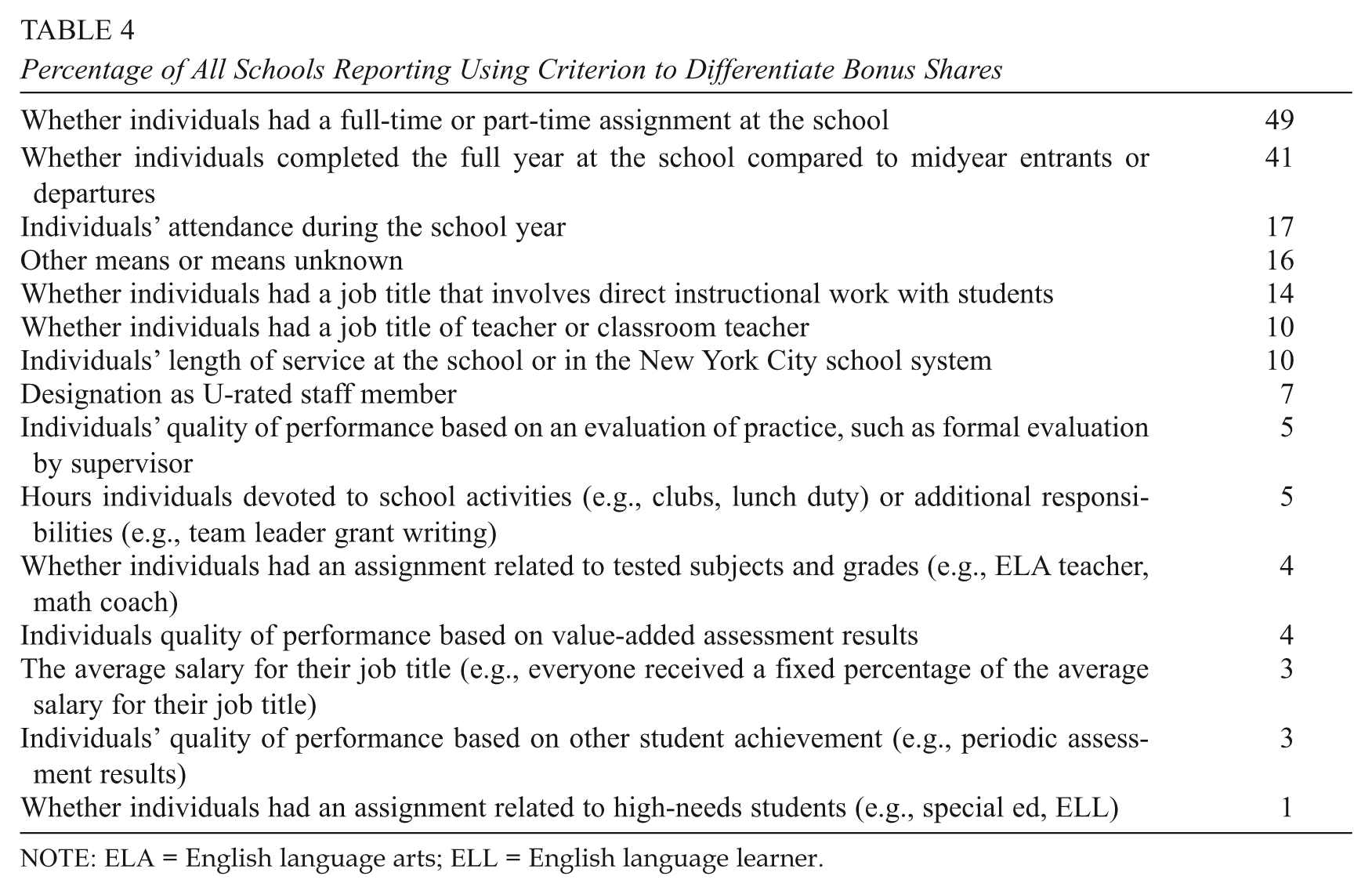
NOTE: ELA = English Language Arts; ELL = English Language Learner.
Case study schools provide further insights into the factors CCs used to determine bonus awards among staff. In some cases, differentiation was based mainly on job title and/or subject taught. For example, 2 of the 14 schools allocated smaller bonus shares to some or all paraprofessionals, secretaries, guidance counselors, and social workers so that more could be awarded to some or all teachers. Two schools differentiated shares within the group of classroom teachers, giving larger bonuses to staff viewed as responsible for test scores factored into Progress Report targets (e.g., English language arts [ELA] and math teachers, upper elementary grade teachers). In contrast, five of the schools we visited differentiated at least some of the bonus shares based on performance or perceived merit. One school provided all staff with a guaranteed equal share of the bonus pool and then allocated additional funds to staff spending extra time on at least five types of school activities or additional responsibilities, such as overseeing lunch detention, writing grants, leading training, or maintaining 90% attendance and 0% “lateness.”
In four other schools, decisions were based on committees’ assessment of who they felt contributed more or less to the school’s success rather than explicit criteria. In one school, CC members based these decisions on attendance, principal- and teacher-led observations, and perceptions of individuals’ effort or willingness to go “above and beyond.” Some acknowledged that the decision was not always based on objective criteria, noting that “one person got whacked by the principal for pissing him off.” In other schools, CC members could not provide a concrete description of criteria used, but instead explained “we know the ones who participate.”
Political Backlash and Tensions Surrounding Differentiation
Overall, the distribution of bonus shares appeared to go very smoothly and was perceived to be quite fair across years. NYCDOE and UFT leaders reported receiving few complaints each year, and none reached the level of an official appeal. Nevertheless, a significant minority of staff reported problems on both surveys. For example, 23% of CC respondents in schools earning the bonus in 2009-2010 reported that colleagues were upset about the unfair distribution of bonus awards and 18% of teachers reported that the distribution of bonus award dollars by the CC was unfair.
In a few case study schools, the differentiated distribution plan generated significant backlash. Several schools experienced fallout among staff after they discovered that some individuals received a greater share of the bonus than others. In one school, a few individuals expressed dissatisfaction with the amounts received and one tried to file a formal grievance (later discovering it was not possible). In two other schools, staff decried a lack of transparent, objective criteria for differentiating bonus shares and speculated over possible favoritism on the part of CC members. In several schools, CC members experienced hostile reactions from colleagues. A CC member in one school reported that a few colleagues stopped talking to her.
Even in case study schools that adopted egalitarian plans, the act of considering differentiation created tensions. According to a high school social worker, staff discussions about whether teachers should receive larger bonus shares than support staff “led to a lot of resentment from the paras and school aides.” A UFT leader’s attempt in an elementary school to engage the faculty in a discussion about the possibility of awarding more to certain staff—using classroom and tested-grade teachers as an example to spark conversation—ignited strong negative reactions. Many individuals reported that “it got crazy” and “unpleasant” with colleagues upset with the implication that they did not work hard. For one teacher, the experience raised the question, “Is this program worth it? Enough to make it an unpleasant place to work?”
D. Summary of Implementation Findings
Overall, the CC process brought together actors with a range of competing interests and preferences, some of which aligned with the values of meritocracy and competition embedded in SPBP and others in stark opposition. Although UFT members outnumbered administrators, all actors came to the table with different resources allocating varying degrees of power and influence in the process—ranging from formal managerial authority to speaking skills and professional ties. While data from the population of CCs indicate that decision-making processes were generally aligned with the vision articulated by SPBP leaders—that participants had equal say in determining the plan, no one group controlled the decision, and committees achieved consensus—case study data reveal finer grained difference in these interactions. Some CCs arrived at consensus quickly, easily, and with little discussion. Others engaged in processes ranging from interest-based negotiations to deliberative exchanges. Nevertheless, in a few cases, the formal power of the principal as supervisor dominated the decision-making process and did not place all CC members on equal footing. Whether done overtly by controlling conversation and overriding opinions or more subtly by relying on privileged data, principals in these schools exerted power to determine the final distribution plan. Yet other actors were also willing players, strategically using other data to advance their interests.
In the end, the majority of CCs developed essentially equal-share distribution plans. Most plans included a small amount of differentiation for a handful of individuals, typically because they worked part-time or part of the year. CCs were much less likely to judge individual performance when allocating shares, and when they did, they sometimes sparked hostility.
V. Unpacking the Results: Factors Shaping Policy Outcomes
In the end, why did so many committees develop egalitarian plans and so few seize upon the opportunity to differentiate bonus shares based on individual performance? Given that a significant proportion of CC members favored some differentiation among staff, why did the majority of CCs provide most staff with virtually equal bonus shares or simply tinker with differentiation at the margins? Returning to the micropolitical framework, I explore the most compelling explanatory factors among actors, the policy, and the one domain I have not yet examined, context. I rely primarily on qualitative data to explore these explanatory factors because quantitative analyses yielded few significant results. For example, using regression analyses with adjustment for clustered data, we examined predictors such as school level (elementary, middle, high), size, principal’s years of experience, average scale scores on the state exams, and student demographics, and only school size showed a significant relationship with the degree of differentiation in CC plans. 7
A. Actors: Power and the Tendency to Avoid and Suppress Conflict
Some evidence suggests that formal or overt power played a very little role in determining the final CC decisions. Contrary to past research on school governance (Goldring, 1993; M. J. Johnson & Pajares, 1996; Malen & Cochran, 2008; Malen & Ogawa, 1988; Merz & Furman, 1997), on average principals—individuals with more power based on their position in the hierarchy—did not dominate deliberations and were not successful in advancing their preferences for differentiation. Furthermore, the majority of CC members reported that the process provided everyone with an equal voice. We also found no relationship between the ratio of administrators to UFT staff members serving on CCs and the ultimate distribution plans they adopted. For example, one might hypothesize that a committee with greater numbers of UFT members, who were more likely than administrators to express preferences for distributing equal shares to all staff, would be more likely to establish egalitarian plans, and conversely, CCs with more administrators would have a greater probability of agreeing to highly differentiated plans. Yet according to our analyses of survey data linked to distribution plans in multiple program years, the numbers of administrators relative to UFT members was not associated with the level of differentiation. 8 In other words, committees with three UFT members and one administrator were just as likely as committees with two UFT members and two administrators to develop highly differentiated plans.
Upon first glance, one might interpret these findings as evidence that power and politics were not dominant forces in the CC process. However, a deeper analysis finds equally compelling evidence indicating just the opposite. A micropolitical perspective suggests that decisions to produce egalitarian plans may in fact represent influence strategies employed by actors to suppress conflict. In fact, the tendency to avoid conflict was pervasive among CC members and echoes past research on school governance (Malen, 1999; Wirt & Kirst, 2005). On the survey, 66% of UFT members and 47% of administrators agreed or strongly agreed that they were reluctant to consider anything but distributing an equal share of the bonus to all employees for fear that unequal distribution would negatively affect school climate. In case study interviews, CC members repeatedly expressed an openness to the idea of awarding certain staff more for greater contributions but did not attempt to do so citing a fear that it would generate divisiveness among staff. This group of individuals viewed the egalitarian plan as “easier” and more palatable. “I don’t want people to get upset,” admitted one teacher who liked the idea of giving larger shares to tested-grade teachers but ultimately supported an egalitarian plan. One UFT chapter leader believed that deciding which staff members deserve more would be “destructive to the fabric you hope to create” in a school.
This tendency to avoid conflict could explain not only why CC members who argued for differentiation ultimately compromised (in CCs characterized by “negotiation and compromise”) but also why others never voiced the preference for differentiation at the outset (in CCs characterized by “mutual agreement”). Supporting the former pattern, an elementary school principal who favored some level of differentiation ultimately decided not to push for this because it “would create disharmony,” and it was “more important to keep some unity” in the school. Similarly, two teachers in another elementary school CC reported raising the idea of giving upper grade teachers a greater share of the bonus but backed down because they “didn’t want people to get upset or feel like some people are more important than others.”
Conflict avoidance was, however, not just a pervasive norm or tendency among CCs, but an influence strategy consciously used by administrators to achieve their goals. For example, many principals of CCs that created differentiated plans purposefully limited communication about them. Some did not plan to share the plan with staff until NYCDOE publicly announced the bonus awards. Others intended to keep the plan secret even after the announcement, in hopes that they could let the information “slide under the radar” and avoid “rocking the boat.” One principal in a school that differentiated bonus shares admitted, “I just feel like they [staff] don’t need to know.” A CC member in another school believed that administrators “were less candid than they could have been. … Nobody in the rest of the faculty knows [about the differentiated plan]. They have no idea. That was done because the administration wanted to avoid friction.” In fact, when recruiting schools for the study, one principal of a school with a highly differentiated distribution plan refused my request due to concerns that a visit would “stir things up.”
Thus, principals’ decisions to limit the flow of information about final plans can be viewed as a way to advance their interests and prevent potentially controversial decisions from affecting school climate. Similarly, some other influence strategies from the case study schools presented earlier—such as appointing all CC members—can be interpreted as other means of preempting conflict and limiting conversations to safe issues (Malen, 1999; Wirt & Kirst, 2005).
Implicated in this discussion is the critical role of leadership in explaining the outcomes of the CC process. One can characterize the principals described above as suppressing conflict as traditional managers who viewed their role as “system maintenance” (Wirt & Kirst, 2005). In contrast, case study schools that adopted highly differentiated plans were almost always associated with a “change agent.” These individuals embraced SPBP, and the potential conflict resulting from differentiating pay, as a means to motivate and reward performance and catalyze change. For example, one high school principal whose CC adopted a highly differentiated plan viewed the bonus program as a key lever to not only motivate staff to improve their practice but also to recruit staff to the school. Another elementary school principal described using the differentiation to “send a message” to staff to perform and demonstrate effort. In most cases, these types of leaders were principals, but in one school the change agent was a teacher, mentioned earlier, who had worked in the private sector and persuaded others to adopt the idea of an incentive pool. “It’s a way to change school culture,” explained the teacher, “to look at how can we have everyone doing this [the activities making staff eligible for a share of the incentive money, like writing grants, working after school].” The same teacher acknowledged that at first there was “some angst associated with” the plan, but “that’s what change is about.”
B. Policy: SPBP Design Elements and CC Structure
A few design elements of the policy may have also contributed to the observed results. First, it is possible that the requirement that CC members achieve consensus or forfeit the bonus reinforced the tendency to avoid conflict and pushed them to pursue “safer” egalitarian plans. In fact, one NYCDOE official early on mused about this relationship: “What we don’t know … is the extent to which that [consensus rule] forces everybody to kind of regress to the mean and do what’s easiest and safest.” Second, the decision to predetermine the bonus shares for administrators may have affected their attitudes and dispositions coming into the CC deliberations. Past research indicates that the salience of what is on the table can influence participants’ attitudes and the way in which decision-making unfolds (Davies, 1981; Malen & Ogawa, 1988). Given that their personal bonus amounts were not within the purview of the CC, some administrators may have viewed the process as not particularly important and been more willing to compromise or disengage.
It is worth noting that SPBP CCs represent a departure from typical school governance bodies which generally deliberate over matters that are not central to the core technology of schools (e.g., campus beautification, student discipline) (Hill & Bonan, 1991; Malen & Ogawa, 1988; Malen, Ogawa, & Kranz, 1990; Murphy & Beck, 1995; Wohlstetter & Odden, 1992). SPBP leaders charged CCs with making decisions on a topic with close proximity to the core: personnel compensation. This distinction may help explain why the dominant pattern of principal domination found in past research did not hold true in this study. It appears that a policy process tied to compensation amplifies the stakes tied to actor interests and preferences and may elicit different kinds of interactions than ones tied to matters with less centrality.
C. Context: Egalitarian Values and Macropolitical Pressures
An explanation of the dynamics and outcomes of the CC process is incomplete without an understanding of the broader context. First, the egalitarian values, norms, and culture deeply embedded in schools appeared to greatly influence actors’ abilities to exert influence on the final CC outcomes. Case study respondents frequently voiced their support for providing equal shares to all staff because that was “the way we do things” and “we are all in this together.” The idea of rewarding some individuals more than others ran up against these institutionalized beliefs and values and provided further rationale to resist differentiation. Thus, individuals advocating for some differentiation or a desire to pursue particular interests may have been thwarted by these deeply engrained norms. Much like the battles over “logics of action” predicted by Bacharach and Mundell (1993), CC debates over distributing a bonus tapped into much broader ideological struggles between democratic values of egalitarianism and market values of meritocracy. In the end, the strong tradition of egalitarianism proved to be quite formidable. The quick institutionalization of egalitarian plans within schools after Year 1 further demonstrated the strength of these forces. One principal described the egalitarian plan as “the tradition here,” noting that once the precedent of an egalitarian plan had been set it was very difficult to change. In fact, NYCDOE and UFT leaders were not surprised that most schools did not differentiate bonus payouts and recognized that it would take a “big cultural leap to move in that direction.”
Ultimately, these norms may have greatly mediated the power of actors. Similar to the “vanishing effects” observed in schools asked to design alternative career ladder programs in the 1980s—in which teachers resisted the opportunity to differentiate salaries by adopting informal practices to uniformly distribute benefits (Malen & Hart, 1987)—the idea of differentiation challenged norms of egalitarianism endemic to the teaching profession (S. M. Johnson, 1984; Murnane & Cohen, 1986) and not surprisingly resulted in the promotion of the status quo. Researchers studying teacher attitudes toward compen-sation reform have found similar evidence of this normative conflict, noting that “merit pay strikes a particularly hard blow at the egalitarian ethos of the profession” (Goldhaber, DeArmond, & DeBurgomaster, 2011, p. 460).
Finally, the experiences of case study schools also indicate that the macropolitical context may have affected the micropolitical dynamics within schools. For example, CC members in several schools resisted a differentiated payout because they saw it as a “slippery slope” to endorsing district-wide individual merit pay—a policy they and their union strongly opposed. Although some supported the idea of compensating individuals for performance in principle, they were reluctant to endorse differentiated distributions plans for fear of what it represented and where it might lead. Some UFT-represented staff, for example, distrusted district leaders, believing they would use the bonus policy to advance their interests (e.g., increasing oversight and tracking of teachers, altering other personnel policies). Though not directly involved in school-level implementation, these larger district and union actors and interests were consciously and perhaps subconsciously present in the minds of school-level actors.
VI. Implications
The results of this research have several implications for policy, practice, and future research. First, this research highlights the underlying political tensions inherent in implementing a bonus system and the enduring challenge of enacting change. Those seeking to enact similar programs should recognize that the very idea of differentiating pay will likely run up against pervasive norms and values of collaboration and egalitarianism and strong tendencies to avoid conflict. Discussion and decision-making around other deeply engrained policies or practices with close proximity to the core (e.g., teacher tenure, evaluation) are likely to encounter a similar set of challenges. Much like the vanishing effects observed in early career ladder experiments (Malen & Hart, 1987) and the egalitarian plans adopted in similar school-based bonus programs in Texas (Taylor, Springer, & Ehlert, 2009), the dominant pattern of translating opportunities for reform into status quo arrangements should be expected. In fact, if policymakers had wanted to ensure the adoption of egalitarian distribution plans (and some UFT leaders certainly expressed this preference), the CC may have been the perfect mechanism to accomplish this goal. If, however, policymakers truly wanted to ensure differentiation of bonus payouts (as some NYCDOE leaders sought), it may have been more effective to rely on other, nonparticipatory arrangements. In the end, how one characterizes the implementation of the CC process depends on where one sits among the leaders who developed the policy. To some, the widespread adoption of egalitarian plans represents fidelity to policy design; to others, the failure to differentiate indicates policy “drift.”
In light of the widespread call for stakeholder involvement in designing pay-for-performance programs, this research also offers several practical lessons for leaders committed to enacting similar bonus programs. Although participatory structures may enhance buy-in (this study does not provide evidence on this point), they may not always operate as intended. As this study and others have demonstrated, power can overtly and covertly shape decision-making and participants may have a tendency to adopt “safer” options of collective and egalitarian incentives (again, Taylor et al., 2009, found similar results in Texas). Anticipating these realities, local leaders should provide clear guidance and technical assistance to facilitate dialogue and decision-making. As noted, many CC members appeared to be resolved to avoid conflict at all costs. If leaders are serious about opening up conversation around deeply embedded traditions and highly contested topics, it would behoove them to set up conditions that allow for open dialogue and ensure that all members have an equal say in the final decisions. Leaders may also want to educate staff on the importance of paying careful attention to whom they select and the rules for deliberation. Also, leaders should recognize the politics of data use and identify data that could privilege one set of actors over another in the decision-making process by either making the data available to all or prohibiting its use (e.g., teacher evaluation ratings).
This study can also inform future research. In terms of frameworks, this study indicates that micropolitical theory can help illuminate important relationships between actors and policies. Applying this lens helped uncover an array of political strategies and responses critical to the dynamics and outcomes of implementing the bonus policy, including formal assertions of power and covert strategies used to conceal information or suppress conflict. This research also indicates that power alone may not be sufficient to explain policy adoption and implementation and that, consistent with other research (e.g., Malen, 2006; Marsh, 2007), the combination of political and sociological perspectives (e.g., attention to broader context, values, norms) offers a more comprehensive framework. Expanding this framework even further, the study indicates that in addition to sociocultural and institutional values, one must add macropolitical forces to the set of embedded contexts worthy of close examination—including an understanding of the values and interests of broader interest groups and actors.
This study also offers substantive implications for future research. As new designs for pay-for-performance programs emerge, researchers should consider conducting comparative studies that examine how variations in key design features affect decision-making processes and outcomes. For example, how would the dynamics and results of a group-based bonus program change under the following conditions: decisions are determined by majority vote, not consensus; bonus shares for administrators are put on the table; committee membership is expanded; and the overall bonus amount per school increases or decreases? It is also worth comparing SPBP and other policies supplementing compensation to policies replacing existing compensation systems or more comprehensive policies combining compensation with evaluation, curricular, and capacity-building reforms. How would these different types of policy affect micropolitical dynamics and outcomes? Across these policies, researchers should also seek to identify the conditions under which educators are more likely to adopt change or differentiation. For example, some research suggests that relationships of trust may be one such condition (Bryk & Schneider, 2002; Goldhaber et al., 2011). Future research should examine these issues in the coming years as traditional personnel policies continue to be challenged and reformed.
Footnotes
Acknowledgements
The author would like to thank the RAND-Vanderbilt research team for their contributions to this research, especially Kun Yuan, Dan McCaffrey, and Scott Epstein who provided invaluable input. Thank you also to Katherine Strunk, Dom Brewer, Penny Wohlstetter, Tony Milanowski, Dan Humphrey, Betty Malen, and three anonymous reviewers for their comments on previous iterations of this article. A version of this research was presented at the Annual Meeting of the American Educational Research Association (April, 2011).