



Abstract
This study examines how high-quality professional development can promote the diffusion of effective teaching strategies among teachers through collaboration. Drawing on longitudinal and sociometric data from a study of writing professional development in 39 schools, this study shows that teachers’ participation in professional development is associated with providing more help to colleagues on instructional matters. Further, the influence of professional development on participants’ instructional practice diffuses through the network of helping. These findings suggest that in addition to direct effects, spillover effects of professional development can occur through collegial interactions. Evidence presented in this study potentially helps educational leaders develop high-quality professional development programs and distribute professional development participants within schools to enhance all teachers’ instructional practices.
Introduction
A
Previous large-scale evaluation studies have focused on changes in participants’ instructional practices and their students’ achievement as outcomes of professional development (reviewed in the next subsection). But few have examined the spillover effect of professional development participation (De Grip & Sauermann, 2012; Dumas, 2008; Penuel, Sun, Frank, & Gallagher, 2012), which we define as the effects of school-based professional development on instructional practices above and beyond the direct effects on teachers who participated in the professional development. Through collegial interactions, teachers who may or may not participate in a professional development program can benefit from these programs by interacting and learning from professional development participants.
This definition stems from economic literature on spillover effects of investments in human capital development (e.g., Berge, 2011; Bjorvatn & Tungodden, 2010; Blundell, Dearden, Meghir, & Sianesi, 1999; Croce & Ghignoni, 2012; Kogut & Zander, 1992; Lalive & Cattaneo, 2009). Beyond receiving private returns to education that individuals invest in improving their skills, working with high-skilled workers increases the productivity and wages of low-skilled workers (Bauer & Vorell, 2010). In other words, improvement in coworker quality can increase a worker’s own productivity because of peer influence and/or knowledge diffusion (Lucas, 1988; Romer, 1994). Economists have used this model of transmission of knowledge learned during a formal training program to other employees to document returns on a firm’s financing the cost of the general training (De Grip & Sauermann, 2012; Dumas, 2008). These studies highlight the potential double effect of training: a direct effect on trainees’ productivity and an indirect effect on the productivity of the whole workforce due to the spillover effect of training. Such spillover is magnified in settings where employees need to work in teams (De Grip & Sauermann, 2012).
In education, prior studies have empirically shown that changes in the quality of a teacher’s colleagues are associated with changes in her or his students’ test score gains (Jackson & Bruegmann, 2009) and that educational outputs are jointly produced by teachers, even across subject areas (Koedel, 2009). Given the potential for spillover effects among teachers, the evaluation of teacher professional development solely based on the effects on those who participated may underestimate the overall effect on a school (Angelucci & Di Maro, 2010). Such underestimation can be significant, in particular, when such spillover effects can be the key effects of interventions that aim to change instructional practices and promote student learning through increased teacher collaboration and collective learning within local school settings.
The study of spillover has potential implications for the design of professional development and other intervention programs. For example, many districts hire instructional coaches of the school faculty to support teacher learning in specific domains such as reading or mathematics (e.g., Coburn & Woulfin, 2012). These coaches are often called upon to share their expertise with teachers in a school not only through formal workshops but also through informal collegial interactions, with the effect of changing other teachers’ instructional practice to align with a district or school’s vision for high-quality instruction (e.g., Cobb & Jackson, 2011). An understanding of spillover could help identify teachers who might make effective coaches because of their expertise in the subject area and skills in sharing expertise. Other schoolwide reform models that target whole school improvement and require significant coordination and collaboration among teachers could also be enhanced by understanding better how spillover effects might function (Berends, Bodilly, & Kirby, 2005; Datnow & Stringfield, 2000).
To enrich the literature on evaluating and designing teacher professional development programs, in this study we examine the dynamics of knowledge flow within schools through collegial interactions and assess spillover effects of professional development on middle school teachers’ writing instruction. Our study draws on survey data from a longitudinal, random assignment evaluation of the National Writing Project’s school partnership. In the larger study, the unit of randomization was the school; here, we focus on effects of professional development and spillover on individual teachers. Specifically, we assess the spillover effects of professional development with two measures. The first is the increase in the number of colleagues helped after participating in high-quality professional development (Frank et al., 2008). We use the lagged value to examine whether professional development makes participants more likely to become the “go-to” experts for teaching writing matters. That is, we modeled how often a teacher was nominated as providing instructional advice as a function of participation in professional development after controlling for his or her prior help provided. The other measure is the extent to which colleagues’ improved instructional practices over their initial status after receiving help from professional development participants (Frank, Zhao, Penuel, Ellefson, & Porter, 2011). Anticipating our key results, we find that teachers’ participation in professional development can significantly predict the increase in number of colleagues a teacher helped with teaching writing. Besides direct participation, interacting with professional development participants has significant impact on teachers’ change in instructional practices.
Background of This Study
Effective Features of Professional Development
There is growing evidence about what constitutes high-quality professional development from studies of its effects on teaching. First, as opposed to a one-time presentation or one-day workshop, professional development should be sustained over time (e.g., Correnti, 2007; Darling-Hammond, Wei, Andree, Richardson, & Orphanos, 2009; Yoon et al., 2007). The gap between targeted practices of educational interventions and the existing teachers’ practices, oftentimes, can be large. Only sustained influences will reinforce new behaviors and enhance the chance that teachers will make substantial changes to their existing practices (Coburn, 2004). There is no exact number of sufficient hours of professional development, however. For example, the average number of contact hours was 25 in 1 year in the Eisenhower-assisted professional development (Garet et al., 2001), while the current National Writing Project study asks teachers to participate in at least 30 contact hours of professional development in each year (Gallagher et al., 2009). Some other studies advocated more than 40 hours of professional development spread over a school year (Yoon et al., 2007).
Second, the content should be anchored to practice, in terms of its subject-specific contents and skills and being linked to standards, curriculum, and assessments employed in teachers’ schools and districts (D. Cohen, Raudenbush, & Ball, 2003; Correnti, 2007; Garet et al., 2001). Empirical studies have shown that this professional development feature has significant and positive associations with teachers’ self-reported increases in knowledge and skills and changes in classroom practices (D. Cohen & Hill, 2000; Penuel, Fishman, Yamaguchi, & Gallagher, 2007). Such professional development may be necessary to overcome routines and beliefs deeply rooted in teachers’ previous experiences (Coburn, 2004).
Third, the types of strategies designed to help teachers learn also matter. Professional development activities that involve active learning, such as small group discussion and analyzing students’ work together, show more effects on instructional practice than didactic lectures (Desimone, Porter, Garet, Yoon, & Birman, 2002). Such activities provide opportunities for teachers to receive feedback on their changing understandings of practice and on practice itself, to interact with each other, and to collectively construct new knowledge. These activities also provide opportunities for teachers to be leaders and take control of their own learning process. Such active learning strategies may take place in the context of intensive, multiweek professional development (Lieberman & Wood, 2003), protocol-driven discussions of student work among peers (Horn & Little, 2010), peer observation of classroom instruction, or peer instructional coaching (Darling-Hammond et al., 2009).
Although these prior studies have examined the direct impact of features of professional development on teacher participants’ knowledge and practices, few studies examined the indirect—or spillover—effects of teacher professional development, in which the provision of professional development to some teachers shapes the practices of other teachers in the school who may or may not directly participate in professional development. We know that school contexts can moderate the effects of professional development (Darling-Hammond & McLaughlin, 1995). For example, some studies show that the change in grade-level colleagues’ quality can influence a teacher’s effectiveness in promoting gain in student achievement (e.g., Jackson & Bruegmann, 20091), while others show that immediate colleagues influence teachers on making sense of new policy initiatives and practices (Coburn, 2001). A question that emerges from empirical findings is how teacher collaboration around instructional matters might augment the direct effect of external professional development.
How Could Spillover Result From Teacher Interactions?
Collegial networks matter for teacher learning because collaboration is a critical tool for growth in teaching (e.g., Barr & Dreeben, 1983; Bidwell & Kasarda, 1987). When interactions involve activities that give rise to deep, critical reflection on practice, peers’ knowledge and instructional expertise can be a major source of professional growth for teachers (e.g., Bidwell & Yasumoto, 1999; Horn & Little, 2010). In such activities, teachers benefit from exposure to information that is embedded in classroom practices that peers can make explicit, especially when those peers possess relevant instructional expertise and local knowledge (e.g., Darling-Hammond & McLaughlin, 1995; Webster-Wright, 2009). This expertise diffuses when teachers interact and collaborate with each other to address commonly identified classroom problems (Penuel, Frank, & Krause, 2006). Grounded on the core principle that informed and effective teachers can be successful teachers and partners of their colleagues, many reform programs, including the National Writing Project and the Coalition of Essential Schools, have focused on promoting teacher collaboration and professional learning communities to improve teacher quality and school capacity (Lieberman & Wood, 2003; Rowan & Miller, 2007).
Reform programs that include teacher collaboration often cultivate teacher leaders (Spillane, 2006). When effective, these teacher leaders contribute to the successful implementation of reforms by working with other teachers to facilitate the collective interpretation of policy messages (Coburn & Russell, 2008). They may also lead other teachers to lobby for shared resources, increasing the amount available to each teacher (Jackson & Bruegmann, 2009). Furthermore, in the implementation of external interventions, the normative influence of these teacher leaders on the core of classroom teaching might surpass the impact of formal leaders such as principals, department chairs, and coaches, because teacher leaders who are engaged in the classroom have specific pedagogical knowledge of what to teach and how to teach (Sun, Frank, Penuel, & Kim, 2013).
The Current Study
The current study explores how the effects of professional development can be enhanced by shaping knowledge diffusion in the school community and by changing relational dynamics to augment the direct effects of participation. Following economic literature (De Grip & Sauermann, 2012; Dumas, 2008; Jackson & Bruegmann, 2009; Lucas, 1988; Romer, 1994), we call this a spillover effect of professional development. Corresponding to the two measures of spillover effects that we introduced previously, we ask,
How do the duration, content foci, and learning strategies of professional development affect the number of colleagues a teacher helps with teaching writing?
How do teachers’ changes in their instructional practices result from interacting with colleagues who had gained expertise from their prior professional development?
We have two hypotheses for these questions, elaborated below:
Hypothesis 1: Teachers are more likely to provide help with writing instruction if they participated in high-quality professional development.
We hypothesize that high-quality professional development promotes participants’ helping behaviors for multiple reasons. First, professional development provides teachers with new sources of information, which can be transformed into participants’ instructional expertise and make them the “go-to” experts in their schools. Second, subject-focused professional development can highlight participants’ role as “content experts.” That is, others recognize those who participated in specific professional development as potential resources related to that professional development (Frank et al., 2008). Third, the routine of professional development can restructure teacher collaboration within schools (Coburn & Russell, 2008). If teachers have been involved in sustained professional development that features active learning activities and promotes teachers’ instructional leadership, teachers can simply transfer these professional development activities into behaviors in schools and may also develop better skills and language to deliver their expertise and engage in deep collaboration (Coburn & Russell, 2008; Lieberman & Wood, 2003).
Hypothesis 2: The expertise that teachers gain from participation in professional development will spread to colleagues through the provision of help and thus change colleagues’ instructional practices.
The extent to which a teacher is influenced by interacting with others is a function of the content and frequency of interactions, as well as the available expertise of colleagues (Frank, Zhao, & Borman, 2004). When teachers participate in professional development, other teachers can benefit from participants’ transfer of expertise through interactions that address needs or problems of instructional practice (Bidwell & Yasumoto, 1999). Such internal dynamics facilitate the diffusion of the effects of professional development.
Relevant to the development of these two hypotheses, teacher individual characteristics may be confounded with the relationship between the features of professional development program and spillover effects. For example, senior teachers may have more opportunities to participate in professional development and also may be more likely to be recognized as potentially helpful experts in their schools (Spillane, 2007). Or, teachers who perceive their school to be under pressure to improve scores on state writing assessments may actively seek professional development to improve their own teaching and also seek to help others to lift the school out of a sense of bounded solidarity (Elmore, 1996; Portes & Sensenbrenner, 1993). Lastly, other indicators of specialized expertise, apart from professional development, may relate to both helping behaviors and instructional practices. These indicators include educational degree or teaching subject area. Having a master’s or higher degree may signal a teacher’s expertise to other teachers in the school and also be positively related to her or his content knowledge if the advanced degree is in the major that the teacher is teaching (e.g., Smith, Desimone, & Ueno, 2005). Being an English/Language Arts (ELA) teacher is likely to make a teacher a potential candidate for writing professional development and for visible resource to other teachers with respect to writing instruction. Thus, we will control for these teacher characteristics in our analysis.
Methods
Sample
This study draws on data from a larger study of evaluating the impact of the National Writing Project’s school partnership on teachers’ instructionalpractices. The larger study used randomized controlled trials (RCTs) in which 39 schools serving middle-grade (seventh and eighth grade) students with minimal or no prior experience with Local Writing Project sites participated beginning in the 2007–2008 school year (Year 1, the baseline). Twenty of the schools were randomly assigned to what we call here the partnership condition: Each of these schools formed individual partnerships with its Local Writing Project site and received customized professional development from that site. Writing professional development was provided to teachers across subject areas, not only to ELA teachers. Another 19 schools were randomly assigned to the delayed partnership condition in which—except for district and state required programs—schools were asked to refrain from participating in any new schoolwide professional development related to writing in the following 2 years of implementing the evaluation study (2008–2009 school year, defined as Year 2; 2009–2010, defined as Year 3). Schools in partnerships were comparable to those in delayed partnerships in baseline school contexts, student demographic characteristics, and students’ overall achievement levels as defined by whether a school met Adequate Yearly Progress (AYP) targets for all of its subgroups.
Since Year 2 is the first year when Local Writing Sites started to provide professional development to partnership schools, we examined the average school and teacher characteristics in Year 2 for partnership and delayed partnership schools (Table 1). In the partnership schools, the average enrollment size was 669 with a standard deviation of 368, compared to the average enrollment size of 564 with a standard deviation of 269 in delayed partnership schools. The average percentage of students who were eligible for free- and reduced-price lunch was about 44% in partnership schools and about 53% in delayed partnership schools. The majority of students were White in both partnership and delayed partnership conditions. The average pupil-teacher ratio was around 15 to 1. The schools had an average of 45 full-time equivalent (FTE) teachers, about 4 of whom taught ELA.
Descriptive Statistics of School and Teacher Characteristics in Year 2
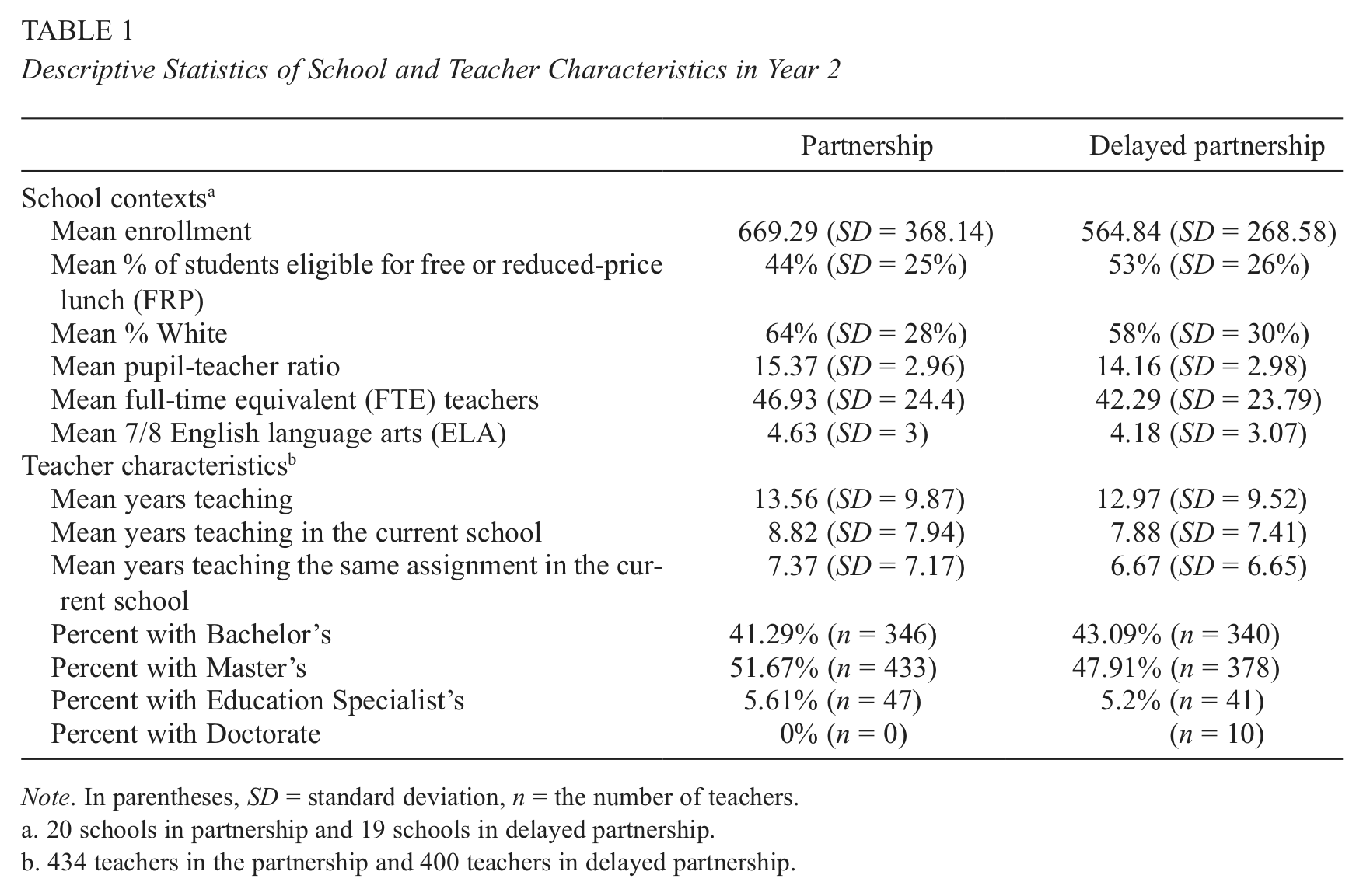
Note. In parentheses, SD = standard deviation, n = the number of teachers.
20 schools in partnership and 19 schools in delayed partnership.
434 teachers in the partnership and 400 teachers in delayed partnership.
Across all schools in Year 2, teachers, on average, had 13 years of teaching experience with a standard deviation of 9.7. On average, they had taught in current schools for 8 years. More than 90% of the teachers had a bachelor’s or master’s degree in both partnership and delayed partnership conditions. About 5% of teachers had an education specialist degree or a professional diploma based on at least 1 year’s work past the master’s degree. Few teachers had doctorates.
Measures
The larger study invited all credentialed staff (except for principals) in the 39 schools to respond to annual surveys, which included questions about professional development experience, teachers’ professional networks, instructional practices, school contexts, and individual background information. The measures in this study were derived from the annual teacher surveys collected in the spring semester of each of the three school years, which yields three waves of data. The response rate for each of these three years was above 90% on average across the schools. 2 In what follows, we briefly summarize the measures we constructed and which waves of data were used.
Dependent Variables
We conducted separate analysis to address each research question and corresponding hypothesis. The outcome variable for the first question was a measure of the amount of help a teacher provided to others regarding teaching writing. For the second question, the outcome variable included two measures of teachers’ instructional practices.
The number of colleagues helped with teaching writing in Year 3
In the Year 3 spring survey (the end of the 2009–2010 school year), teachers were asked to nominate other teachers who had helped them with writing instruction; during the 2009–2010 school year (Year 3), up to five colleagues. 3 The dependent variable is then simply the total number of other teachers who nominated a teacher as helpful. Thus, if Lisa was nominated as having provided help to Joe, Sue, and Bob, then Lisa’s value would be 3, because three other teachers nominated her. In this measure, we followed Frank’s work of emphasizing the import of obtaining the measure from the recipients of help rather than help providers (Frank et al., 2008; Frank, Zhao, & Borman, 2004). That is because expertise with regard to instructional matters is more likely to have been transferred if the recipient indicates such, regardless of reports of those who originally possess expertise and attempt to transmit knowledge (Hansen, 1999). The mean of this measure in partnership condition (MP) = 3 and its standard deviation in partnership condition (SDP) = 3, while the mean in delayed partnership condition (MDP) = 2 and its standard deviation in partnership condition (SDDP) = 2. 4
Writing instruction in Year 3
The survey asked teachers to report on the frequency with which they engaged in research-based instructional practices in writing. The items for these practices were drawn from meta-analysis conducted by Graham and Perin (2007a, 2007b, 2007c) that focused on teaching strategies targeting middle and high school students. We aggregated two measures of high-quality writing instruction that drew from these survey items:
The breadth of writing purposes taught in Year 3
In Year 3 survey, each teacher was asked to rate how often she or he had students engage in writing for various purposes, such as to express themselves creatively (e.g., a poem or play) or to describe a process (e.g., an essay or lab report). Detailed items are as listed in the Technical Appendix. Teachers rated on a 6-point scale: 0 = never, 1 = fewer than 5 times, 2 = 5 times or more, 3 = monthly, 4 = weekly, and 5 = daily. We aggregated these items into one composite variable by taking the mean across these items because they describe the same latent trait of writing purposes (α = .91; MP = 1.77, SDP = 1.15; MDP = 1.81, SDDP = 1.14).
The engagement of students in writing processes in Year 3
Teachers were asked to rate how often they had students engage in several writing-related activities, including organizing ideas for writing text and composing, revising, and editing texts. We constructed one composite variable based on factor analysis by averaging the ratings on these items illustrated in the Technical Appendix (α = .96; MP = 1.71, SDP = 1.34; MDP = 1.74, SDDP = 1.32).
Focal Independent Variables
Following Garet and colleagues’ studies (Desimone et al., 2002; Garet et al., 2001), we identified three composite measures of professional development quality as our focal independent variables to examine the direct and spillover effects of professional development.
Professional development duration in Year 3
In the Year 3 spring survey, we asked teachers to indicate how many hours of professional development related to teaching writing or assessing writing they had participated in as a recipient, including workshops, conferences, classes, writing groups, and site-based professional development activities such as study groups or work on writing with a literacy coach or mentor (see descriptive statistics in Table 3).
Breadth of content areas focused in professional development in Year 3
Teachers were also asked to indicate the extent to which their professional development in writing had focused on writing instruction-related knowledge and strategies on a 3-point scale: 0 = not a focus, 1 = minor focus, 2 = major focus. We then aggregated a composite variable by taking the mean of eight items based on factor analysis, and these items are included in the Technical Appendix (α = .87; see descriptive statistics in Table 3).
Breadth of active learning strategies employed in professional development in Year 3
To create a measure of active learning activities provided by professional development to teachers, we aggregated one composite variable by taking the sum of 15 items (α = .88) that describe activities that teachers had participated in as part of any writing professional development during the 2009–2010 school year (Year 3; e.g., received coaching or mentoring). These 15 items are included in the Technical Appendix (see descriptive statistics in Table 3).
Exposure to colleagues’ estimated expertise gained from Year 2 professional development
Following the our prior work (e.g., Frank et al., 2004; Penuel et al., 2012), we developed this measure using a two-stage process. We first estimated the extent to which teachers had gained instructional expertise from Year 2 professional development. We then derived the measure of indirect exposure to professional development as approximated by the extent to which, through professional interactions, teachers were exposed to their peers’ estimated amount of gain in instructional expertise through collegial interactions.
In constructing this measure, our purpose was to estimate how the effects of professional development were augmented by teacher interactions, not the overall effects of collegial interactions on teachers’ practices. To do so, we statistically estimated the amount of expertise gained from Year 2 professional development that represents the amount of professional development expertise available to disseminate to other teachers. Therefore, we used teachers’ self-reported professional development features in Year 2 professional development to predict teachers’ instructional practices in Year 2, controlling for Year 1 instructional practices. About 50% to 60% of the total variance of Year 2 instructional practices was explained by these models. The coefficients of professional development features are listed in Table 2, 5 which are positively significant at p ≤ .001. Then we multiplied the coefficients with the teachers’ self-reported Year 2 professional development features to estimate the level of instructional practices attributable to receiving Year 2 professional development. For example, if a teacher’s Year 2 professional duration was 20 hours, the contribution of professional development to this teacher’s gain in expertise in the engagement of students in writing process was then estimated to be 20x (the coefficient of professional development duration on the engagement of students in writing processes in Table 2) = 20 × 0.009 = 0.18.
Estimates of the Contribution of Year 2 Professional Development Features to Year 2 Instructional Practice
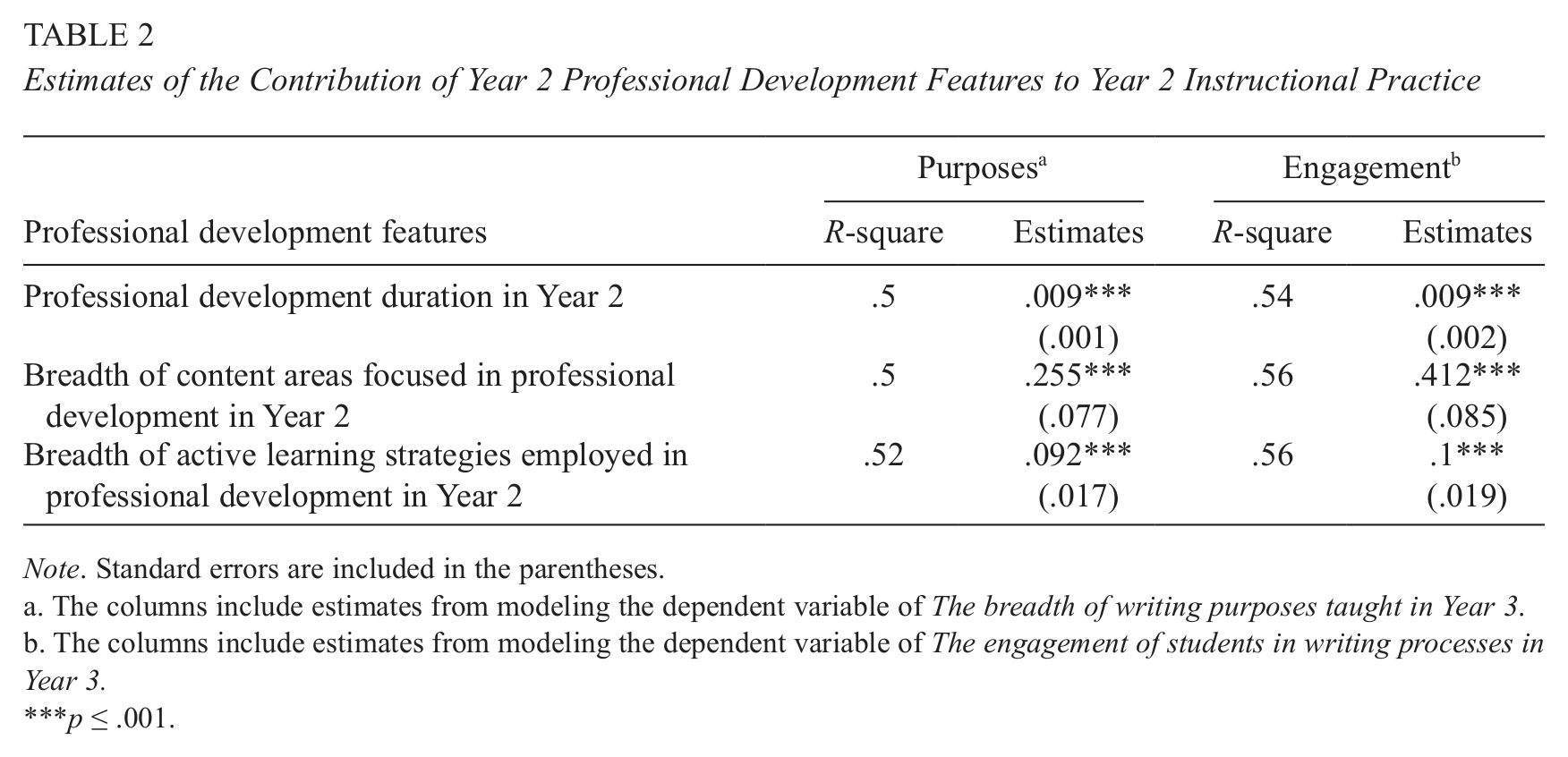
Note. Standard errors are included in the parentheses.
The columns include estimates from modeling the dependent variable of The breadth of writing purposes taught in Year 3.
The columns include estimates from modeling the dependent variable of The engagement of students in writing processes in Year 3.
p ≤ .001.
To illustrate the dynamics of how expertise spread among teachers, we developed a network measure of the extent to which a teacher was exposed to colleagues’ estimated professional development expertise through interactions. To measure teachers’ interactions, in the Year 3 teacher survey, teachers were asked to list five colleagues in the same school who had provided help with teaching writing in the whole school year. Teachers were also asked to rate the frequency of each of the five types of interactions on a 5-point scale: 0 = not at all, 1 = once or twice this year, 2 = monthly, 3 = weekly, and 4 = daily, such as (a) “Gave me curriculum resources (e.g., texts, lesson plans, print materials for students),” (b) “Gave a demonstration of how to lead a writing lesson or activity,” (c) “Provided me with feedback on my teaching that I used to improve how I teach writing,” (d) “Gave me an idea for a new writing-related activity to use with my students,” and (e) “Helped me adapt or improve a writing activity I used with my students.” The original units of the frequency of interactions were transformed to days (0 = 0 days, 1 = 2 days, 2 = 10 days, 3 = 36 days, 4 = 180 days). We then summed the frequency of interactions between two teachers across these different types of interactions (Frank et al., 2004). Consider teacher Lisa who nominated Bob as a help provider with curriculum resources monthly (10), a demonstration of instruction once or twice in this year (2), and an idea of new writing-related activity every week (36). Thus, the frequency of their interactions is the sum of these frequencies on these tasks to be 48 (10 + 2 + 36).
The exposure to help providers’ estimated expertise gained from Year 2 professional development was estimated by multiplying the frequency of the interaction teacher i reported with i’ by the estimated amount of expertise that teacher i’ learned from Year 2 professional development. For example, if Bob’s estimated expertise gained from Year 2 professional development was 2 and the frequency of Lisa and Bob’s interaction was 48, then Lisa’s exposure (via Bob) would be 48 × 2 = 96. If besides Bob, Lisa also nominated Lucy with estimated expertise of 2 (with a frequency of interactions = 180, then 180 × 2 = 360), Tracy with estimated expertise of 0.1 (with an interaction frequency of 14, then 14 × 0.1 = 1.4), and Tom with estimated expertise of 5 (with an interaction frequency of 10, then 10 × 5 = 50), then the combined information across Lisa’s network was the sum of exposure across all teachers that Lisa nominated between 2009 and 2010: 96 + 360 + 1.4 + 50 = 507.4. Formally,
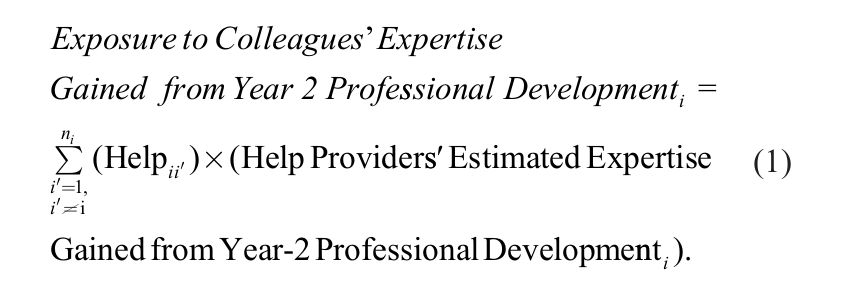
In Equation (1), n
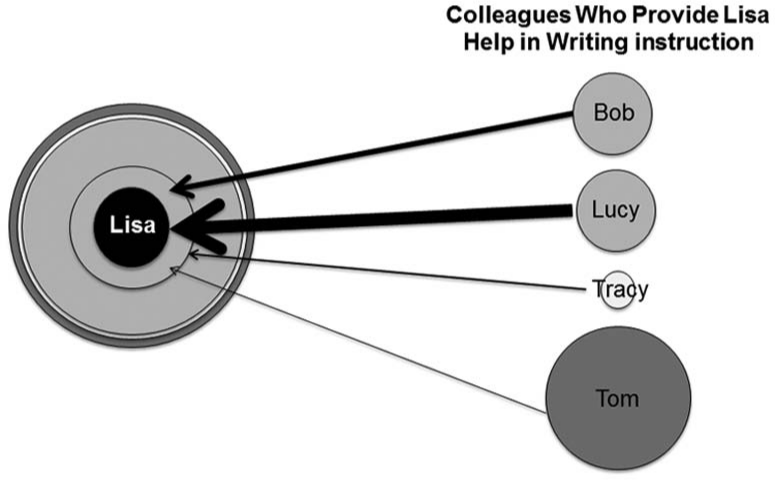
Exposure to colleagues’ expertise.
Analytic Strategies
We conducted separate analysis in partnership and delayed partnership respectively, for the following reasons. As noted earlier, the larger study used clustered RCTs to randomly assign schools within each Local Writing Project site. Assignment to treatment condition was at the school level, because the overall purpose of the study was to examine the effect of school partnership. Our purposes were different in this analysis, focused instead on effects of professional development and spillover on the teachers who received professional development in each condition. Moreover, there was wide variation in actual professional development received in the treatment condition, and teachers in the delayed partnership condition did still participate in regular district-provided professional development that shared some of the same features as those provided in partnership. Thus, there was lack of fidelity in the implementation in both the treatment and control groups. As a result, an analysis that included a treatment indicator as a predictor would yield a noisy signal with respect to receipt of professional development, and our definition of spillover hinges on teachers receiving professional development first in order to convey its benefits to colleagues.
Our analysis and results in the delayed partnership can be treated as internal replications of the findings in the partnership condition, more specifically, differential replication (Lindsay & Ehrenberg, 1993). Teachers in both groups may have experienced similar types of professional development programs, but teachers in partnership on average had more intensive writing professional development as shown in Table 3. Moreover, the separate analysis also isolates the professional development effects from the treatment effects (Nye, Konstantopoulos, & Hedges, 2004).
Descriptive Statistics and Correlations of Professional Development Features in Year 3

Note. Standard deviations are included in parentheses.
This sample includes all teachers in the sample of final analysis in Table 4, Table 5, Table 6, and Table 7. Some of these teachers did not indicate their teaching subject areas in their responses to the Year 3 teacher survey.
p ≤ .001.
Model the Number of Colleagues Helped With Teaching Writing
The logic of estimation is straightforward. We assume that the change in the number of colleagues a teacher helped from the end of Year 2 to the end of Year 3 was a function of professional development experienced by the teacher in Year 3. Specifically, we used lagged value to approximate change for several reasons. By controlling for the number of colleagues helped in Year 2—teachers’ help behavior in the most adjacent year to the dependent variable—we can approximate the estimates of professional development effects closely to the estimates obtained from randomly assigning teachers into professional development programs in Year 3 (Cook, Shadish, &Wong, 2008; Shadish, Clark, & Steiner, 2008). The prior absorbs the influence of other unmeasured and sustaining characteristics of teachers, such as personal value and motivation to collaborate with other teachers (Frank et al., 2008). Moreover, controlling for prior reduces the potential of residuals’ nonnormality and therefore increases the consistency of estimates (Raykov & Marcoulides, 2008).
In addition to adjusting for the prior number of colleagues helped, we accounted for several measures of a teacher’s expertise in teaching writing, which have the potential to be confounded with the relationship between features of professional development and the number of colleagues a teacher helped (e.g., Years of working at the current school up to Year 3, 7 and Being a coach or teacher consultant in Year 3). We also included school fixed effects to account for disparities in unmeasured school contexts that may be confounded with teachers’ professional development experiences and the change in teachers’ help behavior. 8
Model How Professional Development Shapes Instructional Practices Through Collegial Interactions
We used social influence models to examine the extent to which participants’ new instructional expertise gained from participating in Year 2 professional development spread to other teachers. Teachers’ instructional practices in Year 3 were examined as functions of exposure to colleagues’ estimated expertise gained from Year 2 professional development through interactions after accounting for individuals’ practices in Year 1, direct participation in professional development in Year 3, and personal background characteristics in Year 3, as well as school fixed effects. 9 The model is simplified as follows:

In Equation (2), β1–9 is the coefficient of each independent variable, which represents the direction and strength of association between each independent variable and the outcome variable of instructional practice in Year 3. β
p
represents the school fixed effect where teacher i worked. There are 19 school fixed effects in partnership and 18 in delayed partnership. e
Teachers who both participated in professional development might develop a better language to convey their knowledge and communicate with each other better; therefore, the spillover on professional development participants can be stronger than that on nonparticipants. To test whether teachers who participated in professional development were more likely to be influenced by interactions with colleagues, we constructed the interaction effects between professional development participation and exposure to colleagues’ estimated expertise gained from Year 2 professional development. If teachers participated in professional development for one hour or more, we defined professional development participation as “1”; otherwise, professional development participation = “0.” 10 Lastly, we quantified the robustness of inferences of our estimates for concerns of unobserved and unmeasured confounding variables. Due to space limitations, we include examples of robustness calculation in Note 11, and the rest of the results can be found at http://epa.sagepub.com/supplemental. 11
Results
Descriptive Statistics on Professional Development in Partnership and Delayed Partnership Schools
Table 3 indicates that there were significant mean differences in exposure to three professional development features between partnership and delayed partnership schools. Teachers in partnership schools, on average, participated in three times as many hours of professional development as peers in delayed partnership schools. Also, teachers in partnership schools participated in content-focused professional development in writing that covered a wider range of topics in writing and employed more than twice as many active learning strategies than did peers in delayed partnership schools.
Moreover, ELA teachers participated more hours of writing professional development than non-ELA teachers in both partnership and delayed partnership conditions. Compared to non-ELA counterparts, ELA teachers also participated in broader range of contents and active learning activities. We thus controlled for being an ELA teacher in the process of estimating professional development effects.
In addition, given the strong correlation among three measures of professional development features, as indicated in the last three columns in Table 3, we added them separately into the model to avoid multicollinearity issues.
Effects of Professional Development Features on the Number of Colleagues Helped With Teaching Writing
Table 4 shows the estimated effects of professional development features on the number of others helped with teaching writing from six models, separately for each professional development feature and for partnership and delayed partnership respectively. Overall, each of these models explains about 50% to 60% of the total variance of the number of colleagues helped during Year 3.
Estimated Effects of Professional Development Features on the Number of Colleagues Helped With Teaching Writing in Year 3
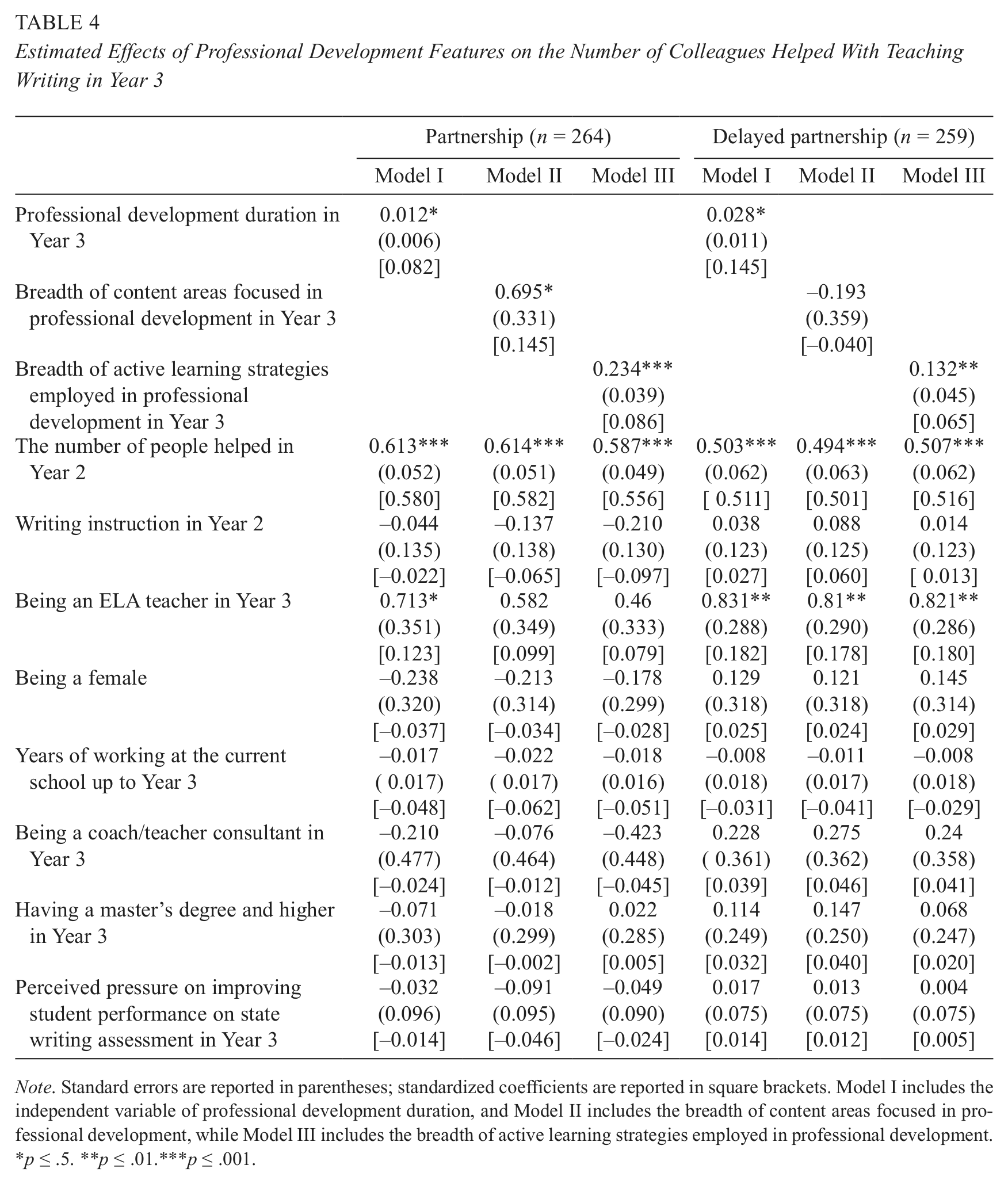
Note. Standard errors are reported in parentheses; standardized coefficients are reported in square brackets. Model I includes the independent variable of professional development duration, and Model II includes the breadth of content areas focused in professional development, while Model III includes the breadth of active learning strategies employed in professional development.
p ≤ .5. **p ≤ .01.***p ≤ .001.
The unstandardized coefficient of professional development duration on the number of colleagues helped is .012 in the partnership and .028 in the delayed partnership. In a hypothetical school of 50 teachers, in which 10 were exposed to 20 hours more of professional development, this effect would have translated to an additional 2 teachers reporting receiving help on writing instruction in partnership and an additional 5 teachers reporting receiving help in the delayed partnership condition. The unstandardized coefficient of breadth of content areas on the number of colleagues helped is .695 in the partnership but close to zero in the delayed partnership.
The variable of the breadth of active learning strategies employed in professional development is a significant independent variable of the number of colleagues helped in Year 3 in both partnership and delayed partnership. The estimate of this effect is .23 in partnership and .13 in delayed partnership. In a school of 50 teachers, in which 10 were exposed to one more active learning strategy as part of professional development, this effect would have translated to an additional 2 teachers reporting receiving help on writing instruction in partnership and an additional 1 teacher reporting receiving help in delayed partnership.
Even though exposure to professional development was related to the increase in collegial help, the strongest independent variable of the number of colleagues an individual helped in Year 3 is the prior number of colleagues helped in Year 2. Its unstandardized coefficient is .5 or larger (p value < .001) and it explains one half of the variance of the outcome variable.
Not surprisingly, help with teaching writing is more likely to be sought from ELA teachers than from teachers of other subjects. In addition, the standardized coefficients of professional development features (duration, content breadth, and active learning strategies) are similar to those of being an ELA teacher, which implies that the effects of professional development features on collegial help were comparable to those of being an ELA teacher.
None of the other covariates—including teaching experience, being a coach or teacher consultant, being a female, perceived pressure from state writing assessment, or having a master’s degree or higher—significantly predicted teachers’ helping with others after controlling for prior helping behaviors and the effects of own professional development participation.
Effects of Professional Development Features on Writing Instruction Through Professional Help
Consistent with some previous studies, professional development duration has a significantly positive impact on each of these two measures of instructional practices, for teachers in both groups, as shown in Table 5. The effects vary between unstandardized coefficient of β = .005 (with corresponding standardized coefficient of b = .083) and β = .024 (with b = .186). Moreover, after controlling for teachers’ own professional development duration, their prior practices in Year 1, and other covariates, interactions with peers who were involved in intense professional development in Year 2 had a significantly positive impact on these teachers’ instructional practices in Year 3 in both partnership and delayed partnership schools. The unstandardized coefficient of peers’ influence is estimated to be between β = .13 and β = .144, with corresponding standardized coefficients between b = .077 and b = .136.
Estimated Effects of Professional Development Duration on Writing Instruction

Note. Standard errors are reported in parentheses; standardized coefficients are reported in square brackets.
The columns include estimates from modeling the dependent variable of the breadth of writing purposes taught in Year 3.
The columns include estimates from modeling the dependent variable of the engagement of students in writing processes in Year 3.
p ≤ .05. **p ≤ .01.***p ≤ .001.
As shown in Table 6, the impact of the breadth of content areas focused in professional development on the breadth of writing purposes taught by teachers in delayed partnership was not statistically significant. Overall, however, the results suggest a strong and positive impact of the breadth of content areas focused in professional development on teacher-reported instructional practices (β ranges from .461 to .457; b ranges from .145 to .222). The exposure to peers’ experienced breadth of content areas focused in professional development has positive effects too, as included in the second row of Table 6. A one standard deviation increase in exposure to the professional development content experienced by peers, had an estimated effect of 0.1 standard deviations on a teacher’s instructional practices in writing.
Estimated Effects of Breadth of Content Areas Focused in Professional Development on Writing Instruction

Note. Standard errors are reported in parentheses; standardized coefficients are reported in square brackets.
The columns include estimates from modeling the dependent variable of the breadth of writing purposes taught in Year 3.
The columns include estimates from modeling the dependent variable of the engagement of students in writing processes in Year 3.
p ≤ .05. **p ≤ .01.***p ≤ .001.
As shown in Table 7, teachers who had participated in professional development programs with more active learning strategies had a higher likelihood of improving their writing instruction in both partnership and delayed partnership. The effect of the breadth of active learning strategies employed in professional development on teachers’ engagement of students in writing processes in partnership group had the largest effect. Its unstandardized coefficient β equals to .082 and standardized coefficient b equals to .197, and its t ratio equals to 5.24.
Estimated Effects of the Breadth of Active Learning Strategies Employed in Professional Development on Writing Instruction

Note. Standard errors are reported in parentheses; standardized coefficients are reported in square brackets.
The columns include estimates from modeling the dependent variable of the breadth of writing purposes taught in Year 3.
The columns include estimates from modeling the dependent variable of the engagement of students in writing processes in Year 3.
p ≤ .05. **p ≤ .01.***p ≤ .001.
After controlling for all of other independent variables, the level of exposure to active learning strategies experienced by one’s peers could influence one’s instructional practices. The coefficients shown in the second row of Table 7 indicate the hypothesized positive effect and relatively substantial magnitudes of spillover effects of professional development who had experienced Year 2 active learning activities.
When comparing the standardized coefficients of exposure to peer’s professional development expertise to those of teachers’ own direct exposure to professional development features in Tables 5, 6, and 7, these peer effects are close to those of own direct exposure to professional development, which deserves our attention. In addition, the interaction terms between teachers’ own professional development participation in Year 3 and exposure to colleagues’ estimated expertise gained from Year 2 professional development were not statistically significant (e.g., t ratio < 1; p value > .35). This indicates that spillover effects are independent from whether help receivers themselves participated in professional development in Year 3 or did not.
Discussion
This study investigated two questions related to how professional development features can promote diffusion of instructional expertise through collegial interactions and lead to writing instructional improvement. In particular, we examined two measures of the spillover effect of professional development: on the number of colleagues helped and on peer influence on instructional practices through collegial interactions. After analyzing longitudinal data from two groups of teachers who experienced different types of professional development programs, we found that across these two types of programs, teachers were more likely to provide help to others with teaching writing if they had intensively participated in professional development of longer duration, with a broader range of writing-related content, and that employed a larger number of active learning strategies. These effects were significant, even after accounting for prior number of colleagues helped and other important confounds. Moreover, we found that the expertise that teachers gained from Year 2 professional development spread to other teachers as they offered professional help. In some cases, the spillover effects on the improvement of instructional practices were almost equal to the direct effects of teachers’ participation in professional development.
Substantive Interpretations
This study extends the inquiry of professional development by the explicit attempt to model the direct and spillover effects of professional development simultaneously. Although it has been long acknowledged that teachers’ immediate social context (i.e., teachers’ professional networks) enables or constrains their behaviors and beliefs (see especially Lieberman & McLaughlin, 1992), it is hard for prior studies to control for teachers’ learning from peers when estimating the amount of improvement in knowledge and skills that could be attributable to learning in professional development. We were able to distinguish direct and spillover effects from professional development because of the unique longitudinal dataset employed in this study. The sociometric data allowed us to explicitly identify teachers’ peers and the patterns of collegial interactions. We were then able to estimate the diffusion mechanism of instructional expertise during these 3 years’ iteration.
Moreover, the study findings are consistent with those from a number of studies that focused on the role of professional communities in supporting instructional improvement. For example, Frank et al.’s (2004) study of teachers’ integration of technology into instruction demonstrated that collegial interactions related to technology could facilitate knowledge diffusion. Conversely, Penuel and Gallagher (2009) found that when professional communities were not cohesive and where teachers were reluctant to ask one another for help, diffusion of improvements was impeded. A number of single- and multiple-case studies point to the potential role of teacher teams and communities in schools in supporting instructional improvement (e.g., Horn & Little, 2010; McLaughlin & Talbert, 2003; Scribner, Sawyer, Watson, & Myers, 2007).
This research extends the inquiry on teacher professional learning communities by illuminating a way that professional development can extend the range of expertise that is accessible to teachers. On their own, communities may lack the knowledge of subject matter content, of pedagogical strategies for teaching content, or of specific curricular resources. These communities may need to improve instruction in goals that they have defined for themselves. In this respect, professional development may serve such purposes by exposing teachers to new knowledge; through collegial interactions, that knowledge can spread in ways that benefit both the school and individual teachers.
Limitations
There are some important limitations of the study to note. First, although this study has used multiple strategies to eliminate alternative interpretations of the spillover effects, because teachers were not randomly assigned to receive professional development, our estimated effects may be biased due to selection. We strongly urge future studies to randomly assign teachers into professional development programs to examine the effects identified in this study. Second, we examined three, but not all, professional development features (Correnti, 2007). It is possible that these unexamined professional development features could drive the positive spillover effects identified in this study. Third, our data provide some evidence to the conjecture that ELA teachers were more likely to offer help with teaching writing after receiving writing professional development. Since this study focuses on estimating spillover effects and writing instruction is a cross-discipline activity in middle schools, we decided not to extensively discuss this finding. But the question of differential influences of professional development on various subgroups of teachers needs to be further investigated. Moreover, the extent to which such cross-subject spillover of writing professional development would occur for teaching other subjects, such as teaching mathematics, also needs to be further explored. 12
Fourth, this study employed a single data source from teacher surveys. We have established adequate reliability (as indicated by the high Cronbach’s alpha coefficients in the Technical Appendix) and predicative validity of these measures of teachers’ writing instructional practices (as indicated by high correlation coefficients between teacher survey and teacher logs data 13 ). But replications of this study should employ different data sources (e.g., videotaped instructional practices and detailed classroom observations) and different measures of teacher expertise (e.g., value-added measures of teacher effectiveness, or teachers’ pedagogical content knowledge 14 ). Lastly, we acknowledge that potential measurement errors in the dependent variables were left to the error term, which may be correlated with the independent variables in the model, potentially biasing estimates. Measurement errors of this sort that correlate with both dependent variables and independent variables can be treated as another form of omitted confounding variables. If measurement errors were included in the independent variable of interest only, or the outcome only, this type of measurement errors actually makes our inferences conservative. Nonetheless, future studies could improve upon the measurement of teachers’ instructional practices or features of professional development or, as suggested above, use multiple data sources.
Policy Implications
Despite the limitations, the findings in this study can lead to several policy recommendations with respect to developing effective professional development programs and distributing professional development participants within schools to promote schoolwide instructional change. This study provides more empirical evidence for developing professional development programs that feature extended duration, focused content, and various active learning strategies. If effective, professional development programs in writing that encourage and promote teacher collaboration as a means to improving instruction may both develop individual teachers’ expertise in enacting high-quality writing instruction and facilitate the diffusion of new expertise. For example, the Cognitively Guided Instruction (CGI) professional development program (Carpenter, Fennema, Franke, Levi, & Empson, 1999) contains this feature of engaging teachers in discussing students’ mathematical thinking in group working sessions and/or one-on-one interaction settings. Consistent with our findings, Franke and her colleagues followed up with participants after the professional development interventions, and they found that teachers still got together to collectively discuss students’ work, which not only expanded but also sustained the impact of this professional development program (Franke, Carpenter, Levi, & Fennema, 2001). In short, the design feature of professional development can potentially sustain change in instruction by promoting effective mechanism of sharing instructional expertise among teachers.
The findings in this study suggest that this kind of professional development may be a vital tool to build internal capacity to support the implementation of ambitious whole-school reforms. The whole-school reforms are evident today within widely implemented models of comprehensive school reform designs (e.g., Success for All). Such reforms and networks have high levels of agreement on the goal of instruction (such as improved student performance) and orchestrate resources to build a coherent infrastructure to support teachers achieve the desired results (Berends et al., 2005; D. Cohen, 2011). Professional development designed to promote both direct and spillover effects can help to develop and institute regular collaboration among teachers, which can help disseminate knowledge of reforms on teaching and learning, stimulate new innovations, and develop coherent instructional practices among teachers schoolwide (e.g., Datnow & Park, 2010; Sargent & Hannum, 2009).
Within schools, to promote spillover effects, principals can purposely motivate teachers to participate in such professional development. Professional development designed to promote both participants’ own instruction and their helping behaviors can develop both “already-go-to” teachers to become also “experts” who have sufficient knowledge to help other teachers, and it can develop “experts” into “go-to” teachers in the school who have collaborative skills to better disseminate their expertise. Both kinds of teachers can potentially become teacher leaders, such as teacher mentors, instructional coaches, or other team leaders. A risk of this approach, of course, is that in some schools, purposely selecting “go-to” teachers to participate in professional development, can isolate particular teachers who have fewer colleagues from whom they can seek help. Furthermore, purposefully selecting expert teachers may widen the gap between expert and novice teachers, if professional development has a strong direct effect on them as participants. Thus, care must be given teachers’ roles in the internal social structure of schools so that all teachers have the potential to benefit from spillover effects. We also acknowledge that we have not empirically evaluated that such an approach of implementing professional development in schools would promote student achievement schoolwide. Therefore, we strongly urge future studies to further examine this recommendation.
Conclusion
The key of achieving ambitious policy efforts for improving all students’ learning is to develop all teachers’ sustainable capacity to improve their instructional practices (Darling-Hammond et al., 2009). To develop such learning behavior, effective professional development programs should not only promote individual participants’ subject knowledge and instructional expertise, but should also aim to develop their ability to collaborate with other teachers. This study’s findings indicate that the extent to which teachers benefit from professional development programs through interacting with professional development participants almost equals the effect of direct participation. These identified spillover mechanisms via intraschool networks deserve policy makers’ and school leaders’ attention when developing and evaluating effective professional development programs for teachers.
Footnotes
Technical Appendix
Composite Measures on Professional Development Features and Writing Instructional Practices
| Measures | Rating scale | Cronbach’s alpha |
|---|---|---|
|
|
0 = never, 1 = fewer than 5 times, 2 = 5 times or more, 3 = monthly, 4 = weekly, 5 = daily | α = .91 |
| To reflect on an experience or topic (e.g., journaling), | ||
| To express themselves creatively (e.g., a poem, story, or play), | ||
| To recount a story or event through narrative, | ||
| To describe a thing, place, process, or procedure (e.g., an essay, lab report, or descriptive response), | ||
| To explain a concept, process, or relationship (e.g., comparison/contrast, problem/solution), | ||
| To make an argument intended to persuade others, | ||
| To gain practice with writing mechanics within students’ own writing, | ||
| To gain practice with particular forms of writing (e.g., letter writing), | ||
| To gain practice with forms of writing encountered on standardized tests. | ||
|
|
0 = never, 1 = fewer than 5 times, 2 = 5 times or more, 3 = monthly, 4 = weekly, 5 = daily | α = .96 |
| Brainstorming or organizing ideas for writing text, | ||
| Composing text, | ||
| Revising text (focused on meaning and ideas), | ||
| Editing text (focused on grammar, usage, punctuation, spelling), | ||
| Meeting individually with the teacher to get oral feedback or discuss how to improve his or her writing, | ||
| Reviewing written feedback on their own writing given by the teacher, | ||
| Sharing or presenting their own writing to peers, | ||
| Analyzing what makes particular texts good or poor models of writing (individually or with others). | ||
|
|
0 = not a focus, 1 = minor focus, 2 = major focus | α = .87 |
| Improving student skills and knowledge of planning and pre-writing strategies (brainstorming, generating and organizing ideas, identifying purpose and audience), | ||
| Improving student skills in drafting, revising, and editing text (for meaning, clarity, sentence structure, word choice), | ||
| Improving student skills in grammar, usage, punctuation, or spelling, | ||
| Improving student ability to work collaboratively with their peers on writing, | ||
| Improving student skills for analyzing models of good writing and applying insights to their own text, | ||
| Improving student learning about literary techniques and authors’ styles, | ||
| Improving collaboration among teachers on writing instruction (either within a single subject or grade level or across the curriculum), | ||
| Learning about writing by writing yourself and revising your own work with other teachers. | ||
|
|
1 = yes, 0 = no | α = .88 |
| I received coaching or mentoring in the classroom, | ||
| I met formally with other participants to discuss classroom implementation, | ||
| I practiced under simulated conditions and received feedback, | ||
| My teaching was observed by the professional development provider(s) and feedback was provided, | ||
| My teaching was observed by other participants and feedback was provided, | ||
| I communicated with the professional development provider(s) concerning classroom implementation, | ||
| My students’ work was reviewed by participants or the professional development provider(s), | ||
| I met informally with other participants to discuss classroom implementation, | ||
| I developed curricula or lesson plans that were reviewed by other participants or the professional development provider(s), | ||
| I gave a lecture or presentation to colleagues or other participants, | ||
| I conducted a demonstration of a lesson, unit or skill, | ||
| I led a whole-group discussion with colleagues or other participants, | ||
| I led a small-group discussion with colleagues or other participants, | ||
| I wrote some text (e.g., a reflection, plan, poem, etc.), | ||
| I created rubrics or used rubrics to assess student work. |

Acknowledgements
We wish to thank the National Writing Project for the permission to use the data. Thanks also go to other team members at SRI International for their efforts in data collection and data cleaning, without which these analyses would not be possible. We also thank Drs. Gary Sykes, Mark Reckase, Alicia Alonzo, and Jacquelynne Eccles for their comments on earlier drafts. We particularly would like to thank all anonymous reviewers for their very thoughtful comments and suggestions.
Funding
The authors disclosed receipt of the following financial support for the research, authorship, and/or publication of this article: This research is supported by a grant from the American Educational Research Association which receives funds for its “AERA Grants Program” from the National Science Foundation under Grant #DRL-0941014. Opinions reflect those of the authors and do not necessarily reflect those of the granting agencies.
Notes
Authors
MIN SUN is an assistant professor in Educational Leadership and Policy Studies at Virginia Tech. 206 E. Eggleston Hall, Blacksburg, VA 24061;
WILLIAM R. PENUEL is professor of educational psychology and learning sciences at the University of Colorado Boulder. His research interest includes design-based implementation research, research-practice partnerships, and technology supports for classroom assessments.
KENNETH A. FRANK is currently a professor in Counseling, Educational Psychology and Special Education as well as in Fisheries and Wildlife at Michigan State University. His substantive interests include the study of schools as organizations, social structures of students and teachers and school decision-making, and social capital. His substantive areas are linked to several methodological interests: social network analysis, causal inference and multilevel models. His publications include quantitative methods for representing relations among actors in a social network, robustness indices for inferences, and the effects of social capital in schools, as well as how the decisions about natural resource use in small communities are embedded in social contexts.
H. ALIX GALLAGHER is a senior researcher in the Center for Education Policy at SRI International. She was a co-principal investigator of the National Evaluation of Writing Project School Partnerships. Her research focuses on teacher quality and school reform.
PETER YOUNGS is an associate professor of educational policy at Michigan State University. His research interests focus on education policy effects on teaching and learning in the core academic subjects. In particular, his work concentrates on state and district policy related to teacher induction, evaluation, and professional development in the United States and their effects on teachers’ instructional practices, commitment to teaching, and retention in the teaching profession.