




Abstract
In this invited response to Moe and Anzia (2014), we describe both the points of convergence and divergence between our prior research (2007a, 2007b) and that of Moe (2005) and Moe and Anzia (2014). We also respond to Moe and Anzia’s critique of our published work. Moe and Anzia’s study helps to refine the policy discussion around seniority preferences in teacher collective bargaining agreements by providing further evidence that such preferences may exacerbate the teacher quality gap in particular settings - specifically, large, likely highly bureaucratic, elementary school districts - a finding that is consistent with a finding from our earlier research. However, we believe that those significant findings are limited to certain school districts, and we were unable in our prior research to conclude that the strength of seniority preferences consistently and systematically exacerbates the teacher quality gap within and among all school districts. This is the point of divergence between our work and that of Moe and Anzia. Consequently, we caution that merely banning seniority preferences may not have widespread, long-term effects on closing the teacher quality gap.
W
Yet, conventional wisdom has long held that teacher employment rules and collective bargaining agreements (CBAs) that give senior teachers preference in school administrators’ hiring and firing practices have conspired to create (or at least exacerbate) the teacher quality gap. Moe’s (2005) original study, our study, and Moe and Anzia’s (2014) study set out to test that proposition. This leads to the third point of agreement: Using the same data set and similar methods, we found and reported essentially what Moe and Anzia found, that is, in certain limited circumstances, there is a negative relationship between the strength of the seniority preferences in CBAs and the experience levels of teachers in minority schools. Indeed, Moe and Anzia’s study helps to refine the policy discussion around seniority preferences by providing further evidence that such preferences exacerbate the quality gap in large, likely highly bureaucratic, elementary school districts in which teachers are most easily able to transfer to more advantaged schools given the flexibility of their teaching credential and the greater number of transfer options.
Still, we appear to disagree with Moe and Anzia on whether those limited significant findings are enough to conclude that the strength of seniority preferences in teacher assignment systematically widens the teacher quality gap. More precisely, a thorough review of our study reaffirms our central conclusion, that is, notwithstanding the limited significant findings, we found relatively little evidence that more “determinative” transfer and assignment rules create or systematically exacerbate the teacher quality gap between higher and lower minority schools within and between districts. “[T]he teacher quality gap persists, in other words, regardless of the presence of seniority preferences” (Koski & Horng, 2007b, p. 293).
Recently, Cohen-Vogel, Feng, and Osborne-Lampkin (2013) confirmed that central conclusion in a comprehensive analysis of Florida data, employing the same theoretical model and methods used by Moe and Anzia (2014) and by us. In their words, [W]e find little in our models and in replications of model specifications by Moe (2005) and Koski and Horng (2007) to suggest that transfer and seniority provisions in CBAs worsen the teacher quality gap between more and less disadvantaged schools. Specifically, the quality gap that exists within Florida’s districts between schools with higher and lower proportions of Hispanic students, as measured by teacher experience, certification and college aptitude, does not appear to widen in the context of bargaining agreements that grant senior teachers more transfer and leave rights. In fact, compared with districts with less determinative transfer and leave rules, districts with more determinative provisions appear to have smaller gaps in teachers’ experience and certification between schools with higher and lower percentages of Hispanic students. (p. 17)
1
To be sure, there could be many reasons why the strength of seniority preference rules do not systematically exacerbate and are not responsible for the teacher quality gap. Due to historical practice and professional culture, it is possible that administrators simply do not exercise the contractual discretion provided by most CBAs and simply give senior teachers “plum” assignments as a reward for service. Or administrators may grant seniority preferences out of concern that teachers would otherwise leave the district or bargain for greater rights during the next round of collective bargaining. Or administrators have simply found ways to work around the seniority rules. Clearly, further research is warranted. Regardless, however, we cannot conclude that eliminating seniority preference rules will systematically and significantly close teacher quality gaps and our policy sights should instead be set on finding ways to encourage the best teachers to teach in the toughest assignments.
In the remainder of this response, we first re-visit our study and findings to show that certain of our findings are essentially what Moe and Anzia (2014) found by narrowing the parameters of our study—restricting the outcome variables, limiting the sample, and modifying the coding scheme. Ex ante, however, we had no theoretical reason to narrow our study to those parameters and sought to answer the broad theoretical question of whether the strength of seniority preference rules affects the distribution of teachers within and among school districts. We found no such statistically significant relationship in 29 of the 40 different models we analyzed and, accordingly, we could not conclude that such a systematic relationship exists. Ex post facto, however, we reported all of our significant findings, including those that parallel Moe’s (2005) original findings. We further offered tentative explanations for those findings, including the possibility that large and highly bureaucratic school districts rely on simple rules for the assignment of teachers (Koski & Horng, 2007a, p. 38). Second, we identify here several specific concerns with Moe and Anzia’s analysis and their critique of our study. We conclude by emphasizing our areas of agreement and proposing a way forward for research and policy.
Understanding the Forest by Revisiting the Koski and Horng Study
Prior to the publication of our Education Finance and Policy article—“Facilitating the Teacher Quality Gap?”—we published as part of the large “Getting Down to Facts” research project on California school finance and governance a 127-page technical report that provides detailed findings on 40 different analyses we conducted based on different theoretical considerations to test the question of whether teacher seniority preferences in the transfer and leave provisions of CBAs either curb or facilitate inequality among California schools. 2 In that technical report, we reported and discussed virtually all of the findings replicated by Moe and Anzia (2014) using our data and methods and all of the findings that they report as being consistent with Moe (2005). Due to severe page limitations, however, we were unable to re-report and again discuss all of our findings in the article that was reviewed and published by Education Finance and Policy.
As we noted in our article and technical report, we relied on Moe’s (2005) theoretical framework. The approach was to identify those variables that might affect the assignment of experienced and credentialed teachers among schools and determine whether seniority preferences have an exacerbating or attenuating effect on those outcomes. We also relied upon Moe’s theoretical considerations to assist us in variable and sample selection.
In our technical report, we analyzed and reported on 40 different models, all of which had ex ante theoretical justifications, seeking to find the effect of transfer and leave provisions on the relationship between percent minority students and percent credentialed/experienced teachers. Table 1 describes the results. Each cell of this table reports the coefficient of the interaction of percent minority and the transfer and leave score for each of these models. The full results for these models can be found in our technical report.
Mixed Effects Estimates for the Interaction of Percent Minority in School and the Strength of Seniority Preferences for 40 Hierarchical Linear Models From Koski and Horng (2007)
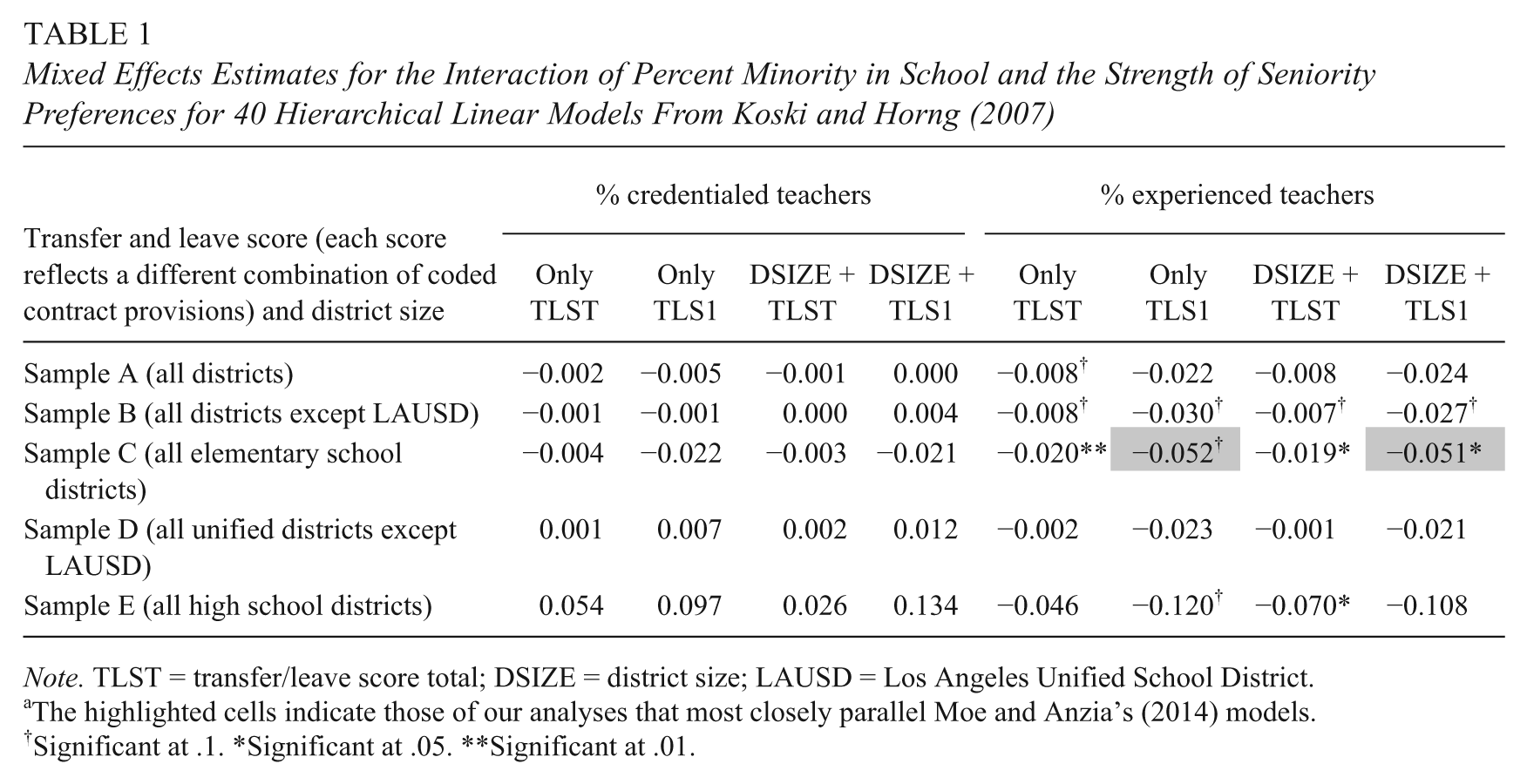
Note. TLST = transfer/leave score total; DSIZE = district size; LAUSD = Los Angeles Unified School District.
The highlighted cells indicate those of our analyses that most closely parallel Moe and Anzia’s (2014) models.
Significant at .1. *Significant at .05. **Significant at .01.
A significant coefficient indicates that the transfer and leave provisions significantly affect the relationship between the percent credentialed/experienced teachers at a school and the percent minority students. Of the 40 models we ran, only 7 yielded a significant result at the p = .10 level; 3 of the 40 models yielded a significant result at the p = .05 level; and 1 of the 40 models yielded a significant result at the p = .01 level. We could have reported only those 11 significant results, but, instead, we chose to report all of the results, including the 29 “null” findings because we did not have ex ante theoretical reasons to limit our models to only those with significant findings.
Moe and Anzia (2014) also rely on Moe’s (2005) basic conceptual framework. But, in reaching their conclusions, Moe and Anzia make a number of methodological decisions that differ from our research, including the elimination of high schools from the sample, looking only at teacher experience as an outcome variable (while rejecting teacher certification), and simplifying the coding scheme by disregarding important information. By making these methodological alterations, they show how our findings are consistent with Moe’s findings.
In Table 1, the highlighted cells indicate those of our analyses that most closely parallel Moe and Anzia’s (2014) models. Specifically, in some of our models, transfer/leave score (TLS; one of the coding schemes that we use) has a significant attenuating effect on the positive relationship between percent minority and teacher experience. Indeed, in Footnote 41 of our technical report, we state, This finding somewhat parallels the finding of Moe (2005a). We find that the MINORITY-EXP relationship is positive but TLS tends to reverse that relationship, thereby promoting an inequitable distribution of teachers. Moe (2005a) finds that the MINORITY-EXP relationship is negative and TLS further exacerbates that relationship, thereby promoting an inequitable distribution of teachers.
Yet, some parallel findings do not justify the conclusion that both studies show the same thing. We did not find such inequitable effects consistently in our models and samples. TLS does not significantly attenuate the relationship between percent minority and teacher experience/certification in a majority (29 out of 40) of our models. Therefore, given our broad theoretical frame, it would have been misleading for us to report that seniority preferences create or exacerbate the teacher quality gap. Stated differently, our study made similar findings to those made by Moe and Anzia (2014) using a restricted sample, one outcome variable, and a simpler coding scheme. We are not suggesting that Moe and Anzia’s theoretical reasons for limiting their analysis are in any way incorrect. Indeed, as we mentioned, Moe and Anzia’s theoretical argument and empirical findings that seniority preferences matter in large, elementary school districts significantly contributes to our understanding of the effects of such rules. We only note that we had no reason at the outset of our study to so limit our analyses. We also note that we reported those significant findings that paralleled Moe’s (2005) study and that Moe and Anzia later found when replicating our study. Indeed, we are gratified that they confirmed our work.
At bottom, we concluded that although a few trees in our study would have supported the conventional wisdom that seniority preferences exacerbate the teacher quality gap, our view of the forest as a whole did not provide sufficient evidence to conclude that those rules have a systematic and consistent effect on the distribution of teacher quality.
Getting Lost in the Weeds
In this section, we address several of the specific theoretical and methodological critiques that Moe and Anzia (2014) level against our study. We also identify a few critiques of theirs.
What Are We Trying to Measure?
Moe and Anzia (2014) begin their discussion of their conceptual framework by making a “midcourse correction” (p. 86). Specifically, they abandon the use of credential status as an outcome variable and focus solely on teacher experience because [s]eniority-based transfer rules are specifically designed to give teachers priority based on their years of experience, not their credentials. To the extent that these rules have a behavioral impact, then, it should be reflected most directly in the ways that experienced and inexperienced teachers get distributed across schools, and this is the aspect of schooling that the analysis ought to be explaining. (Moe & Anzia, 2014, p. 86)
Our difficulty with this midcourse correction is that it also departs from the original intention of these policy studies (or at least our study): to determine the effects of seniority rules on teacher quality, not the effect of such rules on teacher and administrator behavior.
As we discuss extensively on pages 35 to 36 of our technical report, there is very little consensus on the measure of teacher quality. It is for that reason that we selected two of the most prominent measures of quality—experience beyond 2 years and credential status. If we had more robust data available in California (e.g., measures of teachers’ “value added” to student performance), we would use additional and arguably better measures of teacher quality. But no such data were available. 3 Thus, to the extent policymakers and researchers are interested in whether seniority rules affect teacher quality, we would prefer to maintain multiple measures of teacher quality.
Furthermore, our article and technical report did not suggest that seniority rules and contract language do not affect behavior at all. Contract rules should affect administrative behavior and given that these contract rules are designed to discriminate on the basis of experience, one would naturally expect that the behavioral effects would be most pronounced when experience is the sole outcome measured. Finally, we should note that there is still a fair amount of debate that “formal certification has little or nothing to do with teacher effectiveness” (Moe and Anzia, 2014, p. 86), as some research has shown that certification and student performance are related. For example, four studies using individual-level student data from Arizona, Houston, New York City, and North Carolina provide significant empirical evidence that teacher credentials affect student achievement (see Boyd, Grossman, Lankford, Loeb, & Wyckoff, 2006; Clotfelder, Ladd, & Vigdor, 2007; Darling-Hammond, Holtzman, Gatlin, & Heilig, 2005; Laczko-Kerr & Berliner, 2002). As stated by one of these studies, “We find compelling evidence that teacher credentials affect student achievement in systematic ways and that the magnitudes are large enough to be policy relevant” (Clotfelder et al., 2007, p. 2).
Statistical Quibbles
First, Moe and Anzia (2014) criticize us because we “did not provide standard errors or t-scores for the estimated coefficients” (p. 91). This critique is misplaced. It is our understanding that, for the sake of clarity and efficiency, it is not uncommon, if not conventional, for journal articles to not include the specific standard errors and T-scores in addition to the estimated coefficients and an indication if the effects are significant at various levels of confidence. (Our editors did not ask for more.) 4
Second, Moe and Anzia (2014) use a one-sided t test for statistical significance and criticize our decision to use a two-sided hypothesis test (p. 91). Our approach is the more statistically conservative and arguably more appropriate approach for testing theoretical propositions. The convention is to use a two-sided test unless, of course, it is impossible that the effects could go in two directions, not merely that it is hypothesized that the effects go in a certain direction. In our analysis, we used two-sided tests because we were far from certain as to the effects of transfer rights (indeed, that is why we were conducting the study). Moe and Anzia acknowledge in Footnote 53 that, when they use a two-tailed test, they reach the same results we reached. If the results from the one- and two-sided tests provide different conclusions, it demonstrates that the findings may not be particularly robust. Moe and Anzia (2014) also state that, after doing a one-tailed test, “the null hypothesis of no effect can be rejected at a HIGH level of confidence (p = .051)” (p. 91). We would temper that conclusion. With such a large sample, we would typically believe that a p value of .051 is marginally significant, at best.
Third, Moe and Anzia (2014) disregard the statistical convention of a strict threshold for confidence levels and argue that “there is but trivial difference between a p-value of 0.103 and a p-value of 0.100” (p. 91). But “close enough” is not good enough for statistics. If .103 is “close to significant,” then why can’t we say that .105 is close enough, as well? Moe and Anzia appear to recognize the use of strict conventions in other places. Footnote 55 states, “Note that this estimated difference is not statistically distinguishable from zero at conventional levels.” Similarly, Footnote 60 states, “Note, however, that this gap is not statistically distinguishable from zero at conventional levels.” In contrast, we opted to not report those results that were not statistically significant using statistical conventions of significance.
Weeding the Data
Moe and Anzia (2014) criticize us for not dropping Los Angeles Unified School District (LAUSD) from our sample. On the contrary, we did drop LAUSD from several of the analyses reported in the technical report. Our study had five samples (A–E). Sample A included all schools. Sample B removed LAUSD. Sample C included all elementary schools. Sample D included all unified school districts except LAUSD. Sample E included all high school districts. On page 50 of the technical report, we note, LAUSD was removed [from the sample] because it is an outlier in terms of district size. There are 693 schools in LAUSD, whereas the mean district size without LAUSD is 14 schools and the next largest has only 185 schools.
It is worth noting that the argument could be made that LAUSD should be included in the analyses precisely because it is so large and because such a significant portion of California’s children are educated in the district. Yet, it is common practice among researchers in California to both include and exclude LAUSD for comparison purposes.
Moe and Anzia (2014) go on to criticize us by saying that had we omitted LAUSD, using a two-sided test, we would have concluded that “transfer rights do have a significant effect.” The difficulty is that we in fact report those very limited significant findings (which were substantially outweighed by the non-significant findings). On page 72 of our technical report, we note of Samples B, C, D, and E (all of which do not include LAUSD and all of which are reported in detail in the tables): Occasionally, TLST or TLS1 has a significant amplifying or attenuating effect on a level-1 relationship, however, there is no consistent pattern to these effects—and they may likely be no more than a statistical artifact. In general, TLS does not appear to play a significant (if any) role in the distribution of credentialed or experienced teachers.
To put this another way, were one to run 1,000 regressions, one would get 50 significant coefficients simply by chance (or even more if one decided that a .10 p value is “strongly significant”). Accordingly, if one runs a model on many different samples (as we did) and with different permutations and finds a significant effect in only a small number of cases (as we did), one would be justified in concluding that there was not a consistent significant relationship.
On page 93, Moe and Anzia (2014) criticize us for including in our sample “both middle schools and elementary schools (without differentiation).” As reported in our technical report, we did limit our sample in just the fashion that Moe and Anzia would have us limit the sample, and we still found no consistently significant results. Specifically, Sample C is limited to only elementary school districts, Sample D is limited to only unified school districts (excluding LAUSD), and Sample E is limited to only high school districts. We were quite careful to run these different samples because we understood then (what Moe and Anzia find) that elementary schools are different from middle schools are different from high schools, and teachers typically do not transfer among them. Indeed, we know that elementary school teachers are typically multiple-subject credentialed, while upper grade teachers are single-subject credentialed, and most teachers do not hold both types of credentials allowing transfer among the types of schools. Finding no consistently significant results, we again reported all of our findings rather than just a few of the significant results. This is noteworthy because three of the five models that we ran with our Sample C (which includes only elementary schools) did detect significant effects of TLS exacerbating the MINORITY–EXP relationship. As we reported, this finding was consistent with Moe’s (2005) finding. But, because we did not limit our research to elementary schools and TLS for ex ante theoretical reasons, we believed then and still believe now that it is inappropriate to report only those significant findings. Granted, we can construct (and have constructed) post hoc explanations for why there might be significant findings with certain models, ranging from the very explanation that Moe and Anzia advance to statistical luck, but those were not theory-driven reasons to limit our reporting after the analyses.
Which Contract Rules Matter?
Moe and Anzia (2014) criticize us for using several different coding schemes that include additional contract provisions that deal with transfer and leave of teachers. Reasonable minds can differ on this. First, all of the contract language that we coded has at least a theoretical relationship to the distribution of teachers, so it is not inappropriate to include such language in our coding scheme. While Moe and Anzia might believe that certain language has a more direct or strong relationship with the distribution of teachers, we chose the more conservative route of coding all of the theoretically relevant language. Second, and to further emphasize our conservative approach, we also employed simpler coding schemes—TLS1, TLS1a, and TLS1b—all of which restrict the transfer/leave score to the role of seniority in only voluntary transfer decisions (much like Moe and Anzia would have us do). It is noteworthy that we do not find consistent evidence that any of those coding schemes significantly exacerbates the MINORITY–EXP relationship across the various models.
While Moe and Anzia (2014) argue that their chosen scheme is on firmer conceptual ground than ours, it is not clear to us how this is true. Their scheme captures less variation and information than ours. They choose to multiply the value of the voluntary transfer score by two to give it “equal weight” with the two involuntary transfer scores, but it is not clear why such equal weight should be given. Finally, as noted above, we also employ simpler coding schemes in an effort to replicate Moe’s (2005) scheme in our technical report and do not find consistent, significant results.
Choosing a Statistical Strategy
Moe and Anzia (2014) appear to recognize one of the reasons that we chose a Hierarchical Linear Modeling (HLM) approach. To wit: HLM “would simply be telling us that the strength of transfer rights has an effect on the average level of teacher experience in each district—and this tells us nothing about how experienced teachers are distributed across schools within the district” (n. 38). Precisely, because prior research suggested that strong seniority-based hiring and transfer rules burdened those districts with such rules, we were interested in the effects of strong seniority-based assignment rules on the distribution of teachers not only within, but also across districts. Ordinary least squares (OLS) could not accomplish that task. Moreover, it is not true that “Koski and Horng’s HLM analysis showed that transfer rules actually have no effect on the average level of teacher experience in the district anyway” (p. 108). On the contrary, we found that more determinative (stronger) teacher transfer and assignment rules in CBAs are associated with a greater percentage of credentialed teachers in school districts.
Keeping Sight of the Forest
We do not suggest that seniority preference rules never matter. Of course they do. Many school administrators told us about how principals “hide” vacancies until after the internal posting period is over so that they can hire non-senior or outside candidates. They may even have the aggregate effect of affecting the distribution of teachers with more than 2 years of experience in large districts with many elementary schools (as both Moe and Anzia and we found). All we are saying is that there is little evidence that the strength of these provisions significantly and consistently exacerbate the teacher quality gap. We would even speculate that if seniority preferences were outlawed, there would be very little long-term closing of the teacher quality gap (as Gross, DeArmond, & Goldhaber, 2010, found in a study of one district that abandoned seniority preferences). It is even possible that a more perverse effect might occur. It may be that the most senior teachers are precisely those in disadvantaged schools that principals would like to transfer to other schools because those teachers may, in some instances, be the most ineffective. This, of course, points to the distinction between experience and quality, a distinction that gets lost in these debates about seniority, bumping rights, and reduction in force layoffs.
So what does all of this mean for research and policy? First, we should continue to study the effects of teacher employment and collective bargaining rules on the distribution of teacher quality among schools. We should employ better measures of quality and test how contract incentives, due process protections, and other rules affect the quality of teaching in our most disadvantaged schools. Our work and the work of Moe, Anzia, and others is just the first word on the subject. Second, we should caution policymakers who believe that repealing certain employment rules or stripping collective bargaining rights will somehow be a panacea for our disadvantaged schools. Yes, more senior teachers and, arguably, higher quality teachers tend to prefer to teach in more advantaged schools. The question is how public policy can create incentives (in addition to modifying certain administrative restrictions and rules) to get those teachers into our most disadvantaged schools.
Footnotes
Declaration of Conflicting Interests
The author(s) declared no potential conflicts of interest with respect to the research, authorship, and/or publication of this article.
Funding
The author(s) received no financial support for the research, authorship, and/or publication of this article.
Notes
Authors
WILLIAM S. KOSKI is Eric & Nancy Wright Professor of clinical education, professor of law, and professor of education (by courtesy), Stanford University. He directs a legal clinic that advocates for equality of educational opportunity for disadvantaged children and serves as plaintiffs’ counsel in a path-breaking school finance litigation in California. He has published articles on educational equity and adequacy, the politics of judicial decision making, and teacher assignment policies.
ELIEEN L. HORNG is an independent research consultant. Her research interests include the career paths of principals and teachers, district policies that affect the distribution of human resources across schools, and the impact of educator characteristics and mobility patterns on student outcomes. She completed her doctoral training in Education (in the Urban Schooling Division) at the University of California, Los Angeles (UCLA). She has previously been a project director at the Institute for Research on Education Policy and Practice (IREPP) at Stanford University; the director of Research, Assessment, and Accountability for the Redwood City School District; and an elementary school teacher.