



Abstract
Prior research evaluating school entry age effects has largely overlooked the effects on social-behavioral skills despite the growing recognition of returns to such skills. This study is the first to examine the effects of kindergarten entry age on children’s social-behavioral outcomes using 9 years of panel data on a national sample of U.S. children. We leverage exogenous variation in birth dates and kindergarten entrance age policies to estimate instrumental variables models. Our results show that entering kindergarten a year later is associated with significantly better social-behavioral outcomes during elementary school. However, these effects largely disappear by the end of middle school. Larger gains over time among younger entrants support the notion that the estimated effects are age-at-test effects.
This issue is controversial because there are theoretical arguments supporting both early and later school entry. On one hand, proponents of later school entry age support the notion that delayed school entrance will provide children an extra year of out-of-school time for additional family nurturing and biological maturation. On the other hand, opponents argue that the instructional context of school can be more important than the additional year of biological maturation (National Institute of Child Health & Human Development [NICHD], 2007; Stipek, 2002), particularly for children in less advantaged homes where financial and non-monetary resources to support an additional year of child care (and hence additional nurturing) are relatively sparse (Vecchiotti, 2001). Therefore, the question remains an empirical one.
The vast majority of research on this topic has focused on the effects of school entry age on cognitive skills (as measured by academic achievement), 1 partly due to the emphasis placed on test scores by school accountability policies and data availability. However, the theoretical arguments for entry age effects on non-cognitive skills are equally strong. In fact, teachers place more emphasis on behavior readiness at the time of school entry relative to academic skills (Cappelloni, 2010; Lin, Lawrence, & Gorrell, 2003). Moreover, a growing literature shows that non-cognitive abilities (e.g., motivation, perseverance, risk aversion, self-control, effort, work habits, perceived interest in school) play an important role for setting the course for a successful life in childhood and beyond (Cunha & Heckman, 2008; Deke & Haimson, 2006; Gottfried, 1985; Gottfried et al., 2011; Heckman & Rubinstein, 2001; Heckman, Stixrud, & Urzua, 2006). For example, labor market success has been linked to youth non-cognitive measures, including self-esteem and locus-of-control (Deke & Haimson, 2006; Heckman et al., 2006; Waddell, 2006); youth leadership (Kuhn & Weinberger, 2005); the interpersonal trait characterized as directness (Borghans, ter Weel, & Weinberg, 2008); test-taking motivation (Segal, 2012); and behavior problems (Bowles, Gintis, & Osborne, 2001; Karakus, Salkever, Slade, Ialongo, & Stuart, 2010). Besides labor market outcomes, non-cognitive skills have been linked to a variety of other outcomes in later life. There is growing evidence to suggest that interventions that improve non-cognitive skill development in childhood and adolescence can have significant effects on reducing criminal behavior and delinquency later in life (Hill, Guryan, Roberts, Sixkiller, & Grogger, 2011). Moreover, non-cognitive skills are also related to teenage pregnancy and health (Carneiro, Crawford, & Goodman, 2007). Later, school entry has been linked to lower likelihood of teenage pregnancy and mental health problems (Black, Devereux, & Salvanes, 2011).
Despite the growing recognition that non-cognitive skills matter, very little research has examined how school entry age impacts such skills during the school years. Studies based on children in the United States have used small, geographically limited samples and focus only on effects in the early school years (NICHD, 2007; Stipek & Byler, 2001). In this study, we examine the effects of school entry age on children’s social-behavioral outcomes in elementary and middle school using data from the Early Childhood Longitudinal Study–Kindergarten Class (ECLS-K). The ECLS-K is a unique data set that followed a nationally representative cohort of kindergartners in the United States over 9 years (kindergarten through eighth grade) with detailed data on children’s cognitive and social-behavioral outcomes in each wave of data collection. As such, these data represent the ideal observational data to study the effects of entry age on non-cognitive skill accumulation during the school years. Our examination of the entry age effects on a range of social-behavioral skills during elementary as well as middle school builds up on the extant body of research and fills an important gap in the existing literature. In addition, a secondary aim of our study is to examine whether the effects on cognitive outcomes (i.e., test scores) persist beyond elementary school years.
Following previous empirical work, we employ an instrumental variables (IV) strategy to estimate the causal effects of school entry age on social-behavioral outcomes. We leverage two potentially exogenous sources of variation—variation in birth dates within a year and variation in state kindergarten entrance cutoff dates—to construct instruments for kindergarten entry age. Our results suggest that a higher school entry age has non-trivial beneficial effects on children’s social-behavioral skills during the elementary school years. However, these effects largely disappear by the end of middle school. In addition, our updated estimates for the cognitive effects suggest that entry age effects on math and reading test scores diminish considerably after 9 years in school, although the effects on reading still remain statistically significant at the end of eighth grade. This convergence in skill differences suggests that while older entrants enjoy temporary benefits, it is the younger entrants who accumulate these skills at a faster rate. The IV estimates are generally much larger than ordinary least squares (OLS), suggesting that school entry age decisions are endogenous and that those who delay school entry are likely to be children at-risk of poor outcomes in school, such as those with developmental delays.
This article proceeds as follows. We start with a brief overview of the relevant literature followed by a description of the conceptual framework. Next, we describe the empirical approach and the data. The article ends with a discussion of the results and conclusion.
Prior Literature
The literature examining the effects of school entry age on cognitive skills is large and generally concludes that differences between younger and older school entrants are substantially large in the early school years but tend to diminish by middle or high school (see, for example, Bedard & Dhuey, 2006; Datar, 2006a; Deming & Dynarski, 2008; Elder & Lubotsky, 2009; J. Smith, 2009). A relatively smaller, but growing, body of literature has examined longer term effects of school entry age on labor market and other outcomes in adulthood and has mixed findings (Bedard & Dhuey, 2006; Black et al., 2011; Dobkin & Ferreira, 2010; Fredriksson & Öckert, 2013).
However, very few studies have considered the effect of school entry age on non-cognitive skills during the school years, such as social skills, interest in learning, personality, and behavioral measures, and have yielded mixed results. Stipek and Byler (2001) examined the impact of entrance age on social skills, academic engagement, relationship with teachers, and self-ratings of academic skills, in addition to academic achievement using a longitudinal sample of 237 children in kindergarten through third grade from low-income families. Analyses were conducted to compare children who were divided into three age groups and on children matched on age but in different grades. However, these authors found no evidence for entry age effects on teachers’ ratings of children’s social skills, engagement in academic tasks, or their relationship with their teachers. Similarly, the NICHD (2007) Early Child Care Research Network found no relationship between kindergarten entry age and social-behavioral outcomes. The study analyzed data from 900 children participating in the NICHD Study of Early Child Care and found children’s age at kindergarten entry to be unrelated to their social competence and behavior problems in kindergarten or changes in these outcomes between kindergarten and third grade.
In contrast, Muhlenweg, Blomeyer, Stichnoth, and Laucht (2012) analyzed data from a longitudinal cohort study of children in central Germany and found that children with a higher age at school entry due to a birthday late in the year had more favorable outcomes with respect to several temperamental dimensions at age 11 such as hyperactivity and adaptability to change. Elder (2010) and Elder and Lubotsky (2009) find that higher relative age increases the likelihood of attention deficit hyperactivity disorder (ADHD) diagnoses and grade repetition. Dhuey and Lipscomb (2008, 2010) find positive effects of higher relative age on special education classification and high school leadership positions.
Given the scarcity of research on the effects of school entry age on social-behavioral outcomes, our study fills an important gap in this literature. Our study will assess entry age effects on both social-behavioral and cognitive outcomes for the same national sample of students. The case for examining cognitive outcomes is well established in the evaluation of school entry age. However, it is equally important to examine the development of social-behavioral skills for school-aged children, as these skills have been shown to be critical for school success (Rosen, Glennie, Dalton, Lennon, & Bozick, 2010). Moreover, research suggests that the sensitive period for development is around 8 to 9 years (Cunha & Heckman, 2008), which is beyond the age that prior studies examined. In addition, with the exception of Muhlenweg et al. (2012), other studies on non-cognitive effects do not address the endogeneity of school entry age. We address this concern by estimating IV models that leverage variation in children’s birth dates and state kindergarten entry age cutoff dates.
Conceptual Framework
Historically, there have been two dominant viewpoints in the early childhood literature surrounding school entry age that mirror the classic nature versus nurture debate. On one hand, older children are assumed to be more ready because of the “gift of time” and general out-of-school experience and therefore likely to profit more from formal schooling (see Frick, 1986; Uphoff & Gilmore, 1986). This assumption is based on a developmental theory that privileges the contributions of biological maturation (see Kagan, 1990; Meisels, 1999; M. Smith & Shepard, 1988). In this literature, there is an implicit notion of a threshold of cognitive and social development that needs to be crossed to benefit from schooling. On the other hand are those who argue that school itself can provide the nurturing environment that helps to promote children’s learning and development. This view is based on sociocultural perspectives (Vygotsky, 1978; Wertsch, 1985), which posit that learning precedes development and that teachers collaborate with students to develop programs that are responsive to their current level of functioning. It is further argued that as development at this age is uneven and multidimensional, establishing age-based thresholds is not appropriate and instead adapting the curriculum to the child’s developmental levels is likely to yield more success.
In recent years, however, the discussion on school entry age has shifted more toward understanding how the child spends his or her time during the extra year out of school. For example, attending a high-quality preschool program, spending more time in maternal care, or other preschool experiences may have independent effects on children’s human capital accumulation; the influence of improved quality been supported across both academic and sociobehavioral child outcomes (Anders et al., 2011; Burchinal, Campbell, Bryant, Wasik, & Ramey, 1997; Burger, 2010; Camilli, Vargas, Ryan, & Barnett, 2010; Vandell et al., 2010).
In addition to an absolute age effect, a child’s age relative to their classmates may also have an independent effect on their learning. One way that might happen is if the classroom instruction is geared toward the average student’s developmental skills. That instructional level might be beyond the skill set of the youngest child or might be below the skill set of the oldest child. Another possibility is that being the youngest or oldest in one’s classroom may influence social-behavioral outcomes such as self-confidence, aggressive behaviors, and motivation.
Ultimately, school entry age would influence a child’s learning through an interaction between what skill level they enter school with, which is a function of biological maturation (i.e., age) and preschool experiences, how the classroom’s instruction matches with the child’s developmental stage, and the child’s age relative to classroom peers.
Empirical Approach
Estimating the effects of school entry age on outcomes during the school years is empirically challenging due to two primary reasons. The first is a fundamental identification problem: The effects of entry age cannot be identified separately from the effects of assessment-age (i.e., age when the outcomes are measured) when children in the same grade are compared. Likewise, the effects of entry age cannot be identified separately from the effects of years of schooling when children of the same age are compared. In line with the prior literature, we compare the social-behavioral and cognitive skills of older versus younger school entrants after the same time has passed in school. Same-age comparisons are less informative when examining school outcomes because the impact of time in school is likely to swamp any effects of age or entry age on these outcomes (Datar, 2006a).
Second, school entry age is endogenous because the decision to delay school entry is a family’s choice that is likely to depend on a variety of factors that independently influence a child’s skill development, such as his or her innate ability, parental motivation, and family resources. Inability to observe, and therefore control for, any of these factors would lead to biased estimates of entry age effects on child outcomes. We leverage plausibly exogenous variation in state cutoff dates for kindergarten eligibility and children’s birth dates to estimate IV models.
Econometric Model
We model the cognitive and social-behavioral outcomes of child i at time t(Yit) as a linear function of kindergarten entrance age (KEA), and child (X), family (F), and school characteristics (S) at time t.

where ϵ it is the error term and time t refers to the various grades at which the child is surveyed in the ECLS-K data set.
We estimate this model for each time period, that is, grade, separately. 2 Therefore, the coefficient β1t in Equation 1 captures the difference in children’s outcomes at time t between those who entered kindergarten early versus those who entered later. Using these estimates, we can compare the trajectory of social-behavioral and cognitive outcomes across younger versus older kindergarten entrants.
Addressing Endogeneity of Kindergarten Entry Age
We employ an IV strategy (Greene, 2000) to address endogeneity of entry age. We use two sources of arguably exogenous variation in KEA, namely, variation in birthdays and variation in state KEA policies, to construct instruments for KEA. These sources of variation have also been used in other studies to estimate the effect of school entry age on standardized test scores (Bedard & Dhuey, 2006; Datar, 2006a; Elder & Lubotsky, 2009; J. Smith, 2009), on years of schooling (Angrist & Krueger, 1992), and on labor market outcomes (Black, Devereux, & Salvanes, 2011; Dobkin & Ferreira, 2010; Eide & Showalter, 2001).
Our primary instrument is the number of days between a child’s fifth birthday and his or her school’s cutoff date. 3 Children who have their fifth birthday just before the school cutoff date are eligible to enter kindergarten in that school year, whereas those who have birthdays immediately after the cutoff date need to wait an additional year to be eligible to enter kindergarten. As a result, children with birthdays immediately before and after the cutoff date are almost 1 year apart in their entrance age, on average. Therefore, the number of days between a child’s fifth birthday and the school cutoff date would be a strong predictor of his or her entrance age.
Figure 1 plots the mean entrance age in months against the number of days between the child’s fifth birthday and the cutoff date for kindergarten entrance. For example, a value of 1 for this instrument indicates that the child’s fifth birthday was 1 day after the cutoff date. As expected, there is a strong correlation between the instrument and children’s KEA. Children who were born just after the cutoff date tend to be the oldest in the classroom, as they have to wait a full academic year to enter kindergarten.
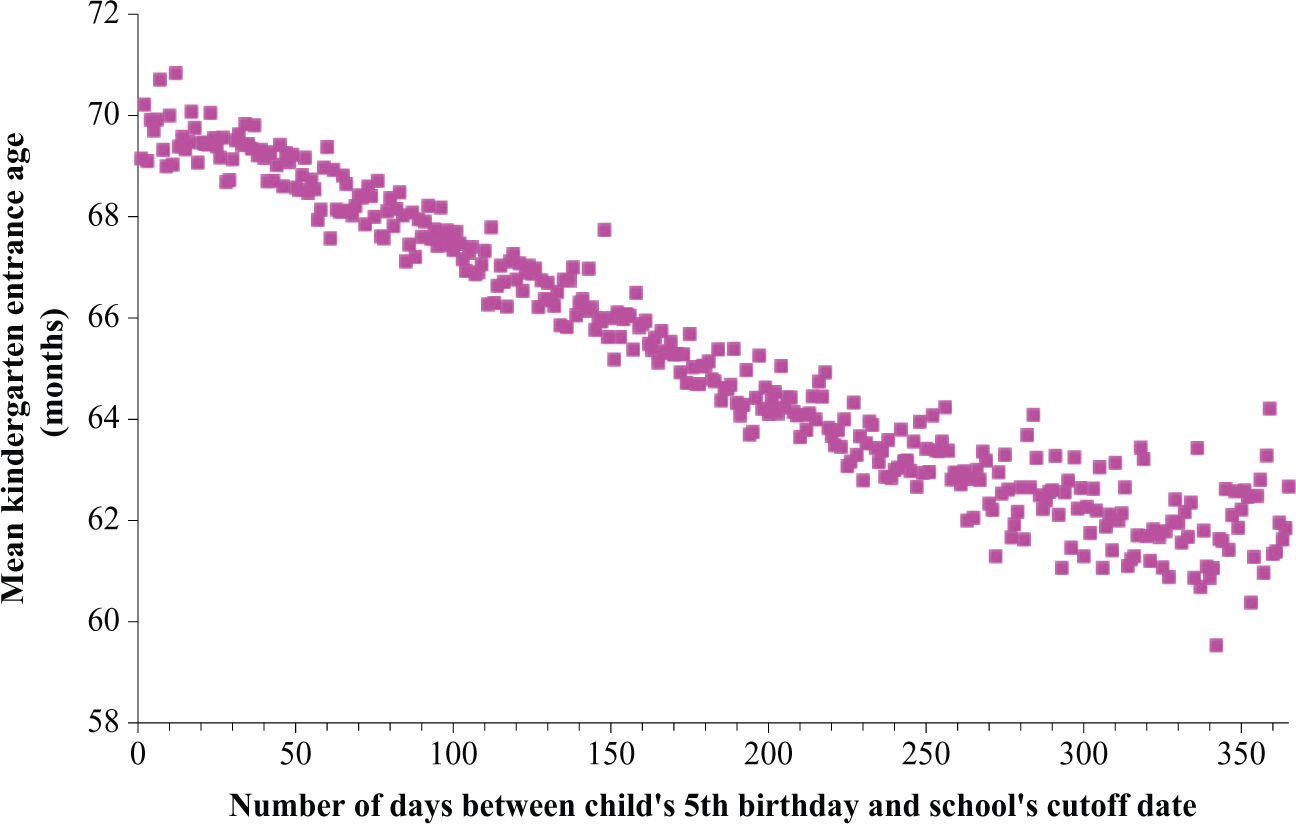
Relationship between mean entrance age and number of days between child’s fifth birthday and school cutoff date.
The identification assumption here is that the distance between the child’s fifth birthday and the school’s cutoff date is exogenous and has no direct effect on the child’s outcomes. Datar (2006a) has previously demonstrated that the observable characteristics between children in four different categories (based on calendar quarters) of distance to the school cutoff date are quite similar (see Online Appendix A at http://epa.sagepub.com/supplemental). However, not surprisingly, quarter-of-birth varies with distance to cutoff date. Children born in the fourth and first quarter would be most likely to narrowly miss the school cutoff date and have a low value for the instrument, whereas children born in the second and third quarter are likely to meet the cutoff date and have high values for the instrument. Consequently, it is possible that there may be season-of-birth effects on child outcomes (Bound & Jaegar, 2000; Bound, Jaegar, & Baker, 1995; Buckles & Hungerman, 2013). To address quarter-of-birth effects, we also estimate models that include birth month fixed effects (reported in the results) and birth quarter (available on request) fixed effects. Another potential concern with this instrument is that as parents choose the school that a child attends, unobserved factors that influence school choice are also correlated with this instrument. Hence, a second test of robustness includes school fixed effects in the models.
Although our main IV models use the primary instrument described above, we also estimate alternate models that use the minimum age required on the first day of school to enter kindergarten in the child’s state of residence as an additional instrument. According to Table 1, there is substantial variation across states in the cutoff date (to be 5 years old) for kindergarten entrance. Hence, children who reside in states with a later cutoff date will, on average, be younger because their state will have a lower minimum entrance age than children who reside in states with an earlier cutoff date. The mean entrance age is higher in states where the cutoff date requiring children to be 5 years old is earlier.
State Kindergarten Entrance Age Policies, 1998
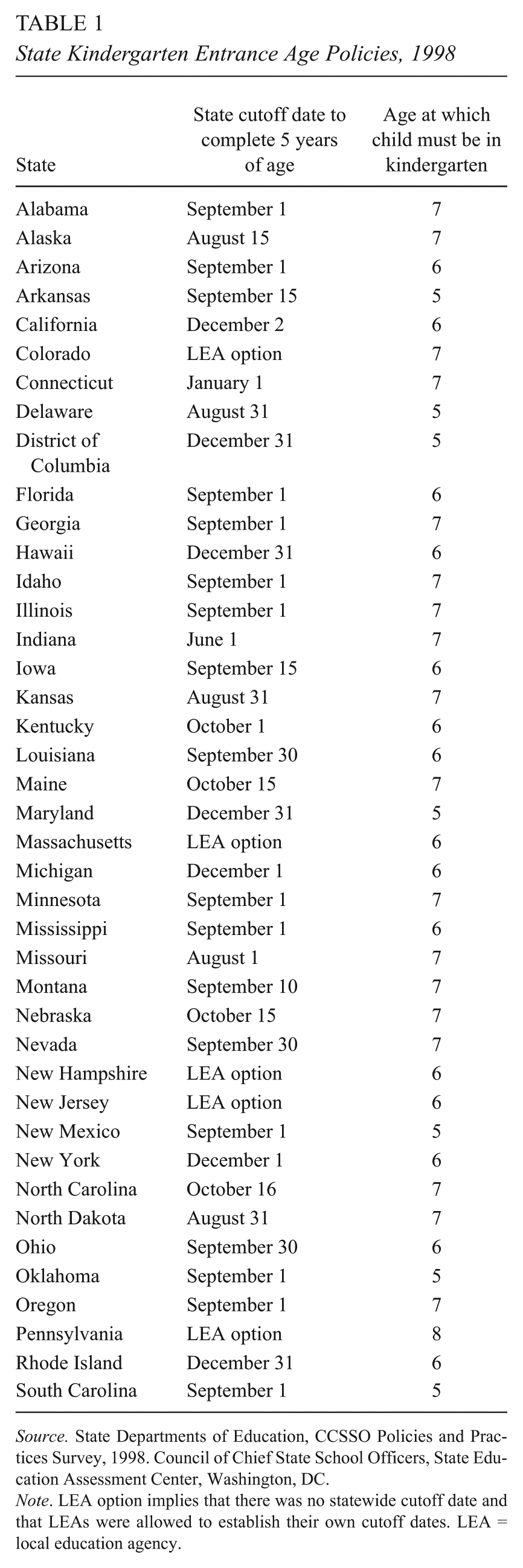
Source. State Departments of Education, CCSSO Policies and Practices Survey, 1998. Council of Chief State School Officers, State Education Assessment Center, Washington, DC.
Note. LEA option implies that there was no statewide cutoff date and that LEAs were allowed to establish their own cutoff dates. LEA = local education agency.
One concern with this instrument is that state cutoff dates for kindergarten eligibility may be endogenous: States with a higher minimum entrance age requirement (or earlier cutoff date) may also make other unobserved investments in their school systems that favorably impact student outcomes. In addition, unobserved parental preferences may influence both the choice regarding state of residence as well as child outcomes. We present results from overidentification tests and models that add school fixed effects, which leverage within-school variation in birth dates to identify entry age effects.
Data
The data analyzed are from the ECLS-K, which surveyed a nationally representative cohort of kindergartners from about 1,000 kindergarten programs in fall and spring of the 1998–1999 school year. This is a panel study where the initial sample of children are followed up until Grade 8, with data collection on the full sample in the spring of Grades 1, 3, 5, and 8. Tourangeau, Nord, Lê, Sorongon, and Najarian (2009) provides details of the survey design and instruments. We use data collected at kindergarten entry (fall of kindergarten), spring of kindergarten, and the spring of Grades 1, 3, 5, and 8.
The primary advantage of this data set is that it includes detailed information on children’s social-behavioral and cognitive skills at multiple time points. The longitudinal aspect of these data allows analysis of whether there are important differences in skills of early versus late entrants and how these differences change over time.
Another unique feature of this data set is that it contains information on kindergarten eligibility cutoff dates at the school level. The ECLS-K also collected data on school start dates, children’s birth dates, and year in which they entered kindergarten. Together, this information is used to compute the exact age at entry into kindergarten.
Extensive background information in these data on the study participants provides a rich set of control variables in the analysis. The data contain detailed information on demographics, and school, teacher, and classroom characteristics. There is also detailed information about the parents of the kindergartners, including family composition and educational background of the parents.
Because the ECLS-K is a panel survey, a concern regarding the data was the extent of attrition in the sample as children progressed from kindergarten to subsequent grades. If attrition is not random, then estimates generated using the sample of non-attritors may be biased. A distinguishing feature of the ECLS-K is that the study followed up all movers from a random 50% of base year schools, and a random 50% of the movers in each subsequent wave. Therefore, most of the children who were lost to follow up in subsequent grade were those who were randomly selected for no follow-up. Approximately 36% of the original kindergarten sample stayed in the ECLS-K data set through Grade 8. Observable characteristics of stayers and attritors were compared using fall kindergarten data. Stayers were more likely to be Whites and have more educated mothers. However, there was no difference in the mean kindergarten entrance age of attritors and stayers.
The analyses in this study are limited to first-time kindergartners only and children who had non-missing information on social-behavioral outcomes in the relevant wave. 4 The sample sizes ranged from 12,000 to 14,000 observations in kindergarten and Grade 1, between 9,000 and 11,000 observations in Grade 3, between 8,000 and 9,000 observations in Grade 5, and between 7,000 and 8,000 in Grade 8. Precise sample size values (rounded to the nearest 50, per the requirements of using restricted ECLS-K data) are available on request for each individual regression. All analyses are unweighted to allow direct comparison with related articles that use the ECLS-K data (Datar, 2006a; Elder & Lubotsky, 2009). Therefore, generalizations to all U.S. kindergartners cannot be made. Nevertheless, all regressions control for variables that were considered for oversampling (i.e., race–ethnicity) and standard errors are adjusted for clustering at the school level.
Dependent Variables
Our main dependent variables included measures of behavioral and social skills from teacher and student surveys. Teachers rated each student on several items that were grouped to create two scales for problem behaviors and four scales for social skills. The two problem behavior scales included (a) externalizing problems (frequency with which a child argues, fights, gets angry, acts impulsively, and disturbs ongoing activities); and (b) internalizing problems (presence of anxiety, loneliness, low self-esteem, and sadness). The four scales for social skills included (a) interpersonal skills (getting along with people, forming and maintaining friendships, helping other children, showing sensitivity to the feelings of others, and expressing feelings, ideas, and opinions in positive ways), (b) self-control (controlling temper, respecting others’ property, accepting peer ideas, and handling peer pressure), (c) peer relations (combination of items from the first two social scales), 5 and (d) approaches to learning (child’s attentiveness, task persistence, eagerness to learn, learning independence, flexibility, and organization).
Teachers’ ratings of individual children might be subjectively reported relative to the average behavior of the class. For example, a generally disruptive child may be rated favorably in a class with numerous unruly peers but unfavorably in a class with few unruly peers. Therefore, we also use scales constructed from items on the Self-Description Questionnaire (SDQ), which was used to determine how children thought about themselves socially and academically. 6 However, the SDQ was only administered starting in third grade. Items on the SDQ were used to construct the two problem behavior scales (Externalizing and Internalizing) and one scale measuring peer relations (perception of their popularity, how easily they make friends and get along with children) in the third and fifth grades. In eighth grade, only the internalizing problem behavior scale was available, but two additional scales for locus of control (amount of control over own life) and self-concept (perceptions about themselves) were added.
These measures are adapted from the Social Skills Rating Scale, a widely used survey technique for detecting social and behavioral problems in the classroom. Each construct averages a series of questions rated on a scale of 1 (never) to 4 (very often), so a high score for self-control and interpersonal skills, for example, reflects a favorable outcome, and a high score on externalizing or internalizing problems reflects an unfavorable outcome. These scales have high construct validity as assessed by test–retest reliability, internal consistency, inter-rater reliability, and correlations with more advanced behavioral constructs (Elliott, Gresham, Freeman, & McCloskey, 1988). They are considered the most comprehensive social skill assessment that can be widely administered in large surveys such as the ECLS-K (Demaray, Ruffalo, Carlson, Busse, & Olson, 1995).
For cognitive outcomes, we examined percentile test scores on mathematics and reading assessments administered at each survey wave. These assessments were designed to measure the age-specific achievement of the child. In addition, we also used the raw scale scores based on item response theory (IRT) procedures. 7 Although the percentile scores capture a child’s performance relative to his or her peers, the IRT scores are a measure of absolute skills.
Explanatory Variables
The key explanatory variable in our analyses was the child’s kindergarten entrance age, or KEA. The age in months was computed accurately using the child’s birth date and the start date of the school year. A variety of child-, family-, and school-level variables were included as additional explanatory variables in the estimation. Child-level variables included race, gender, and disability status. Family-level variables included household composition (measured by number of siblings, number of adults in the household), mother’s education, primary language spoken at home, and poverty status. School-level variables included size of the school as measured by the enrollment, percentage that was minority, public or private school, and geographic region. The means and standard deviations for the dependent and explanatory variables by kindergarten entrance age are reported in Table 2. Whites, children with disabilities, and children whose primary language is English were more likely to enter kindergarten at an older age as were children located in the Midwest or South. However, children from poor and less educated families were more likely to enter kindergarten at a younger age as were children in the Northeast and West.
Descriptive Statistics, by Kindergarten Entrance Age

Note. The values reported are means (SD) for continuous variables and proportions otherwise.
Results and Discussion
Kindergarten Entry Age Effects on Social-Behavioral Outcomes
Table 3 presents OLS and IV estimates of the effect of KEA on teacher-reported behavior problems from kindergarten through fifth grade. Note that teacher ratings on these outcomes were not obtained by the ECLS-K beyond fifth grade. Both OLS and IV estimates suggest that children who are older at the time of kindergarten entry tend to exhibit fewer externalizing and internalizing behavior problems than do children who are younger at kindergarten entry. Here, negative results imply better outcomes. The IV estimates suggests that, in general, OLS tends to underestimate the beneficial effect that KEA has on diminishing externalizing and internalizing behaviors. 8 For instance, OLS estimates show that a 1-year delay in KEA is associated with a 0.06 scale points reduction in externalizing and internalizing problems at kindergarten entry. In comparison, the corresponding IV estimates are considerably higher than the OLS estimates—being a year older at kindergarten entry decreases teacher-reported externalizing problems by 0.09 scale points and internalizing problems by 0.13 scale points at the time of kindergarten entry. To provide a sense of magnitude, the mean, median, and standard deviation of externalizing problem scores at kindergarten entry were 1.60, 1.40, and 0.61, respectively. A 1 standard deviation increase in the externalizing problem score is equivalent to moving a child from the median to the 75th percentile. The magnitude of our estimated IV coefficient implies an effect size of 0.15 9 (6% of the mean), or moving the median child to the 52nd percentile. For internalizing problems, the mean and standard deviation were 1.51 and 0.51, respectively, indicating an effect size of a quarter of a standard deviation, or 9% of the mean, in the IV estimation. The estimates appear to bounce around a bit across waves, but in general, we observe small but statistically significant effects at the end of third grade for both externalizing and internalizing problems and even until the end of fifth grade for internalizing problems. For both outcomes, the estimated effect size (d) declines considerably between fall of kindergarten to spring of fifth grade.
The Effect of a 1-Year Delay in Kindergarten Entry Age on Teacher-Rated Problem Behaviors
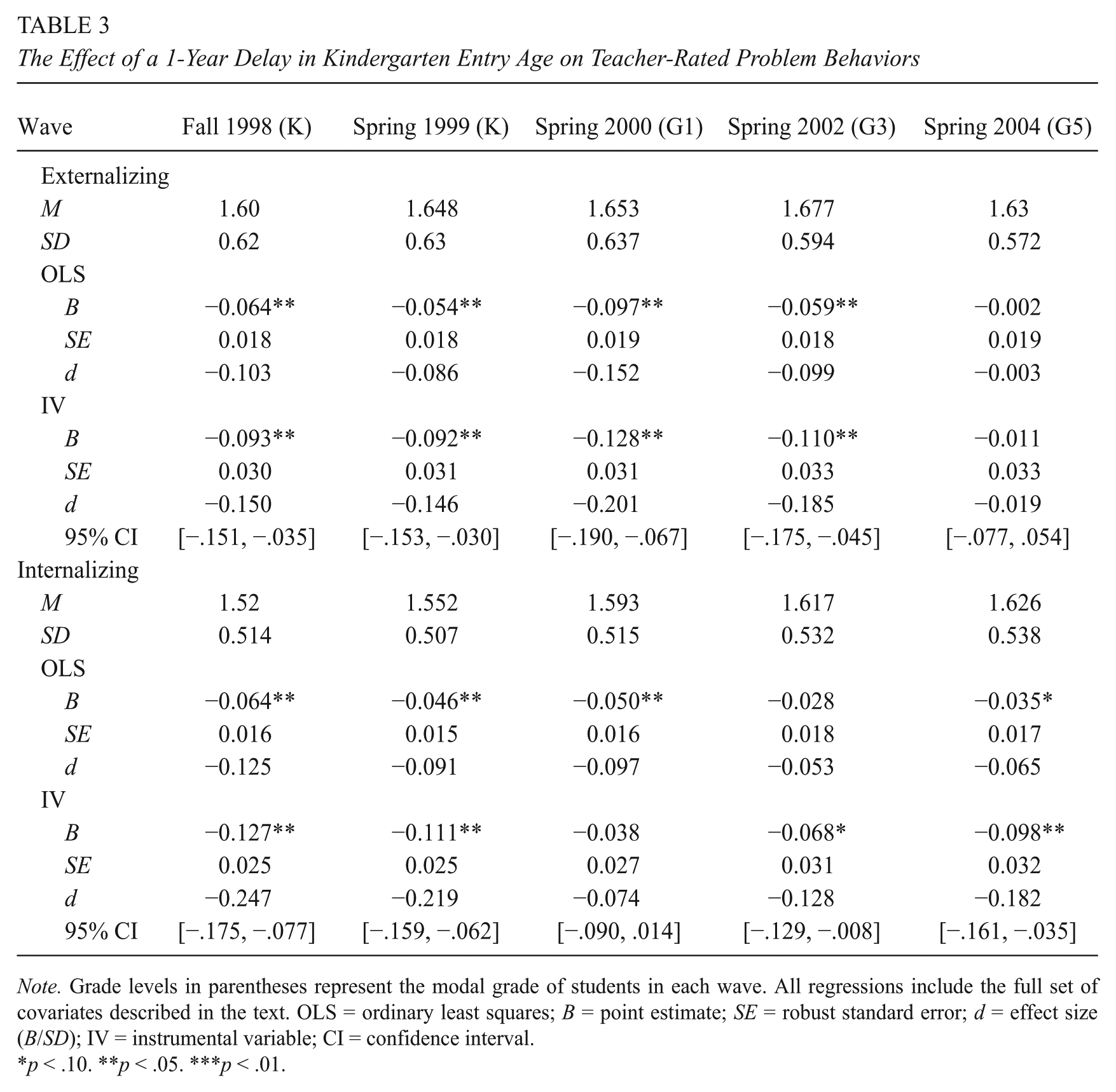
Note. Grade levels in parentheses represent the modal grade of students in each wave. All regressions include the full set of covariates described in the text. OLS = ordinary least squares; B = point estimate; SE = robust standard error; d = effect size (B/SD); IV = instrumental variable; CI = confidence interval.
p < .10. **p < .05. ***p < .01.
Table 4 reports the corresponding set of estimates for the four teacher scales that measure children’s social skills. Across all of these scales—self-control, interpersonal skills, peer relations, and approaches to learning—the results suggest a positive relationship between KEA and these positive skills, although the magnitude of the estimated effects is generally small (d < 0.3). In general, the estimated effects are positive and significant starting in kindergarten and remain statistically significant until the end of fifth grade. The only exception is self-control, which is no longer statistically significant in fifth grade. This is consistent with the results for teacher-reported externalizing behaviors as these two scales are closely related. As with the results for externalizing and internalizing behaviors, the IV estimates are larger in magnitude relative to OLS, suggesting downward bias in the latter. The point estimates decrease in magnitude beginning in third grade, potentially yielding evidence of a diminishing effect over time, although the effects at the end of elementary school are still statistically significant but small.
The Effect of a 1-Year Delay in Kindergarten Entry Age on Teacher-Rated Social Skills
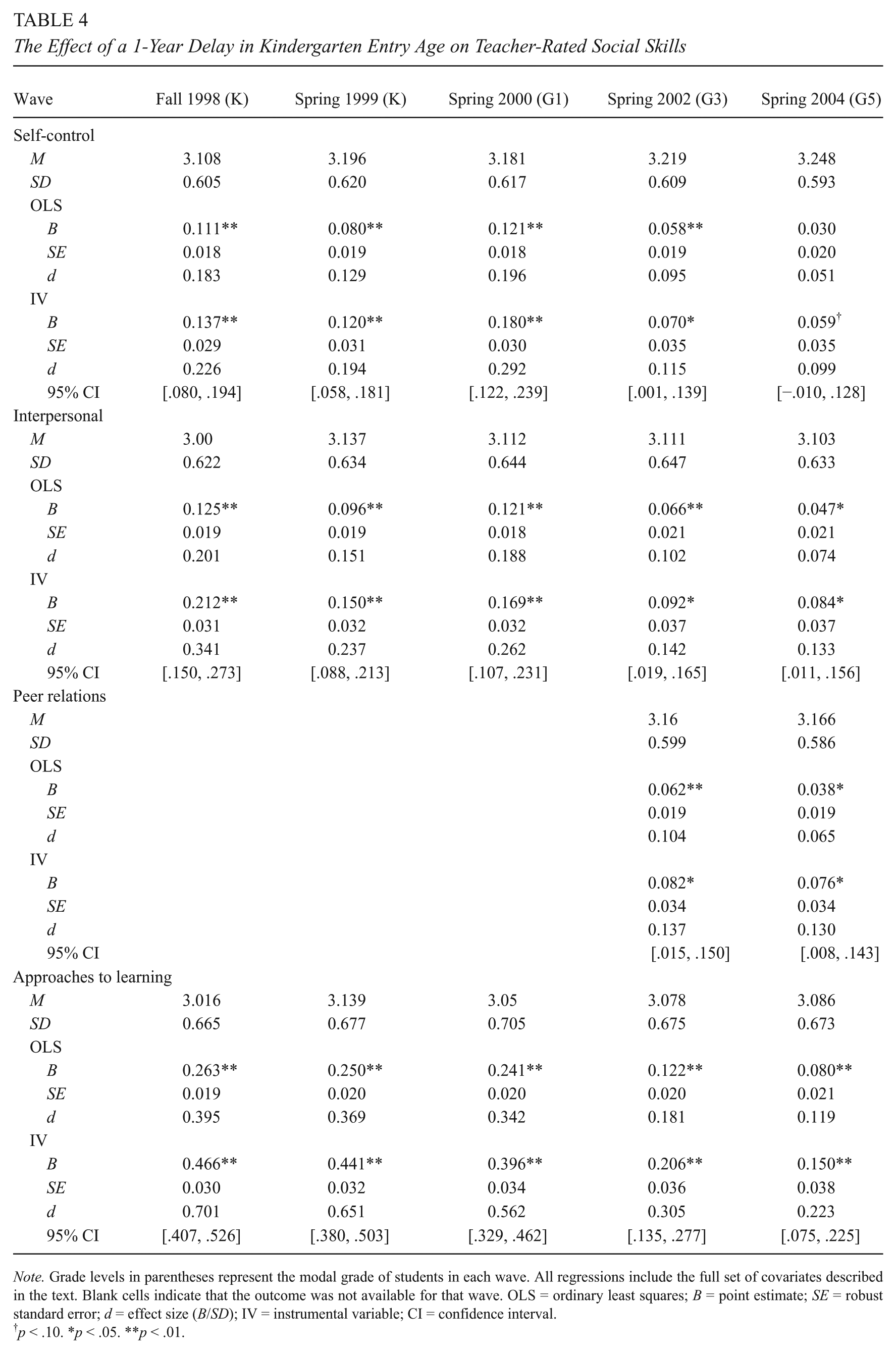
Note. Grade levels in parentheses represent the modal grade of students in each wave. All regressions include the full set of covariates described in the text. Blank cells indicate that the outcome was not available for that wave. OLS = ordinary least squares; B = point estimate; SE = robust standard error; d = effect size (B/SD); IV = instrumental variable; CI = confidence interval.
p < .10. *p < .05. **p < .01.
Table 5 presents results for social-behavioral outcomes from the SDQ scales based on student survey responses. The scales from the student surveys begin in third grade and continue through the final wave of data, that is, eighth grade. Much like previous tables, each cell here represents the coefficient and standard error from a unique regression. All other explanatory variables are similar to those from Table 1.
The Effect of a 1-Year Delay in Kindergarten Entry Age on Student-Rated Social-Behavioral Outcomes

Note. All regressions include the full set of covariates described in the text. OLS = ordinary least squares; B = estimate; SE = robust standard error; d = effect size (B/SD); IV = instrumental variable; CI = confidence interval.
p < .10. *p < .05. **p < .01.
The overall findings are generally consistent with those from Tables 3 and 4; increase in KEA has generally small but statistically significant beneficial effects on child-reported social-behavioral outcomes until the end of elementary school. There are some differences between the child- and teacher-reported results for some scales. Only three scales are potentially comparable between teacher and child reports during the elementary school years—externalizing (K–5), internalizing (K–5), and peer relations (third and fifth grades). KEA effects on externalizing behaviors in fifth grade are significant in child reports but not in teacher reports. But, KEA effects on peer relations and internalizing behaviors are significant in both. Other studies have indicated differences between student self-ratings of social skills and teacher ratings of their social skills (Malecki & Elliott, 2002; Salzman & D’Andrea, 2001), with teaching ratings of children’s social skills considered more reliable and valid compared with student reports (Diperna & Volpe, 2005; Merrell, 2001). Finally, there are no teacher-reported measures in eighth grade, but the child-reported measures suggest that by the end of middle school the effect of KEA on social-behavioral outcomes largely disappears.
To address concerns about multiple testing, we also adjusted the p values of the estimates in Tables 3 to 5 using a False Discovery Rate correction (Benjamini & Hochberg, 1995). Only one estimate that was significant at the .095 level became statistically insignificant after the adjustment.
Kindergarten Entry Age Effects on Cognitive Outcomes
Figures 2 and 3 plot the predicted reading and math percentile scores (and their 95% confidence intervals), respectively, from IV models for children who enter kindergarten at ages 5 and 6 years. 10 Children who enter kindergarten at 6 years score about 15 percentile points higher on reading tests and 22 percentile points higher on math tests at the beginning of kindergarten. This difference reduces by the end of fifth grade but remains substantial and statistically significant. By the end of eighth grade, however, the difference is rendered small and statistically insignificant, except for reading, where the effects are significant at the 10% level.
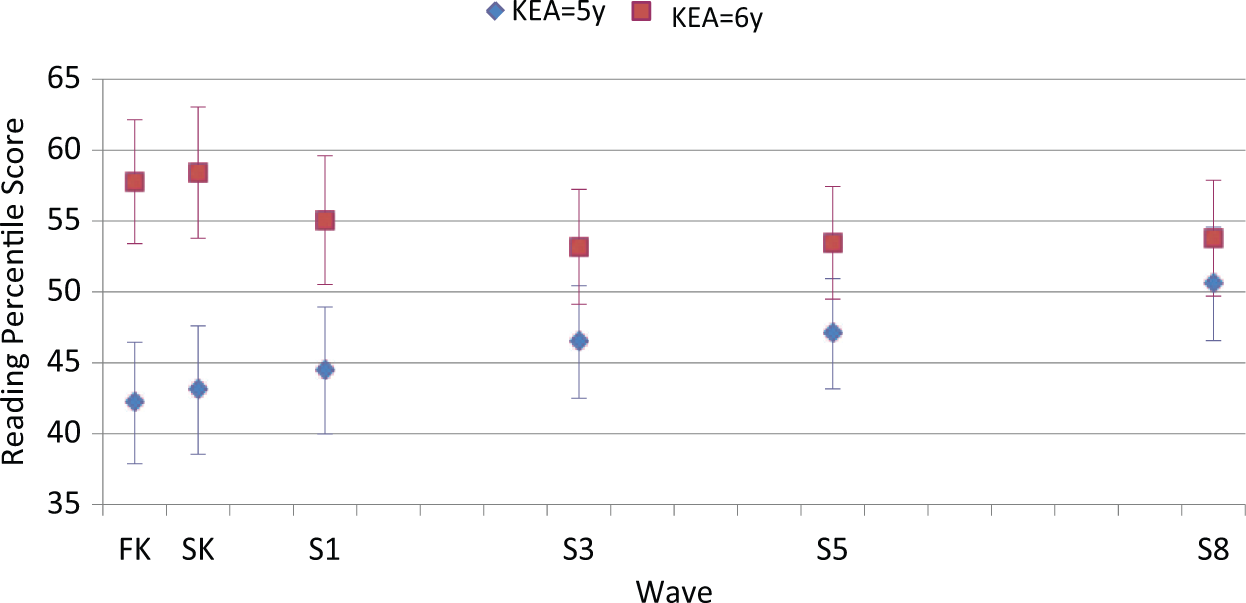
Predicted reading percentile scores, by kindergarten entry age.
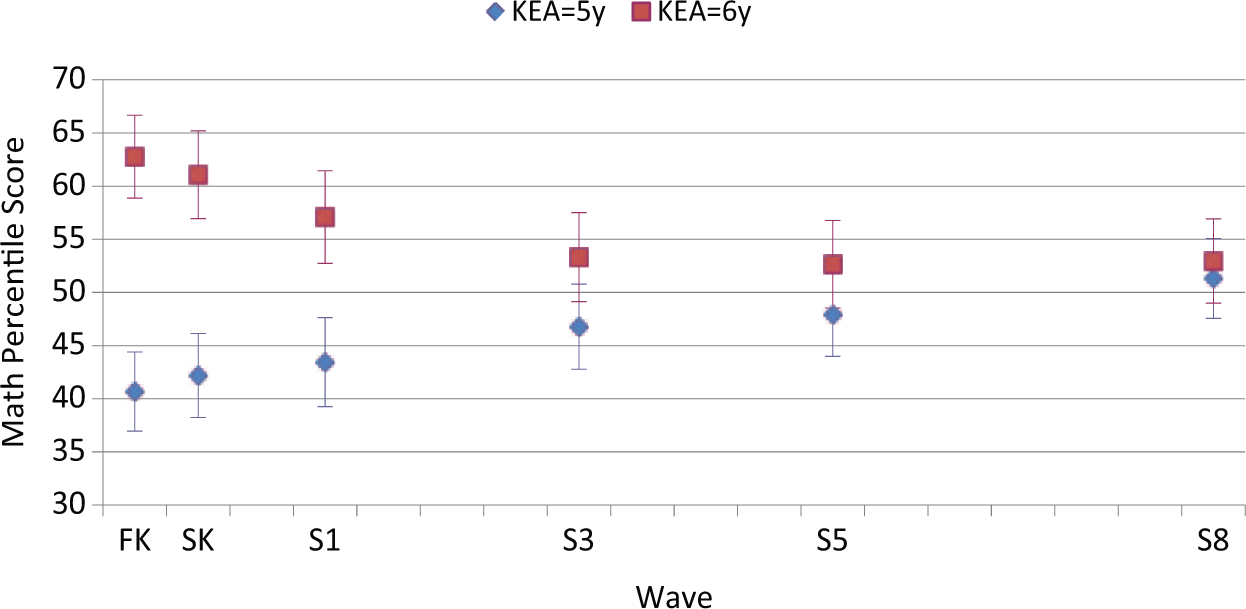
Predicted math percentile scores, by kindergarten entry age.
The figures also speak to the issue of whether older entrants “learn” at a differential rate compared with younger entrants. The convergence between scores of younger and older entrants over time suggests that younger entrants exhibit larger gains in test scores over time relative to older entrants. This pattern of results is consistent even in models that used IRT scale scores instead of percentile scores. For example, the predicted reading IRT scores from IV models in the fall of kindergarten were 33.7 and 38.3 for children who entered at ages 5 and 6, respectively. At the end of eighth grade, the predicted IRT scores were 143.3 and 144.5, respectively, indicating larger gains in absolute scores among younger entrants. These findings are in stark contrast to the results from Datar (2006a), which suggested that older entrants experienced larger gains. However, a closer examination of changes in predicted IRT scores for younger and older entrants reveals that although older entrants gained more between fall of kindergarten and spring of first grade (the period studied in Datar, 2006a), the addition of subsequent waves shows a reversal of that finding. 11
Finally, similar to our findings for social-behavioral outcomes, we find that OLS estimates tend to be biased downward even for cognitive outcomes. 12
Sensitivity Analyses
Next, we examine the sensitivity of the social-behavioral results to controlling for birth month and school-level fixed effects and to the inclusion of an additional instrument (Tables 6 and 7). As our primary instrument leverages variation in birth dates, one concern may be that our IV estimates are biased if season of birth has a direct effect on child outcomes. Estimates from IV models that further control for birth month fixed effects are reported in columns 1 and 4 in both tables and confirm that our results are robust to the inclusion of birth month fixed effects.
Sensitivity Analyses: The Effect of a 1-Year Delay in Kindergarten Entrance on Teacher-Rated Problem Behaviors and Social Skills
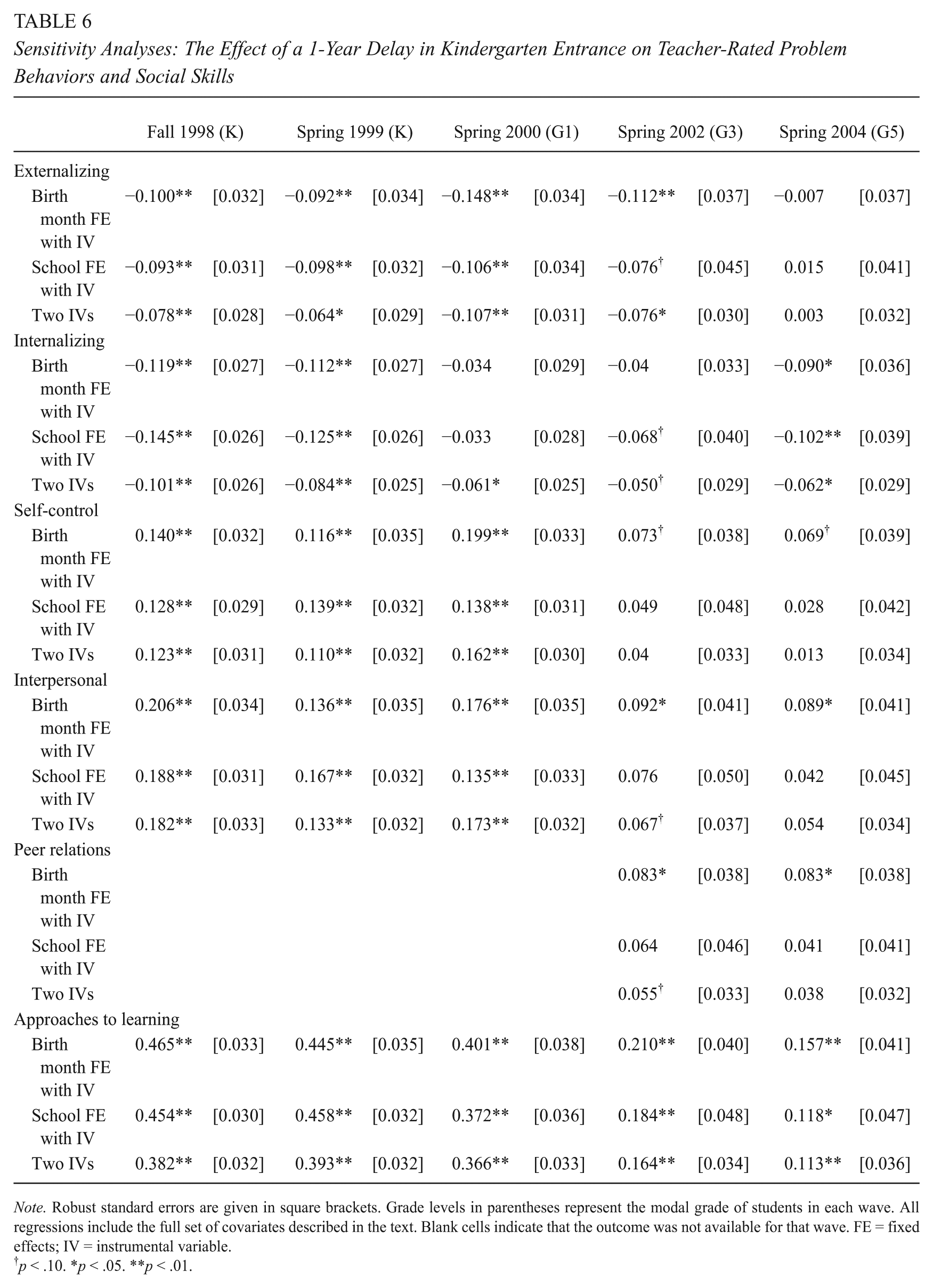
Note. Robust standard errors are given in square brackets. Grade levels in parentheses represent the modal grade of students in each wave. All regressions include the full set of covariates described in the text. Blank cells indicate that the outcome was not available for that wave. FE = fixed effects; IV = instrumental variable.
p < .10. *p < .05. **p < .01.
Sensitivity Analyses: The Effect of a 1-Year Delay in Kindergarten Entry Age on Student-Rated Social-Behavioral Outcomes
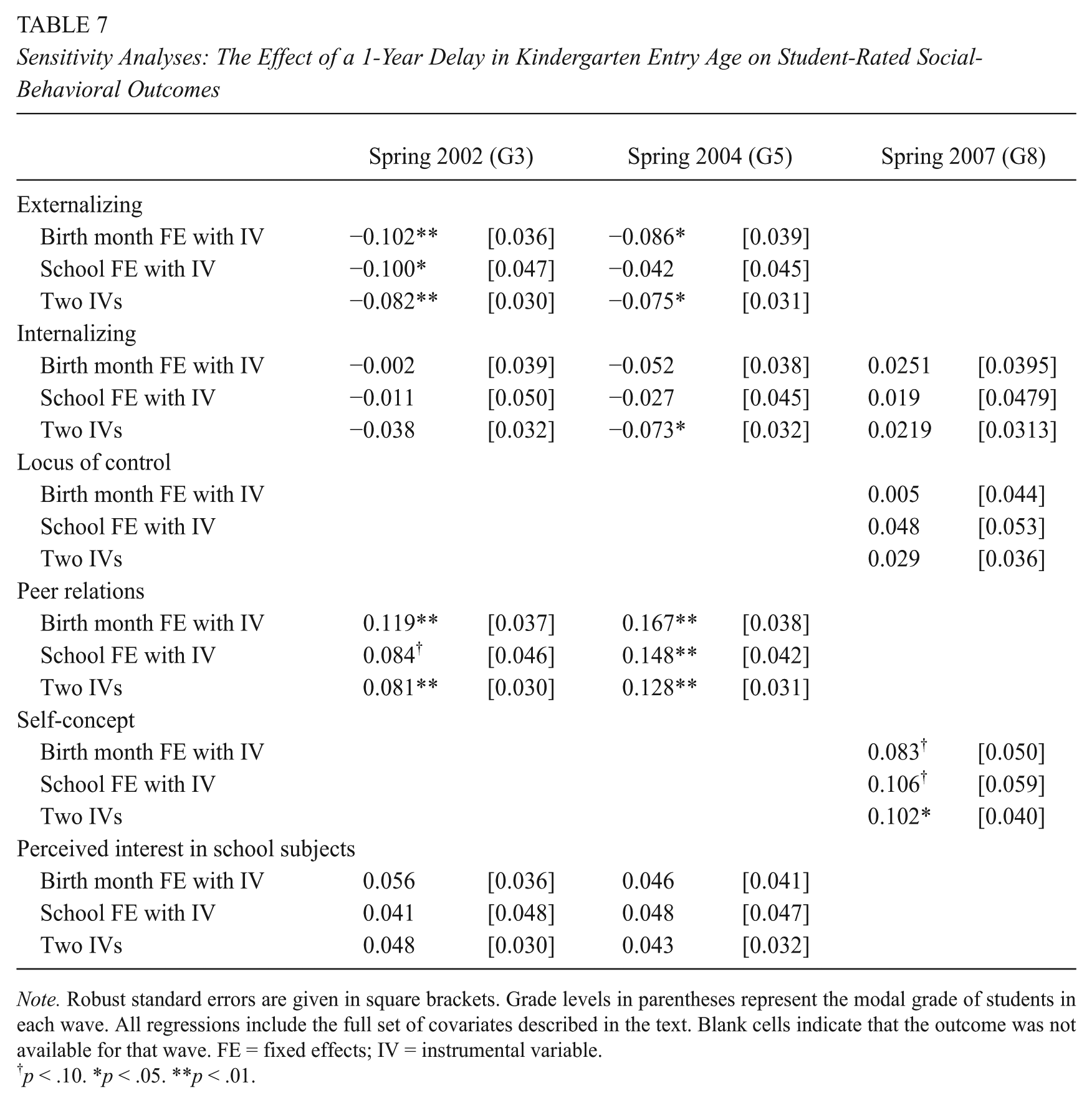
Note. Robust standard errors are given in square brackets. Grade levels in parentheses represent the modal grade of students in each wave. All regressions include the full set of covariates described in the text. Blank cells indicate that the outcome was not available for that wave. FE = fixed effects; IV = instrumental variable.
p < .10. *p < .05. **p < .01.
The second set of regressions controls for school fixed effects to address concerns that unobserved factors that influence school choice may also be correlated with the distance to cutoff date instrument (columns 2 and 5). Again, we find that our results are robust to such controls.
Finally, we estimate a set of regressions that leverage variation in state kindergarten entry age cutoff dates as an additional instrument in the IV regressions (columns 3 and 6). As expected, the state’s kindergarten entry cutoff month is a strong predictor of KEA. The joint F statistic of the instruments in the first stage was greater than 800 in all models (p < .001) and the overidentification test did not reject the validity of the instruments in any model. We find that this overidentified model yields very similar results to our single IV models.
Corresponding sensitivity analyses for the cognitive effects of entry age are reported in Online Appendix D and are largely similar to the main results with one exception. Overidentified models suggest that the cognitive effects of entry age persist even until the end of middle school.
Conclusion
Much of the prior literature has focused on examining the cognitive effects and, to a lesser extent, longer term labor market consequences of school entry age. Our study presents new evidence on the social-behavioral effects of school entry age using 9 years of panel data on a large national sample of kindergartners in the United States.
Several interesting results emerge from our study. First, higher KEA has statistically significant but small (i.e., Cohen’s d < 0.3) positive effects on children’s social-behavioral skills through the elementary school years. For example, older entrants score 0.18σ better on teacher-rated internalizing behavior problems, relative to younger entrants, at the end of fifth grade. Second, it appears that differences in social-behavioral skills between older and younger entrants diminish during the middle school years, largely disappear by the end of eighth grade. However, not all measures of social-behavioral skills are available in eighth grade; therefore, it is possible that some of the differences may persist. For example, we find some evidence that older entrants score significantly higher (0.15σ) on self-concept relative to younger entrants at the end of eighth grade, but no significant differences in internalizing problem behaviors or locus of control. Moreover, the measures of social-behavioral outcomes switch from teacher reports in elementary school years to child self-reports in eighth grade, which makes it difficult to definitively conclude that there is a fade out of effects if these measures are not fully comparable. Third, our updated estimates for the cognitive effects suggest that differences between older and younger kindergarten entrants in math and reading test scores start out large at school entry and diminish over time, although the difference in reading achievement still remains statistically significant and sizable (up to 5 percentile points in some specifications) at the end of eighth grade. Prior work by Datar (2006a) suggests that older entrants gain at a faster rate than younger entrants during the first 2 years in school. Our updated results not only confirm that finding but also show that the reverse seems to happen after first grade—younger entrants begin to catch up and older entrants lose their initial advantage. One potential explanation for this reversal in gains is that the kindergarten curriculum and the demands made on children might not adapt sufficiently to the wide-ranging developmental skills of young children when they enter school, and so biological maturation and quality of preschool experiences may play a bigger role. But as children spend more time in school and are exposed to common instruction, the maturational/preschool advantage of early grades begins to dissipate, allowing younger entrants to catch up with their older entrant peers. Studies have shown that kindergarten and first grade serve as critical developmental years in which these socioemotional skills are critically forming and begin to reach stability by ages 6 to 8 (Olson, Sameroff, Kerr, Lopez, & Wellman, 2005; Posner & Rothbart, 2000). Finally, our IV estimates are generally larger than OLS, suggesting that school entry age decisions are endogenous and that those who delay school entry are likely to be children at risk of poor outcomes in school, such as those with developmental delays. This appears to contrast with the popular notion that “redshirting” families tend to be high-income White families whose children are often academically fairly advanced (Bassok & Reardon, 2013).
Are these merely relative age effects, or are these age-at-test effects, or is it the case that the extra year of maturity provided by delayed school entry sets children on a higher trajectory of skill accumulation? This distinction is important because it has different implications for school entry age policies. If entry age effects are primarily driven by absolute age, increases in the minimum entry age for kindergarten could improve cognitive and social-behavioral outcomes of the entire cohort, on average, because older entrants would be better equipped to succeed in school. However, if entry age effects operated solely through relative age, then such policy changes would have no effect on average outcomes of the cohort because they would merely shift the age distribution.
But, whether the estimated effects are entry age effects or merely age-at-test effects is much harder to test. As differences in cognitive and social-behavioral outcomes between older and younger entrants diminish over time, it may suggest that the estimated differences between older and younger entrants are mainly because of the skills that children accumulate outside of school (i.e., age-at-test effects) that naturally diminish over time due to the increasingly smaller contribution of an additional year of age. Indeed, the pattern of convergence suggests that while older entrants enjoy temporary benefits, it is the younger entrants who accumulate cognitive and social-behavioral skills at a faster rate than older entrants.
However, these findings do not necessarily imply that efforts to raise school entry age lack merit. The significant short-run benefits associated with delayed school entry may be important for parents in some contexts, such as when schools begin tracking in early grades based on ability or when younger entrants are much more likely to be held back in grades or diagnosed with learning disabilities (Elder & Lubotsky, 2009). Early school performance may also be a critical building block for later life outcomes (Currie & Thomas, 2001). On the flip side, however, delaying school entry is associated with significant costs, such as child care and preschool costs for the additional time out of school (Datar, 2006b), lower educational attainment as a result of reaching the minimum drop-out age earlier (Angrist & Krueger, 1992), and delayed entry into the labor market. These benefits and costs may vary across families suggesting that although delaying entry may be optimal for some parents, starting on-time may be optimal for others. In addition, low-income families are likely to be disproportionately impacted as they are less likely to have access to high-quality preschool programs, which may further widen disparities in children’s cognitive and socioemotional skills at kindergarten entry. This would present new challenges for the design and implementation of developmentally appropriate curriculum in early grades as the skill disparities widen. At the same time, it also underscores the importance of high-quality universal pre-kindergarten programs in reducing these skill disparities.
Ultimately, a full cost–benefit analysis of any proposed school entry age policy change is needed. In the meantime, however, the case for blanket policies that raise school entry age for all by moving cutoff dates earlier becomes much weaker with the growing evidence that the benefits from delaying entry, both cognitive and socioemotional, are largely short-run.
Footnotes
Declaration of Conflicting Interests
The author(s) declared no potential conflicts of interest with respect to the research, authorship, and/or publication of this article.
Funding
The author(s) received no financial support for the research, authorship, and/or publication of this article.
1.
The literature supports a strong positive relationship between school entrance age and multiple measures of school achievement (see, for example, Bedard & Dhuey, 2006; Datar, 2006a; Elder & Lubotsky, 2009; J. Smith, 2009). Research finds, however, that the effect of entry age on achievement is strongest early on in schooling and diminishes over time (Elder & Lubotsky, 2009; J. Smith, 2009). Elder and Lubotsky (2009) find the effect of kindergarten entrance age on academic achievement among U.S. children to disappear as early as fifth grade, although  find that effects persist until eighth grade in an international sample.
2.
Note that although we refer to the time period as grade, the Early Childhood Longitudinal Study–Kindergarten Class (ECLS-K) surveyed the baseline sample in each subsequent wave irrespective of the grade level they were currently in. Therefore, grade basically refers to the modal grade of the cohort in that wave.
3.
This instrument measures the distance, in days, between the child’s fifth birth date and the school’s cutoff date in the previous year (i.e., 1997). A value of 1 for the instrument implies that the child’s fifth birth date was 1 day after their school’s cutoff date in 1997, and so they would be the oldest in their class in fall of 1998. A value of 364 implies that the child’s fifth birth date was 364 days after the school cutoff date in 1997 (or 1 day before the 1998 school cutoff); therefore, this child would be the youngest if they entered kindergarten in fall of 1998.
4.
Limiting our sample to children who had social-behavioral outcome data in all waves yielded similar results.
5.
The peer relations scale was added only in the third and fifth grade waves.
6.
We acknowledge, however, that just like teachers, children’s perceptions of their own behavior/social skills may also be influenced by their relative position within a classroom.
7.
The item response theory (IRT) scale scores represent estimates of the number of items students would have answered correctly if they had answered all possible questions on the standardized tests in both reading and math.
8.
The F statistic on the instrumental variables (IV) in the first stage was above 1,400 (p < .001) in all exactly identified IV models for social-behavioral and cognitive outcomes. First-stage regression estimates for the exactly identified and overidentified models are reported from one regression in Online Appendix B (estimates from other models are available on request).
9.
Effect sizes of 0.2 to 0.3 are generally considered to be a “small” effect, around 0.5 a “medium” effect and 0.8 to infinity, a “large” effect (Cohen, 1988).
10.
Detailed ordinary least squares (OLS) and IV estimates from models that use the percentile scores as well as IRT scores are reported in Online Appendix C.
11.
12.
We also examined whether the effects of KEA on social-behavioral and cognitive outcomes varies by gender, race–ethnicity, and poverty status but did not find any consistent, statistically significant patterns. In addition, we estimated all models with additional controls for child care settings before kindergarten entry, including center and non-center based care, but our estimated effects of KEA did not change significantly (available on request).
Authors
ASHLESHA DATAR is a Senior Economist and the Director of Program on Children and Families at the Center for Economic and Social Research at the University of Southern California.
MICHAEL A. GOTTFRIED is an assistant professor at University of California, Santa Barbara, in the Gevirtz Graduate School of Education. His research focuses on the economics of education and educational policy.