



Abstract
Policymakers are implementing reforms with the assumption that students do better when attending high-achieving schools. In this article, we use longitudinal data from Chicago Public Schools to test that assumption. We find that the effects of attending a higher performing school depend on the school’s performance level. At elite public schools with admission criteria, there are no academic benefits—test scores are not better, grades are lower—but students report better environments. In contrast, forgoing a very low-performing school for a nonselective school with high test scores and graduation rates improves a range of academic and nonacademic outcomes.
P
Yet, existing research is insufficient to tell us whether, how, and under what circumstances students benefit from attending schools where their peers demonstrate high levels of achievement. Schools are perceived to be high performing based on the statistics reported about their students’ academic attainment—average test scores, percentage of students scoring at proficiency levels, and graduation rates. These statistics are sensible markers of school success, yet they may reflect the initial qualities of the students who choose to attend a particular school as much as the quality of the school. If a school is labeled as high performing based on the characteristics of the students who enroll there, it is not clear whether other students will benefit simply by attending it. Furthermore, state and district officials need to understand how students benefit from attending higher performing schools as they weigh the pros and cons of implementing contentious policies such as closing low-performing schools or opening selective ones.
Much is unknown about the benefits to students of attending schools that have higher overall achievement level. The benefits may not be the same for all types of schools: Gaining admissions based on academic qualifications into a very high-achieving selective school may be very different from the effect of getting out of a very low-achieving school. With the prevalence of school choice systems, there is also a need to know whether there are benefits to getting into the highest achieving school possible, among schools that are neither high- nor low-performing. Furthermore, almost all research to date has examined the effects of schools on students’ test scores, so there is little knowledge about the effects on other outcomes that families care about, such as students’ experiences in school (e.g., feelings of safety, belonging, academic challenge) and college outcomes. This article addresses these gaps in research, asking,
Previous Research on the Effects of Attending a Higher Performing School
Studying the effects of higher performing schools is difficult; there is the potential for substantial selection bias when families choose schools. Among studies with strong strategies to address bias, there are contradictory findings. Some studies show strong positive effects from attending higher performing schools, but many others show no benefits. However, this body of research includes many different types of contrasts with different definitions of “high-achieving” schools and different counterfactuals. There is more consistency in the literature when focusing on three kinds of comparisons: (a) gaining admission to a selective school with achievement requirements, (b) attending a higher performing nonselective school versus a lower performing one within a heterogeneous system of schools, and (c) moving out of very low-performing schools into schools with somewhat higher achievement.
Gaining Admission to a Selective School
Public selective schools concentrate on the most academically talented students together. Despite high demand to get into these schools, and perceptions that they are strong schools, there is little evidence that students show significantly better academic achievement as a result of gaining entrance. One study that used extensive controls found only limited benefits for students’ test scores from attending magnet high schools—higher test scores in reading and social studies, but not in math and science (Gamoran, 1996). More recent studies that explicitly address selection bias through regression-discontinuity methods found no benefits to students’ test scores from attending higher performing high schools with conflicting evidence on benefits to college enrollment (Abdulkadiroğlu, Angrist, & Pathak, 2014; Clark, 2010; Dobbie & Fryer, 2014). These recent studies suggest that any apparent advantages on student achievement gained by attending a selective school are actually due to selection and not due to value that the schools themselves add for their students.
Attending a Higher Performing School Across a Heterogeneous System of Schools
In districts with open-enrollment policies, students have choices about which high school to attend. In contrast to studies on selective schools, several studies have generally found positive effects from attending higher performing schools when examining system-wide enrollment patterns. Two experiments in Charlotte-Mecklenburg Public School District, in which treated families enrolled in higher achieving schools after receiving information about the achievement levels of local schools, both found that attending a higher scoring school increased student test scores (Hastings & Weinstein, 2008). Two international studies, where students are allowed to rank their school choices but receive admission based on test scores, found large positive effects on exit exams based on regression-discontinuity designs (Jackson, 2010; Pop-Eleches & Urquiola, 2013).
At the same time, there may be heterogeneity in the effects of getting into a higher performing school within a tiered system. The positive findings from the international studies (Jackson, 2010; Pop-Eleches & Urquiola, 2013) were not observed among students who made it into low-achieving schools (those in the bottom third), relative to students who just missed the cutoff for those schools and attended even lower performing ones (at the very bottom of the distribution). Instead, the positive effects from these studies seem to be have been driven by students gaining entrance to schools in the top two thirds of the achievement distribution. Another study that shows little effect from gaining entrance to moderately performing schools (relative to very poor-performing ones) can be seen in the work of Cullen, Jacob, and Levitt (2005) who examined the effects of gaining admission to nonselective neighborhood high schools in Chicago through lotteries. Students who won a school lottery attended marginally better-performing high schools than students who applied but lost the lottery, but the schools in their study with lotteries were generally low-to-moderate achieving. 1 Lottery winners showed no benefit in terms of graduation, test scores, attendance rates, course taking, and credit accumulation, although they did find lower rates of disciplinary incidences and arrest rates for lottery winners. Thus, there is not strong evidence that students benefit academically from getting into moderately performing schools, relative to very low-performing ones.
Exiting Very Low-Performing Schools
At the other end of the spectrum are schools with extremely low performance. These schools generally serve large numbers of low-income students with poor incoming achievement; they face substantial educational challenges, and staff members are often overwhelmed by the vast needs of their students (Neild, 2004). The option to attend a different high school may be particularly crucial for the outcomes of students who would otherwise attend these very low-performing schools. These are the types of schools that have been targeted by policies such as the federal Race to the Top and No Child Left Behind Acts, which have provisions to allow or force students to move to higher performing schools through vouchers or school closure. Yet, there are few studies that exist on the effects of moving out of bottom-performing schools, and those that are most relevant show no academic benefits. Studies of closing low-performing schools show no improvements in test scores, on average, for the students who were displaced (Barrow, Park, & Schanzenbach, 2011; Brummet, 2014; de la Torre & Gwynne, 2009). This could result because most displaced students moved to schools that were only modestly higher achieving than the ones that closed; those few students who enrolled in schools that had much higher achievement levels than the schools that were closed did experience test score gains (Brummet, 2014; de la Torre & Gwynne, 2009; Engberg, Gill, Zamarro, & Zimmer, 2012).
Limitations of Existing Studies
One of the limitations of the existing research is the lack of knowledge about whether there are different effects based on the type of comparison that is being made: Studies either narrowly examine the benefits of one type of high-performing school (e.g., getting into selective schools, getting out of extremely low-performing schools), or they combine many different types of schools into the analysis without differentiating the type of contrast being made. A second limitation arises from the need to account for selection bias. Those studies that are most attentive to potential bias tend to use lotteries or regression discontinuities. Although they sufficiently address selection bias, they are often constrained to study only a limited number of schools (e.g., those that are able to run lotteries or use explicit admission criteria) or a limited number of students (e.g., those with achievement near the admission cutoff). Yet, these marginal students may have different experiences than students with more typical qualifications. Likewise, schools that are popular enough to run lotteries may be very different from undersubscribed schools. Another limitation is that few studies examine many outcomes beyond test scores, so there is little known about other important outcomes. Parents may also be concerned about their children’s experience in school, such as students’ feelings of safety and belonging in school, their perceptions of the quality of classroom instruction, and their risk of being suspended.
This article contributes to the existing literature on all of these dimensions. We examine the effects of attending higher performing high schools on a variety of academic and nonacademic outcomes. We examine all schools in a large district—not just those that have lotteries or specific enrollment policies—and all students who had some propensity for attending schools with different levels of achievement. We also examine the impact of attending schools on various performance levels—what it means for students to attend selective high schools, to attend high-performing nonselective high schools, and to avoid a very low-performing school.
The Chicago Context: Options for High School
Chicago Public Schools (CPS) is a large, public school district that enrolls 85% minority students and where 85% of students qualify for free or reduced-price lunch. Chicago is an ideal place to do this work. It contains different types of schools of varying academic composition: extremely high-achieving selective schools, quality neighborhood schools, many heterogeneous schools, and a number of poor-performing schools. CPS is an open-enrollment district with a portfolio-style approach to providing high school options for students. Each student has a default high school with geographic attendance boundaries. However, students can apply to attend another neighborhood school that is not at capacity, as well as high schools with admissions criteria, including charter high schools, technical schools, military academies, and performing arts schools. In the 2011–2012 school year, 69% of ninth graders attended a high school other than their neighborhood school. Thus, it is a district in which questions of school choice are relevant and pressing.
The district encourages students to engage in the high school choice process through high school fairs, information to parents, and advertisements on billboards and the radio. They provide students with a high school handbook that provides information on all high schools in the district, including indicators of the school’s performance level (ACT scores and graduation rates among them), as well as information about specific programs and admissions processes. CPS central office has made efforts to streamline the high school application process, though it can still be difficult for students to navigate.
Data and Method
Defining the Treatment
We define high school performance in a way that utilizes information available to families when making choices about high school enrollment. We use two measures of performance, average ACT scores and 4-year graduation rates, that were publicly available in the year before students entered high school when students would make decisions about which school to attend. Therefore, definitions of school performance level are based on the performance of students who entered the high school several years prior to the students making choices about where to enroll. We follow the methodology used in Black and Smith (2004) to classify colleges in terms of quality. We first separate the selective schools from the other high schools; these are examined separately from others for several reasons: (a) They have testing requirements for students and, because of that, serve students with exceptionally high levels of incoming achievement relative to other schools; (b) their admission algorithm is known, and we can control directly for the variables that determine admission in the propensity score model; and (c) this group of selective schools is comparable with exam-based schools that have been the subject of research in other places, and we want to isolate the effects of attending these schools to compare results with those in other districts. Because the selection criteria for selective schools are known, we can compare the estimates we obtain from this analysis with those obtained through other methodologies (e.g., regression-discontinuity designs) in subsequent work.
For all remaining schools (i.e., those that are nonselective), we demean the graduation rate and ACT score within each year to account for time trends in these measures. To combine ACT and graduation rates into a single measure, we use principal components analysis. The school-year observations are then assigned to one of three groups, based on breaking the first principal component score into terciles. This results in four groups of schools: (a) selective, (b) top tier, (c) middle tier, and (d) bottom tier. Table 1 shows how schools are distributed across the four groups for the cohorts of students in the analysis. Bottom-tier schools tend to be neighborhood schools, where students are assigned based on their residence, but most of the schools in the middle and top tiers are also neighborhood schools. Charter schools are mostly distributed among the mid-tier and top-tier categories. Specialty schools tend to be top-tier schools.
Characteristics of High Schools by Tier and Cohort
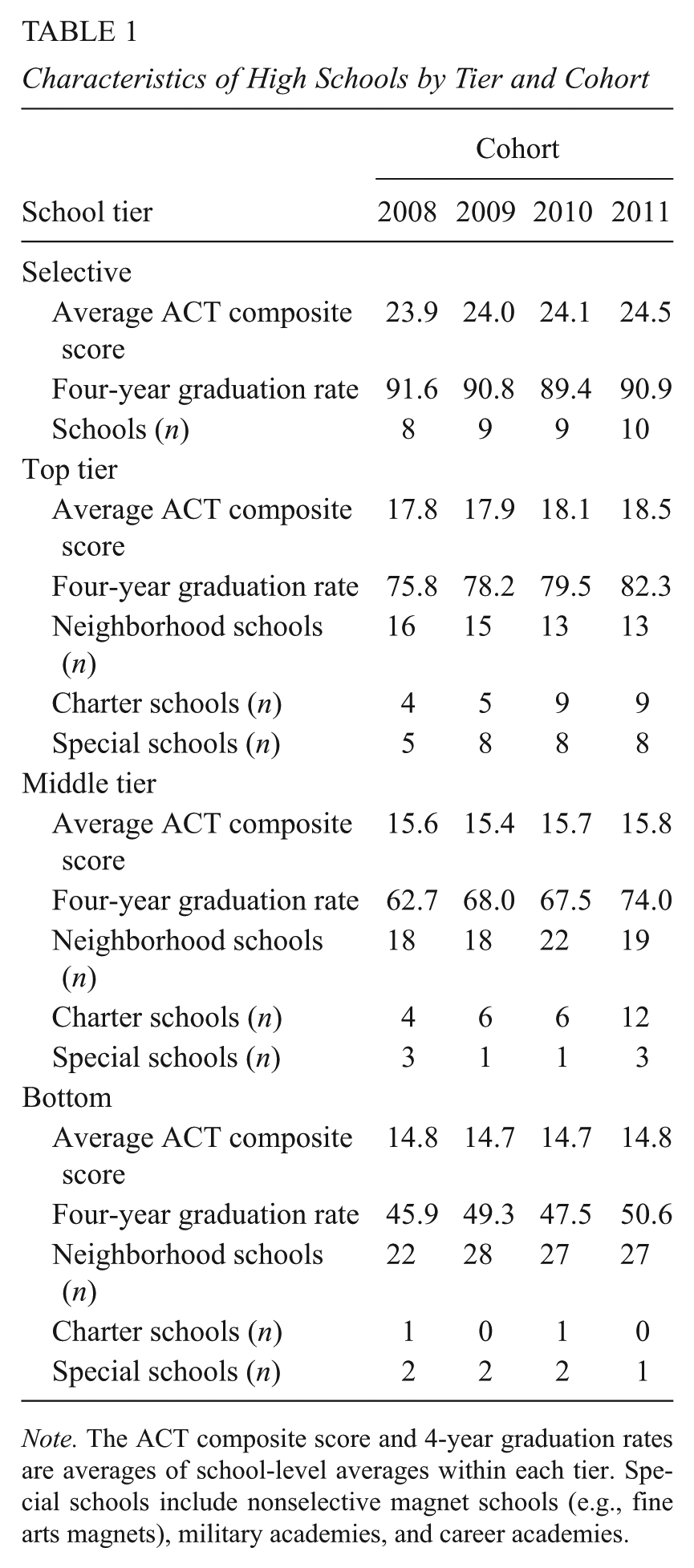
Note. The ACT composite score and 4-year graduation rates are averages of school-level averages within each tier. Special schools include nonselective magnet schools (e.g., fine arts magnets), military academies, and career academies.
Analytic Sample
We use four cohorts of students enrolled as first-time ninth graders in Chicago public high schools from 2008 to 2011. The sample is limited to students who attended CPS in both eighth and ninth grades. There are no meaningful differences in observable characteristics between the population of ninth graders and the analytic sample. 2 High schools in the sample are limited to those that existed for enough years to have a graduating cohort prior to students’ ninth-grade year, because high school average ACT scores and graduation rates are used to classify nonselective high schools into quality tiers based on performance levels. The sample represents 75% to 79% of the first-time ninth graders, depending on the cohort. Table 2 shows the characteristics of students who attend schools in each of the tiers. Students in the top-tier schools are more likely to be non-Black and female and less likely to qualify for free/reduced-price lunch than students in lower tier schools. Not surprisingly, students in selective high schools have higher eighth-grade test scores and grade point averages (GPAs) than others.
Characteristics of First-Time Ninth-Grade Students by Type of High School
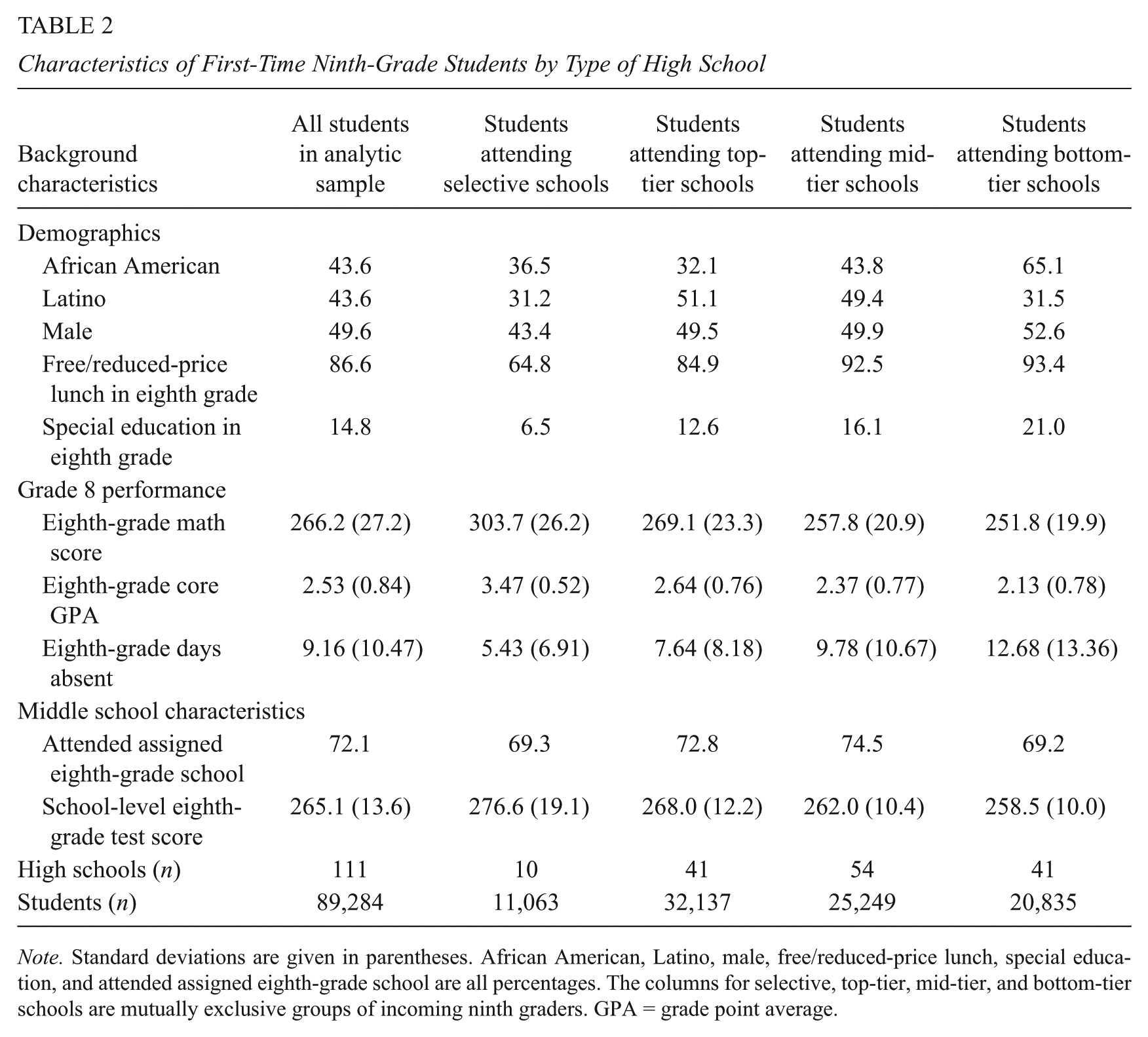
Note. Standard deviations are given in parentheses. African American, Latino, male, free/reduced-price lunch, special education, and attended assigned eighth-grade school are all percentages. The columns for selective, top-tier, mid-tier, and bottom-tier schools are mutually exclusive groups of incoming ninth graders. GPA = grade point average.
Identification Strategy and Data
Identifying the effect of attending a higher performing high school is a task ripe with concerns of selection bias; how students choose high schools is not random, and the factors that affect students’ enrollment into particular schools are very likely to be related to their future outcomes. If the students who are ex ante the most likely to have positive high school outcomes choose to attend the highest performing high schools, then it is difficult to identify the effect of the high school itself on student outcomes.
We employ a propensity score approach to estimation and assume that, given an extensive set of observable pretreatment covariates, the outcomes of interest are independent of treatment assignment (Rosenbaum & Rubin, 1983). This conditional independence assumption is a strong assumption and has to be justified by the data available. Matching estimation strategies have been under criticism since LaLonde (1986), as the author was unable to replicate experimental estimates of job training program effects by matching on observed characteristics. However, since that paper, many researchers have reevaluated the feasibility of replicating experimental estimates using nonexperimental techniques; many of these papers focus on topics in education where selection issues are different from those related to job training programs aimed at improving labor market outcomes. Recent work in school choice contexts (e.g., charter schools, magnet schools) suggests that including pretreatment characteristics that are highly predictive of outcomes of interest—particularly prior test scores—is key when employing nonexperimental techniques (Abdulkadiroğlu, Angrist, Dynarski, Kane, & Pathak, 2011; Bifulco, 2012; Bifulco, Cobb, & Bell, 2009; Fortson, Gleason, Kopa, & Verbitsky-Savitz, 2015). In these articles, researchers compare experimental estimates with estimates obtained through nonexperimental methods within the same study, thereby allowing them to validate the nonexperimental estimates. In our case, we are able to include not only prior achievement in terms of students’ test scores but also their prior course grades, and many other variables that might influence school choice and student outcomes.
Note that if we have not sufficiently controlled for the variables that are correlated both with the quality of high school that a student attends and the outcomes of interest, our estimates are still subject to bias. Readers should seriously consider this assumption when interpreting the results we present for specific outcomes. For many outcomes—such as test scores and grades—we are able to control for lagged values of those outcomes. For other outcomes, specifically those related to educational attainment, we cannot control for a lagged value directly, though we include correlates of those outcomes. It is possible that estimates that we provide for educational attainment, and for some of the nonacademic outcomes for which we do not have a lagged control, are more subject to bias.
One approach to address bias in matching estimators is to utilize data on students that predict both an individual’s participation in treatment and the outcomes of interest. We use detailed pretreatment student-level information, including comprehensive academic records in the middle grades (course grades, test scores), their behaviors in the middle grades (attendance, discipline records), student reports about parent involvement, characterizations of socioeconomic status and crime in their neighborhood, their demographics, and characteristics of their middle school. Information about students’ middle school, parents, and communities is particularly important for this article. Better-educated and motivated parents are more likely to participate in school choice programs (Levin, 2002; McEwan, 2000), and these parental characteristics could generate a spurious relationship between choice and outcomes. Yet, it is very unlikely that parents who are active in securing a “good” high school for their child would have been ambivalent about their child’s middle school education. The mechanisms that parents use to place their child (e.g., residential neighborhood choice, entering a school lottery) might differ for middle versus high school, but the degree of parents’ motivation to secure a good education for their child should result in similarly advantageous placements. Table 3 describes the data used to construct the propensity weights. In total, it is hard to imagine factors influencing both high school selection and student achievement that would not be captured by this rich student-level information.
Covariates Included in the Propensity Score Model
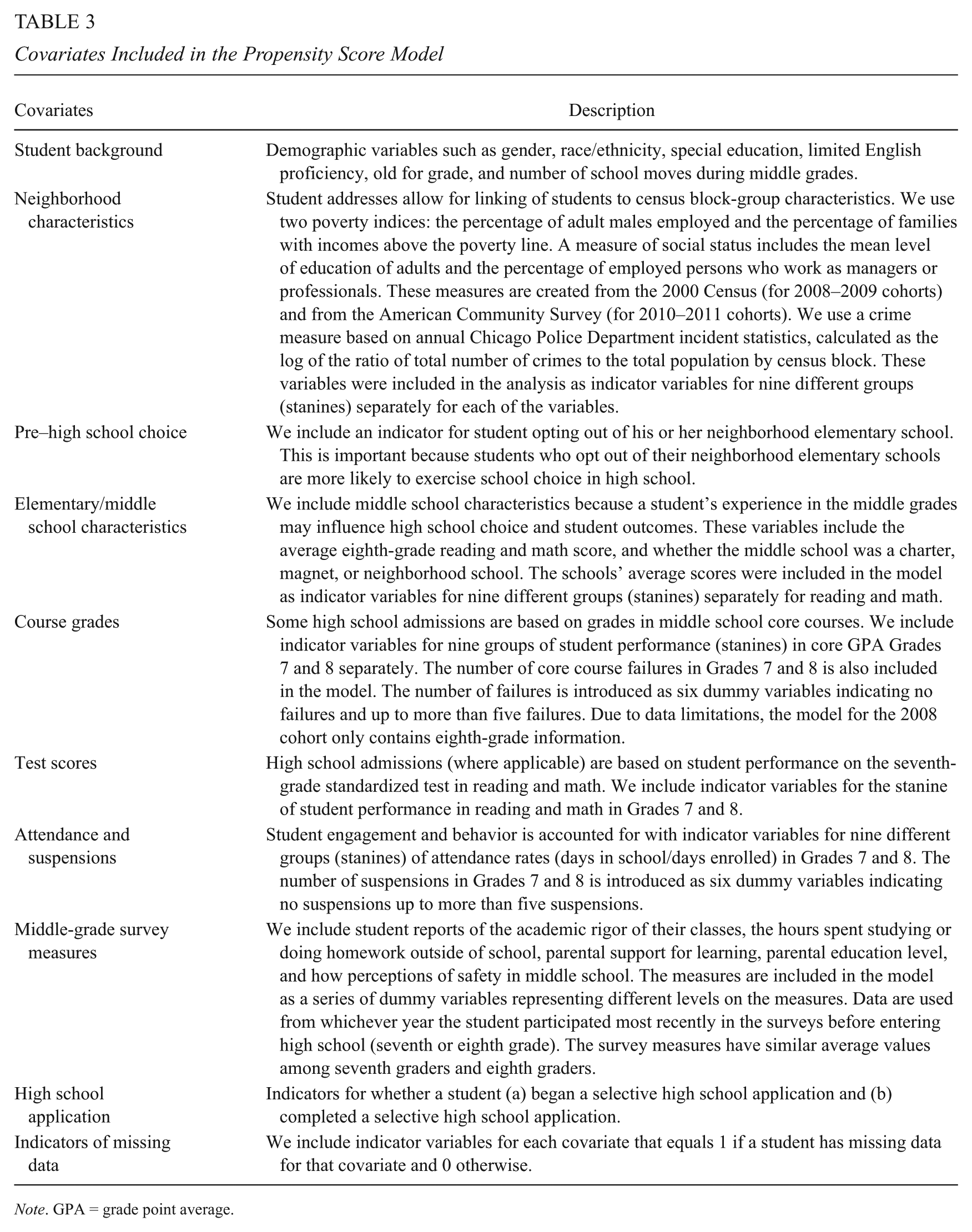
Note. GPA = grade point average.
Table 4 lists the academic and nonacademic outcomes that we study. Academic outcomes are derived from district administrative datasets. They include test scores from ACT’s Educational Planning and Assessment System (EPAS), taken by all students. We examine 11th-grade GPA (which is the GPA that students use to apply to college), whether students graduate from high school, and course-taking patterns. For two cohorts of students, we are able to examine college enrollment, including the selectivity of the college. Two indicators of nonacademic outcomes come from CPS administrative data—attendance (the percentage of enrolled days that a student attends school) and suspensions. Nonacademic outcomes also include survey measures of students’ perceptions of safety at school, classroom behavior, relationships with teachers, academic challenge and study habits, and the degree to which the high school is focused on preparing students for the future (see Appendix Table A1, for detailed information on measures, available in the online version of the journal). Survey measures may be subject to reference bias, in which respondents make judgments based on comparisons with others within the same context. Here, we are less interested in the actual quality of the school than in students’ perceptions, for which reference bias is less of a concern.
Academic and Nonacademic Outcomes

Note. CPS = Chicago Public Schools; EPAS = Educational Planning and Assessment System; GPA = grade point average; AP = advanced placement.
Propensity Score Models
Equations 1a to 1c show the propensity score model specification. We estimate each of the equations separately for each cohort using a logit regression model. For each type of treatment, comparisons are made with students who attend schools in lower performing categories. Equation 1a models the propensity of attending a selective high school and includes all students in the analytic sample. Equation 1b is estimated with all students who did not enroll in a selective high school. Equation 1c is limited to students who did not initially enroll in a selective or top-tier high school. We restrict the estimation sample in this way to understand the benefit of attending better-performing schools. Therefore, each of the three propensity score models includes a different sample:
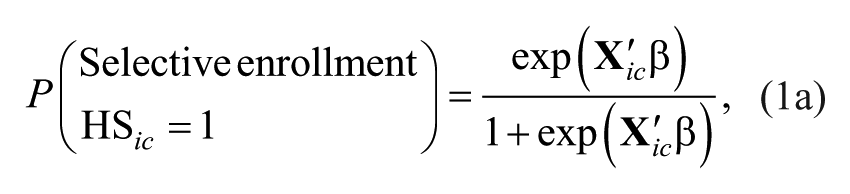

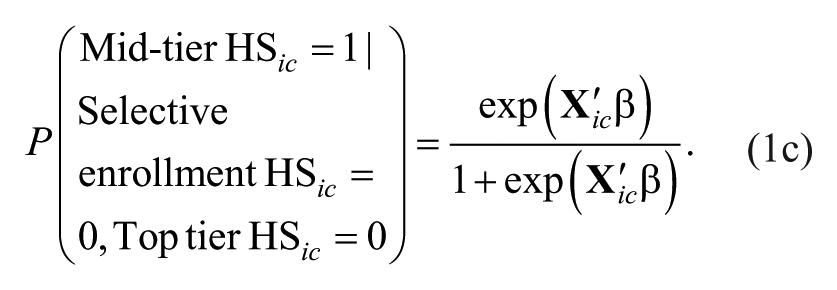
Because schools change over time, and may be related to cohort effects, we calculated a student’s propensity for treatment within his or her cohort of first-time ninth graders. We use a semi-nonparametric specification, binning continuous variables such as prior test scores and adding interaction terms. The
We then use the predicted probability
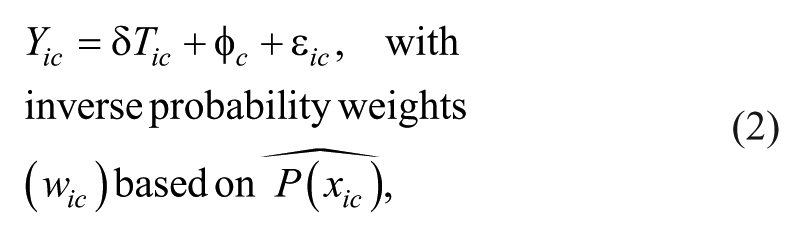
where Tic = 1 if the student attends a higher performing high school, and Tic = 0 otherwise.
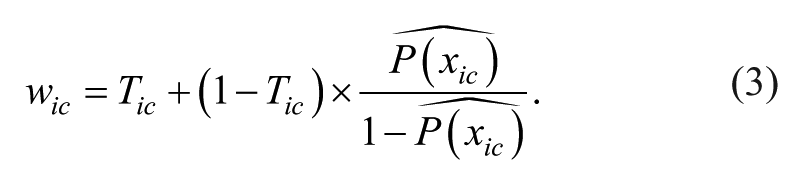
Yic is the outcome of interest. Tic equals 1 if the student attends a higher performing high school and equals 0 otherwise. We run variants of Equation 2 to estimate separately the effect of attending (a) a selective high school, (b) a top-tier high school, and (c) a mid-tier high school. The estimated coefficient on Tic,
Common Support and Covariate Balance
We ensured that students at each propensity score level have some probability of being in both the treatment and control groups: If students at some propensity score levels have a zero probability of being in either the control or treated group, there is no comparison group for students with these combinations of covariates. The estimation of the treatment effect can only be defined in the region of common support. In fact, the distribution of propensity scores for students in the treatment and control groups covers almost the entire range of scores for all three sets of comparisons (see Appendix Figure A1, available in the online version of the journal). There are some students in the treatment groups with very low propensity scores, and students in the control group with very high propensity scores. We disregard students who fall outside the common support region, but the number is relatively small and does not pose a threat to the estimation of the treatment effects. 4
Next, we checked for the balance of the covariates in both the control and treatment groups by comparing how far apart they were before and after the sample was weighted using the estimated propensity. We assessed the balance of the variables by defining the difference of sample means in the treated and control groups divided by the square root of the average of sample variances in both groups. The standardized bias for a particular covariate x in the original sample is given by
Although other approaches rely on testing the differences in the covariates means, given the very large data samples in these analyses, they are not appropriate. In most empirical studies, a bias reduction that brings the standardized bias below .25 (Harder, Stuart, & Anthony, 2010) is seen as sufficient and considers the covariates balanced. Some researchers prefer a more strict cutoff point close to .1. In all 12 propensity models (four cohorts and three different treatments), none of the covariates had a standardized bias greater than .25 after weighting, and fewer than 12 of the variables in any of the propensity analyses showed standardized bias greater than .10 among all the original variables, the missing indicators, and the interaction terms (see Figure A2 and Table A3 in the Appendix, available in the online version of the journal). 5 Among the different treatments, the selection into selective schools was the one that showed the largest unbalances in the covariates before applying propensity score weights. Those covariates with potential for bias were tested in subsequent sensitivity analyses.
Results
This section provides estimates of the effects of attending higher performing high schools on a range of academic and nonacademic outcomes, relative to attending schools with lower quality. We make a number of comparisons that investigate heterogeneity in effects based on the quality of the high school attended. In the case of top-tier nonselective schools, we also provide separate estimates based on the counterfactual condition, for reasons described below. The comparisons are presented along a continuum of school quality—from the effects of attending elite selective schools to the effects of attending schools with middling test scores and graduation rates, relative to schools with lower quality. The estimates compare observationally similar students who attend
a selective school versus any other school (top-tier, mid-tier, or bottom-tier school)
a top-tier nonselective school versus a lower quality school (mid-tier or bottom tier) restricting top-tier to mid-tier comparisons restricting top-tier to bottom-tier comparisons
a mid-tier school versus a bottom-tier school.
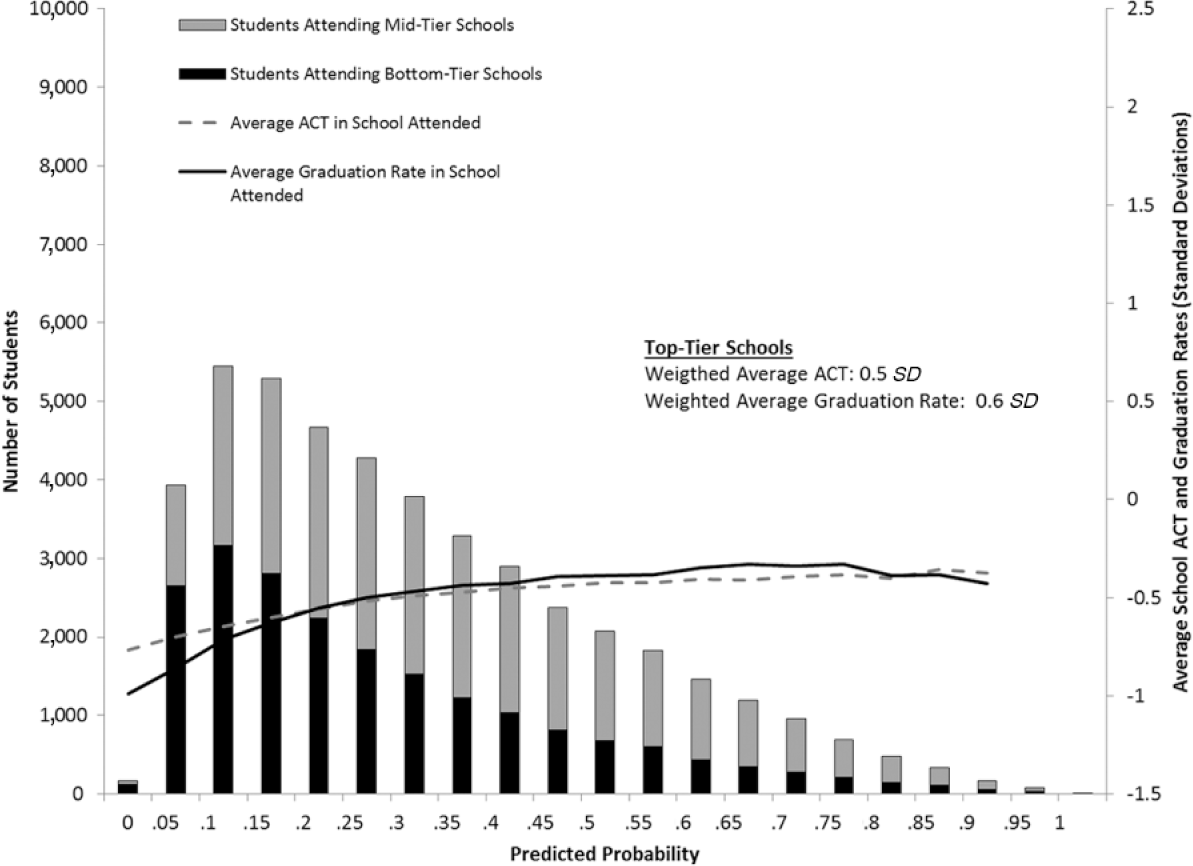
Students who are in the comparison group for each definition of a higher performing school could potentially attend any high school in a lower performing tier; however, it turns out that students with the highest IPWs mostly come from schools in the bordering quality category. For instance, when estimating the probability of attending a top-tier school, students attending mid-tier schools tend to have higher propensity weights than students attending bottom-tier schools. Figures 1 to 3 illustrate this phenomenon.

Description of the counterfactual for selective schools.
Description of the counterfactual for top-tier schools.

Description of the counterfactual for mid-tier schools.
Each of these figures displays a histogram of students sorted by their propensity scores; only students in the counterfactual group are represented. The bars are stacked based on the type of school the counterfactual students attend. For example, Figure 1 shows the counterfactual for attending a selective school. Many students have a very low propensity of attending a selective school. The propensity weight that approaches zero effectively removes them from the estimation model, as discussed previously. Among counterfactual students with propensities for attending a selective school of 5% or higher, most students attend top-tier schools. The differences are less stark in the figure for top-tier nonselective schools (Figure 2). At each propensity level, some students in the counterfactual for attending top-tier schools end up in either mid-tier or bottom-tier schools. However, those with high propensities are more likely to end up in mid-tier schools, whereas those with low propensities are more likely to end up in bottom-tier schools. 6
There are also two lines on the figures. The solid line represents the average graduation rate at the schools attended by the counterfactual students in each of the propensity score bins, and the dashed line is the average ACT score at the schools attended by the counterfactual students in each bin. The higher a counterfactual student’s probability of attending a higher performing school, the higher the performance level of the school they actually attend—shown by the positive slope of the lines in Figures 1 and 2. The exception is with the mid-tier schools (Figure 3) where there is not a strong relationship between propensity to attend a mid-tier school and the school achievement level among students who attend bottom-tier schools.
Results for Academic Outcomes
Table 5 shows two sets of estimates: (a) unadjusted mean differences between the outcomes of treated and comparison students, and (b) the effects of attending a higher performing high school on academic outcomes adjusting for a student’s propensity of treatment. For most students at selective schools, the counterfactual condition is to attend a top-tier school. For students at top-tier schools, the counterfactual could be either attending a mid-tier or a bottom-tier school; therefore, we disaggregate the top-tier effects into effects for students who would otherwise attend a mid-tier high school from those who would otherwise attend a very low-performing school, as well as showing the main effect. For students at mid-tier schools, the counterfactual is attending a poor-performing school; thus, the mid-tier coefficients are estimates for the effects of attending a marginally better-performing school.
Effect of Attending a Higher Performing School on High School Academic Outcomes
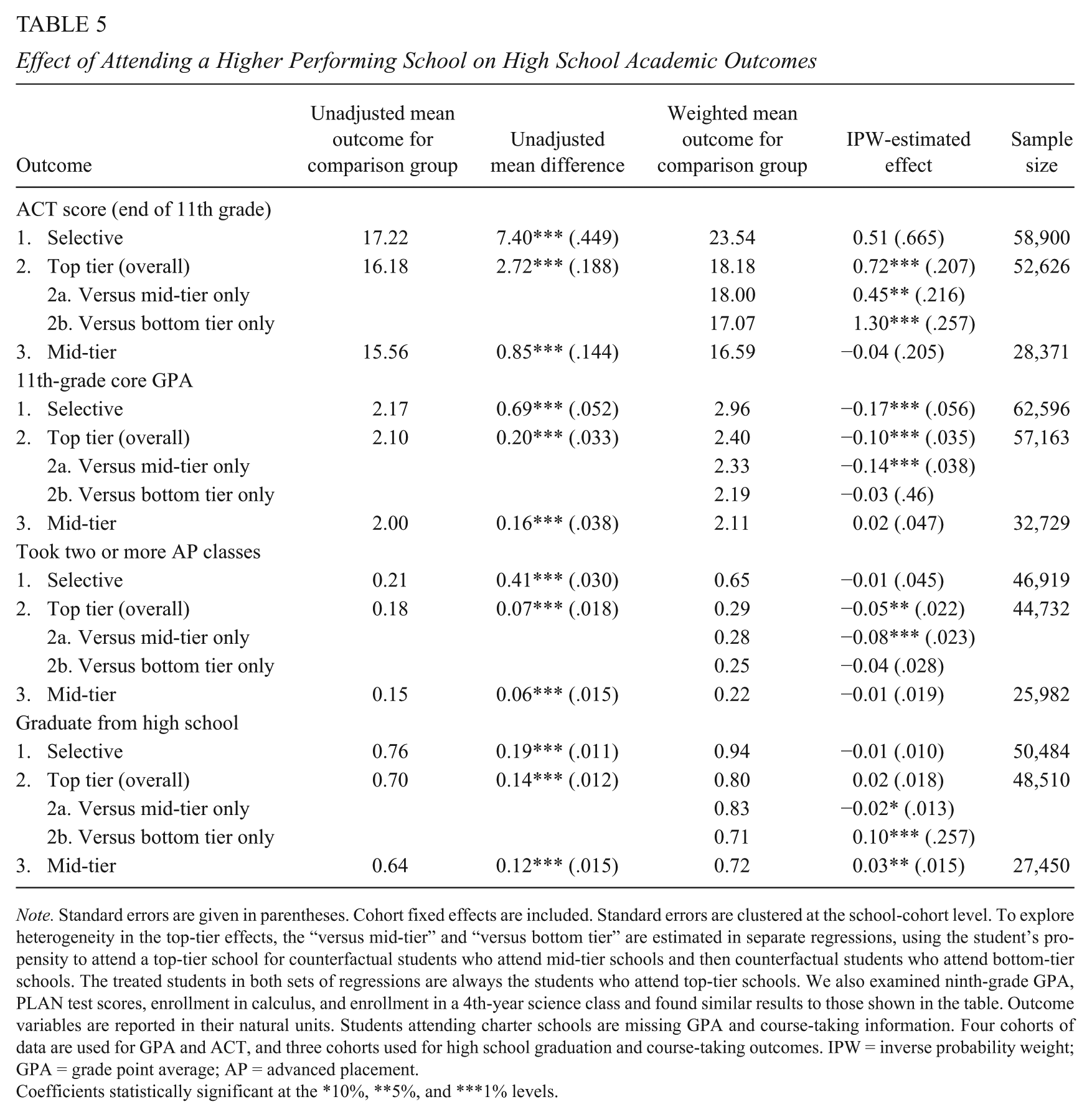
Note. Standard errors are given in parentheses. Cohort fixed effects are included. Standard errors are clustered at the school-cohort level. To explore heterogeneity in the top-tier effects, the “versus mid-tier” and “versus bottom tier” are estimated in separate regressions, using the student’s propensity to attend a top-tier school for counterfactual students who attend mid-tier schools and then counterfactual students who attend bottom-tier schools. The treated students in both sets of regressions are always the students who attend top-tier schools. We also examined ninth-grade GPA, PLAN test scores, enrollment in calculus, and enrollment in a 4th-year science class and found similar results to those shown in the table. Outcome variables are reported in their natural units. Students attending charter schools are missing GPA and course-taking information. Four cohorts of data are used for GPA and ACT, and three cohorts used for high school graduation and course-taking outcomes. IPW = inverse probability weight; GPA = grade point average; AP = advanced placement.
Coefficients statistically significant at the *10%, **5%, and ***1% levels.
Without adjusting for selection, it would appear that higher achieving schools are better at preparing students academically, as shown with the unadjusted mean differences. However, most of the positive academic benefits disappear once the propensity weights are applied, and a few of the coefficients become negative. In short, there is positive selection into higher performing schools. For example, students who attend a selective school, on average, have 7.40 points higher 11th-grade ACT over students in other high schools; however, when we adjust for pretreatment differences among students the difference is .51 points and not significantly different from zero.
The first row in each set of outcome results shows the effects of attending a selective high school. Contrary to common perceptions, but consistent with prior research with rigorous strategies for addressing selection, we do not see statistically significant benefits to attending selective schools on students’ test scores or likelihood of graduating. Furthermore, we find that, on average, students who attend selective schools have GPAs that are .17 points lower than observationally similar peers in nonselective schools. This negative result may occur because classes are more challenging at schools where many students are high achieving, though it may also be a result of distributional consequences because students are likely to be lower ranked at higher performing schools than at lower performing schools. 7 Students are also no more likely to take two or more AP classes if they attend a selective school, compared with counterfactual peers. Thus, the higher academic performance levels of students at selective schools seem to be driven primarily by selection.
Rows 2, 2a, and 2b of each outcome set show the effects of going to a high-achieving school that is not selective, compared with a school that is lower achieving. We see a positive effect of .72 points on the ACT, relative to counterfactual students at mid- or bottom-tier schools, which is equivalent to about two thirds of a year’s growth on ACT’s EPAS tests. 8 The largest benefit is for those students whose counterfactual condition was to attend a bottom-tier school, with an effect of 1.3 ACT score points. The top-tier schools are high achieving, even though they do not admit students on the basis of prior achievement. This evidence suggests that the schools may be considered high achieving because their students show higher gains than typical, not just because they enroll students who already have high test scores prior to high school. In other words, some of these schools likely have strong reputations because they do add value to their students’ learning, beyond what is achieved at other schools.
Although there is a positive relationship between attending a top-tier school and test scores, there are also some negative effects among students whose counterfactual condition is to attend mid-tier schools. Similar to selective schools, students show lower 11th-grade GPAs (by .14 GPA points) if they attend a top-tier versus a mid-tier school. 9 Students who enroll in top-tier schools versus similar students at mid-tier schools are also less likely to enroll in at least two AP classes (by 5 percentage points), and graduation rates are slightly lower (by 2 percentage points). Thus, there may be some trade-offs from attending high-performing schools that were not discerned in prior studies that only focused on test scores.
Row 3 of Table 5 compares the outcomes of students who attend mid-tier schools with bottom-tier schools. There is no relationship between attending a mid-tier school and test scores. Although this finding contrasts with the effect on test scores seen at top-tier schools, it is consistent with prior literature on systems of schools, described earlier, and also with studies of schools closed for low performance. Those studies find no benefits to test scores of students who are displaced to moderately achieving schools, only finding benefits if the receiving schools are substantially higher achieving than the ones they left. There is, however, a boost to graduation rates for students who otherwise would go to bottom-tier schools (Row 3) from attending either a mid-tier or a top-tier school (Row 2a). The effect is not only largest for those who attend top-tier schools (10 percentage points) but also significant for attending a mid-tier high school versus a bottom-tier (by 3 percentage points) school. However, the positive effect of attending a mid-tier school on graduation rates is significant at close to the .05 level; given the large number of significant tests that were conducted, this finding should be interpreted cautiously. Course-taking patterns generally look similar for students attending mid-tier schools and their counterparts in bottom-tier schools.
Not shown in Table 5 are ninth-grade GPA and PLAN test scores; these mirror the estimates seen in the 11th grade in terms of both direction and significance level. Other course-taking patterns were also examined, such as taking calculus and a 4th year of science, and similar results were detected.
Results for Nonacademic Outcomes
Although there are few benefits to attending a selective school on high school academic outcomes, there seem to be considerable nonacademic benefits (see Table 6). Generally, students who attend either selective or top-tier schools have better perceptions of high school experiences than their counterparts in lower performing schools. The differences are bigger in magnitude for selective schools than for top-tier schools, and few nonacademic differences are observed for mid-tier schools. The estimated effects of attending a top-tier school on students’ nonacademic outcomes are also larger for students whose counterfactual is a bottom-tier school than for those whose counterfactual is a mid-tier school.
Effect of Attending a Higher Performing School on Nonacademic Outcomes
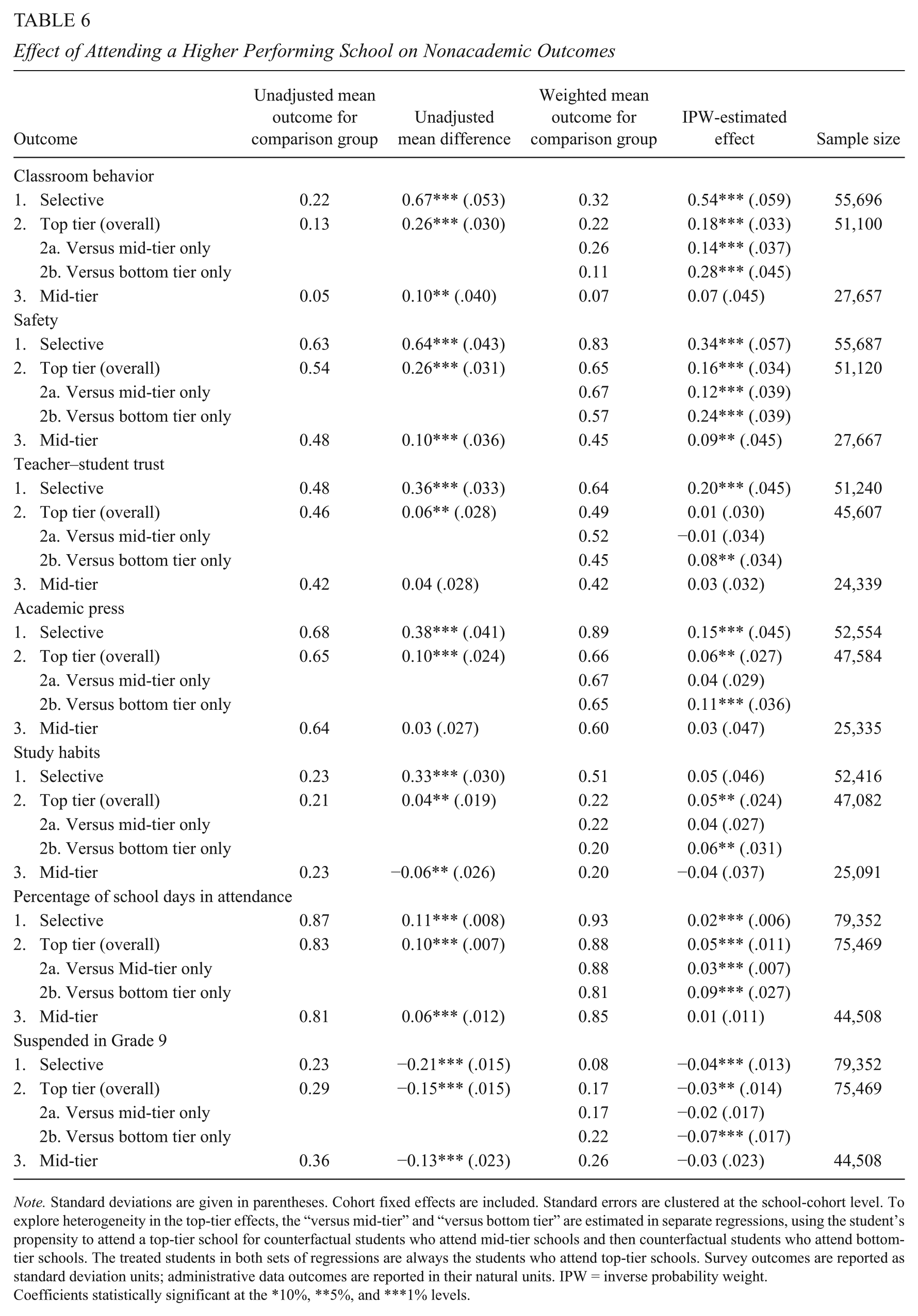
Note. Standard deviations are given in parentheses. Cohort fixed effects are included. Standard errors are clustered at the school-cohort level. To explore heterogeneity in the top-tier effects, the “versus mid-tier” and “versus bottom tier” are estimated in separate regressions, using the student’s propensity to attend a top-tier school for counterfactual students who attend mid-tier schools and then counterfactual students who attend bottom-tier schools. The treated students in both sets of regressions are always the students who attend top-tier schools. Survey outcomes are reported as standard deviation units; administrative data outcomes are reported in their natural units. IPW = inverse probability weight.
Coefficients statistically significant at the *10%, **5%, and ***1% levels.
The experiential differences that are largest in magnitude are with students’ reports of their peers’ behaviors in school. Students at selective schools report better classroom behavior among their peers than students in the comparison group by greater than .5 of a standard deviation. Students at top-tier schools also report better-behaving classroom peers than their counterfactual peers by .18 standard deviations. Students at selective schools also report stronger trust of their teacher (.20 SDs), more academic personalism (.11 SDs), more academic press (.15 SDs), and a stronger focus on the future in their schools. They are also more likely to be in attendance and less likely to get suspended than counterfactual students.
Students at top-tier schools also tend to report better high school experiences than their counterfactual counterparts, but the differences are not as pronounced as with students at selective schools. Students who attend mid-tier schools compared with similar students in lower performing schools report fairly similar high school experiences. Their attendance, suspension rates, and study habits are similar to their comparable peers in bottom-tier schools. The only difference in nonacademic outcomes for students who attend mid-tier schools is that they report that their school environments are safer (by .09 SDs). However, as with the mid-tier effect on high school graduation, this positive effect is marginally significant and not robust to sensitivity analysis. Again, it should be noted that the propensity score models do not have pretreatment values for all of these outcomes, though we are able to control for prior attendance and suspensions, as well as student reports of academic rigor, time spent on homework, parental support for learning, and safety during the middle grades (see Table 3).
Results for College Outcomes
A major focus for high schools is to prepare students for life after high school. Table 7 shows the estimated effects of attending higher performing schools on college enrollment, selectivity, and persistence. All estimates are generated from samples unconditional of graduating from high school for readers to compare across panels of the table. There are generally positive effects on attending a higher performing high school for college outcomes, though there is heterogeneity in those estimates. First, after the propensity score adjustments, selective high schools offer no apparent advantage in terms of enrolling in college, persisting in college, or attending selective colleges (see Table 4 for a description of college selectivity categories). At the same time, students who attend top-tier nonselective high schools see many benefits in college outcomes relative to students at mid- or bottom-tier schools. These students are more likely to enroll in college (a 6-percentage-point increase) and more likely to persist in college for 2 years (a 5-percentage-point increase). Students who attend top-tier high schools are more likely to enroll in colleges with lower acceptance rates (called “highly selective” or “most selective”). The positive estimates for attending a top-tier school are driven by comparisons of observably similar students who attend top-tier and bottom-tier schools. Attending mid-tier schools relative to bottom-tier schools also shows some benefits for college; there are gains in college enrollment (a 4-percentage-point increase) and enrollment in a highly selective college (a 2-percentage-point increase); however, there is not a statistically significant effect on persistence in college for 2 years.
Effect of Attending a Higher Performing School on College Outcomes
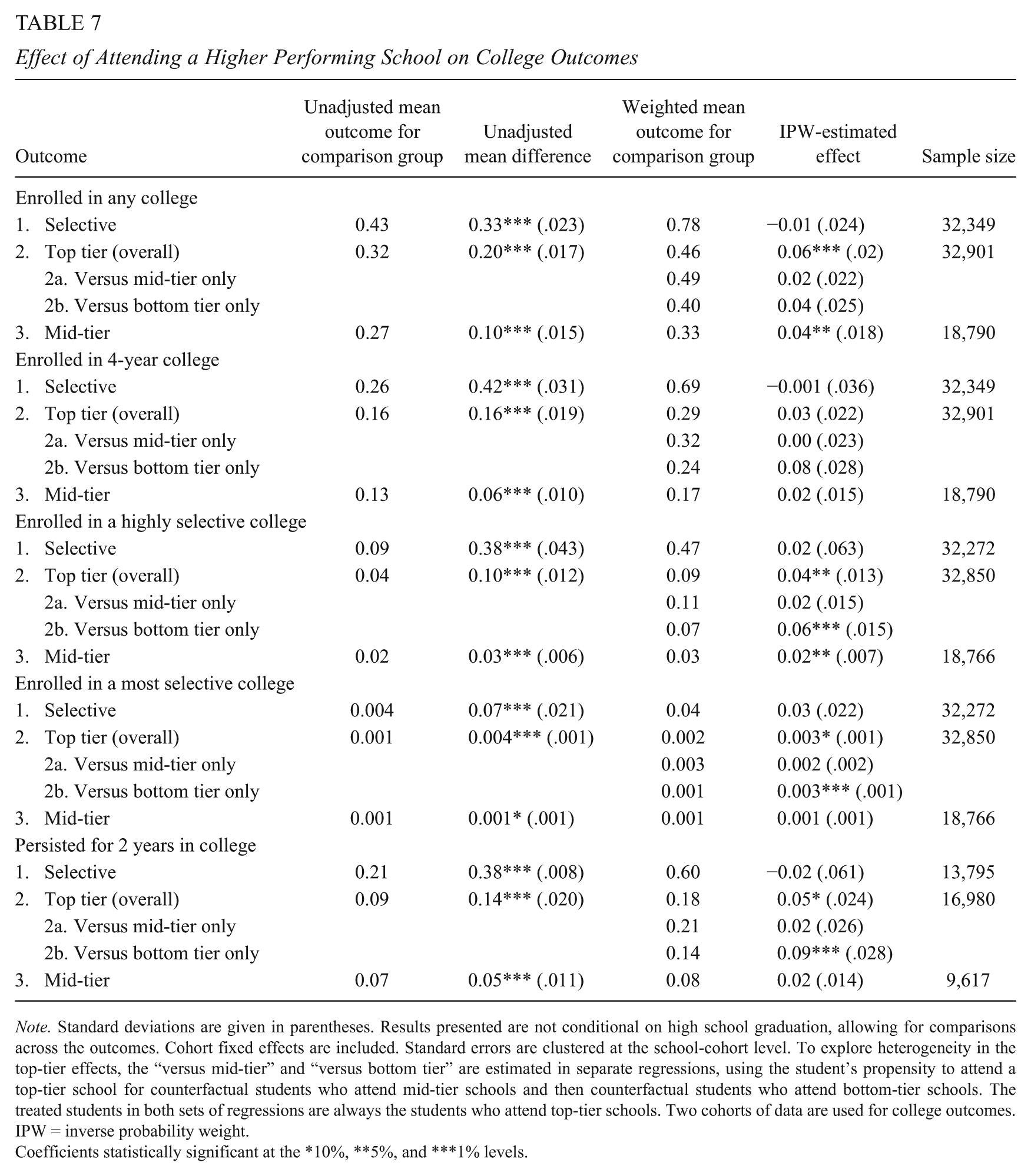
Note. Standard deviations are given in parentheses. Results presented are not conditional on high school graduation, allowing for comparisons across the outcomes. Cohort fixed effects are included. Standard errors are clustered at the school-cohort level. To explore heterogeneity in the top-tier effects, the “versus mid-tier” and “versus bottom tier” are estimated in separate regressions, using the student’s propensity to attend a top-tier school for counterfactual students who attend mid-tier schools and then counterfactual students who attend bottom-tier schools. The treated students in both sets of regressions are always the students who attend top-tier schools. Two cohorts of data are used for college outcomes. IPW = inverse probability weight.
Coefficients statistically significant at the *10%, **5%, and ***1% levels.
One caveat to the findings on college enrollment is that they are less robust to sensitivity analyses than most of the other findings presented in this article described below. The sample size is smaller, as some of the cohorts are not old enough to have enrolled or persisted in college. Some of their significance levels are not below .01; given the number of significance tests that were conducted, we should be somewhat cautious in our interpretation of these results. However, there is no evidence that going to a higher achieving school has a negative effect on college enrollment or selectivity, despite the negative effects that are observed on GPA. For many outcomes in this article, we are able to control for a lagged value of that outcome (e.g., controlling for prior achievement when looking at test score effects). That is not the case for educational attainment outcomes, so there is a bigger assumption that we have taken into consideration all factors that relate to high school quality and college going.
Sensitivity Analyses
To check the robustness of the estimates, we ran the models restricting the counterfactual only to students who attended schools in the next lower tier (e.g., comparing students in selective high schools with students in top-tier high schools only), and the results were very similar. We also ran the outcome models for each individual cohort, instead of grouping all cohorts together, and the yearly results were similar to the ones with all cohorts together. In addition, we ran the outcome regressions including those covariates that showed a standardized bias greater than .10 and the results did not change; those covariates are provided in Appendix Table A3 (available in the online version of the journal).
In any study that uses nonexperimental estimation, selection on unobservables is a concern. We can examine the extent to which there would have to be unobserved endogeneity to change the findings (e.g., a negative effect is nullified; Frank, Maroulis, Duong, & Kelcey, 2013). This method quantifies the amount of sample replacement needed (by replacing observed cases with unobserved cases in which there was no treatment effect) to invalidate an inference due to selection bias. For example, for an average school climate effect—the .15 standard deviation increase in perceptions of academic press in selective schools—41% of the cases in which there was a positive effect would have to be replaced with cases in which there were zero effects to change that finding. For most of our findings, with the exception of those discussed below, the proportion of cases that would need to be replaced with cases of zero effect to invalidate the inference is similar to that of the two examples reported here. The large amount of error required to negate our estimates is significantly larger than many of the published causal claims that Frank et al. (2013) tested and suggests considerable robustness of most of the results.
There are a few estimates which are less robust to the potential influence of selection bias. Across Tables 5 to 7, there are 10 effects that are marked as significant, but whose significance level is greater than .01. Three of these significance tests are associated with the analyses on college selectivity, whereas a fourth comes from the effect of a mid-tier school on attending any college. For these outcomes, 16% or less of the effect would need to change to invalidate the findings. It is possible that college selectivity is affected by unobservables, such as one’s preference for prestige, in a way that is not captured by the propensity score. Students who select into prestigious top-tier and selective high schools may be more likely to pursue selective colleges than observationally similar students who are less concerned with institutional prestige, beyond what is accounted for by covariates such as the quality of their middle school and their neighborhood characteristics.
Two other effects that are particularly not robust to the potential influence of selection bias are the mid-tier school effects on high school graduation and safety. Only 2% of cases would need to change to outcomes to invalidate those significance tests. Thus, we are cautious about presenting benefits for attending mid-tier schools, and suggest the findings be replicated in other studies. In addition, a small percentage of the cases (6%–15%) would need to change to invalidate the effects of top-tier schools on students’ study habits, suspension rates, AP coursework, and reports of academic press. Because most of the top-tier school effects on nonacademic outcomes are very robust, potential uncertainty in these findings does not change the overall conclusions about the benefits of these schools for students’ nonacademic outcomes.
Discussion
Families are fighting to get their children into schools with strong reputations, or to find alternatives to the poor-performing schools in their neighborhood. Policymakers are encouraging families to choose schools with higher performance by closing low-achieving schools, providing vouchers, publicizing school performance levels, and opening selective schools. Without adjustments for selection, schools can look like they have a large effect on student outcomes, while these apparent successes should actually be attributed to the students themselves. As families weigh options about school, and as policymakers shape the choices available to families, they need to know the actual benefits.
Overall, we find mixed, but mostly positive, consequences for attending higher achieving schools, providing some support for policies that encourage families to consider school quality when choosing a high school. Our results show why past research has seemed inconsistent: The effects of attending higher performing schools depend on the outcome being studied and the type of comparison being made. Getting into a selective school is not the same as getting out of a bottom-tier school to go to a mid-tier school, or attending a strong nonselective school in terms of consequences for students’ experiences in high school, their achievement, or their educational attainment.
Students want to gain admission to selective schools, often because of a feeling that they will get an academic edge in more selective environments. However, attending a highly selective school does not give students an academic edge, at least on academic outcomes: Test scores and coursework are no better, and students’ GPAs are actually somewhat lower if they attend a selective school than a nonselective one. Students at selective schools are no more likely to attend college, or to persist once there, than they would have been at a nonselective school. Instead, the major advantage of selective schools is that they provide a more desirable school environment. Students are more likely to feel positive about their high school experiences at selective schools. Note, however, that we cannot say what would happen to students at a selective school if they were to enroll in a poorly performing (mid-tier or bottom-tier) school; students who have access to selective schools do not tend to enroll in either mid- or bottom-tier schools, and so the comparison is to high-performing nonselective schools.
At the other end of the spectrum, there are also few academic benefits for “getting out” of bottom-tier high schools into mid-tier ones. Although there are many policies that aim to improve student achievement by getting students out of very low-performing schools, policymakers may not find substantial improvements in student test scores from such policies, especially if students who leave very poorly performing schools end up at schools that are only moderately higher achieving. There are modest benefits, however, in terms of high school graduation and college enrollment.
The most positive effects are observed with strong nonselective schools; students who attend these schools, rather than mid-tier or bottom-tier schools, do see benefits with a number of academic and nonacademic dimensions, including test scores. They report a more positive high school environment, and they show benefits in terms of college enrollment, college selectivity, and college persistence. These schools are high achieving despite being nonselective: Perhaps they are high achieving precisely because students do perform better at these schools than they would at other schools.
Impacts on nonacademic outcomes and educational attainment highlight the importance of examining outcomes other than just test scores. Educational attainment is critical for students’ life chances, including better employment outcomes, health outcomes, and life expectancy (Autor, Katz, & Kearney, 2008; Day & Newburger, 2002; Heckman, Lochner, & Todd, 2008; Juhn, Murphy, & Pierce, 1993; Muennig, 2005; Sum, Khatiwada, & McLaughlin, 2009). Policies that move students into higher performing schools might fail at raising test scores, yet have positive consequences that are more important than test scores for students’ futures.
Limitations and Future Research
These results have been interpreted with the assumption that when modeling a student’s propensity to attend a high school of a given performance level, we have accounted for any variables that are related to both the choice of school and future outcomes. This assumption is an important caveat, though we believe the results are plausibly causal given the rich longitudinal pretreatment data we observe at the student level. The comparison and treatment groups are equivalent on a large array of pretreatment covariates, including their prior academic achievement. One major concern is that we do not sufficiently control for family background and that some parents are more engaged in school choice or have better tools to navigate the system than other parents. The propensity model accounts for characteristics (quality) of the student’s elementary school and whether or not the student exercised choice prior to high school; these should account for a family’s investment in schooling quality. We further control for socioeconomic background to taken into account family and neighborhood resources: We use census data at the census block-group level about employment and educational attainment, and we also use free/reduced-price lunch status. We consider the extent to which students report that their parents are invested in their education. These data are extensive, though it is possible that there are unobserved confounding variables. Further research is needed to confirm these findings using different methodologies.
We present average treatment effects, showing the overall effect of attending a higher performing high school, regardless of that student’s skills, backgrounds, and dissimilarity to other students in his or her school. The null effects observed for selective schools and bottom/mid-tier school comparisons could mask contradictory heterogeneous effects for students with different counterfactuals. For example, we show evidence that attending a top-tier school is more important for students who would otherwise attend a bottom-tier school than students who would attend a mid-tier school. There are different counterfactuals for attending selective schools as well, but insufficient numbers of students in the counterfactual conditions to make such comparisons. Furthermore, there may be different benefits based on variance in students’ skills within the same type of schools. The negative GPA effects suggest that there may be adverse consequences for students with weaker academic backgrounds, and these could be masked by examining average effects. Prior research shows that students who just make the cutoff into selective schools can feel marginalized in schools with higher achieving peers, controlling for their own achievement (Marsh & Hau, 2003). The negative GPA effects may not translate into lower high school graduation and college attainment rates for all students, but they may make a difference for students with weaker academics. These heterogeneities need to be explored further but are beyond the scope of this article.
In addition, although this article provides insight into how moving students into higher achieving schools affects their outcomes, it does not address the consequences of shifting students, and how students’ choices about which school to attend alter the composition of students in other schools. District leaders who are considering closing low-performing schools or opening selective ones must be aware that changes in who enrolls in schools could also affect the overall achievement levels of other schools. For policymakers considering opening selective schools or closing poor-performing ones, this article is a first step in understanding the potential consequences on student achievement from these types of policies.
Footnotes
Acknowledgements
We thank Chicago Public Schools (CPS) for continued data access and support regarding the work. This article has benefited greatly from the feedback of researchers and the Steering Committee of the University of Chicago Consortium on School Research, as well as Lisa Barrow, Dan Black, Kerwin Charles, Ofer Malamud, participants at the Association for Education Finance and Policy, Illinois Education Research Council, and Chicago Education Research Presentations meetings. We thank Sanja Jagesic and Matt McCracken for their outstanding research assistance.
Authors’ Note
The opinions expressed are those of the authors and do not represent views of the Institute or the U.S. Department of Education. Authors are listed in alphabetical order.
Declaration of Conflicting Interests
The author(s) declared no potential conflicts of interest with respect to the research, authorship, and/or publication of this article.
Funding
The author(s) disclosed receipt of the following financial support for the research, authorship, and/or publication of this article: The research reported here was supported by the Institute of Education Sciences, U.S. Department of Education, through Grant R305A120136.
Notes
Authors
ELAINE M. ALLENSWORTH is the Lewis-Sebring Director of the University of Chicago Consortium on Chicago School Research, where she conducts studies on students’ educational attainment, school leadership, and school organization. She is one of the authors of the book Organizing Schools for Improvement: Lessons From Chicago, which documents the ways in which organizational structures in schools influence improvements in student achievement. She regularly serves on policy commissions, working groups, and review panels at the local, state, and national levels.
PAUL T. MOORE is a research analyst at the University of Chicago Consortium on School Research. His research interests include urban school reform, school choice policies and practices, and quasi-experimental design methodologies.
LAUREN SARTAIN is a senior research analyst at the University of Chicago Consortium on School Research. Her research focuses on issues related to school choice, teacher and principal effectiveness, and urban school reform.
MARISA DE LA TORRE is a senior research associate at the University of Chicago Consortium on School Research. Her research interests include school choice, urban school reform, and early warning indicators.
References
Supplementary Material
Please find the following supplemental material available below.
For Open Access articles published under a Creative Commons License, all supplemental material carries the same license as the article it is associated with.
For non-Open Access articles published, all supplemental material carries a non-exclusive license, and permission requests for re-use of supplemental material or any part of supplemental material shall be sent directly to the copyright owner as specified in the copyright notice associated with the article.
