



Abstract
GEAR UP (Gaining Early Awareness and Readiness for Undergraduate Programs) is a federal program designed to promote college access and success for students from low-income backgrounds. Although some literature has examined K–12 outcomes, little research has explored the extent to which GEAR UP achieves its intended postsecondary objectives. The present study used a difference-in-differences design with a sample of 17,605 students to explore the impact of GEAR UP Iowa on college enrollment and persistence. The findings indicate that GEAR UP Iowa promotes the college enrollment of high school graduates by 3 to 4 percentage points, whereas it appears to have no effect on college persistence. Results are similar regardless of students’ socioeconomic status, race/ethnicity, sex, and K–12 special education status.
The U.S. government sponsors several programs that seek to bolster college outcomes, especially for groups that are underrepresented within higher education. One such program is Gaining Early Awareness and Readiness for Undergraduate Programs, which is better known as GEAR UP. The stated purpose of GEAR UP is “to increase the number of low-income students who are prepared to enter and succeed in postsecondary education” (U.S. Department of Education, 2017, para. 1). This program has had a broad reach: As of several years ago, it had served more than 12 million students in 49 states, the District of Columbia, and seven territories (Ward, Strambler, & Linke, 2013). Given the potential importance of GEAR UP and other large-scale initiatives for promoting equity in U.S. higher education, the present study uses rigorous difference-in-differences analyses of a particular GEAR UP initiative to examine two broad research questions. First, to what extent does GEAR UP Iowa promote college enrollment and persistence? Second, to what extent do these effects depend upon students’ race/ethnicity, family income, sex, and K–12 special education status?
Federal Programs for Improving College Readiness, Access, and Success
With the goals of narrowing the achievement gap and promoting college preparedness and success for low-income and minority students, the federal government has established and implemented federally funded educational initiatives addressing educational equity and access to higher education. In 1965, Title I, Part A of the Elementary and Secondary Education Act, was the largest and longest-standing source of federal governmental supporting programs for low-SES schools (Ward, 2006). Complementing Title I programs, the federal government established three major federal educational initiatives called TRIO: Upward Bound, Talent Search, and Student Support Services (SSS). The major goal of Upward Bound and Talent Search is to increase the number of low-income and minority high school students entering postsecondary education (Ward et al., 2013), whereas the goal of SSS is to increase the college retention and graduation rates of first-generation college students from low-income families and students with disabilities. Although TRIO programs support minority students’ educational attainment (Domina, 2009), the programs have faced challenges because students must be first-generation college students or demonstrate academic promise (Ward, 2006). Evidence of the effectiveness of these federal college-preparation programs for increasing college enrollment or college completion is mixed, with variation in the quality of the evaluation studies (see Harvill, Maynard, Nguyen, Robertson-Kraft, & Tagnatta, 2012; Haskins & Rouse, 2013). Seftor, Mamun, and Schirm (2009) conducted the only experimental study, which used a longitudinal design to explore the impact of Upward Bound from 1992 through 2004. They found that Upward Bound did not affect high school graduation, college enrollment, or the type and selectivity of institutions attended within the entire sample. However, for the subgroup of students who had lower educational expectations at baseline, Upward Bound had a positive and significant effect on college enrollment and persistence. Moreover, using propensity score analyses to explore the potential impact of Talent Search, Constantine, Seftor, Martin, Silva, and Myers (2006) found that program participants were more likely than were matched nonparticipants to enroll in public college or universities in Florida, Indiana, and Texas.
In 1998, the Clinton administration introduced GEAR UP, which has joined the long-standing TRIO programs in the U.S. Department of Education (Ward, 2006). The major goals of GEAR UP are to increase educational opportunities and to provide economically disadvantaged students with preparation to pursue and succeed in postsecondary education. GEAR UP is distinct from TRIO programs with its intent to push systemic change in public schools, because it provides a cohort or priority model in which a group of students participates in the interventions each year from seventh grade through at least high school graduation (Ward, 2006). Another significant distinction is that GEAR UP requires collaborative partnerships among states, a local educational agency, local universities, middle and high schools, and community organizations. GEAR UP seeks to elevate students’ and parents’ awareness of college, their college aspirations, and their preparedness for college by providing holistic and comprehensive services (Cabrera et al., 2006; Morgan, Sinatra, & Eschenauer, 2015; Ward, 2006; Ward et al., 2013; Yampolskaya, Massey, & Greenbaum, 2006). GEAR UP consists of a 6- or 7-year grant awarded to university–school–community partnerships to provide support services to high-poverty school districts. The grantees aim to meet three objectives: (a) increase student performance and preparation for postsecondary education, (b) increase high school graduation and postsecondary enrollment rates, and (c) increase GEAR UP students’ and families’ knowledge of postsecondary options, preparation, and financing (U.S. Department of Education, 2017). Funds received from GEAR UP should also be used to provide college financial assistance to low-income students (U.S. Department of Education, 2017).
Capital Theory and the Design of GEAR UP
To examine the impact of GEAR UP on postsecondary enrollment and persistence, we draw from theories and perspectives of human, social, and economic capital. Human capital consists of intangible resources (e.g., knowledge, skills, motivation) embedded in a person’s ability to produce economic value and to increase overall quality of the labor force. In this sense, the investment in human capital can be defined as activities that attempt to raise future income through bolstering these personal resources (Becker, 1962). In human capital theory, formal schooling is an important way to increase economic value. This theory has been widely used in research on college enrollment because it helps explain how a student makes the decision to attend college based on their expected productivity enhancement and economic returns to education (Becker, 1993; Paulsen, 2001). One of the most important components of human capital for college enrollment is academic preparation (Cabrera & La Nasa, 2001; Perna & Titus, 2005), which has been operationalized in various ways that include college preparatory tracks, completion of the highest level of mathematics coursework, high school grade point average (GPA), and standardized test scores (Engberg & Wolniak, 2010). Having strong academic preparation for postsecondary education is certainly one of the important predictors of college enrollment as well as success in college. Traditionally, colleges and universities use students’ high school coursework, SAT/ACT test scores, and high school GPA to evaluate students’ postsecondary readiness (e.g., Roderick, Nagaoka, & Coca, 2009).
In addition, information about college plays a significant role in subsequent college enrollment by improving students’ relevant knowledge, including the potential costs and benefits of a college education. When students receive more college information and guidance in the college search and college application process, they are more likely to enroll in college (Cabrera & La Nasa, 2001; Flint, 1993; Hossler, Schmit, & Vesper, 1999; Klasik, 2012; Martinez & Cervera, 2012; Perna, 2004; Plank & Jordan, 2001). Using data from a randomized controlled trial in Germany (a tuition-free context), Peter and Zambre (2017) examined the relationship between information and educational expectations; they found that students who received information had greater expectations about the opportunity to obtain a well-paying job after receiving a college degree, along with lower perceived risks of unemployment. For students whose parents did not have a college degree, providing information was significantly and positively associated with intended college enrollment.
However, the quantity and quality of college information varies substantially by SES and race/ethnicity (Bell, Rowan-Kenyon, & Perna, 2009; De La Rosa, 2006; Grodsky & Jones, 2007; Plank & Jordan, 2001). For instance, many low-income and racial minority students lack sufficient knowledge about the college-going process and face barriers to obtain information; as a result, they are less likely to complete all steps of their college applications than are White or high-income students, who often have greater quantity and quality of information (Cabrera & La Nasa, 2001; Klasik, 2012). Underrepresented students may have parents with limited or no college experience (Venegas, 2006), so these students depend heavily on their high school for college information (Cabrera & La Nasa, 2001). This reliance is problematic because disadvantaged students are more likely to attend lower-resourced high schools that cannot provide adequate and accurate information (Bell et al., 2009; Orfield & Lee, 2005; Rosenbaum, 2001).
Social capital theory is also relevant to GEAR UP and postsecondary outcomes. Social capital consists of resources that exist within a social structure (Bourdieu, 1986; Coleman, 1988). Similar to human and financial capital, social capital is productive and makes certain actions and results possible within a social structure; moreover, “social capital inheres in the structure of relations between actors and among actors” (Coleman, 1988, p. S98). This theory is pervasive within educational research, because his conceptualization describes the set of resources that influence students’ educational attainment (Kao, 2004; Kao & Rutherford, 2007). Coleman identified two general types of social capital: social capital within the family and social capital outside the family. The former type of social capital indicates the relations between parents and children. High levels of parent–child interaction and parental involvement at home lead to high academic achievement and educational success, and social capital within the family and outside the family both predict students’ academic achievement and educational attainment (Sandefur, Meier, & Campbell, 2006). Parental expectations and parent–adolescent discussion related to school activities are strongly associated with college attendance (Plank & Jordan, 2001; Sandefur et al., 2006). Meanwhile, social capital outside the family refers to the social relationships of parents and other adults in the community that constitute the cultural norms and the value system and can aid in the development of human capital (Coleman, 1988; Kao & Rutherford, 2007). Coleman (1988) emphasizes “intergenerational closure” that creates social capital outside the family or within the community. This concept means that once a parent gets acquainted with parents of their children’s friends and has interactions with them, social closure ensures that parents monitor not only their child but also other children, which builds trustworthiness and the ability for a community to function effectively. Such parents are also able to share knowledge and monitor about their children’s activities inside and outside of school (Kao & Rutherford, 2007; Pong, Hao, & Gardner, 2005).
Economic capital indicates economic resources from sources that include employment, property, inheritance, and investments; people with high economic capital often have greater access to educational opportunities and other forms of capital (Bourdieu, 1986). Financial aid may constitute an important form of economic capital for prospective college students, particularly those who have greater need. Specifically, many people cannot afford the full price of a college education, so assistance from financial aid may be critical for making the initial decision to enroll in college as well as continuing to attend college. Researchers have pointed out the difficulties in evaluating the effectiveness of financial aid programs, which is complicated by data limitations, the influence of unobserved student characteristics, and a variety of program designs. Nevertheless, the empirical evidence indicates that financial aid generally increases college attendance, persistence, and graduation (for reviews, see Dynarski & Scott-Clayton, 2013; Hossler, Ziskin, Gross, Kim, & Cekic, 2009; Mayhew, Rockenbach, Bowman, Seifert, & Wolniak, 2016).
GEAR UP is designed to increase rates of college preparation, enrollment, and graduation among disadvantaged students; it seeks to accomplish this goal by promoting human, social, and economic capital through various services provided to students and their parents (e.g., academic preparation programs, mentoring and counseling, college-related information, college scholarships; Bausmith & France, 2012). Campus visits, active interaction with college guidance counselors, and participation in college preparatory activities may lead to obtaining college information. In particular, the campus visit can lead to informed decisions, because such visits provide a great deal of information, and students may have opportunities to speak with admissions officers and ask questions (Stevens, 2007). In addition to programs for students, GEAR UP seeks to provide parents with information regarding academic coursework, the college selection process, financial aid, and the benefits of postsecondary education to increase parents’ educational engagement and their children’s long-term achievement outcomes. The available evidence largely suggests that GEAR UP is associated with greater parental involvement in the school and their children’s education (Cabrera et al., 2006; Standing, Judkins, Keller, & Shimshak, 2008; Ward et al., 2013). GEAR UP may lead to greater knowledge about postsecondary education opportunities for their children as well as higher academic expectations for their children’s academic performance (Standing et al., 2008; Weiher, Hughes, Kaplan, & Howard, 2006). GEAR UP also predicts greater parental involvement (Gibson & Jefferson, 2006; Weiher et al., 2006). Therefore, based on human, social, and economic capital perspectives, we expect that GEAR UP should contribute to greater college enrollment and persistence by bolstering academic preparation and college knowledge for students, increasing the involvement of parents in their children’s educational activities and achievement, and providing scholarships to help students pay for college.
GEAR UP and Precollege Outcomes
Prior research on GEAR UP in secondary education can generally be divided into two categories: (a) the effect of GEAR UP on academic achievement and course-taking patterns and (b) GEAR UP’s influence on students’ and parents’ college readiness, focusing on students’ expectations for postsecondary education. Overall, GEAR UP participation generally predicts greater precollege academic achievement (albeit with some mixed findings). For instance, Cabrera et al. (2006) explored the impact of GEAR UP on middle school students’ outcomes in California from 1999 to 2001. They found that GEAR UP schools had significantly higher math gains in the seventh and eighth grades, but they did not find a significant relationship with students’ reading scores. Another study found that students attending GEAR UP schools had greater gains in overall academic performance from 8th and 10th grade; students were also more likely to take core curriculum courses and to plan to attend college in 10th grade than their counterparts at non–GEAR UP schools (ACT, 2007). Pointing out the importance of matching procedures in comparing GEAR UP and non–GEAR UP schools, Bausmith and France (2012) analyzed College Board matched cohort data from 2003 through 2009. They found an overall positive effect of GEAR UP for traditional College Board assessments such as sophomore Preliminary SAT/National Merit Scholarship Qualifying Test (PSAT/NMSQT) participation, junior Advanced Placement (AP) participation, and SAT scores. However, these relationships were nonsignificant for various other outcomes (e.g., PSAT/NMSQT and AP performance, SAT participation), and the effects sometimes varied by program year.
Additional research indicates that GEAR UP services and time spent in the program predict secondary education outcomes. Within a large urban high school in Florida, students who had high participation in academic activities improved their GPAs over a semester relative to students with medium or low participation (Yampolskaya et al., 2006). Focusing on Latina/o students, Cates and Schaefle (2011) found that students who spent more time engaging in GEAR UP advising, summer programs, educational field trips, and college campus visits were more likely to complete college-track courses and take the PSAT exam. In a mixed-methods study, Morgan and colleagues (2015) also reported that academic support services had the greatest impact on SAT scores and high school graduation rates.
Unfortunately, given the available evidence, there may be no true causal relationship between attending GEAR UP and secondary education outcomes. The vast majority of studies on GEAR UP examined the effect without comparison groups or did not take into the account confounding variables. To examine the effect of GEAR UP, most studies compared GEAR UP and non–GEAR UP schools after controlling for school characteristics, but the explanations about how they identified the comparable schools or whether the comparable schools were equal on the outcomes before GEAR UP implementation are often not sufficient (Bausmith & France, 2012).
The second group of studies focused on how attending GEAR UP schools affected students’ educational aspirations toward college-going. This group of studies showed that students in GEAR UP schools increased their college knowledge and improved behavior; however, these studies offer mixed results about the impact of GEAR UP on students’ educational aspiration or expectations. In a longitudinal, mixed-methods study in Texas, Watt, Huerta, and Lozano (2007) compared four groups of 10th-grade students: those who participated only in GEAR UP, only in Advancement Via Individual Determination (which is run by a nonprofit organization and has similar goals as GEAR UP), both programs, and neither program. The results indicated no significant relationship between GEAR UP participation and educational aspirations or college knowledge. A follow-up study that examined these same students in 12th grade did not identify significant differences across groups in students’ educational aspirations (Lozano, Watt, & Huerta, 2009).
In a large-scale evaluation of the GEAR UP program funded by the U.S. Department of Education, Standing et al. (2008) compared seventh grade students in 18 GEAR UP middle schools with students from comparison schools. They found that attending a GEAR UP school was positively associated with students’ knowledge about their postsecondary education opportunities as well as parents’ knowledge of benefits of postsecondary education for their children at the end of eighth grade. However, they did not find any evidence of the link between attending a GEAR UP school and the strength of student intentions for attending college, educational expectations for postsecondary education, or overall orientation toward college. Some researchers have examined the impact of GEAR UP on students’ educational expectations focusing on Latina/o students (Cates & Schaefle, 2011; Sanchez, Usinger, & Thornton, 2015). They found a positive relationship between GEAR UP activities and students’ expectations about attending college. Other research has shown that parents’ awareness of their children’s postsecondary education also increased as a result of GEAR UP (Weiher et al., 2006), such that the program may have influenced parents’ awareness of and preparation for their children’s postsecondary education.
Although educational aspirations are important predictors of college attendance—and lower and higher income students maintain similar educational aspirations—significantly fewer students from low-income families fulfill their aspirations for college (Gladieux & Swail, 1998). Therefore, the mixed results on GEAR UP and precollege outcomes provide (at most) indirect evidence about the effectiveness of GEAR UP, which may instead be best operationalized through college enrollment and persistence.
GEAR UP and College Outcomes
In their review of literature on federally funded college preparation programs, Haskins and Rouse (2013) point out that GEAR UP “has been evaluated many times, but none of the evaluations offers data on college enrollment or completion” (p. 4). A handful of recent studies have provided some important insights; two of these examined GEAR UP outcomes at the same urban high school (Knaggs, Sondergeld, & Schardt, 2015; Sondergeld, Fischer, Samel, & Knaggs, 2013). Both studies compared students who enrolled at the high school before GEAR UP was implemented with those who enrolled later and received GEAR UP services. The GEAR UP cohorts had college enrollment rates that were 7 to 11 percentage points higher than the non-GEAR UP cohort. GEAR UP participation was also associated with a greater proportion of college enrollees attending 4-year (vs. 2-year) institutions. However, the examination of a single high school limits the generalizability of the findings, especially as this high school appeared to enact GEAR UP in a highly comprehensive manner than may not be typical at other schools. In addition, the student racial and socioeconomic demographics changed substantially across cohorts at this school within just a few years, which means that the pre-GEAR UP cohort may not serve as a valid comparison group.
Fogg and Harrington (2015) avoided some of these problems by conducting propensity score analyses of a GEAR UP program in Rhode Island. With this approach, they matched students on various measures from sixth grade, including “key demographic, SES, academic performance, behavioral traits, and school climate measures” (para. 8). They observed a massive effect: GEAR UP participants were 15 percentage points more likely to attend college than were matched students who did not participate. These results are highly intriguing, but the short article does not mention numerous important details, including the number of students and schools in the sample as well as the ways in which comparison students and districts were identified.
The sparse evidence about whether GEAR UP participation improves college retention and persistence is mixed. Knaggs et al. (2015) found greater college persistence rates for all GEAR UP students and specifically for low-SES students. In contrast, Sanchez, Lowman, and Hill (2016) observed no significant relationship between GEAR UP participation and subsequent college GPA or retention at a single public research university. For both studies, the single-institution sample (of a high school and university, respectively) and the possibility of unobserved differences between GEAR UP and non–GEAR UP students limit the strength and generalizability of the conclusions.
Present Study
This study seeks to improve upon previous research and provide strong conclusions about the impact of GEAR UP Iowa on college enrollment and persistence. The sample includes data over a 6-year period from more than 17,000 students who did and did not attend a GEAR UP high school. Specifically, a difference-in-differences quasi-experimental analysis was used to examine whether the implementation of GEAR UP Iowa at certain high schools led to changes in college outcomes over time that were unique to GEAR UP high schools. Because data were obtained at the student level, we were able to ensure that any changes in outcomes were not attributable to changes in students’ demographics as well as to explore whether the effects of GEAR UP Iowa varied across student subgroups. The examination of various high schools facilitates more generalizable conclusions than previous single-school studies, and restricting the sample to a single-area education agency substantially reduced the likelihood that shifts in economic conditions or other factors could provide an alternative explanation for the findings.
Specifically, this study examined outcomes from one region of the state of Iowa. In 2008, the Iowa College Student Aid Commission received a GEAR UP grant from the U.S. Department of Education. The Iowa Department of Education, the Iowa Association of Independent Colleges and Universities, and the Iowa Association of Community College Trustees collaborated to use statewide and school-based services to create a “college-going culture” among low-income and minority students. Districts were assigned to GEAR UP based on the proportion of their students who were eligible for free or reduced-price lunch. The program provides services to a cohort of students who attended seventh grade in 2008–2009 through their final year of high school in 2013–2014. Given some attrition from students in GEAR UP districts from seventh to ninth grade, a small number of additional students were added to GEAR UP cohort at the start of 10th grade. These students received services over the course of several years, whereas students at the same high school who started in other cohorts did not receive services. Figure 1 provides a visual overview of this treatment administration by cohort and year.
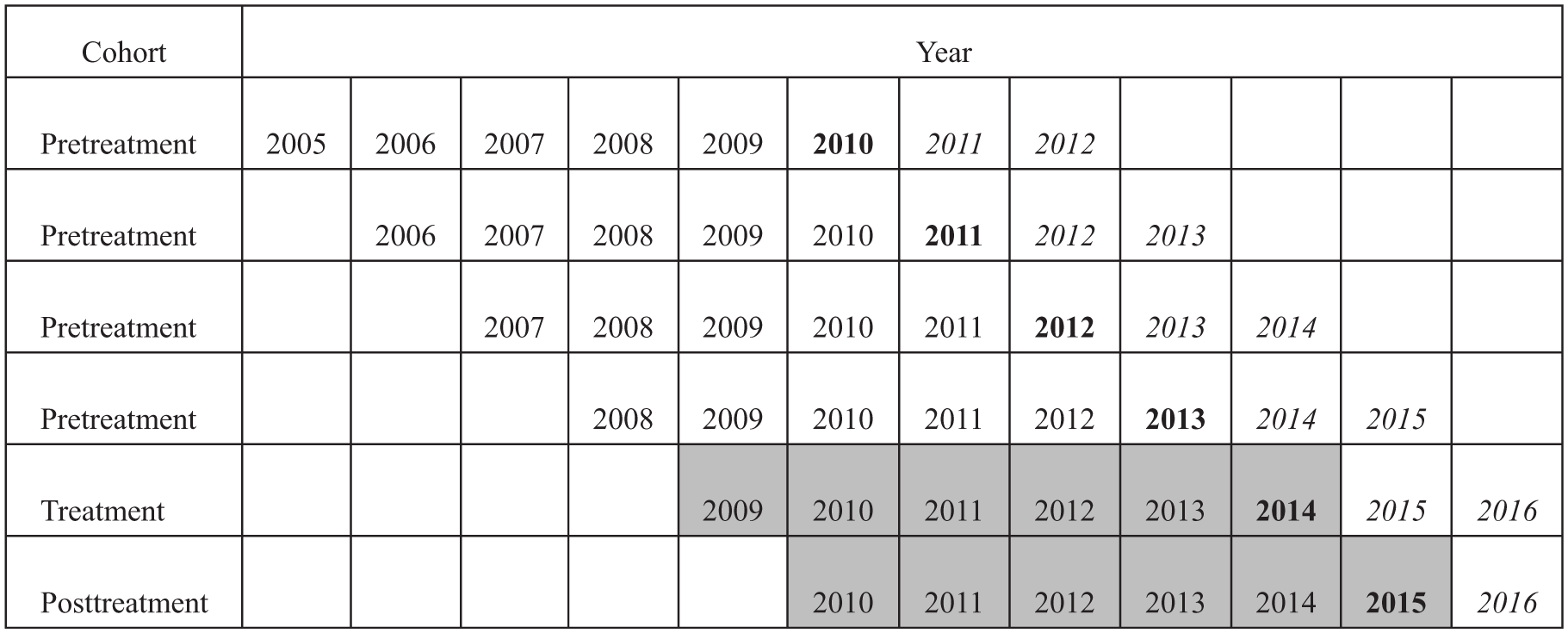
Visual overview of GEAR UP Iowa program implementation by year and cohort.
Using available student data, each partner school developed an annual implementation plan that outlined the school-based services for students, parents, and educators. These services varied somewhat across districts, but they generally included some combination of academic enrichment (e.g., one-on-one tutoring, computer-assisted learning), ACT and/or AP test preparation, career and major advising, college visits, and financial aid counseling/advising. GEAR UP Iowa provided each partner school with an annual allocation of funds to assist in carrying out its plan. GEAR UP students were also eligible to receive a US$1,300 college scholarship in each semester of enrollment (Fall, Spring, and/or Summer) for up to 4 years. More than 90% of GEAR UP students who attended postsecondary education received some form of scholarship; students who were enrolled part-time in a given semester received a prorated portion of the US$1,300 maximum award. By law, GEAR UP programs were required to allocate at least half of their total funding toward scholarships for students (Legal Information Institute, n.d.). The scholarships for GEAR UP Iowa were supported not only by the federal grant but also by the Iowa College Student Aid Commission, so these awards were larger than they would have been without this supplemental funding.
Services were only directly provided to students who both attended a GEAR UP high school and were part of the GEAR UP cohort. Detailed student-level data on service receipt were available from students who started in a GEAR UP district in seventh grade; of these participants, about 1/3 received three to five distinct services, about 1/3 received six or more distinct services, and only 5% received no services. Moreover, students could receive some individual service types (e.g., academic assistance) repeatedly over the course of months or years.
The state of Iowa offers a unique opportunity to evaluate the impact of GEAR UP. In 2014, 92% of Iowans who are 25 years of age or older had earned at least a high school diploma, and the percentage of Iowans with high school diplomas was greater than the national average for all age groups (U.S. Census Bureau, 2015). Iowa was also the first state in the nation to achieve a high school graduation rate over 90% and is one of six states where the graduation rate of low-income students is above 82%, the national average for all students (Civic Enterprises, 2016). However, Iowa’s low-income student graduation rate still trails that of higher income students by more than 10 percentage points, indicating a great deal of work is needed to close this gap. Iowa holds a particularly unusual position in terms of postsecondary education. Iowa had above-average college graduation rates in 2013 at public 4-year, public 2-year, and private not-for-profit institutions (Chronicle of Higher Education, 2015). Despite impressive high school graduation rates and college completion among those who do attend, Iowa was in the bottom third of states in the proportion of adults 25 years and older who hold a bachelor’s degree in 2015 (U.S. Census Bureau, 2017), and they were in the bottom fifth of states in advanced degrees held in 2009 (U.S. Census Bureau, 2011). Taken together, these statistics seem to imply a low rate of college enrollment among Iowa high school graduates, so GEAR UP Iowa has the potential to serve an especially important role toward achieving that goal.
Method
Data Sources and Participants
This study examined data from students who graduated from a high school within the Mississippi Bend Area Education Agency (MBAEA, 2017a, 2017b), which covers six counties in Eastern Iowa that largely border the Mississippi River. The sample included all 19 MBAEA high schools; at least three schools were in each of the following urban-centric locales: city, suburb, town, and rural. Six of these high schools implemented GEAR UP for the cohort of students whose on-time graduation was in 2014. Given its purpose of helping improve the college access and success of primarily low-income students, GEAR UP was implemented in schools that had the largest percentages of students who qualified for free- and reduced-price lunch.
Data were obtained from the 17,605 students who graduated from an MBAEA high school from 2010 through 2015 and for whom demographic information was available (only 4% of the original 18,360 high school graduates were missing demographic data, and missingness was not significantly related to GEAR UP high school attendance, p = .57). These data were linked with postsecondary enrollment information from the National Student Clearinghouse (NSC, 2017), which covers over 3,600 colleges and universities that enroll 98% of all postsecondary students in the United States. Within the entire sample, 50.1% were female, 80.9% were White/Caucasian, 8.3% were Hispanic/Latino, 6.5% were Black/African American, 1.9% were Asian American, 1.8% were multiracial, and 0.6% were from another race/ethnicity. Moreover, 40.6% graduated from a high school that implemented GEAR UP Iowa. As described below, some analyses included only students who graduated from 2010–2014 (n = 14,706).
Measures
Three binary dependent variables were created from NSC data (0 = no, 1 = yes). These indicated whether the student (a) enrolled in postsecondary education in the first year after high school graduation, (b) enrolled within 2 years of high school graduation, and (c) persisted to the second year of postsecondary education (only among students who enrolled in their first year after high school). Because the NSC data were collected in Summer 2016, analyses of the latter two outcomes excluded students who graduated high school in 2015, as data from their second year after college were not yet available.
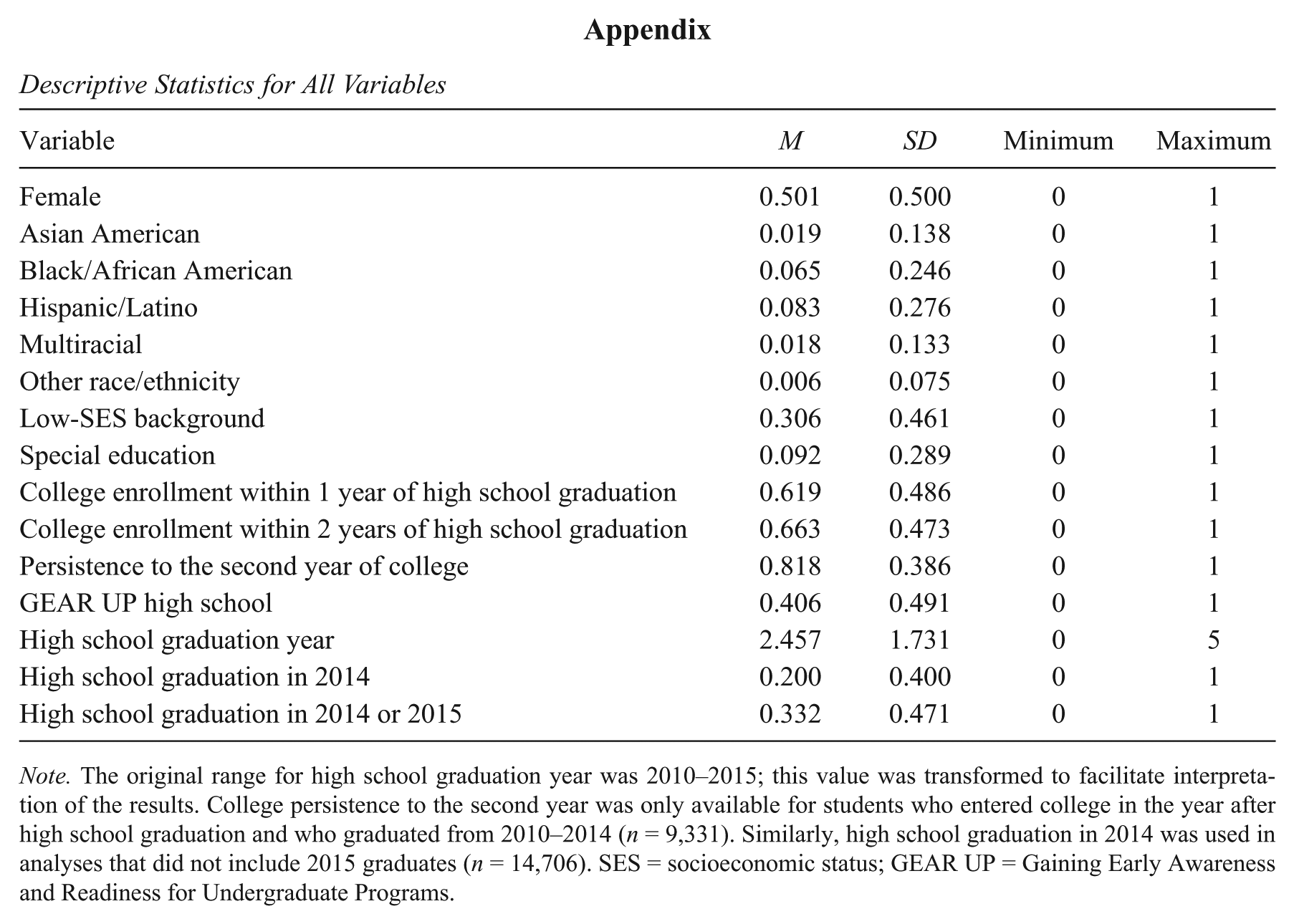
The primary independent variables included whether the student graduated from one of six high schools that implemented GEAR UP (0 = no, 1 = yes), the year of high school graduation (subtracting 2010 from the year to make the main effects of the interaction term more easily interpretable), and whether the student graduated after GEAR UP had been implemented (0 = no, 1 = yes). With the difference-in-differences design, the predictor of interest was the interaction between attending a GEAR UP high school and graduating after GEAR UP had been implemented. Student-level control variables were race/ethnicity (dummy-coded variables for Asian American, Black/African American, Hispanic/Latino, multiracial, and Other, with White/Caucasian as the referent group), sex (0 = male, 1 = female), eligible for free or reduced-price lunch (which served as an indicator of low-SES status; 0 = no, 1 = yes), and enrolled in special education (0 = no, 1 = yes). Descriptive statistics for all variables are provided in the appendix.
Analyses
Difference-in-differences analyses were conducted to predict each of the three college outcomes. The logic of this quasi-experimental analysis is that the trajectory of outcomes for GEAR UP high schools should diverge from those of non–GEAR UP high schools at exactly the time in which students in the GEAR UP cohort are graduating. The use of a single geographic region has notable benefits for causal inference, as any changes in the local economy or state policies should affect all high schools within the sample (for more information about this technique, see Angrist & Pischke, 2009, 2015; Lee, 2016).
The analyses included the binary variables for GEAR UP high school, year after GEAR UP implementation (2014 or 2015), and the interaction between these two variables as predictors. Additional models controlled for year of graduation as a continuous predictor (to account for any general trend in high school graduation rates over time) and student demographics (i.e., race/ethnicity, sex, low-SES, and special education). Moreover, three-way interactions between GEAR UP high school, year after GEAR UP implementation, and each demographic variable were also conducted to test whether the impact of GEAR UP varied across demographic groups. To reduce multicollinearity, the three-way interaction with each demographic group was considered in a separate model. Additional analyses with full control variables explored whether GEAR UP implementation predicted initial enrollment in 4-year, 2-year, public, or private postsecondary institutions (rather than examining enrollment in any college as the outcome).
By definition, students at GEAR UP and non–GEAR UP high schools differed notably by SES, and they may also differ in other ways. Therefore, propensity score weighting was used to account for differences in student characteristics within GEAR UP and non–GEAR UP high schools, and these weights were then used within the difference-in-differences analyses (for more information about this analytic approach, see Guo & Fraser, 2015; Ridgeway, McCaffrey, Morral, Burgette, & Griffin, 2014). The covariates were race/ethnicity, sex, low-SES, K–12 special education, and linear graduation year. The use of weighting substantially improved the comparability of students within GEAR UP and non–GEAR UP high schools; in fact, the absolute value of the percent bias was less than 3.0 for all covariates. The full set of independent variables (i.e., GEAR UP high school, year of GEAR UP implementation, the interaction between these two variables, and all covariates) was used in these propensity score weighted analyses predicting college enrollment and persistence.
Difference-in-differences analyses contain a fundamental assumption of parallel trends, which means that the trends for the treatment and control groups over time would have been the same if the treatment had not been implemented. This assumption cannot be tested directly, because it requires knowledge of a counterfactual that cannot be observed, but several pieces of information suggest that this assumption was likely met. First, the trends over time for the treatment and control condition were similar before the treatment occurred. Specifically, among high school graduates from 2010–2013, logistic regression analyses using year, GEAR UP high school, and the interaction between these two variables as predictors showed no significant interaction for any of the three postsecondary outcomes (ps > .21). These pretreatment trends also did not differ significantly if demographics were added as control variables to the analyses (ps > .36). Second, we are not aware of any other concurrent intervention or policy that would have only—or even primarily—affected students at either GEAR UP or non–GEAR UP high schools in the sample. As a result, GEAR UP is likely to be the only factor that would have caused the parallel pretreatment trends at these two types of high schools to diverge in the 2014 high school graduation year. Third, as discussed below in more detail, any divergence between the postsecondary outcomes at GEAR UP and non–GEAR UP high schools is almost certainly not caused by floor or ceiling effects within college enrollment or persistence.
Two placebo tests were conducted to further ensure that potential significant results associated with the treatment were not the product of changes in student characteristics or chance variation across years. First, each control variable was modeled as an outcome, with the treatment indicated by the interaction between GEAR UP high school and either the 2014 graduation year (excluding 2015 graduates from the sample) or graduation in 2014 and 2015. Using this approach, nonsignificant interactions in the difference-in-differences analyses suggest that any observed effects are not attributable to changes in covariates (Duflo, 2004). Second, students in all high schools who graduated in 2014 and 2015 (i.e., after the treatment) were removed from the sample, and an artificial “false” policy implementation was tested using the same difference-in-differences design. Nonsignificant results for these tests indicate that any significant results for the primary analyses of interest are unlikely to have occurred as a result of other changes that are not related to the treatment (Bertrand, Duflo, & Mullainathan, 2004). Three different cutoffs were tested across the four pretreatment years: 2010 versus 2011–2013, 2010–2011 versus 2012–2013, and 2010–2012 versus 2013.
These difference-in-differences analyses were all multilevel, because students were nested within high schools, and the predictor of interest occurred at the high school level. Multilevel modeling partitions the variance between high schools (at Level 2) and within high schools (at Level 1) and adjusts standard errors accordingly (Raudenbush & Bryk, 2002; Snijders & Bosker, 2012). The outcomes were treated as binary through multilevel mixed-effects logistic regressions using Stata 14. Average marginal effects were used to indicate the effect size. To account for the fact that the treatment effect is indicated by an interaction term within a logistic regression, Jann’s (2013) recommendations were followed to compute the correct values. Nonbinary control variables that served as outcomes in placebo tests were treated appropriately.
Limitations
The most important limitation of the present study is that these data only include high school graduates, so the analyses cannot account for the fact that GEAR UP Iowa may influence the number of students who graduate from high school. If GEAR UP Iowa increased high school graduation rates, then the present study would provide a conservative estimate of the impact of this program, particularly on college enrollment. The extent of any underestimate of the true effect is unclear. Unadjusted differences in high school graduation rates for GEAR UP and non–GEAR UP cohorts ranged from 14 to 20 percentage points at one high school (Knaggs et al., 2015; Sondergeld et al., 2013); in another study, these differences for on-time high school graduation were 8 percentage points when GEAR UP students were matched with a comparable control group (Fogg & Harrington, 2015). That said, Fogg and Harrington conducted separate analyses of the effect of GEAR UP on college enrollment among high school graduates (similar to the present study) and among all students within the entering seventh-grade cohort. The difference in the size of these two effects was actually quite modest (15.3 vs. 13.9 percentage points).
Some indirect evidence suggests that the present results may provide an underestimate of the true programmatic impact. According to the Iowa Department of Education (2017), the overall 4-year high school graduation rate in Iowa increased modestly (0.3–1.0 percentage points) in each consecutive year from 2011 through 2016, whereas the graduation rate for students from low SES jumped from 80.4% in 2013 to 84.1% in 2014 (when the GEAR UP cohort across the state would have graduated). This 3.7 percentage-point increase dwarfs the changes for low-SES students in other years, which ranged from an increase of 1.6% to a decline of 0.9%.
Another limitation pertains to the generalizability of the results. The examination of more than 17,000 graduates from 19 high schools constitutes an important improvement upon previous research, and limiting the sample to a geographic region with similar economic and political dynamics helps avoid alternative explanations for the findings. However, the effects from this administration of GEAR UP Iowa may not generalize to the use of GEAR UP throughout the country, as the types of services offered and implementation of those services vary to some extent within and across states.
Finally, while the within-region sampling of schools provides some clear benefits, the drawback is that the GEAR UP schools differ notably from non–GEAR UP schools in terms of students’ SES, and they likely differ in other ways as well. Such disparities would seem to explain much of the main effect of attending a GEAR UP high school on postsecondary outcomes (as discussed below). It is also possible that some attributes of these different high school types changed at the same time as GEAR UP students were graduating, although we are unaware of any specific alternative explanations that would account for these effects. The propensity score weighting analyses were conducted to account for observable between-school disparities and changes over time in student demographics, but this approach cannot adjust for unobserved factors.
Results and Discussion
Table 1 displays the proportion of students who enrolled and persisted in college as a function of GEAR UP high school and the year of GEAR UP implementation. The college enrollment gap between GEAR UP high schools (which enrolled a larger proportion of low-SES students) and non–GEAR UP high schools shrank considerably in the year in which students in the GEAR UP cohort graduated on time. Specifically, the disparity in college enrollment within 2 years of high school graduation dropped by 40%, while the disparity in the year after high school graduation declined by 52%. The college persistence gap was essentially unchanged before and after GEAR UP implementation; it actually increased by 2%.
College Enrollment and Persistence as a Function of GEAR UP High School and GEAR UP Implementation
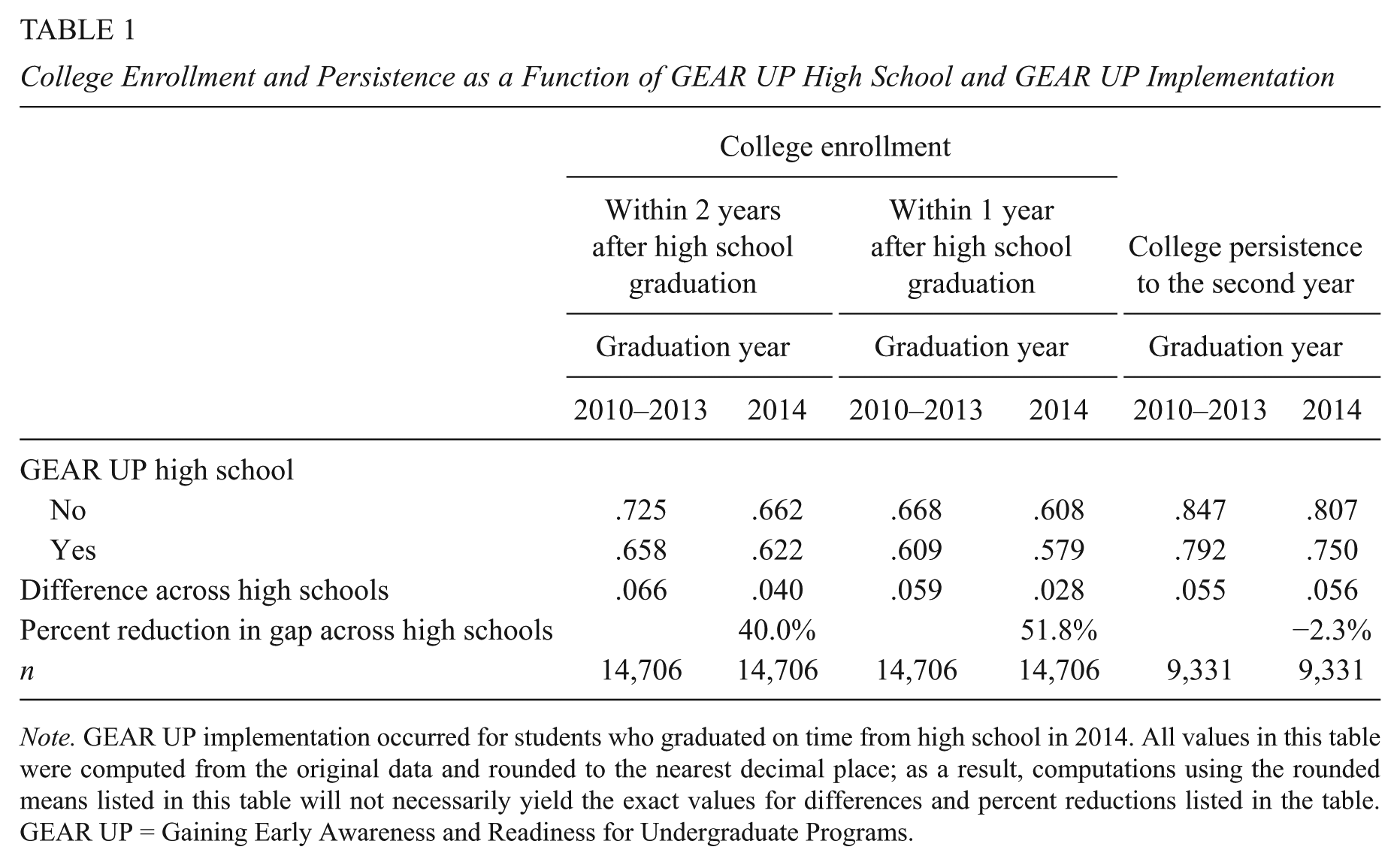
Note. GEAR UP implementation occurred for students who graduated on time from high school in 2014. All values in this table were computed from the original data and rounded to the nearest decimal place; as a result, computations using the rounded means listed in this table will not necessarily yield the exact values for differences and percent reductions listed in the table. GEAR UP = Gaining Early Awareness and Readiness for Undergraduate Programs.
The results of multilevel difference-in-differences analyses without student-level control variables are presented in Table 2. The implementation of GEAR UP Iowa for the high school graduating class of 2014 has marginally significant positive effects (.05 < p < .10) on college enrollment within a year and within 2 years of high school. Depending upon the model and outcome, these gains range from 3.1 to 3.5 percentage points. Among students who enrolled in college in their first year after high school, GEAR UP Iowa participation does not significantly predict persistence to the second year of college. In some ways, this nonsignificant finding could be viewed favorable—or at least not unfavorable—for GEAR UP Iowa. Specifically, if GEAR UP Iowa were only successful at bolstering educational plans and not at preparing students for college, then this program might simultaneously create an increase in college enrollment but a decrease in persistence (as academically underprepared students who otherwise would not have attended college may drop out). Instead, the current results show that GEAR UP Iowa increases the rate of postsecondary attendance, and these students are still just as likely to persist as their peers who did not receive GEAR UP services.
Results of Multilevel Difference-in-Differences Analyses of GEAR UP Program Implementation Predicting College Enrollment and Persistence (Without Student-Level Control Variables)
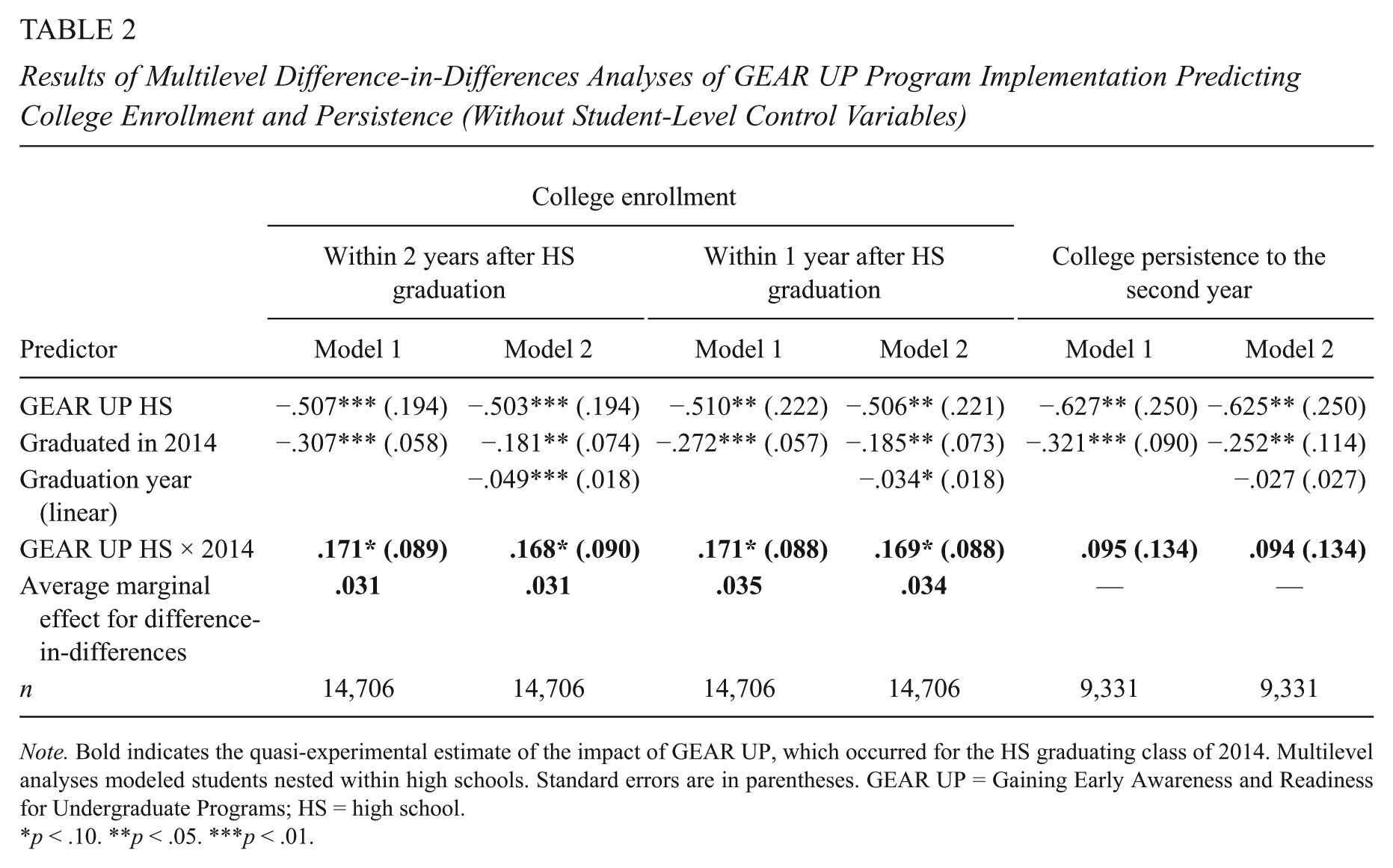
Note. Bold indicates the quasi-experimental estimate of the impact of GEAR UP, which occurred for the HS graduating class of 2014. Multilevel analyses modeled students nested within high schools. Standard errors are in parentheses. GEAR UP = Gaining Early Awareness and Readiness for Undergraduate Programs; HS = high school.
p < .10. **p < .05. ***p < .01.
Although the findings are positive for college enrollment in these analyses, one possible alternative explanation is that the representation of students at the GEAR UP and/or non–GEAR UP high schools changed during the graduating class of 2014. Therefore, additional analyses included student-level control variables of race/ethnicity, sex, SES, and K–12 special education status. As shown in Table 3, the positive effects are still apparent for both college enrollment measures, and no significant effect occurs for college persistence. The inclusion of control variables in these models leads to a slight increase in the size of the estimated effects (3.5–3.8 percentage points).
Results of Multilevel Difference-in-Differences Analyses of GEAR UP Program Implementation Predicting College Enrollment and Persistence (With Student-Level Control Variables)
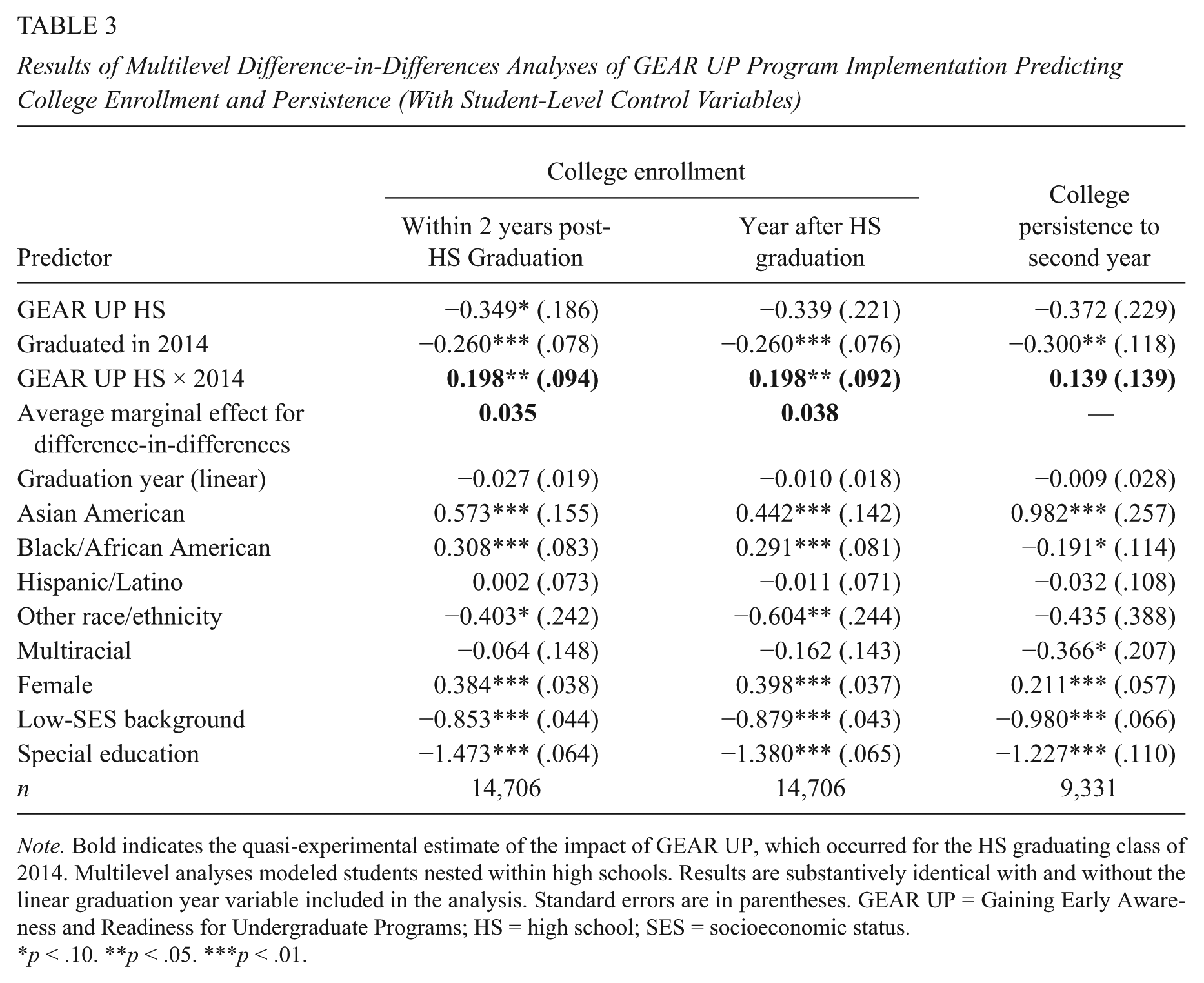
Note. Bold indicates the quasi-experimental estimate of the impact of GEAR UP, which occurred for the HS graduating class of 2014. Multilevel analyses modeled students nested within high schools. Results are substantively identical with and without the linear graduation year variable included in the analysis. Standard errors are in parentheses. GEAR UP = Gaining Early Awareness and Readiness for Undergraduate Programs; HS = high school; SES = socioeconomic status.
p < .10. **p < .05. ***p < .01.
GEAR UP Iowa was funded for the 2014 graduating cohort, but some improvements in school services and practices might last beyond that period. Therefore, additional analyses considered the treatment group as including the graduating classes of both 2014 and 2015 at GEAR UP high schools. Given that the data were collected in 2016, the only outcome that could be examined was college enrollment within 1 year of high school graduation. Once again, a significant interaction between GEAR UP high school and year was present (see Table 4). The magnitude of these effects was similar to those examining 2010–2014, with an estimate of 3.9 percentage points for the 2010–2015 model with student-level control variables.
Results of Multilevel Difference-in-Differences Analyses of GEAR UP Program Implementation Predicting College Enrollment (Treatment and Posttreatment Year)
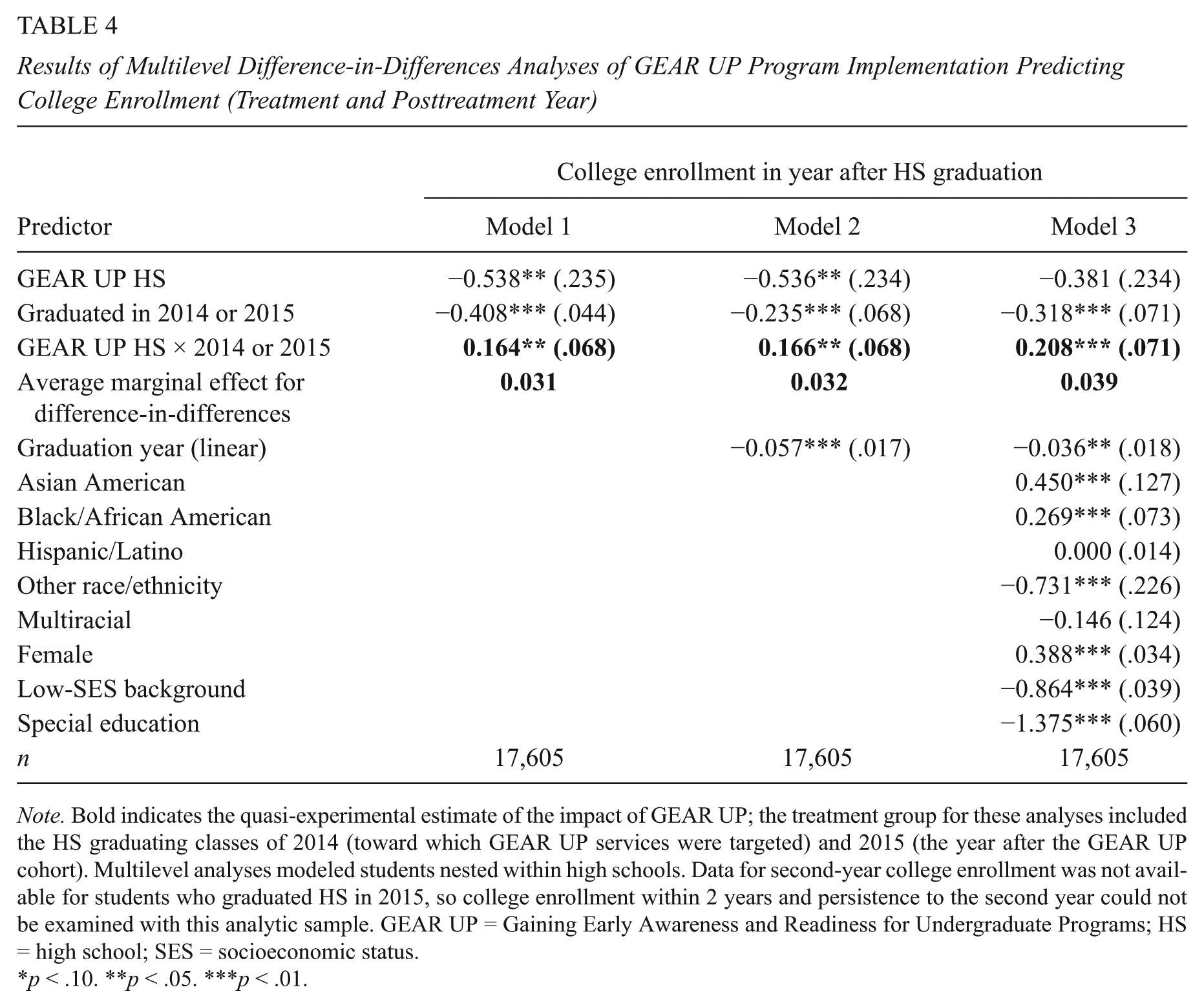
Note. Bold indicates the quasi-experimental estimate of the impact of GEAR UP; the treatment group for these analyses included the HS graduating classes of 2014 (toward which GEAR UP services were targeted) and 2015 (the year after the GEAR UP cohort). Multilevel analyses modeled students nested within high schools. Data for second-year college enrollment was not available for students who graduated HS in 2015, so college enrollment within 2 years and persistence to the second year could not be examined with this analytic sample. GEAR UP = Gaining Early Awareness and Readiness for Undergraduate Programs; HS = high school; SES = socioeconomic status.
p < .10. **p < .05. ***p < .01.
To provide an even more rigorous examination of the causal effect of GEAR UP Iowa, multilevel difference-in-differences analyses with propensity score weighting were conducted. As shown in Table 5, GEAR UP Iowa has a marginally significant and positive effect on college enrollment within 2 years of graduation when examining the 2014 treatment cohort. When the 2014 cohort is combined with the 2015 posttreatment cohort, GEAR UP Iowa has positive, significant effects for college enrollment within 1 year and 2 years after college. The effect sizes observed here (3.3–3.8 percentage points) are similar to those from the unweighted analyses. However, the effect for GEAR UP for only the 2014 cohort predicting college enrollment within a year after high school graduation is no longer significant.
Results of Multilevel Difference-in-Differences Propensity Score Weighting Analyses of GEAR UP Program Implementation Predicting College Enrollment and Persistence

Note. Bold indicates the quasi-experimental estimate of the impact of GEAR UP, which occurred for the HS graduating class of 2014 (with 2015 as a posttreatment year). Model 1 compared students who graduated in 2010–2013 versus 2014, whereas Model 2 compared 2010–2013 versus 2014–2015. Because the data were collected in Summer 2016, college persistence to the second year could not be examined for students who graduated from HS in 2015 (i.e., Model 2 could not be conducted for this outcome). All analyses controlled for race/ethnicity, sex, SES, K–12 special education status, and linear graduation year. Multilevel analyses modeled students nested within high schools. Standard errors are in parentheses. GEAR UP = Gaining Early Awareness and Readiness for Undergraduate Programs. HS = high school; SES = socioeconomic status.
p < .10. **p < .05. ***p < .01.
Providing more insight into the year-by-year trends, Figure 2 displays a graph of the percentage of students who enroll in college within a year after graduation for GEAR UP and non–GEAR UP high schools from 2010 through 2015. Consistent with Table 1, the gap between these lower and higher SES high schools diminishes in 2014 (i.e., the year in which GEAR UP students would graduate on time) relative to the previous 3 years. Furthermore, among 2015 graduates, the high school SES gap in college enrollment within a year of high school (3.5 percentage points) is fairly similar to the gap when GEAR UP Iowa services were administered in 2014 (2.8 percentage points). The overall downward trend in college enrollment over time is expected given that the economy is improving over these years and therefore students may choose to participate in the workforce rather than enroll in college. Indeed, during this time period, high school graduation rates have been increasing while total college enrollment has been decreasing (e.g., Wong, 2016). It is important to note that the values in Figure 2 represent averages across each group of schools. One of the schools in this sample has an immediate college enrollment rate of only 10% among 2015 high school graduates (down from 24% in 2010), so the 52% overall college enrollment rate across all GEAR UP high schools in 2015 does not appear to be the product of a floor effect.
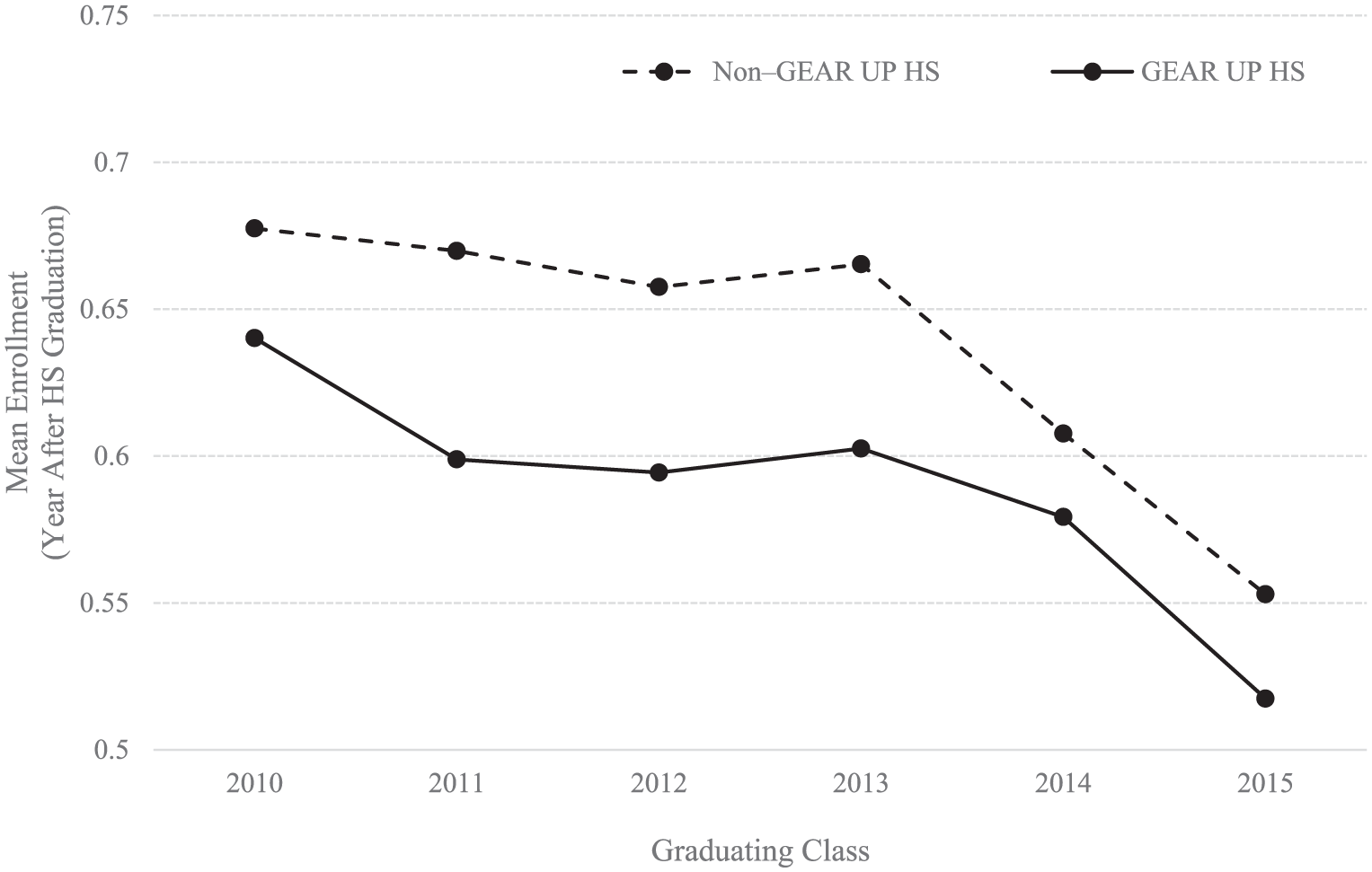
College enrollment within 1 year of high school by graduation year and graduation from a GEAR UP high school.
The lone year that does not fit a clear pattern of positive results for GEAR UP Iowa on college enrollment is 2010. Although the gap between GEAR UP and non–GEAR UP high schools in 2010 (3.7 percentage points) is somewhat larger than in 2014 or even 2015, this gap is smaller than those in any other pretreatment year. A further inspection of the data shows that this initial year of the study is unusual for other reasons. The number of students graduating from non–GEAR UP high schools is notably larger in 2010 (n = 1,972) than in 2011–2015 (n = 1,670–1,728); college persistence among graduates of these high schools is also higher in 2010 (86.8%) than in the other years (80.7%–85.3%). Also within these non–GEAR UP schools, 2010 had the lowest proportion of graduating students who were eligible for free- and reduced-price lunch (17.4% vs. 19.8%–22.8% in 2011–2015) and the greatest proportion of White students (91.9% vs. 86.4%–89.8%). In all of these instances, chi-square tests indicated that the variation across years was highly unlikely to have occurred by random chance (ps < .001). Therefore, the unique nature of students at the non–GEAR UP high schools in 2010 may explain the somewhat distinctive results for college enrollment.
The placebo tests further bolstered the validity of the present results. As expected, no results were significant for 18 different tests that examined control variables as outcomes for difference-in-differences analyses with the “real” program implementation year, including multinomial analyses that compared five different racial/ethnic groups with White students. Moreover, eight of the nine fake policy implementation analyses that examined pretreatment years were nonsignificant (ps > .20). The one exception was for college persistence in 2010 versus 2011–2013, such that the interaction between attending a GEAR UP high school and graduating after 2010 is positive and significant (p < .05). Given the large number of tests conducted for both types of placebo analyses and the potential for Type I error in each test, at least one of these 27 results is likely to be significant by random chance even if there are no true differences in the population. In addition, the lone significant result occurred for college persistence, which was not significant in any of the primary GEAR UP analyses; thus, this placebo finding cannot explain the reliably significant results for college enrollment.
Finally, additional analyses showed that the effects of GEAR UP Iowa on college enrollment were highly consistent in multiple ways. For instance, the difference-in-differences estimates did not differ significantly for enrollment in 2-year versus 4-year institutions or at public versus private institutions. Moreover, only one of the 32 coefficients examining conditional effects of student demographics (SES, sex, special education, and five categories of race/ethnicity) across all outcomes was statistically significant even at the liberal threshold of p < .10 (it was also significant at p < .05). As with the placebo analyses, identifying one significant result across many tests is expected as part of the logic of statistical significance testing, so this lone finding should not be interpreted as being substantively meaningful.
Conclusion
Overall, this study provides strong quasi-experimental evidence that GEAR UP Iowa improved college enrollment rates shortly after high school graduation, but it did not contribute to college persistence. These effects were similar across several student demographic groups, and the enrollment increases continued for students who graduated high school in the year after the program had ended. If anything, the findings were slightly stronger in the more robust models that accounted for demographics and general enrollment trends over time. These findings, which explore a geographic region that varies considerably in its urbanicity, expand upon recent work that examined GEAR UP implementation at a single urban high school (Knaggs et al., 2015; Sondergeld et al., 2013).
An important issue is the extent to which these effects should be considered practically meaningful, especially given the high costs of the program. According to recent recommendations for effect sizes in higher education research, the 3 to 4 percentage points in the present analyses should be considered small (Mayhew et al., 2016). However, two considerations suggest that this effect may be more substantial than the effect size may indicate. First, the observed effects are likely underestimates of the true impact of GEAR UP Iowa, as the analytic sample only includes high school graduates. As discussed earlier, the limited available evidence suggests that the magnitude of this underestimation could vary dramatically from 1.4 percentage points to a double-digit percentage-point increase (Fogg & Harrington, 2015; Knaggs et al., 2015; Sondergeld et al., 2013). Second, even among high school graduates, GEAR UP Iowa reduced the gap in college enrollment between lower SES high schools (who received the program) and higher SES high schools (who were not eligible for the program) by about half. Because GEAR UP is provided to school districts that have high poverty rates, this substantial reduction in inequality is noteworthy in its potential to promote social mobility for lower SES students, neighborhoods, and communities.
The present results provide much-needed rigorous support for the efficacy of GEAR UP in fulfilling its primary intended outcomes, but more research is certainly needed to better understand the effects of these efforts and how they can be maximized. For instance, a few studies have examined how participation in specific services within GEAR UP predicts secondary school outcomes (Cates & Schaefle, 2011; Morgan et al., 2015; Yampolskaya et al., 2006). However, these services may not be solely—or even primarily—responsible for improving attainment, as the college scholarship component may contribute substantially to these outcomes (see Dynarski & Scott-Clayton, 2013). Additional inquiry is needed to examine postsecondary outcomes and to better account for selection into particular services and scholarships. Relatedly, GEAR UP Iowa may differ in its services and implementation in important ways from other GEAR UP initiatives, so further research is needed to explore GEAR UP in other states and regions across the country.
Footnotes
Appendix
Descriptive Statistics for All Variables
| Variable | M | SD | Minimum | Maximum |
|---|---|---|---|---|
| Female | 0.501 | 0.500 | 0 | 1 |
| Asian American | 0.019 | 0.138 | 0 | 1 |
| Black/African American | 0.065 | 0.246 | 0 | 1 |
| Hispanic/Latino | 0.083 | 0.276 | 0 | 1 |
| Multiracial | 0.018 | 0.133 | 0 | 1 |
| Other race/ethnicity | 0.006 | 0.075 | 0 | 1 |
| Low-SES background | 0.306 | 0.461 | 0 | 1 |
| Special education | 0.092 | 0.289 | 0 | 1 |
| College enrollment within 1 year of high school graduation | 0.619 | 0.486 | 0 | 1 |
| College enrollment within 2 years of high school graduation | 0.663 | 0.473 | 0 | 1 |
| Persistence to the second year of college | 0.818 | 0.386 | 0 | 1 |
| GEAR UP high school | 0.406 | 0.491 | 0 | 1 |
| High school graduation year | 2.457 | 1.731 | 0 | 5 |
| High school graduation in 2014 | 0.200 | 0.400 | 0 | 1 |
| High school graduation in 2014 or 2015 | 0.332 | 0.471 | 0 | 1 |
Note. The original range for high school graduation year was 2010–2015; this value was transformed to facilitate interpretation of the results. College persistence to the second year was only available for students who entered college in the year after high school graduation and who graduated from 2010–2014 (n = 9,331). Similarly, high school graduation in 2014 was used in analyses that did not include 2015 graduates (n = 14,706). SES = socioeconomic status; GEAR UP = Gaining Early Awareness and Readiness for Undergraduate Programs.
Acknowledgements
The authors thank the Roy J. Carver Charitable Trust for its generous financial support of this project, the Iowa College Student Aid Commission and the Mississippi Bend Area Education Agency for providing data for this study, and Manuel González Canché for his helpful comments on an earlier version of the paper.
Declaration of Conflicting Interests
The author(s) declared no potential conflicts of interest with respect to the research, authorship, and/or publication of this article.
Funding
The author(s) disclosed receipt of the following financial support for the research, authorship, and/or publication of this article: The authors received a grant from the Roy J. Carver Charitable Trust (#16-4795).

Authors
NICHOLAS A. BOWMAN is a professor in the Department of Educational Policy and Leadership Studies as well as the director of the Center for Research on Undergraduate Education at The University of Iowa. His research uses a social psychological lens to study various issues in higher education, including college diversity, student success, research methodology, college rankings, and college admissions. He can be contacted at N438A Lindquist Center, Iowa City, IA 52242; email:
SANGA KIM is a doctoral candidate in the Department of Educational Policy and Leadership Studies as well as a graduate research assistant of the Center for Research on Undergraduate Education at The University of Iowa. Her research uses sociological perspectives to study equity and racial diversity in higher education, focusing on the experiences and persistence of underrepresented students. She can be contacted at N438C Lindquist Center, Iowa City, IA 52242; email:
LAURA INGLEBY is a research analyst at the Iowa College Student Aid Commission. Her research interests include postsecondary access and success for low income and minority students and the formation of low mass stars. She can be contacted at 430 E. Grand Ave, Des Moines, IA 50309; email:
DAVID C. FORD is postsecondary readiness lead at Mississippi Bend Area Education Agency and director of AEA PREP (Area Education Agency Postsecondary Readiness & Equity Partnership) in Bettendorf, IA. His research interests include examining how longitudinal data systems are used in education to improve postsecondary attainment rates among traditionally underrepresented populations and the impact of school counselor professional development on college enrollment. He can be contacted at MBAEA, 729 21st Street, Bettendorf, IA 52722; email:
CHRISTINA SIBAOUIH is the director for the statewide GEAR UP (Gaining Early Awareness and Readiness for Undergraduate Programs) grant in Iowa, as well as division administrator for Community Engagement for the Iowa College Student Aid Commission. Her research background has included the role of identity in conflict and democratization models to support enhanced civic engagement and stability. Her current work focuses upon the promotion of educational equity and access through collective impact and systems change. She can be contacted at 430 E. Grand Ave, Fl 3, Des Moines, IA 50309; email: