



Abstract
This study is the first large-scale examination of the impact of for-profit colleges on the enrollment and outcomes of students at other postsecondary institutions. Using data primarily from the Integrated Postsecondary Education Data System (IPEDS) and a differences-in-differences approach, I estimate the effect of a new for-profit college opening on community college enrollments and degree completions, as well as county education levels. My results suggest that community college enrollments and degree completions do not decline when a new degree-granting for-profit college opens nearby. Furthermore, I find evidence that the county-level production of short- and long-term certificates increases after a new for-profit college opens, though the number of associate’s degrees does not increase. This evidence should serve to broaden conversations about the role of for-profit colleges in the larger landscape of the American higher education system.
Although a handful of studies have provided evidence that students may view community colleges and 2- and 4-year for-profit colleges as interchangeable (Cellini, 2009; Chung, 2012; Iloh & Tierney, 2014; Ordovensky, 1995; Turner, 2003), this study is the first to explore this with a large, national sample of institutions. In addition, this is the only study exploring this question during the large expansion of the for-profit sector between 2000 and 2012.
This study first examines whether public 2-year and for-profit colleges compete for the same students by examining how enrollments and program awards at public 2-year institutions are affected when a new for-profit college opens nearby. If public 2-year and for-profit institutions compete for some of the same students, then enrollments and program awards should decline at community colleges after a new for-profit college opens. Next, this study explores whether any enrollment shifts are localized within particular subgroups of students, or within particular program strands, such as those more focused on careers in health, business, and computers. A larger proportion of the students enrolled in for-profit colleges are ethnic minorities or of nontraditional age, compared with community colleges. Moreover, for-profit colleges tend to offer credentials in rapidly expanding industries such as information technology and business (Deming, Goldin, & Katz, 2012). The final goal of this study is to determine whether the expansion of the for-profit colleges between 2000 and 2012 increased the overall education levels of the populations in communities where they opened. For-profit colleges may provide access to higher education for students who would not otherwise attend. If this is the case, then the number of people earning postsecondary credentials in a county could increase after a new for-profit college opens.
I find that having a new degree-granting for-profit college open nearby does not affect average enrollments at community colleges or the enrollment of students of color or older students. Likewise, having a new for-profit college open nearby does not affect the production of associate’s degrees, but I find that there are small declines in the number of certificates awarded in health-related fields at community colleges 2 years after a new for-profit institution opens. These results differ from Cellini (2009) who finds that enrollment at community colleges increases when for-profit colleges leave the market. However, Cellini (2009) makes use of data from a single state (California) between 1995 and 2003. Although I find that community colleges across the United States do not lose enrollment to new for-profit colleges, on average, these results could mask heterogeneity by region. Finally, in Cellini (2009), enrollment shifts are the result of changes in funding for community colleges, not only changes in the availability of for-profit college education, as in my study.
My results suggest that for-profit colleges do not only enroll students who would have otherwise attended a community college. If this is the case, then, after a new for-profit college opens, the overall number of degrees produced in a county could increase, depending on the quality of the for-profit institution. I find that the number of certificates produced in a county increases after a new for-profit college opens, though there is no impact on associate’s degrees. This suggests that for-profit colleges may enroll some students who would not have otherwise attended a community college and that the marginal increases in completion at for-profit colleges are concentrated in credentials that take fewer than 2 years to complete. The next section reviews the literature. Following that I describe the data, sample, empirical strategy, and results. The final section discusses my findings and concludes.
Literature Review
Comparing For-Profit and Community Colleges
Some students may view for-profit and community colleges as interchangeable because they offer some similar programs; however, they are very different institutions. Community colleges are typically open-access, 2-year institutions with multiple missions. For example, they award terminal degrees such as certificates and associate’s degrees, but some students also enroll in community colleges with the goal of completing general requirements before transferring to a 4-year institution. Although large for-profit college chains, which offer some online degree programs, such as the University of Phoenix, are among the largest institutions of higher education in the United States, on average, individual for-profit institutions are much smaller than public 2-year institutions. In 2012, the average enrollment at brick and mortar for-profit colleges was approximately 333 students (median = 163.5), while the average enrollment at community colleges was approximately 6,671 students (median = 4,191; tabulation using Integrated Postsecondary Education Data System [IPEDS]). For-profit institutions also enroll a larger proportion of females, minority students, and students above the age of 25 years than community colleges (Chung, 2009; Deming et al., 2012; Rosenbaum, Deil-Amen, & Person, 2006). In 2011, 44% of undergraduate students at for-profit colleges were African American or Hispanic, compared with 34% at community colleges, and while 13% of community college undergraduates were between the ages of 25 and 29 years, 21% of students at for-profit colleges were (NCES, 2012).
For-profit institutions tend to hire professionals as adjuncts to teach their classes and open in office buildings or shopping centers to avoid the costs and bureaucracy associated with faculty and facilities faced by other types of institutions, including community colleges (Breneman, 2006). For-profit colleges develop curricular materials centrally so that courses and programs can be easily replicated in new locations (Bailey, Badway, & Gumport, 2001; Breneman, 2006). In contrast, at community colleges, faculty develop their own course materials and new programs often have to go through a lengthy approval process with the state’s higher education governance structure (Rosenbaum et al., 2006).
The flexible business model of for-profit institutions leaves them freer than community colleges to respond to local labor-market conditions and student demand. For-profit colleges may attract students by offering programs that are more directly tied to local employment demands than those at community colleges (Breneman, 2006; Gilpin, Saunders, & Stoddard, 2015). Moreover, students may choose to enroll in for-profit institutions because capacity constraints at community colleges prevent them from accessing the courses in which they need or want to enroll (Iloh & Tierney, 2014). Almost 20% of respondents to a survey of the National Council of State Directors of Community Colleges (NCSDCC) reported incapacity to serve current and projected student enrollments in 2013 (Katsinas et al., 2013). Moreover, it has been documented that some for-profit colleges offer flexibility and services not provided by many community colleges (Bailey et al., 2001; Breneman, 2006; Kirp, 2003). Kirp (2003) describes the aggressive job placement services that DeVry offers to attract students. Breneman (2006), in a case study of the University of Phoenix, writes that branches of this school offer extensive academic support services, including tutorial services provided online and during the weekend.
Finally, because they do not have access to the same state subsidies for higher education, which allow community colleges to charge students only a small percent of the total cost of their education, for-profit institutions charge higher tuitions than public community colleges. Charges for tuition, fees, room, and board for undergraduates at 2-year public institutions in 2009–2010 amounted to US$8,088, whereas at for-profit institutions in the same year these charges amounted to US$25,016 (NCES, 2012). To pay these higher costs, students make use of federal financial aid and for-profit colleges receive a disproportionate amount of federal aid dollars. In 2008–2009, 76% of all associate’s degrees were awarded by public colleges, while 18% were awarded by for-profit colleges (The College Board, 2011). However, though for-profit institutions produce a much smaller share of the total number of associate’s degrees awarded than community colleges, they receive a similar portion of total Pell grants and a much larger share of subsidized Stafford loans. In 2007–2008, public 2-year institutions received 31% of Pell grants compared with 21% at for-profit colleges (The College Board, 2011). Moreover, for-profit institutions received 21% of subsidized Stafford loans compared with 8% at public 2-year colleges (The College Board, 2011). This distribution of federal financial aid dollars has drawn negative attention to for-profit colleges partly because students attending these schools are more likely to default on student loans than those attending community colleges (Deming et al., 2012).
Given the high cost of for-profit colleges, it may be surprising that some students still choose to enroll in them. Banuelos (2016) lends insight to this puzzle in her historical analysis of the growth in for-profit business schools between 1970 and 1990. The author demonstrates that business employers displayed an increasing preference for employees with credentials over this period, forcing older workers and women to find a way to earn MBAs to advance in their profession. Banuelos argues that, to capture this potential market for MBAs, for-profit colleges offered programs with characteristics that appealed to these experienced workers. Cottom (2017), in her detailed qualitative study of the growth of for-profit colleges, uses her own experience as a recruiter at two different for-profit colleges as well as interview data to argue that students choose for-profit colleges because structures of inequality leave them with little other choice. To advance at work or gain access to middle-class jobs in the first place, individuals need credentials and the for-profits offer the promise of these credentials.
Are For-Profit and Community Colleges Substitutes?
Some early studies theorized about whether community and for-profit colleges could be substitutes, which draw their enrollees from the same pool of potential students (Bailey et al., 2001; Turner, 2006). On the one hand, these two types of institutions may not be substitutes because community colleges have multiple missions, including providing a gateway to 4-year institutions by offering general education requirements at lower tuition levels than 4-year, public institutions. Moreover, for-profit colleges cost much more than community colleges. It is not clear that these institutions could draw in students who could otherwise go to community colleges at a lower cost. Using IPEDS data from 1992–1993 and 1997–1998, Bailey et al. (2001) argue that the for-profit colleges do not pose a strong competitive threat to community colleges. In their case study of a large, multibranch for-profit institution and community colleges located near the for-profit’s branches, the authors find community college administrators report that nearby public 4-year institutions pose the greatest competitive threat.
However, though public 2-year and for-profit colleges might not be perfect substitutes, they may compete along some dimensions. Turner (2006) observes that for-profit colleges are most likely to compete with the public sector for enrollment in programs that offer skills that are easy to observe and certify, such as business and allied health. Moreover, though for-profit and community colleges may have very different sticker prices, for students comparing tuitions net of financial aid, the costs of these two types of institutions may seem more similar.
Despite the importance of understanding whether for-profit and community colleges compete for the same students, there is little empirical evidence exploring this policy puzzle. Ordovensky (1995) uses data from the High School and Beyond Survey of 1980 to explore the effects of distance and cost on college choice. She finds that some students trade away from community colleges toward for-profit colleges when the cost of public institutions increases or when the for-profit institution is closer to the student’s home. Using data on the distribution of Pell grant receipt, Turner (2003) shows that for-profit college enrollment increases when the cost of community college increases. Moreover, she finds that decreases in state appropriations to higher education are positively correlated with enrollment at for-profit colleges. Finally, Chung (2012), using data from the National Educational Longitudinal Survey of 1988 and the associated Postsecondary Education Transcript Study, also finds that characteristics of the higher education marketplace, including the density of surrounding for-profit institutions and the cost of community college, are important predictors of for-profit college choice. These findings suggest that students may view these two types of institutions as interchangeable and decide which to attend based on contextual factors such as which is nearer and which seems to be the best deal financially. However, given the expansion of the for-profit colleges between 2000 and 2010, the findings of these studies using older data may no longer be valid.
Iloh and Tierney (2014) make use of surveys, focus groups, and interviews to better understand how 137 students chose between enrolling in health-related programs at a for-profit or community college in California. Some students appear to view these institutions as substitutes, and they chose between them based on which offered the best service or price. Students who enrolled in the for-profit college report doing so because enrolling was easy and immediate (i.e., the for-profit college has good customer service), while community college students enrolled because of the low cost. However, these authors also found that, for other students, the transfer mission of the community college makes it distinct from a for-profit institution.
Cellini (2009) reports the first causal evidence that for-profit colleges and community colleges compete for the same students. Using an administrative data set including all postsecondary institutions in California from 1995 to 2003, she estimates off the discontinuity caused by votes on bond referenda, and finds that an increase in funding for community colleges reduces the number of for-profit institutions in the market. She also finds some evidence that this increase in funding increases enrollment at the community college, though these estimates are not robust to different specifications.
Does It Matter Where Students Go?
It is only important to understand whether students view for-profit and community colleges as substitutes if where students enroll affects their academic and labor-market success. Deming et al. (2012) use data from the 2004/2009 Beginning Postsecondary Survey and propensity-score matching methods to compare completion rates and employment outcomes for students enrolled in for-profit colleges with observationally similar peers enrolled in community colleges. The authors find that students enrolled in certificate and associate’s degree programs at for-profit colleges are more likely to complete their credentials than students at community colleges. On the contrary, students at for-profit colleges are more likely to be unemployed 6 years after entering their programs (Deming et al., 2012).
A recent study explores whether students who are employed after completing their credentials at for-profit colleges experience a financial return to their degrees. Cellini and Chaudhary (2014) make use of data from the National Longitudinal Survey of Youth (NLSY97) to estimate the returns to education for students enrolled in associate’s degree programs at for-profit colleges, compared with high school students who never enrolled in any postsecondary education. They find that students enrolled in associate’s degree programs at for-profit colleges experience a 10% return to their education. Because these students take, on average, 2.6 years to complete their degrees, the yearly return is estimated to be 4%, per year (Cellini & Chaudhary, 2014).
Marcotte, Bailey, Borkoski, and Kienzl (2005) use National Education Longitudinal Survey of 1988 (NELS:88) data to estimate the returns to attending a community college. They report returns for a year of full-time study, completion of an associate degree, and completion of a certificate. The authors find that men experience a 6% increase in yearly salary for each year of full-time study completed compared with men who only have a high school diploma. Earning a certificate results in a 7.9% increase in yearly salary and earning an associate degree increases annual earnings by 14.7% for men. For women, completing a year of full-time study increases yearly salary by between 8.7% and 11.1%. The increase resulting from earning a certificate is 17.2%, and completing an associate degree results in an increase in annual salary of between 40.4% and 47.6%, depending on which controls are included in the model.
Although there are returns to associate’s degrees earned at for-profit colleges, relative to high school only, these returns are not as high as estimated returns to public 2-year credentials (Cellini & Chaudhary, 2014; Marcotte et al., 2005). Moreover, in the context of a cost-benefit analysis, Cellini (2012) estimates that the return to for-profit education would have to be at least 8.5%, per year, to outweigh the costs to both students and society. The estimated yearly return to students enrolled in for-profit colleges is less than half of that (Cellini & Chaudhary, 2014).
Two recent resume audit studies compare the number of call-backs received by applicants submitting fabricated resumes with credentials obtained from for-profit colleges with those obtained from resumes with credentials from public institutions (Deming, Yutchtman, Abulafi, Goldin, & Katz, 2016; Darolia, Koedel, Martorell, Wilson, & Perez-Arce, 2015). Deming et al. (2016) find that, for health-related jobs that do not require a degree, resumes with certificates obtained from for-profit colleges are approximately 57% less likely to receive a call-back than resumes with certificates from public institutions. On the contrary, when the job requires an occupational license, the authors find no difference in call-back rates for credentials from for-profit versus public institutions. Darolia et al. (2015) find some evidence that employers are more likely to call back applicants listing a credential from a public community college than applicants listing a credential from a for-profit college, though these estimates are not statistically significant.
Although more research is needed on the academic and labor-market outcomes of students attending for-profit and public 2-year institutions, these studies suggest that choosing to obtain credentials from for-profit colleges rather than community colleges has a detrimental effect on students’ labor-market outcomes.
The Importance of Distance
According to economic theory, students choose to enroll in college if the long-run benefits outweigh the present costs. However, after deciding to go to college, a student has to decide where to enroll. This decision may be based on the relative importance of a number of factors including the types of programs offered at different institutions, the relative cost of different schools, and distance from the student’s house to different possible schools. Several studies have demonstrated that distance from home to the nearest college or university affects the educational attainment and enrollment decisions of students (Anderson, Bowman, & Tinto, 1972; Backes & Dunlop Velez, 2015; Card, 1995; Long, 2004; Long & Kurlaender, 2009; Ordovensky, 1995; Rouse, 1993). While the few students attending selective institutions travel to enroll in college, the majority of students enroll in an institution that is close to home (Niu, 2014). In fact, the median distance from a student’s home to the college where they enroll is 11 miles (NCES, 2013). Not only does the distance to the nearest college or university affect the likelihood that a student will enroll (Card, 1995; Rouse, 1993), the nearest school affects the type of institution that a student attends, with people who live near a 2-year college more likely to attend a 2-year college, and people who live near a 4-year college more likely to attend a 4-year college (Backes & Dunlop Velez, 2015; Ordovensky, 1995).
I make use of the distance between community colleges and the nearest newly opened, for-profit college as a measure of the “competitive threat” posed by a new for-profit institution. Because distance matters to students when they decide where to enroll, the distance between institutions may be a good indicator of how much institutions compete with each other. If a new college opens near an already-established one, not only is it now visible and salient to students enrolled at the older school, perhaps leading some students to consider switching, it is also now in close proximity to students who were in close proximity to the already-established institution.
Empirical Framework
Data and Sample
The data for this study come from the IPEDS merged with data from the Census, the American Community Survey (ACS), the Bureau of Labor Statistics’ Local Area Unemployment Statistics (LAUS), and the Grapevine Survey 1 as well as data from Esri Business Analyst. 2 I make use of IPEDS data on institutional characteristics, enrollments, and program completions. I use county-level population data from the Census, county-level population living in poverty and county-level African American population from the ACS, county-level unemployment rates from the LAUS, and state-level per capita appropriations for higher education from the Grapevine Survey. Esri Business Analyst is used to obtain school geocodes not available in IPEDS. 3 Geocodes are used to calculate distances between public community colleges and newly opened, for-profit colleges. All distances are calculated using ArcGIS software. 4
I make use of IPEDS data from 2001 to 2012, because this is the period during which the for-profit colleges experienced the most explosive growth. Because my analysis makes use of geographic markets, I limit my sample to community colleges within the continental United States. In all, 1,237 Title-IV-eligible community colleges appear in IPEDS in the sample years. Of these schools, 24 colleges have missing enrollment data that are not explained by the institution closing or combining with another institution. These schools were excluded from the sample. Supplemental Appendix 1 lists these institutions as well as the unit ID and year of closure of community colleges that closed or combined with another institution between 2001 and 2012. My main sample consists of 1,213 public community colleges. Observations are community college by year. Because some community colleges that were open in 2001 closed before 2012, there are not 12 years of data for every institution.
The distance between each community college and the nearest new for-profit college to open within the sample years is key to my analysis. I make use of the distance between public community colleges and the nearest degree-granting 5 for-profit college, rather than the nearest for-profit college of any kind. I hypothesize that it is nearby degree-granting schools, rather than schools that are far away or that are exclusively offering specific certification programs, such as beauty and truck-driving schools, that are potentially competing with public 2-year colleges. However, when I explore the effect of having a new for-profit college open up nearby on certificates awarded at public community colleges, I make use of the distance between public 2-year institutions and the nearest new for-profit institution of any kind, even if the for-profit college’s highest credential offering is only a certificate. Both 2-year and 4-year for-profit institutions are used when calculating distances because 35% of the credentials awarded by for-profit colleges offering degrees of 4 years or more in 2011–2012 were associate’s degrees (The College Board, 2013). Students seeking an associate’s degree are unlikely to distinguish between a for-profit for which the highest credential offered is a bachelor’s degree and one for which the highest credential offered is an associate’s degree, given that a student could obtain an associate’s degree at either of these schools.
Finally, because my analysis makes use of geographic markets, I have to account for the fact that some for-profit colleges offer primarily online programs. Excluding online institutions from the analysis likely biases estimates downward. Between 2000 and 2010 the growth in for-profit college enrollment was driven by online institutions (Deming et al., 2012). Moreover, the possibility of taking classes online may have been a strong draw for many students and the for-profit colleges were vanguards in the development of online programs. The advertising campaigns of for-profit colleges sometimes focus on the ability to complete courses online as a major benefit of their programs. Following Deming et al. (2012), an institution is coded as “online” if less than 80% of its enrollment comes from in-state or from a state bordering the institution’s home state, or if “online” appears in the name of the school. These online schools were not used when calculating the distance between community colleges and newly opened for-profit colleges.
Figures 1 and 2 display the location of the community colleges in the sample as well as the new for-profit colleges that were used to calculate distances. These maps show that, while community colleges are often scattered across states, in both rural and urban areas, new for-profit institutions open in urban areas. On one hand, this suggests that there is variation in the distance measure. On the other hand, community colleges on both ends of the distance continuum may be very different types of schools. The community colleges that are near new for-profit colleges are much more likely to be large, urban schools.

Community colleges and newly opened degree-granting for-profits, 2001–2012.
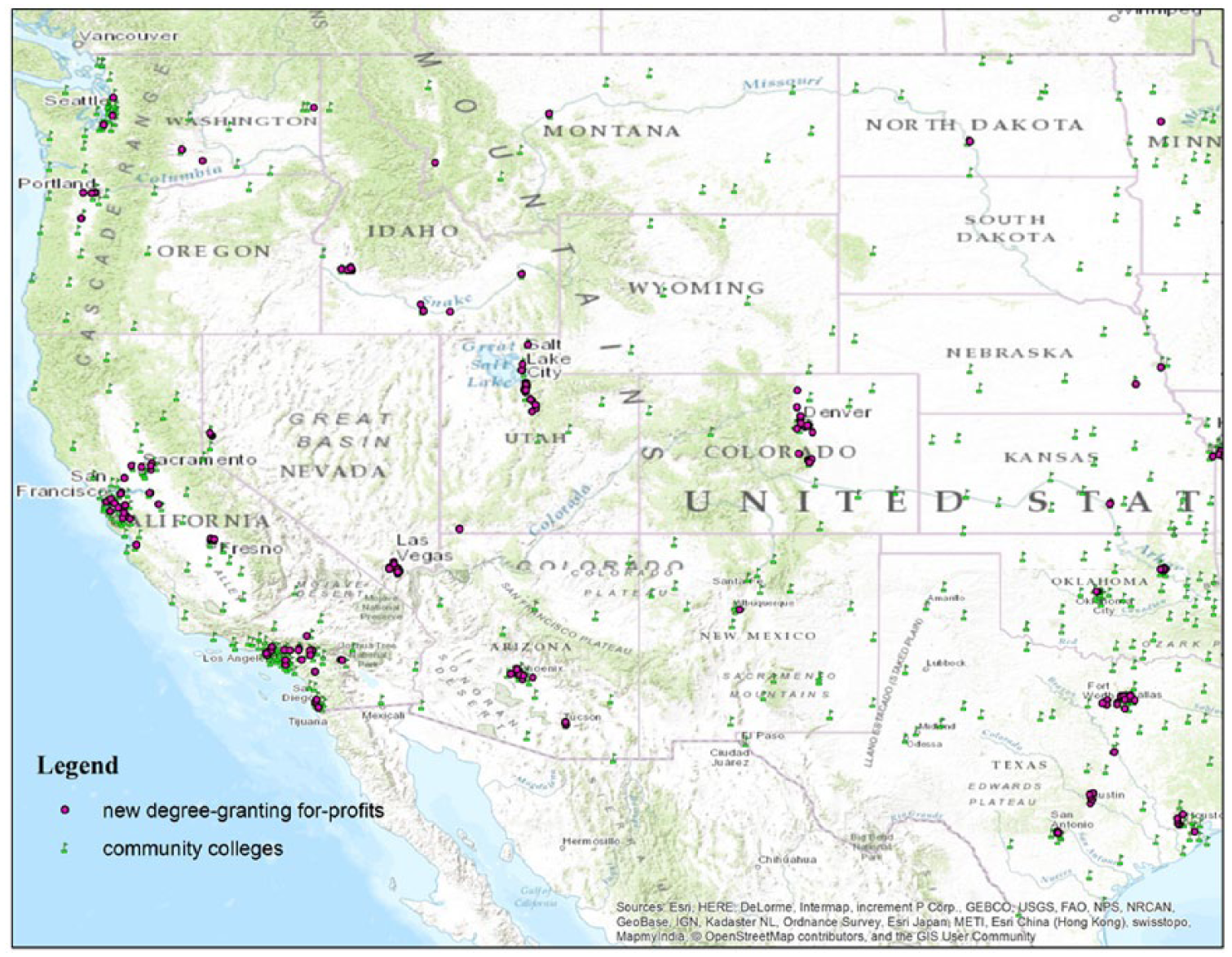
Community colleges and newly opened degree-granting for-profits, 2001–2012.
The difference in the geographic distributions of community and for-profit colleges can be explained by their differing motivations for opening. While for-profit institutions open where they will be able to enroll the most students and maximize their profits, community colleges expanded to increase access to higher education (Brint & Karabel, 1989). Community colleges began to expand rapidly after World War II to meet the labor force needs of an expanding economy as well as to respond to a growing belief that all Americans were owed access to higher education in the same way they had a right to secondary education (Brint & Karabel, 1989). In 1948, the Truman Commission recommended that access to Grades 1 through 14 be made available to the whole population and explicitly recommended the expansion of public 2-year colleges in local communities (Brint & Karabel, 1989). The development of new community colleges still appears to be driven by the needs of local communities. For example, a plan or proposal for a new community college in Ohio must include “a demonstration of needs and prospective enrollment” (Ohio Revised Code Title, 1963).
There are two main sets of outcomes in this analysis: enrollments and degree completions. The enrollment outcomes include total fall enrollment, full-time equivalent enrollment, 6 enrollment of Black and Hispanic students, enrollment by gender, as well as students above the age of 25 years and enrollment of degree-seeking and non-degree-seeking students. Degree completion outcomes include short certificates (certificates of less than 1 year) and long certificates (certificates of at least 1 year but less than 2 years) as well as associate’s degrees awarded in business, education, service, computers, and health-related fields. IPEDS only requires that institutions report enrollments by age group in odd years. For institutions that had missing age-group enrollments in odd years, the previous year’s data were carried forward. For institutions that closed or combined with another institution, enrollment data were missing for the year of and the year before the institution’s change in status.
Some community colleges did not award any certificates and/or associate’s degrees in one or more of the program types included in my analysis in the sample years. These institutions were assumed not to have those program types and were excluded from the models with those outcomes. If an institution did not report awarding any degrees of a particular type, in a particular program, in a given year, but had degree awards of this type in other years, the program awards in missing years were assumed to be zero.
Method
To estimate the effect of competition with for-profit institutions on community college enrollments and program completions, I make use of variation in the competitive threat faced by public, 2-year institutions arising from new for-profit colleges opening nearby. Table 1 displays the number of new for-profit colleges opening in each of the sample years. Many new colleges opened in each year, and the largest growth occurred from 2009 to 2011. 7 A total of 712 new degree-granting for-profit colleges opened within the sample years, though not all of them end up being one of the nearest schools to the community colleges in my sample.
New For-Profit Colleges Appearing in IPEDS Between 2002 and 2012

Source. IPEDS.
Note. Degree-granting for-profit colleges are defined as colleges that offer degrees at least as high as associate degrees. An institution is designated as a chain if it operates in more than one state or has more than five campus branches in a single state. The two categories (“degree-granting” and “degree-granting chain”) are not mutually exclusive. IPEDS = Integrated Postsecondary Education Data System.
Previous research has found that distance is an important predictor of community college student enrollment and persistence (Anderson et al., 1972; Long, 2004; Long & Kurlaender, 2009; Ordovensky, 1995; Rouse 1993). It is plausible that when a new for-profit college opens near a community college, putting it at a similar distance as the public institution for many students, it may offer a tempting alternative for those who see the two types of institutions as substitutes. To estimate the effect of the competitive threat arising from newly opened, for-profit colleges on community college enrollments, I make use of a differences-in-differences approach in which before and after a new for-profit college is the first difference. The distance between public 2-year institutions and the nearest new degree-granting for-profit institution to open within the sample years is the second source of variation. Because there are multiple years in my sample, I interact individual-year dummies with the distance measure, to allow trends to vary non-parametrically. I estimate the following model:

in which
To interpret the coefficient on the interaction as the effect of having a new for-profit college open nearer to the community college, the sign on the coefficient has to be reversed.
Turner (2006) hypothesizes that, while community and for-profit colleges may not be complete substitutes, they are likely to compete for enrollment in programs such as allied health, which teach easily certifiable skills. To explore this hypothesis, I also run my model on a second set of outcomes: associate’s degrees, short certificates and long certificates awarded in health, business, education, service, and computer-related fields.
I am estimating off of variation in the timing and location of new for-profit colleges opening. However, it is possible that the location of a new for-profit college is determined by factors that may also affect community college enrollments. In other words, where and when a new for-profit college chooses to open may not be exogenous. For example, the cost of a particular community college or the local unemployment rate may affect both where a new for-profit college chooses to open and community college enrollments. To overcome this problem, I control for a vector of county and institution-level covariates (
The results will be biased if the covariates and fixed effects do not fully control for factors affecting both where a new for-profit college opens and enrollments and program completions at nearby community colleges. For example, if a new for-profit college that opens near a public community college strategically offers program types not offered by the nearby community college, then the estimates will be biased upward. In other words, I would not find a decline in community college enrollments and program awards, even though, if these two types of colleges offered the same program types, some students may see them as substitutes.
Table 2 compares community colleges for which the distance to the nearest new degree-granting for-profit college is above or below the sample average. These descriptive statistics quantify what can be observed in the maps in Figures 1 and 2: new for-profit colleges open in urban areas. Community colleges nearer new for-profit colleges have larger enrollments, on average, and larger numbers of African American, Hispanic, and nontraditional students. For example, average enrollment at public 2-year colleges with a new for-profit institution opening at a distance below the sample average is 6,741 students, compared with 3,057 students at community colleges farther than average from a new for-profit college. These colleges are also located in counties with larger populations and slightly lower unemployment rates. The average county-level population of community colleges near a new degree-granting for-profit institution is 1,000,000, compared with approximately 120,000 in counties with community colleges farther away from new for-profit colleges. On the contrary, public 2-year colleges with nearer new for-profit colleges are located in states with slightly lower per capita state appropriations to higher education. Community college tuition levels in both groups of schools are very similar. Models using the covariates as outcomes were run to determine whether these factors may be driving any changes in enrollment or program completions that I observe. The covariate as outcomes models suggest that there were statistically significant increases in the population and population age 20 to 29 in the counties where for-profit colleges opened nearer to community colleges (see Supplemental Appendix 4 in the online version of journal). It is possible that population growth is biasing estimates upward and that I find no declines in community college enrollments after a for-profit college opens because enrollments are increasing across sectors due to increases in the population.
Descriptive Statistics for Community Colleges in the Sample

Source. IPEDS, Census, Bureau of Labor Statistics, American Community Survey, and Grapevine Survey.
Note. Distance is the distance (in miles) between each public community college in the sample and the nearest, newly opened for-profit college. Population variables and unemployment rate are county-level variables. Population numbers are in thousands. State appropriations are per capita 2011 dollars. FTE = full-time equivalent; IPEDS = Integrated Postsecondary Education Data System.
If any effects on community college enrollments and degree-completion outcomes in the years after the new for-profit college opens are due to competition from the for-profit institution, rather than secular trends, then I would expect there to be no effects in the years before the new school opens. Equation 1 allows me to test this assumption. If trends in community college enrollments and program completions are equivalent for schools that have a new degree-granting for-profit college open up nearby and for those that have a new degree-granting for-profit institution open up far away, then there should be no statistically significant effect on my outcomes of the interaction of log(distance) and years −4, −3, −2, and −1. Table 3 displays the estimated effects of having a new degree-granting for-profit college open nearby on community college enrollments 4 years before, as well as 4 years after, the new for-profit institution appears in IPEDS. The coefficients on the interactions of log(distance) and years −4, −3, −2, and −1 are close to zero and not statistically significant for any of the enrollment outcomes. This supports my hypothesis that there is no difference in enrollment trends before a new for-profit college opens for public community colleges with new schools opening nearby versus far away. These coefficients suggest that my models meet the assumption that outcome trends for community colleges with a new for-profit college opening near versus far away are equivalent before the new for-profit institution opens.
The Effect of Having a New Degree-Granting For-Profit Open on Community College Enrollments

Source. IPEDS, Census, Bureau of Labor Statistics, and Grapevine Survey.
Note. Observations are community college by year. Year –4 is 4 years before the new degree-granting for-profit appeared in the data, and Year 4 is 4 years after the new for-profit appeared in the data. “Distance” is the distance, in miles, between the community college and then nearest degree-granting for-profit to open in the same state between 2001 and 2012. All models include covariates including county population, county unemployment rate, and county population of adults age 20 to 29 years, ethnic distribution of the population, percent of the population living in poverty, state and local appropriations to higher education, and community college tuition. All models include fixed effects for year, state, and college. Standard errors are clustered by state. IPEDS = Integrated Postsecondary Education Data System.
p<0.01, **p<0.05, *p<0.1.
Results
Enrollment Impacts
I examine the effect of having a new degree-granting for-profit college open on both total enrollments at community colleges as well as the enrollment of students in several subgroups. Some groups of students may be more likely than others to enroll in a for-profit rather than a community college. In 2010, while only approximately 10% of total fall enrollment was in for-profit institutions, approximately 19% of African American students were enrolled in for-profit colleges as well as approximately 11% of Hispanic students (NCES, 2011). In addition, students interested in a vocational credential may be more likely to enroll in for-profit colleges. Credentials at for-profit colleges are usually focused on specific career paths.
To observe the overall trends in community college enrollments, I regressed the enrollment outcomes on the year fixed effects included in Equation 1 as well as county-level covariates and state fixed effects. Figure 3 displays the coefficients on the year fixed effects from these models. Total fall enrollment, full-time equivalent enrollment, the enrollment of men and women, degree-seeking student enrollment, and the enrollment of students above the age of 25 years are clearly increasing over this period. On the contrary, the enrollment of African American and Hispanic students remains fairly stagnant.
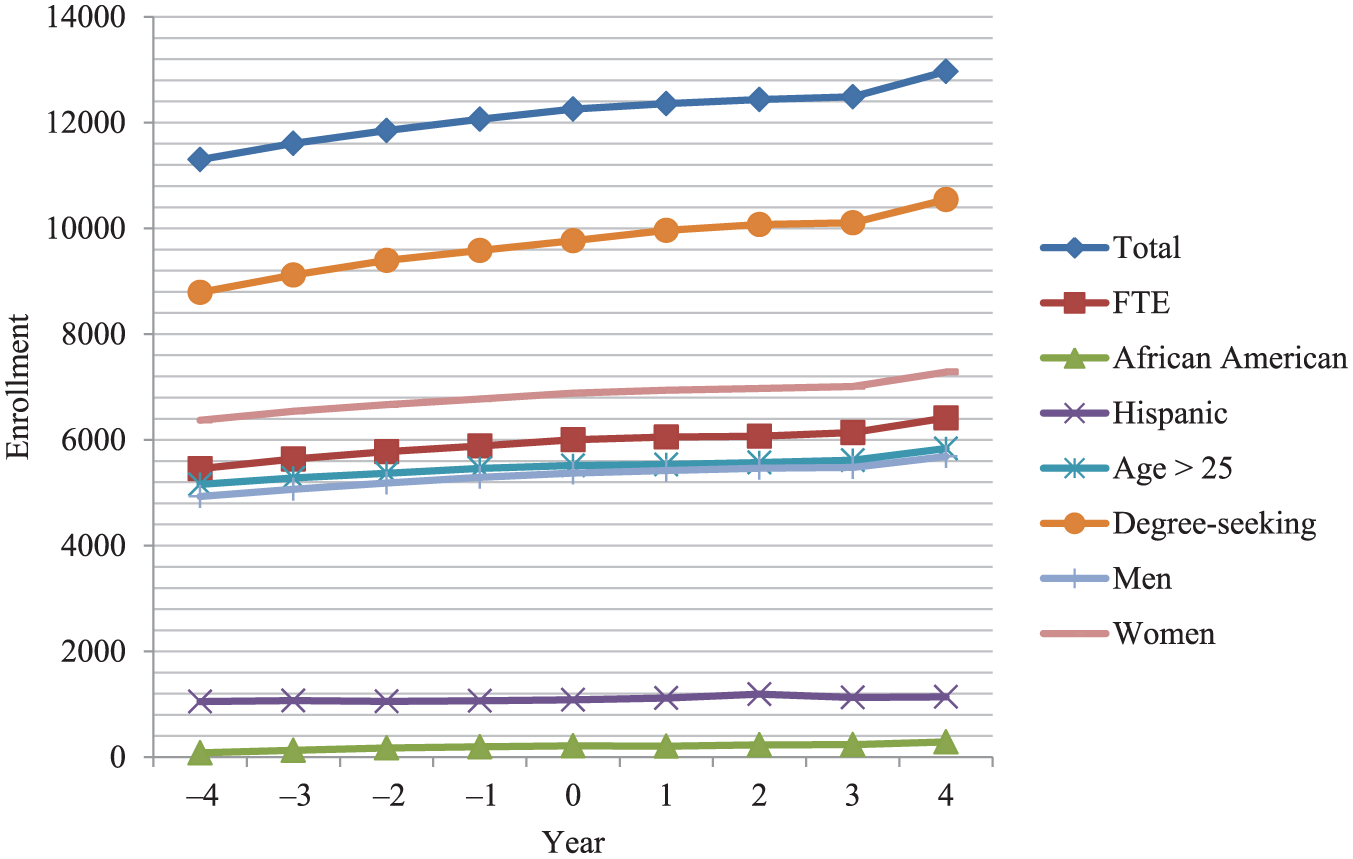
Enrollment trends at public community colleges 4 years before and 4 years after the nearest new for-profit college opens.
Table 3 displays the estimated effect of having a new degree-granting, for-profit college open up nearby on total enrollment at community colleges. I find that having a new for-profit college open nearby has zero effect on average community college enrollments, as well as enrollments by subgroup, and these zeros are precisely estimated. Because I have regressed log enrollments on the interaction of log distance and year dummy variables, I can interpret the coefficients as elasticities. 9 In column 1, the coefficient on the interaction of distance with Year 0 is .00124. 10 This suggest that a 10% decrease in the distance between a community college and the nearest, newly opened for-profit college in Year 0 results in a 0.12% decrease in total enrollment at the community college, though this finding is not statistically significant. 11 Because I want to interpret the coefficient on the interaction as the effect of having a new for-profit college open nearer to the community college, the sign on the coefficient has to be reversed. The standard errors on the coefficients on the interactions for the years after the new for-profit college has opened in column 1 of Table 3 range from 0.0045 to 0.0111. For a 10% decline in the distance between a public community college and the nearest, newly opened for-profit college to cause a 1% decline in community college enrollments, the coefficient on the interaction would have to be close to .1000. Given the standard errors on the coefficients displayed in column 1 of Table 3, this estimate would be statistically significant.
Enrollment at For-Profit College Chains
The explosive growth in for-profit college enrollment between 2000 and 2010 was largely due to the expansion of large chain for-profit colleges (Deming et al., 2012). It is possible that any competitive threat to community colleges comes largely from these institutions. They spend large amounts of their budget on advertising and recruitment (Deming et al., 2012), and, as a result, are probably the most salient to students making decisions about where to attend. In addition, the effect of these institutions on students’ decision-making process probably has the greatest policy relevance. It is these institutions whose predatory practices have made headlines and mobilized the policy community against them. Column 2 of Table 3 displays the effects of having a new branch of a chain for-profit college 12 open up nearby on community college enrollments. Consistent with the results using all newly opened for-profit colleges, having a new branch of a chain open has no statistically significant effect on total enrollments at nearby public community colleges. The results for subgroup enrollments are displayed in Supplemental Appendices 5 and 6.
Nonprofit Private, 2-Year Institutions and 4-Year Institutions
Although it is not clear ex ante whether community and for-profit colleges compete for the same students, it seems likely that private, nonprofit, 2-year colleges would compete with for-profit colleges for the same students. The average tuition charged by the private, nonprofit, 2-year colleges in my sample is US$8,743 (median = US$8,088). This is much closer to the tuition charged by for-profit institutions than community college tuition levels are. Moreover, many of the private, nonprofit, 2-year colleges in the sample are professional schools, similar to the for-profit institutions. There are 301 private, nonprofit, 2-year colleges in my sample, 125 of which I exclude because they have missing geocodes. Of the remaining 176 colleges, 81 have the words “nursing” or “radiologic technology” in the institution’s name. An additional seven schools are described as technical colleges or institutes of technology.
If private, nonprofit, 2-year colleges are more likely than public 2-year institutions to compete with nearby, newly opened for-profit institutions, then running Equation 1 with outcomes at private, non-profit, 2-year colleges provides a test of the empirical strategy. Supplemental Appendix 7 displays the estimates of the effect of having a new degree-granting for-profit college open up nearby on enrollments at private, nonprofit 2-year colleges. Column 1 shows the effect of having a new degree-granting for-profit college open on total enrollment. In years 0 to 2, the coefficients suggest that a 10% increase in the distance from the private, nonprofit 2-year college to the nearest newly opened degree-granting for-profit institution has no effect on total enrollment at the nonprofit college. The coefficient on the interaction of year and distance in Year 3 suggests that a 10% reduction in the distance between the private non-profit, 2-year college and the nearest newly opened, degree-granting for-profit institution is associated with a statistically significant 0.76% decline in total enrollment, on average, across nonprofit private 2-year colleges, and there is a similar decline in Year 4 (0.63%).
Column 5 shows the estimated effect of having a new degree-granting for-profit college open on the enrollment of students over the age of 25 years at private, nonprofit 2-year colleges, and column 7 shows the estimates for the enrollment of men. The estimates for both of these two subgroups suggest a small (between 0.6% and 1%), but statistically significant, negative effect on enrollment of having a new degree-granting for-profit college open nearby and this effect is fairly consistent in the years after the new school has opened. Although the effects on enrollment are small, the coefficients in the models using enrollment at private, nonprofit 2-year colleges as the outcome suggest these two types of institutions compete for the same students.
I would expect a nearby for-profit college to have no effect on enrollments at private, nonprofit 4-year institutions. The majority of private, nonprofit 4-year colleges are not open admission. Moreover, they do not tend to focus their curricula around work-force education the way for-profit colleges do. Supplemental Appendix 8 displays estimates of the effect of having a new degree-granting for-profit college open nearby on enrollments at private, nonprofit 4-year colleges. Having a new degree-granting for-profit institution open nearby has no effect on total enrollment or the enrollment of subgroups except for African American and Hispanic students. Moreover, these zeros are precise. In the case of African American and Hispanic students, there are small, statistically significant declines in enrollment after a new degree-granting for-profit college opens; however, there are also statistically significant declines in the enrollment of these subgroups the year before the new for-profit school opens. This suggests that these declines are a secular trend and not associated with having a new for-profit institution open up nearby.
Program Completion Effects
I would like to know how competition with for-profit institutions affects community college enrollment in particular program strands. Unfortunately, IPEDS does not collect data on enrollments by program, only completions by program. Therefore, I estimate the effect of having a new for-profit college open up nearby on program completions. Because many students, particularly at community colleges, enroll in a program without completing it, the program completions variables are not a perfect proxy for program enrollments. 13
Descriptive statistics suggest that there is overlap in degree-types offered by community and for-profit colleges, and that these schools could be competing for students interested in these programs (see Supplemental Appendix 9 in the online version of the journal). 14 The results suggest that having a new for-profit institution open up nearby has no effect on the number of associate’s degrees produced in these fields at the closest community college (see Supplemental Appendix 10 in the online version of the journal). There is some evidence that having a new for-profit college open nearby has an effect on the number of health-related certificates offered by community colleges. Table 4 displays the results for long certificates. Two years after a new for-profit institution opens, a 10% reduction in the distance between a community college and the newly open for-profit college is associated with a 0.27% reduction in the number of long certificates awarded in health-related fields at a community college, and this decline is statistically significant. There is also a small, statistically significant decline in the number of short certificates awarded 3 years after a new for-profit college opens nearby.
The Effect of Having a New Degree-Granting, for-Profit College Open on the Production of Long Certificates, by Subject

Note. Observations are community college by year. Year –4 is four years before the new degree-granting for-profit appeared in the data, and Year 4 is 4 years after the new for-profit appeared in the data. “Distance” is the distance, in miles, between the community college and then nearest degree-granting for-profit to open in the same state between 2001 and 2012. All models include covariates including county population, county unemployment rate, and county population of adults age 20 to 29 years, ethnic distribution of the population, percent of the population living in poverty, state and local appropriations to higher education, and community college tuition. All models include fixed effects for year, state, and college. Standard errors are clustered by state. IPEDS = Integrated Postsecondary Education Data System.
p<0.01, **p<0.05, *p<0.1.
Community Education Levels
The results above suggest that, with the exception of long certificates in health-related fields, having a new for-profit college open nearby does not affect community college enrollments or program completions. Given these results, I would expect having a new for-profit college open in a county to increase the number of degrees produced in that county. To explore this hypothesis, I estimate the following model using a data set comprised of all counties that are home to at least one community college and at least one new for-profit college:

in which y are county totals of short and long certificates as well as associate’s degrees. “After” is a binary variable coded 0 in the years before the first new for-profit college opens, and 1 in the years after. “Time” is a linear time trend ranging from −9 (9 years before the first new for-profit college opened in county j) to +9 (9 years after the new for-profit college opened in county j).
The errors are clustered by state.
Figure 4 plots the coefficients on year fixed effects from regressions of county-level degree totals on year fixed-effects and county covariates including population, unemployment rate, the population age 20 to 29 years, average community college tuition, percent of the population living in poverty, African American population, and state appropriations to higher education. The model was estimated without an intercept so the coefficient on the year fixed effect represents average county-level degree totals for that year, conditional on covariates. Year is zero for the year in which the first new for-profit college (for certificates) opened or the first new degree-granting for-profit college (for associate’s degrees) opened in each county.

Trends in degrees awarded in counties where a new for-profit college opened between 2001 and 2012.
The trends plotted in Figure 4 suggest that the average number of degrees produced in a county is increasing over time for all degree types. In the case of associate’s degrees, the increase after year zero appears to be the continuation of a secular trend. In the plots for both types of certificates, the average number granted in a county is decreasing in the 1 or 2 years before the first new for-profit college opens and increases after the new college opens.
Table 5 displays the coefficients on the models estimating the effects of having a new for-profit college open on county-level degree production. In Models 1 and 2 in the top panel of Table 5, the outcomes are log-transformed county-level totals of short and long certificates, respectively. In these models, “after new for-profit” is a dummy variable coded 1 in all years after a new for-profit college opens and zero otherwise. In Model 3, the outcome is log-transformed total associate’s degrees produced at the county level and “after new for-profit” is a dummy variable coded 1 in all the years after the first new degree-granting for-profit college opens in a county and zero otherwise.
The Effect of Having a New for-Profit College Open on County-Level Degree Production

Source. IPEDS, Census, Bureau of Labor Statistics, and Grapevine Survey.
Note. Observations are community college by year. All models include covariates including county population, county unemployment rate, and county population of adults age 20 to 29 years, ethnic distribution of the population, percent of the population living in poverty, state and local appropriations to higher education, and community college tuition. All models include fixed effects for year and county. Standard errors are clustered by state. IPEDS = Integrated Postsecondary Education Data System.
p<0.01, **p<0.05, *p<0.1.
In Model 1, the coefficient of interest suggests that having a new for-profit college open in a county is associated with a 23% increase, on average, in the number of short certificates earned and this increase is statistically significant. 15 The estimate from Model 2 indicates that having a new for-profit college open in a county is associated with a statistically significant 13% increase in the number of long certificates earned, on average. While for-profit colleges appear to increase the number of certificates produced in a county, they do not increase the number of associate’s degrees produced. The coefficient of interest in Model 3 suggests that having a new degree-granting for-profit college open in a county is not associated with a change in the number of associate’s degrees produced in that county, on average. Given the potential difficulty of obtaining a longer credential, it is logical that the increases in credential completion occurring after a for-profit college opens in a county occur among the shorter credentials, that is, certificates.
As a simple test of the assumption that it is the new for-profit college opening in a county that is associated with an increase in the number of certificates produced and not just the continuation of a secular trend, I rerun my models with a dummy variable coded 1 beginning 2 years before the first new for-profit college opens in the county. The estimates from these models are displayed in the bottom panel of Table 5. The coefficients on the variables indicating 2 years before the first new for-profit college opens support my argument that it is the new schools that are associated with increases in the number of certificates produced, rather than just a secular trend.
Summary and Conclusion
This study explores whether having a new for-profit college open up nearby affects community college enrollments as well as program awards in computers, service, education, health, and business-related fields. I find that having a new for-profit institution open nearby has no effect on total community college enrollment or the enrollment of African American or Hispanic students, students above or below the age of 25 years, degree-seeking students, or male or female students. Likewise, I find almost no evidence that having a new for-profit college open up nearby changes the number of associate’s degrees, or short or long certificates awarded at community colleges in computers, service, education, health, or business-related fields, though I find some evidence that there is a slight reduction in the number of certificates awarded in health-related fields in the years after a new for-profit college opens up nearby. This is plausible given that a large number of the new for-profit colleges to open during my sample years offer degrees in health-related fields.
My overall findings are different from those of Cellini (2009) who finds enrollment shifts from the for-profit to the public sector result from increases in funding for community colleges. It is possible that students choose community colleges in this instance because of a perceived improvement in community college quality as a result of the increase in funding. In the present study, there is no change in the real or perceived quality of for-profit versus community colleges that could be driving the findings. Rather, I examine whether a change in the availability of a for-profit education leads students to shift from community colleges to for-profit colleges. Moreover, because a large proportion of for-profit college enrollment is online, it is possible that a new brick and mortar for-profit college does not even change the relative availability of for-profit education. In 2012, 42.6% of students enrolled in for-profit institutions were enrolled exclusively in distance education, compared with 9.8% of students at community colleges (NCES, 2014). In addition, though Cellini (2009) finds strong evidence that an increase in funding for community colleges causes for-profit institutions to leave the geographic market, her results for community college enrollment are not consistent. Finally, it is possible that there are regional differences in the effect of having a new for-profit college open nearby on community college enrollments and program awards that are not detectable in this national sample.
The final part of this study explores how new for-profit colleges affect the number of associate’s degrees, as well as long and short certificates, produced at the county level. I find that having a new for-profit college open increases the number of long and short certificates awarded at the county level, though there is no effect on the number of associate’s degrees. This supports the findings related to community college enrollments. If there is no decline in enrollment at community colleges, on average, when a new for-profit college opens nearby, then the for-profit institutions must be enrolling some students who would not otherwise attend. If this is the case, then I would expect to find that a new for-profit college increases the overall number of degrees produced in a community. This is what I find, and it appears that the increase in credentials produced occurs primarily at the certificate level.
Although enrollment in for-profit colleges expanded rapidly between 2000 and 2010, enrollment in these institutions has declined since 2010. At the end of the decade, for-profit institutions faced tightening regulations intended to help students judge the quality of a for-profit college education. The Federal Register issued on October 29, 2010, specified that the following information must be clearly displayed on a program’s website: occupations the program prepares students to enter, on-time graduation rates for students completing the program, tuition and fees charged to students completing the program in normal time, placement rates for students completing the program, and median loan debt incurred by students who complete the program (“Program Integrity Issues,” 2010). Also in 2010 the Government Accountability Office released a report describing the aggressive recruiting practices of for-profit colleges. In May of 2015, the for-profit college chain Corinthian Colleges filed for chapter 11 bankruptcy, leaving thousands of students adrift (Douglas-Gabriel, 2015; Fain, 2014). My results suggest that for-profit colleges are enrolling some students who would not otherwise attend a community college. If this is the case, there may be unmet demand for higher education as for-profit colleges cease to be an option.
Research suggests that students with credentials from for-profit colleges have worse labor-market outcomes than students who earn their degrees from public 2-year institutions (Cellini & Chaudhary, 2014; Darolia et al., 2015; Deming et al., 2012; Deming et al., 2016). However, despite much higher tuition levels, students still choose to enroll in these colleges. On one hand, this could be the result of aggressive recruitment practices and the large portion of their budgets that these institutions spend on advertising (U.S. Government Accountability Office, 2010), or that experiences in the public sector leave students with little other choice (Cottom, 2017). On the other hand, students may enroll in these institutions because they offer programs that are more tightly coupled with local labor-market demand than some programs at community colleges (Gilpin et al., 2015) or because the for-profit institutions are easy to enroll in and offer clear paths to graduation (Iloh & Tierney, 2014; Rosenbaum et al., 2006).
If some students are choosing to enroll in a for-profit college who would not otherwise enroll in a public 2-year institution, then community colleges may not be meeting the needs of some students. The development of programs such as the National Science Foundation’s Advanced Technological Education (ATE) program suggests that community colleges are attuned to the fact that students want to enroll in certificate programs that are tightly coupled with local labor-market needs, and that these programs are being developed. Calls for clearer pathways to degrees at community colleges also suggest that there is a growing recognition that, for some students, community colleges are not effective. As for-profit colleges continue to close, it is the responsibility of state and federal policy makers to ensure that community colleges have the capacity and resources to serve student demand.
Supplemental Material
DS_10.3102_0162373718795053 – Supplemental material for The Effects of the Expansion of For-Profit Colleges on Student Enrollments and Outcomes at Community Colleges
Supplemental material, DS_10.3102_0162373718795053 for The Effects of the Expansion of For-Profit Colleges on Student Enrollments and Outcomes at Community Colleges by Adela Soliz in Educational Evaluation and Policy Analysis
Footnotes
Acknowledgements
I thank Stephanie Cellini, David Deming, Joshua Goodman, Andrew Ho, and Bridget Terry Long for valuable feedback. Any errors are my own.
Declaration of Conflicting Interests
The author(s) declared no potential conflicts of interest with respect to the research, authorship, and/or publication of this article.
Funding
The author(s) disclosed receipt of the following financial support for the research, authorship, and/or publication of this article: This research was supported by a grant from the American Educational Research Association which receives funds for its “AERA Grants Program” from the National Science Foundation under Grant #DRL-0941014. Opinions reflect those of the author and do not necessarily reflect those of the granting agencies.
Notes
Author
References
Supplementary Material
Please find the following supplemental material available below.
For Open Access articles published under a Creative Commons License, all supplemental material carries the same license as the article it is associated with.
For non-Open Access articles published, all supplemental material carries a non-exclusive license, and permission requests for re-use of supplemental material or any part of supplemental material shall be sent directly to the copyright owner as specified in the copyright notice associated with the article.
