



Abstract
Early colleges are a new model of schooling in which the high school and college experiences are merged, shortening the total amount of time a student spends in school. This study uses a lottery-based experimental design to examine the impact of the model on longer term outcomes, including attainment of a postsecondary credential and academic performance in 4-year institutions. Results show that a significantly higher proportion of early college students were attaining postsecondary credentials. The results also show that early college students were completing their degrees more rapidly but that their performance in 4-year institutions was still comparable with the control students.
Keywords
Educators and policymakers have been seeking to increase the number of students enrolling and succeeding in college by implementing a variety of interventions at both the high school and postsecondary levels. High school-level activities have included efforts such as changing the high school graduation requirements to increase students’ likelihood of completing the courses needed for college (Edmunds & McColskey, 2007; Tierney et al., 2009); interventions designed to build students’ aspirations to go to college and their college readiness skills (Swanson et al., 1995); expanding access to college-level courses through dual enrollment and Advanced Placement (Iatarola et al., 2011; Long et al., 2012; Speroni, 2011); and providing assistance to help students complete the logistical steps associated with applying to and enrolling in college (Castleman et al., 2014, 2015). Postsecondary-level interventions include tutoring and counseling, financial aid, efforts to increase students’ sense of belonging in college, as well as more comprehensive interventions that combine multiple factors, such as “living and learning communities” or interventions that couple financial aid with required academic supports (Anderson & Goldrick-Rab, 2018; Angrist et al., 2016; Denning et al., 2019; Perna & Leigh, 2018). These interventions are primarily targeted at addressing specific student needs and are done within the current system that keeps high school and college as separate entities.
Early college high schools (“early colleges” for short) are a different approach that integrates practices designed to promote postsecondary success while combining the high school and college experience. Serving students in Grades 9 through 12 or 13, early colleges target students who are underrepresented in college, such as low-income students, students who are the first in their family to go to college, and students who are members of underrepresented racial and ethnic minority groups. Early colleges are often located on college campuses, which allow students to begin their engagement in the postsecondary experience early. Many students take at least one college course as early as ninth grade; by the time students are juniors or seniors in high school, most of their courses are college courses, and they spend most of their day interacting with other college students. The expectation is that early college students will graduate with both a high school diploma and an associate degree or 2 years of college credit. Thus, students are expected to accomplish in 4 to 5 years what would normally take them at least 6 years (4 years of high school plus 2 years of postsecondary education).
The early college model in North Carolina (one of the states to most fully embrace the model) has been the subject of a 14-year longitudinal experimental study that has found a variety of positive impacts at both the high school and postsecondary levels. Early college students were more likely to successfully complete a college preparatory course of study (Edmunds, Bernstein, Unlu, Glennie, Willse, et al., 2012; Edmunds et al., 2015). They also had higher attendance, fewer suspensions, and were more likely to graduate from high school than students in the control group (Edmunds, Bernstein, Unlu, Glennie, Smith, et al., 2012; Edmunds et al., 2013). Finally, the study found that early college students enrolled in postsecondary education at higher rates, and preliminary findings showed that they were more likely to receive an associate degree within 6 years of entering high school (Edmunds, Unlu, et al., 2017). The enrollment and associate degree findings were replicated in a national study of 10 early colleges (Berger et al., 2013, 2014).
Despite the positive impacts on these outcomes, there are still questions about how well this truncated educational experience will serve students once they graduate from the early college and pursue additional postsecondary education on their own. Some postsecondary faculty may worry that, if the total amount of education time is shortened, students may miss core knowledge and skills that are essential for performing well in college. Early college advocates may respond that their students will be just as well, if not better, prepared than traditional students because of the schools’ emphasis on rigorous instruction, comprehensive supports, and early access to college courses. This article is designed to test these competing hypotheses by examining the impact of the early college on students’ performance in postsecondary education after they leave the early college. Specifically, we are examining the impact of the early college on students’ attainment of a postsecondary credential within 6 years after 12th grade and on their performance in college, as measured by their postsecondary Grade Point Average (GPA). Answering these questions will help determine whether a combined high school–college experience could serve as a viable path for increasing students’ successful completion of postsecondary education.
Conceptual Framework
Researchers have argued that students’ success in college is a longitudinal process (Perna & Thomas, 2006), driven substantially by the background and experiences they bring with them (Tinto, 1993), including their academic knowledge and skills, their organizational and study skills, and their cultural capital, which includes an understanding of how to navigate college. We begin by examining these factors and then describe how the early college environment is designed to address them. We conclude by discussing the unique structure of the early college and the potential advantages and disadvantages associated with it.
Factors Associated With Success in College
Students’ level of incoming academic achievement and preparation are strongly associated with success in college. Students’ grades in high school and scores on standardized tests are positively associated with college grades and successful completion of college (ACT, Inc., 2008; Geiser & Santelices, 2007). In addition, taking more advanced high school courses strongly predicts success in college (Adelman, 2006; Adelman et al., 2003). From at least the early 1900s, colleges themselves have used the type and level of courses that students take in high school as an indicator of whether a student is ready for college, expecting that students take what is now commonly known as a college preparatory course of study (Finkelstein & Fong, 2008; Krug, 1969). In addition to academic content knowledge, researchers have also argued that students’ success in college is dependent upon the level of a variety of academically oriented skills including critical thinking, reading and writing effectively, and problem-solving (Conley, 2005, 2007, 2008; Edmunds, Arshavsky, et al., 2017).
Success in college also depends on students’ ability to adapt to a different cultural environment that requires students to be able to operate more independently (Hooker & Brand, 2010). Thus, skills such as time management, organizational management, study skills, the ability to collaborate with others, and the ability to advocate for oneself take on increasing importance (Byrd & MacDonald, 2005; Conley, 2007), but these are areas in which underrepresented populations, such as first-generation college-goers, may struggle (Collier & Morgan, 2008; Roderick et al., 2009). Some students come with a better understanding of what it means to be a college student, bringing with them the cultural capital that comes from their family members’ academic history or parental coaching on how to behave and what to expect in college (Collier & Morgan, 2008).
A third area associated with success in college is students’ ability to navigate the college environment, including registering for classes, understanding the process of applying for financial aid, and understanding majors and graduation requirements. These are processes that can be confusing and unclear, particularly for low-income or first-generation students (Roderick et al., 2008). For example, an estimated one in five low-income students who were enrolled in college and would have qualified for financial aid never applied for it (Roderick et al., 2009).
As implemented in North Carolina, the early college model intends to prepare students for success in college on many of these fronts. The next section describes the early colleges and the strategies they use to promote postsecondary success.
Early College Model
Early colleges, as studied in this project, are small schools of choice that combine the high school and college experiences and are located on college campuses, primarily on community college campuses. The schools were purposefully created to prepare all of their students for college (Edmunds, 2012), building an environment where “college readiness was not something left to chance . . .” (Edmunds, Arshavsky, et al., 2017, p. 129).
To prepare students academically, the early college uses a variety of approaches, two of which involve coursetaking. The first approach requires all students to take an honors-level college preparatory high school curriculum (North Carolina New Schools, 2013; Thompson & Onganga, 2011). This curriculum is intended to ensure that more students complete the courses needed for entrance to a 4-year university. Results from the existing longitudinal experimental study shows that this does happen with a significantly higher proportion of treatment students successfully completing a college preparatory course of study (Edmunds, Bernstein, Unlu, Glennie, Willse, et al., 2012; Edmunds, Unlu, et al., 2015). Second, early college students receive early exposure to college courses, frequently starting in the ninth grade. As students progress through the early college model, they take more and more college courses that can help them simultaneously meet high school graduation requirements as well as the requirements for an associate degree or, for students on a 4-year university campus, meet the general education requirements of the first 2 years of college (Berger et al., 2010). Results from the experimental study show that early college students completed many more college credits while in high school than the control group (Edmunds, Unlu, et al., 2017).
Early colleges implement other strategies that prepare students with the academic and other skills necessary for success in postsecondary education. For example, the schools emphasize a set of rigorous and relevant instructional practices that required students to engage in critical thinking, extensive writing, cooperative work, and ongoing class discussion (Edmunds, Arshavsky, et al., 2017; North Carolina New Schools, 2013). As an interviewed early college student noted, writing here at the early college gives you a step above the other college students when you get into the English class, because you know what to expect and you’ve already written most of these papers that they ask you to do . . . (Edmunds, Arshavsky, et al., 2017, p. 131)
Early colleges also provide explicit instruction in other skills such as time management, note-taking, and study skills. Most of the schools also indicated that they focus specifically on teaching students to advocate for themselves with college faculty, scaffolding the experience to slowly build students’ ability to communicate effectively with their instructors (Bruce, 2007; Edmunds, Arshavsky, et al., 2017). Students are coached through some aspects of the college navigation processes, including selecting and registering for their classes, identifying and using college resources, and utilizing online course materials, such as Blackboard (Le & Frankfort, 2011). The early colleges also provide explicit assistance in helping students through the college application process, including applying for financial aid (Edmunds, Arshavsky, et al., 2017).
Finally, the early college model recognizes that the increased expectations must be accompanied by increasing support (Jobs for the Future, 2008). As a result, schools focus on developing a comprehensive suite of academic and affective supports (Born, 2006; Le & Frankfort, 2011). Results reported elsewhere indicate that early college students noted higher levels of support than control students (Edmunds et al., 2013).
The Unique Structure of the Early College
The early college thus incorporates a comprehensive suite of practices and supports that are associated with students’ success in college. Given the model’s components, it is reasonable to expect that the early college will result in increased performance in postsecondary education. Nevertheless, as noted earlier, the unique structure of the early college means that high school and college are essentially happening at the same time. The end result is that the early college is truncating what would normally take 6 years (4 years of high school plus 2 years of college) into either a 4- or 5-year experience.
This approach builds on a long-standing argument that there is overlap between parts of the high school and college experiences that can be consolidated (Krug, 1969; Wechsler, 2001). For example, as far back as the early 1900s, Stanford University president David Starr Jordan argued that the instruction of college’s first 2 years “is of necessity elementary and of the same general nature as the work of the high school itself” (McDowell, 1919, p. 18). Nevertheless, the idea of combining portions of high school and college never took extensive hold, reflecting countervailing beliefs that a full 4 years of high school were necessary to provide comprehensive academic preparation and enrichment (Wechsler, 2001).
As a result, it is still an open question about whether combining the high school and college experience, thereby shortening the two, will provide students with sufficient academic preparation to be successful in college. In addition, if high school students are unsuccessful in their college courses, they might be less likely to succeed or be discouraged from future postsecondary education. For example, one qualitative study found that early college students who had poor performance in a college biology class later lost interest in biology and the sciences when they enrolled in the local university (Alaie, 2011).
This article examines two competing scenarios relative to the early college. The first scenario is that a combined high school and college experience, supplemented by comprehensive and purposefully focused practices and supports, can adequately prepare students for further postsecondary education. These supports may especially be instrumental for the postsecondary enrollment, persistence, and degree acquisition of first-generation college-goers and students from economically disadvantaged backgrounds. The second scenario is that, despite the additional supports, the shortened time spent in a high school/college combination and completion of a substantial portion of the first 2 years of college coursework while in high school may result in significant omissions in students’ preparation that would reduce their likelihood of success. This adverse effect may be more prevalent for students who would have pursued postsecondary education even in the absence of the early college model because these students could be missing advanced high school courses they would otherwise have taken. We explore these two scenarios by looking at the impact of the early college model on students’ attainment of a postsecondary credential and their performance in postsecondary education.
Method
This study is based on a multisite randomized field trial designed to examine the impact of early colleges on core student outcomes. The purpose of this article is to examine the impact of the model on students’ performance in postsecondary education. The specific research questions are as follows:
Early colleges included in this study utilized lotteries to select students from an applicant pool, and the study compares the students assigned to the treatment group (early college) with students assigned to the control group (generally the traditional high school in the district, or “business as usual”). This research methodology has been used to look at the majority of impacts from this study (Edmunds, Bernstein, Unlu, Glennie, Willse, et al., 2012; Edmunds, Unlu, et al., 2017).
Analyses estimating the impact of the early college model on postsecondary degree attainment were conducted within the experimental framework; however, we were unable to use the experimental design for the 4-year GPA outcomes for a variety of reasons. First, GPA requires transcript-level data, which was only available for students who enrolled in the University of North Carolina (UNC) system. Second, earlier results indicated that early college students had higher enrollment than control students in 4-year institutions. Both issues indicate that the treatment and control group students were likely not comparable; as a result, we chose to use a quasi-experimental matching approach within the original randomized sample, described in more depth below.
Sample
The full study includes 4,054 students who applied to 19 early colleges over a series of 6 years. The first cohort was in ninth grade in 2005–2006 and the final cohort was in ninth grade in 2010–2011. The early colleges in our sample are located in rural and urban settings in all regions of North Carolina. Schools in the study had to agree to use a lottery to select their students. Students applied to the early college and underwent a screening process designed independently by each school, resulting in a pool of eligible students. The eligible students were then entered into a lottery where students were either offered a spot to attend the early college (treatment group) or were not offered a spot and attended the business-as-usual condition, usually the comprehensive high school in the district (control group). Some schools requested that lotteries be further stratified by selected student demographic characteristics to accommodate their specific priorities, such as ensuring that the school had 80% first-generation students or that each home high school in the district was sending a number of students proportional to their overall population. The sample for each early college was thus a function of the number of eligible applicants each school had, the number of slots they were trying to fill, and the extent to which any additional stratification reduced the number of students randomized (which might have happened if all students in a specific stratum were accepted and therefore had to be excluded from the study).
The 19 early colleges in our sample are only a proportion of the 85 early colleges that were in place at the time of these analyses. To explore the representativeness of our sample, we looked at the characteristics of the students who were enrolled in our study schools compared with students enrolled in other North Carolina early colleges not in our study and also compared with students enrolled in traditional high schools in the same districts as our study sample. As Table 1 shows, the study schools were similar to other early colleges, although study schools had more economically disadvantaged students. In general, the study early colleges had similar socioeconomic characteristics to their neighboring traditional high schools, except that students in our study were more likely to be female, less likely to be identified with a disability, and had higher eighth-grade academic performance than the average student in their district.
Representativeness of the Early Colleges in the Analytic Sample

The demographics for students in the study schools include students who were enrolled in a study school but who may not have been in the study sample (i.e., they were admitted through a nonrandom process).
Within this overall sample, the specific analytic samples were different for the two outcomes and are described along with the outcomes below.
Measures and Data Sources
Outcome Measures
This study focused on two long-term outcomes: attainment of a postsecondary credential and postsecondary GPA. 1
Postsecondary credentials
Successfully completing postsecondary education is one of the key goals of the early college model. The primary outcome examined for this study is attainment of any postsecondary credential including bachelor’s degrees, associate degrees, and technical credentials. We present results both for overall attainment of any credential and separately for each degree type. We primarily examined students’ attainment of these degrees by two time points: 4 years after completion of 12th grade (what is often described as graduating within 100% time for 4-year institutions) and 6 years after completion of 12th grade (what is often described as graduating at 150% time). 2 The federal Integrated Postsecondary Education Data System (IPEDS) reports 6-year graduation rates (Ginder et al., 2018).
The data source for degree attainment is the National Student Clearinghouse (Clearinghouse). The Clearinghouse collects data representing approximately 97% of students enrolled in postsecondary institutions in the United States, including 98% of 4-year institutions and 99% of 2-year institutions in North Carolina (National Student Clearinghouse Research Center, 2019), and provides information about enrollment by semester, the institution in which a student is enrolled, and type and date of any degrees received. The Clearinghouse linked our applicant data to their files using name and birth date.
If a student did not have a degree in the Clearinghouse data, we considered him or her not to have earned one. We acknowledge that a student could be missing from the Clearinghouse data for a variety of reasons beyond nonenrollment or nondegree attainment. The primary other reasons include misidentification or a student opting out of sharing his or her data (Dynarski et al., 2015). We undertook various approaches to minimize these reasons, including resubmitting the same list of names for multiple years since students’ permissions can change over time (Dynarski et al., 2015) and submitting various spellings of the same name (e.g., John, Jon, Jonathan, Jonathon). Although our approach ensures that we have outcome data for all randomized students (i.e., virtually no overall or differential attrition) and the outcomes are defined in the same way for both treatment and control groups, numerically more treatment students may be affected by the incompleteness of degree acquisition data in the Clearinghouse if, as we expect, more treatment students enroll in postsecondary education. As a result, our impact estimates may be considered conservative.
The sample used for the postsecondary credential analyses includes a total of 1,687 students who applied to 12 early colleges in North Carolina from 2005–2006 through 2008–2009. This represents the full sample of students for whom we had data through 6 years after the completion of 12th grade. The analytic sample includes 952 treatment and 735 control students. The baseline characteristics for the sample are shown in Table 2, which indicates that the differences between the treatment and control groups are small and not statistically significant for almost all variables, as expected from groups constructed using random assignment. Nevertheless, all analyses that compare outcomes of treatment and control students control for all of these characteristics.
Sample Characteristics, by Treatment Status

Note. The proportions are weighted by students’ probability of being selected into the ECHS. ECHS = early college high school.
Statistically significant at p < .05.
GPA
Although postsecondary credential attainment is the ultimate goal of going to college, students may still graduate even if they do not do well academically. In other words, any positive impact on graduation rates may mask a lower level of learning. As a result, as a measure of how well students performed in courses they took after leaving the early college, we examine students’ GPA for all college courses they had taken since entering the UNC system after graduation from the early college. Specifically, we examine cumulative GPA measures at four time points: (a) through 2 years after 12th grade, (b) through 3 years after 12th grade, (c) through students’ first year at the UNC system, and (d) through students’ second year at the UNC system. Cumulative GPA measured at 2 and 3 years after 12th grade aims to hold constant students’ age and the time after they enrolled in high school, whereas cumulative GPA through the first and second year at the UNC system aims to hold constant the time students spent in the UNC system. Using multiple measures defined at different time points allows us to examine GPA in a comprehensive and flexible manner, accounting for the wide variation across when students enrolled in the UNC system. For example, some students enrolled in the UNC system right after completing high school, whereas some students enrolled after spending 2 years in a 2-year institution.
Analyses of GPA cannot use the fully randomized sample of students because a given grade point measure is only defined for students who enrolled in the UNC system at each time point. In addition, for students who enrolled in a 4-year college outside the UNC system, we cannot measure their GPA reliably and set their GPA to missing. Therefore, the analytic sample for GPA measured at each of these time points differ according to which students were enrolled in the UNC system with course data at that particular time point. Given the relatively large proportion of students with missing GPA (between 68% and 74%), we did not impute missing values for this outcome.
Another factor complicating the GPA analyses was that having a nonmissing GPA measure could have been directly related to the treatment. For example, cumulative GPA through 2 years after 12th grade was missing for 69% of the treatment students, whereas it was missing for 76% of the control students. This was likely a direct result of the positive impact of the treatment on students’ enrollment in 4-year institutions. Because of the large overall and differential missing rates for the GPA measures, we treated these analyses as quasi-experimental and employed propensity score weighting methods to conduct the GPA analyses with comparable treatment and control students, described in the “Statistical Methods” section.
The sample used for the GPA analyses includes students who applied to the 19 study early colleges from 2005–2006 through 2010–2011 and enrolled in a UNC campus post high school through the spring 2017 semester. The size of the analytic sample varies across the four GPA measures, from 1,072 students (674 treatment and 398 control) for cumulative GPA through second year of college to 1,292 students (797 treatment and 495 control) GPA through first year of college.
Covariates
The outcome measures created using the UNC System and National Student Clearinghouse data were linked to student application data (which included treatment/control status and odds of being selected to the early college) and data from the North Carolina Department of Public Instruction (NCDPI). NCDPI data included baseline covariates such as demographic characteristics (gender, race/ethnicity), economically disadvantaged status, eighth-grade achievement scores, and special education status. The propensity score analysis conducted for the GPA measures utilized additional measures including eighth-grade absences, teachers’ assessment of students reading and math achievement in eighth grade, performance score for the eighth-grade school, district-level average high school graduation rates, and number of colleges within eighth-grade county. All of the data were linked and stored at the North Carolina Education Research Data Center housed at Duke University.
Subgroups
Early colleges were specifically designed to increase postsecondary access and success for students for whom access to college has historically been problematic. As a result, we examined the impact for four different subgroups. Three of these subgroups were members of the target population for the early college: (a) underrepresented minorities (students who identified as African American, Hispanic/Latino, or Native American); (b) first-generation college-goers, defined as students whose parents had no exposure to postsecondary (Cataldi et al., 2018, p. 2); and (c) economically disadvantaged students. The final subgroup was students who were not prepared for ninth grade, defined as students who did not pass either the reading or math eighth-grade end-of-grade exams. This was not a target population for the initiative; however, we believed it was important to examine this subgroup because many practitioners had concerns about whether lower performing students could succeed in a model that accelerates them quickly into college courses.
Statistical Methods
This section first describes our basic approach for analyzing impacts. We then identify how this approach had to be modified to look at postsecondary GPA.
Estimation of Impacts
Each outcome measure was used as the dependent variable in multivariate regression models that included lottery indicators, baseline covariates (demographics and measures of prior achievement listed above), and a treatment group indicator, which yielded the estimated impact of the early college on that outcome. The analyses reported in the article were conducted in the intent-to-treat (ITT) framework, meaning that the treatment indicator captures the initial random assignment status for a given student. We do not report separate treatment-on-the-treated (TOT) or local average treatment effect (LATE) estimates as compliance with the initial random assignment status was fairly large (92% among treatment students and 99% among control students).
As mentioned above, some school-level lotteries were stratified on student demographic characteristics which led to different probabilities of being assigned to the treatment group. 3 For such lotteries, we created weights to account for the unequal treatment assignment probabilities and these weights were used in the estimation 4 (Imbens & Rubin, 2015; Institute of Education Sciences, 2018). We used cluster-robust standard errors calculated based on the early college or the regular high school that students attended for the longest period of time. The equation below represents a prototypical regression model:
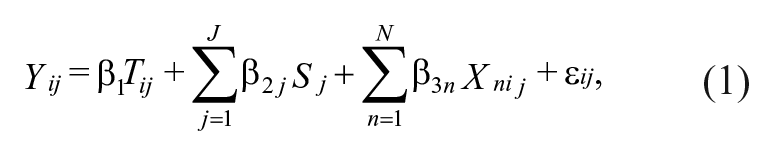
where Yij is the outcome of interest for student i in lottery j; Tij is the treatment indicator for student i in lottery j (Tij = 1 if student i is assigned to the treatment group; Tij = 0 otherwise); Sj is a lottery indicator equal to 1 for students who participated in lottery j and to 0 otherwise (j = 1, . . ., J); β1 is the estimated average ITT treatment effect; β2j is the fixed effect for lottery j (i.e., the average outcome of the control students from lottery j); Xnij is the nth characteristics of student i in lottery j, which is included as a covariate; β3n represents the relationship between the nth student characteristic and the outcome Y; and εij represents the random error term
For all outcomes, we present the adjusted impact estimate, the unadjusted control mean, and an adjusted mean for the treatment group that is calculated by adding the adjusted impact to the unadjusted control mean. We also present the cluster-robust standard errors for the impact estimates.
The subgroup analyses were conducted by estimating a similar impact model for each subgroup of interest and the rest of the sample (i.e., separate impact models were run for first-generation college-goers and non-first-generation college-goers). Following Bloom and Michalopoulos (2010), we also report whether the impact for a given subgroup is statistically significantly different than the impact for the rest of the sample.
Addressing Missing Values for Outcomes and Covariates
Relying on administrative data reduced the instances of missing outcome and covariate values. We did not impute missing outcome values. To address missing covariate values, we used Stata’s multiple imputation module mi (StataCorp, 2019). Specifically, we utilized multiple stochastic imputation by chained equations that included the treatment indicator and outcome values. This approach is consistent with the widely accepted best practices in the field and the most recent WWC standards. Using Rubin’s rules, our statistical inferences accounted for the uncertainty introduced by the imputation procedure (Rubin, 1987).
Propensity Score Weighting for GPA
As described in the “Method” section, the GPA analyses faced challenges with missing data because we only had data for students in the UNC system and because the early college had a positive impact on enrollment in postsecondary education. We used a propensity score weighting approach to balance the observable characteristics of the treatment and control students who had valid GPA to the extent possible. As there were many more treatment students who had a GPA than control students, the weighting process is similar to matching control students who have valid GPA with similar treatment students who have valid GPA. Therefore, this analysis is expected to yield the effect of early colleges on GPA for students who would have enrolled in the UNC system even in the absence of the program. We used weighting as it does not require making additional decisions that most matching procedures do (e.g., choosing a radius, whether to match with replacement or not, whether one-to-one or one-to-many matching is conducted; Stuart, 2010). 5
We implemented weighting separately for each of the four GPA measures through a multistep process. The first step was estimation of the propensity scores. In this case, the propensity score represents the probability of having a GPA as function of baseline covariates that are considered to predict GPA and enrolling in an UNC campus. Our covariates included demographics (race/ethnicity, gender, age, economic disadvantage, first-generation college going status, having a disability, being identified as academically or intellectually gifted), baseline indicators of student achievement (being retained in a prior grade, scores in eighth-grade math and reading end-of-course exams, passing Algebra I in eighth grade, and teachers’ assessment of eighth-grade achievement in math and reading), eighth-grade absences (proxy for academic engagement and motivation), and additional factors that we expected to predict enrolling in UNC such as academic performance of the eighth-grade middle schools, 6 district-level baseline high school graduation rates, and number of colleges in the eighth-grade county. We estimated the propensity scores using generalized boosted modeling (GBM; McCaffrey et al., 2013). GBM combines boosting (i.e., iterations) and regression trees (which partition the data set into numerous regions based on the covariate values). GBM is data adaptive and nonparametric; it automatically selects which covariates should be included and the best functional form by using many piecewise functions of the covariates and testing all possible interactions to achieve the best balance between the treatments and comparison units. GBM also accommodates missing values for covariates by balancing both the distribution and the rates of missingness of each covariate between the treatment and comparison arms. We implemented GBM using the twang package in Stata (Cefalu et al., 2015).
The second step was calculating weights for the treatment students with valid GPA measures so that they look similar to the control students who have a valid GPA measures. Following Stuart (2010), control students are weighted by 1, treatment students are weighted by
The final step was assessing baseline equivalence. For each covariate, we examined standardized differences (i.e., effect sizes) between the weighted treatment and control students (Institute of Education Sciences, 2018; Rosenbaum & Rubin, 1985). We required standardized differences to be less than 0.1 SDs in absolute value for all covariates (which is more stringent than the 0.25 SD threshold adopted by the WWC).
Table 3 shows the sizes and characteristics of the GPA analysis samples. For each GPA measure, we present treatment and control differences before and after weighing. We see that there were sizable differences between the treatment and control students prior to weighting, with some differences being greater than 0.2 SD. Weighing reduced all of these differences below 0.10 SDs and made the two groups tightly balanced on observable characteristics.
Balance of the Weighted Control and Treatment Students With Valid GPA, Before and After Weighting
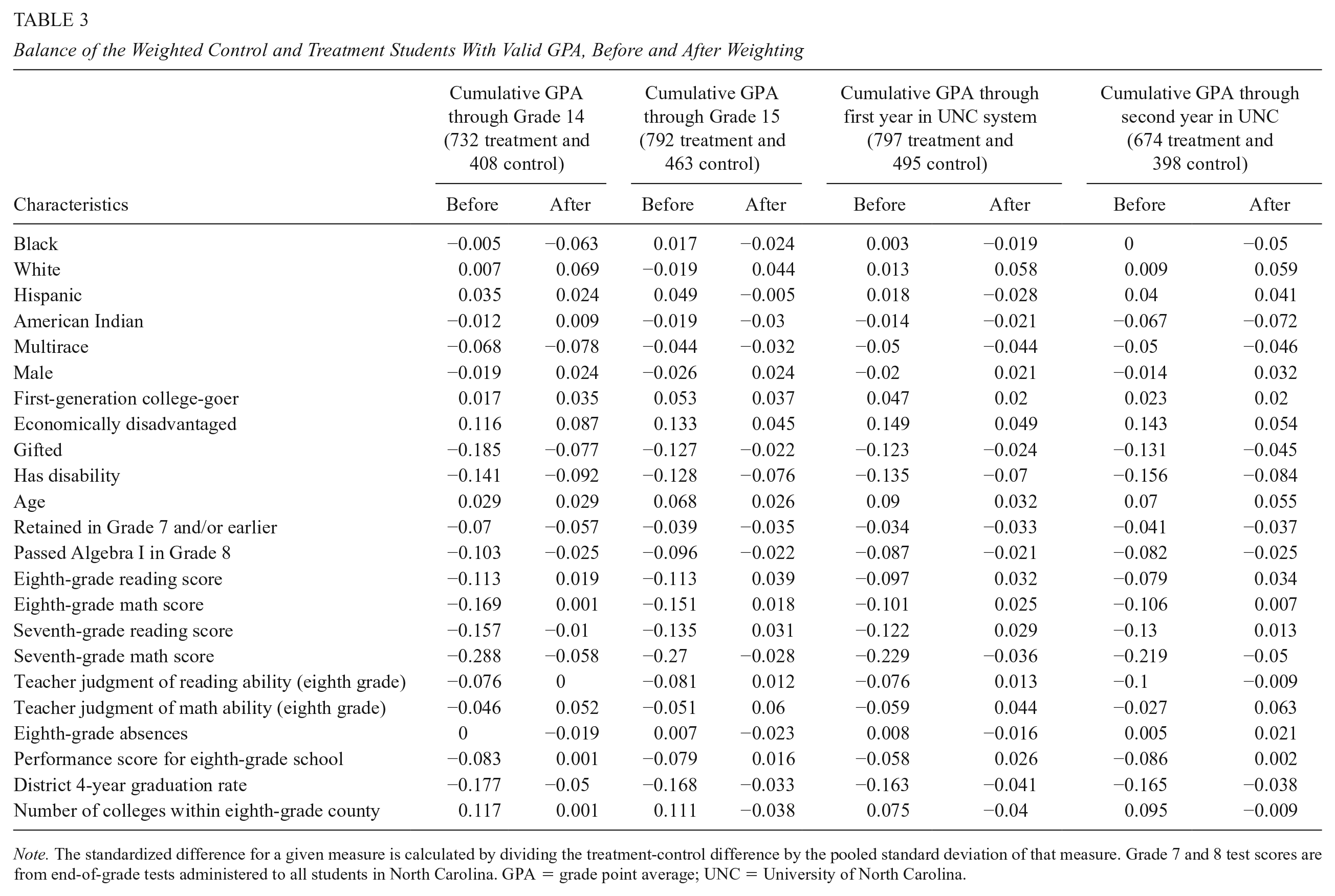
Note. The standardized difference for a given measure is calculated by dividing the treatment-control difference by the pooled standard deviation of that measure. Grade 7 and 8 test scores are from end-of-grade tests administered to all students in North Carolina. GPA = grade point average; UNC = University of North Carolina.
To calculate the impact on GPA, we used the analytic model and approach described above for the analysis postsecondary credentials.
Results and Discussion
The first research question asked whether early college students were more likely to earn a postsecondary credential than control students; we assessed these impacts using the randomized controlled trial sample. Our results show that early college students received postsecondary credentials at a higher rate than control students: By the end of the fourth year after the end of Grade 12, 37.8% of the treatment group had earned a postsecondary degree compared with 22.0% of the control group (see Table 4). This was driven in large part by a 21.2 percentage point impact on associate degree attainment.
Impact of the Early College Model on Attainment of a Postsecondary Credential
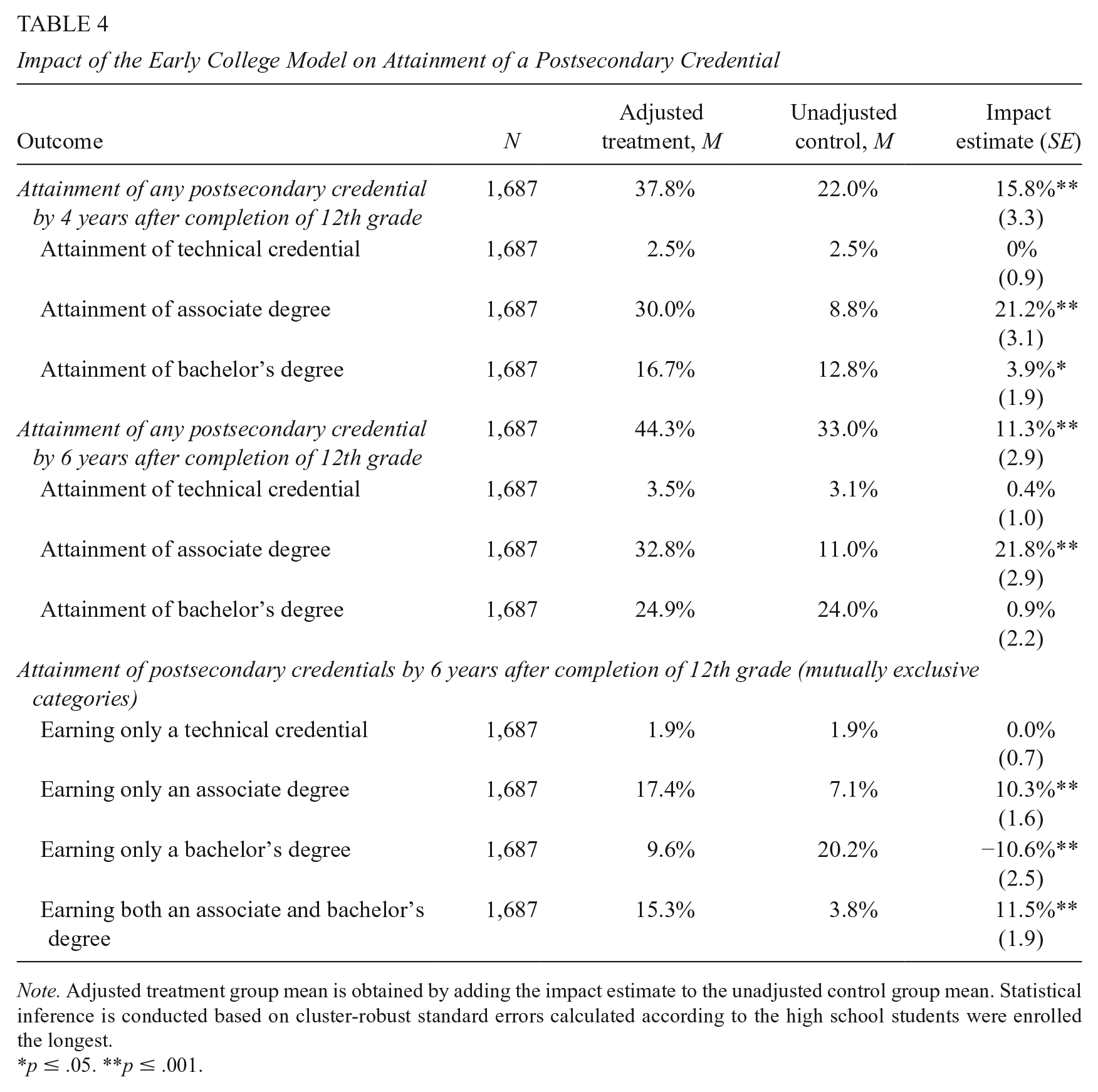
Note. Adjusted treatment group mean is obtained by adding the impact estimate to the unadjusted control group mean. Statistical inference is conducted based on cluster-robust standard errors calculated according to the high school students were enrolled the longest.
p ≤ .05. **p ≤ .001.
When we look 6 years after the end of Grade 12, we see that there remains a significant impact on overall degree attainment and on associate degree attainment with 44.3% of the treatment group estimated to have a postsecondary credential compared with 33.0% of the control group and an impact of 21.8 percentage points on associate degree attainment. As Table 4 also shows, however, by 6 years after Grade 12, the control students have essentially caught up to the treatment students in 4-year degree attainment (24.9% treatment vs. 24.0% control).
Because students could earn both an associate degree and a bachelor’s degree, we also analyzed the results by the following mutually exclusive categories: (a) earning only a technical certificate, (b) earning only an associate degree, (c) earning only a bachelor’s degree, and (d) earning both an associate and bachelor’s degree. These results, also shown in Table 4, provide additional support that the mechanism for increased degree attainment is primarily through the associate degree route, giving students a credential who would otherwise have not earned one at all and also giving students with bachelor’s degrees an additional credential.
When we look at the results for degree attainment by subgroup (shown in Table 5), we see similar results with large positive impacts for associate degree and generally nonsignificant impacts for 4-year degree attainment with one exception: There is a statistically significant positive impact on 4-year degree attainment for economically disadvantaged students. This is consistent with the program’s theory of change for removing barriers to degree attainment for first-generation and low-income students. When we look at differences in impacts between subgroups, we see larger impacts on 2-year degree attainment for the nontargeted groups. We speculate that this might be because students in these relatively more advantaged groups might otherwise be less likely to attain an associate degree, instead going directly into a 4-year university. Results for the mutually exclusive categories by subgroup are reported in the Supplemental Appendix (provided in the online version of the journal).
Impact of the Early College Model on Attainment of a Postsecondary Credential, by Subgroup

Note. Adjusted treatment group mean is obtained by adding the impact estimate to the unadjusted control group mean. Statistical inference is conducted based on cluster-robust standard errors calculated according to the high school students who were enrolled the longest.
p ≤ .05. **p ≤ .001.
The findings suggest that the large impact on 2-year degree attainment is maintained (and even grows slightly) when looking at the time period between 4 and 6 years after 12th grade. In contrast, the control group appears to be catching up relative to 4-year attainment with the significant impact at 4 years essentially disappearing when students are 6 years out. There is, however, an advantage to students completing their degree more quickly—it may end up costing students and taxpayers less, and students may be able to more quickly find employment. Indeed, one of the goals of the early college is to streamline the high school and college experiences so that students require less time to graduate and can enter the workforce more rapidly. As a result, we looked at the time it took students in both treatment and control groups to earn a degree. Figure 1 shows both the impact estimates and the timing of 2- and 4-year degree acquisition by the treatment and control students, respectively. These figures not only show that a larger number of treatment students have obtained 2- and 4-year degrees than control students (which is consistent with the positive impact estimates shown in Table 4), but they also indicate that treatment students obtained their degrees at a faster pace than control students. Our analyses found that treatment students who earned an associate degree did so approximately 2 years earlier than the control students. Treatment students who earned a bachelor’s degree did so approximately half a year earlier than control students.
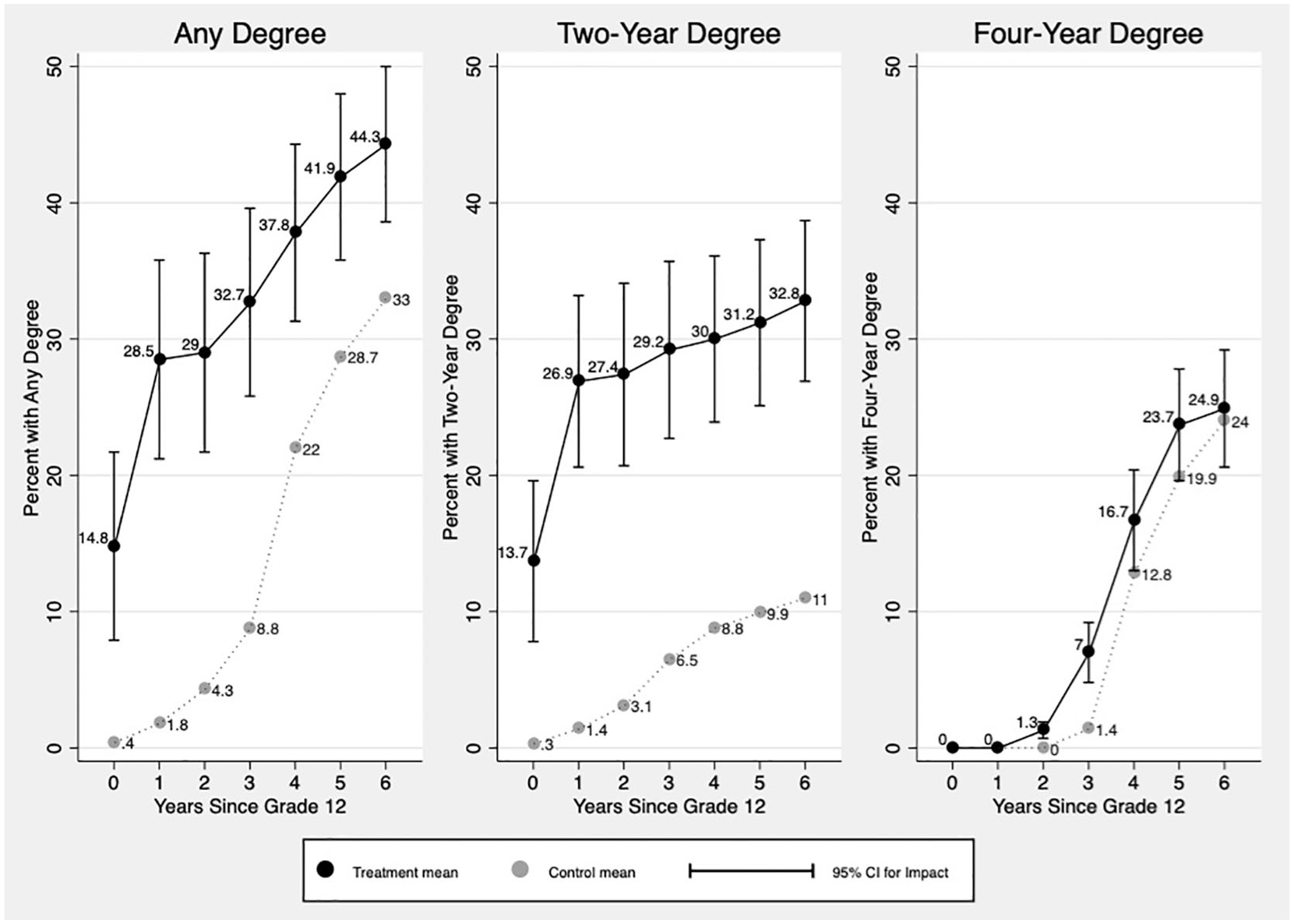
Attainment of postsecondary credential over time, by treatment status and by level of degree.
Our results show that the early college is having a large and sustained impact on associate degree attainment and that students are earning a 4-year degree more rapidly. Nevertheless, some educators and policymakers may argue that the shortened time to degree means that students are missing time to develop key content and skills. Although the final test of this will be students’ success in the workplace, students’ GPA in college courses give a preliminary indication of whether students are missing key skills. Table 6 shows impacts on student performance on cumulative GPA at four different time points (2 and 3 years after 12th grade, and the first and second years in college). As noted above, the first two analyses control for the time since starting high school, whereas the second set (GPA in the first and second years of college) control for the time enrolled in the university system. As the table shows, early college students performed the same as control students. Among the four measures, the estimated impacts on all outcomes were small in magnitude and not statistically significant. These findings suggest that those treatment students who would have enrolled in the UNC system even in the absence of the early college model were just as prepared as control students but did not have a substantial advantage relative to academic preparation post high school.
Impact on Cumulative GPA
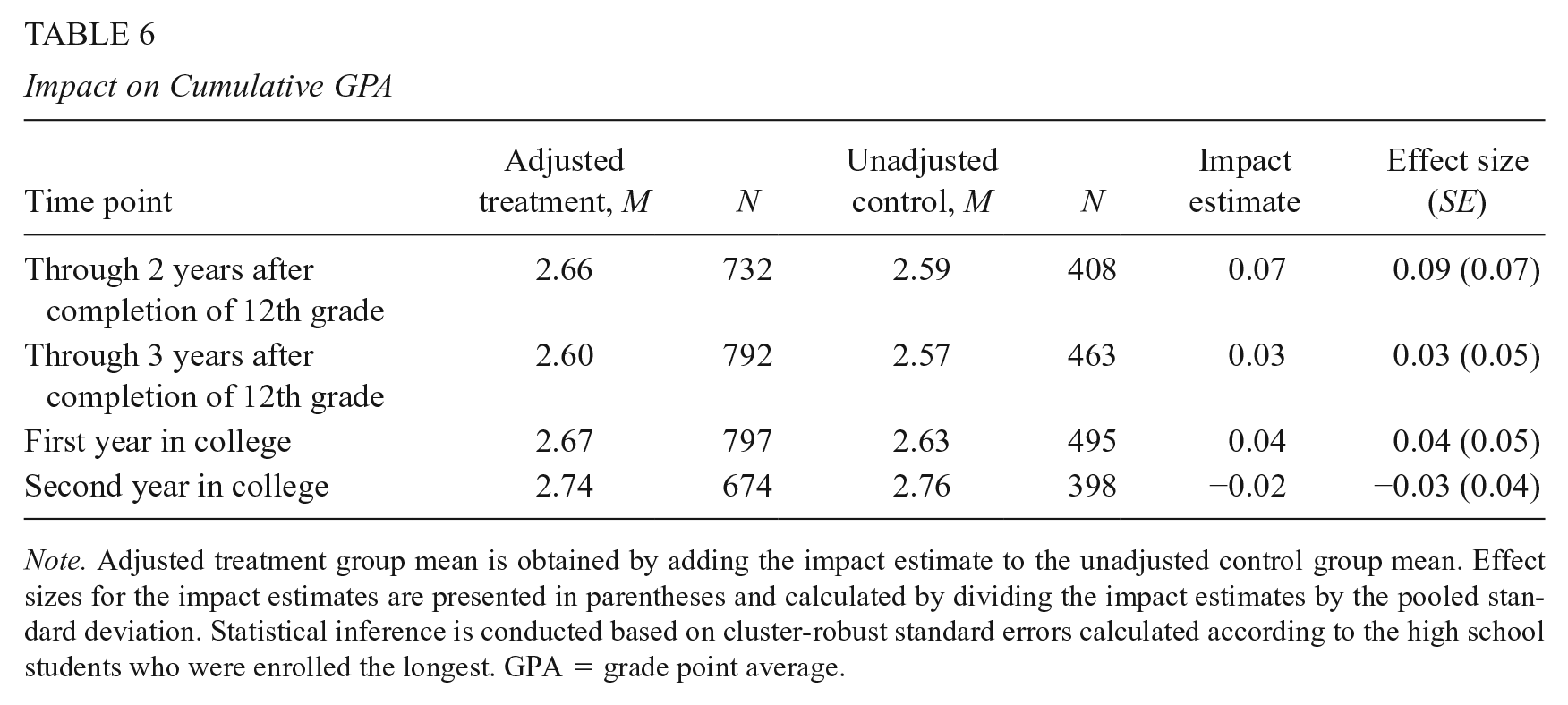
Note. Adjusted treatment group mean is obtained by adding the impact estimate to the unadjusted control group mean. Effect sizes for the impact estimates are presented in parentheses and calculated by dividing the impact estimates by the pooled standard deviation. Statistical inference is conducted based on cluster-robust standard errors calculated according to the high school students who were enrolled the longest. GPA = grade point average.
As explained above, these results are considered as quasi-experimental and rely on observable covariates capturing all of the confounders of GPA and going to a UNC campus; therefore, we tested their robustness to unobserved confounders using the sensitivity analysis framework introduced by Oster (2013, 2017). The Supplemental Appendix (provided in the online version of the journal) includes a discussion of the sensitivity analyses and the findings.
Although these results suggest that early college students are just as well, if not better, prepared than students who attended traditional high schools, there are several factors to consider in interpreting the GPA findings. First, despite the fact that GPA is a common and acceptable measure of postsecondary performance (Institute of Education Sciences, 2016), GPA may differ across colleges and across subject areas (Arcidiacono et al., 2012; Conger & Long, 2010). Future research will explore the impact of the early college on major selection and on enrollment in specific courses. In addition, because early college students earn more credits in high school and often enroll at a more advanced level, they may enter a postsecondary institution taking courses that students might take later in college; research has suggested that GPA in higher level courses tends to be higher and have less variation (Arcidiacono et al., 2012; Grove & Wasserman, 2004). Our measurement of GPA 2 and 3 years after 12th grade should account for this to a certain degree but may not fully account for it given that other research we have done has shown that early college students have earned more college credits by those points in time (Edmunds, Unlu, et al., 2017).
Conclusion
The early college model is a new model of schooling that combines the high school and college experiences, explicitly focusing on practices and structures that are intended to increase students’ success in college while also shortening the amount of time that students spend in the educational system. Essentially, the early college model is a test case of whether we can restructure the educational system in a way that embeds attainment of postsecondary credentials into high school.
At the beginning of the article, we postulated two different scenarios—one where the practices and supports prepare early college students for postsecondary success, and one where the shortened time results in indirect and adverse effects on students once they leave the early college setting. Our results show that neither hypothesis is entirely correct. Results show no systematic impact on students’ college GPA, suggesting that students did not appear to enter the 4-year institution with either an academic advantage or disadvantage from their early college experience. Thus, the acceleration that they received was not counter-balanced by a negative impact on their preparation. Future work should examine GPA in light of course selections of early college graduates compared with traditional high school graduates.
Results did show, however, that early colleges had a positive impact on the percentage of students receiving a postsecondary credential. The increase was driven in large part by increased attainment of associate degrees, much of which was happening while students were in the early college. There was also a positive impact, however, on attainment of bachelor’s degrees earned within a 4 years after 12th grade, although control students had essentially caught up by 6 years after 12th grade. Time-to-degree analyses do indicate that treatment students who earned degrees did so more rapidly than control students. One likely explanation is that the number of college credits a student receives serves as form of momentum to accomplish their degree; in other research, we have shown that treatment students earned a much higher number of college credits while in high school (Edmunds, Unlu, et al., 2017). Graduating more quickly may mean these students became less encumbered by student loan debt and were able to enter the workforce more quickly. Future research should examine the economic stability of early college high school graduates compared with those from traditional high schools.
When looking at the impact on credential attainment for subgroups, we see positive impacts for all groups, which indicates that the treatment benefited all types of students. Looking at the increases, however, there are differential impacts by subgroup and by degree level. Relative to associate degree attainment, we see that the treatment had a larger impact on students who faced fewer challenges (e.g., non–economically disadvantaged students, nonminority students, non-first-generation students, more academically prepared students). We believe these results are an artifact of the early college’s unique design. Because students can earn an associate degree as part of the program, it is highly likely that students who earn this degree might not have otherwise considered it because they would have gone straight to a 4-year institution. Yet, it does not appear that the early college is necessarily redirecting students from a 4-year to a 2-year, given that we also have small positive impacts on bachelor’s degrees. We also see that the impact on 4-year degrees was higher for economically disadvantaged students and similar for minority students. These results run counter to recent findings that have found smaller impacts of dual enrollment efforts for low-income students, driven in large part by lower academic preparation (Miller et al., 2018). It is possible that the additional supports that are embedded in the early college, and that are often missing from dual enrollment programs in traditional high schools, are providing the extra support that low-income students need to complete their degrees. The early college study thus provides evidence that some students can benefit from a system that combines both the high school and college experiences. At this point, there appears to be little disadvantage to the acceleration that arises from this unique approach and quite a few advantages. It also suggests that early college may serve as a model to help close gaps in degree attainment, particularly for low-income students.
Supplemental Material
Supplemental_Appendix – Supplemental material for What Happens When You Combine High School and College? The Impact of the Early College Model on Postsecondary Performance and Completion
Supplemental material, Supplemental_Appendix for What Happens When You Combine High School and College? The Impact of the Early College Model on Postsecondary Performance and Completion by Julie A. Edmunds, Fatih Unlu, Jane Furey, Elizabeth Glennie and Nina Arshavsky in Educational Evaluation and Policy Analysis
Footnotes
Declaration of Conflicting Interests
The author(s) declared no potential conflicts of interest with respect to the research, authorship, and/or publication of this article.
Funding
The author(s) disclosed receipt of the following financial support for the research, authorship, and/or publication of this article: The research reported here was supported by the Institute of Education Sciences, U.S. Department of Education, through Grants R305R060022, R305A110085, R305A140361, and R305H190036 and by a grant from Arnold Ventures to the University of North Carolina at Greensboro. The views expressed here are of the authors and do not reflect those of the Institute of Education Sciences, the U.S. Department of Education, or Arnold Ventures.
Notes
Authors
JULIE A. EDMUNDS, PhD, is a program director at SERVE Center at UNC Greensboro where she is principal investigator of a 14-year longitudinal study exploring the impact of North Carolina’s Early College High School Model. She has also led numerous other experimental and quasi-experimental impact studies.
FATIH UNLU, PhD, is a senior economist and research quality assurance manager of the Education and Labor Division at the RAND Corporation. He has substantial experience with designing and conducting complex and multifaceted evaluations of education programs and interventions. His project portfolio includes evaluations of programs that aim to increase students’ access to and success in postsecondary education and alternative routes to teacher and principal preparation. He has also presented and written on a wide array of research methodology topics.
JANE FUREY is a PhD student in Public Policy and Sociology and a trainee at the Population Studies Center at the University of Michigan, Ann Arbor. Her research interests include secondary and postsecondary education, public policy, and inequality
ELIZABETH GLENNIE, PhD, is a senior education research analyst at RTI International. Her research focuses on factors influencing success in secondary school and access to postsecondary education.
NINA ARSHAVSKY, PhD, is a senior research specialist at the SERVE Center at UNC Greensboro. Her research and evaluation projects focus on STEM and high school reform efforts, including the early college. She has also developed math curricula and designed teacher professional development in mathematics content, pedagogy, and use of technology in the math classroom.
References
Supplementary Material
Please find the following supplemental material available below.
For Open Access articles published under a Creative Commons License, all supplemental material carries the same license as the article it is associated with.
For non-Open Access articles published, all supplemental material carries a non-exclusive license, and permission requests for re-use of supplemental material or any part of supplemental material shall be sent directly to the copyright owner as specified in the copyright notice associated with the article.
