



Abstract
Undocumented immigrants face learning, compliance, and psychological costs when confronting in-state resident tuition (ISRT) policy implementation. Building on administrative burdens scholarship and using qualitative data from 19 semi-structured interviews with undocumented youth immigrants, this article examines administrative burdens that may discourage and prevent students from accessing ISRT policy—a public benefit aimed at extending their educational opportunities. Findings demonstrate that undocumented youth navigate multifaceted contexts, including multiple rules at different organizational levels and interactions with admissions officers whose attitudes may facilitate or obstruct access. This study spotlights how some intended beneficiaries may be more affected by stigma and fear, depriving them of accessing public benefits. Furthermore, the study shows how bureaucratic procedures reinforce existing social inequalities by affecting those less well-positioned to address burdens.
Keywords
Whenever I see any of those questions such as SSN, residency status, and so on, I just don’t finish the form. I just don’t fill it out because I feel I don’t have it. I can’t pretend to have it, so I just don’t want to go through the process of being frustrated [when] I’ve been rejected for something else, for another thing. (Juliana,
1
undocumented youth in Virginia)
In the United States, undocumented immigrants cope with administrative burdens when seeking to access public higher education and benefit from in-state resident tuition (ISRT) policy benefits in those states that have legislated such a public benefit or in some higher education systems that have in place such policy 2 (Amuedo-Dorantes & Sparber, 2014; Nienhusser, 2014; Olivas, 2020). Overall, undocumented immigrants can benefit from ISRT policy if they have lived in any of those states between 2 and 3 years, have attended and graduated from a state high school, and have a notarized signed affidavit stating that they will seek legal permanent residency when possible (Amuedo-Dorantes & Sparber, 2014; Nienhusser, 2014, 2018; Olivas, 2020). Although those requirements seem simple to meet, policy interpretations and bureaucratic procedures at the institutional level may be highly burdensome for undocumented youth. Specific information, paperwork, and documentation may result in magnified learning, compliance, and psychological costs that citizens and lawful residents do not confront. Undocumented youth’s unlawful status, their frequent condition as first-generation college students, lack of financial resources, and generally lower cultural and social capital (Gonzales, 2016) could intensify their perception of facing an overwhelming and frustrating process. Moreover, the lack of synchronization between eligibility criteria for ISRT and the requirements at higher education institutions may make the experience especially daunting for this target group. Those burdens may prevent undocumented students from applying for or delaying their educational opportunities.
Allowing undocumented students to pay ISRT or receive state financial aid constitutes a public benefit and a mechanism of equalization with citizens and lawful residents who automatically pay in-state tuition rates in the states they have lived and studied. The availability of ISRT policy is the only real possibility that undocumented immigrants have to attain higher education. Undocumented youth often come from lower income families and have higher poverty rates (Diaz-Strong et al., 2011; Kaushal, 2008). Thus, if undocumented students cannot claim such public benefits, their ability to attend college is reduced (Amuedo-Dorantes & Sparber, 2014; Kaushal, 2008; Nienhusser, 2013).
Previous research discussed the challenges undocumented students face when accessing higher education and determining whether they qualify for ISRT policy or financial aid at the state and institutional levels (Enriquez, 2011; Nienhusser, 2014; Nienhusser & Connery, 2021; Olivas, 2020; Serna et al., 2017). Scholars consistently have found that financial barriers are the primary reason undocumented students do not attend college (Bjorklund, 2018; Nienhusser, 2014; Serna et al., 2017; Terriquez, 2015). However, administrative burdens as a function of learning, compliance, and psychological costs may also become barriers that discourage or prevent undocumented youth from applying to college and claiming ISRT. Studies have also demonstrated that the stigma and fear associated with their status may lower their propensity to claim ISRT (Abrego et al., 2017; Abrego & Gonzales, 2010). Little scholarly work, however, focuses specifically on how they experience administrative burdens as a function of learning, compliance, and psychological costs and the factors that may influence the variation of such experiences. When examining undocumented students’ perceptions of such rules, the exploration of the bureaucratic procedures moves from an organizational analysis to inquiring about undocumented students’ experiences when seeking access to public benefits to which they are entitled in existing policies.
Building on administrative burdens scholarship, this study examines dimensions of learning, compliance, and psychological costs when undocumented students confront the implementation of ISRT policy in the states where it is available. The analysis relies on information from undocumented youth through 19 semi-structured interviews conducted during 2020. The findings show multiple administrative burdens faced by undocumented youth resulting from a lack of guidance from high school counselors, ISRT requirements and rules that overlap at different organizational levels, varying policy implementation requirements, perceptions of undocumented students’ deservingness of a public benefit, and the administrative discretion of college personnel. The findings suggest that through the admissions requirements, states and higher education institutions shape the sense of belonging of immigrant youth and chart their legal and social inclusion.
This study adds to higher education scholarship on policy implementation in four ways. First, it demonstrates how institutional requirements may reinforce existing social inequalities and disproportionally affect individuals who are less well-positioned to address such burdens. Second, it probes how organizational procedures and rules can affect the desire and ability of undocumented immigrants to claim ISRT. Third, it reveals how college personnel’s attitudes and administrative discretion may be associated with a biased perception of deservingness for undocumented immigrants (Baekgaard et al., 2021; Bell et al., 2021; Nienhusser & Connery, 2021). Fourth, it illustrates how powerless groups may be more susceptible to fear, resulting in a lack of autonomy when coping with bureaucratic procedures to participate in public benefits. The common assumption is that if states or boards of trustees pass a new policy, it will be implemented fairly and support the intended target groups. The results show that this is more complex for most undocumented participants in this study and calls for more responsive programs and personnel as well as an adjustment of requirements and rules.
In the following sections, I elaborate on the literature on administrative burdens in policy implementation. Next, I contextualize the administrative burdens framework when examining the ISRT policy for undocumented youth immigrants. Then, I present the research design and discuss the findings. Finally, I provide conclusions and discuss implications for theory and practice in higher education policy.
Administrative Burdens: Learning, Compliance, and Psychological Costs
Some entitled individuals or intended beneficiaries do not access public benefits despite favorable policies (Currie, 2006). Research on administrative burdens has focused on understanding why individuals entitled to public benefits do not claim them and how the established bureaucratic requirements and rules to access such benefits may impact non-participation (Burden et al., 2012; Herd & Moynihan, 2018). Some reasons include a lack of awareness of public benefits (e.g., Chetty & Saez, 2013), confusion about and poor understanding of requirements and procedures (Christensen et al., 2020; Liebman et al., 2015), considering trade-offs between costs and benefits (Craig, 1991), the stigma associated with participating (Baumberg, 2016; Herd & Moynihan, 2018), and emotional stress of completing requirements and interacting with bureaucratic personnel (Bertrand et al., 2006; Herd & Moynihan, 2018).
Learning costs refer to the time and effort required to find out about a public program, associated eligibility criteria, and necessary supporting paperwork. Compliance costs involve the forms applicants should complete, the documentation they must provide, the fees they must pay to apply for public benefits, and the time involved in completing paperwork. Psychological costs include the possible stigma and emotional stress of claiming a public benefit and dealing with SLBs who hold administrative power to shape requirements and facilitate or obstruct a process (Herd & Moynihan, 2018; Moynihan et al., 2015). In this regard, Allen, Wright, Harding, and Broffman (2014) found that the stigma faced by some individuals was not associated with socioeconomic factors; instead, it resulted from “demeaning” interactions between SLBs and participants. Thus, applying for public benefits involves several costs that may become onerous and discouraging, thwarting eligible individuals from accessing those benefits.
Some target groups may experience magnified psychological costs. Although such burdens are complex to measure, identifying them is crucial for understanding the reasons why some undocumented youth do not apply for public benefits such as the ISRT policy. Social psychologists observe that when disadvantaged individuals must make essential decisions, they are more likely than others to become discouraged and sometimes avoid deciding (Beattie et al., 1994). Some individuals may make “irrational” decisions without enough information and uncertainty (Kahneman & Tversky, 1979), or they may make inconsistent decisions—far from their preferences—because of limited autonomy.
Administrative burdens scholarship has also inquired about how the interactions with SLBs influence individuals’ behavior and decisions when they claim public benefits (e.g., Barnes & Henly, 2018; Hattke et al., 2020; Herd & Moynihan, 2018). Empirical studies show that SLBs’ values and beliefs drive their work and decisions when shaping administrative rules and allocating public benefits (Bell et al., 2021; Nienhusser & Connery, 2021). Some SLBs—influenced by perceptions of certain target groups’ deservingness of public benefits—may be more or less reluctant to ease administrative rules so that such individuals benefit. Some SLBs could omit eligibility information or provide it inaccurately to potential recipients. They also could increase requirements such as documentation and paperwork for target groups; some may be reluctant to clearly explain procedures, answer calls or other communications from potential beneficiaries, or display helpful attitudes. In short, some SLBs may use their administrative discretion to make access to public benefits more onerous for some target groups (Bell et al., 2021; Brehm & Hamilton, 1996; Tummers & Bekkers, 2014). Next, the conceptual framework of administrative burdens is contextualized when undocumented students seek to benefit from the ISRT policy.
Burdens Faced by Undocumented Students and ISRT Policy Benefits
In the United States, the Supreme Court ruled through Plyler v. Doe (1982) that undocumented minors are legally entitled to free public education from kindergarten through 12th grade (Baum & Flores, 2011; Olivas, 2020). The Court argued that denying them access to K–12 education excluded them from developing basic skills to be involved in society. However, their access to higher education is not ruled. Although no federal law prohibits access to higher education for this target group, they cannot benefit from federal student financial aid (Free Application for Federal Student Aid [FAFSA]; Olivas, 2020; Terriquez, 2015), which, in the first place, represents a substantial financial barrier to a population that needs it more.
When undocumented students seek to gain access to higher education, most undocumented youth confront their unlawful status for the first time (Gonzales, 2011) and face numerous legal and financial barriers (Abrego & Gonzales, 2010; Bjorklund, 2018; Serna et al., 2017; Terriquez, 2015). The social construction of deservingness is not questioned for undocumented children since federal laws, as the Supreme Court in Plyler v. Doe (1982), ruled access to public education regardless of their citizenship status. Their access does not go through high scrutiny, the provision of documents, or some demonstration of “entitlement.” However, the social and political context for undocumented youth abruptly shifts when they graduate from high school. Undocumented youth encounter restrictive policies in both applying to college and entering the job market. Particularly when facing the college application process, many confront the limitations of their lack of citizenship status for the first time (Gonzales, 2011). Further, their deservingness and sense of belonging are questioned by those who become aware of their status (Perez, 2015). Undocumented youth realize that they are socially differentiated from citizens and lawful residents through this official encounter with public organizations such as colleges and universities and the availability or absence of policies directed toward them.
The U.S. immigration system classifies undocumented youth as being either a Deferred Action for Childhood Arrivals (DACA) recipient or a non-DACA recipient. 3 This distinction is crucial to understand access to higher education and the benefit of ISRT policy. The DACA program grants undocumented youth renewable 2-year lawful residency—including a temporary Social Security number (SSN)—facilitating the process of accessing higher education and participating in the labor market. In other words, DACA grants a legal “floor” that enables certain social and labor mobility. One might assume that it makes the admission process and benefit from ISRT more accessible and feasible. In addition, in some states, such as Indiana, Maryland, and Georgia, the benefit of ISRT is only granted to DACA recipients, facilitating a path toward higher education. However, DACA does not provide lawful status in the long term and only provides a “partial” residency. Also, the DACA program is not available for all undocumented youth. Therefore, non-DACA recipients face more legal and financial barriers to accessing state and college or university benefits.
Between 2001 and 2021, 19 states, through legislation, granted ISRT eligibility for undocumented youth immigrants at public colleges and universities; 11 of those states also provided eligibility for state financial aid to such students (National Conference of State Legislatures, 2021; see Supplementary Tables A and B in the online version of the journal). Overall, to benefit from ISRT policy, undocumented youth immigrants must have lived in any of those states between 2 and 3 years, have attended and graduated from a state high school, and have a notarized signed affidavit stating that they will seek legal permanent residency when possible (Amuedo-Dorantes & Sparber, 2014; Nienhusser, 2014, 2018; Olivas, 2020).
ISRT policy requirements seem simple to meet; however, the road to benefits is full of roadblocks. Implementing ISRT is not necessarily straightforward, since such policies do not always mandate or provide instructions for how colleges and universities should apply the policy. Without specific guidance for implementation, college administrators and SLBs interpret the policy and use their administrative power to establish requirements and shape administrative requirements (Nienhusser, 2014, 2018). Higher education institutions also must follow other policies at the state and institutional levels that may over-lap with or limit the provision of ISRT benefits to undocumented students (Castrellón, 2022; Nienhusser, 2018; Olivas, 2020). Yet, Nienhusser and Connery (2021) rightly assert that this complex and ambiguous environment provides opportunities to shape rules that may favor or harm undocumented youth pursuing higher education.
Administrative discretion regarding ISRT benefits may be delayed or contested due to the lack of certain required documents (e.g., SSNs, residency identification cards, domicile proofs, tax forms, unexpired passports, and visas). College admissions officers and others often may view such documents as technical prerequisites for receiving the ISRT policy benefit. Olivas (2020) posits how some states and higher education organizations intertwine residence and domicile, and lack knowledge about immigration categories resulting in a vexing problem that impacts undocumented youth seeking higher education access. For instance, some institutions pay more attention to validating a long time spent in the “same place” than what is actually reported by the policy in terms of having studied and graduated from a state high school. On the way, other issues come up. Trivialities can happen, such as an applicant who has changed address multiple times—either in different cities or counties—within the state being classified as out-state resident tuition, or applicants who, although they have attended the same state’s high school for 3 consecutive years, have lived in a border state. Although it may seem nonsense, different scholars suggest that this “misinterpretation” shapes undocumented students’ receipt of in-state tuition benefits (Nienhusser & Connery, 2021; Olivas, 2020).
In states that request proof of residency, such as a resident identification card or driver’s license, undocumented participants may be frustrated since such documentation depends upon an individual’s legal status (e.g., Florida, Maryland, Nebraska, Virginia), and it can be supplied only by citizens or lawful residents. Furthermore, when undocumented students must provide tax forms or evidence of income either for themselves or for their parents, meeting this requirement may be difficult. Some undocumented immigrants do not have these documents as they work “under the table.” Other undocumented immigrants work with fake SSNs, making the provision of evidence of income or tax forms from them and their parents risky and fearful. This unique feeling of fear about being targeted because of undocumented status—not experienced by other minoritized groups—magnifies the administrative burdens that this group faces.
Yet, college personnel agency also matters. Interactions with SLBs influence individuals’ behavior, reactions, and decisions when they claim public benefits (e.g., Barnes & Henly, 2018; Hattke et al., 2020; Herd & Moynihan, 2018). The level of burden likely increases when an undocumented student interacts with the college admissions staff, drops off an application, or is subject to questions. One might expect that undocumented students feel embarrassed about needing to provide evidence to explain their “unlawful” status. Even more crucial, they may feel insecure talking with admissions staff, whom they have no reason to trust and who could disclose their status.
Although college personnel’s decisions are expected to be based on statutory requirements, SLBs’ behavior and decision-making may be value-based (Bell et al., 2021; Nienhusser & Connery, 2021; Romzek & Dubnick, 1987; Weissert, 1994). Admissions officers’ attitudes, actions, and inactions can be crucial in affecting the behavior of undocumented applicants and in identifying mechanisms and options that facilitate or hamper their benefit from ISRT. Colleges’ admissions officers are the main source of information; they review and validate documents that entitle undocumented immigrants to ISRT, and they constantly interact with such applicants. Admissions officers are institutional agents with considerable administrative power to shape admission requirements and to decide on admission and ISRT policy eligibility for undocumented applicants (Nienhusser, 2018; Nienhusser & Connery, 2021).
However, college personnel’s work may be affected by contextual factors that restrain their ability to exercise discretion. Thus, those working in the same policy area may act differently for numerous reasons, including varying levels of knowledge about policy requirements and organizational rules or differing protocols. Although admissions officers may have good intentions, some scholars suggest that they often act as compliance officers for ISRT and other state and institutional financial aid policies for undocumented youth (Castrellón, 2022; Nienhusser, 2018). However, Nienhusser and Connery (2021) posit that admissions officers who support greater access to higher education for undocumented applicants may be more cooperative, capitalizing on political ambiguity in the immigrants’ favor.
Finally, it should be noted that learning, compliance, and psychological burdens differ conceptually, but they cannot be understood separately. For example, when undocumented immigrants seek to benefit from ISRT policy, they may encounter confusing or insufficient information. In the process of learning about eligibility criteria, they also may discover the need to complete paperwork and provide specific documentation. Doing so may exacerbate their emotional stress and induce feelings of fear and frustration. In addition, while learning and dealing with stress, they must gather the documentation, take time off work, approach the offices that issue needed documents, deliver the documentation, participate in interviews, and interact with SLBs. Thus, they may experience learning, psychological, and compliance costs simultaneously.
Data and Method
The study was guided by the research question: What are the learning, compliance, and psychological costs that undocumented youth cope with while applying for college and claiming eligibility for ISRT? I conducted 19 semi-structured interviews with undocumented youth residing and/or studying in states that granted ISRT in 2020. 4 I contacted undocumented students through interactions with high school and college admissions counselors to locate potential participants in states that grant ISRT policy benefits. I sent invitations to Dreamer and DACA groups located in relevant states with ISRT policies for undocumented students and registered on social media platforms, particularly Facebook.
The interview protocol focused on undocumented applicants’ experiences and challenges when applying, including the learning process, administrative steps involved in completing forms, and their levels of concern about meeting institutional requirements to demonstrate eligibility for ISRT policy and any social-emotional stigma from being undocumented. Other questions asked about information and guidance in the admission process, interaction with admissions officers, and suggestions for improving the admission process. No in-person interviews were conducted. Instead, interviews were carried out through Zoom meetings during 2020. All interviews were audio-recorded.
I used both deductive and inductive coding approaches. It is deductive in terms of designing questions that would specifically lead to identifying learning, compliance, and psychological burdens. For learning burdens, I considered items such as sources of information about and guidance for applying to college and qualifying for ISRT, the time it took to understand criteria for policy benefits eligibility, and the people involved in the learning process. I examined tangible and intangible costs of compliance burdens, including gathering documentation, meeting requirements, completing paperwork, paying fees, and the time spent running errands, having interviews, and waiting for responses from admissions officers. Psychological costs included fear of applying, emotional distress, interaction with admissions officers, and the social stigma of participating. I also noted individual and institutional factors that may have made the application process easier or more burdensome.
Inductively, using the administrative burdens framework developed by Herd and Moynihan (2018), and following Corbin and Strauss’s (2008) methodology, I coded learning, compliance, and psychological costs based on participants’ answers. For instance, if more than half of the participants mentioned that they did not know about ISRT policy, nor did they receive guidance from their high school counselor or admissions officers about the potential benefit of ISRT, those facts represent a learning cost, which becomes a generalizable finding or pattern in qualitative analysis. Then, that pattern was coded and named “Lack of information and guidance from high school counselors and admissions officers.”
Regarding compliance costs, if most interviewees during the ISRT application process were wrongly categorized with non-resident tuition rates instead of in-state rates—although they are entitled to benefit from it—it was identified as a compliance cost. The rationales behind this are that having to pay non-resident tuition—which could be twice the in-state rates—may cause them to give up on accessing higher education. Similarly, if more than half of the participants mentioned that additional documentation was required to benefit from ISRT policy, those extra efforts involved in demonstrating the right to benefit from ISRT despite having studied and graduated from a state high school represent a compliance cost (e.g., having to prove residency, domicile, providing residency cards, driver license in some cases, utility bills, along with high school diploma). Regarding psychological costs, for instance, if a common observation by most participants referred to waiting a long for administrative responses, having an answer regarding eligibility, or feelings of experiencing an unfair process, those represent psychological costs since it prolongs uncertainty and emotional distress.
Participants’ Profile
Table 1 presents the profiles of those interviewed. Eleven women and eight men participated; their average age was 22 years. They arrived in the United States at the average age of 4 years old, and on average, they had lived in the country for almost 18 years. The majority of the participants were from Mexico (70%), and most of those interviewed lived in California, Texas, and Virginia. Eleven interviewees were enrolled in 4-year institutions, six attended community college, and two were not currently studying at any higher education institution. Fifteen (78%) were DACA recipients, and the remaining individuals had been rejected from the DACA program. First-generation college students were the majority in the sample, constituting 17 or 90% of the participants.
Profile of Interview Respondents
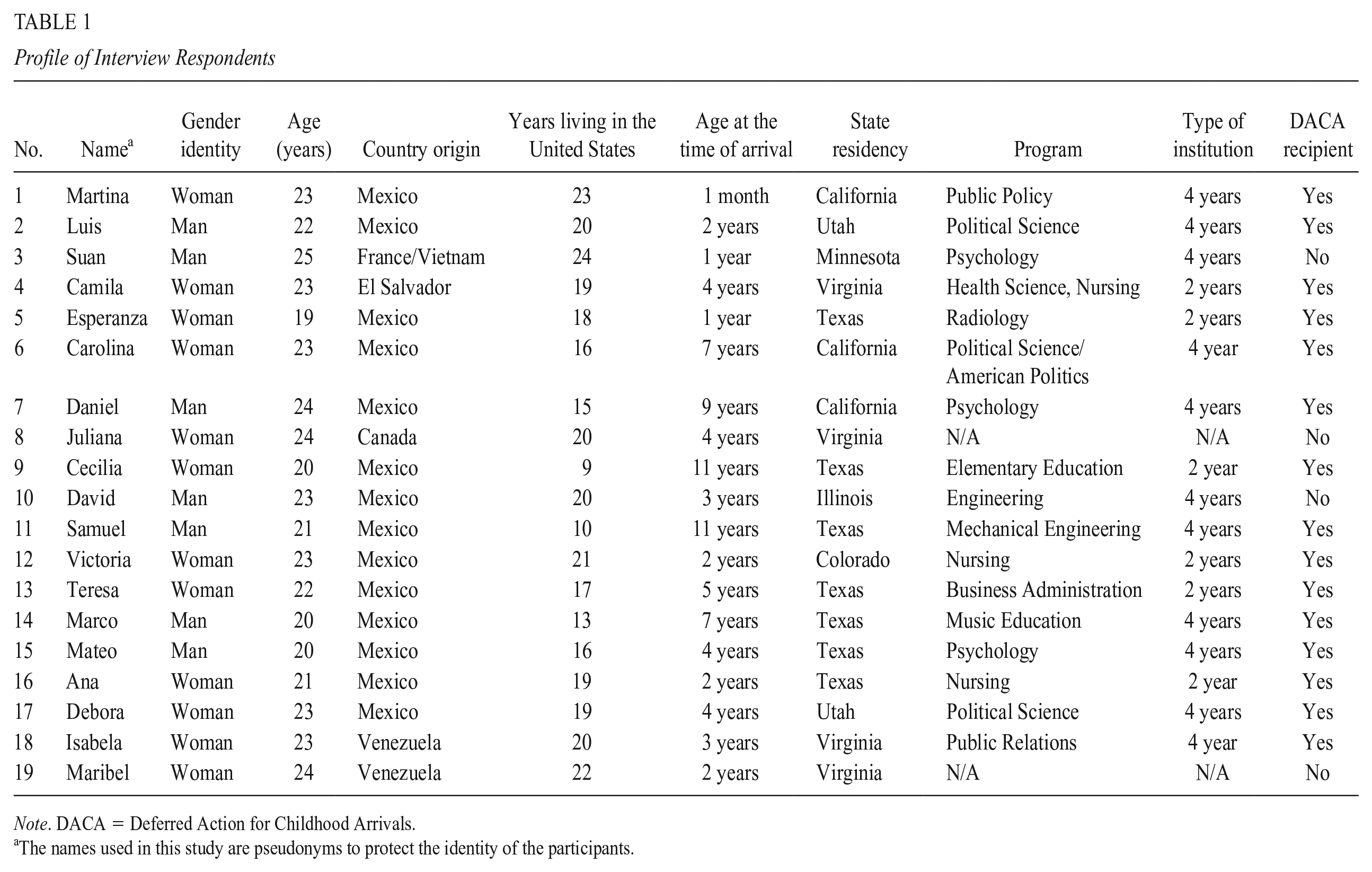
Note. DACA = Deferred Action for Childhood Arrivals.
The names used in this study are pseudonyms to protect the identity of the participants.
Limitations
Participants were primarily women, and most of the participants live in states with large populations of undocumented immigrants (Cali-fornia and Texas), which could obscure significant factors associated with burdens faced by undocumented students in other states. More importantly, appropriate sampling frames of undocumented youth between the ages of 17 and 25 years simply do not exist. The findings, then, are best seen as exploratory and instructive. Another limitation is that most of the participants interviewed for this study were currently enrolled in a higher education institution. Only three could not attend college due to burdens associated with their unlawful status. Although the participants talked about the barriers to applying and qualifying for ISRT policy, not having a more significant number of participants who could not access higher education may well overlook other unexplored administrative burdens. It may be that those undocumented youth who do not attend college face higher compliance and psychological costs compared with those undocumented youth who eventually enroll and benefit from ISRT policy.
In addition, not comparing learning, compliance, and psychological burdens of undocumented youth with those experienced by other groups, such as first-generation, African Ameri-can, and Asian American applicants, risks overemphasizing the distinctiveness of undocumented students’ burdens, overlooking burdens experienced by other groups. Further research should consider how administrative burdens affect other national origin population groups to find patterns and possible similarities and differences among undocumented youth.
Findings
In this section, I describe the most pronounced and relevant patterns about the learning, compliance, and psychological costs undocumented students experience when claiming public benefits. Most interviewees posited that learning costs were due to a lack of information and guidance from high school counselors and admissions officers and discouragement from pursuing higher education. Regarding compliance costs, most interviewees complained about overlapping administrative requirements at different organizational levels, being wrongly categorized as out-of-state residents for tuition purposes instead of in-state, providing additional documentation and paperwork not required by ISRT policy, and facing higher opportunity costs. Regarding psychological costs, most interviewees complained about facing an unfair admission process, feelings of being excluded, fear of putting their parents at risk for deportation, and complex interactions with admissions officers—including long waiting periods, feelings of frustration, and lack of autonomy. Table 2 summarizes coded patterns from the interviews organized by learning, compliance, and psychological costs. Afterward, each pattern is described and illustrated by a participant’s quote (see Supplementary Table C in the online version of the journal for more selected quotes per burden and pattern).
Interviews: Patterns of Administrative Burdens
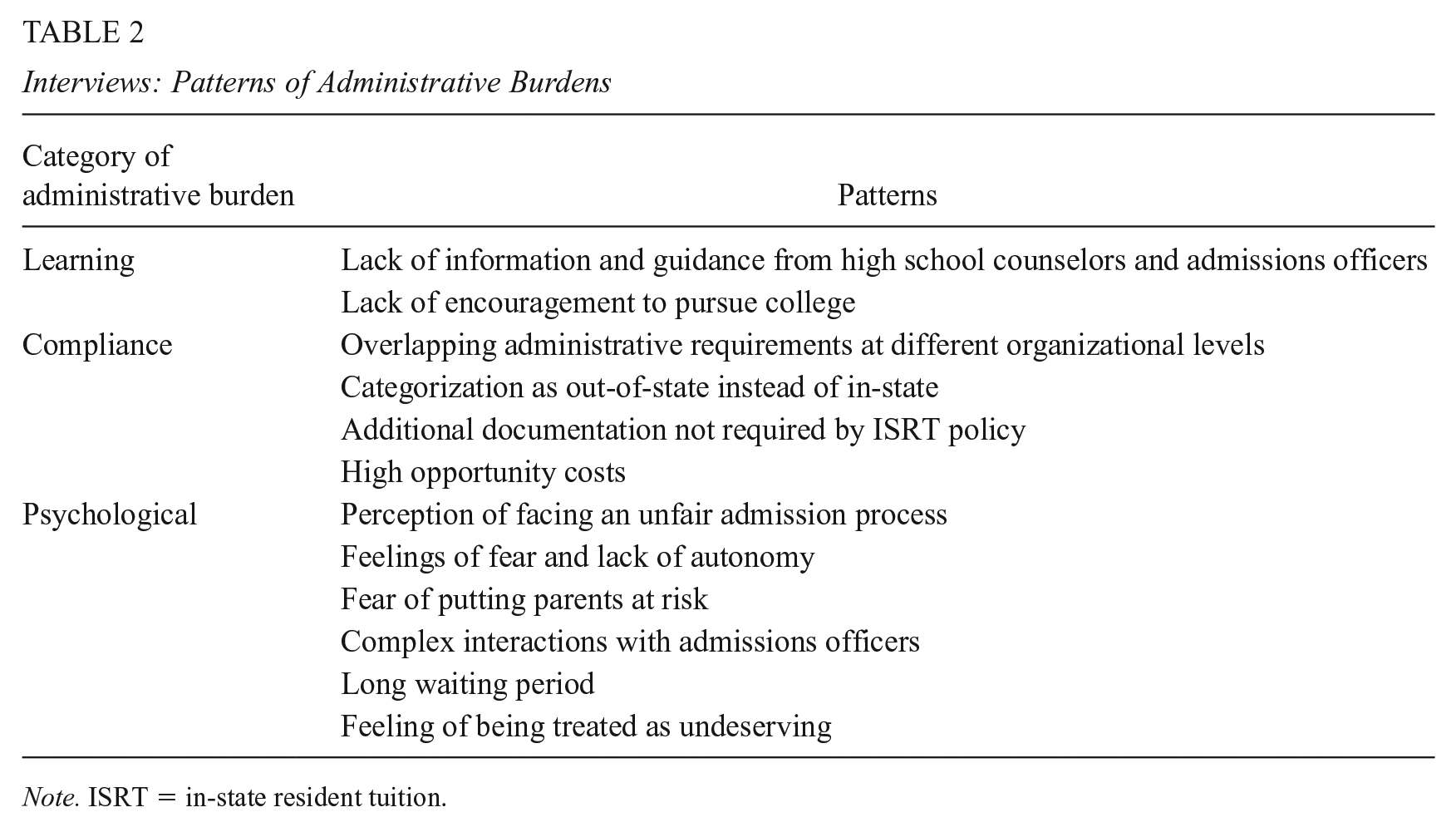
Note. ISRT = in-state resident tuition.
Learning Burdens
Lack of Information and Guidance From High School Counselors and Admissions Officers
Various studies have pointed out that undocumented youth do not receive reliable information about the college admission process (e.g., Nienhusser, 2013). This lack of accurate information may be due to the lack of familiarity of high school counselors and college admissions officers with state or institutional policies for undocumented students, a lack of interest in helping such students, or bias. Most interviewees (17 or 89%) did not know about college admission processes and requirements for qualifying for ISRT during the application process. Most participants suggested that the learning process felt like walking “blindly” and “by themselves.” One interviewee noted, The process itself is a little bit blurry because like I’ve said, it’s kind of been different pieces. Some people would say: “Oh, you may be able to qualify for ISRT,” but others said the opposite. So eventually, I figured it out right like I had to google things cause I had a counselor telling me things, I had teachers saying other things. So, I had to look for undocumented groups that I knew existed around San Diego to check it out. So I guess it was after a lot of research, but I think it wasn’t as readily available as I had hoped. (Carolina, California)
Since most undocumented youths are first-generation college students (Alissa, 2018) and they cannot take advantage of their parents’ experience to navigate the college admission process, one might expect that they would rely primarily on high school staff counselors, social networks, and admissions officers to help them make college decisions. Yet, studies have shown that first-generation college students are less likely than their peers to interact with high school and college admissions staff (Nunez & Cuccaro-Alamin, 1998; Terenzini et al., 1996). This lower level of interaction may affect persistence in the college application process. Most participants (16 or 84%) noted how confusing it is to learn about college options and processes given limited access to information, guidance, and assistance from parents, high school counselors, and admissions officers. A student observed, My parents didn’t know anything about those types of stuff [college application]. So, it was pretty hard . . . Everything was me figuring out everything myself and not having someone to guide me through the process. That took me a long time, probably two months or so because there was a lot of confusion with them (admissions officers) not knowing what that is. That made it really confusing and they weren’t sure what paperwork they needed for me. (Daniel, California)
Several studies show that receiving information from those knowledgeable about program requirements and managing the procedures and rules to access public benefits are crucial in increasing participation. Some scholars have found that providing both information and personal assistance about college financial aid increased applications and college enrollments (Bettinger et al., 2012; Page et al., 2020). In this study, students consistently noted a lack of information and support from college admissions officers when they asked about requirements, procedures, paperwork, and information on financial aid or scholarships: It was really hard to get guidance. Every single time that I spoke to him (admissions officer) I would get a different direction. Then I felt like sometimes I needed to speak to a different person. They didn’t know how to guide me in that direction. They said something contradictory to what the other person had already said. So It was kind of like, I had to piece together these different components to complete the application. It was a lot like figuring it out by myself. It was difficult. (Carolina, California)
Lack of Encouragement to Pursue College
Although it might seem that the learning stage has little to do with encouragement or individual motivation to learn, this matters. Many of the interviewees (16 or 84%) recalled instead that they were discouraged by high school counselors from pursuing higher education due to their unlawful status. Social psychologists have found that individuals typically are not interested in learning about something that could benefit them if they previously did not have a “trigger” that impelled them to do so (Schie et al., 2015). A participant pointed out, Let me tell you, it was horrible . . . my high school counselor, when I told her about my immigration status I had, she completely said: “Students like you do not attend higher education, they go to community college if they’re lucky.” I think it was a mixture of bias and ignorance . . . and she told me that they didn’t accept students like me, that you had to be documented in order to attend a college, because it was basically impossible for me to attend. I am a first-generation student, I’m undocumented as well, so I didn’t question her. (Martina, California)
Compliance Burdens
Overlapping Administrative Requirements at Different Organizational Levels
Compliance costs may increase when administrative procedures and rules for accessing a policy benefit overlap across organizational levels. For instance, some undocumented students confront various state and institutional requirements to qualify for ISRT. Sometimes such requirements can be contradictory. Requirements established in the legislation granting ISRT to undocumented immigrants in Minnesota, Maryland, and Color-ado, for example, do not mandate that males register for the Selective Service. At the institutional level, however, colleges and universities require it. A student from Minnesota expressed his frustration over the confusion: So one of the requirements was selective service. When I was younger, I tried to join the army, the Air Force, but I was told that because I was an immigrant and illegal, I was restricted . . . She (admissions officer) said that every man, once they turn 18 they can apply to Selective Service no matter what their immigration status is. I explained and explained to her what I was told by the recruiters who are from the military that I could not, and she said: “Okay, just write us a paper stating what happened, write a paper saying why you weren’t able to apply for Selective Service, and I will try to use that to help you get into the program paying ISRT.” (Suan, Minnesota)
A student in California found herself with different state and institutional forms to complete and no help in doing so. Furthermore, admissions staffers did not respond to her questions or give reasons for the need to fill out forms for different levels of government. This situation increased her compliance costs: When I had just started, everybody told me that I had to put I was a DACA recipient. So, I looked, there was a citizen, there was an international student, there was a resident and then there was this thing called AB540. I didn’t know what an AB540 was. AB540 in the state of California is for you to receive in-state tuition, along with financial aid if you’re applicable for it, but I didn’t know that. So I was like, so I think I had to call three different offices, and nobody wanted to help me. (Martina, California)
Meanwhile, changing policies in different organizations also affected college applications and eligibility for ISRT: It was very difficult because there were a lot of the things that were implemented the year I was supposed to come into college. They [higher education institutions] were changing the policies and some institutions hadn’t changed their policies. I know, for example, my institution when I was coming in, I didn’t have a government identification number, I was in the process of still getting all my paperwork. I already had my Social Security Number because of my DACA status, but I didn’t have my government ID. So they refused to help me in the beginning when I had just applied and said I was going to go there. They refused to help me because I didn’t have a government ID. (Daniel, California)
In states like California and Texas, some years ago, before undocumented applicants could claim in-state tuition and state financial aid, they must fill out FAFSA forms, even though they could not benefit from any federal financial assistance so that public colleges can determine financial need. This requirement was overwhelming for many undocumented students at that time. Applicants must create a federal student identification for both themselves and one parent. A common problem is that to create the account, the applicant and parent each need a SSN and an email address. Both are daunting since most parents have neither. If some parents have SSNs, those could be fake, making the application even more stressful. One also might anticipate that knowing an application shares data with federal officials would be distressing for undocumented immigrants fearing deportation or legal action: “We don’t qualify for state financial aid or FAFSA, but we still have to fill that out; if you don’t do it, it doesn’t let you complete the application” (Carolina, California). 5
Further, a Minnesota respondent reported that he had to submit all documentation—including proof of residency—to the state higher education department first and then to the college of interest. Previous studies have shown that when recipients of a public benefit must provide similar documents in different instances, their compliance (and psychological) burdens increase the likelihood of giving up (Herd & Moynihan, 2018). A participant observed, In order to apply for ISRT, you have to go through the higher education department and demonstrate you live in the state and provide all the proofs to them. Otherwise, if you aren’t approved by the higher ed, they don’t waive you that you’re in state tuition. When I applied for it, I sent them everything that I could. (Suan, Minnesota)
Categorization as Out-of-State
When undocumented applicants are accepted to college but classified as out-of-state residents despite meeting all ISRT requirements, compliance and psychological costs increase. Such students typically come from low-income families; some work multiple jobs and get loans to afford college. If they are admitted to a public higher education institution but classified as out-of-state, tuition costs increase significantly, which may lead them to hesitate to enroll or drop out. Having to demonstrate to admissions and financial aid officers that the out-of-state classification was a mistake could result not only in efforts to gather further documentation but also in having to be persistent in explaining the policy to bureaucrats. An interviewee observed, I remember they tried charging me out-of-state tuition at a community college in Colorado. I was trying to explain to them the mistake because someone who is DACA should be in-state or in-district. I went over a few weeks, I was just kind of going back and forth, and they were trying to, you know, like, charge me like a lot for it. And eventually, like, I guess, they educated themselves. (Victoria, Colorado)
Additional Documentation Not Required by ISRT Policy
During the interviews, undocumented participants routinely complained about having to provide documentation that was not required by existing ISRT policy legislation. I remember they also asked for proof of residence. I told them: “I have been here since fifth grade,” but apparently, my high school diploma was not enough. So, I brought those two utility bills and my bank statement (Deep breath). They also asked me for my driver’s license, I don’t know why. I guess that it demonstrated that I was residing here according to them. That is odd, there are folks [advancing the] out-state tuition “cause,” they do not have a driver’s license. (Camila, Virginia)
Fifteen participants (78%) mentioned how compliance burdens increased when they were asked for proof of parental or other relatives’ income. Previous studies have found that participation in public benefits drops when additional reporting of income or taxes is requested (Brien & Swann, 2001). For instance, according to one participant, The most difficult part was just filling out that economic stuff where they ask you for each family member, how much money that family member makes . . . We never really had that yearly salary. That question how much do you make in a conversation was hard. We really had to go into the records of getting his [father’s] pay stubs to be able to figure out that exact number that we needed. So I think that was the most challenging part, it was trying to identify information that I’ve never had to use before. At public school you don’t ever have to use that. For them [my parents] to require all these different forms was a little bit harder to track down, especially just ‘cause like I’m the first in my family to go to college, and my parents weren’t really prepared to do so. (Luis, Utah).
Scholarship in behavioral economics and social psychology suggests how compliance burdens increase when individuals move “back and forth” when completing paperwork and gathering documentation to access public benefits (Craig, 1991; Riphahn, 2001). Scholars point out that one of the tactics of SLBs to discourage potential beneficiaries is to use the qualification process to “wear down” claimants (Herd & Moynihan, 2018). In interviews with undocumented applicants, close to 90% of respondents expressed feeling exhausted and frustrated when completing admissions paperwork to benefit from ISRT. As one reported, At the university, I felt like they didn’t really try and reach out to help me. Like it was, it was very hard. They made it very, very hard for me, just because they kept asking me for more and more and more documents, and then I would give them those documents and they would ask me for more and more and more documents. And then it was just like a back and forth back and forth, back and forth, you know, in it. It was starting to become very, very, very stressful and, and just like heartbreak. (Teresa, Texas)
High Opportunity Costs
Undocumented youth immigrants are more affected than others are by opportunity costs, often reflecting their scarcity of financial and other resources. Opportunity cost refers to the tradeoff between alternatives that individuals give up when making decisions and choosing an alternative. When facing a shortage of resources individuals may make less advantageous decisions. The literature evaluating vulnerability bias argues that those in situations of extreme deprivation tend to privilege resolution of daily emergencies over investing resources in medium- or long-term actions (Bhargava & Manoli, 2015, p. 3518). Most participants (16) pointed out that applying for college and meeting requirements for ISRT eligibility involve decisions that balance spending time, money, and effort. A participant noted that she had to sacrifice wage-hours worked while completing requirements: And then I had to call off work one day, and yeah, I had to call off work one day. . . . Use the day. . . I don’t know whatever excuse I gave them and I went to the IRS. (Martina, California)
Scarcity of resources can bias an individual’s decisions and influence whether they claim public benefits. Each action can involve significant cognitive demand when considering how a particular decision may affect budgets and outcomes (Bertrand et al., 2004). One can assume that some undocumented applicants give up on the path of applying for college as they prioritize work, as previous work has demonstrated (Hsin & Ortega, 2018).
Psychological Burdens
Perception of Facing an Unfair Admission Process
Social psychologists note that individuals have a basic human need to be treated fairly and respectfully for their well-being and self-esteem (Lind & Tyler, 1988). When participating in public benefits, being treated with respect and fairness legitimizes the process and the policy outcomes—regardless of whether one benefits—and encourages individuals to continue interacting with the administrative state (Stone, 2012). Most of the undocumented students interviewed (17) found the admission process and claiming ISRT often unfair and demeaning. They must follow the rules, meet requirements, and experience deeper scrutiny to benefit from ISRT than their counterparts. A participant noted, It was kind of tough. I was just a little embarrassed about saying, I don’t know how to answer these questions. I just felt I was separated from other people because all my other friends were able to fill it out quickly and easy. But I had to go through this tough process for just being undocumented. It was asking me if I had any proof of residency, or if I came with the visa, if I had a green card. It was just asking me all these other questions that nobody else also experiences. (Esperanza, Texas)
Feelings of Fear and Lack of Autonomy
Fifteen participants (78%) saw the college admission process as steeped in uncertainty, fear, and frustration. Respondents expressed feeling exhausted and frustrated when completing admissions paperwork to benefit from ISRT policy. The emotional stress and fear that some individuals experience when claiming public benefits are one of the most difficult aspects to measure, and public policy design has mostly neglected it. A participant noted, I feel like something is dangerous or something could get me into trouble just for being there, I just leave very fast. I leave very quickly, and you know, that fear makes me avoid looking for college options. (Juliana, Virginia)
Submission to the will of admissions officers limits the autonomy of undocumented participants. Autonomy is an individual need that shapes individual decisions and identity (Deci & Ryan, 1985). One participant observed, I just did what they told me to do. And I just did not know what the hell I was signing at the time. I was just like: “OK, you are telling me to sign this and this,” I’ll sign it whatever, I was kind of just going with the flow, honestly. I had no clue what I was doing. So you know, I guess my defense mechanism was to sign everything. I was losing myself. (Daniel, California)
Moreover, respondents conveyed a generalized feeling of not knowing what to expect about the admission process while waiting. Overall, participants reported not knowing the “right” documentation and paperwork they needed to apply for college and claim ISRT policy benefits. They simply waited and returned to college offices as many times as necessary to complete the process. They also reported having little certainty about the final decision. They saw the process as full of obstacles and complained that the admission process was too bureaucratic: He [admissions officer] told me: “Call me back, I will try to figure out some way to help you. I understand that I was able to help your sister when she was younger, but every rule has changed, and it is more restrictive for someone like you.” He was referring to me to actually get into college and get the in-state tuition. It was a shit, there was like a lot of red tape. (Suan, Minnesota)
Not knowing what to expect exacerbates frustration and fear. As Moynihan et al. (2015) note, In situations where the individual depends upon the state for vital resources—for example, the provision of health services, income, immigration status—uncertainty about the receipt of those benefits, as well as frustrations in the process of seeking may elevate stresses among individuals. (p. 50)
A participant recounted, I did not enroll at any other institution. I was too scared of getting denied because of my legal residency. So, I figured I kind of set my own boundary on there. Of course, people around me and the government told me what I could or couldn’t do, but because of that (uncertainty), I didn’t want to go further. (Carolina, California)
Based on stereotypes, some scholars argue that immigrants may engage in protective behaviors to avoid being categorized as “illegals” (Flores & Schachter, 2018). They may try to camouflage accents and show themselves to be “Americanized.” This behavior produces frustration and a detachment from their true origins. Wanting to appear “other” and not wanting to reveal “who you are” when interacting with the administrative state.
Undocumented youth also may be concerned about being identified as some form of “alien.” Others, as in the case of DACA recipients who have “partial resident status,” are in limbo when they fill out admissions forms that allow selection among “legal resident,” “citizen,” but do not offer the option of “partial resident.” A participant commented, . . . Answering other questions like, if I was an alien, or if I had, or I came with a visa or nothing, but that I was considered an alien. DACA is my “alien card.” It’s just unbelievable how people can say that we are aliens. (Esperanza, Texas)
Fear of Putting Parents at Risk
Studies of economic behavior show that individuals frequently do not make decisions based on self-interest but on the welfare of others (Andreoni & Miller, 2002). Sixteen of the interviewees (84%) noted that their decisions about going to college nearly always are influenced by considering the risk to their parents’ well-being. Although some undocumented youth may be protected by temporary legal residence under DACA, their undocumented parents are not. A participant observed, Providing my parents’ information was always the difficult part for us, because since they’re undocumented, they’re working on their fake Social Security numbers and so it’s always that worry of those questions. I wondered if it was worth it to even try to continue higher education if it was possibly going to put me and my family at risk. (Luis, Utah)
When submitting information to admissions officers or uploading it to a database, most fear legal actions against their relatives. One might expect that in this case, the psychological burden is carried by both undocumented youth and their parents. This should be an aspect to consider in the administrative burdens of policy implementation literature. Some target groups, such as undocumented youth, experience psychological costs such as fear. Fear not only encompasses the potential consequences for them, but for their parents or relatives. It is one thing to face an application process and assume individual consequences. Another thing is to bear a shared fear. Would it be worth risking the future of loved ones to complete an application for benefiting from ISRT policy, which includes in some cases giving information that could identify their relatives?
Complex Interactions With Admissions Officers
In what follows, the discussion examines several notable patterns in interviewees’ reports of their interactions with admissions officers when applying for college and claiming public benefits.
Long Waiting Period
Waiting is one way of experiencing the effects of power (Auyero, 2012). Reid (2013, p. 754) notes that “waiting is a socially constructed medium through which power relations are made.” Some scholars argue that making people wait and delaying procedures and responses are common practices in public service, particularly with powerless groups (Auyero, 2012; Schwartz, 1974; Soss, 1999; Wacquant, 2009). Most interviewees (17 or 89%) complained about long waiting periods and having phone calls go unanswered. Some scholars assert that such experiences systematically communicate that an individual’s time is of little value and must be endured to receive the benefit (Mettler & Soss, 2004; Soss, 1999). Long waiting times also reinforce a lack of power and standing and make people tired and frustrated (Piven & Cloward, 1971).
Auyero (2012) suggests that while waiting, powerless groups learn to be “patients” of the state. Similarly, Soss (1999) posits that some bureaucratic procedures and interactions with SLBs “train” people to subordinate themselves to the authorities. Then, some target groups absorb the message that they should be patient and keep waiting because nothing else can be done. A participant noted, And, it is not easy that they answer your calls or your emails, they take forever like they take sometimes they won’t answer you the whole day or like you know your email. They won’t give it I would never email them because I was like no they won’t get back to me. I’m just going to call and wait like hours to make sure that they were taunting. You know, I think that was one of the big things that happen to me when I applied, time always scared me like but yeah, that was difficult. (Carolina, California)
Long waiting times also include mistakes such as delays produced caused by system crashes and errors in interpreting policy. Furthermore, unlike the possible reactions of more powerful groups to similar situations of lengthy waiting and mistreatment, undocumented applicants evidently learn that, despite delays, arbitrary changes, and meaningless paperwork, they must comply without complaining. A participant observed, It was a very hectic time. You know, applying for college and resident rates, not just because I didn’t know what to do or what I was doing, but because there was a lot of back and forth. I remembered that I went one day, and then, they asked me to bring other things, other documents. So I had to go back home, look for documents, go back and it was repeated like three times in one day, and you know, I lived like 15 minutes away, so it wasn’t too bad, but you know, it was a lot of back and forth a lot of miscommunication, a lot of hectic going on at that time, and it was a lot of fear. (Daniel, California)
Feeling of Being Treated as Undeserving
In the United States, undocumented immigrants are constructed as illegitimate, immoral, invisible, and guilty (Ackerman, 2014; Chavez, 2013; Perez, 2015; Warner, 2005). Such social construction of illegality matters when implementing ISRT policy for undocumented youth. It could make political actors, including SLBs, impose more requirements, exercise deeper scrutiny, and treat undocumented youth in degrading ways. Ten participants (52%) experienced a biased attitude from college personnel. Some respondents observed, I interacted with an admissions officer; I felt like since she knew that I was an immigrant and undocumented, I feel in a way, she made it harder for me by asking all of that stuff that I felt it was unnecessary. Her attitude was pretty demeaning. So, what actually I ended up doing was that instead of going to that campus, I went to a different campus and they treated me better. (Camila, Virginia)
Another observed, I definitely believe that there’s biases, and a lot of times it’s not that the person is racist. I think that it’s just biases that we learn because society teaches us do things just like in terms of you see it in movies. You see movies where every time you see a Latino, the Latino is always a gang member, you know . . . and so we have these perceptions in the back of our head. We see a Hispanic name and we automatically make assumptions just because this is what we know. This is what society teaches us, and so. I definitely think that there’s biases in admissions officers. (Luis, Utah)
Another common but inaccurate narrative that echoes public opinion is that undocumented immigrants abuse welfare programs and take away benefits from citizens (Brown, 2013). Some opponents of inclusion policies for immigrants argue that public benefits are magnets for immigrants who therefore should be prohibited from receiving public benefits (Borjas, 1999). Yet, undocumented immigrants are ineligible for government benefits and do not benefit from them (Haider et al., 2004). As a participant noted, I feel that that they’re not in favor of immigrants getting an education here. Yeah. Yeah. In Virginia. Yeah. It feels like we were a burden to them in a way. Like, they think that, you know, we take away from, from their benefits, which we don’t get benefits at all. That’s how it feels like, that’s how I read on Facebook post. You know, that’s how comments, a lot of comments, they say like, oh, like: “Why are they coming here to study and taking away our kids’ financial aid, benefiting from the college system, and they’re not even from here.” (Camila, Virginia)
It should be noted that the experiences faced by target groups shape their future interactions with the state and civic engagement (Mettler & Soss, 2004), political participation (Campbell, 2012), and transmit messages about the role each person has in society and the way governments work (Bruch et al., 2010; Wichowsky & Moynihan, 2008). Interactions and experiences with bureaucracy may result in feedback mechanisms through direct interactions or anecdotes shared in social networks (Aizer, 2007; Moynihan & Soss, 2014).
Conclusion and Discussion
Undocumented immigrants seeking access to higher education and benefit from ISRT experience magnified learning, compliance, and psychological burdens. They navigate several complex institutional contexts, including multiple rules at different organizational levels and interactions with college admissions officers. Both administrative rules and officers’ attitudes may facilitate or obstruct this population’s access to college and their eligibility for ISRT. The most prominent burdens commented by the participants are discussed in the following sections.
Learning Costs
In terms of learning burdens, the biggest complaints were around the lack of information and guidance from school staff and admissions officers. The learning process for undocumented youth immigrants, including knowing about college applications and the possibility of benefiting from ISRT and state financial aid, does not start at the college application stage. Instead, it starts in high school. Hossler and Gallagher (1987) found that the search stage of making college choices demands information and support from parents, high school staff, and social networks. Similarly, some scholars argue that certain conditions should be met during the college learning process: encouragement from high school staff and deployment of all technical and financial information needed for the application process (McDonough & Calderone, 2006).
Also, it should be noted that not all individuals have the same cognitive resources, nor do they understand and interpret information in the same way. Some individuals lack the requisite cultural and social capital, which may shape their learning and limit their access to public benefits (Christensen et al., 2020). Then, scholars assert that the “consequential decision of claiming a benefit is highly sensitive to the manner, and frequency, with which public benefits information is presented” (Bhargava & Manoli, 2015, p. 3493).
Since higher education institutions have control over the information they provide to applicants, the content and tone used influence their reactions and decisions. In the case of public benefits such as ISRT policy, employing inclusive language, explaining why extra documentation may be needed, clarifying ways to address paperwork, and avoiding confusing information could help motivate more students to complete the admissions and financial aid procedures (Cochrane et al., 2010).
Compliance Costs
Compliance costs increase for undocumented students given the higher level of documentation and paperwork they must meet. In some cases, other institutions at the national and state levels mediate such requirements. Proof of residency and documentation of income and taxes are one of the most onerous requirements for this population. To reduce compliance costs, some scholars have called for simplifying processes for college admissions, financial aid, and verification for undocumented students. Dynarski and Scott-Clayton (2006) demonstrated that up to 80% of the financial aid application’s questions could be removed without impacting the efficiency and effectiveness of the need estimation process. Some questions, particularly those related to taxes, income, and net worth, frequently trigger frustration and anxiety.
Psychological Costs
When undocumented immigrants seek to benefit from ISRT policy, one of the most significant negative features is associated with psychological costs, which are intertwined with a deep sense of fear, particularly fear of deportation for themselves or their families. Beattie et al. (1994) found that individuals are more likely not to make decisions when their decisions might significantly affect loved ones or when there is a high chance of a negative outcome. This in turn leads one to expect that some undocumented youth will be deterred from applying at all because such action could put their parents at risk.
Besides, for undocumented youth, the emotional distress of applying for a public benefit goes beyond asking for help or acknowledging that navigating the college process and meeting requirements are overwhelming. Instead, their presence suggests “otherness” and “being unfit.” Furthermore, stereotypical language and media narratives frequently reinforce that stigma. Perez (2015) suggested that undocumented immigrants face stigma-linked burdens related to Hispanic ethnicity and culture, lack of citizenship, and low socioeconomic status. Thus, these conditions may magnify psychological burdens when this bureaucrats target group applies for college.
Most participants complained about navigating an admission process created for citizens and lawful residents, not for them. When individuals believe that they receive unfair treatment, the level of psychological burden may intensify because it makes them feel “undeserving” and not “belonging.” Despite having resided in the United States for many years and studied in a state high school, undocumented youth make multiple efforts to demonstrate their deservingness to pay state tuition when such a benefit is available. Undocumented youth must provide extra documentation and cope with circumstances that most of their counterparts do not confront to benefit from ISRT policy. For many undocumented applicants, being exposed to deeper scrutiny of their documentation reinforces feelings of unfairness and not belonging. Furthermore, other invisible barriers that matter exist in the college application process; Muñoz and Maldonado (2012), for example, found that factors such as language, phenotype, geographical origin, and level of acculturation result in additional obstacles to post-secondary education access. Nonetheless, the stigma that surrounds undocumented immigrants evidently differs from that affecting other target groups.
Institutional requirements to qualify for ISRT policy benefits reflect implicit standards about what constitutes a “deserving” recipient. In some higher education institutions, the admission process reflects a model of an individual applicant who possesses characteristics such as being white, a citizen or full legal resident, and a taxpayer (or one’s dependent). Although the application for ISRT policy appears fair—since it is the “same” for everyone—undocumented youth perceive meeting requirements as a burdensome experience that demands meeting extra documentation and paperwork due to their unlawful status.
One may intuit that such feelings shape their motivations to apply and their agency to exercise a benefit to which they are entitled. Their expressions in this study often evoke feelings of total surrender. It is one thing to seek a public benefit when the individual feels deserving or belonging; another is to claim a benefit when the individual thinks that the administrative state is giving away a benefit. Feeling like a subject of rights is very different from feeling like a recipient of benefits. Those feelings undoubtedly may affect undocumented youth immigrants’ agency when accessing ISRT policy benefits and their role in society. Such perceptions may also result in later reluctance to interact with the administrative state or engage in civic participation.
Policy Implications
Federal law does not restrict access to higher education for undocumented students. Yet, neither does it grant them access to federal student financial aid. Then, states and some higher education systems have granted the benefit of accessing ISRT, and some also state financial aid. ISRT policy benefits for undocumented students are twofold. First, it extends access to public higher education by enabling undocumented youth to pay in-state tuition rates. In doing so, states subsidize public higher education and provide explicit and direct benefits (Gonzales, 2016; Kaushal, 2008). Second, ISRT policies enhance opportunities for undocumented students to social mobility and exercise their civil rights (Enriquez, 2010; Ovink et al., 2016).
Yet, the policy agenda over undocumented immigrants and higher education has largely been limited to access. Although designing policies that enable access to higher education for this population is critical, it arguably is not enough. Policies such as ISRT show that the availability of public benefits does not guarantee access to it. Furthermore, policies or procedures that seem neutral may have unequal impacts on various target groups (Chudnovsky & Peeters, 2021), which may reinforce social inequalities. Although ISRT policy establishes similar eligibility criteria for undocumented students across the states, at the organizational level, such requirements are shaped by political and administrative factors. Some states and institutions try to ease rules and support access to and integration of undocumented youth in their institutions of higher education. Other states and institutions implement requirements and rules that appear more onerous and may marginalize and exclude this target group.
In some states, information, documentation, and requirements embedded standards that citizens and lawful residents meet, excluding undocumented immigrants. Is it intentional to establish requirements for access to a public benefit that skew the policy goal to benefit a target group? Diaz-Strong et al. (2011, p. 108) comment, “Denying access to higher education has historically been a strategy to further disenfranchise vulnerable communities.” What is the point of requesting countless proofs of residency if having lived in a state, studying, and graduating from a state high school suffice for the policy eligibility criteria? Does it make sense to thwart the benefit of ISRT to those undocumented youth who do not have an SSN or cannot provide a certain document that has nothing to do with the ISRT policy? The burdens and costs imposed on undocumented youth are what the scholarship has defined as policymaking by other means (Herd & Moynihan, 2018). Ray, Herd, and Moynihan (2022) also note, “Racialized burdens are the experience of learning, compliance, and psychological costs, which serve as tools to reinforce racial inequality; they are the handmaidens of the racialized state.” One of the central questions that scholars and practitioners have investigated is criteria for defining “reasonable” requirements that do not delegitimize individuals or deviate from the policy goal when an entitled individual claims public benefits (Doughty & Baehler, 2020).
Although administrative burdens have been studied by examining interactions between entitled citizens/individuals and the administrative state, the causes and consequences of the burdens are related to the broader social and administrative context surrounding policy implementation. As ISRT policy for undocumented students indicates applicants’ characteristics and contexts, a conflictual debate about the deservingness of undocumented youth, policy vagueness at the federal and state levels, and sometimes arbitrary institutional rules may exacerbate administrative burdens and hamper the agency of undocumented youth and their receipt of benefits. Although some burdens may be unintentional, their consequences disproportionately affect undocumented youth seeking higher education. Some of these burdens could be avoided if higher education and colleges evaluated how their practices affect participation in ISRT by undocumented youth.
Higher education policy should consider the importance of fully understanding individual behavior and reasons for decision-making. Indeed, decisions to seek college access and ISRT policy benefits are shaped by economic needs and more psychologically based rationales. Designing policies and administrative rules that consider undocumented immigrants’ rationales and contexts may improve policy outcomes and better allocate resources. Furthermore, the factors involved in the unequal effects of the higher education institutions’ practices—across and within states—suggest the importance of exploring more systemic vulnerabilities and inequalities when individuals claim public benefits. This study shows that intended beneficiaries of policies are not well-served due these systemic issues that remain unresolved surrounding implementation.
The agency of higher education institutions’ personnel matters. Yet, Cherlin, Bogen, Quane, and Burton (2002) suggest that SLBs sometimes became more concerned with satisfying organizations’ procedural requirements than helping eligible individuals navigate systems that have become increasingly bureaucratic. Institutional agents, including SLBs, may behave as rule-abiding who adhere to rules/practices that may hamper the educational opportunities of undocumented immigrants. One might expect that some institutional agents are influenced by values rooted in legitimacy that push them to make decisions that may be unfair because they believe they are following the law. Other admissions officers may be more flexible and strive to facilitate the path to higher education access. Nienhusser (2018) has argued that the ambiguity of ISRT policy and the general absence of guidance about implementation leave considerable space for administrative discretion—driven by organizational practices and political values—at the institutional level that may favor or disfavor the ability of undocumented immigrants to go to college. Admissions officers play crucial roles in influencing undocumented youth behavior and choices. College personnel have both information and social capital to help undocumented youth to navigate the admission process, locate resources, and connect them with other offices to assist in qualifying for ISRT policy benefits and other aid (Nienhusser, 2018). Instead of undocumented students having to navigate alone, learning about and applying to college can shift substantially with assistance from college staff. Higher education institutions should also recruit and train staff at different levels that reflect the diversity of the groups they serve. College personnel and representative bureaucrats tend to be more receptive to seeking mechanisms that remedy organizational rules that affect individuals with whom they share identities (Larson & Ovando, 2001).
Among the factors that can significantly shape the experiences of undocumented students are the social and institutional networks. Institutions and admissions officers should be more transparent and purposefully communicate about ISRT policy rules and available resources. Cisneros and Valdivia (2020) demonstrated that institutionalizing undocumented student resource centers allowed—among others—to be more responsive and gain feedback from this target group. By intentionally involving undocumented students in the academic spaces and process, their burdens and outcomes could be addressed effectively.
Future Research
Undocumented youth immigrants normalize the emotional strain that comes from their unlawful immigration status (Cha et al., 2019). The fear that some disadvantaged groups experience when participating in higher education benefits and facing bureaucratic procedures and public servants’ discretion is an aspect that deserves more attention in higher education scholarship to improve students’ educational experiences. Further research should include inquiries regarding whether and how powerless groups may be more susceptible to feelings of fear, resulting in a lack of autonomy when coping with bureaucratic procedures. Public administration scholarship has not devoted much attention to this aspect of administrative burdens. This unique feeling of fear about being undocumented—not experienced by other target groups—magnifies the administrative burdens that this population faces. Most of the undocumented applicants evidently had an encompassing fear of the administrative power that public higher education institutions and admissions officers may have over them.
A better understanding of how higher education institutions implement ISRT policies could significantly impact opportunities for undocumented youth. Scholars and practitioners in public administration and higher education policy should both identify mechanisms that reveal patterns of administrative exclusion and devise ways of responding. Besides, the factors that drive college staff to be more empathetic in facilitating participation and access to public benefits remain an area that deserves additional research on practice. Although these tendencies appear likely to reflect individual values and personality traits, which are challenging to investigate empirically (Nienhusser, 2018), the perspectives of undocumented students provide insights into educators’ interactions and ability to implement policies equitably.
Supplemental Material
sj-pdf-1-epa-10.3102_01623737231182672 – Supplemental material for “They Asked for More, More, and More Paperwork”: Administrative Burdens When Undocumented Youth Claim In-State Resident Tuition Policy Benefits
Supplemental material, sj-pdf-1-epa-10.3102_01623737231182672 for “They Asked for More, More, and More Paperwork”: Administrative Burdens When Undocumented Youth Claim In-State Resident Tuition Policy Benefits by Andrea Briceno Mosquera in Educational Evaluation and Policy Analysis
Footnotes
Acknowledgements
This article grew out of work undertaken originally for my PhD dissertation. I acknowledge the support of my chair, Dr. Karen Hult, and committee members. Also, I am grateful for the support of professors Sharon Mastracci and Max Stephenson.
Declaration of Conflicting Interests
The author(s) declared no potential conflicts of interest with respect to the research, authorship, and/or publication of this article.
Funding
The author(s) received no financial support for the research, authorship, and/or publication of this article.

Notes
Author
ANDREA BRICENO MOSQUERA, PhD, in Public Administration and Public Affairs, is a postdoctoral associate at the Virginia Tech Institute for Policy and Governance. Her research focuses on administrative burdens scholarship, the intersection between immigration and higher education policies, and bureaucrats’ discretion during policy implementation.
References
Supplementary Material
Please find the following supplemental material available below.
For Open Access articles published under a Creative Commons License, all supplemental material carries the same license as the article it is associated with.
For non-Open Access articles published, all supplemental material carries a non-exclusive license, and permission requests for re-use of supplemental material or any part of supplemental material shall be sent directly to the copyright owner as specified in the copyright notice associated with the article.
