




Abstract
Corporal punishment (CP), or inflicting pain through spanking, hitting, and paddling, is still legally sanctioned and exercised in U.S. schools. We use critical discourse analysis and draw on state policy documents and data from the Office of Civil Rights to investigate which discourses pervade policy texts and how CP is practiced. These sources reveal discourses relating to morality, delinquency, and authority that draw on ideas associated with power, punishment, and control. Across all these discourses, we find color-evasive and deficit language to justify CP practices that are disproportionally applied to minoritized students. We conclude with policy implications for CP and school discipline more broadly.
W
CP’s continued use, particularly in the U.S. South, raises questions about why and how physical punishment has endured despite legal challenges and its ties to racialized violence (Gershoff & Font, 2016; Heekes et al., 2022). Entrenched ideas related to punishment, control, and power might offer some explanation for its durability. Historically, CP has been normalized as a tool of racialized violence, including across the South, where generations of Black people have been subjected to the threat and imposition of physical pain as a control mechanism (e.g., whippings and lynchings; Cunningham et al., 2021), and in the history of boarding schools, where brutal punishment was used to assimilate Native American students (Adams, 1995).
To better understand why CP persists, we draw attention to state education codes and related policy documents that govern the use of CP in schools, as the language of these documents may reveal the logics or rationalizations that make its practice appear natural and necessary. State policy documents create the legal framework in which schools function, including defining what counts as misbehavior and what disciplinary responses are permitted when misbehavior arises (Fenning et al., 2012; Woodside-Jiron, 2004). These documents present an opportunity for researchers to critically investigate the extent to which the same logics that legitimized historical forms of violence are reflected in current law and practices. Research of this kind could reveal the role of discourses and the broader ideologies they reflect, like racial hierarchy, in patterns of CP use. In addition, this work has implications for the literature on discipline disproportionality more broadly, which is not explained by differences in students’ (mis)behavior (Skiba et al., 2014; Welsh & Little, 2018), and on scholarship on CP specifically, which shows Black students’ disproportionate enrollment in schools that use CP does not explain their disparate receipt of this form of punishment (Gershoff & Font, 2016).
We use critical discourse analysis (CDA) to uncover the logics embedded in CP policy documents, to explore their association with how CP is practiced in schools, and to uncover the discursive themes underpinning CP policy and practice. CDA aims to challenge existing hegemonies by revealing how dominant ideologies are normalized, delivered, and sustained through discourses or a particular way of using language (Fairclough & Wodak, 1997; Wodak & Meyer, 2015). The approach treats language as an active feature that has a dialectical relationship with social practice, where language both shapes and is shaped by social practice. Motivated by this dialectical relationship, we examine state policy documents governing CP in schools to examine the discourses reflected in policy texts. We also draw on quantitative data on the frequency with which students are corporally punished to understand how CP is practiced using the 2017–2018 federal Civil Rights Data Collection (CRDC). Our mixed-methods analysis explores the following research questions:
We find that the state policy documents and patterns in CP use reveal discourses relating to morality, delinquency, and authority. These discourses span several logics related to the purpose of CP, appropriateness of CP, and discretion in the use of CP. The notion of morality is used to justify CP in policy texts by portraying it as a means to teach moral development and by appealing to educators’ moral obligation to discipline students. The moral discourse reflects broader ideas related to the socializing role of schools (Apple, 1982; Durkheim, 1961; Foucault, 1977) and racial socialization (Nikolaidis, 2023; Patterson, 1982; Tolnay & Beck, 1995). Policy documents also label students who receive CP as delinquents who must be punished to protect others, which we term the delinquency discourse. The use of crime-imbued labels dehumanizes students, thereby making the application of physical violence and the denial of due process more palatable. The delinquency discourse reflects ideas of criminality and problematizes the concept of “open” schools—the assumed community supervision in schools—that features prominently in the legal justification of CP (see Ingraham v. Wright, 1977). Finally, we uncover a discourse on authority in schools, revealing tensions between the power of schools and parents and who ultimately gets to decide punishment. Across all of these discourses, we find examples of color-evasive and deficit language used to justify CP practices that are disproportionally applied to minoritized students (Annamma et al., 2017).
In what follows, we provide a brief overview of CP’s historical, racialized, and legal context. Next, we describe CDA and provide a detailed discussion of our methods, highlighting our qualitative and quantitative data sources and procedures for analyzing and integrating them. Finally, we present our main findings before discussing their implications for policy and practice.
Background
The practice of CP in schools has been supported by a range of justifications that reflect cultural and religious influences, a history of racialized violence, and broader debates about the role of schools and parents in deciding punishment. We provide an overview of the historical, racialized, and legal context of CP, where we focus on how CP has been justified over time and how these justifications relate to ideas of power, control, and punishment.
Historical and Racialized Context of CP
CP was commonly used in U.S. schools in the 18th and 19th centuries and first entered schools as a way to bring “order” to disorganized early American one-room schoolhouses. It became the dominant classroom management approach during this time because it reflected the prevailing Western and Protestant ideas of moral development and discipline (Scribner & Warnick, 2021). CP was emphasized in Christian religious teachings as a tool for moral development, with some Christian denominations considering it an essential parenting practice to bring children “into accordance with divine authority” and rid them of impulsive behavior (Scribner & Warnick, 2021, p. 34). Schools were also invested in the moral and educational development of students. As a result, the use of CP was extended to educators through the legal doctrine of in loco parentis, where teachers could use CP without the explicit permission of parents and guardians because they were acting “in position or place of the parent” (Calhoun, 1969; Hogan & Schwartz, 1987; Parker-Jenkins, 1998). The use of CP to create disciplined and moral students was also welcomed in the early republic because it aligned with one of the primary political goals of education, namely, creating compliant citizens (Scribner & Warnick, 2021).
Aside from moral and political rationales, pseudo-scientific theories of human development and racial superiority were also central to the normalization of CP. These theories emphasized hierarchy in human development and race, arguing that although the progress of the race [as a whole] is away from the brute, the individual who is born into the world is, biologically, no farther away from the brute than was the infant who was born at the very dawn of human progress. (Bagley, 1910, p. 118)
According to this flawed thinking, White children and non-White people were “brutish” and, thus, more responsive to physical sensation than reason. CP was reasoned as a developmentally appropriate response for these groups, and its use was recommended to parents and educators.
CP was used more frequently and longer on students of color than on White students (Scribner & Warnick, 2021). Because the early American school system excluded all non-White students, by default, White students were the first recipients of CP in schools. However, CP was preserved for students of color even after its use was challenged for White students. For example, early critics of CP argued that it was a “brutalizing and degrading” method of discipline for White children (Glenn, 1984) while expressing no concern for its effects on Black children. Those who opposed it for White students feared the practice might socialize them to “develop the character or temper of a slave” (Glenn, 1984, pp. 402–407) because it was “a ‘slavish’ form of discipline, more befitting the ‘negro plantation,’ than the republican schoolhouse” (Glenn, 1984, p. 402). Native American students were also subjected to CP as a means of assimilation and racialized violence in U.S. schools. Physical punishment was so violently applied to Native American students that it often resulted in their deaths while attending school (Adams, 1995). CP continued to be viewed as an acceptable practice for students of color in the mid-twentieth century, even after it had fallen out of favor in many states. During school desegregation, the American Federation of Teachers (AFT) lobbied for using CP to discipline Black students attending newly desegregated schools (Brodinsky, 1980), including advocating for its reintroduction in states like California that had previously banned it.
Such calls for using CP to punish children were tethered to the broader American legacy of using state-sanctioned violence in the name of order and discipline. For instance, public lynchings and severe beatings were used as tools to maintain white supremacy by instilling fear and terror (Patterson, 1982). This racial terrorism was especially evident when White enslavers whipped enslaved Black Americans, as they sought to both punish them and “impress upon them that they were slaves” (Patterson, 1982). It is also present in the use of public lynchings, which often took place in settings where large numbers of Black people congregated, and, too, were used to instill fear and signify White domination (Henderson et al., 2021). The public nature and location of lynchings sent a painfully clear message of the normality of violence on Black people—serving as a “form of collective violence wherein more than the direct murderers participated in the terrorizing of Black Americans” (Henderson et al., 2021, p. 2).
These legacies of racial violence shape contemporary outcomes, policies and practices (Cook et al., 2018; Craemer et al., 2020; Williams et al., 2021), including the modern use of CP in schools. This is partly reflected in the fact that many of the states that still permit the use of CP in schools are places where enslavement, racial terrorism, and the Jim Crow era were most pronounced (Gershoff & Font, 2016; Ward, 2016; Williams et al., 2021). Black students, who are 2.5 times more likely to receive CP than White students on average, are even more disproportionately corporally punished in states with more visceral legacies of racial violence (Font & Gershoff, 2017; The Southern Poverty Law Center & The Center for Civil Rights Remedies, 2019; Ward et al., 2021). This is particularly true in Alabama and Mississippi (Gershoff & Font, 2016), which have well-documented histories of state-sanctioned violence against Black people (Ward et al., 2021). The uneven imposition of CP in schools links the practice to a history of state-approved violence to subjugate minoritized populations (Erlenbusch-Anderson, 2022).
Legal Context of CP
The courts have played an active role in sustaining CP by advancing legal rationales that justify its use and that grant schools nearly complete authority over punishment. In the landmark Ingraham v. Wright (1977) Supreme Court decision, the Court sustained a ruling that dismissed a complaint involving two students who were paddled by a school principal, one of whom required medical attention. The case centered on whether CP (a) was cruel and unusual punishment and (b) denied students’ due process. In the majority opinion, the Court argued that the cruel and unusual punishment clause of the Eighth Amendment only applied to imprisonment, reasoning that “the prisoner and the schoolchild stand in wholly different circumstances, separated by the harsh facts of criminal conviction and incarceration” (Ingraham v. Wright, 1977). Justices argued schools were sufficiently “open” places for the loosely regulated use of CP because, unlike prisons, schools were protected by community supervision, where others could monitor CP and stop its improper use (Rosenberg, 1978, 1990). The Majority opinion suggest that schools could practice CP because of these presumed built-in safeguards.
The Supreme Court’s decision advanced this reasoning even though the Ingraham case involved a student beaten so severely that he needed medical treatment, proving that the “openness of schools” was insufficient to protect students from mistreatment. The Court also acknowledged that while the imposition of CP infringes upon students’ liberties, schools did not need to hold advanced hearings to ensure due process, stating the costs of doing so would not merit many benefits because of the perceived “openness of schools.” As a result, the Ingrahm decision means that the same physical punishment that would be considered cruel if applied to a criminal is allowable for children at school (Block, 1997; Gershoff et al., 2015).
The Court conferred all authority for disciplining students to schools by implicating and expanding upon the doctrine of in loco parentis in other legal decisions. Prior to the Ingrahm decision, in Baker v. Owen (1975), the Supreme Court ruled against a family whose child was corporally punished despite the child’s mother prohibiting school personnel from using the practice. The Court stated, “We cannot allow the wishes of a parent to restrict school officials’ discretion in deciding the methods to be used in accomplishing the not just legitimate but essential purpose of maintaining discipline” (Baker v. Owen, 1975, at 301). The Justices suggested that schools operate not just in place of parents, but they also have the authority to supersede their wishes to maintain school values, such as discipline, control, and order.
Following these opinions, the judiciary introduced only a few limits on the use of CP. In two subsequent cases, Hall v. Tawney (1980) and Garcia v. Miera (1987), where students were severely physically harmed, the Court agreed that educators’ actions “shocked the conscience” enough to fall outside the bounds of the law. The Court capitulated that there were limits to CP, and those who brutally applied it could be brought to trial. However, by this point, many states offered qualified immunity for public employees that shielded them from civil and criminal charges, making it exceptionally challenging to bring educators to trial for excessive punishment (Scribner & Warnick, 2021).
Conceptual Framework
We use CDA to explore the logics, or rationalizations, embedded in CP policy documents, and we pair our analysis of language with quantitative evidence on how CP is practiced in schools to illuminate the dominant discourses that motivate policy and practice. While doing so, we draw connections between our findings and the historical role of physical punishment, including racialized ideas of control, power, and punishment. CDA is helpful for reaching the aims of our study, as it is a diverse and interdisciplinary approach that sheds light on how power is exercised through language in written, spoken, or visual data (Fairclough & Wodak, 1997; Wodak, 2015; Wodak & Meyer, 2015).
While CDA has been applied in various ways, four fundamental principles unify critical discourse approaches (Wodak & Meyer, 2015). First, CDA examines how discourse shapes and is shaped by ideology by seeking to uncover what is “hidden” and “latent” in everyday beliefs (Fairclough & Wodak, 1997; Foucault, 1977; Wodak & Meyer, 2015), particularly those ideas that take on a hegemonic status (Gramsci, 1947/2011). Second, CDA suggests language “indexes and expresses” power (Wodak & Meyer, 2015, p. 12) by mediating relationships of power and privilege in social interactions and institutions like schools (Rogers et al., 2005). As a result, analyzing text can unpack how people understand the world, themselves, and relationships, including how language is used to construct and negotiate social identities, power relations, and cultural meaning. Third, through a dialectical relationship between language and society, CDA assumes that language can cultivate, maintain, or resist existing ideology and power structures through its influence on social practice (Wodak & Meyer, 2001). Finally, CDA is also oriented toward critiquing society and its dominant discourses, changing society, and disrupting patterns of social domination (Wodak & Meyer, 2015).
CDA has been used in several education studies to shed light on how language reflects, maintains, and disseminates racialized beliefs and ideologies, particularly in school discipline (Jenkins, 2023; Kolluri & Young, 2021; Nikolaidis, 2023; Turner & Beneke, 2020). Ideology and power are central to CDA, and, in the context of our study, we pay particular attention to how the legal rationales described in the previous section relate to CP policies and their use (i.e., “open” schools and in loco parentis). Furthermore, given CP’s historical ties to other state-sanctioned socialization and marginalization tools, we also draw on critical perspectives on the socializing goals of schooling (Apple, 1982; Durkheim, 1961; Foucault, 1977) in addition to our focus on racial socialization described previously. Using these perspectives, we position our work with other scholarship critiquing schools as socializing organizations central to maintaining order, control, and societal hierarchies that benefit dominant groups (Foucault, 1977). This framing of schools also underscores how schooling socializes students by defining what behaviors are permitted, which consequences are justified, and what it means to be a “good” or “bad” student (Apple, 1982; Foucault, 1977; Noguera, 2003). Our attention to these ideas related to power, control, and punishment, as well as their racialization, are used to explore how CP is normalized and why it continues to endure.
Data and Methods
We limit our analysis to the 15 states that did not prohibit CP in state codes and reported using the practice in the most recent federal data collection (Office for Civil Rights, 2018). Our sample includes Alabama, Arizona, Arkansas, Florida, Georgia, Indiana, Kentucky, Louisiana, Mississippi, Missouri, North Carolina, Oklahoma, South Carolina, Tennessee, and Texas. For each of these states, we collect education codes, administrative regulations (i.e., rules adopted by state agencies and authorized by the legislature), and guidance documents (i.e., any official, published documents related to CP in schools/districts) that mention “corporal punishment” and were published before 2019. We refer to this assortment of data sources as policy documents because, together, they communicate how CP should be enacted (see Supplementary Table A1 in the online version of the journal for a complete list of sources). For each state, we collected between one and 12 policy documents (consisting of 1–14 pages) and analyzed 83 total pages of documents.
The contents of states’ policy documents vary significantly in the detail they provide and which aspects of CP are described. Table 1 lists the types of information and requirements included in these documents and for which states they are present. These documents describe up to 14 different parameters related to CP administration, which encompass who is allowed to administer or receive CP; the process school personnel must or should follow before, during, and after CP administration; procedures for creating local policies and using alternative discipline approaches to CP; and whether parents are consulted during local policy design, can opt-out of CP, or are notified when their child is punished.
CP-Relevant Parameters in State Policy Documents
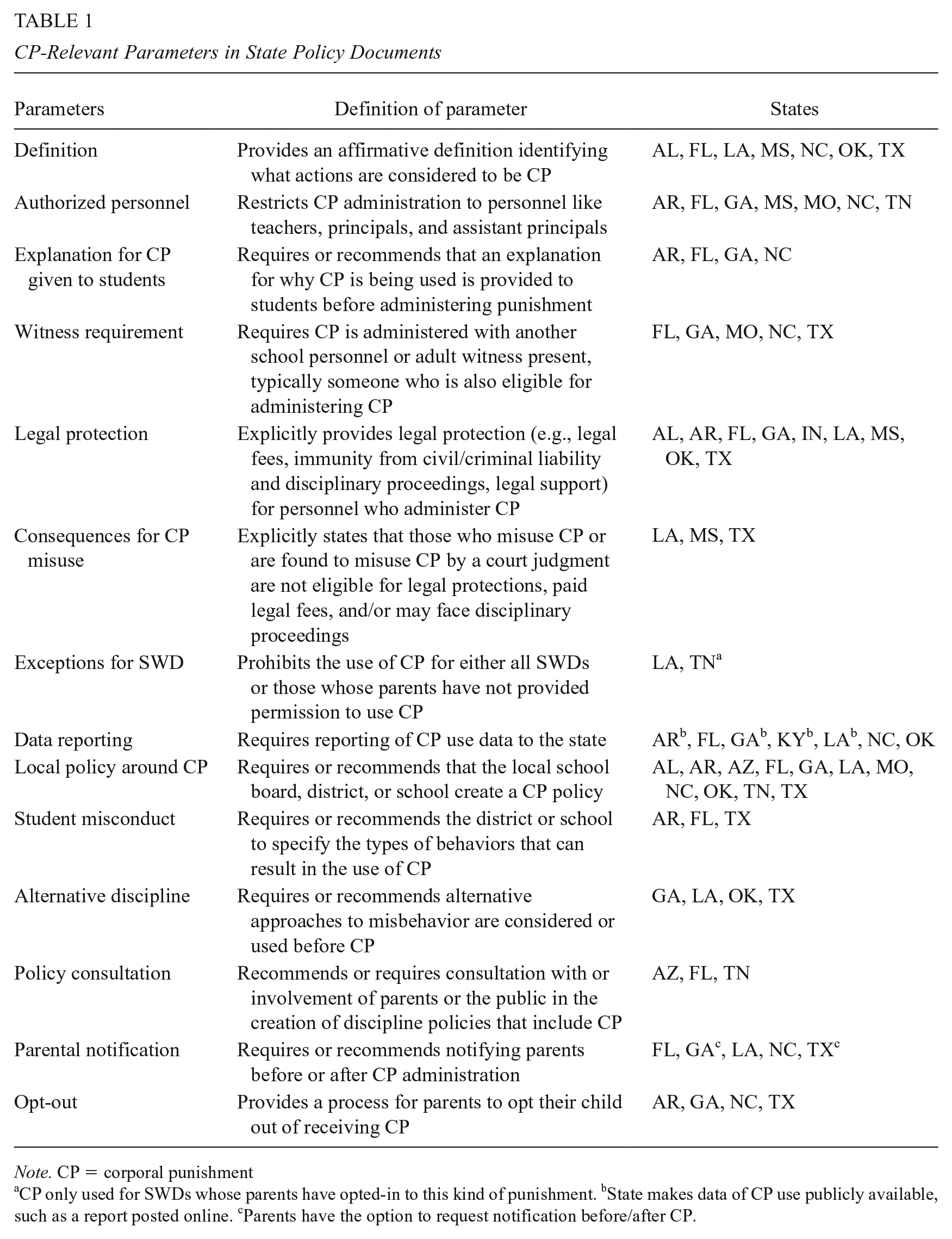
Note. CP = corporal punishment
CP only used for SWDs whose parents have opted-in to this kind of punishment. bState makes data of CP use publicly available, such as a report posted online. cParents have the option to request notification before/after CP.
We combine our qualitative data sources with quantitative data from the U.S. Department of Education’s Civil Rights Data Collection (CRDC) to examine to what extent CP is used in schools. We draw on the 2017–18 school year of CRDC, the most recent survey of the universe of U.S. public schools (Office for Civil Rights, 2018). The data include school-level variables for each state in our sample, describing the number of students who received CP by disability, race, and sex. We then created an aggregate student with disabilities (SWDs) category, combining SWDs served by either IDEA or Section 504. The data also include indicators for school level (elementary, middle, high, other K–12), school type (traditional public school, charter, and magnet), and geographic locale (city, suburban, town/rural), allowing us to examine the use of CP across these settings. Lastly, we merge additional data from the Common Core of Data, which provides us with the school-level enrollment of students from each demographic group, including race, disability, and FRPL status (U.S. Department of Education Common Core of Data, 2022). The Office for Civil Rights (OCR) requires all schools to track and self-report their use of school discipline, including CP, defined as “paddling, spanking, or other forms of physical punishment imposed on a child.” Schools likely underreported their use of CP and discipline, more generally, either intentionally in response to legal concerns or inadvertently due to misunderstanding definitions and poor recordkeeping. Therefore, our results are likely a lower-bound estimate of the actual use of CP.
As a quality control check, OCR used a process for flagging and suppressing cases when quality checks suggested flawed data, which involved contacting LEAs to revise or confirm the veracity of the flagged data. For the CP data, OCR specifically contacted LEAs when the instances of CP were less than the repor-ted number of students who received CP. Nevertheless, there remained some data discrepancies that required researcher discretion. In some cases, the reported number of SWDs in a school exceeded the total number of students enrolled. For these schools, we adjusted the total number of students enrolled to the number of SWDs enrolled, which indicates that all the students were SWDs. We used a similar approach for other instances when the enrollment proportion of a demographic group appeared to be greater than one and capped these proportions to one. Such discrepancies also occurred with the proportion of students corporally punished, wherein the count of students of a given demographic corporally punished was greater than the enrollment of stud-ents of that demographic.
Analysis
Our study uses a novel mixed-methods design that incorporates qualitative analysis of language and quantitative analysis of patterns of CP use to explore how these dimensions relate to each other and what they signal about the overarching discourses that mediate CP policy and practice. Our mixed-methods design provides a more complete understanding of discourse by using both methods to illuminate what might be obfuscated in language but visible in practice, or vice versa.
We draw on Fairclough’s (1992, 1995) three-dimensional critical discourse approach in analyzing qualitative and quantitative data sources. The approach considers multiple aspects of discourse, including text (language), discourse practice (text production and consumption), and social practice (counts of CP use). Fairclough proposes an analytical process that begins with describing a piece of text through textual analysis, interpreting the process involved in the production and reception of the text and what might be communicated, and explaining the relationship between the text (what was described), the larger social context the text is situated within (i.e., ideologies, power relations that bear upon the text and govern its reproduction or reception), and how it relates to social practice (i.e., how it is acted upon by social actors). We use the process of description, interpretation, and explanation in our analysis of both the language of policy in qualitative data and the practice of CP in quantitative data, which we describe in detail in the following sections.
Our analysis begins with examining the language of CP policy documents to identify the logics that justify its use (Research Question 1). We follow this with a quantitative analysis that examines how CP is practiced in schools, including where it is practiced, its prevalence and disparate use, and which school-level factors are related to its use (Research Question 2). We then examine the relationship between CP use and the logics we identified earlier (Research Question 3) before creating a cohesive set of discursive themes based on our qualitative and quantitative findings (Research Question 4).
Qualitative Analysis: Research Question 1
We engaged in multiple rounds of coding and analytic memo writing to analyze the policy documents. For each state in our sample, two researchers independently and inductively coded the policy documents with a focus on describing the subject (“who”) and object (“what”) of the text and interpreting the relationships between them. This coding resulted in codes that were “close to the data” and denoted the text (e.g., “teacher,” “principal,” “authorized to hold those strictly accountable,” “maintain discipline and order”). After condensing the data through coding, researchers answered a series of analytic questions (Saldaña, 2015) that asked them to (1) describe the prominent activities cited in the text and the actors responsible for them; (2) interpret the logics that the text explicitly or implicitly provides to justify the use of CP; and (3) explain how these relate to ideas about power, control, and punishment (e.g., in loco parentis, socialization, “open” schools). After working independently, the pair of researchers met to debrief their coding and analytic question responses (Creswell & Miller, 2000; Lincoln & Guba, 1985) and co-author a state memo that was shared with the broader team and reflected their synthesized responses to the same analytical questions described above.
The state memos were analyzed by two researchers who used matrix analyses to compare states and engage in cross-state coding of memos (Averill, 2002; Miles et al., 2014; Saldaña, 2015). We coded the state memos, clustered similar codes into categories, and grouped categories into themes. For example, initial codes related to the logics of CP use included “productive learning environment,” “learn in a safe classroom setting,” and “opportunity to learn.” These were clustered into the category “establishing environments conducive to learning” and finally grouped as describing “the purpose of CP.” The initial categories and themes were shared with the broader research team, where they were discussed, debated, and refined to reflect the data more accurately.
Our analytic process incorporated multiple checks to enhance the trustworthiness of our analysis. Before beginning our analysis, the research team discussed how our positionalities, primarily our racial and cultural backgrounds, inform our analysis (Milner, 2007). The research team - consisting of an Asian American woman, two African American men, and an Asian woman - reflected on our own diverse experiences with CP in schools and at home and the “cultural intuition” we brought to this study (Bernal, 2016). Engaging in this reflection prompted us to identify and discuss the working assumptions of our analysis and consider how to bolster its trustworthiness and interpretation. For example, to increase transparency, we decided to list the working assumptions related to CDA in our qualitative protocols to orient our analysis (i.e., coding and memo documents). We also created opportunities to elicit alternative interpretations by having multiple researchers analyze the same state policy documents and engage in the cross-state analysis process, along with having regular meeti-ngs to discuss interpretations with the team.
Quantitative Analysis: Research Questions 2 and 3
We began our quantitative analyses by describing where CP is practiced using a series of maps that show the proportion of schools using CP and the shares of students corporally punished. Next, we identified disparities in CP use across schools by creating risk ratios (RRs) that describe how much more or less frequently one student subgroup is corporally punished compared with another. We calculated the following RRs: (a) Black to White students, (b) Hispanic to White students, and (c) SWDs to students without disabilities. To do so, we use Equation 1, where we divide the within-group proportion of CP for subgroup i (i.e., the number of students subjected to CP in subgroup i divided by the total number of students in subgroup i) by the within-group proportion of CP for subgroup j in school s:

The interpretations of any disparities are subject to the measures used (Curran, 2020; Girvan et al., 2019). In our study, we focused on RRs because we seek to highlight the relative magnitude of the differences in CP use (i.e., how many times more or less a group is corporally punished in comparison to another group). One drawback of RRs is their sensitivity to small cell sizes and student enrollment. To attend to these limitations, we computed RRs only in cases where there is a minimum CP cell size of 1 (i.e., 1 use of CP per comparison group in the school) and a minimum enrollment of 10 students per comparison demographic. If a subgroup of interest met the thresholds, but its comparison group did not, we compared the within-group proportion of CP for the subgroup of interest at the school level to the proportion for the comparison group at the district level. If the population at the district level was too small, we used state counts. To check the robustness of our findings, we also compared our results when we computed RRs only in cases where there is a minimum cell size (CP count per demographic) of 10, and we found our results were qualitatively similar.
To further contextualize the disparities we observed, we also computed absolute risk differences by subtracting the proportion of enrolled students of a demographic group corporally punished from the proportion of enrolled students corporally punished of the comparison group, which yields the percentage point differential between groups, as shown in Equation 2:

The results from Equation 2 tell us how many percentage points more (or less) of one subgroup enrolled in the school were corporally punished than would be expected if that subgroup of students were corporally punished at the same rate as students in the comparison subgroup. We chose to calculate risk differences in addition to RRs because risk differences are less sensitive, though still sensitive, to small cell sizes (Curran, 2020; Girvan et al., 2019). Consequently, risk differences tend to be smaller for less frequent events, whereas RRs can be large for less-frequent events. We provide both measures in many places in our findings section to give a sense of the relative magnitude of CP and its actual percentage point differential. A complete comparison of RRs and risk differences can be found in Supplementary Table A2 in the online version of the journal.
To interpret how school-level factors are related to CP use and disparities, we used a multilevel, random-intercept model to account for the nesting of schools in districts. 1 We used this model because it accounts for the fact that districts set their own discipline policies that schools must comply with and because schools in the same district are likely more similar to one another than schools in other districts, which violates the assumption of independence needed for ordinary least squares regression analyses. 2 We regress the proportion of students corporally punished as well as the RRs 3 on student demographics, school locale, school level, and school type, as expressed in the following reduced form, mixed-effect Equation (3):

where
Finally, to explain how the logics in state codes relates to CP use, we created binary indicators for the presence of each logic identified by our qualitative analysis and related these to the state-level CP outcomes using point biserial correlations. The point biserial correlations, shown in Equation (4), estimate the association between the binary logic variables and the continuous CP proportions and RRs:

where
Integrating Quantitative and Qualitative Findings: Research Question 4
We began our analysis of discursive themes with a focus on policy documents, where we analyzed state memos for ideas related to power, control, and punishment—the topic of one of the memos’ analytic questions. We coded the state memos paying attention to the dominant power structure and ideologies espoused in the policy documents (e.g., power, punishment, control, and socialization). These codes are collapsed into categories, and then we look for commonalities between categories, which we use to generate discursive themes. After developing an initial set of discursive themes, we used the quantitative findings to revise and expand on these emerging ideas through a series of team meetings where we discussed our qualitative and quantitative findings in relation to each other. We looked for ways the quantitative results support or refute our initial discourses and places where our quantitative findings provided additional insights into how discourse might operate. Thus, the final set of discourses reflects both how CP is reasoned in policy texts and how it is inflicted on students.
Findings
We begin by describing the logics explicitly and implicitly communicated in policy documents before describing to what extent CP is used, noting where it is used, the students it affects most, and the contextual factors that predict its use. Next, we discuss how the logics embedded in policy documents correlate with CP use and disparities therein before concluding with a description of the discursive themes that pervade our findings.
Qualitative Findings: CP Logics in Policy Documents (Research Question 1)
We find several different logics that we cluster into three themes: those that relate to the purpose of CP, appropriateness of CP, and discretion in CP use. Importantly, these categories are not mutually exclusive, as some states have a combination of ideas. Table 2 displays these logics and the states where they were present.
The Logics of CP Use Identified in Policy Documents
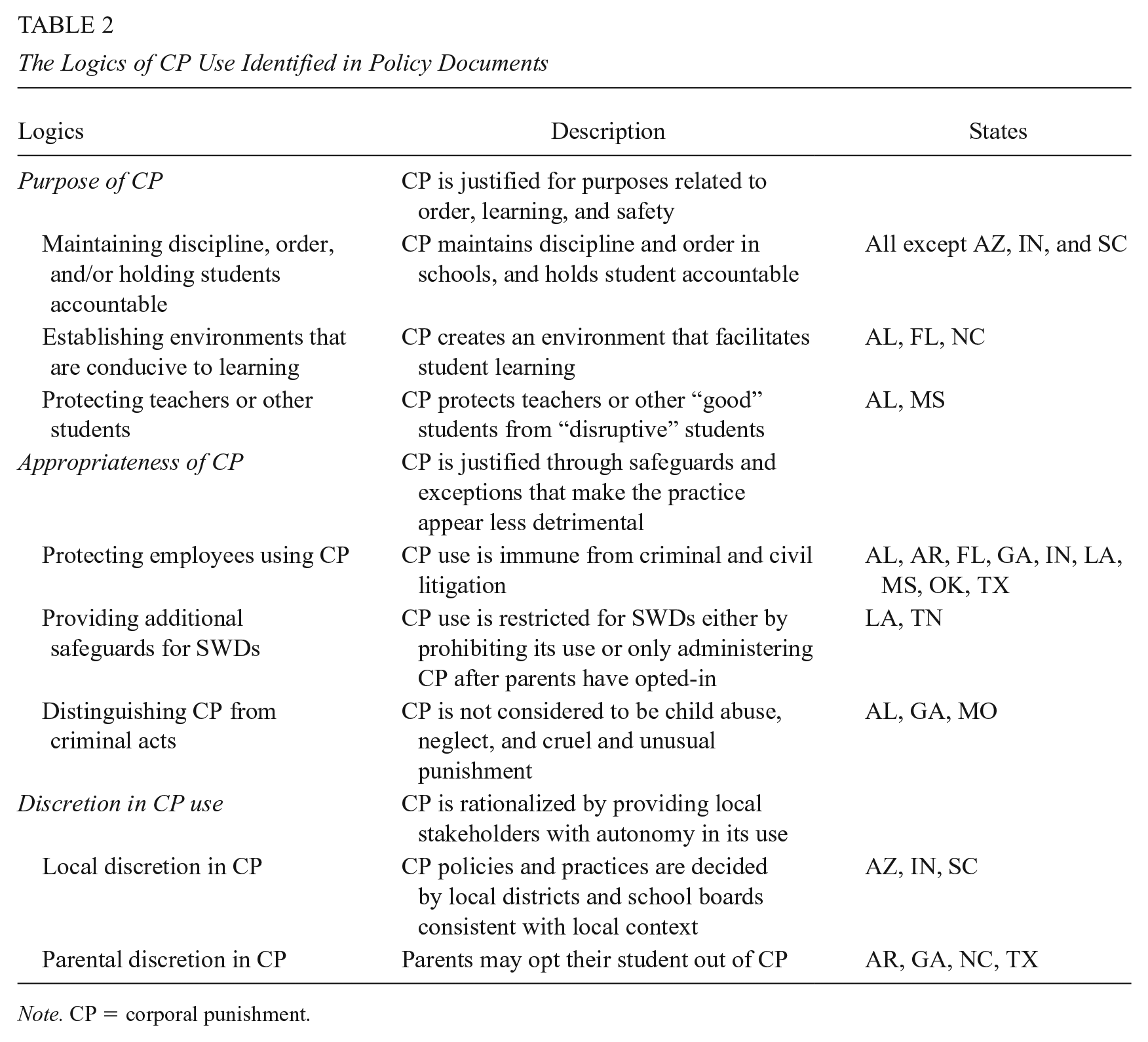
Note. CP = corporal punishment.
Purpose of CP
State policy documents communicated at least one of three primary reasons to justify the use of CP in schools and reminded their employees to act in accordance with these goals. The most frequently stated purpose, present in all but three states, was to maintain discipline, order, and accountability. For example, in Florida, the state code describes: Each teacher or other member of the staff of any school shall have such authority for the control and discipline of student. . . and shall keep good order in the classroom and in other places in which he or she is assigned to be in charge of students. (Fla. Stat. §1003.32, 2018)
Educators and other staff in the state are encouraged to use discipline, including CP, to keep order in the school. In other states, educators are directed to use physical punishment to “hold pupils to strict account” (Ky. Rev. Stat. Ann. § 161.180, 2018) or keep them “strictly accountable” (La. Rev. Stat. §17:416, 2018) for their conduct. Across these examples, CP is presented as a tool to achieve the goals of discipline, order, and control in schools.
A second documented purpose of CP, most notably present in three states (AL, FL, and NC), was to establish environments conducive to learning. These states also mentioned discipline and order as ancillary outcomes, but the primary purpose of CP was to establish a “productive learning environment” (N.C. Gen. Stat. §115C-390.1, 2018), uphold the rights of students to “learn in a safe classroom setting” (Ala. Code §16-28A-1, 2018), or ensure students have an “opportunity to learn” (Fla. Stat. §1003.32, 2018). Physical punishment is framed as necessary to promote learning. Yet, CP could do the opposite by creating an environment of fear and negatively impacting the well-being of corporally punished students as documented in other research (e.g., resulting in depression, externalizing behavior, and antisocial behaviors; Gershoff et al., 2019; Grogan-Kaylor et al., 2018; Jackson et al., 2010).
A final reason for using CP, present in two states (AL and MS), is to protect teachers or other students from disruptive students. For example, in Mississippi, CP is described as necessary “for self-protection or for the protection of other students from disruptive students” (Miss. Code Ann. § 37-11-57, 2018). CP is rationalized as a tool for promoting safety, despite CP recipients potentially feeling less safe after being disciplined. The purported safety of teachers and other students is prioritized above the physical and psychological safety of disruptive students who are physically punished.
Appropriateness of CP
Aside from describing the purpose of CP, policy documents also rationalize its use by providing legal protections for school employees who practice it, providing exceptions for SWDs, and distinguishing CP from criminal acts like child abuse. These provisions justify CP by providing safeguards and exceptions to its practice that make it appear more appropriate or ethical. Legal protections for employees were the main focus of most policy documents, including immunity from civil and criminal liability (e.g., FL and GA) and disciplinary proceedings (e.g., TX), and legal support for employees named in lawsuits (e.g., AL and AR). Only two states (LA and MS) explicitly mentioned possible consequences for misusing CP. The imbalance between protections and consequences for misuse insulates schools from repercussions, which might encourage employees to employ the practice.
As of 2018, few states (LA and TN) limit which students can receive CP, both making exceptions for SWDs. Louisiana prohibits using CP for SWDs, while Tennessee requires additional measures when disciplining SWDs (i.e., CP is only applied to SWDs whose parents have opted-in to the practice, and the school must notify the parent when CP is used (Tenn. Code Ann. § 49-6-4402, 2018). Neither state clarifies why it treats the CP of SWDs differently, but the additional protections might be due to ethical concerns or perceived increased legal risk of corporally disciplining SWDs. These states concede that there are limits to CP and that the practice might not be appropriate for some students.
Other states frame CP as appropriate by contrasting it with widely agreed upon criminal acts like “cruel and unusual punishment” (Ala. Code §16-1-24.1, 2018) and “child abuse” (Georgia Department of Education, 2012; Mo. Rev. Stat. §160.261, 2018). While none of these states provide details on why CP is different, contrasting it with these extreme acts might persuade school employees to consider physical punishment an acceptable and viable disciplinary option.
Discretion in CP
We also find that some policy documents grant local stakeholders broad authority in enacting CP by deferring all details of the practice to local districts or school boards. In other cases, states provide more control to parents by allowing them to opt out of CP. While most states offer some discretion in enacting CP to local districts or school boards, three states (AZ, IN, and SC) do not provide any state-level guidance, granting complete discretion to local entities. For example, the only mention of CP in South Carolina is “The governing body of each school district may provide CP for any pupil that it deems just and proper” (S.C. Code Ann. §59-63-260, 2018). The lack of state regulation could be due to the infrequency of CP cases reported by these states, representing three of the four states with fewer than 75 instances of CP. Regardless, the focus on local control implies that needs may differ across contexts and, thus, practices should vary. CP is rationalized by allowing local stakeholders, namely districts and schools, to design suitable practices and policies.
Four other states (AR, GA, NC, TX) give parents more discretion by allowing them to opt out of CP. However, the use of an opt-out (rather than an opt-in) process means parents have to be aware that they can choose to withdraw their student from CP to begin with. Then, parents interested in doing so must navigate a potentially burdensome process to exercise their rights. For instance, Georgia’s opt-out policy is one of the most restrictive in our sample. It requires parents to provide “a statement from a medical doctor licensed in Georgia stating that [CP] is detrimental to the child’s mental or emotional stability” by the first day of school (Ga. Code Ann. §20-2-731, 2018). This opt-out process is likely untenable for some parents, particularly low-income families and parents of color, who lack access to health care, may find the financial cost of arranging an appointment burdensome, or are wary of their children receiving a medical diagnosis that is shared with schools.
Quantitative Findings: CP Use, Disparities in Practice and Correlates With Logics (Research Questions 2 and 3)
We first describe CP use in each state, identifying the proportion of schools that use CP and the share of students who are corporally punished. We then use RRs to highlight the disparities in CP use. At times, we also describe the absolute risk difference to highlight how much the rate at which Black, Hispanic, and SWDs are corporally punished differs from that of White and general education students. Next, we interpret results from multilevel models that show how school factors are related to CP use and its disparities. We conclude by correlating the logics described above with CP outcomes.
The Prevalence and Disparate Use of CP
School CP is largely a regional practice, with nearly every state in our sample located in the South. We find that the share of schools using CP in the 2017–2018 school year ranges considerably, from 52% (MS) to over 0.1% (NC), as shown in Figure 1. The scatter plot in Figure 2 generally shows that states with the greatest proportion of schools using CP also tend to corporally punish larger shares of their students, with some exceptions. For example, in Louisiana, where more than 11% of its schools use CP, only about 2% of students in schools are corporally punished. In Missouri, however, a smaller share of schools reported using CP (7%), but those schools corporally punished 6% of their students, which was higher than any state except for Mississippi (9%).
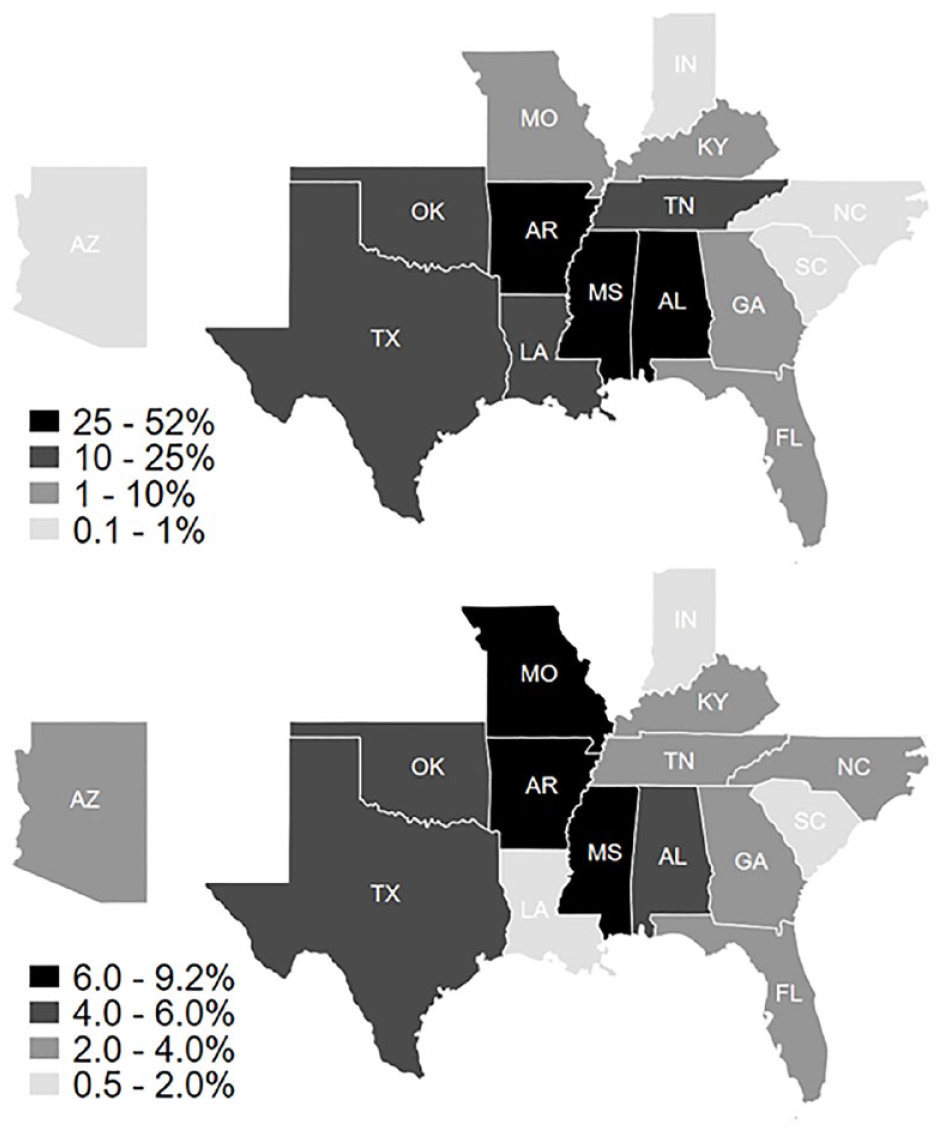
Percent of schools practicing corporal punishment and percent of students corporally punished, 2017–18.

Relationship between the percent of schools with CP and the mean percent of students corporally punished in the school, 2017–2018.
We also explore how the use of CP differs across school characteristics and student demographics, finding large discrepancies between who is enrolled in schools and who is subjected to CP (Table 3). Across states, elementary, rural, and traditional public schools compose the largest share of schools practicing CP (see Supp-lementary Table A3 in the online version of the journal). On average, White students comprise the largest demographic group in schools with CP, except in Mississippi, North Carolina, and Arizona, where the largest racial groups in these schools are Black, Native American, and His-panic students, respectively. In all but three states (OK, SC, and TX), the proportion of CP on White students was less than their enrollment proportion, suggesting that White students were less likely to be corporally punished. Differences between the enrollment share and corporal punishment rate for White students were statistically significant for six states (AL, GA, LA, MO, MS, and NC). Across many states, we find that the state’s largest student minority group tends to be disproportionally punished, with the exception of Kentucky, Oklahoma, South Carolina and Texas. Black students comprise the largest minority group in most states that use CP, and in these states (AL, AR, FL, GA, LA, MO, MS, SC, and TN), we find that the share of Black students corporally punished significantly outnumbers their enrollment, except for in South Carolina. Hispanic students are the largest minority group in Arizona and Indiana, where they are disproportionately subjected to more CP, although these differences are not statistically significant. In contrast, Hispanic students are also the largest minority group in Texas, but they are physically punished at a rate lower than their enrollment. Meanwhile, in North Carolina, only two counties use CP, and these counties educate majority Native American students, and we still find Native American students are disproportionally punished when compared to their enrollment share, albeit not statistically significant. The largest minority group in Oklahoma is Native American, and unlike in North Carolina, they are corporally punished at lower rates than their enrollment. In Kentucky, the two racial minority groups with the largest enrollment in CP schools are Black and Hispanic students and they are corporally punished at similar rates to their respective enrollment rates. SWDs also tend to be corporally punished at rates greater than their enrollment, except in Louisiana where SWDs are punished at rates that are statistically significantly lower than their enrollment rate. Nevertheless, Louisiana and Tennessee both restricting the use of CP on SWDs, each has a sizable proportion of CP use administered on SWDs, accounting for 6.2% and 18.7% of the total CP in the state, respectively. Given that CP is prohibited or restricted among SWDs in both these states, these results might imply that parents are opting their children into CP, or that there is a lack of compliance with state mandates prohibiting the practice on these students, or perhaps data reporting errors.
Corporal Punishment Use and Enrollment in Schools Using CP, 2017–2018
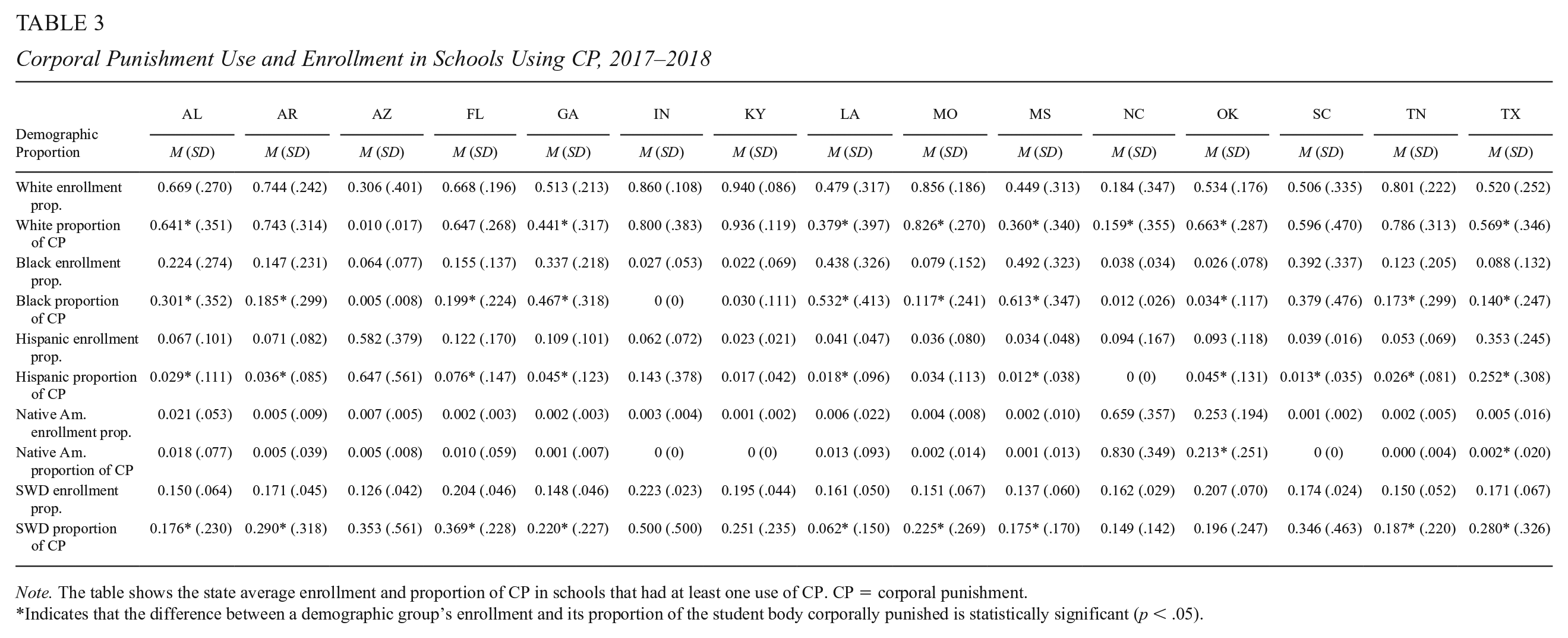
Note. The table shows the state average enrollment and proportion of CP in schools that had at least one use of CP. CP = corporal punishment.
Indicates that the difference between a demographic group’s enrollment and its proportion of the student body corporally punished is statistically significant (p < .05).
While Table 3 highlights how the average share of students enrolled relates to the average proportion of students corporally punished across schools, the table does not reveal the level of disparities between groups within schools. In Figure 3, we use the average RR within each school to show how much more likely students of color and SWDs are to receive CP relative to White and general education students, respectively. We further contextualize the disparities by reporting the absolute risk differences in the text (for the complete absolute risk differences see Supplementary Figure A1 in the online version of the journal).

Mean school corporal punishment relative risk ratios, 2017–18.
We find that Black students in every state that meets the inclusion criteria were, on average, more than 1.5 times as likely to be corporally punished as their White peers. This ranges from an absolute difference of 0.29 percentage points in Kentucky to nearly 9 percentage points in Missouri. In contrast, in most states, Hispanic students were corporally punished at rates in relative parity to White students, on average. Louisiana notably had the most severe Hispanic-White disparity, with the proportion of Hispanic students corporally punished four times greater than that of White students. 4
Like Black students, SWDs were corporally punished at alarmingly disparate rates. In every state except for Arizona, SWDs were at least 1.5 times as likely to be corporally punished as their general education peers, with South Carolina having the most extreme disparities. SWDs were more likely to be corporally punished than their general education peers even in states that restricted CP use on SWDs—Louisiana and Tennessee. In terms of the average percentage point difference in CP use on SWDs and general education students, every state except Arizona and Louisiana had an average risk difference reflecting the greater use of CP on SWDs. Absolute risk differences ranged from –3.2 pp in Arizona (an artifact of there being just three schools in the state recording CP) to +4.6 pp in Missouri (where more than 150 schools use CP).
The Relationship Between School Characteristics and CP Use
To interpret how student and school characteristics relate to the use of and disparities in CP, we also conduct a series of regressions, as shown in Figure 4. We report our results using conventional levels of significance (p < .05). The presence of two marginalized student groups—Black and FRPL-eligible students—is associated with significantly greater shares of students corporally punished (Figure 4A). Schools with Black and FRPL-eligible populations 1 SD (22–27 pp) greater than the mean have 0.20 and 0.08 SD more students corporally punished, respectively. This equates to a CP proportion roughly 0.5 to 1.4 (10%–30%) greater than the average. The presence of these groups has little relationship with the Black–White (Figure 4B) and Hispanic–White RRs (Figure 4C), although the SWD–general education RR is an estimated 0.07 SD lower when Black student enrollment increases 1 SD. The only RR that varies significantly with Hispanic student enrollment is the Hispanic–White RR (Figure 4C). We find that schools with a Hispanic population 1 SD (19 pp) greater than the mean realize a Hispanic–White RR 0.19 SD lower than average, with Hispanic and White students then having similar risks of being punished (0.95 Hispanic–White RR as compared to 1.31 Hispanic-White RR). In general, though, regardless of the population demographics in a school, the disproportionality in CP use between racial/ethnic groups and between disability groups remains relatively constant.

The relationship between school characteristics and CP use.
A few school factors are related to CP usa-ge and RRs, and their relationships with these outcomes are generally larger than the student demographics we reported above. Small towns and rural areas corporally punish 0.38 SD more students than city schools, which represents nearly a 100% increase in CP from 2.6% of city students corporally punished to an estimated 5.2% of town/rural students (Figure 4A). Although these less populous areas corporally punish more students, it is the city schools that have the most severe Black–White CP disparities, as shown in Figure 4B. Specifically, the Black–White RR is approximately 0.29 SD lower in rural/town schools compared to city schools—a 2.77 Black–White RR in rural/town schools compared to a 3.72 Black–White RR in city schools. School level is only statistically significantly associated with differing magnitudes of the SWD-general education RR (Figure 4D), with smaller RRs in high schools and other nontraditional leveled schools. For example, high schools have SWD–general education RRs that are 0.15 SD lower in comparison to elementary schools, which means 2.67 times as many SWDs are corporally punished in elementary schools compared to 2.20 times as many SWDs punished in high schools.
Whether a school is a charter or magnet relative to traditional public schools is also related to CP use, although many of these estimates are imprecise because of the relatively small number of these schools using CP. Charter schools are found to have Black–White and Hispanic–White RRs that are 0.5 to 1 SD larger than traditional public schools, though this is only significant for the Hispanic–White RR (Figure 4B and 4C). While the average Black–White RR in traditional public schools is 2.83, the average charter school uses CP on Blacks at a rate nearly five times greater than on White students. Meanwhile, Hispanic students in charter schools are corporally punished 2.64 times more often than White students as compared to a RR of 1.32 in traditional public schools. For magnet schools, the regression estimates suggest the proportion of students corporally punished is 0.39 SD lower than in traditional public schools (from 5% in traditional public schools to 2.7% in magnets, Figure 4A). Similarly, magnet schools appear to have lower RRs when compared to traditional public schools, although all of these coefficients are imprecisely estimated (see Figures 4B–4D).
To connect the logics embedded in the CP policy documents to the use of and disparities in CP, we conduct a series of point biserial correlations and present the results in a heatmap with darker shading for larger absolute magnitudes (Figure 5). While most associations between the logics and the proportion of students corporally punished are weak and not statistically significant, several are worth noting. States with logics that frame CP as a means to create discipline, order, and accountability (r = 0.53) and a tool to protect teachers and students from disruptive students (r = 0.56) have higher CP use. This is a moderately strong relationship. We also find that these frames correlate with RRs in varied ways. For example, states emphasizing discipline, order, and accountability have a slight association with more disparate Black–White RRs (r = 0.34), though this logic is also somewhat strongly related to lower Hispanic-White (r = −0.60) and more weakly associated with lower SWD-general education (r = −0.34) RRs.

The correlation between state code logics and the use of and disparities in corporal punishment.
When examining logics related to the appropriateness of CP, we find evidence that states that frame CP as distinct from abuse are correlated with slightly larger Black–White RRs (r = 0.35) than those without this framing. Furthermore, the criminal and civil immunity logic has a slight negative correlation with the Hispanic-White RR (r = −0.36). States with safeguards for SWDs appear to be modestly associated with less-severe SWD-general education RRs (r = −0.40), as expected, but they also tend to have significantly higher Black–White RRs (r = 0.40). Finally, the local discretion logic is moderately associated with fewer CP cases reported (r = −0.53). This might be driven by low usage of CP but also perhaps because districts in these states do not track CP sufficiently because there is little state oversight of CP. We also find that the local discretion logic is weakly correlated with less–pronounced Black–White RRs (r = −0.34) but more strongly associated with greater CP use on Hispanic students (r = 0.60) as well as a more modest correlation with increased SWD (r = 0.34) punishment in comparison to White and general education students, respectively.
Integrating Quantitative and Qualitative Findings: Research Question 4
We draw together our qualitative and quantitative findings to identify discourses that reflect broader ideas of power, control, and punishment, including how these ideas are racialized. A few distinct discourses emerge across our findings that we label as (1) moral discourse, (2) delinquency discourse, and (3) authority discourse.
Moral Discourse
Morality is implicated across policy documents in varied ways. Several states justify using CP by stating that the practice teaches aspects of moral development like “respect” or “accountability.” This is most prevalent in states where the stated goal of CP is to maintain discipline, order, and accountability. In these contexts, CP is a tool for developing “good” students or correcting “bad” ones. Louisiana provides an illustrative example of the focus on accountability: Every teacher is authorized to hold every pupil to strict accountability for any disorderly conduct in school or on the playground of the school, or on any school bus going to or returning from school, or during intermission or recess. Each parish and city school board shall have discretion in the use of corporal punishment. (La. Rev. Stat. §17:81.6, 2018)
The code draws together the focus on accountability with the legal authority to punish corporally, implying that the purpose of the punishment is to instill accountability for disorderly behavior.
Within this discourse, there is also an appeal to the moral obligations of educators to discipline students by describing educators’ “authority” to instill order and control—like in the example above. Other examples suggest that school employees have a “responsibility” or that they are “entrusted with the care” of students and, thus, they are obligated to use disciplinary practices like CP (Office of the Attorney General, 2013). Instilling morality might also motivate the practice of CP, as evidenced by the significant positive correlation between the logic of using CP for discipline, order, and accountability and CP use (r = 0.53). These appeals to educators’ moral goals and obligations are used to communicate why CP is appropriate and necessary.
Notably, the moral discourse reflects broader ideas related to the socializing role of scho-ols (Apple, 1982; Durkheim, 1961; Foucault, 1977) and racial socialization (Nikolaidis, 2023; Patterson, 1982; Tolnay & Beck, 1995). CP is normalized as a part of the school socialization process, wherein teachers (authority) require students’ (citizens’) obedience. Students should follow the schools’ rules and submit to the socialization process or face physical punishment. More broadly, while the moral discourse in policy texts is race-evasive (Annam-ma et al., 2017; Bonilla-Silva & Ashe, 2014; Frankenberg, 1993), the practice of CP is racialized and reflects historical patterns. Schools with more Black students are more likely to report CP, and within schools, Black students are more likely to be corporally punished than White students. The trends in CP might reflect that educators believe Black students are especially in need of the moral development that CP can instill. Given the racialized history of CP, when it was conceived as a “slavish” form of discipline (Glenn, 1984) and suitable for “inferior” races, it is perhaps unsurprising that Black students continue to receive the practice most disproportionately.
The same pseudo-scientific theories that supported CP for Black students also recommended its use for young students by reasoning that these students were more responsive to physical punishment than other means. We find that elementary schools are more likely to report using CP. While developmental psychologists have rejected these theories and references to student age are not found in the policy text, we find echoes of these ideas in the ways CP is used. Analyzing both the language of policy texts and examining the practice of CP provides insights into how “discourse (re)produces social domination” (Wodak & Meyer, 2015, p. 9) by showing how CP use reflects latent assumptions about discipline that are not explicitly stated in language but are evident in social practice.
Delinquency Discourse
The practice of CP is endorsed in policy documents by portraying punished students using a delinquency discourse. For example, several states described the focus of CP as protecting teachers or other students from those labeled as “disruptive,” “unruly,” “threatening,” or “assaultive.” These labels are “imbued with crime-related meaning and imagery” (Hirschfield & Celinska, 2011, p. 2) and conjure up ideas of malfeasance and culpability. While labels are commonly used for varying goals, they have also been used as a strategy of dehumanization used in genocide, colonization, and slavery (Bandura et al., 1975; Bar-Tal, 1990; Kelman, 1973), where labels justify violence against a target group by portraying the target group as unworthy of empathy (Bruneau et al., 2020). Labeling the recipients of CP as delinquents could justify the use of physical violence. The disparities in CP use suggest that Black students and SWDs are more likely to be considered delinquents since these students have higher RRs of receiving CP.
Labeling also segregates students into two competing groups, disruptive students and their peers who need to be protected from them, where the needs of the latter group are pitted against the needs of the former. In some states, like Alabama, the language of rights is used to describe the tension between the groups: [E]very child in Alabama is entitled to have access to a program of instruction which gives him or her the right to learn in a non-disruptive environment. No student has a right to be unruly in his or her classroom to the extent that such disruption denies fellow students their right to learn. (Ala. Code §16-28A-1, 2018)
The code suggests that disruptive students should be punished because they pose a threat to the learning and safety of others. Because the delinquent label also assumes guilt, the needs and rights of disciplined students are ignored in policy documents. For instance, no state offers due process after students are corporally punished, even though some of these same states provide due process for suspended students, making it nearly impossible to appeal improper use of CP. Only Arkansas and Louisiana require schools to provide opportunities for students to explain their behavior before administering CP. Furthermore, although CP is framed as a tool to maintain an educational environment, the right of punished students to learn is ignored, as CP is associated with mental and emotional trauma that is detrimental to learning and socioemotional well-being (Gershoff et al., 2019; Grogan-Kaylor et al., 2018; Jackson et al., 2010). Instead, the delinquency discourse focuses on using CP to protect the safety and learning of their peers by dispensing punishment.
Policy documents do not provide explicit protections for punished students, thus the only protection that exists is the “openness” of schools, as argued by the Supreme Court. Policy documents show that disciplined students can receive public punishment in most states, which gives literal meaning to the concept of “open” schools, wherein children are physically assaulted in the presence of onlookers who could ostensibly intervene to prevent excessive harm. The openness of schools is meant to serve as a protective factor for any student subjected to CP, but the codes are not written with student protection in mind. History reminds us that public displays of violence are also associated with racialized terror—not just for the victim of violence but especially for those witnessing it (Ward, 2016; Ward et al., 2021). Publicized racial violence has been used historically to cultivate a “climate of terror” (Tolnay & Beck, 1995, p. 19). CP in the presence of other students could have a similar effect for these onlookers. Thus, the public administration of CP seems better purposed to socialize students witnessing CP through fear rather than the idea of openness reasoned by the Ingraham v Wright decision.
Authority Discourse
Policy documents describe a complicated and, at times, contradictory narrative around the power dynamics between the state, schools, and parents/guardians that we refer to as the authority discourse. In some cases, policy documents place the authority of schools and parents on equal footing and draw an equivalency between these groups to substantiate the use of CP. For instance, policy documents allude to the fact that schools are expected to develop students both academically and morally. Because of this dual purpose, policy documents position schools as an extension of parents by alluding to the fact that schools are “entrusted with the care” of, act in the “welfare” of, or have the “responsibility” to attend to the development of students. In these examples, schools derive their authority to use CP by invoking in loco parentis and arguing that their role is akin to parents/guardians (Calhoun, 1969; Hogan & Schwartz, 1987; Parker-Jenkins, 1998). By drawing similarities between the responsibility of schools and that of parents, the authority of schools and parents are considered to be equal.
In other cases, policy documents convey a clear hierarchy between schools and parents, where the authority of schools supersedes that of parents. For example, very few states mandate an opt-out process for parents opposed to CP, and no states require an opt-in process. The few states requiring an opt-out process have created barriers to using it, including requiring a doctor’s note (e.g., GA) or requiring parents to renew their decision annually by the first day of school (e.g., TX). In other settings, states caution parents against opting out of CP by stating that suspensions and expulsions that result in missed instructional time may be used instead of CP for any opted-out students (N.C. Gen. Stat. § 115C-390.4, 2018). In addition, no state requires schools to notify parents when CP is practiced on their student, aside from two states that require such notification only for SWDs. The courts have agreed that the authority to use CP resides with schools and not parents by allowing CP on children whose parents had opted them out of practice (Baker v. Owen, 1975).
Parents may be able to influence CP in their local schools by voicing their opinions to local leaders. Some state policy documents sometimes require local school boards to hold hearings about CP and take public testimony from community stakeholders when determining the CP policies. In Florida, for instance, school boards are required to hold hearings on CP every 3 years, and there may be settings like this where parents influence CP (Fla. Stat. § 1002.20, 2018). We find that when CP decision-making is decentralized from the state to local communities (where parents perhaps have opportunities to exert their influence), it is correlated with reductions in CP use and disparities for Black students, suggesting that local control could be helpful for limiting CP.
The only other recourse parents have for checking the authority of schools is through the legal system. Nearly all policy documents restrict liability protections in cases where CP is used in an “unduly severe,” “neglectful,” and “abusive” manner. In some states, schools impose their own penalties on employees if found guilty of misuse by requiring employees to reimburse districts for any legal fees paid in their defense (e.g., LA, MS, and TX). However, the bar for being found guilty of misuse is exceptionally high as Court cases have insolated CP users from liability even in cases where the Courts acknowledge violations of student civil liberties and due process (Garcia v. Miera, 1987; Hall v. Tawney, 1980; Ingraham v. Wright, 1977), making the legal system an unreliable accountability mechanism. A much weaker form of oversight that parents might use are data and reports on CP use. A few states require this information to be made publicly available, which is necessary but perhaps insufficient for public accountability. Even when made public, this information is often buried on public agency websites, making it an unlikely tool to hold schools accountable. Without clear communication, oversight, and accountability mechanisms, parents’ wishes are secondary to the powerof schools, their governing boards, and their employees.
Discussion
In this study, we use a critical discourse app-roach and draw on policy documents as well as school-level data from the 2017–2018 CRDC to: (a) examine the logics communicated around the use of CP in policy documents; (b) describe where CP is used, what disparities exist in its use, and what factors predict its overall and differential use; (c) relate the policy logics to what extent CP is used; and (d) uncover the discursive themes underpinning CP policy and practice.
Our data reveal discourses relating to morality, delinquency, and authority. A moral discourse is elicited through states’ policy documents, as they frame CP as both morally justifiable and educational. States using logics framing CP as necessary for maintaining discipline and protecting students from disruptive peers tend to administer it more frequently and disproportionately on Black students. Policy documents also portray students who receive CP as delinquents needing correction. While this delinquency discourse is color-evasive (Annamma et al., 2017; Bonilla-Silva, 2010) and avoids specific references to students’ background characteristics in writing, Black students and SWDs are seen as especially in need of correction, as evidenced by the fact that they are more than twice as likely to be corporally punished than their peers. Finally, we uncover a discourse related to the authority to punish, revealing tensions around the power dynamics between schools and parents.
Furthermore, the pervasiveness of the logics that undergirds such discourses is a testament to the fact that education policy and practice are not immune from the legacy of racial hierarchy and can function to uphold it. (Diem & Welton, 2020; Dumas, 2016; Kohli et al., 2017; Parker, 2003). In the case of CP, many early advocates feared its potential ramifications for White students’ identity, framing CP as a “brutalizing and degrading” method of discipline (Glenn, 1984). At the same time, it was seen as apt for Black and other minoritized students. Our analysis of CP use suggests it continues to be practiced in the same way.
Our findings also highlight how policies that threaten and use violence as a control strategy are deeply rooted in U.S. racial history (Ward et al., 2021). In particular, generations of Black Americans have experienced systemic forms of racialized terror that involve the intentional infliction of pain through whipping and other means to control and socialize them (Cook et al., 2018; Craemer et al., 2020; Williams et al., 2021). While a growing body of empirical research on this history of racial violence finds that these histories shape current practice (Ward, 2016; Ward et al., 2021), far less work has explored how the logics governing CP policy influence how it is administered in practice. Connecting these discipline policies to prominent and problematic discourses is an important step in understanding why the practice has continued.
Our study adds to several recent studies using CDA to explore how discipline policies are framed and the logics embedded within them (e.g., Jenkins, 2023; Nikolaidis, 2023; Turner & Beneke, 2020). Like these studies, the results of our work highlight how the logics of school discipline policies reveal discourses that are intensely racialized, wedded to systemic injustice, and legitimized through arguments that uphold white supremacy. Avoiding references to student background characteristics like race and disability status in school discipline policies appears to be a feature, not a bug. Discourses suggesting the need for approaches like CP, school resource officers, and other exclusionary practices ignore the racialized manner in which discipline is practiced, despite strong evidence of the widespread disparities in its use (Barrett et al., 2021; Sorensen et al., 2022; Welsh & Little, 2018). By contextualizing the discourses with CP use and disparities therein, we elaborate on how these race- and status-evasive discourses appear in policy documents and reinforce systematic marginalization. Thus, our study also contributes to the school discipline literature by shedding light on which logics are apparent in state discipline policies and how they relate to disproportionality in one form of school discipline.
Policy Implications and Directions for Future Research
This study has several relevant policy implications and can be expanded upon in future research. We urge policymakers and education leaders to immediately act to prohibit CP—a call that was recently made by the Secretary of Education (U.S. Department of Education, 2023). We show that, as of 2018, CP was still inflicted on seventy thousand students despite the overwhelming evidence that CP is harmful for children (e.g., Gershoff, 2013). Our results show that without its outright prohibition, some schools will still continue to use it and disproportionally for marginalized student groups. Our results suggest that CP has formidable staying power and will continue to endure without formal bans to eradicate its use.
Second, education leaders, educators, students, and families should work to unearth hidden logics and assumptions within their discipline systems and deliberate about the purpose of punishment. Our findings suggest that punitive practices draw on ideas of morality, delinquency, and authority to normalize punitive actions. Thus, education stakeholders should reflect on the ideas embedded within their own discipline systems, consider whether those align with their visions of what school should be, and possibly reimagine the role of punishment in their schools. Researchers can play an important role in offering guides on what this reimagining of schools could look like, and how CDA can be used by practitioners to review school materials (see Allbright et al., 2023; Alonso et al., 2022; for an example applied to school marketing materials). We invite education stakeholders to examine their own discipline policies and documents, paying attention to how power is exercised in these policies, who benefits and suffers from these actions, and what the broader purpose of punishment is.
Our results also highlight the need for school discipline policies to contend with the reality that race and other student background characteristics are central to the practice of school discipline. The practice of CP and other disciplinary practices are disproportionately applied to minoritized students, which serves to preserve and maintain a racial societal hierarchy. (Diem & Welton, 2020; Dumas, 2016; Kohli et al., 2017; Parker, 2003). The avoidance of references to student race and identity in school discipline policies allows the disproportional application of punishment to appear natural and necessary (Bonilla-Silva & Ashe, 2014; Kohli et al., 2017), thereby ignoring the systemic inequities that influence how (mis)behavior is conceptualized and responded to (Au, 2016; Bonilla-Silva & Ashe, 2014; Frankenberg, 1993). A failure to recognize students’ background characteristics in discipline policy allows racism and white supremacy to operate uninterrupted. Failing to discuss race in school discipline reforms, for instance, ignores the need for proper safeguards that protect students from the disparate imposition of CP.
Our results also suggest a few promising directions for future research. Our study assumes a mediating relationship between policy documents and how CP is practiced in schools. However, the process by which local actors interpret, make sense of, and act upon these policies is dynamic and multifaceted. Other research suggests that this process is dependent on both individual (e.g., attitudes and beliefs, previous experiences) and organizational factors (e.g., organizational values, structures, and routines; Spillane et al., 2002; Weick, 1995). We encourage future work to exp-lore the mediation process between written discipline policies and actions taken by educators and school leaders, and in particular, pay attention to how power is exercised and reinforced through this process (Apple, 2019).
Furthermore, an examination of district and school discipline policies might also reveal more nuances related to the logics and discourses that govern punishment in schools. While states provide the framework for school discipline, districts have considerable autonomy in what types of discipline are permitted. We plan to examine how local features of school discipline policies predict discipline use and disparities in addition to examining how discourse operates in these policy texts.
Supplemental Material
sj-pdf-1-epa-10.3102_01623737231213040 – Supplemental material for Spare the Rod, Spoil the Child? A Critical Discourse Analysis of State Corporal Punishment Policies and Practices
Supplemental material, sj-pdf-1-epa-10.3102_01623737231213040 for Spare the Rod, Spoil the Child? A Critical Discourse Analysis of State Corporal Punishment Policies and Practices by Tasminda K. Dhaliwal, Jerome Graham, Yi-Chih Chiang and Andrew S. Johnson in Educational Evaluation and Policy Analysis
Footnotes
Acknowledgements
The authors wish to acknowledge the anonymous reviewers and guest editors for their helpful feedback.
Correction (March 2024):
Article updated to correct data in the text and URL in references.
Correction (May 2024):

Declaration of Conflicting Interests
The author(s) declared no potential conflicts of interest with respect to the research, authorship, and/or publication of this article.
Funding
The author(s) disclosed receipt of the following financial support for the research, authorship, and/or publication of this article: The research reported here was supported by the Institute of Education Sciences, U.S. Department of Education, through Grant R305B200009 to Michigan State University. The opinions expressed are those of the authors and do not represent views of the Institute or the U.S. Department of Education.
Notes
Authors
TASMINDA K. DHALIWAL, PhD, is an assistant professor of Education Policy at Michigan State University. Her research focuses on how social and economic conditions shape outcomes for marginalized students and the implementation and effectiveness of policies designed to reduce inequality.
JEROME GRAHAM, PhD, is an assistant professor of K–12 Educational Administration at Michigan State University. His research evaluates the implementation and effects of educational policies and practices that have the potential to make schools more humanizing for Black children by (a) problematizing, analyzing, and documenting the disparities that often make school a “site of suffering” for Black students and (b) investigating the implementation and effects of policies and practices offering alternatives to current schooling approaches that would center, improve, and affirm well-being.
YI-CHIH CHIANG, MEd, is a doctoral student in K–12 Educational Administration at Michigan State University. Her research focuses on policy discourses, policy implementation, and school/district improvement in K–12 education settings.
ANDREW S. JOHNSON, MEd, is a doctoral candidate in Education Policy at Michigan State University. He uses critical quantitative and mixed-methods to study educational decision-making and evaluate policies from an equity standpoint.
References
Supplementary Material
Please find the following supplemental material available below.
For Open Access articles published under a Creative Commons License, all supplemental material carries the same license as the article it is associated with.
For non-Open Access articles published, all supplemental material carries a non-exclusive license, and permission requests for re-use of supplemental material or any part of supplemental material shall be sent directly to the copyright owner as specified in the copyright notice associated with the article.
