



Abstract
The presence of endothelin (ET)-like immunoreactivity and the cardiovascular effects of mammalian ET-1 in fish have been reported. To identify ET-related peptides in fish, we screened the cDNA library of the salmon (Oncorhynchus keta) stomach by means of rapid amplification of cDNA ends, and we cloned cDNAs encoding an ET-related peptide. The salmon ET-related sequence of 21 amino acids is identical to the trout ET-1 peptide recently purified from kidney specimens of Oncorhynchus mykiss. The deduced amino acid sequence of salmon pre-proET-1 (PPET-1) comprises 244 amino acids, including a putative signal sequence and mature ET-1, as well as big ET-1 and ET-1-like sequences. This precursor, the first reported PPET-1 sequence for Salmoniformes, Teleostei, has low homology with the sequences of human, mouse, frog (Xenopus laevis), and zebrafish (Danio rerio) PPET-1 (26%, 29%, 24%, and 39%, respectively).
Introduction
The family of endothelin (ET) ligands comprises ET-1, ET-2/vasoactive intestinal contractor, and ET-3. These ligands are 21-residue peptide hormones with varied and important roles in the regulation of mammalian physiological processes (1–12). ET-like immunoreactivity has been observed not only in mammals but also in fish (13, 14). The biological actions of exogenously administered mammalian ET-1 peptide are similar in fish and mammals (15, 16). Recently, trout (Oncorhynchus mykiss) ET-1 peptide was purified and its myotropic activity analyzed (17). Zebrafish (Danio rerio) ET-1 was identified as a morphogen that is expressed ventrally in the pharyngeal arches and required for correct patterning of pharyngeal cartilage development (18).
In the present article, the rapid amplification of cDNA ends (RACE) method (10) was used to screen ET-related peptides from specimens of salmon stomach. The cloned cDNA sequence and deduced amino acid sequence of a salmon precursor of the ET-related peptide were analyzed.
Materials and Methods
Reagents and software used are the same as those in the report by Quan et al. (10). The stomach was excised from a fresh-caught salmon preserved on ice. Isolation of mRNA, cDNA amplification, subcloning of RACE-PCR products, sequencing of the cloned products, and sequence analysis were performed as previously described (10). Two kinds of guess PCR primers, 5′-GSP (5′-GGBGTRTTGACCCA-GATKATRTCC-3′, where B = G, T, or C; R = A or G; and K = G or T) and 5′-NGSP (5′-GATGATRTCCARGTGR-CAGAART-3′), which were designed on the basis of the conserved region in the mature peptide (10), were used in 5′-RACE PCR. For 3′-RACE PCR, 3′-GSP (5′- CCTATGGGAAAAGAAACAGCGGTA-3′) and 3′-NGSP (5′-CAGTGCGCCACATCAGGAAC-3′), which were designed on the basis of the sequences of the 5′-RACE products shown in Figure 1, were used. Several clones of 5′-and 3′- RACE products were obtained, and the resulting sequences were the same as an identical cDNA shown in Figure 1.
The sequence data from this study has been deposited in the EMBL/GenBank/DDJB Data Bank with accession number AB175495.
Results and Discussion
Nucleotide and Deduced Amino Acid Sequences of Salmon (O. keta) PPET-1.
To identify ET-related peptides in fish, we screened the cDNA in samples from salmon with RACE and cloned 5′-RACE cDNAs encoding the 5′-portion of an ET-related peptide. To obtain the 3′-portion of the ET-related mature peptide and the full-length precursor protein of the fish ET-related peptide, we screened and cloned 3′-RACE cDNAs from salmon stomach specimens and then combined them with the cloned cDNAs identified by 5′-RACE into a cDNA of 2094 base pairs (Fig. 1). The identified ET-related sequence of 21 amino acids (C49–W69) is identical to the sequence of fish ET-1 peptide recently determined in kidney specimens from steelhead trout (O. mykiss) (17). The cDNA includes the full length (732 base pairs) of the coding region of the salmon precursor of ET-1, preproET-1 (PPET-1), which encodes 244 amino acid residues. The first N-terminal 23 hydrophobic amino acids were predicted by Henrik Nielsen’s algorithm to be a secretory signal sequence (19). Paired basic amino acid residues K47–R48, which are recognized by processing endopeptidases, directly precede a putative mature region of the salmon PPET-1. However, no dibasic pair is found until K88–R89, indicating that salmon ET-1 is produced from a 39-residue intermediate, salmon big ET-1 (C49–K87). Amino acid residues C103–C117 of salmon PPET-1 encode an ET-1–like peptide of 15 amino acids. This sequence contains four cysteine residues (C103, C105, C113, and C117) at relative positions 1, 3, 11, and 15, an arrangement that is structurally related to mature ET-1 in salmon.
Comparison of Salmon PPET-1 Sequence with Zebrafish, Frog, Mouse, and Human PPET-1 Sequences.
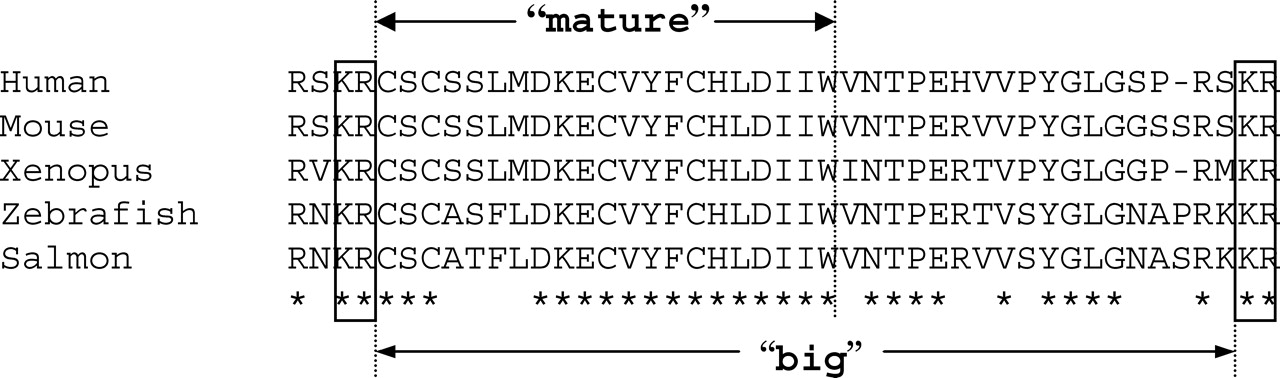
Salmon PPET-1 is the first ET-1 precursor sequence identified in Salmoniformes, Teleostei. Deduced amino acid sequences of salmon PPET-1 and zebrafish PPET-1 (18) are aligned in Figure 2. The salmon ET-1 (C49–W69) and zebrafish ET-1 sequences are different; one of 21 amino acid differs between the two sequences. Salmon big ET-1 (C49–M87) has a high homology with zebrafish big ET-1, with 36 of 39 amino acids identical (Figs. 2 and 3). The salmon PPET-1 sequence has low identity with zebrafish (96 [39%] of 244 amino acids; Fig. 2) (18), frog (Xenopus laevis) (24%) (10), mouse (29%) (4), and human (26%) (20) PPET-1 sequences. The dibasic amino acid pairs flanking the 5′- and 3′- regions of salmon big ET-1 (K47–R48 and K88–R89) are identical to those in other PPET-1s, indicating that the generation of big ET-1 is conserved from fish to mammal (Fig. 3). Further studies based on this cDNA sequence, including expression and bioactivity experiments, are needed to better understand the biological characteristics of the ET-1 peptide in salmon.
Nucleotide and deduced amino acid sequences of salmon (O. keta)
preproendothelin-1 (PPET-1). An open reading frame and noncoding regions are shown in
capital and small letters, respectively. The sequence of O. keta
endothelin-1 (ET-1) (C49–W69) is underlined by a solid line and
the C-terminus of big ET-1 (V70–K87) by a dashed line. The
putative proteolytic processing site at the C-terminus of ET-1 is indicated by an
arrow (between W69 and V70). Paired basic amino acid residues
are doubly underlined. The ET-1-like peptide (C103–C117) is
underlined by a thick dotted line. Amino acids of the probable signal sequence are in
italic. The arrowhead indicates the putative site of signal sequence cleavage (between
S23 and A24). Six occurrences of the DTVIRRVP repeat sequences
are present in the C-terminal region of PPET-1, as indicated by dotted lines. The
deduced amino acid sequence is given below the nucleotide sequence, which is numbered
at the end of each sequence line. Amino acid residues are numbered in parentheses
beginning with the initial methionine. The termination codon is marked with an
asterisk. Five attta sequences, destabilizing signals for mRNA (4, 5), are present in the 3′-untranslated region, just
before the poly (A)+ additional signal aataaa. This cDNA was produced by
combining two overlapping 5′- and 3′-RACE cDNAs. Comparison of PPET-1 amino acid sequences of salmon and zebrafish. The deduced amino
acid sequence of salmon PPET-1 is aligned with that of zebrafish PPET-1. Identical
amino acids are indicated by asterisks. Mature and similar peptides are indicated. Six
occurrences of the DTVIRRVP repeat sequences of salmon PPET-1 are absent in the
C-terminal region of zebrafish PPET-1, as indicated by a dotted line divided into six
segments. Amino acid sequences are numbered at the end of each sequence row. Comparison of amino acid sequences of mature ET-1 and big ET-1 from fish to mammal.
Identical amino acids are indicated by asterisks. “Mature” and “big” ET-1 peptides are
indicated by arrows. Paired basic amino acid residues on either side of big ET-1 are
boxed. The ET-1-converting enzyme processing site at the C-terminus of mature ET-1 is
indicated by a dotted line.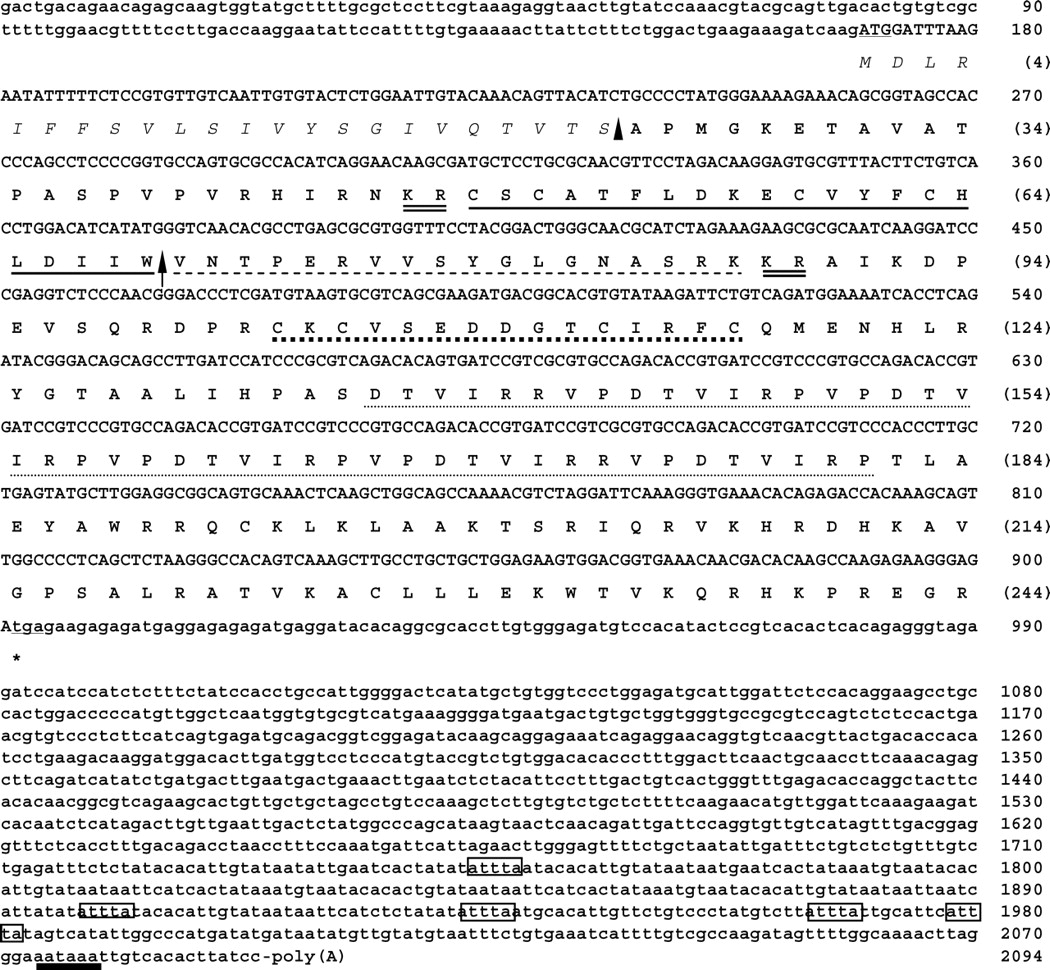

Footnotes
J.Q. is a recipient of the Japan Society for the Promotion of Science postdoctoral fellowship for foreign researchers. E. K.-N. is a recipient of a New Energy and Industrial Technology Development Organization fellowship. This work was supported by grants from the Ministry of Economy, Trade, and Industry of Japan (to K.S.) and the Japan Society for the Promotion of Science (17580089 to K.S.).
Acknowledgements
K.S. gratefully thanks Drs. Kazunori Nakamura, Hiroshi Kuriyama, Masahiro Iwakura, and Etsuo Niki of AIST for their support. H.W. and K.S. thank Prof. Shiro Bannai (University of Tsukuba) and Dr. Hideyo Sato (Yamagata Univ.) for encouragement. H.W. is on leave from Hokkaido System Science Company (Sapporo, Japan).