



Abstract
Endothelin regulates cytokine expression in vitro and in vivo. This study investigated the effects of chronic allograft rejection on hepatic endothelin-converting enzyme-1 (ECE-1) gene expression and endothelin-1 (ET-1) plasma clearance. Using the Lewis-F344 minor histocompatibility mismatch model of heterotopic cardiac transplantation, hepatic ECE-1 gene expression was measured by real-time polymerase chain reaction and host plasma clearance of ET-1 was measured 8 weeks after transplantation in the absence of immunosuppression. In animals undergoing allograft rejection, hepatic ECE-1 gene expression increased 2-fold (P < 0.05), whereas no effect of rejection on ET-1 clearance from plasma was observed. In summary, upregulation of ECE-1 gene expression occurs in the liver of the host during chronic allograft rejection. Because the liver represents both a key organ for cytokine production and for endothelin metabolism, increased hepatic ECE-1–mediated ET-1 synthesis may contribute to host responses and cytokine production during allograft rejection.
Introduction
Endothelin-converting enzyme-1 (ECE-1) contributes to production of active endothelin-1 (ET-1) by cleaving its precursor big–ET-1 (1, 2). Endothelin-1, well known as a vasoconstrictor peptide and mitogen (3), has also been implicated in inflammation and immune responses (4). Chronic allograft rejection is the major cause of graft loss after solid organ transplantation, and causative therapy is available (5). Circulating levels and intragraft ET-1 expression are increased in patients undergoing chronic allograft rejection who are receiving immunosuppression (6–8), and inhibition of ECE-1 attenuates intragraft transplant vasculopathy and rejection of rat cardiac allografts in the presence of concomitant immunosuppressive therapy (9). We recently reported activation of cytokines in plasma and liver of the host in animals undergoing rejection that is regulated by endothelin ETA receptors (10). These findings also suggest that the liver plays a role in the body’s response to chronic rejection of the allograft (10). There is no information available regarding whether ECE-1 expression in host organs of mammals undergoing chronic allograft rejection is affected. Furthermore, the effects of rejection on ET-1 plasma clearance in chronic rejection are not known. Because the liver is involved in the production of cytokines and in ET-1 metabolism (11), and because cytokines regulate ECE-1 expression and activity (12, 13), we hypothesized that local immune activation in the host might affect hepatic ECE-1 gene expression and ET-1 clearance during chronic rejection. Therefore, host hepatic ECE-1 gene expression and ET-1 plasma clearance were determined in a rodent model of chronic allograft rejection.
Materials and Methods
Animal Model of Chronic Allograft Rejection.
The Lewis-F344 heterotopic cardiac transplant model was used to induce chronic rejection in the absence of immunosuppression as described elsewhere (10, 14). In untreated animals, cardiac allografts undergo progressive rejection resulting in severe transplant vasculopathy (10, 14). Graft survival was determined by manual palpation of the graft at regular intervals during the entire study. All animals were kept at a 12:12-hr light:dark cycle at 24°C with free access to water and regular rodent chow ad libitum. Study design and experimental protocols were approved by the Ministerium für Umwelt, Natur und Forsten des Landes Schleswig-Holstein, Bereich Tierschutz, Kiel, Germany.
Surgical Procedures.
Heterotopic cardiac transplantation was performed in recipient animals anesthetized with pentobarbital (60 mg/kg ip), as described previously (10). Briefly, the thorax was opened after injection of 1500 iE heparin into the inferior vena cava. Donors were killed after cutting the ascending aorta, and the donor heart was then perfused through the cannulated aorta with St. Thomas cardioplegic solution and transplanted intra-abdominally with side-to-end-anastomoses between both aortas and between pulmonary artery and inferior vena cava to the recipient animal. All animals recovered from the surgical procedure. Animals were killed 8 weeks after transplantation and hepatic tissue was immediately snap frozen in liquid nitrogen and stored at −80°C until further analysis.
[125I]-ET-1 Clearance.
Plasma clearance of radio-labeled [125I]-ET-1 with a specific activity of 2000 Ci/mM was assessed before death in anesthetized animals (pentobarbital 60 mg/kg ip). Radiolabeled (3-[125I]-iodotyrosyl) ET-1 was administered by iv bolus injection at nonpressor doses of approximately 200,000 cpm (0.13 pM), and 50 μl of blood was sampled at varying times after injection over a period of 120 secs (15). Radioactivity of the samples was determined using a gamma counter (Canberra Packard, Zurich, Switzerland). Data were used for construction of monoexponential decay curves using Biosoft Software (Biosoft, Cambridge, UK).
Gene Expression Studies.
Ribonucleic acid was extracted from hepatic tissue using the silica-based RNeasy method (Qiagen, Hilden, Germany) and purity was determined photospectrometrically (ratio 260:280 nm), by gel electrophoresis, and by RT(−) reactions. For each sample, 1 μg RNA was reverse transcribed (Omniscript RT kit, Qiagen; Superscript RT kit; Invitrogen, Basel, Switzerland). Gene expression was determined by real-time polymerase chain reaction (PCR) and performed as described elsewhere (10), and reactions were run on the iQ iCycler (Bio-Rad, Reinach, Switzerland), using specifically designed cDNA primers. Two-step PCR was performed using the SYBR Green PCR kit (Qiagen). The following primer was used for ECE-1: forward 5′-GGG AGT ATG ACA AGG ATG GGA AC-3′, reverse 5′-ACT CGG TCT GCT GCT TGA ATG-3′. R-18s was used as control gene, using the following primer-sequence: forward 5′-CTT TGG TCG CTC GCT CCT C-3′, reverse 5′-CTG ACC GGG TTG GTT TTG AT-3′. Identity and specificity of amplicons were confirmed by agarose gel electrophoresis, melting curve analysis (1 min 95°C, 1 min 55°C, 80 × 10 secs at 55°C, 0.5°C increment temperature), and sequencing (Microsynth, Balgach, Switzerland).
Calculations and Statistical Analysis.
Data are given as means ± SEM. Statistical analyses were performed using StatView 5.0 (SAS Institute Inc., Cary, NC) using ANOVA or the Mann-Whitney U test if samples were not normally distributed. A P value of <0.05 was considered significant.
Results
Physiology.
Body weight increased during the study period of 8 weeks (average weight gain 84 ± 7 g) and no differences between groups were observed (data not shown). Blood pressure (137 ± 6 vs. 138 ± 4 mm Hg, NS) and hematocrit (50 ± 1% vs. 50 ± 1%, NS) were not different between groups. All allografts were beating at the time of death.
ECE-1 Gene Expression.
ECE-1 gene expression increased 2-fold in the liver of animals undergoing chronic rejection compared with control animals (P < 0.05, Fig. 1).
Plasma Clearance of [125I]-ET-1.
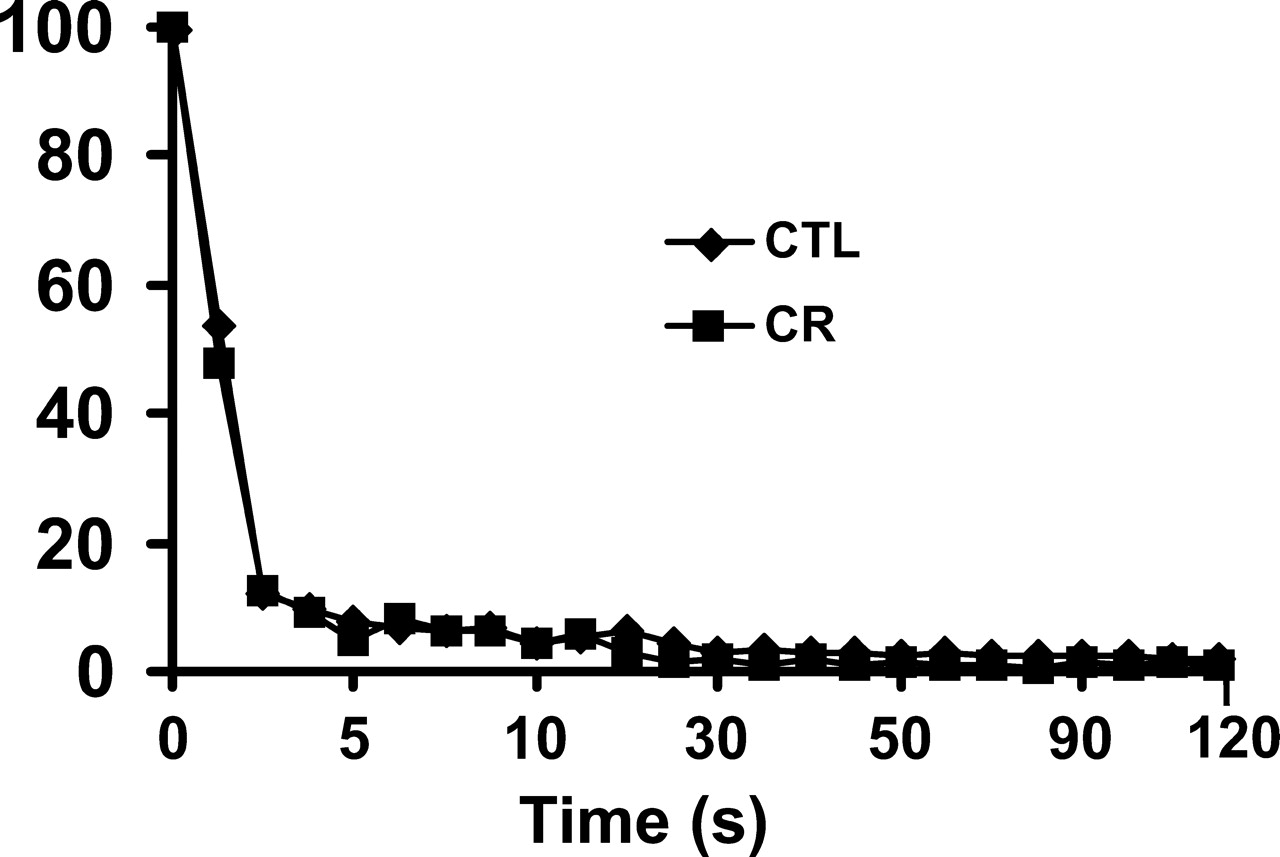
Radiolabeled [125I]-ET-1 was cleared from plasma within 120 secs after iv injection, and chronic rejection had no effect (P = NS, Fig. 2).
Discussion
This study demonstrates that chronic rejection after cardiac allograft transplantation in the absence of immunosuppression is associated with induction of hepatic ECE-1 gene expression without affecting [125I]-ET-1 plasma clearance in the host. We previously reported that ET-1 signaling contributes to cytokine transcription in host organs and to the regulation of cytokine plasma levels during allograft rejection, indicating that ET-1 participates in the immune responses of the host (10). Inhibition of ECE-1 attenuates intragraft transplant vasculopathy and rejection in rat cardiac allografts (9), but only in the presence of concomitant immunosuppressive therapy. Because cyclosporine activates the endothelin system (16), the role of ECE-1 in rejection remains unclear. Because the liver represents a key organ for both cytokine production and endothelin metabolism (11), information about the effects of chronic rejection on host hepatic ECE-1 gene expression might help to clarify this issue.
Here we report an increase of ECE-1 gene expression in host liver during chronic rejection, suggesting a role of the hepatic endothelin system in the systemic process of chronic rejection in the allograft recipient. Since cytokine production increases in host liver during chronic rejection (10), proinflammatory molecules might contribute to hepatic induction of ECE-1 (12, 13). ET-1 plasma levels are increased in individuals undergoing chronic rejection (8), and are thought to be derived from graft infiltrating mononuclear cells, among other sources (8). Our results suggest another possible source of increased post-transplant ET-1 plasma levels in the host, namely hepatic ECE-1, which importantly contributes to ET-1 production by cleaving big–ET-1 to mature ET-1 (2). Because the observed increase in ECE-1 was detected only at the transcriptional level, and because protein synthesis and activity of ECE were not determined, our data do not allow us to conclude that the liver is the source of increased endothelin plasma levels.
In the present study, radiolabeled ET-1 was cleared from plasma within 120 secs, which is in line with previous observations (15). The lack of an effect of rejection on ET-1 clearance time suggests that the overall kinetics of ET-1 clearance are unaffected by chronic rejection. Recent results from our group suggest that neither ET-1 clearance nor ECE-1 gene expression are ETA receptor mediated, because selective ETA-receptor blockade for 8 weeks with darusentan had no effect. 1
Lattmann T, Shaw SG, and Barton M. 2005. Unpublished data.
In conclusion, this study provides evidence that induction of ECE-1 gene expression occurs in host liver during chronic allograft rejection. The present findings are compatible with a role for the hepatic endothelin system of the host in response to or even as part of chronic allograft rejection. Increased ECE-1 expression may contribute to local cytokine production in the host and, if also present in humans, provides a potential therapeutic target in transplantation medicine to interfere with the rejection process.
Gene expression in host liver as determined by real-time PCR using ribosomal 18s as
housekeeping gene (ΔΔCT-Method). Hepatic expression of ECE-1 is given as
percent of control (P < 0.05, n = 7 per group).
CTL, control; CR, chronic rejection. Clearance after injection of [125I]-ET-1 was not affected by chronic
rejection (n = 4 per group, NS). Data are given as percent of first
measurement. CTL, control; CR, chronic rejection.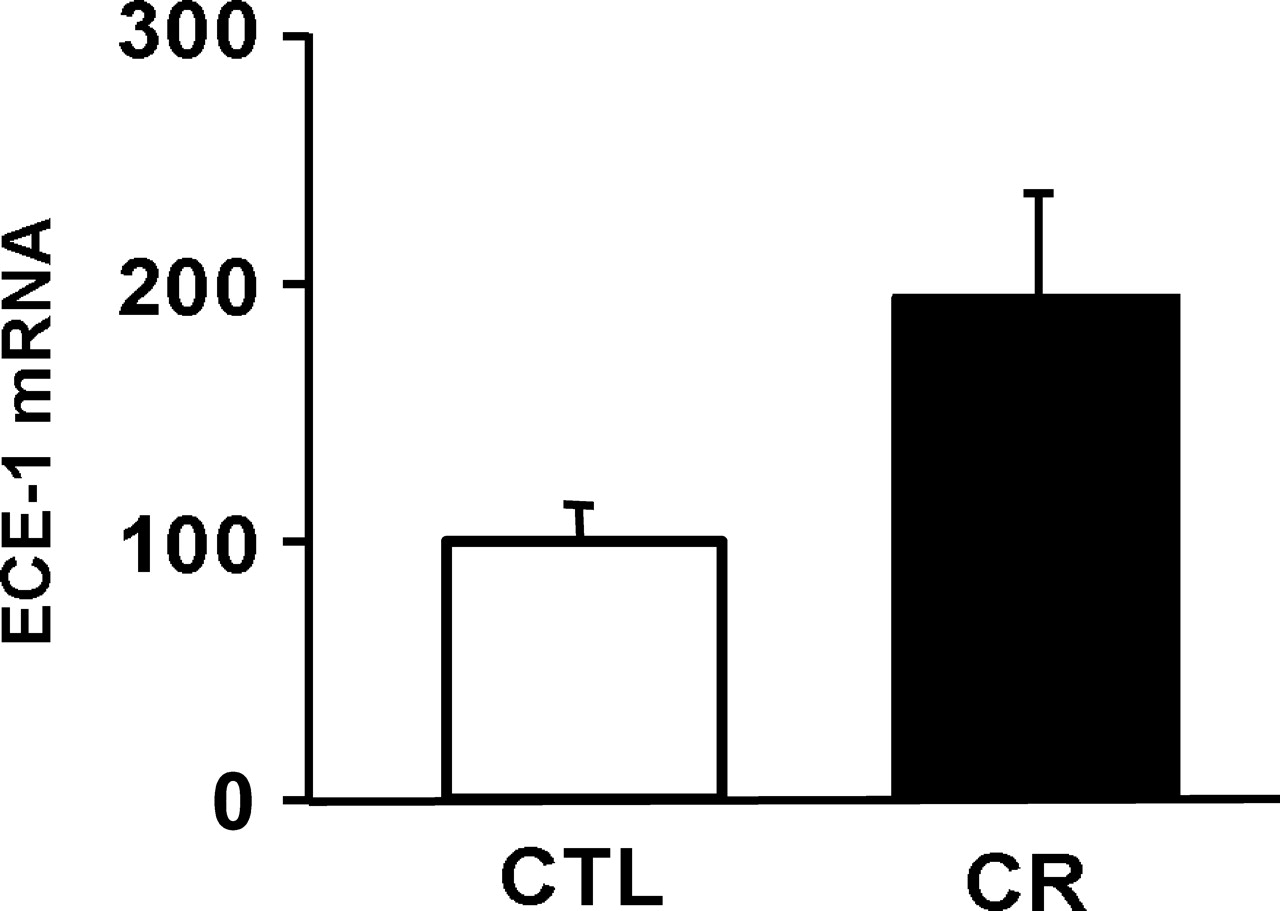
Footnotes
This work was supported by the Swiss National Foundation (SCORE 32-58421.99, 32-58426.99/1, and 3200-108258/1) and the Hanne Liebermann Stiftung.
1
These authors contributed equally.
Acknowledgements
We thank Wilhelm Vetter for support and acknowledge the skillful technical assistance of J. Boden with the clearance studies.