



Abstract
The dual endothelin receptor antagonist, bosentan, and the phosphodiesterase inhibitor, sildenafil, are efficacious in experimental and clinical pulmonary hypertension (PHT). The effects of bosentan, sildenafil, and their combination were evaluated in rats with monocrotaline (MCT)-induced PHT. A first group consisted of control rats with no MCT injection. Four other groups of rats received MCT subcutaneously and were assigned to receive no treatment, 300 mg/kg/day bosentan as food admix, 100 mg/kg/day sildenafil in drinking water, or their combination for 4 weeks. The doses of bosentan and sildenafil were the maximally effective doses based on a dose-range–finding study. Mortality was 0%, 53%, 11%, 11%, and 0%, respectively, in the five different groups. Bosentan and sildenafil significantly attenuated the increase in mean pulmonary arterial pressure, and the combination had an additional effect. Similarly, bosentan, sildenafil, and, to a greater extent, their combination significantly reduced right ventricular (RV) hypertrophy. Bosentan, but not sildenafil, decreased norepinephrine and BNP plasma concentrations, reduced kidney weight, and normalized systemic hemodynamics. In conclusion, bosentan and sildenafil are efficacious in rats with chronic PHT, and their combination shows an additional effect for decreasing pulmonary arterial pressure, reducing plasma catecholamines, maintaining body weight, and reducing mortality.
Introduction
Pulmonary arterial hypertension (PAH) is an often-fatal disease characterized by a progressive increase in pulmonary vascular resistance leading to right ventricular (RV) failure (1). Two orally available agents have been shown to be clinically effective. Bosentan, a dual endothelin (ET) ETA/ETB receptor antagonist, improves hemodynamics, increases exercise capacity, and decreases the rate of clinical worsening in patients with World Health Organization Class III or IV PAH (2, 3). This is in agreement with a key pathogenic role of ET in PAH. Sildenafil, which enhances nitric oxide (NO) signaling by inhibition of phosphodiesterase Type 5 (PDE5), was shown to improve hemodynamics and exercise capacity in patients with PAH, without significantly affecting the rate of clinical worsening (4). Because bosentan and sildenafil act on different targets, combining these two therapies might provide an added benefit. However, the ET and NO systems interact (5); therefore, the combination of drugs affecting the two pathways might not be additive. We investigated the effects of the combination using the rat model of monocrotaline (MCT)-induced pulmonary hypertension (PHT).
MCT, a pyrrolizidine alkaloid of plant origin (6), induces progressive PHT in rats after a single subcutaneous injection (7, 8). Rats exposed to MCT develop acute pulmonary vascular inflammation. Although this model may not fully reflect the clinical situation of PAH (9), the ET system is associated with the pathogenesis of the disease in this rat PHT model as well as in human PAH (10–12). Both bosentan (13, 14) and sildenafil (15) have been shown to attenuate the development of PHT in rats treated with MCT. The objectives of this study were to compare the pharmacologic profiles of bosentan and sildenafil, and to evaluate the effects of their combination at maximally effective doses on pulmonary arterial pressure, cardiac size, and endothelial function in MCT-induced PHT rats. The effects of the two drugs and their combination on plasma concentrations of ET-1, brain natriuretic peptide (BNP; Refs. 16, 17), cGMP (15, 18), and catecholamines (19) were also studied.
Materials and Methods
Animals.
Male Wistar rats were purchased from RCC Ltd. (Füllingsdorf, Switzerland) or from the Experimental Animal Center of the Chinese Academy of Sciences (Shanghai, China), and maintained under identical conditions in accordance with local guidelines (Basel-Landschaft cantonal veterinary office or Animal Care and Use Committee of the Shanghai Institute of Materia Medica, Chinese Academy of Sciences). All rats were housed in climate-controlled conditions with a 12:12-hr light:dark cycle, and had free access to chow and water.
MCT Treatment.
MCT (Sigma Chemicals, St. Louis, MO) was administered as a single subcutaneous (sc) injection (60 mg/kg) in a volume of 3 ml/kg, and control, age-matched rats received an equal volume of saline. These animals were randomly assigned into experimental groups, and treatment was initiated immediately after MCT injection, for a duration of 4 weeks.
Test Compounds.
Test compounds were supplied by Actelion Pharmaceuticals Ltd. (Shanghai, China and Allschwil, Switzerland). Bosentan was given as food admix, and sildenafil was given in drinking water.
Experimental Protocols.
Dose-Finding Studies for Bosentan and Sildenafil.
In the first study, dose-range–finding studies were conducted to determine the maximally effective doses of bosentan and sildenafil on mean pulmonary arterial pressure (MPAP) in MCT-treated rats. Bosentan (0, 10, 30, 100, or 300 mg/kg/day as food admix; n = 14 or 15 per dose) or sildenafil (0, 3, 10, 30, or 100 mg/kg/day in drinking water; n = 4 or 5 per dose) was given for 4 weeks, and MPAP determined in anesthetized rats, as described below in “Hemodynamic Study in Anesthetized Rats.” Doses of 300 mg/kg/day bosentan and of 100 mg/kg/day sildenafil were chosen for the next study, because they were maximally effective doses, that is, at the plateau of the respective dose-response curves, and equally effective on MPAP.
Comparison and Combination of Bosentan and Sildenafil.
After determination of maximally effective doses of bosentan and sildenafil, a second study was performed. Male Wistar rats (210–240 g) were randomized into five groups: Group 1 (control), sc injection of saline and no treatment (n = 15); Group 2, sc injection of MCT and no treatment (n = 19); Group 3, MCT plus 300 mg/kg/day bosentan as food admix (n = 19); Group 4, MCT plus 100 mg/kg/day sildenafil in drinking water (n = 19); and Group 5, MCT plus 300 mg/kg/day bosentan plus 100 mg/kg/day sildenafil (n = 19).
Hemodynamic Study in Anesthetized Rats.
To evaluate the effects of bosentan and sildenafil on the development of PHT in both studies, hemodynamic measurements were performed in anesthetized rats. Four weeks after MCT injection, the rats were anesthetized by intraperitoneal injection of 100 mg/kg thiobutabarbital-Na (Inactin; Byk-Gulden, Konstanz, Germany) and placed on a thermostatically controlled heating table to maintain body temperature at 36°C–38°C. A tracheotomy tube was put in place and a catheter inserted into the right jugular vein for measurement of MPAP, using the procedure previously described by Stinger et al. (20). Measurements were recorded for 15 mins using a PowerLab data acquisition system (IOX 1.7.0 Data acquisition; Emka Technologies, Paris, France) connected to a Dell Optiplex GX 270 computer equipped with Datanalyst software (v.1.83.0; Emka Technologies).
Arterial Blood Pressure Measurements in Conscious, Freely Moving Rats.
For measurement of arterial blood pressure and heart rate, a subset of 25 rats was surgically implanted with a pressure sensor/transmitter (model TA11PA-C40; Data Sciences, St. Paul, MN) in the peritoneal cavity. The sensing catheter was placed in the descending aorta below the renal arteries, pointing upstream. A receiver platform (RPC-1, Data Sciences) connected the radio signal to digitized input that was then sent to a dedicated personal computer (Compaq, Deskpro, Hewlett-Packard, Geneva, Switzerland). Arterial pressures were calibrated using input from an ambient-pressure reference (APR-1; Data Sciences). Two weeks after implantation of the telemetry device, the rats were randomized into the five treatment groups (n = 5 per group). Arterial blood pressure and heart rate measurements were collected at 5-min intervals for 4 weeks.
ET-1, BNP, cGMP, and Catecholamine Concentrations.
At the end of the hemodynamic experiments in anesthetized rats, plasma samples in 5% EDTA were collected for determinations of ET-1, BNP, cGMP, and catecholamine concentrations. Plasma ET-1 concentration was measured using a human ET-1 immunoassay kit (QuantiGlo, QET00; R&D Systems, Minneapolis, MN); BNP was measured using a rat BNP-32 enzyme immunoassay (S-1192.001; Bachem, Heidelberg, Germany); cGMP was measured using an enzyme immunoassay (DE0600; R&D Systems); and epinephrine and norepinephrine were measured using a CATCOMBI enzyme-linked immuno-sorbent assay kit (RE58242; IBL, Hamburg, Germany).
Organ Weights.
At the end of the study, rats were sacrificed. Heart, lungs, kidneys, and liver were removed and weighed, and the ratio of organ weight to body weight (BW) was calculated. The RV and the left ventricle plus septum were separated and weighed; the ratio RV/BW was used as an index of RV hypertrophy.
Endothelial Function.
Ring segments of aorta (one per rat; n = 8–10 per group), cleaned of fat and connective tissues and 3 mm in length, were mounted between two stainless-steel wires in 10-ml organ baths (Emka Technologies). After a 30-min recovery period, stepwise increases in tension up to 2 g were applied to each segment. Two consecutive administrations of 60 mM KCl were performed. Preconstriction of the aortic ring was achieved with a concentration of phenylephrine (Sigma) sufficient to reach approximately 70% of the tissue maximum, as determined with KCl. Then, each segment was tested as follows: (i) determination of concentration-response curve for 1 nM to 10 μM acetylcholine (Sigma); and (ii) determination of concentration-response curve for 10 pM to 1 μM sodium nitroprusside (Sigma).
Statistical Analysis.
All data are presented as mean ± SEM. Statistical analyses were performed by analysis of variance (ANOVA) using Statistica (StatSoft, Berikon, Switzerland) and Student-Newman-Keuls procedure for multiple comparisons. The null hypothesis was rejected when P < 0.05. To avoid a bias due to the death rate observed in certain groups, all data missing because of early mortality were imputed using the worst value from each group.
Results
First Study: Dose Finding.
PHT had developed in untreated rats 4 weeks after MCT injection, and chronic oral administration of bosentan and of sildenafil dose-dependently reduced the increase in MPAP. The maximally effective dose of sildenafil, 100 mg/kg/day, reduced MPAP to the same extent as 300 mg/kg/day bosentan (MPAP, 23.0 ± 3.5 mm Hg and 19.8 ± 1.4 mm Hg, respectively). These doses were, therefore, chosen for the subsequent study.
Second Study: Comparison and Combination of Bosentan and Sildenafil.
Mortality.
Because of the severity of the animal model, mortality was significantly higher in the untreated MCT rats compared with the control rats. During the 4-week treatment period and during anesthesia at the end of the treatment period, mortality was 0%, 53%, 11%, 11%, and 0%, respectively, in the five different groups.
Hemodynamics.
Four weeks after MCT injection, untreated rats exhibited higher MPAP as compared with controls (53 ± 3 mm Hg vs. 18 ± 1 mm Hg; P < 0.001; Fig. 1). As expected, administration of 300 mg/kg/day bosentan and 100 mg/kg/day sildenafil had similar effects and decreased MPAP by 21% (42 ± 2 mm Hg and 41 ± 3 mm Hg; P < 0.01, respectively). Combination treatment caused a further decrease and reduced MPAP by 42% (31 ± 2 mm Hg; P < 0.001, as compared with untreated rats).
Arterial Blood Pressure Measurements in Conscious Rats.
At baseline, neither mean arterial pressure nor heart rate differed among the various groups. Four weeks after MCT injection, there were no differences in heart rate between the various groups. Untreated rats showed a significant blood pressure decrease from baseline (Δ, −9.7 ± 2.3 mm Hg), as compared with control rats (Δ, −1.5 ± 2.8 mm Hg; P < 0.05). Bosentan, but neither sildenafil nor the combination, significantly prevented this decrease (Δ, −1.6 ± 1.6 mm Hg; P < 0.05).
Endothelial Function.
MCT-treated rats exhibited a marked endothelial dysfunction, characterized by a decreased response to acetylcholine (maximal effect = 71.7 ± 6.1% in MCT rats vs. 97.2 ± 1.6% in controls; P < 0.001; and logEC50 = −6.94 ± 0.11 in MCT rats vs. −7.44 ± 0.03 in controls; P < 0.001; Fig. 2A) without any alteration of the response to sodium nitroprusside (Fig. 2B). Bosentan, sildenafil, or the combination increased endothelium-dependent relaxation to acetylcholine (Fig. 2A) without modifying the response to sodium nitroprusside (Fig. 2B).
ET-1, BNP, cGMP, and Catecholamine Concentrations.
Four weeks after MCT injection, the mean plasma ET-1 concentration was significantly increased as compared with control rats (Table 1). Bosentan increased the mean plasma ET-1 concentration by 5-fold as compared with untreated MCT rats. In contrast, sildenafil decreased the mean plasma ET-1 concentration by 50% compared with untreated MCT rats. The combination of bosentan and sildenafil increased plasma ET-1 concentration, but to a lesser extent (93% increase) than with bosentan alone. The plasma BNP concentration increased by 21% and the plasma cGMP concentration increased by 73% in MCT rats compared with control rats (Table 1); these increases were significantly inhibited by bosentan. No significant changes in plasma BNP or cGMP concentrations were observed in rats treated with sildenafil or with sildenafil plus bosentan as compared with untreated MCT rats. Catecholamines increased in PHT rats, as shown by a 147% increase in plasma epinephrine and a 41% increase in plasma norepinephrine compared with control rats (Table 1). Bosentan markedly reduced plasma norepinephrine concentrations to values even lower than in control rats, and a further decrease was observed in MCT rats treated with bosentan plus sildenafil. There was no effect of sildenafil alone on plasma norepinephrine concentration. The increase in plasma epinephrine was significantly attenuated by bosentan or the combination, but, again, sildenafil alone had no significant effect.
Body and Organ Weights.
Baseline BW was similar in each experimental group. At 4 weeks after MCT injection, the mean BW of untreated animals was 25% less than that of control rats (267 ± 11 g vs. 357 ± 9 g; P < 0.001). Bosentan or sildenafil significantly attenuated the decrease in BW (297 ± 12 g and 304 ± 7 g, respectively) and the combination had an additional effect (327 ± 7 g; P < 0.001). Right ventricular weight expressed per BW increased significantly in MCT rats compared with control rats (1.50 ± 0.1 g vs. 0.48 ± 0.02 g; P < 0.001). Bosentan, sildenafil, or their combination for 4 weeks significantly reduced RV/BW by 30%, 33%, and 37%, respectively (P < 0.001 for all vs. no treatment). Similar results were obtained using the ratio RV/(LV + septum). The ratio of lung weight (LW) to BW significantly increased in MCT rats (7.5 ± 0.6 vs. 4.2 ± 0.1; P < 0.001). Bosentan or sildenafil had no statistically significant effect, but the combination significantly decreased the LW (LW/BW = 6.0 ± 0.3; P < 0.05 as compared with untreated MCT rats). Liver weight normalized for BW was similar to that of control rats in both untreated MCT rats and bosentan-treated rats. In rats treated with sildenafil or the combination, liver weight increased (39.0 ± 1.1 and 41.6 ± 0.6; P < 0.001). The kidney weight (KW) to BW ratio increased in MCT-treated rats (6.84 ± 0.21 vs. 6.11 ± 0.15; P < 0.01). The increase in KW was prevented in part by bosentan (KW/BW = 6.35 ± 0.16; P = 0.07), but sildenafil or the combination had no effect on KW in MCT rats.
Discussion
The goal of this study was 2-fold: to compare the effects of sildenafil and bosentan, and to evaluate whether the combination of bosentan and sildenafil confers an additional benefit for treatment of PHT. Our results show that combination therapy may be more effective, particularly for decreasing MPAP, than either agent given alone at the maximally effective dose. Our results also show that bosentan and sildenafil differ in their profiles, and that bosentan, but not sildenafil, decreases catecholamines and BNP, reduces KW, and normalizes systemic hemodynamics.
The combination of bosentan and sildenafil had additive effects on a number of variables, reflecting their different mechanism of action: bosentan antagonizes binding on ETA and ETB receptors; sildenafil increases cGMP by PDE5 inhibition. Doses of bosentan and sildenafil that moderately lowered MPAP, when given separately, further lowered MPAP when given in combination. There was no death in the combination group, whereas both bosentan and sildenafil partially reduced the death rate as compared with untreated PHT rats. Although the study was not designed to be a mortality study, these data suggest that combination therapy was associated with a maximal survival rate. Both bosentan and sildenafil inhibited the development of RV hypertrophy, and there was a nonstatistically significant trend for an added benefit of combined therapy. Bosentan is a potent inhibitor of cardiomyocyte hypertrophy in vitro and in vivo (21, 22), and sildenafil decreases cardiac hypertrophy by increasing cardiac cGMP content (23).
The current data with bosentan in MCT-induced PHT are in agreement with previous data obtained with bosentan (13) and with another dual ET receptor antagonist, BSF420627 (14), which were shown to improve survival and decrease RV hypertrophy in MCT-treated rats. Studies using PDE5 inhibitors also showed a survival benefit in an MCT model (24).
Neither bosentan nor sildenafil alone significantly reduced relative LW; however, a reduction in LW was observed with the combination. The study, however, did not evaluate whether this effect was caused by a reduction in pulmonary edema, or by a decrease in pulmonary vascular hypertrophy. Finally, there was a major effect of the combination on plasma concentrations of catecholamines, norepinephrine in particular. Bosentan alone had a major effect on norepinephrine concentration. This decrease in catecholamines has been described previously with dual ETA/ETB antagonists (25, 26); this is not the case with selective ETA receptor antagonists (27). In contrast, sildenafil, similar to PDE5 inhibitors in general, has been shown to stimulate sympathetic activity and increase norepinephrine concentrations (28). Both epinephrine and norepinephrine were further reduced when bosentan and sildenafil were combined, suggesting a further neurohormonal inhibition, which could possibly contribute to the survival benefit brought by the bosentan plus sildenafil combination. Bosentan, but not sildenafil, prevented the decrease in mean arterial blood pressure observed in MCT-treated rats, and the effect was partially negated by co-administration of sildenafil. The reductions of KW and plasma BNP concentrations caused by bosentan were also hindered by sildenafil co-administration. Liver weight was increased only in sildenafil-treated rats; this is a known species-specific effect of sildenafil (29).
MCT-induced PHT was associated with a decrease in endothelium-dependent but not endothelium-independent relaxation. This is in contrast with the report by Prié et al. (30) of decreased smooth-muscle responsiveness to NO with maintained endothelium-dependent vasodilator capacity. The study by Prié et al., however, was performed in isolated lung preparations, which may explain the discrepancy. Bosentan and sildenafil had favorable effects on endothelial function assessed ex vivo, and their combination fully normalized endothelium-dependent relaxation. ET-1 overexpression causes endothelial dysfunction (31), and bosentan improves endothelium-dependent relaxation in various animal models (32, 33), human vessels (34), and clinical situations (35, 36). Sildenafil increases NO signaling and increases endothelium-dependent relaxation in various situations (37–39).
Plasma concentrations of ET-1 increased in MCT rats, consistent with a role of ET in the pathophysiology of PHT. They further increased in bosentan-treated rats because of lack of binding of ET-1, in particular to the ETB receptor, which is known to contribute to ET-1 clearance (40). However, the increase in circulating ET-1 by dual receptor antagonists is not associated with any negative effects, because both ETA and ETB receptors are blocked. Sildenafil, by enhancing NO sensitivity, may modulate ET-1 production.
In conclusion, the results of the present study show additive effects of the combination bosentan plus sildenafil for decreasing MPAP, reducing plasma catecholamines, maintaining BW, ameliorating lung inflammation, and reducing mortality. These results suggest that combination therapy may have added beneficial effects. In the clinical setting, preliminary data indicate that combining bosentan and sildenafil in idiopathic PAH patients is safe and effective (41). Further studies will evaluate whether combining sildenafil with bosentan brings additional clinical benefit in the treatment of PAH.
Effect of Bosentan, Sildenafil, and Their Combination on Plasma ET-1, BNP, cGMP, and Catecholamine Concentrations a
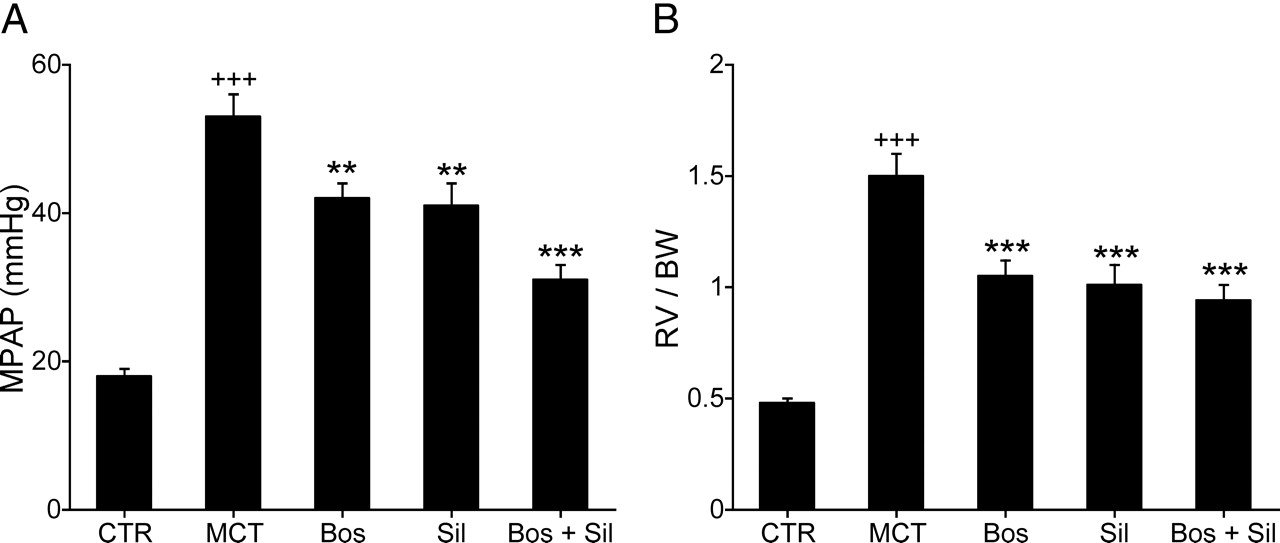
Effect of chronic oral administration of bosentan, sildenafil, and their combination on (A) MPAP in anesthetized rats; and (B) on RV hypertrophy, measured as the ratio of RV weight to BW, 4 weeks after MCT injection. CTR, control; MCT, MCT alone; Bos, bosentan; Sil, sildenafil. +++P < 0.001 versus control; **P < 0.01 versus MCT alone; ***P < 0.001 versus MCT alone.

Effect of chronic oral administration of bosentan, sildenafil, and their combination on endothelium-dependent and independent relaxation, measured in aortic ring segments isolated from rats 4 weeks after MCT injection. (A) The concentration-response curves in response to acetylcholine (endothelium-dependent relaxation). (B) The concentration-response curves in response to sodium nitroprusside (endothelium-independent relaxation). CTR, control; MCT, MCT alone; Bos, bosentan; Sil, sildenafil. +++P < 0.001 versus control; **P < 0.01 versus MCT alone; ***P < 0.001 versus MCT alone.
Footnotes
Acknowledgements
We thank Daniel Wanner, Hakim Hadana, Pauline Loriette, Virginie Sippel, Shuangshuang Ding, and Josiane Rein for expert technical assistance, and Susan Flores for her editorial support.