



Abstract
Endothelin (ET)-1 is involved in the pathophysiology of various renal disorders, promoting renal cellular proliferation and extracellular matrix protein accumulation, and, thus, diminishing fundamental renal function, including filtration. To determine whether ET-1 and ET-2 play a role in feline chronic renal failure, we analyzed the messenger RNA (mRNA) expression of the prepro-ET (PPET )-1 and PPET-2 genes in affected cat kidney after molecular cloning of full-length PPET-2 complementary DNA (cDNA). Conceptual analysis of the primary structure of cat PPET-2 based on the cloned sequence demonstrated that the putative regions corresponding to a mature peptide and peptidase processing sites are present in cat PPET-2. Homology analysis showed that the similarity of the cat PPET-2 amino acid sequence with those from human, mouse, rat, rabbit, dog, ferret, cow, and horse was 73.0%, 68.6%, 69.1%, 76.4%, 81.2%, 83.1%, 76.3%, and 79.2%, respectively. Analysis of PPET-1 and PPET-2 mRNA in cat by reverse transcription polymerase chain reaction showed upregulated expression of both genes in kidneys affected by renal failure.
Introduction
Endothelin (ET)-1 has drawn much interest as a strong vasoconstrictive mediator, having been proposed to play a significant role in the development of pulmonary hypertension in humans. In addition to its primary activity in vascular tissue, ET-1 plays various physiologic roles in nonvascular tissues, including the kidney. Fundamental renal functions related to glomerular filtration and tubular reabsorption are regulated in part by ET-1 (1–3). ET-1 is also involved in the pathogenesis and progression of various renal diseases through the promotion of vascular smooth muscle and mesangial cell proliferation and extracellular matrix protein accumulation, events that cause gradual deterioration of renal function (4–7). In human patients with progressive renal disease, elevated plasma and urinary ET-1 levels correlate with the degree of deterioration in renal function (8, 9). In veterinary medicine, however, little is known regarding the pathophysiologic role of ET-1 or other ET isoforms in renal disease.
In this study, we focus on an important veterinary disease, feline chronic renal failure, and explore, via molecular cloning and messenger RNA (mRNA) expression analysis in diseased kidneys, the possible involvement of the two isoforms, ET-1 and ET-2, in the pathogenesis of chronic renal failure.
Materials and Methods
Cloning of Complementary DNA (cDNA).
Cloning of cat prepro-ET (PPET)-2 cDNA was performed by rapid amplification of cDNA ends (RACE) in combination with reverse transcription (RT) polymerase chain reaction (PCR), using a commercial RACE system (SMART RACE cDNA Amplification Kit, Clontech, Mountain View, CA). The degenerate primers used were designed based on the conserved cDNA region of human (10) and mouse PPET-2 (11). PCR conditions are described in detail elsewhere (12). The sequence analysis method used here also has been described previously (12).
Detection of mRNAs by RT-PCR.
With the owners’ consent, kidney tissues were biopsied under anesthesia from five diseased cats referred to the Kitasato University Veterinary Teaching Hospital (Towada, Aomori, Japan) because of chronic renal failure or from three healthy cats kept at the University. The tissues were preserved at −80°C immediately after biopsy until use. Total RNA was prepared from tissue homogenate using Isogen solution (Nippon Gene, Toyama City, Japan) according to the manufacturer’s protocol. For PCR, specific primers for the PPET-1 gene (forward: 5′-TGCTCCTGCTCTTCCCTGT-3′, reverse: 5′-AAGCTGTTTTGATGCTGTTCC-3′) and for the PPET-2 gene (forward: 5′-TGCAGCTCCTGGCTCGA-3′, reverse: 5′-AGTTCCCTCACTGCCACCTGTTGT-3′) were designed based on the cDNA sequences obtained from GenBank (accession no. AB197698) and obtained by cloning in this study, respectively. Primers specific for the glyceraldehyde-3-phosphate dehydrogenase (GAPDH) gene (forward: 5′-CTTCACCACCATGGAGAAGGC-3′, reverse: 5′-CTCATGACCACAGTCCATGCCA-3′) were designed so that the mRNA could be used as an internal control. With total RNA extracted from cat kidneys, first-strand cDNA was synthesized with the RNA PCR Kit (TaKaRa, Otsu City, Japan). PCR was performed with AmpliTaq Gold DNA polymerase (Applied Biosystems, Foster City, CA) under the following conditions: 1 cycle of 95°C for 10 mins; 35 (PPET-1 and PPET-2) or 25 (GAPDH) cycles of 95°C for 1 min, 65°C for 1 min, and 72°C for 1 min; and 1 cycle of 72°C for 30 secs. The experiments reported here were all performed in accordance with the Guidelines on Handling and Care of Animals by the Committee for Animal Welfare of Kitasato University.
Results
Comparison of Primary Protein Structures.
Through conceptual analysis of the cloned cDNA sequence (GenBank accession no. AB197699), a 178-amino acid polypeptide was predicted as cat PPET-2. The result of a similarity analysis between cat and human (10), mouse (11), rat (13), rabbit (GenBank accession no. AB115085), dog (14), ferret (15), cow (12), and horse (16) PPET-2 is shown in Table 1. The identity of the open reading frame sequence for cat with those from the other mammals is 83.8%, 77.4%, 77.1%, 82.9%, 85.1%, 87.7%, 84.8%, and 86.4%, and at the amino acid level it is 73.0%, 68.6%, 69.1%, 76.4%, 81.2%, 83.1%, 76.3%, and 79.2%, respectively. Comparative alignment of the amino acid sequences of cat PPET-2 with those of these other mammals is shown in Figure 1. Domain regions corresponding to a bioactive mature ET-2 peptide (C49–W69), an intermediate form known as big ET-2 (C49–R86), and an ET-like peptide (C96–H111) that is structurally related to the 16 amino-terminal residues of mature ET-2 and shares 9 amino acids with ET-2, are present in cat PPET-2 (Fig. 2), as is the case with other mammalian PPET-2. Paired basic amino acid residues, which are target sites for dibasic endopeptidases, at both the N- and C-terminals of the big ET-2 (R47–R48 and R87–R88) and the ET-like peptides (K94–R95 and R112–R113), as well as a target site for ET-converting enzyme within the big ET-2 (W69–V70), are all conserved.
mRNA Expression in Kidney.
To examine the possible contribution of ET-1 and ET-2 to the pathophysiology of feline chronic renal failure, PPET-1 and PPET-2 mRNA expression in the kidney was compared between healthy and affected cats. Renal failure was diagnosed based on results of a clinical examination including blood test, X-ray, and renal ultrasonography. An increase in renal mRNA expression of the both genes was observed in all of the five affected cats examined. A representative gel electrophoresis of all trials is shown in Figure 3.
Discussion
We cloned and sequenced full-length PPET-2 cDNA from cat intestine. Analysis of the primary structure based on the cDNA sequence showed that fundamental protein features commonly observed in ET-family, including domain organization and putative target sites for processing peptidases (10, 11, 17, 18), are all conserved in cat PPET-2. These characteristics coincide with those in other mammals compared, indicating that cat ET-2 is produced through the same processing steps as predicted for other mammals (10–16). Renal RT-PCR analysis showed upregulation of PPET-1 and PPET-2 mRNA expression in affected cat kidneys. In veterinary medicine, it is usually difficult to determine the cause of feline chronic renal failure, although primary glomerular disorders are believed to be a leading cause. In human glomerular disease, pathophysiologic involvement of ET-1 has been demonstrated by a number of clinical and basic studies (19, 20). Molecular studies of human ET-2 transgenic rats also revealed that overexpression of ET-2 in kidney leads to significant glomerular injury (21). Given the results from these studies in humans, our finding in cat kidney suggests that both ET-1 and ET-2 might play a pathophysiologic role in the progression of cat chronic renal failure, although the detailed mechanism remains to be investigated. To demonstrate this hypothesis, we are performing an extensive study by quantitative mRNA expression analysis and histochemistry using biopsied renal tissues.
In veterinary medicine, chronic renal failure in older cats can be a serious clinical problem. Therefore, new pharmacotherapeutic approaches to inhibiting the progression of feline renal disease focusing on overexpression of ET in the kidney are anticipated.
Homology Analysis at Nucleotide and Amino Acid Levels Between Cat and Other Mammals
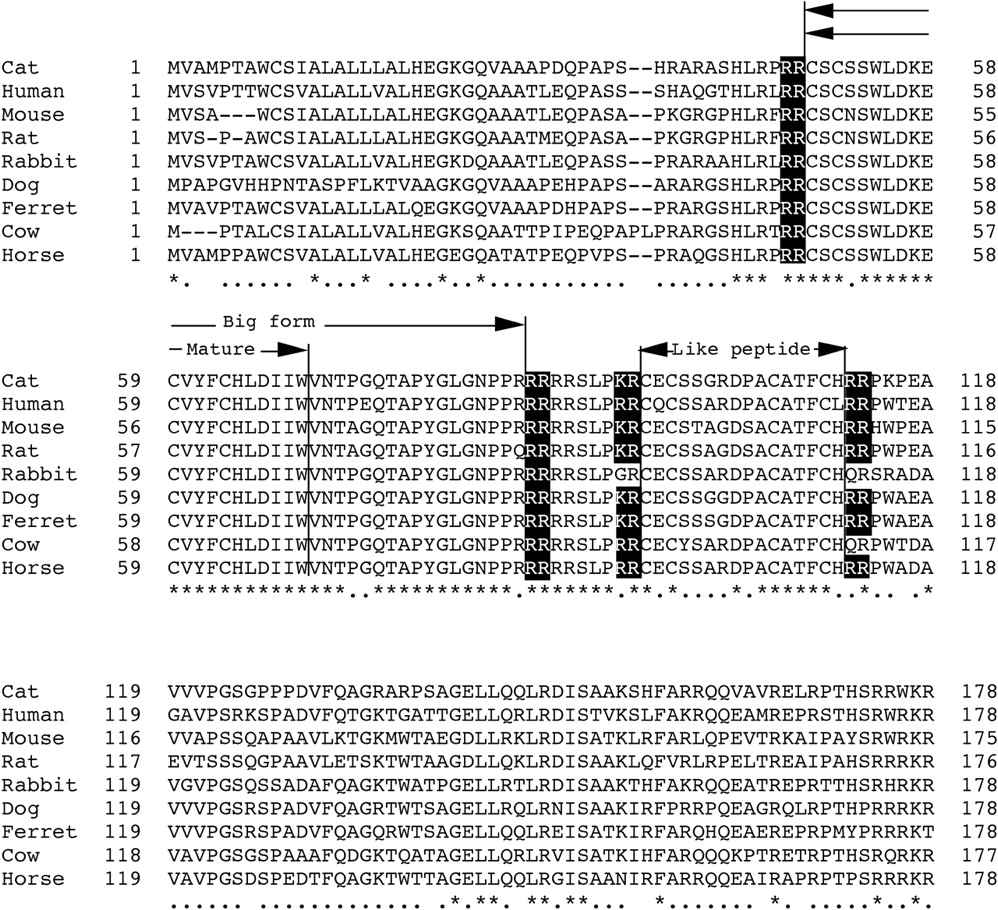
Comparison of PPET-2 amino acid sequences. Amino acid sequences deduced from the cDNA sequences of cat, human, mouse, rat, rabbit, dog, ferret, cow, and horse are aligned. Identical and conservative amino acids are indicated by asterisks and dots, respectively. Regions corresponding to mature ET-2 peptide, the big form of ET-2, and ET–like peptides are also indicated. Paired basic amino acid residues, which are recognized by processing endopeptidases, are shown by black boxes. Amino acid sequences are numbered on both the right and left sides.

Internal homology within cat PPET-2. Regions H37–L81 and P84–P128, which contain ET-2 and ET-like peptides, are aligned to show internal homology. The ET-2 and ET-like peptides are boxed. Identical amino acids are indicated by asterisks.

PPET-1 and PPET-2 mRNA expression in kidney. PPET-1 and PPET-2 mRNA expression was analyzed by RT-PCR in kidney tissue from cats affected with chronic renal failure (RF) or from healthy control cats (Cont). The GAPDH gene was used as an internal control. A representative electrophoresis trial is shown. Increased PPET-1 and PPET-2 mRNA expression is detected in the affected kidney.
Footnotes
This work was supported by Grant for Scientific Research (S0501) from the School of Veterinary Medicine and Animal Sciences, Kitasato University, and by a Grant-in-Aid for Scientific Research (17580271) from the Japan Society for the Promotion of Science.