



Abstract
Endothelin (ET)-B receptors are expressed in human breast carcinoma. We previously demonstrated that intravenous administration of the ETB receptor agonist, IRL-1620, to tumor-bearing rats, increased blood perfusion and enhanced delivery of paclitaxel to breast tumor tissue. The present study was conducted to determine whether IRL-1620 alters the pharmacokinetics of paclitaxel. Breast tumor–bearing rats were given 0.3 ml/kg saline or 3 nmol/kg IRL-1620 by intravenous (iv) administration. Fifteen minutes after saline or IRL-1620, 40 μCi/rat 3H-Paclitaxel was administered iv and serial plasma samples were collected until 24 hrs. 3H-Paclitaxel radioactivity in the plasma samples was measured by liquid scintillation counting. Data were fit to a three-compartment model and pharmacokinetic parameters were generated using WinNonlin software. IRL-1620 did not produce any change in the plasma paclitaxel pharmacokinetics of tumor-bearing rats. The AUC0–∞ (9.43 ± 3.18 μg-hr/ml), clearance (0.69 ± 0.17 l/hr/kg), volume of distribution (10.31 ± 4.54 l/kg), and half-life (1.0 ± 0.32 hrs) of paclitaxel were similar between rats treated with saline or IRL-1620. In conclusion, the ETB receptor agonist, IRL-1620, does not alter paclitaxel plasma pharmacokinetics and, therefore, could be used to augment the delivery of paclitaxel to the tumor tissue.
Introduction
Blood flow rate is an important factor regulating drug delivery to tumors and therapeutic outcome. Therefore, the possibility of influencing the distribution of drugs to the tumors by administering vasoactive agents is of clinical interest. The endothelin (ET) axis, which includes ET-1, ET-2, ET-3, and the ET receptors, ETA and ETB, participates in the growth and progression of a variety of tumors, such as prostatic, ovarian, and breast carcinoma (1, 2). ETB receptors are expressed in invasive as well as ductal and lobular breast carcinoma in humans (3, 4). Administration of ET-1 produces an increase in blood perfusion to the breast tumor (5). This effect is attenuated by BQ788, an ETB receptor antagonist, confirming that ETB receptors are involved in vasodilation induced by ET-1 in the breast tumor. Recently, we have shown that administration of IRL-1620 (N-Suc-[Glu9,Ala11,15]ET-1 [8–21]), a highly selective ETB receptor agonist (6), significantly increases breast tumor perfusion (7). Tumor paclitaxel concentration was increased by 308.5% when paclitaxel was administered 15 mins after IRL-1620, compared with vehicle-treated rats. Paclitaxel administration 15 mins after IRL-1620 did not increase paclitaxel concentrations in the liver, kidney, spleen, heart, bone marrow, muscles, brain, or ovaries (7).
Paclitaxel is one of the most important anticancer drugs and has shown significant activity against human solid tumors (8). Paclitaxel is known to have complex pharmacokinetic properties. The present study was conducted to determine whether IRL-1620, an ETB receptor–selective agonist, alters pharmacokinetics of paclitaxel in breast tumor–bearing rats.
Materials and Methods
Drugs.
IRL-1620 was purchased from Sigma-Aldrich (St. Louis, MO). Paclitaxel (6 mg/ml solution; Ben Venue Laboratories Inc., Bedford, OH), ketamine (Phoenix Scientific, Inc., St. Joseph, MO), and xylazine (Phoenix Scientific) were purchased from the University of Illinois at Chicago (UIC) Pharmacy (Chicago, IL). 3H-Paclitaxel (1 mCi, 6.4 Ci/mmol, specific activity) was purchased from Moravek Biochemicals, Brea, CA.
Animals.
Virgin female Sprague-Dawley rats (Harlan Co., Indianapolis, IN) at 48 days old (120–140 g) were used for the study. After arrival at the Biological Research Laboratories at UIC, all rats were housed three to a cage, in a room with controlled temperature (23 ± 1°C), humidity (50 ± 10%) and artificial light (0600–1800 hrs). The rats were given food and water ad libitum. The experiments were begun only after the rats were acclimatized to the environment for at least 4 days. The Animal Care Committee of the UIC approved the protocols, and all rats were used according to the rules and guidelines of the American Association for Accreditation of Laboratory Animal Care.
Tumor Induction.
Breast tumors were induced by the administration of N-methyl-n-nitrosourea (MNU) at a dose of 50 mg/kg, via intraperitoneal (ip) administration (9). Tumor appearance and location was monitored by manual mammary gland palpation, and the tumor diameters were measured with a digital caliper. Rats with a tumor volume of 100–200 mm3 were selected for the experiments. This tumor model is best suited as a comparative study with human solid tumors because MNU-induced tumors are native carcinomas generated from the epithelial mammary tissue at the time of mammary gland maturation (10).
Determination of Paclitaxel Pharmacokinetics and Tumor Concentration in Rats Using Radio-labeled Paclitaxel.
Rats were anesthetized with a single ip injection of a combination of 100 mg/kg ketamine and 2 mg/kg xylazine. The neck was cleaned with surgical disinfectant and alcohol and shaved. A midline incision was made near the neck region and the left carotid artery was cannulated with PE50 tubing for blood sampling. Catheters were tunneled subcutaneously and exteriorized at the base of the neck (11). All surgeries were performed under aseptic conditions. Neosporin antibiotic cream (Pfizer, Morris Plains, NJ) was applied to the wounds to prevent infection. A 45-min recovery period was given before drug administration.
IRL-1620 was administered iv to tumor-bearing animals (n = 4) at a dose of 3 nmol/kg. 3H-Paclitaxel (40 μCi) was mixed with unlabeled paclitaxel so that a total dose of 5 mg/kg was injected iv 15 mins after vehicle or IRL-1620 administration. Plasma was collected before vehicle or IRL-1620 administration to provide baseline values. Approximately 0.2 ml of blood was drawn from the rats in heparinized syringes at baseline, 1, 5, 15, and 30 mins, and 1, 2, 4, 6, 8, 12, and 24 hrs. The samples were centrifuged, and plasma was separated and stored at −80°C until analysis.
Analysis of 3H-Paclitaxel.
The concentrations of 3H-paclitaxel in the plasma were measured using a Beckman Coulter liquid scintillation counter (model LS 6500; Fullerton, CA). Briefly, plasma was thawed and mixed with 20 ml of liquid scintillation cocktail. The samples were counted, and the counts were converted from disintegrations per minute (dpm) units to femtomoles per milliliter (fmol/ml) units using the following formula: fmol/ml = dpm value × decay factor × 2.2 × specific activity × volume of sample in milliliters. After conversion into femtomoles per milliliter, the pharmacokinetics of the total paclitaxel was calculated using the ratio of 3H-paclitaxel to unlabeled paclitaxel.
Pharmacokinetic Analyses.
Plasma paclitaxel pharmacokinetic estimates were determined using both noncompartmental and compartmental analyses as implemented in WinNonlin Pro 4.1 (Pharsight Corp, Mt. View, CA).
Statistical Analyses.
All values are presented as mean ± SEM, and the data were analyzed by analysis of variance (ANOVA) followed by Duncan’s test. P < 0.05 was considered significant.
Results
The pharmacokinetic profile of paclitaxel was not affected by IRL-1620 administration in tumor-bearing rats as compared with vehicle-treated rats (Fig. 1). The area under the curve (AUC) of paclitaxel in vehicle-treated rats was 9.42 ± 3.18 μg-hr/ml. In saline-treated tumor-bearing rats, the steady-state volume of distribution (Vss) was 10.31 ± 4.54 l/kg. Clearance was estimated to be 0.69 ± 0.17 l/hr/kg. The α t1/2, β t1/2, and γ t1/2 were 0.03 ± 0.01 hrs, 1.0 ± 0.32 hrs, and 25.87 ± 17.81 hrs, respectively. The mean residence time was 27.92 ± 19.84 hrs. In IRL-1620–treated tumor-bearing rats, Vss was 7.28 ± 1.79 l/kg. Clearance was estimated to be 0.72 ± 0.09 l/hr/kg. The α t1/2, β t1/2, and γ t1/2 were 0.04 ± 0.01 hrs, 0.84 ± 0.32 hrs, and 9.42 ± 2.59 hrs, respectively. These parameters estimated in the IRL-1620–treated group were not significantly different from those in the vehicle-treated group.
Discussion
The results of the present study showed that the pharmacokinetics of paclitaxel in tumor-bearing rats did not change when administered 15 mins after an IRL-1620 injection. In this study, a three-compartment model best described the plasma pharmacokinetics of paclitaxel. IRL-1620 administration did not change the distribution of paclitaxel. The plasma pharmacokinetic parameters, generated by the three-compartment model, displayed comparable clearances, volumes of distribution and absorption, distribution, and elimination half-lives for the groups treated with vehicle and IRL-1620. The pharmacokinetics of IRL-1620 have not been studied extensively. However, it has been shown that ETs have a short half-life of 7–8 mins (12). As an analog of ET-1, IRL-1620 may have a similar half-life. The duration of effect of IRL-1620 was approximately 2 hrs after administration, which is similar to that of ET-1.
In the continuing search for effective treatments for cancer, the emerging model is a combination of traditional chemotherapy with antiangiogenesis agents that inhibit blood-vessel growth (13). However, the implementation of this strategy has faced two major obstacles. First, the long-term shutdown of tumor blood vessels by the antiangiogenesis agent can prevent the tumor from receiving a therapeutic concentration of the chemotherapy agent. Second, inhibiting blood supply drives a hypoxic response that can enhance the metastatic and invasive potential of tumor cells and can enhance resistance to chemotherapy (14). From a drug-development perspective, several trials are in progress in which a neutralizing antibody against vascular endothelial growth factor (VEGF) in combination with standard chemotherapy drugs produced an increase in survival in patients with colorectal cancer (15). It is not clearly established whether combined therapy yields maximal benefit because they act through two separate mechanisms; one destroys cancer cells and the other destroys endothelial cells. Chemotherapy and radiation therapy may also have antiangiogenic effects, or cancer cells may express VEGF receptors (16). However, it is also possible that destroying the vasculature would decrease the delivery of oxygen and chemotherapeutic agents to the solid tumor and may render them ineffective. It has been proposed that antiangiogenic agents can “normalize” the abnormal tumor vasculature, leading to more efficient delivery of oxygen and chemotherapeutic agents to the tumor (17). We have provided evidence of a novel approach of using IRL-1620, an ETB receptor agonist, to increase tumor perfusion and delivery of paclitaxel to the tumor tissue (18, 19). The results obtained in the present study indicate that if the ETB receptor agonist, IRL-1620, is used to enhance the delivery of paclitaxel, it will not affect pharmacokinetics of paclitaxel.
Effect of iv administration of vehicle or 3 nmol/kg IRL-1620 on plasma
pharmacokinetics of 3H-paclitaxel, as determined by liquid scintillation
counting (n = 4).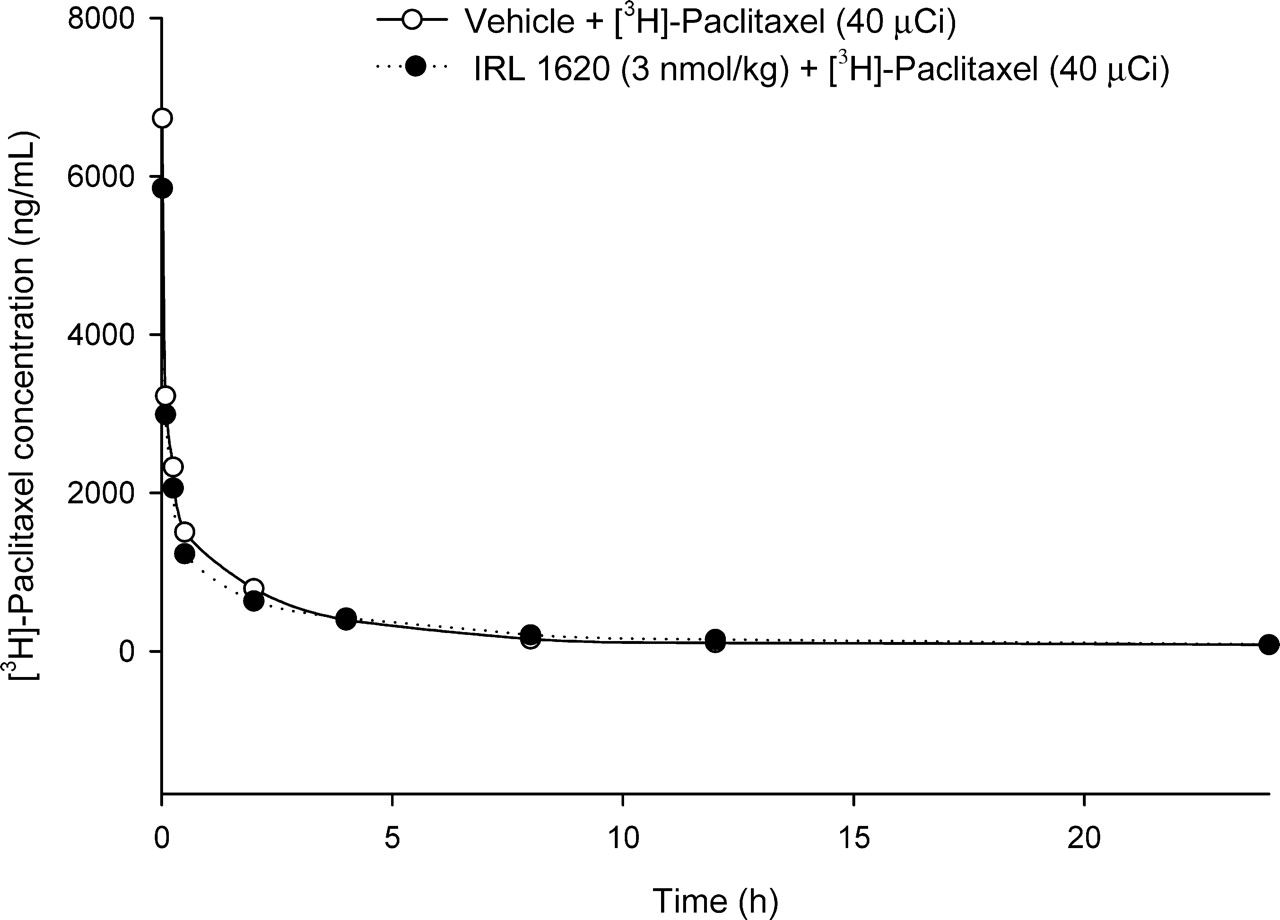
Footnotes
This study was funded by Chicago Labs, Inc., Chicago, IL.
Acknowledgements
The authors are grateful to Mr. George Matwyshyn for technical assistance in mammary tumor induction.