



Abstract
Coalition formation is studied in a setting where agents take part to a group decision-making scenario and where their preferences are expressed via weighted propositional logic, in particular by considering formulas consisting of conjunctions of literals only. Interactions among agents are constrained by an underlying social environment and each agent is associated with a specific social factor determining to which extent she prefers staying in a coalition with other agents. In particular, the utilities of the agents depend not only on their absolute preferences but also on the number of “neighbors” occurring with them in the coalition that emerged. Within this setting, the computational complexity of a number of relevant reasoning tasks is studied, by charting a clear picture of the intrinsic difficulty of finding “agreements” among the agents. Specific algorithmic approaches to reason about such social environments are proposed under the utilitarian perspective, where the collective utility of a coalition is the sum of the utilities of the individuals, as well as under the egalitarian perspective, with the goal being to maximize the utility of the least satisfied agent. These algorithms have been implemented and results of experimental activity are discussed, too.
Keywords
Introduction
The analysis of social environments and of the dynamics regulating the interactions among rational individuals/agents had attracted much attention in the literature. In particular, interesting problems that have been put under the lens of theoretical and practical investigations involve the study of the mechanisms underlying the aggregation of individual knowledge bases and beliefs into a global and collective behavior. This led to define an area of research that is well-established in a number of different disciplines – including economics, finance, epidemiology, social psychology, and political science, to name a few – and that, more recently, due to the proliferation of social networking services, gained attention in computer science, too (see, e.g., [36]).
A social environment can be very conveniently abstracted as network, whose nodes correspond to the individuals and whose edges encode their social interconnections giving rise to influence phenomena. By departing from classical approaches [11,22,28,29,55,59,64,74,82], which assume that neighbors communicate by propagating and diffusing “items”, such as technologies or diseases, richer models of social dynamics have been proposed in the last few years, which are tailored to study how “immaterial” things, such as opinions, form and diffuse over the network [2,13,19,20,39,48,50,62]. In fact, these studies are conceptually related to works in the field of group decision-making, where individuals are seen as thinking entities equipped with their own (in particular, logical) theories meant to express some preferences over a set of possible alternatives, and where mechanisms are conceived to reason about how these theories can be amalgamated in order to end up with some socially desirable outcome (see, e.g., [18,25,66]).
In the paper, we take the perspective of group decision-making and we consider a cardinal setting, where each agent models her preferences via a utility function mapping the available alternatives to some suitable numerical scale defined in terms of weighted propositional logic [34]. In more detail, by following earlier group decision-making studies based on this logic (e.g., [57,84]), we assume that each individual expresses her preferences as a set of propositional formulas associated with numerical values: Given an interpretation σ assigning a truth value to each variable, the utility of the agent is then defined as the sum of the values associated with the formulas belonging to her own theory and that are satisfied by σ [34,84].
An important advantage of this approach is that expressing utilities by weighted formulas is more succinct than expressing them directly, and is fully expressive, in the sense that every utility function can be expressed by some set of weighted formulas [47,51,65,85]. Indeed, weighted propositional logics has been used in a wide spectrum of AI applications, for instance in fair division [24] and to design bidding languages in combinatorial auctions [23,70]. In fact, even social environments populated by logic-based agents modeled via weighted propositional logics have been already studied in the literature [1], by focusing on questions related to the existence of Nash stable profiles (i.e., configurations of the environments where no agent finds convenient to adopt a different decision/opinion) as well as to the convergence of decentralized dynamics consisting of sequences of best response updates.
As a matter of fact, however, while competitive scenarios where agents are selfish interested and want to maximize their own utility have been already analyzed, less attention has been paid so far to analyze how such social environments behave when agents are willing to collaborate with each other in order to obtain higher worths than by staying in isolation.
The main conceptual contribution of the paper is to address this research question, by studying a setting where logic-based agents interact in social environments and can form coalitions (see, e.g., [45,79]), while carrying out the decision process. In more detail, our contribution can be summarized as follows:
We define a framework for reasoning in social environments, which founds on notions borrowed from coalitional games [72,89] and where the basic utilities associated with the agents are adjusted by considering the influence of the other agents. In particular, each agent is associated with a specific social factor determining to which extent she prefers staying in a coalition with other agents. In fact, we model conformist agents which would like to stay with as many agents as possible. So, a tension will emerge between the number of agents staying together in the given coalition and the utility derived by the alternative on which such agents can agree.
We study the computational complexity of some relevant reasoning tasks arising within the proposed framework, such as, for instance, checking whether there is some coalition guaranteeing some desired level of utility to all the agents. In particular, we conduct an analysis that is parametric w.r.t. the underlying semantics for aggregating the utilities of the agents belonging to the same coalition. On the one hand, the utilitarian semantics is considered, where the collective utility of a coalition is the sum of the utilities of the individuals, called the utilitarian social welfare. On the other hand, an egalitarian perspective is also considered. In fact, in a number of application domains, a “fair” approach would be more appropriate with the goal being to maximize the egalitarian social welfare, that is, the satisfaction of the least satisfied agent (see, e.g., [17,24]).
We define concrete mechanisms for reasoning about some of the tasks we have proposed and characterized from the complexity viewpoint. The mechanisms are based on encoding that tasks via pseudo-Boolean constraints and on taking advantage of current state-of-the-art pseudo-Boolean solvers (see, e.g., [41]). In particular, we show that existing solvers can be smoothly adopted to deal with the utilitarian semantics. However, specific algorithms and methods have been required to deal with the egalitarian semantics.
We implemented the above algorithms and integrated them into a concrete solver we made available to the community. Notably, this is the first solver that explicitly supports forms of fair optimization and it is, therefore, of interest even independently of its specific usage in the application domain considered in the paper. Indeed, the usage of the solver in different application domains can be easily envisaged.
Finally, we discuss results of some experimental activity we have conducted to assess the practical behavior of the proposed algorithmic methods for reasoning about social environments. In particular, the discussion is focused on results obtained under the egalitarian semantics, given that this is a distinguishing feature of our solver.
Organization. The rest of the paper is organized as follows. The formal framework is presented in Section 2 and exemplifications are illustrated in Section 3. The computational complexity of a number of relevant reasoning tasks arising therein are discussed in Section 4. Moving from the general intractability of such tasks, restrictions leading to identify classes of tractable instances are discussed in Section 5. Concrete algorithmic methods to reason about social environments with logic-based agents are discussed in Section 6 and in Section 7, by considering the utilitarian and the egalitarian social welfare, respectively. The implementation of the proposed methods and results of experimental activity are illustrated in Section 8. Further works that are related to our research are illustrated and discussed in Section 9, while a few final remarks are eventually drawn in Section 10.
Formal framework
In this section, we formalize a framework for group decision-making where rational agents can group into coalitions in order to find better agreements on the decision that has to be taken. In particular, the coalition formation process will be guided by constraints imposed by the topology of an underlying interaction graph, which is meant to encode the social influence phenomena occurring in a social environment.
Agents and utility functions
Throughout the paper, we assume that a universe
In our framework, a set
Whenever no confusion can arise, we transparently apply
Let us consider a very simple setting where two friends, say
Note that, in the above example, the maximum and minimum values of the utility functions are 1 and 0, respectively. This is not by chance, as we can always rescale the utility functions of the agents from a given set
The goal of the paper is to study the process of amalgamating the preferences of the agents in settings where they interact in a given social environment.
In particular, by following a standard modeling assumption, a social environment is described as a network
In fact, for reasons that might range from physical limitations and constraints to legal banishments, certain agents might not be allowed to form coalitions with certain others (see, e.g., [30], and the references therein). In these cases, it is natural to assume that if two disconnected agents are not connected by intermediaries in a given coalition, then they might not be able to cooperate at all. In particular, following Myerson’s influential work [69], this intuition has been often formalized (see, e.g., [21,31,88]) by stating that a coalition
Consider again the setting of Example 1, by assuming that another agent, say
In this context,
Now, while taking part to the coalition formation process, agents can be influenced by their “social” relationships, in that their own utility functions can be affected by the number of neighbors belonging to the coalitions they belong to. To define this influence, we first define the concept of neighborhood w.r.t. the underlying interaction graph: For each legal coalition
Belonging to a social environment, it makes sense to assume that the utilities of the agents depend not only of their absolute preferences but also on the number of neighbors occurring with them in the coalition that emerged. Accordingly, each agent
In particular, for each interpretation σ over a superset of
Note that an agent
Note that the modeling approach we have proposed is suited to deal with social agents that are “conformist” in their behavior, and it is fully consistent with traditional studies on opinion formation and diffusion in social environments based on influence models, such as the cascade, the tipping/treshold, and the homophilic models. Extending the analysis to “dissenter” agents, whose adjusted utility does not monotonically increase with the number of neighbors in the coalition, is an interesting avenue of further research – in the context of competing agents and when one looks for Nash solutions, both conformist and dissenter agents have been recently studied in the literature [1]. Let us continue our discussion about the running example over the set Then, given the interaction graph of Example 2 where In particular, note that for
The final ingredient of the formalization is to define the objective functions that we would like to optimize for modeling the agreement process among the agents.
To this end, we consider two classical approaches discussed in the literature, that is, the utilitarian and the egalitarian social welfare. In the former case we just look for maximizing the sum of the adjusted utilities, while in the latter a fair approach is considered where we maximize the utility of the least satisfied agent. More formally, for any given interpretation σ and coalition C, we will consider:
the utilitarian social welfare, denoted by
the egalitarian social welfare, denoted by
Based on the above notions, we then say that an interpretation σ is
Similarly, σ is
Consider again the setting discussed in Example 3. For the coalition
Consider instead the coalition
Therefore, it is immediate to check that
We leave this section by stressing that, in many practical real-world scenarios, one might want to study settings where agents can form a coalition structure, i.e., where they can partition themselves into a set Π of disjoint coalitions such that
Assessing which coalition structure might emerge in a given scenario is a fundamental problem in the study of multi-agent systems, which attracted much research in earlier literature (see, e.g., [45,79]). In particular, we are interested in those coalition structures Π that are optimal w.r.t. the utilitarian and the egalitarian social welfare, i.e., such that the values
Consider again Example 4 and note that
Eventually, the coalition structure where all agents stay together can be preferred to Π and it can be checked that such structure is the optimal coalition structure w.r.t. the utilitarian social welfare and the egalitarian social welfare.
In the above example, it emerged that it is convenient for the agents to stay all together. However, this is not in general the case, even when agents have some social attitude. An exemplification is discussed below. Let us go back to Example 1, where only agents
In particular, note that when staying all together, since
In this section, we exemplify a few possible applications of the general framework we have introduced for reasoning about social environments.
Voting and influence phenomena
Consider a scenario where a set
Now, agents
Concerning the social factors, assume for the moment that
Finally, consider the scenario where
Influence in large networks
The proliferation of social networking services, such as FaceBook and Twitter, created novel and highly-dynamic forms of techno-social ecosystems where agents are deeply influenced by their social relationships. In a contest of this kind, consider an agent
At the extreme opposite of being all together, consider the coalition structure Π where each agent stays alone. In this case, each agent
Therefore, by looking at the sum of the utilities of the agents, we get the overall value
Complexity analysis
Now that we have entirely formalized the framework for reasoning about social environments, we move to analyzing the amount of computational resources that are intrinsically needed to reason about it.
Preliminaries on complexity theory
For the sake of completeness, we next present some preliminaries on complexity theory. For expanding on these concepts, the reader is referred to [73].
For the complexity analysis reported in the paper, we abstract the reasoning tasks in terms of decision problems. Formally, decision problems are maps from strings (encoding the input instance over a fixed alphabet, e.g., the binary alphabet
We are often interested in computations carried out by non-deterministic Turing machines. Unlike deterministic Turning machines, at some points of the computation, these machines may not have one single next action to perform, but a choice between several possible next actions. A non-deterministic Turing machine answers a decision problem if, on any input x, (i) there is at least one sequence of choices leading to halt in an accepting state if x is a “yes” instance (such a sequence is called accepting computation path); and (ii) all possible sequences of choices lead to a rejecting state if x is a “no” instance.
The class of decision problems that can be solved (resp., whose complement can be solved) by non-deterministic Turing machines in polynomial time is denoted by
Computational setting and problems of interest
In order to formalize the reasoning problems that will be analyzed, it is sensible to first discuss the specific encoding mechanisms we adopt to define the utility functions of the agents.
By following well-known logic-based encoding approaches [34,57,84], we assume to this end that each agent
Note that, while adopting the perspective of earlier logic-based approaches, we actually depart from them by considering formulas that only consist of conjunctions of literals, i.e., variables or their negation. In fact, weighted formulas of this kinds have been already proven to be useful for expressing values of coalitions in cooperative games and hedonic games, in so-called marginal contribution nets [44,46,60]. Here, we argue that this language, which is clerkly more restricted that full propositional logic, is still powerful enough to model real-world setting in social environments, while being conceptually simple and easy to manipulate.
For the running example discussed in Section 2, the utility function of agents
For the example discussed in Section 3.1, instead, the utility functions of agents
Within this setting, we next embark on the study of a number of decision problems, being defined parametrically w.r.t. the specific kind of social welfare
Given a legal coalition
Is there any legal coalition
Is there any coalition structure Π such that
Given a legal coalition
Note, in particular, that the latter problem is meant to identify maximal coalitions on which good “agreements” can be found. Instead, the former problems directly reflect the concepts we have defined in our formal framework, so far.
We start our analysis by focusing on the most basic problem, that is,
For each
(Membership) The problem
(Hardness) Recall that deciding whether a Boolean formula in conjunctive normal form
Let
In order to conclude, let us consider the egalitarian social welfare. Assume that φ is not satisfiable. Then, for each interpretation σ with
A similar result can be proven for
For each
(Membership) The problem
(Hardness) Consider again the reduction we have exhibited in the proof of Theorem 1. For each possible legal coalition
To conclude, let us consider the egalitarian social welfare. Note that, for each interpretation σ, coalition C and agent
For each
(Membership) The problem can be solved in polynomial time by a nondeterministic Turing machine that guesses a coalition structure Π and an interpretation
(Hardness) Consider again the reduction the proof of Theorem 1 and the arguments in the proof of Theorem 2. Note that the inequalities
To complete the picture of the complexity results, we now consider
For each
(Membership) Let (Hardness) Recall that the problem receiving a pair Now, by Theorem 1, we know that A more technical reduction based on the same kinds of ingredients can be then used to show the
The results derived in the previous section are bad news concerning the possibility of dealing efficiently with the framework we have proposed for reasoning about social environment. This motivates the study of restrictions leading to identify classes of instances that are tractable. In particular, in the rest of the section we shall study qualitative as well as structural restrictions.
Qualitative restrictions
The first natural restriction pertains the social factors associated with the agents in
For each
For an agent
Finally, for the egalitarian social welfare, note that if
Another interesting restriction is analyzed below about the language used for representing the utility functions, which similarly to the above case leads to a monotonic behavior and, ultimately, to tractability.
For each
Consider the interpretation
Many
More generally, practical instances while being not properly acyclic are often not very intricate and exhibit some rather limited degree of cyclicity, which suffices to retain most of the nice properties of acyclic instances. Indeed, many efforts have been spent to investigate graph properties that are best suited to identify nearly-acyclic graph, leading to the definition of a number of structural decomposition methods (see, e.g., [53]). The goal of this section is to check whether these methods are effective to identify islands of tractability also in our setting defined for reasoning in social environments.
Actually, before going on with the formalization, we observe that there is no hope to exploit these methods if reasoning with one single agent is already an intractable problem. Therefore, to keep confined the intrinsic complexity of this task, we consider agents with bounded reasoning capabilities. Formally, for any fixed natural number
By focusing on h-bounded agents, we shall consider the concept of treewidth [78] as the reference measure of graph acyclicity. Indeed, there are different possible notions to measure how far a graph is from a tree, that is, to measure its degree of cyclicity or, dually, its tree-likeness (see, e.g., [54]). Among them, the treewidth is provably the most powerful one, in that it is able to extend the nice computational properties of trees to the largest possible classes of graphs, in many applications from different fields.
For the sake of completeness, we recall that a tree decomposition of a graph
Now, all definitions are in place to state the main result of this section, which refers to the tractability of the reasoning problems we have defined over the utilitarian social welfare and over interaction graphs having bounded treewidth – the proposed proof method cannot be immediately generalized to deal with the egalitarian social welfare, so that checking whether that setting is tractable over bounded treewidth interaction graphs remains an interesting technical question to be addressed in further research.
Let h and k be fixed natural numbers. Then, problems
In order to establish the above result, we notice that the proofs of
Hence, we next focus on the proof of
The proof approach uses, as a technical tool, results about structurally tractable constraint satisfaction problems (CSPs). This is a well-known method to prove tractability results over structures having bounded treewidth. The method has been used in a number of different contexts (see, e.g., [53]) and even to derive structural tractability results for problems related to coalition structure generation (see, e.g., [56]).
Here, we apply the method to the case of the problem
Preliminaries CSPs. We start with some preliminaries on constraint satisfaction. The reader interested in expanding on this formalism is referred to [37].
A constraint satisfaction problem instance is a triple
A weighted CSP (short: WCSP) instance consists of a tuple
From
Since the scenario is h-bounded, it can be easily checked that the construction of the above CSP instance is feasible in polynomial time – indeed, note that h is a fixed natural number.
Concerning the properties of the encoding, instead, we can just observe that, because of the constraints having the form
If θ is a solution to
On the other hand, every interpretation can be derived from some solution.
For each interpretation σ over C, there is a solution θ to
Let σ be an interpretation and consider the substitution θ such that, for each agent
In order to complete the analysis, we now define
Let θ be a solution to
In the light of the above fact and two lemmas, the problem of finding an interpretation σ over
Therefore, to complete the proof, we can show that computing an optimal solution to a weighted CSP instance is feasible in polynomial time. In fact, that problem is
Let
Let In particular, note that the connectedness condition of tree decompositions follows by the condition of h-bounded agents prescribing that an edge
In this section, we define concrete strategies to address the most basic reasoning problems we have defined and analyzed so far, namely
Our algorithmic approach is to take advantage of efficient pseudo-Boolean solvers, by associating a given set
Let us first recall a few preliminary notions on pseudo-Boolean theories (see, e.g., [41]).
Preliminaries on pseudo-Boolean theories
A pseudo-Boolean function f is of the following form:
A pseudo-Boolean constraint ψ is of the form
An assignment σ maps each pseudo-Boolean function f to the following rational number:
Consider a pseudo-Boolean theory Γ consisting of the following pseudo-Boolean constraint:
In some cases, pseudo-Boolean theories Γ can be equipped with a pseudo-Boolean function f to be maximized. In this case, we say that a model σ is optimal w.r.t. f if there is no model
Recall that
Based on
Concerning utility functions, for every agent
In particular, note that in the above expressions the coalition C provided as input to
It is immediate to check that the theory
Consider the setting of Example 3, that is, agents
For example, if C is
For C being
We leave the section by noticing that the natural optimization variant of Continuing Example 9, for
Let us now move to presenting an encoding for the problem
Variables
Intuitively, variables
As in the previous encodings, for the decisional problem, the theory Consider the setting of Example 3. Then, For γ being 3, the only model of
In this section, we consider encoding strategies for the counterparts, over the egalitarian social welfare, of the problems already considered in Section 6. Actually, it can be observed that decision problems can be addressed by pseudo-Boolean encodings similar to those we have already discussed. In particular, under the egalitarian social welfare, it suffices to replace the pseudo-Boolean constraint (4) with the following set of constraints:
More care is needed, instead, for the optimization variants, in which we would like to replace the objective function (5) with the following nonlinear function:
For the setting of Example 3, and for a given γ, the encodings presented in Examples 9–11 are modified by replacing the constraint associated with utility functions with the following set of constraints:
Now, the main problem emerging with the use of the nonlinear encoding is that this is a kind of feature that is currently not supported by existing pseudo-Boolean solvers. Consequently, specific solution approaches have to be proposed to deal with the optimization problem under the egalitarian semantics.
In the rest of the section, we face this problem and we present algorithms (linear, binary, and progression search) that are capable of supporting natively the form of fair optimization related to the maximization of the minimum value over a given set of functions.
We consider a general setting where the input consists of a pair
In the following, all numbers in
Consider the pseudo-Boolean constraints in Example 12. For
In the algorithms presented in this section, intermediate solutions are obtained by means of calls to a pseudo-Boolean solver (PBS) oracle. Formally, for a set of constraints Γ, and a set of assumptions
A key ingredient for the definition of such procedures is the representation of objective functions as pseudo-Boolean constraints. Specifically, for a pseudo-Boolean objective function o, the pseudo-Boolean representation of o, denoted Consider the following objective functions:
The intuition behind linear search is to compute a possibly non-optimal solution, and then iteratively ask for new solutions of better weight, until the weight of the current solution cannot be further improved. At that point, an interpretation of optimum weight is found.
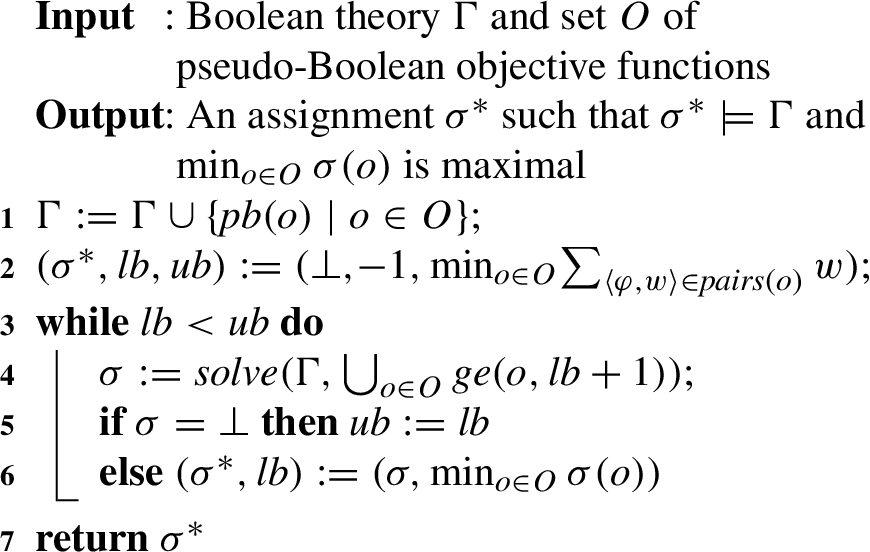
Linear Search
Algorithm 1 is the proposed linear search procedure. Initially, the set Γ of clauses is extended by adding the pseudo-Boolean representation of all objective functions in O (line 2). Moreover, the current solution is stored in variable
Consider the setting of Example 3 and the optimization variant of the problem
Binary search requires to store a lower bound and an upper bound, so that the call to the PBS oracle will check the existence of an interpretation whose weight is at least the mean of the two bounds. If such an interpretation does exist, then the lower bound is increased; otherwise, the upper bound is decreased. The process terminates when the two bounds coincide.
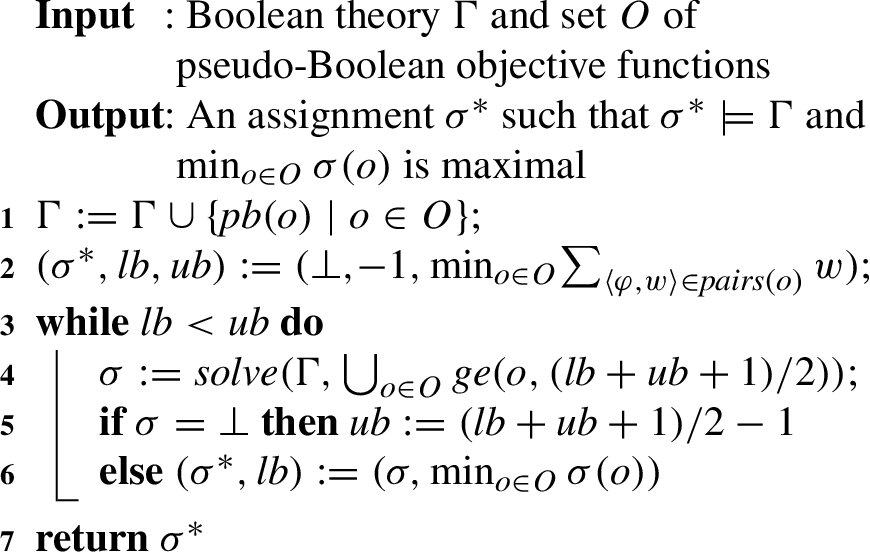
Binary Search
Algorithm 2 is the proposed binary search procedure. Initially, lower bound
Progression search is similar to binary search. The main difference is that new solutions are not required to have utility greater than or equal to the mean of lower bound and upper bound, but instead a geometric progression is used.

Progression Search
Algorithm 3 is the proposed procedure. Initially, the progression
The encodings and algorithms discussed in the previous sections have been implemented and experimentation has been conducted to assess the scalability of the overall approach. Actually, the encodings discussed in Section 6 can be straightforwardly provided as input to a pseudo-Boolean solver and the nice scaling of the approach will emerge with no surprise, because of the scaling of the underlying solver. In the light of this observation, details on experimentation on this basic setting are hence omitted and we next focus on illustrating the behavior of our implementation under the egalitarian social welfare.
In fact, from the conceptual viewpoint, assessing the scalability under the egalitarian social welfare is even more relevant than focusing on the utilitarian social welfare, since our solver is the first one in the literature that explicitly supports forms of fair optimization. Therefore, the experimental analysis we shall discuss in this section is of interest even independently of the specific application domain considered in the paper. The analysis will be focused on encodings discussed in Section 7, with the three algorithms presented there being implemented in
Benchmark problems
In order to analyze the performances of the proposed algorithms on standard datasets (possibly taken from real-world applications), we focused our experimentation on optimization problems already considered in the literature. In fact, rather than considering standard optimization, we looked for the fair optimization required by the egalitarian social welfare. In particular, all problems have been modeled in our framework by considering egalitarian scenarios where the goal is to compute
The first problem we considered in our experiments is referred to as Fair Movie Partitioning: Let M be a list of movies, where each movie m is associated with one or more genres. We considered a setting where we would like to compute an assignment corresponding to mapping movies in M to n persons such that the minimum number of genres covered by each person is maximized. Instances of this problem are obtained from the MovieLens Datasets [58], with
The second problem we considered is referred to as Fair Graph Partitioning: Let
Additional testcases were obtained from the crafted instances of the 2015 MaxSAT Evaluation: Soft clauses are distributed among n different agents, for
Results
Experiments have been conducted on an Intel Xeon CPU 2.4 GHz with 16 GB of RAM. Time and memory were limited to 600 seconds and 15 GB, respectively. Resource usage is measured by
Solved instances (S), average execution time (T, in seconds), and average memory consumption (M, in MB)
Special care has been devoted to compare the performances of the three algorithms presented in Section 7. The overall results are reported in Table 1. The three algorithms have a similar performance in terms of solved instances: binary search and progression search solved the highest number of instances, 4 instances more than linear search. Also in terms of average execution time and memory usage the three algorithms have a similar performance. A better view on the execution time is provided by the cactus plot reported in Fig. 1. Indeed, the plot highlights that binary and progression searches are often faster than linear search in solving instances in our benchmark. A detaield view of the execution time of the three algorithms on Fair Movie Parititioning is given in Fig. 2, where it can be observed that binary and progression searches provide optimal values for instances involving up to 128 agents in 67% of the cases.
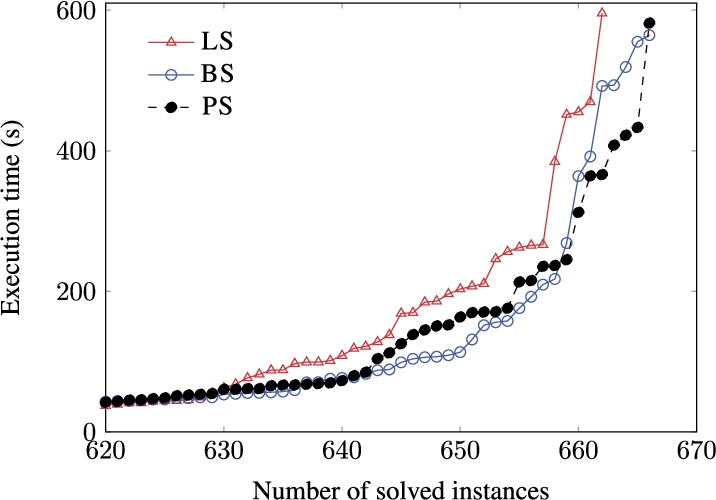
Cactus plot of the overall performance.

Fair Movie Partitioning: execution time for increasing number of agents.
As shown in Table 1, none of the implemented algorithms can solve instances of Fair Graph Partitioning in the allotted time. Nevertheless, the performance of the three algorithms on these instances is different in terms of suboptimal solutions provided to the user. Within this regards, Table 2 reports the weight of the best computed solution by the three algorithms on each instance of Fair Graph Partitioning. It is interesting to observe that binary search cannot provide any solution within the allotted time. The other two algorithms complement each other, as also shown in Fig. 3.
More details regarding the computation of suboptimal solutions are given by the plots in Fig. 4, where the time at which suboptimal solutions are provided to the user is also reported. It can be observed that progression search requires less invocations of the PBS solver, which however are sometimes really challenging to complete. This is the case, for example, of the instance of ego-Facebook for
In the paper we have formalized and studied the process of amalgamating the preferences of the agents, formalized via weighted propositional logic, in a setting where they interact in a given social environment. On the one hand, our framework has been influenced by the large body of literature related to information and opinion diffusion that we have already discussed in the Introduction. On the other hand, the reasoning problems we have formalized and studied can be better positioned within the area of research that is devoted to the study of coalition formation in multi-agent systems. For the sake of completeness, we review in this section some of the literature in this field, by stressing the conceptual and technical differences of our approach w.r.t. earlier proposals.
According to a classical classification in the literature [79], coalition formation is a process that involves three distinct activities. The first activity is related to the fact that agents have to joint coalitions and form a coalition structure, either endogenously or being coordinated by a system designer. In both cases, we are usually interested in the coalition structures that enjoy desirable properties, such as optimizing the utilitarian social welfare or minimizing the agents’ incentive to deviate from their coalitions. The second activity is related to how the agents can coordinate in order to optimize the worth they can guarantee to themselves by collaborating with each other, rather than by acting in isolation. Finally, the third activity is related to dividing this worth according to distribution methods that can be perceived as fair and stable. The research discussed in this paper clearly fits the first of the above three activities. In abstract terms, this activity (known as coalition structure generation) can be defined over a pair
Fair Graph Partitioning: Weight of the best solution computed for instances of ego-Facebook and wiki-Vote
Fair Graph Partitioning: Weight of the best solution computed for instances of ego-Facebook and wiki-Vote
In the paper, we have analyzed coalition structure generation from the computational and algorithmic perspectives. In fact, there is an extensive literature studying computational issues and proposing efficient solution algorithms for coalition structure generation, which we can partition in two groups based on the kinds of game encoding considered in the research. Classically, valuation functions are viewed as “black boxes” that, on input a coalition C, return the value
Our model departs from the approaches discussed above in three respects. First, in addition to the maximization of the social welfare, we have considered the maximization of the egalitarian social welfare – which is an optimization function rather popular in the computational social choice community, but whose application in the context of coalition formation has been largely unexplored in earlier literature.
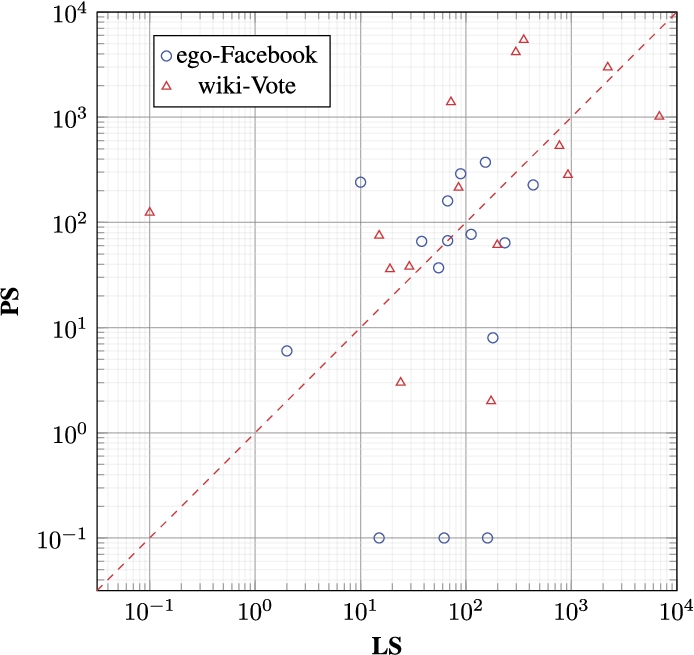
Fair Graph Partitioning: Weight of the best solution computed for instances of ego-Facebook and wiki-Vote (0 normalized to 0.1).
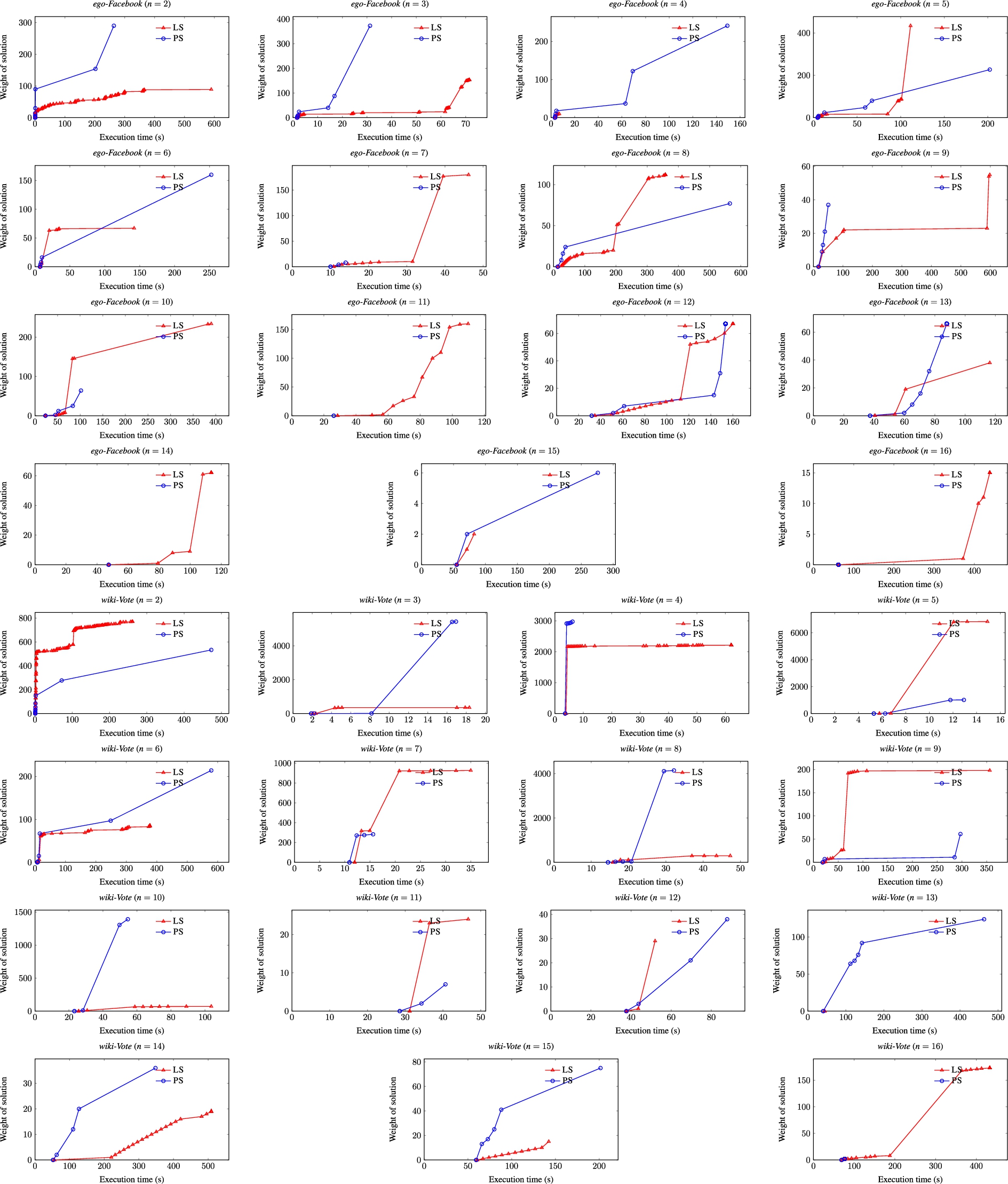
Fair Graph Partitioning: Weight of suboptimal solutions computed for instances of ego-Facebook and wiki-Vote.
Second, we have considered a logic-based modeling of the agents, which is semantically richer than traditional valuation functions. In fact, by looking at our contribution from this perspective, it might be relevant to mention here some of the most popular logic-based approaches in the multi-agent community, namely, alternating-time temporal logic [7] and coalition logic [75], which influenced further proposals, including epistemic coalition logic [3], and resource-bounded temporal logic [6,38]. Moreover, specific logic-based formalisms for defining coalitional games include Qualitative Coalitional Games [90], Temporal Qualitative Coalitional Games [4], Coalitional Resource Games [42], and Coalitional Game Logic [5]. Our work can be positioned within this avenue of research, but it must be observed that the utility function we have considered is very specific to reflect a logic-based formalization that interplays (in a way that is entirely novel in the literature) with the innate social attitude of the agents. On the one hand, this is a conceptual novelty and a distinguishing modeling feature of our proposal; on the other hand, when we consider the technical contribution and given the specificity of the functions we have dealt with, it clearly emerges that earlier complexity results in the literature do not apply to our setting and an ad-hoc analysis was in order.
The third distinguishing feature of our work is that we have positioned our agents in a social environment where only certain coalitions were allowed to form based on agents’ interactions. In fact, this latter aspect is not entirely novel, as it is reminiscent of coalition structure generation methods imposing constraints on the allowed coalitions [21,31,56,88]. However, in our modeling perspective, the underlying social networks is not only responsible of defining hard constraints on the coalitions that are allowed to form, but it also impacts the valuations of the agents in a measure that is proportional to their social attitude.
Social environments are usually modeled in the literature as networks, whose nodes correspond to the individuals and whose edges encode their social interconnections which give rise to influence phenomena, because of reasons ranging from similarity and social ties [10], to conformity [83], and to compliance [32], just to name a few. In particular, classical studies focuses their analysis on understanding how information diffuses over the newtwork by exploiting such phenomena (see, e.g., [22,28,29,55,59,64]).
In fact, richer models of social environments have been also proposed to study the process of opinion diffusion, rather than just information diffusion (see, e.g., [1,48]). The paper position itself within this avenue of research, by studying the problem of assessing how a general consensus can be reached over a network where agents are seen as thinking entities equipped with their own logical theories. In particular, we have proposed a framework where agents can form coalitions, i.e., we do not necessarily require that a general consensus is reached, and where their reasoning capabilities are encoded via weighted propositional formulas. On the one hand, a number of exemplifications have been provided to illustrate the expressiveness of the framework. On the other hand, a thorough complexity analysis has been conducted in order to assess the amount of resources that are intrinsically needed to reason in the resulting setting.
Our theoretical investigations have been complemented by designing concrete algorithms to solve the problems of interest. In particular, we have proposed rewriting in terms of pseudo-Boolean constraints, which can be used on top of current state-of-the-art pseudo-Boolean solvers. In particular, existing solvers can be smoothly adopted to deal with the utilitarian semantics. Instead, to deal with the egalitarian social welfare, an ad-hoc solver has been implemented which is capable of supporting forms of fair optimization – hence being of interest independently of its specific usage in our application domain.
In the paper, we left open a number of specific technical questions (such as the identification of islands of tractability under the egalitarian social welfare and the definition of encodings for the reasoning tasks currently not covered in Section 6 and in Section 7). In addition to facing them, a natural avenue of further research is to study different optimization functions in the coalition structure generation problem. Indeed, while our focus on the egalitarian social welfare is rather novel in the coalition structure generation literature, there might be cases where neither this kinds of social welfare not the classical utilitarian social welfare are appropriate. For instance, it might be natural to study settings with a strategy that aims to minimize the differences between the individual utilities of the coalition agents and to maximize the global utility of the coalition.
Finally, another avenue of further research might lead to face different problems in social environments, beside those we have already considered. For instance, it would be interesting to apply, within our framework, solutions concepts from cooperative game theory, leading to establishing criteria of fairness and stability in the agreements over the agents. Then, it would be interesting to assess whether the computational problems arising with them can be encoded in a way that can be smoothly handled by our solver.
Footnotes
Acknowledgements
We thank the anonymous reviewers for their useful comments and suggestions. Mario Alviano was partially supported by the POR CALABRIA FESR 2014-2020 project “DLV Large Scale”, by the EU H2020 PON I&C 2014-2020 project “S2BDW”, and by GNCS-INdAM. Gianluigi Greco was partially supported by the POR CALABRIA FESR 2014-2020 project “Explora Process” and by the EU H2020 PON I&C 2014-2020 project “S2BDW”. Antonella Guzzo was partially supported by the EU H2020 PON I&C 2014-2020 project “IDService: Digital Identity and Service Accountability”.