Analogical proportions are statements of the form “a is to b as c is to d”, denoted , that may apply to any type of items a, b, c, d. Analogical proportions, as a building block for analogical reasoning, is then a tool of interest in artificial intelligence. Viewed as a relation between pairs and , these proportions are supposed to obey three postulates: reflexivity, symmetry, and central permutation (i.e., b and c can be exchanged). The logical modeling of analogical proportions expresses that a and b differ in the same way as c and d, when the four items are represented by vectors encoding Boolean properties. When items are real numbers, numerical proportions – arithmetic and geometric proportions – can be considered as prototypical examples of analogical proportions. Taking inspiration of an old practice where numerical proportions were handled in a vectorial way and where sequences of numerical proportions of the form were in use, we emphasize a vectorial treatment of Boolean analogical proportions and we propose a Boolean logic counterpart to such sequences. This provides a linear algebra calculus of analogical inference and acknowledges the fact that analogical proportions should not be considered in isolation. Moreover, this also leads us to reconsider the postulates underlying analogical proportions (since central permutation makes no sense when ) and then to formalize a weak form of analogical proportion which no longer obeys the central permutation postulate inherited from numerical proportions. But these weak proportions may still be combined in multiple weak analogical proportions.
For a long time and until the XIXth century, numerical proportions have been thought of as a somewhat autonomous chapter of mathematics having its special notations. Thus the use of “::” for denoting the equality of ratios (see [37] p. 394) dates back to the 17th century English mathematician William Oughtred [7], while “:” was often used for denoting ratios. Thus, the geometric proportion , was written , and read as “a is to b as c is to d”. However, some variations can be observed, such as instead, while was denoting the arithmetic proportion , according to the mathematical section of the entry Proportion in Diderot and d’Alembert’ Encyclopédie [35]. An example of such an extensive use of for denoting geometric proportions can be found in a book written by Gaspard Monge at the very end of XVIIIth century [26], as we shall see in Section 3.
Interestingly enough, the section “Log. Métaphys.” of the entry Proportion [8] in the Encyclopédie states the following: “conformity of relation between various things, when the mind, thinking of two objects, has conceived a relation between these two objects, & that thinking of two other things, it finds there also the relationship between them; this conformity of thought & relations is called proportion.”1
French text: Proportion, (Log. Métaphys.) conformité de relation entre diverses choses, lorsque l’esprit pensant à deux objets, a conçu un rapport entre ces deux objets, & que pensant à deux autres choses, il y trouve aussi du rapport entr’elles; cette conformité de pensées & de relations s’appelle proportion.”
So the idea of proportion between four terms was applied both to numerical quantities and to abstract items. Moreover the entry Analogy (due to d’Alembert) in the Encyclopédie was saying: “Analogy, in Mathematics, is the same as proportion, or equality of ratio.”2
French text: Analogie, en Mathématique, est la même chose que proportion, ou égalité de rapport. Voyez Proportion, Rapport, Raison. See Vol. I, 1751.
Thus the notions of analogy and proportion were closely related. Such a parallel between conceptual entities and numerical quantities, as arguments of an analogical proportion, dates back to Aristotle [2], under the influence of the works of mathematicians of his time, such as Archytas of Tarentum who studied arithmetic and geometric proportions.
The notation between non numerical items applied to statements of the form “a is to b as c is to d”, called analogical proportion (AP for short), continues naturally to be in use with the study of analogical reasoning, e.g., [9]. Various formal modelings of APs have been proposed in the last fifty years, where items have discrete, numerical, or structured representations [3,11,14,18,19,23,24,28,36,38]. See [34] for an introductory survey on APs and their use in Artificial Intelligence. Indeed APs are a key tool for analogical reasoning. In the following, we consider the situation where items a, b, c, d are represented by vectors of Boolean feature values. The propositional logic modeling [24] of appears to offer a good formal parallel with numerical proportions [29].
The present paper pursues the study of this parallel by introducing Boolean multiple analogical proportions as a counterpart of the numerical proportion sequences such as , understood as , which are extensively used by Gaspard Monge in his previously cited book [26]. As we shall see, it leads to a renewed view of (Boolean) analogical proportions.
The paper is organized as follows. We start with a brief reminder on the Boolean modeling of APs in Section 2, before presenting and discussing the use of numerical proportion sequences by Gaspard Monge in Section 3, and then proposing a vectorial handling of Boolean analogical inference. In Section 4 we provide a Boolean counterpart to these sequences, propose postulates for them, before introducing and discussing a weak form of AP that does not satisfy a central permutation postulate (usually assumed for APs) in Section 5.
Boolean analogical proportion – a short background
An AP relates four items a, b, c, d by a statement of the form “a is to b as c is to d”. This is a comparative device that can be applied to items of any type. In this paper, as already said, items a, b, c, d are represented by vectors of Boolean attribute values. Before recalling the Boolean modeling of APs, we first state the postulates that they are supposed to obey.
Postulates and properties
Given a set of items X, AP is a quaternary relation supposed to obey the 3 following postulates (e.g., [9,19]): ,
(reflexivity);
(symmetry);
(central permutation).
Clearly these postulates are satisfied by geometric and arithmetic proportions. They have straightforward consequences like:
(full identity);
(identity);
(internal reversal);
;
(complete reversal).
While reflexivity and symmetry looks uncontroversial, central permutation is more debatable. For instance, in the case of analogy between words, for an AP such as “the dog is to the wolf as the pig is to the boar”, it makes sense to say that “the dog is to the pig as the wolf is to the boar”. But applying central permutation to “gills are to fishes as lungs are to mammals” leads to the statement “gills are to lungs as fishes are to mammals” which seems not very meaningful and is thus less acceptable; see [3] for a discussion.
The above postulates seem to have been inspired by well-known properties of geometric proportions or arithmetic proportions between numbers. Note that these two basic proportions can be exchanged by logarithmic / exponential transformations. Indeed if then we have , and if then we have . This explains why they have similar properties. These properties are also shared by Boolean analogical proportions that are now recalled [29].
Propositional logic model
The previous postulates are expressed in first order logic (with quantifiers over a universe X). In the case where the underlying universe is just , we can wonder what are the logical relations on , expressed as Boolean formulas, satisfying the 3 postulates. In [24], it has been shown that
is such a formula (but obviously, many other logically equivalent expressions exist). It makes explicit that “a differs from b as c differs from d and conversely, b differs from a as d differs from c” (note that with numbers, there is no need to express two conditions as in the above formula, since is the same as ). It can be checked that the above logical formula is only true for the 6 patterns in Table 1 among patterns, and false for the 10 other patterns.
Boolean model [33] obeying the 3 postulates of analogy. It can be noticed that Table 1 is also in agreement with the arithmetic proportion (where the differences take values in ).
In addition, it can be shown that can be equivalently written in a way that reminds of a well-known property of numerical proportions ( and ), namely:
Note that this logical writing emphasizes similarity, and not dissimilarity as the previous one.
Besides, it can be seen in Table 1 that 1 and 0 play a symmetrical role, which makes the definition of Boolean APs code-independent. This is formally expressed with the negation operator as:
Moreover, Boolean APs are transitive (which does not follow from the postulates, but which is also true for numerical proportions), namely we have [30]
More on the parallel with numerical proportions
The parallel between numerical proportions and Boolean analogies as defined above can still be continued. Thus, geometric proportions also satisfy , i.e.,
This property of geometric proportions is used by Gaspard Monge in his book [26]. However, note that it is false for arithmetic proportions since . Using the truth table of their logical expression, it can be checked that Boolean APs have the two following properties, which may be viewed as counterparts of the above property of geometric proportions:
Similarly,
are counterparts of .4
This second geometric proportion follows from the previous one by applications of the postulates. Indeed from , we get by central permutation and by internal reversal. Then, changing into , we obtain , i.e., or .
Moreover, arithmetic proportions, on their side, have properties that are false for geometric proportions, such as, for instance, , or . But these properties have no Boolean counterparts with ∧ or ∨ (indeed holds, but neither , nor ; similarly holds, but neither , nor ). Even if here Boolean analogical proportions seem a bit closer to geometric proportions, they are also very similar to arithmetic proportions, as it will appear more clearly in Section 3.2.
Inference based on APs
Analogical inference is based on an equation solving process: namely finding x such that holds true. This is the counterpart of the rule of three for geometric proportions. In the case of numerical proportions (arithmetic ones solvable on , geometric ones solvable on ), this equation always has a unique solution. However, in the Boolean case, the equation has no solution if or since these two triplets cannot be completed into one of the 4-tuples in Table 1. Otherwise, the solution is unique, as can be readily checked in Table 1 and can be expressed when it exists by where ⊕ is the sum modulo 2 (i.e., the x-or connective).
To deal with items represented by vectors of attribute values, AP definitions are extended componentwise from X to :
Obviously, this is equivalent to define analogy on real-valued vectors , , , as
whose geometric interpretation is: makes a parallelogram (note that we also have ).
Let us take an example of items described by vectors of Boolean attribute values. For instance, using the 6 attributes , , , , , in that order, Table 2 makes clear why “the dog is to the wolf as the pig is to the boar”. Indeed can be considered as a valid analogy since we recognize patterns of Table 1, vertically, in Table 2. Moreover, the description of boar can be indeed obtained from the ones of dog, wolf and pig by a componentwise equation solving process (), as can be checked.
A Boolean validation of dog : wolf :: pig : boar
dog
1
0
1
0
1
0
wolf
1
0
1
0
0
1
pig
1
0
0
1
1
0
boar
1
0
0
1
0
1
Taking inspiration from an old treatise
As we have seen, there is a striking parallel between numerical proportions and Boolean APs. The parallel that can be made is still deeper, as suggested to the authors by the reading of an old treatise by Gaspard Monge, discovered by chance. We first present this book with a meaningful excerpt, before providing a vectorial view of APs in Section 3.2, and then studying multiple analogical proportions in the next section.
Gaspard Monge’s book on statics
Gaspard Monge, a renowned mathematician, especially known for his work in descriptive geometry, wrote An Elementary Treatise on Statics [26]. This book had 8 editions in French (the last one was in 1846, the first one in 1788). An English translation was published in 1851. This influential book, republished over more than half a century, is remarkable in many respects, by its mathematical rigor and its didacticism concerns.
What is of a special interest here, is its extensive use of numerical proportions, usually written using the old notations for proportions, namely (in place of ), which does not prevent the author to write after that in modern notations, when exploiting them.
Moreover, as can be seen in the book Section 43 (or 44 depending on the editions) that we reproduce below, the author also uses numerical proportion sequences such as , to be understood as , as well as an implicit equivalent of vectorial calculus for computing the resultant of several forces. Let us quote Gaspard Monge (in the 1851 translation by Woods Baker):
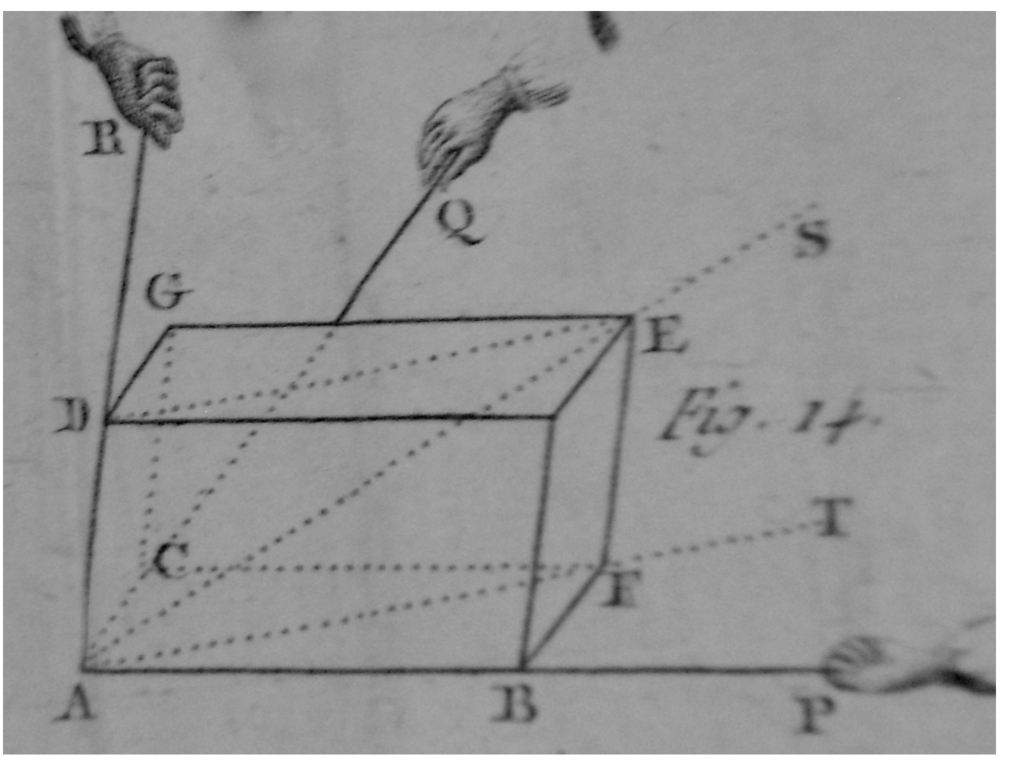
. If three forces P, Q, R, be represented in intensity and direction by the three sides , , , adjacent to the same angle of a parallelopipedon , so that
their resultant S will be represented in intensity and direction by the diagonal of the parallelopipedon adjacent to the same angle, and we shall have
DEMONSTRATION. In the plane , which contains the directions of the two forces P, Q, draw the diagonal ; also draw the diagonal in the opposite face : these two diagonals will be equal and parallel; for the two sides , of the parallelopipedon at the extremities of which they terminate are parallel and equal: hence will be a parallelogram. This done, the two forces P, Q, being represented in intensity and direction by the sides , , of the plane , which is a parallelogram, their resultant T will be represented in magnitude and direction by the diagonal (36),6
Here the author refers to a previous result: “When the directions of the two forces P, Q, are contained in the same plane, and coincide in a point A, if the lines , , be laid off on these directions proportional to these forces so that , and the parallelogram be completed, the resultant R of these two forces will be represented in intensity and direction by the diagonal of the parallelogram; that is to say, we shall have: .”
and we shall have
Likewise the two forces T, R, being represented by the sides , , of the parallelogram , their resultant S, which will be also that of the three forces P, Q, R, will be represented by the diagonal of the same parallelogram, and we shall have
Hence, combining the two proportions, we will obtain
Now the diagonal is also the diagonal of the parallelopipedon; hence the resultant of the three forces will be represented in intensity and direction by the diagonal of the parallelopipedon.
Fig. 14 in Gaspard Monge’s book.
Vectorial Boolean analogical proportions
The parallel with the above excerpt of Gaspard Monge’s book dealing with numerical proportions raises the question of the possibility of a fully vectorial calculus for Boolean analogical proportions. The following results answer this question affirmatively. They exploit the previously mentioned agreement between the arithmetic mean and the truth table of an AP, which straightforwardly extends to vectorial representations in (see [16] for illustrations). It is quite tempting to consider as a subset of , and then Boolean vectors are considered as real-valued vectors whose components are restricted to 0 and 1. But the (componentwise) definition of analogical proportions in terms of Boolean vectors given in Section 2 does not coincide with the real-valued vectors definition due to the fact that the Boolean definition restricts the resulting values to be in and does not allow a negative value as . In order to be sure our geometric intuition does not mislead us, we need the following proposition:
Four items a, b, c, d represented by Boolean vectors,,,on a set of n features form an analogical proportion componentwise if and only ifis a parallelogram in.
Let , , , . The items are thus points in . When comparing two vectors,7
In the following, we use an approach that makes clear that Boolean APs involve a form of Boolean calculus of differences. However, this should not be confused with a calculus of derivatives of Boolean functions, as developed in [39] under such a name. Still the reader is referred to [32] for a preliminary analysis of analogical proportions in terms of Boolean derivatives.
say and , one can define three subsets of features:
where the two vectors agree, and . It can be easily checked that holds if and only if , and [31].
⇒ Let us show that the vectors and are equal, (or equivalently that the vectors and are equal), which is equivalent to say that is a parallelogram. Clearly,
and , and as soon as holds true componentwise. Thus we have , i.e., . The vectorial equality ii) could be proven similarly, it is the same as i) after central permutation of and .
⇐ Conversely, if is a parallelogram, we have and holds true componentwise. □
The following example is inspired from a seminal paper [36] by Rumelhart and Abrahamson who very early proposed a parallelogram view of APs between words, modeled by means of an arithmetic proportion for word items represented by real-valued vectors;8
This example has been extensively used more recently by many authors developing word embeddings, e.g., [10,25].
see [21] for a recent discussion of works related to this view.
Here the four items, man, king, woman and queen, are represented in terms of 6 Boolean features, as given in Table 3. In this representation, it is clear that the AP “a man is to a king as a woman is to a queen” holds true.
The man : king :: woman : queen example
Sex M
Sex F
Power position
Ordinary position
Human
God
Man
1
0
0
1
1
0
King
1
0
1
0
1
0
Woman
0
1
0
1
1
0
Queen
0
1
1
0
1
0
First, let us check that it provides an illustration of the above result, namely we have a parallelogram. Indeed, ordering the attributes in Table 3 from left to right, we can check that we have a parallelogram:
thus .
thus .
As always when an AP holds, the 4th line of the Boolean table can be obtained from the 3 first ones by the analogical equation solving mechanism. This inferential mechanism can also be captured by a simple vectorial calculus, as shown now:
Thus, we have
and then
It makes clear that more generally we have:
If four Boolean vectors make an analogical proportionthen.
Conversely, can be rewritten as . So is a parallelogram. Then holds true, provided that such that and , or such that and , in order to guarantee the existence of a Boolean solution .
As can be seen, the above representation of analogical proportions emphasizes their linear nature. Thus one may wonder if one could generalized the idea by assuming that can be obtained from , and from , by a linear mapping. Namely and where α is a scalar number and a scalar vector. Then . Thus analogical proportions correspond to the case where . Note that we also have . Thus in general there does not exist γ such that , So central permutation cannot be preserved, except if .
Besides, this may be also found reminiscent of the idea of relational similarity [13] where the difference between two similarity ratings of 2 items with respect to a reference item is compared with the difference of the similarity ratings of 2 other items (with respect to the same reference). Possible links should be explored in further research.
Boolean counterpart to proportion sequences
We now study proportion sequences in the Boolean setting. Proportion sequences compare two triplets, two quadruplets, and more generally two n-tuples of items, just as simple APs compare two pairs of items.9
One might also wonder about singletons. This amounts to consider , read as “a is as x”. In the Boolean case, it means (a and x are true (resp. false) in the same time). In the numerical case it may be understood as a proportionality, namely such that , i.e., . When dealing with pairs, it would lead to , and it is no longer necessary to introduce a k for getting a geometric proportion.
We start with the simplest case, namely with proportion sequences of the form , before considering more general ones (with more than 3 items on each side of ::).
Double proportion
As recalled in the previous section, Gaspard Monge [26] makes use of expressions such as , where quantities (‘forces’ in the excerpt) are proportional to quantities (‘lengths’ in the excerpt) respectively. Indeed, from Monge draws the numerical equalities and . From which, one can easily conclude (by eliminating ).
What is the counterpart of in the Boolean setting (i.e., when are Boolean variables, or vectors thereof)? The numerical interpretation suggests to see it as the conjunction of the two APs and .10
Hence the name double proportion for , in spite of the fact there are 3 items on each side of ::. This goes with the fact that the simple analogical proportion has 2 items on each side of ::.
Then is a double AP. Using the vectorial setting and the parallelogram view of the previous section, reads in the parallelogram . Since in the parallelogram , we have , which yields (by subtracting to each side of the equality). This corresponds to and to a 3rd parallelogram , as expected.
Thus follows from and . This can also be viewed by applying central permutation, symmetry and transitivity : Indeed can be equivalently written as and then as , and as , which yields by transitivity, and finally by central permutation.
Boolean model
The above analysis shows that from , one obtains an AP by deleting the i-th term (for ) on both sides of “::”. The double AP can be read “ is as ”.
Since is equivalent to and , one can easily obtain its truth table. Namely is true for exactly 10 patterns that are exhibited in Table 4 and false for the others.
Valid valuations for
000111
111000
000000
001001
010010
011011
100100
101101
110110
111111
Postulates and consequences
What are the postulates underlying ? Clearly, extended reflexivity and extended symmetry make sense. Central permutation seems specific of simple APs for comparing two pairs and no clear extension seems to exist when comparing two triplets.
In the Boolean case, looking at Table 4 it appears that 8 of the 10 patterns obey reflexivity and corresponds to the patterns corresponding to , while the 2 other patterns obey identity,11
They are 000111 and 111000. Note that 000000 and 111111 obey both reflexivity and identity.
namely . Indeed, the two postulates and are enough in the Boolean case for inducing Table 4 as a minimal model.
Moreover it can be observed in the table that satisfies symmetry12
Note that in the case of APs, reflexivity and identity are also enough for inducing Table 1 as a minimal model in the Boolean setting. In particular, central permutation property is preserved.
and code independency. Besides, it can be seen from Table 4 that transitivity is preserved:
Another consequence in the Boolean setting is: where σ is a 3-permutation. It includes as particular cases an extension of internal reversal () and an extension of complete reversal () as a consequence.
Inference and triangulation
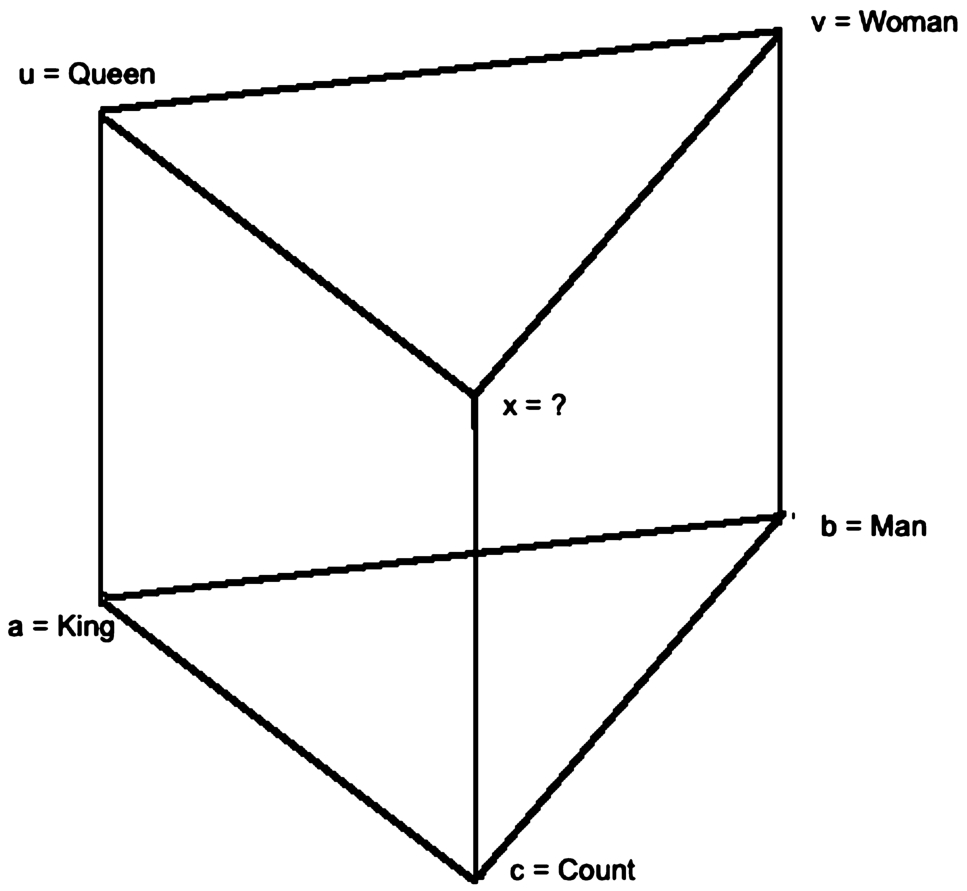
In case of a double proportion where x is unknown, the solution x of and the one of should be equal, as soon as hold. Indeed, as explained above, and entail . This kind of triangulation may be of interest for checking if a double proportion holds, or for finding the right x in case one would have several candidate solutions.
To illustrate this second use, let us consider the two following analogical proportions where the fourth word item is to be found.
Triangulation example.
Since the proportion holds, the two solutions of the previous equations should be the same. The situation is pictured in Fig. 2.
Analogy solving problem (knowing 3 words , find a word d such that ) has become a standard benchmark to validate the accuracy of a word embedding technique ([22]). The embedding-based algorithm is quite simple:
embed in a real-valued vector space V and get 3 real-valued vectors
consider the vector:
as it is very unlikely that there exists a word w such that , look for the word embedding closest to x
return d as the solution of .
Because the final d can be unsatisfactory, several authors [6,20] have tried to modify the parallelogram formula. But multiple proportions could help in this matter, without any modification of the initial formula. Let us consider the two equations below with unique solution x:
when we have . In our example, . In the case of the basic parallelogram definition, this is just described with two equalities:
Applying the process mentioned above to solve the equations, we will get,
from the first equation a pivot vector y, then look for a set of n nearest neighbors;
from the second equation a pivot vector , then look for a set of n nearest neighbors;
the solution of the problem should be in
We have just attempted a basic experience using GloVe [27] as word embedding,in dimension 100, to solve the above analogical proportions. We get as candidate solutions for the first equation:
and for the second :
The solution appears in both sets. However, due to the polysemous nature of , other words are in common in the two lists. Still the intersection of the two lists restricts the candidate solutions. Note that the process could be iterated: e.g., knowing the proportion , the third equation should have the same solution x as the two first ones.
Triple proportion and more
In the quoted excerpt of Gaspard Monge’s book [26], we have an example of a proportion sequence of the form involving 8 items. We briefly examine this case and its relation with another extension of APs in greater dimension called “super-proportion” that has been recently introduced [4], before considering the general case of proportion sequences of any size.
Triple proportion
In the numerical case, is understood as , and , from which one can easily derive 3 other similar relations , , and . Indeed amounts to the equality of 4 ratios , from which one can extract equalities of 2 ratios.
Thus in the Boolean setting can be defined by the conjunction of 3 APs: , and ,13
Hence the name triple proportion for , in spite of the fact there are 4 items on each side of ::. This fits with the cases of simple and double analogical proportions.
from which one can derive 3 other APs , , and , using transitivity. Indeed, for instance, we already saw (in the second paragraph of Section 4.1) that and entail , and the last two analogical proportions can be derived similarly.
As can be seen, one obtains a valid AP from by selecting the i-th term () and the j-th term (), on both sides of “::”.
Following the example of double proportions, the truth table of is true for only patterns that are induced by the two postulates (reflexivity and identity), and . The contents of this table is made explicit in the next subsection.
Link with super-proportions
In [4], so called “super-proportions” have been introduced. They involve 8 vectors of Boolean variables and can be defined by the following expression involving 4 APs:
The 8 vectors of Boolean variables correspond to the 8 leaves of a binary taxonomic tree induced by 3 pairs of mutually exclusive properties. Each leave thus corresponds to the description of a particular type of items in terms of these properties. The construction goes up by adding more pairs of such properties. The same construction with only two pairs yields which is nothing but . It has been shown that is true for only 8 patterns among possible patterns:
Valid valuations for
00001111
11110000
00000000
00110011
01010101
10101010
11001100
11111111
entails the validity of 8 other APs: , , , , , , , .
Among the 12 APs associated with , one can recognize the 3 following APs , , and . These 3 APs are enough to define the triple proportion .
Thus, we have
Indeed is true for the 8 valuations in Table 5 and also for 10 more valuations given in Table 6: Note that the valuations given in Table 6 (in contrast with the ones of Table 5) are all induced by the postulate . However the values of a, b, c, d in the patterns in Table 6 are valuations that would make false the AP . But the repetition of the sub-pattern into leads to valuations compatible with the triple proportion. The discrepancy between and is due to the fact that they are two extensions of APs induced by different constructs: the former is just a collection of APs that coexist by being true together, while the latter gathers all the APs that are induced by a taxonomy.
Valid valuations for that are not valid for
00010001
00100010
01000100
10001000
01110111
10111011
11011101
11101110
01100110
10011001
Multiple proportions
The extension beyond double and triple proportions is straightforward. The multiple proportion , which reads in the numerical case, is expressed in the Boolean case by APs of the form with , which entails other APs using transitivity.
Its truth table is induced by the two postulates:
and the multiple proportion is true for patterns among possibles ones.
Intended meaning
Taking any pair on the left side of “::” form a valid AP with the corresponding pair on the right side. For instance, assuming , on can obtain, e.g., . This means that we have for each component j of the vectors i) , and ii) and . In other words, the ’s are a copy of the ’s, up to the possibility of having and , or and . In this latter case, the attribute j is involved in the description of the respective (distinct) contexts of on the one hand, and of on the other hand.
Thus stating that holds, where the ’s and the ’s are Boolean variables (or vectors thereof, all of the same size), establishes a parallel between two situations, one described by the ’s, the other described by the ’s, with a one to one correspondence between each and each . We retrieve here the common view of an analogy between two situations put in parallel [12,15,40]. The postulate emphasizes the fact that the two situations are the copy of each other in terms of the variables used in their description, while the other postulate allows that some variables keep opposite values, remaining in some sense outside the analogy but describing the context of each situation. The multiple proportion can be used for enforcing the parallel between the two situations: when some variable values change in one situation, the corresponding variables should change their values accordingly, namely we have a co-variation of the two situations. In the next subsection, we provide an illustrative example.
Plane geometry interpretation
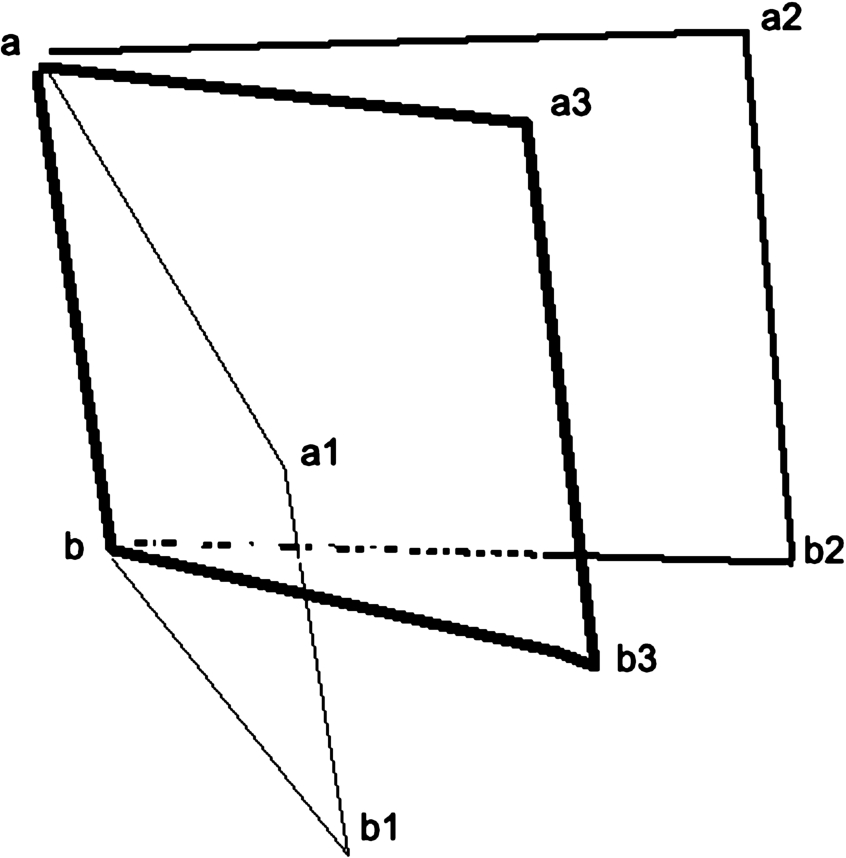
To get a visual description of these multiple proportions, let us assume the items belong to . As such, they can be represented as dots on a plane. Let us consider a triple proportion , which is equivalent to 3 simple proportions, say , , for instance. Then, this multiple proportion can be partially visualized as a set of 3 parallelograms in as in Fig. 3.
The 3 parallelograms share a common edge: . For instance, we have as a parallelogram just because holds. It is the same situation for the 2 remaining parallelograms and . As explained above for triple proportions, 3 other simple proportions, namely , , and can be deduced corresponding to 3 other parallelograms , and which have not been put in the figure (for sake of readability).
3 parallelograms with a common basis .
Let us take an example with the triple proportion:
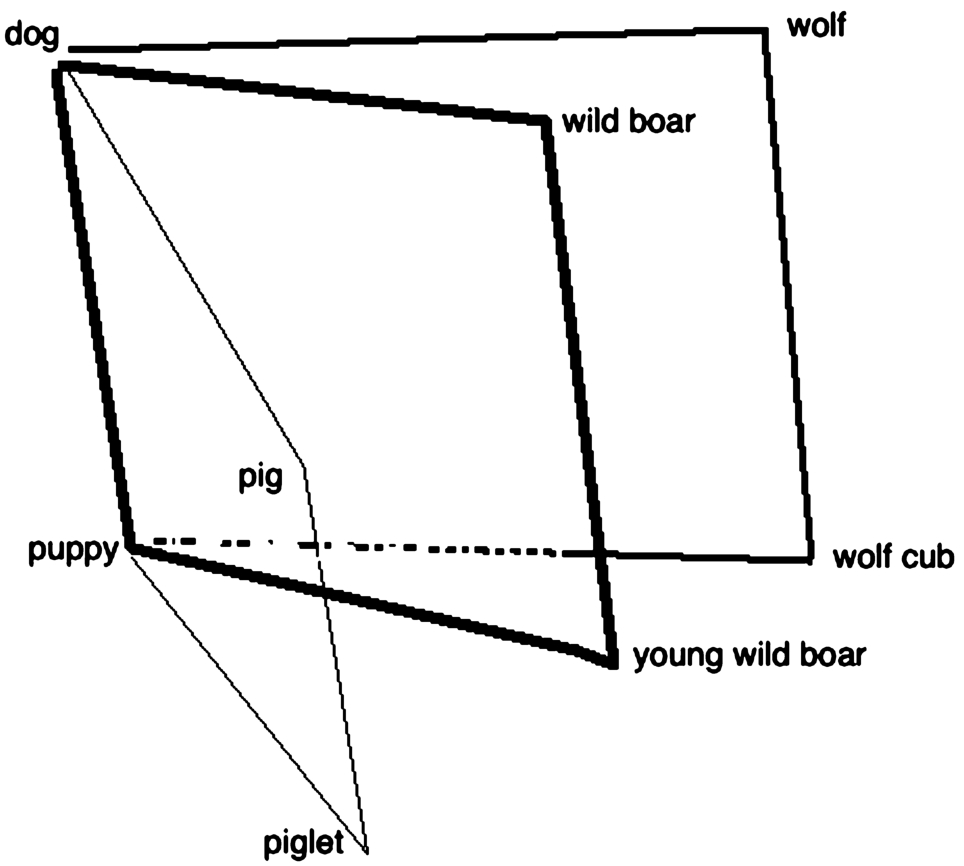
where the names of the respective offsprings of 4 animals whose names are given before ::, appear after ::. By definition, it is equivalent to the 3 proportions:
These proportions appear in Fig. 4. As explained above, 3 other proportions can be derived. Similarly, with the same 8 words, one can state the following triple proportion that displays their wild counterpart (on the right side of ::) of the animals (young or adult) that are on the left side of ::.
By definition it is equivalent to the 3 proportions:
These proportions appear in Fig. 5. Again 3 other proportions can be derived. There are not the same as in the case of the previous triple proportion. Still another triple proportion with the same 8 words can be stated, where we go from canids to porcine animals.
It would lay bare other proportions.
Animals and their offsprings.
Domestic animals and corresponding wild animals.
Getting rid of central permutation
As already mentioned, the central permutation postulate may be debatable in some cases. We may wonder what can be preserved in terms of properties for APs if we abandon it. If we only keep as a unique postulate, we obtain the 4 patterns given in Table 7. It corresponds to the 4 first lines of Table 1. Viewed as the patterns for which a quaternary connective is true, a Boolean expression corresponding to Table 7 is given by
It is the Boolean expression of a weak analogical proportion (denoted with ). It is worth noticing that full identity, symmetry, internal reversal and complete reversal are consequences of postulate . Transitivity also holds in the Boolean model. Indeed the only way to have both and is to have and .
Valid valuations for minimal weak Boolean analogical proportion
0 : 0 :: 0 : 0
1 : 1 :: 1 : 1
0 : 1 :: 0 : 1
1 : 0 :: 1 : 0
n-Multiple analogical proportions are a conjunction of n simple analogical proportions. Similarly, n-multiple weak analogical proportions can be defined as the conjunction of n simple weak analogical proportions. Thus, the double weak analogical proportion would be defined as the conjunction of and . But, in the non-weak case, the proof, that these two proportions entail the third proportion (see the third paragraph of Section 4.1) uses not only transitivity but also central permutation. However, it can be checked using truth tables that the entailment still holds in the weak case.14
Indeed can only be equal to 0000, 0101, 1010, or 1111. is only compatible with or , while is also only compatible with or . Then it can be checked that takes one of the 4 valuations that make true. The cases and are similar, exchanging 0 and 1.
So the definition of the double weak proportion is the conjunction of 2 simple weak proportions, similarly to the non-weak case.
Thus, minimality applied to postulate leads to a very simple model where holds if and only if and . But this model is too simple since it cannot cope with examples such as “gills are to fishes as lungs are to mammals” or “wine is to the French what beer is to the Germans”, since “gills” and “lungs”, or “wine” and “beer”, cannot have exactly the same representation. However, note that if we think of a concept-based representation (as in Example 2 for instance), there should be some common features between the representations of “gills” and “lungs” (or the representations of “wine” and “beer”), which is not at all the case between “wine” and “French” for instance in case we would apply central permutation. However, these common features would lead in such cases to partially identical representations (e.g., “beer” and “wine” are liquids, alcoholic beverages and so on). The study of such partially identical representations and their use are a topic for further research. Using a numerical representation, instead of a Boolean one, would make possible to get rid of central permutation without forcing and , see [1] for a proposal.
Concluding remarks
This paper has surveyed and revisited the notion of analogical proportion, which underlays analogical reasoning, and in particular its Boolean logic modeling. This study has followed an unusual route with a historical flavor by taking inspiration from an old manual where an extensive use of numerical proportions was made. Beyond the overview of existing results, this has led us to introduce the idea of multiple proportions in the Boolean setting, and to reconsider and discuss the postulates usually associated to analogical proportions and the role of the central permutation postulate. We have also shown that the analogical proportion calculus can be embedded in a vectorial calculus. This may help to bridge Boolean representations with numerical representations such as the vectorial embeddings of words, as used, e.g., in [21].
Even if numerical proportions were still denoted (in place of ) in the time of Gaspard Monge, it is noticeable that this mathematician made such an extensive use of this kind of notation in his educational book [26] while he did not hesitate to switch to modern notations (in terms of explicit equalities between ratios) when he wanted to make computations. This may suggest that stating numerical proportions as has an intrinsic didactic value. This is to be connected with the use of analogy-based explanations in machine learning recently advocated in [17].
Generally speaking, multiple analogical proportions are of interest because APs often do not come in isolation, as suggested by several examples in this paper. Still further research is needed how this could also benefit to some usual applications of APs such as classification [5] for instance.
References
1.
S.Afantenos, T.Kunze, S.Lim, H.Prade and G.Richard, Analogies between sentences: Theoretical aspects – preliminary experiments, in: Proc. 16th Eur. Conf. on Symbolic and Quantitative Approaches to Reasoning with Uncertainty (ECSQARU’21), Prague, Sept. 21–24, J.Vejnarová and N.Wilson, eds, LNCS, Vol. 12897, Springer, Prague, 2021, pp. 3–18. doi:10.1007/978-3-030-86772-0_1.
2.
Aristotle, Nicomachean Ethics. Univ. of Chicago Press, 2011. Trans. by R.C. Bartlett and S.D. Collins.
3.
N.Barbot, L.Miclet and H.Prade, Analogy between concepts, Artif. Intell.275 (2019), 487–539. doi:10.1016/j.artint.2019.06.008.
4.
N.Barbot, L.Miclet, H.Prade and G.Richard, A new perspective on analogical proportions, in: Proc. 15th Eur. Conf. on Symbolic and Quantitative Approaches to Reasoning with Uncertainty (ECSQARU’19), Belgrade, Sept. 18–20, G.Kern-Isberner and Z.Ognjanovic, eds, LNCS, Vol. 11726, Springer, 2019, pp. 163–174. doi:10.1007/978-3-030-29765-7_14.
5.
M.Bounhas, H.Prade and G.Richard, Analogy-based classifiers for nominal or numerical data, Int. J. Approx. Reasoning91 (2017), 36–55. doi:10.1016/j.ijar.2017.08.010.
6.
Z.Bouraoui, J.Camacho-Collados and S.Schockaert, Inducing relational knowledge from BERT, in: Proc. 34th AAAI Conf. on Artificial Intelligence (AAAI’20), New York, February 7–12, AAAI Press, 2020, pp. 7456–7463.
7.
F.Cajori, William Oughtred: A Great Seventeenth-Century Teacher of Mathematics, Open Court Publishing Company, Chicago and London, 1916.
8.
L.de Jaucourt, Proportion (log. métaphys.), in: Encyclopédie ou Dictionnaire Raisonné des Sciences, des Arts et des Métiers, D. Diderot and J. le Rond D’Alembert, eds, volume XIII. Published between 1751 and 1772, Paris, 1765.
9.
M.Dorolle, Le Raisonnement Par Analogie, PUF, Paris, 1949.
10.
A.Drozd, A.Gladkova and S.Matsuoka, Word embeddings, analogies, and machine learning: Beyond king – man + woman = queen, in: Proc. COLING’16, 26th Int. Conf. on Comput. Linguistics: Tech. Papers, The COLING 2016 Organizing Committee, 2016, pp. 3519–3530.
11.
D.Dubois, H.Prade and G.Richard, Multiple-valued extensions of analogical proportions, Fuzzy Sets and Systems292 (2016), 193–202. doi:10.1016/j.fss.2015.03.019.
12.
D.Gentnerg, Structure-mapping: A theoretical framework for analogy, Cognitive Science7(2) (1983), 155–170. doi:10.1207/s15516709cog0702_3.
13.
R.L.Goldstone, D.L.Medin and D.Gentner, Relational similarity and the non independence of features in similarity judgements, Cognitive Psychology23 (1991), 222–262. doi:10.1016/0010-0285(91)90010-L.
14.
H.Gust, K.Kühnberger and U.Schmid, Metaphors and heuristic-driven theory projection (HDTP), Theoretical Computer Science354(1) (2006), 98–117. doi:10.1016/j.tcs.2005.11.009.
15.
M.Hesse, On defining analogy, Proceedings of the Aristotelian Society60 (1959), 79–100. doi:10.1093/aristotelian/60.1.79.
16.
N.Hug, Contributions to the use of analogical proportions for machine learning: Theoretical properties and application to recommendation, PhD thesis, Université Paul Sabatier – Toulouse III, 2017.
17.
E.Hüllermeier, Towards analogy-based explanations in machine learning, in: Proc. 17th Int. Conf. on Modeling Decisions for Artificial Intelligence (MDAI’20), Sant Cugat, Spain, Sept. 2–4, V.Torra, Y.Narukawa, J.Nin and N.Agell, eds, LNCS, Vol. 12256, Springer, 2020, pp. 205–217. doi:10.1007/978-3-030-57524-3_17.
18.
S.Klein, Analogy and mysticism and the structure of culture (and Comments & Reply), Current Anthropology24(2) (1983), 151–180. doi:10.1086/202962.
O.Levy, Y.Goldberg and I.Dagan, Improving distributional similarity with lessons learned from word embeddings, Trans. Ass. for Comput. Ling.3 (2015), 211–225.
21.
S.Lim, H.Prade and G.Richard, Classifying and completing word analogies by machine learning, Int. J. Appr. Reas.132 (2021), 1–25. doi:10.1016/j.ijar.2021.02.002.
22.
T.Linzen, Issues in evaluating semantic spaces using word analogies, 2016, CoRR, abs/1606.07736.
23.
L.Miclet, N.Barbot and B.Jeudy, Analogical proportions in a lattice of sets of alignments built on the common subwords in a finite language, in: Computational Approaches to Analogical Reasoning – Current Trends, H.Prade and G.Richard, eds, Springer, 2013.
24.
L.Miclet and H.Prade, Handling analogical proportions in classical logic and fuzzy logics settings, in: Proc. 10th Eur. Conf. on Symbolic and Quantitative Approaches to Reasoning with Uncertainty (ECSQARU’09), Verona, LNCS, Vol. 5590, Springer, 2009, pp. 638–650. doi:10.1007/978-3-642-02906-6_55.
25.
T.Mikolov, I.Sutskever, K.Chen, G.S.Corrado and J.Dean, Distributed representations of words and phrases and their compositionality, in: Advances in Neural Information Processing Systems 26: 27th Annual Conference on Neural Information Processing Systems 2013, Proc. NIPS’13, Lake Tahoe, Dec. 5–8, C.J.C.Burges, L.Bottou, Z.Ghahramani and K.Q.Weinberger, eds, 2013, pp. 3111–3119.
26.
G.Monge, Traité Élémentaire de Statique, à l’usage des Écoles de la Marine (3ème édition), Baudoin, Paris, 1798, 1st French edition: Musier, Paris, 1788, English translation by Woods Baker, A. M.: An Elementary Treatise on Statics, Philadelphia: E.C. & J. Biddle,1851.
27.
J.Pennington, R.Socher and C.M.Glove, Global vectors for word representation, in: Proc. Conf. on Empirical Methods in Natural Language Processing (EMNLP), Association for Computational Linguistics, Vol. 14, 2014, pp. 1532–1543.
28.
V.Pirrelli and F.Yvon, Analogy in the lexicon: A probe into analogy-based machine learning of language, in: Proc. 6th Int. Symp. on Human Communic, Cuba, 1999.
29.
H.Prade and G.Richard, Homogeneous logical proportions: Their uniqueness and their role in similarity-based prediction, in: Proc. 13th Int. Conf. on Principles of Knowledge Representation and Reasoning (KR’12), Roma, June 10–14, G.Brewka, T.Eiter and S.A.McIlraith, eds, AAAI Press, 2012, pp. 402–412.
30.
H.Prade and G.Richard, From analogical proportion to logical proportions, Logica Universalis7(4) (2013), 441–505. doi:10.1007/s11787-013-0089-6.
31.
H.Prade and G.Richard, Analogical proportions and analogical reasoning – an introduction, in: Proc. 25th Int. Conf. on Case-Based Reasoning Research and Development (ICCBR’17), Trondheim, Norway, June 26–28, D.W.Aha and J.Lieber, eds, LNAI, Vol. 10339, Springer, 2017, pp. 16–32. doi:10.1007/978-3-319-61030-6_2.
32.
H.Prade and G.Richard, A discussion of analogical-proportion based inference, in: Proc. ICCBR 2017 Workshops Co-Located with the 25th Int. Conf. on Case-Based Reasoning, Trondheim, June 26–28, A.A.Sánchez-Ruiz and A.Kofod-Petersen, eds, CEUR Workshop Proceedings, Vol. 2028, CEUR-WS.org, 2017, pp. 73–82.
33.
H.Prade and G.Richard, Analogical proportions: From equality to inequality, Int. J. Approx. Reasoning101 (2018), 234–254. doi:10.1016/j.ijar.2018.07.005.
34.
H.Prade and G.Richard, Analogical proportions: Why they are useful in AI, in: Proc. 30th Int. Joint Conf. on Artificial Intelligence (IJCAI-21), Virtual Event / Montreal, Aug. 21–26, Z.-H.Zhou, ed., 2021, pp. 4568–4576.
35.
J.J.Rallier des Ourmes, Proportion, (mathémat.), in: Encyclopédie ou Dictionnaire Raisonné des Sciences, des Arts et des Métiers, D. Diderot and J. le Rond D’Alembert, eds, volume XIII. Published between 1751 and 1772, Paris, 1765.
36.
D.E.Rumelhart and A.A.Abrahamson, A model for analogical reasoning, Cognitive Psychol.5 (1973), 1–28. doi:10.1016/0010-0285(73)90023-6.
37.
D.E.Smith, History of Mathematics, Vol. 1, reprinted byDover, New York, 1958.
38.
N.Stroppa and F.Yvon, Du quatrième de proportion comme principe inductif: Une proposition et son application à l’apprentissage de la morphologie, Traitement Automatique des Langues47(2) (2006), 1–27.
39.
A.Thayse, Boolean Calculus of Differences, LNCS., Vol. 101, Springer, 1981.
40.
P.H.Winston, Learning and reasoning by analogy, Commun. ACM23(12) (1980), 689–703. doi:10.1145/359038.359042.