



Abstract
Prioritized
In this paper, we aim to fill this gap. More specifically, we use Dung’s abstract argumentation framework to address the problem of explaining inconsistency-tolerant query answering in
Introduction
Formal ontologies have been remarkably successful in their wide-array of applications to various domains, including biomedics, cultural heritage, and the semantic web [8,28,29,38]. In particular, Datalog and Description Logics (DLs) (or the more closely related Web Ontology Language (OWL)) have been popular formal ontology languages due to their fine-balance between expressiveness and decidability [2,18,37]. Further, their lighter-weighted fragments such as guarded
Oftentimes in real-world applications, data collected from different resources give rise to conflicting information. In order to provide useful answers to user queries in such situations, research has been carried out on inconsistency-tolerant semantics in which one looks at maximal consistent subsets (also called repairs) [14,16,30,31]. When we have the information about the reliability of different data resources, we can exploit such information by giving higher priority to more reliable resources of data [40]. This can be done by using a preference relation over data resources representing their reliability. Operationalising this idea, various repair semantics with priorities (also called preferred repairs) have been proposed [11,14,31,33,39].
The explanation techniques for query answering in knowledge bases (KBs) under repair semantics, have received much less attention. Some existing approaches address explanations for reasoning tasks such as query entailment under various inconsistency-tolerant semantics in the presence of existential rules [32] or DL-Lite [16].1
It should be noted that these works are in fact quite related i.e., the minimal explanation in Lukasiewicz’s work [32] can be seen as the cause defined in [16].
AF has been a focus of study for a large amount of works in the literature of representation and reasoning with inconsistent KBs (see e.g., [4–7,13,21,22,27,41,42] and [3] for an overview). In some recent works [4,21,22,27,41], authors proposed various argumentation frameworks to provide a useful platform for representing and reasoning with maximally consistent subsets of prioritized KBs in propositional logic. In first order fragments, such as inconsistent ontological KBs, argumentation has also been a focus of several works [13,25,42]. A common feature of these works is that, they first show that their formal machinery outputs a set of extensions which is equivalent to the set of repairs of the KB, and then they study the computational properties of the repair semantics. Explanations aspect concerning the user perspective (i.e., explaining why the query is entailed or not in the inconsistent KB under some repairs), however, mostly stayed limited. As a result of that, the explanation techniques to allow users understanding querying process better is one of the recent challenges in KR research.2
Now, there is a new highly relevant annual workshop (The Third Workshop on Explainable Logic-Based Knowledge Representation) aiming this, and the related questions in general:
The actual term they use is dialectical, however for the alignment purposes of the terminology within our work, later in the paper we use the term dialogical.
To the best of our knowledge, the problem of explaining inconsistency-tolerant query answering in prioritized
The main contributions of our paper are as follows:
We propose a new prioritized argumentation framework to address the problem of explaining query answers in inconsistent
We formalise the relation between preferred repairs of the prioritized KB and extensions of the proposed argumentation framework.
We prove that the proposed AF satisfies rationality postulates from [1,19]. These are consistency, closure of extension, closure under sub-arguments, strong consistency, exhaustiveness and free precedence.
We exploit the equivalence between the preferred repairs of the prioritized KBs and the extensions of the proposed AF to provide dialogical explanations for the query answer under different semantics (see Section 5 for details).
This paper is structured as follows: Section 2 provides an overview of related works. Section 3 reviews abstract argumentation (in Section 3.1),
As mentioned in the introduction, there are only few works given in [5–7,13,15,16,32] to address the problem of explaining query answers in ontological KBs. For
ICR stands for intersection of closed repairs.
Argumentation-based approaches are also commonly used for representation and reasoning with inconsistent KBs. Works such as [13,25] and [42] make use of formal argumentation for inconsistency-tolerant reasoning in ontological KBs. In these works, they focus on the relation between the set of extensions and the set of repairs with respect to KBs. These works’ main focus, however, is on the computational properties of the repair semantics but not on the problem of explaining query answers.
On the propositional logic side, Arieli et al. [4] proposed a prioritized sequent-based argumentation framework in which arguments are characterized by the proof-theoretic notion of a sequent, and attack relations are represented by elimination rules. Authors show that extensions of such argumentation setting correspond to the most preferred maximal consistent subsets of propositional KB. In [22], Marcello et al. developed argumentative characterisations of preferred sub-theories using both the standard approaches and the dialogical approaches more suited for the real-world resource-bounded agents (i.e., human). The idea of this work is to apply preferred sub-theories to compute the most preferred maximal consistent subsets in a given propositional KB, and show a link between preferred sub-theories based and the stable semantics of both approaches. In contrast with the propositional language, our work studies a fragment of first-order logic, namely
Another closely related work is Young et al. [41] which introduces prioritised default logic (PDL) in the form of an argumentation framework
Perhaps the closest related works are [5,6] and [7] by Ariqua et al. who study inconsistency-tolerant semantics based explanation. They study a relation between acceptable semantics (stable, preferred, grounded semantic) of argumentation systems and inconsistency-tolerant semantics (ICR, IAR, CQA) of
Abstract argumentation
We shall briefly recall the notion of abstract argumentation (AF) and related definitions, which are originally introduced by Dung [23].
(Abstract Argumentation).
An abstract argumentation framework is a pair
The argumentation framework is based on acceptability semantics which defines the set of accepted arguments, also called extensions. These extensions include admissible, complete, stable, preferred and grounded semantics which are defined as follows.
(Extensions).
Let
Let us consider an AF
Argumentation framework for Example 1.
In order to evaluate the arguments, two types of acceptance are introduced in terms of their extensions: the sceptical and credulous acceptance. Sceptical acceptance requires that an argument is accepted in all extensions, while credulous acceptance requires that an argument is accepted in at least one extension. This is formalized in the following definitions:
Given an AF A is sceptically accepted w.r.t. a semantic S iff it is in all extensions under S. A is credulously accepted w.r.t. a semantic S iff it is in at least one extension under S. A is rejected iff it is not in any extension under S.
Intuitively, when an argument (or a set of arguments) is sceptically accepted, it is the most trusted justification, even in the most sceptical scenarios. The credulously acceptance is a weaker form of acceptance since it is possibly not accepted in all extensions.
In this subsection, we recall some of the basics of
We assume a set C of constants, a set P of predicates, a set V of variables and a set T of terms. A term t over C is either a constant or a variable, or null. An atomic formula (or atom) has the form
In the existential rules framework, a fact is the existential closure of a conjunction of atoms [10]. For example,
For simplicity, we shall sometimes abuse the notation and write a single letter x for a vector of variables whenever it is clear from the context e.g.,
A knowledge base (KB)
A rule
Next, we define query answering with respect to
Prioritized
knowledge base
In this section, we shall introduce the first major component of our framework; namely, the notion of prioritized
In many applications, there are often multiple sources of information, each providing partially overlapping and partially different part of the knowledge, and each having potentially a different level of reliability. In order to distinguish this varying degree of reliability, one can employ a preference relation with the basic intuition that the higher the reliability of the information source, the more prioritised (or more preferable) it is in the ranking. Following this intuition, we introduce the notion of prioritized
(Prioritized
knowledge bases).
The KB is partitioned into h pairwise-disjoint sets such that the facts in
Note that the facts of
Let
The first axiom states that modern dances do not use props. The second one states that traditional dances use props.
Since data is assumed to be the source of inconsistency, violation of constraints might be the case when applying the rules to the set of facts. In what follows, we recall the formal definition of inconsistency in
Given a knowledge base
Next, we give the formal definition for the notion of repair.
(Repair).
Let
In prioritized
(Ranking function).
Let
Now we define two preference relations for preferred repairs.
(Preference relation).
Given a prioritized
The relation
We introduce definitions of a preferred repair and a set of
Let A preferred repair of A set of
We next introduce notions of consistent entailment under preferred repair semantics. ( Q is entailed by Q is entailed by Let us consider the KB In the KB, rules For the relation Consider a query Consider a query For the relation
In this section, we focus on the use of Dung’s argumentation framework to address the problem of explaining query answers under preferred repair semantics in prioritized
Prioritized argumentation framework
In this section, we introduce a prioritized argumentation framework (PAF) as an instantiation5
This means that we inherit attack and defeat relations over arguments as it was defined in Dung’s framework.
In [6], an argument consists of a set of facts called a support, and a conclusion entailed from the support. Following this idea, we will define the concept of argument in the context of PAF.
Let
The support Ψ of a PAF argument A is denoted by
For simplification purposes, in the rest of the article, we shall simply call a “PAF argument” as “argument”. Next, we introduce some notation for the concepts we will use throughout the paper.
Given a prioritized
The set of all arguments generated from
The set of arguments that is constructed from
Given a set of arguments
Given a set of arguments
An argument B is a subargument of argument A iff
We next show how we construct arguments from the prioritized
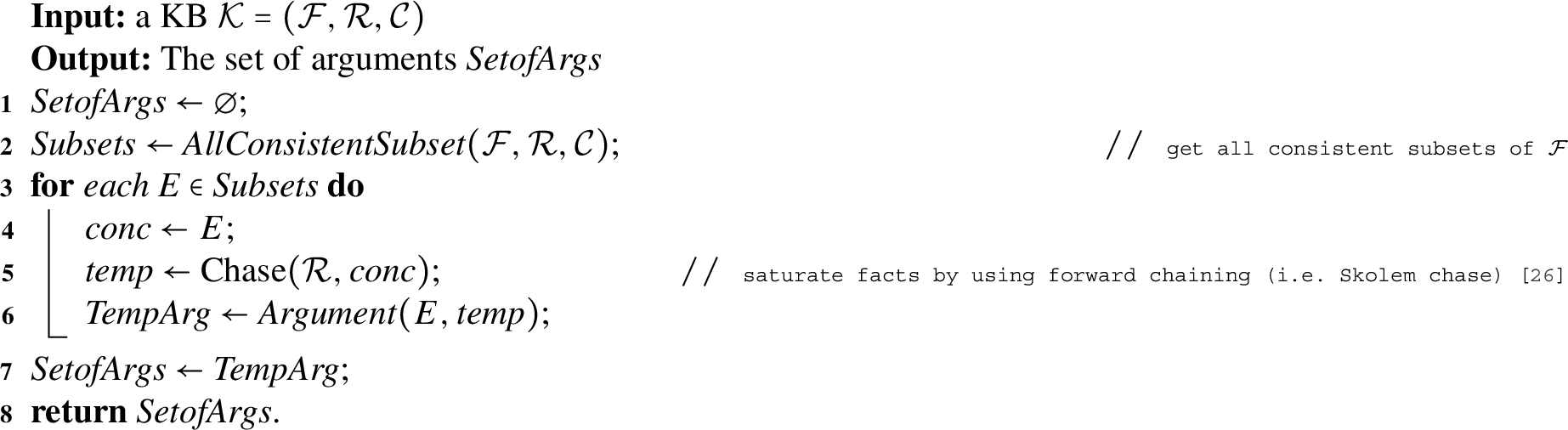
GenerateArguments
Consider again the KB
We next define an undercut attack to express conflicting information.
Let
Informally, A undercut attacks B if there is an element of the support of B which is
Now we introduce the notion of defeat attack, which is a variant of the undercut relation for the prioritized KB. Since the facts of
Realize that the relation
We apply two instances of In case of In case of
From now on, we shall use ≻ instead of
(Defeat attack).
Let
Intuitively, the defeat attack succeeds if and only if the priority argument of higher level attacks the one of the lower level. We illustrate it over an example.
(Example 5 continued).
Consider two arguments:
We have
Next, we introduce the notion of prioritized argumentation framework.
(Prioritized argumentation).
Let
In the PAF setting, we can apply Dung’s acceptability semantics for evaluating the arguments. We shall denote a set of extensions of
Reconsider the prioritized KB
As a result, we have the set of stable extensions
Next, we present our Algorithm 2 (GenerateArgumentGraph) that produces an argument graph
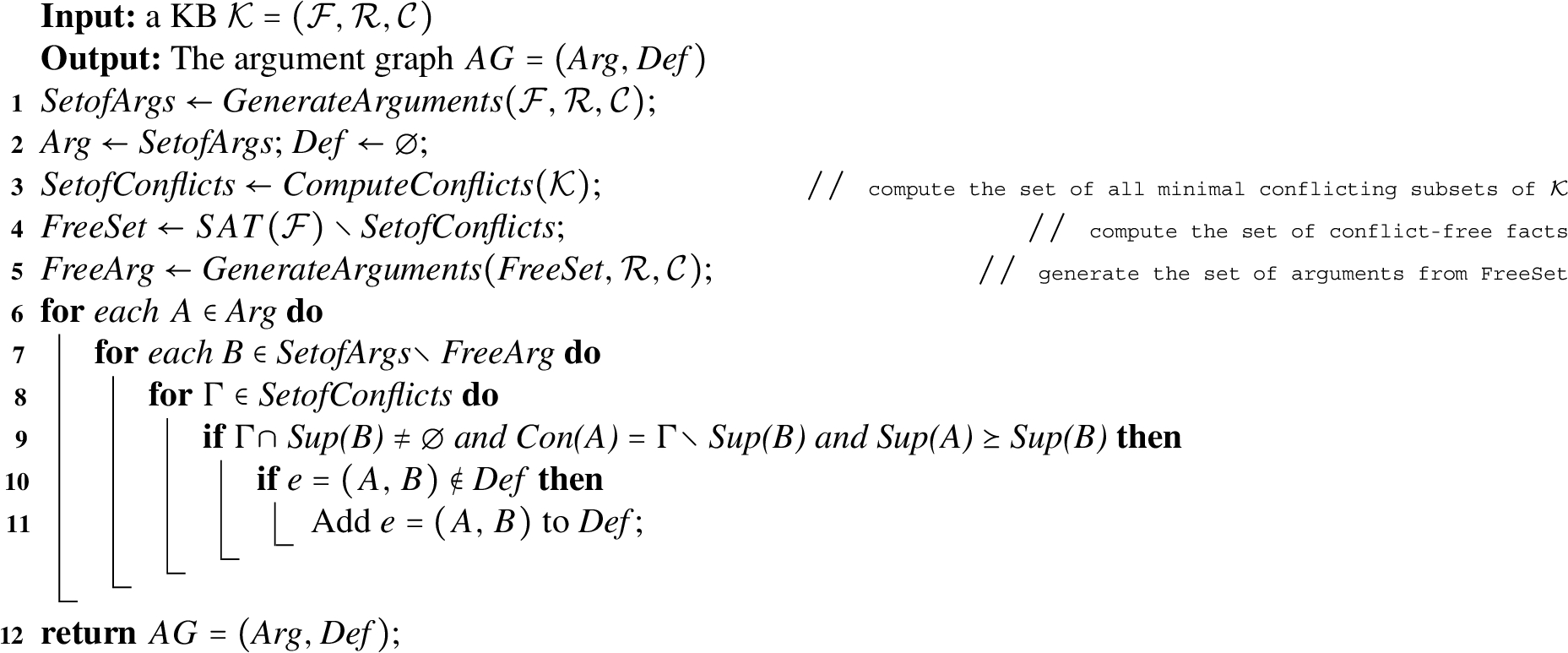
GenerateArgumentGraph
The following theorem shows the soundness of Algorithm 2; that is, the algorithm computes all the defeat attacks correctly and for each defeat attack there is an edge in the generated graph AG representing that attack. The proof is rather straight forward.
Let
An argument A defeats an argument B iff
For all defeat attacks,
First, we show that for each iteration of the for loop at line 7, computing defeat attacks is based on computing minimal inconsistent sets in
Given a prioritized KB
In the previous section, we have shown a translation from prioritized KBs to PAF. In this section, we first define the acceptability semantics in PAF, and then show (in Theorem 2) that preferred repairs of prioritized KBs correspond to the extensions of PAFs which is also one of the main results of this article.
Inspired from the study [6], we define the prioritized versions of the acceptances for a query Q in prioritized
(Acceptability).
Let Q is sceptically accepted under semantics S (written Q is credulously accepted under semantics S (written
Finally, we can present the main result of this section.
Given a prioritized
The theorem follows from the three lemmas below. Lemmas 4 and 5 show that the equivalence between the set of repairs and the set of preferred (resp. stable) extension, and in turn implies the equivalence results for query answering in KB.
First, we show that a repair of a KB has a higher priority than any consistent subsets of facts of the KB.
Given a prioritized
By assumption
We present the next result which shows that every repair for the KB with a total preorder between them, is a stable extension of the constructed argumentation framework (with respect to the same order).
Let
Suppose that
We first prove that
Next we prove that
Lemma 5 below shows that every preferred extension of the constructed argumentation framework is a repair for the prioritized KB.
Let
Suppose that
Next, we will show that
Next, we show that
Next, Lemma 6 show that an PAF possess a “coherent” property, i.e., the PAF is said to be coherent if its preferred and stable extensions coincide [36].
Let
The proof follows directly from Lemma 4 and Lemma 5. The lemmas are needed to prove Lemma 6. □
Now, we are finally ready to prove Theorem 2.
By Lemmas 4 and 5, there exists a link between the set of repair on
This concludes Theorem 2 □
The following example illustrates the idea of this theorem. Reconsider the prioritized KB Consider the query Similarly, consider the query This example illustrates that the semantics of acceptance of an argument according to our PAF and the semantics of query entailment coincide, as it was shown in Theorem 2.
In this section, we demonstrate that the proposed argumentation framework has some desirable properties, namely a set of rationality postulates from [1,19] which is one of the main results we present in the paper. These are consistency, closure of extension, closure under sub-arguments, strong consistency, exhaustiveness and free precedence given in the definition below.
(Rationality Postulates).
Let
Now, we show one of the main contribution of this paper.
The PAF
Obviously, Closure of extensions: We prove that for every Weak closure under sub-argument: Let Consistency: We prove that for Exhaustiveness: Suppose the contrary that there exists an argument Free precedence: We first observe that
In the previous section, we have clarified the use of the sceptical (resp. credulous) semantics of our prioritized argumentation framework to determine answers of a query under
In PAF, we can interpret the above questions as: Is Q supported by an argument that can be deemed (dialogically) acceptable under sceptical semantics or credulous semantics? In general, explanations based on the argumentation can be viewed as a debate between two fictitious agents (i.e., the proponent and the opponent) arguing why arguments in an extension should be (or should not be) accepted. The general idea is as follows:
We first present the notion of supporting argument of a query, which was proposed in [6] (presented in Section 5.2).
We then construct dialogical explanations for that query, which are based on the notions of argumentation trees and argumentation structure introduced in [12] (presented in Section 5.2).
Finally, we show the usability of argumentation structure with respect to explanations of
Before representing the formal theory, we introduce the general idea with a motivating example.
Motivating example
In what follows we present a motivating example, which illustrates the motivation of using the argumentation framework to explain the
Given a prioritized KB
Above is the dialogical process that shows
At the beginning, the user asks why
In particular,

where C:
The above example shows the need for explanation facilities to help the user to understand why a query holds and fails. We next discuss the generation process of dialogical explanations through argumentation trees for inconsistency of a prioritized KG.
In order to construct dialogical explanations, we introduce the notion of an argumentation tree proposed in [12], which is a formal representation of the dialogue within the PAF. Before continuing, let us first review the notion called causes (for a query) introduced in [16].
(Bienvenu et.al [16]).
A cause for a Boolean query Q in a KB
It turns out that the notion of causes coincides with the definition of arguments. Inspired by earlier argumentation frameworks [6], we recall the notion of supporting argument of a query. Informally, an argument supports a query if and only if the query is entailed by the conclusion of the argument. The notion is necessary to select the arguments for or against the query.
(Arioua et.al. [6]).
Let
Corollary 1 clarifies the relation between causes and supporting arguments of the query, which follows directly from Definition 18.
Let
Observe that the relation between the repair semantics and the causes has been shown in [16]. The causes also correspond to the supporting arguments of the query (by Corollary 1). It is easily seen that these relations are crucial to establish the results mentioned in Proposition 1 related to the definitions in this section. The following proposition clarifies the relation between the preferred repairs and the supporting arguments of the query.
Let
1.
2.
In our work, we use argumentation as a formal framework to explain query answers under
An argumentation tree The root node For every node Each child node defeats its parent node.
Note that the second condition of the definition guarantees that each counter-argument contains an additional information compared to its ancestry, thereby preventing cycles. Note also that for a given query Q, there can be multiple but finitely many argumentation tree since there are potentially many but finite supporting argument to be chosen as the root node. Moreover, the length of each such tree is finite which follows from the cycle-freeness guaranteed by the second condition of Definition 19. We state this important fact as a proposition below.
(Finiteness).
Given a prioritized KB
Following the previous result, it is of interest to know the complexity of deciding whether a supporting argument is defeated or not. The following results answer this.
Given an argumentation tree
Instead of giving the full-fledged proof, we give the crucial observation that proof follows from. Observe that if there is a path from a
Argumentation trees are very useful in the sense that it contains all the relevant information about the position of the arguments. As a result of that, once they are provided the computational complexity of deciding whether the root node is an accepted argument is very favorable as we mention it in the following corollary (which follows from the proposition above).
Deciding whether
In order to ground these intuitions, we give an example.
An argumentation tree for 
In what follows, given an argumentation tree for
Now, with the notion of labelling, we can determine whether the argumentation tree is successful or not.
Let
The dialogical process can be seen as a two-person (argumentation) game between a proponent and an opponent. The proponent and the opponent are engaged in an argumentation dialogue of a sequence of moves. The dialogue starts by the proponent with a supporting argument for Q. Then, the opponent presents an argument (or a set of arguments) that defeats the supporting argument of the proponent. Next, the proponent tries to avoid this attack and reinstate the query by using another argument which is not attacked by the opponent. The opponent tries to extend the previous set of attackers so that it defeats all the supporting arguments advanced so far. When the opponent fails to extend the set, it retraces back and chooses another set of attackers and continues the dialogue from thereafter. By doing so, the opponent is trying to construct a set of arguments that defeats all the supporting of the query Q.
The following example shows how the dialogical process for Example 9 is constructed from the argumentation tree.
For
The dialogical process is built as follows: At the beginning, an explanation request is made by the proponent (the human user) asking “Why the query 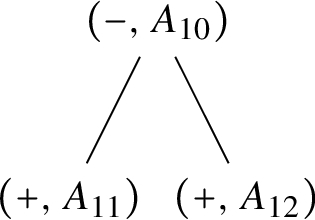
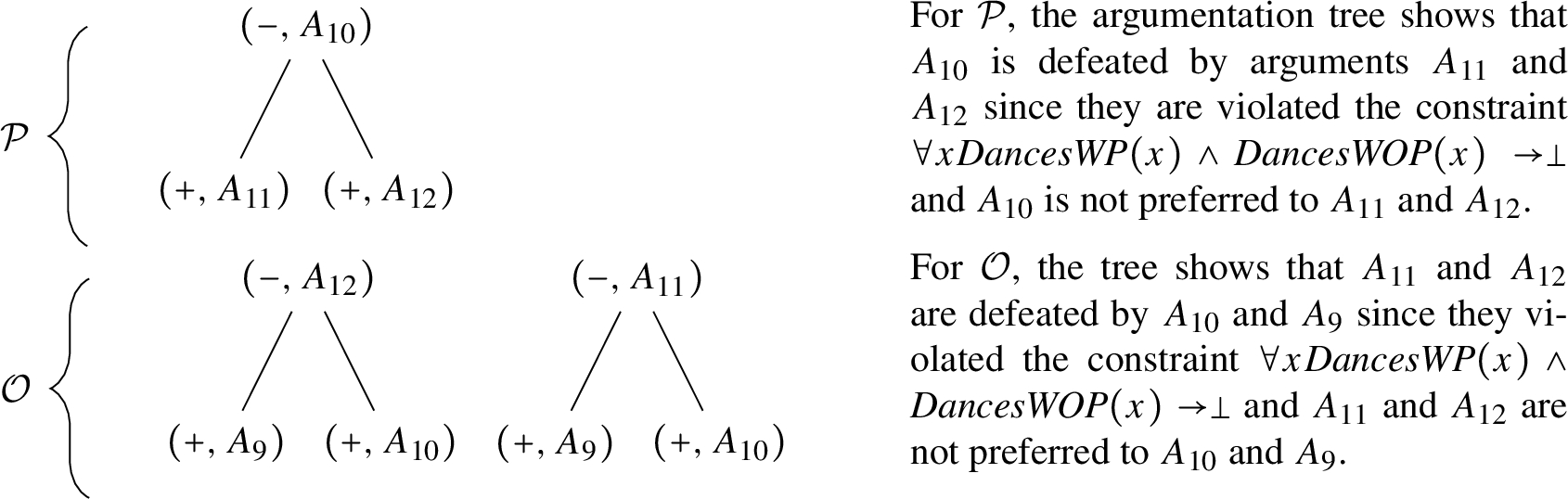
As aforementioned, given a prioritized KB An argumentation structure for a query Q is a pair of sets Consider the query We obtained some of the argument trees of the argument structure for (Argumentation structure).
(Continued Example 11).
Argument-based explanations for query answers
In this section, we explain
Next, we clarify the relation between argument-based explanations and the
(Argument-based explanation).
Let if if if it is an explanation for
Realize that given a Q and
Regarding explanations for an
Next, explanations for
(Continued Example 9).
Consider
We explain
We consider an explanation for
Augmentation structures for 
Regarding explanations for
Consider 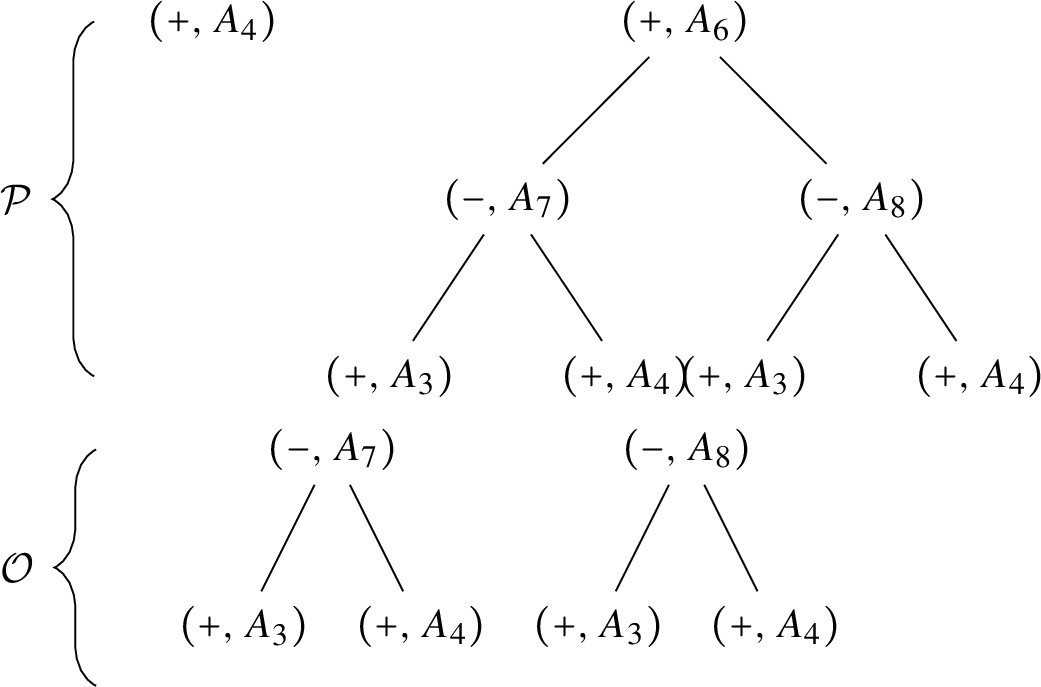
Next, we present Algorithm 3 to generate an argumentation tree for a specific argument. The function GenerateTree in Algorithm 3 takes an argument A and an argumentation graph

GenerateTree
We now propose the main algorithm ExplainQuery (Algorithm 4) that determines the explanations and the semantics (

ExplainQuery
The correctness of Algorithm 4 is given by Theorem 8.
Let
Given a prioritized KB
In this paper, we have investigated the use of argumentation to handle inconsistency in
A natural future avenue of research is to analyze the computational complexity of computing the argument-based explanations both empirically and theoretically, pinpointing easy and hard cases. Moreover, we plan to extend our work to the case of dynamic knowledge bases, i.e., prioritized information can be updated and the new information may contradict to existing knowledge. One advantage of dynamic knowledge bases over static ones is that, they can represent the relevant knowledge that is tailored towards the dependent context and the temporality which can be carried out by knowledge updates that are common in real-world applications.
Footnotes
Acknowledgements
This work was supported by grants from Khon Kaen University via ASEAN and GMS Countries’s Personnel Programs 2016–2019 and an Interdisciplinary Grant (CSKKU2559) from the Department of Computer Science, Khon Kaen University. Erman Acar is generously funded by the Hybrid Intelligence Project which is financed by the Dutch Ministry of Education, Culture and Science with project number 024.004.022