



Abstract
Critical applications ranging from sensitive military data to restricted area access demand selective user authentication. The prevalent methods of tokens, passwords, and other commonly used techniques proved deficient as they can be easily stolen, lost, or broken to gain illegitimate access, leading to data spillage. Since data safety against tricksters is a significant issue nowadays, biometrics is one of the unique human characteristic-based techniques that may give better solutions in this regard. The technique entails biometric authentication of users based on an individual’s inimitable physiological or behavioral characteristics to provide access to a specific application or data. This paper provides a detailed description of authentication and its approaches, focusing on biometric-based authentication methods, the primary challenges they encounter, and how they have been addressed. The tabular view shows the benefits and downsides of various multimodal biometric systems, and open research challenges. To put it another way, this article lays out a roadmap for the emergence of multimodal biometric-based authentication, covering both the challenges and the solutions that have been proposed. Further, the urge to develop various multi-trait-based methods for secure authentication and data privacy is focused. Lastly, some multimodal biometric systems comprising fingerprint and iris modalities have been compared based on False Accept Rate (FAR), False Reject Rate (FRR), and accuracy to find the best secure model with easy accessibility.
Introduction
Due to the overwhelming number of scammers in nearly every sector, extremely secure authentication techniques are crucial for access to confidential data. Strict authentication services with data privacy need to be implemented at this moment in order to accomplish an outstanding level of security. Literature involves various user authentication techniques: traditional password-based authentication, frictionless authentication, unimodal, and multimodal authentication. Out of these, traditional authentication methods are less secure and vulnerable. Various researchers have pointed out that multimodal techniques provide better authentication services than unimodal systems [1–5]. However, most of the multimodal systems designed so far have lower user acceptance rates due to biometric data privacy issues. Therefore, they are only accepted by some organizations as a suitable user authentication method. Numerous researchers have addressed this data privacy issue, but the complete framework for strict authentication and data protection is still an open research problem. This paper provides the strengths and weaknesses of these systems and emphasizes the fact that there is a great need for a complete solution for data security in highly confidential applications. Additionally, a thorough examination of some biometric systems based on fingerprint and iris modalities has been conducted.
A tabular comparison of our review work with most recent review works
A tabular comparison of our review work with most recent review works
The primary goal of this work is to provide an insight into biometric-based authentication for new researchers in this field, although this description is available in other articles [13–16] too but it is not all-encompassing. The majority of survey publications on biometric authentication focused solely on the various modalities utilized [17–22] or on specific application areas, but a comprehensive survey is still missing. Shaheed et al. [6] offered a systematic review of several physiological biometric features organized into three categories: hand, face, and ocular regions. They also assessed several strategies for these trait categories, but it is still needed to pinpoint the crucial advantages and disadvantages explored in this article. The researchers additionally offered a list of datasets that were readily available, however, it lacked certain vital information that will be uncovered in this article. Furthermore, their research was limited to the above-mentioned feature categories exclusively, leaving a slew of other crucial traits unexplored. Therefore, the main objective of this paper is to provide newcomers with an in-depth overview of biometric authentication in a single place. Table 1 compares this work to prior works and shows how this paper differs from those earlier efforts. To summarize, the significant contributions of this article include:
Reviewing state-of-the-art authentication methods and outlining concerns connected with different authentication techniques identified by the researchers,
Discussing research-based solutions to such problems and outlining the requirement for multimodal biometric systems,
Summarizing publicly accessible datasets for both unimodal and multimodal biometric systems, together with the vital information that has not been mentioned in most survey publications,
Examining existing multimodal biometric systems in terms of their advantages and disadvantages and emphasizing the importance of the biometric database’s stored template security,
Discussing challenges and solutions in the field of authentication followed by future research directions along with the preceding topics,
Comparing five multimodal biometric systems that include fingerprint and iris features in terms of availability and security.
The rest of the article is organized as follows: Section 2 provides a brief description of authentication and its various methods, thereby describing the need for biometric-based authentication systems. A detailed overview of biometric usage for authentication and authorization purposes is given in Section 3. Section 4 addresses the major challenges in biometric systems along with the major focus on data security in such systems, and the quick summary of the complete flow of research in the field of authentication is given in Section 5. Section 6 compares some multimodal systems utilizing the fingerprint and iris of individuals. Finally, Section 7 concludes the paper.
Authentication can be defined as the process in which a user claims a particular identity, and the system checks for its genuineness. The various factors used for authentication can be broadly classified into specific information-based authentication and heterogeneous information-based authentication factors.
Specific information-based authentication
They are also called one-factor authentication, which comprises knowledge-based, possession-based, and biometric-based authentication methods. Knowledge-based authentication, one of the traditional user authentication methods, requires the user to reveal his password-based knowledge. These passwords are unique to a user but are still vulnerable to security breaches [23]. Since knowledge-based methods are less secure and problematic, possession-based authentication methods were introduced. This method is based on “what the user has” but suffers from difficulties like missing cards, stolen cards, etc. It is further broken down into two categories: single-device possession and multi-device possession. Security levels would be high in the case of multi-device possession schemes as compared to single-device possession schemes. The biometric-based authentication method works on “who the user is” i.e., his essential physiological characteristics work as the password to unlock access to the system. It is a widely accepted authentication method nowadays and is gaining increasingly more importance daily.
Heterogeneous information-based authentication
Due to the high risk of security-critical applications, a combination of two distinct authentication methods based on specific information-based techniques was devised, resulting in heterogeneous information-based authentication methods or two-factor authentication methods [24,25], which include knowledge-possession-based and biometric-possession-based techniques. The primary disadvantage of the knowledge-possession-based strategy is that it lacks user-friendliness and acceptability because it requires an additional step for the user to enter. Since data security is in high demand today, authentication systems that enable users to authenticate securely without leaking their personal information are needed. The biometric-possession-based system uses a person’s biometric characteristics and the card issued to him to provide a high-security grade. For example, Das et al. [26] utilized smart cards and user’s biometric information for remote authentication, providing security against various attacks and making it usable in real-world applications.
Despite the increased level of data security offered by heterogeneous information-based systems, they are still not considered widely accepted means of authentication because, during authentication, the user is not only concerned with the application access, but his requirements also include easily accessible applications without many obstacles. So, the system for authentication needs to be improved to meet this user expectation. Also, the user desires that the system should not violate user privacy terms at any cost and must possess easily understandable properties so that any naive user can use it without difficulties. Furthermore, during the COVID-19 pandemic situations with raised health concerns, users hesitate to touch any sensors for data acquisition. Therefore, the authentication process involved with an application must have some features to enable automatic data acquisition with little human intervention. Deployment of a frictionless authentication system can be one of the promising solutions for this requirement.
Frictionless multitudinal information-based authentication
For ease of application access in heterogeneous information-based authentication systems, frictionless multi-information-based authentication systems have gained importance in the past few decades. Mustafa et al. suggested a Frictionless Authentication System (FAS), but unfortunately, the system suffers from high computational and communication costs due to the employment of fuzzy extractors [27]. Zhang et al. utilized the location information in [28] for authentication and authorization purposes. Singh et al. also used location information to control access in healthcare management systems [29]. Hernandez et al. [30] proffered an effective privacy-preserving continuous authentication technique that exploited behavioral information from two sensors on the user’s mobile device. The major downside of this approach is that it relies on other authentication processes in the case of a cloud outage.
To assure security, individuals are increasingly turning to multi-information-based approaches, such as biometrics, rather than single-information-based techniques because multi-information-based techniques allow for using two or more authentication criteria for successful authentication. To some extent, these measures would increase security. Luo et al. [31] introduced a new access control system for anonymous person identification approaching critical areas. Bera et al. [32] provided resilient user authentication leveraging passwords, mobile devices, and biometrics in a smart city environment with user anonymity and untraceability properties. Authors in [33,34] explored self-service-based techniques for automatic check-in and other formalities at the airport. Solano et al. [35] employed device identification and behavioral identification for authentication purposes.
From the preceding discussion, it is evident that frictionless procedures are required, but with biometrics added to ensure outstanding security. Thus, combining frictionless approaches with biometrics would be a far more effective bundle.
Biometric-based authentication
Human beings themselves are one of the everlasting as well as invulnerable means of authentication for any data, or system access. Their distinguishable characteristics such as ear, nose, face, hand, iris, fingerprint, etc., make them unique from other individuals since no two individuals bear the same features. Mathematically, suppose the biometric image is represented by the function
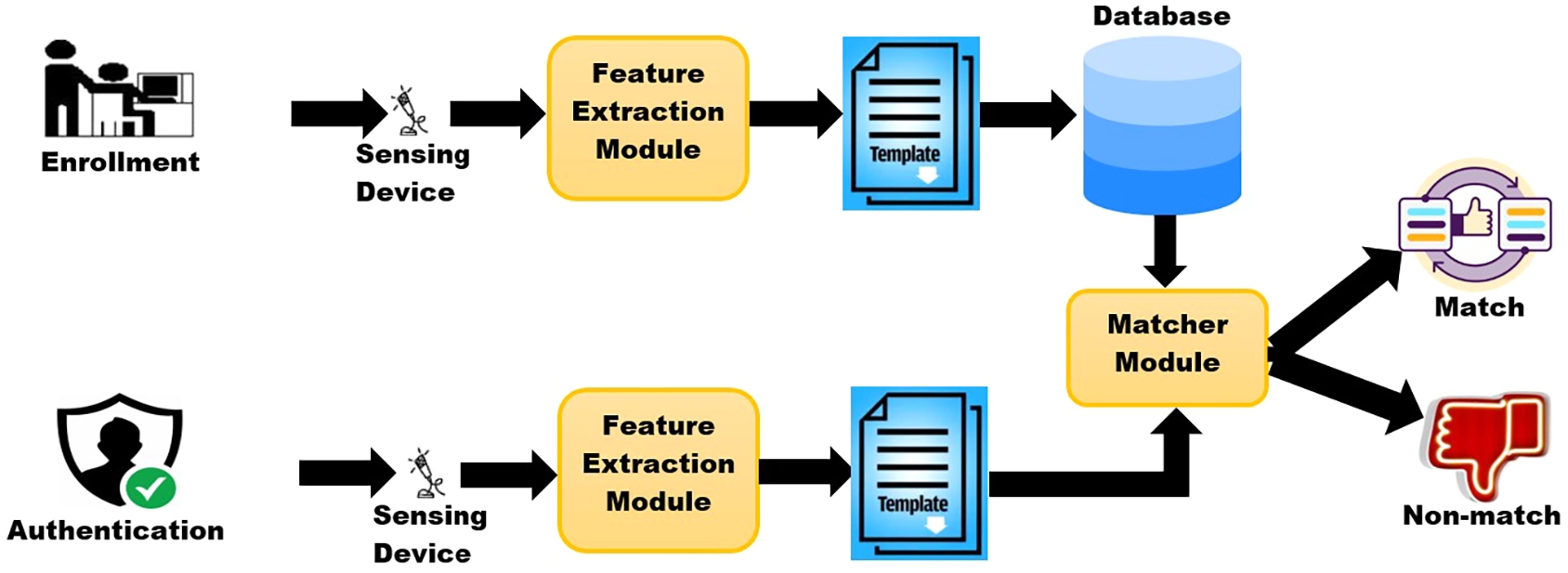
Working: enrollment and authentication phase.
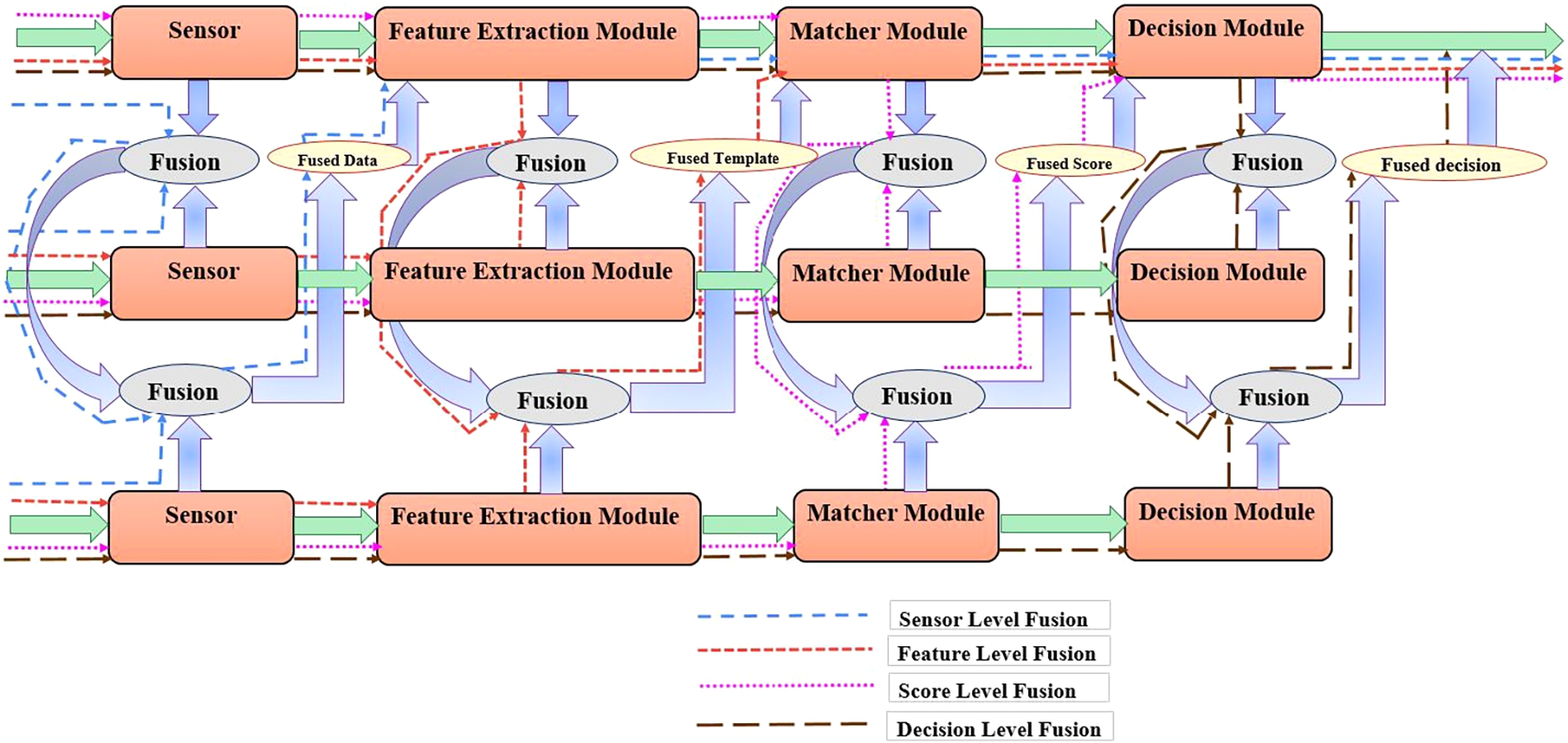
Generic multimodal authentication process based on fusion at various levels.
There are basically two types of biometric systems, which are as follows:
Abo-Zahhad et al. [42] proposed a human identification scheme based on Canonical Correlation Analysis (CCA) by utilizing heart sound as an identifier. They should have considered several factors used in practical applications, such as using an extensive signal database containing individual data with varying ages, emotions, and heart diseases, because their main focus was maximizing the correlation between feature sets alone. Similarly, Xin and Xiaojun employed correlation to fuse biometric data at the feature level [43]. However, the canonical correlation analysis method must highlight the complicated and nonlinear correlation relationship, which is its fundamental shortcoming. In [38], the features of fingerprint, ear, and palm are extracted using the High-Frequency Maximum Significant Bit (HMSB) operator as well as the Gabor filter, and these features are further selected using Oppositional Gray Wolf Optimization (OGWO) algorithm. However, using raw data during enrollment makes the system-stored data less secure and vulnerable to attack. Difference between unimodal and multimodal systems
There are basically two modes of biometric identification which are as under:
Positive. In this, user identity is checked against the stored identity for application access. This is used for authentication purposes or access control applications. Here, the user gives a biometric input, which is then processed to give the desired results. It involves one-to-one comparisons in the database and is also termed the mode of authentication or verification.
Negative. In this, user identity is compared with the list of stored identities to find a suitable match. This is used by Crime Investigation Departments (CID) for criminal identification purposes. This mode does not require user biometric input; instead, this input is acquired from the crime scene for one-to-many comparisons. This mode is also termed as a mode of identification. Many researchers have created several biometric identification systems that use various modalities.
Biometric identifiers
They can be defined as the human physiological and behavioral traits used for unique identification and verification. They can be classified based on their capability to avoid intrusion: Intrusive and Non-intrusive. Every identifier has pros and cons and applies in various fields, as mentioned in Table 3. The selection of identifiers to be used in various systems is purely based on the system’s requirements to be designed.
A summary of biometric identifiers with their advantages, disadvantages and applications
A summary of biometric identifiers with their advantages, disadvantages and applications
(Continued)
A large variety of datasets for unimodal and multimodal biometric research are available in the biometric market. Table 4 and 5 present an overview of some of these datasets along with some notable points of interest. For multimodal-based research, the researchers preferred to use virtual datasets instead of making realistic ones based on the assumption that each characteristic of the individual bears distinct properties [46,47]. As depicted in Fig. 3, chimeric datasets are formed by combining multiple datasets with different modalities. The number of inter-class variations and intra-class variations in the dataset as well as the application’s requirements is used to choose between these different datasets to create one virtual dataset.
List of unimodal datasets with detailed information
List of unimodal datasets with detailed information
Multimodal datasets with detailed information
If ‘C’ denotes the total number of classes in the given dataset and the total number of images captured per class in the dataset are represented by ‘
Whether it be for banking services, home security services, mobile services, or any other service, biometrics is becoming increasingly significant in our daily lives. However, even biometric solutions encounter numerous challenges since the system has several vulnerable points that can be exploited, as illustrated in Fig. 4. The main challenge in biometric authentication is to enhance the security of the biometric image over insecure public channels and the security of biometric templates stored in the database [66]. Since biometrics are increasingly becoming part of numerous identification and verification applications, various intruder attacks are also prevalent. Thus, specific security mechanisms must be devised to preserve biometric data’s security and integrity. Researchers have found that traditional cryptographic techniques [67] cannot provide better security to digital images than digital messages since cryptographic algorithms are not suitable for direct application to images. This is primarily due to the massive computational overhead associated with image encryption and the fact that images take quite a long time to encrypt due to their enormous size. So, they moved towards fragile watermarking [68,69], hoping that it would provide strict authentication services. But still, the problem persisted, so finally, biometric encryption was used for encrypting the template stored in the database to preserve the biometric image credentials from illegal users. For this, many biometric cryptosystems and feature transform-based algorithms [70] have been presented in the literature. Adler in [71] describes the biometric encryption system’s vulnerability to hill-climbing attacks leading to leakage of secret code and estimation of an enrolled image of the person. Jincey John et al. [72] have proposed a new biometric encryption scheme for biometric data security involving chaotic maps, but the algorithm uses ample-sized key space to provide enhanced security.
Usage of visual cryptographic technique [73] also became prevalent for securing biometric templates, but it involves pixel expansion, leading to increased image size and hence loss in original values of pixels, making the image degradable. The fuzzy vault scheme is also used in many research works [74–79] for providing security to biometric templates. Radha et al. demonstrated the use of a cancellable biometric technique with the added advantage of revocability, i.e., if the templates are compromised, they can be canceled and further reissued [80]. However, this technique also has a limitation, as reported by [81]; recognition accuracy of the system is reduced due to the high variance obtained by the distorted data when a transformation is applied to the user’s biometric data. In [82,83], a face de-identification technique has been introduced, and Bitouk et al. [84] proposed a face-swapping technique for the security of biometric templates of facial images, but both these techniques resulted in the loss of original image. Two schemes – visual cryptography technique without pixel expansion and visual secret sharing scheme for multiple secrets without image size expansion – were used by [85] to encrypt the biometric template and maintain system security to get around the drawbacks of pixel expansion and image size expansion. Nevertheless, these schemes suffer from the drawback of increased storage requirements due to the high-quality target image obtained.
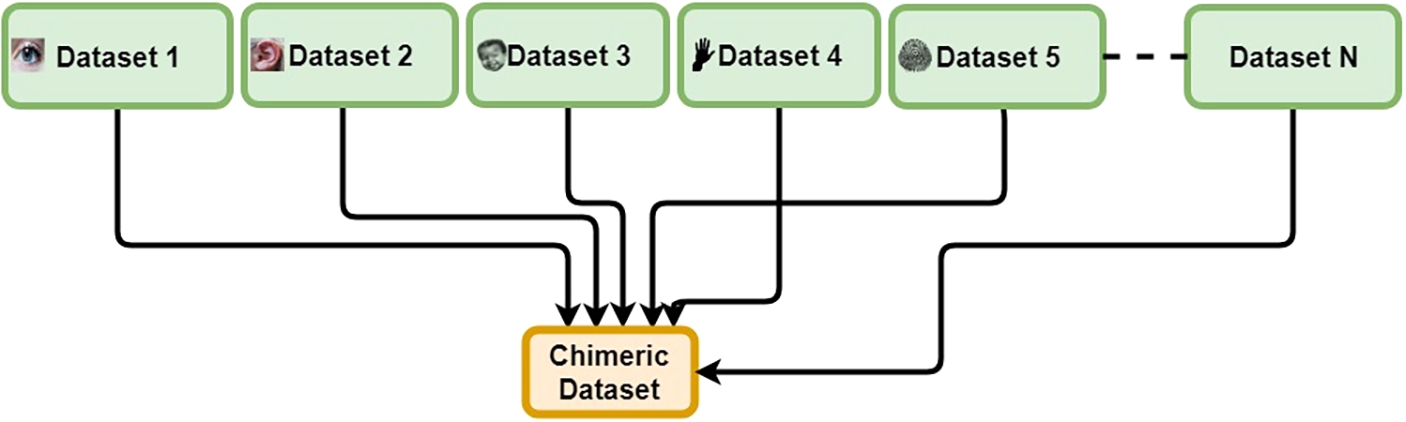
Virtual or chimeric dataset.
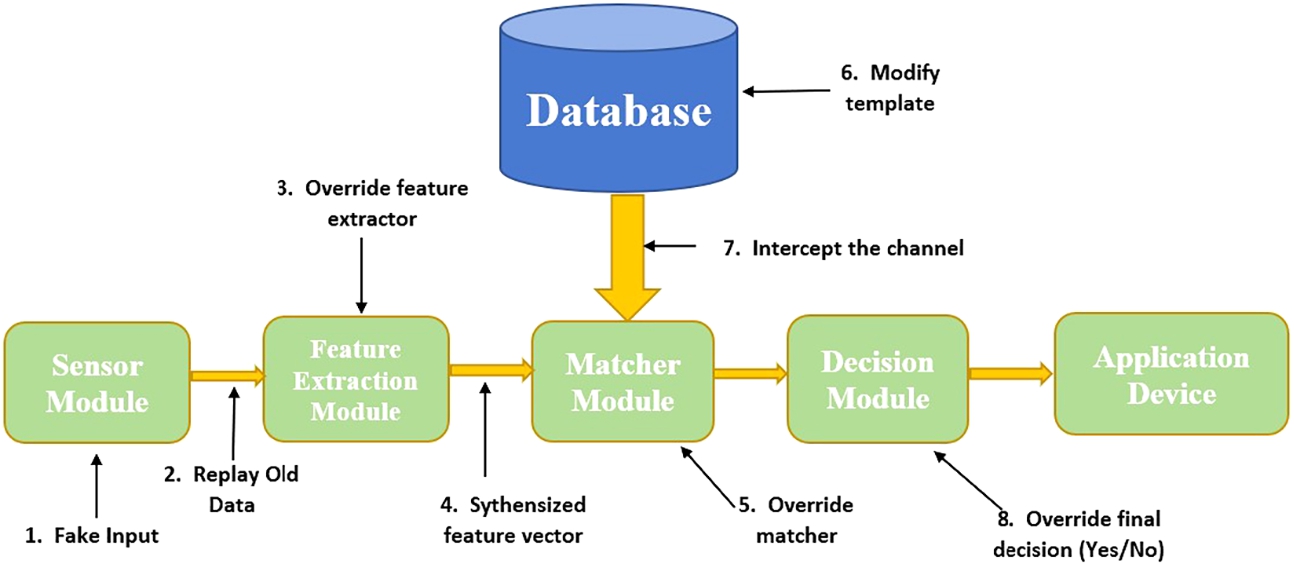
Attack points in biometric system.
Das et al. [86] proposed a new two-factor authentication scheme based on two threat models and further proved that the proposed algorithm is secure against various kinds of attacks such as Denial of Service (DoS) attacks, privileged user attacks, impersonation attacks, the man in the middle attack and replay attack.
According to Tapase [87], an inverse relationship exists between biometric template security and matching performance in current biometric schemes. To address this issue, the authors propose an encryption method that prioritizes high levels of confusion and diffusion. Deploying multimodal biometric systems that utilize multiple biometric features to ensure data security is highly recommended. A comprehensive approach is necessary to develop a cost-effective security mechanism for template protection that can withstand various attacks [66,88]. Despite extensive research conducted by many scholars, they have yet to meet all the aforementioned requirements.
As discussed above, a multimodal biometric system proved advantageous regarding biometric data security. Additionally, they can withstand sensor or subsystem failures. Considering the fact that information fusion makes the system resilient to harmful activities, employing them to assure data security and privacy is a brilliant idea [89]. Numerous examples of it can be found in the literature.
Two biometric characteristics, namely the palmprint and palm vein, were obtained employing the newly developed acquisition system by Michael et al. [90]. Furthermore, they demonstrated that combining these produced a Genuine Acceptance Rate (GAR) of 99.73%, which was superior to the unimodal-based system when FAR was set to 0.001. In [91], a new human identification system for mobile-based devices using two biometric traits, namely palm print and knuckle, has been proposed. The system is designed to work in real-life conditions without any physical contact with the acquisition device. Jaswal et al. [92] used four biometric traits of a human hand, namely major finger knuckle, minor finger knuckle, palm print, and handprint. All these traits were acquired using a single virtual imaging device to reduce the user’s overhead. Results proved that combining different traits gives better performance with an Equal Error Rate (EER) of 0.01%, and the system is resilient against spoof attacks. Regouid et al. [93] created a novel multimodal system using internal (ECG) and external (ear, iris) features of human beings. The system involves normalizing ECG signals for noise reduction purposes and segmenting ear and iris features in the preprocessing step. Results showed 100% Correct Recognition Rate (CRR) with EER of 0.5%, 0% FAR and 1.1% FRR. An android-based user authentication method that makes use of a person’s visual and vocal characteristics was presented by Zhang et al. [94]. The approach must be improved because the required training data prevents it from being used in real applications.
Based on the cascading principle, which splits the authentication procedure into three layers, a multimodal biometric identification system is proposed in [95]. The algorithm would terminate if the first level of recognition is successful; otherwise, it would proceed to the second level, which would trigger the system to seek the third level if the second level failed. They used decision-level fusion with the AND rule applied to two or three different modalities at the second and third levels. However, if the impostor possesses prior knowledge of the modality used for the first level of authentication, the system is quite susceptible to attack. In [96], another multimodal system that used face, fingerprint, and voice signals as three biometric features is discussed. The dual cross pattern approach is used to preprocess face images, binarization and thinning are used to process fingerprint images, and the Mel-Frequency Cepstral Coefficients (MFCC) approach is used to extract the speech data. These obtained attributes are then combined in order to leverage various distance classifiers and machine learning-based techniques for ideal matching. A multimodal biometric identification system utilizing the user’s face and iris attributes was proposed by Xiong et al. [97], but the model suffers from the loss of crucial feature information caused by the conversion from feature tensors to vectors.
Multimodal biometric system usage surpasses unimodal biometric systems in the current scenario because it makes it more difficult for offenders to defeat system security and offers superior recognition rates. Table 6 summarizes various multimodal biometric systems explored in the literature and their shortcomings. The authors of [98–101] demonstrate that there is a critical need for the security of biometric templates being stored at the time of enrollment because this information is essential to authenticate a person afterward.
Some state-of-the-art multimodal biometric systems with significant information, results and their limitations
Some state-of-the-art multimodal biometric systems with significant information, results and their limitations
(Continued)
Numerous models developed in the literature need to be more secure since they incorporate fewer modalities and high complexity levels, making them less useful for various organizations. Additionally, the models have substantial computational costs and do not use template security. Although Singh et al. [102] employed score-level fusion of ECG and fingerprint for authentication purposes, the system exhibits overfitting issues and is computationally complex, making it less useful for practical applications. The overfitting issue also affects the model put forward by [103,104]. Hammad and Wang in [105] suggested a new trustworthy CNN-based authentication system in conjunction with template protection to alleviate such issues in this combination.
To protect templates, Nafea et al. employed a blend of cryptography and watermarking schemes [106]. The proposed method is resistant to biometric attacks, key theft, brute force predictions of a valid template, and estimates of the Hadamard row of that template. The created templates are also diversified, non-invertible, and revocable without impairing system performance. However, the main disadvantage of this strategy is the deterioration of facial characteristics with age and the incapability of providing fingerprints in erratic weather. Authors in [107] developed a novel code called competition code derived from the combination of magnitude and orientation characteristics of finger vein and iris images. These magnitude and orientation features are obtained using Gabor operators, which are further resized and then processed. However, this model’s primary flaw is how susceptible it is to lighting and finger posture changes. As illustrated in Table 7, the multimodal-based authentication system still has several unresolved problems that must be addressed to offer more secure authentication services to different applications. The review of the listed papers [4,47,96,108–110] show that most of the multimodal systems developed so far stored raw biometric data into the database leading to the problem of non-revocability if compromised. The research gaps in the table (see Table 7) also emphasize the need to develop multimodal biometric systems with template protection to address data privacy issues.
Research trends in multimodal biometric systems: advantages and research gaps
The review of papers [101,120,122–124,127] shows that most of the multimodal systems developed to provide template security are non-revocable. This non-revocability has recently been addressed by [128], but the level of performance is compromised.
As stated in the preceding sections, there are certain issues with various authentication techniques. Traditional authentication methods are less reliable and vulnerable; location-based approaches have device-related problems; unimodal biometric systems are brittle and not widely used; and multimodal biometric systems have data security and privacy concerns. Multimodal biometric systems can replace conventional, frictionless, unimodal biometric systems and template protection strategies can address multimodal biometric system’s data security and privacy concerns. As depicted in Fig. 5, combining multimodal biometric systems and template protection will result in improved security services, with the added benefit of revocability in template protection. [129,130].
Human Action Recognition (HAR) is another growing field that uses various algorithms to recognize and comprehend human actions. It is increasingly widely used in security-critical applications as well. When integrated with HAR, biometrics can provide far more promising solutions by enabling human-computer interaction [131–134]. Islam et al. [135] proposed a Concatenated Action Descriptor (CAD) for efficiently recognizing one or two people. They made use of silhouettes and skeletal frames. A blend of signature-based optical flow, signature-based corner point, and BRISK descriptors are employed in CAD. In [136], the authors presented another technique, ASD-R, incorporating 3D skeletal joint spatial and temporal information. On the SBU Kinect Interaction Dataset, both techniques [135,136] obtained 95.6% accuracy. In [137], they recently suggested a human action recognition network based on SNSP properties. To reduce spatial and temporal redundancy in video-based content, the authors proposed action recognition based on Steered, Diversion, Quadrangular, Intricacy, and Obscurity (SDQIO) features, which allow for quick action detection in a variety of applications [138]. Therefore, it can be concluded from the above discussion that using HAR along with multimodal biometric systems will provide better security in real-time scenarios in the future.
Performance comparison of existing multimodal biometric systems based on fingerprint and iris modalities
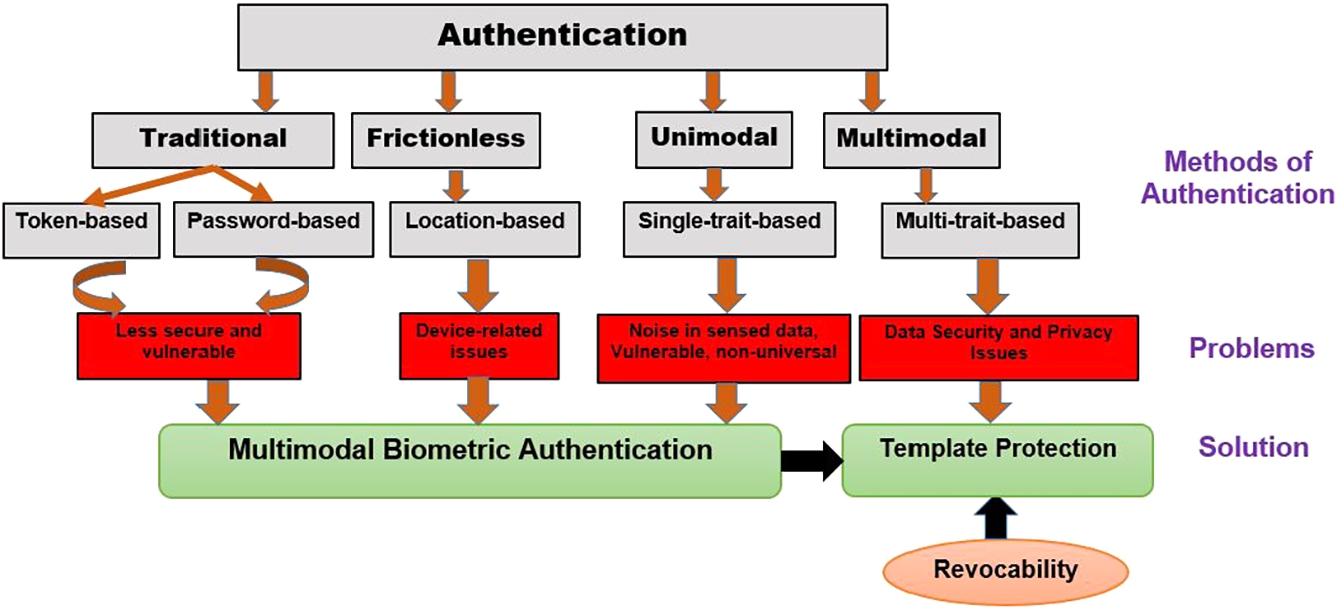
Research flow in authentication.
In this section, the performance parameters of five existing multimodal biometric systems have been compared in the MATLAB environment. Because of the fingerprint’s consistency and acceptance across the board, despite its susceptibility to spoofing attacks, and because the iris has permanence characteristics that can get around a fingerprint’s limitations, multimodal systems that only use the fingerprint and iris modalities were chosen. In addition, fingerprints and irises have a high degree of uniqueness compared to other biometric features. The system is, therefore, ideal for safety-critical applications because its combination offers promising outcomes in terms of data security. These multimodal biometric systems, which are based on features taken from iris and fingerprint characteristics, are explained as follows:
Garg et al. [139] retrieved textural features from fingerprint and iris samples stored in the CASIA dataset. They used KNN and neural classifiers for classification and accomplished decision-level fusion utilizing logical conjunction and disjunction approaches. The neural classifiers with logical conjunction outperformed the other classification methods in terms of recognition accuracy.
Abdolahi et al. [140] used weighted scores for both fingerprint and iris. A final judgment is then reached by using fuzzy logic for decision-level fusion. Due to its higher stability factor and more detailed features, the iris biometric modality is given more weight in this study than the fingerprint.
Benaliouche and Touahria used the existing mono-modal systems with three distinct matching algorithms, out of which two are classical and one is their own proposal, to build and implement a multimodal biometric system that includes iris and fingerprint [141]. For matching purposes, the authors use three techniques: sum rule matching, weighted sum rule matching, and the proposed matching with fuzzy logic. The latter strategy uses fusion at the decision level, whereas the first two use fusion at the score level. Experimental validation using the CASIA iris database and the FVC 2004 fingerprint database revealed that using fuzzy logic produces superior outcomes to the sum rule and weighted sum rule.
Features of a fingerprint are extracted using minutiae-based techniques, and features of an iris are extracted using a log Gabor filter. A Hough transform is used for boundary detection in the iris, and for segmentation, a canny edge detector is used. Hamming distance is utilized for matching purposes. Experiments are performed on the CASIA-Iris V1 dataset, FVC 2000, and FVC 2002 datasets at various threshold levels, and results are promising when the threshold level is set to 0.55 [142].
Gawande et al. [143] used a log Gabor filter for feature extraction of both traits, which are then fused in the frequency domain and matched using hamming distance. The authors can achieve 0% FAR and increased execution speed due to the separation of templates based on the number of cores.
Table 8 shows results of all these multimodal biometric systems in terms of FAR, FRR and Accuracy.
Results of above multimodal systems
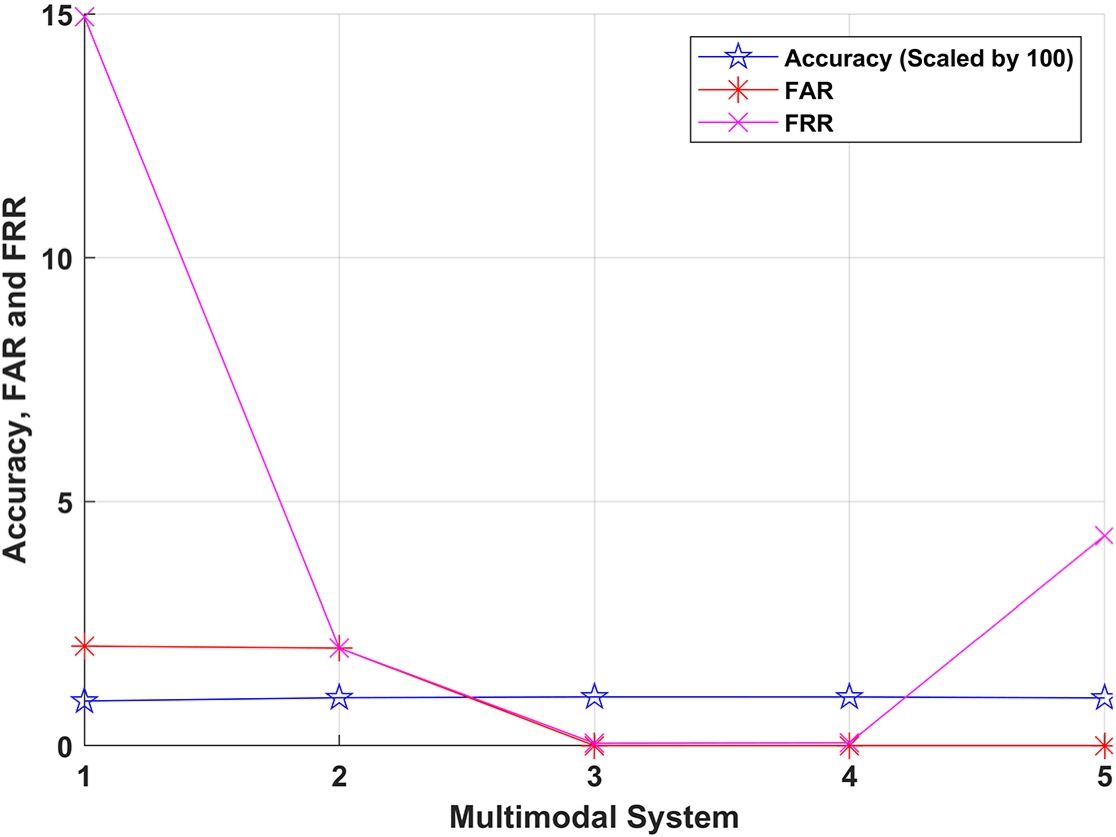
Comparison of fingerprint-iris based multimodal systems.
As depicted in Fig. 6, the multimodal systems FM-MBS, C-MBS, and HSF-MBS are more secure as compared to systems DLF-MBS and FL-MBS in terms of imposter access due to their 0% FAR value, but the system HSF-MBS has a high degree of false rejections making it less usable in the applications that require frequent access by legitimate users. The FAR and FRR values of the systems FM-MBS and C-MBS are nearly comparable, while system FM-MBS offers a comparatively greater accuracy value. System DLF-MBS, which is less accurate and less usable than system FL-MBS, has a high FAR value that makes it susceptible to imposters. It also has a high FRR value that makes it less usable.
Conclusion
In the modern world, the incorporation of biometrics into the user authentication process has progressed substantially, and it is now widely used in every sector demanding critical access. Robust multimodal biometric systems are used frequently today for authentication because they enable maximum population coverage, an increased degree of freedom, improved recognition rates (low FAR and FRR values), are less vulnerable to spoof attacks, and have a lower failure to enroll rate than unimodal biometric systems, which have numerous problems in daily life. Despite these tremendous benefits, multimodal systems have storage issues due to the massive datasets, processing time-related issues, and computational demands. The primary advantage of such systems is data privacy and security, which can be achieved using various techniques, thus making them more acceptable in daily life. In this article, various biometric methods, along with measures taken for template security, have been explored. The whole study made us arrive at a common conclusion that using a multi-feature-based biometric authentication method would always be beneficial in terms of better acceptance rates and trickster identification. Additionally, five multimodal systems designed by various researchers are also analyzed to determine the best system in terms of security, recognition performance, and usability. Finally, the analysis’s findings indicate that, in terms of security, accuracy, and accessibility, the FM-MBS system outperforms all other biometric systems under consideration.
Footnotes
Acknowledgements
No funding has been received to carry this survey work.