



Abstract

Keywords
On 16th of February 2016, Cristian González García defended his PhD thesis on the Internet of Things (IoT) at the University of Oviedo [1]. He presented his dissertation in a publicly open presentation held in the School of Computer Engineering (Fig. 1). After commenting on every question raised by the assessing committee, he was awarded the highest-grade possible, distinction with cum laude, obtaining his International Doctorate. He was in a 14-weeks stay at the University of Manchester (UK), with the supervisor Dr Liping Zhao.
Before the presentation, Dr Ramiro Gonçalves and Dr José Martins (University of Trás-os-Montes e Alto Douro, Vila Real, Portugal) had reviewed the doctoral thesis as external expert reviewers.
The doctoral thesis was supervised by Dr Juan Manuel Cueva Lovelle and Dr B. Cristina Pelayo García-Bustelo (University of Oviedo, Spain).
The PhD dissertation Committee was composed of Dr Manuel Pérez Cota (University of Vigo, Spain), Dr Carlos Enrique Montenegro Marín (Universidad Distrital Francisco José de Caldas, Bogotá, Colombia), and Dr Edward Rolando Núñez Valdez (University of Oviedo). All of them were present at the presentation.
Thesis summary
In the last years has appeared a revolution in the world of objects thanks to Smart Objects, sensors, and actuators [5], and the integration of these ones with the IoT. The classic and indefatigable example about this case is the smart fridge, which will call our smartphone when we are in the supermarket to notify us about what we have to buy. Or even, if we move forward in the future, our own servant robot will do this type of labour, while it talks with its friends, who will be the remainders of the smart electrical appliances that will live in our house.
The IoT is a field still barely exploited, very recent, and which needs a lot of investigation. It is necessary to connect the own objects to allow interacting automatically amongst themselves at the same time that these interconnections will be easily definable by any type of person. IoT can improve our life at home, in the so-called Smart Homes; it can make better the cities livability creating in this way Smart Cities; it can protect the culture and heritage of towns creating Smart Towns; it can improve the security, the productivity, and the labour conditions in the industry through the Industrial IoT, also named as Industry 4.0; finally, it can enhance our communication with The Earth to be able to understand it better through the Smart Earth.
This is why the doctoral thesis has attempted how to facilitate the creation of IoT applications, obtaining an abstraction, which allows to any type of user create these interconnections. Thus, the authors decided to use Model-Driven Engineering (MDE), in order to be able to create Domain-Specific Languages (DSL) that will allow offering an abstraction that moves the creation of the necessary software that are in the IoT closer to the users. One example of this abstraction can be seen in [4], where the authors proposed a DSL using MDE to create the interconnection amongst objects, furthermore of the Midgar IoT platform. This first iteration was completed with the work of [3], which shows another DSL, but in this case, to create the software for Smart Objects like Android smartphones or Arduino microcontrollers. These abstractions allow users to avoid the use of different General-Purpose Language (GPL) like Java, Swift, or Objective-C [2].
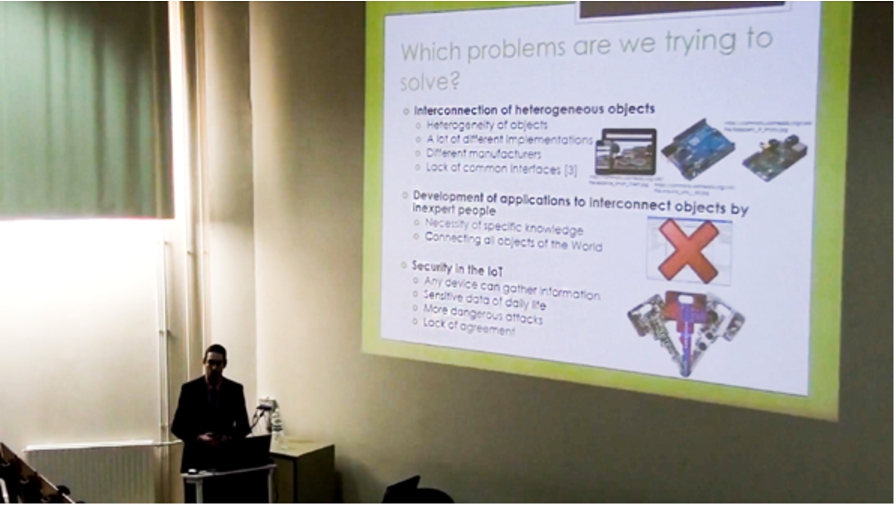
PhD dissertation defense.
To interconnect these objects there are different methods: The objects can be interconnected between themselves through a public cloud, using different private or own clouds, or as it occurs in some researches, using Online Social Networks as the point of interconnection amongst objects and between objects and people. In this case, the doctoral thesis has two articles about how the users can use Online Social Networks (OSNs), as the communication protocol, to ask questions to a special account, which is read by a central system. This central system manages the questions, obtains the information of different sensors, and creates the answers for the users, answering them in the OSN [9].
Notwithstanding, not everything in the IoT is based on the objects, although the objects are closely connected. An important point in the IoT is the security, exactly the cryptology, above everything after the last problems and leaks that have appeared in the last years. This remembers us how important is the privacy in our lives and how dangerous is the Internet, and therefore the IoT, for our life. This is why it was required to do a study about the different cryptographic algorithms to create secure messages that can be sent amongst Smart Objects [10].
Another point that appears is the level of intelligence of the Smart Objects, because they may not be intelligent or have Artificial Intelligence. For instance, the doctoral thesis contains prototypes for managing indoor temperature using Fuzzy Logic [7], applying Computer Vision to recognise people [6], and the creation of a system that emulates the human body [8].
All of the above is part of the problems and the possible solutions that were solved in the thesis.