



Abstract
With the vigorous development of information technology, the applications of the Internet of Things (IoT) have become increasingly common in recent years. Robot vacuum has become a popular and representative product in smart homes. This study proposed a hybrid fuzzy multi-criteria decision-making (MCDM) model that applied fuzzy analytic network process (FANP) and decision-making trial and evaluation laboratory (DEMATEL) to analyze the critical factors evaluated by users when adopting a robot vacuum. It was found that the top two dimensions in order are “epistemic value” and “functional value”; and the top five factors in order are “novelty”, “exploratory”, “family information infrastructure”, “family consensus”, and “reliability”. Significant influential and affected factors were identified. Gender differences in decision-making factors are also discussed.
Keywords
Introduction
With the vigorous development of information technology, the applications of the Internet of Things (IoT) have become increasingly common in recent years [10]. The IoT is formed by a large number of embedded devices based on Internet communication protocols. These devices have unique identification tags and can be connected to each other through cloud services to communicate with almost no human interference [18]. The application of IoT includes many different fields. At present, the smart home IoT has the lowest development threshold and rapid growth rate. It provides digital connections and enhanced services in the home environment by sensing interconnections in the devices. The network formed by devices and smart devices can monitor the home environment, protect safety, and improve quality of life [32,33,57,60].
In home life, smart meters, smart speakers, and network camera monitoring systems, and IoT home electrical appliances are quickly entering our daily lives [4]. By integrating mobile phones, smart speakers, and devices with sensors, the system can collect users’ living habits, provide services to automate home life, and improve the quality of family life.
Perhaps because of service life and price factors, large home appliances (refrigerators, washing machines, and TVs) have been slow to switch from traditional to smart. Thus, large smart home appliances have low penetration rates in households. However, in comparison, small household appliances such as robot vacuum cleaners have become extremely popular products. According to Grand View Research’s survey results, the global market size of the robot vacuum cleaners (abbreviated as “robot vacuums”) was USD 4.48 billion in 2021, and it is predicted that there will be an annual growth rate of 23.4% from 2022 to 2030.1
Robotic Vacuum Cleaner Market Size, Share & Trends Analysis Report
There have been some studies related to the home IoT [4,10,46,54,55,65,66]. Some studies also specially focused on robot vacuums [7,13,28]. In terms of research methods, most previous studies applied survey methods to explore or testify the adoption consideration factors for home IoT. However, consumer perception of value involves navigating a trade-off between the price paid and the quality received [69]. For consumers, the process of deciding to adopt home IoT products should have many trade-offs among multiple positive and negative factors. This process should be a multi-criteria decision-making (MCDM) issue. In the past, scholars have seldom studied the home IoT from the MCDM direction. To the best of our knowledge, very few studies have applied the MCDM to discuss consumers’ considerations for the adoption of robot vacuums. Only Kumcu et al. ([27]) assessed six best-selling new generation vacuum cleaners by applying fuzzy analytic network process (FANP). Additionally, gender seems to exert influence over the adoption of smart home products in general [13]. Then, it would be interesting to explore whether male and female consumers have different considerations or feelings while adopting robot vacuums.
Therefore, the expected contribution of this research would be as follows.
Applying hybrid huzzy MCDM model to robot vacuums: This study is the first to apply a hybrid fuzzy MCDM model (using FANP and DEMATEL) to understand the importance ranking of factors and the potential causal relationships and degrees of influence among different factors when consumers consider adopting robot vacuums, filling a gap in past research that predominantly used survey methods. Gender-based considerations: It explores further to gain insight into the different factors that men and women consider when adopting robot vacuums, offering valuable perspectives on gender differences in the adoption process. Industry insights: This study, based on empirical interviews, provides practical recommendations for the industry. By analyzing consumer value theory and decision-making processes, the research helps understand the key factors influencing consumer decisions and offers strategies for promoting robot vacuums into homes. The research results would provide useful reference for the industry to promote robot vacuums into homes.
Smart home IOT
Smart home refers to devices that provide a certain degree of digital connection and enhanced services for home life. It is often equipped with home automation systems [43]. With the development of IoT, smart home is defined as a type of home information and communication technology, interconnection and automation of electrical appliances and equipment, and the IoT [58], which is equipped with smart technology and is expected to provide users with tailor-made services [32]. In smart homes, the IoT plays an important role, which provides devices in the home environment that can be connected to each other so that they can be integrated and operated. For example, through temperature and humidity and infrared sensors in the home environment, we can obtain information about the temperature and humidity in the space and detect the presence of people. Through the integrated information and preset programs, the related devices can conduct lighting control, temperature and humidity adjustment, and automatic cleaning [56,60]. Moreover, with the advancement of information technology, users can directly operate IoT devices and provide services using mobile phones or voice assistant. Thus, the IoT in smart homes, called the smart home IoT, emerges as an information and communication platform in the home environment, including sensors, communication equipment, IoT home appliances, and so on, to provide interconnection and communication between various devices and provide users with more convenient services.
Under such development, robot vacuums become an increasingly popular home appliance product. Following the user’s setting or cleaning orders from a control device, such as a mobile phone or voice assistant, the robot vacuum plans out the cleaning areas, detects obstacles such as furniture and walls, and performs functions including dust removal, cleaning, and mopping [13]. Users can check the robot’s cleaning status, power level, the current status of various consumables, and use complete cleaning functions from their mobile phones or related devices [38].
Some studies have explored the technical aspects of smart home IoT [40,44,62]. On the other hand, some studies have conducted sample surveys to discuss the adoption or continued use of the smart home IoT. For example, Shin et al. reported that compatibility, ease of use, and usefulness have a significant positive influence on purchase intention [54]. Yang et al. also indicated that perceived controllability, perceived interconnectedness, and perceived reliability all influence adoption intention [66].
With the launch of different types of smart home IoT products, some scholars have also conducted studies on some specific IoT products. For example, Wunderlich et al. used mixed qualitative and quantitative research methods to explore the adoption of smart metering technology in households and found that factors such as consumer motivation (stemming from external mandates or internal feelings), perceived privacy risk, and inherent innovativeness are important for consumers [65]. Sinaga showed that trust is the most important factor for people to adopt Philips’ smart lamps in Indonesia, followed by performance expectancy, social influence, and facilitating conditions. Based on value theory [56], Shuhaiber found that epistemic, environmental, emotional, and convenience values significantly influence the adoption intention of smart meters; however, social and monetary values are not [55].
There are also some studies on attention on the robot vacuum. Fink et al. [13] conducted a six-month ethnographic observation of nine households using vacuum cleaners and summarized possible adoption or rejection factors, including usefulness, ease of use, habit compatibility, subjective norm, financial benefits, and environmental context. They also found male and female have different experiences on perceived ease of use and fun. With a survey of potential consumers in Taiwan, Chen and Huang found that the theory of planned behavior (TPB) model better predicts purchase intention than the technology acceptance model and the theory of reasoned action; and with two additional constructs, global identity and lead-usership (implying adopting innovations earlier), the explanatory power of the extended TPB model rises [7]. Based on the expectation-confirmation model, the results of Lee and Chae suggested that the perceived usefulness of the robot vacuum is determined by subjective norms, product quality, and confirmation of expectations before and after using it [28]. Franzmann et al. stated that trust and other explicit motivational factors, personal innovativeness, hedonic values, social influence, performance expectancy, and perceived convenience have a significant positive influence on consumers’ intention to use robot vacuums; however, perceived risk has a significant negative impact [16].
In addition, some studies have applied multicriteria decision-making methods to analyze the choice of different home energy management systems [24], the preferred IoT service among 18 detailed services provided by telecommunications companies [37], and improvement planning for smart home products (e.g., monitoring home security or detecting temperature and humidity changes) [30]. However, to our best knowledge, the only study applying the MCDM method to the adoption or usage of a robot vacuum is Kumcu et al. [27] in 2023. The criteria for new generation vacuum cleaners specified on the Türkiye’s e-commerce market review platform were used: price/performance, ergonomic usability, suction power, noise level, dust capacity, technical service. Ten experts who work in various electronics stores were interviewed to ascertain the relative importance of these six factors. Kumcu et al. then applied FANP and fuzzy Technique for Order Preference by Similarity to Ideal Solutions (TOPSIS) method to assess six best-selling vacuum cleaners.
In summary, the smart home IoT studies in literature are listed in Table 1.
Summary of smart home IoT studies in literature
Summary of smart home IoT studies in literature
Source: This study.
Decision-making trial and evaluation laboratory (DEMATEL) can be used to decompose complex problems into relatively clear and simple sub-problems. It can be effectively used for observing the interactions between different sub-problems and their influencing factors. Through this method, we can understand the causality in complex problems [15].
In this study, the steps of DEMATEL analysis are as follows:
Step 1 is to define the correlations between the evaluation factors: through literature review and brainstorming, we list the factors that may affect the decision-making problem, and invite domain experts to conduct interviews to determine the correlation between any two factors (using 0, 1, 2, 3, 4 indicate the strength of relationship from “no impact” to “very-high impact”).
Step 2 is to establish a direct relation matrix: In this study, we obtained the correlation values between factors from each expert and then calculated the average correlation values. For example, we averaged the scores provided by each expert regarding the influence of factor
Step 3 is to calculate the standardized direct relation matrix: After calculating λ by Eq. (2), we multiply each element in the matrix Z by λ (
Step 4 is to calculate the direct/indirect matrix: Goodman’s research [19] confirms Eq. (3) and Eq. (4), where O is a zero matrix and I is an unit matrix, so the direct/indirect matrix T is as in Eq. (4):
Step 5 is to calculate the degree of prominence: Assuming that
Step 6 is to explore the importance of each issue.
Through the DEMATEL method, this method can assist decision makers to clearly understand the relationships between the factors. Furthermore, the direct relation matrix of the evaluation factors obtained from the analysis of DEMATEL can be used as the basis for the Analytic Network Process method [67].
Analytic network process with fuzzy theory
The analytic network process (ANP) approach, considering network and nonlinear structure, is developed in response to the fact that many decision problems in the realistic environment that cannot be presented with the structured hierarchy [49,50]. It is an improvement of analytic hierarchy process (AHP), which allows all decision-making issues to have a chance to be compared [6]. Through ANP, the decision problem is decomposed into a multi-dimensional network structure, and a network structure between all criteria can be established [51]. This method has been used in different fields to solve decision-making problems [26,68].
However, there may be vagueness when decision makers measure the importance of criteria. Therefore, applying fuzzy ANP (FANP), which combines fuzzy theory and ANP, researchers will have the opportunity to reflect the actual situation more truthfully in the case of ambiguity [3]. The FANP steps are as follows:
Pairwise-comparison scale and the conversion of triangular fuzzy numbers
Pairwise-comparison scale and the conversion of triangular fuzzy numbers
Step 1 is to conduct pairwise comparison: According to the evaluation network structure, we adopt the 1–9 scale proposed by Saaty [52] to conduct pairwise-comparison between every two criteria for the priority of each criterion. In Table 2, it is a key concept used to capture the relative importance and uncertainty between different elements. The pairwise comparison scale includes five main values: 1, 3, 5, 7, and 9, which represent “equal importance” to “extreme importance,” respectively. Each value corresponds to a set of triangular fuzzy numbers, represented by three parameters: the lowest value
Step 2 is to build pairwise-comparison matrix: As shown in Eq. (5), where
Step 3 is to translate into triangular fuzzy numbers. Based on Table 2, we translate each score in the matrix into a triangular fuzzy number (
Step 4 is to calculate fuzzy weights. After obtaining n triangular fuzzy numbers of each participant, we can further obtain the overall triangular fuzzy numbers
Step 5 is normalization: Obtaining the triangular fuzzy weights in the previous step, we then need to conduct normalization for obtaining the final weights.
Step 6 is to build the super-matrix. After obtaining all triangular fuzzy weights (
Step 7 is to prioritize each criterion. By normalization of the super-matrix and complex matrix multiplication, we can obtain a limit super-matrix containing the weights of the evaluation criteria. According to these weights, the importance priority of evaluation criteria in the decision problem can be sorted.
The main purpose of this study is to analyze the priorities of critical factors that are evaluated by users in the decision to adopt a robot vacuum. It is suggested that in decision-making problems, the network architecture provided by ANP is more capable of comparing factors under different dimensions than AHP [6]. Because the mixed model has better results in multi-criteria decision-making problems [61], this study applied DEMATEL and FANP methods to analyze the priorities of factors that users would consider. The research aims and methodology are illustrated in the flow chart shown in Fig. 1.

Research aims and methodology flow chart.
Microsoft Excel software was used in the calculating the matrix and equations by referring to the Sections 2.2 and 2.3. The DEMATEL and FANP methods come from the literature, but they would be the first to be applied for understanding the importance of ranking of the factors and the possible causal relationships and degree of influence between different factors when consumers consider to adopt robot vacuums. The detailed research processes are shown in Fig. 2, and the description is as follows.
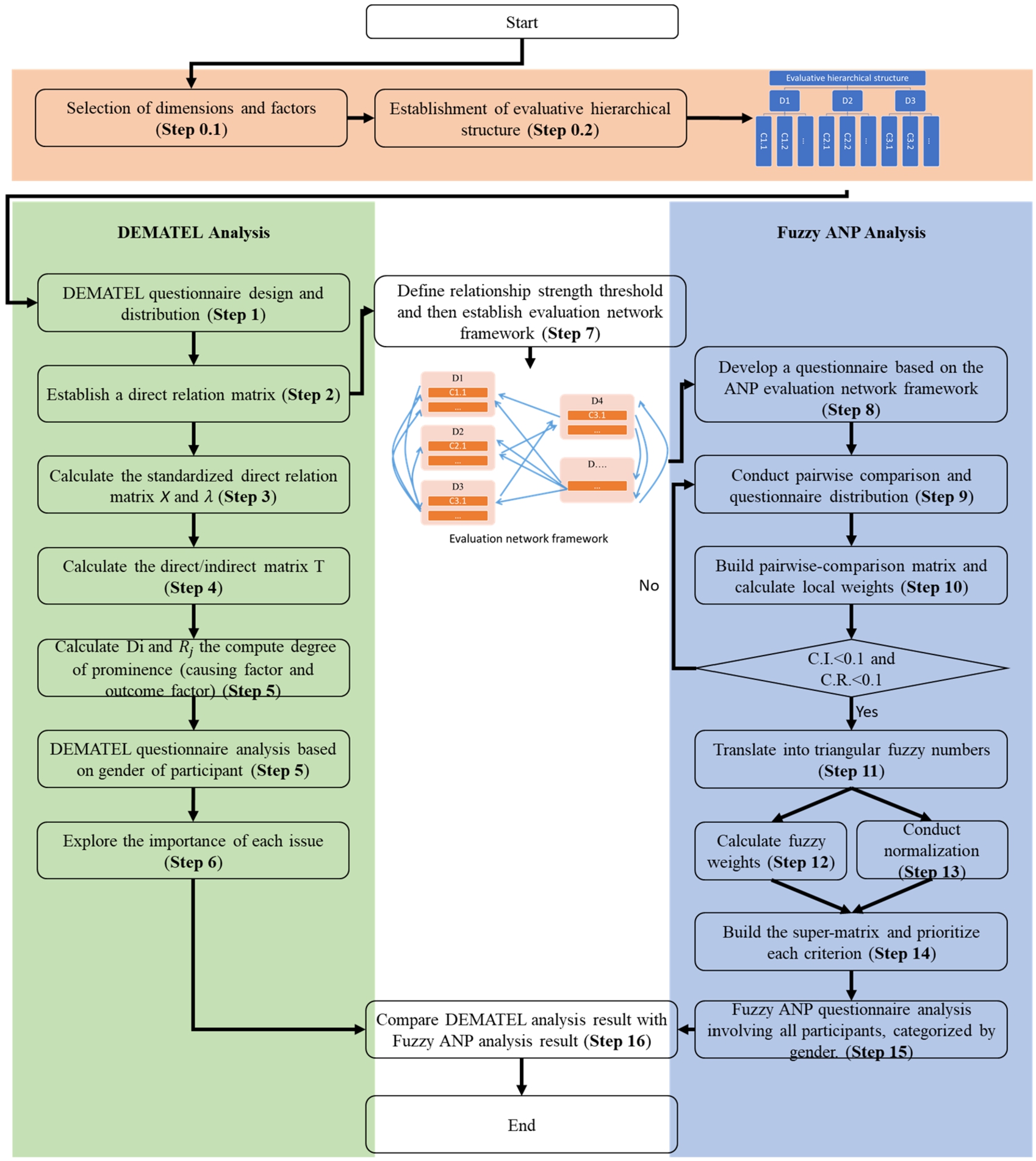
Detailed research processes.
First, through an extensive literature review grounded in value theory and consultations with domain experts, we identified the key dimensions and factors influencing user decisions to adopt a robot vacuum (step 0.1). These factors served as the basis for constructing the evaluative hierarchical framework of our study (step 0.2).
Second, we designed a DEMATEL questionnaire to investigate the mutual influences among the identified critical factors. After collecting the responses, we applied the DEMATEL method following steps 1 through 6 outlined in the previous Section 2.2. These steps, corresponding to steps 1 through 6 in Fig. 2, include defining the correlations between the evaluation factors and calculating various matrices, ultimately leading to the analysis results.
Third, using the relationships identified in step 2 of the Fig. 2, we developed an evaluation network framework. Based on this framework, we designed an ANP questionnaire (as described in step 7 and 8). This second questionnaire was then distributed to the same sample of participants. Following the methodology detailed in Section 2.3, we conducted the ANP analysis, as steps 9 to 15 in Fig. 2. The results from both the DEMATEL and ANP analyses allowed us to investigate whether different genders have distinct considerations when adopting a robot vacuum.
In this study, because robot vacuums are emerging technology products that are closest to consumers, users who adopt robot vacuums should consider the costs and benefits that these products bring to themselves. Previously, there have been some references on the factors influencing the adoption of information technology products [11,63], but because of the unique attributes of a robot vacuum, it is not suitable to directly apply previous adoption models of information technology products. When deciding whether to adopt a robot vacuum, perceived value is important for users [70]. Zeithaml stated that consumers have a comprehensive overall evaluation of products or services to form consumer value [69]. Sheth et al. claimed that consumer value includes functional, social, emotional, epistemic, and conditional values [53]. In contrast to traditional home appliances, smart home IoT products bring completely different values to consumers. Hsu and Lin found that perceived usefulness and perceived enjoyment through perceived value have a significant positive impact on the intention to adopt a variety of IoT (such as highway electronic toll systems, mobile payments, and smart homes) [21]. In addition, it has been reported that consumer value has a significant impact on the intention to adopt smart lamps [56] or smart meters [55].
In addition to value theory, some considerations in the purchase of home appliances are the focus of scholars’ consideration. For home appliances, such as refrigerators and air conditioners, consumers’ choice to adopt and purchase depends on the influence of important groups (family members and friends) around them [22,41]. Moreover, after-sales services provided by home appliances [42] and cooperation between suppliers [29] are important external support for consumers.
Furthermore, from the perspective of information security, it has been reported that endless information security incidents bother various IoT users [12,29]. Particularly for IoT home appliances, related studies also show that privacy and perceived risk have a significant impact on adoption [34,56,65]. In addition, security is an indispensable factor in the use of IoT home appliances [37].
In summary, this study proposes a total of seven dimensions in Table 3, including “D1 functional value”, “D2 epistemic value”, “D3 social value” (from the value theory perspective), “D4 internal family support”, “D4 external support” (from home appliance purchase perspective), and “D6 security”, and “D7 risk” dimensions (referring to the endless information security incidents and privacy threats in IoT). Based on these seven dimensions, we summarized the appropriate evaluation factors from the literature to list a total of 24 items. In Table 4 and Table 5, the 24 evaluation factors are defined according to the situation of using a robot vacuum.
References of evaluation dimensions and factors
References of evaluation dimensions and factors
Source: This study.
Definition of evaluation dimensions
Source: This study.
Definition of evaluation factors
Source: This study.
Based on the above dimensions and factors, we established an evaluation hierarchy (as shown in Fig. 3) and conducted two questionnaire (DEMATEL and FANP) surveys (as shown in Fig. 2) to analyze and evaluate the key evaluation factors that consumers are concerned about when considering to adopt a robot vacuum.
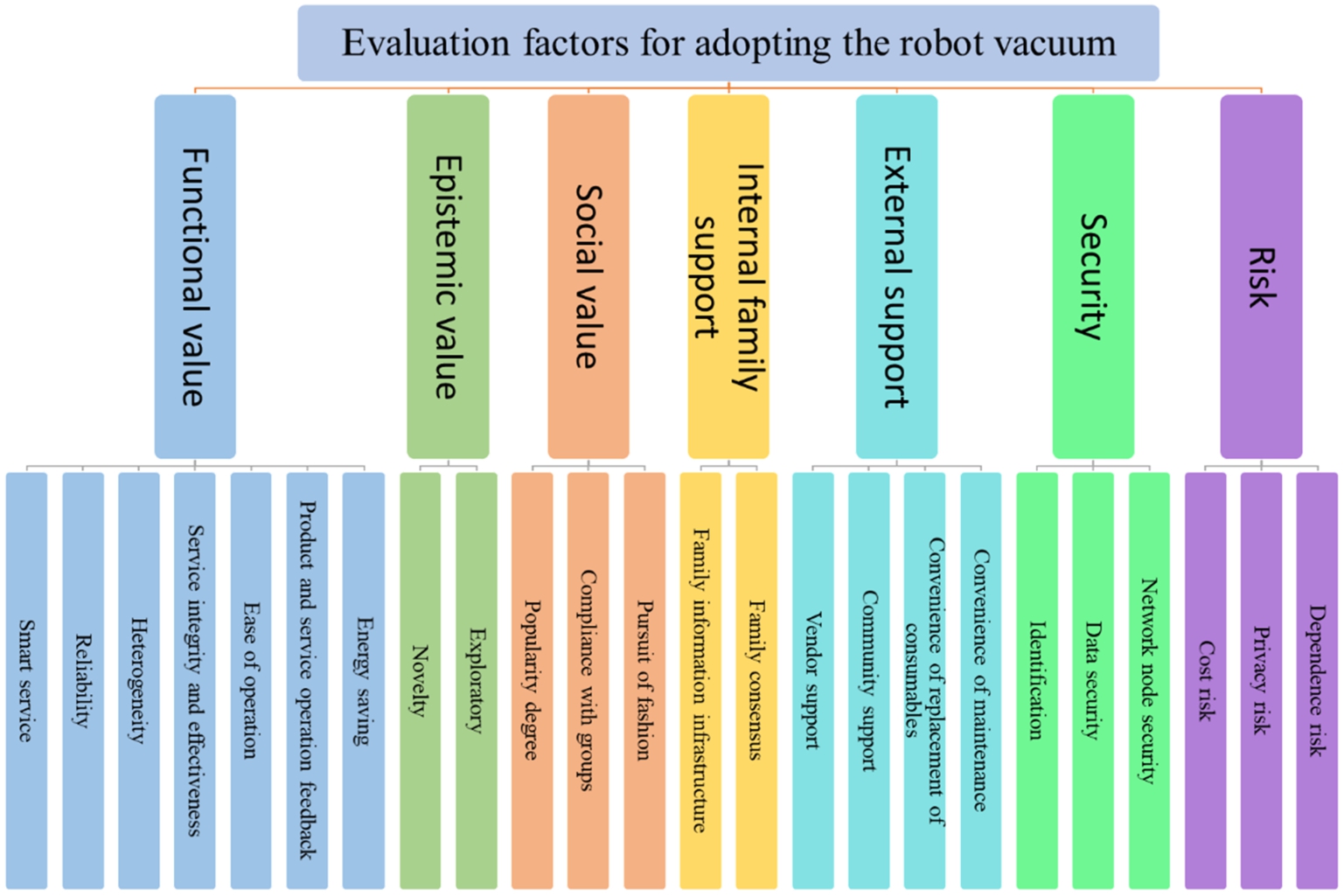
Evaluative hierarchical structure.
Demographic information of respondents
Based on the research process (Fig. 2) and decision-making questions, we invited suitable individuals as interview subjects. When selecting research participants, we had the following considerations: (1) We hoped that they had participated in the process of purchasing a robot vacuum so that they were not only users but also buying decision makers; (2) they had at least basic information technology literacy so that information security and privacy issues are familiar to them, even if they might not be very good at those issues; and (3) they had at least three months of experience in using a robot vacuum. Accordingly, we visited eight organizations, including four universities and four companies, to recruit 22 users to complete the DEMATEL questionnaire. Two weeks later, we invited these 22 participants, and 8 more persons, 30 persons in total, to complete the FANP questionnaires. In each interview, we explained to the participants the definitions of evaluation dimensions and factors, and they were asked to recall their considerations when they had decided to adopt a robot vacuum in the past. We applied software to help participants detect possible inconsistencies in scores when participants answered the questions. Table 6 presents the demographic information of the respondents.
Demographic information of respondents
Demographic information of respondents
Source: This study.
Before applying ANP to conduct cross-dimension comparisons of evaluation factors, we attempted to find the correlation between criteria using DEMATEL. Based on the 24 factors of the seven dimensions, we established a 24 × 24 direct relation matrix and invited participants to answer. The higher the score, the higher the degree of influence of the factor. The average length of the interview for each participant was 20 min. In the DEMATEL analysis process, we initially aggregate the scores of all respondents in step 2, and then establish the 24 by 24 direct relation matrix Z by Eq. (1), as detailed in Table 7. Each value represents the experts’ average opinion on the influence of the factor.
Direct relation matrix Z
Direct relation matrix Z
Source: This study, and Note: this study actually calculates the numbers to the 6th decimal place, but due to limited space in the table, only some decimal places can be presented.
Following step 3 in Section 2.2, we calculated
Direct/indirect relation matrix
Source: This study, and Note: this study actually calculates the numbers to the 6th decimal place, but due to limited space in the table, only some decimal places can be presented.
According to the direct/indirect relation matrix in Table 8, we can obtain the total influential level
Prominence and relation of evaluation factors
Source: This study.
According to the results of the DEMATEL interview, this study obtained the interviewee’s direct relation matrix for cross-dimension factors in Table 7. To ensure the rationality of the respondents’ pairwise comparison and maintain the consistency and reliability of quality, Saaty suggested that there should be no more than seven factors for each dimension [48]. To keep at most seven factors related to each factor, in terms of the scale of 0 to 4, a relationship strength threshold of 2.136 was set. For example, in Table 7, the impact of “C1.1 Smart service” on “C4.1 Family information infrastructure” is recorded as 2.455, exceeding the threshold value of 2.136. Hence, this relationship is depicted. Thus, we build the ANP evaluation network architecture, as shown in Fig. 4, in which each the line represents the influential relationship between the two factors. Most factors exert a one-way influence on each other, except for two noteworthy cases: “C6.2 Data security” has a reciprocal relationship with “C7.2 Privacy risk”, and “C6.3 Network node security” similarly influences “’C7.2 Privacy risk” bidirectionally.

Evaluation network framework.
Based on the evaluation network architecture, we designed the ANP questionnaire using 9:1, 7:1, 5:1, and 1:9 to evaluate the relative importance [52]. For example, in Fig. 5, if a user chooses 9:1, it implies that comparing these two factors, “reliability” is absolutely more important than “heterogeneity.” Interviews were conducted with 30 persons, including the same 22 participants in the DEMATEL interview and 8 additional participants. The average interview time for each participant was approximately 30 minutes.

An example of pairwise comparison in the ANP questionnaire.
Following the step 2 in Section 2.3, a consistency test (C.I. and C.R.) was conducted using the collected questionnaires [47]. After confirming that they all passed the consistency test, ANP analysis was performed. Following the step 3 in Section 2.3, and calculating the triangular fuzzy numbers of each criterion, we can fill them into the super matrix and then normalize it so that the sum of each column is 1, as shown in Table 10.
By normalizing the super-matrix and complex matrix multiplication, a limit super-matrix containing the weights of the evaluation criteria can be obtained. In Table 11, we list only three columns to save space because in each row, all values converge to the same number. As shown, “C2.1 novelty” (15.021%), “C2.2 exploratory” (13.537%), “C4.1 family information infrastructure” (6.518%), “C4.2 family consensus” (4.427%), and “C1.2 reliability” (4.055%) were all greater than the average weight, 4%. This indicates that they are all important factors for users when they consider adopting a cleaning robot vacuum.
Normalization of super-matrix
Source: This study, and Note: this study actually calculates the numbers to the 6th decimal place, but due to limited space in the table, only some decimal places can be presented.
Limit super-matrix
Source: This study.
Some studies have reported that gender differences have an impact on the issues of home appliances and smart homes [1,39,54]. In this study, some interviewees also reflected this tendency. In this view, we classified the returned questionnaires according to gender and then analyzed the differences between these two groups. The results are presented in Tables 11 and 12.
Prominence of evaluation factors based on gender of participants
Prominence of evaluation factors based on gender of participants
Source: This study.
Discussions on ANP results
This study applied DEMATEL and FANP methods to understand the priorities and relationships between factors when users consider adopting a robot vacuum. Table 11 shows the top five factors in the following order: “C2.1 novelty”, “C2.2 exploratory”, “C4.1 family information infrastructure”, “C4.2 family consensus”, and “C1.2 reliability”. It should be noted that the total weight of the top two reached 28.558%. This indicates that participants hope that a robot vacuum can bring novelty and that participants desire to explore it. In fact, the smart home IoT scene was planned more than ten years ago, aiming to provide a more automated and convenient family life [5]. However, the blueprints cannot be realized until the technological development of communication, cloud computing, and mobile services has become more mature in recent years. The emergence of household appliances, such as a robot vacuum, is a symbol of the gradual arrival of this era. When these scenes are implemented in every family, the first thing everyone feels is the freshness and concern about what they can really do for family life. All are about the dimension of “D2 epistemic value”.
“C4.1 family information infrastructure” and “C4.2 family consensus” are the third and fourth important considerations, respectively. For most robot vacuums, there are only a few buttons on the panel, which only provide basic functions, including cleaning, back to the charging station, and so on. Thus, if there is no wireless network, it cannot be initialized and connected to mobile phones or other home devices. If the Internet is interrupted afterward, it can only be used directly by pressing the power button on the panel. The cleaning status cannot be uploaded to the platform via the Internet; therefore, users cannot view it with a mobile phone or any device, nor can the settings be changed. Thus, before considering the use of a robot vacuum, users still need to examine the status of their family information infrastructure. Furthermore, as an important household appliance in a family, its purchase requires family members to reach a consensus. All are about the dimensions of “D4 internal family support”.
The fifth place is “C1.2 reliability”, whose weight is not much different from the other factors (C1.1, C1.7, C1.4. C1.5, and C1.3 in the descending order) in the dimension of “D1 functional value”. The vacuum cleaner is an essential tool for daily cleaning, so the basic requirement should be that the user feels that the performance is stable and reliable.
Furthermore, we found that the weights of all three factors under “D3 social value” are less than 1% and ranked in the bottom three. The total weight of social value is only 1.248%, which shows that it would not be concerned with the decision to adopt a robot vacuum. In terms of dimension level, the “D2 epistemic value” dimension accounted for 28.558% and ranked first. The “D1 functional value” dimension contains as many as seven factors, and their weights were all close to the average value of 4%. Therefore, the “D1 functional value” dimension accounted for 28.234%, ranking second, which indicates that product function and quality are the basic considerations in consumer decision-making factors. Finally, the weights of the remaining four dimensions (D4, D5, D6, D7) were not significantly different from each other; the values of all four were close to 10%.
Discussions on DEMATEL results
In addition to the above FANP analysis results, the results of the DEMATEL analysis provide some other useful insights. In terms of prominence, that is, the total degrees of “affecting other factors” plus “affected by other factors,” as shown in Table 9, the top five factors in order are “C2.1 novelty”, “C2.2 exploratory”, “C4.2 family consensus”, “C7.2 privacy risk”, and “C7.3 dependence risk”. Compared with the top five factors of Table 11 in the ANP analysis, three factors are worth mentioning. The first is “privacy risk.” The robot vacuum records the cleaned map of the house every time it cleans. This picture may contain a lot of information about home layouts and usage habits. If the functions of vacuum cleaners are more explored, e.g., after the robot vacuum is combined with devices such as voice assistants and smart lamps, the smart home IoT can become more convenient, but the user’s personal information stored in the devices is becoming increasingly comprehensive. Thus, the privacy risk is affected by other factors, resulting in a higher
The second is “dependence risk.” When the user perceives the excellent functions and reliable use of the robot vacuum, they may accumulate more reliance on it; therefore, the reliance risk is affected by other factors, also resulting in a higher
In addition, the values of
On the other hand, if
Fuzzy ANP analysis based on gender
Fuzzy ANP analysis based on gender
Source: This study.
Factors influencing the decision of adopting robot vacuum
Source: This study.
Table 13 clearly points out the biggest difference between men and women: in the ranking of the top five factors, although the first three top factors are the same, men are more concerned about “C6.2 data security” and “C7.2 privacy risk”, and women are more concerned about “C4.2 family consensus” and “C1.2 reliability”. In terms of the C6.2 and C7.2 factors, the rankings of men and women are very different. This phenomenon might be explained as follows. Similarly to adopting smart locks [31], in this newly introduced family staff, men pay more attention to the external threats brought by its introduction. On the other hand, women’s roles in the family may tend to be communicators [20]; therefore, in addition to knowing whether the machine is reliable to use, they hope to reach a consensus at home before the introduction.
In terms of the DEMATEL analysis results, there is not much difference between men and women; thus, no further discussion is given.
Comparison with the studies in literature
We compare the results with the studies in literature in Table 14. In terms of the diversity of research methodologies, unlike the ethnographic approach adopted by Fink et al. [13] or the simple survey method used by Chen and Huang [7], our study stands out by integrating DEMATEL and FANP. This methodological integration allows us to identify interrelationships among factors and comprehensively evaluate the significance of each factor. Such an approach facilitates a more precise assessment of various factors within complex decision-making contexts.
Furthermore, the scope of our research is considerably broader. While previous studies typically examined a limited number of factors, our study identified and rigorously analyzed twenty-four factors. These factors encompass usability, ease of use, subjective norms, innovativeness, and hedonic value, among others, thereby enhancing the comprehensiveness and representativeness of our findings.
In terms of the detail and applicability of our results, we not only provided a ranking of factor importance but also explored the intricate interactions among these factors. Additionally, we conducted an in-depth analysis of how different demographic groups, such as males and females, prioritize specific factors.
Finally, as detailed in Table 14, we compare our findings with those of existing studies in the literature. Although Kumcu et al. [27] also employed FANP, their study identified a relatively small number of factors, focusing primarily on our first dimension of functional value and the “cost risk” factor.
Conclusions and future studies
This study combines two MCDM methods, DEMATEL and FANP, to understand the importance of ranking of the factors when consumers consider to adopt robot vacuums. It was found that the top two dimensions in order are “D2 epistemic value” and “D1 functional value”; and the top five factors in order are “C2.1 novelty”, “C2.2 exploratory”, “C4.1 family information infrastructure”, “C4.2 family consensus”, and “C1.2 reliability”. The seven factors of the “functional value” are significantly influential factors; two factors of “epistemic value” and three factors of “risk” and “family consensus” are significantly affected factors. In addition, men pay more attention to “C6.2 data security” and “C7.2 privacy risk”, and women care more about “C4.2 family consensus” and “C1.2 reliability”.
Implications for academia
First, it is believed that for consumers, the process of deciding to adopt home IoT products have many trade-offs among multiple positive and negative factors. However, most of the previous studies applied survey methods to explore the adoption factors for home IoT. To fill this research gap, this study contributes by combining two MCDM methods, DEMATEL and FANP, to understand the importance of ranking and causal relationships of the factors when consumers consider to adopt robot vacuums.
Second, combining the perspectives of value theory, home appliance purchase, and information security, this study proposes a seven-dimensional evaluation hierarchy for robot vacuum adoption decisions. The evaluation hierarchy proposed in this study can be used as a reference for future researchers to understand the adoption of other new IoT home appliances.
Finally, although some studies considered gender differences among users when discussing energy conservation or environmental issues, few studies have analyzed the decision-making process of users of different genders in adopting IoT devices. The gender difference discussions in this study can serve as a reference for future related studies.
Implications for practice
This study is based on empirical interviews and aims to help us understand the ranking of the factors and the possible causal relationships and degree of influence between different factors when consumers consider to adopt robot vacuums. These research results will provide a useful reference for the industry to promote sweeping robots into homes. Detailed recommendations are as follows.
As reported in the FANP analysis, “D2 epistemic value” dimension (including “C2.1 novelty” and “C2.2 exploratory” factors) ranks first, while “D1 functional value” dimension ranks second. In addition, the impacts of the factors of “functional value” on “epistemic value” can be observed from the DEMATEL analysis. Moreover, all factors of the “functional value” are significantly influential factors. This emphasizes that the superior functions and stable quality of products are still the basic considerations for consumers in sweeping decisions. Thus, it is suggested that manufacturers should do a good job in product quality assurance and conduct a series of cleaning comparative experiments to demonstrate the superiority of the robot vacuum over traditional vacuum cleaners.
Second, because “novelty” and “exploratory” are so important, vendors may design a related virtual reality game in some exhibition centers to allow potential users to virtualize their usages and experience possible scenarios (e.g., wooden floors and keeping pets in the house) and recommend usage methods in the game to educate consumers. At the same time, the system may save the settings preferred by a user, and the vendor can customize the relevant settings into the consumer’s preset cleaning plan in the next sale.
Moreover, during the COVID-19 pandemic, consumer concern for household cleanliness and hygiene has reached unprecedented levels. Robot vacuum cleaners, with their automation and contactless operation, are particularly advantageous in this context. VR games can play a crucial role in educating consumers on how to maximize the functionality of robot vacuum cleaners to maintain a clean and safe home environment. We recommend that suppliers develop VR games to demonstrate the actual cleaning effectiveness of robot vacuum cleaners, supported by scientific experimental data to verify their efficacy in reducing the transmission of viruses and bacteria.
Third, it should be noted that although “C7.2 privacy risk” and “C7.3 data security” are not listed among the top five most important factors for all participants, they are negative factors and significantly affected factors, that is, many factors have impacts on them. They are also ranked as the fourth and fifth important by men users. Moreover, as the functional value (particularly smart services) increases, consumers’ privacy concerns increase. Further, security has a significant impact on privacy risk. In addition, product manufacturers not only sell products to consumers but also provide cloud platforms for consumers to update related software. Thus, it is suggested that on one hand, manufacturers should provide complete information security mechanism, including encryption, access control, data storage, and information transmission to prevent hackers and data leakage. On the other hand, they should also declare strict privacy policies and implement fair practices to respect the right to users’ privacy. At present, most brands of robot vacuums need to be connected to the Internet for the first initialization when they are bought home. If the settings are completed, they can still be used for cleaning when the network is disconnected, but only for pre-set cleaning. In addition, as long as it is connected to the Internet, it automatically uploads data to the manufacturer’s cloud platform. We suggest that the design of the robot vacuum should allow users to plan and change home cleaning without the manufacturer’s centralized cloud platform, or at least provide the freedom of opt-in/opt-out at any time, allowing users to decide whether to upload usage data online, particularly details such as cleaning maps. This study also suggests that the government should have legislation to regulate the entire procedure for the collection, storage, protection, and reuse of privacy data. Only when the robot vacuum manufacturer provides users with a smart and reliable service and a complete privacy protection mechanism can users accept and adopt it.
Finally, the findings of gender differences also provide some insights into the salespersons of robot vacuums. Because women care more about “C1.2 reliability,” salespersons should try their best to show to female consumers how the machine would be easy to use and would work stably and reliably in the future. On the other hand, because men pay more attention to “C6.2 data security” and “C7.2 privacy risk,” sales staff should put forward perfect instructions for men on their security measures and respect for privacy to get rid of their doubts.
Limitations and future studies
According to Statista2
“Robotic assistants (such as robot vacuums) user share in the United States as of 2018, by age”
Footnotes
Acknowledgements
The authors would like to thank the Ministry of Science and Technology, Taiwan, for financially supporting this research under Contract No. MOST 110-2410-H-004-087-.
Conflict of interest
The authors have no conflict of interest to report.
References
