



Abstract
The research presented in this article is motivated by the increasing importance of complex human relations in linked data, either extracted from social networks, or found in existing databases. The FOAF vocabulary, targeted in our research, plays a central role in those data, and is a model for lightweight ontologies largely used in linked data, such as the DBpedia ontology and schema.org. We provide an overview of FOAF and other approaches for describing human relations, followed by a detailed analysis and critique of the FOAF Relationship Vocabulary, the most important FOAF extension. We propose an explicit formal axiomatization of this vocabulary, and an ontological analysis concerning the properties used to describe human relationships. We analyze the distribution of human relations based on their epistemological status, and define an ontoepistemic meta-property as characteristic of some of these predicates. Our analysis is generalizable to semantic modeling of social networks. Additionally, the modeling patterns used in other relevant linked data vocabularies are analyzed for comparison.
Introduction
The Linked Data initiative was started by Tim Berners-Lee as an architectural vision for the Semantic Web. It explores the idea of Semantic Web understood as a web of data explicitly linked across different datasets, so that both people and machines can integrate and explore them semantically. If data are linked, then “when you have some of it, you can find other, related, data” says Berners-Lee (2009). Just like HTML hyperlinks enable relationships between documents, linked data enable relationships between entities by using the RDF abstract data structure. The key requirements for Linked Data are quite simple:
Use
Use
When someone looks up a
Include links to other
Guidance provided by these general points was later extended in technical documents like those by Bizer et al. (2007) and Sauermann et al. (2007), as well as in overview papers by Bizer et al. (2008) and Bizer et al. (2009). Linked data can be queried through SPARQL endpoints like in relational databases, or crawled with appropriate browsers by following RDF links (analogously to HTML links); a search engine can also retrieve RDF triples that are used annotate HTML pages. RDF also has the nice properties of graph databases to handle high-dimensional sparse data. However, unlike HTML, which only provides a generic linking capability, links in a Linked Data environment can have different types: we can, e.g., specify that one person is author of a paper, or that this person knows another person.
However, linked data critically need cleaning, as well as the ability to reason on them based on more clearly axiomatized ontologies. Ontology schemata like the DBpedia ontology and schema.org have been developed without caring too much about the axioms that were going to be enforced on linked data, so leading to known issues when querying on those data is performed with inference engines. After the impressive ‘semantic bootstrap’ provided by light-weight linked data vocabularies, it is probably time to introduce some good practices to polish vocabularies and data when serious inference is needed.
In this article we provide a study primarily based on one of the oldest and most central semantic web ontologies, FOAF, as defined by Brickley and Miller (2010), and its extensions. As a matter of fact, FOAF plays a central role in linked data oriented on human relations (HR), and is a model for lightweight ontologies largely used in linked data, such as the DBpedia ontology1
Our study concentrates on the formal properties of FOAF-related human relation predicates, providing a revised and richer axiomatization, which can inject currently implicit knowledge into human relation linked data, and help maintain its consistency.
While the FOAF project itself has a long history and has been subject of lot of research efforts, it has been for some time put aside of the main research focus. However in the context of rising interest in Linked Data initiative, the importance of FOAF increased, e.g., most linked data vocabularies contain an explicit mapping to the FOAF class
The rest of the article is organized as follows: Section 2 is a basic characterization of the FOAF project, of its history, and an overview of some important extensions directed at describing human relations. This section also provides a short overview of other approaches to modeling human relations. Section 3 analyses the formal ontological characteristics of the Relationship Vocabulary extension of FOAF, and analyses some formal problems. Section 4 provides our (reconstructed) formal axiomatization of the FOAF Relationship Vocabulary, based also on the natural language descriptions provided in the documentation. In Section 5 we proceed with a detailed analysis of the properties defined by this vocabulary, jointly with the introduction of an epistemic/ontologic distinction, leading to the proposition of an ‘ontoepistemic’ predicate. On the grounds of this analysis, we present a revised list of characteristics of human relationships. Section 6 contains a revised formal axiomatization that, while respecting the basic assumptions of the original FOAF Relationship Vocabulary, yet makes it more explicit some implicit assumptions in the original axioms. Section 7 provides an empirical survey of human relationships in Linked Open Data/Vocabularies. Finally, Sections 8 provides some conclusions and acknowledgments.
In this section we discuss some problems related to the FOAF project and the
The Friend of a Friend (FOAF) project started with the aim of creating a Web of machine-readable pages describing people, the links between them and the things they do, work on, create and like, with an emphasis on the on-line presence of people.7
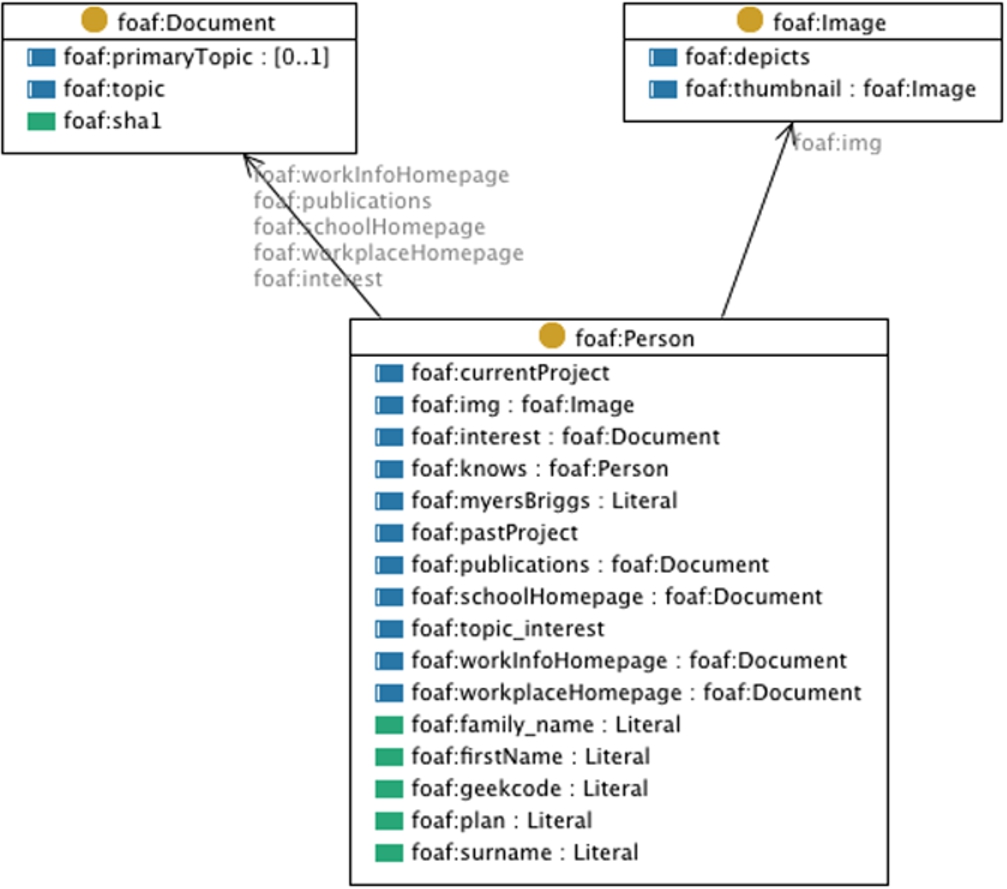
The axioms related to the
As a first observation, no axiom tells us that
Certainly reciprocated interaction does not imply symmetry of the specific relationship emerging from reciprocating: I can hate someone that actually loves me. However, at the generic level, both the hater and the lover know each other. It would be very hard to imagine reciprocating without mutual knowing. Probably, FOAF designers have realized that, in many cases, common sense knowing is not symmetrical, as when I know someone that does not know me. The decision not to put symmetry in
in many cases, if I know A then I am known by A;
in general, knowing someone does not require being known;
knowing is very specific in practice: special forms of knowing apply to friends, relatives, colleagues, competitors, public people, etc.;
expressing the actual context of knowing someone (i.e. creating additional entities for knowing contexts, provenance, etc.) creates indirections that one would like to avoid, e.g., for regular social network analysis on graphs whose nodes are persons;
the conditions, under which I can actually claim/admit to know A, can be unsatisfactory in practice, either for me or others. In other words, there are epistemic aspects of knowing to be considered;
knowing can be indirect: I can pretend to know someone even if I do not have direct communication with her (e.g., with public persons). Also, someone can claim I know someone even if I do not admit it, or if there is no evidence of direct connection, e.g., in a legal trial against a politician accused of having liaisons with a mafia boss;
reciprocated knowing can be physically impossible (e.g., knowing historical figures).
Is there anything better than
Inclusion of some of these properties seems debatable. For example, if a person describes someone as his/her enemy, then the person surely knows the enemy. However, the opposite may not be true. There may be an unknown enemy of anybody (the same holds, e.g., for children knowing their parents).
Also inclusion of enemies in a friend of a friend vocabulary seems counterintuitive, because the general intuition about knows in the semantic context of FOAF is a positive (or at least neutral) relation between people.
Since 2004 the relationship module has been modified to a more general FOAF Relationship Vocabulary and is continually maintained and enhanced.9
The Relationship Vocabulary is represented in OWL and is presented as a vocabulary for expressing human relations in general. The Relationship Vocabulary is not used as widely as FOAF core, but there are substantial linked datasets that use it, e.g., BBC Music10
See also:
The reason why we go into such depth with the analysis of the FOAF project and the Relationship Vocabulary is to analyze the difficulties when we link these data to similar datasets using different vocabularies. Subsumption and other logical relations are important because they are used even in the simplest reasoners and information aggregators like Tabulator by Berners-Lee et al. (2006).
Limitations of the
However, even this approach has problems. Firstly, all criteria used in that classification are events: communications, face-to-face meetings, telephone calls, sending e-mail messages. Therefore, it is not clear why relationships based on communication should form a separate top level class from that based on events. Secondly, having a common property in most cases does not imply a
Two other, more general, ontologies are those by Gangemi and Mika (2003) and Masolo et al. (2004), which lay down the foundations for the Neo-Davidsonian representation of human relations proposed by Mika and Gangemi (2004).
Gangemi and Mika (2003) developed the Descriptions and Situations ontology design pattern that provides a very generic way to capture relations between a description and a described situation. The authors rely on the distinction between individual (extensional) relationships (i.e. situations), and their generic descriptions (intensional relations, i.e. situation types aka situation descriptions). These two levels need to be represented separately, in order to support a class of use cases, e.g., the relation between a norm, and a case to which a norm should be applied. The separation is not enough though, because intensional or extensional social relations can have multiple arities (they are multivaried predicates), which cannot be known in advance. A famous example is due to Davidson (1967): when representing, e.g., the intensional relation preparing a coffee, how many arguments are needed? The agent preparing the coffee, the amount of coffee, its quality, the coffee-pot, the heating, the kind of water, the time and place of preparing it, etc.? In order to support both separation of intension and extension, and multivaried predicates, the generic pattern of Description and Situations applies a double reification strategy, which allows to represent separately (extensional) relationships such as a certain coffee making situation, (intensional) relations with any arity required, such as a coffee making recipe, and to relate them systematically.
Related to work by Gangemi and Mika (2003), paper by Masolo et al. (2004), on a rich axiomatic setting, provides a “general formal framework for developing a foundational ontology of socially constructed entities”, based on formal analysis of roles and their descriptions (understood as intensional relations).
These two ontologies share the basic assumptions, and provide the groundwork for paper by Mika and Gangemi (2004), which proposes an extension of social ontologies such as FOAF with reification (first-order treatment) of social relationships. Mika and Gangemi (2004) introduce a
From the point of view of formal ontology, the design pattern proposed by Mika and Gangemi (2004) is more expressive and powerful, and should be preferred whenever a use case requires substantial expressiveness and reasoning capabilities. However the Neo-Davidsonian pattern has not got a wide usage specifically for human relations in the Linked Data domain, since ‘direct’ binary relation patterns are usually preferred, probably because of their simplicity and closeness to the basic RDF data model. The analysis presented in this paper is therefore directed at binary human relations, although the results of the analysis can also be used for ontologies following more expressive patterns.
Formal ontological structure of the Relationship Vocabulary
This section focuses on the Relationship Vocabulary extension of FOAF. Its first part reviews definitions of some important ontological concepts, and the second part provides a more detailed analysis of its logical and ontological structure.
Formal concepts used in analysis of Relationship Vocabulary: Ontology pattern and reification
The meaning of term “ontology pattern” is summarized by Gangemi (2005): historically it is based on latin word “patronus” (patron) – someone proposed for imitation. In knowledge engineering Clark and Porter (1997) define “pattern” as “a theory ‘template’ or ‘schema’, which denotes a structure of objects and relationships, but whose axioms are not directly part of the global KB”. In ontology engineering “ontology pattern” is often defined more flexibly as various schemas and macros for UML, OWL, core ontologies, etc. See works by Reich (2000), Gangemi et al. (2003), Guizzardi et al. (2004) and Svátek (2004).
The term “reification” is historically based on latin words “res” (thing) and “facere” (to make) so it can be translated as “thingmaking”, i.e. turning of something abstract into a thing. Stevens and Lord (2010) claim that in the case of ontology engineering, the term “reification” describes technique that represents a property as an object enabling a richer description of a property.
Structure of Relationship Vocabulary
At the beginning we will analyze what ontological patterns are used in Relationship Vocabulary to describe various types of human relations.
The first observation is that almost all properties of Relationship Vocabulary have the class
On the other hand, there are also three terms that do not fit within this description: the properties
We therefore observe that Relationship Vocabulary includes two different ontology patterns for human relations.
The first pattern follows the legacy of the original FOAF, and is depicted in Fig. 2. Human relations such as
The second pattern uses the class
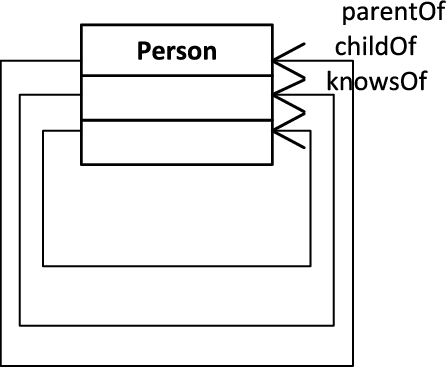
Ontology pattern of Relationship Vocabulary 1.
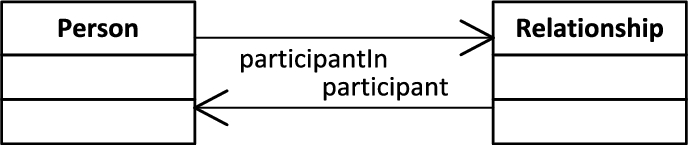
Ontology pattern of Relationship Vocabulary 2.
Let us look at the first pattern first. Historically the limitation of the original FOAF relationship module was that it consisted of just
A recent (February 2010) revision of the Relationship Vocabulary eventually acknowledged that for distant descendants/ancestors it may not be possible to know reciprocally each other, hence the property
In many cases the assumption that being
The second pattern seems a bit puzzling. What is that modeling approach meant for? For a person to be participant in a relationship, we need that members of that class are reifications of extensional, rather than intensional, relationships.
In practice, each individual relationship becomes an instance of the class
Notice that even with this interpretation, reified relationships are instances of the general class
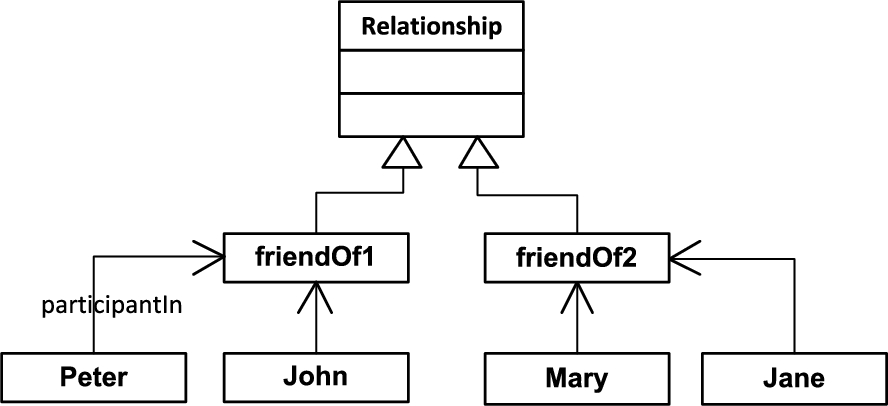
Instances
Finally, it is not clear how to express the semantics of the relations, e.g., not being symmetric: how can we use
The Relationship Vocabulary has some other gaps. For example, it does not include intuitive axioms such as
Another problem is related to employment relations like
A clarification of the intended semantics of the Relationship Vocabulary, as far as we can reconstruct it from the known documentation, is provided in Section 4.
Formal axiomatization of FOAF Relationship Vocabulary relations
In order to have a neutral basis for improving the design of the FOAF Relationship Vocabulary, we reconstruct here its formal axiomatization (from OWL code15
Notice also that in the Relationship Vocabulary there is a
OWL2 notion of asymmetry is equivalent to antisymmetry plus irreflexivity:
See
An overview of the design of the Relationship Vocabulary is provided in Fig. 5 (with exception of
Later in the paper, in Table 1, we present the results of an analysis of the involved relations. The table provides an overview of symmetry (column RV Symm) and explicitly assigned super properties for each property (column RV Super-prop).18
For a more detailed account of the complexity issues arising from the combination of symmetry, reflexivity, and transitivity with kinship relations, see the work by Longo et al. (2013).
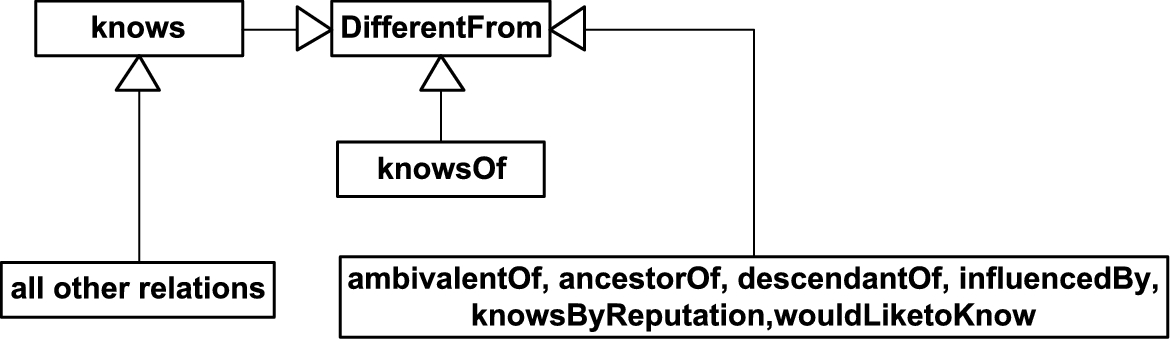
Ontology of FOAF Relationship Vocabulary.
The core of some of the problems we have identified could be found in a confusion between epistemic and ontological states of affairs assumed for the relation interpretation. The distinction can be formulated in the following way:
An
An
Of course, there is a grey line in the distinction, e.g., when asking involved people is part of the procedures for ascertaining the (ontological) truth of a state of affairs. However, we esteem there is enough intuition to distinguish the mere fact of personally knowing something, vs. desiring to ascertain an objective truth. In some cases, it is an involved person that desires to ascertain that truth, therefore acting according to an ‘ontological mode’.
The distinction between ontological and epistemic state of affairs has two important aspects – philosophical and logical – we will analyse both of them in following sections.
Philosophical problems relating to human relations
We may start philosophical analysis with some remarks concerning theory of intentionality; it is overview was made by Jacob (2010). Theory of intentionality, as founded by Brentano (1874), deals among other topics with the analysis of intentional inexistence: the characteristic specific of every mental phenomenon – that it includes something as an object and a direction or reference to it. Mental phenomena that interest us here are mental acts and these can have different types. Any such act has an object and is directed toward this object; e.g., in imagining something is imagined, in judgment something is affirmed or denied, in love something is loved etc.
We must therefore differentiate between three paradigmatic cases represented by these examples of forms of assertions:
x knows y;
x knows/believes that y is his/her child;
y is child of x.
Notice that while cases 1 and 2 deal with mental acts, assertion 3 concerns no mental phenomena but describes state of affairs. Notice also that the meaning of verb “to know” is in cases 1 and 2 completely different. While the intentional object of assertion 1 is a person (person y), the intentional object of assertion 2 is a proposition – assertion 2 can be rephrased: “x knows/believes that proposition ‘y is child of x’ is true”. Assertions similar to case 2 are usually called belief-ascriptions and some authors like, e.g., Schiffer (1992) interpret them not only using x as person, p as proposition, but introduce even third component m as mode of presentation of under which x believes p (main idea is that x can believe p under
Notice also that in assertion 2 we have written “knows/believes”. The reason is that while in common language is the word “to know” used relatively freely with respect to various propositions whose certainty is not assured, in philosophical discourse the verb “to believe” is preferred in such contexts. Usage of the word “to know” is defined usually with reference to “justified true belief” (credited to Plato, see Chisholm (1982)) and there are additional complex requirements to assure certainty of “known” proposition. In philosophical context we should therefore use the verb “to believe” unless these requirements are shown to be fulfilled.
Assertions like 1 are quite different – they still describe intentional acts and their intentional object is a person, however mode of existence of this object is intentional inexistence. As already Brentano (1874) noted: while in other relations (like the relation child of) both fundament and terminus are real,19
Brentano used words fundament and terminus to refer to endpoints of binary relation.
Concerning assertions like 1 we have also to ask what is meant by “knowing”? Russell (1911) distinguishes knowing by acquaintance and by description. Knowing by acquaintance means the first hand knowledge based in case of persons primarily on personal meeting accompanied with sufficient amount of empiric and other experience. The knowledge by description is based only on indirect propositional (verbal, textual, theoretical) information about its object. Notice that only knowledge by acquaintance can guarantee existence of know person.
We can observe also some general problems regarding semantics of names used in these assertions. Frege (1892) noted that one may have some beliefs about “Hesperus” but not about “Phosphorus” because of not knowing that these two names denote the same object (planet Venus). He developed distinction between the sense and reference of the word and used it to clarify such questions. Similarly one may know “Cicero” but not “Tully” because of not knowing that these two names denote the same person. One may have even different set of beliefs concerning both of these names. Russell (1905) later enhanced this theory with addition of distinction between the name (e.g., “Scott”) and definite descriptions (e.g., “author of Waverley”) that exhibit similar problems.
These questions are also connected with problem of referential opacity. According to Quine (1960) we say that two terms are referentially opaque if they cannot be substituted salva veritate (i.e. without changing the truth value of the statement). This theory claims that possibility of such substitution depends on context: in context like assertion 1 or 2 are called referentially opaque contexts because we cannot substitute terms salva veritate: “John knows Cicero” may be true, but “John knows Tully” may be false. Similarly with assertion 2. However Quine (1960) claims that cases such as our assertion 3 are referentially transparent contexts so truth value of “Marcus is child of Cicero” and truth value of “Marcus is child of Tully” are always the same.
Conclusion of our analysis is that assertion 3 is completely different from assertions 1 and 2. While assertions 1 and 2 concern mental states of individual human beings and also their truth value depends on these mental states, the assertion 3 concerns actual state of affairs, independent of knowledge and beliefs of any human being. While assertion 3 represents a real world relation, assertions 1 and 2 represent quasi-relations. For relation 3 to obtain, both fundament and terminus (x and y) must exist, assertions 1 and 2 may be true even if terminus (y) does not exist. The conclusion of this analysis is that assertions 1, 2 and 3 are in some very fundamental aspects different and irreducible. Using our terminology introduced above – assertions 1 and 2 concern epistemic state of affairs, while assertion 3 concerns ontological state of affairs.
Principles of reasoning about knowledge are formalized by epistemic logic described by Rescher (2005) and autoepistemic logic presented by (Moore, 1985).
Autoepistemic logic is one of formalisms trying to describe nonmonotonic reasoning. It focuses on reasoning of perfectly rational agent about his own knowledge and utilizes classic propositional logic enhanced with unary operator K – denoting knowledge or belief. If p signifies proposition, then
Epistemic logic introduces the notational binary operator K. Formula
On its turn, the interpersonal relation “knows”, which we baptize here p-knows, is problematic because it is related to epistemic reasoning, but at the same time it refers to the social aspects of knowing certain facts about persons, which lead to the ability of performing certain actions, having rights and duties, etc. In other words, p-knows is a consequence of the ‘application’ of epistemic reasoning to interpersonal and social worlds: if I know some facts about a person, then I am entitled to do certain actions; if I have a certain connection (e.g., a kinship relation) to someone then I am expected to know other facts that make me eligible to other actions, etc. So from the point of view of epistemic logic we have to distinguish two relations:
Grounding this reflection in logic, what is meant by saying that “person x knows person y”? What exactly does person x know? Is it possible to define how the relations knows and p-knows are interrelated?
A comprehensive ontology (“NIC”) of how knowledge, norms, and social behavior are entrenched in the lifecycle of social collectives is presented by Gangemi (2008) by using the Description and Situations pattern (cf. Section 2.3). However, the scope and design of NIC are probably too complex: as we have noticed before, here we want to respect the simplicity of the use case faced by the Relationship Vocabulary, therefore we focus on a rigorous, but logically simple, design.
On the other hand, in line with (Rescher, 2005, p. 6), p-knows can be reduced to knows by a formula following an axiom schema such as:
Eventually, we probably need to live without epistemic extensions, and treat p-knows as a plain empirical relation. Still, the considerations about epistemic and ontological states of affairs may provide us some help for a better organization of the Relationship Vocabulary. For each relation R in the Relationship Vocabulary, we may ask whether axiom (60) holds:
That means that the relation R between persons x and y holds if and only if person x knows that relation R holds between persons x and y. This is a non-trivial assumption, because while
It is thus never the case that the assertion
Ontoepistemic relations
Ontoepistemic relations are in many cases those describing our mental states. Sometimes, as Robb and Heil (2009) note, they are called mental properties. Assuming that ontoepistemic relations are only mental predicates can be debatable for relations such us
The domain of an ontoepistemic relation is that of “knowers”, and when a state of affairs occurs, in which
E.g., the predicate hates is ontoepistemic because if x hates y then x always knows that s/he hates y (this is a simple example because the hates property is mental). On the other hand, the predicate isFatherOf is not ontoepistemic because there can be situations when x isFatherOf y, but x does not know it.
It is also quite common that a relation is ontoepistemic while its inverse relation is not. E.g., if a person likes-to-eat (
In the case of symmetric relations then obviously if a relation is ontoepistemic then also inverse relation is ontoepistemic.
This analysis is by no means restricted to the FOAF Relationship Vocabulary: using vocabularies such as SIOC (Semantically-Interlinked Online Communities)20
We do not want to enter here the debate about free will, awareness, and knowing, and assume this presupposition as a common sense one.
Other examples include the Sport Ontology,22
All these examples are taken from vocabularies considered to be part of the Linked Data initiative and listed, e.g., on the LOV (Linked Open Vocabulary) portal.24
We can now determine what relations from the Relationship Vocabulary are ontoepistemic. We have also performed an analysis of these predicates from the point of view of general formal ontology, in order to improve their formalization beyond the ontoepistemic properties. The results are presented along definitions from the original FOAF Relationship Vocabulary in Table 1. We have also determined which of these properties are symmetric, asymmetric and irreflexive, and compared the results to the Relationship Vocabulary definitions. Irreflexivity is implied by asymmetry, but there are also relations that are symmetric but also irreflexive (e.g.
Property – the name of the property.
RV Super-prop – the super-properties of a property as from the FOAF Relationship Vocabulary. We omit
Super-prop – the super-properties of a property as from our analytic revision. We use k for
Ontoepist – whether a property is ontoepistemic.
RV Symm – symmetry as defined in the FOAF Relationship Vocabulary.
Symm – symmetry as from our analytic revision.
It might be interesting to ask which relations are irreflexive. Irreflexivity is implied by asymmetry so we may conclude that all relations that are asymmetric are also irreflexive. For other relations the question is puzzling and in many cases difficult to answer from the point of view of formal ontology. It may belong to psychology or other disciplines and is matter of an interpretation. Can a person be influenced by itself? Can a person lose contact with itself? Can a person be employed by itself in true sense of term employment? Because these questions do not have definite answers we did not include irreflexivity in the Table 1.
Properties of relations as from FOAF Relationship Vocabulary and as from our revision
The definition says that x “has mixed feelings or emotions” towards y. We suppose that a conscious agent is aware of his/her feelings or emotions. Therefore s/he also
The definition says: “A property representing a person who is a member of the same profession as this person”. We suppose that usually people do not necessarily know all people who are members of the same profession. It is also different from relation
If we accept concept of self–employed person then relations
Note that an employer who has thousands of employees usually does not know each of them. See page 242.
See footnote c .
We assume that a relevant meaning of
A person does not necessarily know that s/he was (in his/her work etc.) been influenced by someone else.
We understand it as a social relation, so it is ontoepistemic.
This relation is defined as “a property representing person who works for the same employer as this person”. This does not imply that they know each other.
For obvious reasons, relations that are not ontoepistemic (e.g.,
In this section we present a revised axiomatization of human relations from the FOAF Relationship Vocabulary. While we respect the original conceptualization (as evidenced in code and textual definitions), we provide refinements that enable to work around some problems, as well as to extend the reuse of data in different contexts. Our axiomatization is minimal, in the sense that we only cover a minimal set of ontological assumptions and do not provide a complete axiomatic theory of the domain. We want to use ontological analysis to make the FOAF Relationship Vocabulary more robust and intuitive, but we also want to respect the basic design choices, which were tailored to lightweight semantic web applications. The axioms will then be useful for data injection to and extraction from FOAF Relationship Vocabulary, i.e. as a tool for understanding, processing and transformation of FOAF data, also enabling previously impossible reasoning capabilities.
We introduce here revised axioms for human relations from the Relationship Vocabulary, ordered by type.
For brevity, we do not include here axioms that are already in Table 1, i.e. subsumption axioms by
As we have discussed in Section 4, the relation
A (possibly intuitive) transitivity axiom for
Social knowing relations:
About close friendship (axiom (80)), we assume that it is not possible to be close friend with someone without meeting him/her (in some physical or virtual sense). About
Survey of human relationships in Linked Open Data/Vocabularies
The fact that FOAF (and probably also RV, rooted in it) is undoubtedly the best known semantic vocabulary allowing to describe human relationships does not necessarily mean that it is the one most massively used for providing semantics to instances of linked data on the web. We thus performed an empirical analysis, taking advantage of the results of the linked data statistics observatory LODStats as presented by Auer et al. (2012), as available through the Linked Open Vocabularies (LOV) portal, at
The DBpedia and schema.org HR case
The most used HR vocabulary is actually a general vocabulary, the DBpedia ontology,25
The actual number of human relations and triples used in all DBpedia datasets is higher, probably a bit more than 1 million triples and about 1 thousand relations. Most of those relations come from a less controlled schema that is being refactored, and most of them are used in a small number of triples.
The 30 most used DBpedia HR relations (>1000 triples)
This relation is one of the projections of the (reified) n-ary relation used in DBpedia to represent the situation of an athlete to be enrolled in a team. From a formal ontology perspective, the entities reifying the individual relationships may be considered as temporal slices of a person, or as tropes/qua-entities of a person playing a certain role. It is massively used in DBpedia data, but is not of interest for the HR relations we are considering here.
This relation seems mostly used for persons that play similar roles at different times. This is a typical case of binary relations that should be actually modeled as n-ary ones, in order to make room for roles and time intervals.
The observed ambiguity between musical artists and bands causes the application of this relation to persons, not only bands.
It is the inverse of associatedMusicBand.
The DBpedia
It is the inverse of influencedBy. This relation is ontoepistemic only on the side of the influenced, which can be hardly influenced without knowing the influencer.
It is the inverse of successor.
The DBpedia
We have also applied our ontoepistemic property to DBpedia (and schema.org, see below) vocabulary (see again Table 2). The practical impact of the property becomes evident as soon as we would like to use HR relations to reconstruct social networks of public persons. For example, Lloyd Osborne was influenced by Robert Louis Stevenson, spouse of Fanny Stevenson, who is a relative of Lloyd Osborne. In principle, we cannot be sure that R.L. Stevenson was aware of Osborne being a relative of his as well, or that he influenced him. Osborne on its turn was probably aware of the influence of R.L. Stevenson’s, but still we cannot infer he was aware of being a relative of his. On the contrary, in a regular social network analysis scenario, we would easily flatten these relations, assuming the Stevensons and Osborne form a social subgraph.
The benefits of a foundational axiomatization can be described empirically for human relationships. When considering an axiomatization for large, crowdsourced, and partly uncontrolled data, new interesting problems appear which show the importance of ontological and logical methods to improve data quality, but also pose a challenge for the sustainability of data quality assumptions.
DBpedia is quite interesting for ontology design because its ontology schema is partly misaligned with the real usage in data. In practice, the domain and range axioms declared in the schema are not based on the actual distribution of types of entities referred to in the triples, either because of data dirtiness, or because of missing data analysis. For example, the relation
Even worse, in some cases misalignment with data generates ontological conflicts that in accurate logical representations would generate also logical inconsistencies. For example, the
A different problem can be seen at the schema level. If the DBpedia ontology schema is aligned to DOLCE,27
An OWL version is
A recent result by Paulheim and Gangemi (2015) on cleaning up DBpedia ontology and data after the linking to DOLCE-Zero (a simplified version of DOLCE + DnS, downloadable from
Schema.org is also a source of human relations, and it is becoming a de facto ontology standard for search engine optimization, being maintained and enforced by Google, Yahoo, Microsoft, and Yandex. There is no easy detection of the size of available data for schema.org, but it is interesting to report on what HR are currently included in it, as shown in Table 3.28
Taken from
Schema.org HR relations
Besides HR fragments of general ontologies like DBpedia and schema.org, several domain-oriented vocabularies also focus on HR relations. From the of approx. 2800 vocabulary entities listed in LOV,29
The list does not include all entities defined in more than 400 vocabularies registered by LOV, but only those referenced either in a LOD dataset or in another LOV vocabulary.
In Table 4 we can see that the most massively used HR vocabulary at the domain level is GNDO, the German National Library ontology. Since library linked data presumably cover human relationships of authors (or other encyclopedically relevant persons), this use of HR vocabulary is mostly complementary to the use of FOAF/RV, which is typically used by ‘ordinary’ persons in their personal profiles.
LOV entities with non-zero reuse in LOD data, as of March 10, 2014
Additionally, we also examined in detail all the LOV vocabularies that had been arranged, by the LOV curators, into a ‘cluster’ named ‘People’. There are 14 vocabularies aside FOAF and RV. Of these, 8 contain entities with some relevance to the HR topic. The vocabularies are (from this restricted point of view) reviewed below as roughly ordered from those pre-dominantly focused on officially recognised relationships, through those dealing with mere ‘knowing’, to ontologies that focus on modelling inner feelings of persons. Note that GNDO is not member of this cluster as its coverage is much broader; there is however the Agrelon ontology coming from the same provider (German National Library).
Bio ontology30
The usual lowercase convention for properties is not followed.
PoderVocab32
VCard ontology33
Agrelon ontology34
Gen ontology35
It is not directly accessible from LOV at the moment, but only via its github repository.
Online presence ontology37
Appearances ontology39
Emoca ontology40
Our research is motivated by the growing importance of the Linked Data initiative that is naturally connected with renewed interest in broadly used vocabularies such as FOAF. We have provided an overview of some FOAF extensions, as well as of alternative approaches for describing human relationships. We then focused on the FOAF Relationship Vocabulary, attempting at its revision on formal ontological grounds. The analysis lead us to compare a reconstructed formal axiomatization of that vocabulary to a proposed revised axiomatization that solves many issues and improves the reasoning potential, without changing the basic architectural choices of FOAF (lightweight expressivity, directness of relations, etc.). Our axiomatic revision is based on several theoretical remarks concerning the nature of properties used to describe human relationship, as well as on a newly defined ontoepistemic meta-property as characteristic of some of these predicates. The provided systematization, even if limited to basic properties of knowing, knowing of, and knowing of knowing, can already be used to perform safer reasoning on human relationship data, since linked data do not even address those basic properties.
A broader survey of human relations (and general patterns used to express them) in existing linked vocabularies has also been presented as complement, and an overview of the state of their usage in DBpedia has been proposed, with some evidence of how a stronger axiomatization can be helpful for the human relations domain.
Footnotes
Acknowledgements
This work has been partially supported by the VŠE IGA projects No. F4/34/2014 and F4/90/2015. We also acknowledge long-term institutional support of research activities by Faculty of Informatics and Statistics, University of Economics, Prague.