



Abstract
Location ontologies axiomatize the relationship between physical bodies and the space that they occupy, and there is a rich literature on the philosophical underpinnings of these ontologies. Existing location ontologies have given primacy to the structure of what might be called abstract space. Consequently, the spatial properties and relations between physical bodies are extracted from the spatial properties and relations of the spatial regions that they occupy. In this paper, we take a different approach by beginning with the philosophical position of mereological pluralism, in which there are different mereologies for different kinds of entities. In particular, we make the fundamental ontological commitment that the mereology for spatial regions is different than the mereology for physical bodies. Different intuitions about location and different classes of physical bodies can be formally specified by imposing different conditions on this mapping, thus leading to different possible location ontologies. We propose an axiomatization of a location ontology and characterize the models of the axiomatization, up to isomorphism, by providing a representation theorem with respect to graph and poset homomorphisms.
Introduction
The question, what is place? presents many difficulties. An examination of all the relevant facts seems to lead to divergent conclusions. Moreover, we have inherited nothing from previous thinkers, whether in the way of a statement of difficulties or of a solution. (Physics 208a27–208b7) (McKeon, 2009)
The relationship between physical bodies and the space that they occupy has long been a fundamental topic both in philosophy and more recently in applied ontology. This discussion has been closely related to debates in mereology, in which the relationship between the mereologies of both physical bodies and abstract space has been prominent. Approaches ranging from mereological monism to mereological pluralism have profoundly shaped any proposed ontology for location.
Existing location ontologies (and their applications in qualitative spatial reasoning and geospatial information systems) have given primacy to the structure of what might be called abstract space. Consequently, the spatial properties and relations between physical bodies are extracted from the spatial properties and relations of the spatial regions that they occupy. For example, the Region Connection Calculus is considered to be an axiomatization of space, not physical objects; indeed, discussion of the intended models of RCC (Cohn et al., 1997) have emphasized the role of Euclidean space. This leads to the oversimplification in which the spatial structure of physical bodies is naively mirrored in the structure of abstract space. This in turn raises a number of philosophical problems for mereology, such as the problem of extended simples (whether or not there exist physical objects that can be decomposed into spatially extended mereological atoms) and gunky space (abstract space that has no mereological atoms). Applying spatial mereotopologies for physical objects is also problematic from the practical point of view: Spatial regions are often considered to be atomless and extensional. However, there are valid physical configurations that do not satisfy atomlessness and extensionality axioms (Aameri and Gruninger, 2017). Consider for example the assembly of a bookshelf with two side panels and a back panel. Assemblies are typically modeled as finite domains; that is, it is assumed that the assembly product (in this case the bookshelf) has finite components and each component is atomic. Moreover, the two side panels are connected to the same set of elements (i.e., the back panel), but they are not identical. In fact, any model with finite number of elements may not be extensional. The atomlessness and extensionality axioms, therefore, should not be included in physical domain mereotopologies, but nor should their negations since a physical configuration may or may not be atomless and extensional.
Virtually all current location ontologies (Casati and Varzi, 1999; Donnelly et al., 2006; Borgo et al., 1997) assume that a unique fundamental parthood relation holds for all elements in all ontological categories. That is, there is just one parthood relation that holds both among regions and among entities that are located at regions. Such an assumption allows a whole that is composed of entities from distinct ontological categories, such as an entity that is the sum of a physical body and a spatial region.
One way to resolve these problems is to provide an explicit treatment of the underlying principles that can guide our understanding of the relationship between physical bodies and abstract spatial regions. The identification of these principles for a location ontology is inspired by the following quote from Casati and Varzi (1999):
One way or the other, spatial reasoning must come to terms with the fundamental metaphysical mystery on which it depends – embedding in space.
We accordingly propose a new approach to the axiomatization of location ontologies. First, we adopt the philosophical stance of mereological pluralism, that one needs different mereologies for different kinds of entities. In particular, we make the fundamental ontological commitment that the mereology for spatial regions is different than the mereology for physical bodies. This allows us to use a mereotopology (such as
Second, location axiomatizes a mapping from the mereotopology of physical bodies to the mereotopology of regions in abstract space. Different intuitions about location and different classes of physical bodies can be formally specified by imposing different conditions on this mapping, thus leading to different possible location ontologies. We do not commit to any specific assumption about space, objects, or the relationships between them except that there should be a distinction between spatial regions and objects that occupy them. This allows us to reuse existing mereotopologies when designing new location ontologies.
We propose an axiomatization of a location ontology and characterize the models of the axiomatization, up to isomorphism, by providing a representation theorem with respect to graph and poset homomorphisms. Our proposed theory is the weakest axiomatization required for representing location and occupation and so uses a region mereotopology with the same strength as the physical object mereotopology. However, due to the way we conceptualize and axiomatize location, both of the object and region mereotopologies can be extended to stronger mereotopologies with no effects on other modules of the proposed location ontology. The only restriction that the ontology imposes is that the region mereotopology must be at least as strong as the physical object mereotopology.
We begin in Section 2 by presenting a set of motivating scenarios and competency questions for our proposed ontology. We then review, in Section 3, the fundamental ontological commitments and ontological choices for location, thereby specifying a set of semantic requirements for location ontologies. In Section 4, we formalize these requirements as a class of mathematical structures (which we name occupation structures), present an axiomatization (named
Motivating scenarios
To guide the identification for the ontological choices and commitments for location ontologies, we propose a set of motivating scenarios that encapsulate potential applications of these ontologies.
It should be noted that we are interested only in the problem of location for physical bodies; in this paper we do not consider the problem of spatial location for events.
Scenario 1: Bookshelf. Alice buys a bookshelf from a furniture store. After unpacking the components from the box, she lays them out on the floor. Following the instructions, Alice assembles the bookshelf by attaching the sides to the backboard, and then connecting each shelf to the subassembly.
Scenario 2: Motion. Bob moves his computer across the table in his office. The parts of the computer and the table remain the same, and the space inside the office is fixed.
Scenario 3: Spatial change. A forest fire begins on the side of a mountain, grows to cover the entire valley adjacent to the mountain, and is then extinguished by firefighters.
Scenario 4: Landforms. An island cannot be disconnected (otherwise it would be two islands); similarly, the sum of two islands is not itself an island. Geological terranes never overlap, although they can be disconnected, and the sum of two terranes is not a terrane.
Scenario 5: Delivery and logistics systems. Carol, who lives in Toronto, orders a book from Acme Publishing. A copy of the book is found in a warehouse near Montreal. A shipping company picks up the book from the warehouse, loads it into the truck, and delivers it to Carol’s address.
Scenario 6: Commonsense reasoning. David drops some ice cubes into a glass and then pours water from a pitcher into the glass until it is full. Where are the ice cubes?
Scenario 7: Behaviour of physical objects. Emily is packing her car after shopping. She stuffs the pillow into the space between the chair and the lampstand, and then places the lampshade on top so that it doesn’t break.
Scenario 8: Behaviour of physical objects. A wooden board cannot be bent so that its ends touch each other, but we can bend a piece of thin metal sheet.
To evaluate the proposed ontology, we use the following competency questions which are based on Scenarios 1 to 8.
Mereological Pluralism – do there exist distinct mereotopological relations for different classes of objects? If so, are they axiomatized by different mereotopological theories?
Motion and Spatial Change – When a physical object moves, what spatial relations change? What relationships do not change? How can one say whether an object is moving or expanding/contracting?
Locations and Addresses – What is the relationship between a physical object (e.g., an ice cube) and objects that surround it (e.g., a portion of water in the cup)? What is the relationship between a physical object (e.g., a book) and the address that it’s located on (e.g., a warehouse)? How can we say two objects have the same address? When can we say that the object moved to another address?
Rigidity of Objects – In terms of spatial properties, what is the difference between a rigid object and a non-rigid object?
Scenarios 1 and 4 motivate [CQ1]: In Scenario 1, within the box the components are not connected, although the spatial regions occupied by the components are in contact with each other. While the components are laid on the floor, they are all disconnected. During construction, self-connected subassemblies correspond to different sums of components. In each of these cases, the mereotopological relationships of the components are different than those of the spatial regions they occupy. If we consider the landforms in Scenario 4, we can see that islands, continents, terranes, and other classes of geographical entities satisfy different mereological axioms, and hence have different parthood relations. Furthermore, there are different mereologies for different classes of physical bodies, even though all share the same mereology on spatial regions.
Scenarios 2 and 3 motivate [CQ2]: In Scenario 2, there is no change in any parthood relation (either in the physical bodies or spatial regions), whereas in Scenario 3, the parts of the physical body that is the fire are also changing as the fire grows and is extinguished, yet there is no change in either the parts of the spatial regions nor their mereotopological relationships. In both scenarios the locations of physical bodies are changing.
In Scenario 5, there is a relationship between physical bodies that is derivative of the locations of the bodies. Scenario 6 is similar insofar as it is concerned with the relationship between physical bodies and their locations. Both the icecubes and the water occupy regions that are part of the spatial region enclosed by the cup’s location. Scenarios 5 and 6 motivate [CQ3].
Finally, scenarios 7 and 8 motivate [CQ4] as with these scenarios we find the distinction between rigid and flexible physical bodies.
Ontological choices for location ontologies
What then after all is place? The answer to this question may be elucidated as follows.
Let us take for granted about it the various characteristics which are supposed correctly to belong to it essentially. We assume then –
(1) Place is what contains that of which it is the place.
(2) Place is no part of the thing.
(3) The immediate place of a thing is neither less nor greater than the thing.
(4) Place can be left behind by the thing and is separable.
In addition:
(5) All place admits of the distinction of up and down, and each of the bodies is naturally carried to its appropriate place and rests there, and this makes the place either up or down.
(Physics 210b32–211a5)
Aristotle notwithstanding, a number of philosophical positions underpin much of the foundations for location ontologies.
Substantivalism: Bodies and regions
The first choice that one must make is the distinction between physical bodies and abstract space. With supersubstantivalism (Lehmkuhl, 2018; Schaffer, 2009; Sklar, 1974), there is no such distinction – located entities are identical with their locations, so that each object is identical to the region of space it occupies. From the applied ontology perspective, this is typically formalized by saying that physical bodies form a subclass of regions (since every physical body is a region). Proponents of supersubstantivalism argue that its parsimony simplifies the ontology by positing fewer distinct class of objects (in fact going so far as to say that there is a unique fundamental substance in the world – space).
Substantivalism (Parsons, 2007) is less extreme, insofar as it posits the existence of such entities as physical bodies that are distinct from spatial regions, and that both are concrete fundamental entities in the world with the same ontological status. The motivation is that the basic properties, relationships, and identity criteria are so different between physical bodies and spatial regions that the two classes must be disjoint. Arguably, this approach is closer to the commonsense notions of bodies and space than supersubstantivalism. Even the linguistic use of the word “location” has a bias towards this distinction – we say that a physical body is located in or at some spatial region, rather than saying that a region is a physical body.
Compositional monism and pluralism
If one adopts substantivalism, the natural question to ask is about the relationship between spatial regions and physical bodies. Compositional (or mereological) monism advocates that there is a unique fundamental parthood relation that holds for all elements in all ontological categories. In particular, there is just one parthood relation that holds both among regions and among entities that are located at regions (Gilmore, 2017; Sider, 2007; Saucedo, 2011; Lehmkuhl, 2018; Leonard, 2016; Lewis, 1991). This position is adopted by virtually all current location ontologies (Casati and Varzi, 1999; Donnelly et al., 2006; Borgo et al., 1997).
With mereological monism, regions of space also have a location (typically, they are located at themselves). In fact, many approaches define spatial regions to be those entities that are located at themselves. Strictly speaking, this also means that there are at least two entities that can be located in a spatial region – the physical body and the region itself (although non-colocation axioms can be specified by suitably constraining the restricted entities to be nonregions).
Variants of compositional monism allow for additional parthood relations that are specializations of the one parthood relation only if they are definable with respect to an a priori taxonomy. For example, one can define the parthood subrelation in which its arguments are restricted to both be physical bodies or both be abstract spatial regions (Borgo et al., 1997). Nevertheless, this still allows a whole that is composed of entities from distinct ontological categories, such as an entity that is the sum of a physical body and a spatial region. Compositional monism allows the existence of an object that consists of a physical body (e.g. chair) and the region of space that it occupies. Both Parsons (2007) and Leonard (2016) raise the example of the possible location for the object that is the sum of someone’s left hand and the number π.
In contrast, compositional pluralism (McDaniel, 2004, 2007; Markosian, 2014) commits to one fundamental parthood relation that holds between regions, and another distinct parthood relation that holds between material objects. The primary argument in favour of this approach is that it avoids the problems of anomalous sums. Following compositional pluralism, physical bodies are entirely separate from their locations – there is no possible way for them to share any parts, since there are distinct mereological relations.
This approach can also be extended to a notion of mereotopological pluralism, in which there are distinct mereotopologies for physical objects and spatial regions (that is, in addition to distinct parthood relations, there are distinct connection relations for regions and physical bodies).
Mereological harmony
Since substantivalism posits the distinction between physical bodies and spatial regions, and compositional pluralism further requires the mereotopologies on these entities be distinct, we are naturally faced with the problem of the relationship between location and mereotopology. The notion of mereological harmony was introduced by Schaffer (2009) to describe the relationship between the mereological structure of a located entity and the mereological structure of its location. In particular, this notion is a response to the question: if an object occupies a region of space, must it have the same mereological structure as that region of space?
We argue that any resolution of this question requires compositional pluralism. Attempting to formalize mereological harmony principles within mereological monism leads to confusion.
A variety of different principles for mereological harmony have been proposed within the philosophical literature (Leonard, 2016; Uzquiano, 2011; Parsons, 2007; Gilmore, 2017; Saucedo, 2011). In this paper, we adopt the following:
(Basic Harmony Principle).
The parts of a physical body occupy parts of the region occupied by the physical body itself.
Note that this principle only postulates the existence of a mapping from the mereotopology of physical bodies to the mereotopology of spatial regions. In this sense, the Basic Harmony Principle is the weakest formalization of mereological harmony insofar as it does not posit any additional constraints on the mapping. A subsequent paper will characterize other mereological harmony principles and their relationships to each other.
Ontological commitments for the occupy ontology
A location ontology can be designed by adopting different stances towards the ontological choices introduced in the preceding section. The location ontology that we propose in this paper adopts the following ontological commitments:
Spatial regions and physical bodies are distinct entities, and each have their own distinct mereotopology.
Occupation is a relation between a physical body and an spatial region – there is no mereotopological relationship between spatial regions and physical bodies.
Each physical body occupies exactly one spatial region – multilocation is not possible.
The mereotopological relations between physical bodies must be preserved in the mereotopological relations between the spatial regions that they occupy.
We therefore adopt the stance of substantivalism and mereological pluralism, together with the Basic Harmony Principle. On the one hand, a supersubstantivalist might say that we have a crowded ontology indeed, with two fundamental disjoint classes of entities and two distinct mereotopologies. On the other hand, we have selected these commitments because they are the minimal conditions on mereological harmony principles. For example, the requirements we state allow the possibility of multiple objects occupying one single region, but they do not allow a connected physical body to be located in disconnected regions. The justification of these commitments is a natural question that arises at this point – in what sense are these the right ontological commitments for a location ontology? Are there in fact multiple alternative sets of ontological commitments that are equally valid?
We can show that the set of above ontological commitments are sufficient to address the competency questions and represent the motivating scenarios.
Adaptation of substantivalism and mereological pluralism addresses [CQ1] as well as the representation of Scenarios 1 and 4. In Scenarios 4, for example, Geographical entities form a subclass of physical bodies distinct from spatial regions (following substantivalism) and mereological pluralism supports the multiple mereologies that are used to capture the parthood relation for each class of entities.
Having occupation as a relation between physical bodies and spatial regions enables addressing [CQ2] and [CQ3]: Motion and spatial changes can be represented in terms of change in an occupy relation. When an object expands, the region that it occupies before the expansion is a proper part of the region it occupies after the expansion, while when an object merely moves the regions that it occupies (before and after the movement) only overlap. To say that a physical body is located in an address/location (e.g., the book is located in the warehouse or that it is located in the truck after loading) means that the region occupied by the physical body is part of the region occupied by the address/location. In Scenario 6, for example, both the icecubes and the water occupy regions that are part of the spatial region enclosed by the cup’s location (following the Basic Harmony Principle). However, the regions occupied by the icecubes are disjoint from the regions occupied by the water; rather than having interpenetrating objects, the icecubes occupy holes in the region occupied by the water. This indicates that in some cases, stronger mereological harmony principles may be needed. (As the icecubes melt down the region that they occupy shrinks and the region that water occupies expands. So to fully represent this process a temporal representation is also required) Note that different types of spatial change (i.e., [CQ2]), as well as addresses/locations (i.e., [CQ3]) can be represented since spatial regions and physical bodies are distinct entities with distinct mereotopologies, and occupation maps each physical body to a unique spatial region representing its location.
The distinction between rigidity and flexibility (i.e., [CQ4]) lies not in the mereotopology of physical bodies but in the way they are embedded in space. For example, parts of a flexible physical body that are not connected may occupy spatial regions that are connected by bending the object, which requires distinctive mereotopologies for physical objects and spatial regions as well as an occupation relation.
The occupy ontology
In designing an ontology, our objective is twofold – first, to prove that the models of the ontology are actually the intended models, and second, to demonstrate that the intended models do indeed formalize the ontological commitments. Our strategy is to first specify a class of mathematical structures and show that the ontology axiomatizes this class of structures (that is, there is a one-to-one correspondence between the class of models of the ontology and the class of mathematical structures). We then specify a representation theorem for this class of mathematical structures to demonstrate that it formalizes the ontological commitments. The primary benefit of this strategy is that it makes explicit the modular organization of the subtheories of the ontology, thereby highlighting how other ontologies are reused.
Methodology
The design and evaluation of the Occupy Ontology follows the verification approach described by Gruninger et al. (2010) and Aameri and Gruninger (2015). Rather than beginning with an axiomatization and then determining whether the models of the axioms are correct, we start by stating the requirements and ontological commitments that must be satisfied by the ontology. The requirements are then specified in the form of a class of mathematical structures; such structures are referred to as the required structures for the ontology. The ontology is verified with respect to the relationship between the required structures for the ontology and the axiomatization of the ontology.
If the ontology is too weak, it has models which are not isomorphic to any required structures. That is, there are requirements that are not captured by the ontology. If the ontology is too strong, there exist required models which are omitted, since the ontology imposes conditions which are not necessary by the requirements. An ontology
Nevertheless, it can be quite difficult to characterize the models of an ontology up to isomorphism and demonstrate that there is such a bijection between
Introducing
The first step is to specify the class of structures which capture intuitions and ontological commitments we described in Section 3:
compositional pluralism: there is a mereotopology on physical bodies and another distinct mereotopology on spatial regions;
mereological harmony: there is a homomorphism from the mereotopology of physical objects to the mereotopology of regions which is both
a homomorphism from the mereology of physical objects to the mereology of spatial regions, and
a homomorphism from the connection structure of physical objects to the connection structure of spatial regions.
Note that the existence of a mapping from one mereotopology to the other means that each physical body has a unique location. Multilocation for physical bodies would mean that a mapping could not exist.
We will denote the class of required structures by
Definitions for the notation used in the specification of the mathematical structures can be found in Appendix A.
The ontological commitment to mereotopological pluralism means that we need to specify the mereotopology of physical bodies as well as the mereotopology of regions. We follow the work of Grüninger and Aameri (2017) for the approach to mereotopology in which both parthood and connection are primitive relations.
The mereology of the parthood relation is represented by the class of partial orderings
A partial ordering is a pair of sets
Since the connection relation is symmetric and reflexive, it is represented by the class of graphs with loops
A graph with loops is a pair of sets
Mereotopologies are represented by the amalgamation of partial orderings and graphs with loops:
Figure 1 depicts an example of a mereograph.

Example of a mereograph.
The following Theorem from Grüninger and Aameri (2017) showed that there is a one-to-one correspondence between
There exists a bijection
The use of MT rather than a mereotopology such as the Region Connection Calculus (RCC; Randell et al. 1992) is rooted in the ontological commitment to mereotopological pluralism. Formalizing the structure of a physical body (such as the bookshelf in Scenario 1), as well as the physical relationships among the different components and subassemblies of the body, requires a mereotopology for physical bodies. The mereological subtheory expresses parthood relations (e.g. the shelves, brackets, sideboards are atomic parts of the bookshelf), while the topological subtheory expresses connection relations between the parts (e.g. each shelf is connected to the two sideboards). The RCC8 relations (Cohn et al., 1997) have widely been used for describing spatial relationships within physical settings. The results of Grüninger and Aameri (2017) show that the mereotopology MT corresponds to an extension of the first-order theory of the RCC8 composition table. This means that the underlying mereotopology for RCC8 used in such settings does not include any of the basic mereotopological principles (i.e., supplementation, atomicity, extensibility, and closure under sum and product), since these principles are not axioms in MT.
On the other hand, RCC is widely used for the representation of space. RCC is a first-order theory3
whose signature contains the single primitive binary relationIntuitively then, elements of the two classes satisfy the axioms of two different mereotopologies –
If we look closely at Scenarios 2 and 3, we can see that any treatment of motion and spatial change also leads to the ontological commitment to multiple mereotopologies. A model-theoretic characterization of RCC (Stell, 2000) demonstrates that every model of RCC is equivalent to an atomless Boolean lattice together with a graph, where the Boolean lattice represents parthood relations and the graph represents connection relations. On the other hand, any pair of nontrivial atomless Boolean algebras are elementary equivalent, and so the differences between the pairs are not first-order axiomatizable. Therefore, it is not possible to describe spatial change (by a first-order language) with the RCC theory alone. This is compatible with the view that RCC is intended to be a representation of spatial regions, and abstract space is fixed – it is the spatial extensions of physical objects that change. Therefore, to represent mereotopological change, there should be an explicit distinction between spatial regions and objects that occupy them. In that sense, rather than changing spatial regions, activity occurrences change the regions that are occupied by a set of objects.
The next requirement for the required structures in
It is important to note that although mereological monism can represent occupation as a mapping, it cannot represent occupation as a homomorphism on the mereology. First, since there is only one mereology
The advantage of representing occupation as a poset homomorphism (related to mapping the mereology of physical bodies to the mereology of spatial regions) is that the class of homomorphisms between posets is well-understood (Schröder, 2003). On the other hand, a characterization of poset endomorphisms that fix a subordering does not exist in the literature. In particular, given two posets
Some approaches (e.g. Borgo et al., 1997) attempt to specify occupation as a mapping from one definable subordering (i.e. the mereology restricted to physical bodies) to another definable subordering (i.e. the mereology restricted to spatial regions), and then argue that this mapping is a homomorphism. However, since the mapping is total, restricting it to definable substructures does not correspond to a homomorphism between the substructures. Admittedly, one could consider the notion of partial homomorphisms (i.e. partial mappings with domain and image that are subsets of the domain); however, there is no known characterization of the set of partial homomorphisms of a poset.
The first challenge in the design of the ontology is to find a class of mathematical structures that can be used to represent a mapping between the mereotopology of physical bodies and the mereotopology of spatial regions.
A mapping-bipartite incidence structure is a tuple for each pair of distinct elements
The idea behind mapping-bipartite incidence structures is that physical bodies and spatial regions are represented by the two disjoint sets P and L respectively,4
Within incidence structures, the elements of P are referred to as points and the elements of L are referred to as lines.
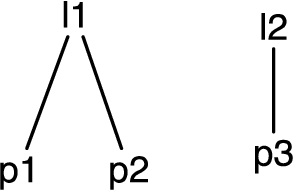
Example of a mapping-bipartite incidence structure.
It is insufficient to only require that there be a mapping from physical bodies to spatial regions – we need to impose an additional condition on the relationship between their mereologies. Recall that in the context of location ontologies, the Basic Harmony Principle (the parts of a physical body occupy parts of the region occupied by the physical body itself) is captured by the notion of homomorphisms between partially ordered sets, which are mappings that preserve the structure of the partial orderings.
Suppose
A mapping
To formally capture the Basic Harmony Principle, we therefore consider a class of structures that represents homomorphisms between partial orderings.
How are the conditions in the definition of preserved multigeometry related to the definition of poset homomorphism? By Conditions (1) and (2), there exist two partial orderings
An example of a preserved multigeometry can be seen in Fig. 3. The elements

Example of a preserved multigeometry. The dashed lines represent the incidence relation in the preserved multigeometry and a mapping
The representation theorem shows that preserved multigeometries do indeed represent poset homomorphisms:
Let
If
In other words, each preserved multigeometry
Note that since each element of
The mathematical theory
There exists a bijection
One may ask why we first present a definition of preserved multigeometries and then prove a separate theorem that shows how these structures correspond to poset homomorphisms. Why not define preserved multigeometries directly by their relationship to poset homomorphisms? A mathematical structure is specified using only the extensions of the relations in the signature and elements of the domain; there is no external reference to any mathematical properties beyond the relations in the signature. The relationship between the extension of a relation and some other property (e.g. the existence of homomorphisms) is proven in a representation theorem. For example, Boolean lattices are defined with respect to the existence of meets, joins, and complements; the relationship to the field of sets is proven in the Stone Representation Theorem. Similarly, distributive lattices are defined with respect to constraints on meet and join, while Birkhoff’s Representation Theorem shows that the elements of any finite distributive lattice can be represented as finite sets, in such a way that the lattice operations correspond to unions and intersections of sets.
For mereotopological harmony, we also need to formalize the mapping of the connection structure of physical objects to the connection structure of regions (in addition to the mereologies). Just as we invoked the notion of poset homomorphisms to formalize the preservation of mereologies under the mapping, the notion of graph homomorphism formalizes the preservation of connection structures.
Suppose
A mapping
In a similar way that we used multigeometries to represent poset homomorphisms, we consider a class of structures that represent graph homomorphisms as a way of formalizing the application of the Basic Harmony Principle to mereotopology.
How are the conditions in the definition of looped graph homomorphism structure related to the definition of graph homomorphism? By Conditions (1), (3) and (4), there are two disjoint subgraphs of a graph
An example of a looped graph homomorphism structure can be seen in Fig. 4. The points

Example of a looped graph homomorphism structure. The dashed lines represent the incidence relation in the looped graph homomorphism structure.
Looped graph homomorphism structures represent graph homomorphisms through the following representation theorem:
Let
If
As we saw with preserved multigeometries, each looped graph homomorphism structure
Thus, each structure
The mathematical theory
There exists a bijection
Individually, preserved multigeometries formalize poset homomorphisms and looped graph homomorphism structures represent graph homomorphisms, yet we are primarily interested in formalizing mereograph homomorphisms, since mereographs are the amalgamation of posets and looped graphs.
The idea is that occupation structures are a representation of mereograph homomorphisms, which are captured by the amalgamation of preserved multigeometries and looped graph homomorphism structures.
Suppose
There is a bijection
Thus, the class of structures
It is worthwhile to review how the structures in
In this section, we provide and analyze the axiomatization of the ontology
We have already seen from Theorem 1 that
The modularity of
Following the requirement of compositional pluralism, we combine a mereology on physical bodies and a connection structure on physical bodies to axiomatize a mereotopology on physical bodies:
The modularity of
For the requirement of mereotopological harmony, we axiomatize location as a mapping on mereologies (
Having specified the subtheories that axiomatize the substructures, we can now specify the entire theory.
The relationships among the different modules of

Modules of
This illustrates a technique known as design by reuse. We first formalize the requirements for the ontology by specifying classes of mathematical structures and then find the theory in COLORE that axiomatizes the class of structures and finally we reuse this mathematical theory to propose the axioms of the ontology via synonymy, which also provides a modularization of the ontology. In a sense, the axioms of the ontology are generated from the mathematical theories via translation definitions.
To this point, we have specified a set of ontological commitments based on mereotopological pluralism, and formalized them as a class of intended structures
Looking at Fig. 5, we see that the five subtheories that we presented above correspond to the modules of
The reductive modules (Aameri et al.,
2016
) of
The weak reductive modules (Aameri et al.,
2016
) of
Each structure in
There exists a bijection
This theorem provides a justification for
One final methodological note – In this paper we have followed a methodology in which we begin with a set of ontological commitments which are formalized through the specification of a class of required structures, and then find a logical theory that axiomatizes the class of structures. An alternative approach (suggested by a reviewer) would be to start with an axiomatization, construct its models, and then show how these models are related to the original ontological commitments. However, this presumes that the axiomatization of the ontology already exists, and hence is more appropriate to ontology analysis, whereas we are designing the ontology from requirements.
Another way of strengthening
Additionally,
In the reminder of this part we describe how
[CQ1]: The signature of
[CQ2]: When a physical object moves, the occupy relation corresponding to that object changes; that is, the object is mapped into a different region. When an object expands, the region that it occupies before the expansion is a proper part of the region it occupies after the expansion. To fully represent any kind of spatial change one also needs to represent time and process. A possible approach for that is to convert all axioms of
[CQ3]: Addresses of objects can be defined with respect to the regions the objects and their addresses occupy. All objects with the same address occupy regions that are parts of the region the address occupies (e.g., the regions occupied by two books in the same warehouse are parts of the region that is occupied by the warehouse).
[CQ4]: In physics, a rigid body is an object in which the distance between any two given points on it remains constant in time. From a qualitative perspective, this implies that the region occupied by a rigid object is never a proper part of the region the object occupies in the next state. However, spatial embedding is not sufficient for representing rigid bodies since the above implication is not for example sufficient for distinguishing a moving rigid object from a non-rigid object that expands as it moves. Therefore, the Occupy Ontology is necessary for representing rigid objects, but not sufficient.
Relationship to other location ontologies
The focus of most of the existing spatial ontologies is on axiomatizing properties of spatial or spatio-temporal regions and only a few explicitly axiomatize location.
Two approaches are taken by the existing mereotopological ontologies: in one approach connection is considered as the primitive relation and parthood is defined in terms of connection. Examples of this approach can be found in the work by Randell et al. (1992) and Asher and Vieu (1995). In the second approach, which is also adopted by the Occupy Ontology, both connection and parthood are primitives and the ontology includes axioms describing how the two relations are combined. MT, CMT, and CEMT are examples of the second approach (Casati and Varzi, 1999).
Spatio-temporal ontologies consider space and time as a whole which can be represented by four-dimensional regions. They adopt a spatial mereotopology, replace spatial regions in the mereotopology by spatio-temporal regions, and extend the mereotopology by axioms that capture temporal relationships between the spatio-temporal regions. Muller (2002) for examples adopts the spatial mereotopology of Asher and Vieu (1995), while Stell and West (2004) present a spatio-temporal ontology extending RCC.
Multi-dimensional spatial ontologies, such as INCH (Gotts, 1996), GFO (Baumann et al., 2016) and CODI (Hahmann, 2013), introduce primitive relations among spatial entities with different dimensionality, which enable capturing properties of multi-dimensional spatial regions and spatial boundaries.
None of the above-mentioned ontologies consider location. In the reminder of this section we present a detailed review of those ontologies that include a formal theory of location and describe how those theories are related to
Casati and Varzi’s location ontology
Casati and Varzi’s location ontology (Casati and Varzi, 1999) extends the mereotopology CEMT7
Casati and Varzi actually use GEMTC, which is a second-order theory. But we only consider CEMTC which is the first-order part of GEMTC.

Varzi’s location relation is antisymmetric, and transitive:
This might indicate that
Since axioms of
Although a definitional extension of
The main reason is that the P and C relations in models of
Basic Inclusion Theory (BIT; Donnelly et al., 2006) is a first-order theory of parthood and location which is developed for the purpose of qualitative spatial reasoning in biology and medicine. Like

Location relations are defined based on the region function and the parthood relation:
The main difference between BIT location ontology and Casati and Varzi’s theory is that in Casati and Varzi’s theory location is a primitive relation and regions are defined in terms of location, while in BIT the region function is primitive and location can be defined based on the region function. Nevertheless, we have the following:
Suggested Upper Merged Ontology (SUMO; Pease et al., 2002) is an upper ontology intended to capture general concepts such as time and location. According to SUMO, every physical object is located on an individual and associated with a time:
SUMO makes distinction between physical bodies and spatial regions (i.e., it takes substantivalism) but it makes ontological commitments which restrict its reusability. For example, it assumes that for every region, there exists an individual which is located on the region, which is not the case in many applications:
The ontology contains three locative primitives, namely
Summary
In this paper, we propose a new approach to the axiomatization of location ontologies based on the philosophical stance of merelogical pluralism, in which one uses different mereologies for different kinds of entities. In particular, we make the fundamental ontological commitment that the mereology for spatial regions is different than the mereology for physical bodies. The ontology we propose,
Two sequels to this paper will appear in the future. The first is a rigorous axiomatization of the different mereological harmony principles that have been proposed in the philosophical literature by Uzquiano (2011) and Leonard (2016). In this paper we have shown that the models of our location ontology
Several approaches axiomatize location ontologies as time-varying, introducing an additional argument for a time object. This is typically used to represent motion as the change in location for a physical body (see the Motivating scenarios in Section 2). The second sequel to this paper will use the methodology of Aameri (2012) to the Occupy Ontology to axiomatize motion as a change in location.