



Abstract
We present an OWL 2 ontology, called
This work started with the purpose of relating Catania’s San Nicolò l’Arena Benedectine Monastery with the abstract notion of Benedectine monastery, in the ambit of an ontological model based on the renovation works carried out by the architect Giancarlo De Carlo and developed by the same authors.
The
Introduction
The project of valorisation of Catania’s Benedictine Monastery “San Nicolò l’Arena”, currently carried on by the University of Catania, required the realization of an information system allowing the different agents involved in the process to manipulate information concerning the Sicilian late-baroque building nowadays hosting the Department of Humanities and, in particular to query, integrate, share, understand, and modify data concerning its contemporary renovation (1977–2005). In view of the project requirements, the authors proposed an ontology, called
Besides information on documents and people, the ontology includes a section devoted to the internal description of the building. The latter has been defined from the “Progetto Guida” – designed by the architect Giancarlo De Carlo for the renovation of the Benedictine Monastery (1988) – in order to associate each area of the Monastery with the related documents stored inside the building site.
The
The scroll of parchment of the Saint Gall plan, dated back to the 9th century A.D. and stored in the Stiftsbibliothek Sankt Gallen, is a kind of a meta project, namely the program of designing of how a Benedectine monastery should be built; it is a precious document not only from historical and artistic points of view – it presents itself as a conceptual map of “the ideal monastery” – but also because the organization of the information is easily readable by means of its high-resolution digitalization.2
The project of digitalization and metadatation of the Saint Gall plan lasted approximately six years and gave to the research community the possibility to remotely vision the scroll in every detail, from front to back, and to zoom and rotate it. There is also a search tool for the metadata included in the map. The project, available at
In this paper, we propose an OWL 2 ontology, called
A preliminary version of this work is outlined by Cantale et al. (2017a).
Usefulness of the ontology is three-fold. From one side, it helps in identifying similarities and differences between given real monasteries and the Saint Gall map and to comprehend social, economical, and environmental motivations lying behind such differences. In addition, the
From another side, the ontology helps in re-discovering the original conception of the spaces of monasteries nowadays refurbished to accommodate the functionality of a modern building, also considering the fact that monasteries, in their turn, are evolution of the nucleus of more ancient architectural artefacts that changed their function over time (Grandinetti, 2017; Giani, 2010).
Finally, the
The
The paper is organized as follows. Section 2 presents some related work. Section 3 is devoted to the
Ontologies can be applied as a useful tool to represent architectural artefacts and historical buildings, and to describe their conservation state and design process Acierno et al. (2016). Cantale et al. (2017b) have applied ontologies to formally represent Catania’s Benedectine Monastery and its process of refurbishment and renovation. However, spaces and architectural elements of the monastery according to the architect’s refurbishment project have been considered there, while the analysis of their original structure and function has been neglected.
Literature is rich in research concerning the application of ontologies to the design for architectural heritage. In fact, the theoretical baggage of architecture, involving a great variety of knowledge (historical, technical, artistic, subjective knowledge, and so on), fits well to be explored and modeled via ontological methods Roussey et al. (2011). Moreover, ontologies can be extremely useful to manage, organize, and share such a baggage in an unambiguous way, in particular when agents need to unravel knowledge, data, and information concerning some design tasks. In particular, ontologies are applied to conceptual design in architecture in order to facilitate knowledge sharing of shapes and their properties Emdanat and Vakalo (1998), and to manage cartographic urban themes and the complex multi-dimensional data of architectural heritage Noardo (2016).
Recently, documentation processes concerning the conservation of the architectural heritage and of the ex novo architectural design have been carried out focusing efforts and contributions on knowledge representation and management of existing elements, training memories, and personal remembrances (Stufano Melone, 2011; Stufano Melone and Borgo, 2016; Maietti et al., 2017).
Design in architecture is an expression of critical conscience detached from reality and derives from the special personal universe of the architect and her/his “inventive memory”. The analysis of memories (disaggregated knowledge) can be possible through ontological tools (Hois et al., 2009; Borri et al., 2014). According to some literature, the architectural type is a kind of epistemological foundational knowledge. Specifically, an architectural type is a logical statement that describes a formal structure (i.e., a shape) Martís Arís (1990). Types regulate relational and functional systems, a kind of “mental projects” that can be considered pre-representations of the space preceding the design stage Muratori (1960). An ontological analysis can make explicit, clarify, and manage the complexity of references, constraints, functional goals, and designer’s ambition through a cognitively centered design process. Moreover, it helps in highlighting and coherently separating the key elements of the architectural creative process Melone and Borgo (2016).
Types in architecture have been listed, explained, and discussed over time in the attempt to introduce and specialize notions such as form and function. For example, in Palladio’s (1570) and Durand’s (1799) books we find listed some. They are about architectural objects and urban frames referred to buildings and infrastructures intended to accomplish specific functions (burial monuments and hospitals, city walls, city doors, streets, triumphal arches, bridges, public squares, public buildings, temples/churches, palaces, courthouses, colleges, libraries, museums, observatories, markets, lighthouses, customs trade fairs, and theatres).
There exist studies about how to manage via ontological analysis the intrinsic knowledge of architectural types as a first step to explore all the memories with the aim of supporting design processes in both the restoration and refurbishment of architectural heritage (Acierno et al., 2016; Pauwels et al., 2018). Despite the fact that literature is rich of contributions concerning ontologies for architectural design, as far as we know this paper is the first attempt to formally define the architectural type of a Benedictine monastery and to analyze such kind of historical buildings from the point of view of their original conception and function.
The ontology of Saint Gall plan
We devote this section to the description of the
Historical notes on Benedictine monasteries
Monasteries were conceived by the Benedictine monastic order, founded by Saint Benedict of Nursia, after the collapse of the Western Roman Empire. The monastic shape aims at preserving the European Christianity inside small self-sustaining communities where to lead a life of mystic and religious contemplation and introspection. The main principle is to protect and shield Christian religion and tradition from barbarian invasions. In the tradition related to Saint Benedict, the theme of Goths is recurring. For instance, we recall the famous episode of the meeting between the God’s servant Benedict and the king Totila, commander of the Goths army.
Monasteries differ from convents primarily because of their purpose. Monasteries are inhabited by monks belonging to some monastic order such as the Benedictine one, having an ascetic and solitary lifestyle. Convents, originating later with the mendicant orders such as the Franciscan one, are more dependent by the outside world. The two religious constructions arose in different historical periods, carrying out different functions inside the religious community. Monasteries are often also abbeys that are spaces where the nullius diocesis is effective. Such norm, in the canon law, represents the independence of a church and of the related monastery from the diocese in which the building is located. Therefore, the abbot is a substitute for the bishop inside the Benedictine “village”.
«Monasticism has its root in the interpretation of the Christian faith developed in the theology of the 6th century firstly in Orient. Analogously to theology and architecture, it is subjected to a deep transformation in Occident. [ ... ] The Benedictine Order remains for a long time the principal one. Hundreds of convents and monasteries are spread across the Christian Europe and represent cells of Christian tradition and faith, of science, and of culture» Kubach (1972).
Since the foundation of the Monastery of Montecassino (the first Benedictine monastery) in the first half of the 6th century, the Benedictine Order has been subjected to incessant internal reforms, especially when periods of spiritual and moral weakening took over the strictness of the Order. Reforms often influenced the housing architecture of the monks.
Starting from the 7th century, Western Europe is characterized by a capillary network of monasteries, preserved more than castles, public and laic works, precisely because of their religious function Gombrich (1950). Their shape in Occident remained largely unchanged in its characteristics during the whole Middle Age and in all Christian countries, with differences in the volume of some spaces. For example, in more recent periods, larger libraries are built in order to host bigger amounts of books.
The plan of Saint Gall, illustrated in Fig. 1, is a model of monastery better representing the Benedictine architecture since it is strongly inspired by the rule of Saint Benedict, and can be considered a fixed-type for the Middle Age monasteries De Vecchi and Cerchiari (1995).
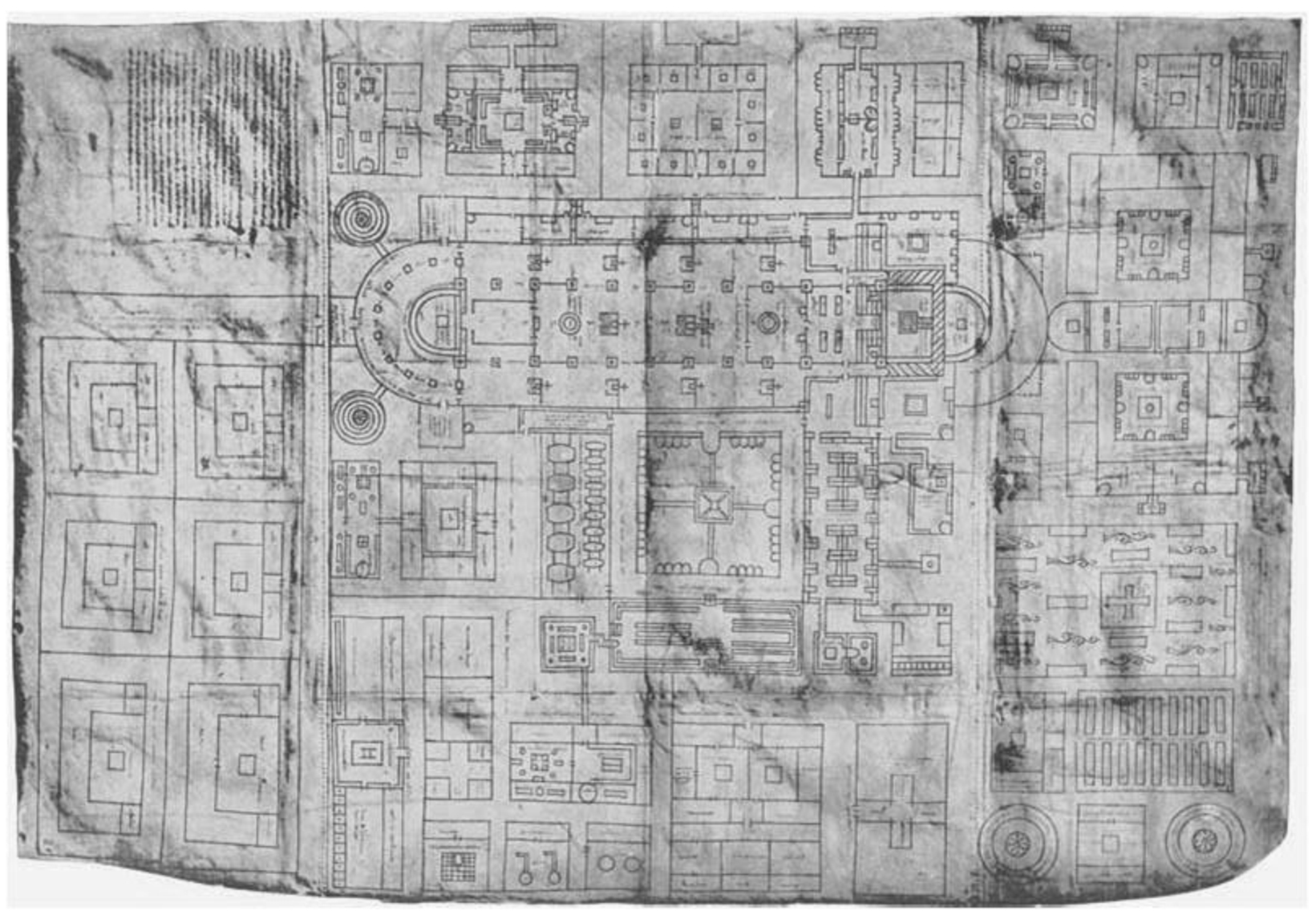
The plan of Saint Gall.
The plan has been designed in the context of Pre-Romanesque Carolingian art and architecture. «[...] The planimetry of Saint Gall Monastery provides the ideal committing schema adopted until the late-Gothic period: the monks dwellings are located on three sides of a rectangular or quadratic courtyard (cloister), while on the other side (on north or on south) runs one side of the church. The internal court is entirely surrounded by a quadrangular arcade that links the buildings. Besides the oriental wing of the cloister, as a rule, we find two small rooms assigned to the sacristy and armarium (book storage), and one room assigned to the monks reunions where they discuss all the community matters under the supervision of the abbot or the prior.
On the east side of the church, there is the monks dormitory, located on the upper floor for space connectivity reasons and because of tasks to be performed inside the church. Often, in front of the church there is the refectory, the dinner room, and the kitchen of the monastery, while on the occidental wing there are other buildings, services, and the entrance.» Kubach (1972). Thus, rooms of common use such as dormitories turn out to be of great relevance. They are usually located beside a cloister containing a little garden or a green area, and, in the middle, a fountain or a water source for the ablutions. The cloister was devoted to contemplation of beauty and meditation, being an open area in a seclusion space. Inside the fortification, right out the cloister area, there are locations assigned to the farms and the dwelling of animals.
As shown in Fig. 1, the space arrangement is inspired by that of a small village: a large church in the centre with annexed cloister and dormitory; at East one can find the novitiate, the infirmary, the cemetery, and the orchards, at South the factories, at North the guest houses, schools, and the dwelling of the abbot, and, finally, at West the farms. Thanks to its shape, the Monastery accomplishes the “nullius diocesis”, being self-sustained and independent from the outside world, and the “ora et labora” rule professed by San Benedict.
Being one of the most ancient descriptions of primitive Benedictine monastery arrived intact today, the Saint Gall map turns out to be an important structural, architectonic, and functional landmark for the Benedictine monasteries. Indeed, many European monasteries are inspired by the Saint Gall plan even though for practical and technical reasons they deviated from it.
In what follows we display the plans of some Benedectine monasteries. Our aim is not to enter the history of each represented monastery, but to indicate the reader the characteristics that all these artefacts have in common, and the shared program that subsides them.
In Fig. 2 (representing the Beaulieu Abbey, in Hampshire, England, founded in 1203–1204), in Fig. 3 (showing the Kirkstall Abbey, in Kirkstall, England, built in 1152), in Fig. 4 (displaying the Montmajour Abbey, in Arles, France, founded in 949), in Fig. 5 (showing the S. Michele in Vulture Abbey, Monticchio, Italy, constructed in the VIII Century), in Fig. 6 (showing a fictional monastery for the Umberto Eco’s novel “Il nome della Rosa”), in Fig. 7 (depicting the Monastery of La Tourette, in Éveux, France, built by LeCorbusier in 1956), and in Fig. 8 (representing the Monastery of San Nicolò l’Arena in Catania, Italy, founded in 1558), we highlighted the church (in red), the cloister (in green), and the dormitory (in blue), as fixed elements of such representations. Such elements are always strictly interconnected in similar successions of spaces, even though difficult topographical conditions required a kind of contraction of the shapes and of the relations between the different elements, as in the S. Michele in Vulture Abbey (Fig. 5).
Image credited to www.historyfish.net.
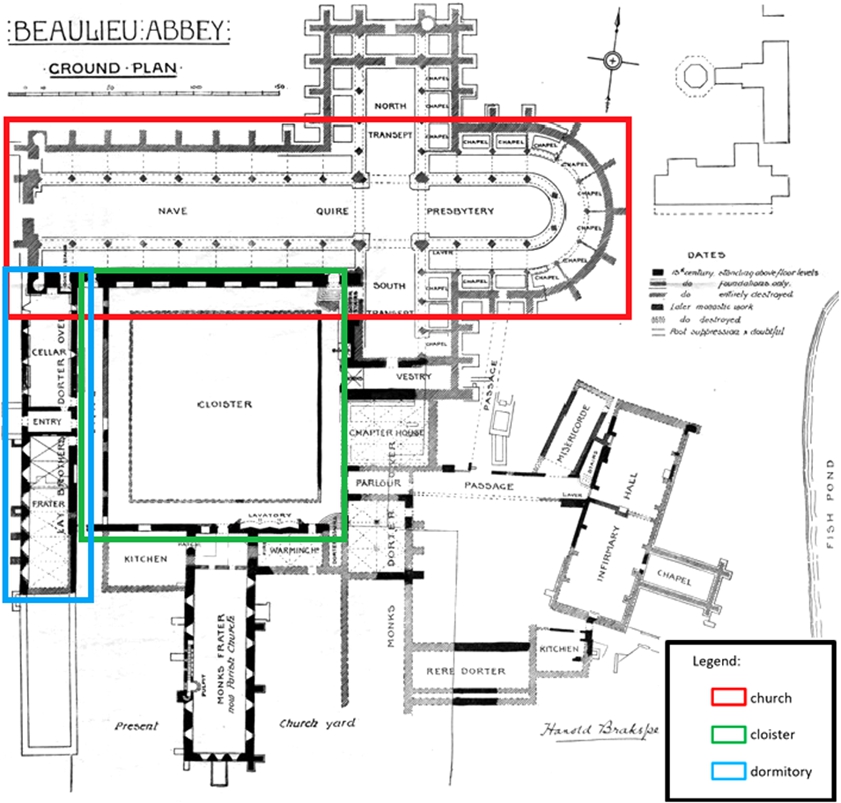
Beaulieu Abbey, Hampshire, England.4
Image credited to www.1902encyclopedia.com.
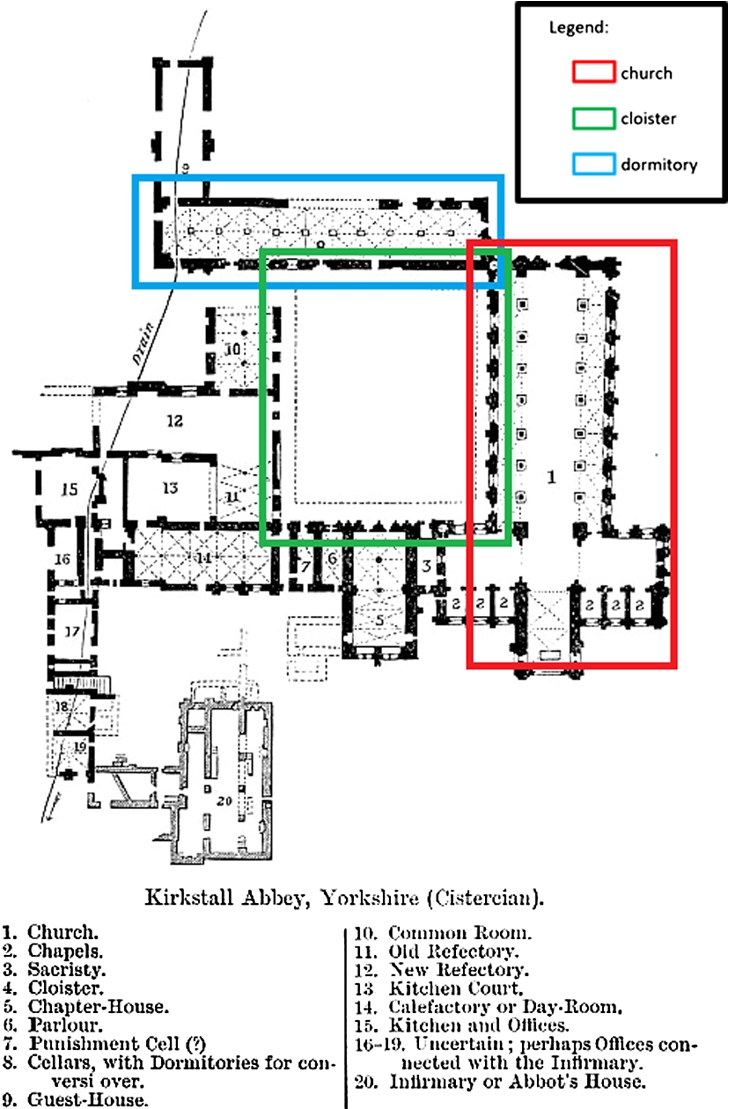
Kirkstall Abbey, Kirkstall, England.5
Image credited to www.heritage-route.com, Aix-Marseille Université.
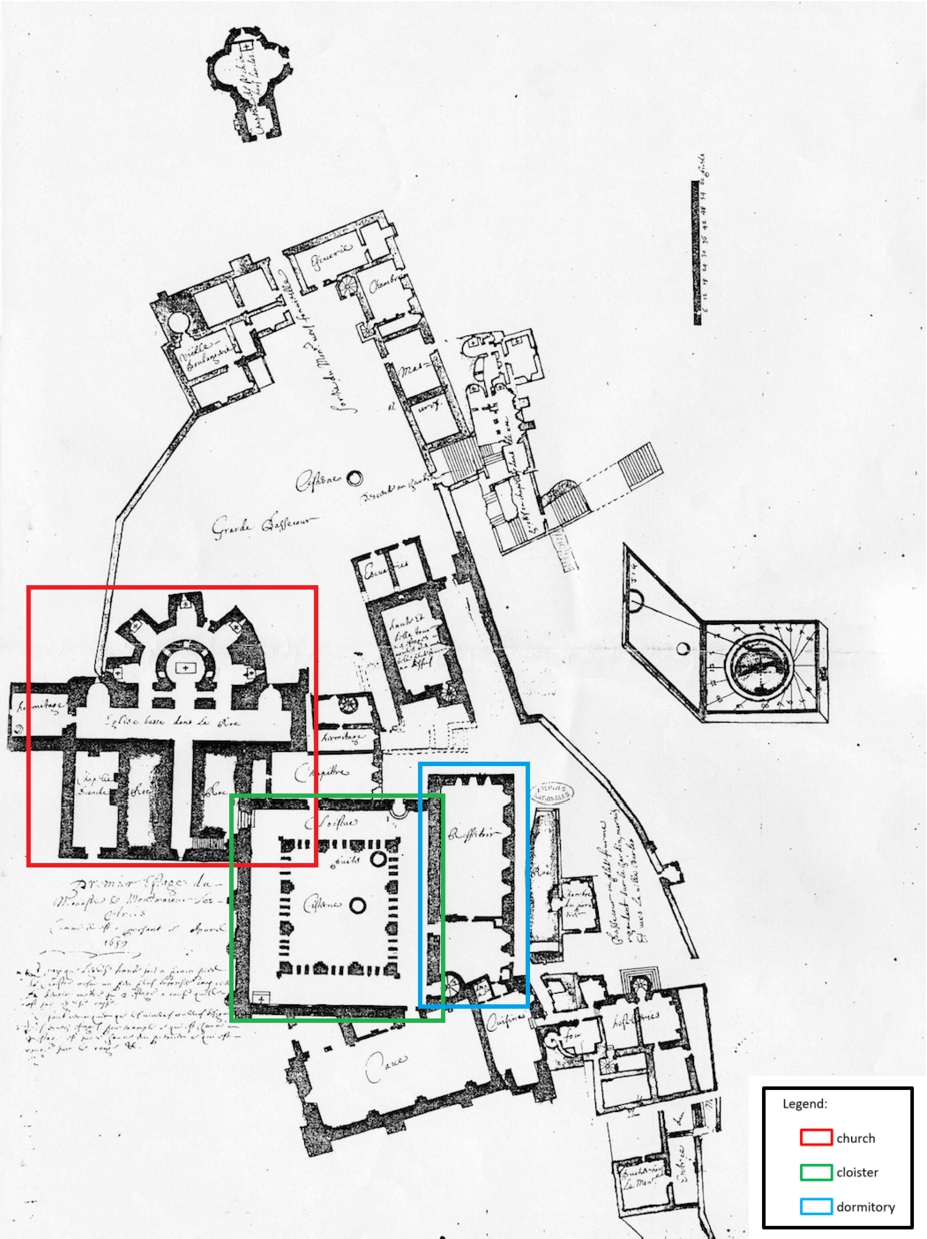
Montmajour Abbey, Arles, France.6
Image credited to “I monasteri italogreci e benedettini in Basilicata”, Luigi Bubbico, Luigi Caputo, Attilio Maurano, 1996, per il Ministero dei Beni Culturali e Ambientali, Sopraintenenza per i Beni Culturali e Architettonici della Basilicata.
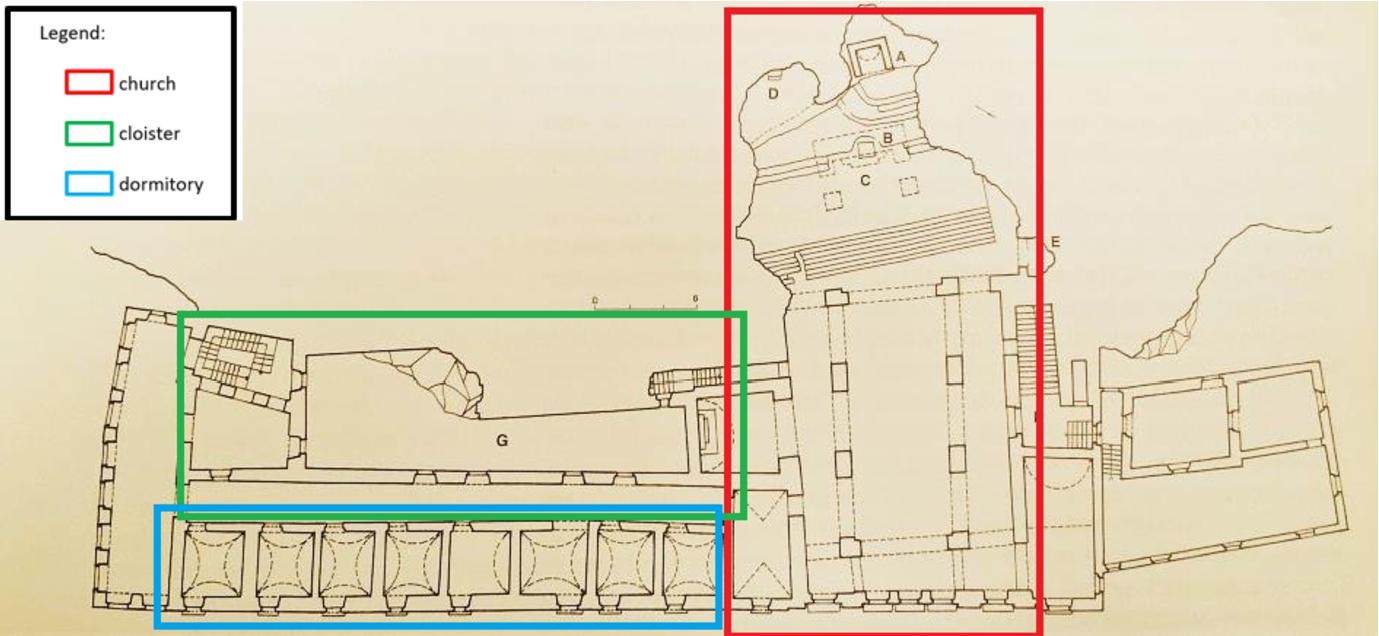
S. Michele in Vulture, Monticchio, Italy.7
Image credited to www.architecturalpapers.ch.
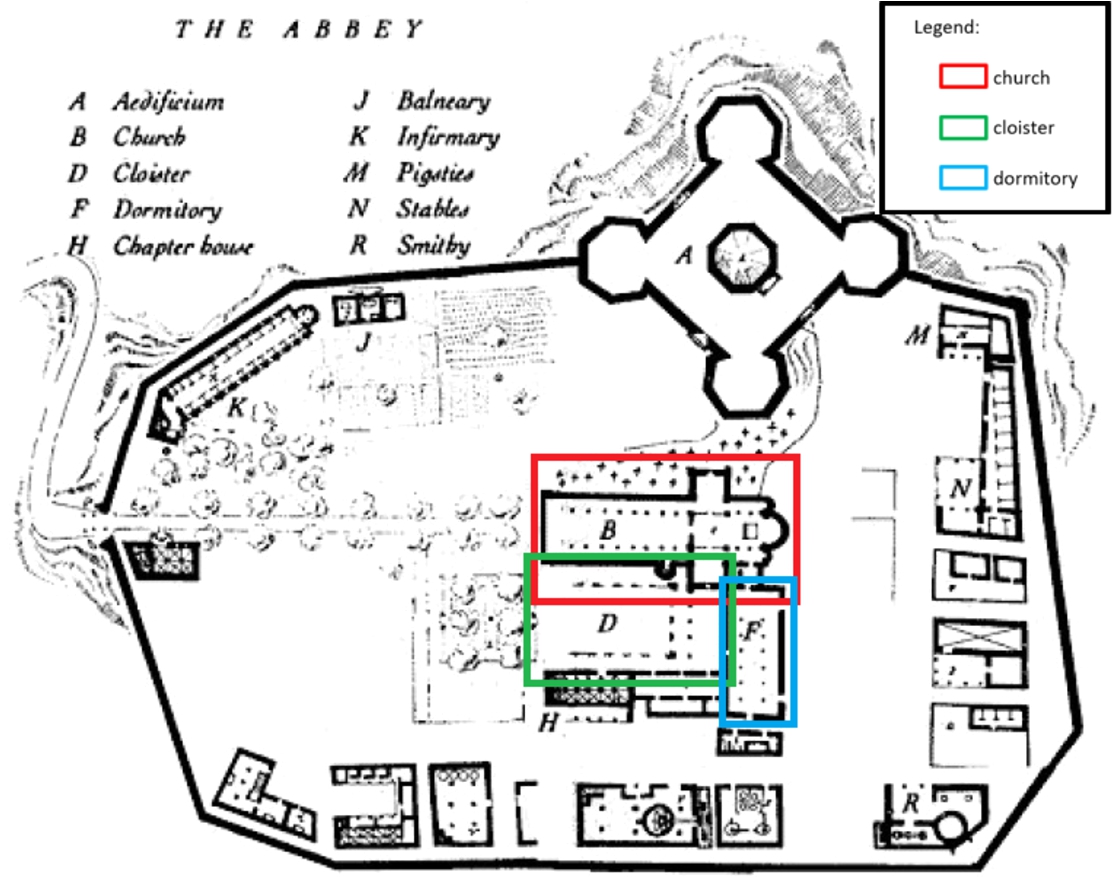
Sketch of the Monastery in the novel “Il nome della Rosa” by Umberto Eco.8
Image credited to www.GreatBuildings.com.
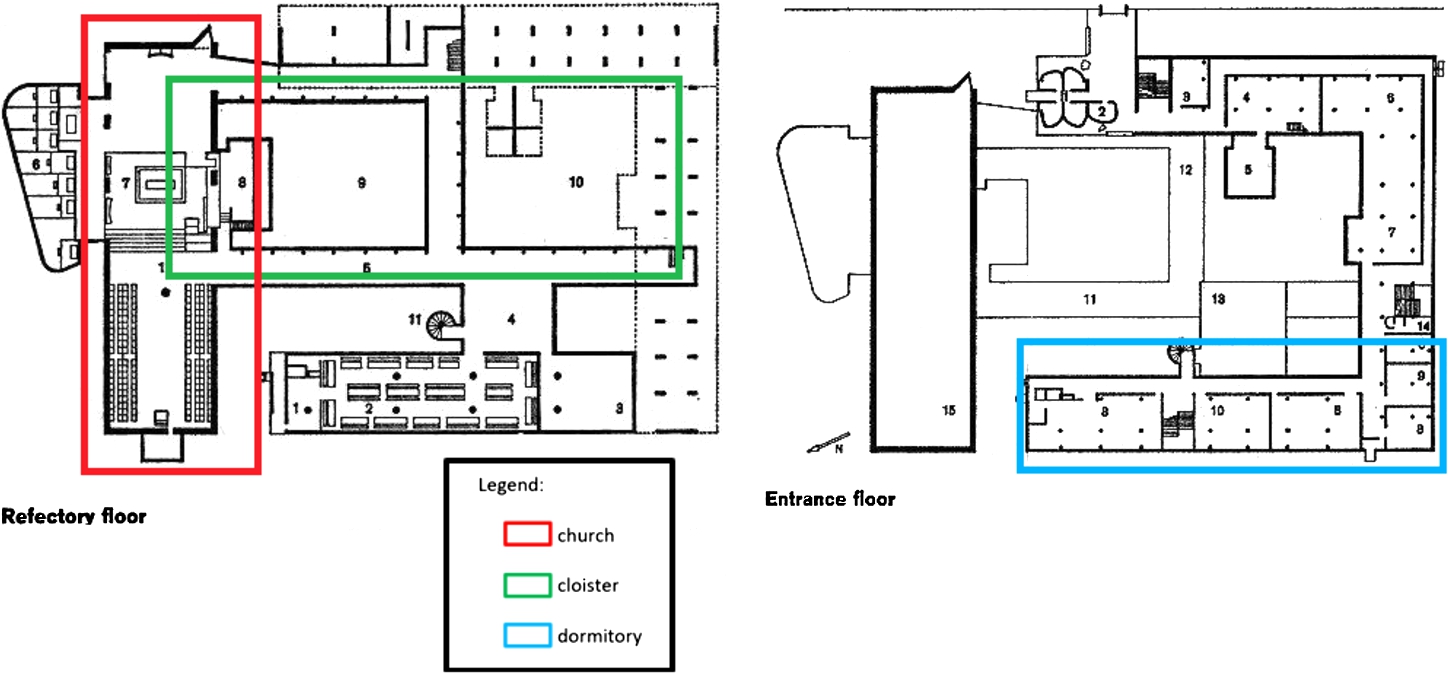
Monastery of La Tourette, Éveux, France.9
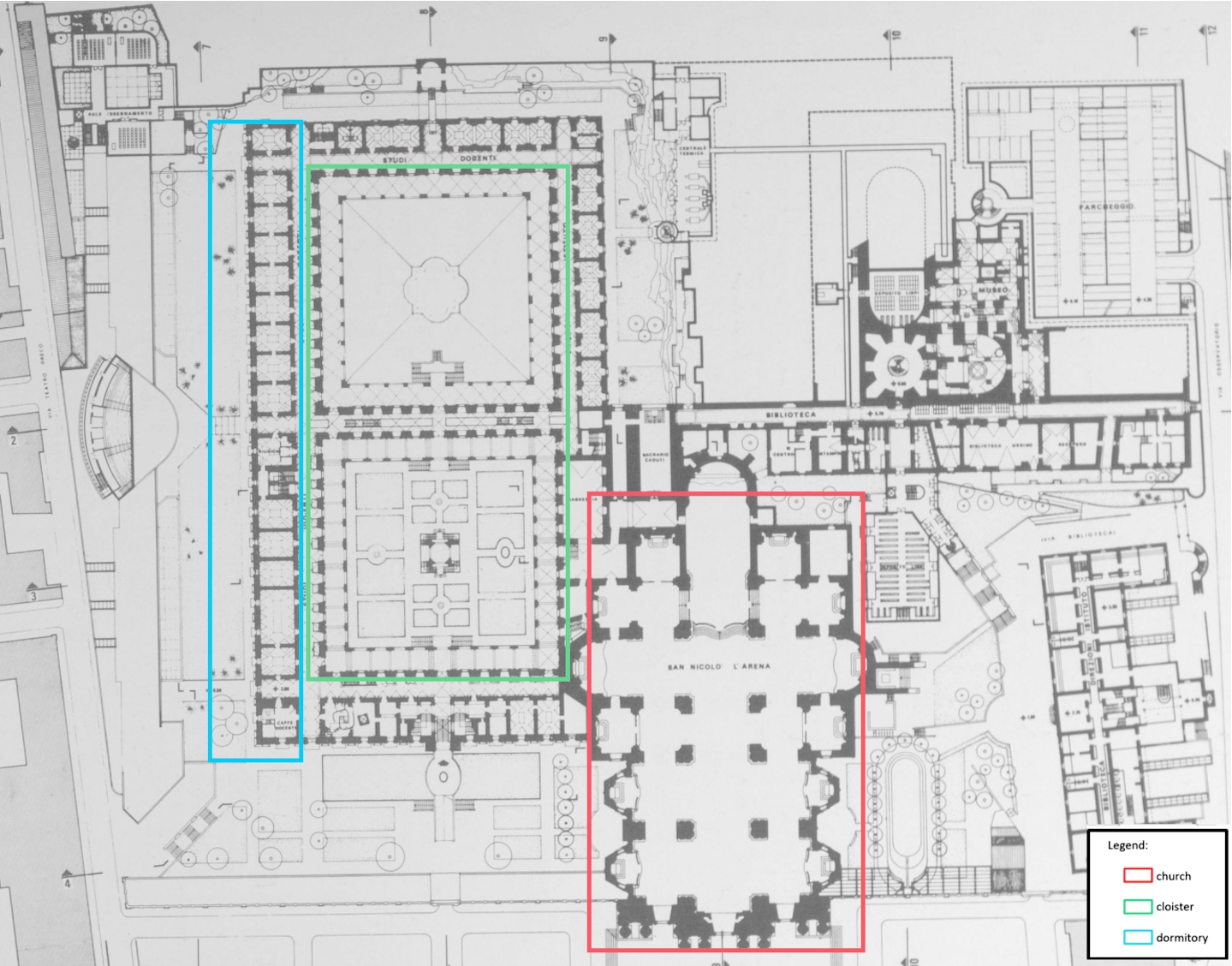
Monastery of San Nicolò l’Arena, Catania, Italy.10
The strength of setting offered by the Saint Gall plan program, namely the fact that it represents a meta design, what should be there and where, travels across centuries. Two emblematic examples are the imaginary monastery represented in Fig. 7 and La Tourette Monastery depicted in Fig. 8, both conceived in the second half the XX century.
Finally, the Benedictine Monastery of San Nicolò l’Arena in Catania (Sicily) (Leonardi and Cantale (2017); Mannino, 2015; Atripaldi and Costa (2008); DeCarlo, 1988; Librando (1988)) contains most of the elements of the Saint Gall plan with the exception of some locations such as the brewery that, for cultural reasons, has been replaced by a distillery. Moreover, Catania’s Benedictine Monastery is a urban monastery and therefore the structure of the animal farms is also slightly modified. Such questions are treated in some details in Section 3.5.
Image credited to “Un Progetto per Catania”, Giancarlo De Carlo (1988).
Next, we briefly report on the two foundational ontologies used by the
CIDOC-CRM is the international official standard ISO 21127:2006 for the controlled exchange of information in cultural heritage since 2006. It has been used by the
CIDOC-CRM serves as guideline for good practices of conceptual modelling in the cultural heritage context, and provides a high-level set of specifications used to construct a semantic web-based information system which improves information sharing. Nowadays, many institutions are adopting CIDOC-CRM: galleries, libraries, museums, archives, and several other cultural environments based on cultural heritage information that publish and share semantic web data. The CIDOC-CRM core covers several general aspects of cultural information, such as material and immaterial entities, events, space, and time. The general concepts provided by CIDOC-CRM can be specialized, contextualized and integrated in order to address practical aspects of cultural heritage issues. CIDOC-CRM also introduces several notions acting through temporal entities such as participation, appellation, part-hood and structure, material and immaterial concepts, location, assessment and identification, purpose, motivation, and so on. In this context, actors operate or deal with material and immaterial stuff within a certain temporal window. Such participation can occur in some real or figurative place. Moreover, everything can be classified in more details by introducing a “type” and can be identified by some appellations such as name, labels, or title. The existence of objects that have a persistent life-span such as birth, death, creation, destruction, and so on, can be limited in specific temporal windows. Activities and events that introduce some changes of state in cultural, social, or physical systems can be modelled in CIDOC-CRM together with their results or products. Finally, objects and events that influenced or motivated activities can be also modelled by means of different forms of influence and their mutual relations.
EDM is an ontology for collecting, connecting, and enriching cultural heritage information provided by content providers. In fact, EDM introduces several entities both new and re-used from other namespaces such as the
EDM has been used by the
The
The
These are defined as subclasses of the CIDOC-CRM class
One of the most important partition criteria of buildings in the Saint Gall map concerns their functionality. The map identifies five main groups of buildings: buildings for education, for hospitality, for sick and infirm people, factories and farms, and monastic buildings, the latter group including the church, which receives a special consideration. Consequently, we modelled the functional areas of the monastery, by classifying the buildings represented on the map according to their intended use and position as reported in the Saint Gall map and in (Willis, 1848; De Vecchi and Cerchiari (1995); D’Onofrio, 1994; Gombrich, 1950; Kubach, 2001). Specifically, we introduced as subclasses of
The class
The green spaces inside the monastery are modeled by means of the class
The classes
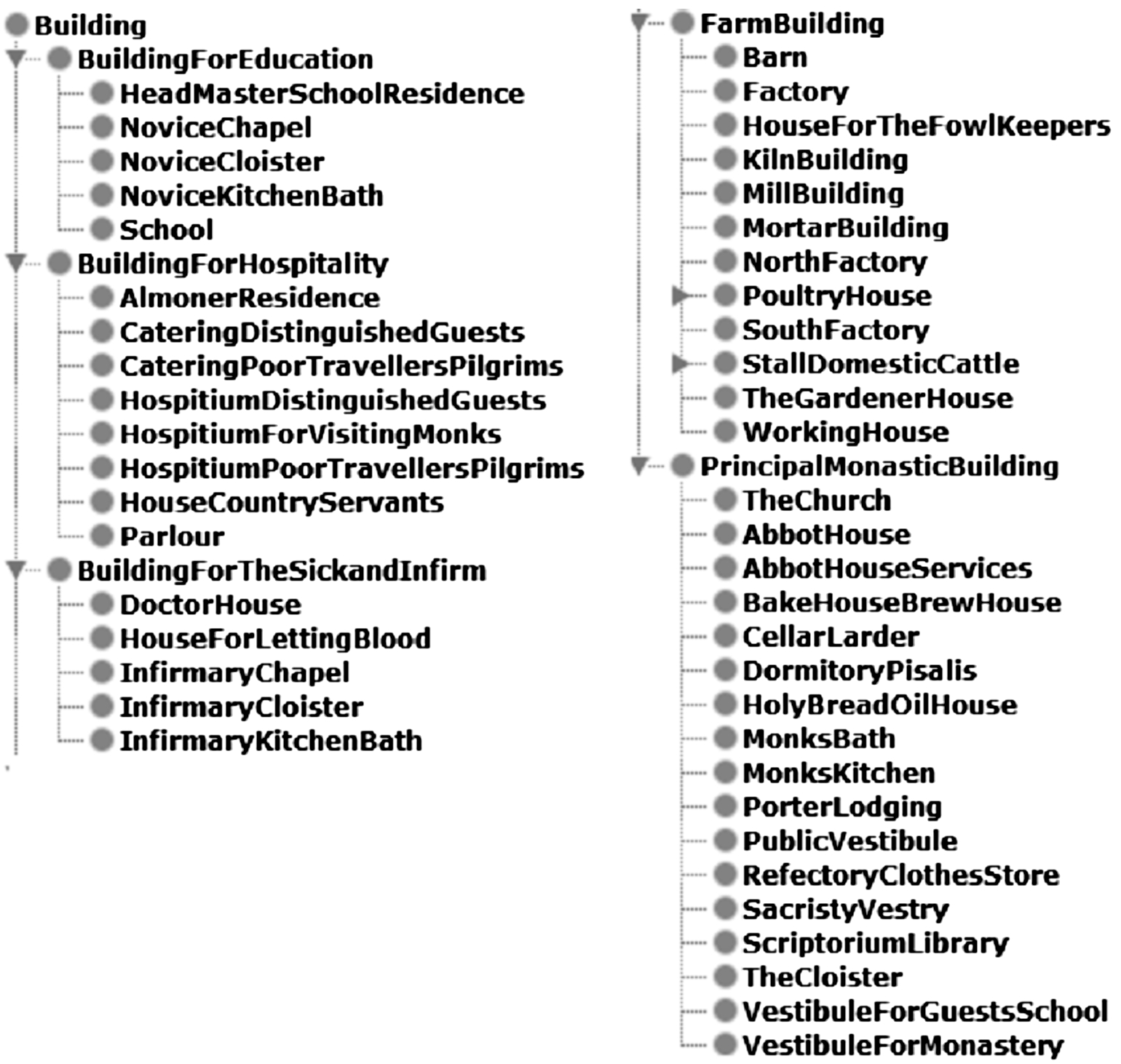
Subclass hierarchy of
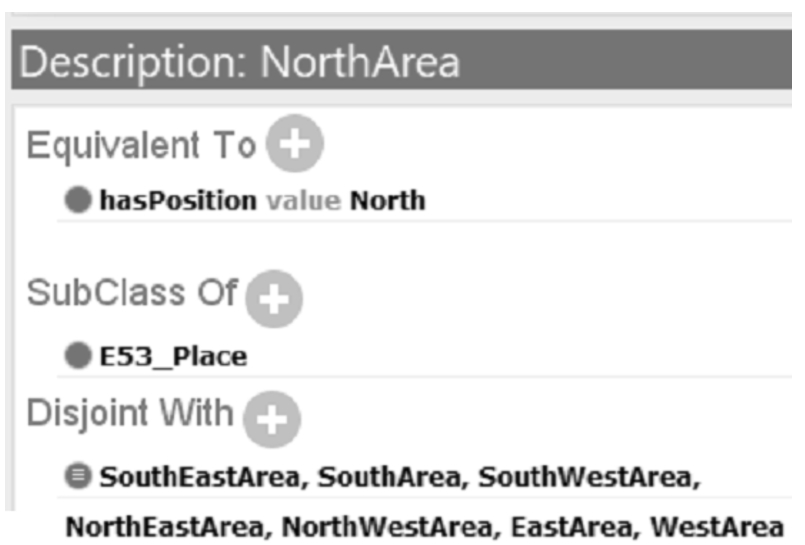
Description of
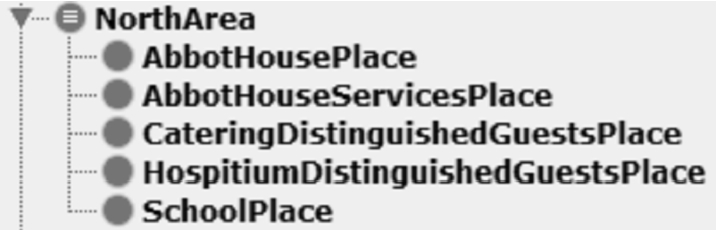
Inferred hierarchy of
We define the position of buildings or gardens in the map with respect to other contiguous buildings or gardens by means of the object-properties
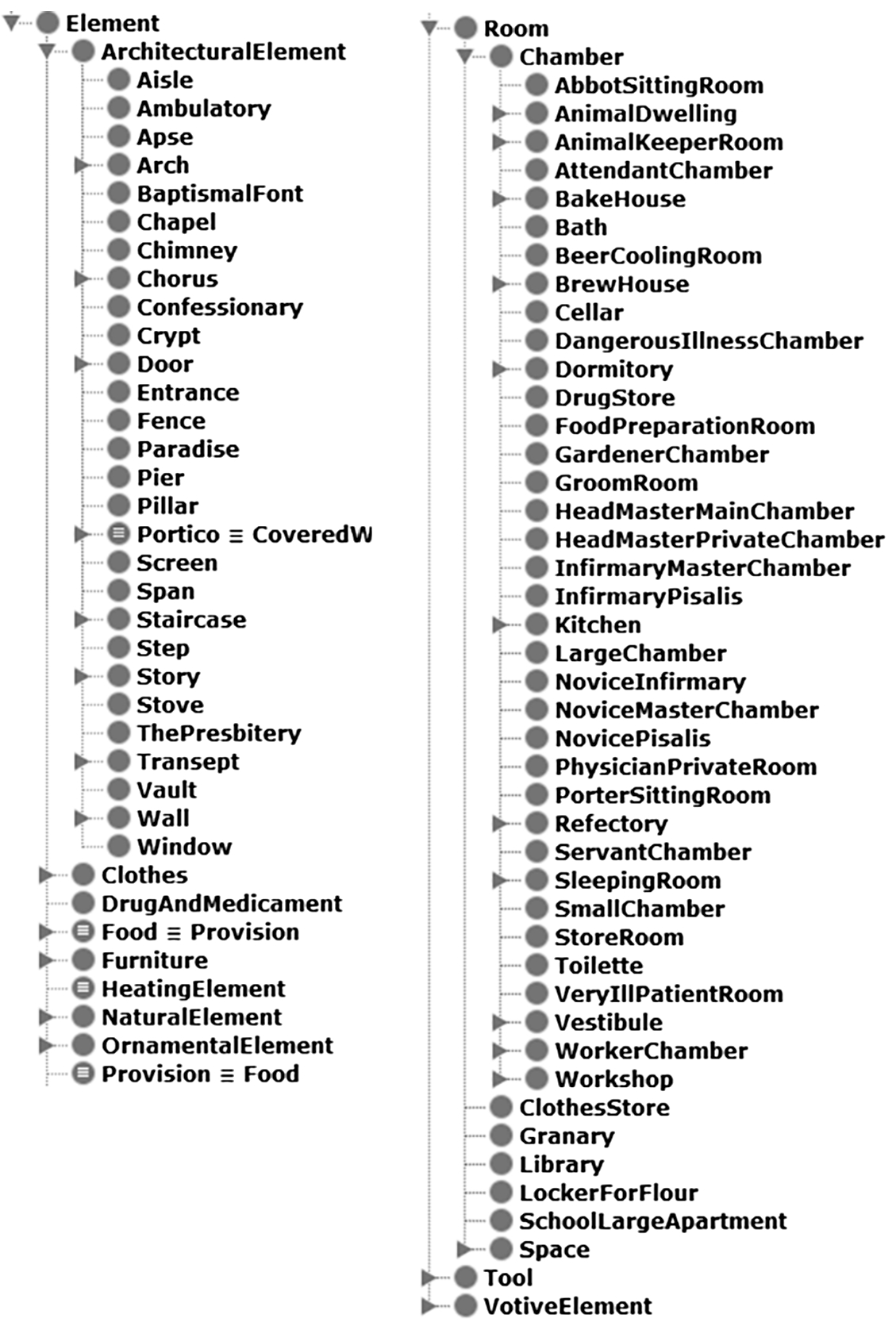
For the sake of modelling the shape, the size, and the internal structure of buildings and gardens, we introduce the following entities: the class
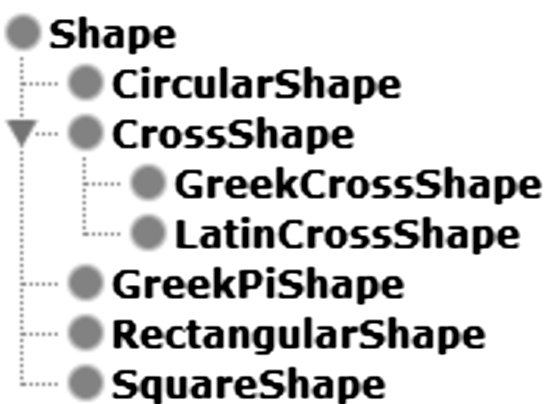
Subclass hierarchy of
In the
The class
In order to relate buildings with the elements they contain, we provided the object-property
Subclass hierarchy of
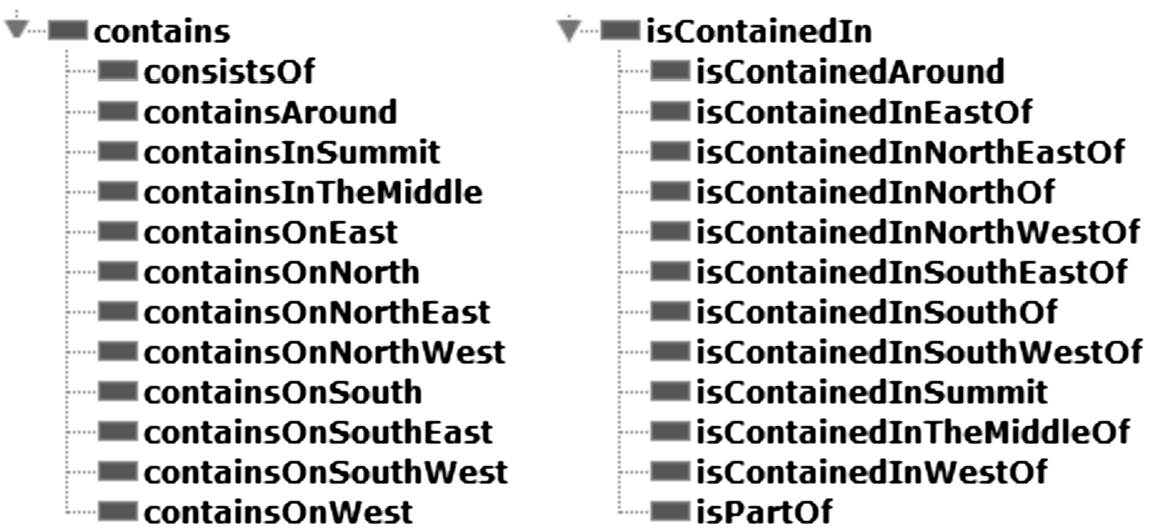
Object-properties related to the class
In Fig. 15 we show the picture of the abbot house as depicted in the Saint Gall map, and we report our OWL 2 model of the abbot house, as represented by the tool Protégé.16
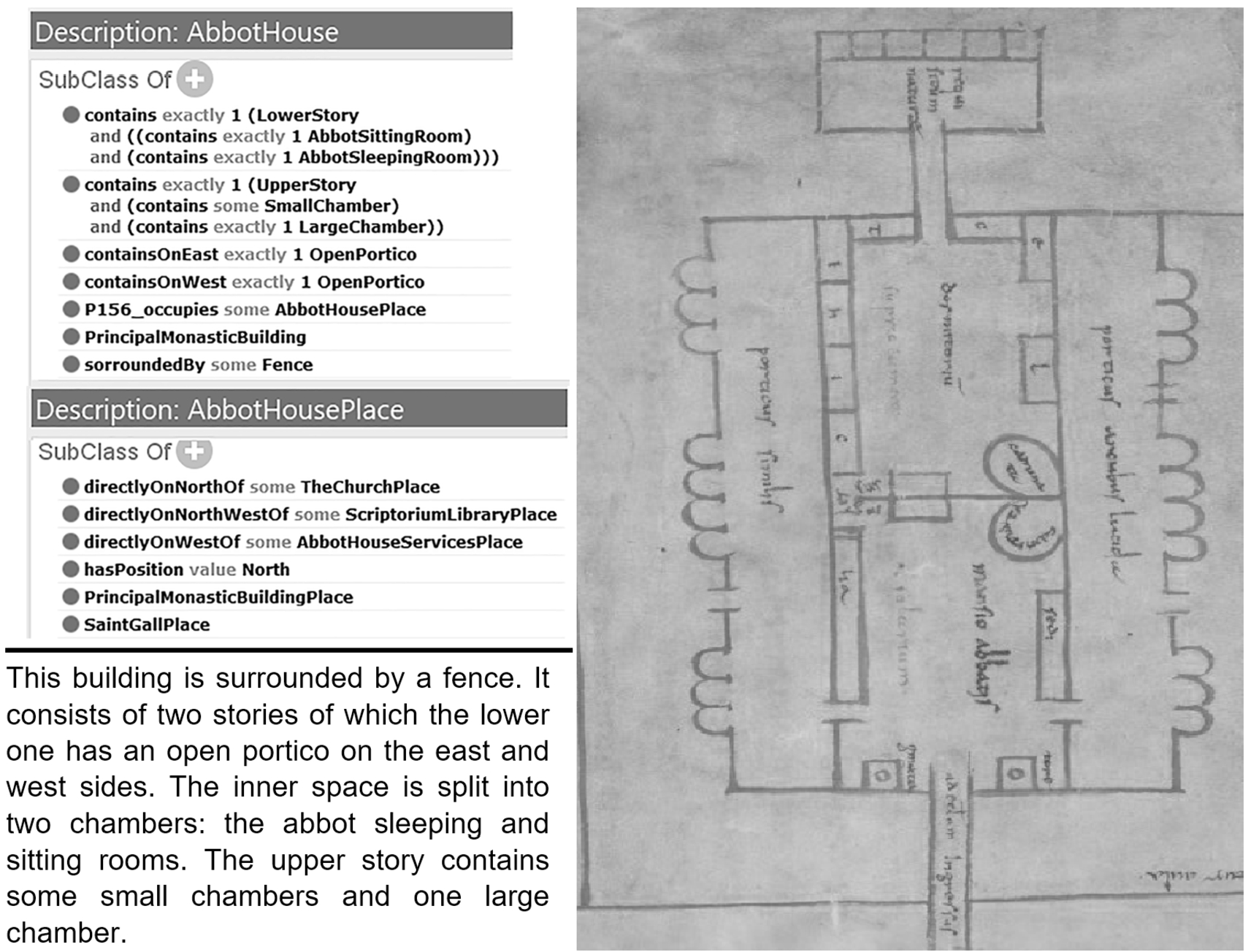
Example of the abbot house.
This building, inhabited by the abbot, is surrounded by a fence. In accordance with the nullius diocesis rule, it is a major building consisting of two stories of which the lower one has an open portico on the east and west sides. The inner space is split into two chambers, namely the abbot sleeping and sitting rooms. The upper story contains some small chambers and one large chamber. Details concerning the furniture of the abbot sleeping and sitting rooms are modeled by the classes
As Fig. 15 shows in the specific case of the abbot house, our OWL 2 representation of the Saint Gall map was developed so as to be as faithful as possible to the textual description by Willis (1848) and to the map.
Another important case is represented by the monk cloister which is reported in Fig. 16 (inside the black circle). Even in this case, our OWL 2 representation tightly reflects the map and the descriptions by Willis (1848) and Kubach (2001), the latter partially reported in Section 3.1.
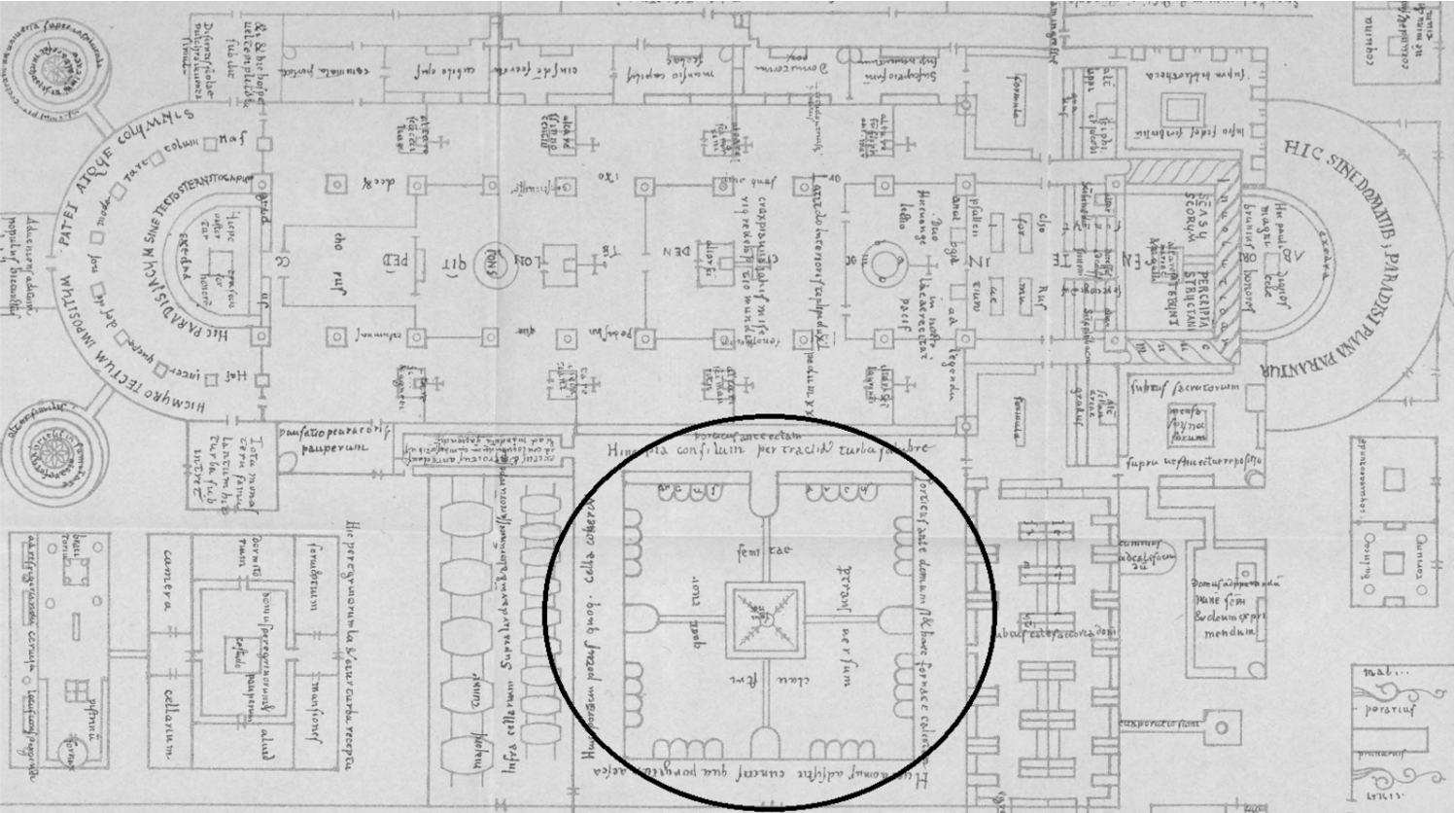
Detail of the monks cloister (inside the black circle).
The cloister court is located on the south wing of the church. It is constituted by a large area bounded on the north by the church and on the other sides by three important buildings of the monastery: the parlour, the dormitory, and the refectory. The parlour serves as a vestibule to the cloister and as a space where servants receive orders by superiors and visitors can meet the monks. The refectory is used as dining and amusement room. The cloister also contains a passage to a cellar with larder for storing food. It is surrounded by a covered walk, called porticus, and contains in the centre an open space with a fountain or water source, probably laid out with grass or shrubs. The cloister is characterized by the presence of a portico, rested on a low perimetric wall and admitting light inside the spaces annexed to the gallery. For each side of the cloister, there is a big central arch that gives access to the garden. The cloister connects the different areas of the cenoby; it allows monks to use the portico as a place where to rest and have shelter from bad weather.
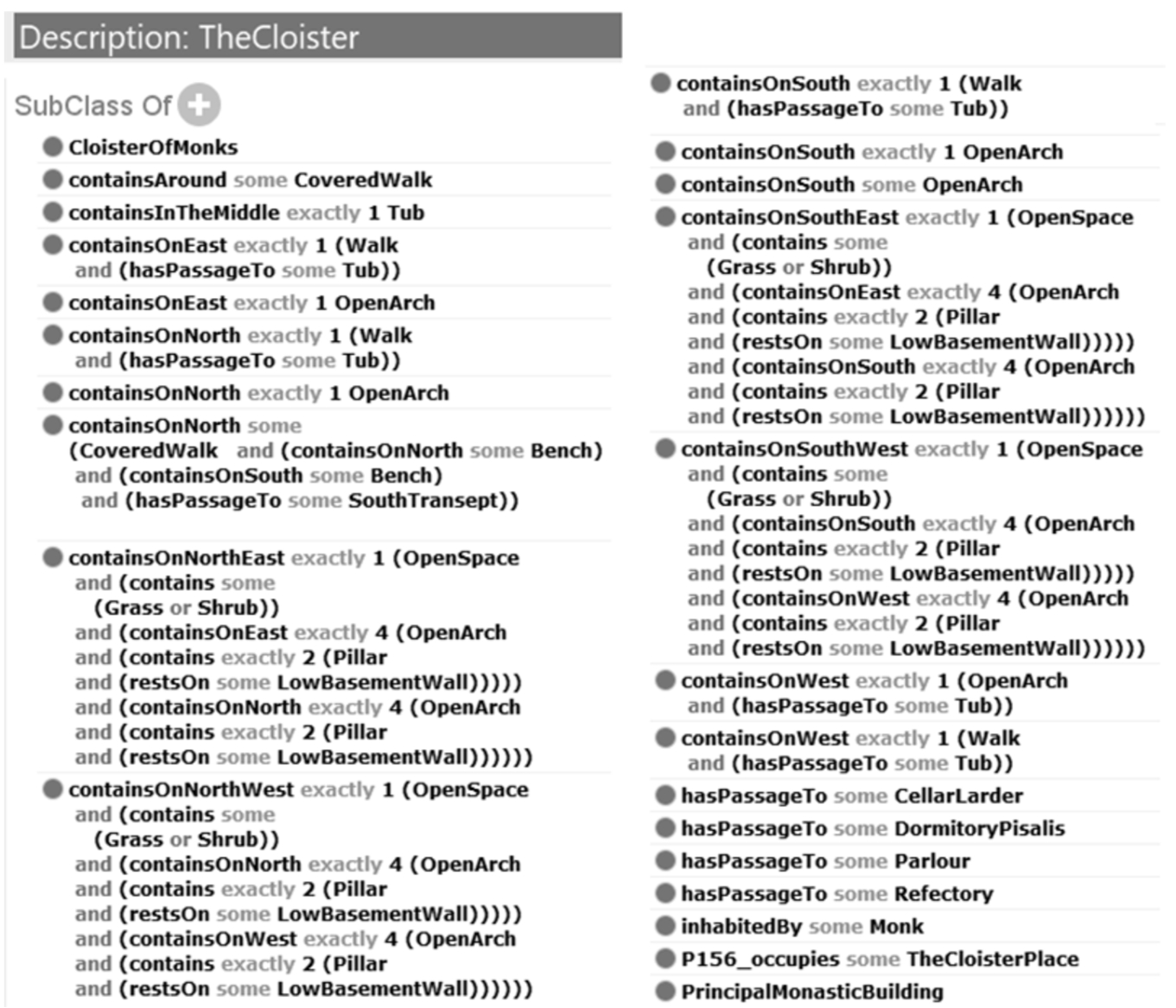
Description of
Our OWL 2 model of the monk cloister, as represented by the tool Protégé, is illustrated in Fig. 17.
Persons are classified according to the place in which they live and work for most of the day by means of the object-properties
We introduce a hierarchy having as root the class

Description of the abbot of a monastery.
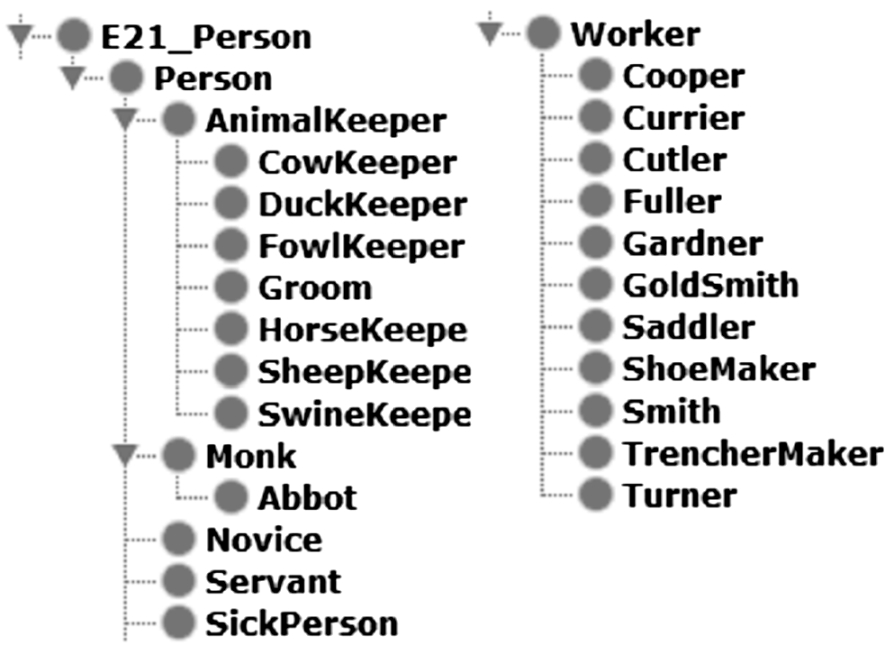
Hierarchy describing persons living and working in a monastery.
This section discusses structural metrics and evaluation criteria for the
The main evaluation criteria for the
The results are shown in Table 2 and are explained below.
OntoQA metric results
OntoQA metric results
The relationship richness metric reflects the diversity of the relations and the placement of the relations occurring in the ontology. An ontology that contains more property relations other than class/subclass relations is richer than a taxonomy (with only class/subclass relationships). The value of relationship richness is a percentage representing how much relationships between classes are rich with respect to all of the possible connections (inheritance and properties). With a value of
The inheritance richness describes the distribution of information across the different levels of the inheritance tree of the classes. It is an indicator of how well knowledge in the ontology is grouped into distinct categories and subcategories. This measure can help to distinguish a horizontal ontology from a vertical one, or from an ontology with different levels of specialization. A horizontal (or flat) ontology has a small number of inheritance levels, and each class has a relatively large number of subclasses. In contrast, a vertical ontology contains a large number of inheritance levels where classes have a small number of subclasses. An ontology with a low inheritance richness would be of a vertical nature, which might reflect the fact that the ontology represents a very specific and well detailed knowledge. An ontology with a high value of inheritance richness has a horizontal nature, which means that the ontology represents a wide range of general knowledge. The
The tree balance metric is referred to how much class hierarchies differ in deepness. This may be related to the fact that some hierarchies are very deep whereas others are not. The
The attribute richness calculates the average number of attributes per class, which gives insight into how much knowledge about classes is represented in the model. An ontology with a high value for attribute richness indicates that each class has averagely a high number of attributes, namely that it is specified in detail, whereas a low value might indicate that little information is provided about each class.
The class richness is related to how instances are distributed across classes. An ontology having a very low class richness does not have data exemplifying the knowledge represented in the model. On the other hand, a high value of such metric (close to
Finally, the average population is an indicator of the number of instances divided by the number of classes, whereas the instance coverage indicates how much each class is populated.
The
As additional non-measurable evaluation criteria for the
consistency: consists in verifying that contradictions cannot be inferred from the ontology;
clarity: consists in checking whether terms defined in the ontology effectively communicate the intended meaning and definitions are given in an objective way;
extendibility: regards the issue of checking whether the ontology offers a conceptual foundation for the considered domain and it can be extended and specialized monotonically (new terms can be introduced without the need of revising existing axioms).
The consistency criterium has been evaluated by checking the classification of the ontology with the Fact++ reasoner which performs well with ontologies admitting axioms containing existential (“Some values from”) and universal (“All values from”) OWL restrictions.17
In order to guarantee that the clarity criterium is fulfilled, the ontology has been developed as a faithful OWL 2 representation of the Saint Gall chart and of its textual description by Willis (1848) (for example, see Fig. 15).
The extendibility criterium has been evaluated by integrating the ontology
Comparison among the places of the
The monastery of Catania has almost all the characteristics described by the
We presented an ontology for the Saint Gall plan that describes the ideal model of a monastic Benedictine building. The plan allows one to study the most significant features of European monastic buildings such as the Monastery of San Nicolò l’Arena in Catania, the Abbey of Santa Giustina in Padua, the Cluny Abbey, and the Montecassino Abbey De Vecchi and Cerchiari (1995). We expect that by means of the
In order to provide support to the analyses and to the actions concerning the architectural type of Monastery, it was deemed appropriate to model the ontology of an ideal monastery such as the Saint Gall map, which can be potentially extended/specialized, on a case-by-case basis, by providing the architectonic specification of the considered monastery. Indeed, the ontology introduced in this work can be considered as a general support tool for all the refurbishment, recovery, and change-in-use actions concerning a Benedictine monastery, or, more generally, the architectural type of Monastery.
We are currently considering the integration of the
The