We consider the homogenization of a singularly perturbed self-adjoint fourth order elliptic operator with locally periodic coefficients, stated in a bounded domain. We impose Dirichlet boundary conditions on the boundary of the domain. The presence of large parameters in the lower order terms and the dependence of the coefficients on the slow variable lead to localization of the eigenfunctions. We show that the jth eigenfunction can be approximated by a rescaled function that is constructed in terms of the jth eigenfunction of fourth or second order effective operators with constant coefficients.
We study the spectral asymptotics of a self-adjoint fourth order elliptic operator with locally periodic coefficients. The problem is stated in a bounded domain, and we impose Dirichlet boundary conditions on the boundary of the domain. The problem can be viewed as a combination of homogenization and singular perturbation. Because of the rapidly varying coefficients, homogenization arguments can be applied after a proper rescaling of the equation. As a result, we obtain an effective problem stated in the full space, which is of fourth or second order, depending on the choice of the large parameters (, in Eq. (1)). We focus on values of the parameters for which the eigenfunctions localize and prove that the eigenfunctions of the original problem converge to the properly rescaled eigenfunctions of the effective problem.
Similar problems for second order locally periodic elliptic operators, that are closely related to the present paper, were studied in [20,21]. Dependence of the problem on a slow variable, in the coefficients or in the geometry, together with the presence of a large parameter in the equation gives rise to the effect of localization of eigenfunctions. These results correspond to the so-called subcritical case, when eigenfunctions can be approximated by eigenfunctions of a harmonic oscillator operator.
A second order locally periodic elliptic operator with a large potential was studied in [4]. Homogenization of periodic elliptic systems with large potential was treated in [2]. In both cases, under a generic assumption on the ground state of an auxiliary cell problem, it was proved that the solution can be approximately factorized as the product of a fast oscillating cell eigenfunction and of a slowly varying solution of a scalar second order equation. These two cases correspond to the so-called critical case.
There is a vast literature devoted to the homogenization of elliptic systems and higher order elliptic equations in domains with microstructure. For the homogenization of linear elliptic systems we refer to [6,15,18,24]. Homogenization of boundary value problems for higher order equations in domains with fine-grained boundary were studied in [10,11,16,19]. Homogenization of linear higher order equations in perforated domains were studied in [7,12,23]; nonlinear higher order equations in perforated domains were considered in [9,13]. In [17] spectral asymptotics for a fourth order elliptic operator with rapidly oscillating coefficients were obtained. Spectral asymptotics for a biharmonic operator in a domain with a deeply indented boundary were constructed in [14].
Problem statement
Let Ω be a bounded domain in with Lipschitz boundary . We consider the following Dirichlet spectral problem for a fourth order self-adjoint uniformly elliptic operator:
where n denotes the exterior unit normal to . We use summation convention over repeated indices and use “·” for the standard scalar product in ; is a small parameter; α, β are positive parameters.
Our main assumptions are:
The coefficients are real and of the form , and , where the functions , are periodic in y; is the torus of measure one. As a consequence, there is such that .
Symmetry condition: , .
The coefficients satisfy the uniform ellipticity condition in : there is such that, almost everywhere,
The function is assumed to be strictly positive almost everywhere in , and its local average
has a unique global minimum at , with a non-degenerate Hessian :
The coefficients satisfy the uniform ellipticity condition in : there is such that, almost everywhere,
For we denote the -norm of u by , and
We consider the following bilinear form corresponding to (1)
The weak form of (1) reads: Find and nonzero such that
for all .
By the Riesz–Schauder, Hilbert–Schmidt theorems and the minmax principle ([8,22]), for each ε small enough, we have the following characterization of the spectrum.
Suppose that (H1)–(H4) are satisfied. Then for all sufficiently small , the eigenvalues of (1) are real and such thatwhere each eigenvalue is counted as many times as its multiplicity. The eigenfunctions form an orthonormal basis in. All eigenvalues are of finite multiplicity and are characterized by the variational principle:where the minimum is taken over all nonzero functions v inthat are orthogonal into the firsteigenfunctions.
The goal of this paper is to describe the asymptotic behavior of the eigenpairs , as . We restrict ourselves to the values of the parameters , (singular perturbation) such that (the concentration effect is observed) and (subcritical case). The result is presented in the three Theorems 3.1, 4.1 and 5.1.
In the case we get no concentration, and the standard two-scale convergence can be applied to describe the asymptotics of eigenpairs. Depending on the value of α one gets either fourth order limit operator without second order terms (), or fourth order with second order terms (, ), or just a second order limit operator ().
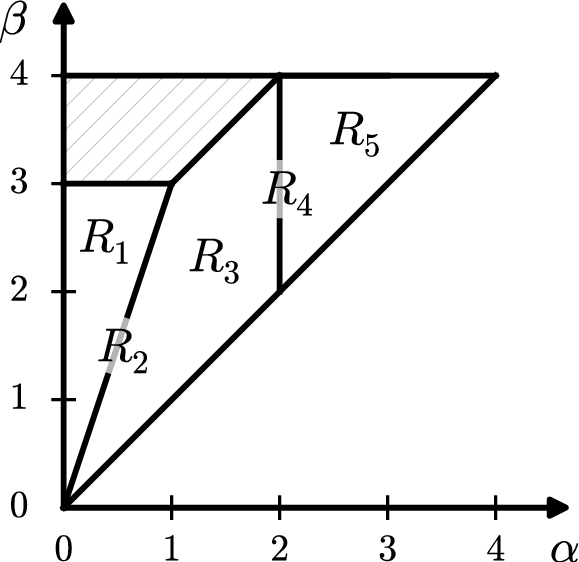
The case , is the critical case, when the oscillations of the eigenfunctions are expected to be of order ε. As it is seen from [2], the technique to be used is different, and this case is to be considered elsewhere. In addition, the values of α, β such that and are not covered by the present paper (the hatched region in Fig. 1), because the error coming from Lemma 3.3 while passing to the limit does not vanish, as (see the proof of Lemma 3.7). In that region one has to consider the oscillations coming from the potential more carefully, which is also the case for the corresponding region for the second order operator, and it is to be considered elsewhere.
To describe the asymptotic behavior of eigenpairs as , we divide the domain for the parameters into the following regions (see Fig. 1):
The reason for distinguishing these regions is that we get different asymptotics in each case. In short, in we get a fourth order equation in the limit without second order terms; in the limit equation contains both fourth and second order terms; in , , the limit equations are of the second order. We choose to consider in details one case , corresponding to region , since all the terms contribute in the limit (see Theorem 3.1). The spectral asymptotics in the other cases are described in Sections 4 and 5.
The results in this paper are presented as Theorems 3.1, 4.1 and 5.1. The rest of this paper is devoted to the proofs of these theorems.
The partition of the parameter region for .
A model problem: The case
The result of this section is contained in the following theorem.
Letand letbe the kth eigenpair of (1) normalized by. Suppose that the conditions (H1)–(H4) are satisfied. Then we have the following representation:whereare such that, as ,
,
up to a subsequence,converges toweakly inand strongly in,
whereis the kth eigenvalue and is an eigenfunction corresponding to, normalized by , of the uniformly elliptic effective problem withdefined by (18),, and .
The proof of Theorem 3.1 will occupy the rest of this section and is given for the case . The argument used is the same for the other values of .
The localization of eigenfunctions appears in the current problem due to the simultaneous presence of a slow variable in the coefficients and a singular perturbation. Neither locally periodic coefficients, nor the singular perturbation alone will lead to the concentration effect. Note that it is not necessary that the dependence on the slow variable is in the coefficients of the operator: it can be in the geometry of the domain instead (see, for example, [20] for the case of locally periodic perforation).
Estimates for eigenvalues of the original problem
To motivate the change of variables we will make in the next subsection, we prove the following a priori estimates for the eigenvalues and the eigenfunctions of problem (1).
Suppose that (H1)–(H4) are satisfied. Let be the ith eigenpair of (1) with, normalized by . Then there exist positive constants ,such that for all sufficiently small,
To prove Lemma 3.2 we will use the following estimate for integrals of oscillating functions.
Letbe such thatfor all. Then there exists a positive constant C such that for all.
Let , periodic in y, be defined by
Since the local average of is zero, Ψ is well-defined. By the Green formula,
After an application of the Green formula to the term coming from , by the Hölder and triangle inequalities, we have
The estimate follows from the regularity of Ψ and the Poincaré inequality. □
Let be such that , and set . We assume that ε is small enough such that . By the variational principle,
By the boundedness of the coefficients, the first fraction in (4) is bounded by . The second fraction in (4) is estimated using (H4) and Lemma 3.3:
for sufficiently small .
In order to obtain an estimate from below for the first eigenvalue , we need to estimate the second derivatives of the corresponding eigenfunctions. Let denote any eigenfunction corresponding to , normalized by . Then, by (3),
On the one hand, by the ellipticity of and the boundedness of the coefficients,
where in the Cauchy inequality is chosen small enough such that the resulting constant C is positive. One can choose γ that depends just on the ellipticity constant of and the upper bound for .
On the other hand, from the upper estimate for ,
where we in the third step used that 0 is a minimum point for by (H4), and Lemma 3.3.
Combining (5) and (6), by the Cauchy inequality, we deduce that,
We proceed with the estimate from below for . By (5) and (7) we have
By (H4) and Lemma 3.3, combined with (7),
for all sufficiently small . In this way we have obtained the required estimates for the first eigenvalue . Since is the smallest eigenvalue, the estimate from below for , , follows from the corresponding estimate for .
To estimate for from above, one can use as a test function the projection of onto the orthogonal complement of the span of the first eigenvectors, with respect to the inner product. Since the span is finite dimensional this projection is nonzero for all sufficiently small .
Let be the multiplicity of the first eigenvalue . We estimate from above , similar arguments can be applied to estimate the other eigenvalues.
For , we introduce and denote , . Then is orthogonal in to . For convenience we assume the normalization condition
Using as a test function in the variational principle, we deduce that
By (H1)–(H3) and Lemma 3.3 we get
Due to (8) , (9) and the estimate from below for ,
Due to the normalization condition for ,
thus
and the estimate is proved. □
Rescaling the problem and computing the asymptotics
Led by Lemma 3.2, we shift the spectrum of (1) by and rescale such that the eigenvalues become bounded. Let
Then (3) takes the form
for any , where
For the rest of , one uses .
In order to describe the asymptotic behavior of eigenpairs of (11), we consider the Green operator
where is the unique solution to the boundary-value problem
Here is a large enough constant, but depending just on the ellipticity constant Λ. The operator can be considered as an operator from into itself by extending the corresponding solution by zero outside . The existence and uniqueness is ensured by the Riesz–Fréchet representation theorem since the corresponding symmetric quadratic form
is coercive. Indeed, by (H1)–(H4) and Lemma 3.3 we have:
Since the Hessian matrix H is positive definite, there exist a positive constant such that
Due to the Dirichlet boundary conditions,
Applying the Cauchy inequality with in (14) we get
For ε small enough, we can choose μ depending just on Λ and such that, for some positive constant , we have
Even though is enough for coercivity of the quadratic form, we will make use of the last inequality. The addition of the constant μ has the effect of shifting the entire spectrum of (11) by μ.
We introduce also the limit Green operator
where is the unique solution to the equation
Here H is the Hessian matrix of at (see (H4)), and the effective coefficients are defined by
where the periodic functions solve the following cell problems:
Due to the periodicity of in y, the above problem is well-posed, the solution is unique up to an additive constant.
Under the assumptions (H1)–(H4),defined by (18) is coercive on, i.e. there is a positive constant C such that for all.
Due to (H1)–(H4), is well-defined. We rewrite (18) as
Using as a test function in Eq. (19) for we obtain
Thus
The last equation shows that is symmetric by (H2): . Moreover, with we obtain
by the coerciveness of guaranteed by (H3). The last inequality implies that is positive definite. Indeed, if is such that , then for all p, q. It follows that for all q. Therefore, is constant and so necessarily is periodic by the periodicity of . Hence for all i, q. We conclude that for all ,
By the compactness of the unit ball in , there is a positive constant C such that for all . □
The bilinear form corresponding to (17) takes the form
and it is coercive. Namely, there exists a positive constant such that
Thus, by the Riesz–Fréchet representation theorem, the Green operator is well-defined. Using Lemma 3.4 we see that the operator G is self-adjoint. Moreover, due to the compact embedding of in , the operator G is compact as an operator in ; is the weighted -space with the weight . As a direct consequence, we have the following result.
The spectrum of the limit problemis real, discrete, and consists of a countably infinite number of eigenvalues, each of finite multiplicity:The corresponding eigenfunctionsform an orthogonal basis in.
We proceed to the proof of the convergence of spectra. We will prove that the Green operator converges uniformly to G in . Then we apply the following result, the proof of the which can be found in [3, Lemma 2.6] (see also [5]), to conclude the desired convergence of eigenvalues and eigenfunctions.
Letbe a sequence of compact self-adjoint operators acting in. Assume that converges uniformly to a compact self-adjoint operator G. Let andbe the kth eigenvalues of the operatorsand G, respectively;,are eigenfunctions corresponding to,. Then as ,
,
up to a subsequence,converges strongly into.
The uniform convergence of the Green operators is a straightforward consequence of the convergence of the solutions to the corresponding boundary value problems with weakly converging data in , as has been pointed out in [3, Theorem 2.2].
Letbe a sequence converging weakly to f in, and letbe the unique solution of (12) . Then converges weakly inand strongly into the unique solution V of the effective problem (17). Moreover,where,, solve problem (19) .
The proof consists of two parts. First, we derive a priori estimates for . Second, we pass to the two-scale limit in order to obtain the effective problem.
The estimates for follows from (16):
Having in hand the a priori estimate (21), we deduce (see, for example, Proposition 1.14 in [1]) that in we have the following two-scale convergences:
where . The strong convergence of to V in follows also from (21), namely from the boundedness of weighted -norm, which gives compactness. We are going to pass to the limit in the weak formulation of (12):
where , . The term containing is added and subtracted for convenience, since we are going to use Lemma 3.3 when passing to the limit. Due to the regularity assumptions (H1), the coefficients can be regarded as a part of a test function.
First we take a test function , with , . Then (23) transforms into
Using Lemma 3.3 and (22) we may pass to the limit, as , using the two-scale convergence, and obtain
From the last identity we deduce that , where the periodic functions solve (19).
Now we take as a test function in (23), and passing to the limit get the weak formulation of the effective problem (17):
for any . Lemma 3.7 is proved. □
The Green operator of (12) converges uniformly, in , to the Green operator of (17), as .
Let be a maximizing sequence for . By compactness there is a subsequence weakly converging to some f in . By Lemma 3.7, strongly in , and by the compactness of G, strongly in . Hence
as , and the convergence along a subsequence follows. Since the limit is unique by Lemma 3.7, the whole sequence converges. □
Due to the Lemma 3.8, the sequence of the Green operators of the rescaled problem (12) converges uniformly to the Green operator of the effective problem (17). Lemma 3.6 applied to the Green operators ensures the convergence of spectrum of the rescaled problem (11).
Letbe kth eigenpair of the rescaled spectral problem (11). Then under the assumptions (H1)–(H4), as,
, where is the kth eigenvalue of the effective problem (20),
along a subsequenceconverges weakly inand strongly into, where is the eigenfunction corresponding tounder a proper orthonormalization.
The last lemma combined with (10) yields Theorem 3.1.
In the next sections we consider the cases when belong to , , , .
The case
Recall that
Letand letbe the kth eigenpair of (1) normalized by. Suppose that the conditions (H1)–(H4) are satisfied. Then we have the following representation:whereare such that as,
,
up to a subsequence,converges toweakly inand strongly in,
whereis the kth eigenvalue, andis an eigenfunction corresponding tonormalized by, of the uniformly elliptic effective spectral problem withdefined by (18), and .
We shift the spectrum by and make the following the change of variables:
Then we obtain the rescaled problem
where
and
In order to describe the asymptotic behavior of the eigenpairs , as , we prove the uniform convergence of the corresponding Green operators and then use Lemma 3.6.
Let and be a sequence converging weakly in to f. Consider the boundary value problem
By (H1)–(H4), for all sufficiently small , the Green operator of (26) is a compact, self-adjoint and positive operator on . Moreover, for the sequence of solutions to (26) we have
Thus, up to a subsequence,
where , . Passing to the limit in the variational formulation of (26) we find that is the unique solution to the equation
where
and is coercive on and given by (18) . The second order term vanishes because of the hypothesis and the boundedness of . The Green operator of (27), as an operator on , is well-defined, is compact, self-adjoint, and positive. Due to the uniqueness of the solution to (27), the whole sequence converges to V.
In this way the Green operator of (26) converges uniformly to the Green operator of (27), as . By Lemma 3.6, the spectrum of (24) converges to the spectrum of the limit operator (28) in the sense of Kuratowsky convergence of subsets of R. Changing back the variables yields the desired result. □
The cases
Recall that
For these regions, the limit problems are of second order and have the same form, but the effective coefficients and the corresponding cell problems are different. We assume the coerciveness of the matrix so that the effective problems are well-posed. We gather the results for these cases in the following theorem.
Let the effective coefficients be defined by
where and are the unique solutions to the respective cell problems
Letand letbe the kth eigenpair of (1) normalized by. Suppose that the conditions (H1)–(H5) are satisfied. Then the following representation holds:whereare such that as,
,
up to a subsequence,converges toweakly inand strongly in,
whereis the kth eigenvalue, andis an eigenfunction corresponding tonormalized by, of the harmonic oscillator problem withdefined by (29), and .
We shift the spectrum by and make the following the change of variables:
Then we obtain the rescaled problem
where
and
As above, to describe the asymptotic behavior of the eigenpairs , as , we prove the uniform convergence of the corresponding Green operators and then use Lemma 3.6.
Let and be a sequence converging weakly in to f. Consider the boundary value problem
By (H1)–(H5), for all sufficiently small , the Green operator of (35) is a compact, self-adjoint and positive operator in . Moreover, for the sequence of solutions to (35) we have
We proceed by dividing into the cases:
where will be the scale in the two-scale convergence.
Up to a subsequence,
where , . Passing to the limit in the variational formulation of (35) we find that is the unique solution to the equation
where is coercive on by (H5).
In this case . Up to a subsequence,
in , where , . Passing to the limit in the variational formulation of (35) we find that is the unique solution to the same equation (36) with
where solves (31). By the periodicity of , is well-defined.
Following the lines of Lemma 3.4, one can prove that under the assumptions (H1)–(H3) and (H5), defined by (37) is coercive on .
Up to a subsequence,
in , where , , and solves (31) . Passing to the limit in the variational formulation of (35) we find that is the unique solution to (36) with
By the similar argument used in Lemma 3.4, is coercive on .
In this way, in all the three cases, the Green operator of (35) converges uniformly to the Green operator of (36), as . By Lemma 3.6, the spectrum of (33) converges to the spectrum of the limit operator (32). Changing back the variables yields the desired result. □
Footnotes
Acknowledgements
The first author was supported by the Norwegian Research Council under the Yggdrasil mobility program 2014, Project 227254/F11.
This work was done during the stay of A. Chechkina at Narvik University College in 2014, the hospitality of which is kindly acknowledged.
References
1.
G.Allaire, Homogenization and two-scale convergence, SIAM J. Math. Anal.23(6) (1992), 1482–1518.
2.
G.Allaire, Y.Capdeboscq, A.Piatnitski, V.Siess and M.Vanninathan, Homogenization of periodic systems with large potentials, Arch. Ration. Mech. Anal.174(2) (2004), 179–220.
3.
G.Allaire and C.Conca, Bloch wave homogenization and spectral asymptotic analysis, J. Math. Pures Appl. (9)77(2) (1998), 153–208.
4.
G.Allaire and A.Piatnitski, Uniform spectral asymptotics for singularly perturbed locally periodic operators, Comm. Partial Differential Equations27(3-4) (2002), 705–725.
5.
P.M.Anselone, Collectively Compact Operator Approximation Theory and Applications to Integral Equations, Prentice-Hall, Englewood Cliffs, NJ, 1971. (With an appendix by J. Davis, Prentice-Hall Series in Automatic Computation.)
6.
N.Bakhvalov and G.Panasenko, Homogenisation: Averaging Processes in Periodic Media, Mathematics and Its Applications (Soviet Series), Vol. 36, Kluwer Academic Publishers Group, Dordrecht, 1989. (Mathematical problems in the mechanics of composite materials, translated from the Russian by D. Leĭtes.)
7.
L.V.Berlyand and I.Yu.Chudinovich, Averaging of boundary value problems for higher-order differential operators in domains with holes, Dokl. Akad. Nauk SSSR272(4) (1983), 777–780.
8.
R.Courant and D.Hilbert, Methods of Mathematical Physics, Vol. I, Interscience Publishers, New York, NY, 1953.
9.
G.Dal Maso and I.V.Skrypnik, Asymptotic behaviour of nonlinear elliptic higher order equations in perforated domains, J. Anal. Math.79 (1999), 63–112.
10.
Ē.Ja.Hruslov, The method of orthogonal projections and the Dirichlet boundary value problem in domains with a “fine-grained” boundary, Mat. Sb. (N. S.)88(130)(1(5)) (1972), 38–60.
11.
Ē.Ja.Hruslov, The first boundary value problem in domains with a complex boundary for higher order equations, Mat. Sb. (N. S.)103(145)(4(8)) (1977), 614–629.
12.
C.Huang, Homogenization of biharmonic equations in domains perforated with tiny holes, Asymptot. Anal.15(3-4) (1997), 203–227.
13.
A.A.Kovalevsky, On strong G-convergence of nonlinear elliptic high order operators corresponding to Dirichlet problems in variable domains, Dopov. Nats. Akad. Nauk Ukr. Mat. Prirodozn. Tekh. Nauki6 (1997), 27–30.
14.
V.A.Kozlov and S.A.Nazarov, Asymptotics of the spectrum of the Dirichlet problem for the biharmonic operator in a domain with a deeply indented boundary, Algebra i Analiz22(6) (2010), 127–184.
15.
J.-L.Lions, A.Bensoussan and G.Papanicolaou, Asymptotic Analysis for Periodic Structures, Studies in Mathematics and Its Applications, Vol. 5, North-Holland Publishing Co., Amsterdam, 1978.
16.
V.A.Marčenko and E.Ya.Khruslov, Kraevye zadachi v oblastyakh s melkozernistoi granitsei, Izdat. “Naukova Dumka”, Kiev, 1974.
17.
T.A.Mel’nik, Asymptotic expansions of the solutions of a spectral boundary value problem for a fourth-order differential operator with rapidly oscillating coefficients, in: Boundary Value Problems for Differential Equations (Russian), Akad. Nauk Ukrainy, Inst. Mat., Kiev, 1992, pp. 70–83.
18.
A.S.O.Oleĭnik and G.Yosifian, Mathematical Problems in Elasticity and Homogenization, Studies in Mathematics and Its Applications, Vol. 26, North-Holland Publishing Co., Amsterdam, 1992.
19.
O.A.Oleĭnik and T.A.Shaposhnikova, On the averaging of the biharmonic equation in a domain punctured along manifolds of small dimension, Differ. Uravn.32(6) (1996), 830–842, 863.
20.
I.Pankratova and K.Pettersson, Spectral asymptotics for an elliptic operator in a locally periodic perforated domain, Applicable Analysis1 (2014).
21.
I.Pankratova, V.C.Piat and A.Piatnitski, Localization effect for a spectral problem in a perforated domain with Fourier boundary conditions, SIAM J. Math. Anal.45(3) (2013), 1302–1327.
22.
M.Reed and B.Simon, Methods of Modern Mathematical Physics. I: Functional Analysis, 2nd edn, Academic Press (Harcourt Brace Jovanovich, Publishers), New York, 1980.
23.
E.V.Svishcheva, Averaging higher-order equations in domains of small measure, Teor. Funktsiĭ Funktsional. Anal. i Prilozhen.58 (1993), 95–106.
24.
V.V.Zhikov and O.A.Oleĭnik, Averaging of a system of elasticity theory with almost periodic coefficients, Vestnik Moskov. Univ. Ser. I Mat. Mekh.6 (1982), 62–70, 121–122.