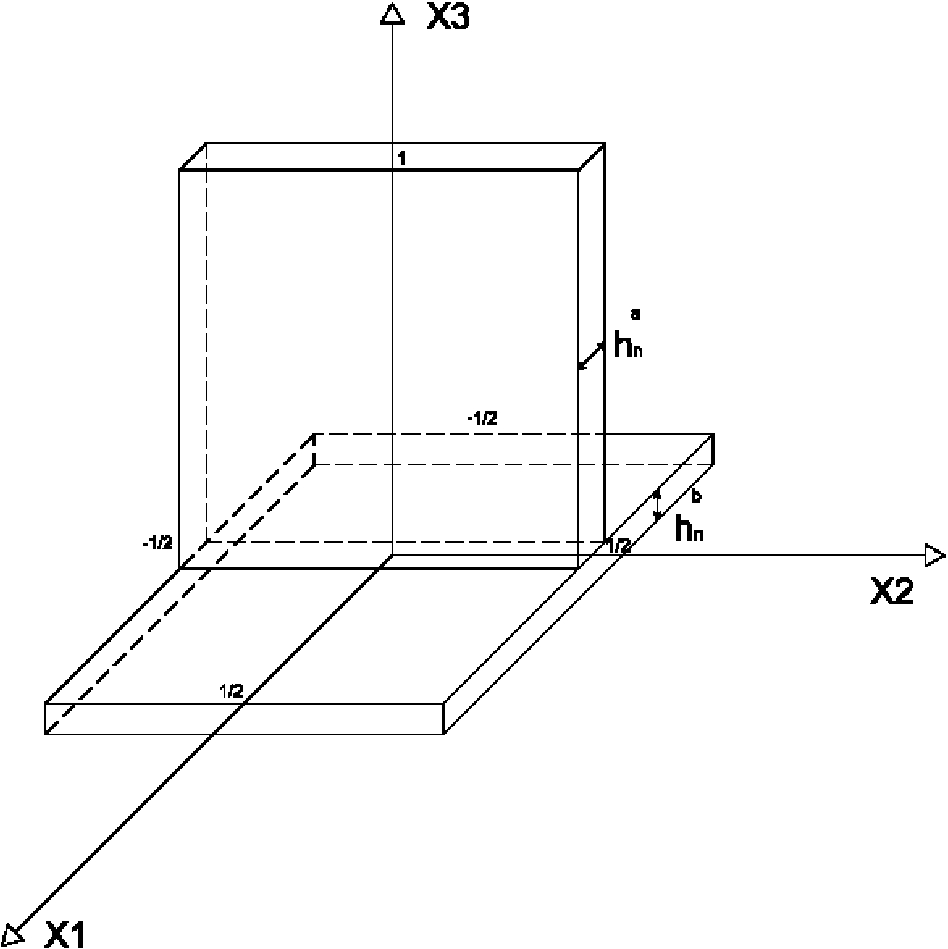
In this paper we study the asymptotic behavior of the solutions of time dependent micromagnetism problem in a multi-domain consisting of two joined ferromagnetic thin films. We distinguish different regimes depending on the limit of the ratio between the small thickness of the two films.
Ferromagnetic behavior, in particular the presence of spontaneous magnetization even in the absence of an applied magnetic field, can be examined by the theory started by Weiss in 1907 and perfectioned by Landau and Lifshitz in 1935 (see [35] and for a modern analysis see [5]). It is proposed that, under suitable conditions, in particular when the temperature is below a critical point (the so called Curie’s temperature, characteristic of the material), a ferromagnetic body breaks up into uniformly magnetized region (Weiss domains) separated by thin transition layers (Bloch wall), even in the absence of any applied magnetic field. Then, the phenomena can be described by a magnetization field M, defined on the domain Ω in which the material is confined, which on a microscopic scale has a fixed modulus and variable orientation, because of the presence of a strong molecular field. So, the system can be studied through the functional representing its magnetic energy. This energy consists in several terms: the so called exchange energy, which contains the space derivative of M and is peculiar to ferromagnetic behavior, a term corresponding to magnetic anisotropy, and another one depending on the magnetic field H, which is related to M via the equations of magnetostatic.
More precisely, assume the body is homogeneous and has a uniform temperature. Then the magnetic induction B, the magnetic field H and the magnetization M are connected by: the relation where is the extension by zero of M outside Ω; the static Maxwell equation and the magnetostatic equation (Faraday law):
So the steady state configuration of M corresponds to a minimum of the following functional E representing the magnetic energy:
where E is obtained by summing up the exchange energy , the magnetostatic energy , which is related to M via equation of magnetostatic, and the anisotropy energy .
Existence of the minimizers of E is proved in [39]; here the author showed that the total magnetic energy as a functional of M is convex, coercive and lower-semicontinuous in Sobolev space , hence the corresponding minimization problem as at least one solution. Of course this is not unique, in general, because of the non-convexity of the constraint . Regularity results about these minimizers are proved in [6,30] and [39].
Gioia and James in [27] study the asymptotic behavior arbitrary-shaped very thin films of small thickness. They analyze “rescaled energies”. So they prove that the thickness of the film imports an artificial anisotropy which disfavours out of plane magnetization. Moreover, the limiting energy is completely local, that is to say the magnetostatic equation which contains the magnetization m in the original problem, disappears from the limiting one. Problems of dimension reduction in magnetostatic were treated by several authors. A pioneering work is the paper of Stoner and Wohlfarth (1948). A rigorous treatment in this case was given by De Simone [16]. Carbou treated the case of magnetic wire in [9,10] and the case of thin films again in [7]. Other regimes are considered in [18] and [17] in the case of the films. In [23] and [24] Gaudiello and Hadiji studies the behavior of minimizers of Problem (1.2) in a multidomain. More precisely, in [23] Gaudiello and Hadiji, study the free energy of two joined ferromagnetic thin films distinguishing different regimes depending on the limit of the ratio between the small thickness of the two films. In what concerns the study of a ferroelectric materials see also [25]. See [20,22,26] for junction 3D–1D and [21] for junction 1D–1D.
When the body is isotropic, one can assume . In this case the quasi-stationary model situation is governed by Landau–Lifshitz’s equation (see [8,35])
subject to conditions (1.1).
The existence result for this problem is proved, in a more general case, in [39] (see Theorem 2) and in [8] (see Sections 3 and 5), see also [3] and [29]. We observe (see [8] and [39]) that the corresponding configuration satisfies an energy estimate.
Then Carbou in [7], as Gioia and James [27] in the stationary case, studies the limit behavior of the isotropic ferromagnetic films when the thicknesses goes to zero, in the quasi stationary case. Other similar problems are studied by Ammari et al. [3]. The homogenization of the Landau–Lifshitz equation in periodically perforated domain was studied in [37]. For related problems see also [1,2,15,28,34].
In this work we study, as Gaudiello and Hadiji in the stationary case (see [23]), the limit behavior of a system governed by Landau–Lifshitz equation, in an isotropic ferromagnetic multi-domain consisting of two joined thin films when the thicknesses goes to zero, by using, also, some ideas contained in [7,23] and [36].
More precisely, for every , let
be a 3D ferromagnetic multidomain consisting of two orthogonal joined films, as in Fig. 1, with small thicknesses such that
(For instance, such structure appears as a component of a rotor of a permanent magnetic synchronous micro-machine, see Irudayarai and Emadi [32].)
.
Then, for any fixed , the aim of our paper is to study the asymptotic behavior as n diverges, of the following problem:
where in .
If (i.e. ), assuming that the initial energy is an , we show that the solutions of (1.6) converge in mean square, for every t, up to a subsequence, to solutions of the following limit problem, “morally” defined only on two perpendicular sections
where is a pair of coupled magnetic fields acting on to a couple of perpendicular surfaces. We explicitly observe that the coupling between the two 2D problems is given by the junction condition , for in . Moreover, and in (1.7) are limits in mean square of the initial data .
Eventually we prove that if the initial energy is an then the converging subsequences of converge in mean square, for every t, to or to .
We note that this problem is completely local. The cases and were studied in [14]. Here we proved that if (i.e. ) the limit problem reduces to a 2D local problem in a vertical thin film losing the junction condition (see [14], Theorem 3.1). Analogously, if (i.e. ) the limit problem reduces to a 2D local problem in an horizontal thin film (see [14], Theorem 3.2).
We obtain our result by reformulating the problem in a fixed domain , with and , through appropriate rescalings of the kind proposed by Ciarlet and Destuynder [11], and by using the main ideas of Γ-convergence method introduced by De Giorgi [13].
The paper is organized as follows. Section 2 is devoted to give a precise mathematical statement of the problem and some preliminary results. In Section 3, we give the main results. In Section 4 we give a compactness result. In Section 5 we study the behavior of magnetostatic energy. In Section 6 we prove the main results.
Statement of the problem and preliminary results
Preliminary notations and weak formulation of (1.6) and (1.7)
Let denote the generic point of . If , then denotes the real matrix having as first column as second column and as third column. In according with this notation if then denotes the real matrix , where , , stands for the derivative of v with respect to . Let be the unit sphere of .
Let B be a rectangle containing , for every , for instance let . Let us consider the space
It is easy to prove that is contained in and it is an Hilbert space with the inner product . Moreover, from Poincaré–Wirtinger inequality it follows that a norm on equivalent to is given by . To reformulate conditions (1.1), related to Eq. (1.3), as usual let us introduce , the scalar magnetostatic potential, which satisfies the equation , where denotes the zero extension of M outside . Posed , obviously, we obtain and then conditions (1.1). Let then the following problem
admits a unique solution . This solution is characterized as the unique minimizer of the following problem:
where as usual denotes the zero extension of M in . Moreover, up to an additive constant, see [33]. Then a weak formulation of the Landau–Lifshitz equation (1.6) in our case is the following.
Fixed ( being the corresponding solution of Problem (2.2)), find which satisfies
Now, we give an existence result for Problem (2.4) slightly adapting results contained in [8] and [39].
Let. Then there exists at least a weak solution of Problem (2.4). Moreover, it satisfies the following energy estimate:
By a density like argument (for instance see [31], Lemma 1.9, p. 39, and also [19]), Problem (2.4) is equivalent to problem
by choosing as test functions with and . In [8] and [39] the existence of a solution such that , with a.e. in of Problem (2.6) and estimate (2.5) are proved. Moreover, by Proposition 23.23 in [40] (see also [12]) we have that . Consequently, is well defined and is well defined for every and for a.e. x in , so we get the thesis. □
Moreover, we pose, for every
the magnetic energy (i.e. the sum of the exchange and magnetostatic energies). We observe that
Moreover, we will denote
Now we want to give a variational formulation of (1.7).
To formulate our result precisely it is necessary to look at the 2D Problem (1.7) as a 3D problem defined on the domain . To this aim let consider such that for in in the trace sense.
Let us suppose that is extended on so that it does not depend on . Similarly, let us suppose that is extended on so that it does not depend on . These extensions will be denoted by the same symbol. Under this notation makes sense to write for a.e. in . In this sense, we can introduce the following space
Moreover, we can pose
which explicitly takes into account the condition and
Then, the equivalent 3D variational formulation of Problem (1.7) is the following one:
To Problem (2.10), for a.e. , the following energy will be associated,
where
Here, the term
can be considered an exchange energy and the term
can be considered the equivalent of a magnetostatic energy.
Now, we give a density result (see also [23] and Lemma 4.10 in [36]).
Let us pose . We denote the space of the Lipschitz continuous functions on S by . In the following with slight abuse of notation, we will continue to denote with the space of functions ψ on Ω such that ψ restricted to S is in , ψ is constant in in and is constant in in .
Letbe the space defined in (2.7). Then,is dense in.
Let . The goal is to find a sequence such that
as n diverges.
We prove that it is possible to choose such that
To this aim, we begin by splitting in the odd part and in the even part with respect to :
Remark that , is an even function with respect to , is an odd function with respect to . Moreover, we have
By (2.17)(ii) and by convolution with radial kernel, we can build a sequence such that is an odd function with respect to and
Then, obviously
Now, let be a 90 degrees angle rotation about axes, such that
and let us consider the function
By (2.17)(i) we have that and so by using density argument there exists a sequence such that
Let us pose
and
Then we obtain
By setting , since , one derives that
Then, two approximating sequences of have been built. □
The main results
To enunciate our results, we need some hypothesis on the initial data. So, let us consider
as n diverges. Then, our main result is the following.
Assume (1.5) with. Suppose thatand (3.1) holds, for every, letbe the solution of Problem (2.4). Then, there exist an increasing sequence of positive integer numbers, still denoted by,and, depending on the selected subsequence, such thatas n diverges and for everyas n diverges, whereis a solution of Problem (2.10).
Moreover, under assumption (3.2) the converging subsequences of initial data and solutions converge toor.
In order to prove Theorem 3.1, we have to rescale Problem (2.4). So, we can reformulate it on a fixed domain.
The rescaling is the following:
where denotes the interior of .
For every , the space , defined in (2.1), is rescaled in the following one:
where , , and .
For , the following problem
which rescales Eq. (2.2), admits a unique solution.
Its solution, is characterized as the unique minimizer of the problem
understanding in .
For every , let us consider the following space
For simplicity of notation, let us introduce the space
which explicitly takes into account the condition .
Let us pose
Now, it is possible to translate Problem (2.4) on a fixed domain.
If , then there exists a solution such that
Let us denote for a.e. :
We observe that
Then, we will denote
So, we can reformulate Theorem 2.1 in the rescaled form.
Let. Then there exists at least a weak solution of Problem (3.11). Moreover, it satisfies the following energy estimate:
Indeed, we can observe that, for every , the function defined by
with solution of Problem (2.4), is a solution of Problem (3.11) with the following initial data:
Vice versa, the function defined by
with solution of Problem (3.11), is a solution of Problem (2.4) with the following initial data:
In the sequel we denote, for every and for a.e.
and
So, by virtue (3.12), can be rewritten as
the sum of the exchange and magnetostatic energies.
Consider now the hypothesis
Now, we state a result, which describes the asymptotic behavior of Problem (3.11), i.e. the rescaled problem of (2.4).
Assume (1.5) with. Suppose thatand (3.23) holds, for every, letbe the solution of Problem (3.11). Then, there exist an increasing sequence of positive integer numbers, still denoted by,and, depending on the selected subsequence, such thatas n diverges andas n diverges, whereis a solution of Problem (2.10).
Moreover, under assumption (3.24) the converging subsequences of initial data and solutions converge toor.
Theorem 3.1 is an immediate consequence of Theorem 3.3. Indeed, we have to observe that (3.1) and (3.2) are equivalent to (3.23) and (3.24), respectively. So, we can apply Theorem 3.3. Then, we can use the observed equivalence between Problem (2.4) and Problem (3.11). So a change of variables and convergences (3.25) give the convergences (3.3), the third and fourth convergences in (3.26) give the convergences (3.4).
Compactness like results
Let us obtain a priori estimates for the sequence of the solutions of Problem (3.11). Let us introduce the following compactness like results.
Letbe a sequence such thatfor every, where C is a constant independent on n. Then there exist an increasing sequence of positive integer numbers, still denoted by, and, depending on the subsequence, such thatas n diverges.
Moreover, ifthen.
From (4.1)(i), (4.1)(ii) and (4.1)(iii) it follows that there exist and such that (4.2)(i) and (4.2)(ii) immediately holds (see [40], Problems 23.11–23.12).
To get (4.2)(iii), for every , let us fix , for every such that , by Holder inequality and (4.1)(iv) we obtain
where the constant C is independent of n and h. Finally by (4.1)(i), (4.3) and Theorem 3 in [38], we obtain, up to a subsequence, in , then (4.2)(iii). Arguing, in the same way we obtain (4.2)(iv).
To this aim, let us observe that, by definition of distributional derivative (see [40], Chapter 23), one has
Then by (4.2)(i) and the first estimate in (4.1)(iv) we have
as n diverges, and
as n diverges, where ς is the weak limit of in , up to a subsequence. Consequently by definition of distributional derivative, it follows (respectively for ). Then convergences (4.2)(v) (respectively (4.2)(vi)) holds true.
Now let us prove that if then . First of all let us observe that for every and x a.e. in . So, by (4.2)(iii), for every and x a.e. in (respectively for every and x a.e. in ).
Furthermore, let us point out that, by first estimate in (4.1)(ii) and third estimate in (4.1)(iii), the functions and do not depend on and , respectively.
Indeed by (4.2)(i) we get that
Then, by lower semicontinuity theorem for a convex functional, we obtain
So, by (4.1), since is bounded in and goes to zero as n diverges, we obtain, for a.e. , that
Then for a.e. we get
Similarly
We need to prove that a.e.
To this aim, by (4.1)(i) and first estimate in (4.1)(iv) the sequence is bounded in , so by trace theorem, up to a subsequence (still denoted by ), we have
We want to prove that
We split this integral in the following way
Now will pass to the limit, as n diverges, in each term of this decomposition. By (4.1)(iii) and (1.5) with , there exists such that
On the other side, from (4.1)(iii), there exists such that
Again, in virtue of (4.1)(i) and second estimate in (4.1)(iv) the sequence is bounded in , so by trace theorem, up to a subsequence (still denoted by ), we have
Consequently, we obtain that
Then, by passing to the limit in (4.11), as n diverges, and taking into account (4.12)–(4.15), one obtains (4.10). Since we have
by using (4.9) and (4.10) to pass to the limit in (4.16), we get
Then, we obtain (4.8). □
The following results are easy consequences of Proposition 4.1 and assumption (3.23).
Letsuch that (3.23) holds. Then, there exist an increasing sequence of positive integer numbers, still denoted by,, depending on the subsequence, such thatas n diverges.
Observe that by (3.1), (3.13) and (3.14), we have
for every , where C is a constant independent on n. Then, it is enough to observe that is independent of t and apply Proposition 4.1. □
Assume (1.5) withand (3.23). For every, letand letbe the solution of Problem (3.11). Then, there exist an increasing sequence of positive integer numbers, still denoted by,, and, depending on the subsequence, such that:as n diverges andas n diverges. Moreover,
By Corollary 4.2, under hypotheses (3.23), there exist an increasing sequence of positive integer numbers , still denoted by and such that convergences (4.20) are verified. Moreover, by (3.15) and hypotheses (3.23), the estimates (4.1) are satisfied. Eventually, by applying Proposition 4.1, convergences (4.21) hold true, up to a subsequence. About initial conditions, we observe that
Then by (4.2)(iii) and (4.2)(iv), it follows
Then, by (4.20), we get (4.22). □
A convergence result for the magnetostatic energy
Let us identify the limit function for the magnetostatic energy and its potential.
Assume (1.5) with. Letandbe such thatas n diverges. Moreover, for every, letbe the unique solution of (3.6) corresponding toand letbe defined by (3.21). Then it result thatas n diverges, and forwhere it is understood thatin,inand,are given by (3.21) and (2.14), respectively.
By (3.6) and (5.1) by choosing itself as test function we obtain that there exists a positive constant c, independent of n, such that, for every
Consequently, by taking into account (1.5) with , and for all , it follows that
From the Sobolev–Gagliardo–Niremberg inequality and (5.5), we obtains
Moreover, estimates (5.5) and (5.6) guarantee, for all , the existence of a function and , is independent of and is independent of such that, on extraction of a suitable subsequence (not relabelled)
as n diverges. Moreover, for all , the fact that is independent of and it is in , provides that . Similarly, for all we have in . We concludes that, for all t in ,
and that there exist and such that
as n diverges. The following step is devoted to identify and . Let us fix . In Problem (3.6), choose
where the constant is chosen in such way to have . After having multiplied Eq. (3.6) by , we have:
Then passing to the limit as n diverges, by (5.1), (5.8) and (5.9), we obtain
where denotes the zero extension of on . This proves that the function is constant with respect to for every . Consequently, since for every , it results that
Similarly, now, in Eq. (3.6), we choose
where , one obtains
The last step is devoted to prove the convergence of the magnetostatic energies. To this aim, remark that from (5.9), and for every t in , we have
Then by passing to the limit in (3.21), and by taking into account (5.8), (5.14) and (3.6) with , using (5.1) we obtain,
Proof of Theorem 3.3
In this subsection, our aim is to study the asymptotic behavior, as n diverges, of Problem (3.11). By Corollary 4.3 it is possible to apply Proposition 4.1 to a sequence solution of Problem (3.11). If μ is the limit given in (4.2) we want to identify μ as solution of Problem (2.10). First step is to build a suitable couple of test functions.
Let. Then there exists a sequencesuch thatandas n diverges.
To obtain (6.1), for every , and , set
In this way holds true. Moreover, (i) and (ii) of (6.1) easy follows from (6.2) and from continuity property of the translations for functions in (see Lemma 4.3, p. 114 of [4]). □
Now, let us choose, as in Proposition 6.1, and then , with satisfying (6.1), as test function in (3.11). So, we want to pass to the limit as n diverges in (3.11) term by term.
By (4.2)(iii), and (6.1)(ii) (remembering that for every ), we obtain
By (1.5), (4.2)(iv), (remembering that for every ) and observing that is constant with respect to , one has
By (4.2)(iii), , (5.2)(i) and (6.1)(i)
By (1.5), (4.2)(iv), and (5.2)(ii) we get
Let us observe that can be any arbitrarily element of . Being dense in , we obtain that the above convergences hold true for every .
Now suppose (3.24). We want to prove that for a.e.
By Corollary 4.3 we get that
then
Still, by Corollary 4.3 we have that
Then one has
Our results can be applied to study existence of solutions for Problem (1.7) and in the variational formulation (2.10). Indeed we have the following corollary:
Letsuch thatfor every, withand, and for every. Then there exists at least a solution μ of Problem (2.10).
Let us consider
Then and (3.23) holds, so we can apply Theorem 3.3 and prove the existence of a solution. □
References
1.
F.Alouges, T.Rivière and S.Serfaty, Néel and cross-tie wall energies for planar micromagnetic configurations. A tribute to J.L. Lions, ESAIM Control Optim. Calc. Var.8 (2002), 31–68.
2.
F.Alouges and A.Soyeur, On global weak solutions for Landau–Lifshitz equations: Existence and nonuniqueness, Nonlinear Anal.18(11) (1992), 1071–1084.
3.
H.Ammari, L.Halpern and K.Hamdache, Asymptotic behavior of thin ferromagnetic films, Asymptot. Anal.24 (2000), 277–294.
4.
H.Brezis, Functional Analysis, Sobolev Spaces and Partial Differential Equations, Universitext, Springer, New York, 2011.
5.
W.F.Brown, Micromagnetics, John Willey & Sons, New York, 1963.
6.
G.Carbou, Regularity of critical points of a non local energy, Calc. Var. Partial Differential Equations5 (1997), 409–433.
G.Carbou and F.Fabrie, Time average in micromagnetism, Journal of Differential Equations147 (1998), 383–409.
9.
G.Carbou and S.Labbè, Stabilization of walls for nano-wires of finite length, ESAIM Control Optim. Calc. Var.18(1) (2012), 1–21.
10.
G.Carbou, S.Labbè and E.Trèlat, Control of travelling walls in a ferromagnetic nanowire, Discrete Contin. Dyn. Syst. Ser. S1(1) (2008), 51–59.
11.
P.G.Ciarlet and P.Destuynder, A justification of the two-dimensional linear plate model, J. Mècanique18(2) (1979), 315–344.
12.
D.Cioranescu and P.Donato, An Introduction to Homogenization, Oxford Univ. Press, New York, 1999.
13.
E.De Giorgi and T.Franzoni, Su un tipo di convergenza variazionale, Atti Accad. Naz. Lincei Rend. Cl. Sci. Fis. Mat. Natur. (8)58(6) (1975), 842–850.
14.
U.De Maio, L.Faella and S.Soueid, Quasy-stationary ferromagnetic thin films in degenerated cases, Ricerche Mat.63 (2014), 225–237.
15.
A.Desimone, Energy minimizers for large ferromagnetic bodies, Arch. Rational Mech. Anal.125(2) (1993), 99–143.
16.
A.Desimone, Hysteresis and imperfection sensitivity in small ferromagnetic particles. Microstructure and phase transitions in solids, Meccanica30(5) (1995), 591–603.
17.
A.Desimone, R.V.Kohn, S.M.F.Alouges and S.Labbé, Convergence of a ferromagnetic film model, C. R. Math. Acad. Sci. Paris344(2) (2007), 77–82.
18.
A.Desimone, R.V.Kohn, S.Muller and F.Otto, A reduced theory for thin-film micromagnetics, Commun. Pure Appl. Math.55(11) (2002), 1408–1460.
19.
T.Durante, L.Faella and C.Perugia, Homogenization and behaviour of optimal controls for the wave equation in domains with oscillating boundary, Nonlinear Differ. Equ. Appl.14 (2007), 455–489.
20.
A.Gaudiello, B.Gustafsson, C.Lefter and J.Mossino, Asymptotic analysis for monotone quasilinear problems in thin multidomains, in: GAKUTO Internat. Ser. Math. Sci. Appl., Vol. 18, Gakkotosho, Tokyo, 2003, pp. 245–249.
21.
A.Gaudiello and R.Hadiji, Junction of one-dimensional minimization problems involving valued maps, Adv. Differ. Equ.13(9,10) (2008), 935–958.
22.
A.Gaudiello and R.Hadiji, Asymptotic analysis, in a thin multidomain, of minimizing maps with values in , Ann. Inst. Henri Poincaré, Anal. Non Linéaire26(1) (2009), 59–80.
23.
A.Gaudiello and R.Hadiji, Junction of ferromagnetic thin films, Calc. Var. Partial Differential Equations39(3) (2010), 593–619.
24.
A.Gaudiello and R.Hadiji, Ferromagnetic thin multi-structures, Journal of Differential Equations257 (2014), 1591–1622.
25.
A.Gaudiello and K.Hamdache, The polarization in a ferroelectric thin film: Local and nonlocal limit problems, ESAIM Control Optim. Calc. Var.19 (2013), 657–667.
26.
A.Gaudiello and A.Sili, Asymptotic analysis of the eigenvalues of an elliptic problem in an anisotropic thin multidomain, Proc. Roy. Soc. Edinburgh Sect. A141(4) (2011), 739–754.
27.
G.Gioia and R.D.James, Micromagnetism of very thin films, Proc. R. Lond. A453 (1997), 213–223.
28.
R.Hadiji and K.Shirakawa, Asymptotic analysis for micromagnetics of thin films governed by indefinite material coefficients, Commun. Pure Appl. Anal.9(5) (2010), 1345–1361.
29.
K.Hamdache and M.Tilioua, On the zero thickness limit of thin ferromagnetic films with surface anisotropy, Math. Models Appl. Sci.11(8) (2001), 1469–1490.
30.
R.Hardt and D.Kinderlehrer, Some regularity results in ferromagnetism, Communication in Partial Differential Equation25(7-8) (2000), 1235–1258.
31.
M.Hinze, R.Pinnau, M.Ulbrich and S.Ulbrich, Optimization with PDE Constraints, Mathematical Modelling: Theory and Applications, Vol. 23, Springer, New York, 2009.
32.
S.S.Irudayaraj and A.Emadi, Micromachines: Principles of operation, dynamics, and control, electric machines and drives, in: 2005 IEEE International Conference, 2005, pp. 1108–1115.
33.
R.D.James and D.Kinderlehrer, Frustration in ferromagnetic materials, Continuum Mech. Thermodyn.2 (1990), 215–239.
34.
R.V.Kohn and V.V.Slastikov, Another thin-film limit of micromagnetics, Arch. Rational Mech. Anal.178 (2005), 227–245.
35.
L.D.Landau and E.M.Lifshitz, On the theory of the dispersion of magnetic permeability in ferromagnetic bodies, Phy. Z. Sowjetunion8 (1935), 153–169; Reproduced by D. ter Haar (ed.), Collected Papers of L.D. Landau, Pergamon Press, New York, 1965, pp. 101–114.
36.
H.Le Dret, Problèmes Variationnels dans le Multi-domaines: Modélisation des Jonctions et Applications, Research in Applied Mathematics, Vol. 19, Masson, Paris, 1991.
37.
K.Santugini-Repiquet, Homogenization of the demagnetization field operator in periodically perforated domains, J. Math. Anal. Appl.334 (2007), 502–516.
38.
J.Simon, Compact sets in the space , J. Ann. Mat. Pura Appl.4(146) (1987), 65–96.
39.
A.Visintin, On Landau–Lifshitz’ equations for ferromagnetism, Jap. J. Appl. Math.2 (1985), 69–84.
40.
E.Zeidler, Nonlinear Functional Analysis and Its Applications. II/B: Nonlinear Monotone Operators, Springer, New York, 1990.