In this paper, one considers the coupling of a Brinkman model and Stokes equations with jump embedded transmission conditions. In this model, one assumes that the viscosity in the porous region is very small. Then we derive a Wentzel–Kramers–Brillouin (WKB) expansion in power series of the square root of this small parameter for the velocity and the pressure which are solution of the transmission problem. This WKB expansion is justified rigorously by proving uniform errors estimates.
We address the problem of fluid flow modeling in complex media which combine porous regions and fluid regions with free flow. This issue holds for instance in the study of aquifer media made up of a porous media containing cracks and conduits (see [8]) and also the passive control of the flow around an obstacle covered by a porous thin layer (see [4]).
In this paper the free flow satisfies the linear Stokes equation. In the porous media, we consider two models, the Brinkman and the Darcy models. There are several interface conditions in the literature. In the case of the Stokes–Brinkman coupling, the simpler interface condition is the continuity of the velocity and the normal stress. More accurate models are given by Ochoa-Tapia and Whitaker transmission conditions, by Beavers and Joseph conditions or Beaver, Joseph and Saffman conditions (see [8]). In this paper, we deal with the more general jump embedded transmission conditions described in [2]. This condition links the jumps and the averages of both the velocity and the shear stress on the interface. A small parameter appears in this system, in particular the equivalent viscosity in the porous part is small, so that when this parameter tends to zero, we expect that the flow in the porous part will be described by the Darcy law. Our interest lies in the asymptotic study justifying the obtention of the limit model. In particular we describe the boundary layer due to the jump conditions appearing in the porous medium.
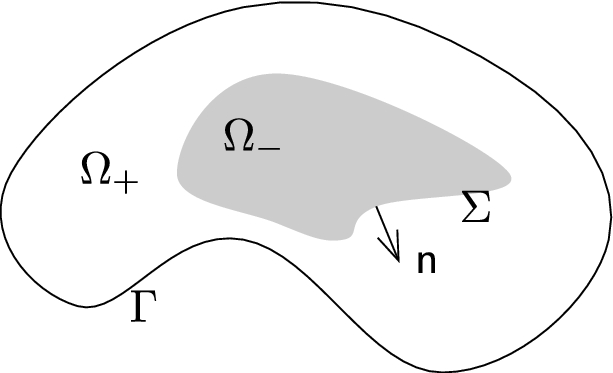
Let us describe the Stokes–Brinkman model with jump embedded transmission conditions. The problem is set in the domain made of a fluid region and a porous subdomain . We assume that the domains and are Lipschitz and bounded, and that . We denote so that we have (see Fig. 1). We denote by the outward unit normal at .
The domain Ω and the subdomains , .
On the fluid region , the velocity and the pressure satisfy the Stokes equations. In the porous region , the velocity and the pressure satisfy a Brinkman model. We couple these models by the Beaver–Joseph conditions at the common boundary Σ. These conditions link the jumps of the velocity and the normal stress vector with the averages of these quantities on Σ.
We denote by (resp. ) the stress tensor in the fluid (resp. in the porous) medium:
with
, that is ,
μ is the viscosity of the fluid and ε is the effective viscosity in the porous medium.
The problem writes
where:
is fixed positive constant.
In the previous equations set on Σ, we denote by the mean value across Σ of .
The right-hand sides in (1.1) are given data which are defined as follow: are vector fields in , , and are vector fields defined on Σ.
The matrix M is zero on and satisfies:
with .
The matrix S satisfies and :
with .
We remark that using the divergence free conditions, we can replace the first equation in (1.1) by
For any set we denote the space and the space .
Statement of the main results
In order to prove existence of weak solutions for (1.1), let us describe the associated variational formulation.
We denote by the space of vector fields such that and . We introduce a weak formulation of the problem (1.1) for in the space
endowed with the piecewise norm. Such a variational formulation writes: Find such that
where
with being a duality pairing between and , denoting the jump of v across Σ, and
compare with [1, Theorem 1.1], [2, Theorem 2.1]. The duality pairing between and coincides with the duality pairing in .
For , applying Lax–Milgram theorem, we prove the existence and uniqueness of weak solution for (1.1) and we obtain uniform estimates of the solutions with respect to the parameter ε.
Letand. Then, the problem (2.1) has a unique solutionfor all. Moreover, forsmall enough, the following uniform estimate holds:with a constant.
This result still holds when the data and belong to the space . For the sake of simplicity, we prove this lemma when and belong to the space . We eventually compare this stability result with [1,2] where the author prove also energy estimates. In [1, Theorem 1.1] and [2, Theorem 2.1], estimates are non-necessary uniform, whereas estimates (2.2) are uniform with respect to the parameter ε.
The asymptotic limit of the Stokes–Brinkman model towards the Stokes–Darcy one with Beavers–Joseph interface conditions is studied in [2,8] in the case of a flat interface when the viscosity in the porous region is very small and when the jump of the normal velocities is penalized. We address in this paper the problem of the convergence of the model (1.1) when the parameter ε tends to zero.
When ε tends to zero, we formally converge to the following Stokes–Darcy problem with Beavers and Joseph interface conditions
This problem is incompatible with the limit (as ε tends to zero) of the tangential part of the interface condition on Σ so that it appears a boundary layer inside the porous medium. We describe this boundary layer by an asymptotic expansion at any order with a WKB method. We derive this expansion in power series of the small parameter for both the velocity and the pressure which are solutions of the transmission problem. This expansion is justified rigorously by proving uniform estimates for remainders of this expansion, Theorem 7.1.
An immediate corollary of our asymptotic expansion is the following convergence theorem:
We assume that the data in (1.1) satisfy:Then, the solutionfor (1.1) given by Theorem2.1satisfies:where
This remainder term satisfies the following estimate:
The concept of WKB expansion is rather classical in the modeling of problems arising in fluid mechanics. For instance in [5–7] the authors derive WKB expansions with boundary layer terms or thin layer asymptotics to describe penalization methods in the context of viscous incompressible flow.
In this work, one difficulty to validate the WKB expansion lies in the proof of both existence and regularity results for one part of the asymptotics which appear in this expansion at any order and which solve Darcy–Stokes problems with non-standard transmission conditions. It is possible to tackle these problems by carefully introducing a Dirichlet-to-Neumann operator which lead us to prove well-posedness results and elliptic regularity results simply for the Stokes operator with mixed boundary conditions.
The outline of the paper proceeds as follows. We prove the well-posedness result for problem (2.1) together with uniform estimates with respect to the small parameter is Section 3. In Sections 4 and 5, one exhibits a formal WKB expansion for the solution of the transmission problem. The equations satisfied by the asymptotics at any order are explicited in Section 5 and existence and regularity results concerning the asymptotics which satisfy Darcy–Stokes problems with non-standard transmission conditions are claimed in Proposition 5.1. The proof of this proposition is postponed to Section 6. In Section 7, one proves uniform errors estimates to validate this WKB expansion.
Uniform estimates
In this section, we prove the well-posedness result for problem (2.1) together with uniform estimates, Theorem 2.1.
We denote by the norm in the Sobolev space .
Since is a Lipschitz bounded domain, since on for , we have the following Poincaré inequality in :
then, there hold ,
Hence, is V-coercive, and according to the Lax–Milgram lemma, the problem (2.1) has a unique solution for all . We also infer: if v satisfies (2.1), then ,
Let such that . Then, for all , there holds
We treat hereafter the last two terms: for all , there holds
Since , there holds
hence, using a trace inequality, there exists such that
We infer: for all ,
According to (3.2), we obtain
We fix constants such that
According to (3.3), we infer
Formal asymptotic expansion
From now on, we assume that the surfaces Σ (interface) and Γ (external boundary) are smooth.
If X is a vector field defined on Σ, we denote by the tangent components of X: , so that . For example, we denote by the tangent components of the normal constraint defined on the interface Σ.
Rewriting the transmission conditions set on Σ in (1.1), we use formulation (1.2) to obtain the following equivalent problem,
(we recall that ).
As already said, when ε tends to zero, we formally converge to problem (2.3). The well posedness of this limit system is establish in Section 6. This problem is incompatible with the limit of the jump condition (4.6) on the tangential velocity:
Hence, it appears a boundary layer that we describe with a multiscale method, namely a WKB expansion: we exhibit series expansions in powers of for the flow , and the pressure . In the fluid part, we do not expect the formation of a boundary layer, therefore we look for an Ansatz on the form:
In the porous part, we denote by the Euclidean distance to Σ, . We describe the velocity and the pressure on the following way:
The terms and are boundary layer terms and defined on . They are required to tend to 0 (such as their derivatives) when .
We use the following notations (see also [7]): denotes the Cartesian coordinates in ,
For ,
We recall that is the outward unit normal on . Since we assume that Σ is a regular manifold, then d is smooth in a neighborhood of Σ. In this neighborhood, . In addition, for , so that on Σ. We extend by setting . If X is a vector field defined in , in a neighborhood of Σ, we define the tangential part of X by .
By simple calculations there holds
We insert the Ansatz (4.9)–(4.12) in Eqs (4.1)–(4.8) and we perform the identification of terms with the same power in .
Order. According to (4.13), solves
Hence, taking the limit of this equation when , since and all its derivatives tends to zero when tends to , we infer
and by difference with the previous equation, we obtain
Order. solves
and taking the limit of this equation when , we infer
By difference with the previous equation, we obtain
Finally, according to (4.15), (4.28), (4.31), and according to (4.23) and (4.30) when , , and satisfy the transmission problem:
Let us claim the following existence and regularity result concerning such a problem.
Let. Let,,and. We assume that h satisfies the compatibility conditionWe consider the following problem:Then (5.4) admits a weak solution unique up to additive constants forand. It satisfies the regularity properties:
Using Proposition 5.1 with , and , using the regularity of the data (5.1), we obtain the existence and uniqueness (up to an additive constant for the pressures) of the asymptotics , , and .
Determination of
The tangential component of (4.16) reduce to
Hence, since when , we obtain
According to (4.34), we infer
Hereafter, we introduce which is a tangential extension of in the domain . We choose this extension such that it has a support in a tubular neighborhood of the interface Σ. Since , since , since and belong to the space , we can take this extension satisfying , and using (5.2) we obtain
and then is completely defined by (5.5).
Equations satisfied by asymptotics of order 1
Determination of
According to (4.26), by taking the normal components in (4.16), we obtain . Hence, since when , we obtain
Determination of
According to (4.29)
Hence, since tends to zero when tends to ,
Determination of , and
According to (4.26) and (5.6), the transmission condition (4.32) writes:
Hence, according to (4.18), (4.28), and to (4.24) and (4.30) when , and according to (4.32), (4.37), (5.5) and (5.7), , and satisfy the transmission problem:
We apply Proposition 5.1 with
and . We remark that satisfies the compatibility condition since is the divergence of a tangential vector field. Indeed, the divergence of on the surface Σ is the divergence operator on Σ applied to a tangent vector field on Σ; hence by the Stokes formula, the integral of vanishes since Σ does not have boundary.
Hence we obtain the existence and uniqueness (up to an additive constant for the pressures) for the asymptotics , , and which satisfy:
Taking the tangential components of the previous equation, we obtain that solves
with (see (4.35)):
On the one hand, we introduce which is a tangential extension of in the domain . We choose this extension such that it has a support in a tubular neighborhood of the interface Σ. Since and , we can take an extension satisfying
On the other hand, we denote
We remark that since .
By solving (5.11) with the boundary condition (5.12) and we obtain that
Characterization of the asymptotics of order
First let us write the equations satisfied by the asymptotics at order j.
At order 2, from the normal components of (4.19), using (5.5), we have
Hence, according to (5.7), satisfies
We infer
At order , from the normal part of (4.22), replacing j by , we obtain that
so that
There holdsIn addition, the boundary layer termsare on the following form:andConcerning the boundary layer terms for the pressure,and for,
From Sections 5.1 and 5.2, the property is true for and .
Let us assume that the property is true up to order , with . We claim without proof the following lemma:
For all,
First step: Construction of.
Concerning , if , we have property (5.14). If , then from (5.15) and with the induction property at order and , writes:
where the terms are linear combinations of the terms , , , , , , , and . In particular, all these terms belong to the space . Hence, by using the previous lemma, we obtain by (5.19) that writes:
Second step: Construction of.
From (5.16), with the induction property at order , we remark that writes
where the terms are linear combinations of the and the , so that the are in . Using the Lemma 5.3, we obtain that writes:
Third step: Construction of the terms,,and.
The terms , , and satisfy (5.17), and the data satisfy
We remark that we can add an arbitrary constant to in order to obtain the compatibility condition:
Hence, we can apply Proposition 5.1 with , , , , . Therefore we obtain the existence and the uniqueness (up to an additive constant for the pressures) of the solution of (5.17) and the solution satisfies:
Fourth step: Construction of.
On the interface Σ, from the previous results, . We introduce a tangential extension of this boundary data. We choose this extension such that it has a support in a tubular neighborhood of the interface Σ.
We have now the following lemma:
Let. The solution of the ODEis. Here,whereis anon-singular matrix with entriessuch that,, and with vanishing other entries.
From (5.18), using the induction hypothesis on , and on , satisfies the system:
where and . Hence, by applying Lemma 5.4, we obtain that
This concludes the proof of the property at order j. □
Regularity proof for the asymptotics
Following the previous section, we want to solve a collection of elementary problems satisfying: Find , and such that
where , associated with the data g, h, l. We remark that because of the divergence free condition, we need the compatibility condition .
The first asymptotic satisfies the problem (6.1) with , and . The term satisfies the problem (6.1) with , , and .
We first address this problem when .
Elementary problem without jump for the normal components
We consider the following problem:
Then, we introduce a variational problem for associated with the problem (6.2) in the space
Such a variational formulation writes: Find such that
where
and
Endowed with the norm
the functional space W is a Hilbert space since W is a closed subspace of the Hilbert space .
As a consequence of both the Poincaré inequality in and the Lax–Milgram lemma, we infer the well-posedness of problem (6.3):
For given dataand, the problem (6.3) is well posed in W.
If we assume in addition that , then the solution v of the problem (6.3) belongs to the space V (we remind that V is introduced in the beginning of Section 3).
For given datawith, and, the solution v of the problem (6.3) belongs to the space V.
Taking the curl in the first equation in (6.2), . Moreover and since belongs to . Since is a smooth domain, we infer . □
The next proposition ensures a regularity result in Sobolev spaces for the solutions of problem (6.2). It is the main result of this section.
Let. We assume that,, and. Then the solution of the problem (6.2) satisfies,,and.
We remark that if we know on Σ, then and are completely determined. Indeed, taking the divergence of the first equation in (6.2) we obtain that
In addition, taking the scalar product of the same equation with , we obtain that
Thus, satisfies:
With an additional condition on the mean of , this characterizes completely .
We fix . We introduce the following Dirichlet to Neumann operator in the following way: for we solve
and we denote by the trace of the obtained p on Σ.
We remark that since , if then by classical elliptic regularity results, so that there exists a constant C independent on φ and such that
In addition, we have , and we infer
Now on the domain , we rewrite the boundary conditions: we remark first that on Σ. In addition, from the equations on , . Therefore, satisfies the problem:
Hereafter we use the next proposition which ensures a well-posedness result together with elliptic regularity result for the Stokes operator with mixed boundary conditions (namely with a stress boundary condition on Σ and a Dirichlet boundary condition on Γ):
Letand. Then the problemhas a unique solutionin the space.
Let. We assume that there exists a solutionof the problem (6.7) in the space. Ifand, thenand there exists a constantsuch that
This proposition is a consequence of elliptic regularity result for the Stokes operator with normal stress boundary conditions (see [3, Theorem III.5.7] on p. 192).
Using Proposition 6.5, let us prove now by induction on j that for all , we have the property :
We already know that using Proposition 6.4. Hence, . Thus, by (6.5), we obtain that the right-hand side of the third equation in (6.6) is in and thus, by Proposition 6.5, we obtain that
We assume that and that is satisfied, i.e.. Hence . Thus, by (6.5), we obtain that the right-hand side of the third equation in (6.6) is in and thus, by Proposition 6.5, we obtain that
General existence and regularity result for the elementary problems
We address now the elementary problem with non-vanishing jump for the normal velocity (6.1). We prove the following result:
Let. We consider,,and. Assume that h satisfies the compatibility conditionThen the solution of problem (6.1) satisfies,,and.
Let such that in with on Σ. We denote . Then satisfies (6.1) if and only if satisfies:
We remark that and that therefore, by Proposition 6.4, we obtain that , and . We obtain in addition that and since , we obtain the same regularity for . □
Estimates of remainders
We address the validation of the WKB expansion found before. We claim the following theorem:
Let. We assume that the data in (1.1) satisfy hypothesis (5.1) that we recall here:We fix. Let,,,,and,given by Proposition5.2. We defineby removing to the solutionof (1.1) the truncated expansion up to the order:
We have the following estimate:
By construction of the profiles, we derive:
with
Let us introduce such that
From the expression of given by Proposition 5.2, since is bounded on , we obtain that
In addition,
Hence, there exists a constant such that
Therefore we can assume that there exists such that for all k and ε,
and
Now we denote and we obtain that , and satisfy:
where
By assumption (5.1), since , the terms , , , , , are bounded in , and , , and are bounded in .
Hence, we obtain the following estimates: there exists C such that for all ε,
Then, the remainder terms satisfy problem (1.1) with the following data:
and by (7.7), using Theorem 2.1, we obtain that
Since , this concludes the proof of Theorem 7.1 by using estimate (7.5). □
Applying Theorem 7.1 for , by straightforward estimates of the order 1, order 2 and order 3 terms of the asymptotic expansion, we conclude the proof of Theorem 2.3.
References
1.
P.Angot, A fictitious domain model for the Stokes/Brinkman problem with jump embedded boundary conditions, C. R. Math. Acad. Sci. Paris348(11,12) (2010), 697–702.
2.
P.Angot, On the well-posed coupling between free fluid and porous viscous flows, Appl. Math. Lett.24(6) (2011), 803–810.
3.
F.Boyer and P.Fabrie, Eléments D’analyse Pour L’étude de Quelques Modèles D’écoulements de Fluides Visqueux Incompressibles, Vol. 52, Springer, 2005.
4.
C.-H.Bruneau and I.Mortazavi, Contrôle passif d’écoulements incompressibles autour d’obstacles à l’aide de milieux poreux, Comptes Rendus de l’Académie des Sciences – Series IIB – Mechanics329(7) (2001), 517–521.
5.
G.Carbou, Penalization method for viscous incompressible flow around a porous thin layer, Nonlinear Anal. Real World Appl.5(5) (2004), 815–855.
6.
G.Carbou, Brinkmann model and double penalization method for the flow around a porous thin layer, J. Math. Fluid Mech.10(1) (2008), 126–158.
7.
G.Carbou and P.Fabrie, Boundary layer for a penalization method for viscous incompressible flow, Adv. Differential Equations8(12) (2003), 1453–1480.
8.
N.Chen, M.Gunzburger and X.Wang, Asymptotic analysis of the differences between the Stokes–Darcy system with different interface conditions and the Stokes–Brinkman system, J. Math. Anal. Appl.368(2) (2010), 658–676.