



Abstract
The present work deals with the resolution of the Poisson equation in a bounded domain made of a thin and periodic layer of finite length placed into a homogeneous medium. We provide and justify a high order asymptotic expansion which takes into account the boundary layer effect occurring in the vicinity of the periodic layer as well as the corner singularities appearing in the neighborhood of the extremities of the layer. Our approach combines the method of matched asymptotic expansions and the method of periodic surface homogenization.
Introduction
The present work is dedicated to the construction of a high order asymptotic expansion of the solution to a Poisson problem posed in a polygonal domain which excludes a set of similar small obstacles equi-spaced along the line between two re-entrant corners. The distance between two consecutive obstacles, which appear to be holes in the domain, and the diameter of the obstacles are of the same order of magnitude δ, which is supposed to be small compared to the dimensions of the domain. The presence of this thin periodic layer of holes is responsible for the appearance of two different kinds of singular behaviors. First, a highly oscillatory boundary layer appears in the vicinity of the periodic layer. Strongly localized, it decays exponentially fast as the distance to the periodic layer increases. Additionally, since the thin periodic layer has a finite length and ends in corners of the boundary, corners singularities come up in the neighborhood of its extremities. The objective of this work is to provide a sophisticated asymptotic expansion that takes into account these two types of singular behaviors.
The boundary layer effect occurring in the vicinity of the periodic layer is well-known. It can be described using a two-scale asymptotic expansion (inspired by the periodic homogenization theory) that superposes slowly varying macroscopic terms and periodic correctors that have a two-scale behavior: these functions are the combination of highly oscillatory and decaying functions (periodic of period δ with respect to the tangential direction of the periodic interface and exponentially decaying with respect to
On the other hand, corner singularities appearing when dealing with singularly perturbed boundaries have also been widely investigated. Among the numerous examples of such singularly perturbed problems, we can mention the cases of small inclusions (see [29, Chapter 2] for the case of one inclusion and [8] for the case of several inclusions), perturbed corners [15], propagation of waves in thin slots [23,24], the diffraction by wires [13], or the mathematical investigation of patched antennas [7]. Again, this effect can be depicted using two-scale asymptotic expansion methods that are the method of multiscale expansion (sometimes called compound method) and the method of matched asymptotic expansions (see [22,29,38]). Following these methods, the solution of the perturbed problem may be seen as the superposition of slowly varying macroscopic terms that do not see directly the perturbation and microscopic terms that take into account the local perturbation.
Recently, Vial and co-authors [10,39] investigated a Poisson problem in a polygonal domain surrounded by a thin and homogeneous layer, while Nazarov [31] studied the resolution of a general elliptic problem in a polygonal domain with periodically changing boundary. In their studies they have combined the two different kinds of asymptotic expansions mentioned above in order to deal with both corner singularities and the boundary layer effect. Based on the multiscale method, the authors of [10,39] constructed and justified a complete asymptotic expansion for the case of the homogeneous layer. For the periodic boundary in [31] the first terms of the asymptotic expansion have been constructed and error estimates have been carried out. This asymptotic expansion relies on a sophisticated analysis of solution behavior at infinity for the Poisson problem in an infinite cone with oscillating boundary with Dirichlet boundary conditions by Nazarov [30], where he published an analysis for Neumann boundary conditions in [32]. In the present paper, we are going to extend the work for the homogeneous layer and the periodic boundary by constructing explicitely and rigorously justifying asymptotic expansion for the above mentioned periodic layer transmission problem to any order (with Neumann boundary conditions on the perforations of the layer).
The remainder of the paper is organized as follows. In Section 1 we are going to define the problem and show the main ingredients of the asymptotic expansion following the method of matched asymptotic expansions. The asymptotic expansion for the solution away from the corners, the far field, is given in Section 2, where the problems for the terms of the far field expansion and their behaviour when approaching the corners is analysed in Section 3. The terms of this expansion take into account the boundary layer effect due to the thin layer with small perforations and satisfy transmission conditions. The asymptotic expansion of the solution close to the re-entrant corners in stretched coordinates, the near field, is derived in Section 4. Then, the matching of the far field and near field expansions and the iterative construction of the terms of the asymptotic expansions are conducted in Section 5. Finally, in Section 6 the asymptotic expansion is justified with an error analysis. Not to stress the main line of the justification too much we have released some details in the appendices.
Description of the problem and main results
Description of the problem
In this section we are going to define the domain of interest
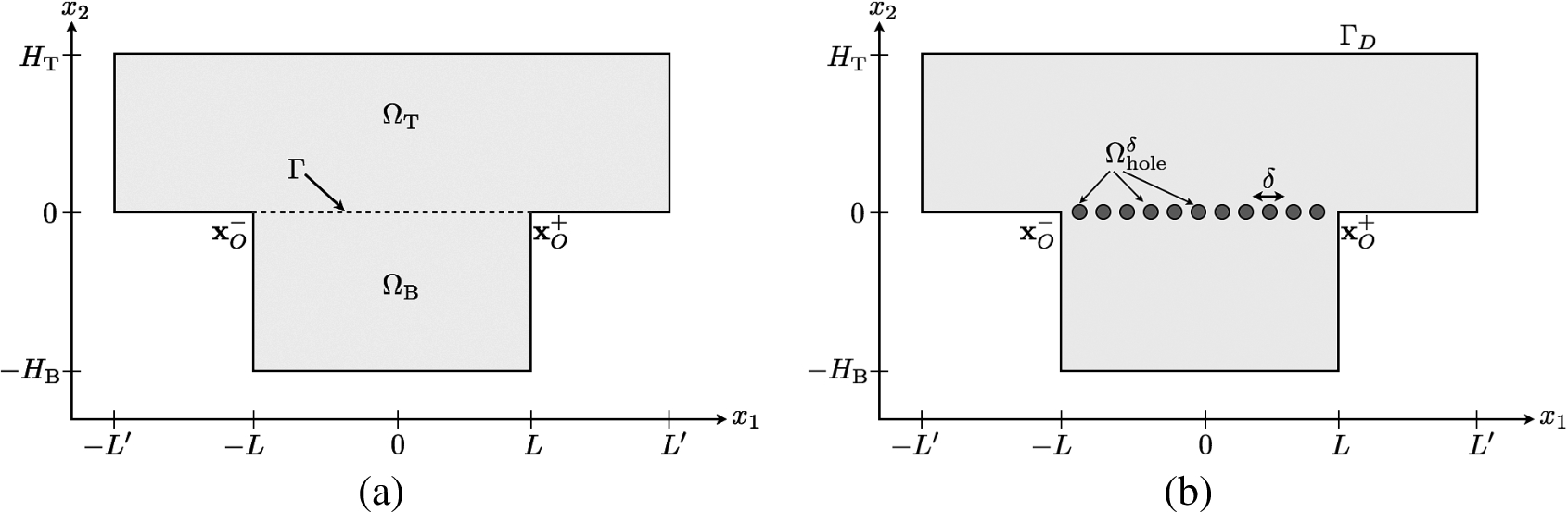
Illustration of the polygonal domain Ω and the domain of interest
Besides, let
Now, let
The domain
Let
The objective of this paper is to describe the behavior of
The construction is for simplicity for the specific geometrical setting, where Γ is a straight line ending in two corners of the polygonal boundary
It is worth noting that the choice of the boundary condition imposed on the small obstacles
The smoothness of
As mentioned in the introduction, due to the periodic layer, it seems not possible to write a simple asymptotic expansion valid in the whole domain. We have to take into account both the boundary layer effect in the vicinity of Γ and the additional corner singularities appearing in the neighborhood of the two reentrant corners. To do so, we shall distinguish a far field area located ‘far’ from the reentrant corners
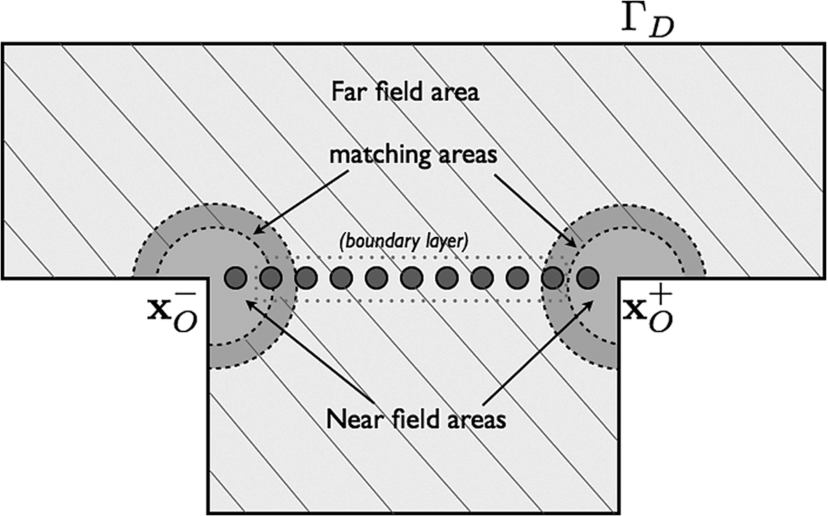
Schematic representation of the overlapping subdomains for the asymptotic expansion. The far field area (hatched) away from the corners
Far from the two corners
Here and in what follows, although it might be surprising at first glance, we call far field expansion the expansion (1.6), i.e., the superposition of the macroscopic terms and the boundary layer correctors. Besides, it should also be noted that, for any
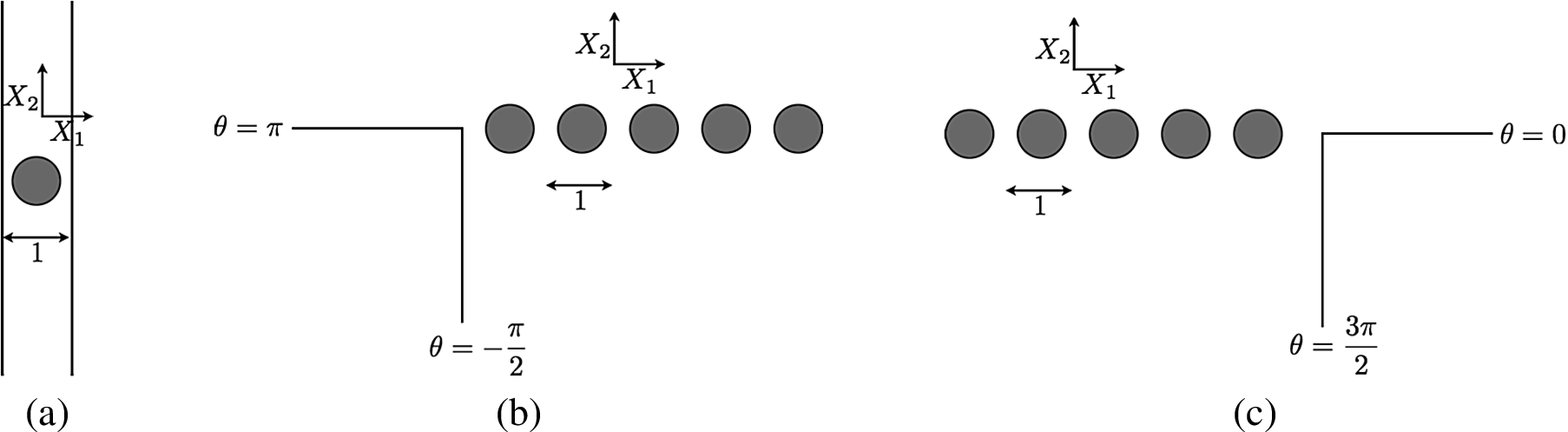
The periodicity cell
In the vicinity of the two corners
Matching principle
To link the two different expansions, we assume that they are both valid in two intermediate areas
Far and near field equations
The ‘ansatz’ being assumed, the next objective is to construct the terms
Far field equations: Macroscopic and boundary layer correctors equations
Inserting the far field expansion into the initial problem (1.3) and separating the different powers of δ (the complete procedure, based on the separation of the scales, is explained in [18] (Appendix)) gives a collection of equations for the macroscopic terms and the boundary layer terms:
Macroscopic equations. The macroscopic terms
Boundary layer corrector equations. The boundary layer correctors satisfy
Near field equations
The near field equations are obtained in a much more direct way. Inserting the near field ansatz (1.11) into the Laplace equation (1.3) and separating formally the different powers of δ, it is easily seen that the near field term
Outlook of the paper and main result
The remainder of the paper is organized as follows. In Section 2, we investigate the boundary layer problems. We derive transmission condition for the macroscopic term
Then, Section 3 is dedicated to the analysis of the far field problems (consisting of the far field equations (1.13) together with the transmission conditions (2.29a), (2.29b)). We first introduce two families of so-called macroscopic singularities
Section 4 deals with the resolution of the near field problems (1.18). As done for the macroscopic terms, we define two families of near field singularities
Section 5 is dedicated to the derivation of the matching conditions and the definition of the terms of the asymptotic expansions. Based on an asymptotic representation of the far field terms close to the reentrant corners and of the near field terms at infinity, we obtain a collection of matching conditions (5.11), (5.13), (5.14) and (5.15) that permit to determine the constants
Finally, Section 6 deals with the justification of the asymptotic. We prove the following macroscopic error estimate:
Let
This section is dedicated to the analysis of the boundary layers problems (1.18). It permits us to derive (necessary) transmission conditions for the macroscopic fields
For any sufficiently smooth function u defined in
Let
The present section is organized as follows: in Section 2.1, we give a standard existence and uniqueness result (Proposition 2.2), which shows that under two compatibility conditions the boundary layer problems for The asymptotic construction described in this section is entirely similar to the construction of a multi-scale expansion for an infinite periodic thin layer (without corner singularity). A complete description of this case may be found in [1,3,35,37] and references therein.
In this subsection, we give a standard result of existence for the boundary layer corrector problems for
Based on this functional framework, we consider the following problem: for given
Problem
If f is orthogonal to
Conversely
For the proof of the previous proposition we refer the reader to [32, Proposition 2.2] and [14, Section 5]. General results on the elliptic problems in infinite cylinder can be found in [26] (Chapter 5). Note that all these results remain the same with a different exponential growth or decay constant in the definition of
Based on the previous proposition, we shall construct
The following relations hold
We can now turn to the formal computation of the first solutions of the sequence of problems (2.2). We emphasize that the upcoming iterative procedure is formal in the sense that we shall provide necessary transmission conditions for the macroscopic terms
Step 0:
and
The limit boundary layer term (or periodic corrector)
Step 1:
,
, and
In view of the general sequence of problems (2.2), the second boundary layer (or periodic corrector)
Step 2:
(
and
)
We can continue the iterative procedure started in the two previous steps as follows. The periodic corrector
For a fixed
Transmission conditions up to any order
We are now in a position to extend the previous approach up to any order. For each We compute the right-hand side We compute the normal jump We compute the jump We write a tensorial representation of the periodic corrector
Applying this general scheme, we can prove the following proposition, whose proof can be found in [18] (Proposition 2.4, Appendix B.1).
Assume that the macroscopic terms
In the previous definition,we have used the superscript
We point out that the periodic correctors
Thanks to the previous section (see in particular Proposition 2.4, reminding that the index n and the superscript δ have been deliberately omitted in the previous section), we can see that if the macroscopic terms
The present section is dedicated to the analysis of problems (3.1). In Section 3.1, we give general results of well-posedness for transmission problems: we first introduce a variational framework, then we present an alternative functional framework based on weighted Sobolev spaces. In Section 3.2, we explain the reason why the variational framework is not adapted for the resolution of problem (3.1) for
General results of existence for transmission problem
The problems under consideration can be investigated using the general framework for transmission problems posed in polygonal domains developed in [33]. In the present paper, we first recall a classical well-posedness result based on a variational form of the problem. Then, based on weighted Sobolev spaces, we describe the behavior of the solutions close to the two reentrant corners.
Variational framework
Let us introduce the classical Hilbert spaces associated with our problems
Let
In the next subsections, we shall study the behavior of the macroscopic terms in the neighborhood of the two reentrant corners. It is well-known that the Hilbert spaces
When studying the behavior of the far field terms close to the reentrant corners, the set
Let
The expansion (3.13) is nothing but a modal expansion of the solution u is the vicinity of the two corners. Without doubt a similar expansion could be obtained using the technique of separation of variables (see [20, Chapter 2]). The sum
The limit macroscopic term and its behavior in the vicinity of the corners
The limit macroscopic term
The existence and uniqueness of
A singular problem defining
To illustrate the fact that the macroscopic terms of higher orders cannot always be variational (i.e. belonging to The previous analysis explains why, contrary to the case of an infinite thin periodic layer (see [14,34]), it is not possible to construct an asymptotic expansion of the form
Since it is not possible to construct regular macroscopic terms, we shall construct singular ones. Nevertheless, the exact solution
In this section, we introduce two families of functions, that are
Harmonic singularities
(
)
For any positive integer n, the terms
Let
Remarking that
It is worth noting that
As for
Let
The formulas (3.18), (3.19) provide asymptotic expansions of It is known [26, Chapter 6] that any function
In order to construct the macroscopic terms, it is useful to introduce the family of functions
For any
For any
For any
A complete proof of Proposition 3.8 can be found in [18] (Appendix C). It is strongly based on the explicit resolution of the Laplace equation in so-called infinite conical domains for particular right-hand sides of the form In the same way, for each
Let us comment the results of the previous proposition and of Proposition 3.6:
For The exponents λ of The function The functions Problem (3.22) alone does not uniquely determine the function For a given The constants
An explicit expression for the macroscopic terms
These part is dedicated to the derivation of a quasi-explicit formula of the macroscopic terms
The macroscopic terms
,
We remind that the limit macroscopic field
For any
For any
Analogously
Note that the functions
We construct
Let
We remind that the functions
The ‘most singular’ part of
Let
Assume now that
Asymptotic of the far field terms close to the corners
Thanks to the previous formulas, we have a complete asymptotic expansion describing the behavior of both macroscopic and boundary layer correctors terms in the vicinity of the reentrant corners: for any
For
Naturally, similar asymptotic expansions occur in the vicinity of the left corner.
Analysis of the near field equations and near field singularities
The near field terms
General results of existence and asymptotics of the solution at infinity
Variational framework
As fully described in Section 3.3 in [10], the standard space to solve problem (4.1) is
Assume that
As usual when dealing with matched asymptotic expansions, it is important (for the matching procedure) to be able to write an asymptotic expansion of the near fields as
For the statement of the next results, we need to consider a new family of weighted Sobolev spaces. For
In the classical weighted Sobolev norm (4.5), the weight
To be used later we mention the following properties related to these new function spaces (see [18], Section D.1, for the proof):
Let
The function
The function
Let
Let
Then
In absence of the periodic layer the solutions of the near field equations might be written as linear combination of harmonic functions
For this let us introduce a smooth cut-off function
Under the condition
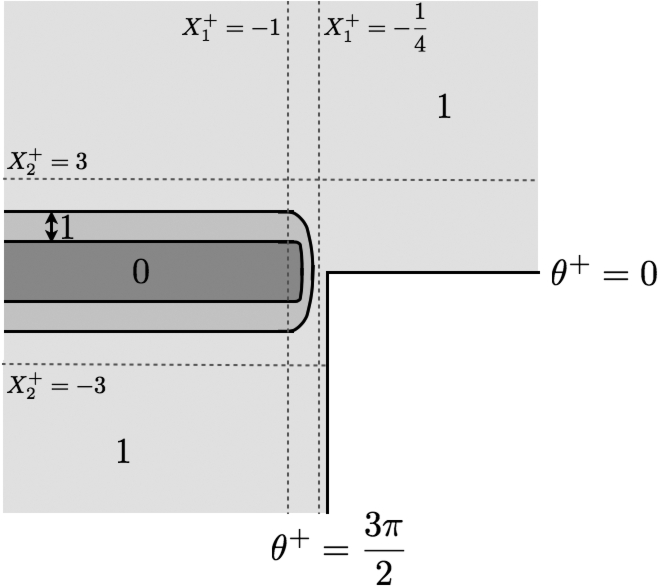
Schematic representation of the cut-off function
The functions
In view of Proposition 4.2, reminding that
Defining
We are now in a position to write the main result of this subsection, which proves that for
Let
We remind that
The proof of Proposition 4.5 (see Section B.3 in [18]), deeply relies on successive applications of the following lemma, which is a direct adaptation of Theorem 4.1 in [32]. To long to be presented in this paper, its proof requires the use of involved tools of complex analysis that are fully described in [32].
Let
We emphasize that the powers of
The assumption on g in Proposition 4.5 and Lemma 4.6 could be weakened by using the trace spaces associated with the weighted Sobolev spaces
This subsection is dedicated to the construction of two families of functions
There exists a unique function
In the same way as the near field singularities for the right corner The proof is classical and is very similar to the proof of Propositions 3.5, 3.6 and 3.8. We first prove the existence of
As done for the macroscopic terms in Section 3.4, we can write a quasi-explicit formula for the near field terms
Asymptotic behavior for large
The near field terms
Matching procedure and construction of the far and near field terms
We are now in the position to write the matching conditions that account for the asymptotic coincidence of the far field expansion with the near field expansion in the matching areas. Based on the matching conditions, we provide an iterative algorithm to define all the terms of the far and near field expansion (to any order), which have not been fixed yet.
Far field expansion expressed in the microscopic variables
We start with writing the formal expansion of the far field
The equalities
With the convention that
Inserting (5.3) into (5.2) and noting that
Arrived at this point, the derivation of the matching conditions is straight-forward. It suffices to identify formally all terms of the expansions (5.9) and (5.6) of the far field with all terms of the expansions (4.27) and (4.28) for the near field. We end up with the following set of conditions:
For
For
For
Here again, we can write similar matching conditions for the matching area located close to the left corner. These conditions link the macroscopic terms
Construction of the terms of the asymptotic expansions
The matching conditions then allow us to construct the far field terms
Then, assuming that
Far field terms. We remind that, for a given
Near field terms. Similarly, the definition of the near field terms We point out that the variables n and q play a very different roles in the recursive construction of the terms of the asymptotic expansion. Indeed, the construction is by induction only in n. At the step n, we construct
To finish this paper, we shall prove Theorem 1.6, which shows the convergence of the truncated macroscopic series toward the exact solution in a fixed domains that excludes a neighbourhood of the corners
As usual for this kind of work (see e.g. [24, Section 3], [21, Section 5.1], [17, Section 4]), the proof is based on the construction of an approximation
The truncated macroscopic series
The truncated periodic corrector series
The truncated near field series
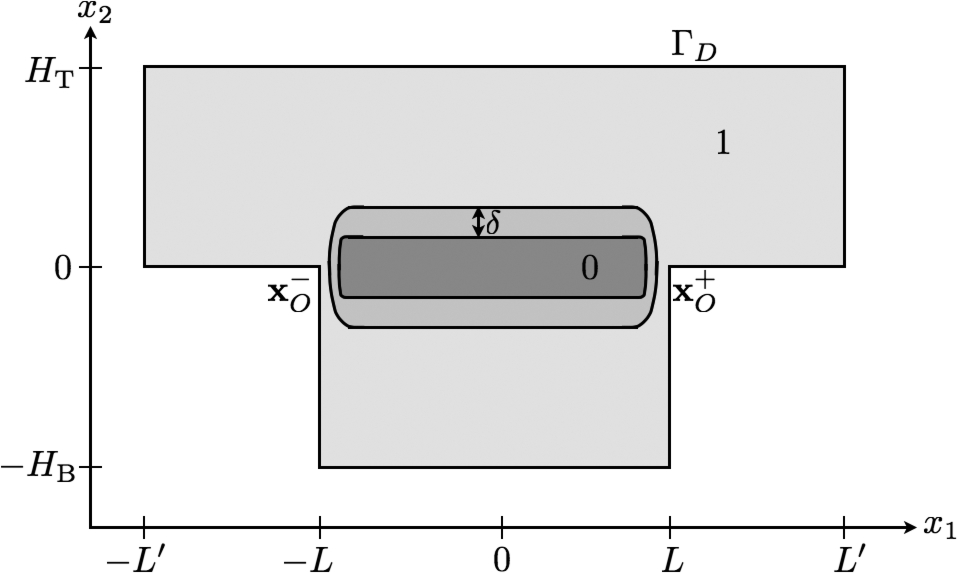
Schematic representation of the cut-off function
We shall construct a global approximation
The aim of this part is to estimate the
There exist a constant
As a direct corollary, choosing
We emphasize that
In this paper, we only explain the main ingredients of the proof but a detailed proof may be found in [18] (Section 6). Remarking that the supports of the derivatives of
As for the residue on the boundary, is it easily seen that
Footnotes
Acknowledgements
The authors gratefully acknowledge the financial support from the Einstein Foundation Berlin, and the second author thanks the research center MATHEON for its support. Part of this work was carried out where B. Delourme was on research leave at Laboratoire POEMS, INRIA-Saclay, ENSTA, UMR CNRS 2706, France.