



Abstract
In this paper we study the asymptotic behaviour as
Keywords
Introduction
The problem we are going to study lies on the intersection of spectral theory and homogenization theory for partial differential operators. We recall that one of the central problems of homogenization theory is to study the asymptotic behaviour as
If, on the contrary, conditions (1.1) are violated, for example there exist subsets
In all papers mentioned above the case of bulk distribution of shells was considered. In the present work we are interested in the case of surface distribution of shells, i.e., the shells are located in a neighbourhood of some hyperplane.
We note that our research is inspired, in particular, by spectral problems for periodic differential operators posed in a waveguide-like domain. These applications are discussed later in the introduction.
Below we briefly present our main results. Let Ω be a bounded domain in

The domain Ω and the family of shells
The operator
Operators of the form (1.3) occur in many other areas of physics. For example, in the case
Indeed, starting from the basic linear acoustic equations (see, e.g., [32])
Asymptotics of eigenvibrations of a body with a mass density perturbed near a hypersurface was studied in a lot of papers – see, e.g., [10–12,26,27,29] and references therein; we refer also to the monographs [35,39]. The case of simultaneously perturbed density and stiffness (“double-contrast”) was investigated in [20] (see also [2], where the case of bulk distribution of double-contrast inclusions was studied). In all these articles the geometry of a set supporting the perturbation differs essentially from that one considered in the current paper.
The spectrum
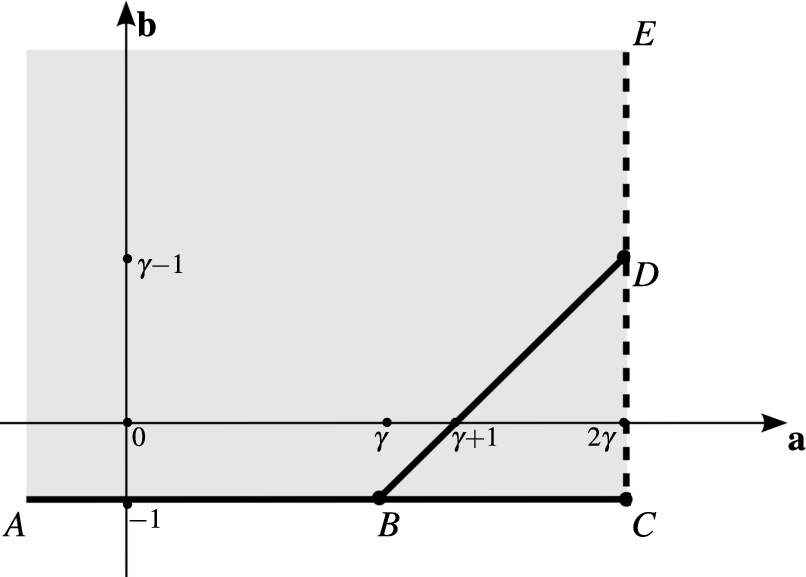
Condition (1.5) means that the eigenfunctions cannot concentrate on the shells (cf. (3.45)). The case
The parameter q characterizes the “strength” of the coupling between the domain
The finiteness of r implies the uniform (with respect to ε) boundedness of the “mass”
In spite of the fact that
At this point we present the results in a formal way; more precise statements are formulated in the next section using the language of operator theory. Below the convergence of spectra is understood in the Hausdorff sense, see Definition 2.1. One has:
Let
If
We notice that in the case
Let
The following estimate is valid:
Note, that in the case
Also we note, that instead of Dirichlet conditions on
In the last part of the paper we consider the same problem for a waveguide-like domain Ω:
Due to the periodicity of
It was proved in [22] that in the case
Our goal is to study whether gaps will open up in case of our waveguide-like domain. We will prove that the spectrum of
Periodic perturbations of the Laplacian in wavegide-like domains leading to opening of spectral gaps were also studied in [3–5,8,9,19,33,34,41]. In all these papers (except [4,19]) spectral gaps appear because of a perturbation of the boundary of the waveguide (for example by making small holes periodically distributed along the waveguide [9] or by dividing the waveguide into two parts coupled by a periodic system of small windows [5]). In the paper [4] the authors considered small perturbations of the Laplace operator in a cylindrical domain by second-order differential operators with periodic coefficients; they gave sufficient conditions on this perturbation for gap opening. These conditions are not valid for the operators considered in the present work. In the paper [19] the authors perturbed the Laplace operator by a singular potential supported by a family of periodically distributed surfaces.
Let us note that we restrict ourselves to the two-dimensional case since our study is originally motivated by applications to photonic crystals. Namely, it is well-known (see, e.g., [16, Chapter 1]), that in a
Nevertheless, it will be visible from the proof that there are no mathematical peculiarities in the two-dimensional case and the results remain qualitatively the same for higher dimensions.
The paper is organized as follows. In Section 2 we set the problem and formulate the main result (Theorem 2.1), also we prove the estimate (1.11) (Theorem 2.2). Theorem 2.1 will be proven in Section 3: the case
The operator
In what follows we denote the Cartesian coordinates in
Let
We denote by
We introduce the piecewise constant functions
Now, let us define accurately the operator formally given by
The domain of
The spectrum
The limit operator
Next we introduce the limit operator
Let
For
For
The forms
Spectrum of the operator
Let
Let
We will prove this lemma in Section 3.3.
It is easy to see that the operator
Finally,
Let if if
Note, that problem (1.10) is a formal limit of problem (1.8) as
In what follows speaking about the convergence of spectra we will use the concept of Hausdorff convergence.
The Hausdorff distance between two compact sets
Now, we are in position to formulate the main result of this paper.
Let
It is straightforward to show that the claim of Theorem 2.1 is equivalent to the following two properties:
Before starting the proof of Theorem 2.1 we obtain an estimate concerning the behaviour of the kth eigenvalue of
One has
Below we assume that We fix k arbitrary pairwise different indices We denote
Taking into account that Finally, using (2.10) and (2.11), we obtain
For each
From Corollary 2.1 one may see that the Hausdorff limit and indexwise limit (i.e., the set In the current work we do not treat the question of the indexwise convergence of Note, that if
We present the proof for the case
Preliminaries
In what follows by
By
We introduce the following sets (the sets
One has
By
The following lemmata will be frequently used throughout the proof.
One has the following estimates Using a standard trace inequality and rescaling arguments one can easily obtain the following inequality:
We set In the same way we prove the estimates
One has the following inequality By density arguments it is enough to prove this lemma only for smooth functions. We introduce in
Recall that the claim of Theorem 2.1 is equivalent to the fulfillment of properties (A)–(B) (see Remark 2.2).
Proof of property (A)
Let
We denote by
In order to describe the behavior of
Also we introduce the operator
As we already mentioned in the introduction, the parameter q characterizes the “strength” of the coupling between
In view of (3.8)–(3.11) the functions
Now we consider separately two cases: We will prove that in this case λ is an eigenvalue of the operator For an arbitrary For constructing this special test-function we introduce several additional functions. Let By It is easy to see that Finally, taking arbitrary functions We plug Let us study step-by-step the terms 1) Since 2) Using the estimates
3) Integrating by parts and taking into account that We introduce the operator We obtain from (3.31):
4) Similarly to 5), 6) In view of (1.5) and since 7) Using the equality Combining (3.28)–(3.30), (3.36)–(3.39) we get
If If We will prove that in this case We express the eigenfunction At first we obtain some estimates for the eigenfunction Finally, using the Poincaré inequality and (3.9), we obtain:
Using the fact that
Using (1.5)–(1.7), (3.25), (3.26) and taking (3.49) into account we obtain the following estimates:
From the Bessel inequality and the orthogonality of the eigenfunctions (namely, Now let us estimate the remainder In view of (3.50), (3.51), (3.56) the second term on the right-hand side of (3.57) tends to zero as Now, let us estimate the first term. One has
Finally, using (3.9), (3.41), (3.50), (3.56), (3.65), we obtain:
Property (A) is completely proved. (
Proof of property (B)
Let
For proving this indirectly we assume the opposite. Then a positive number δ and a subsequence (for convenience still indexed by ε) exist such that
Since
We introduce the function
Taking (1.7) into account we obtain:
By virtue of (3.67) λ is in the resolvent set of
For an arbitrary
Spectrum of operator
(
,
)
This subsection is devoted to the proof of Lemma 2.1. First we study the discrete spectrum of the operator
Let
We denote by
We also introduce the operator
Below we establish some properties of the spectrum of the operator
One has for each fixed
I. One has due to the min-max principle (see, e.g., [15]):
Now, let us prove continuity. Let
Now, let
For each
It follows from (3.80) and (3.84) that for each fixed
II. It is easy to see that
III. Let
Let
It is clear that
Now, with Proposition 3.1 we can easily establish the properties of the set on the right-hand side of (3.76). We denote by
It follows easily from (3.77)–(3.79) that
For each We denote by (2.8) holds true.
Thus, with (3.76), we conclude that
Since
We denote by
There are several ways how to define the essential spectrum for non-self-adjoint operators. All the definitions can be found, for example, in [18] (for self-adjoint operators they are equivalent). One of the possible ways is to define it by (3.91). The advantage of this definition is twofold: the so-defined essential spectrum can be characterized via singular sequences (see (3.3)) and it is stable under relatively compact perturbations.
Suppose that
Lemma 2.1 is proved. It is clear from the proof that the spectrum of the operator
Let
Again by
For an arbitrary
Taking into account that the integral
Let us prove that
Using (3.3), (3.4), (3.7), the inequality
It follows from (3.97), (3.99) that
Finally we prove that
It follows from (3.101)–(3.103), (3.105) that
Property (B) of the Hausdorff convergence is proved in the same way as in the case
Spectrum of a waveguide
In this section we consider the unbounded waveguide type domain
In the same way as before we introduce the Hilbert spaces
In order to state the result we need to introduce some additional notations. For fixed
This is the smallest eigenvalue of the problem
Of course, the aforementioned properties can be also obtained via the direct computation of
Using these properties one can easily conclude that there exists one and only one point
Now we are able to present the main result of this section.
Let
The spectrum of the operator
First let us prove (4.2).
For
By
We denote by
In the same way as in Lemma 2.1 (or via direct calculations) we conclude that the spectrum of
Let λ be an eigenvalue of
Now, we prove the reverse inclusion. Let
We denote by
One can easily calculate that
Let us fix
We extend
Let
Let us now turn to the proof of the Hausdorff convergence. Recall that we have to show the fulfillment of properties (A) and (B).
The proof of property (B) of the Hausdorff convergence repeats word-by-word the proof in case of a bounded domain Ω. Therefore we focus of the proof of property (A): let
For the sake of clarity we suppose that the shells are centered at the points
We denote
It is well-known from Floquet–Bloch theory (see, e.g., [6,17,24]) that the spectrum of
We also introduce the operator
In the same way as in Lemma 2.1 we conclude that
In view of (4.9) there exists
Let
In the same way as in the proof of Theorem 2.1 we conclude that there exists a subsequence (still indexed by ε),
If
Now, let
Let
Plugging
Then passing to the limit
Theorem 4.1 is proved. □
Footnotes
Acknowledgements
The authors are grateful to the referee for his/her careful reading of our manuscript and for the useful and constructive criticism. We gratefully acknowledge financial support by the Deutsche Forschungsgemeinschaft (DFG) through RTG 1294 and CRC 1173.