



Abstract
Contact problems with given friction are considered for plane elasticity in the framework of shape-topological optimization. The asymptotic analysis of the second kind variational inequalities in plane elasticity is performed for the purposes of shape-topological optimization. To this end, the saddle point formulation for the associated Lagrangian is introduced for the variational inequality. The non-smooth term in the energy functional is replaced by pointwise constraints for the multipliers. The one term expansion of the strain energy with respect to the small parameter which governs the size of the singular perturbation of geometrical domain is obtained. The topological derivatives of energy functional are derived in closed form adapted to the numerical methods of shape-topological optimization. In general, the topological derivative (TD) of the elastic energy is defined through a limit passage when the small parameter governing the size of the topological perturbation goes to zero. TD can be used as a steepest-descent direction in an optimization process like in any method based on the gradient of the cost functional. In this paper, we deal with the topological asymptotic analysis in the context of contact problems with given friction. Since the problem is nonlinear, the domain decomposition technique combined with the Steklov–Poincaré pseudo-differential boundary operator is used for asymptotic analysis purposes with respect to the small parameter associated with the size of the topological perturbation. As a fundamental result, the expansion of the strain energy coincides with the expansion of the Steklov–Poincaré operator on the boundary of the truncated domain, leading to the expression for TD. Finally, the obtained TD is applied in the context of topology optimization of mechanical structures under contact condition with given friction.
Keywords
Introduction
The optimum design in structural mechanics for problems governed by variational inequalities is considered in the literature using the energy functionals. Such variational problems are non-smooth, therefore one cannot expect the existence of classical shape gradients for general shape functionals depending on solutions of variational inequalities. We refer to the monograph [36] for the so-called conical shape derivatives of solutions to variational inequalities of the second kind. To this end, the solutions are given by the saddle-points of Lagrangian. The multipliers associated with the nondifferentiable terms of the elastic energy functional are subject to pointwise inequality constraints. The results obtained in [36] on shape sensitivity analysis are extended to the framework of topological sensitivity analysis. Actually, the topological derivatives of the energy functionals for contact problems with given friction with respect to the singular domain perturbations by creation of holes or inclusions are obtained. In this way, the asymptotic analysis is applied to numerical solution of optimum design for contact problems.
The complete theory of topological derivatives for linear elasticity in three spatial dimensions from the point of view of asymptotic analysis is given in [28], see also [19,20,29] for further developments on polarization tensors in elasticity or piezoelasticity. The results obtained for linear elasticity cannot be directly extended to variational inequalities. The difficulty, is non-smooth nature of variational inequalities. We refer to [4] for a result obtained in the case of the Signorini problem by using the classical approach of compound asymptotic expansions under the hypothesis of strict complementarity for the unknown solution of variational inequality.
In order to circumvent this difficulty, the new method of asymptotic analysis for variational inequalities based on the domain decomposition technique combined with the compound asymptotic expansions is proposed in [35] and it is presented with all details in monograph [30]. In this way, the topological derivatives of the non-smooth energy functional can be obtained. We show also that the theoretical results on asymptotic analysis are useful for numerical solution of an important optimum design problem.
Located in Florianópolis – Brazil, the Hercílio Luz bridge shown in Fig. 1 is a rare and significant bridge on many different aspects. It is recognized as the longest suspension bridge in Brazil. It was also the longest spanning eyebars suspension bridge in the world when built, between 1922 and 1926. One of the most noteworthy features of Hercílio Luz bridge is that the main cables are formed by eyebars chain rather than wire cables [17].
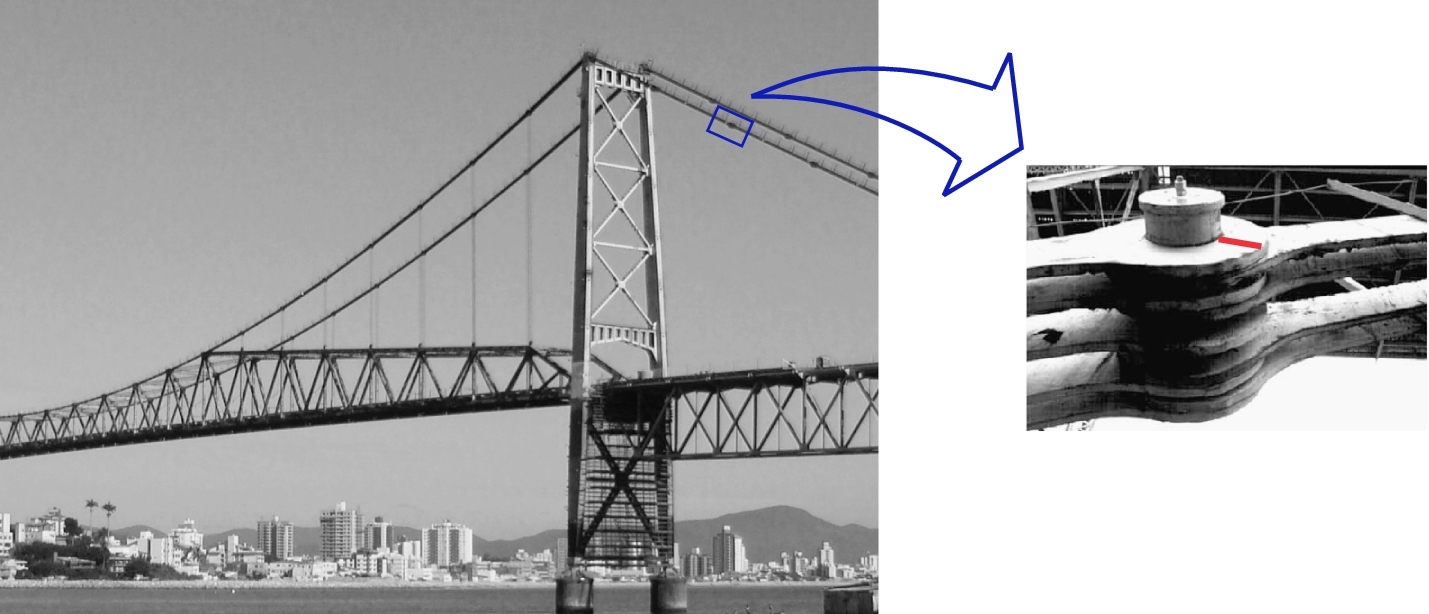
Hercílio Luz bridge in Florianópolis, Brazil. In highlight an eyebar chain (adapted from [31]).
The Hercílio Luz bridge links Florianópolis island to the continent. Because of the very aggressive environment over the ocean, it has started to suffer from a high corrosion process. In particular, some of the eyebars in the chain have collapsed according to the red line shown in Fig. 1. Based on safety concerns, the Hercílio Luz bridge was closed for the first time in 1982, and reopened again in 1988. After a technical report analyzing the feasibility of keeping the traffic over the bridge, presented 1990, it was completely closed in 1991. Nowadays there is an effort on the rehabilitation of the bridge. Another famous bridge of similar design, the Silver Bridge over the Ohio River in the USA, collapsed in 1967 due to a failure of a single eyebar in the suspension chain.
In this paper, we are interested in the redesign of an eyebar belonging to the eyebars chain of the Hercílio Luz cable bridge. The eyebars are linked through pin-joints, which are under contact condition with friction. There is a vast literature dealing with contact problems in elasticity. For the mathematical and numerical analysis of variational inequalities, see for instance the following monographs [5,10,14].
In order to deal with the design problem, the topology optimization of elastic structures under contact condition with given friction (stick-sleep condition) is considered. From mathematical point of view the model considered takes the form of a variational inequality of the second kind. The convenience for topological sensitivity analysis is an equivalent variational formulation as a saddle point of the Lagrangian. Such a formulation is already analyzed in [36] for the purposes of the shape sensitivity analysis. In this article new results on the existence of topological derivatives for the energy functional are derived. What is also important, the results obtained by the asymptotic analysis are used for the numerical solution of the shape-topological optimization problem. The paper is written in such a way that it is also accessible to the engineering community. We combine the asymptotic analysis in singularly perturbed geometrical domains which belongs to pure mathematics, with the numerical methods of shape-topological optimization which belongs to applied mathematics.
Optimization of structures submitted to contact boundary conditions has received considerable attention in the last decades [6,11,16,24,37]. In particular, we are interested in the topological derivative concept [30], which is defined as the first term (correction) of the asymptotic expansion of a given shape functional with respect to a small parameter that measures the size of singular domain perturbations, such as holes, inclusions, defects, source-terms and cracks. The topological derivative can naturally be used as a steepest-descent direction in an optimization process like in any method based on the gradient of the cost functional. Therefore, this relatively new concept has applications in many different fields such as shape and topology optimization, inverse problems, imaging processing, multi-scale material design and mechanical modeling including damage, fracture evolution phenomena and control of crack propagation. See, for instance, [2,7,8,27,29,32]. See also recent papers [13,18,21,35] dealing with topological asymptotic analysis in the context of contact problems. An application of the same technique in the context of coupled electro-mechanical system can be found in [1]. These results are here extended to the case of given friction condition.
The asymptotic analysis of linear elasticity system in truncated domain has been performed in [12] by an application of the Green’s function technique. In particular, the statement on a spherical hole can be found in Section 3.3, p. 1766. In contrast to [12], the method developed in [35] has been designed for the purpose of asymptotic analysis in singularly perturbed domains for a class of nonlinear elasticity systems. It relies on the knowledge of the explicit solution of an auxiliary elasticity problem posed in a subdomain of simple geometry. In the ring in two spatial dimensions it is obtained by the complex Kolosov potentials [25]. By a result from the functional analysis on positive, self-adjoint operators, the expansion of the elastic energy in the ring gives rise to the expansion of the Steklov–Poincaré operator on the boundary of the topologically perturbed truncated domain, with the remainder uniformly bounded in the operator norm. In addition, the explicit solution allows us to replace the expression of the topological derivative unbounded in the energy norm by its equivalent form which is bounded in the energy norm. In this way, the truncated domain technique proposed in [12] was extended to the nonlinear contact problems in elasticity fully developed in [35]. We refer also [26] for the general case of elliptic systems and for the self-adjoint extensions of elliptic operators in punctured domains.
Therefore, following the original ideas presented by [35], in this paper the topological derivative is extended to the context of topology optimization of elastic structures under contact condition with given friction. Since the problem is nonlinear, the domain decomposition technique combined with the Steklov–Poincaré pseudo-differential boundary operator is used in the asymptotic analysis with respect to the small parameter associated with the size of the topological perturbation. As a fundamental result, the expansion of the strain energy coincides with the expansion of the Steklov–Poincaré operator on the boundary of the truncated domain, leading to the associated topological derivative. Finally, the obtained result is used in the redesign of the eyebar from Hercílio Luz cable bridge.
The paper is organized as follows. In Section 2 the mechanical problem we are dealing with is stated. The domain decomposition technique and the Steklov–Poincaré operator are presented in Section 3. The topological asymptotic analysis of the problem under consideration is developed in Section 4. The associated topological derivative, obtained in its closed form, is presented in Section 5, which represents the main theoretical result of the paper. In Section 6 the optimization problem we are dealing with is formulated and the redesign of the eyerbar under contact condition with given friction (stick-sleep condition) is presented. Finally, the paper ends with some concluding remarks in Section 7.
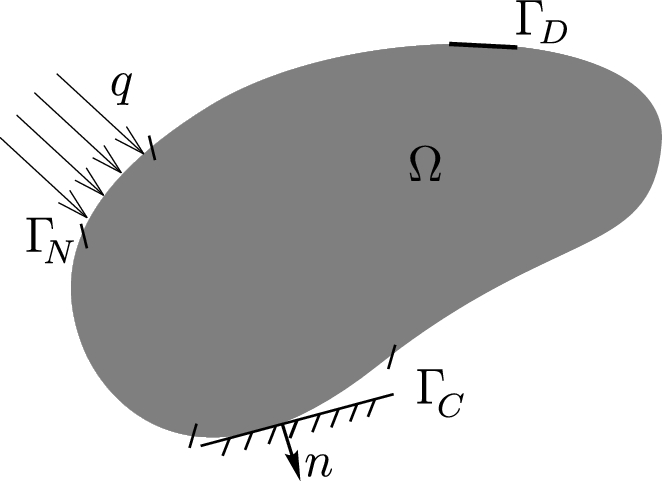
Domain representation.
Let us consider an open and bounded domain

Domain decomposition representation.
We start by decomposing Ω into two parts, namely
Topological asymptotic analysis
We are interested on the topological derivative of the energy shape functional (1) with respect to the nucleation of a small inclusion. Therefore, let us consider that the domain Ω is subjected to a topological perturbation confined in a small arbitrary shaped set
In this work, the topological perturbation is characterized by the nucleation of a small circular inclusion
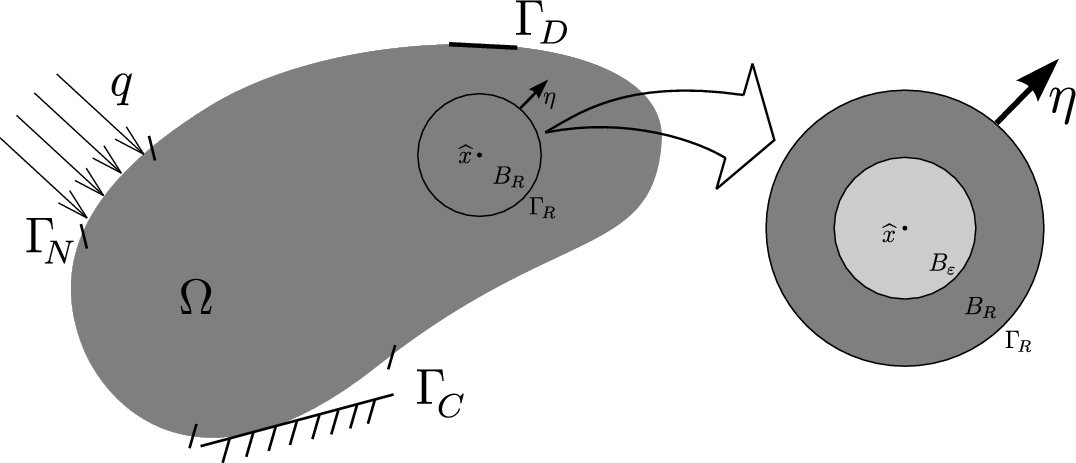
Perturbed domain decomposition.
Now, we apply the domain decomposition technique to the above topologically perturbed problem, as shown in the sketch of Fig. 4. This decomposition allows us to proceed with the topological asymptotic analysis in a simple geometrical domain, which is separated from the analysis of the shape function (18) endowed with a nondifferentiable term. Therefore, in the ball
Before evaluate the topological derivative, we present two important results. The first one ensures the existence of the topological derivative associated with the problem under analysis. The second result proves the topological differentiability of the energy shape functional.
Let
By taking
The perturbed energy shape functional
By taking into account that
In this section, the topological derivative associated with the problem under analysis is obtained in its closed form. Before proceeding, let us state the following important result, whose proof can be found in [30]:
The energy inside
Now, note that by Proposition 1 we write
The topological derivative of the shape functional
In this section the obtained topological derivative (50) is applied in the context of topology optimization of structures under contact condition with given friction. The idea is to redesign an eyebar belonging to the eyebars chain of the Hercílio Luz cable bridge, as presented in Section 1.
Therefore, let us consider a hold-all domain
The numerical implementation was performed by using FEniCS software [22]. Once we are interested in redesigning the eyebar shown in Fig. 1, we consider as original design the domain shown in Fig. 5(a). On the other hand, the initial guess is given by a rectangle of dimensions
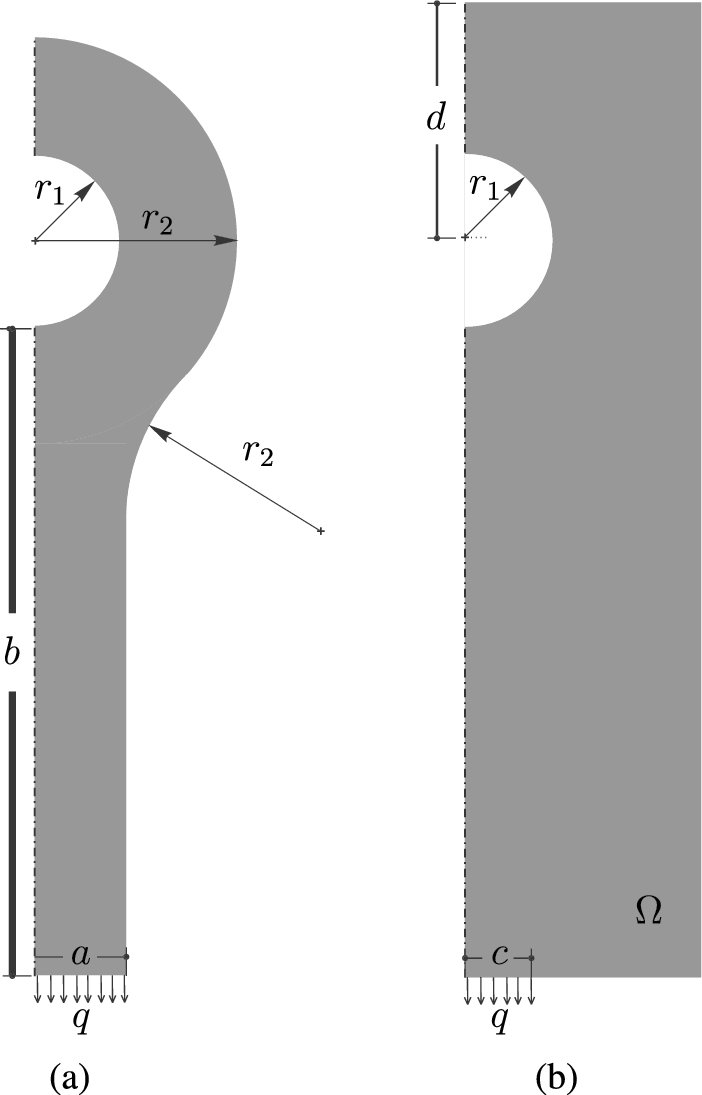
Original design (a) and initial guess (b).
Material properties and geometrical parameters
The obtained result is presented in Fig. 6. The normalized von Mises stresses distribution are shown in Fig. 7. Note that in both cases the maximal value is bounded by one. However, the original design has approximately 46.08% (orange area) while the obtained optimized eyebar has approximately 38.62% of volume fraction, which corresponds to more than 16% of volume reduction without violate the stress limit of the material.
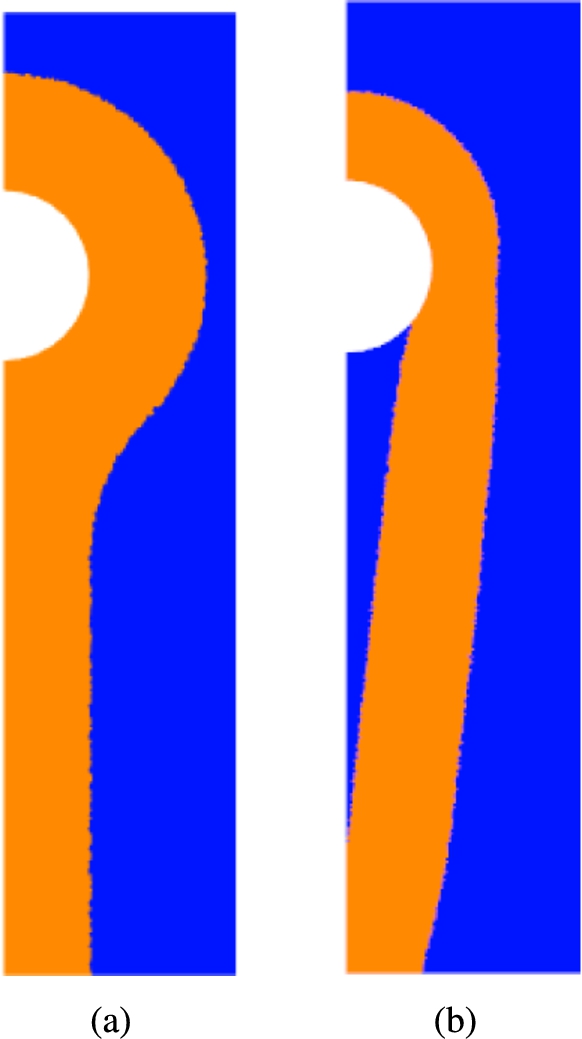
Original design (a) and obtained result (b).
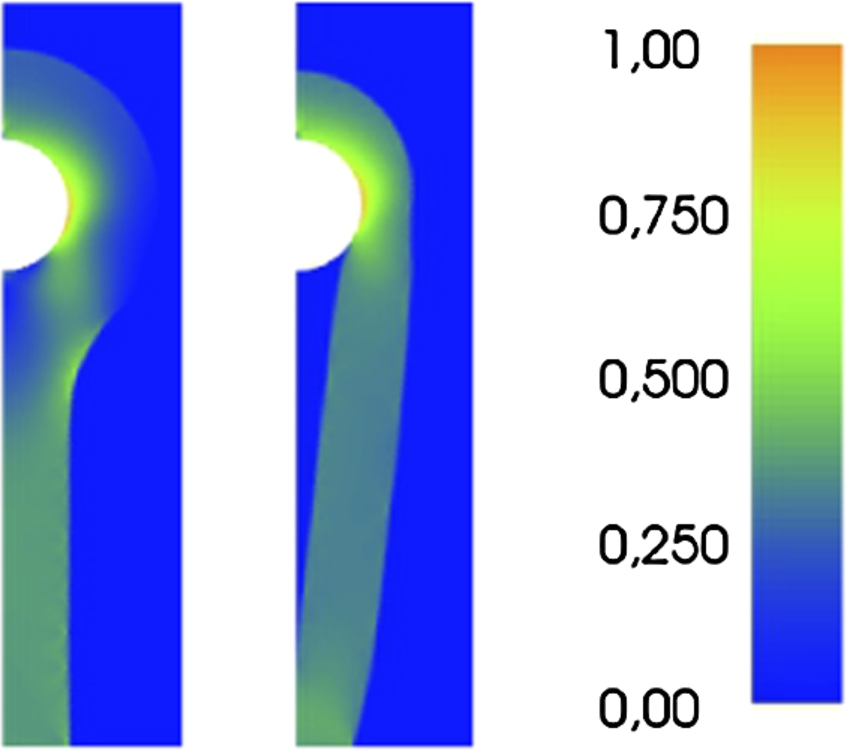
Stresses distributions: original design (left) and optimized result (right).
In this paper, the topological derivative concept has been applied in the context of contact problems in elasticity with given friction. Since the problem is nonlinear, the domain decomposition technique together with the Steklov–Poincaré pseudo-differential boundary operator were used in the topological asymptotic analysis of the energy shape functional with respect to the nucleation of a small circular inclusion. From such an analysis, the associated topological derivative has been derived in its closed form. The obtained result has been applied in a case study concerning the redesign of an eyebar belonging to the eyebars chain of the Hercílio Luz cable bridge. As a result, the obtained optimal design is much more efficient from the mechanical point of view in comparison with the original one, since its volume has been reduced about 16% while the maximal von Mises stress does not exceed the stress limit of the material.
The proposed method is general and it can be applied for numerical solution of shape-topology optimization of contact problems in three spatial dimensions. On the other hand, the topological sensitivity analysis of contact with the Coulomb friction is still an unsolved and difficult problem.
Footnotes
Acknowledgements
This research was partly supported by CNPq (Brazilian Research Council), CAPES (Brazilian Higher Education Staff Training Agency) and FAPERJ (Research Foundation of the State of Rio de Janeiro). These supports are gratefully acknowledged. We also thanks to Prof. Eduardo Alberto Fancello for sharing the real life data from the Hercílio Luz Bridge.