



Abstract
In this article we study the propagation of Wigner measures linked to solutions of the Schrödinger equation with potentials presenting conical singularities and show that they are transported by two different Hamiltonian flows, one over the bundle cotangent to the singular set and the other elsewhere in the phase space, up to a transference phenomenon between these two regimes that may arise whenever trajectories in the outsider flow lead in or out the bundle. We describe in detail either the flow and the mass concentration around and on the singular set and illustrate with examples some issues raised by the lack of unicity for the classical trajectories at the singularities despite the unicity of the quantum solutions, dismissing any classical selection principle, but in some cases being able to fully solve the propagation problem.
Keywords
Introduction
Initial considerations
Classically, a particle with mass
In Quantum Mechanics, the state evolution of a similar system is described by a function
If V satisfies the Kato–Rellich conditions (V continuous and
Now, for
When
Of course μ may depend on the subsequence, this is why we refer to it as a semiclassical limit, not necessarily the classical one (examples of non-unicity in [19]).
Again, more regularity on V implies more good properties [16]. The Wigner measure is always absolutely continuous with respect to the Lebesgue measure
This last equation is interpreted as a transport phenomenon along the classical flow Φ, which can be easily seen by picking up test functions
Moreover, the test functions
The quadratic form
From a non-statistical point of view, the classical limit properly speaking would be a particular subsequence
It happens that a very large class of relevant problems do not present potentials with all such regularity. For instance: conical potentials, which are of the form
V and F and This is: there is
Similar problems have been treated in works like [2,4] and [5] in a probabilistic way. In other works authors have been analysing the deterministic behaviour of the Wigner measures under the conical potentials defined above, more noticeably in [12], where they found a non-homogeneous version of (1.5) whose inhomogeneity is an unknown measure supported on
The set Ω corresponds exactly to the tangent bundle to Λ, since any curve γ over Λ (i.e., such that
This suggests an intriguing possibility involving irregular potentials: what happens to the Wigner measures in a system where the potential allows a complete quantum treatment, but causes the classical flow to be ill-defined? Is there some selection principle from the quantum-classical correspondence that could provide information enough for describing the transport of the measure where the classical flow fails?
To fix some ideas, forget for a moment about the measures and think of a classical particle submitted to conical potentials like
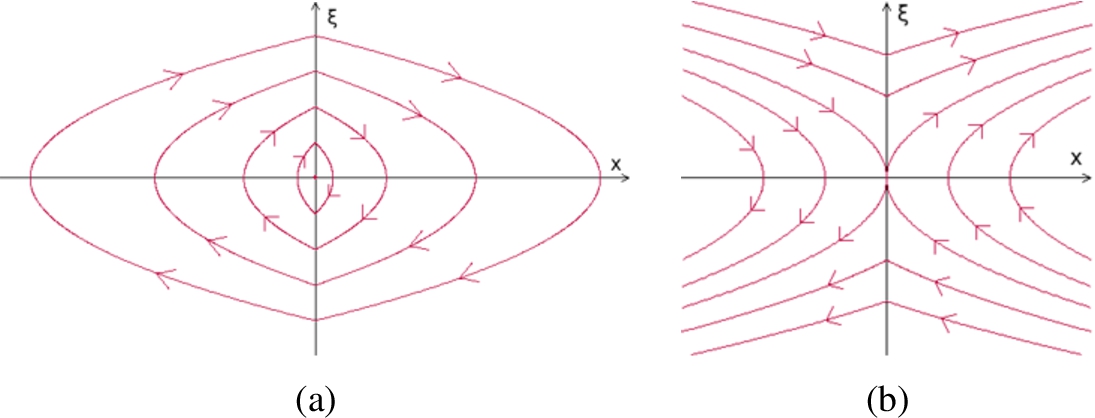
A glance on the classical flows for the potentials
In the case
Furthermore, there are other kinds of difficulties. In the case
Let us treat this problem in three different steps.
In [12], the authors proved that the Hamiltonian flow can always be continuously extended in a unique manner to
In this paper we will obtain in Section 4 a complete description of the dynamics to which the semiclassical measures ought to obey, including near and inside the singularities, by driving an approach similar to that of [12], which makes an extensive use of symbolic calculus (Section 2.2) and two-microlocal measures (Section 2.3):
Let
Furthermore, decomposing
Observe that equation (1.10) is the sum of two Liouville terms, one for the potential V outside Ω and another for
To see this, just test μ against functions in
The second part of the theorem, the asymmetry formula, will be discussed ahead in Section 1.4 and turns out to indicate that any mass that stays on the singularity will be in static equilibrium over it.
Remark 1.3 immediately gives:
In the same conditions of Theorem
1.2
, suppose that no Hamiltonian trajectories lead into Ω. Call Φ the Hamiltonian flow defined by the trajectories induced by V for
More precisely, suppose that the Hamiltonian flow Φ can be extended in a unique way everywhere in a region
Now, what happens if some trajectories hit Ω? First, realize that in this case there is never uniqueness, since there are necessarily the outgoing trajectory (which is the reverse of the incoming one) and the one whose projection on
The second part of the theorem, however, may solve the question. It has got a rich geometric interpretation, saying that the mass distribution on Ω has some asymmetry around Λ due to the “shape”
Indeed, the measure ν gives the mass distribution in a sphere bundle with fibres
If
Loosely, let us also consider ν as a function of
Realize that the speed the mass may have tangentially to the singular space Λ, that we call ζ, plays no role in dictating how the quantum concentration will happen thereon; with simple hypotheses on the family
Well, the derivative of a potential is a force, so let us call
An example is illustrated in Fig. 2.

Above, we depict Λ encircled by its normal bundle in sphere
The reason why we have said that equation (1.11) is a condition of equilibrium is that the expression inside the integral is similar to what would be the total force normal to Λ, i.e.
Besides, in formula (1.12), we have
If for some
Once established that in some cases the mass is forbidden to stay over the singularity, it is worth studying more deeply the ways it can get in and out Ω:
Supposing
If ( 1.13 ) has no non-zero roots, then no trajectory leads in or out Ω in σ.
If
If
Equation (
1.13
) has non-zero roots Equation (
1.13
) has “zero roots”, in the sense that there are The classical flow does not touch Ω in σ through any well-defined direction.
In any case, if equation (1.13) has no roots (“zero” or non-zero), then no classical trajectory passes by Ω in
In [6], we will endeavour a more precise study of the link between ν and the classical flow, generalizing the link between Theorem 1.7 and Theorems 1.8 and 1.9.
In Section 5.1 we will work out the proof of Theorems 1.7, 1.8 and 1.9 in coordinates that are more suitable to understand
In short, so far we have seen that whenever we have a well-defined flow, we know what the semiclassical measures do: they are transported thereby. If the flow presents trajectory splits, they necessarily happen on Ω, where there is always the possibility of regime change between outsider and insider flows. Then, thanks to the measure ν, we may be able to obtain enough information to decide whether the measures stay or not on the singularity, and in case they stay, we know that they will be carried by the flow generated by
Finally, a last problem is: if a measure does not stay on Ω and continues in the exterior flow, but even though there are different trajectories to take, can we derive from the well-posed quantum evolution some general criterion for choosing the actual trajectories that the measure will follow? Is there any selection principle for the classical movement of a particle under such conical potentials?
As we will see in Section 3, the answer is negative. The path a Wigner measure (or a particle) takes after its trajectory splits depends crucially on its quantum state concentration, so any selection principle making appeal only to purely classical or semiclassical information is to be dismissed.
This can be justified by:
Let be
In pictures, the particle
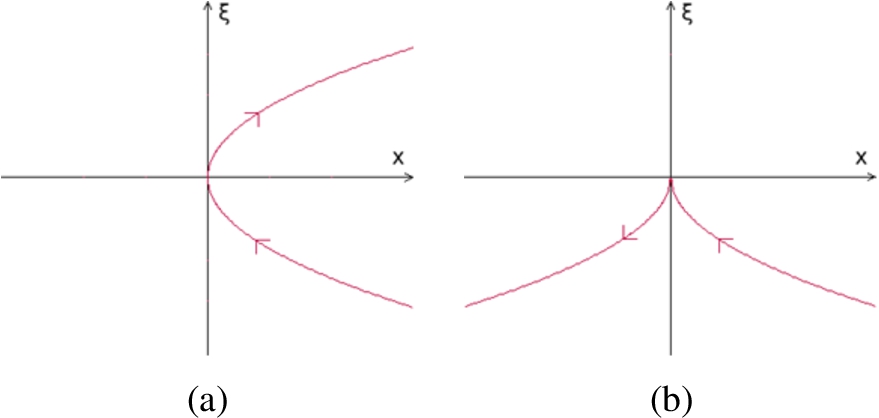
Trajectories followed by two different particles, coinciding for
This result will be obtained with the help of approximative solutions of (1.2) called wave packets, which are
In the case of the returning particle, the problem will be solved by decomposing the initial data into two pieces, for
Yet, this does not give a full example of non-unicity as in Theorem 1.12, since, if we evolve the pieces
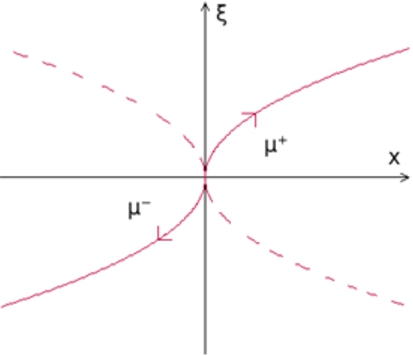
Trajectories followed by the measures
Constructing a quantum solution whose semiclassical measure behaves like in Fig. 3(b) will be more difficult and will require us to consider a family of wave packets following different trajectories with smaller and smaller initial momenta η, that in some sense converge to the aimed path with
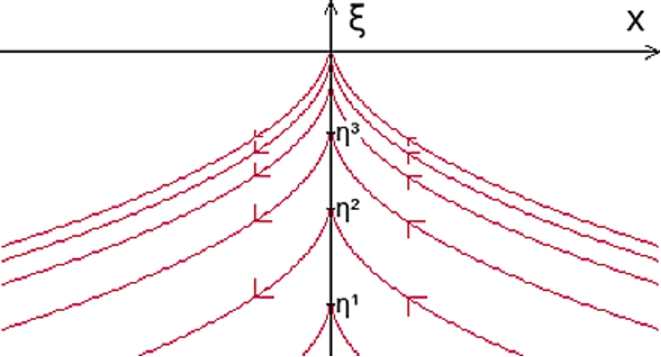
The trajectories (3.10) for
In Section 2, we will introduce the fundamentals of our analysis: wave packet approximations (Section 2.1), symbolic calculus (Section 2.2) and two-microlocal measures (Section 2.3). In Section 3, we will construct the solutions of the Schrödinger equation that lead to Theorem 1.12; the case keeping on the same parabola is treated in Section 3.1, the other one in Section 3.2. Finally, in Section 4 we will prove Theorem 1.2, firstly in a particular version for subspaces, what will be done step by step from Section 4.2 to 4.6 (the part where we effectively establish the dynamical equation and the asymmetry condition being Section 4.5). Then this version will be immediately extended to the general case thanks to the coordinate change that we will have set in Section 4.1. In Section 5.1 we will use the asymmetry condition (1.11) to prove Theorem 1.7. Theorems 1.8 and 1.9 are also proven in this section, and in Section 5.2 we conclude by showing with Examples 5.4 to 5.10 how the results in this article allow a full classification of the behaviours that the Wigner measures present and, sometimes, give a full description of the transport phenomenon.
Preliminaries
In this section, we will present the basics of the main tools that we use in this work. First the wave packet method for approximating solutions of the Schrödinger equation (see for example [7] and [17], or [3] for a generalized notion of wave packet) that we will adapt later in Section 3, then some simple results in standard symbolic calculus [8,25] which will provide a guideline for proving Theorem 1.2, and last some notions about the two-microlocal measures [9,20,21], that we will deploy in order to accomplish the necessary refined analysis for obtaining either the dynamical equation for the Wigner measures and the asymmetry condition on the mass concentration around the singular manifold.
For the sake of simplicity, we will use these measures in a specialized version for p-codimensional subspaces of
The wave packets
For a
Any semiclassical measure associated to the family
A straightforward calculation. Writing down
Another virtue of the wave packets is that they provide approximative solutions to the Schrödinger equation with convenient initial data, as stated in:
For fixed initial
After a direct calculation, one obtains the following differential system for
Naturally, the function
Call μ the semiclassical measure linked to the exact family of solutions
V being at least of class
Actually, the approximation in the corollary remains good for t smaller than the Ehrenfest time
Observe that even if V is not as regular as we required, we can still write
Finally, observe that it is also possible to write the actual solution
Let us consider the ε-pseudodifferential operators
Inequalities (2.7) and (2.8) give upper bounds for the Schur estimate of the norm of
Nonetheless, formula (1.7) can be used for more general symbols, although we may lose boundedness, good properties for symbolic calculation, and be forced to restrict their domains. In particular, for V satisfying the Kato–Rellich conditions,
Thus, taking a test function
The conical singularities that V presents, however, will require a specific treatment. Roughly, we will have to re-derive “by hand” adapted formulæfor a correct symbolic calculus with such potentials, which we will do progressively in Sections 4.4.1, 4.4.2 and 4.4.3.
Now, let us define a new symbol class For each There exists some
These symbols will be quantized as
There exists a measure
Furthermore, for a smooth compactly supported function
Finally, the terms in (
2.13
) are obtained respectively from those in the decomposition
If
A very general treatment of this result can be found in [9,11]. The introduction of
Observe that M induces a measure
That
Observe that it is sufficient to consider
The measure
Indeed, if
The semiclassical measure μ decomposes as
If
With the two-microlocal measures, we are equipped to tackle the analysis of the singular term of the commutator in (2.11).
In the Introduction we pointed out that the non-uniqueness of the classical flow for the present case only plays a relevant role when the initial data concentrate to a point belonging to a trajectory that leads to the singularity. The behaviour of the measure will depend on the concentration rate and oscillations of the quantum states
Below, we will prove some results that altogether are slightly more general than Theorem 1.12. We will present concrete cases of solutions to the Schrödinger equation with the conical potential
These examples refute any possibility of a classical selection principle allowing one to predict the evolution of a particle (i.e., a Wigner measure concentrated to a single point) after it touches the singularity, since they show two particles subjected to the same potential and following the same path for any
Measures rebounding at the singularity
Let us consider the trajectories
Let be
For any
Given an arbitrary
The middle term’s semiclassical measure has total mass of order
As a short justification of this estimate, take
For the study of
For any
(The proof is postponed.)
So, the Wigner measures for the components
Finally, as δ is arbitrary, we take the limit
To begin with, since for
Additionally, one can solve equation (3.4) for the profile From (3.4) and the fact that its initial datum is
Therefore, from expressions (3.5) and (3.6):
Because of our choice of
So, in this section we saw the example of a case where the initial measure splits in two pieces, each one gliding to its side as in Fig. 4, accordingly to the quantum distribution of mass along the x-axis.
Remark that there is no crossings at all. The part
Now, consider for
If
Besides, if we take
For the case with
Before we proceed to the lemmata, let us define
Above, for
Write down
Now, define
We will call
For
Let us treat the problem partitioning it in zones by choosing Denote6 Since now η depends on ε, we will drop down the dependencies on η in order not to overcharge the notation. We will also let the dependency of the trajectories on ε implicit until it be crucial to take it into account.
As a step aside, notice the following:
Taking into account the domain restrictions of
Now, considering that
Finally, this results is a superior bound for
Hereafter denote
Recalling the trajectory defined in (3.10), the estimation in (3.12) and the fact that
For
As a conclusion, for ε small enough we have
The proposition is proven once we remark that for any
To evaluate
The trick will be to transform the
Repeating the steps above for the term
Two things are remarkable in this formula. The first one is that all terms
The second remarkable thing is that among the terms within the
Making use of (3.13) and the initial condition (3.14), let us calculate the remaining quantities:
The way for calculating the expression above is the following: if condition (3.20) is fulfilled, then we have
It follows that, for σ such that
This completes the proposition’s proof.
With
The fact that
To begin with, if conditions (3.19) and (3.20) are fulfilled, then
Now, define
Well, for
If
All results in this section also work taking
Hence, we have found that it is possible that a particle arrive into the singularity from the up left or from the down right and that it continue to the other side down or up, as partially indicated in Fig. 3(b). Moreover, we also proved that the wave packet approximation is valid for the non-smooth trajectories indicated in Fig. 5 (and for the reverse ones not indicated in the picture).
In view of the developments in Section 2.2, from equation (2.11) we are left with the analysis of the commutator
The third term is complicate because of the conical singularities it presents, which will require us to employ the two-microlocal analysis in Section 2.3. This strategy was followed in [12], but here we will describe the two-microlocal measures in more details. Prior to proceeding to this kind of analysis, however, we will need to restrict ourselves to the case where
It is in this context that we will be able to prove Proposition 4.17, which is a particular version of Theorem 1.2 for
Reducing Λ to a subspace
For a general conical potential, thanks to
Such f may be constructed as follows: let be
Now, for the sake of clarity let us consider the coordinate change in tangent space induced by ϕ:
Writing
Thus one has:
Analogously,
Geometrically, let be the manifold
Due to the fact that the coordinate
At this point we shall state a central result in semiclassical analysis (see for instance Proposition 5.1 of [10] and its proof):
Let be ϕ a diffeomorphism of
Besides, denoting
As a consequence, if
Since in the rest of this work the variables that we will write are going to be dummy, we will not care about marking the differences between
In short, now we can fairly relay on the study of the concentration of a family
Let us start the computation of the first term in the right-hand side of (4.4) by the following exact calculation, with arbitrary
Observe that Observe that
Consider the Taylor developments
This kind of procedure will be largely used in the following pages, but we will not repeat the calculations textually everytime; exposing the kernels issued from the second order terms will be sufficient for our analyses.
Now, consider also the fact that
Since so far we are still dealing with smooth symbols, as in standard symbolic calculus we use the formula
In order to analyse the commutator with
In the context of two-microlocal analysis, each of these pieces is related to a different two-microlocal measure, and that is what we will be talking about in the next sections.
The inner part
Defining
Now, for each
Regarding the error:
The operators
Let us prove the lemma for
In fact, noting
Regarding
Now we only need to focus on the lasting term; from what we have seen in Section 2.3, in the limit where
One has got the estimate
From a calculation similar to that we made in (4.10) and similar estimates, it follows that
Observe that
In [12], an estimate that turns up to be equivalent to last lemma was obtained by noticing directly that
In Section 4.5, this lim sup will be shown to be zero.
We start by proving with standard symbolic calculus the technical result below:
For
In view of the identities
Replacing δ by
For
Because
The rest of the proof consists on the basic derivation
Analogously to Remark 4.9, in Section 4.4.3 we will use that
Combining Lemmata 4.8 and 4.10, we obtain
As seen in Remarks 4.9 and 4.11, the calculations in Section 4.4.1 lead to
Establishing the equation
From equations (2.10), (2.11) and (2.12), more the results in the last sections, equations (4.5), (4.8), (4.11), (4.13) and (4.14), we obtain the equation
In the two-microlocal decomposition given in Lemma
2.11
, the operator valued measure M is zero and
The matrix
To begin with, re-write equation (4.15) as
Regarding
More generally, a distribution supported on such a set can be developed as
To conclude, just re-write (4.15) attaching all the information we have just got and verify that it simplifies to (4.16). □
As a scholium of the last proof, one has that μ is not supported on the region of the
One has the identity
Recall estimate (4.17), which holds for
The measure ν introduced in Lemma
4.12
obeys to the following identity in the sense of the distributions on
For test functions of the form
To finish establishing a Liouville equation for μ, let us put all Lemmata 4.12, 4.15, 4.16 and Remark 4.4 together and write equation (4.16) in a distributional and clearer way:
Let be
From equation (2.9), it is obvious that μ is absolutely continuous with respect to the Lebesgue measure
Nevertheless, the same is not true for continuity. In fact, in [12] it was shown that
This is not true for
On the other hand, one could use an argument of continuity for
An application of the asymmetry condition and examples
The classical flow and the concentration of ν
In last section we presented a trivial application of the asymmetry condition (1.11). In this section we will apply it to obtain Theorem 1.7. Moreover, we will prove Theorems 1.8 and 1.9. In next section we will give examples of applications of these results.
So, to start with:
Since
Now, in order to study the classical flow in more details, remark that in the transformed coordinates introduced in Section 4.1, the equation of motion for the component of x in Λ,
Let us suppose that
Also, let be
Fix a vector
Besides,
Finally, if
Observe that
Equation (5.2) comes from taking lateral limits in equation (5.1) when
Two things remain before completing the proof: recognizing equation (5.3) from (5.4) and, if
The latter is done by remarking that, if
Finally, recall that
As we have seen in the lemma above, for any trajectory arriving on Ω within a well-defined direction
Regarding the inverse affirmation, Lemma 5.1 does not say whether there are actual trajectories approaching Ω in all possible directions satisfying (5.2). Below we will verify that indeed any
If
First, let us choose
Consequently, by Banach’s fixed point theorem, there exists a unique triple
For
Bringing together Lemmata 5.1 and 5.2, one proves Theorem 1.8. In order to obtain Theorem 1.9, we observe the following facts:
The hypothesis
If
The proof of Theorem 1.9 will be complete after showing that any such trajectories only reach Ω after an infinite time. Letting be
If
From the hypotheses Then
In this section we will give examples of how Theorems 1.7, 1.8 and 1.9 can be used in order to classify the trajectories that arrive on a conical singularity and, sometimes, to completely describe the transport phenomenon to which the semiclassical measures are submitted. In particular, Examples 5.6 and 5.7 are part of the reasoning that led to obtaining the second assertive in Theorem 1.9.
To begin with, let us consider
(
with no roots).
Take Example 5.4.
Then (1.13) admits no non-zero solutions, which is consistent with the fact that the classical flow Φ presents no trajectories hitting the singularity.
In this case, the asymmetry condition (1.11) gives that
Consider Example 5.5.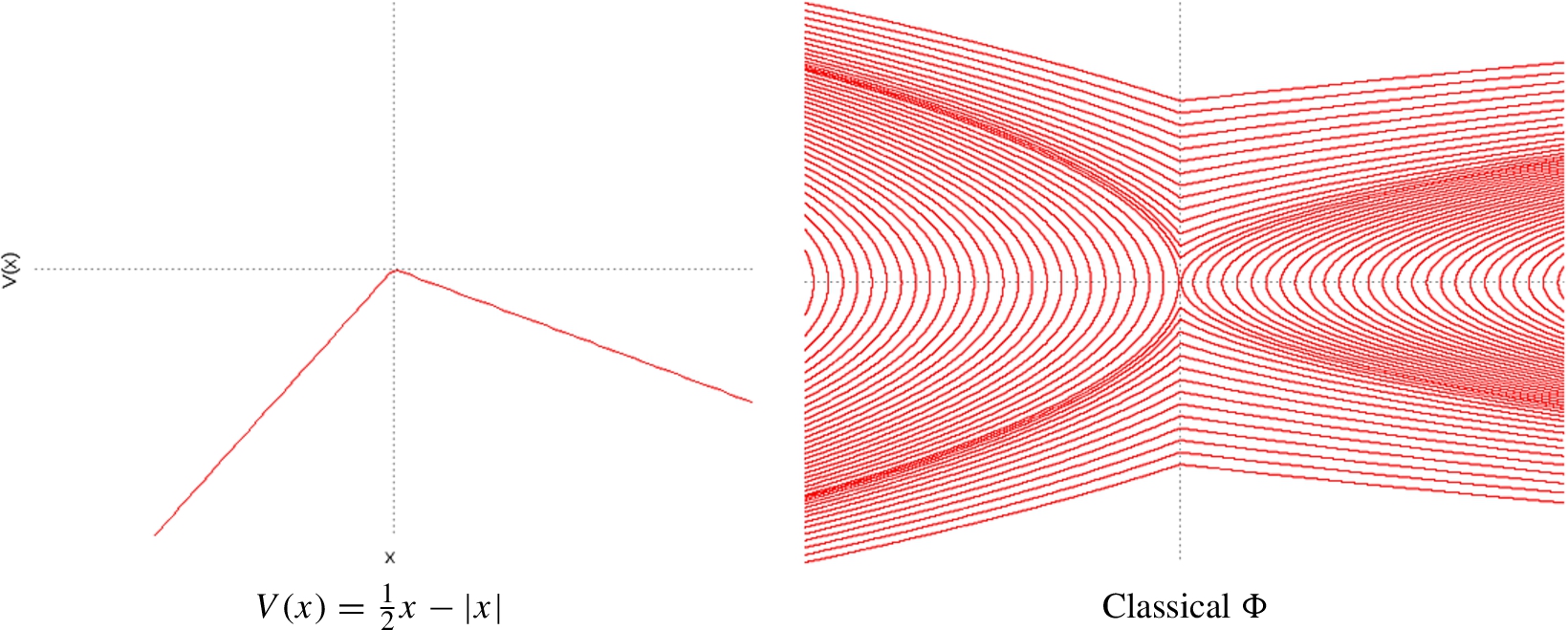
Then (1.13) admits two solutions:
In this case, we will have
Take
Example 5.6.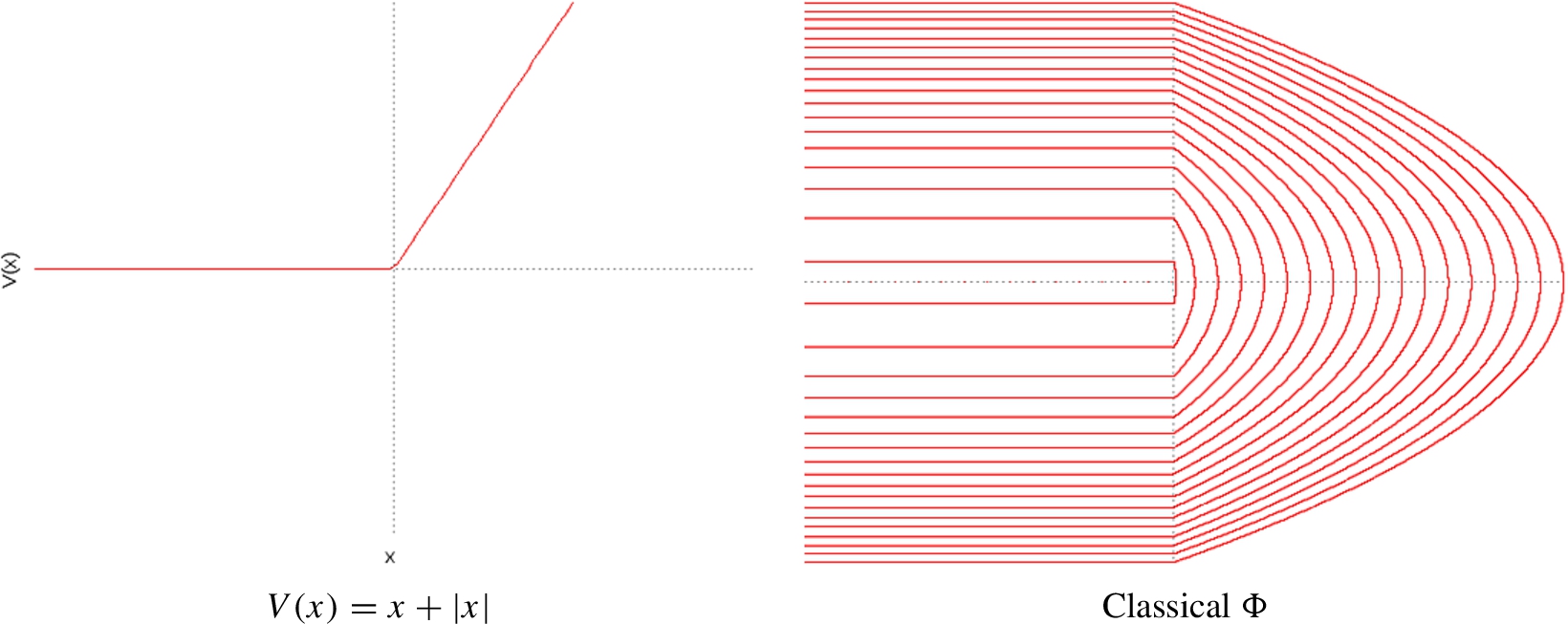
Then equation (1.13) has no non-zero roots, but equation (1.14) admits any solution
Pick up
Example 5.7.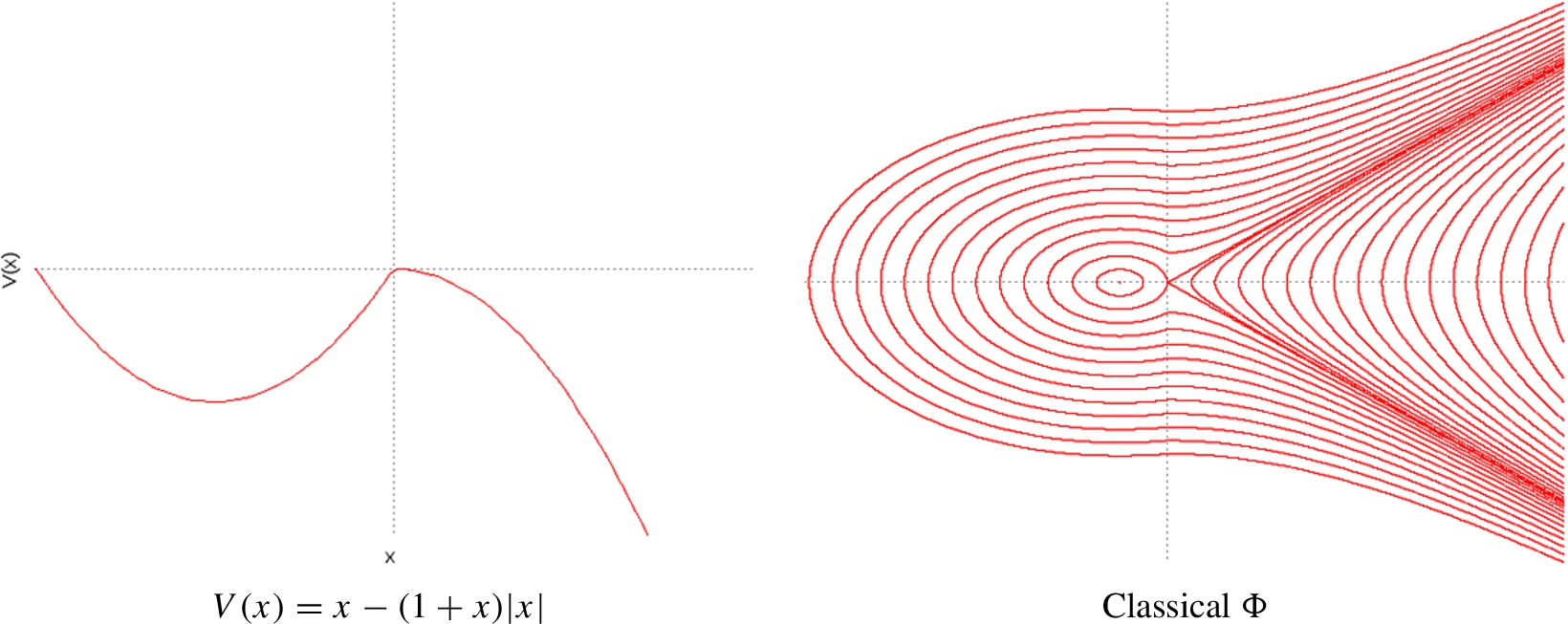
Then equation (1.13) admits one solution:
One has:
Take
Example 5.8.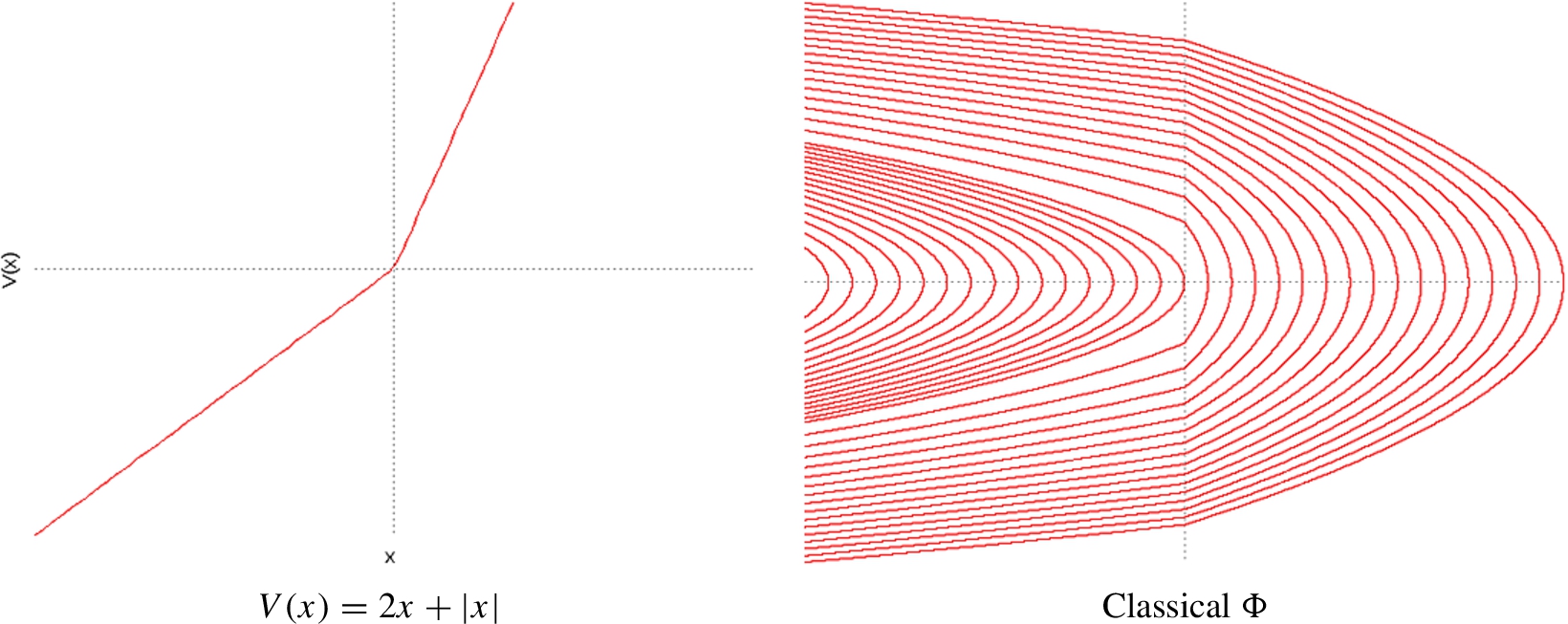
Then equation (1.13) admits a unique solution:
In this case, since
Now let be
Choose an exterior potential
(
with many trajectories).
Last, we will take the same
Footnotes
Acknowledgements
We thank Dr. Clotilde Fermanian for her helpful support and fruitful advises all over the writing of this paper. We also thank Dr. Fabricio Macià for the help in Sections 4.4.2 and  .
.